1. Introduction
The design of programmable, customizable matrices is a leading trend in modern bioengineering, offering a robust foundation for developing innovative technological approaches by emulating biological paradigms. Ideal polymer scaffolds for macromolecular hybrids must feature an adaptive, three-dimensional interconnected porous network. This architecture should facilitate metal ingrowth at room temperature while ensuring the controlled transport of ions and other reagents essential for nanoparticle growth, coalescence, or sintering. Currently, the synthesis of inorganic nanomaterials embedded within organic matrices remains a primary focus of materials science. The unique characteristics of these hybrid materials arise from the size-dependent effects of the nanoscale inorganic core and the specific properties of the stabilizing organic ligands [
1,
2]. Among the diverse array of inorganic–organic composites, gold nanoparticles (GNPs) are of particular interest due to their versatile applications, which leverage the unique phenomena of localized surface plasmon resonance [
3].
However, current synthesis methods still lack the ability to control the structural features and, consequently, the chemical properties of such nanomaterials in a single-step process. To address this, a wide range of natural components has been successfully utilized in GNPs synthesis, including extracts from plants, algae, fungi, and yeast [
4]. Natural polyphenols, proteins, and carbohydrates possess the dual capability to act as both reducing and stabilizing agents during GNPs synthesis. Among these compounds, natural polymer-based structures are particularly well-suited for GNPs engineering, attracting significant attention due to their excellent biocompatibility and tunable properties [
5]. Polysaccharides, in particular, serve as ideal natural frameworks. By utilizing the specific functional groups within their structure, they provide predefined functionality and act as a supporting matrix for the nanoparticles [
6,
7]. While various functionalization strategies for gold nanoparticles have been explored, such as the use of thiol-containing ligands or disulfide-crosslinked biopolymers to ensure high colloidal stability [
8,
9], there is a growing interest in utilizing the inherent functional groups of natural polysaccharides without further chemical modification. Foundational studies have demonstrated that polysaccharides can act as effective templates [
10]; however, the specific role of the host matrix’s conformational dynamics remains under-explored.
Among the diverse classes of biopolymers, glucuronoxylomannans (GXM) stand out due to their intricate heteropolysaccharide architecture. The presence of glucuronic acid residues along the mannan backbone imparts a polyanionic character that is highly responsive to pH changes. While many studies utilize simple polysaccharides as passive capping agents, the specific use of GXM in this work is motivated by its ability to undergo dramatic conformational transitions in alkaline media. This transition not only facilitates the ‘green’ reduction of gold ions but also provides a dynamic structural scaffold that dictates the final symmetry and morphology of the gold nanoparticles. In this work, we demonstrate that the alkaline-mediated structural transition of glucuronoxylomannan offers a robust alternative to sulfur-based stabilization, allowing for precise control over nanoparticle symmetry through purely electrostatic and steric pathways.
The present study describes the formation of GNPs under alkaline conditions using the polysaccharide glucuronoxylomannan (GXM) extracted from the ‘yellow brain’ mushroom, Tremella mesenterica. This work focuses on the intramolecular mechanisms driving the transformation of the polysaccharide’s spatial architecture. Ultimately, we demonstrate that this structural transition enables the controlled synthesis of gold nanoparticles with diverse geometries, ranging from spherical and ellipsoidal to complex planar structures with tri-, tetra-, penta-, and hexagonal symmetries.
2. Methods
2.1. Chemicals
All chemicals were of analytical grade and purchased from Sigma-Aldrich and Merck (Burlington, MA, USA). All reagents were used as purchased without further purification. Glucuronoxylomannan (GXM) was separated from the culture liquid of the
Tremella mesenterica Ritz. Fr. (
Heterobasidiaceae) fungus using published procedure [
11]. Water used in all the experiments was double distilled and deionized.
GNPs were synthesized by mixing HAuCl4 and GXM alkali solutions. GXM solution was prepared by dissolution of 3 mg GXM in 2.9 mL H2O, followed by adding 0.1 mL of 0.1 M NaOH. Then, aqueous solution of HAuCl4 (0.1 mL, 30 mM) was added to alkali GXM solution at violent stirring, with being stirred during 1 min at room temperature, with subsequent heating to 100 °C to boil during 10 min.
2.2. Measurement Instrumentation
The morphological, optical, and spectroscopic properties of GNPs were examined using the following equipment.
UV-vis spectra were acquired with an Umico UV-Vis spectrophotometer (Alexandria, VA, USA). The spectra were collected over a range of 200–1100 nm.
TEM was performed at 100 kV using a JEOL-1011 (Akishima, Tokyo, Japan). The GNPs solutions were drop cast onto a carbon-coated copper grid sample holder followed by natural evaporation at room temperature.
3. Results and Discussion
Ideal polymer scaffolds for macromolecular hybrids should feature an adaptive, three-dimensional interconnected porous network that facilitates metal ingrowth at room temperature. Such a structure must ensure the controlled delivery of ions and other reagents necessary for nanoparticle growth, coalescence, or sintering. Ultimately, the biopolymer acts as a stimulus-responsive, autonomous framework governed by its inherent structural ‘blueprint.’ This allows for the creation of an intramolecular space—isolated from the external environment—possessing well-defined structural and chemical properties. As previously noted, polysaccharides are uniquely suited for this role, serving as natural frameworks with predefined functionality.
A hybrid material was synthesized via the formation of gold nanoparticles within a GXM polysaccharide matrix under alkaline conditions. In this environment, the ionization of the GXM carboxyl groups induces electrostatic repulsion between similarly charged polysaccharide fragments, resulting in a highly flexible matrix structure. Simultaneously, the polysaccharide undergoes hydrolysis in the alkaline medium, characterized by the gradual cleavage of monosaccharide linkages through base-catalyzed degradation.
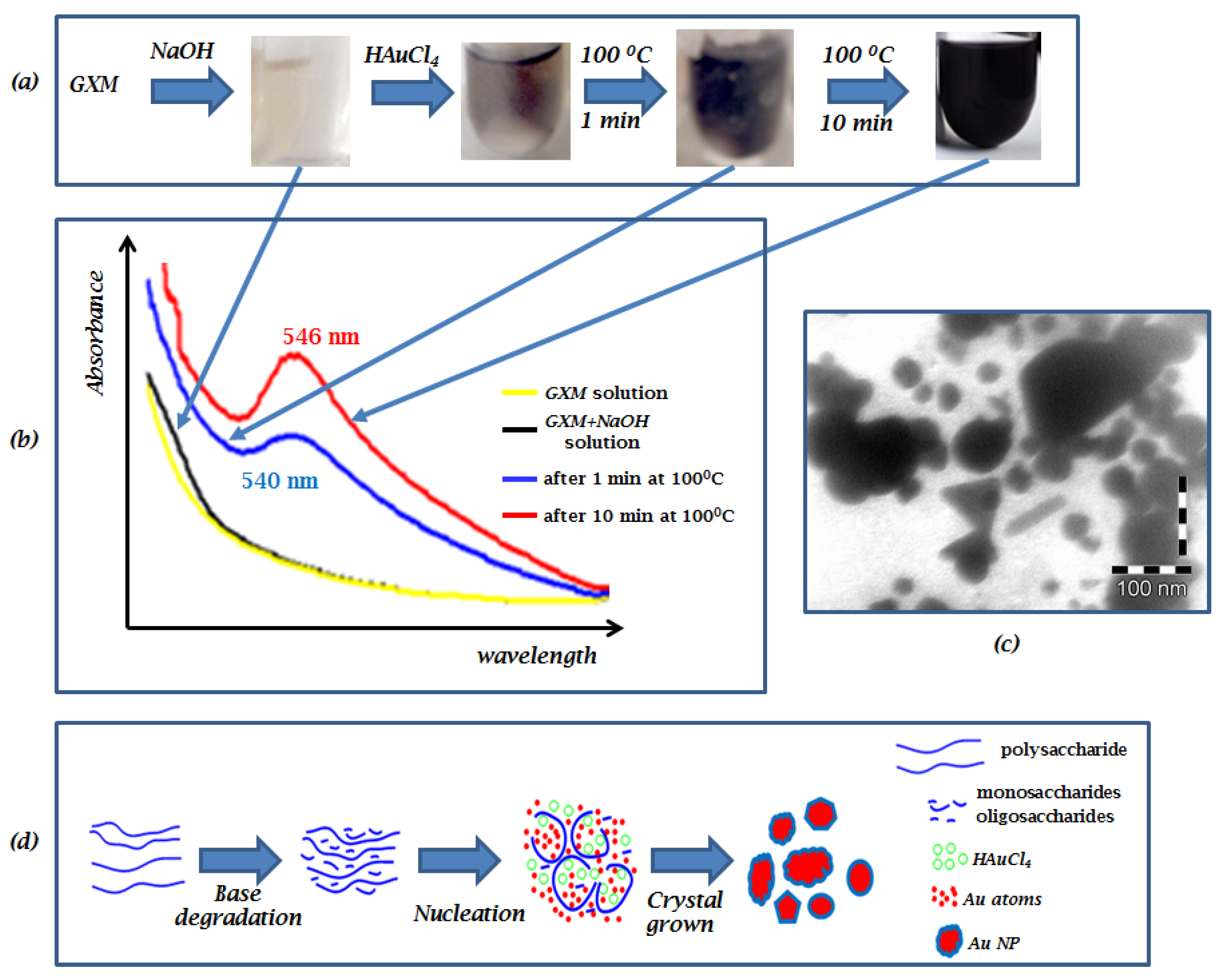
The alkaline cleavage of the heteroglycan results in a shortened polysaccharide backbone within the reaction mixture, accompanied by low-molecular-weight sugars derived from the GXM side chains. This alkali-induced hydrolysis increases the density of available hydroxyl groups on these smaller fragments, which effectively stabilize the nanostructures by preventing further growth, coalescence, or dissolution. Furthermore, the presence of these small, mobile polysaccharide fragments leads to a more robust stabilization of the exposed surfaces of the formed GNPs. Consequently, these hybrids possess a dense, well-organized organic shell. This dynamic reorganization of the matrix not only stabilizes the particles but also dictates their final morphology, enabling the development of diverse geometries including spherical, ellipsoidal, and multifaceted planar shapes such as rounded, tri-, tetra-, penta-, and hexagonal structures. The UV-vis spectrum (
Figure 1b) exhibits a characteristic surface plasmon resonance (SPR) peak at approximately 546 nm, confirming the formation of stable gold nanoparticles.
The successful formation of GNPs is confirmed by the emergence of an intense absorption band in the visible region (
Figure 1b). The position and symmetry of the LSPR peak correlate with the TEM observations (
Figure 1c), which show well-dispersed nanoparticles. The high stability of these particles, even without additional purification, provides empirical support for our hypothesis that the alkaline-cleaved GXM fragments form a dense, protective organic shell (as illustrated in the mechanism in
Figure 1d). These results demonstrate that the structural reorganization of the GXM matrix directly governs the stabilization and final architecture of the gold-polysaccharide hybrids.
As the pH rises above the pKa of the functional groups, the carboxylic acid groups undergo deprotonation. This triggers an unfolding of the polymeric network due to electrostatic repulsion between the anionic sites, transforming the initial globular conformation into stochastic coils with worm-, rod-, or ribbon-like geometries, which may partially fuse into fibrillar structures. At a pH exceeding the pKa of the hydroxyl groups (pKa = 12.08–12.74), the complete ionization of the carboxyl groups results in intense electrostatic repulsion between similarly charged GXM fragments. Similar to other polysaccharides with charged moieties along the backbone, GXM extends into flexible ribbon-like structures that are partially folded in a fibrillar fashion. This conformational transition is further facilitated by the shortening of the polysaccharide backbone via alkaline hydrolysis, involving the gradual cleavage of monosaccharide units through the basic degradation of the polysaccharide chains. The resulting colloidal system represents a stable hybrid material where the GXM matrix serves as both a primary stabilizer and a permanent structural scaffold; thus, no further purification from the organic phase was performed.
The proposed synthesis method offers a significant advantage over traditional chemical reduction by utilizing the pH-dependent conformational flexibility of GXM. This not only ensures a green and cost-effective production route but also provides a unique mechanism for controlling nanoparticle symmetry, which is critical for applications in localized surface plasmon resonance (LSPR) sensing and targeted drug delivery.
4. Conclusions
In conclusion, this study demonstrates that the glucuronoxylomannan (GXM) polysaccharide matrix serves as a highly effective template for the in situ synthesis of stable gold nanoparticles, resulting in the formation of robust organic–inorganic hybrid materials. The alkaline environment plays a dual role in this process: it induces the complete ionization of GXM carboxyl groups, leading to strong electrostatic repulsion and the unfolding of the polymer into an extended, flexible framework, while simultaneously triggering the base-catalyzed hydrolysis of the polysaccharide backbone. The resulting shortened chains and mobile low-molecular-weight fragments provide dense steric and electrostatic stabilization, forming a well-organized organic shell around the GNPs. This unique mechanism not only ensures high colloidal stability without the need for additional thiol-functionalization but also facilitates the development of diverse nanoparticle morphologies, offering a sustainable and versatile route for producing biocompatible functional nanomaterials.
Author Contributions
Conceptualization, S.K. and B.S.; methodology, S.K.; software, B.S.; validation, O.K. and P.B.; formal analysis, B.S.; investigation, P.B.; resources, O.K.; data curation, B.S.; writing—original draft preparation, P.B.; writing—review and editing, S.K.; visualization, S.K.; supervision, B.S.; project administration, B.S.; funding acquisition, O.K. All authors have read and agreed to the published version of the manuscript.
Funding
This research received no external funding.
Institutional Review Board Statement
Not applicable.
Informed Consent Statement
Not applicable.
Data Availability Statement
The raw data supporting the conclusions of this article will be made available by the authors on request.
Conflicts of Interest
The authors declare no conflicts of interest.
Abbreviations
The following abbreviations are used in this manuscript:
| GXM | glucuronoxylomannan |
| GNPs | Gold nanoparticles |
References
- Lombardo, D.; Calandra, P.; Pasqua, L.; Magazù, S. Self-Assembly of Organic Nanomaterials and Biomaterials: The Bottom-Up Approach for Functional Nanostructures Formation and Advanced Applications. Materials 2020, 13, 1048. [Google Scholar] [CrossRef] [PubMed]
- Alshammari, B.H.; Lashin, M.M.A.; Mahmood, M.A.; Al-Mubaddel, F.S.; Ilyas, N.; Rahman, N.; Sohail, M.; Khan, A.; Abdullaev, S.S.; Khan, R. Organic and inorganic nanomaterials: Fabrication, properties and applications. RSC Adv. 2023, 13, 13735–13785. [Google Scholar] [CrossRef] [PubMed]
- Krishchenko, I.M.; Manoilov, E.G.; Kravchenko, S.A.; Snopok, B.A. Resonant Optical Phenomena in Heterogeneous Plasmon Nanostructures of Noble Metals: A Review. Theor. Exp. Chem. 2020, 56, 67–110. [Google Scholar] [CrossRef]
- Kant, K.; Beeram, R.; Cao, Y.; dos Santos, P.S.S.; González-Cabaleiro, L.; García-Lojo, D.; Guo, H.; Joung, Y.; Kothadiya, S.; Lafuente, M.; et al. Plasmonic nanoparticle sensors: Current progress, challenges, and future prospects. Nanoscale Horiz. 2024, 9, 2085–2166. [Google Scholar] [CrossRef] [PubMed]
- Karnwal, A.; Sachan, R.S.K.; Devgon, I.; Devgon, J.; Pant, G.; Panchpuri, M.; Ahmad, A.; Alshammari, M.B.; Hossain, K.; Kumar, G. Gold Nanoparticles in Nanobiotechnology: From Synthesis to Biosensing Applications. ACS Omega 2024, 9, 29966–29982. [Google Scholar] [CrossRef] [PubMed]
- Pandey, N.; Ahmad, F.; Singh, K.; Ahmad, S.; Sharma, R. Mushroom-Derived Nanoparticles in Drug Delivery Systems—Therapeutic Roles and Biological Functions. Precis. Nanomed. 2023, 6, 1157–1178. [Google Scholar] [CrossRef]
- Wu, M.; Zhang, W.; Song, H.; Hu, Y.; Li, W. Beyond biologics: Fungal polysaccharides as dual-function materials for nanomedicine. Nanomedicine 2025, 20, 2275–2289. [Google Scholar] [CrossRef] [PubMed]
- Ielo, I.; Rando, G.; Giacobello, F.; Sfameni, S.; Castellano, A.; Galletta, M.; Drommi, D.; Rosace, G.; Plutino, M.R. Synthesis, Chemical–Physical Characterization, and Biomedical Applications of Functional Gold Nanoparticles: A Review. Molecules 2021, 26, 5823. [Google Scholar] [CrossRef] [PubMed]
- Porcaro, F.; Battocchio, C.; Antoccia, A.; Fratoddi, I.; Venditti, I.; Fracassi, A.; Luisetto, I.; Russo, M.V.; Polzonetti, G. Synthesis of functionalized gold nanoparticles capped with 3-mercapto-1-propansulfonate and 1-thioglucose mixed thiols and “in vitro” bioresponse. Colloids Surf. B Biointerfaces 2016, 142, 408–416. [Google Scholar] [CrossRef] [PubMed]
- Huang, H.; Yang, X. Synthesis of polysaccharide-stabilized gold and silver nanoparticles: A green method. Carbohydr. Res. 2004, 339, 2627–2631. [Google Scholar] [CrossRef] [PubMed]
- Kovalenko, O.G.; Polischuk, E.N.; Wasser, S.P. Glycans of Higher Basidiomycetes Mushrooms with Antiphytoviral Properties: Isolation, Characterization, and Biological Activity. Biotechnology 2010, 3, 83–91. [Google Scholar]
| Disclaimer/Publisher’s Note: The statements, opinions and data contained in all publications are solely those of the individual author(s) and contributor(s) and not of MDPI and/or the editor(s). MDPI and/or the editor(s) disclaim responsibility for any injury to people or property resulting from any ideas, methods, instructions or products referred to in the content. |
© 2026 by the authors. Licensee MDPI, Basel, Switzerland. This article is an open access article distributed under the terms and conditions of the Creative Commons Attribution (CC BY) license (https://creativecommons.org/licenses/by/4.0/).