


Abstract
The subject of this article is the information model of a building, the data of which can be used in the phase of operation and use. The aim of the article is to define the requirements for building information models for the purpose of data collection for spatial evidence. The article describes the method of sorting data according to the IFC standard developer for the international non-profit organization buildingSMART, or a classification system, and it describes the method of sorting the relevant data. Spatial evidence describes using the data from building information models. The conclusions of the article provide the information on how the users can collect the data from the information model and create spatial evidence in this case. Spatial evidence was selected because it is the one of the essential documents used by facility managers.
1. Introduction
Knowing exact floor areas or the clear height of a room is essential information for professionals such as facility managers, property managers, asset managers, and real estate managers. These data are critical for commissioning services, configuring building systems (e.g., HVAC performance), and for leasing or selling spaces. The need for such information is truly a priority [1,2,3].
Before the era of digitalization and 3D modeling, this information was usually derived from available 2D drawings. However, with the development of digital tools and advanced methods of converting paper documentation into digital form, it has become possible to obtain these details directly from a digital building model. The data contained in these models form an integral part of every digital representation of a building.
It is the facility manager, acting on behalf of the client, who decides what information should be included in the model. The definition of spatial data can be guided by EN 15221-6 [4], a standard that specifies types of spaces and measurement methods. Although this standard is awaiting revision, it remains valid and has been applied in demonstrating the use of digital building models for recording and managing spatial information.
The purpose of this article is to present methods for obtaining data from digital building models for facility management needs, particularly spatial evidence, using data categorization within the Industry Foundation Clasess (IFC) schema, which classifies some of the spatial information defined by EN 15221-6.
2. Standards and IFC Classification
Facility management, like Building Information Modeling (BIM), is a standardized discipline. Facility management is described through the EN 15221 series of standards and the ISO 41000 series. The standard referenced in this article is EN 15221-6: Area and Space Measurement in Facility Management.
Building Information Modeling uses the IFC standard, developed and maintained by the international non-profit organization buildingSMART (https://www.buildingsmart.org/ (accessed on 26 February 2025)). Among other things, the IFC standard defines property sets, which provide the required information for models through specific properties. Property sets are collections of attributes that describe a model element from a particular perspective—in this case, in terms of dimensions, areas, and volumes.
2.1. EN 15221-6:2011 Facility Management—Part 6: Area and Space Measurement in Facility Management
The terms of EN 15221-6 [4] used in this article are as follows:
- Floor: generally, the lower horizontal structure of a room which constitutes the bounding element of a building or part thereof;
- Wall: generally a vertical structure that constitutes the bounding elements of a building.
Floor areas should be measured at the floor level, which is known as the top of the finished floor. Also, each story area should be calculated and measured separately.
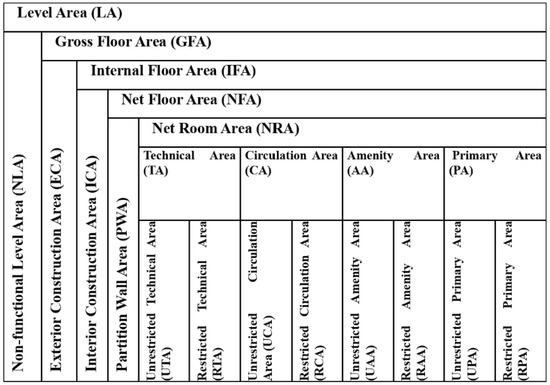
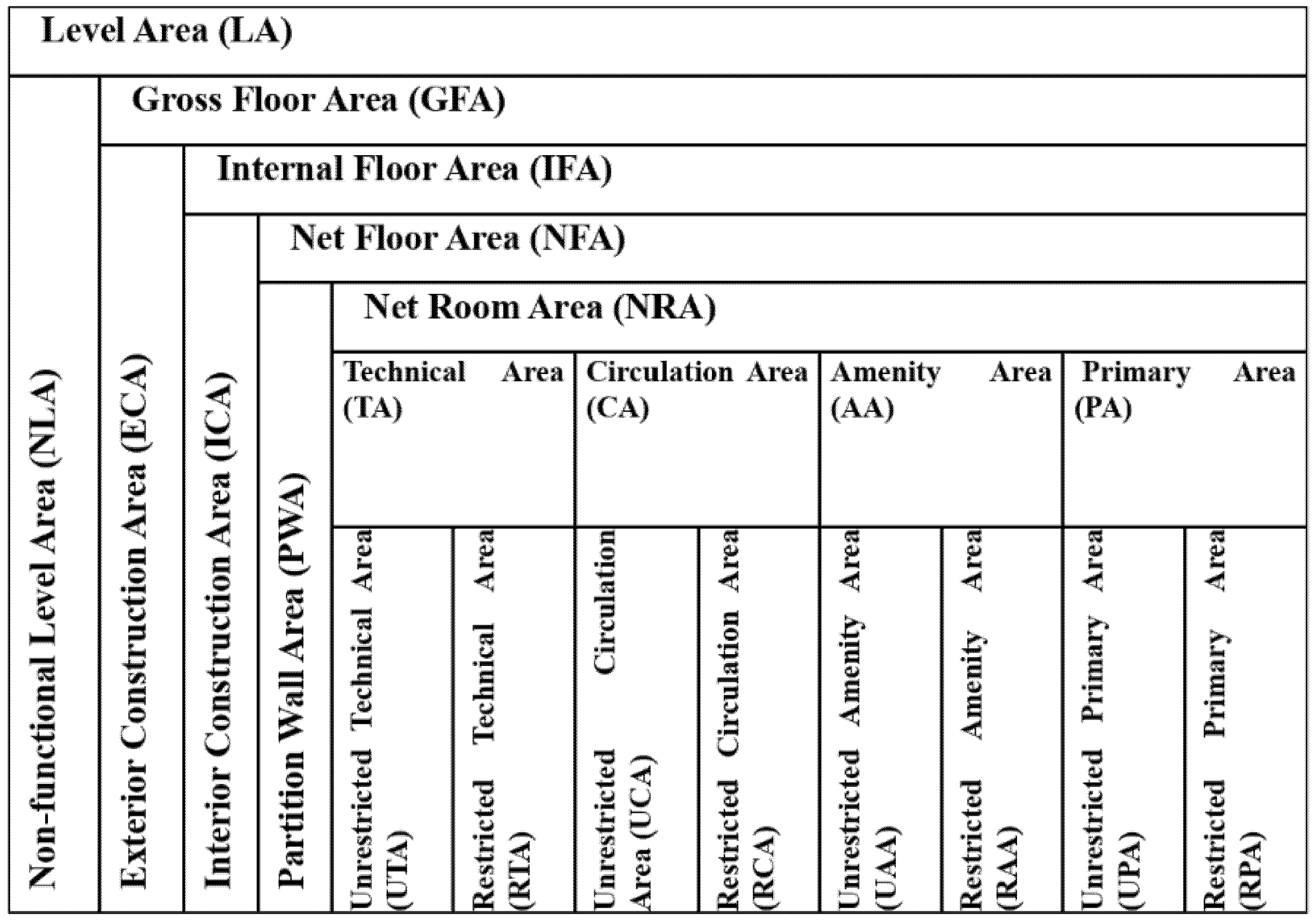
The standard provides a categorization of building areas and spaces, for which a hierarchy table can be created. Figure 1, named “Hierarchy of floor areas in the building”, provided in EN 152221-6 is considered more as a framework for implementing the standard application for area measurement rather than only a categorization of areas.
Figure 1.
Hierarchy of floor areas in the building.
2.2. IFC Classification
IFC, or Industry Foundation Classes, is an international data standard used in construction and building management. It provides a common language for describing buildings and their components so that different software systems can exchange information without losing meaning [2,5,6].
Within IFC, objects in a building—such as walls, doors, rooms, or mechanical systems—are described using a structured set of attributes. These attributes are grouped into what are called property sets (Psets). Each property set focuses on a particular type of information, for example, dimensions, materials, performance, or cost.
Classification in IFC means assigning each building element a specific type and a consistent set of data. This allows designers, engineers, facility managers, and other stakeholders to understand exactly what an object is and what information is connected to it. The advantage is clear: everyone can work with the same data, whether they are planning a project, running maintenance, or analyzing costs.
In short, IFC classification makes building information organized, shareable, and usable throughout the entire life cycle of a facility.
In relation to the topic of this paper, there is an “IFCspace” type of entity in the models, which is defined as follows: “A space represents an area or volume bounded actually or theoretically. Spaces are areas or volumes that provide for certain functions within a building” [7]. The property set of this entity’s type Qto_SpaceBaseQuantities is particularly relevant (see Table 1). This set defines dimensional and area-related properties of the elements.
Table 1.
Selected properties of Qto_SpaceBaseQuatities property sets [7].
3. Digital Model—Working with Data
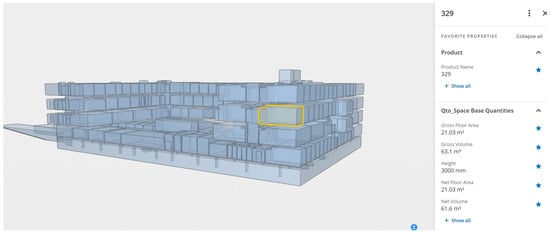
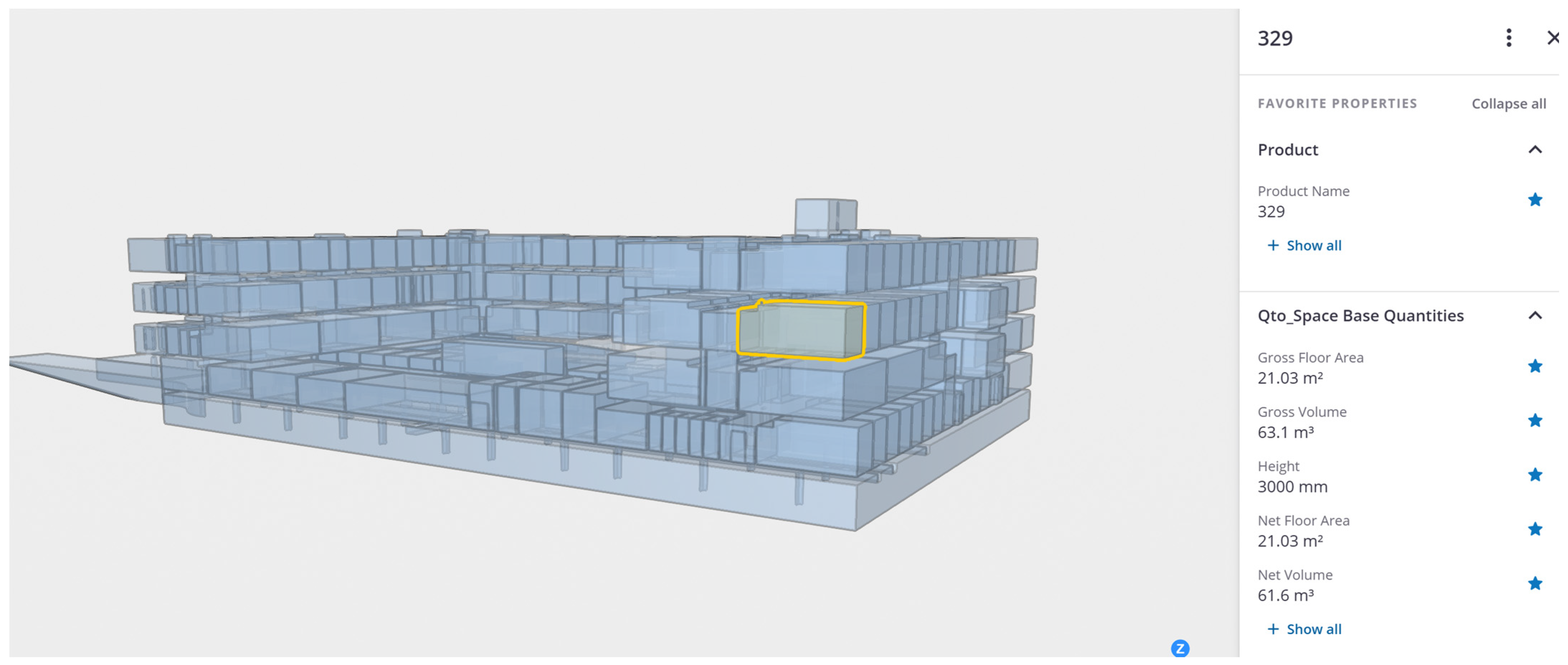
A 3D model of a construction is not always a digital model of the building. If the model is to be considered as a digital model, it is necessary to fill in some data inside. The data that describe spaces are natively a part of each 3D model. It is useful for further work with the model to split the federation model into several models according to MEP (mechanical, electrical, plumbing) engineering, and the rest of the model into spaces. See Figure 2, which shows a model of space. This model is full of data that were set according to the level of information needed.
Figure 2.
Spatial model of the building with the properties that describe space.
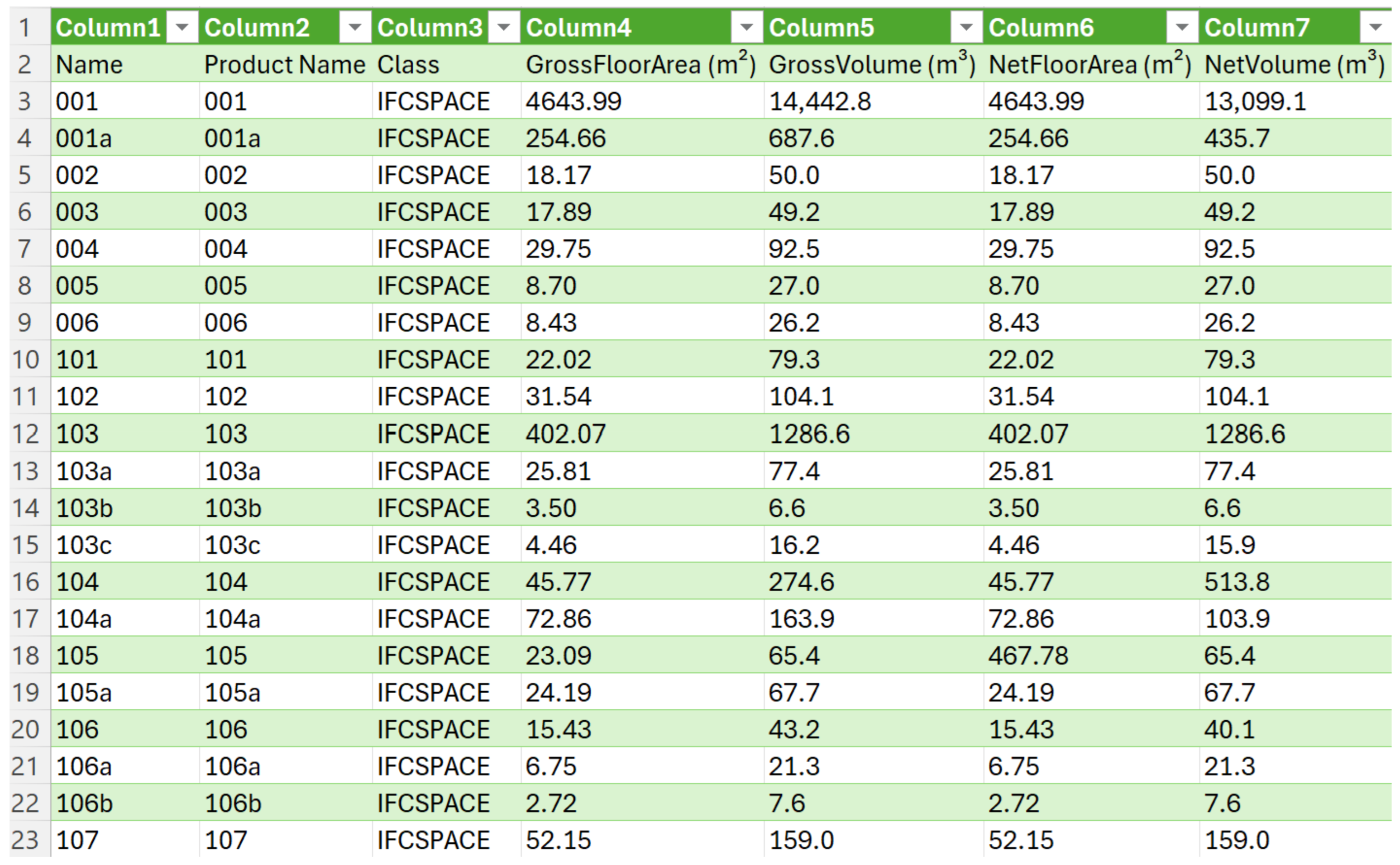
Some data are related to Qto_SpaceBaseQuatities. These data give information about the gross floor area, gross volume, height, net floor area, and net volume.
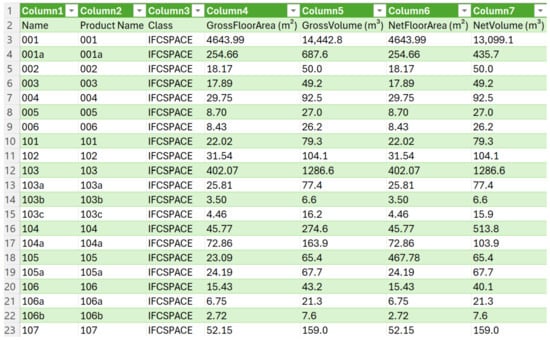
This is an example of only one entity of space. Space managers need to know information about the whole building or about selected rooms. Models can sort and filter the information. All these activities are performed in CDE. It is possible to export data from a model into a table editor for further sharing with other clients or users who are not able to work in the CDE workspace; see Figure 3.
Figure 3.
Example of space evidence—data exported from digital model and imported to table editor (Microsoft® Excel® for Microsoft 365 MSO (Version 2509 Build 16.0.19231.20246) 64 bit).
4. Conclusions
Digital models are useful for facility management over the life cycle of the building. Facility management is a standardized discipline, and the standard EN 15221-6 Measurement of areas and spaces in facility management lists the types of floor areas and the methods of counting them into individual categories. Digital models of buildings can be used to obtain this information via the CDE tool or by exporting the data to a table editor, e.g., MS Excel.
Information management of a building is a useful tool in a facility managers’ hands. IFC classification helps them with sorting the data in the models. Models consist of many elements; these elements are described by many property sets. Only the necessary information is required by facility management. Data that relate to space management, such as property sets “Qto_SPaceBaseQuantities”, are some examples of required information, which can be used for creating spatial evidence.
Author Contributions
Conceptualization, E.W., M.F. and V.M.; methodology, E.W.; software, E.W.; validation, E.W., M.F. and V.M.; formal analysis, V.M.; resources, E.W. and V.M.; data curation, E.W.; writing—original draft preparation, E.W.; writing—review and editing, E.W. and V.M.; visualization, E.W.; supervision, E.W.; project administration, E.W.; funding acquisition, M.F. All authors have read and agreed to the published version of the manuscript.
Funding
Technology Agency of the Czech Republic—grant number CK03000089 “Research of Information Modelling in Public Space which a focus on Infrastructure”.
Institutional Review Board Statement
Not applicable.
Informed Consent Statement
Not applicable.
Data Availability Statement
Data is not public, it is the property of VSB-Technical University of Ostrava.
Acknowledgments
This work was supported by the Technology Agency of the Czech Republic—grant number CK03000089 “Research of Information Modelling in Public Space which a focus on Infrastructure”.
Conflicts of Interest
The authors declare no conflicts of interest.
Abbreviations
The following abbreviations are used in this manuscript:
| BIM | Building Information Models |
| CDE | Common Data Environment |
| IFC | Industry Foundation Classes |
| MEP | Mechanical, Electrical, Plumbing |
References
- Hardin, B.; McCool, D. BIM and Construction Management: Proven Tools, Methods, and Workflows; Wiley: Indianapolis, IN, USA, 2015. [Google Scholar]
- Lederer, L.; Ellingerová, H.; Ďubek, S.; Bočkaj, J.; Ďubek, M. Construction price forecasting models in the construction industry: A comparative analysis. Buildings 2024, 14, 1325. [Google Scholar] [CrossRef] [Scilit]
- Švajlenka, J.; Kozlovská, M. The potential of timber-based buildings in terms of energy efficiency. MATEC Web Conf. 2020, 322, 01002. [Google Scholar] [CrossRef] [Scilit]
- EN 15221-6:2011; Facility Management—Part 6: Area and Space Measurement in Facility Management. European Committee for Standardization (CEN): Brussels, Belgium, 2011.
- buildingSMART International. Industry Foundation Classes (IFC). 2025. Available online: https://www.buildingsmart.org/standards/bsi-standards/industry-foundation-classes/ (accessed on 26 February 2025).
- Konovalov, D.; Švajlenka, J.; Katunsky, D. Information model of the building and its application in selected phases of the life cycle. In E3S Web Conferences, Proceedings of the 16th International Scientific Conference of Civil and Environmental Engineering for the PhD. Students and Young Scientists—Young Scientist 2024 (YS24), Hight Tatras, Slovakia, 17–19 April 2024; Katunský, D., Safaei, B., Kotrasová, K., Zeleňáková, M., Eds.; EDP Sciences: Les Ulis, France, 2024; Volume 550, p. 01008. [Google Scholar] [CrossRef] [Scilit]
- ISO 16739-1:2024; Industry Foundation Classes (IFC) for Data Sharing in the Construction and Facility Management Industries—Part 1: Data Schema. 2. vyd. International Organisation for Standardization: Genève, Switzerland, 2024.

Disclaimer/Publisher’s Note: The statements, opinions and data contained in all publications are solely those of the individual author(s) and contributor(s) and not of MDPI and/or the editor(s). MDPI and/or the editor(s) disclaim responsibility for any injury to people or property resulting from any ideas, methods, instructions or products referred to in the content. |
© 2025 by the authors. Licensee MDPI, Basel, Switzerland. This article is an open access article distributed under the terms and conditions of the Creative Commons Attribution (CC BY) license (https://creativecommons.org/licenses/by/4.0/).