Proceeding Paper

Multicomponent Synthesis of the New Compound 2-Benzyl-6-(3-((7-chloroquinolin-4-yl)amino)propyl)-3-morpholino-7-(4-pyridin-2-yl)phenyl)-6,7-dihidro-5H-pyrrolo[3,4-b]pyridin-5-one †

by
Roberto E. Blanco-Carapia
,
Rodolfo Alonso-Pérez
,
Alejandro Islas-Jácome
* and
Eduardo Gonzalez-Zamora
*
Departamento de Química, Universidad Autónoma Metropolitana-Iztapalapa, Av. Ferrocarril San Rafael Atlixco 186, Col. Leyes de Reforma 1A Sección, Iztapalapa, Ciudad de México C.P. 09310, Mexico
*
Authors to whom correspondence should be addressed.
Presented at the 29th International Electronic Conference on Synthetic Organic Chemistry, 14–28 November 2025; Available online: https://sciforum.net/event/ecsoc-29.
Chem. Proc. 2025, 18(1), 93; https://doi.org/10.3390/ecsoc-29-26676
Published: 11 November 2025

Abstract

The combination of multicomponent reactions with post-transformation processes is a powerful strategy for the rapid synthesis of structurally complex polyheterocycles. Herein, we describe the preparation of the novel compound 2-benzyl-6-(3-((7-chloroquinolin-4-yl)amino)propyl)-3-morpholino-7-(4-(pyridin-2-yl)phenyl)-6,7-dihydro-5H-pyrrolo[3,4-b]pyridin-5-one via a sequence that combines an Ugi-Zhu reaction with a cascade process (aza-Diels–Alder/N-acylation/aromatization) under microwave irradiation in chlorobenzene using ytterbium (III) triflate (Yb(OTf)3) as the catalyst. The method provided the target polyheterocycle in 75% yield and 85% atom economy. Structural characterization was performed by 1D (1H and 13C) and 2D (COSY, HSQC and HMBC) NMR spectroscopy, and the molecular mass was confirmed by high-resolution mass spectrometry (HRMS). These results illustrate the effectiveness of MCR as powerful synthetic tools for expanding chemical diversity.

1. Introduction

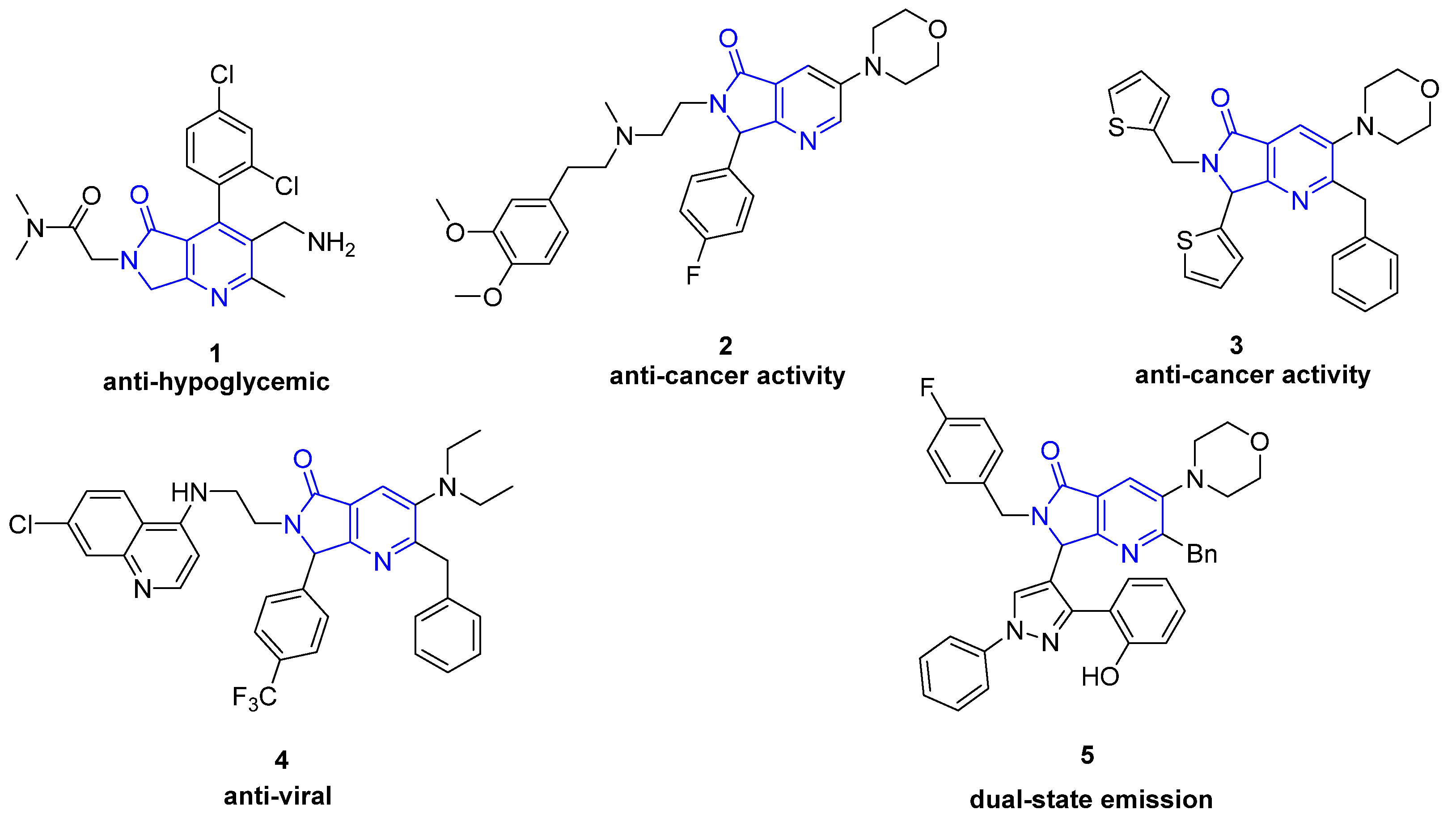
Multicomponent reactions (MCRs) are convergent processes that allow for the creation of complex molecules with high atom economy, utilizing three or more components [1]. These reactions are particularly appealing because, with the careful selection of starting components, it is possible to incorporate multiple privileged chemical structures important in both medicinal chemistry and materials science. This one significantly expands the potential applications of the compounds synthesized through these methods. A notable example is the synthesis of polyheterocycles featuring a pyrrolo[3,4-b]pyridin-5-one core, which is an aza-analogue of the isoindolin-2-one, a well-established privileged structure in medicinal chemistry [2]. The pyrrolo[3,4-b]pyridin-5-one core can be assembled through a one-pot process involving an Ugi-Zhu reaction (UZ-3CR) coupled to a cascade sequence that includes a N-acylation, an aza-Diels–Alder cycloaddition, and an aromatization [3]. Compounds derived from this method have shown considerable biological activity as well as luminescent properties (Figure 1) [4,5,6,7,8]. In this work, we describe the synthesis and characterization of a new polyheterocyclic compound containing the pyrrolo[3,4-b]pyridin-5-one core. This compound incorporates the privileged structures of quinoline and 2-phenylpyridine, with the latter being particularly relevant for applications in materials science [9].

2. Results and Discussion

In order to access to the desired polyheterocycle, the initial step involved the synthesis of two key components: the aminoquinoline 7 and the α-isocyanoacetamide 11. The 4-(2-pyridyl)benzaldehyde 12 was used as a commercially available reagent without needing purification.
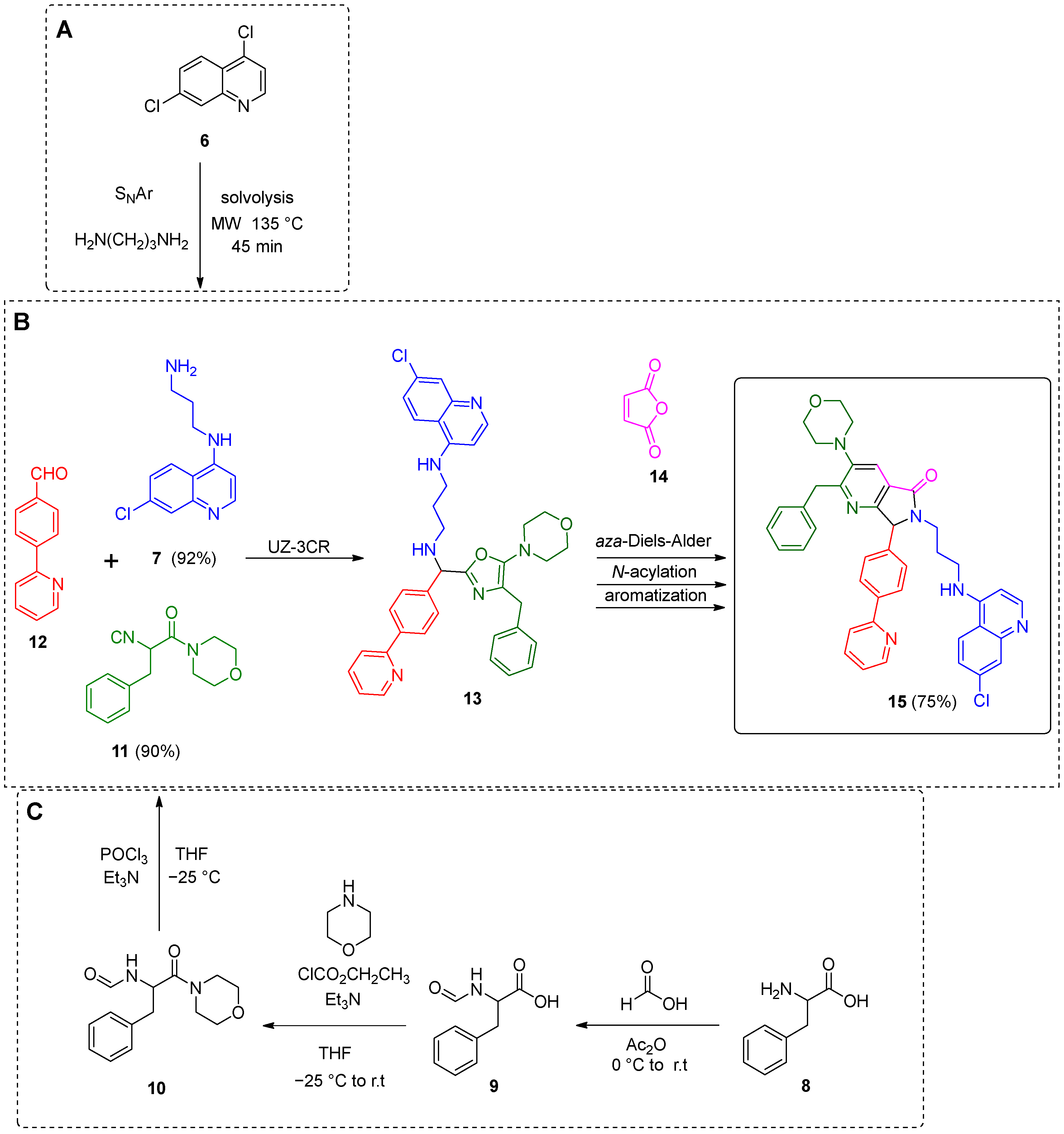
The aminoquinoline 7 was obtained via a nucleophilic aromatic substitution (SNAr) on 4,7-dichloroquinoline 6, employing propane-1,3-diamine as the nucleophile, under solvent-free conditions and microwave irradiation (135 °C, 100 W). Under these conditions, the desired product was obtained in 92% yield (Scheme 1A).
The α-isocyanoacetamide 11 was synthesized from racemic phenylalanine 8 through a three-step sequence involving a formylation, a peptide coupling, and an Ugi-type dehydration. This synthetic route was adapted from the protocol reported by Bienaymé and coworkers, affording the target compound in an overall yield of 90% (Scheme 1C) [10].
Once all components were ready, the Ugi–Zhu three-component reaction was performed. Therefore, 4-(2-pyridyl)benzaldehyde 12 was reacted with N1-(7-chloroquinolin-4-yl)propane-1,3-diamine 7 in chlorobenzene under microwave irradiation at 80 °C and 100 W. After 25 min, thin-layer chromatography (TLC) analysis confirmed the complete consumption of the aldehyde 12. Next, ytterbium triflate (Yb(OTf)3) was added as an imine activator (Table 1, entry 1). The reaction mixture was irradiated at 65 °C and 100 W. After this step, 2-isocyano-1-morpholino-3-phenylpropan-1-one 11 was introduced, and the mixture was heated again to 80 °C at 100 W for 30 min. This process yielded the corresponding 5-aminooxazole 13, as confirmed by TLC analysis. At this point, maleic anhydride 14 was added, which was reacted with the 5-aminooxazole 13 at 80 °C under microwave irradiation at 100 W for 25 min, initiating a cascade process that involved an aza-Diels–Alder cycloaddition coupled to N-acylation and subsequent aromatization through a tandem decarboxylation/dehydration process, ultimately resulting in the formation of the pyrrolo[3,4-b]pyridin-5-one 15 with an overall 51% yield (Scheme 1B).
To enhance the overall yield, the effect of using various loadings of ytterbium triflate was evaluated (Table 1, entry 2). The presence of nitrogen atoms in both aminoquinoline and the aldehyde may lead to undesired coordination with the ytterbium center. This one could interfere with its interaction with the imine intermediate and negatively affect the subsequent aza Diels–Alder cycloaddition. It is important to note that ytterbium has been shown to facilitate this type of cycloadditions [11]. Under these conditions, the highest yield was achieved with a loading of 10 mol% of Yb(OTf)3 (Table 1, entry 3). Increasing the catalyst loading beyond this amount did not result in any significant improvement (Table 1, entry 4).
The synthesized polyheterocycle 15 was thoroughly characterized using nuclear magnetic resonance spectroscopy (1H, 13C, COSY, HMBC, and HSQC), and its molecular weight was confirmed through high-resolution mass spectrometry (HRMS). See the ESM file for further details and access to all copies of all spectra (Figures S1–S9). This novel compound is anticipated to demonstrate promising biological activity and luminescent properties.

3. Experimental Section

3.1. General Information, Instrumentation and Chemicals

All reagents and solvents were purchased from Sigma-Aldrich-Merck (Toluca, Estado de México, Mexico) and used as received, without any further purification or dehydration. The target compound underwent purification by flash column chromatography on silica gel (230–400 mesh), employing mixtures of hexanes and ethyl acetate as eluents. The same solvent system was utilized for thin-layer chromatography (TLC) and for determining Rf values. TLC analyses were performed on silica gel F254 plastic-backed plates, with spot visualization under UV irradiation at 254 and 360 nm to monitor the reaction progress. Structural representations of synthesized compounds were generated using ChemDraw Professional software (version 15.0.0.106, PerkinElmer Informatics). 1H and 13C NMR spectra were acquired on a Bruker Avance III spectrometer (Fällande, Uster, Switzerland) operating at 500 MHz, with CDCl3 as the deuterated solvent. Chemical shifts (δ) are reported in parts per million (ppm) relative to tetramethylsilane (TMS) as the internal standard and coupling constants (J) are given in hertz (Hz). Signal multiplicities are indicated using standard abbreviations (s, d, t, q, m). Spectral data were processed and analyzed using MestReNova software (v. 14.2.0-26256).

3.2. General Procedure

Anhydrous chlorobenzene (2.0 mL) was placed in a 10 mL microwave reactor (CEM Discover system, Matthews, NC, USA) vial (closed-vessel mode) equipped with a magnetic stirring bar. Then, 4-(2-pyridyl)benzaldehyde (1 mmol, 0.183 g, 1.0 equiv.) and N1-(7-chloroquinolin-4-yl)propane-1,3-diamine (1 mmol, 0.235 g, 1.0 equiv.) were added sequentially. The mixture was irradiated under microwave conditions at 80 °C (100 W) for 25 min. Ytterbium triflate (Yb(OTf)3, 0.1 mmol, 0.062 g, 0.1 equiv.) was subsequently added, and the reaction was irradiated at 65 °C (100 W) for an additional 5 min. Then, 2-isocyano-1-morpholino-3-phenylpropan-1-one (1.2 mmol, 0.293 g, 1.2 equiv.) was then introduced, and the reaction mixture was heated under microwave irradiation at 80 °C (100 W) for 30 min. Finally, maleic anhydride (1.2 mmol, 0.117 g, 1.2 equiv.) was subsequently added, and the reaction was maintained at 80 °C (100 W) for an additional time of 30 min. Upon completion, the reaction mixture was transferred to a 100 mL separatory funnel and treated with saturated aqueous K2CO3 (15 mL) and ethyl acetate (15 mL). The organic layer was separated, and the aqueous phase was extracted with ethyl acetate (3 × 15 mL). The combined organic extracts were concentrated to dryness under reduced pressure to yield the crude product. Purification was performed by column chromatography on silica gel using a hexane/ethyl acetate mixture (3:2, v/v) solvent system as the eluent, followed by preparative chromatography using the same solvent system as the eluent. The target compound was isolated as a pale-yellow solid (0.51 g).

3.3. Spectral Data

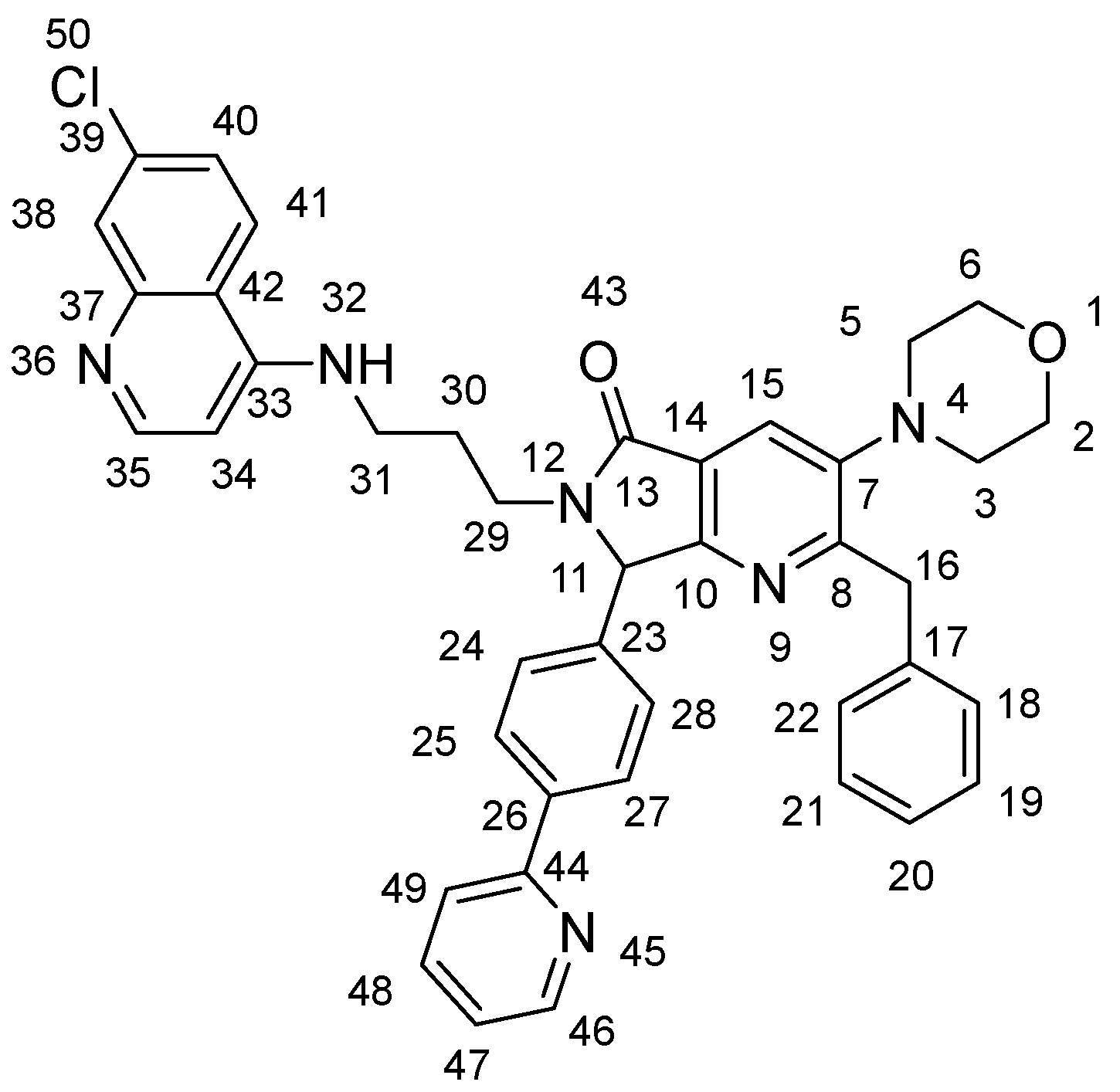
2-Benzyl-6-(3-((7-chloroquinolin-4-yl)amino)propyl)-3-morpholino-7-(4-(pyridin-2-yl)phenyl)-6,7-dihydro-5H-pyrrolo[3,4-b]pyridin-5-one (15, Figure 2).
1H NMR (500 MHz, CDCl3): δ 8.69 (ddd, J = 4.8, 1.8, 1.0 Hz, 1H, H-46), 8.45 (d, J = 5.4 Hz, 1H, H-35), 8.00–7.96 (m, 3H, H-41, H-27, H-25), 7.93 (s, 1H, H-15), 7.91 (d, J = 2.4 Hz, 1H, H-38), 7.78–7.74 (m, 1H, H-48), 7.72–7.69 (m, 1H, H-49), 7.37 (dd, J = 8.9, 2.2 Hz, 1H, H-40), 7.27–7.23 (m, 3H, H-47, H-28, H-24), 7.18–7.11 (m, 5H, H-22, H-21, H-20, H-19, H-18), 6.59 (t, J = 6.5 Hz, 1H, H-32), 6.32 (d, J = 5.5 Hz, 1H, H-34), 5.30 (s, 1H, H-11), 4.33 (d, J = 13.9 Hz, 1H, H-16), 4.20 (d, J = 13.9 Hz, 1H, H-16′), 3.95–3.87 (m, 1H, H-29), 3.82 (t, J = 4.6 Hz, 3H, H-6, H-2), 3.51–3.41 (m, 1H, H-31), 3.40–3.30 (m, 1H, H-31′), 3.30–3.22 (m, 1H, H-29′), 2.93–2.47 (m, 4H, H-5, H-3), 1.84–1.66 (m, 2H, H-30); 13C NMR (125 MHz, CDCl3): δ 168.5 (C-13), 162.6 (C-10), 160.1 (C-8), 156.5 (C-44), 151.8 (C-35), 149.8 (C-46), 149.7 (C-37, C-33), 149.3 (C-7), 148.1 (C-26), 140.2 (C-42), 139.1 (C-17), 136.8 (C-48), 135.8 (C-23), 134.8 (C-39), 128.7 (C-15), 128.5 (C-38), 128.4 (C-20, C-14), 128.2 (C-28, C-24), 127.6 (C-27, C-25), 126.2 (C-22, C-18), 125.3 (C-40), 123.7 (C-41), 122.5 (C-47), 121.8 (C-21, C-19), 120.5 (C-49), 117.6 (C-42), 98.4 (C-34), 67.1 (C-6, C-2), 65.9 (C-11), 53.0 (C-5, C-3), 40.1 (C-16), 39.0 (C-31), 37.9 (C-29), 26.0 (C-30); HRMS (ESI+): m/z calcd for C41H37ClN6O2 [M + H]+ 681.2735, found 681.2739.

4. Conclusions

The MCR/cascade methodology allowed for the synthesis of a structurally complex polyheterocycle containing a couple of biologically relevant and luminescent fragments in just 90 min. This process required only a single step for purification and isolation. Remarkably, 85% of the atoms from the starting materials were incorporated into the final product, while two molecules of H2O and one CO2 were produced as by-products.

Supplementary Materials

The following supporting information can be downloaded at: https://www.mdpi.com/article/10.3390/ecsoc-29-26676/s1, Figure S1: 1H-NMR (500 MHz, CDCl3) spectrum of compound 15; Figure S2: 13C-NMR (125 MHz, CDCl3) spectrum of compound 15; Figure S3: 2D-NMR (COSY) spectrum of compound 15; Figure S4: 2D-NMR (HSQC-part I) spectrum of compound 15; Figure S5: 2D-NMR (HSQC-part II) spectrum of compound 15; Figure S6: 2D-NMR (HMBC-part I) spectrum of compound 15; Figure S7: 2D-NMR (HMBC-part II) spectrum of compound 15; Figure S8: 2D-NMR (HMBC-part III) spectrum of compound 15; Figure S9: HRMS (ESI+–TOF) spectrum of compound 15.

Author Contributions

R.E.B.-C., synthesis and characterization; R.E.B.-C. and R.A.-P., data analysis; R.E.B.-C., writing—original draft preparation; A.I.-J. and E.G.-Z., supervision, and writing—review and editing; A.I.-J., funding acquisition, conceptualization, and writing—review and editing. All authors have read and agreed to the published version of the manuscript.

Funding

R.E.B.C. gratefully acknowledges the support of SECIHTI-México through a postdoctoral scholarship (815447). R.A.P. thanks SECIHTI-México for his M.Sc. scholarship (1279007). A.I.J. acknowledges “Proyecto de Investigación por Personal Académico de Ingreso Reciente 2024 UAM” for financial support. E. G. Z acknowledges DCBI-UAM-I/PEAPDI 2024 and SECIHTI CBF-2025-I-3043 for financial support.

Institutional Review Board Statement

Not applicable.

Informed Consent Statement

Not applicable.

Data Availability Statement

The raw data supporting the conclusions of this article will be made available by the authors on request.

Acknowledgments

Authors acknowledge Atilano Gutiérrez-Carrillo and Mónica A. Rincón-Guevara for the NMR and HRMS acquisitions, respectively.

Conflicts of Interest

The authors declare no conflict of interest. The funders had no role in the design of the study; in the collection, analyses, or interpretation of data; in the writing of the manuscript, or in the decision to publish the results.

References

  1. Ibarra, I.A.; Islas-Jacome, A.; Gonzalez-Zamora, E. Synthesis of polyheterocycles via multicomponent reactions. Org. Biomol. Chem. 2018, 16, 1402–1418. [Google Scholar] [CrossRef] [PubMed]
  2. Upadhyay, S.P.; Thapa, P.; Sharma, R.; Sharma, M. 1-Isoindolinone scaffold-based natural products with a promising diverse bioactivity. Fitoterapia 2020, 146, 104722. [Google Scholar] [CrossRef] [PubMed]
  3. Sun, X.; Janvier, P.; Zhao, G.; Bienayme, H.; Zhu, J. A Novel Multicomponent Synthesis of Polysubstituted 5-Aminooxazole and its New Scaffold-Generating Reaction to Pyrrolo[3,4-b]pyridine. Org. Lett. 2001, 3, 877–880. [Google Scholar] [CrossRef] [PubMed]
  4. Devasthale, P.; Wang, Y.; Wang, W.; Fevig, J.; Feng, J.; Wang, A.; Harrity, T.; Egan, D.; Morgan, N.; Cap, M.; et al. Optimization of Activity, Selectivity, and Liability Profiles in 5-Oxopyrrolopyridine DPP4 Inhibitors Leading to Clinical Candidate (Sa)-2-(3-(Aminomethyl)-4-(2,4-dichlorophenyl)-2-methyl-5-oxo-5H-pyrrolo [3,4-b] pyridin-6(7H)-yl)-N,N-dimethylacetamide (BMS-767778). J. Med. Chem. 2013, 56, 7343–7357. [Google Scholar] [PubMed]
  5. Segura-Olvera, D.; García-González, A.N.; Morales-Salazar, I.; Islas-Jácome, A.; Rojas-Aguirre, Y.; Ibarra, I.A.; Díaz-Cervantes, E.; Alcaraz-Estrada, S.L.; González-Zamora, E. Synthesis of Pyrrolo[3,4-b]pyridin-5-ones via Multicomponent Reactions and In Vitro–In Silico Studies Against SiHa, HeLa, and CaSki Human Cervical Carcinoma Cell Lines. Molecules 2019, 24, 2648. [Google Scholar] [CrossRef] [PubMed]
  6. Morales-Salazar, I.; Garduño-Albino, C.E.; Montes-Enríquez, F.P.; Nava-Tapia, D.A.; Navarro-Tito, N.; Herrera-Zúñiga, L.D.; González-Zamora, E.; Islas-Jácome, A. Synthesis of Pyrrolo[3,4-b]pyridin-5-ones via Ugi–Zhu Reaction and In Vitro–In Silico Studies against Breast Carcinoma. Pharmaceuticals 2023, 16, 1562. [Google Scholar] [CrossRef] [PubMed]
  7. Blanco-Carapia, R.E.; Hernández-López, R.; Alcaraz-Estrada, S.L.; Sarmiento-Silva, R.E.; García-Hernández, M.E.; Estrada-Toledo, N.V.; Padilla-Bernal, G.; Herrera-Zúñiga, L.D.; Garza, J.; Vargas, R.; et al. Multi-Component Synthesis of New Fluorinated-Pyrrolo[3,4-b]pyridin-5-ones Containing the 4-Amino-7-chloroquinoline Moiety and In Vitro–In Silico Studies Against Human SARS-CoV-2. Int. J. Mol. Sci. 2025, 26, 7651. [Google Scholar] [CrossRef] [PubMed]
  8. Flores-Reyes, J.C.; Amador-Sanchez, Y.A.; Valderrama-Celestino, A.; Barrios-Campos, B.D.; Peralta, R.A.; Huxley, M.T.; Ibarra, I.A.; Islas-Jácome, A.; Solis-Ibarra, D.; Gonzalez-Zamora, E. Dual-state emission of pyrazolyl-pyrrolo[3,4-b]pyridin-5-ones via excited-state intramolecular proton transfer (ESIPT): Multicomponent synthesis and optical characterization. Org. Chem. Front. 2025, 12, 2607–2616. [Google Scholar] [CrossRef]
  9. Craig, C.A.; Garces, F.O.; Watts, R.J.; Palmans, R.; Frank, A.J. Luminescence properties of two new Pt(II)-2-phenylpyridine complexes; the influence of metal-carbon bonds. Coord. Chem. Rev. 1990, 97, 193–208. [Google Scholar] [CrossRef]
  10. Fayol, A.; Housseman, C.; Sun, X.; Janvier, P.; Bienayme, H.; Zhu, J. Synthesis of α-Isocyano-α-alkyl(aryl)acetamides and their Use in the Multicomponent Synthesis of 5-Aminooxazole, Pyrrolo[3,4-b]pyridin-5-one and 4,5,6,7-Tetrahydrofuro [2,3-c]pyridine. Synthesis 2005, 1, 161–165. [Google Scholar] [CrossRef]
  11. Saito, T.; Kawawura, M.; Nishimura, J. Ytterbium triflate-catalyzed asymmetric hetero Diels-Alder cycloaddition of a 1-thiabuta-1,3-diene with a chiral N-acryloyloxazolidinone dienophile. Diastereoface control by solvents or achiral additives. Tetrahedron. Lett. 1997, 38, 3231–3234. [Google Scholar] [CrossRef]
Figure 1. Polyheterocycles based on the pyrrolo[3,4-b] pyridin-5-one core (in blue) with biological and luminescent properties.
Chemproc 18 00093 g001
Scheme 1. (A) Synthetic route to aminoquinoline 7, (C) Synthetic route to α-isocyanoacetamide 11, (B) Synthetic route to access pyrrolo[3,4-b]pyridin-5-one 15. Color key: aldehyde fragment in red, amine fragment in blue, isocyanide fragment in green and maleic anhydride fragment in pink.
Chemproc 18 00093 sch001
Figure 2. Synthesized polyheterocycle.
Chemproc 18 00093 g002
Table 1. Variation of the amount of ytterbium triflate.
Entry% mol Yb(OTf)3Yield (%) a
15%51
27%64
310%75
412%74
a Yields measured after the purification of the compound 15.
Disclaimer/Publisher’s Note: The statements, opinions and data contained in all publications are solely those of the individual author(s) and contributor(s) and not of MDPI and/or the editor(s). MDPI and/or the editor(s) disclaim responsibility for any injury to people or property resulting from any ideas, methods, instructions or products referred to in the content.