
Proceeding Paper

Synthesis and Structural Confirmation of a Novel 3,6-Dicarbonyl Derivative of 2-Chloropyrazine via Regioselective Dilithiation †
Department of Chemistry, Victoria Institution (College), 78B, A.P.C. Road, Kolkata 700009, West Bengal, India
Presented at the 29th International Electronic Conference on Synthetic Organic Chemistry, 14–28 November 2025; Available online: https://sciforum.net/event/ecsoc-29.
Chem. Proc. 2025, 18(1), 87; https://doi.org/10.3390/ecsoc-29-26696
Published: 22 December 2025

Abstract

A novel 3,6-dicarbonyl-substituted derivative of 2-chloropyrazine has been synthesized for the first time via regioselective dilithiation using lithium 2,2,6,6-tetramethylpiperidide (LiTMP) and subsequent trapping with methyl benzoate. The structure was unambiguously confirmed through Sonogashira coupling and diagnostic NMR analysis, establishing selective substitution at both the 3- and 6-positions. This result demonstrates that symmetrical 3,6-functionalization of 2-chloropyrazine is feasible under mild conditions, overcoming long-standing limitations of multiple metalations in electron-deficient heterocycles and opening new pathways for the synthesis of polyfunctional pyrazine frameworks.

1. Introduction

Pyrazine derivatives are privileged heterocycles with broad applications in medicinal, agrochemical, and material sciences [1,2,3,4]. Among them, 2-chloropyrazine serves as a synthetically versatile substrate due to the electron-withdrawing chlorine atom, which facilitates regioselective ortholithiation at the 3-position under directed metalation conditions [5,6,7]. This strategy has been widely exploited to access 3-substituted pyrazines, particularly via lithiation, formylation, and subsequent oxidation, yielding valuable 2-chloro-3-carbonylpyrazine derivatives [8,9,10].
However, despite extensive studies on monosubstitution, multiple metalations of 2-chloropyrazine have remained unexplored, primarily due to the potential for competing reactivity and the perceived instability of poly-lithiated intermediates in electron-deficient N-heterocycles [11].
In this context, we report for the first time the successful 3,6-dilithiation of 2-chloropyrazine, enabling the direct synthesis of symmetrical 3,6-dicarbonyl derivatives via sequential quenching with methyl benzoate. This discovery opens a new avenue in the regioselective functionalization of pyrazines, offering a simple, scalable route to novel poly-substituted heterocycles previously inaccessible by conventional lithiation protocols.
Our findings demonstrate not only the feasibility of 3,6-dimetalation but also the high selectivity and efficiency of this transformation under optimized conditions, challenging prior assumptions about the limitations of directed lithiation on pyrazine scaffolds.

2. Results and Discussion

The metallation of 2-chloropyrazine was initially carried out using Lithium 2,2,6,6-tetramethylpiperidide (LiTMP) as the base, followed by electrophilic trapping with methyl benzoate. Under these conditions, two distinct products were isolated. As anticipated, the major product under standard conditions was the 3-carbonyl-substituted derivative (2a). Interestingly, alongside this expected product, we observed the formation of a novel 3,6-dicarbonyl-substituted compound (3a), previously unreported in the context of 2-chloropyrazine lithiation.
Subsequent optimization experiments focused on understanding and enhancing the selectivity toward the dicarbonylated product (3). We systematically investigated various parameters, including temperature, stoichiometry of LiTMP, reaction time, and quenching conditions.
Our data reveal that the formation of the dicarbonyl derivative (3) is significantly favored when the reaction mixture is quenched at −78 °C after sufficient time for generation of 3,6-dilithiated 2-chloropyrazine (Table 1, Entry 1–3). Remarkably, we identified a set of conditions under which the 3,6-dicarbonyl compound (3) was obtained as the major product in up to 75% yield, while the mono-carbonyl compound (2) was formed only in negligible amounts (Entry 4). In contrast, performing both the metalation and subsequent quenching at −78 °C favored the formation of the mono-carbonyl derivative (2) as the principal product. These observations strongly suggest that initial lithiation occurs at the 3-position, as expected, but a second lithiation at the 6-position can also take place under thermally favorable conditions, leading to a 3,6-dilithiated intermediate, which is efficiently trapped by the ester electrophile. The use of excess LiTMP (lithium tetramethylpiperidine) has been observed to decrease the yield of the desired product (Entry 5), possibly due to its competitive side reaction with methyl benzoate, leading to reduced availability of the electrophile for the targeted lithiation pathway.
This finding not only provides a new route to selectively functionalized pyrazine derivatives but also demonstrates, for the first time, the feasibility of 3,6-dilithiation of 2-chloropyrazine, thus expanding the scope of directed ortho-lithiation (DoL) strategies in nitrogen-containing heteroaromatics.
Lithiation of 2-chloropyrazine preferentially occurs at the C-6 position because the corresponding C–H bond is more acidic, owing to the strong inductive (−I) effect of the adjacent chlorine atom and the absence of competing resonance (+R) stabilization [12]. In contrast, the C-5 position is less reactive, as it experiences minimal inductive influence and limited resonance destabilization [13].
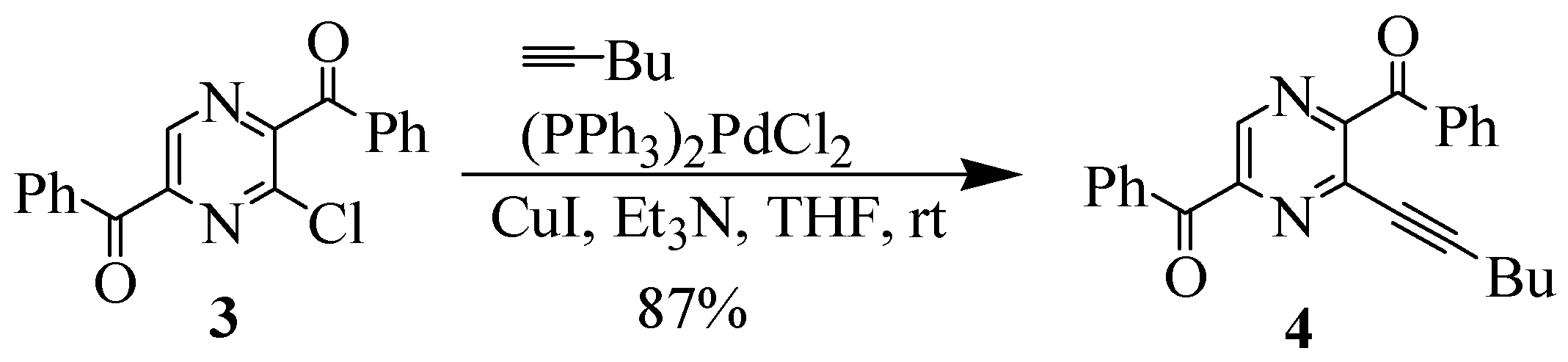
To experimentally validate the lithiation site, the chlorodicarbonyl derivative (3) was subjected to Sonogashira coupling with 1-hexyne under Pd–Cu catalysis (Scheme 1), yielding the corresponding alkynylated derivative (4). The rationale was that substituting the chlorine with a strongly inductive alkynyl group, which has minimal electron-donating resonance character, would induce an observable downfield shift in the adjacent proton resonance, particularly if the remaining proton were located at position 5.
NMR analysis revealed a significantly downfield shift proton signal in the alkynylated compound (4) compared to its precursor (3), consistent with position 6 hydrogen experiencing stronger deshielding due to the combined −I and negligible +R effects of the alkynyl group. This observation strongly supports the structural assignment of the product as a 3,6-dicarbonyl derivative, confirming that dilithiation occurs at positions 3 and 6, not at 3 and 5.

3. Materials and Methods

3.1. General

All melting points are uncorrected. Unless otherwise noted, all reactions were carried out under an inert atmosphere in flame-dried flasks. Solvents and reagents were dried and purified by distillation before use, as follows: tetrahydrofuran, hexane, and diethyl ether were dried over sodium–benzophenone ketyl; dichloromethane and triethylamine were dried over solid KOH. After drying over Na2SO4, organic extracts were evaporated under reduced pressure, and the residues were purified by column chromatography on silica gel (Spectrochem, particle size 100–200 mesh) using an ethyl acetate–petroleum ether (60–80 °C) mixture as eluent, unless specified otherwise. The 1H NMR and 13C NMR spectra were recorded on a Bruker AV-500 spectrometer (500 MHz). Splitting patterns for 1H NMR signals are designated as s (singlet), d (doublet), t (triplet), q (quartet), m (multiplet), and br (broad).

3.2. (5-Benzoyl-3-chloro-pyrazin-2-yl)-phenylmethanone

Freshly distilled chloropyrazine (1) (252 mg, 2.2 mmol) was added slowly to a solution of LiTMP (4.4 mmol) [prepared from 1.6 M n-BuLi in hexane (4 mL) and 2,2,6,6-tetramethylpiperidine (0.8 mL, 4.6 mmol)] in THF (30 mL), over a period of 5 min at −78 °C under argon atmosphere and the mixture was stirred for 1.5 h at 0 °C. Mixture was cooled to −78 °C, methyl benzoate (1.2 mL, 12.0 mmol) solution in THF (3 mL) was added and stirred for 15 min at the same temperature. Hydrolysis is then carried out at −78 °C using a mixture of 20% aqueous HCl (20 mL), EtOH (2 mL), and THF (6 mL). The mixture was extracted with diethyl ether (3 × 20 mL). The ether extract was washed with brine and dried (Na2SO4). After removal of solvent, the residue was purified by silica gel column chromatography (silica gel, ethyl acetate/petroleum ether 1:4) to yield the carbonyl compound 3 (533 mg, 75%) and compound 2 in trace (24 mg, 5%). Mp 121 °C; 1H NMR (500 MHz, CDCl3): δ 9.19 (s, 1H), 8.14 (d, 2H, J = 9.6 Hz), 7.87 (d, 2H, J = 9.6 Hz), 7.71–7.65 (m, 2H), 7.57–7.50 (m, 4H); 13C NMR (125 MHz, CDCl3): δ 190.5, 189.8, 182.5, 149.4, 144.6, 142.5, 134.8 (2C), 134.3, 134.1, 130.9 (2C), 130.3 (2C), 128.9 (2C), 128.6 (2C); HRMS calcd for C18H11ClN2O2 (M+): 322.0509; found: 322.0512.

3.3. (5-Benzoyl-3-hex-1-ynyl-pyrazin-2-yl)-phenylmethanone

A mixture of pyrazine derivative (2) (1.101 g, 3.987 mmol), Pd(PPh3)2Cl2 (140 mg, 0.2 mmol), PPh3 (26 mg, 0.1 mmol), (trimethylsilyl)acetylene (587 mg, 5.98 mmol) and triethylamine (605 mg, 5.98 mmol) in THF (20 mL) was stirred for 20 min at room temperature, and then CuI (9 mg, 0.049 mmol) was added. The reaction was stirred for 12–16 h at room temperature, and the solvent was removed on a rotary evaporator. The residue was treated with dichloromethane and filtered through Celite, washed with saturated aqueous sodium chloride solution, and dried over sodium sulfate. The solvent was removed on rotary evaporator and the residue was purified by column chromatography (silica gel/ethyl acetate–petroleum ether, 1:4). After column chromatography a single fraction was isolated and assigned as compound 5b (687 mg, 78% yield). Mp 110 °C; 1H NMR (500 MHz, CDCl3): δ 9.23 (s, 1H), 8.11 (d, 2H, J = 7.4 Hz), 7.96 (d, 2H, J = 7.4 Hz), 7.68–7.61 (m, 2H), 7.57–7.49 (m, 4H), 2.54 (t, 2H, J = 7.4 Hz), 1.32–1.22 (m, 2H), 0.86 (t, 3H, J = 7.3 Hz); 13C NMR (125 MHz, CDCl3): δ 190.9, 189.1, 147.3, 146.0, 142.9, 140.5, 137.7, 134.5, 133.3, 131.9, 131.6 (2C), 130.4 (2C), 129.1 (2C), 129.0 (2C), 99.5, 84.9, 35.9, 29.7, 20.8, 12.9; HRMS calcd for C24H20N2O2 (M+): 368.1525; found: 368.1531.

4. Conclusions

In summary, we have demonstrated the first successful 3,6-dilithiation of 2-chloropyrazine under directed ortho-lithiation conditions, enabling the synthesis of a novel 3,6-dicarbonyl derivative. The regioselectivity was confirmed by Sonogashira coupling and diagnostic NMR shifts, establishing the lithiation pattern at positions 3 and 6. This work expands the scope of lithiation strategies in pyrazine chemistry and provides a new route for creating symmetrically functionalized N-heterocycles.

Supplementary Materials

The following supporting information can be downloaded at https://www.mdpi.com/article/10.3390/ecsoc-29-26696/s1, Figure S1: 1H NMR spectra of (5-Benzoyl-3-chloro-pyrazin-2-yl)-phenylmethanone (3); Figure S2: 13C NMR spectra of (5-Benzoyl-3-chloro-pyrazin-2-yl)-phenylmethanone (3); Figure S3: HRMS spectra of (5-Benzoyl-3-chloro-pyrazin-2-yl)-phenylmethanone; Figure S4: 1H NMR spectra of (5-Benzoyl-3-hex-1-ynyl-pyrazin-2-yl)-phenylmethanone (3); Figure S5: 13C NMR spectra of (5-Benzoyl-3-hex-1-ynyl-pyrazin-2-yl)-phenylmethanone (3); Figure S6: HRMS spectra of (5-Benzoyl-3-hex-1-ynyl-pyrazin-2-yl)-phenylmethanone.

Funding

This research received no external funding.

Institutional Review Board Statement

Not applicable.

Informed Consent Statement

Not applicable.

Data Availability Statement

The data presented in this study are available in this article and the supporting Supplementary Materials.

Acknowledgments

The author gratefully acknowledges Binoy Krishna Ghorai for his valuable guidance and support.

Conflicts of Interest

The authors declare no conflict of interest.

Abbreviations

The following abbreviations are used in this manuscript:
LiTMPLithium 2,2,6,6-tetramethylpiperidide.
NMRNuclear Magnetic Resonance.
THFTetrahydrofuran.
DoLDirected ortho-Lithiation.

References

  1. Choudhary, D.; Garg, S.; Kaur, M.; Sohal, H.S.; Malhi, D.S.; Kaur, L.; Verma, M.; Sharma, A.; Mutreja, V. Advances in the Synthesis and Bio-Applications of Pyrazine Derivatives: A Review. Polycycl. Aromat. Compd. 2023, 43, 4512–4578. [Google Scholar] [CrossRef]
  2. Chen, G.-Q.; Guo, H.-Y.; Quan, Z.-S.; Shen, Q.-K.; Li, X.; Luan, T. Natural Products–Pyrazine Hybrids: A Review of Developments in Medicinal Chemistry. Molecules 2023, 28, 7440. [Google Scholar] [CrossRef] [PubMed]
  3. Huigens, R.W., III; Brummel, B.R.; Tenneti, S.; Garrison, A.T.; Xiao, T. Pyrazine and Phenazine Heterocycles: Platforms for Total Synthesis and Drug Discovery. Molecules 2022, 27, 1112. [Google Scholar] [CrossRef]
  4. Masaret, G.S.; Farghaly, T.A.; Al-Hussain, S.A.; Zaki, M.E.A.; Alsaedi, A.M.R.; Muhammad, Z.A. Site-Selectivity of the Reaction of 3-Amino-4-Cyano-5-Phenyl-1H-Pyrrole-2-Carboxylic Acid Amide with α-Halocarbonyl Compounds. Antimicrobial Activity and Docking Study for COVID-19 of the Products. Polycycl. Aromat. Compd. 2023, 43, 7110–7126. [Google Scholar] [CrossRef]
  5. Hess, A.; Alandini, N.; Guelen, H.C.; Prohaska, J.P.; Knochel, P. Regioselective magnesiations of functionalized arenes and heteroarenes using TMP2Mg in hydrocarbons. Chem. Commun. 2022, 58, 8774–8777. [Google Scholar] [CrossRef] [PubMed]
  6. Gros, P.C.; Choppin, S.; Fort, Y. Lithiation of 2-Chloro- and 2-Methoxypyridine with Lithium Dialkylamides: Initial Ortho-Direction or Subsequent Lithium Ortho-Stabilization. J. Org. Chem. 2003, 68, 2243–2247. [Google Scholar] [CrossRef] [PubMed]
  7. Toudic, F.; Plé, N.; Turck, A.; Quéguiner, G. Regioselective synthesis and metallation of fluoroiodopyrazines. Application to the synthesis of aryl and alkylbenzylpyrazines. Diazines. Part 31. Tetrahedron 2002, 58, 283–293. [Google Scholar] [CrossRef]
  8. Roy, P.; Ghorai, B.K. One-pot three-component synthesis of quinoxaline and phenazine ring systems using Fischer carbene complexes. Beilstein J. Org. Chem. 2010, 6, 52. [Google Scholar] [CrossRef] [PubMed]
  9. Turck, A.; Mojovic, L.; Quéguiner, G. A new route to 2,3-disubstituted pyrazines: Regioselective metalation of chloropyrazine. Synthesis 1988, 11, 881–884. [Google Scholar] [CrossRef]
  10. Mukherjee, S.; Roy, P.; Ghorai, B.K. One-pot three-component synthesis of quinoxaline, quinazoline and phenazine ring systems using Fischer carbene complexes. Synthesis 2011, 9, 1419–1426. [Google Scholar] [CrossRef]
  11. Turck, A.; Plé, N.; Mongin, F.; Quéguiner, G. Advances in the directed metallation of azines and diazines (pyridines, pyrimidines, pyrazines, pyridazines, quinolines, benzodiazines and carbolines). Part 2: Metallation of pyrimidines, pyrazines, pyridazines and benzodiazines. Tetrahedron 2001, 57, 4489–4505. [Google Scholar] [CrossRef]
  12. Bouchoux, G. Gas phase acidity of substituted benzenes. Chem. Phys. Lett. 2011, 506, 167–174. [Google Scholar] [CrossRef]
  13. Choppin, S.; Gros, P.; Fort, Y. Unusual C-6 Lithiation of 2-Chloropyridine Mediated by BuLi-Me2N(CH2)2OLi: New Access to 6-Functional-2-chloropyridines and Chloro-bis-heterocycles. Org. Lett. 2000, 2, 803–805. [Google Scholar] [CrossRef]
Scheme 1. Alkynylation of the 3,6-Dicarbonyl Pyrazine via Sonogashira Coupling.
Chemproc 18 00087 sch001
Table 1. Effect of reaction conditions on the regioselective carbonylation of 2-chloropyrazine.
Chemproc 18 00087 i001
EntryReaction Conditions a,bYield (%) d
Product 2Product 3
1A5010
2B6316
3C1535
4D0575
5A c0545
a Condition A: t1 = 30 min at −78 °C, t2 = 30 min at −78 °C, quenched at −78 °C; condition B: t1 = 1.5 h at −78 °C, t2 = 30 min at −78 °C, quenched at −78 °C; condition C: t1 = 30 min at −78 °C, t2 = 30 min at 0 °C, quenched at 0 °C; condition D: t1 = 1.5 h at 0 °C, t2 = 15 min at −78 °C, quenched at −78 °C; where t1 is time of addition of methyl benzoate after adding LiTMP on 2-chloropyrazine at −78 °C and t2 is time of stirring after methyl benzoate addition. b The reaction was carried out using a 1:2:2 ratio of 2-chloropyrazine- LiTMP-methyl benzoate. c The reaction was carried out using a 1:2.5:2 ratio of 2-chloropyrazine- LiTMP-methyl benzoate. d Isolated yield.
Disclaimer/Publisher’s Note: The statements, opinions and data contained in all publications are solely those of the individual author(s) and contributor(s) and not of MDPI and/or the editor(s). MDPI and/or the editor(s) disclaim responsibility for any injury to people or property resulting from any ideas, methods, instructions or products referred to in the content.