
Proceeding Paper

Study and Development on the Hydroxamation of Natural Resinic Acids: Synthesis and Computational Studies †

by
William E. Mendoza-Hernández
1,
Ramón J. Zaragozá
2 and
Miguel A. González-Cardenete
1,*
1
Instituto de Tecnología Química, Universitat Politècnica de València-Consejo Superior de Investigaciones Cientificas, Avda. de los Naranjos s/n, 46022 Valencia, Spain
2
Departamento de Química Orgánica, Universitat de Valencia, Dr. Moliner 50, 46100 Burjassot, Spain
*
Author to whom correspondence should be addressed.
Presented at the 29th International Electronic Conference on Synthetic Organic Chemistry, 14–28 November 2025; Available online: https://sciforum.net/event/ecsoc-29.
Chem. Proc. 2025, 18(1), 81; https://doi.org/10.3390/ecsoc-29-26736 (registering DOI)
Published: 12 November 2025

Abstract

The hydroxamic acid moiety is part of many bioactive molecules, including several clinical drugs, which can be constructed through, generally, the parent carboxylic acid and a source of hydroxylamine by a variety of methods. Hydroxamic acids compose a remarkable group of N-hydroxy amides with high capacity to chelate certain transition metal ions such as Fe(III), considered siderophores in Nature, and Ni(II), for instance. During a synthetic program towards the derivatization of natural resinic acids, it was decided to prepare some corresponding hydroxamic acid derivatives with potential biological activity for further studies. There are few reports on hydroxamate-derived terpenoids. It was predicted that adding a hydroxamic acid moiety to the carbon skeleton could enhance the antiproliferative activities or other pharmacological properties, as it occurs in other terpenoid compounds. In this communication, we describe the several issues that we faced in this generally straightforward conversion. Generally, the carboxylic group needs to be activated towards coupling with hydroxylamine. We screened several methods and realized that the desired conversion is difficult in this kind of substrate. After extensive testing, we propose a new protocol via a phosphate intermediate for better results than standard procedures. A basic computational study on the mechanism of this transformation was also carried out to support our experimental results.

1. Introduction

Abietic acid is one of the most representative and abundant abietane-type diterpenoids in nature, present in conifer resins and commercially available at low cost. Its tricyclic skeleton and the presence of an accessible carboxylic group make it an attractive starting material for the preparation of semisynthetic derivatives of interest in organic and natural products chemistry [1].
Among the possible structural modifications, the conversion of carboxylic acids into hydroxamic acids is particularly appealing. This functional group, extensively studied in medicinal chemistry, is characterized by its ability to coordinate transition metal ions and its occurrence in numerous bioactive molecules [2]. In the case of abietic acid, its hydroxamic derivative was first reported in 1999 from abietic anhydride, obtained in only 14% yield, highlighting the difficulty of this transformation [3]. However, no procedures have been described to date for the preparation of this hydroxamate directly from abietic acid as the starting substrate.
The absence of reported procedures underscores the convenience of carrying out a systematic reactivity study, in which different activation methods of abietic acid are evaluated and the outcomes rationalized through computational calculations. The aim is to establish an effective protocol to access the corresponding hydroxamic derivative while gaining insight into the factors that limit this transformation in sterically congested resinic systems.

2. Materials and Methods

2.1. Materials and Equipment

Abietic acid (93%) was purchased from Biosynth. (Staad, Switzerland). Diethyl chlorophosphate (DCP, 97%), triethylamine (Et3N, 99%), and hydroxylamine hydrochloride (NH2OH·HCl, 99%) were obtained from Merck Life Science S.L.U. (St Louis, MO, USA). N,N-dimethylformamide (DMF, 99.8%, extra dry over molecular sieves, AcroSeal) was purchased from ACROS Organics (Geel, Belgium) TLC was performed on silica gel 60 F254 plates (Merck Life Science S.L.U., St. Louis, MO, USA), and column chromatography was carried out on silica gel 60 (0.040–0.063 mm, Merck Life Science S.L.U., St. Louis, MO, USA).
Analytical data were obtained using the following instruments: Bruker Ascend 400 (9.4 T) NMR spectrometer (Billerica, MA, USA), Cole-Parmer MP-800D (Vernon Hills, IL, USA) melting point apparatus, AB Sciex QTOF 6600+ (Framingham, MA, USA) mass spectrometer and JASCO P2000 (Tokyo, Japan) polarimeter.

2.2. General Procedure for Abietohydroxamic Acid (1a)

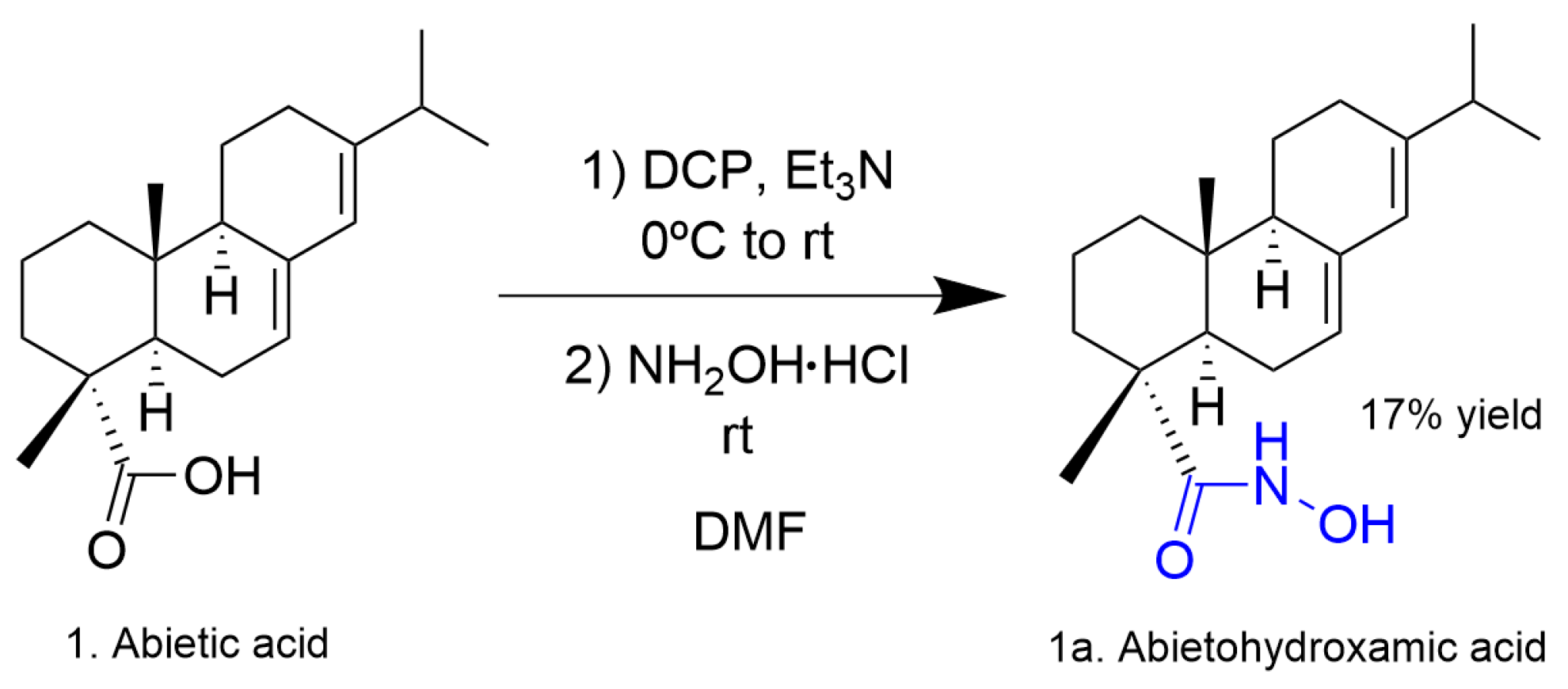
The preparation of abietohydroxamic acid (1a) was achieved through a one-pot phosphate-mediated hydroxamation, as shown in Scheme 1. To a cooled solution of abietic acid (1) (93% purity, 649 mg, 2.0 mmol), Et3N (2.52 mL, 18.0 mmol) in anhydrous DMF (12 mL) at 0 °C under Ar atmosphere, diethyl chlorophosphate (446 µL, 3.0 mmol) was added dropwise and allowed to warm to rt. After being stirred for 8 h, NH2OH·HCl (702 mg, 10.0 mmol) was added in one portion and the resulting reaction mixture was stirred overnight (16 h). Then, the mixture was diluted with water (20 mL) and extracted with ethyl acetate (3 × 16 mL). The combined organic extracts were washed with 1N HCl (2 × 10 mL), H2O (10 mL), sat NaHCO3 (10 mL), brine (10 mL), dried (MgSO4) and concentrated. The crude residue (489 mg, yellowish foam, estimation by 1H NMR ca, 2:1 hydroxamic acid:carboxylic acid) was chromatographed on silica eluting with n-hexane-acetone (7:3) to give 111 mg of a white solid as an impure fraction of 1a containing recovered abietic acid (1) followed by 109.8 mg (17% yield) of abietohydroxamic acid (1a) as a white solid: m.p. 125–128 °C (lit. [3], 127–131 °C); [α]25D = −72.9° (c 0.5, DCM) (lit. [3], [α]20D = −78°); 1H NMR (CDCl3, 400 MHz) δH: 5.75 (1H, s), 5.32 (1H, br s), 2.21 (1H, sept., J = 6.8), 2.08–1.90 (4H, m), 1.88–1.77 (3H, m), 1.60–1.50 (4H, m), 1.23 (3H, s), 1.25–1.20 (3H, m), 1.00 (3H, d, J = 6.8), 0.99 (3H, d, J = 6.8), 0.82 (3H, s); 13C NMR (CDCl3, 100 MHz) δC: 176.6 (s), 145.3 (s), 135.5 (s), 122.3 (d), 120.1 (d), 50.9 (d), 45.2 (d), 45.1 (s), 38.1 (t), 37.2 (t), 34.9 (d), 34.6 (s), 27.4 (t), 25.2 (t), 22.4 (t), 21.4 (q), 20.8 (q), 17.9 (t), 15.8 (q), 14.2 (q); HRMS (ESI) m/z 318.2425 [M + H]+, calcd for C20H32NO2: 318.2433.

2.3. Computational Methods

All quantum-chemical calculations were performed with Gaussian 16 at the M06-2X/6-31G** level, including solvent effects with the PCM model (DMF). Frequency analyses confirmed the nature of the stationary points (no imaginary frequencies for minima and a single one for TS), and IRC calculations verified the connectivity between transition states and their respective reactants and products.
Relative free energies (ΔG, kcal·mol−1) were obtained to compare alternative pathways. For mechanistic simplification, dimethoxyphosphates were used instead of diethoxyphosphates. The study focused on the hydroxylamine addition step to the phosphate-activated intermediate of abietic acid, which governs the competition between hydroxamic amide and ester formation.

3. Results and Discussion

3.1. Screening of Coupling Conditions

The hydroxamation of abietic acid (1) was first evaluated under different activation methods. Using EDC·HCl/DMAP/Et3N in DCM gave mixtures of starting acid and the hydroxamic derivative (1a), with only trace amounts isolated after chromatography. With diethyl cyanophosphate (DEPC) in THF, mixtures containing both acid and 1a were obtained and proved difficult to separate, while with propylphosphonic anhydride (PPAA) in acetonitrile no conversion was observed, recovering mostly the starting acid. Activation through acid chlorides (SOCl2/pyridine or oxalyl chloride) was also unsuccessful: the intermediates were unstable and abietic acid was recovered after work-up. The overall outcomes of these activation strategies are summarized in Table 1, highlighting that, unlike other terpenoid systems, the direct hydroxamation of abietic acid is synthetically demanding due to steric hindrance at the carboxyl group and the poor solubility of hydroxylamine in apolar solvents.

3.2. One-Pot Phosphate-Mediated Hydroxamation

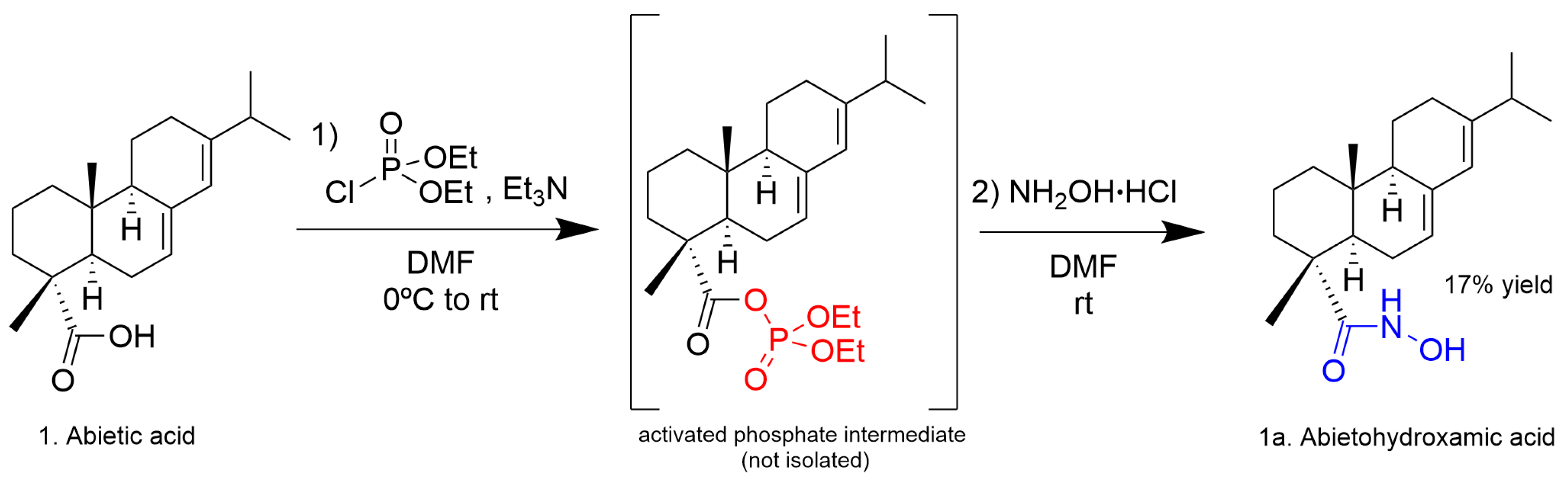
The use of diethyl chlorophosphate (DCP) in DMF, together with excess triethylamine followed by in situ addition of hydroxylamine hydrochloride, enabled the preparation of abietohydroxamic acid (1a) in a one-pot transformation, as illustrated in Scheme 2. The reaction likely proceeds through an activated phosphate intermediate, which was not isolated, and subsequent nucleophilic substitution by hydroxylamine. After purification, compound 1a was obtained in 17% yield, together with partial recovery of abietic acid. Compared with other activation strategies tested, this protocol proved to be reproducible and currently represents the most effective approach identified for accessing this hydroxamic derivative.

3.3. Computational Studies

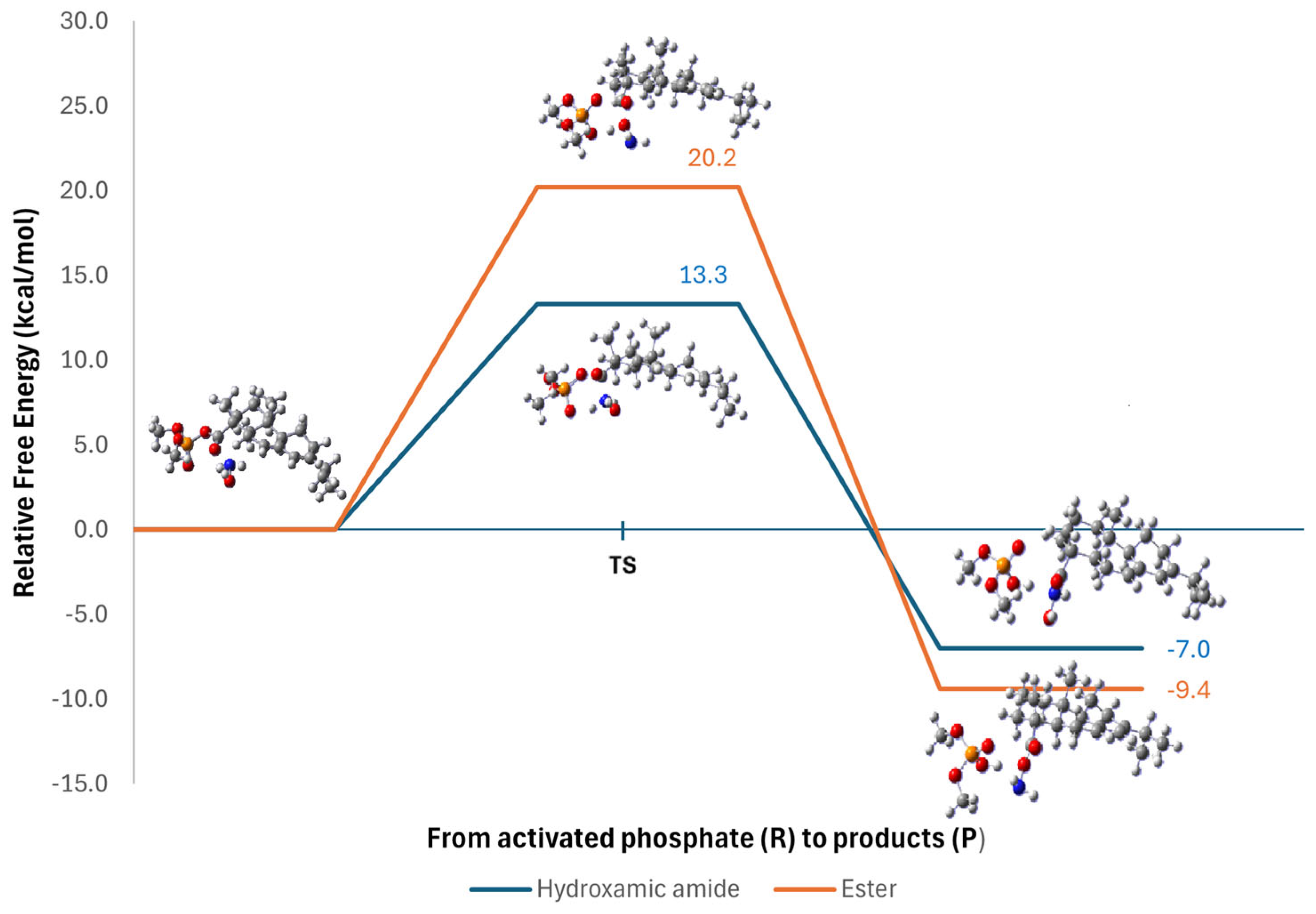
As shown in Scheme 3, two competitive pathways were identified for the hydroxylamine addition to the phosphate-activated intermediate of abietic acid: nitrogen attack affording the hydroxamic amide and oxygen attack leading to the ester. The computed free-energy profiles, taking the ester reactants as reference (0.0 kcal·mol−1), were 0.0/+13.3/–7.0 kcal·mol−1 (R/TS/P) for the amide and 0.0/+20.2/–9.4 kcal·mol−1 for the ester. These results indicate that the hydroxamic pathway has a much lower activation barrier, consistent with its experimental isolation, while both products are exothermic and relatively close in stability. Overall, the data support that the hydroxamic amide corresponds to the kinetic product obtained under mild conditions, whereas the ester represents the thermodynamic product, accessible only under harsher conditions.

3.4. General Discussion

The experimental and computational data converge to a consistent picture. Under conventional activation methods the hydroxamation of abietic acid is largely unsuccessful, leading either to recovery of starting material or to inseparable mixtures. In contrast, when the reaction is performed in a polar solvent such as DMF and activated with diethyl chlorophosphate, conditions that favor kinetic control, the hydroxamic derivative can be obtained, although only in moderate yield.
These findings highlight that the hydroxamation of abietic acid is an unusually demanding transformation among terpenoid acids. The combined experimental and theoretical results provide a synthetic and mechanistic framework that rationalizes the observed selectivity and offers guidance for future optimization, such as the use of alternative activating agents, the evaluation of different solvents, or protective strategies for hydroxylamine. Future work for optimizing the yield is underway, particularly for the amount of reagents and extraction and purification due to the polar nature of the material.

4. Conclusions

The hydroxamation of abietic acid proved to be a challenging transformation compared to other terpenoid acids, since conventional coupling methods and activation through acid chlorides were ineffective, yielding only starting material or inseparable mixtures. In contrast, a one-pot strategy using diethyl chlorophosphate (DCP) in DMF enabled the reproducible preparation of the hydroxamic derivative in moderate yield. DFT calculations further supported these results, showing that the hydroxamic amide pathway is kinetically favored, whereas ester formation corresponds to the thermodynamic product. Altogether, this study establishes a coherent synthetic and mechanistic framework that may guide the future development of other hydroxamic acid derivatives.

Author Contributions

Conceptualization, M.A.G.-C.; methodology, M.A.G.-C., W.E.M.-H. and R.J.Z.; validation, M.A.G.-C. and R.J.Z.; formal analysis, M.A.G.-C. and W.E.M.-H.; investigation, M.A.G.-C., W.E.M.-H. and R.J.Z.; resources, M.A.G.-C. and R.J.Z.; writing—original draft preparation, W.E.M.-H.; writing—review and editing, M.A.G.-C. and W.E.M.-H.; funding acquisition, M.A.G.-C. All authors have read and agreed to the published version of the manuscript.

Funding

The authors thank the Spanish Government (Project CEX2021-001230-S funded by MCIN/AEI/10.13039/501100011033/FEDER, UE) for financial support. This research was supported by the regional government “Generalitat Valenciana, Conselleria de Educación, Universidades y Empleo”, grant number CIAICO/2022/220 to M.A.G.-C., W.E.M.-H. also thanks the regional government “Generalitat Valenciana” for a PhD contract (grant number CIACIF/2024/510).

Institutional Review Board Statement

Not applicable.

Informed Consent Statement

Not applicable.

Data Availability Statement

The data is available in the manuscript and further details upon request.

Acknowledgments

We acknowledge the support given by the characterization department of the “Instituto de Tecnologia Quimica, ITQ” for providing the NMR, elemental composition and high-resolution mass spectra (through Universitat de Valencia) of the samples.

Conflicts of Interest

The authors declare no conflicts of interest.

References

  1. González, M.A.; Correa-Royero, J.; Agudelo, L.; Mesa, A.; Betancur-Galvis, L. Synthesis and Biological Evaluation of Abietic Acid Derivatives. Eur. J. Med. Chem. 2009, 44, 2468–2472. [Google Scholar] [CrossRef] [PubMed]
  2. Alam, M.A. Methods for Hydroxamic Acid Synthesis. Curr. Org. Chem. 2019, 23, 978–993. [Google Scholar] [CrossRef] [PubMed]
  3. Bardyshev, I.I. Diterpenoid Carboxylic Acid Anhydrides of the Abietane, Pimarane, and Isopimarane Series. Russ. J. Org. Chem. 1999, 35, 41–55. [Google Scholar]
Scheme 1. One-pot hydroxamation of abietic acid (1) with diethyl chlorophosphate (DCP) in DMF.
Chemproc 18 00081 sch001
Scheme 2. One-pot hydroxamation of abietic acid (1) to abietohydroxamic acid (1a) via a phosphate intermediate.
Chemproc 18 00081 sch002
Scheme 3. Computed free-energy profile for the hydroxylamine attack on the phosphate-activated intermediate of abietic acid (1). The hydroxamic amide pathway (blue) is kinetically favored, while the ester pathway (orange) is thermodynamically preferred.
Chemproc 18 00081 sch003
Table 1. Screening of activation methods for the hydroxamation of abietic acid (1).
Activation MethodSolventResult/Observation
EDC·HCl/DMAPDCMMixture of 1 and 1a; only trace amounts of 1a isolated
DEPCTHFMixture of 1 and 1a; separation difficult
PPAACH3CNNo conversion; 1 fully recovered
SOCl2DCMUnstable acyl chloride; 1 recovered after work-up
Oxalyl chlorideDCM/THFDecomposition; 1 recovered after work-up
Disclaimer/Publisher’s Note: The statements, opinions and data contained in all publications are solely those of the individual author(s) and contributor(s) and not of MDPI and/or the editor(s). MDPI and/or the editor(s) disclaim responsibility for any injury to people or property resulting from any ideas, methods, instructions or products referred to in the content.