
Proceeding Paper

A Novel Flavonoid Ester Derivative from the Ethyl Acetate Fraction of Nelsonia canescens: Isolation and Structural Elucidation Techniques †
by
Abubakar Abdulhameed Abdullahi
1,
Dauda Garba
2,*,
Yahaya Mohammed Sani
3 and
Mohammed Ibrahim Sule
3
1
Department of Chemistry, Faculty of Science, Nigeria Police Academy, Kano, Wudil 1003, Nigeria
2
Department of Pharmaceutical and Medicinal Chemistry, University of Abuja, Abuja 900105, Nigeria
3
Department of Pharmaceutical and Medicinal Chemistry, Ahmadu Bello University, Zaria 810107, Nigeria
*
Author to whom correspondence should be addressed.
Presented at the 29th International Electronic Conference on Synthetic Organic Chemistry, 14–28 November 2025; Available online: https://sciforum.net/event/ecsoc-29.
Chem. Proc. 2025, 18(1), 20; https://doi.org/10.3390/ecsoc-29-26863
Published: 12 November 2025

Abstract

The increasing resistance of pathogens to conventional antibiotics has necessitated the search for novel antimicrobial agents from medicinal plants. Nelsonia canescens—a plant traditionally used in Africa and Asia for the management of health issues, such as viral infections, cardiovascular diseases, and inflammation—has been reported to demonstrate antimicrobial activity and has been investigated for its bioactive constituents. The whole plant was collected, air-dried, and extracted using 70% methanol. The crude methanol extract was partitioned into hexane, chloroform, ethyl acetate, and butanol fractions. The ethyl acetate fraction was subjected to column chromatography and gel filtration, leading to the isolation of a compound coded A1. The structure of compound A1 was established through UV, FTIR, NMR (1H, 13C, DEPT, COSY, HMQC, and HMBC), and chemical tests. Compound A1 was identified as a 2*-hydroxy-4*-phenyl-(2**-hydroxy-ethyl)-3′-(4′′′→1′′) glucose-rhamnose-3-hydroxy phenyl ester, a flavonoid derivative. A spectral analysis confirmed its structure, with key signals including olefinic protons (δ 6.30 and 7.62) in the trans-configuration, aromatic protons, and sugar moieties. The compound exhibited a melting point of 105–107 °C and was partially soluble in chloroform but fully soluble in methanol, suggesting that the compound is highly polar in nature. This is the first report on the isolation of the 2*-hydroxy-4*-phenyl-(2**-hydroxy-ethyl)-3′-(4′′′→1′′) glucose-rhamnose-3-hydroxy phenyl ester from Nelsonia canescens, contributing to the taxonomy of the plant. The compound’s structural features suggest potential bioactive properties, warranting further investigation into its pharmacological applications through in vitro and molecular docking studies.

1. Introduction

Flavonoids constitute one of the most important classes of naturally occurring phenols, serving as protective agents in plants and offering significant benefits for human health [1]. Over 4000 flavonoids have been identified from various plant sources. Their potential therapeutic applications have been of considerable interest in recent years, as the diverse structures derived from medicinal plants are often perceived to possess an immense drug-likeness and biological friendliness, making them excellent candidates for drug development [2,3,4,5].
The analysis of flavonoids in complex mixtures relies on various analytical procedures, with chromatographic techniques such as high-performance liquid chromatography (HPLC), column chromatography (CC), and gas chromatography (GC) being among the most successful [6,7,8]. In contrast, nuclear magnetic resonance (NMR) spectroscopy is a powerful technique that provides insight into mixtures of natural products without requiring the prior separation of individual components. Its advantages include a simpler, non-destructive sample preparation. NMR has been successfully used for the structural identification of diverse natural products in mixtures, including essential oils, terpenoids, sterols, saponins, anthocyanins, and phenolic acids [8].
Nigeria’s rich biodiversity, particularly its tropical rainforests, harbors a vast array of medicinal plants with documented traditional uses. Nelsonia canescens (family Acanthaceae) is one such plant, used in traditional medicine to manage diarrhea, fever, smallpox, hypertension, inflammation, and viral infections [9,10]. Previous phytochemical studies have revealed the presence of saponins, tannins, alkaloids, polyphenols, coumarins, and flavonoids in this plant [11], though only two iridoids, shanzhiside methyl ester and galiridoside [11], have been fully identified to date. There remains a scarcity of studies focused on the systematic isolation and full structural characterization of active secondary metabolites from its ethyl acetate fraction.
This paper reports the structural elucidation of a novel 2*-hydroxy-4*-phenyl-(2**-hydroxy-ethyl)-3′-(4′′′→1′′) glucose-rhamnose-3-hydroxy phenyl ester isolated from Nelsonia canescens. The determination of its structure was based on comprehensive spectral data from UV, IR, 1D (COSY and DEPT), and 2D NMR techniques—including the HSQC (Heteronuclear Single Quantum Correlation) and HMBC (Heteronuclear Multiple Bond Correlation)—supplemented with chemical tests and a comparative analysis of the literature data.

2. Material and Method

2.1. General Experimental Procedures

The compound’s color and physical appearance were observed and recorded, and it was subjected to chemical tests (Shinoda, ferric chloride test) and melting point determination (Gallenkhamp electro-thermal melting point apparatus). The isolated compound was dissolved in absolute methanol for the UV analysis. The absorbance at a specific wavelength was obtained using Ultraviolet-Visible (UV-Vis) spectroscopy and infrared (Agilent Technologies Cary 6030 FTIR spectrometer, Santa Clara, CA, USA), and for the isolated compounds, the dried samples were dissolved in deuterated methanol (MeOD) for the NRM analysis. Nuclear magnetic resonance (NMR) spectra were recorded at 400 MHz for 1D and 2D (Bruker AVANCE III Instruments Incorporation, Billerica, MA, USA, 400 MHz), using TMS as an internal standard or by referencing with solvent signals.

2.2. Plant Material

The whole Nelsonia canescens plant was collected in March 2016 from the Zaria local government area of Kaduna State. It was confirmed and authenticated by Namadi Sanusi of the Herbarium section of the Department of Biological Sciences, Ahmadu Bello University, Zaria, where a voucher specimen No:1181 was deposited.

2.3. Extraction and Purification

The collected plant was air-dried under shade for 7 days; then it was powdered and weighed. The powdered plant material (3000 g) was extracted with 70% methanol (10 L) using a maceration method for 72 h, and the extract was filtered using Whatman No.1 filter paper. The extract was concentrated under reduced pressure to yield 180 g, subsequently referred to as the crude methanol extract, and then partitioned with n-hexane, chloroform, ethyl acetate, and butanol to obtain the following yield of fractions: n-hexane fraction (51.65 g), chloroform fraction (1.20 g), ethyl acetate fraction (7.2 g), and butanol fraction (29.23 g) [12,13]. The ethyl acetate fraction was subjected to a column chromatographic analysis based on the fact that it demonstrated the highest antimicrobial activity among the fractions tested.

2.4. Isolation of Compound

2.4.1. Column Chromatography of Ethyl Acetate Fraction

The column was packed using the wet slurry method. Briefly, 7 g of the ethyl acetate fraction was dissolved with ethyl acetate and absorbed (60–120 mesh size). Silica gel was added to form a slurry, which was allowed to dry. The column was prepared by placing cotton wool at the bottom end of the column; an estimated quantity of the silica gel was poured into a small amount of n-hexane, stirred vigorously, and then poured into the column while stirring and allowed to settle. The absorbed fraction was introduced onto the packed column and was gradually eluted at a reduction ration of 5%, starting from n-hexane (100%) to ethyl acetate–n-hexane (90%:10%) and methanol (100%). A total of 87 samples were collected and pooled together based on their TLC profiles to produce 14 major pooled fractions, A-N.

2.4.2. Gel Filtration Chromatography of A1

Collections from beakers 65–76 of the ethyl acetate fraction were pulled together and tagged as M. M was then divided into two portions: M1 and M2. The first portion of M (M1) was then subjected to gel filtration based on the TLC profile. The elution was performed using 100% methanol. Then, 20 (2 mL) collections were obtained and pooled into 7 fractions, coded as MA-MG. The MC that had a better profile was subject to gel filtration using Sephadex to yield Mc1, MC2, and MC3, which were further purified using Sephadex, and 12 collections were produced and pooled into 4 fractions based on similarities, coded as I. Later, I was subjected to repeated gel filtration, which yielded a dark-red amorphous compound coded A1, and then A1 was subjected to a chemical test and spectroscopic analysis.

3. Results and Discussions

The silica gel column chromatographic separation of the ethyl acetate fraction followed by the gel filtration over Sephadex LH-20 led to the isolation of a deep-red amorphous compound coded A1. A1 produced a single homogenous spot obtained using ethyl acetate–chloroform–methanol–Water in a ratio of 15:4:4:1, which was then characterized by physical, chemical, and spectroscopic techniques.
Compound A1 tested positive in the ferric chloride test, indicating a phenolic nucleus. Also, the melting point range of 105–107 °C further suggested that the compound was purely isolated.
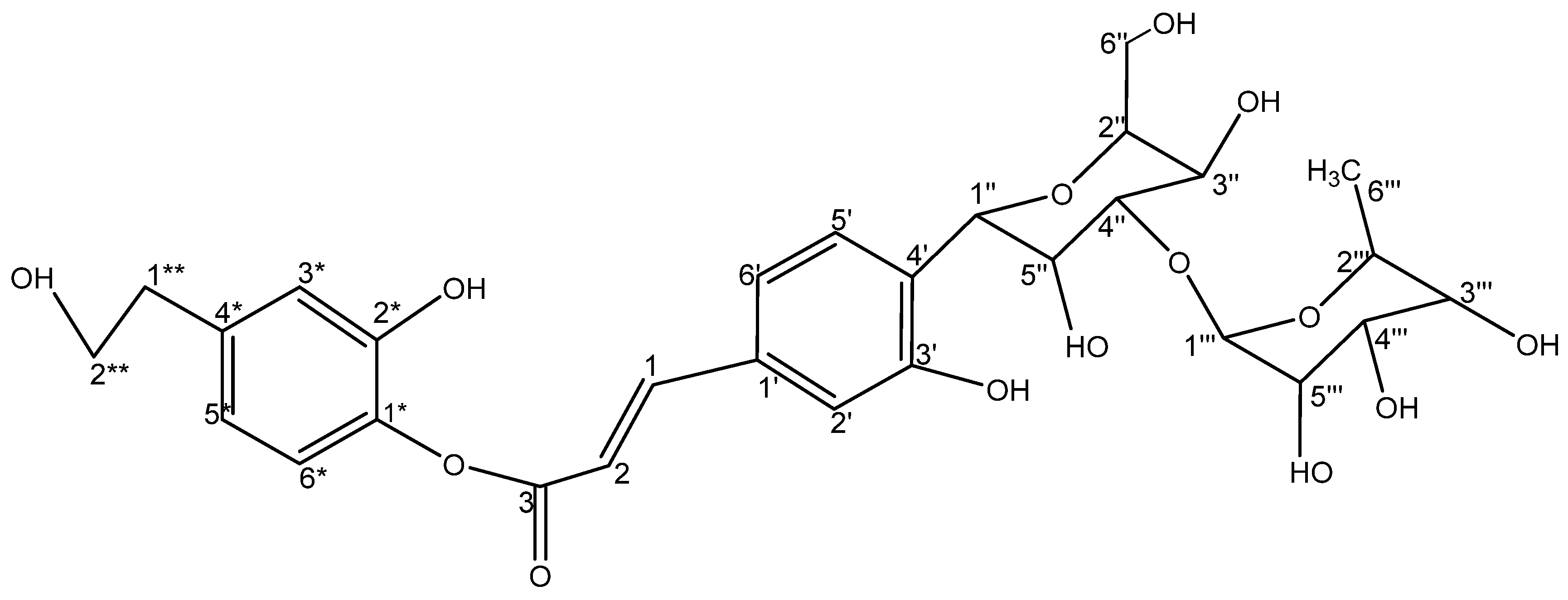
One compound was isolated and identified as a novel chalcone and was characterized by spectral data (UV, IR, 1H NMR, 13C, DEPT, COSY, HMBC, and HSQC) as a 2*-hydroxy-4*-phenyl-(2**-hydroxy-ethyl)-3′-(4′′′→1′′) glucose-rhamnose-3-hydroxy phenyl ester (Figure 1).
The UV absorption maxima at 206 and 219 nm suggested a substituted benzoyl moiety and 332 nm of a carbonyl moiety of an ester [14]. The IR spectrum of A1 revealed major bands at 3295.0 cm−1, which is a characteristic of an OH stretch: 2944.6 cm−1, which is due to a C-H aliphatic stretch; 2150.7 cm−1, which is due to an aromatic overtone; 1692 cm−1, which is due to a C=C olefinic stretch in the aliphatic chain; 1602 cm−1, which is due to a C=O stretch; and 1446.2 cm−1, which is characteristic of C-H scissoring and bending and a sharp peak at 1010.1 due to the C=O stretch of an ester [15].
The1H-NMR spectrum showed two doublets at δH 6.30(1H, d, J = 16Hz, H-2) and δH 7.62(1H, d, J = 16Hz, H-1), signifying trans-olefinic protons [13,16]. Signals at δH 6.70 (2H, dd, J = 1.6, 8 Hz, H-3*) and δH 6.59 (1H, dd, J = 1.6 Hz, H-5*) of the ABX trisubstituted benzene ring correspond to the aromatic protons of ring A (Table 1). Also, signals at δH 7.09 (1H, d, J = 1.6 Hz, H-2′) and δH 6.98 (1H, dd, J = 1.6,8.0 Hz, H-6′) meta-coupled to each other and at δH 6.81 (1H, dd, J = 1.6, 8 Hz, H-5′) ortho-coupled to δH 6.98 (1H, dd, J = 1.6, 8.0 Hz H-6′) suggest another trisubstitution in ring B (Table 1) [14,17]. The signals for the anomeric proton of the glucosyl and rhamnosyl units appear at δH 5.21 (1H, s) and δH 4.39 (1H, t, J = 8, 17.6 Hz) [13,14]. The high coupling constants observed at (8.0 Hz and 17.6 Hz) are due to the axial coupling with the H-4′′ proton of the glucosyl moiety and the H-1′′′ of rhamnosyl, which confirms the configuration of both sugars as β-D glucosyl (1–4) rhamnose [14]. Other up field signals around δH 2.81 (2H, t, J = 6.4, 12 Hz) and 1.12 (3H, d, J = 6.4 Hz) are due to methylene and methyl groups, indicating the presence of an aliphatic moiety as a side chain of the molecule (Table 1) [18].
The 13CNMR spectral analysis revealed the presence of 29 carbon signals, and the multiplicities of the carbon atoms were confirmed by the DEPT experiments, which revealed 7 quaternary carbon groups (C), 18 methine groups (CH), 3 methylene groups (CH2), and 1 methyl group (CH3). (Table 1) The downfield resonances at δC 166.99 (C-3) resemble a carbonyl group C=O of a phenyl ester [19], and resonances at δC 113.65 (C-2) and δC 146.67 (C-3) resemble olefinic carbon between the carbonyl moiety (C-3) and benzene. Also, the presence of a methylene carbon resonance at δC 60.99 and methyl carbon at δC 17.08 indicates the presence of sugar (β-glucose –rhamnose) [14].
In the COSY Spectrum of A1, there are cross-peaks between δH [6.30 and 7.62] of the olefinic moiety, δH [6.59 and 6.70], δH [6.81 and 6.98], and δH [6.98 and 7.09] of the aromatic protons in ring A and B δH [5.21 and 3.95]; δH [4.39 and 3.36] of the anomeric sugar residue of glucosyl and rhamnosyl; and δH [3.84 and 2.81] of the aliphatic side chain in ring A (Table 1).
The Heteronuclear Multiple Bond Correlation (HMBC) spectral data allowed for the establishment of long-range connectivity between various units of the molecule. Some of which include δH 7.62 correlated with δC 113.36, 121.88, and 166.99, which confirms the attachment of the carbonyl moiety to the olefinic carbon (Table 1). A signal at δH 7.09 correlated with δC 121.88, 145.41, and 146.67, which confirms the attachment of the proton at position 2′ of ring B, with the quaternary carbon carrying the sugar residue and that of the hydroxyl group. The signal at δH 6.98 correlated with δC 113.95 and 146.67; this confirms that position 1′ of ring B at the olefinic bond and a proton at δH 6.71 correlated with δC 145.41, 121.88, and 130.17, which confirms the attachment of the aliphatic chain at 4′′′ and that of the hydroxyl group at 2′′′. Other correlations confirmed by the HMBC are those of the sugar residue (Table 1).

4. Conclusions

To the best of our knowledge, this is the first report on the isolation of the 2*-hydroxy-4*-phenyl-(2**-hydroxy-ethyl)-3′-(4′′′→1′′) glucose-rhamnose-3-hydroxy phenyl ester from Nelsonia canescens.

Author Contributions

Conceptualization, A.A.A. and D.G.; methodology, A.A.A., D.G. and Y.M.S.; software, A.A.A. and D.G.; validation, A.A.A., M.I.S. and D.G.; formal analysis, D.G.; investigation, A.A.A.; resources, A.A.A.; data curation, D.G.; writing—original draft preparation, A.A.A. and D.G.; writing—review and editing, D.G.; visualization, A.A.A.; supervision, Y.M.S. and M.I.S.; project administration, Y.M.S. and M.I.S.; funding acquisition, A.A.A. All authors have read and agreed to the published version of the manuscript.

Funding

This research received no external funding.

Institutional Review Board Statement

Not applicable.

Informed Consent Statement

Not applicable.

Data Availability Statement

The data presented in this study are available on request from the corresponding author. The data are not publicly available due to [ethical concerns about plagiarism].

Conflicts of Interest

The authors declare no competing interests.

References

  1. Ezeonu, F.C.; Chidume, G.I.; Udedi, S.C. Insetici dal properties of volatile extracts of orange peels. Bioresour. Technol. 2001, 76, 273–274. [Google Scholar] [CrossRef] [PubMed]
  2. Koehn, F.E.; Carter, G.T. The evolving role of natural products in drug discovery. Nat. Rev. Drug Discov. 2005, 4, 206–220. [Google Scholar] [CrossRef] [PubMed]
  3. Balunas, M.J.; Kinghorn, A.D. Drug discovery from medicinal plants. Life Sci. 2005, 78, 431–441. [Google Scholar] [CrossRef] [PubMed]
  4. Jones, W.P.; Chin, Y.W.; Kinghorn, A.D. The role of pharmacognosy in modern medicine and pharmacy. Curr. Drug Targets 2006, 7, 247–264. [Google Scholar] [CrossRef] [PubMed]
  5. Drahl, C.; Cravatt, B.F.; Sorensen, E.J. Protein reactive natural products. Angew. Chem. Int. Ed. Engl. 2005, 44, 5788–5809. [Google Scholar] [CrossRef] [PubMed]
  6. Branco, A.; Pereira, A.S.; Cardoso, J.N.; Aquino Neto, F.R.; Pinto, A.C.; Braz-Filho, R. Further lipophilic flavonols in Vellozia graminifolia (Vellozia ceae) by high temperature gas chromatography: Quick de tectionofnewcompounds. Phytochem. Anal. 2001, 2, 266–270. [Google Scholar] [CrossRef] [PubMed]
  7. Oliveira, B.H.; Nakashima, T.; Souza Filho, J.D.; Frehse, F.L. HPLC analysis of flavonoids in Eupatorium littorale. J. Braz. Chem. Soc. 2001, 12, 243–246. [Google Scholar] [CrossRef]
  8. Gorripati, S.; Rajashekar, K.; Dasu, D.; Jupaka, A.; Thupurani, M.K. Bactericidal activity of Flavonoids isolated from Muntingia calabura. Int. J. Life Sci. Scienti. Res. 2018, 2455, 1716. [Google Scholar] [CrossRef]
  9. Grubben, G.J.H.; Denton, O.A. (Eds.) PROTA PROTA4U Web Database; Plant Resources of Tropical Africa: Wageningen, The Netherlands, 2014. [Google Scholar]
  10. Hussaini, I.; Yusuf, H.; Moki, E.C.; Owoyele, B.V. Quantitative Phytochemical and In-Vitro Antimicrobial Activity of Aqueous Leaves Extract of Blue Pussy leaf (Nelsonia canescens) (Lam.) Spreng. Greener J. Med. Sci. 2019, 9, 40–45. [Google Scholar] [CrossRef]
  11. Nabèrè, O.; Hilou, A.; Guenné, S.; Konaté, K.; Zerbo, P.; Meda, N.R.; Compaoré, M.; Kiendrébeogo, M.; Millogo, F.J.; Nacoulma, O.G. Antibacterial and Phytochemical studies of three Acanthaceae species used in Burkina Faso traditional medicine. J. Appl. Pharm. Sci. 2013, 3, 049–055. [Google Scholar]
  12. Dettweiler, M.; Marquez, L.; Bao, M.; Quave, C.L. Quantifying synergy in the bioassay-guided fractionation of natural product extracts. PLoS ONE 2020, 15, e0235723. [Google Scholar] [CrossRef]
  13. Garba, D.; Ali, B.H.; Bawa, B.; Sanusi, A.; Sani, Y.M.; Magaji, M.G.; Abdullahi, M.I.; Musa, A.M.; Sadiya, H.H. Isolation of secondary metabolites from leaves of Globimetula oreophila parasitizing Azadirachta indica: A spectroscopic study. Discov. Plants 2024, 1, 1–14. [Google Scholar] [CrossRef]
  14. Mabry, T.J.; Markham, K.R.; Thomas, M.B. The Systematic Identification of Flavonoids; Springer: Berlin/Heidelberg, Germany, 1970; pp. 261–294. [Google Scholar]
  15. Abdullahi, S.M.; Musa, A.M.; Abdullahi, M.I.; Sule, M.I.; Sani, Y.M. Isolation of lupeol from the stem bark of Lonchocarpus sericeus (Papilionaceae). Sch. Acad. J. Biosci. 2013, 1, 18–19. [Google Scholar]
  16. Zhang, X.F.; Hung, T.M.; Phuong, P.T.; Ngoc, T.M.; Min, B.S.; Song, K.S.; Seong, Y.H.; Bae, K.H. Anti-inflammatory activity of flavonoids from Populus davidiana. Arch. Pharmacal. Res. 2006, 29, 1102–1108. [Google Scholar] [CrossRef] [PubMed]
  17. Dauda, G.; Haruna, A.K.; Bila, H.; Sani, Y.M.; Haruna, A.; Musa, A.; Abdullahi, M. Prenylated quercetin from the leaves extract of Globimetula ore ophila (HOOK. K) Danser. Niger. J. Sci. Res. 2017, 16, 731–735. [Google Scholar]
  18. Lee, Y.-L.; Cesario, T.; Wang, Y.; Shanbrom, E.; Thrupp, L. Antibacterial activity of vegetables and juices. Nutrition 2003, 19, 994. [Google Scholar] [CrossRef] [PubMed]
  19. Salim, S.A.; Hassan, M.A.; Ibrahim, A.A. Analysis of 13C NMR Spectra of some phenyl acetates. J. Chem. Soc. Pak. 1981, 3, 2. [Google Scholar]
Figure 1. 2*-hydroxy-4*-phenyl-(2**-hydroxy-ethyl)-3′-(4′′′→1′′) glucose-rhamnose-3-hydroxy phenyl ester.
Chemproc 18 00020 g001
Table 1. Summary of 1D and 2D spectral data for compound A1 (MeOD, 400 MHz).
Position 1H, J(Hz)13CDEPTCOSYHMBC
17.62(1H, d, J = 16 Hz)146.67CHH-2C-2,3,6′
26.30(1H, d, J = 16 HZ)113.36CHH-1C-1,1′
3 166.99
1* 143
2* 144.71
3*6.70(2H, dd, J = 1.6, 8 Hz)115.29CHH-5*C-1*,4*6′
4* 130.17
5*6.59(1H, dd, J = 1.6, 8 Hz)119.95CHH-6*C-1*,2*3*6*
6*6.70(2H, dd, J = 1.6, 8 Hz)115.29CHH-5*C-1*,4*6′
1**2.81(2H, t, J = 6.4, 12 Hz)35.16CH2H-2**
2**3.84(1H, t, J = 9.2, 18.4 Hz)70.96CH2H-1**
1′ 126.31
2′7.09(1H, d, J = 1.6 Hz)113.95CHH-6′C-1′,3′,4′
3′ 145.41
4′ 148.37
5′6.81(1H, d, J = 8 Hz)115.01CHH-6′C-1′,3,’4′
6′6.98(1H, dd, J = 1.6, 8 Hz)121.88CHH-2′C-2′,3′
1′′4.39(1H, t, J = 8, 17.6 Hz)102.79CHH-6′′
2′′4.07(1H, m, J = 8.4, 16 Hz)74.60CH
3′′4.07(1H, m, J = 8.4, 16 Hz)80.32CHH-4′′
4′′3.36(2H, t, J = 6.4, 12 Hz)69.04CHH-3′′
5′′3.36(2H, t, J = 6.4, 12 Hz)74.80CH
6′′3.84(1H, t, J = 9.2, 18.4 Hz)60.99CH2H-1′′
1′′′5.21(1H, s)101.63CH
2′′′3.66(1H, m, J = 2.4, 8 Hz)70.69CH
3′′′4.07(1H, m, J = 8.4, 16 Hz)70.87CH
4′′′3.36(2H, t, J = 6.4, 12 Hz)72.43CH
5′′′3.66(1H, m, J = 2.4, 8 Hz)69.24CH
6′′′1.12(3H, d, J = 6.4 Hz)17.08CH3H-3′′
Disclaimer/Publisher’s Note: The statements, opinions and data contained in all publications are solely those of the individual author(s) and contributor(s) and not of MDPI and/or the editor(s). MDPI and/or the editor(s) disclaim responsibility for any injury to people or property resulting from any ideas, methods, instructions or products referred to in the content.