


Abstract
The present study focuses on the kinetics of the Knoevenagel condensation reaction between 7-methoxy-1-tetralone (1) and glyoxylic acid (2), catalyzed by potassium tert-butoxide in tert-butanol as a solvent, using a batch-type system under nitrogen atmosphere. The objective of this study was to synthesize the product (E)-2-(7-methoxy-1-oxo-3,4-dihydronaphthalen-2(1H)-ylidene) acetic acid (3). The reaction was conducted under controlled temperature conditions (65 °C, 75 °C and 85 °C), considering five specified time intervals to monitor its progress by thin layer chromatography (TLC) and high-performance liquid chromatography (HPLC). The kinetic data obtained was analyzed through three different mathematical methods: integral, differential, and nonlinear regression method, in order to determine the most suitable kinetic model. Applying the power law, the findings indicated that the pseudo-second order model, which was estimated via nonlinear regression, showed the best fit with the experimental data, characterized by minimal discrepancy between the calculated and observed values. The kinetic constants (k) obtained at temperatures of 65 °C, 75 °C and 85 °C were 0.89, 1.77 and 3.42 mL mmol−1 min−1, respectively. The pre-exponential factor (A) was calculated to be 2.194 × 10¹⁰ mL mmol−1 min−1, and the activation energy (Ea) was determined to be 67.22 kJ mol−1. The product yield at these temperatures was 17.01%, 81.40% and 72.59%, respectively. The final product was characterized by GC-MS, FTIR, and UV-Vis. In conclusion, the kinetic study of the reaction was able to determine the optimal Knoevenagel condensation reaction conditions between (3) and (2) catalyzed by potassium tert-butoxide, and to facilitate understanding of the mechanism involved.
1. Introduction
1-Tetralones are compounds widely used as raw materials in organic synthesis due to their molecular versatility for the design of molecules with applications in various industrial fields. In particular, 7-Methoxy-1-tetralone stands out for its pharmacological activity and as an intermediate in the synthesis of compounds such as dyes, pesticides, among others [1,2,3,4,5,6]. Based on this evidence, the present study aimed to investigate the kinetics of the Knoevenagel condensation reaction between 7-Methoxy-1-tetralone (1), glyoxylic acid (2), and potassium tert-butoxide as a catalyst. The reaction was carried out at three temperatures (65, 75, and 85 °C), monitoring the progress over time using TLC and HPLC for the production of (E)-2-(7-Methoxy-1-oxo-3,4-dihydronaphthalen-2(1H)-ylidene) acetic acid (3). The experimental results allowed for the identification of the kinetic parameters of the reaction and the mathematical models that best fit and maximize the yield. Figure 1 shows the general reaction.
Figure 1.
Knoevenagel condensation reaction with: (1) 7-Methoxy-1-tetralone, (2) glyoxylic acid and (3) (E)-2-(7-Methoxy-1-oxo-3,4-dihydronaphthalen-2(1H)-ylidene) acetic acid.
2. Materials and Methods
2.1. Materials
All reagents used were purchased from Sigma Aldrich, (St. Louis, MO, USA). 7-methoxy-1-tetralone (99%, CAS: 6836-19-7), freshly distilled tert-butanol (99%, CAS: 75-65-0), potassium tert-butoxide (98%, CAS: 865-47-4), glyoxylic acid (98%, CAS: 563-96-2), chloroform (99.5%, CAS: 67-66-3), methanol (99.9%, CAS: 64-56-1), glacial acetic acid (99%, CAS: 64-19-7), and ethanol (96%, CAS: 64-17-5) were used.
2.2. Synthesis and Characterization
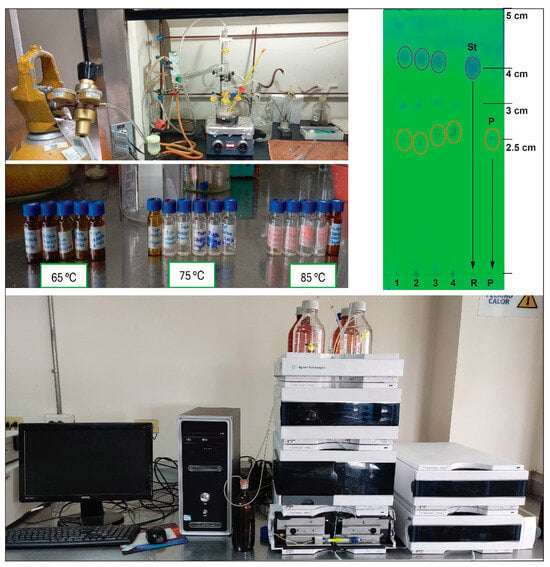
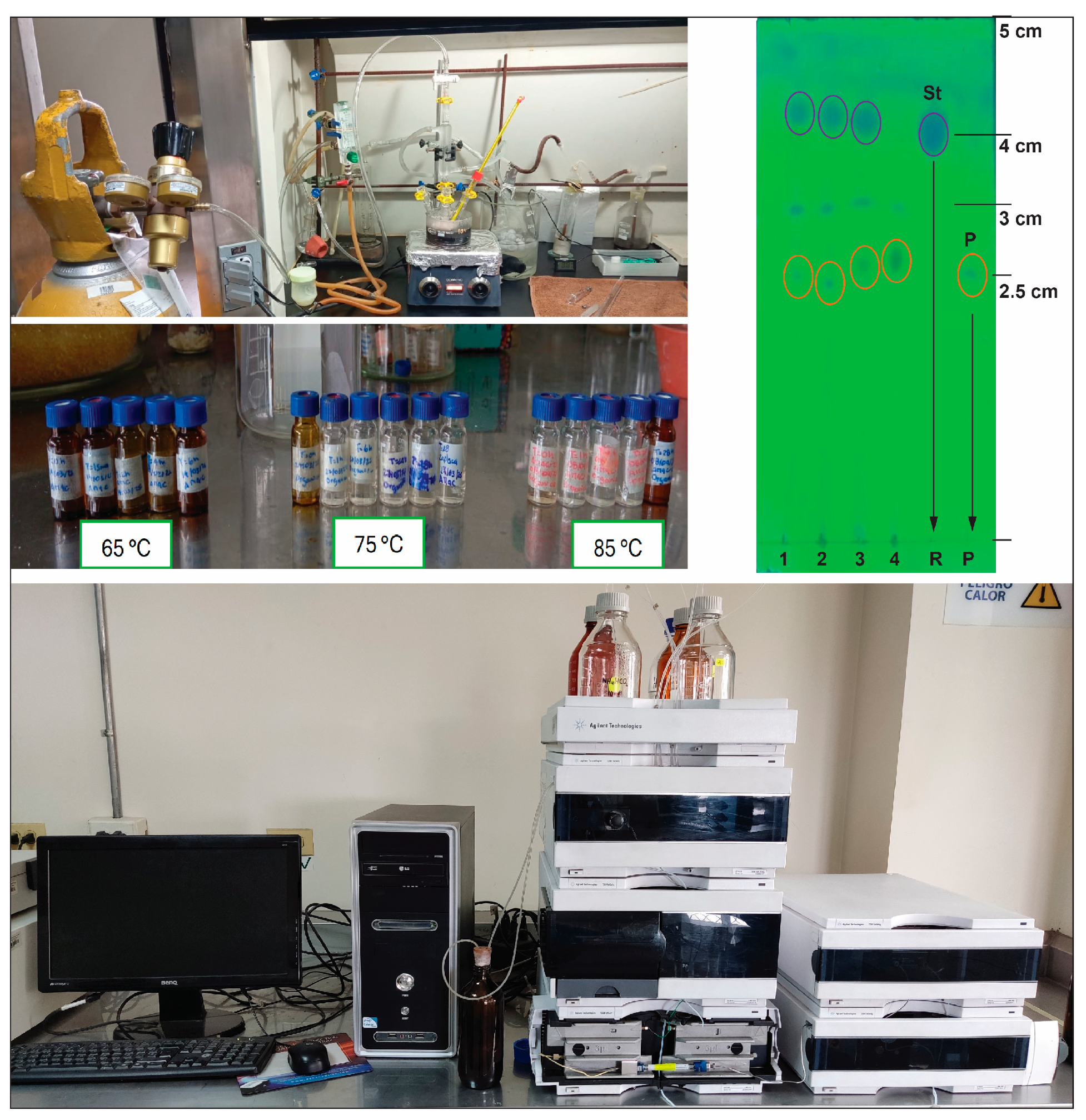
The reaction was carried out in a batch system under a nitrogen atmosphere. In a three-neck flask equipped with a thermometer, connectors, and a condenser, the reactants (1) (50 mg, 0.292 mmol) were dissolved in 60 mL tert-butanol, stirred at 600 rpm and heated to 50 °C for 10 min. Next, 180 mg (1.664 mmol) of tert-BuOK was added as a catalyst and maintained under stirring for 10 min. Subsequently, the monohydrate of glyoxylic acid (160 mg, 2.16 mmol) was added at this temperature. (2) The mixture was heated in an oil bath at the study temperatures (65, 75 and 85 °C) with constant stirring at 600 rpm. The conversion was monitored using thin-layer chromatography (TLC) (chloroform; methanol; glacial acetic acid 9; 0.9; 0.5) and high-performance liquid chromatography (HPLC) (UV-vis in ethanol [λmax (nm)]: 260) at defined time intervals (Figure 2). The final product (3) was recrystallized in ethanol, yielding yellow crystals.
Figure 2.
Experimental setup. Upper left: Laboratory setup, Left-middle: Sample vials, Right: Reaction monitoring: 1–4 progressing time, R = Raw material (1), P = Product (3). Lower part: HPLC setup.
Characterization was performed using Fourier-transform infrared spectroscopy (FTIR) with a Perkin-Elmer Spectrum Two spectrometer (Shelton, CT, USA), covering a range of 500 to 4000 cm−1. UV-Vis spectra were recorded using an UV-Vis Spectrometer from Agilent Technologies, model Cary 60, manufactured in Penang, Malaysia. Reaction monitoring and concentration data were obtained using an Agilent Technologies 1260 Series Infinity HPLC, employing a 150 × 4.6 mm RP-18 column. Finally, gas chromatography coupled with mass spectrometry (GC-MS) was conducted using an Agilent Technologies 5977E MSD (NIST 2014). Reaction monitoring was carried out via thin-layer chromatography (TLC) using silica plates with a mobile phase of chloroform, methanol, and glacial acetic acid in the ratios of 9:0.9:0.5. Product purification was achieved through recrystallization in ethanol.
The kinetic data were analyzed using the following mathematical methods: integral, differential, and nonlinear regression.
3. Results and Discussion
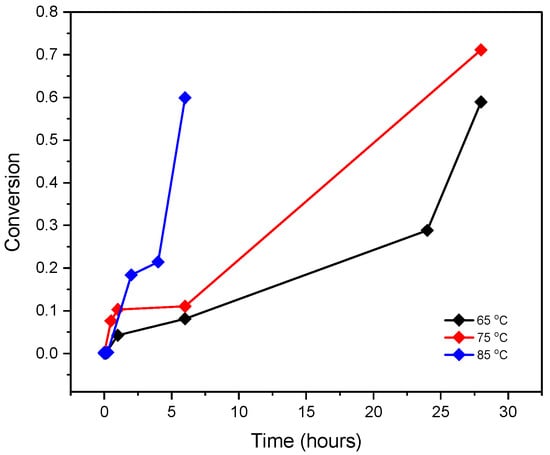
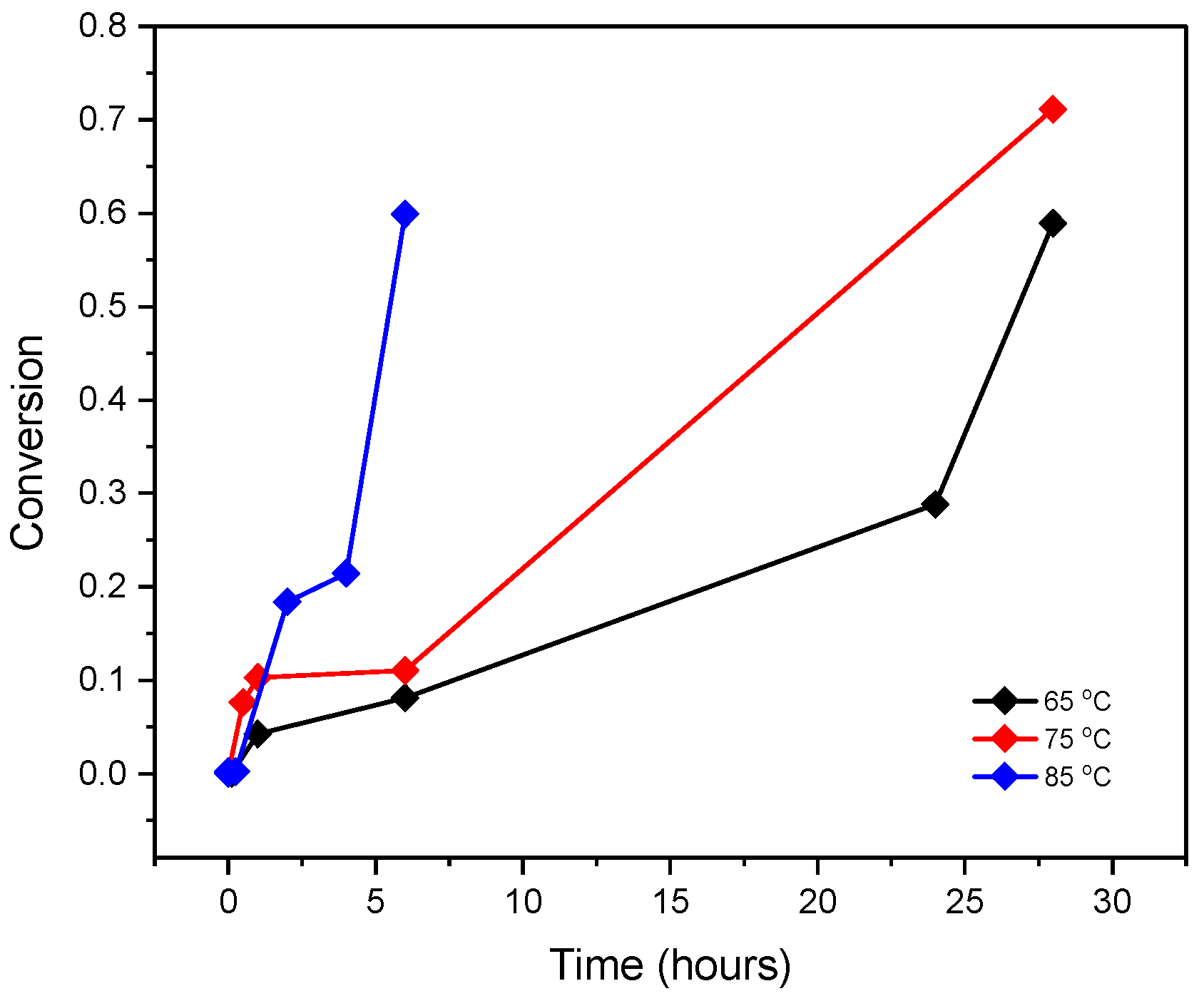
The unsaturated acid (3) was obtained under experimental conditions at a temperature of 75 °C over a period of 28 h, with a total yield of 81.40%. In contrast, at temperatures of 65 °C and 85 °C, the yields were 17.01% and 72.59%, respectively, and total conversion was not achieved.
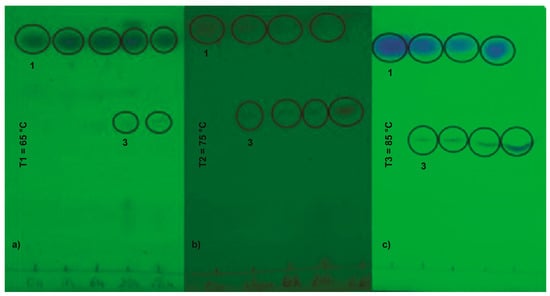
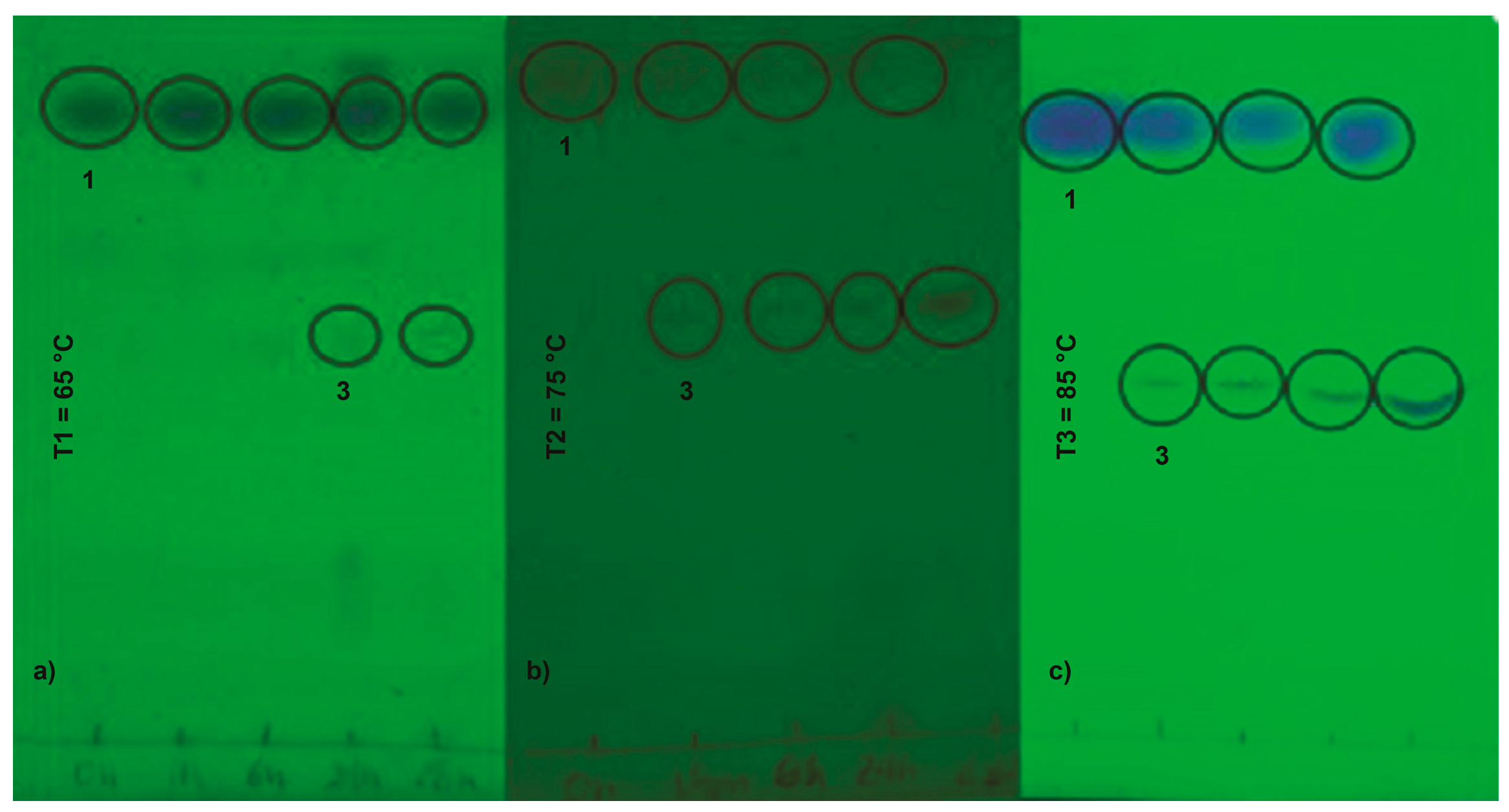
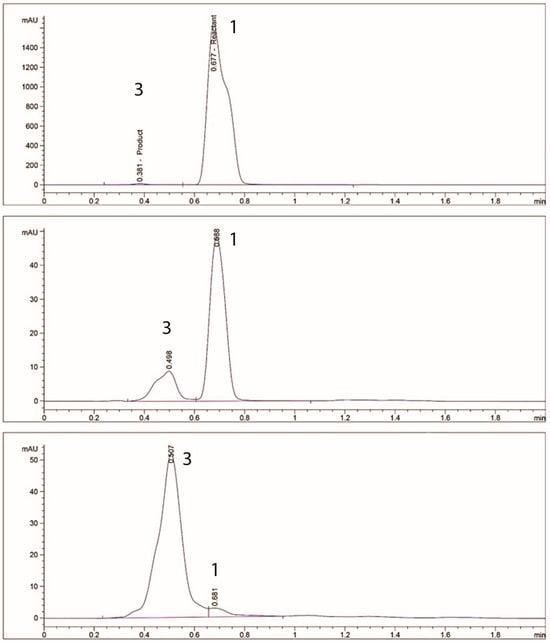
In Figure 3, the monitoring of the reaction by TLC at the three studied temperatures is shown. It can be observed that at 75 °C, after 28 h of reaction, only compound (3) is detected, while at 85 °C, high conversion occurs within 6 h. In Figure 4, the monitoring of the condensation reaction by HPLC under the conditions of T = 75 °C (t = 0, 6, and 28 h) is presented, clearly and quantitatively illustrating the formation of compound (3).
Figure 3.
Reaction monitoring using TLC. From left to right, the figure presents reaction temperatures of (a) 65 °C, (b) 75 °C, and (c) 85 °C. The label (1) denotes the raw material, while (3) indicates the final product. The stains on each TLC plate are arranged in order of progressive reaction time from left to right.
Figure 4.
Monitoring and quantification of the condensation reaction for the synthesis of (3) via HPLC under the conditions of T = 75 °C (from top to bottom: t = 0, 6, and 28 h).
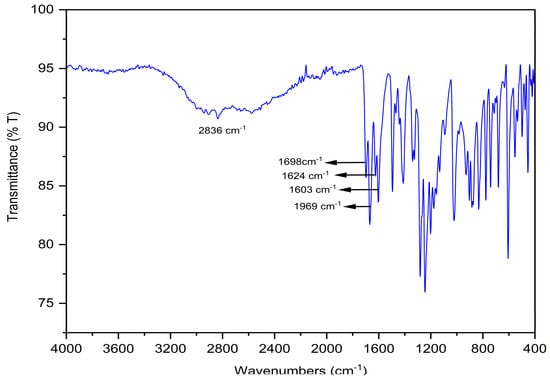
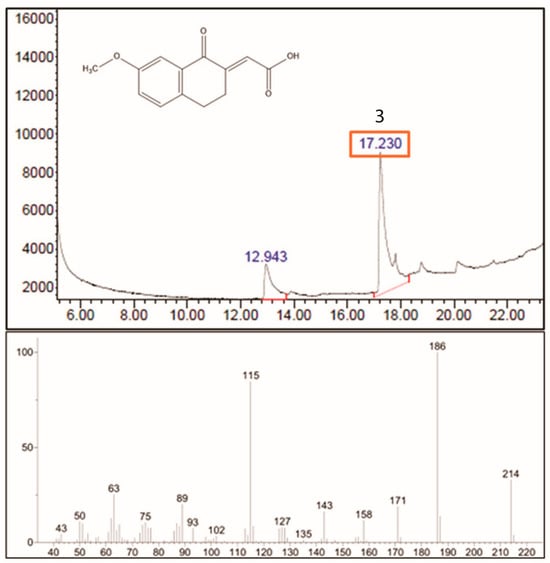
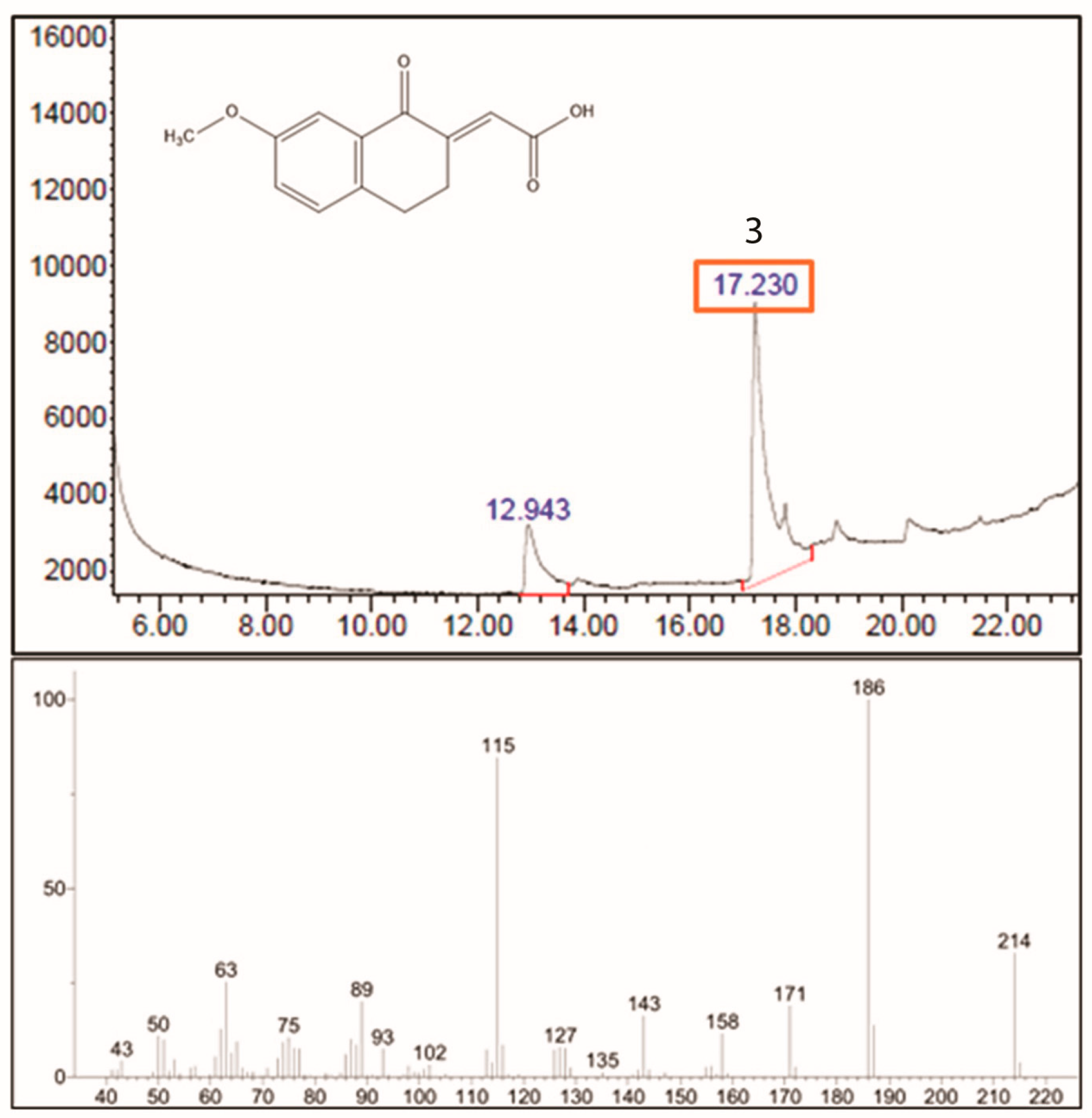
The characterization of the unsaturated acid compound (3) was conducted using FTIR (Figure 5), GC-MS (Figure 6), and UV-Vis spectroscopy, providing detailed information about its structure and purity. In this GC-MS analysis, the mass fragmentation corresponding to the product, which is 214 g mol−1, is observed. Two significant signals are identified in the chromatogram: the first, with a retention time of 12.943 min, represents an intermediate compound or a possible impurity, while the second, with a more abundant signal at 17.230 min, corresponds to the product (3).
Figure 5.
Characterization of (3) via FTIR.
Figure 6.
Characterization of product (3) using GC-MS. The upper graphic displays the chromatogram, while the lower graphic presents the mass spectrum obtained for (3).
The kinetic study showed that the model that best fitted was the pseudo-second order model, determined through nonlinear regression, with a rate constant of 1.77 mL mmol−1 min−1 a 75 °C. The calculated activation energy was 67.22 kJ mol−1, and the pre-exponential factor was 2.19 × 10¹⁰ mL mmol−1 min−1, indicating that the reaction is favorable (see Table 1). In Figure 7, the degree of conversion of reactant (1) to product (3) as a function of time at various temperatures is presented.
Table 1.
Results of the kinetic parameters.
Figure 7.
Conversion to (3) as a function of time at various temperatures.
4. Conclusions
The synthesis of (E)-2-(7-methoxy-1-oxo-3,4-dihydronaphthalen-2(1H)-ylidene)acetic acid (3) was achieved through the Knoevenagel condensation of 7-methoxy-1-tetralone with glyoxylic acid using tert-BuOK at a temperature of 75 °C, yielding 81.40%. The kinetic analysis allowed us to conclude that the reaction follows a pseudo-second order model. The results obtained provide valuable information about the kinetics of this reaction and establish a foundation for future studies in the synthesis and evaluation of derivatives with potential biological activity.
Author Contributions
A.K.R.: Investigation and formal analysis. U.S.: Writing—review and editing, Writing—original draft, Methodology, Investigation, Formal analysis. E.V.C. and J.C.-A.: Writing—review and editing, Validation, Supervision, Formal analysis, Conceptualization. M.E.H.: Validation, Supervision, Formal analysis. All authors have read and agreed to the published version of the manuscript.
Funding
This research was funded by the Universidad Central del Ecuador through the Senior Research Project DI-CONV-2022-049.
Institutional Review Board Statement
Not applicable.
Informed Consent Statement
Not applicable.
Data Availability Statement
The data are included in the manuscript.
Acknowledgments
The authors wish to express their gratitude to the Central University of Ecuador for funding the graduation project “Synthesis of New Amidolidenes-1-Tetralones: Structural, Molecular Interaction, and Antineoplastic Activity Analysis,” with code DI-CONV-2022-049, as well as to the Research Laboratories and Specialized Services of the Faculty of Chemical Engineering at the Central University of Ecuador.
Conflicts of Interest
The authors declare that they have no conflicts of interest.
References
- Lin, S.; March, J. March’s Advanced Organic Chemistry: Reactions, Mechanisms, and Structure, 5th Edition. Molecules 2001, 6, 1064–1065. [Google Scholar] [CrossRef] [Scilit]
- Cheung, M.; Tangirala, R.S.; Bethi, S.R.; Joshi, H.V.; Ariazi, J.L.; Tirunagaru, V.G.; Kumar, S. Discovery of Tetralones as Potent and Selective Inhibitors of Acyl-CoA:Diacylglycerol Acyltransferase 1. ACS Med. Chem. Lett. 2018, 9, 103–108. [Google Scholar] [CrossRef] [Scilit] [PubMed]
- Isac-Garcia, J.; Dobado, J.A.; Calvo-flores, F.G. Experimental Organic Chemistry: Laboratory Manual, 1st ed.; Elsevier: Amsterdam, The Netherlands, 2015; ISBN 978-0-12-803893-2. [Google Scholar]
- Ferraz, H.M.C.; Silva, L.F., Jr.; Aguilar, A.M.; Vieira, T.O. The Reaction of 1-Tetralones with Thallium Trinitrate Supported on Clay: Ring Contraction vs Alpha-Oxidation. J. Braz. Chem. Soc. 2001, 12, 680–684. [Google Scholar] [CrossRef] [Scilit]
- Wen, Y.; Cai, X.; Chen, S.; Fu, W.; Chai, D.; Zhang, H.; Zhang, Y. 7-Methoxy-1-Tetralone Induces Apoptosis, Suppresses Cell Proliferation and Migration in Hepatocellular Carcinoma via Regulating c-Met, p-AKT, NF-κB, MMP2, and MMP9 Expression. Front. Oncol. 2020, 10, 58. [Google Scholar] [CrossRef] [Scilit] [PubMed]
- Li, R.; Liu, Z.; Chen, L.; Pan, J.; Zhou, W. Enantioselective Phase-Transfer Catalyzed Alkylation of 1-Methyl-7-Methoxy-2-Tetralone: An Effective Route to Dezocine. Beilstein J. Org. Chem. 2018, 14, 1421–1427. [Google Scholar] [CrossRef] [Scilit] [PubMed]



Disclaimer/Publisher’s Note: The statements, opinions and data contained in all publications are solely those of the individual author(s) and contributor(s) and not of MDPI and/or the editor(s). MDPI and/or the editor(s) disclaim responsibility for any injury to people or property resulting from any ideas, methods, instructions or products referred to in the content. |
© 2025 by the authors. Licensee MDPI, Basel, Switzerland. This article is an open access article distributed under the terms and conditions of the Creative Commons Attribution (CC BY) license.