


Abstract
Colorectal cancer ranks as the third most prevalent form of cancer on a global scale. The abnormal expression of Peroxiredoxin 1, or PRDX1, plays an important role in cancer progression and tumor cell survival. This makes inhibiting this protein a promising target for colorectal cancer treatment. In order to develop effective PRDX1 inhibitors, a drug design investigation based on computational methods was carried out using a collection of recently synthesized compounds derived from two main chemical base structures: C-5 sulfenylated amino uracils and 1,2,3-triazole benzothiazole derivatives. To obtain the PRDX1 protein PDB ID: 7WET, molecular docking was performed on the studied compounds in combination with PRDX1. The 1,2,3-triazole benzothiazole derivatives showed interesting docking results. For instance, nine promising candidates were distinguished by their formation of better stable complexes with PRDX1 in terms of E (binding) from −7.0 to −7.3 kcal/mol, namely, 7WET-L18, 7WET-L17, 7WET-L25, 7WET-L19, 7WET-L20, 7WET-L26, 7WET-L22, 7WET-L23, and 7WET-L24, as well as an E of −6.8 kcal/mol for Celastrol, a known PRDX1 inhibitor. Moreover, an extensive evaluation of ADME-TOX was performed to predict the pharmacokinetic, pharmacodynamic, and toxicological properties of the compounds studied. The findings offer significant support for the prospective application of these analogs in the fight against colorectal cancer.
1. Introduction
Colorectal cancer (CRC) plays a major role in the worldwide cancer burden, standing out as one of the most frequently occurring cancers across the globe [1,2]. Among the factors involved in CRC pathogenesis, initiation, and development is oxidative stress [3], which is the imbalance between reactive oxygen species (ROS) [4] and antioxidants such as Peroxiredoxins (Prxs) [5], leading to cell damage [2].
Peroxiredoxin 1 (PRX1) is a transcriptional factor expressed during early limb bud mesoderm development [6], belonging to the Prxs family. PRRX1 significantly enhances the growth, survival, and stem cell-like characteristics of CRC via the JAK2/STAT3 pathway by affecting IL-6 as a major transcriptional factor regulating its transcription in CRC [7]. Studies show that PRRX1 plays a crucial role in cell growth and has been suggested as a dependable biomarker for evaluating the probability of tumor metastasis in CRC [8]. Moreover, it was discovered that chemotherapy may exclusively improve the prospects of CRC patients with diminished PRRX1 expression. This makes PRX1 a pivotal target for advancements in anti-CRC therapies [7].
In order to develop effective PRDX1 inhibitors, a drug design investigation based on computational methods was carried out using a collection of recently synthesized compounds, derived from two main chemical base structures—thiol-linked pyrimidine derivatives [9] and 1,2,3-triazole benzothiazole derivatives [10]. To obtain the PRDX1 protein PDB ID: 7WET, molecular docking was performed on the studied compounds in combination with PRDX1.Furthermore, an extensive evaluation of ADME-TOX was performed to predict the pharmacokinetic, pharmacodynamic, and toxicological properties of the compounds studied. The findings offer significant support for the prospective application of these analogs in the fight against colorectal cancer.
2. Materials and Methods
Twenty-seven compounds belonging to thiol-linked pyrimidine and 1,2,3-triazole benzothiazole derivatives were optimized by HyperChem software [11]. The compounds were docked by Autodock Vina [12] using the PyRx—Virtual Screening Tool (https://pyrx.sourceforge.io/, accessed on 5 September 2024). ADME-T prediction of the best compounds out of those selected was conducted using some wed tool such as SwissADME (http://www.swissadme.ch/, accessed on 5 September 2024) and PKCSM (https://biosig.lab.uq.edu.au/pkcsm/, accessed on 5 September 2024).
3. Results and Discussion
3.1. Molecular Docking
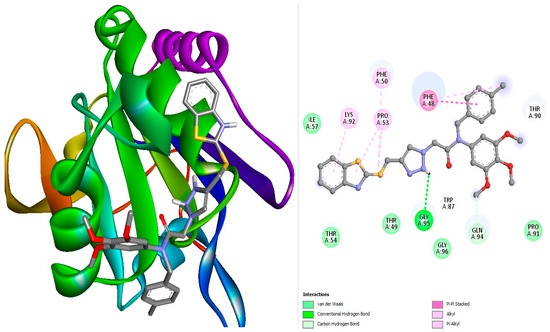
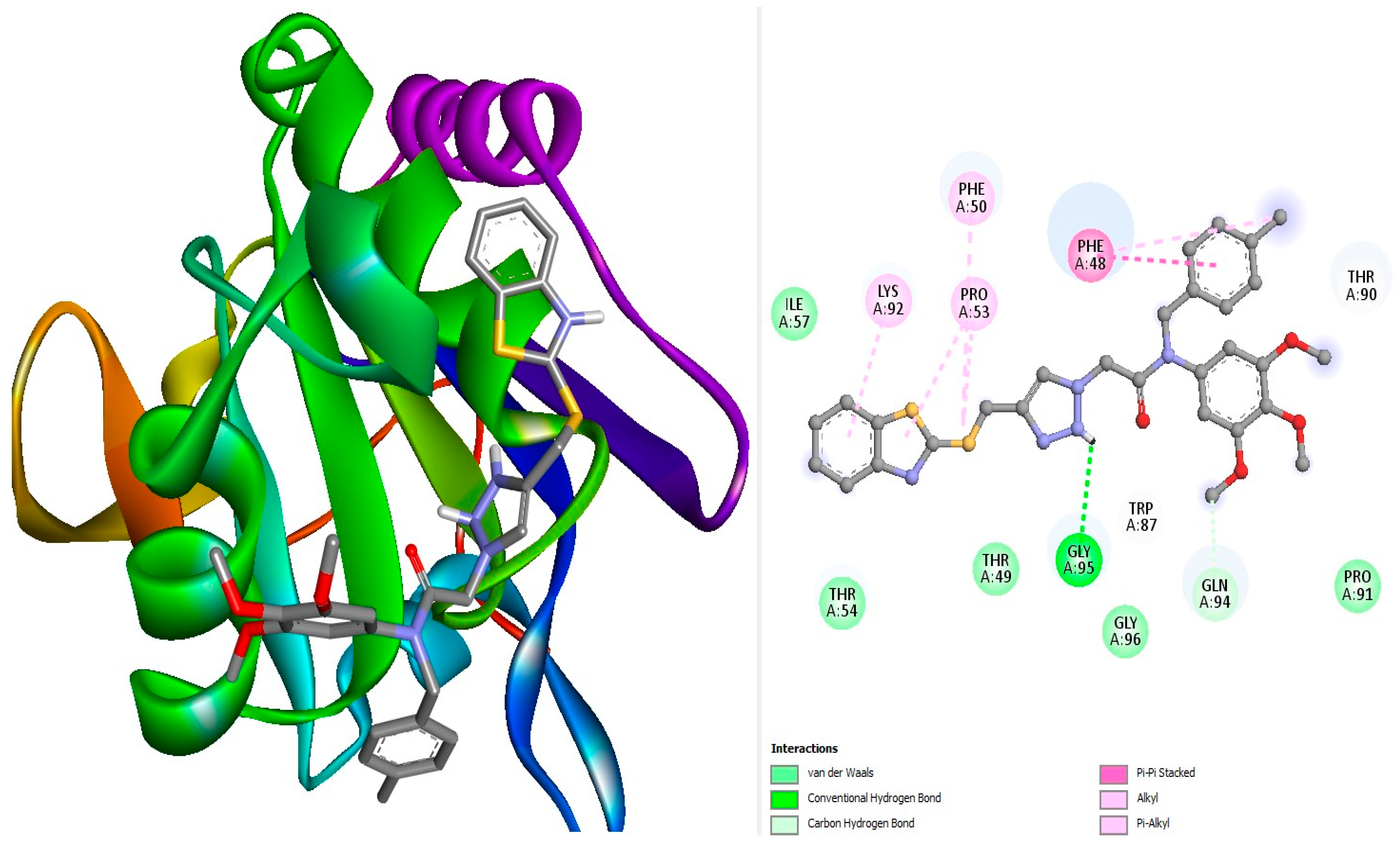
A molecular docking study was conducted for twenty-seven derivatives with PRDX1 in their 7WET protein PDB structure. L18 had the best energy score compared to the other compounds (−9.4 kcal/mol). Figure 1 shows the 2D and 3D interaction diagrams between the active site of 7WET and L18.
Figure 1.
Two-dimensional interactions and three-dimensional illustration of 7WET’s active site and L18.
The total score energy results of the docked complexes, alongside their distances, types of interactions, key residues, atoms involved in the compounds, and the receptor for the 7WET target, are summarized in Table 1.
Table 1.
Docking score and interactions between compounds and 7WET active site.
The reference molecule had a score energy of −6.8 Kcal/mol, without the formation of H-Bonds; however, it showed Pi-Pi interactions with the PHE50 residue.
The nine best compounds were ordered according to their affinity for the formation of stable complexes with the 7WET protein as follows: 7WET-L18 < 7WET-L17, 7WET-L25 < 7WET-L19, 7WET-L20, 7WET-L26 < 7WET-L22, 7WET-L23, and 7WET-L24. Their energy scores were −7.4, −7.3, and −7.2 (kcal/mol), respectively.
3.2. Evaluation ADME-TOX
ADME-T properties play a significant role in drug development [13]. Table 2 summarizes the best pharmacological property profiles of ligands 25, 20, and 26. According to the presented results, all selected compounds had high human intestinal absorption, and they were P-gp substrates. It is worth nothing that all these compounds could not pass through the BBB. These molecules had a similar metabolic profile; they were all metabolized by CYP3A4. The total clearance (CLtot) value of the molecules ranged from 0.73 to 0.78 mL/min/kg, with a T1/2 (h) value between 0.7 and 1.14. No compound presented AMES toxicity, hepatotoxicity, nor skin sensitization. The LD50 value of the studied molecules ranged from 1.75 to 2.4 mol/kg.
Table 2.
ADME-T properties of candidate compounds.
4. Conclusions
According to these findings, we revealed that the three selected cytotoxic molecules—L25, L20, and L26—had very important structures, without toxicity. As such, they should be pay attention to in future studies in order to improve their properties and employ them as effective PRDX1 inhibitors against colorectal cancer.
Author Contributions
I.B. and F.A. carried out data collection and the formal analysis, completed the first draft of the manuscript, and created the software. All the authors commented on previous versions of the manuscript. N.M. contributed to the conceptualization of this research, project administration, and supervision. I.D. guaranteed the validation of this study and curated the data. All authors have read and agreed to the published version of the manuscript.
Funding
This research received no external funding.
Institutional Review Board Statement
Not applicable.
Informed Consent Statement
Not applicable.
Data Availability Statement
Data are contained within this article.
Conflicts of Interest
The authors declare no conflicts of interest.
References
- Adebayo, A.S.; Agbaje, K.; Adesina, S.K.; Olajubutu, O. Colorectal Cancer: Disease Process, Current Treatment Options, and Future Perspectives. Pharmaceutics 2023, 15, 2620. [Google Scholar] [CrossRef] [Scilit] [PubMed]
- Marcellinaro, R.; Spoletini, D.; Grieco, M.; Avella, P.; Cappuccio, M.; Troiano, R.; Lisi, G.; Garbarino, G.M.; Carlini, M. Colorectal Cancer: Current Updates and Future Perspectives. J. Clin. Med. 2024, 13, 40. [Google Scholar] [CrossRef] [Scilit] [PubMed]
- Bardelčíková, A.; Šoltys, J.; Mojžiš, J. Oxidative Stress, Inflammation and Colorectal Cancer: An Overview. Antioxidants 2023, 12, 901. [Google Scholar] [CrossRef] [Scilit] [PubMed]
- Saraiva, M.R.; Rosa, I.; Claro, I. Early-onset colorectal cancer: A review of current knowledge. World J. Gastroenterol. 2023, 29, 1289–1303. [Google Scholar] [CrossRef] [Scilit] [PubMed]
- Fischer, J.; Eglinton, T.W.; Frizelle, F.A.; Hampton, M.B. Peroxiredoxins in Colorectal Cancer: Predictive Biomarkers of Radiation Response and Therapeutic Targets to Increase Radiation Sensitivity? Antioxidants 2018, 7, 136. [Google Scholar] [CrossRef] [Scilit] [PubMed]
- Zhong, L.; Tan, W.; Yang, Q.; Zou, Z.; Zhou, R.; Huang, Y.; Qiu, Z.; Zheng, K.; Huang, Z. PRRX1 promotes colorectal cancer stemness and chemoresistance via the JAK2/STAT3 axis by targeting IL-6. J. Gastrointest. Oncol. 2022, 13, 2989–3008. [Google Scholar] [CrossRef] [Scilit] [PubMed]
- Xu, H.; Zhao, H.; Ding, C.; Jiang, D.; Zhao, Z.; Li, Y.; Ding, X.; Gao, J.; Zhou, H.; Luo, C.; et al. Celastrol suppresses colorectal cancer via covalent targeting peroxiredoxin 1. Signal Transduct. Target. Ther. 2023, 8, 51. [Google Scholar] [CrossRef] [Scilit] [PubMed]
- Thapa, P.; Jiang, H.; Ding, N.; Hao, Y.; Alshahrani, A.; Wei, Q. The Role of Peroxiredoxins in Cancer Development. Biology 2023, 12, 666. [Google Scholar] [CrossRef] [Scilit]
- Rani, P.; Chahal, S.; Kumar, R.; Mayank, K.P.; Negi, A.; Singh, R.; Kumar, S.; Kataria, R.; Joshi, G.; Sindhu, J. Electro-organic synthesis of C-5 sulfenylated amino uracils: Optimization and exploring topoisomerase-I based anti-cancer profile. Bioorganic Chem. 2023, 138, 106660. [Google Scholar] [CrossRef] [Scilit] [PubMed]
- Wu, B.W.; Huang, W.J.; Liu, Y.H.; Liu, Q.G.; Song, J.; Hu, T.; Chen, P.; Zhang, S.Y. Design, synthesis and biological evaluation of 1,2,3-triazole benzothiazole derivatives as tubulin polymerization inhibitors with potent anti-esophageal cancer activities. Eur. J. Med. Chem. 2024, 265, 116118. [Google Scholar] [CrossRef] [Scilit] [PubMed]
- HyperChem(TM) Professional 7.51; Hypercube, Inc.: Gainesville, FL, USA, 2001.
- Eberhardt, J.; Santos-Martins, D.; Tillack, A.F.; Forli, S. AutoDock Vina 1.2.0: New Docking Methods, Expanded Force Field, and Python Bindings. J. Chem. Inf. Model. 2021, 61, 3891–3898. [Google Scholar] [CrossRef] [Scilit] [PubMed]
- Saghiri, K.; Daoud, I.; Melkemi, N.; Mesli, F. Molecular docking/dynamics simulations, MEP analysis, and pharmacokinetics prediction of some withangulatin A derivatives as allosteric glutaminase C inhibitors in breast cancer. Chem. Data Collect. 2023, 46, 101044. [Google Scholar] [CrossRef] [Scilit]

Disclaimer/Publisher’s Note: The statements, opinions and data contained in all publications are solely those of the individual author(s) and contributor(s) and not of MDPI and/or the editor(s). MDPI and/or the editor(s) disclaim responsibility for any injury to people or property resulting from any ideas, methods, instructions or products referred to in the content. |
© 2024 by the authors. Licensee MDPI, Basel, Switzerland. This article is an open access article distributed under the terms and conditions of the Creative Commons Attribution (CC BY) license (https://creativecommons.org/licenses/by/4.0/).