1. Introduction
Type 2 diabetes (T2D) is among the most common chronic diseases worldwide and represents a substantial public health burden. Globally, diabetes affects approximately 540 million adults, and this burden is projected to rise to 780 million by 2045, with the greatest impact occurring in low- and middle-income countries [
1]. In Mexico, diabetes is highly prevalent, affecting approximately 18.3% of adults aged 20 years and older, corresponding to nearly 14.6 million individuals. These figures are particularly alarming considering that diabetes is also one of the leading causes of death and healthy life-years lost in the country [
2].
T2D is a complex disease that requires sustained medical care and a long-term commitment to self-management behaviors to achieve adequate glycemic control. These behaviors include maintaining a healthy diet, engaging in regular physical activity, attending follow-up medical appointments, and adhering to prescribed medication [
3]. However, medication adherence remains a significant challenge among people living with chronic diseases. Available evidence indicates that, on average, only about half of patients in high-income countries adhere adequately to their treatment regimens, and adherence rates are likely even lower in low- and middle-income settings [
4].
Despite the central role of pharmacological treatment in diabetes management, medication adherence remains a complex, multifactorial behavior shaped by clinical, socioeconomic, and psychological factors. In recent years, increasing attention has been given to the role of psychosocial factors in shaping patients’ capacity to engage in long-term self-care. Among these factors, adaptive coping has emerged as a key construct for understanding how individuals respond to the demands of chronic illness and manage the emotional and practical challenges associated with lifelong treatment [
5].
Coping refers to the cognitive and behavioral efforts individuals use to manage the internal and external demands of stressful situations [
5,
6,
7]. These responses may be adaptive or maladaptive depending on whether they promote effective adjustment and well-being. Adaptive coping involves strategies that facilitate problem-solving, emotional regulation, and constructive engagement with challenges, whereas non-adaptive coping may provide short-term relief but ultimately compromise health and functioning [
7].
In the context of chronic diseases such as T2D, coping represents a dynamic process of psychological and behavioral adaptation to a persistent health-related stressor [
8]. Rather than being a static or dichotomous attribute, adaptive coping operates along a continuum of adaptive capacity, reflecting different levels of adjustment and engagement with long-term treatment demands [
9]. Higher levels of adaptive coping are characterized by more effective integration of the disease into daily life and greater involvement in self-care behaviors. In contrast, lower levels reflect difficulties with adjustment and greater vulnerability to suboptimal treatment behaviors [
8]. This conceptualization is consistent with adaptation models of chronic illness, which describe healthy behavior as the result of continuous regulatory and cognitive responses to persistent physiological and environmental demands [
9]. In particular, Roy’s Adaptation Model conceptualizes individuals as adaptive systems that continuously respond to internal and external stimuli through integrated regulatory and cognizant subsystems. Within this framework, coping is not reducible to isolated strategies (i.e., problem-focused or emotion-focused responses) but rather reflects a broader adaptive processing capacity that shapes behavioral responses in the physiological, self-concept, role, and interdependence domains [
10,
11]. In chronic conditions such as T2D, this adaptive processing capacity may also be influenced by individual and clinical characteristics, including age, sex, duration of diabetes, and the presence of comorbidities, which can modify both the demands imposed by the disease and the individual’s capacity to respond to them.
The Coping and Adaptation Processing Scale (CAPS) was developed within this theoretical model and operationalizes coping as an integrative adaptive capacity, rather than as discrete coping styles [
12]. By assessing how individuals process and respond to ongoing demands, CAPS captures variation in overall adaptive functioning, which can be particularly relevant in chronic diseases such as T2D, where sustained behavioral regulation is required over time [
11]. Accordingly, throughout this study, adaptive coping is conceptualized as a global adaptive processing capacity, consistent with the CAPS framework, rather than as a set of discrete coping strategies.
Within this adaptive perspective, prior research examining specific coping strategies has shown that patterns characterized by active engagement with illness-related demands (i.e., problem-solving, treatment planning, cognitive reframing, and support seeking) are generally associated with better psychological adjustment and sustained participation in self-care behaviors [
13]. In contrast, disengagement-oriented responses, such as denial or behavioral withdrawal [
14], have been linked to poorer long-term health outcomes and lower adherence. Although these studies typically operationalize coping through discrete strategy-based frameworks, their findings are consistent with the broader concept of adaptive processing capacity.
Although several studies have examined coping strategies and self-care behaviors in adults with T2D, evidence linking coping to medication adherence remains inconsistent. Investigations focusing on emotional or problem-focused coping have shown mixed associations with adherence outcomes [
15,
16], and systematic reviews highlight considerable heterogeneity in how coping is operationalized and related to treatment behaviors [
17,
18,
19].
One possible explanation is the predominant reliance on strategy-specific frameworks that assess isolated coping behaviors rather than overall adaptive capacity. Such fragmentation may obscure the cumulative and regulatory nature of coping with chronic illness. Conceptualizing coping as an integrated adaptive processing capacity may therefore provide a more coherent understanding of how individuals regulate treatment-related behaviors.
Adaptive processing capacity may be particularly relevant for understanding medication adherence, as adherence requires sustained behavioral regulation rather than isolated responses to specific stressors. Unlike strategy-based coping frameworks that capture situational responses, CAPS reflects the individual’s overall capacity to integrate cognitive, emotional, and behavioral resources in the face of ongoing illness-related demands. This broader adaptive perspective may therefore provide additional explanatory value for understanding persistent treatment behaviors such as medication adherence in chronic conditions.
This gap is particularly relevant in low- and middle-income settings, where the burden of diabetes is high and structural barriers may further compromise long-term adherence [
20,
21]. Generating context-specific evidence may inform psychosocial strategies to support medication adherence in routine primary care. Therefore, we aimed to evaluate the association between adaptive coping and medication adherence in adults with T2D.
3. Results
Table 1 presents the general characteristics of the study population. Most participants were women (64.0%) and aged 60 years or older (57.7%). The majority lived with a partner and/or adult children (84.8%), and 85.5% had a stable partner. Approximately half (50.6%) had completed primary education, and 69.8% reported a monthly household income below USD 508.
Regarding clinical characteristics, 33.7% had been diagnosed with T2D for less than 5 years, oral hypoglycemic agents were the most common treatment (39.8%), and 60.5% had 1 or 2 comorbidities. Overall, 81.4% of participants were classified as non-adherent to their medication regimen.
Adaptive coping scores were significantly higher among adherent participants compared to non-adherent participants. This difference was consistent when coping was analyzed using both the mean and the median (both
p < 0.001;
Table 2). When coping was categorized for descriptive purposes, non-adherent participants showed a higher proportion of medium and low adaptive coping levels (
p < 0.001;
Table S1).
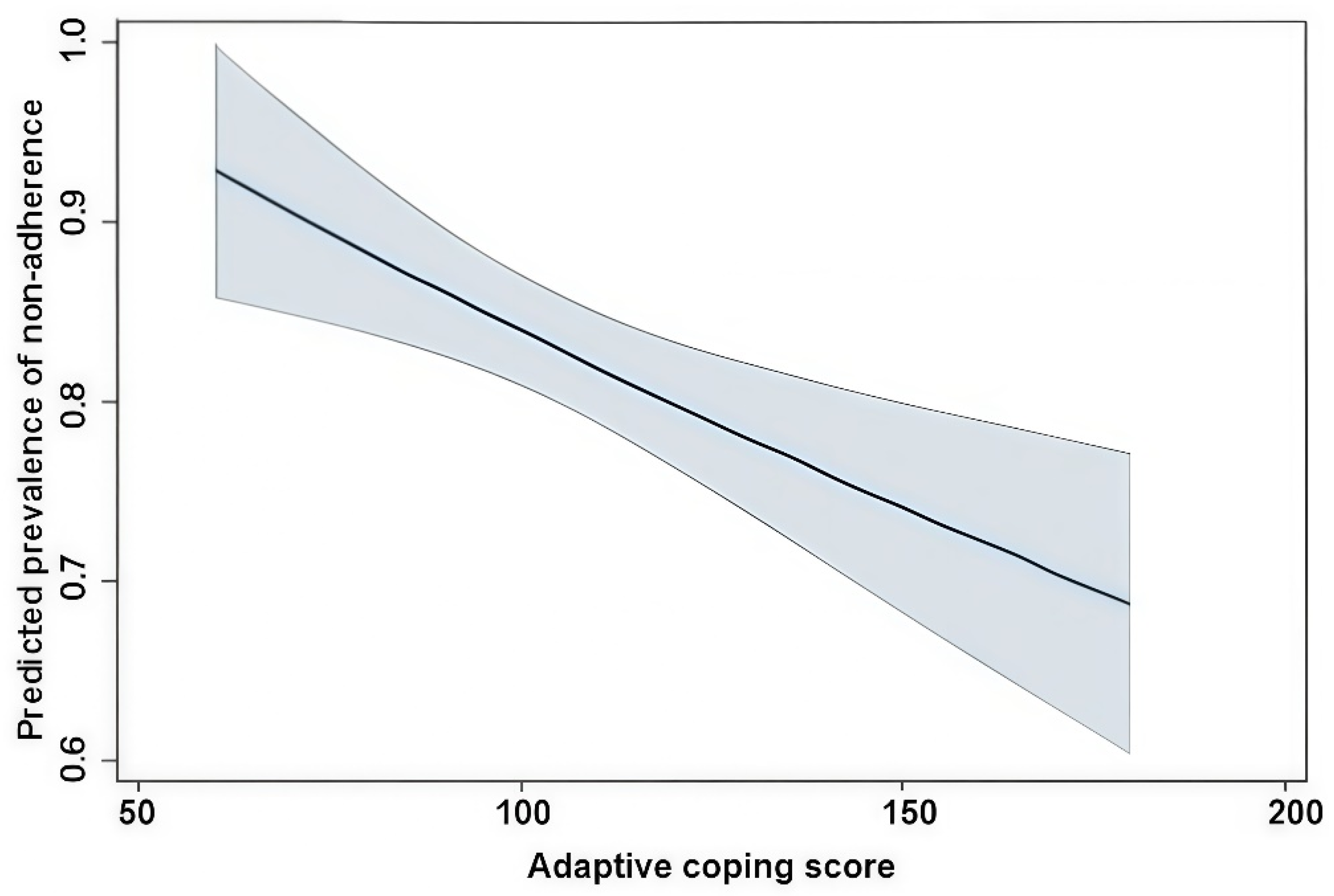
After adjustment for potential confounding variables, higher adaptive coping was significantly associated with a lower prevalence of medication non-adherence. A 20-point increase in coping score was associated with a 4.8% lower prevalence of non-adherence (PR = 0.952; 95% CI: 0.924–0.981;
p = 0.001;
Table 3). To visually represent this association,
Figure 1 displays the adjusted predicted prevalence of medication non-adherence across the observed range of adaptive coping scores, derived from the fully adjusted model.
To assess the robustness of these associations to unmeasured confounding, E-values were calculated. For the association between adaptive coping (per 20-point increase) and medication non-adherence (PR = 0.95), the E-value was 1.29, and for the confidence limit closest to the null (PR = 0.98), the E-value was 1.16. This suggests that an unmeasured confounder would need to be associated with both adaptive coping and non-adherence, with a PR of at least 1.16 for each (beyond the measured covariates) to move the confidence interval to the null.
In a sensitivity analysis, where medication non-adherence was defined as a Morisky score ≥2, the prevalence decreased to 69.5%. In the adjusted model, higher adaptive coping remained significantly associated with a lower prevalence of non-adherence (PR per 20-point increase = 0.93; 95% CI: 0.90–0.97), showing results consistent with the primary analysis (
Table S2).
Additionally, adaptive coping was categorized according to the instrument-defined levels (high, medium, and low). After adjustment for potential confounders, participants with medium adaptive coping had a higher prevalence of medication non-adherence compared with those with high coping (adjusted PR = 1.27; 95% CI: 1.10–1.47;
p = 0.001). Low adaptive coping was similarly associated with non-adherence (adjusted PR = 1.29; 95% CI: 1.09–1.52;
p = 0.002). A significant linear trend across coping categories was observed (
p for trend = 0.001). Similar associations in the same direction were observed in crude models (
Table S3). When the alternative Morisky definition (≥2) was applied, low adaptive coping remained significantly associated with a higher prevalence of medication non-adherence. In contrast, the association for medium coping was attenuated and no longer statistically significant, although the overall trend across coping categories persisted (
Table S4).
On the other hand, when interaction terms between adaptive coping (continuous) and sex, as well as between adaptive coping and time since T2D diagnosis, were included in the adjusted model, neither interaction term was statistically significant (
p = 0.385 and
p = 0.895, respectively) (
Table 4).
4. Discussion
Our results suggest an association between lower levels of adaptive coping and a higher prevalence of medication non-adherence in adults with T2D. Individuals with low or moderate coping exhibited a significantly higher prevalence of non-adherence compared with those with high adaptive coping, even after adjustment for sociodemographic and clinical factors. These findings add to the literature describing the potential role of psychosocial factors in the context of chronic disease management.
Globally, medication non-adherence remains a significant public health problem among adults with T2D. A previous meta-analysis published in 2023, which included 156 studies and more than 10 million participants from Asia, Europe, Africa, and North America, reported an overall non-adherence prevalence of 46% [
4]. While this estimate reflects a considerable global burden, Latin American populations were underrepresented, as only one included study included participants of Latin American origin residing in the United States. Consequently, current global estimates may not adequately reflect the extent of non-adherence in Latin America.
In Mexico, evidence suggests that non-adherence may be more pronounced. In the present study, 81.4% of participants were classified as non-adherent. While this figure is higher than pooled global estimates, it is consistent with previous reports from Mexican primary care centers, where prevalences of 80.8% [
29] and 82.0% [
24] have been reported. Lower prevalences have been reported in other regions, such as Baja California Sur (63%) [
30] and Tabasco (27.5%) [
31], likely reflecting heterogeneity in study populations, measurement methods, and sociodemographic composition.
The high prevalence observed in our study may partly reflect the strict binary classification of the four-item Morisky–Green–Levine Scale, which classifies any positive response as non-adherent. This approach prioritizes sensitivity and could increase the proportion of individuals classified as non-adherent. In a sensitivity analysis using a more specific definition of non-adherence (Morisky score ≥ 2), the overall prevalence decreased; however, the general pattern of low adherence remained evident. However, it is important to contextualize these findings within national target indicators. According to the 2022–2023 Encuesta Nacional de Salud y Nutrición (ENSANUT) [National Health and Nutrition Survey], a nationally representative survey of the Mexican population, only 25.8% of adults diagnosed with type 2 diabetes achieved adequate glycemic control (HbA1c < 7%), implying that approximately 74.2% had suboptimal glycemic control at the population level. While glycemic control is not a direct measure of adherence, this objective biomarker indicates substantial therapeutic challenges in Mexico [
32]. Therefore, the high prevalence observed in our study likely reflects both measurement characteristics and the broader national context.
Differences between studies may also be influenced by age distribution and clinical complexity. Older adults with chronic diseases such as T2D may experience cognitive decline, polypharmacy, and a heavy treatment burden, all of which can make consistent medication adherence difficult. These factors should be considered when interpreting regional variations in adherence estimates.
In our analysis, individuals with lower levels of adaptive coping showed a substantially higher prevalence of medication non-adherence compared to those with higher levels of coping. While prior studies have primarily focused on discrete coping strategies, our findings refer to global adaptive coping capacity as conceptualized by CAPS.
Unlike strategy-based coping frameworks that focus on specific situational responses, CAPS conceptualizes coping as an integrative, adaptive processing capacity that reflects the individual’s overall ability to regulate cognitive, emotional, and behavioral responses to the demands of chronic illness. This broader perspective may be particularly relevant for understanding sustained treatment behaviors such as medication adherence, which require long-term behavioral regulation rather than isolated coping responses.
Within this broader adaptive framework, our findings are consistent with strong evidence linking coping processes to diabetes treatment-related behaviors. Previous studies have shown that greater coping effort is associated with better adherence to insulin use, glucose control, and dietary recommendations, as well as with better glycemic control [
33].
An additional observation from our categorical analyses is that the association between coping and medication adherence was more evident among individuals with the lowest coping levels. When a more specific definition of non-adherence was applied, the intermediate coping category was no longer significantly different from the highest coping category. This pattern suggests that moderate coping levels may not differ substantially from high coping in relation to medication adherence, whereas lower coping levels were associated with a higher prevalence of non-adherence.
Although the association observed in our study suggests that adaptive coping may play a role in medication-taking behavior, the effect size was modest. Coping processes rarely operate in isolation and often coexist with other psychosocial factors commonly reported among individuals living with diabetes, such as depressive symptoms, diabetes-related distress, or limited social support. These factors may influence both coping processes and treatment-related behaviors and, therefore, could partially contribute to the observed association. Consequently, some degree of residual confounding cannot be completely ruled out.
Current international diabetes care recommendations emphasize the importance of addressing psychosocial factors in comprehensive diabetes management. The American Diabetes Association Standards of Care recommend integrating psychosocial assessment into routine diabetes care to identify factors that may influence patients’ ability to engage in long-term self-management behaviors, including medication adherence [
34]. Within this broader framework, coping may represent one of several psychosocial characteristics observed among individuals living with diabetes and managing pharmacological treatment.
Although the present study conceptualized coping as a global adaptive processing capacity rather than as discrete coping strategies, prior research examining specific coping styles has reported similar patterns. Previous studies examining specific coping styles suggest that not all coping strategies are equally associated with medication adherence. Supportive and problem-focused coping have been consistently associated with better medication adherence, whereas avoidance-oriented responses tend to be linked to poorer adherence [
16,
19,
35]. In addition, emotional processing (defined as the recognition and active processing of illness-related emotions) has been positively associated with self-care behaviors, including medication use [
15].
It is important to highlight that coping is influenced not only by individual tendencies but also by the healthcare context. Healthcare professional attributes, such as compassion and optimism, can improve patients’ coping abilities, thereby indirectly improving adherence behaviors [
36].
From a theoretical perspective, these findings are consistent with Roy’s Adaptation Model, which conceptualizes coping as a dynamic regulatory process through which individuals respond to internal and external stimuli to maintain adaptive functioning. Within this framework, medication adherence can be interpreted as a behavioral expression of effective adaptive processing in the context of a chronic illness [
11,
12].
Regarding potential effect modification, no statistically significant interactions were observed between adaptive coping and sex or time since type 2 diabetes diagnosis in the adjusted continuous models. These findings suggest that the association between adaptive coping and medication non-adherence was relatively consistent across all demographic and clinical subgroups.
Previous literature has reported sex-related differences in coping styles, with women more frequently engaging in support-seeking and emotion-focused responses, and men more often reporting avoidance-oriented strategies [
37]. Our analyses did not detect a statistically significant interaction between adaptive coping and sex, suggesting that the association observed in this study was broadly consistent across men and women.
Similarly, the lack of interaction with the time elapsed since diagnosis indicates that adaptive coping is associated with medication adherence at different stages of disease progression. While the initial phase of diabetes is often characterized by significant psychological and behavioral adaptation demands, including integrating treatment, redefining identity, and establishing new routines [
11,
38], our results do not support a stage-specific effect. Instead, they are consistent with the idea that coping represents a dynamic and continuous process of adaptation that continues to shape therapeutic behaviors throughout the course of chronic disease [
8,
39].
Limitations
This study has several limitations that should be considered when interpreting the findings. First, given the cross-sectional design, a temporal precedence between adaptive coping and medication adherence cannot be established. Although adaptive coping was conceptualized as a potential protective factor influencing adherence behaviors, both variables were assessed concurrently, precluding conclusions about directionality. Therefore, it is plausible that the relationship may operate in the opposite direction, with difficulties maintaining adherence, treatment fatigue, or suboptimal clinical outcomes negatively influencing individuals’ coping responses over time. Furthermore, the association may reflect a bidirectional dynamic in which coping strategies and adherence behaviors mutually reinforce each other within the broader context of chronic disease management. Given that coping was assessed via self-report, perceptions of coping may also reflect individuals’ current experiences with disease management. Consequently, the findings should be interpreted as correlational rather than causal. Longitudinal or prospective studies are needed to clarify the temporal sequence and determine whether adaptive coping precedes, results from, or dynamically interacts with improved adherence over time.
Second, medication adherence was assessed using a self-reported questionnaire rather than objective indicators such as pharmacy refill records or biomarkers of glycemic control. Self-reported measures may be affected by recall inaccuracies or social desirability tendencies. If present, these reporting tendencies would more likely lead to an underestimation rather than an overestimation of non-adherence. Despite this possibility, the prevalence of non-adherence observed in our study remained high. One explanation may relate to the strict binary classification used in the four-item Morisky–Green–Levine scale, in which any positive response is categorized as non-adherence. This approach prioritizes sensitivity and may increase the proportion of individuals classified as non-adherent. To examine the robustness of our findings, we conducted a sensitivity analysis using an alternative threshold (Morisky score ≥ 2). Although this definition reduced the overall prevalence of non-adherence, the general pattern of low adherence remained evident. This pattern is also consistent with national evidence from ENSANUT indicating persistent challenges in glycemic control among adults with T2D in Mexico.
Similarly, coping was assessed using a psychometric scale that reflects participants’ subjective perceptions rather than directly observed behavioral patterns. Moreover, coping is a dynamic construct that may vary over time and across clinical contexts; therefore, a single-point measurement may not fully capture its complexity.
Third, both exposure and outcome were measured using self-report instruments collected concurrently. When both variables are obtained using the same reporting method, shared response tendencies or general psychological states can influence how participants report on both constructs. This may introduce common-method variance and potentially inflate the observed associations between coping and adherence. Thus, future studies should incorporate more objective measures of medication adherence, such as pharmacy refill records, electronic monitoring systems, or biomarkers of glycemic control (i.e., HbA1c), to further minimize reporting bias.
Although several relevant sociodemographic and clinical variables were adjusted for, including comorbidities as indicators of treatment complexity and potential polypharmacy, some degree of residual confounding cannot be completely ruled out. In particular, the study lacked detailed information on certain psychosocial factors that may influence both coping processes and treatment-related behaviors, such as depressive symptoms, diabetes-related distress, or perceived social support.
From a theoretical perspective, the conceptual framework guiding this study is grounded in adaptation-based nursing theory, particularly Roy’s Adaptation Model, in which coping processes are conceptualized as central mechanisms shaping adaptive or maladaptive responses to chronic illness. Within this framework, depressive symptoms may be interpreted as a possible maladaptive outcome of ineffective coping rather than as a clear antecedent confounder. However, given the cross-sectional design of the study, the temporal ordering between coping processes, depressive symptoms, and medication adherence cannot be definitively established, and alternative causal structures remain plausible.
The magnitude of the observed association between adaptive coping and medication non-adherence was modest. In addition, the E-value analysis indicates that a relatively moderate unmeasured confounder associated with both coping and adherence could potentially attenuate the observed association. Therefore, although the findings suggest a relationship between adaptive coping and medication-taking behavior, they should be interpreted cautiously, as unmeasured psychosocial or behavioral factors may partially explain the observed association.
Another limitation concerns the study setting and sampling strategy. Participants were conveniently sampled from two primary healthcare centers in Mexico that serve populations without social security coverage. This non-probabilistic sampling approach may limit representativeness and introduce selection bias, as individuals who attend these centers and agree to participate may differ systematically from those receiving care in other healthcare settings or from those who decline to participate. Although these centers serve a large and socioeconomically diverse population receiving routine diabetes care, our findings may not be directly generalizable to patients treated in other healthcare subsystems, such as social security institutions, private clinics, or hospital-based settings. Therefore, future studies should aim to replicate these results in different healthcare contexts. Nevertheless, the consistency of the observed associations and the presence of a precise dose–response pattern suggest that our findings are internally coherent within the study population.
Finally, although the sample size was sufficient to detect the main associations, it may have limited the ability to identify small interaction effects. Therefore, subtle heterogeneity across subgroups cannot be entirely excluded.




 ,
,