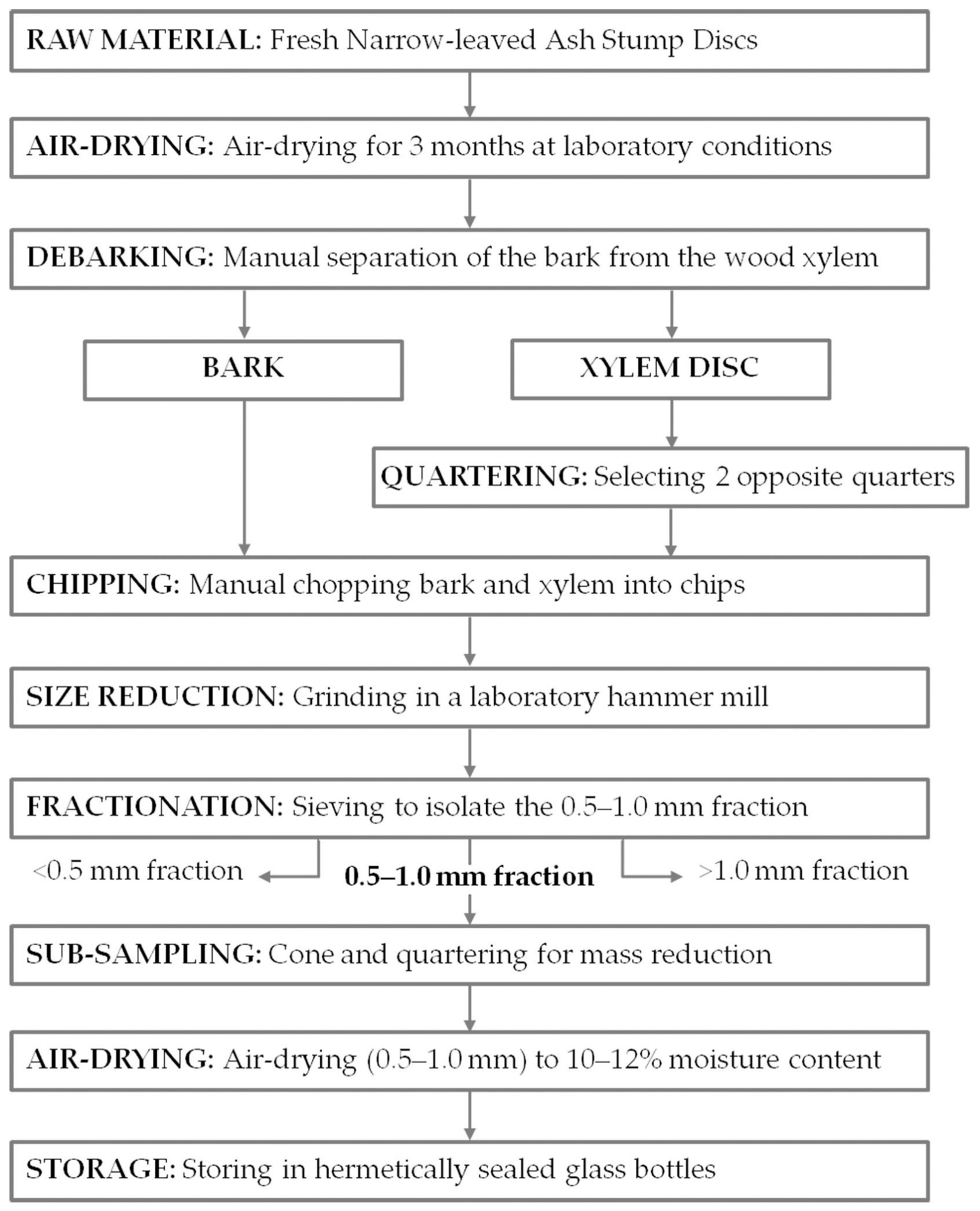

Chemical Characterization of Fraxinus angustifolia Vahl. ssp. pannonica Soó & Simon Stump-Derived Biomass: Evaluation of Valorization Potential

 ,
,  , and
, and
Abstract
1. Introduction
2. Materials and Methods
2.1. Plant Material
2.2. Chemicals and Materials
2.3. Chemical Composition Determination
2.4. Total Phenolic Content (TPC)
2.5. Antioxidant Potential of Water Extracts Determined Spectrophotometrically
2.6. Antioxidant Potential of Water Extracts Determined by HPTLC
2.7. UHPLC-DAD-ESI-MS/MS Analysis
2.8. ICP-OES Analysis
3. Results and Discussion
3.1. Chemical Composition

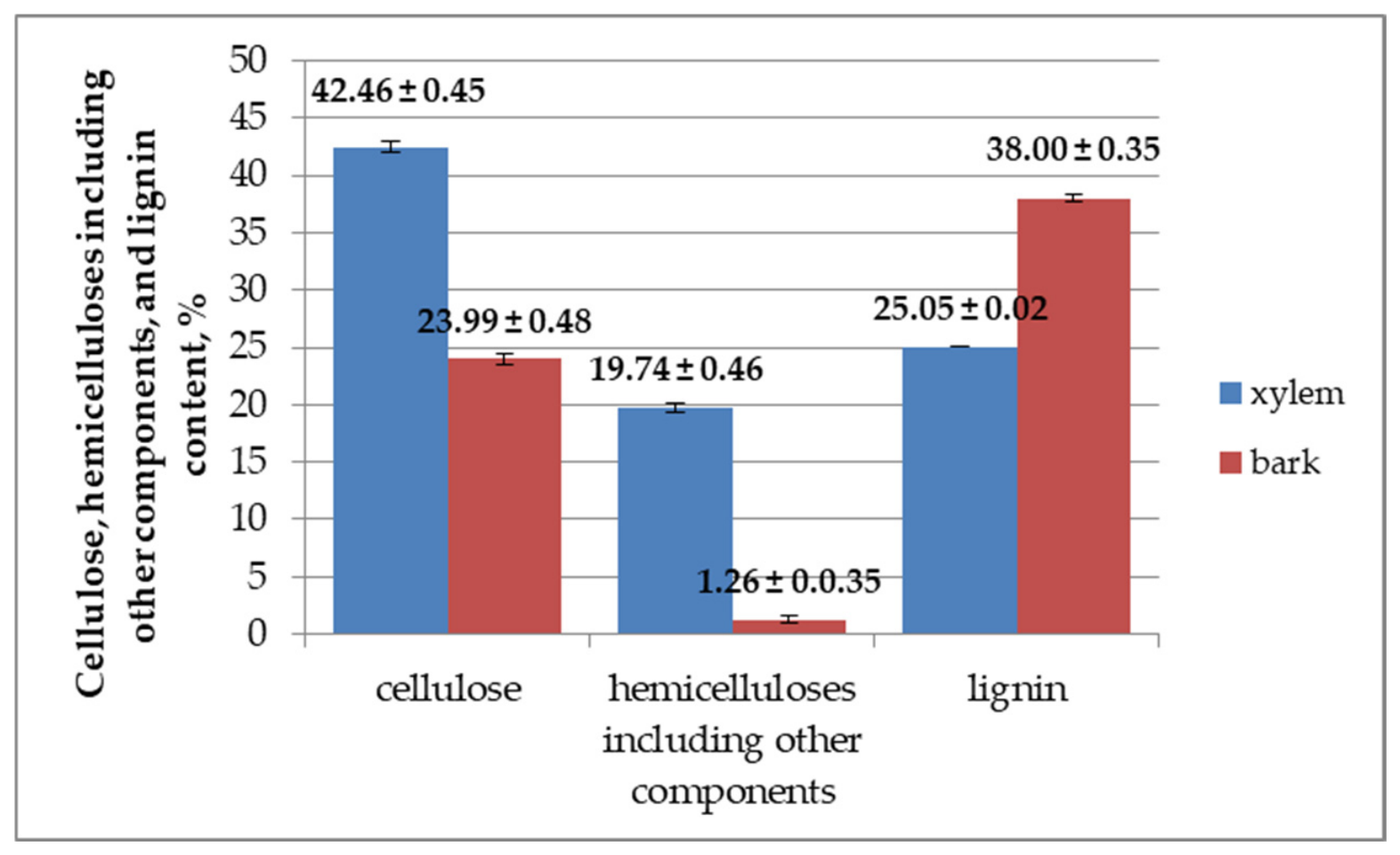
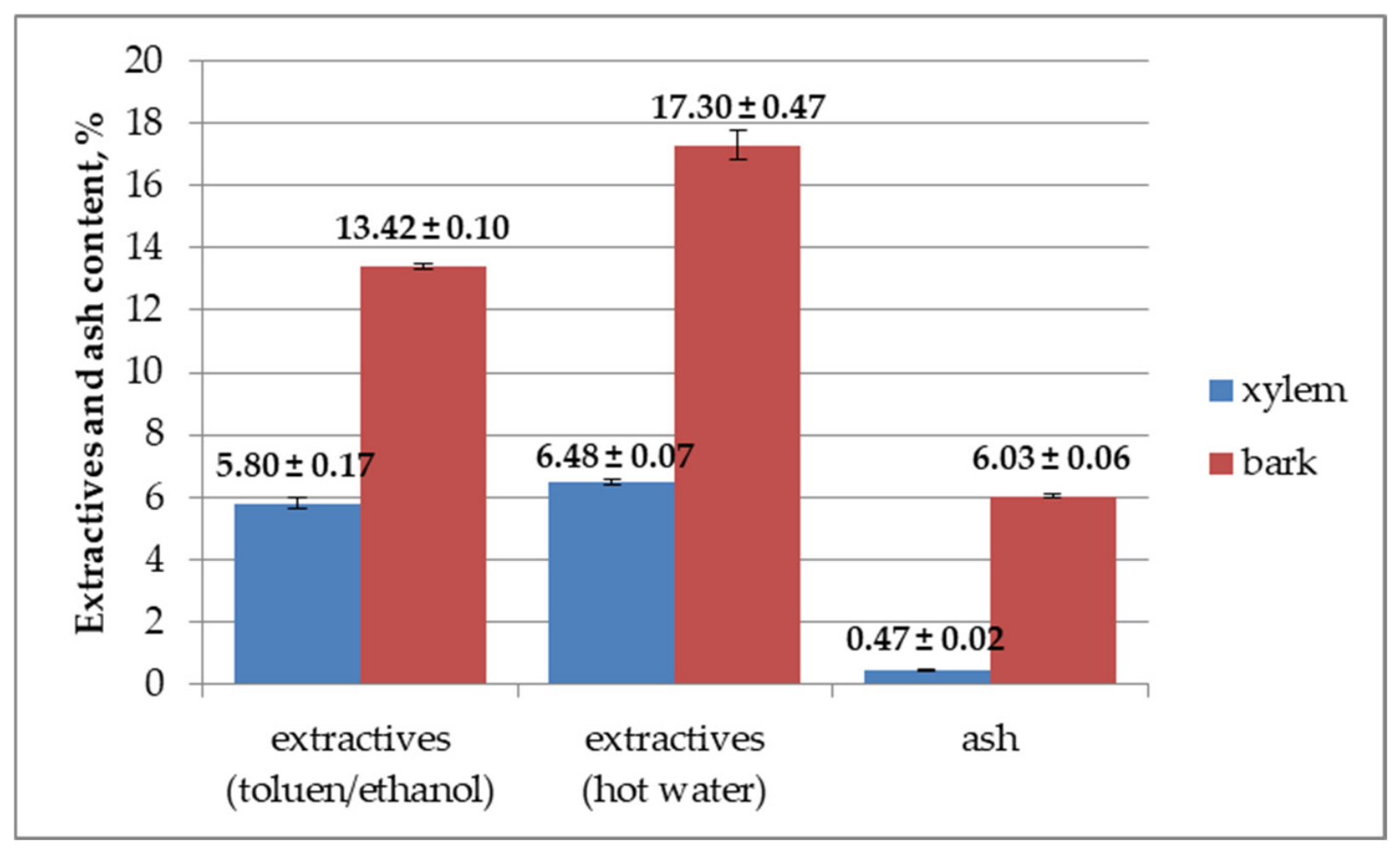
| Age (Years) | Sampling Height on the Tree (m) | Cellulose (%) | Hemicelluloses (%) | Lignin (%) | Extractives (Organic Solution) (%) | Extractives (Hot Water) (%) | Ash (%) | Reference | |
|---|---|---|---|---|---|---|---|---|---|
| F. angustifolia | |||||||||
| stem wood | 70–73 | 1.3 | 46.83 | 24.70 | 4.39 | 4.44–5.59 | 0.36 | [69] | |
| 22 | 1.5 | 53.46 (sapwood) | 24.93 | 21.40 (acid-insoluble, Klason) | 4.18 | 5.14 | 0.83 | [70] | |
| 62–64 | 25.53 (acid-insoluble, Runkel) | 4.90–8.08 | 11.23 | 0.44–0.77 | [77] | ||||
| 27 | 2.5 | 28.38 (sapwood) 27.60 (heartwood) | 21.9 (sapwood) 23.4 (heartwood) | 0.83 | [74] | ||||
| stem bark | 5 | [39] | |||||||
| 5.85 | [38] | ||||||||
| F. americana, L. Marsh. | |||||||||
| stem wood | 38.22–49.24 | [73] | |||||||
| F. excelsior L. | |||||||||
| stem wood | 40.86–46.77 | [73] | |||||||
| 102 | 1.3 | 43.81 | [72] | ||||||
3.2. TPC and Antioxidant Capacity Determined Spectrophotometrically
3.3. Antioxidant Potential of Water Extracts by HPTLC–DPPH• Scavenging Assay
3.4. UHPLC-DAD-ESI-MS/MS Analysis
3.5. ICP-OES Analysis of Water Extracts
4. Conclusions
Supplementary Materials
Author Contributions
Funding
Data Availability Statement
Conflicts of Interest
Abbreviations
| CID | Collision-induced dissociation |
| DW | Dry weight |
| DAD | Diode array detector |
| DPPH | 2,2-diphenyl-1-picrylhydrazy |
| GAE | Gallic acid equivalent |
| HPTLC | High-performance thin-layer chromatography |
| ICH Q3D | International Council for Harmonisation Guideline for Elemental Impurities |
| ICP-OES | Inductively coupled plasma—optical emission spectrometry |
| LODs | Limits of detection |
| LR | Linearity ranges |
| ND | Not detected (below the limit of detection) |
| PDE | Permitted daily exposure |
| PCL | Permitted concentration limit |
| R | Correlation coefficient |
| TE | Trolox equivalent |
| TPC | Total phenolic content |
| UHPLC-DAD-ESI-MS/MS | Ultra-high-performance liquid chromatography coupled to diode array detection and electrospray ionization mass spectrometry |
| UV-Vis | Ultraviolet-visible |
References
- Bergström, D.; Matisons, M. Forest Refine, 2012–2014—Efficient Forest Biomass Supply Chain Management for Biorefineries; Department of Forest Biomaterials and Technology, Swedish University of Agricultural Sciences: Umeå, Sweden, 2014. [Google Scholar]
- García-Pérez, M.E.; Kasangana, P.B.; Stevanovic, T. Bioactive Molecules from Myrianthus Arboreus, Acer Rubrum, and Picea Mariana Forest Resources. Molecules 2023, 28, 2045. [Google Scholar] [CrossRef] [Scilit] [PubMed]
- Walmsley, J.D.; Godbold, D.L. Stump Harvesting for Bioenergy—A Review of the Environmental Impacts. Forestry 2010, 83, 17–38. [Google Scholar] [CrossRef] [Scilit]
- Vangeel, T.; Neiva, D.M.; Quilhó, T.; Costa, R.A.; Sousa, V.; Sels, B.F.; Pereira, H. Tree Bark Characterization Envisioning an Integrated Use in a Biorefinery. Biomass Convers. Biorefinery 2023, 13, 2029–2043. [Google Scholar] [CrossRef] [Scilit]
- Fengel, D.; Wegner, G. Wood, Chemistry, Ultrastructure, Reactions; Walter de Gruyter: Berlin, Germany; New York, NY, USA, 1989. [Google Scholar]
- Luís, Â.; Neiva, D.; Pereira, H.; Gominho, J.; Domingues, F.; Duarte, A. Stumps of Eucalyptus Globulus as a Source of Antioxidant and Antimicrobial Polyphenols. Molecules 2014, 19, 16428–16446. [Google Scholar] [CrossRef] [Scilit] [PubMed]
- Gominho, J.; Lourenço, A.; Miranda, I.; Pereira, H. Chemical and Fuel Properties of Stumps Biomass from Eucalyptus Globulus Plantations. Ind. Crops Prod. 2012, 39, 12–16. [Google Scholar] [CrossRef] [Scilit]
- Halmemies, E.S.; Brännström, H.E.; Karjalainen, M.; Nurmi, J.; Alén, R. Availability of Extractives from Various Norway Spruce (Picea Abies) Stumps Assortments. J. Wood Chem. Technol. 2023, 43, 13–27. [Google Scholar] [CrossRef] [Scilit]
- Moffat, A.; Nisbet, T.; Nicoll, B. Environmental Effects of Stump and Root Harvesting. Available online: https://www.forestresearch.gov.uk/publications/environmental-effects-of-stump-and-root-harvesting/ (accessed on 16 March 2025).
- Persson, T.; Egnelly, G.; Lithell, C. Stump Harvesting, Impact on Climate and Environment; Persson, T., Egnell, G., Lithell, C., Eds.; IEA Bioenergy: Paris, France, 2017. [Google Scholar]
- Trezza, A.; Mahboob, L.; Visibelli, A.; Geminiani, M. Lignin Waste Valorization in the Bioeconomy Era: Toward Sustainable Innovation and Climate Resilience. Appl. Sci. 2025, 15, 8038. [Google Scholar] [CrossRef] [Scilit]
- Zuin, V.G.; Ramin, L.Z. Green and Sustainable Separation of Natural Products from Agro-Industrial Waste: Challenges, Potentialities, and Perspectives on Emerging Approaches. Top. Curr. Chem. 2018, 376, 3. [Google Scholar] [CrossRef] [Scilit] [PubMed]
- Niu, X.; He, Y.; Musl, O.; Bautista, G.F.M.; Xie, Q.; Wu, Y.; Guo, J.; Rojas, O.J. Bark Extractives as Sources of Carbon-Efficient Functional Precursors and Materials. Innov. Mater. 2024, 2, 100074. [Google Scholar] [CrossRef] [Scilit]
- Persson, T. Environmental Consequences of Tree-Stump Harvesting. For. Ecol. Manag. 2013, 290, 1–4. [Google Scholar] [CrossRef] [Scilit]
- Vanguelova, E.I.; Pitman, R.; Benham, S.; Perks, M.; Morison, J.I.L. Impact of Tree Stump Harvesting on Soil Carbon and Nutrients and Second Rotation Tree Growth in Mid-Wales, UK. Open J. For. 2017, 7, 58–78. [Google Scholar] [CrossRef]
- Damyanova, S.; Dimitrova, V. Chemical Composition and Stocks of Nutrients in Dead Wood of Beech (Fagus sylvatica L.) Forests. WSEAS Trans. Environ. Dev. 2023, 19, 465–471. [Google Scholar] [CrossRef] [Scilit]
- Nurmi, J. Heating Values of Mature Trees, 1st ed.; Acta Forestalia Fennica 256: Tampere, Finland, 1997. [Google Scholar]
- Latva-Mäenpää, H. Bioactive and Protective Polyphenolics from Roots and Stumps of Conifer Trees (Norway Spruce and Scots Pine). Ph.D. Thesis, University of Helsinki, Helsinki, Finland, 2017. [Google Scholar]
- Routa, J.; Brannstrom, H.; Anttila, P.; Makinen, M.; Janis, J.; Asikainen, A. Wood Extractives of Finnish Pine, Spruce and Birch—Availability and Optimal Sources of Compounds: A Literature Review; Natural Resources Institute Finland (Luke): Helsinki, Finland, 2017.
- Sisojević, D. Anatomija Drveta, 2nd ed.; Šumarski Fakultet-OOUR Institut za Preradu Drveta: Beograd, Serbia, 1987. [Google Scholar]
- Tahirović, A.; Bašić, N. Determination of Phenolic Content and Antioxidant Capacity of Fraxinus excelsior L. and Fraxinus angustifolia Vahl. Leaves and Bark Extracts. Work. Fac. For. Univ. Sarajev. 2016, 46, 29–41. [Google Scholar] [CrossRef] [Scilit]
- Caudullo, G.; Durrant, T.H. Fraxinus angustifolia in Europe: Distribution, Habitat, Usage and Threats. In European Atlas of Forest Tree Species; Publications Office of the European Union: Luxembourg, 2016; p. 97. [Google Scholar]
- Cicek, E.; Yilmaz, M. The Importance of Fraxinus angustifolia Subsp. Oxycarpa as a Fast Growing Tree for Turkey. In Proceedings of the IUFRO Meeting: Management of Fast Growing Plantations, Div. 4.04.06, İzmit, Turkey, 11–13 September 2002; pp. 192–200. [Google Scholar]
- Zhao, Y.; He, W.; Yang, Y.; Liu, R.; Wang, X.; Bai, J. Phytochemical Constituents and Pharmacological Properties of Fraxinus spp.: A Review. Chem. Biodivers. 2025, 22, e202402879. [Google Scholar] [CrossRef] [Scilit] [PubMed]
- Joseleau, J.P.; Messaoudi, D.; Ruel, K.; Conseil, L. How the Biochemical Activities of Polyphenols May Be Effective for the Protection of Wood Deterioration by Termites? In Proceedings of the Proceeding of IRG54 Scientific Conference on Wood Protection, Cairns, Australia, 28 May–1 June 2023. [Google Scholar]
- Hidalgo, J.; Hidalgo, L.; Serrano, C.; Punina, D.; Rea, E.; Ilbay, M.; Vilaso-Cadre, J.E.; Reyes-Dominguez, I.A. A Study of the Inhibition Capacity of a Novel Ilex guayusa Green Extract for Preventing Corrosion in Mild Steel Exposed to Different Conditions. Analytica 2025, 6, 1. [Google Scholar] [CrossRef] [Scilit]
- Hidalgo, J.; Hidalgo, L.; Serrano Aguiar, C.D.; Garcia Madronero, D.B.; Galambos, I.; Vilaso-Cadre, J.E.; Reyes-Domingues, I.A.; Branzanic, A.M.V.; Ignat, N.; Turdean, G.L. Study of Caesalpinia spinosa Extracts As Green Corrosion Inhibitor for Mild Steel. Langmur 2025, 41, 9406–9421. [Google Scholar] [CrossRef] [Scilit] [PubMed]
- Nykolov, N.; Iossifova, T.; Vassileva, E.; Kostova, I.; Stoev, G. Reverse-Phase High Pressure Liquid Chromatographic Analysis of Hydroxycoumarins in Plant Extracts. Quantitative Determination of Hydroxycoumarins in Fraxinus ornus. Phytochem. Anal. 1993, 4, 86–88. [Google Scholar] [CrossRef] [Scilit]
- Iossifova, T.; Vogler, B.; Klaiber, I.; Kostova, I.; Kraus, W. Caffeic Acid Esters of Phenylethanoid Glycosides from Fraxinus Ornus Bark. Phytochemistry 1999, 50, 297–301. [Google Scholar] [CrossRef] [Scilit]
- Chang, H.C.; Wang, S.W.; Chen, C.Y.; Hwang, T.L.; Cheng, M.J.; Sung, P.J.; Liao, K.W.; Chen, J.J. Secoiridoid Glucosides and Anti-Inflammatory Constituents from the Stem Bark of Fraxinus chinensis. Molecules 2020, 25, 5911. [Google Scholar] [CrossRef] [Scilit] [PubMed]
- Jensen, S.R.; Nielsen, B.J. A New Coumarin, Fraxidin 8-O-β-D-Glucoside and 10-Hydroxyligstroside from Bark of Fraxinus exelsior. Phytochemistry 1976, 15, 221–223. [Google Scholar] [CrossRef] [Scilit]
- Si, C.L.; Liu, Z.; Su, Y.F.; Kim, J.K.; Bae, Y.S. Coumarins and Secoiridoid Glucosides from Bark of Fraxinus rhynchophylla Hance. Holzforschung 2008, 62, 553–555. [Google Scholar] [CrossRef] [Scilit]
- Shen, Y.C.; Chen, C.H.; Lee, K.-H. Secoiridoid Dilactones from Fraxinus uhdei. Phytochemistry 1993, 33, 1531–1533. [Google Scholar] [CrossRef] [Scilit]
- Kiss, A.K.; Michalak, B.; Patyra, A.; Majdan, M. UHPLC-DAD-ESI-MS/MS and HPTLC Profiling of Ash Leaf Samples from Different Commercial and Natural Sources and Their in Vitro Effects on Mediators of Inflammation. Phytochem. Anal. 2020, 31, 57–67. [Google Scholar] [CrossRef] [Scilit] [PubMed]
- Kasmi, S.; Hamdi, A.; Atmani-Kilani, D.; Debbache-Benaida, N.; Jaramillo-Carmona, S.; Rodríguez-Arcos, R.; Jiménez-Araujo, A.; Ayouni, K.; Atmani, D.; Guillén-Bejarano, R. Characterization of Phenolic Compounds Isolated from the Fraxinus angustifolia Plant and Several Associated Bioactivities. J. Herb. Med. 2021, 29, 100485. [Google Scholar] [CrossRef] [Scilit]
- Kostova, I.; Iossifova, T. Chemical Components of Fraxinus Species. Fitoterapia 2007, 78, 85–106. [Google Scholar] [CrossRef] [Scilit] [PubMed]
- Atmani, D.; Chaher, N.; Berboucha, M.; Ayouni, K.; Lounis, H.; Boudaoud, H.; Debbache, N.; Atmani, D. Antioxidant Capacity and Phenol Content of Selected Algerian Medicinal Plants. Food Chem. 2009, 112, 303–309. [Google Scholar] [CrossRef] [Scilit]
- Bouguellid, G.; Russo, C.; Lavorgna, M.; Piscitelli, C.; Ayouni, K.; Wilson, E.; Kim, H.K.; Verpoorte, R.; Choi, Y.H.; Kilani-Atmani, D.; et al. Antimutagenic, Antigenotoxic and Antiproliferative Activities of Fraxinus angustifolia Vahl. Leaves and Stem Bark Extracts and Their Phytochemical Composition. PLoS ONE 2020, 15, e0230690. [Google Scholar] [CrossRef] [Scilit] [PubMed]
- Ahmane, N.; Atmani-Kilani, D.; Chaher, N.; Ayouni, K.; Rahmani-Berboucha, M.; Da Costa, G.; Debbache-Benaida, N.; Richard, T.; Atmani, D. Identification of Bioactive Compounds from Fraxinus angustifolia Extracts with Anti-NADH Oxidase Activity of Bovine Milk Xanthine Oxidoreductase. Turk. J. Biol. 2019, 43, 133–147. [Google Scholar] [CrossRef] [Scilit] [PubMed]
- José-Vicente, O.V.; Enrique, G.A. Analysis of Durability and Dimensional Stability of Hydrothermal Carbonized Wooden Pellets. Wood Res. 2016, 61, 321–330. [Google Scholar]
- Popović, J.J.; Popović, M.M.; Điporović-Momčilović, M.R.; Prahin, A.M.; Dodevski, V.M.; Gavrilović-Grmuša, I.M. Effects of Water Pretreatment on Properties of Pellets Made from Beech Particles. Hem. Ind. 2021, 75, 39–51. [Google Scholar] [CrossRef] [Scilit]
- Pelaez-Samaniego, M.R.; Yadama, V.; Lowell, E.; Amidon, T.E.; Chaffee, T.L. Hot Water Extracted Wood Fiber for Production of Wood Plastic Composites (WPCs). Holzforschung 2013, 67, 193–200. [Google Scholar] [CrossRef] [Scilit]
- Ozdemir, F.; Ayrilmis, N.; Kaymakci, A.; Kwon, J.H. Improving Dimensional Stability of Injection Molded Wood Plastic Composites Using Cold and Hot Water Extraction Methods. Maderas Cienc. Tecnol. 2014, 16, 365–372. [Google Scholar] [CrossRef] [Scilit]
- Pelaez-Samaniego, M.R.; Yadama, V.; Garcia-Perez, T.; Lowell, E.; Amidon, T. Effect of Hot Water Extracted Hardwood and Softwood Chips on Particleboard Properties. Holzforschung 2014, 68, 807–815. [Google Scholar] [CrossRef] [Scilit]
- Mohebby, B.; Ilbeighi, F.; Kazemi-Najafi, S. Influence of Hydrothermal Modification of Fibers on Some Physical and Mechanical Properties of Medium Density Fiberboard (MDF). Holz Roh Werkst. 2008, 66, 213–218. [Google Scholar] [CrossRef] [Scilit]
- Paredes, J.J.; Jara, R.; Shaler, S.M.; van Heiningen, A. Influence of Hot Water Extraction on the Physical and Mechanical Behavior of OSB. For. Prod. J. 2008, 58, 56–62. [Google Scholar]
- Forest Stewardship Council (FSC). FSC Public Certificate Search. Available online: https://fsc.org/en (accessed on 31 July 2026).
- TAPPI-Technical Association of the Pulp and Paper Industry. TAPPI T 257 cm-02: Sampling and Preparing Wood for Analysis; TAPPI Press: Atlanta, GA, USA, 2012. [Google Scholar]
- ISO 14780:2017; Solid Biofuels—Sample Preparation. International Organization for Standardization: Geneva, Switzerland, 2017.
- TAPPI-Technical Association of the Pulp and Paper Industry. TAPPI T 264 cm-97: Preparation of Wood for Chemical Analysis; TAPPI Press: Atlanta, GA, USA, 1997. [Google Scholar]
- Browning, B.L. Methods of Wood Chemistry, Vol. 2; Interscience Publishers: New York, NY, USA, 1967. [Google Scholar]
- TAPPI-Technical Association of the Pulp and Paper Industry. TAPPI T 222 om-02 Acid-Insoluble Lignin in Wood and Pulp; TAPPI Press: Atlanta, GA, USA, 2002. [Google Scholar]
- TAPPI-Technical Association of the Pulp and Paper Industry. TAPPI T UM 250: Acid-Soluble Lignin in Wood and Pulp; TAPPI Press: Atlanta, GA, USA, 1991. [Google Scholar]
- ASTM D1107-96; Standard Test Method for Ethanol-Toluene Solubility of Wood. ASTM International: West Conshohocken, PA, USA, 2010.
- TAPPI-Technical Association of the Pulp and Paper Industry. TAPPI T 207 cm-99: Water Solubility of Wood and Pulp; TAPPI Press: Atlanta, GA, USA, 2008. [Google Scholar]
- ASTM D1110-21; Standard Test Methods for Water Solubility of Wood. ASTM International: West Conshohocken, PA, USA, 2021.
- TAPPI-Technical Association of the Pulp and Paper Industry. TAPPI T 413 om-93: Ash in Wood, Pulp, Paper and Paperboard: Combustion at 900 °C; TAPPI Press: Atlanta, GA, USA, 1993. [Google Scholar]
- Aksić, M.; Dekić, B.; Janićević, S. Determination of Polyphenol and Flavonoid Content and Antioxidant Activity of Ethanolic, Chloroform and Ethyl Acetate Extract of the Plant Species Thymus serpyllum L. Bull. Nat. Sci. Res. 2023, 13, 5–9. [Google Scholar] [CrossRef] [Scilit]
- Smailagić, A.; Veljović, S.; Gašić, U.; Zagorac, D.D.; Stanković, M.; Radotić, K.; Natić, M. Phenolic Profile, Chromatic Parameters and Fluorescence of Different Woods Used in Balkan Cooperage. Ind. Crops Prod. 2019, 132, 156–167. [Google Scholar] [CrossRef] [Scilit]
- Sonia, K.; Shree, B.S.; Lakshmi, K.S. HPTLC Method Development and Validation. J. Pharm. Sci. Res. 2017, 9, 652–657. [Google Scholar] [CrossRef] [Scilit]
- Long, H.; Yao, S.; Tian, W.; Hou, J.; Lei, M.; Zhang, Z.; Guo, D.; Wu, W. A Simple and Effective Method for Identification of Fraxini Cortex from Different Sources by Multi-Mode Fingerprint Combined with Chemometrics. J. Sep. Sci. 2022, 45, 788–803. [Google Scholar] [CrossRef] [Scilit] [PubMed]
- Wang, J.; Yue, Y.D.; Tang, F.; Sun, J. TLC Screening for Antioxidant Activity of Extracts from Fifteen Bamboo Species and Identification of Antioxidant Flavone Glycosides from Leaves of Bambusa. textilis McClure. Molecules 2012, 17, 12297–12311. [Google Scholar] [CrossRef] [Scilit] [PubMed]
- Sjöström, E. Wood Chemistry, 2nd ed.; Academic Press: San Diego, CA, USA, 1993. [Google Scholar]
- International Council for Harmonisation (ICH). Guideline for Elemental Impurities Q3D (R2). Available online: https://database.ich.org/sites/default/files/Q3D-R2_Guideline_Step4_2022_0308.pdf (accessed on 2 August 2026).
- Rowell, R.M. Cell Wall Chemistry, 2nd ed.; CRC Press LLC: Boca Raton, FL, USA, 2005. [Google Scholar]
- Pásztory, Z.; Mohácsiné, I.R.; Gorbacheva, G.; Börcsök, Z. The Utilization of Tree Bark. BioResources 2016, 11, 7859–7888. [Google Scholar] [CrossRef] [Scilit]
- Zobel, B.J.; van Buijtenen, J.P. Wood Variation. Its Causes and Control; Timell, T.E., Ed.; Springer: Berlin/Heidelberg, Germany, 1989. [Google Scholar]
- Plomion, C.; Leprovost, G.; Stokes, A. Wood Formation in Trees. Plant Physiol. 2001, 127, 1513–1523. [Google Scholar] [CrossRef]
- Popović, J.; Klašnja, B.; Popović, M.; Điporović-Momčilović, M.; Gavrilović-Grmuša, I. Variability in Chemical Composition of Narrow-Leaved Ash (Fraxinus angustifolia Vahl. Ssp. Pannonica Soó & Simon) in Regard to Its Age and Possition inside the Tree. In Proceedings of the 27th International Conference on Wood Science and Technology 2016 Implementation of Wood Science in Woodworking Sector; University of Zagreb—Faculty of Forestry: Zagreb, Croatia, 2016; pp. 175–184. [Google Scholar]
- Yalcin, M.; Sahin, H.I. Changes in the Chemical Structure and Decay Resistance of Heat-Treated Narrow-Leaved Ash Wood. Maderas. Cienc. Technol. 2015, 17, 435–446. [Google Scholar] [CrossRef] [Scilit]
- Donaldson, L.; Nanayakkara, B.; Harrington, J. Plant Cells: Wood Growth and Development. Encycl. Appl. Plant Sci. 2017, 1, 203–210. [Google Scholar] [CrossRef] [Scilit]
- Bodîrlau, R.; Spiridon, I.; Teaca, C.A. Chemical Investigation of Wood Tree Species in Temperate Forest in East-Northern Romania. BioResources 2007, 2, 41–57. [Google Scholar] [CrossRef] [Scilit]
- Rowell, R.M. The Chemistry of Solid Wood; American Chemical Society: Washington, DC, USA, 1984. [Google Scholar]
- Mazri, S.; Benotmane, B.; Hachemi, M.; Pranovich, A.; Willför, S.; Smeds, A. Chemical Characterization of Sapwood and Heartwood of Fraxinus angustifolia Growing in Algeria. J. Wood Chem. Technol. 2022, 42, 26–36. [Google Scholar] [CrossRef] [Scilit]
- Pettersen, R.C. The Chemical Composition of Wood. In The Chemistry of Solid Wood; American Chemical Society: Washington, DC, USA, 1984; pp. 57–126. [Google Scholar] [CrossRef] [Scilit]
- Ihnat, V.; Fišerova, M.; Opalena, E.; Russ, A.; Bohaček, Š. Chemical Composition and Fibre Characteristics of Branch Wood of Selected Hardwood Species. Acta Fac. Xylologiae Zvolen 2021, 63, 17–30. [Google Scholar] [CrossRef]
- Elmas, G.M. Comparison of Various Pulping Characteristic of Fraxinus angustifolia Vahl. Wood. Afr. J. Biotechnol. 2011, 10, 9812–9816. [Google Scholar] [CrossRef] [Scilit]
- Dou, J.; Bian, H.; Yelle, D.J.; Ago, M.; Vajanto, K.; Vuorinen, T.; Zhu, J. Lignin Containing Cellulose Nanofibril Production from Willow Bark at 80 °C Using a Highly Recyclable Acid Hydrotrope. Ind. Crops Prod. 2019, 129, 15–23. [Google Scholar] [CrossRef] [Scilit]
- Dedrie, M.; Jacquet, N.; Bombeck, P.L.; Hébert, J.; Richel, A. Oak Barks as Raw Materials for the Extraction of Polyphenols for the Chemical and Pharmaceutical Sectors: A Regional Case Study. Ind. Crops Prod. 2015, 70, 316–321. [Google Scholar] [CrossRef] [Scilit]
- Bekhta, P.; Sedliačik, J.; Noshchenko, G.; Kačík, F.; Bekhta, N. Characteristics of Beech Bark and Its Effect on Properties of UF Adhesive and on Bonding Strength and Formaldehyde Emission of Plywood Panels. Eur. J. Wood Wood Prod. 2021, 79, 423–433. [Google Scholar] [CrossRef] [Scilit]
- Hamad, A.M.A.; Ates, S.; Olgun, Ç.; Gür, M. Chemical Composition and Antioxidant Properties of Some Industrial Tree Bark Extracts. BioResources 2023, 14, 5657–5671. [Google Scholar] [CrossRef] [Scilit]
- Safdari, V.; Khodadadi, H.; Hosseinihashemi, S.K.; Ganjian, E. The Effects of Poplar Bark and Wood Content on the Mechanical Properties of Wood-Polypropylene. BioResources 2011, 6, 5180–5192. [Google Scholar] [CrossRef] [Scilit]
- Akgül, M.; Gücüş, O.; Demİr, S.; Üner, B. Melez Kavak (Populus Euramericana (I-214)) Odunu ve Kabuğunun Kimyasal Bileşimi. Orman. Derg. 2013, 9, 105–110. [Google Scholar] [CrossRef] [Scilit]
- Dibdiakova, J.; Gjølsjø, S.; Wang, L. Solid Biofuels from Forest—Fuel Specification and Quality Inherent Properties of Norway Spruce Biomass in Some Geographical Locations in South Norway; Norwegian Forest and Landscape Institute: As, Norway, 2014.
- Nosek, R.; Holubcik, M.; Jandacka, J. The Impact of Bark Content of Wood Biomass on Biofuel Properties. BioResources 2016, 11, 44–53. [Google Scholar] [CrossRef] [Scilit]
- Stevanović-Janežić, T. Hemija Drveta Sa Hemijskom Preradom. Prvi Deo: Hemija Drveta, 1st. ed.; Jugoslavijapublik: Beograd, Serbia, 1993. [Google Scholar]
- Sakai, K. Chemistry of bark. In Wood and Cellulosic Chemistry; Hon, D.N.S., Shiraishi, N., Eds.; Marcel Dekker: New York, NY, USA, 2001; pp. 243–273. [Google Scholar]
- Touhami, I.; Ghazghazi, H.; Sellimi, H.; Khaldi, A.; Mahmoudi, H. Antioxidant Activities and Phenolic Contents of Bark and Leave Extracts from Tunisian Native Tree: Fraxinus angustifolia Vahl. Subsp. Angustifolia. J. New Sci. 2017, 45, 2496–2501. [Google Scholar]
- Brennan, M.; Fritsch, C.; Cosgun, S.; Dumarcay, S.; Colin, F.; Gerardin, P. Quantitative and Qualitative Composition of Bark Polyphenols Changes Longitudinally with Bark Maturity in Abies alba Mill. Ann. For. Sci. 2020, 77, 9. [Google Scholar] [CrossRef] [Scilit]
- Azib, L.; Debbache-Benaida, N.; Da Costa, G.; Atmani-Kilani, D.; Saidene, N.; Bouguellid, G.; Ourabah, A.; Krisa, S.; Richard, T.; Atmani, D. Neuroprotective Effects of Fraxinus angustifolia Vahl. Bark Extract against Alzheimer’s Disease. J. Chem. Neuroanat. 2020, 109, 101848. [Google Scholar] [CrossRef] [Scilit] [PubMed]
- Withouck, H.; Paelinck, A.; Foubert, I.; Fraeye, I. Ultrasound-Assisted Extraction of Applewood Polyphenols at Lab and Pilot Scales. Foods 2023, 12, 3142. [Google Scholar] [CrossRef] [Scilit] [PubMed]
- Lazar, L.; Iulia, A.; Volf, I.; Popa, V.I. Kinetic Modeling of the Ultrasound-Assisted Extraction of Polyphenols from Picea Abies Bark. Ultrason. Sonochem. 2016, 32, 191–197. [Google Scholar] [CrossRef] [Scilit] [PubMed]
- Meneses, N.G.T.; Martins, S.; Teixeira, J.A.; Mussatto, S.I. Influence of Extraction Solvents on the Recovery of Antioxidant Phenolic Compounds from Brewer’s Spent Grains. Sep. Purif. Technol. 2013, 108, 152–158. [Google Scholar] [CrossRef] [Scilit]
- Baron, G.; Ferrario, G.; Marinello, C.; Carini, M.; Morazzoni, P.; Aldini, G. Effect of Extraction Solvent and Temperature on Polyphenol Profiles, Antioxidant and Anti-Inflammatory Effects of Red Grape Skin by-Product. Molecules 2021, 26, 5454. [Google Scholar] [CrossRef] [Scilit] [PubMed]
- Sarfraz, I.; Rasul, A.; Jabeen, F.; Younis, T.; Zahoor, M.K.; Arshad, M.; Ali, M. Fraxinus: A Plant with Versatile Pharmacological and Biological Activities. Evid.-Based Complement. Altern. Med. 2017, 2017, 4269868. [Google Scholar] [CrossRef] [Scilit] [PubMed]
- Ivković, Đ.; Andrić, F.; Senćanski, M.; Stević, T.; Krstić Ristivojević, M.; Ristivojević, P. Innovative Analytical Methodology for Skin Anti-Aging Compounds Discovery from Plant Extracts: Integration of High-Performance Thin-Layer Chromatography-in Vitro Spectrophotometry Bioassays with Multivariate Modeling and Molecular Docking. J. Chromatogr. A 2025, 1742, 465640. [Google Scholar] [CrossRef] [Scilit] [PubMed]
- Zürn, M.; Tóth, G.; Ausbüttel, T.; Mucsi, Z.; Horváti, K.; Bősze, S.; Sütöri-Diószegi, M.; Pályi, B.; Kis, Z.; Noszál, B.; et al. Tissue-Specific Accumulation and Isomerization of Valuable Phenylethanoid Glycosides from Plantago and Forsythia Plants. Int. J. Mol. Sci. 2021, 22, 3880. [Google Scholar] [CrossRef] [Scilit] [PubMed]
- Liu, T.; Lin, S. Comprehensive Characterization of the Chemical Constituents of Lianhua Qingwen Capsule by Ultra High Performance Liquid Chromatography Coupled with Fourier Transform Ion Cyclotron Resonance Mass Spectrometry. Heliyon 2024, 10, e27352. [Google Scholar] [CrossRef] [Scilit] [PubMed]
- Torres-Vega, J.; Gómez-Alonso, S.; Pérez-Navarro, J.; Alarcón-Enos, J.; Pastene-Navarrete, E. Polyphenolic Compounds Extracted and Purified from Buddleja Globosa Hope (Buddlejaceae) Leaves Using Natural Deep Eutectic Solvents and Centrifugal Partition Chromatography. Molecules 2021, 26, 2192. [Google Scholar] [CrossRef] [Scilit] [PubMed]
- Passon, M.; Weber, F.; Jung, N.U.; Bartels, D. Profiling of Phenolic Compounds in Desiccation-Tolerant and Non-Desiccation-Tolerant Linderniaceae. Phytochem. Anal. 2021, 32, 521–529. [Google Scholar] [CrossRef] [Scilit] [PubMed]
- Llorent-Martínez, E.J.; Gouveia, S.; Castilho, P.C. Analysis of Phenolic Compounds in Leaves from Endemic Trees from Madeira Island. A Contribution to the Chemotaxonomy of Laurisilva Forest Species. Ind. Crops Prod. 2015, 64, 135–151. [Google Scholar] [CrossRef] [Scilit]
- Ado, M.A.; Abas, F.; Leong, S.W.; Shaari, K.; Ismail, I.S.; Ghazali, H.M.; Lajis, N.H. Chemical Constituents and Biological Activities of Callicarpa Maingayi Leaves. S. Afr. J. Bot. 2016, 104, 98–104. [Google Scholar] [CrossRef] [Scilit]
- Saka, S. Chemical Composition and Distribution. In Wood and Cellulosic Chemistry; Hon, D.N.S., Shiraishi, N., Eds.; Marcel Dekker: New York, NY, USA, 2001; pp. 51–81. [Google Scholar]
- Vegunta, V.; Senthilkumar, E.R.; Lindén, P.; Sevastyanova, O.; Vilaplana, F.; Garcia, A.; Björk, M.; Jansson, U.; Henriksson, G.; Lindström, M.E. High Calcium Content of Eucalyptus Dunnii Wood Affects Delignification and Polysaccharide Degradation in Kraft Pulping. Nord. Pulp Pap. Res. J. 2022, 37, 338–348. [Google Scholar] [CrossRef] [Scilit]
- Mellerowicz, E.J.; Baucher, M.; Sundberg, B.; Boerjan, W. Unravelling Cell Wall Formation in the Woody Dicot Stem. Plant Mol. Biol. 2001, 47, 239–274. [Google Scholar] [CrossRef] [Scilit]
- Bratu, M.M.; Birghila, S.; Miresan, H.; Negreanu-Pirol, T.; Prajitura, C.; Calinescu, M. Biological Activities of Zn(II) and Cu(II) Complexes with Quercetin and Rutin: Antioxidant Properties and UV-Protection Capacity. Rev. Chim. 2014, 65, 544–549. [Google Scholar]
- Khater, M.; Ravishankar, D.; Greco, F.; Osborn, H.M.I. Metal Complexes of Flavonoids: Their Synthesis, Characterization and Enhanced Antioxidant and Anticancer Activities. Future Med. Chem. 2019, 11, 2845–2867. [Google Scholar] [CrossRef] [Scilit] [PubMed]
- Rodríguez-Arce, E.; Saldías, M. Antioxidant Properties of Flavonoid Metal Complexes and Their Potential Inclusion in the Development of Novel Strategies for the Treatment against Neurodegenerative Diseases. Biomed. Pharmacother. 2021, 143, 112236. [Google Scholar] [CrossRef] [Scilit] [PubMed]
- Rak, K.; Kolniak-Ostek, J.; Gajda, R.; Marcinkiewicz, K.; Nemś, A.; Raczkowska, E. Antioxidant Activity, Total Polyphenol Content, and Mineral Composition of Milk Beverages Fortified with Spice Mixtures (Clove, Cinnamon, and Turmeric) and Natural Sweeteners (Erythritol and Stevia): Evidence of Synergistic or Antagonistic Effects of Comp. Int. J. Mol. Sci. 2025, 26, 8813. [Google Scholar] [CrossRef] [Scilit] [PubMed]
- Kejík, Z.; Kaplánek, R.; Masařík, M.; Babula, P.; Matkowski, A.; Filipenský, P.; Veselá, K.; Gburek, J.; Sýkora, D.; Martásek, P.; et al. Iron Complexes of Flavonoids-Antioxidant Capacity and Beyond. Int. J. Mol. Sci. 2021, 22, 646. [Google Scholar] [CrossRef] [Scilit] [PubMed]

| Narrow-Leaved Ash Stump | TPC mg GAE/g DW | DPPH μmol TE/g DW |
|---|---|---|
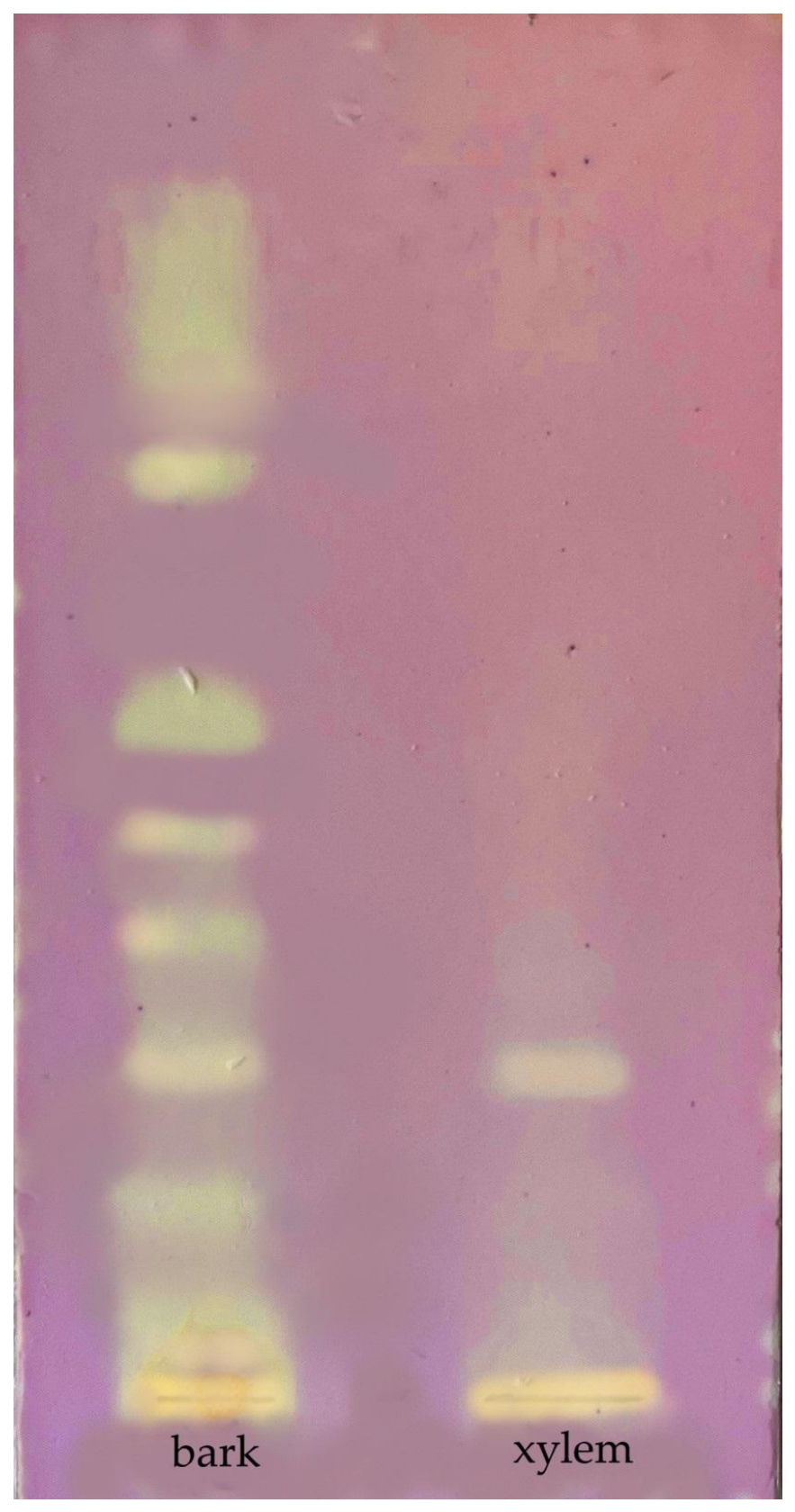
| xylem | 6.26 ± 0.21 | 47.79 ± 3.71 |
| bark | 33.94 ± 1.43 | 198.48 ± 3.33 |
| tr, min | λmax, nm | Molecular Ion Peak [M-H]– * [M-H + HCOOH]- ** [M + H]+ *** [M + Na]+ **** [M + NH4]+, m/z | ESI MS/MS Fragment Ions, m/z | Tentative Annotation (Reference) | Sample | |
|---|---|---|---|---|---|---|
| Xylem | Bark | |||||
| 0.67 | - | 181 | 163 (100%), 131, 119, 101, 89, 71, 59 | n.i. Derivative of p-coumaric acid | + | + |
| 0.75 | - | * 387 | * 341 (100%),179 | Caffeoyl hexose (PubChem CID:6124135) | + | + |
| 0.77 | - | 133 | 115 (100%),87 | Mallic acid (standard) | - | + |
| 0.96 | - | 191 | 173,111 (100%) | Quinic acid (PubChem CID: 1064) | + | + |
| 1.15 | 286 | 393 | 375, 363 (100%), 331, 213, 183, 151, 139 | n.i. | + | + |
| 1.25 | 280 | * 377 | * 331 (100%), 169 | Galloyl hexoside (PubChem CID:124021) | - | + |
| 1.35 | 289 320 | * 479 *** 457 **** 452 | * 433 (100%), 293 *** 302, 295, 267 (100%), 237, 207 | n.i. Flavanone hexoside | + | + |
| 1.53 | - | 393 | 375, 363 (100%), 331, 213, 183, 151, 139 | n.i. | + | + |
| 1.80 | - | *377 | * 331 (100%), 169 | Galloyl hexoside (PubChem CID:124021) | - | + |
| 2.38 | 233 281 306 | 315 | 179, 153, 135 (100%) | Hydroxytyrosol hexoside [65] | + | + |
| 2.62 | 320 | 375 | 357, 331 (100%), 191, 179, 161, 151 | n.i. Phenolic acid | + | + |
| 3.17 | 279 313 | 407 | 389, 375/377, 357 (100%), 345, 313 | n.i. | + | + |
| 3.40 | 279 313 | 407 | 389, 375/377, 357 (100%), 345, 331, 313 | n.i. | + | + |
| 3.40 | - | 461 | 315 (100%), 297, 281, 161, 135 | Decaffeoylverbascoside, verbasoside [67] | + | + |
| 3.87–4.00 | - | 345 | 299 (100%), 179 | n.i. | + | + |
| 4.86 | * 387 | * 341 (100%), 179 | Caffeic acid hexoside (PubChem CID: 6124135) | - | + | |
| 5.35 | 270 | 431 | 413, 299 (100%)/300, 251, 191, 179, 161, 149, 131 | pentoside | + | + |
| 5.53 | 266 | 611 | 565 (100%), 403 | n.i. | + | + |
| 5.73 | 266 | 611 | 565 (100%), 403 | n.i. | + | + |
| 5.83 | 342 | 369 | 207 (100%), 192 | n.i. | + | + |
| 6.16 | 329 | 429 | 383, 369, 221 (100%), 206, 191, 177, 163 | n.i. | + | + |
| 6.34 | 361 | 583 | 537 (100%), 375 | n.i. | + | + |
| 6.86 | 269 300 | 477 | 431, 341, 315, 179, 161 (100%), 135 | Hydroxytyrosol dihexoside (PubChem CID: 177827552) | + | + |
| 7.01 | 329 300 sh | 639 | 621 (100%), 529, 459 | β-hydroxyverbascoside [66] | + | + |
| 7.28 | 328 300 sh | 581 565 | 535, 337 (100%), 193, 175 519 (100%), 501 | n.i. Coumaroylquinic acid derivative | + | + |
| 7.28 | 341 | 525 | 481, 363 (100%), 345, 301, 283, 207, 181 | Demethyloleuropein [68] | - | + |
| 7.51 | 327 300 | 787 | 741 (100%), 579 | n.i. | + | + |
| 7.75 | 324 300 sh | 639 | 621 (100%), 529, 459 | β-hydroxyisoverbascoside [66] | + | + |
| 8.00 | 281 | 477 | 431, 341, 315, 179, 161 (100%), 135 | Hydroxytyrosol dihexoside (PubChem CID: 177827552) | + | + |
| 8.36 | 333 300 sh | 623 ** 625 *** 647 **** 642 | 461 (100%), 315 ** - *** - **** 625 (100%), 479, 471, 325, 309 | Phenylethanoid glycoside isomer (forsythoside/acetoside-related compound) [63,65] | + | + |
| 8.56 | 281 | 477 | 431, 341, 315, 181, 161 (100%), 135 | Hydroxytyrosol dihexoside (PubChem CID: 177827552) | + | + |
| 8.58 | 333 300 sh | 623 | 461 (100%), 315 | Phenylethanoid glycoside isomer (verbascoside-related compound) [63,65] | + | + |
| 9.05 | 330 290 sh | 623 | 461 (100%), 315 | Phenylethanoid glycoside isomer (verbascoside-related compound) [63,65] | + | + |
| 9.29 | 198 224 242 | 731 | 685 (100%), 523, 345 | Oleoside/secologanoside derivative [68] | + | + |
| 9.54 | 314 300 | 539 | 377 (100%), 359, 291, 275 | Secoiridoid glycoside isomer (oleuropein-related compound) [68] | - | + |
| 10.00 | 202 231 280 | 539 ** 541 | 377, 345, 327, 307 (100%), 275 ** 511, 331 (100%), 286, 233 | Secoiridoid glycoside isomer (oleuropein-related compound) [68] | + | + |
| 10.21 | 283 335 | 637 | 619, 491, 475, 461 (100%), 443, 297, 235, 193 | Eukovoside [69] | + | + |
| 10.80 | 228 240 sh | 523 ** 525 *** 547 | 361 (100%), 291, 259 ** - *** 385 (100%), 369/367, 353, 311, 233 | Secoiridoid glycoside (ligstroside-related compound) [68] | + | + |
| 11.23 | - | 895 * 569 523 | 793, 663, 509 (100%), 347 * 523 (100%) 403, 385, 361 (100%), 291, 347 | Lignan hexoside derivative (secoisolariciresinol-related compound) [65] | + | + |
| 11.76 | - | * 569 523 | * 523 (100%) 453, 385, 361 (100%), 291, 259 | Lignan hexoside derivative (secoisolariciresinol-related compound) [65] | + | + |
| 12.14–12.20 | 240 | * 955 909 ** 929 | 935, 909 (100%) - ** 731/732, 551 (100%)/552, 519, 477 | n.i. | + | + |
| Concentrations of Macro- and Microelements and PCLs (μg/mL) | |||||||||||||||||
|---|---|---|---|---|---|---|---|---|---|---|---|---|---|---|---|---|---|
| As | Ag | B | Ba | Bi | Ca | Cd | Co | Cr | Cu | Fe | In | K | Li | Mg | Mn | Na | |
| xylem | ND | ND | ND | 0.04 | ND | 11.12 | ND | ND | 0.05 | 0.22 | 0.01 | ND | 44.43 | ND | 2.55 | ND | 1.00 |
| bark | ND | ND | 0.18 | 0.12 | ND | 26.00 | ND | ND | 0.07 | 0.14 | 0.02 | ND | 92.63 | ND | 6.73 | ND | 1.10 |
| PCL oral | 1.5 | 15 | - | 140 | - | - | 0.5 | 5 | 1100 | 300 | - | - | - | 55 | - | - | - |
| PCL cutaneous | 3 | 15 | - | 700 | - | - | 2 | 5 | 1100 | 300 | - | - | - | 250 | - | - | - |
| Ni | Pb | Sr | Til | Zn | Hg | Si | P | S | Ce | Sn | Ta | Ti | V | W | Nb | Ge | |
| xylem | ND | ND | ND | ND | 0.20 | ND | 0.99 | 3.72 | 13.27 | ND | ND | ND | ND | ND | ND | ND | ND |
| bark | ND | ND | ND | ND | 0.29 | ND | 0.90 | 7.56 | 12.97 | ND | ND | ND | ND | ND | ND | ND | ND |
| PCL oral | 20 | 0.5 | - | 0.8 | - | 3.00 | - | - | - | - | 600 | - | - | 10 | - | - | - |
| PCL cutaneous | 20 | 5 | - | - | - | 3.00 | - | - | - | - | 600 | - | - | - | 0.8 | 10 | - |
Disclaimer/Publisher’s Note: The statements, opinions and data contained in all publications are solely those of the individual author(s) and contributor(s) and not of MDPI and/or the editor(s). MDPI and/or the editor(s) disclaim responsibility for any injury to people or property resulting from any ideas, methods, instructions or products referred to in the content. |
© 2026 by the authors. Licensee MDPI, Basel, Switzerland. This article is an open access article distributed under the terms and conditions of the Creative Commons Attribution (CC BY) license.
Share and Cite
Popović, J.; Petković, G.; Petrović, S.; Zvezdanović, J.; Vranić, M.; Krstić Ristivojević, M.; Ivković, Đ.; Lavadinović, I. Chemical Characterization of Fraxinus angustifolia Vahl. ssp. pannonica Soó & Simon Stump-Derived Biomass: Evaluation of Valorization Potential. Analytica 2026, 7, 56. https://doi.org/10.3390/analytica7030056
Popović J, Petković G, Petrović S, Zvezdanović J, Vranić M, Krstić Ristivojević M, Ivković Đ, Lavadinović I. Chemical Characterization of Fraxinus angustifolia Vahl. ssp. pannonica Soó & Simon Stump-Derived Biomass: Evaluation of Valorization Potential. Analytica. 2026; 7(3):56. https://doi.org/10.3390/analytica7030056
Chicago/Turabian StylePopović, Jasmina, Gordana Petković, Sanja Petrović, Jelena Zvezdanović, Milica Vranić, Maja Krstić Ristivojević, Đurđa Ivković, and Ivana Lavadinović. 2026. "Chemical Characterization of Fraxinus angustifolia Vahl. ssp. pannonica Soó & Simon Stump-Derived Biomass: Evaluation of Valorization Potential" Analytica 7, no. 3: 56. https://doi.org/10.3390/analytica7030056
APA StylePopović, J., Petković, G., Petrović, S., Zvezdanović, J., Vranić, M., Krstić Ristivojević, M., Ivković, Đ., & Lavadinović, I. (2026). Chemical Characterization of Fraxinus angustifolia Vahl. ssp. pannonica Soó & Simon Stump-Derived Biomass: Evaluation of Valorization Potential. Analytica, 7(3), 56. https://doi.org/10.3390/analytica7030056