Article

Optimization of CO2 Supercritical Extraction and Air-Drying Temperature Process on the Antimicrobial Properties of Pistacia lentiscus Leaves Essential Oil


1
Laboratory of Environment and Applied Chemistry (LCAE), Department of Chemistry, Mohammed First University, Bd Mohamed VI, Oujda 60000, Morocco
2
LAGEPP, UMR 5007, CNRS, Université Lyon 1, 01000 Bourg-en-Bresse, France
3
Laboratory of Bioresources, Biotechnology, Ethnopharmacology and Health, Department of Biology, Mohammed Premier University, Bd. Med VI, Oujda 60000, Morocco
4
Department of Life and Environmental Science, University of Cagliari, Campus of Monserrato, 09042 Cagliari, Italy
*
Authors to whom correspondence should be addressed.
Analytica 2026, 7(3), 54; https://doi.org/10.3390/analytica7030054
Submission received: 11 June 2026 / Revised: 26 July 2026 / Accepted: 5 August 2026 / Published: 11 August 2026

Abstract

Supercritical carbon dioxide extraction (SFE-CO2) is an efficient and environmentally friendly process for extracting bioactive compounds from plant material. This investigation examined the combined effects of air-drying temperature of the leaves and SFE-CO2 operating conditions on the extraction yield, volatile compound composition, and antimicrobial activity of Pistacia lentiscus leaf extracts. Extractions were performed at pressures ranging from 100 to 200 bar and temperatures ranging from 35 to 55 °C. Extraction yield increased with extraction pressure and temperature, while fresh leaves yielded the highest extract, highlighting the importance of pretreatment on extractability. Chemical analysis revealed notable variations in monoterpene hydrocarbons, oxygenated monoterpenes, sesquiterpene hydrocarbons, and oxygenated sesquiterpenes depending on drying temperature and extraction parameters, confirming the high sensitivity of the volatile compound composition to processing conditions. Response surface methodology (RSM) was used to optimize process variables in order to enhance antimicrobial activity. The extracts inhibited both bacterial and fungal strains, confirming that the extraction conditions exert a direct influence on biological properties. The quadratic model identified the optimal combinations of drying and supercritical CO2 extraction parameters, thereby providing a rational strategy to maximize the antimicrobial potency of P. lentiscus extracts. Overall, controlling pretreatment and supercritical extraction conditions allows for targeted modulation of chemical composition and bioactivity, thereby promoting the development of natural antimicrobial agents and valuable functional components.

1. Introduction

Pistacia lentiscus, commonly known as the mastic tree, is a Mediterranean plant widely recognized for its therapeutic and biological properties [1]. The leaves contain a wide range of bioactive compounds, including phenols, flavonoids and essential oils, which have significant pharmacological activity, such as antioxidants, anti-diabetic, and antimicrobial properties [2,3,4]. Post-harvest treatments, such as drying, can considerably affect the chemical composition and, consequently, the biological properties of these extracts [3,5]. Antimicrobial properties have been attributed to volatile compounds such as alpha-pinene, beta-pinene, and limonene [6,7].
Among the different variables, drying temperature can affect the concentration of bioactive compounds and their therapeutic efficiency [3]. Therefore, inappropriate temperatures can lead to substantial losses of volatile or heat-sensitive constituents. Optimizing this setting could preserve their concentration or even enhance certain constituents. Similarly to the extraction method, post-processing such as drying can affect the amount of P. lentiscus bioactive compounds, and the sc-CO2 extraction technique yielded different results, affecting the extract’s activity [7]. This technique has become one of the most promising green extraction technologies for recovering natural products. In which carbon dioxide reaches its supercritical state under operating conditions (31.1 °C, 73.8 bar), which gives it unique physical and chemical properties that allow it to effectively penetrate plant tissues while selectively dissolving lipophilic compounds. Compared to conventional techniques hydrodistillation, maceration, solvent extraction, Soxhlet extraction, and supercritical CO2 extraction offers numerous benefits, most notably low process temperatures, the elimination of toxic organic solvent waste, quick solvent removal through depressurization, reduced oxidation of sensitive compounds, faster extraction process times, and a lower environmental impact. Therefore, SFE-CO2 has become an interesting choice for producing high-quality extracts for food, pharmaceutical, and cosmetic applications [8,9].
In this regard, it has been reported that the composition of the sc-CO2 extraction technique was more diverse and offered greater benefits [7]. Although existing studies provide a clearer understanding of the influence of drying and extraction methods on the chemical and biological properties of Pistacia lentiscus leaf extracts, specific research directly linking air-drying temperatures to therapeutic activities remains limited [10]. More research is needed to optimize drying procedures that maintain or improve the therapeutic potential of Pistacia lentiscus leaf extracts. Many other studies provide insights into the interaction between drying temperature and extraction procedure parameters [11].
In this context, this study was developed to examine the possibility that pretreatment by air drying alters the physical and chemical properties of the leaves of the Pistacia lentiscus, which in turn affects the extraction efficiency using supercritical carbon dioxide, the chemical composition of the extracted compounds, and their antimicrobial activity. In particular, this work aimed to evaluate the combined effects of air-drying temperatures 30–70 °C and supercritical carbon dioxide extraction conditions 100–200 bar and 35–55 °C on the extraction performance and antimicrobial activity of P. lentiscus leaf extracts on four microorganism strains, Rhodotorula glutinis, Geotrichum candidum, Pseudomonas aeruginosa, and Listeria monocytogenes.

2. Materials and Methods

2.1. Chemicals and Reagents

P. lentiscus leaves used in this study were collected during the flowering period in the Jerrada region of eastern Morocco, in May 2022 (elevation: 34°32′52.968″ N, 1°51′ 25.301″ W, 836 m) and identified by the Botanist Elachouri Mostafa under the number HUMPOM811. Then the leaves were dried at different temperatures ranging from 30 °C to 70 °C using a conventional forced convection dryer (East S.A.R.L, Oujda, Morocco), with continuous controlled airflow [4]. The chemicals’ products and reagents were supplied by Sigma-Aldrich (St. Louis, MO, USA). The CO2 gas, with a purity of 99.97%, was supplied by Air Liquide, Paris, France, and delivered by East S.A.R.L (Morocco).

2.2. Extraction Procedures

Supercritical fluid extractions were carried out using a supercritical CO2 extraction pilot system (Better Industry Co., Ltd., Shanghai, China), the procedure follows a similar procedure to those previously described in the literature for extracting oils from plants. In which, the unit is equipped with two pumps: a high-pressure CO2 pump featuring a manual pressure regulator capable of reaching 500 bar, and a co-solvent pump with a capacity of 4 L and a maximum pressure of 500 bar [8].
The system also includes a 1 L extraction chamber, two 0.6 L separation chambers, and an integrated heat exchanger. For all trials, 200 g of crushed P. lentiscus leaves were loaded into a 1 L stainless steel cylindrical reactor, which was then placed in a column oven set at 35–55 °C and 100–200 bar. Extractions were carried out at a constant CO2 flow rate of 30 Kg/h for a fixed duration of 3 h. After each extraction, the extract fractions were recovered in the separation chambers following CO2 depressurization. In which the pressure in the separator was maintained at approximately 30 bar, while the collection vessel was cooled using a refrigerated circulation system maintained at 20 ± 1 °C to ensure efficient recovery of the essential oil and minimize evaporation losses of volatile compounds. Finally, the fractions were collected in glass vials and weighed after complete evaporation of the residual CO2 [8].
The Pistacia lentiscus leaves were dried in a conventional dryer until a constant weight was reached, and the final moisture content in the plant material was 43.4 ± 1.30% (on a wet basis). The leaves were then ground until a uniform particle size of 1.2 mm was achieved.
Extraction yield was calculated and expressed on a dry weight basis (dry basis) according to the following equation:
Yield (%, dry basis) = (Mass of extract (g))/(Dry initial mass of plant material (g))

2.3. Chemical Composition: GC-MS Analyses

A volume of 1 µL of P. lentiscus leaf extract diluted 1/10 was injected in splitless mode into a GC-MS SHIMADZU (Duisburg, Germany) coupled with an autosampler.
The column was a DB-5MS (95% dimethylpolysiloxane and 5% phenyl, 0.25 μm film thickness, 30 m × 0.25 mm). The mass spectrometer was operated in EI (70 eV), and helium was used as the carrier gas at a flow rate of 1.69 mL/min [3].

2.4. Evaluation of the Antimicrobial Activity of the Pistacia lentiscus Extracts

The essential oil extracts were initially dissolved in dimethyl sulfoxide (DMSO) and then diluted to obtain final concentrations of 10, 15, and 20 mg/mL, which were used in the antimicrobial tests.
The antifungal and antibacterial effects were evaluated against the yeast Rhodotorula glutinis (ON 209167.1), the fungus Geotrichum candidum, the Gram-negative Pseudomonas aeruginosa (ATCC 15442), and the Gram-positive Listeria monocytogenes (ATCC 19117).
The assays utilized the agar well-diffusion technique on Mueller-Hinton agar (MHA) for bacterial strains and Potato Dextrose Agar (PDA) for fungal cultures. Each Petri dish was filled with 15 mL of medium and was allowed to solidify. Microbial suspensions were prepared at 106 cells/mL for bacteria and yeast, and 105 spores/mL for mold, evenly spread over the agar surface, and allowed to dry for 30 min.
Six mm diameter wells were filled with 100 µL of the SFE-CO2 extract, using distilled water as a negative control or standard antimicrobials (gentamicin for bacteria and cycloheximide for fungi) as positive controls. The plates were incubated at 37 °C for 24 h for bacteria, at 25 °C for 24 h for R. glutinis, and at 25 °C for 72 h for G. candidum.
Antimicrobial activity was assessed by measuring the diameter of the inhibition zones surrounding the wells; the extract was deemed active if the inhibition zone exceeded 8 mm. All experiments were conducted in triplicate [5].

2.5. Experimental Design of Antimicrobial Activity: Box-Bohnken Optimization

Response surface methodology (RSM) was employed to improve the antimicrobial effectiveness of P. lentiscus extract. The primary objective was to optimize parameters for SFE-CO2 extraction, including the extraction pressure (bar), and extraction temperature (°C), used during the extraction. As well as the concentrations of the obtained extract used in the antimicrobial assays(mg/mL). Those experimental variable ranges were selected based on preliminary experiments and previously reported studies on the extraction of biologically active compounds from plants using supercritical carbon dioxide, taking into account the operational limits of the extraction system [12]. And, due to the fact that the drying temperature represents a pretreatment process that alters the physical and chemical properties of the plant material, independent experimental designs were conducted for each drying condition in order to evaluate the effect of extraction parameters on antimicrobial activity independently.
This was done to vary the initial pretreatment of the extract by altering the drying state of the leaves from fresh, undried leaves to air-dried leaves at 30, 50, 60, and 70 °C.
The Box–Behnken design was used to explore the main interaction and quadratic effects of these three factors on biological activity for each type of extract, enabling the optimization of parameters for each drying state (Table 1). A three-level design was chosen to assess the impact of the three factors on the four responses corresponding to the diameters of inhibition zones (mm) measured for the tested microorganisms, using Expert-Design software version 13.0.5 from Stat-Ease (Minneapolis, MN, USA).
As a result, fifteen formulations were created from the design, along with three replicated experiments, and the mathematical model was evaluated using one-way analysis of variance (ANOVA) for each of the four responses to determine the significance of the model and the variables. The regression coefficients were derived from a second-order polynomial equation, which can be represented by the following non-linear quadratic model:
R = b0 + b1A + b2B + b3C + b12AB+ b13AC + b23BC + b11A2 + b22B2 + b33C2
R denotes the response variable, and A, B, and C represent the independent variables.
The term b0 signifies the intercept of the model, and the coefficients b1 through b33 correspond to the regression coefficients. Interactions among the factors are denoted as AB, AC, or BC, whereas A2, B2, and C2 indicate the quadratic terms.

2.6. Statistical Analysis

All measurements were performed in triplicate, and the average values ± standard deviations (SD) were calculated using OriginPro 2018 software. A one-way analysis of variance (ANOVA), followed by Tukey’s test at the 5% significance level, was used to analyze the variables. All results were performed in triplicate.

3. Results

3.1. Extraction Yield

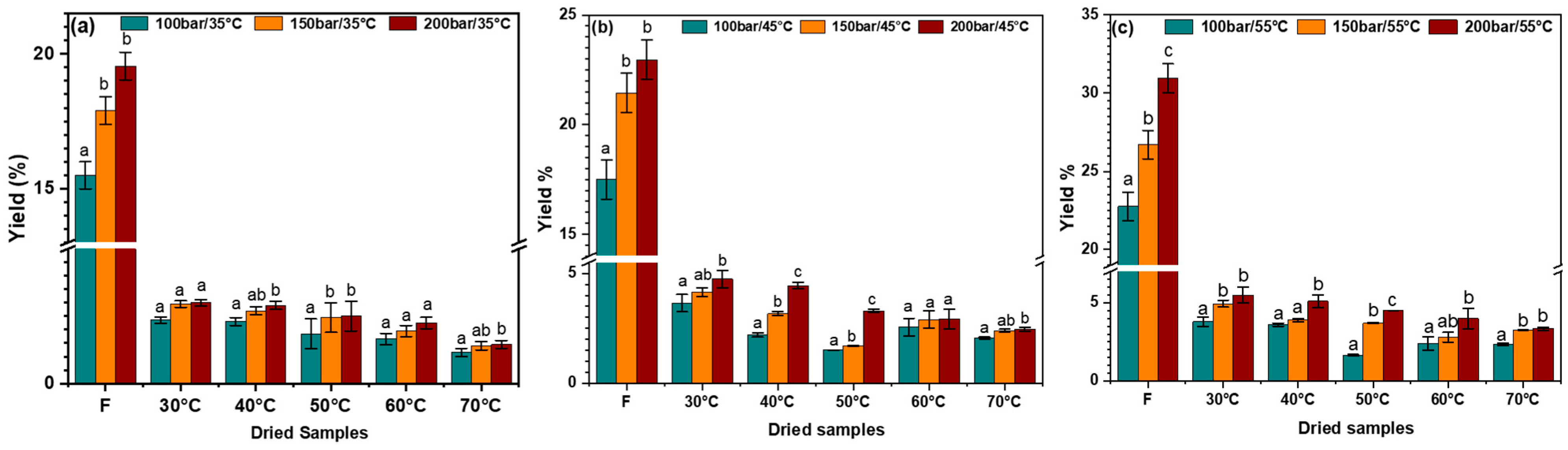
Supercritical CO2 (SFE-CO2) yield of Pistacia lentiscus extracts was monitored as a function of two main parameters: leaf pretreatment (drying temperature) and SFE-CO2 operational conditions, which varied in pressure (from 100 to 200 bar) and extraction temperatures (from 35 °C to 55 °C). The results revealed that the yields were significantly influenced by both the drying temperature and extraction conditions (p < 0.05) (Figure 1).
Extraction temperature had a significant, positive effect on yield. Fresh samples under 200 bars showed an increase in yield from 19.55% (35 °C) to 22.95% and 30.95% (45 °C and 55 °C, respectively).
A similar trend was observed for the dried samples. However, the increase was smaller in magnitude, probably due to a reduction in yield (p < 0.05) associated with leaf drying, and the lowest yield was observed for samples dried above 60 °C. This reduction may be due to thermal degradation or evaporation of heat-sensitive volatiles, consistent with previous findings from traditional hydro-distillation [3].
On the other hand, pressure was a critical factor influencing extraction yield, showing a positive correlation. Higher pressures generally yielded higher values across samples and conditions. Statistical analysis confirmed a significant effect (p < 0.05) in most cases, except for samples dried at 60 °C and extracted at 35 °C or 45 °C. Similar patterns regarding the influence of extraction parameters, particularly pressure and temperature, on yield have also been reported in previous studies [9,10].
Combining higher extraction temperature and pressure with moderate drying temperature appears to enhance extraction yield. This improvement may be attributed to the residual moisture in moderately dried leaves, which acts as a cosolvent under supercritical conditions, thereby enhancing the solubility of volatile compounds and improving overall extraction efficiency.
These data are consistent with previous findings reported by Bampouli et al., which investigated the effects of different extraction parameters on the supercritical CO2 extraction of Pistacia lentiscus leaves, focusing on yield variation under various conditions, and reporting extraction yields of 23% and 1.6% for fresh and dried leaves, respectively, at 45 °C and 100 bar [11].
The difference between fresh and dried samples was attributed to the significant effect of leaf moisture content, with fresh leaves yielding markedly higher amounts than dried across different combinations of temperature and pressure [10].

3.2. Chemical Profile of Pistacia lentiscus Extracts

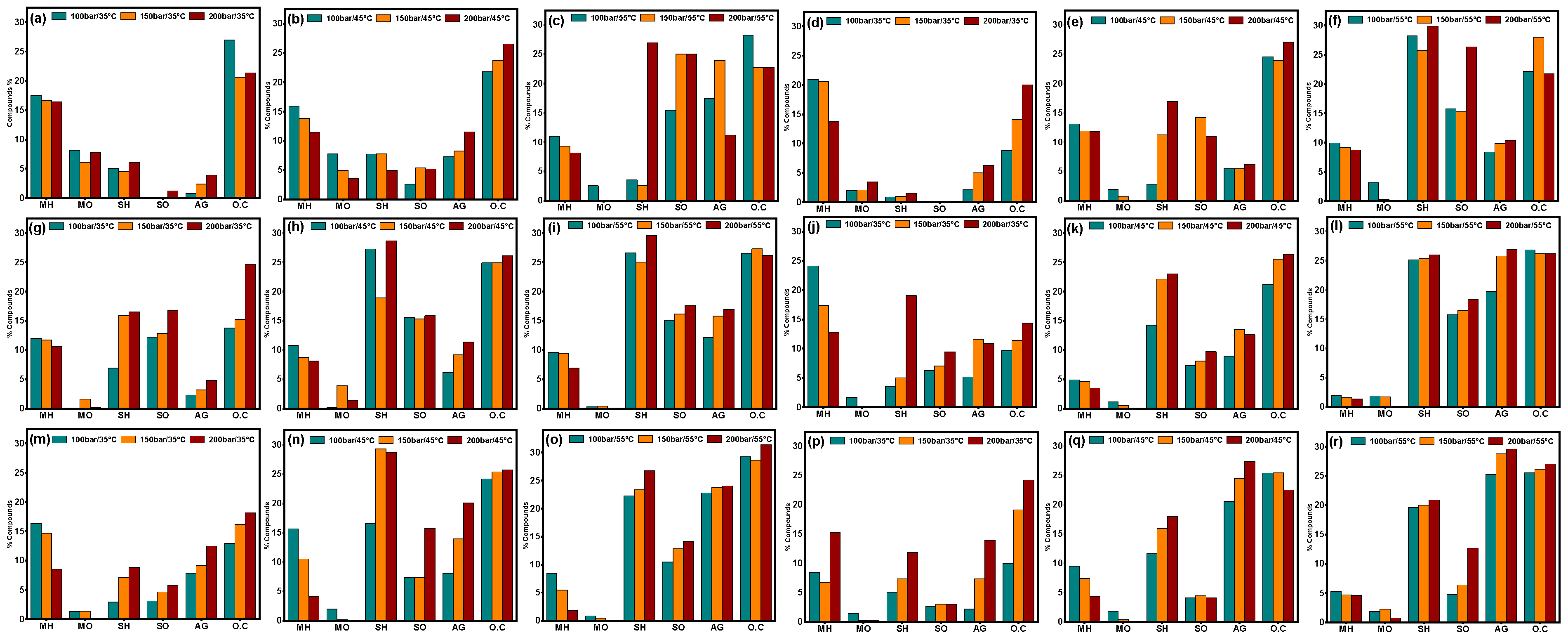
The GC-MS analysis of Pistacia lentiscus essential oils obtained by supercritical CO2 extraction (SFE-CO2) showed a diverse chemical composition dominated by various classes of terpenoid compounds, including monoterpene hydrocarbons (M.H), oxygenated monoterpenes (M.O), sesquiterpene hydrocarbons (S.H), oxygenated sesquiterpenes (S.O), fatty acids (A.G), and other minor constituents (O.C). The relative abundance of these compounds varied significantly depending on both extraction conditions and drying temperature, which confirms that the processing parameters have a strong influence on the chemical composition of P. lentiscus extracts (Figure 2).
Under moderate extraction conditions of 100 bar and 35 °C, the extracts were mainly characterized by monoterpene hydrocarbons, which represent the most volatile fraction of the essential oil. Similar findings have been reported in previous studies on P. lentiscus essential oils, where monoterpenes such as α-pinene, β-pinene and D-limonene were identified as major constituents of the volatile fraction [5]. In our research, the proportion of monoterpene hydrocarbons reached 17.46, 20.96, 12.03, 24.13, 16.35, and 8.43% for fresh and dried leaves subjected to drying temperatures of 30–70 °C, respectively. These compounds are recognized for their bioactivities, particularly antimicrobial and antioxidant effects, which are commonly associated with the disruption of microbial cell membranes and interference with metabolic processes (Figure 2).
In contrast, when the extraction conditions were increased to 200 bar and 55 °C, the chemical profile changed toward a higher proportion of sesquiterpene hydrocarbons and oxygenated sesquiterpenes, with values ranging from 12.67% to 29.89%. This behavior can be explained by the higher density and solvating power of supercritical CO2 at elevated pressures, which enhances the extraction of less volatile and more lipophilic compounds embedded within the plant matrix [8]. Similar observations have been reported in previous investigations, where pressure was identified as a key parameter controlling the extraction yield and composition of P. lentiscus oils obtained by SFE-CO2 [13]. In addition, supercritical CO2 extraction has been shown to selectively recover heavier terpenoid compounds such as germacrene D, β-caryophyllene and δ-cadinene, which contribute significantly to the biological properties of the extracts [13].
Furthermore, supercritical fluid extraction (SFE-CO2) at higher pressure and temperature levels helped extract additional lipophilic compounds, such as fatty acids and other secondary metabolites, particularly in extracts obtained from fresh leaves. This behavior highlights the versatility of supercritical carbon dioxide as a solvent, as extraction selectivity can be modulated by adjusting pressure and temperature parameters. Previous research has also confirmed that the extraction method plays a decisive role in determining the chemical composition of plant essential oils, as SFE-CO2 often yields extracts richer in biologically active compounds compared to traditional water distillation methods [14].
These variations in chemical composition may also explain the differences observed in the biological activities of the extracts. Indeed, monoterpenes such as α-pinene and myrcene, which are frequently reported as major constituents of P. lentiscus essential oils, have been associated with antimicrobial, antioxidant, and cytoprotective properties [6]. Therefore, the relative abundance of these compounds, together with the presence of sesquiterpenes and other lipophilic metabolites, may contribute to the antifungal and antibacterial activities observed in the present study.
Regarding P. lentiscus, whose biological activities are primarily associated with volatile monoterpenes and sesquiterpenes such as α-pinene, β-pinene, limonene, and terpinene-4 -ol and germacrene D, SFE-CO2 extraction seems to be a more suitable extraction technology due to its affinity for nonpolar and moderately polar compounds. However, the NADES and DES techniques are generally more effective at extracting polar phenolic compounds than volatile terpenoids. Consequently, the selection of SFE-CO2 extraction in this study was driven by its ability to selectively extract the volatile components without solvents while preserving the heat-sensitive compounds that significantly contribute to the antimicrobial properties of P. lentiscus leaves. Recently, mixed extraction strategies combining supercritical carbon dioxide and environmentally friendly co-solvents, such as ethanol or NADES, have emerged as promising alternatives for the simultaneous extraction of volatile and polar phytochemicals, representing an interesting avenue for future research [15].

3.3. Antimicrobial Activity, Analysis of Experiments (Box–Behnken and Regression Models)

3.3.1. Model Fitting and Statistical Validation of the Box–Behnken Design

The antimicrobial activity of the essential oils of P. lentiscus has been attributed to monoterpenes and sesquiterpenes compounds, which can disrupt cell membranes and inhibit microbial enzymes [14,16]. They are effective against several Gram-positive bacteria (Staphylococcus aureus, Bacillus subtilis) and Gram-negative bacteria (Escherichia coli, Pseudomonas aeruginosa), as well as certain fungi [17]. Supercritical CO2 extraction (SFE) is an effective approach for concentrating these bioactive molecules [5]. Moreover, high pressure and moderate temperature promote the extraction of these compounds while preserving their stability [18].
Antimicrobial outcomes were measured as inhibition zones and evaluated using ANOVA (ExpertDesign) to assess model fit with linear, Two-Factor Interaction (2FI), quadratic, and cubic models. The fitting results indicated that the quadratic model performed better, demonstrating a statistically significant relationship (p < 0.001) (Table 1), and the lack of fit test for the quadratic models was not statistically significant (p > 0.05), indicating that the models adequately describe the experimental data and that the remaining variability can be primarily attributed to experimental error and not to model inadequacy. While the other models were either aliased or showed no significant dependence and were not considered in the discussion. Across all drying conditions, the quadratic model yielded a high coefficient of determination (R2) ranging from 0.9192 to 0.9979. The differences between adjusted R2a and predicted R2p values generally indicated good agreement, not exceeding a difference of >0.2 in most instances, except for the extracts from fresh leaves R3 (R2p = 0.3460 vs. R2a = 0.8490) and R4 (R2p = 0.5743 vs. R2a = 0.8385), which may necessitate careful validation of the run with lower confidence. Model adequacy diagnostics confirmed a reliable navigation of the design space (Table 2).
Adequate Precision (signal-to-noise) easily surpassed the common threshold of 4 for all responses, indicating strong predictive discrimination over experimental noise.
Based on the parameters and the accurate results, it is recommended that the relationship between the selected independent variables and their antimicrobial responses is represented by a quadratic model.

3.3.2. Effect of Independent Variables and the Drying Conditions on the Antifungal Activity of the Pistacia lentiscus Extracts

The antifungal properties of the extract were evaluated against two fungi, R. glutinis and G. candidum. The extracts demonstrated a significantly greater antifungal activity against R. glutinis than against G. candidum. For fresh leaves, the inhibition zones against R. glutinis ranged from 10.9 to 14.5 mm, with the highest inhibition observed at 150 bars, 55 °C, and 20 mg/mL, whereas for dried samples ranged 12.3–15.0 mm, 12.0–15.1 mm, 11.8–16.7 mm, and 12.4–16.0 mm, at 30 °C, 50 °C, 60 °C, and 70 °C, respectively. In contrast, the inhibition zones for G. candidum ranged 9.0–13.0 mm, 10.0–12.8 mm, 9.0–13.5 mm, 10.0–13.5 mm, and 9.5–14.5 mm for fresh and dried samples at 30 °C, 50 °C, 60 °C, and 70 °C, respectively (Table S1).
Nevertheless, despite varying resistance to the extracts, prolonged drying of the extract enhanced antifungal activity. This improvement may be attributed to the concentration and alterations in the chemical profile of the extracts, which were positively influenced by the drying process, as previously reported by Bouakline et al. [4]. The authors highlighted that all the fungi and bacteria studied were sensitive to all oils extracted from the dried leaves at 30–70 °C, especially at 40 °C. Inhibition zones of 32 ± 0.3, 9.8 ± 0.3, 18.02 ± 0.1, 13.5 ± 0.3, and 16.1 ± 0.1 mm, respectively, were set for Rhodotorula glutinis, Saccharomyces cerevisiae, Geotrichum candidum, Escherichia coli, and Listeria monocytogenes.
In addition, Bouchfara, A. reported that even a slight difference in the concentration of essential oil compounds could alter their apparent composition and result in differences in the properties and characteristics of the extracted essential oil [19].
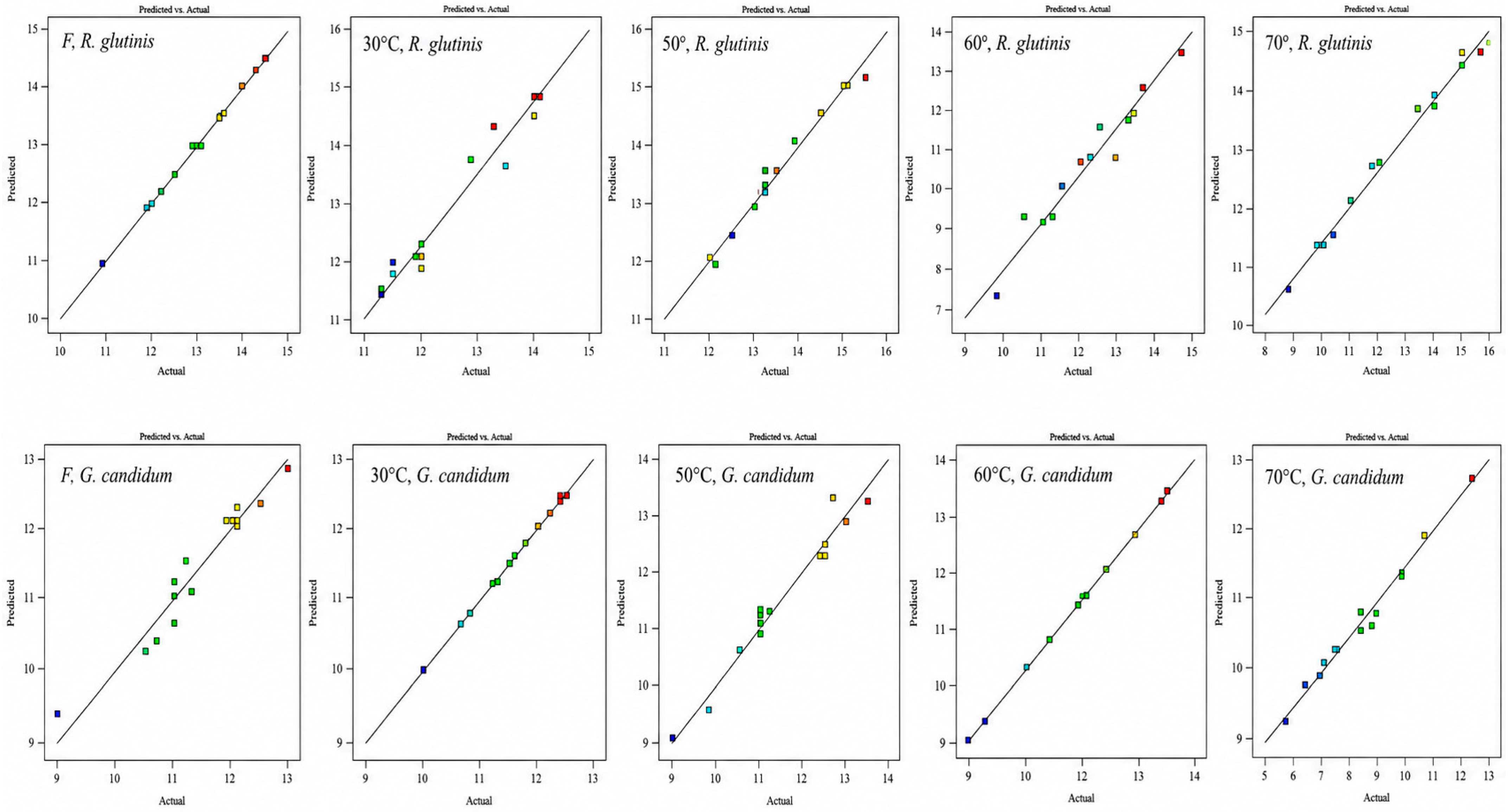
To gain a more profound comprehension of the impact of the independent variables (pressure and temperature, as measured by SFE, in conjunction with the concentration employed in the antifungal assays), the significance of each factor and its quadratic terms were evaluated (Table S2, Figure 3).
The extracts obtained at higher pressure, temperature, and concentration showed greater inhibition of R. glutinis, indicating that intensified extraction enhanced the recovery of active compounds from fresh leaves (Equation (S1), Table S2). However, the presence of negative quadratic effects suggested that, beyond certain limits, higher levels of pressure or concentration reduced efficacy, likely due to compound degradation or inefficient extraction.
In the case of G. candidum, concentration and temperature were the most important parameters, whereas excessive pressure slightly decreased inhibition, showing that optimal extraction intensity depends on the fungal target. Drying the leaves at 30 °C increased antifungal activity compared with fresh samples, especially for R. glutinis.
Nevertheless, the overall model indicated that excessively high extraction parameters could negatively affect the antifungal activity, probably due to the degradation of thermolabile compounds.
For G. candidum, concentration remained the main factor enhancing inhibition, whereas higher pressure reduced it, confirming that mild extraction conditions better preserve antifungal constituents at this drying temperature.
Raising the leaf-drying temperature to 50 °C maintained a strong antifungal activity of the extract for R. glutinis (12.0–15.5 mm). The concentration was the primary positive factor (C = +0.815), whereas pressure and temperature had minor negative effects. In the case of G. candidum, the activity increased (9.0–13.5 mm) (Equation (S9), Table S2), and the model showed significant positive influences from concentration and temperature, along with a positive interaction between pressure and temperature (Equation (S10), Table S2). This suggests that drying at 50 °C helps stabilize bioactive antifungal compounds; however, extraction processes need to be fine-tuned to prevent overprocessing, as evidenced by the negative quadratic effects at high extraction temperatures.
Leaves dried at 60 °C and 70 °C yielded extracts exhibiting the highest antifungal activity against both fungi. R. glutinis showed maximum inhibition of 16.7 mm at 60 °C (200 bar, 45 °C, and 20 mg/mL), and 16.0 mm at 70 °C under lower pressure (100 bar, 45 °C, and 20 mg/mL). The same trend was observed in the work of Shrirame, B., in which the antimicrobial activity of the extracted oil was evaluated at 50 °C and 200 bar, given its richness in compounds with biological activity under appropriate extraction conditions. The fungi C. albicans and C. tropicalis were sensitive to the extracted essential oil, with inhibition zones of 10 and 8 mm, respectively [20].
The models (Equations (S13) and (S17), Table S2) indicated that pressure, temperature, and concentration positively influenced antifungal activity, confirming their synergistic roles in compound extraction. However, for leaves dried at 60 °C, the interaction between pressure and temperature became unfavorable, suggesting that combining high values of both parameters can reduce efficacy. For G. candidum, inhibition zones ranged from 10.0 to 13.5 mm, with pressure and concentration being the most relevant factors; however, their interaction showed that excessive pressure improved activity only within a limited temperature range.
Conversely, the extract from leaves dried at 70 °C benefits from high-intensity extraction. The models highlighted that increasing pressure and concentration enhanced antifungal performance, and the positive interaction between pressure and temperature indicated a synergistic effect. At this drying temperature, G. candidum exhibited the largest inhibition zones, up to 14.5 mm, indicating that appropriate combinations of extraction parameters can maximize bioactive compound yield.
Overall, extract concentration consistently enhanced antifungal activity across all drying conditions and fungal strains. Extraction temperature had a generally positive effect, particularly at higher drying levels, whereas pressure had a different effect depending on the drying temperature. At 60 °C, high pressure combined with high temperature reduced activity due to negative interactions, whereas at 70 °C, pressure and temperature had synergistic effects.
These findings highlight that the impact of extraction parameters depends on the thermal treatment of the raw material and must be adjusted accordingly for optimal antifungal performance [21].

3.3.3. Effect of Independent Variables and the Drying Conditions on the Antibacterial Activity of the Pistacia lentiscus Extracts

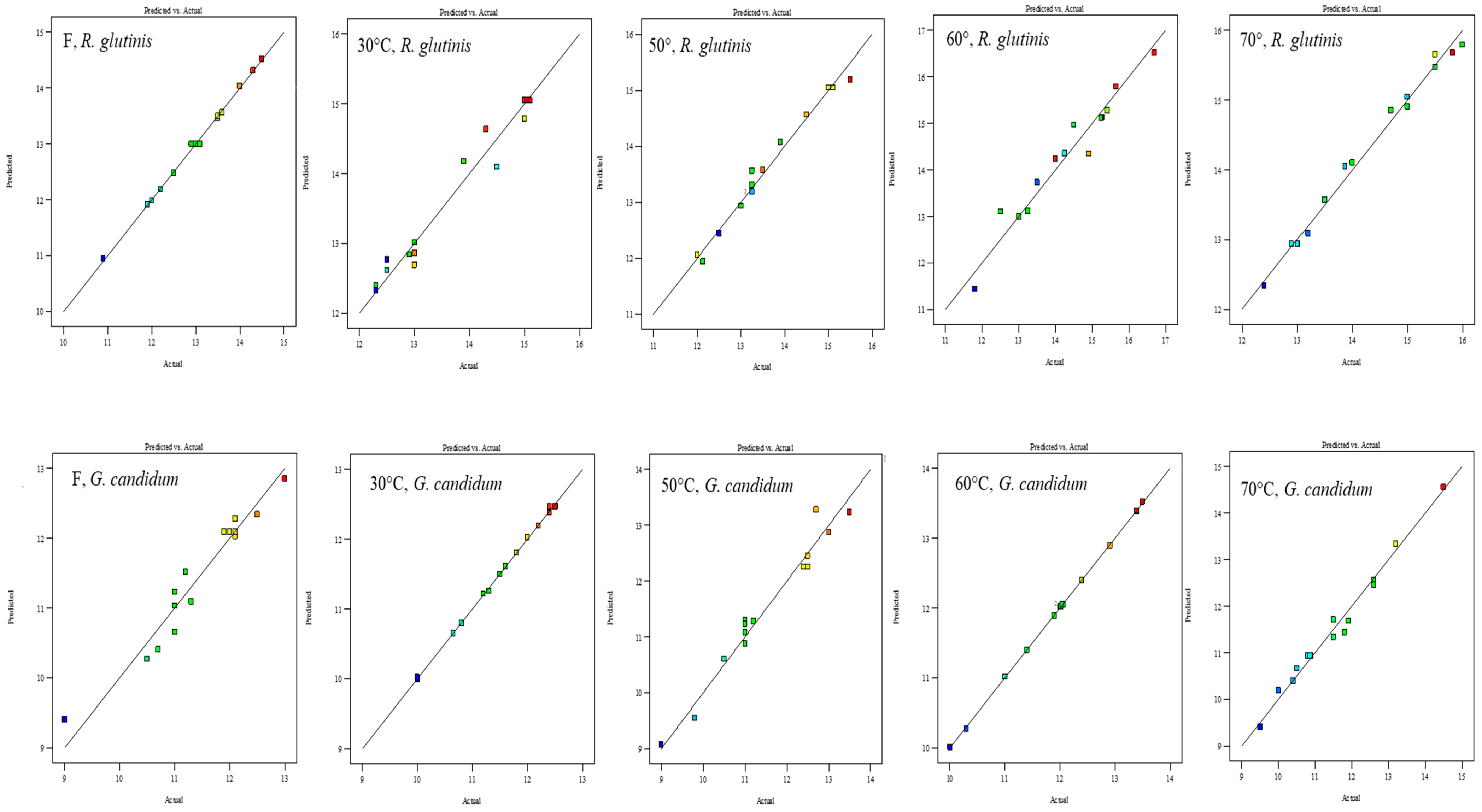
The antibacterial properties of the extracts from P. lentiscus, evaluated by measuring inhibition zone diameters against P. aeruginosa (R3) and L. monocytogenes (R4), showed variability according to leaf drying temperature and supercritical CO2 extraction parameters (Table S1). The correlations between the predicted and actual values of the antibacterial activity of extracts showed good R2 (Figure 4).
Across all drying conditions, the inhibition zones ranged from 10.0 to 14.6 mm for P. aeruginosa and from 10.3 to 13.3 mm for L. monocytogenes, reflecting moderate antimicrobial activity and a greater sensitivity of the Gram-negative bacteria to the various P. lentiscus extracts.
Fresh leaf extracts showed relatively moderate inhibition zones, ranging from 10.0 to 14.0 mm for P. aeruginosa and 10.4 to 12.0 mm for L. monocytogenes. The quadratic models showed weak individual effects of pressure and temperature but revealed positive interactions between these factors, suggesting that a combination of moderate to high extraction pressure and elevated temperature improves antibacterial performance. The antibacterial response for L. monocytogenes was more dependent on interactions among parameters than on individual variables, indicating a complex relationship between extraction conditions and bioactivity.
At 30 °C, a significant positive effect of both temperature and concentration was observed, suggesting that higher extract concentrations and higher temperatures improve efficacy against P. aeruginosa (Equation (S7), Table S2). All quadratic terms were negative, indicating a local maximum in the response surface. Against L. monocytogenes, all main factors (pressure, temperature, and concentration) contributed positively, but their interactions reduced overall activity when increased simultaneously, indicating that balance among parameters is essential. When leaves were dried at 50 °C, antibacterial activity against P. aeruginosa (10.0–13.5 mm) was mainly influenced by pressure and temperature, whereas concentration had a smaller role. Negative quadratic trends indicated that excessive extraction conditions could reduce activity. For L. monocytogenes (10.4–13.0 mm), all factors contributed positively, and the positive pressure–temperature interaction suggested a synergistic effect between these parameters.
At 60 °C, the inhibition of P. aeruginosa ranged from 10.6 to 13.5 mm, whereas the inhibition zones for L. monocytogenes fluctuated between 10.3 and 12.8 mm. The quadratic model for P. aeruginosa showed positive contributions from both temperature and concentration, with pressure having a minimal effect (Equation (S15), Table S2).
Additionally, negative quadratic effects underscored the need to avoid extreme conditions. In contrast, the model for L. monocytogenes (Equation (S16), Table S2) demonstrated consistently positive effects from all variables, along with corresponding quadratic terms, indicating a wider range of acceptable extraction parameters and a more resilient response, consistent with findings from leaves dried at 50 °C.
At the elevated drying temperature of 70 °C, P. aeruginosa displayed inhibition zones ranging from 10.0 to 14.6 mm, marking the highest antibacterial activity observed in this study. Increasing both temperature and concentration significantly enhanced efficacy, particularly for heat-stable compounds. For L. monocytogenes, inhibition zones ranged from 10.8 to 12.3 mm, with all factors contributing positively. The positive interactions between pressure and temperature, along with all positive quadratic terms, suggested that antibacterial activity can be optimized across a wide range of conditions, although P. aeruginosa remained more responsive overall.
The extracts from P. lentiscus exhibited superior antibacterial properties against P. aeruginosa compared to L. monocytogenes. The extraction temperature and the concentration of the extract were consistently identified as critical factors that enhanced antibacterial activity, while pressure played a significant role in certain instances, particularly with Gram-negative bacteria. On the one hand, this was previously noted in Reyes Jurado’s paper, which claimed that changes in temperature and pressure alter selectivity, enabling the selective extraction of different compounds from oils. This is particularly evident at high pressures (40–60 MPa) during the second extraction step [22]. On the other hand, Bouakline et al.’s finding under the extraction condition of 200 bar and 55 °C showed a noticeable variation in inhibition with increasing extract concentration against different bacterial strains, including Escherichia coli, Pseudomonas aeruginosa, Staphylococcus aureus, and Listeria monocytogenes, the molds Geotrichum candidum and Penicillium digitatum, and the yeasts Rhodotorula glutinis and Saccharomyces cerevisiae [4].

3.3.4. Optimization and Validation

The response surface methodology (RSM) enabled optimization of the criteria, keeping all factors within their experimental ranges while maximizing the inhibition zones for Rhodotorula glutinis (R1), Geotrichum candidum (R2), Pseudomonas aeruginosa (R3), and Listeria monocytogenes (R4). The results showed that optimal conditions varied with leaf drying temperature (Table S3). For both the fresh samples and those dried at 30 °C, the optimized parameters included moderate to high extraction intensity alongside consistently elevated extract concentrations, with predicted outcomes aligning closely with experimental findings. At 50 °C (intermediate drying temperature), the ideal conditions favored slightly reduced pressure and temperature, achieving high concentrations and yielding consistent antimicrobial responses in line with model predictions.
The extracts obtained at 70 °C exhibited the highest overall activity. Validation indicated that these extracts could withstand and even thrive under increased pressure and temperature. These findings corroborate the RSM analysis, which indicated that drying pretreatment significantly affects the relationship between extraction intensity and bioactivity. In summary, the models exhibited robust predictive performance, as evidenced by low standard errors and 95% prediction intervals across all measured responses.
The results highlighted a distinct relationship among the operating factors, demonstrating that pressure significantly affects the antibacterial activity of all strains tested. In terms of inhibition, values between 150 bar and 200 bar led to larger inhibition diameters, especially for R. glutinis and G. candidum. This trend suggests that pressure enhances the release and concentration of bioactive compounds responsible for the antimicrobial activity, particularly oxygenated terpenes.
For P. aeruginosa, known for its high intrinsic resistance, the effect of pressure becomes more pronounced, indicating that increasing this factor enables the achievement of sufficient concentrations of active molecules capable of disrupting bacterial membranes. On the other hand, L. monocytogenes exhibited a more moderate response, indicating moderate sensitivity to pressure changes.
The 45 °C temperature yielded the largest inhibition diameters for most strains across all air-drying temperatures. Lower or higher temperatures reduced activity, suggesting an equilibrium between extraction efficiency and antimicrobial compound stability. This effect is most notable in G. candidum and P. aeruginosa. Therefore, temperature is an important control parameter that regulates process optimization and the final bioactivity of the extracts.
The results reveal a distinct influence of concentration on the intensity and selectivity of antibacterial activity. Overall, an average concentration of 15 mg/mL yielded the best antibacterial activity, particularly against R. glutinis and P. aeruginosa, whereas 10 mg/mL decreased the inhibition, reflecting an insufficient concentration of active compounds. Conversely, at high concentrations (around 20 mg/mL), activity was stabilized, possibly due to antagonistic effects between the compounds or to a limitation in their diffusion in the culture medium.
In addition, the chemical composition of essential oils is a key factor in their antimicrobial activity. It is influenced by air-drying temperature, extraction pressure, and temperature. The samples dried at 50 °C and 60 °C demonstrated high levels of O.C and S.O, especially at high concentrations such as 20 mg/mL. According to the study by Boukaline et al. [4], which highlighted the influence of air-drying temperature on the antimicrobial and antifungal properties.
The diversity and chemical complexity of the volatile compounds in essential oils, combined with their synergistic effects, allow them to diffuse rapidly across cell membranes, thereby enhancing their antimicrobial efficacy by destabilizing the plasma membrane and increasing its permeability, as already reported by Chua, L.Y.W.et al. [23].
In addition, Reves-Jurado, F. et al. tested the effect of different concentrations of essential oil samples, and the results indicated that efficacy increased with increasing essential oil concentration and M.O [24]. Oxygenated monoterpenes have been shown to be more effective because their oxygen-containing functional groups, such as OH, CHO, and O, confer higher polarity and chemical reactivity, enabling greater binding to microbial cell membranes than non-oxygenated hydrocarbons, as reported in previous studies [25,26].

4. Conclusions

This study demonstrates that both air-drying pretreatment and supercritical CO2 extraction conditions significantly influence the yield, chemical profile, and antimicrobial activity of Pistacia lentiscus leaf extracts. Increasing extraction pressure and temperature enhanced extraction yield and modified the distribution of key volatile families, indicating that processing conditions shape not only extract recovery but also compositional outcomes relevant to biological functionality.
The response surface methodology (RSM) model provided reliable predictions and confirmed that drying pretreatment, extraction pressure, temperature, and extract concentration are key parameters for optimizing yield and bioactivity.
Overall, these findings improve our understanding of how upstream drying and SFE-CO2 settings jointly determine the chemical and antimicrobial properties of P. lentiscus extracts. Future work should expand the range of drying temperatures and supercritical extraction conditions and apply advanced analytical and chemometric approaches to better identify the main contributors to antimicrobial activity.
In addition, further studies should evaluate the stability, safety, and performance of P. lentiscus extracts under application-relevant conditions to support their development as natural antimicrobial agents.

Supplementary Materials

The following supporting information can be downloaded at: https://www.mdpi.com/article/10.3390/analytica7030054/s1, Table S1: Chemical profile of Pistacia lentiscus essential oils from fresh and dried leaves and different CO2 extraction pressures and temperatures; Table S2: Chemical profile of Pistacia lentiscus essential oils extracted at 100 bar and 35, 45, and 55 °C from fresh and dried leaves at 30 and 40 °C; Table S3: Inhibition zones (mm) on the four microorganisms as a function of the proposed pressure, temperature, and concentration combinations, for fresh and dried samples at various temperatures (30, 50, 60, and 70 °C).; Table S4: Equations in terms of coded factors (A: pressure; B: temperature; C: concentration), as a function of the proposed pressure, temperature, and concentration combinations, for each undried (fresh) and dried sample at various temperatures (30, 50, 60, and 70 °C). Table S5: Optimization criteria. optimal formulation results. and statistical analysis. Table S6: ANOVA tables of the experiments carried out for the system validation for G. candidum. Table S7: Drying parameters for Pistacia lentiscus leaves adapted to different temperatures.

Author Contributions

Conceptualization, writing—original draft preparation, H.B.; methodology; software and review and editing, M.B.; investigation, I.Z.; project administration, funding acquisition and review and editing, A.A. (Alberto Angioni); formal analysis, M.I.Y.; formal analysis, A.A. (Alessandro Atzei); formal analysis, A.A. (Abdeslam Asehraou); review and editing, A.T.; review and editing, F.C.; review and editing, A.G.; review and editing, A.T.; supervision, A.E.B. All authors have read and agreed to the published version of the manuscript.

Funding

This research was supported by Legge Regionale 11 aprile 1996, n. 19 (Regione Autonoma della Sardegna), (Recovery and valorisation of medicinal and aromatic plants from the Eastern Region of Morocco and their exploitation for the creation of effective and low-cost health care products).

Informed Consent Statement

Informed consent was obtained from all subjects involved in the study.

Data Availability Statement

Dataset available on request from the authors.

Conflicts of Interest

The authors declare no conflicts of interest.

References

  1. Soulaidopoulos, S.; Tsiogka, A.; Chrysohoou, C.; Lazarou, E.; Aznaouridis, K.; Doundoulakis, I.; Tyrovola, D.; Tousoulis, D.; Tsioufis, K.; Vlachopoulos, C.; et al. Overview of Chios Mastic Gum (Pistacia lentiscus) Effects on Human Health. Nutrients 2022, 14, 590. [Google Scholar] [CrossRef] [PubMed]
  2. Bouakline, H.; Bouknana, S.; Merzouki, M.; Ziani, I.; Challioui, A.; Bnouham, M.; Tahani, A.; El Bachiri, A. The Phenolic Content of Pistacia lentiscus Leaf Extract and Its Antioxidant and Antidiabetic Properties. Sci. World J. 2024, 1, 1998870. [Google Scholar] [CrossRef] [PubMed]
  3. Ziani, I.; Bouakline, H.; Merzouki, M.; Fauconnier, M.L.; Sher, F.; Bentouhami, N.E.; Asehraou, A.; El Bachiri, A. Purification of bioactive compounds from rosemary by-products for innovative solutions in food industry. Ind. Crops Prod. 2025, 223, 120125. [Google Scholar] [CrossRef]
  4. Bouakline, H.; Ziani, I.; Yahyaoui, M.I.; Corrias, F.; Abdeslam, A.; El Bachiri, A. Using green solvents as co-solvent in supercritical carbon dioxide extraction: A promising source of extracts rich in antioxidants and antimicrobials agents. Sustain. Chem. Pharm. 2025, 44, 101950. [Google Scholar] [CrossRef]
  5. Bouakline, H.; Brahmi, M.; Ziani, I.; Rhizlan, A.; Yahyaoui, M.I.; Angioni, A.; Talhaoui, A.; Bnouham, M.; Abdeslam, A.; Tahani, A.; et al. Influence of air-drying temperature on yield, volatilome content, antioxidant, antidiabetic and antimicrobial activities of Pistacia lentiscus leaf oil: Experimental and modeling aspects. Food Biosci. 2025, 63, 105773. [Google Scholar] [CrossRef]
  6. Xanthis, V.; Fitsiou, E.; Voulgaridou, G.P.; Bogadakis, A.; Chlichlia, K.; Galanis, A.; Pappa, A. Antioxidant and cytoprotective potential of the essential oil Pistacia lentiscus var. Chia and its major components myrcene and α-pinene. Antioxidants 2021, 10, 127. [Google Scholar] [CrossRef] [PubMed]
  7. Congiu, R.; Falconieri, D.; Marongiu, B.; Piras, A.; Porcedda, S. Extraction and isolation of Pistacia lentiscus L. essential oil by supercritical CO2. Flavour Fragr. J. 2002, 17, 239–244. [Google Scholar] [CrossRef]
  8. Bouakline, H.; Ziani, I.; Elkabous, M.; Daoudi, N.E.; Angioni, A.; Atzei, A.; Corrias, F.; Karzazi, Y.; Tahani, A.; El Bachiri, A. Eco-friendly extraction of Pistacia lentiscus bioactives: Supercritical CO2 technology and artificial neural networks predictions. J. Supercrit. Fluids 2026, 227, 106751. [Google Scholar] [CrossRef]
  9. Mira, B.; Blasco, M.; Berna, A.; Subirats, S. Supercritical CO2 extraction of essential oil from orange peel. Effect of operation conditions on the extract composition. J. Supercrit. Fluids 1999, 14, 95–104. [Google Scholar] [CrossRef]
  10. Bampouli, A.; Kyriakopoulou, K.; Papaefstathiou, G.; Louli, V.; Aligiannis, N.; Magoulas, K.; Krokida, M. Evaluation of total antioxidant potential of Pistacia lentiscus var. chia leaves extracts using UHPLC-HRMS. J. Food Eng. 2015, 167, 25–31. [Google Scholar] [CrossRef]
  11. Kwaśnica, A.; Pachura, N.; Masztalerz, K.; Figiel, A.; Zimmer, A.; Kupczyński, R.; Wujcikowska, K.; Carbonell-Barrachina, A.A.; Szumny, A.; Różański, H. Volatile composition and sensory properties as quality attributes of fresh and dried hemp flowers (Cannabis sativa L.). Foods 2020, 9, 1118. [Google Scholar] [CrossRef] [PubMed]
  12. Chemat, F.; Vian, M.A.; Cravotto, G. Green Extraction of Natural Products: Concept and Principles. Int. J. Mol. Sci. 2012, 13, 8615–8627. [Google Scholar] [CrossRef] [PubMed]
  13. Aydi, A.; Zibetti, A.W.; Al-khazaal, A.Z.; Eladeb, A.; Adberraba, M.; Barth, D. Supercritical CO2 Extraction of Extracted Oil from Pistacia lentiscus L.: Mathematical Modeling, Economic Evaluation and Scale-Up. Molecules 2020, 25, 199. [Google Scholar] [CrossRef] [PubMed]
  14. Bampouli, A.; Kyriakopoulou, K.; Papaefstathiou, G.; Louli, V.; Krokida, M.; Magoulas, K. Comparison of different extraction methods of Pistacia lentiscus var. chia leaves: Yield, antioxidant activity and essential oil chemical composition. J. Appl. Res. Med. Aromat. Plants 2014, 1, 81–91. [Google Scholar] [CrossRef]
  15. Gazal, U. Supercritical CO2 Extraction Reimagined: Advances in Co-Solvent Systems, Hybrid Green Techniques, and Circular Bioeconomy Applications. Curr. Top. Chem. 2026, 6, E29504023461207. [Google Scholar] [CrossRef]
  16. Mouahid, A.; Dufour, C.; Badens, E. Supercritical CO2 extraction from endemic Corsican plants; Comparison of oil composition and extraction yield with hydrodistillation method. J. CO2 Util. 2017, 20, 263–273. [Google Scholar] [CrossRef]
  17. Meriem, M.; Rachida, A.; Housseyn, M.; Farida, T.; Abdelaziz, M.; Fouzia, M. Antimicrobial Activity of the Essential Oil Isolated from Pistacia lentiscus Leaves Against Helicobacter pylori Algerian Clinical Isolates. J. Essent. Oil-Bear. Plants 2016, 19, 466–474. [Google Scholar] [CrossRef]
  18. Mezni, F.; Aouadhi, C.; Khouja, M.L.; Khaldi, A.; Maaroufi, A. In vitro antimicrobial activity of Pistacia lentiscus L. edible oil and phenolic extract. Nat. Prod. Res. 2015, 29, 565–570. [Google Scholar] [CrossRef] [PubMed]
  19. Bouchfara, A.; Zerrad, H.; Ez-zari, A.; Laglaoui, A.; Nechar, M.; Souhail, B. Antibacterial and antioxidant activities of Pistacia lentiscus essential oils: Impact of total phenolic content on antioxidant efficacy. Biocatal. Agric. Biotechnol. 2025, 64, 103532. [Google Scholar] [CrossRef]
  20. Shrirame, B.; Geed, S.R.; Hassan, S.Z.; Verma, J.S.; Samal, K.; Namdeo, A.; Rai, B.N. Supercritical CO2 extraction of caraway (Carum carvi L.) seed: Optimization and parametric interaction studies using design of experiments. J. CO2 Util. 2022, 65, 102195. [Google Scholar] [CrossRef]
  21. Sadowska, U.; Kopeć, A.; Kourimska, L.; Zarubova, L.; Kloucek, P. The effect of drying methods on the concentration of compounds in sage and thyme. J. Food Process. Preserv. 2017, 41, e13286. [Google Scholar] [CrossRef]
  22. Silva, S.G.; de Olivera, M.S.; Cruz, J.N.; da Costa, W.A.; da Silva, S.H.M.; Maia, A.A.B.; de Sousa, R.L.; Carvalho Junior, R.N.; de Aguiar Andrade, E.H. Supercritical CO2 extraction to obtain Lippia thymoides Mart. & Schauer (Verbenaceae) essential oil rich in thymol and evaluation of its antimicrobial activity. J. Supercrit. Fluids 2021, 168, 105064. [Google Scholar] [CrossRef]
  23. Chua, L.Y.W.; Chong, C.H.; Chua, B.L.; Figiel, A. Influence of Drying Methods on the Antibacterial, Antioxidant and Essential Oil Volatile Composition of Herbs: A Review. Food Bioprocess. Technol. 2019, 12, 450–476. [Google Scholar] [CrossRef]
  24. Reves-Jurado, F.; Franco-Vega, A.; Ramirez-Corona, N.; Palou, E.; Lopez-Malo, A. Essential Oils: Antimicrobial Activities, Extraction Methods, and Their Modeling. Food Eng. Rev. 2014, 7, 275–297. [Google Scholar] [CrossRef]
  25. Ziani, I.; Bouakline, H.; Bouknana, S.; Bentouhami, N.E.; Sher, F.; Ansar, S.; Fauconnier, M.L.; Bnouham, M.; El Bachiri, A. Sustainable management of rosemary wastewater and essential oil in agri-environmental bioprocessing. Food Biosci. 2024, 62, 105263. [Google Scholar] [CrossRef]
  26. Hassanzad Azar, H.; Yousefizadeh, S.; Ghafari, A.; Mehdi, F.; Majid, A. Antimicrobial effects of the nanoemulsion of rosemary essential oil against important foodborne pathogens. J. Hum. Environ. Health Promot. 2019, 5, 79–85. [Google Scholar] [CrossRef]
Figure 1. Extraction yield (%) of Pistacia lentiscus leaf extracts obtained by SFE-CO2 at different extraction temperatures: 35 °C (a), 45 °C (b), and 55 °C (c), with different extraction pressure values at 100, 150, and 200 bars.
Analytica 07 00054 g001
Figure 2. Distribution of M.H, M.O, S.H, S.O, A.G, and O.C in the essential oil of Pistacia lentiscus leaves extracted at different pressures and temperatures: fresh sample (ac); air-dried leaves at 30 °C (df), 40 °C (gi), 50 °C (jl), 60 °C (mo), and 70 °C (pr).
Analytica 07 00054 g002
Figure 3. Correlation between the predicted and actual values of the antifungal activity of extracts obtained from leaves dried at different temperatures.
Analytica 07 00054 g003
Figure 4. Correlation regressions between the predicted and actual values of the antibacterial activity of extracts obtained from leaves dried at different temperatures.
Analytica 07 00054 g004
Table 1. Box–Behnken design variables used for the optimization.
Independent VariablesFactorsActual and Coded Levels
LowMediumHigh
−101
Pressure (bar)A100150200
Temperature (°C)B354555
Concentration (mg/mL)C101520
Dependent variablesResponses (Inhibition zone diameter, mm)
R. GlutinisR1 (mm)
G. candidumR2 (mm)
P. aeruginosaR3 (mm)
L. monocytogenesR4 (mm)
Table 2. Regression analysis results of the quadratic model.
R2R2aR2pp-ValueLack of FitAdeq Precision
Fresh
R10.99790.99420.9876<0.00010.857559.24
R20.94410.91310.8255<0.00010.090218.88
R30.92450.84900.34600.00190.124611.73
R40.91920.83850.57430.00240.495110.52
30 °C
R10.96390.93690.8562<0.00010.024214.40
R20.99890.99730.9954<0.00010.862072.34
R30.99440.98690.9315<0.00010.031234.46
R40.99180.98080.9246<0.00010.158125.64
50 °C
R10.98320.96640.9234<0.00010.041921.68
R20.96410.94420.8789<0.00010.025922.13
R30.99790.99420.9674<0.00010.018448.47
R40.98030.96540.9045<0.00010.001225.61
60 °C
R10.94840.91970.7722<0.00010.001321.24
R20.99980.99960.9984<0.00010.1917216.26
R30.98560.97120.9007<0.00010.023925.55
R40.98220.95860.81860.00010.034919.98
70 °C
R10.99030.98290.9476<0.00010.108632.24
R20.98410.97520.9457<0.00010.039939.30
R30.98510.97020.8989<0.00010.082523.06
R40.99290.98350.9648<0.00010.926029.90
R1 R. glutinis, R2 G. candidum, R3 P. aeruginosa, R4 L. monocytogenes.
Disclaimer/Publisher’s Note: The statements, opinions and data contained in all publications are solely those of the individual author(s) and contributor(s) and not of MDPI and/or the editor(s). MDPI and/or the editor(s) disclaim responsibility for any injury to people or property resulting from any ideas, methods, instructions or products referred to in the content.