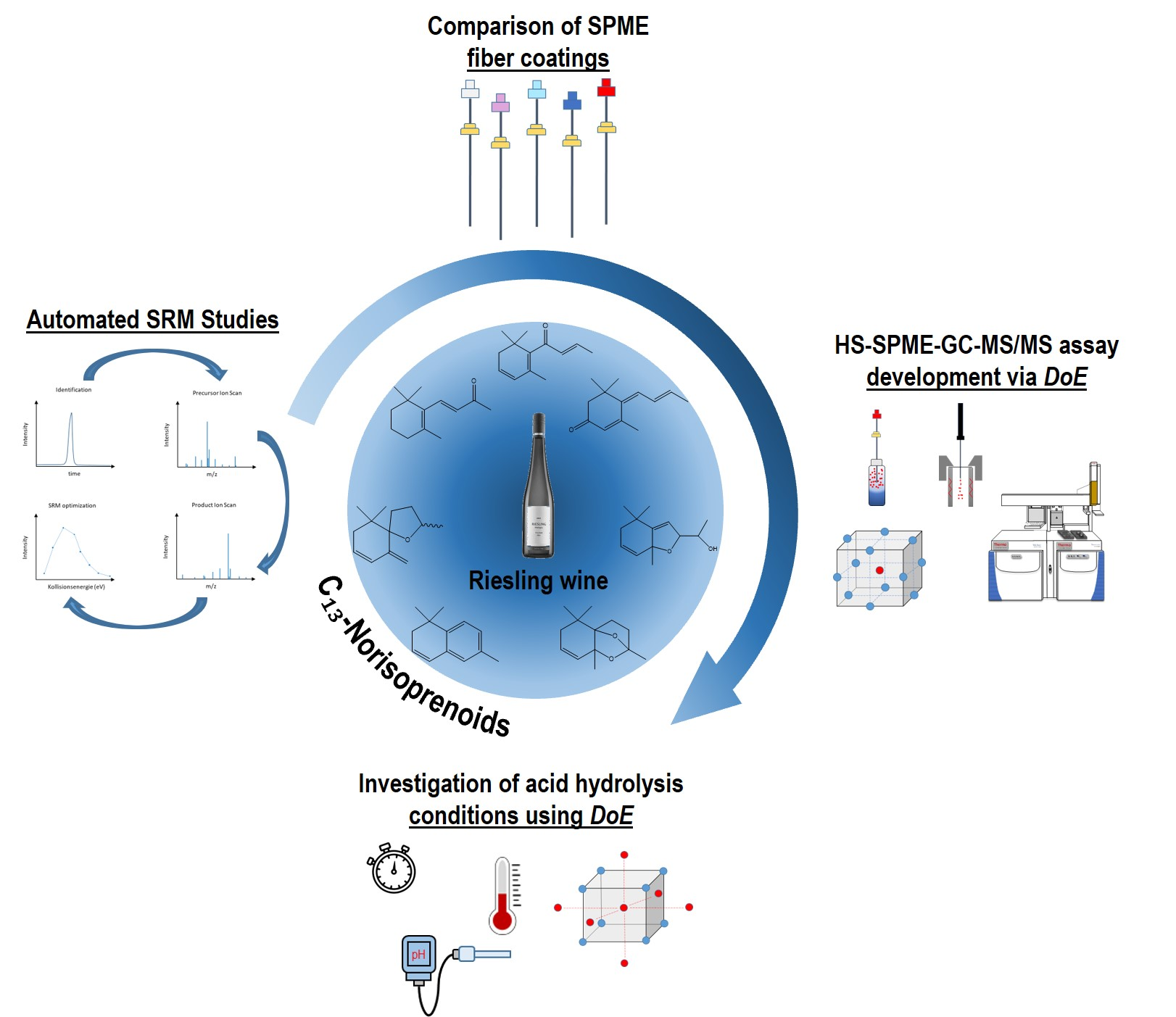

Development of an Assay for C13-Norisoprenoid Analysis in Riesling Wine and Its Application to Simulated Aging by Acidic Hydrolysis Using Response Surface Methodology


Abstract
1. Introduction
2. Materials and Methods
2.1. Chemicals and Materials
2.2. Synthesis of Reference Compounds
2.3. Generation of Reference Compounds by Simultaneous Distillation–Extraction (SDE)
2.4. Wine Samples
2.5. Analysis of Norisoprenoids
2.5.1. Sample Preparation
2.5.2. Initial HS-SPME-GC-MS/MS Parameters
2.5.3. Optimized Method Parameters
2.6. Statistical Analysis
3. Results and Discussion
3.1. Selection of Target C13-Norisoprenoids and Auto-SRM Studies
- (i)
- Compounds with a direct impact on the wine aroma
- (ii)
- Compounds that primarily do not contribute directly to wine aroma because of their low contents or compounds that act as precursors of aroma-active norisoprenoids
Selection of Analytical Standards and Extracts and Optimization of SRM Transitions

| Compound | RT | Transition 1 (Quantifier) | Collision 1 (eV) | Transition 2 (Qualifier 1) | Collision 2 (eV) | q/Q Ratio [%] | Transition 3 (Qualifier 2) | Collision 3 (eV) | q/Q Ratio [%] | RIExp a | Identification b |
|---|---|---|---|---|---|---|---|---|---|---|---|
| (d5)-Vitispiranes | 24.02 & 24.12 | 182.2 → 121.1 | 10.0 | 197.2 → 182.2 | 10.0 | 107 | 182.2 → 93.1 | 15.0 | 58 | 1505 + 1507 | RS |
| Vitispiranes c | 24.14 & 24.25 | 177.1 → 121.1 | 10.0 | 192.1 → 177.2 | 10.0 | 89 | 177.1 → 93.1 | 15.0 | 57 | 1508 + 1511 | RS |
| Riesling acetal c | 28.36 | 138.1 → 123.1 | 10.0 | 148.1 → 133.2 | 5.0 | 48 | 133.1 → 91.1 | 10.0 | 6 | 1616 | LRI MS 1 |
| (d6)-TDN | 32.20 | 163.2 → 148.2 | 10.0 | 178.2 → 163.2 | 10.0 | 85 | 145.1 → 144.1 | 15.0 | 47 | 1717 | RS |
| TDN d | 32.37 | 157.1 → 142.1 | 14.0 | 172.1 → 157.1 | 8.0 | 50 | 157.1 → 115.1 | 38.0 | 36 | 1722 | RS |
| (d4)-β-damascenone | 35.09 | 194.2 → 121.2 | 5.0 | 194.2 → 179.2 | 5.0 | 38 | 179.2 → 73.1 | 10.0 | 6 | 1797 | RS |
| β-damascenone e | 35.20 | 190.1 → 175.2 | 5.0 | 190.1 → 121.1 | 10.0 | 152 | 190.1 → 105.1 | 10.0 | 1800 | RS | |
| TPB d | 35.54 | 157.1 → 142.2 | 10.0 | 172.2 → 157.2 | 5.0 | 36 | 142.1 → 141.1 | 15.0 | 1809 | LRI MS 2 | |
| α-ionone f | 36.31 | 192.1 → 177.2 | 5.0 | 192.1 → 149.2 | 5.0 | 19 | 177.1 → 147.1 | 20.0 | 15 | 1829 | RS |
| trans-actinidol (isomer I) c | 38.90 | 163.1 → 145.2 | 5.0 | 163.1 → 121.2 | 5.0 | 62 | 145.1 → 105.1 | 10.0 | 56 | 1904 | LRI MS 1 |
| (d3)-β-ionone | 39.00 | 180.1 → 165.2 | 20.0 | 180.1 → 150.1 | 10.0 | 115 | 1909 | RS | |||
| β-ionone f | 39.24 | 177.1 → 162.1 | 10.0 | 177.1 → 147.1 | 20.0 | 119 | 1916 | RS | |||
| trans-actinidol (isomer II) c | 39.33 | 163.1 → 145.2 | 5.0 | 163.1 → 121.2 | 5.0 | 69 | 145.1 → 105.1 | 10.0 | 36 | 1917 | LRI MS 1 |
| megastigma-4,6Z,8E-trien-3-one f | 46.01 | 190.1 → 175.1 | 5.0 | 133.1 → 105.1 | 10.0 | 103 | 147.1 → 119.1 | 5.0 | 74 | 2126 | RS |
| megastigma-4,7E,9Z-trien-3-one f | 46.50 | 134.1 → 91.1 | 15.0 | 119.1 → 91.1 | 15.0 | 68 | 190.1 → 134.1 | 5.0 | 52 | 2142 | RS |
| megastigma-4,6Z,8Z-trien-3-one f | 47.33 | 148.2 → 133.1 | 5.0 | 133.1 → 105.1 | 10.0 | 63 | 190.1 → 175.1 | 5.0 | 42 | 2169 | RS |
| megastigma-4,6E,8E-trien-3-one f | 49.31 | 190.1 → 175.1 | 5.0 | 133.1 → 105.1 | 10.0 | 125 | 147.1 → 119.1 | 5.0 | 84 | 2235 | RS |
| megastigma-4,6E,8Z-trien-3-one f | 50.19 | 148.2 → 133.1 | 5.0 | 190.1 → 175.1 | 5.0 | 54 | 133.1 → 105.1 | 10.0 | 76 | 2265 | RS |
3.2. Optimization of HS-SPME-GC Conditions Using Statistical Design of Experiments (DoE)
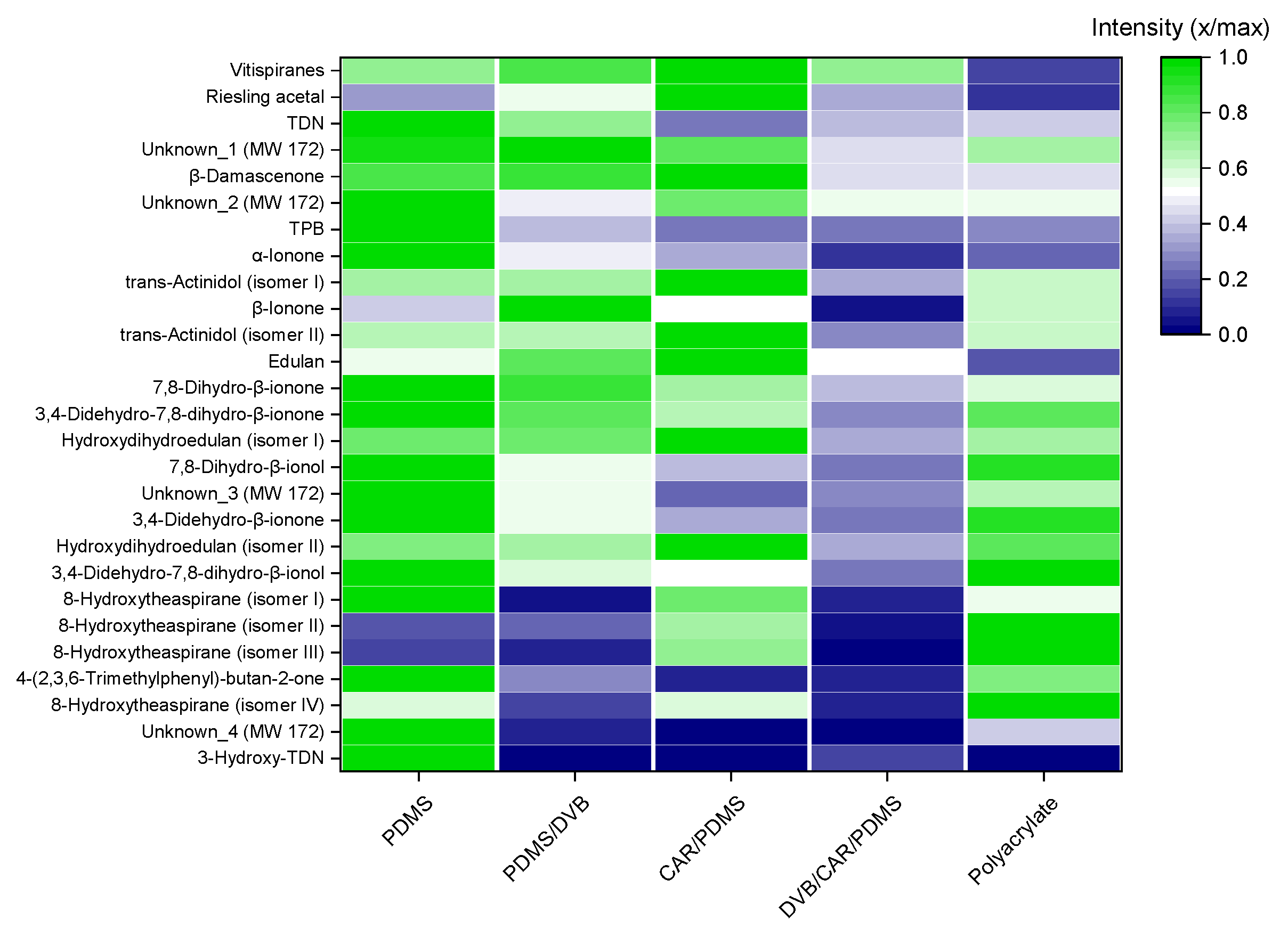
3.2.1. SPME Fiber Selection
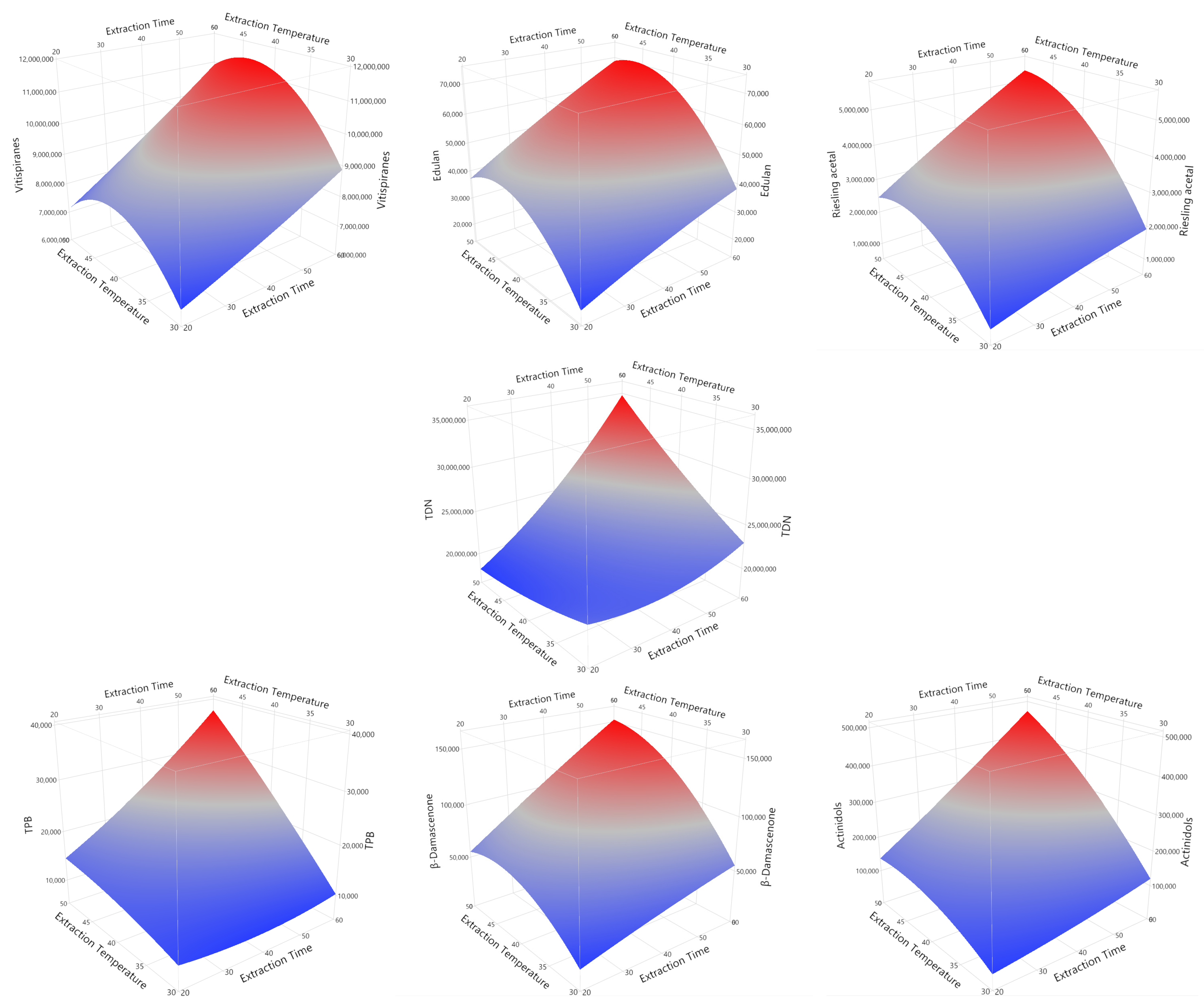
3.2.2. Selection of the Key Factors of the Extraction Process Using HS-SPME
3.2.3. Experimental Design and Selection of Response Variables
3.3. Quantitative Approach and Analytical Performance Parameters
3.4. Investigation of Norisoprenoid Profiles Under Different Hydrolysis Conditions in Riesling Wine
3.4.1. Experimental Design for Acidic Hydrolysis Conditions
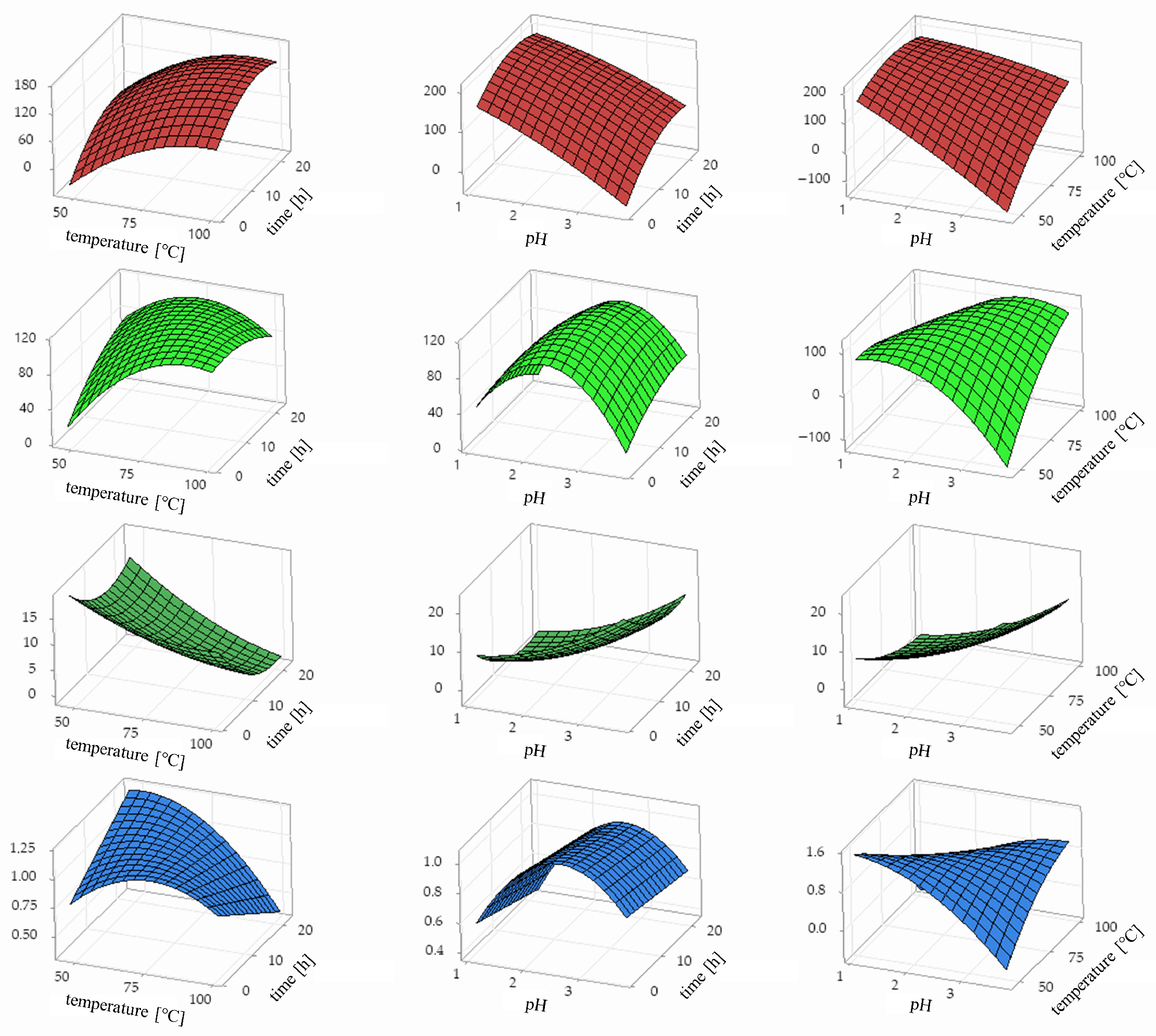
3.4.2. Results of the DoE Investigation of Acid Hydrolysis
Evaluation of the Investigated Factors
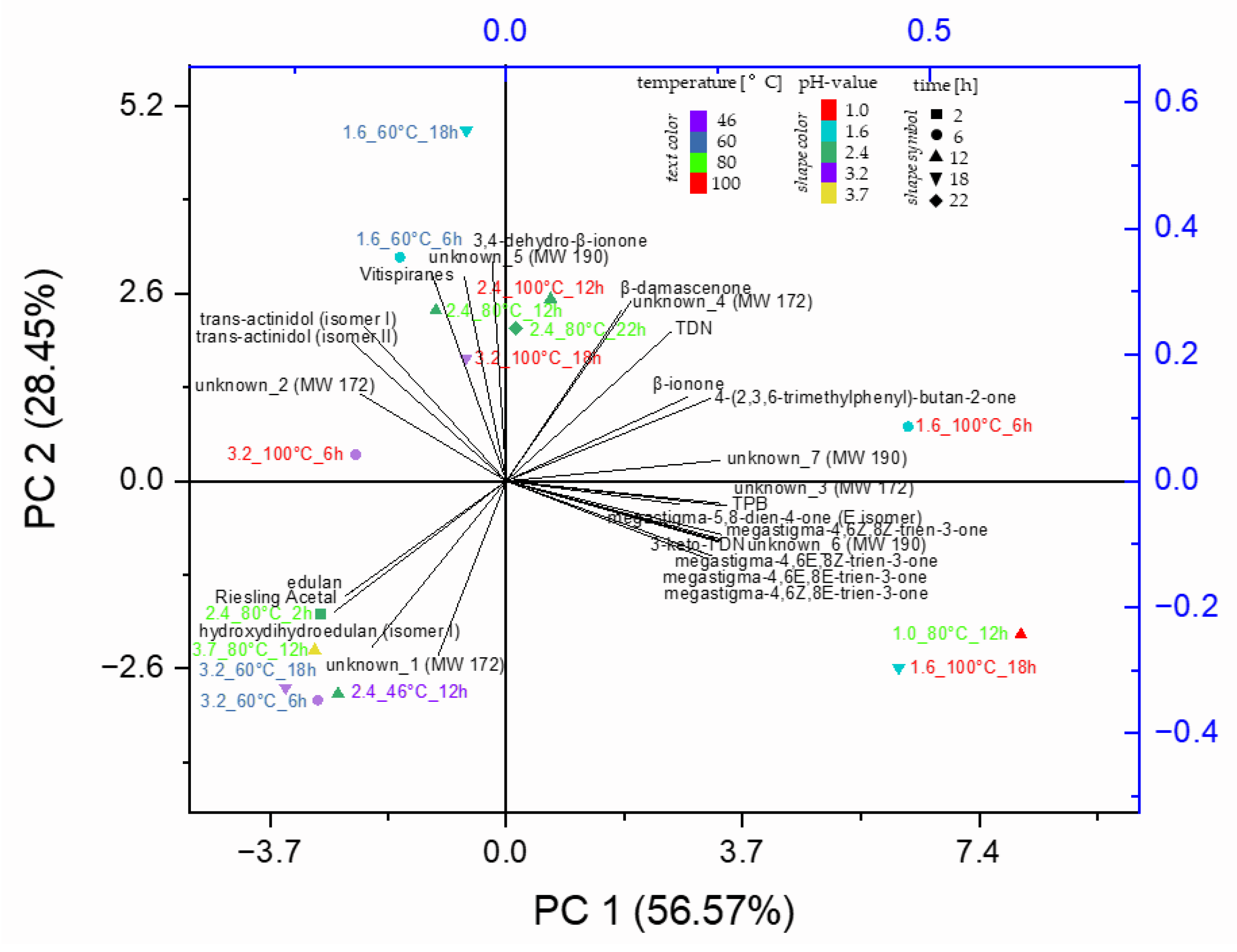
Impact of Hydrolysis Conditions on Individual Norisoprenoids
Use of Acidic Hydrolysis to Simulate Wine Aging
4. Conclusions
Author Contributions
Funding
Data Availability Statement
Conflicts of Interest
Abbreviations
| CAR | Carboxen |
| CCD | Central composite design |
| CW | Carbowax |
| DoE | Design of experiments |
| DVB | Divinylbenzene |
| GC | Gas chromatography |
| HS | Headspace |
| LOD | Limit of detection |
| LOQ | Limit of quantification |
| PA | Polyacrylate |
| PCA | Principal component analysis |
| PDMS | Polydimethylsiloxane |
| PEG | Polyethylene glycol |
| q/Q | Qualifier/quantifier |
| RSM | Response surface methodology |
| SDE | Simultaneous distillation extraction |
| SIDA | Stable isotope dilution analysis |
| SIM | Selective ion monitoring |
| SPME | Solid-phase microextraction |
| SRM | Selected reaction monitoring |
| TDN | 1,1,6-trimethyl-1,2-dihydronaphthalene |
| TPB | (E)-1-(2,3,6-trimethylphenyl)-buta-1,3-diene |
Appendix A
| Norisoprenoid | EI-MS (70 eV) m/z rel [%] |
|---|---|
| unknown_1 (MW 172) a | 172 (41), 158 (12), 157 (90), 143 (17), 142 (100), 141 (50), 129 (32), 128 (29), 115 (29), 77 (11) |
| unknown_2 (MW 172) a | 172 (41), 158 (11), 157 (90), 143 (17), 142 (100), 141 (51), 129 (32), 128 (29), 115 (29), 77 (11) |
| unknown_3 (MW 172) ab | 172 (38), 158 (13), 157 (100), 143 (14), 142 (46), 141 (29), 129 (12), 128 (23), 115 (17) |
| unknown_4 (MW 172) ab | 172 (35), 157 (100), 142 (29), 133 (34), 132 (42), 129 (25), 128 (28), 117 (35), 115 (32), 105 (25) |
| unknown_5 (MW 190) ab | 190 (10), 172 (26), 158 (13), 157 (100), 145 (8), 143 (16), 142 (29), 141 (10), 129 (20), 128 (21), 115 (13) |
| unknown_6 (MW 190) ab | 190 (10), 172 (26), 158 (13), 157 (100), 145 (8), 143 (16), 142 (29), 141 (10), 129 (20), 128 (21), 115 (13) |
| unknown_7 (MW 190) ab | 190 (10), 172 (26), 158 (13), 157 (100), 145 (8), 143 (16), 142 (29), 141 (10), 129 (20), 128 (21), 115 (13) |
| Compound | RT | Transition 1 (Quantifier) | Collision 1 (eV) | Transition 2 (Qualifier 1) | Collision 2 (eV) | q/Q Ratio [%] | Transition 3 (Qualifier 2) | Collision 3 (eV) | q/Q Ratio [%] | RIExp a | Identification b |
| edulan | 27.57 | 177.2 → 159.2 | 5.0 | 172.2 → 131.2 | 10.0 | 55 | 159.2 → 129.2 | 15.0 | 30 | 1592 | LRI MS 1 |
| unknown_1 (MW 172) d | 35.10 | 157.1 → 142.2 | 10.0 | 172.2 → 157.2 | 5.0 | 18 | 1799 | LRI MS 1 | |||
| unknown_2 (MW 172) d | 35.26 | 157.1 → 142.2 | 10.0 | 172.2 → 157.2 | 5.0 | 1804 | LRI MS 1 | ||||
| 7,8-dihydro-β-ionone f | 35.60 | 121.2 → 93.1 | 5.0 | 161.2 → 105.1 | 10.0 | 44 | 176.2 → 106.2 | 5.0 | 39 | 1811 | RS |
| 3,4-didehydro-7,8-dihydro-β-ionone f | 37.02 | 119.1 → 91.1 | 10.0 | 192.2 → 119.1 | 15.0 | 134.2 → 119.2 | 10.0 | 8 | 1852 | RS | |
| hydroxydihydroedulan (isomer I) c | 38.60 | 126.1 → 70.1 | 10.0 | 111.1 → 55.1 | 10.0 | 34 | 1897 | LRI MS 2,3 | |||
| 7,8-dihydro-β-ionol c | 40.49 | 123.2 → 81.1 | 10.0 | 163.2 → 107.2 | 5.0 | 33 | 1952 | LRI MS 1 | |||
| megastigma-5,8-dien-4-one (E isomer) f | 40.52 | 137.1 → 109.1 | 5.0 | 192.1 → 177.2 | 5.0 | 29 | 1955 | LRI MS 1 | |||
| unknown_3 (MW 172) d | 40.86 | 157.1 → 142.2 | 10.0 | 157.1 → 141.2 | 20.0 | 81 | 172.2 → 157.2 | 10.0 | 58 | 1965 | LRI MS 1 |
| 5,6-epoxy-β-ionone f | 40.95 | 123.1 → 67.1 | 10.0 | 135.1 → 107.1 | 5.0 | 26 | 135.1 → 91.1 | 10.0 | 32 | 1968 | LRI MS1 |
| 3,4-didehydro-β-ionone f | 41.35 | 190.2 → 175.2 | 8.0 | 175.1 → 157.1 | 5.0 | 58 | 147.2 → 119.2 | 10.0 | 68 | 1978 | RS |
| hydroxydihydroedulan (isomer II) c | 41.41 | 126.1 → 111.1 | 10.0 | 126.1 → 70.1 | 5.0 | 89 | 111.1 → 55.1 | 10.0 | 31 | 1979 | LRI MS 2,3 |
| megastigma-5,8-dien-4-one (Z isomer) f | 41.70 | 163.1 → 119.1 | 10.0 | 192.1 → 109.1 | 5.0 | 13 | 192.1 → 177.2 | 5.0 | 93 | 1990 | LRI MS 1 |
| 3,4-didehydro-7,8-dihydro-β-ionol f | 42.05 | 119.1 → 91.1 | 15.0 | 194.2 → 119.2 | 15.0 | 121.2 → 105.1 | 10.0 | 4 | 1998 | RS | |
| 8-hydroxy-theaspirane c | 47.13 | 125.2 → 69.1 | 10.0 | 154.1 → 98.1 | 10.0 | 5 | 2161 | LRI MS 1,2,3 | |||
| 8-hydroxy-theaspirane c | 47.50 | 125.2 → 69.1 | 10.0 | 154.1 → 69.1 | 10.0 | 5 | 2172 | LRI MS 1,2,3 | |||
| 8-hydroxy-theaspirane c | 47.89 | 125.2 → 69.1 | 15.0 | 154.1 → 69.1 | 10.0 | 5 | 2185 | LRI MS 1,2,3 | |||
| 3-keto-TDN d | 48.08 | 173.1 → 145.1 | 10.0 | 188.1 → 173.1 | 5.0 | 76 | 2193 | LRI MS | |||
| 4-(2,3,6-Trimethylphenyl)-butan-2-one e | 48.52 | 172.1→157.2 | 10.0 | 157.1 → 142.2 | 10.0 | 66 | 132.1 → 105.1 | 5.0 | 61 | 2208 | LRI MS 1 |
| 8-hydroxy-theaspirane c | 49.05 | 154.1 → 69.1 | 10.0 | 154.2 → 98.1 | 15.0 | 125.2 → 69.1 | 10.0 | 2224 | LRI MS 1,2,3 | ||
| unknown_4 (MW 172) d | 53.18 | 157.1 → 142.2 | 10.0 | 157.1 → 141.2 | 20.0 | 32 | 172.2→157.2 | 5.0 | 57 | 2369 | LRI MS 1 |
| 3-hydroxy-TDN d | 53.97 | 157.2 → 142.2 | 10.0 | 190.2 → 175.2 | 5.0 | 175.2 → 157.2 | 5.0 | 2397 | RS | ||
| 3,4-didehydro-7,8-dihydro-6-hydroxy-γ-ionol f | 54.08 | 192.2 → 134.2 | 5.0 | 192.2 → 119.2 | 15.0 | 133.2→105.1 | 10.0 | 2400 | RS | ||
| 4-oxo-β-ionone f | 54.77 | 206.2 → 191.0 | 10.0 | 2426 | LRI MS 1 | ||||||
| unknown_5 (MW 190) d | 54.85 | 157.1 → 142.2 | 10.0 | 157.1 → 141.2 | 20.0 | 190.2 → 157.2 | 10.0 | 2428 | LRI MS 1 | ||
| unknown_6 (MW 190) d | 55.25 | 157.1 → 142.2 | 10.0 | 157.1 → 141.2 | 20.0 | 148 | 190.2 → 157.2 | 10.0 | 46 | 2443 | LRI MS 3 |
| unknown_7 (MW 190) d | 56.47 | 157.1 → 142.2 | 10.0 | 157.1 → 141.1 | 20.0 | 82 | 190.2 → 157.2 | 10.0 | 27 | 2488 | LRI MS 3 |
| 3-oxo-α-ionone f | 57.00 | 191.2 → 149.2 | 15.0 | 150.1 → 108.2 | 5.0 | 108.1 → 107.1 | 10.0 | 2507 | LRI MS 1 | ||
| 4-oxo-β-ionol f | 59.74 | 165.2 →137.2 | 5.0 | 137.2 → 122.2 | 5.0 | 2612 | LRI MS 1 | ||||
| 3-hydroxy-β-ionone f | 60.87 | 193.2 → 175.2 | 10.0 | 193.2 → 145.1 | 25.0 | 175.1 → 145.1 | 15.0 | 2656 | LRI MS 1 | ||
| dehydrovomifoliol | 70.11 | 166.1 → 124.2 | 5.0 | 124.1 → 95.1 | 10.0 | 124.1 →123.1 | 3038 | LRI MS 1 |
| Run | Extraction Temperature (°C) | Extraction Time (Min) | Incubation Time (Min) | Desorption Temperature (°C) | Vitispiranes (Area) | Edulan (Area) | Riesling Acetal (Area) | TDN (Area) | TPB (Area) | β-Damascenone (Area) | Actinidols (Area) |
|---|---|---|---|---|---|---|---|---|---|---|---|
| 1 | 40 | 40 | 4 | 250 | 1.15 × 10⁷ | 6.96 × 10⁴ | 4.78 × 10⁶ | 2.89 × 10⁷ | 2.37 × 10⁴ | 1.21 × 10⁵ | 2.92 × 10⁵ |
| 2 | 30 | 40 | 4 | 225 | 1.14 × 10⁷ | 4.77 × 10⁴ | 2.75 × 10⁶ | 2.80 × 10⁷ | 1.91 × 10⁴ | 0.66 × 10⁵ | 2.21 × 10⁵ |
| 3 | 50 | 40 | 8 | 200 | 1.14 × 10⁷ | 6.80 × 10⁴ | 5.43 × 10⁶ | 3.26 × 10⁷ | 3.59 × 10⁴ | 1.25 × 10⁵ | 4.00 × 10⁵ |
| 4 | 30 | 60 | 8 | 225 | 0.92 × 10⁷ | 4.35 × 10⁴ | 2.26 × 10⁶ | 2.50 × 10⁷ | 1.10 × 10⁴ | 0.58 × 10⁵ | 1.17 × 10⁵ |
| 5 | 50 | 40 | 12 | 225 | 1.00 × 10⁷ | 5.97 × 10⁴ | 4.18 × 10⁶ | 2.80 × 10⁷ | 2.94 × 10⁴ | 1.11 × 10⁵ | 3.09 × 10⁵ |
| 6 | 40 | 40 | 8 | 225 | 1.01 × 10⁷ | 6.38 × 10⁴ | 4.49 × 10⁶ | 2.35 × 10⁷ | 1.77 × 10⁴ | 1.10 × 10⁵ | 2.61 × 10⁵ |
| 7 | 40 | 20 | 8 | 200 | 0.94 × 10⁷ | 4.97 × 10⁴ | 3.41 × 10⁶ | 2.23 × 10⁷ | 1.67 × 10⁴ | 0.70 × 10⁵ | 1.69 × 10⁵ |
| 8 | 40 | 40 | 12 | 200 | 0.86 × 10⁷ | 4.16 × 10⁴ | 2.51 × 10⁶ | 2.13 × 10⁷ | 1.30 × 10⁴ | 0.65 × 10⁵ | 1.47 × 10⁵ |
| 9 | 40 | 40 | 8 | 225 | 0.89 × 10⁷ | 4.52 × 10⁴ | 2.65 × 10⁶ | 1.96 × 10⁷ | 1.63 × 10⁴ | 0.72 × 10⁵ | 1.88 × 10⁵ |
| 10 | 40 | 20 | 8 | 250 | 1.30 × 10⁷ | 6.66 × 10⁴ | 4.53 × 10⁶ | 3.23 × 10⁷ | 3.31 × 10⁴ | 1.03 × 10⁵ | 2.71 × 10⁵ |
| 11 | 30 | 40 | 8 | 250 | 1.12 × 10⁷ | 5.90 × 10⁴ | 3.52 × 10⁶ | 2.94 × 10⁷ | 2.33 × 10⁴ | 0.88 × 10⁵ | 2.11 × 10⁵ |
| 12 a | 50 | 60 | 8 | 225 | |||||||
| 13 | 30 | 40 | 8 | 200 | 0.39 × 10⁷ | 0.91 × 10⁴ | 0.47 × 10⁶ | 1.49 × 10⁷ | 0.53 × 10⁴ | 0.12 × 10⁵ | 0.24 × 10⁵ |
| 14 | 30 | 20 | 8 | 225 | 0.61 × 10⁷ | 1.79 × 10⁴ | 0.91 × 10⁶ | 2.00 × 10⁷ | 0.81 × 10⁴ | 0.20 × 10⁵ | 0.41 × 10⁵ |
| 15 | 50 | 20 | 8 | 225 | 0.64 × 10⁷ | 3.14 × 10⁴ | 2.07 × 10⁶ | 1.50 × 10⁷ | 1.22 × 10⁴ | 0.53 × 10⁵ | 1.37 × 10⁵ |
| 16 | 40 | 40 | 8 | 225 | 1.00 × 10⁷ | 5.31 × 10⁴ | 3.46 × 10⁶ | 2.37 × 10⁷ | 1.89 × 10⁴ | 0.95 × 10⁵ | 2.08 × 10⁵ |
| 17 | 40 | 40 | 12 | 250 | 1.43 × 10⁷ | 8.95 × 10⁴ | 6.27 × 10⁶ | 3.66 × 10⁷ | 3.89 × 10⁴ | 1.59 × 10⁵ | 4.36 × 10⁵ |
| 18 | 40 | 60 | 12 | 225 | 1.17 × 10⁷ | 7.27 × 10⁴ | 4.89 × 10⁶ | 3.05 × 10⁷ | 2.44 × 10⁴ | 1.27 × 10⁵ | 3.19 × 10⁵ |
| 19 | 40 | 20 | 4 | 225 | 0.99 × 10⁷ | 5.70 × 10⁴ | 3.81 × 10⁶ | 2.34 × 10⁷ | 1.81 × 10⁴ | 0.80 × 10⁵ | 2.04 × 10⁵ |
| 20 a | 40 | 40 | 4 | 200 | |||||||
| 21 | 40 | 20 | 12 | 225 | 0.67 × 10⁷ | 2.86 × 10⁴ | 1.52 × 10⁶ | 1.74 × 10⁷ | 0.98 × 10⁴ | 0.37 × 10⁵ | 0.76 × 10⁵ |
| 22 | 30 | 40 | 12 | 225 | 0.83 × 10⁷ | 3.07 × 10⁴ | 1.74 × 10⁶ | 2.46 × 10⁷ | 1.01 × 10⁴ | 0.43 × 10⁵ | 0.82 × 10⁵ |
| 23 | 40 | 60 | 8 | 250 | 1.43 × 10⁷ | 8.43 × 10⁴ | 5.92 × 10⁶ | 3.80 × 10⁷ | 4.23 × 10⁴ | 1.72 × 10⁵ | 4.82 × 10⁵ |
| 24 | 50 | 40 | 4 | 225 | 0.98 × 10⁷ | 6.35 × 10⁴ | 4.88 × 10⁶ | 2.79 × 10⁷ | 2.84 × 10⁴ | 1.23 × 10⁵ | 3.75 × 10⁵ |
| 25 | 40 | 60 | 8 | 200 | 1.14 × 10⁷ | 6.42 × 10⁴ | 4.67 × 10⁶ | 2.83 × 10⁷ | 2.60 × 10⁴ | 1.19 × 10⁵ | 3.47 × 10⁵ |
| 26 | 40 | 60 | 4 | 225 | 1.24 × 10⁷ | 7.04 × 10⁴ | 4.71 × 10⁶ | 3.02 × 10⁷ | 2.74 × 10⁴ | 1.32 × 10⁵ | 3.92 × 10⁵ |
| 27 | 50 | 40 | 8 | 250 | 1.03 × 10⁷ | 6.46 × 10⁴ | 4.52 × 10⁶ | 3.05 × 10⁷ | 2.99 × 10⁴ | 1.20 × 10⁵ | 3.36 × 10⁵ |
| Regression Equation | R-Qd [%] | R-Qd cor [%] | R-Qd prog [%] | Constant | A-pH | B-T [°C] | C-t [h] | A2 | B2 | C2 | AB | AC | BC |
|---|---|---|---|---|---|---|---|---|---|---|---|---|---|
| vitispiranes = 11.0 + 1.3 pH + 1.22 T [°C]—23.76 pH*pH—0.02839 T [°C]*T [°C] + 1.444 pH*T [°C] | 77.02 | 72.60 | 64.79 | 0 | 0.399 | 0.388 | 0 | 0.004 | 0 | ||||
| Riesling acetal = 7.17 + 3.728 pH—0.1026 T [°C]—0.2986 t [h] | 75.61 | 73.00 | 67.85 | 0 | 0 | 0 | 0 | ||||||
| TDN = 38–117.1 pH + 3.52 T [°C] + 6.97 t [h]- 0.0311 T [°C]*T [°C]—0.201 t [h]*t [h]+ 0.997 pH*T [°C] | 81.60 | 77.19 | 69.57 | 0 | 0 | 0.001 | 0.003 | 0.028 | 0.095 | 0.005 | |||
| β-damascenone = 0.55–1.101 pH + 0.0607 T [°C] + 0.1022 t [h] | 60.70 | 56.49 | 46.48 | 0 | 0.001 | 0 | 0.013 | ||||||
| trans-actinidol (isomer I) = 2.397–0.428 pH—0.03330 T [°C]—0.1081 pH*pH+ 0.01223 pH*T [°C] | 54.34 | 47.57 | 35.77 | 0 | 0.443 | 0.04 | 0.053 | 0 | |||||
| β-ionone = 0.0558–0.01345 pH | 19.19 | 16.50 | 7.90 | 0 | 0.012 | ||||||||
| trans-actinidol (isomer II) = 3.750–1.138 pH—0.04242 T [°C]+ 0.01493 pH*T [°C] | 47.66 | 42.05 | 33.12 | 0 | 0.31 | 0.013 | 0 | ||||||
| TPB = -0.19–2.272 pH + 0.0865 T [°C] + 0.711 pH*pH—0.02612 pH*T [°C] | 85.35 | 83.18 | 73.35 | 0.003 | 0 | 0 | 0 | 0.001 | |||||
| edulan = -0.0289 + 0.0681 pH—0.00464 t [h] | 66.77 | 64.48 | 58.87 | 0 | 0 | 0.02 | |||||||
| unknown_1 (MW 172) = -0.0767 + 0.0240 pH + 0.001540 T [°C] + 0.000580 t [h]- 0.000007 T [°C]*T [°C]—0.000201 pH*T [°C]- 0.000421 pH*t [h] | 33.23 | 17.20 | 0.00 | 0 | 0.131 | 0.18 | 0.091 | 0.149 | 0.107 | 0.302 | |||
| unknown_2 (MW 172) = 0.0640–0.000527 T [°C] | 19.29 | 16.60 | 8.65 | 0 | 0.012 | ||||||||
| hydroxydihydroedulan (isomer I) = 0.547 + 0.238 pH—0.01465 T [°C]- 0.02339 t [h] + 0.0666 pH*pH+ 0.000140 T [°C]*T [°C]+ 0.000762 t [h]*t [h]—0.005490 pH*T [°C] | 92.03 | 89.71 | 84.85 | 0.915 | 0 | 0 | 0.006 | 0.001 | 0 | 0.024 | 0 | ||
| megastigma-5,8-dien-4-one (E isomer) = 0.02040–0.01476 pH + 0.00258 pH*pH | 30.15 | 25.34 | 0.00 | 0.842 | 0.01 | 0.033 | |||||||
| unknown_3 (MW 172) = 0.58–2.94 pH + 0.0907 T [°C] + 0.865 pH*pH- 0.02851 pH*T [°C] | 80.38 | 77.47 | 64.86 | 0.055 | 0 | 0.001 | 0 | 0.004 | |||||
| 3,4-didehydro-β-ionone =-0.826 + 0.247 pH + 0.0231 T [°C]—0.1884 pH*pH- 0.000252 T [°C]*T [°C] + 0.00768 pH*T [°C] | 67.72 | 61.51 | 53.42 | 0 | 0.153 | 0.393 | 0 | 0.003 | 0 | ||||
| megastigma-4,6Z,8E-trien-3-one = 0.133–0.193 pH + 0.00224 T [°C] + 0.0970 pH*pH+ 0.000080 T [°C]*T [°C]- 0.004827 pH*T [°C] | 84.77 | 81.84 | 71.81 | 0.772 | 0 | 0 | 0 | 0.05 | 0 | ||||
| megastigma-4,6Z,8Z-trien-3-one = 0.56–1.165 pH + 0.0228 T [°C] + 0.616 pH*pH+ 0.000503 T [°C]*T [°C]- 0.03273 pH*T [°C] | 89.60 | 87.60 | 80.25 | 0.486 | 0 | 0 | 0 | 0.03 | 0 | ||||
| 3-keto-TDN = -0.0504–0.0474 pH + 0.002881 T [°C] + 0.02039 pH*pH- 0.000933 pH*T [°C] | 85.46 | 83.31 | 76.34 | 0.137 | 0 | 0 | 0 | 0 | |||||
| 4-(2,3,6-trimethylphenyl)-butan-2-one = 0.546–0.6841 pH + 0.02355 T [°C]+ 0.03167 t [h] | 89.77 | 88.67 | 86.35 | 0 | 0 | 0 | 0 | ||||||
| megastigma-4,6E,8E-trien-3-one = -0.1062–0.0407 pH + 0.004093 T [°C]+ 0.02461 pH*pH—0.001355 pH*T [°C] | 70.88 | 66.56 | 48.72 | 0.388 | 0 | 0.003 | 0.003 | 0.001 | |||||
| megastigma-4,6E,8Z-trien-3-one = -0.631–0.544 pH + 0.03516 T [°C] + 0.2442 pH*pH- 0.01163 pH*T [°C] | 80.80 | 77.95 | 64.63 | 0.25 | 0 | 0.001 | 0 | 0 | |||||
| unknown_4 (MW 172) = 0.4354–0.0942 pH | 28.34 | 25.95 | 17.87 | 0 | 0.002 | ||||||||
| unknown_5 (MW 190) = 0.3757–0.1314 pH—0.00396 T [°C] + 0.001518 pH*T [°C] | 38.12 | 31.49 | 22.99 | 0 | 0.127 | 0.276 | 0.001 | ||||||
| unknown_6 (MW 190) = 0.00358–0.00462 pH + 0.000024 T [°C] + 0.003460 pH*pH+ 0.000004 T [°C]*T [°C]—0.000205 pH*T [°C] | 96.77 | 96.15 | 93.49 | 0.63 | 0 | 0 | 0 | ||||||
| unknown_7 (MW 190) = 0.0145–0.0287 pH + 0.000884 T [°C] + 0.00758 pH*pH- 0.000279 pH*T [°C] | 77.56 | 74.23 | 61.05 | 0.002 | 0 | 0.014 | 0.003 | 0.024 |
| DoE – Experimental Points | 2.4_80 °C_12 h | 2.4_80 °C_2 h | 2.4_80 °C_22 h | 1.0_80 °C_12 h | 3.7_80 °C_12 h | 2.4_46 °C_12 h | 1.6_60 °C_6 h | 1.6_60 °C_18 h | 1.6_100 °C_6 h | 1.6_100 °C_18 h | 3.2_60 °C_6 h | 3.2_60 °C_18 h | 3.2_100 °C_6 h | 3.2_100 °C_18 h | 2.4_100 °C_12 h |
| Compound | Content [μg/L] | ||||||||||||||
| vitispiranes | 74.30 | 46.20 | 70.05 | 9.66 | 30.36 | 18.99 | 71.79 | 73.39 | 42.09 | 9.80 | 21.11 | 29.49 | 74.11 | 68.04 | 66.10 |
| Riesling acetal | 2.47 | 10.14 | 0.31 | n.d. | 9.23 | 8.41 | 5.22 | 0.71 | n.d. | n.d. | 8.73 | 11.55 | 8.56 | 2.31 | 0.05 |
| TDN | 89.42 | 22.56 | 96.20 | 134.26 | 14.21 | 8.09 | 80.27 | 108.70 | 104.07 | 86.48 | 8.93 | 13.35 | 57.07 | 94.39 | 91.22 |
| β-damascenone | 4.61 | 1.77 | 6.46 | 3.83 | 2.34 | 1.112 | 4.11 | 5.25 | 7.23 | 4.42 | 1.23 | 1.5 | 3.45 | 5.31 | 8.24 |
| trans-actinidol (isomer I) | 0.50 | 0.41 | 0.35 | 0.03 | 0.34 | 0.27 | 0.73 | 0.78 | 0.15 | 0.02 | 0.28 | 0.36 | 0.50 | 0.36 | 0.29 |
| β-ionone | 0.02 | 0.01 | 0.02 | 0.05 | 0.01 | 0.02 | 0.03 | 0.03 | 0.06 | 0.02 | n.d. | 0.01 | 0.01 | 0.02 | 0.03 |
| trans-actinidol (isomer II) | 0.64 | 0.58 | 0.46 | 0.05 | 0.50 | 0.41 | 0.95 | 0.78 | 0.18 | 0.03 | 0.39 | 0.53 | 0.64 | 0.45 | 0.38 |
| TPB | 0.38 | 0.08 | 0.48 | 3.45 | 0.03 | 0.02 | 0.28 | 0.38 | 2.46 | 2.16 | 0.02 | 0.02 | 0.26 | 0.39 | 0.76 |
| edulan | 0.05 | 0.16 | 0.01 | n.d. | 0.19 | 0.08 | 0.08 | 0.01 | n.d. | 0.03 | 0.12 | 0.18 | 0.20 | 0.05 | 0.01 |
| unknown_1 (MW 172) | 0.01 | 0.03 | 0.01 | 0.01 | 0.02 | 0.01 | 0.01 | n.d. | n.d. | 0.01 | 0.01 | 0.02 | 0.02 | n.d. | n.d. |
| unknown_2 (MW 172) | 0.04 | 0.01 | n.d. | n.d. | 0.03 | 0.02 | 0.04 | 0.05 | n.d. | n.d. | 0.03 | 0.04 | 0.02 | 0.02 | 0.04 |
| hydroxydihydroedulan (Isomer 1) | n.d. | 0.20 | n.d. | n.d. | 0.29 | 0.38 | 0.05 | n.d. | n.d. | n.d. | 0.39 | 0.42 | 0.06 | n.d. | n.d. |
| megastigma-5,8-dien-4-one (E isomer) | n.d. | n.d. | n.d. | 0.01 | n.d. | n.d. | n.d. | n.d. | 0.01 | n.d. | n.d. | n.d. | n.d. | n.d. | n.d. |
| unknown_3 (MW 172) | 0.38 | 0.04 | 0.53 | 4.09 | 0.02 | 0.01 | 0.26 | 0.34 | 2.83 | 1.78 | 0.01 | 0.01 | 0.22 | 0.15 | 0.92 |
| 3,4-didehydro-β-ionone | 0.46 | 0.17 | 0.37 | 0.02 | 0.02 | n.d. | 0.38 | 0.35 | 0.28 | n.d. | n.d. | 0.01 | 0.29 | 0.25 | 0.37 |
| megastigma-4,6Z,8E-trien-3-one | n.d. | n.d. | n.d. | 0.37 | n.d. | n.d. | n.d. | n.d. | 0.20 | 0.41 | n.d. | n.d. | n.d. | n.d. | 0.01 |
| megastigma-4,6Z,8Z-trien-3-one | 0.09 | n.d. | 0.25 | 2.57 | n.d. | n.d. | 0.06 | 0.21 | 1.78 | 2.72 | n.d. | n.d. | 0.02 | 0.03 | 0.41 |
| 3-keto-TDN | n.d. | n.d. | 0.01 | 0.09 | n.d. | n.d. | n.d. | n.d. | 0.05 | 0.08 | n.d. | n.d. | n.d. | 0.01 | 0.02 |
| 4-(2,3,6-trimethylphenyl)-butan-2-one | 1.21 | 0.42 | 1.4 | 2.04 | 0.33 | 0.23 | 1.14 | 1.43 | 2.2 | 2.47 | 0.29 | 0.32 | 0.83 | 1.19 | 1.63 |
| megastigma-4,6E,8E-trien-3-one | n.d. | n.d. | n.d. | 0.10 | n.d. | n.d. | n.d. | n.d. | 0.05 | 0.12 | n.d. | n.d. | n.d. | n.d. | n.d. |
| megastigma-4,6E,8Z-trien-3-one | 0.01 | n.d. | 0.05 | 0.99 | n.d. | n.d. | n.d. | 0.07 | 0.66 | 0.90 | n.d. | n.d. | n.d. | n.d. | 0.10 |
| megastigma-4,7E,9Z-trien-3-one | n.d. | n.d. | n.d. | n.d. | n.d. | n.d. | n.d. | n.d. | n.d. | n.d. | n.d. | n.d. | n.d. | n.d. | n.d. |
| unknown_4 (MW 172) | 0.24 | 0.13 | 0.22 | 0.28 | 0.09 | 0.05 | 0.30 | 0.41 | 0.35 | 0.23 | 0.06 | 0.08 | 0.23 | 0.22 | 0.23 |
| unknown_5 (MW 190) | 0.05 | 0.02 | 0.05 | 0.01 | 0.02 | 0.01 | 0.08 | 0.10 | 0.02 | 0.01 | 0.01 | 0.02 | 0.03 | 0.03 | 0.03 |
| unknown_6 (MW 190) | n.d. | n.d. | n.d. | 0.01 | n.d. | n.d. | n.d. | n.d. | 0.01 | 0.01 | n.d. | n.d. | n.d. | n.d. | n.d. |
| unknown_7 (MW 190) | 0.01 | n.d. | 0.01 | 0.04 | n.d. | n.d. | 0.01 | 0.02 | 0.03 | 0.03 | n.d. | n.d. | n.d. | n.d. | 0.01 |
References
- Winterhalter, P.; Rouseff, R. Carotenoid-Derived Aroma compounds: An Introduction. In Carotenoid-Derived Aroma Compounds; Winterhalter, P., Rouseff, R.L., Eds.; ACS Symposium Series, 802; American Chemical Society: Washington, DC, USA, 2001; pp. 1–17. [Google Scholar]
- Mendes-Pinto, M.M. Carotenoid breakdown products the—Norisoprenoids—In wine aroma. Arch. Biochem. Biophys. 2009, 483, 236–245. [Google Scholar] [CrossRef] [Scilit]
- Vinholes, J.; Coimbra, M.A.; Rocha, S.M. Rapid tool for assessment of C13 norisoprenoids in wines. J. Chromatogr. A 2009, 1216, 8398–8403. [Google Scholar] [CrossRef] [Scilit]
- Petrozziello, M.; Borsa, D.; Guaita, M.; Gerbi, V.; Bosso, A. Quantification by solid phase micro extraction and stable isotope dilution assay of norisoprenoid compounds in red wines obtained from Piedmont rare varieties. Food Chem. 2012, 135, 2483–2489. [Google Scholar] [CrossRef] [Scilit]
- Ferreira, A.C.S.; de Pinho, P.G. Nor-isoprenoids profile during port wine ageing—Influence of some technological parameters. Anal. Chim. Acta 2004, 513, 169–176. [Google Scholar] [CrossRef]
- Slaghenaufi, D.; Luzzini, G.; Samaniego Solis, J.; Forte, F.; Ugliano, M. Two sides to one story—Aroma chemical and sensory signature of lugana and verdicchio wines. Molecules 2021, 26, 2127. [Google Scholar] [CrossRef] [Scilit]
- Gamero, A.; Wesselink, W.; de Jong, C. Comparison of the sensitivity of different aroma extraction techniques in combination with gas chromatography–mass spectrometry to detect minor aroma compounds in wine. J. Chromatogr. A 2013, 1272, 1–7. [Google Scholar] [CrossRef] [Scilit]
- Ibarz, M.J.; Ferreira, V.; Hernández-Orte, P.; Loscos, N.; Cacho, J. Optimization and evaluation of a procedure for the gas chromatographic–mass spectrometric analysis of the aromas generated by fast acid hydrolysis of flavor precursors extracted from grapes. J. Chromatogr. A 2006, 1116, 217–229. [Google Scholar] [CrossRef] [Scilit] [PubMed]
- Chen, S.; Xu, Y.; Qian, M.C. Aroma characterization of Chinese rice wine by gas chromatography–olfactometry, chemical quantitative analysis, and aroma reconstitution. J. Agric. Food Chem. 2013, 61, 11295–11302. [Google Scholar] [CrossRef] [Scilit] [PubMed]
- Yuan, F.; Qian, M.C. Development of C13-norisoprenoids, carotenoids and other volatile compounds in Vitis vinifera L. Cv. Pinot noir grapes. Food Chem. 2016, 192, 633–641. [Google Scholar] [CrossRef] [Scilit] [PubMed]
- Carlin, S.; Lotti, C.; Correggi, L.; Mattivi, F.; Arapitsas, P.; Vrhovšek, U. Measurement of the Effect of Accelerated Aging on the Aromatic Compounds of Gewürztraminer and Teroldego Wines, Using a SPE-GC-MS/MS Protocol. Metabolites 2022, 12, 180. [Google Scholar] [CrossRef] [Scilit]
- Azzi-Achkouty, S.; Estephan, N.; Ouaini, N.; Rutledge, D.N. Headspace solid-phase microextraction for wine volatile analysis. Crit. Rev. Food Sci. Nutr. 2017, 57, 2009–2020. [Google Scholar] [CrossRef] [Scilit]
- Kataoka, H.; Lord, H.L.; Pawliszyn, J. Applications of solid-phase microextraction in food analysis. J. Chromatogr. A 2000, 880, 35–62. [Google Scholar] [CrossRef] [Scilit] [PubMed]
- Ferreira, A.C.S.; de Pinho, P.G. Analytical method for determination of some aroma compounds on white wines by solid phase microextraction and gas chromatography. J. Food Sci. 2003, 68, 2817–2820. [Google Scholar] [CrossRef] [Scilit]
- Carrillo, J.D.; Garrido-López, Á.; Tena, M.T. Determination of volatile oak compounds in wine by headspace solid-phase microextraction and gas chromatography–mass spectrometry. J. Chromatogr. A 2006, 1102, 25–36. [Google Scholar] [CrossRef] [Scilit]
- Hampel, D.; Robinson, A.L.; Johnson, A.J.; Ebeler, S.E. Direct hydrolysis and analysis of glycosidically bound aroma compounds in grapes and wines: Comparison of hydrolysis conditions and sample preparation methods. Aust. J. Grape Wine Res. 2014, 20, 361–377. [Google Scholar] [CrossRef] [Scilit]
- Carlin, S.; Vrhovsek, U.; Franceschi, P.; Lotti, C.; Bontempo, L.; Camin, F.; Toubiana, D.; Zottele, F.; Toller, G.; Fait, A. Regional features of northern Italian sparkling wines, identified using solid-phase micro extraction and comprehensive two-dimensional gas chromatography coupled with time-of-flight mass spectrometry. Food Chem. 2016, 208, 68–80. [Google Scholar] [CrossRef] [Scilit]
- Feng, H.; Skinkis, P.A.; Qian, M.C. Pinot noir wine volatile and anthocyanin composition under different levels of vine fruit zone leaf removal. Food Chem. 2017, 214, 736–744. [Google Scholar] [CrossRef] [Scilit]
- Slaghenaufi, D.; Ugliano, M. Norisoprenoids, sesquiterpenes and terpenoids content of Valpolicella wines during aging: Investigating aroma potential in relationship to evolution of tobacco and balsamic aroma in aged wine. Front. Chem. 2018, 6, 66. [Google Scholar] [CrossRef] [Scilit]
- Luzzini, G.; Slaghenaufi, D.; Ugliano, M. Volatile compounds in monovarietal wines of two amarone della valpolicella terroirs: Chemical and sensory impact of grape variety and origin, yeast strain and spontaneous fermentation. Foods 2021, 10, 2474. [Google Scholar] [CrossRef] [Scilit]
- Slaghenaufi, D.; Vanzo, L.; Luzzini, G.; Arapitsas, P.; Marangon, M.; Curioni, A.; Mattivi, F.; Piombino, P.; Moio, L.; Versari, A. Monoterpenoids and norisoprenoids in Italian red wines. Oeno One 2022, 56, 185–193. [Google Scholar] [CrossRef] [Scilit]
- Rossi, L.; Foschi, M.; Biancolillo, A.; Maggi, M.A.; D’Archivio, A.A. Optimization of HS-SPME-GC/MS Analysis of Wine Volatiles Supported by Chemometrics for the Aroma Profiling of Trebbiano d’Abruzzo and Pecorino White Wines Produced in Abruzzo (Italy). Molecules 2023, 28, 1534. [Google Scholar] [CrossRef] [Scilit]
- Schieberle, P.; Grosch, W. Quantitative analysis of aroma compounds in wheat and rye bread crusts using a stable isotope dilution assay. J. Agric. Food Chem. 1987, 35, 252–257. [Google Scholar] [CrossRef] [Scilit]
- Gök, R.; Bechtloff, P.; Ziegler, M.; Schmarr, H.-G.; Fischer, U.; Winterhalter, P. Synthesis of deuterium-labeled 1,1,6-trimethyl-1,2-dihydronaphthalene (TDN) and quantitative determination of TDN and isomeric vitispiranes in Riesling wines by a stable-isotope-dilution assay. J. Agric. Food Chem. 2019, 67, 6414–6422. [Google Scholar] [CrossRef] [Scilit] [PubMed]
- Kotseridis, Y.; Baumes, R.; Skouroumounis, G.K. Synthesis of labeled β-damascenone, 2-methoxy-3-isobutylpyrazine, R-ionone and β-ionone for quantification in grapes, juices and wines. J. Chromatogr. A 1998, 824, 71–78. [Google Scholar] [CrossRef] [Scilit]
- Asproudi, A.; Ferrandino, A.; Bonello, F.; Vaudano, E.; Pollon, M.; Petrozziello, M. Key norisoprenoid compounds in wines from early-harvested grapes in view of climate change. Food Chem. 2018, 268, 143–152. [Google Scholar] [CrossRef] [Scilit]
- Langen, J.; Wegmann-Herr, P.; Schmarr, H.-G. Quantitative determination of α-ionone, β-ionone, and β-damascenone and enantiodifferentiation of α-ionone in wine for authenticity control using multidimensional gas chromatography with tandem mass spectrometric detection. Anal. Bioanal. Chem. 2016, 408, 6483–6496. [Google Scholar] [CrossRef] [Scilit] [PubMed]
- Dein, M.; Kerley, T.; Munafo, J.P., Jr. Characterization of Odorants in a 10-Year-Old Riesling Wine. J. Agric. Food Chem. 2021, 69, 11372–11381. [Google Scholar] [CrossRef] [Scilit]
- Grebneva, Y.; Bellon, J.R.; Herderich, M.J.; Rauhut, D.; Stoll, M.; Hixson, J.L. Understanding yeast impact on 1,1,6-Trimethyl-1,2-dihydronaphthalene formation in riesling wine through a formation-Pathway-Informed hydrolytic assay. J. Agric. Food Chem. 2019, 67, 13487–13495. [Google Scholar] [CrossRef] [Scilit]
- Falcão, L.D.; de Revel, G.; Perello, M.C.; Moutsiou, A.; Zanus, M.C.; Bordignon-Luiz, M.T. A survey of seasonal temperatures and vineyard altitude influences on 2-methoxy-3-isobutylpyrazine, C13-norisoprenoids, and the sensory profile of Brazilian Cabernet Sauvignon wines. J. Agric. Food Chem. 2007, 55, 3605–3612. [Google Scholar] [CrossRef] [Scilit]
- Luzzini, G.; Slaghenaufi, D.; Facinelli, D.; Ugliano, M. Contribution of terpenes, methanethiol, and fermentative esters to sparkling wine aroma in relationship to production technology, vintage, and aging: A case study on Durello wines. J. Sci. Food Agric. 2023, 103, 5353–5363. [Google Scholar] [CrossRef] [Scilit]
- Marais, J.; van Wyk, C.J.; Rapp, A. Effect of sunlight and shade on norisoprenoid levels in maturing Weisser Riesling and Chenin blanc grapes and Weisser Riesling wines. SAJEV 1992, 13, 23–32. [Google Scholar] [CrossRef] [Scilit]
- Gerdes, S.M.; Winterhalter, P.; Ebeler, S.E. Effect of sunlight exposure on norisoprenoid formation in White Riesling grapes. In Carotenoid-Derived Aroma Compounds; Winterhalter, P., Roussef, R.L., Eds.; ACS Symposium Series, 802; American Chemical Society: Washington, DC, USA, 2001; pp. 262–272. [Google Scholar]
- Kwasniewski, M.T.; Vanden Heuvel, J.E.; Pan, B.S.; Sacks, G.L. Timing of cluster light environment manipulation during grape development affects C13 norisoprenoid and carotenoid concentrations in Riesling. J. Agric. Food Chem. 2010, 58, 6841–6849. [Google Scholar] [CrossRef] [Scilit]
- van Leeuwen, C.; Barbe, J.-C.; Darriet, P.; Geffroy, O.; Gomès, E.; Guillaumie, S.; Helwi, P.; Laboyrie, J.; Lytra, G.; Le Menn, N. Recent advancements in understanding the terroir effect on aromas in grapes and wines. Oeno One 2020, 54, 985–1006. [Google Scholar] [CrossRef] [Scilit]
- Marais, J.; van Wyk, C.J.; Rapp, A. Carotenoid levels in maturing grapes as affected by climatic regions, sunlight and shade. S. Afr. J. Enol. Vitic. 1991, 12, 64–69. [Google Scholar] [CrossRef] [Scilit]
- Williams, P.J.; Strauss, C.R.; Wilson, B.; Massy-Westropp, R.A. Use of C18 reversed-phase liquid chromatography for the isolation of monoterpene glycosides and nor-isoprenoid precursors from grape juice and wines. J. Chromatogr. A 1982, 235, 471–480. [Google Scholar] [CrossRef] [Scilit]
- Gunata, Y.Z.; Bayonove, C.L.; Baumes, R.L.; Cordonnier, R.E. The aroma of grapes I. Extraction and determination of free and glycosidically bound fractions of some grape aroma components. J. Chromatogr. A 1985, 331, 83–90. [Google Scholar] [CrossRef] [Scilit]
- Liu, J.; Zhu, X.-L.; Ullah, N.; Tao, Y.-S. Aroma glycosides in grapes and wine. J. Food Sci. 2017, 82, 248–259. [Google Scholar] [CrossRef] [Scilit] [PubMed]
- Baumes, R.; Wirth, J.; Bureau, S.; Gunata, Y.; Razungles, A. Biogeneration of C13-norisoprenoid compounds: Experiments supportive for an apo-carotenoid pathway in grapevines. Anal. Chim. Acta 2002, 458, 3–14. [Google Scholar] [CrossRef] [Scilit]
- Mathieu, S.; Terrier, N.; Procureur, J.; Bigey, F.; Günata, Z. A carotenoid cleavage dioxygenase from Vitis vinifera L.: Functional characterization and expression during grape berry development in relation to C13-norisoprenoid accumulation. J. Exp. Bot. 2005, 56, 2721–2731. [Google Scholar] [CrossRef] [Scilit]
- Young, P.R.; Lashbrooke, J.G.; Alexandersson, E.; Jacobson, D.; Moser, C.; Velasco, R.; Vivier, M.A. The genes and enzymes of the carotenoid metabolic pathway in Vitis vinifera L. BMC genom. 2012, 13, 243. [Google Scholar] [CrossRef] [Scilit] [PubMed]
- Ferreira, V.; Lopez, R. The actual and potential aroma of winemaking grapes. Biomolecules 2019, 9, 818. [Google Scholar] [CrossRef] [Scilit]
- Cabrita, M.J.; Freitas, A.M.C.; Laureano, O.; Di Stefano, R. Glycosidic aroma compounds of some Portuguese grape cultivars. J. Sci. Food Agric. 2006, 86, 922–931. [Google Scholar] [CrossRef] [Scilit]
- Loscos, N.; Hernandez-Orte, P.; Cacho, J.; Ferreira, V. Comparison of the suitability of different hydrolytic strategies to predict aroma potential of different grape varieties. J. Agric. Food Chem. 2009, 57, 2468–2480. [Google Scholar] [CrossRef] [Scilit]
- Sánchez-Acevedo, E.; Lopez, R.; Ferreira, V. Kinetics of aroma formation from grape-derived precursors: Temperature effects and predictive potential. Food Chem. 2024, 438, 137935. [Google Scholar] [CrossRef] [Scilit] [PubMed]
- Daniel, M.A.; Capone, D.L.; Sefton, M.A.; Elsey, G.M. Riesling acetal is a precursor to 1,1,6-trimethyl-1,2-dihydronaphthalene (TDN) in wine. Aust. J. Grape Wine Res. 2009, 15, 93–96. [Google Scholar] [CrossRef] [Scilit]
- Gök, R. Einfluss von Hefen auf die Glykosidisch Gebundenen Aromavorstufen und Untersuchungen zur Vermeidung der TDN-Fehlnote in Riesling. Ph.D. Thesis, Technische Universität Braunschweig, Braunschweig, Germany, 2015. [Google Scholar]
- Khachik, F.; Chang, A.-N. Process or Synthesis of (3S)- and (3R)-3-Hydroxy-Beta-Ionone, and Their Transformation to Zeaxanthin and Beta-Cryptoxanthin. U.S. Patent US8,222,458B2, 17 July 2012. [Google Scholar]
- Han, X.; Zhou, Z.; Wan, C.; Xiao, Y.; Qin, Z. Co(acac)2-catalyzed allylic and benzylic oxidation by tert-butyl hydroperoxide. Synthesis 2013, 45, 615–620. [Google Scholar]
- Tu, V.A.; Kaga, A.; Gericke, K.-H.; Watanabe, N.; Narumi, T.; Toda, M.; Brueckner, B.; Baldermann, S.; Mase, N. Synthesis and characterization of quantum dot nanoparticles bound to the plant volatile precursor of hydroxy-apo-10′-carotenal. J. Org. Chem. 2014, 79, 6808–6815. [Google Scholar] [CrossRef] [Scilit] [PubMed]
- Strauss, C.R.; Dimitriadis, E.; Wilson, B.; Williams, P.J. Studies on the hydrolysis of two megastigma-3,6,9-triols rationalizing the origins of some volatile C13 norisoprenoids of Vitis vinifera grapes. J. Agric. Food Chem. 1986, 34, 145–149. [Google Scholar] [CrossRef] [Scilit]
- Winterhalter, P. 1,1,6-Trimethyl-1,2-dihydronaphthalene (TDN) formation in wine. 1. Studies on the hydrolysis of 2,6,10,10-tetramethyl-1-oxaspiro[4.5]dec-6-ene-2,8-diol rationalizing the origin of TDN and related C13 norisoprenoids in Riesling wine. J. Agric. Food Chem. 1991, 39, 1825–1829. [Google Scholar] [CrossRef] [Scilit]
- Simpson, R.F. 1,1,6-Trimethyl-1,2-dihydronaphthalene: An important contributor to the bottle aged bouquet of wine. Chem. Ind. 1978, 1, 37. [Google Scholar]
- Strauss, C.R.; Gooley, P.R.; Wilson, B.; Williams, P.J. Application of droplet countercurrent chromatography to the analysis of conjugated forms of terpenoids, phenols, and other constituents of grape juice. J. Agric. Food Chem. 1987, 35, 519–524. [Google Scholar] [CrossRef] [Scilit]
- Winterhalter, P.; Sefton, M.A.; Williams, P.J. Volatile C13-norisoprenoid compounds in Riesling wine are generated from multiple precursors. Am. J. Enol. Vitic. 1990, 41, 277–283. [Google Scholar] [CrossRef] [Scilit]
- Guth, H. Quantitation and sensory studies of character impact odorants of different white wine varieties. J. Agric. Food Chem. 1997, 45, 3027–3032. [Google Scholar] [CrossRef] [Scilit]
- Escudero, A.; Campo, E.; Fariña, L.; Cacho, J.; Ferreira, V. Analytical characterization of the aroma of five premium red wines. Insights into the role of odor families and the concept of fruitiness of wines. J. Agric. Food Chem. 2007, 55, 4501–4510. [Google Scholar] [CrossRef] [Scilit] [PubMed]
- Kotseridis, Y.; Baumes, R.L.; Skouroumounis, G.K. Quantitative determination of free and hydrolytically liberated β-damascenone in red grapes and wines using a stable isotope dilution assay. J. Chromatogr. A 1999, 849, 245–254. [Google Scholar] [CrossRef] [Scilit] [PubMed]
- Simpson, R.F.; Strauss, C.R.; Williams, P.J. Vitispirane C-13 spiro-ether in aroma volatiles of grape juice, wines and distilled grape spirits. Chem. Ind. 1977, 15, 663–664. [Google Scholar]
- Rapp, A.; Mandery, H. Wine aroma. Experientia 1986, 42, 873–884. [Google Scholar] [CrossRef] [Scilit]
- Dimitriadis, E.; Strauss, C.R.; Wilson, B.; Williams, P.J. The actinidols: Nor-isoprenoid compounds in grapes, wines and spirits. Phytochemistry 1985, 24, 767–770. [Google Scholar] [CrossRef] [Scilit]
- Cox, A.; Capone, D.L.; Elsey, G.M.; Perkins, M.V.; Sefton, M.A. Quantitative analysis, occurrence, and stability of (E)-1-(2,3,6-trimethylphenyl) buta-1,3-diene in wine. J. Agric. Food Chem. 2005, 53, 3584–3591. [Google Scholar] [CrossRef] [Scilit]
- Janusz, A.; Capone, D.L.; Puglisi, C.J.; Perkins, M.V.; Elsey, G.M.; Sefton, M.A. (E)-1-(2,3,6-Trimethylphenyl)buta-1,3-diene: A potent grape-derived odorant in wine. J. Agric. Food Chem. 2003, 51, 7759–7763. [Google Scholar] [CrossRef] [Scilit]
- Slaghenaufi, D.; Perello, M.-C.; Marchand-Marion, S.; Tempere, S.; de Revel, G. Quantitative solid phase microextraction–Gas chromatography mass spectrometry analysis of five megastigmatrienone isomers in aged wine. Anal. Chim. Acta 2014, 813, 63–69. [Google Scholar] [CrossRef] [Scilit] [PubMed]
- Aasen, A.J.; Kimland, B.; Almqvist, S.-O.; Enzell, C.R.; Svensson, S. Tobacco Chemistry. 15. New Tobacco Constituents. The Structures of Five Isomeric Megastigmatrienones. Acta Chem. Scand. 1972, 26, 2573–2576. [Google Scholar] [CrossRef] [Scilit]
- Strauss, C.R.; Wilson, B.; Williams, P.J. 3-oxo-α-ionol, vomifoliol and roseoside in Vitis vinifera fruit. Phytochemistry 1987, 26, 1995–1997. [Google Scholar] [CrossRef] [Scilit]
- Sefton, M.A.; Francis, I.L.; Williams, P.J. The volatile composition of Chardonnay juices: A study by flavor precursor analysis. Am. J. Enol. Vitic. 1993, 44, 359–370. [Google Scholar] [CrossRef] [Scilit]
- Gök, R.; Selhorst, P.; Kiene, M.; Noske, T.; Ziegler, M.; Fischer, U.; Winterhalter, P. Target-Guided Isolation of Progenitors of 1,1,6-Trimethyl-1,2-dihydronaphthalene (TDN) from Riesling Wine by High-Performance Countercurrent Chromatography. Molecules 2022, 27, 5378. [Google Scholar] [CrossRef] [Scilit]
- Gueldner, A.; Winterhalter, P. Structures of two new ionone glycosides from quince fruit (Cydonia oblonga Mill.). J. Agric. Food Chem. 1991, 39, 2142–2146. [Google Scholar] [CrossRef] [Scilit]
- Marais, J. 1,1,6-Trimethyl-1,2-dihydronaphthalene (TDN): A possible degradation product of lutein and beta-carotene. S. Afr. J. Enol. Vitic. 1992, 13, 52–55. [Google Scholar]
- Waldmann, D.; Winterhalter, P. Identification of a novel vitispirane precursor in Riesling wine. Vitis 1992, 31, 169–174. [Google Scholar] [CrossRef]
- Winterhalter, P.; Schreier, P. Free and bound C13 norisoprenoids in quince (Cydonia oblonga, Mill.) fruit. J. Agric. Food Chem. 1988, 36, 1251–1256. [Google Scholar] [CrossRef] [Scilit]
- Kanasawud, P.; Crouzet, J.C. Mechanism of formation of volatile compounds by thermal degradation of carotenoids in aqueous medium. 1. β-Carotene degradation. J. Agric. Food Chem. 1990, 38, 237–243. [Google Scholar] [CrossRef] [Scilit]
- Bailly, S.; Jerkovic, V.; Meurée, A.; Timmermans, A.; Collin, S. Fate of key odorants in Sauternes wines through aging. J. Agric. Food Chem. 2009, 57, 8557–8563. [Google Scholar] [CrossRef] [Scilit]
- Vilanova, M.; Zamuz, S.; Vilarino, F.; Sieiro, C. Effect of terroir on the volatiles of Vitis vinifera cv. Albariño. J. Sci. Food Agric. 2007, 87, 1252–1256. [Google Scholar] [CrossRef] [Scilit]
- Calleja, A.; Falqué, E. Volatile composition of Mencıa wines. Food Chem. 2005, 90, 357–363. [Google Scholar] [CrossRef] [Scilit]
- Winterhalter, P. Carotenoid-derived aroma compounds: Biogenetic and biotechnological aspects. In Biotechnology for Improved Foods and Flavors; Takeoka, G.R., Teranishi, R., Williams, P.J., Kobayashi, A., Eds.; ACS Symposium Series, 637; American Chemical Society: Washington, DC, USA, 1996; pp. 295–308. [Google Scholar]
- SANTE 11312/2021; Analytical Quality Control and Method Validation Procedures for Pesticide Residues Analysis in Food and Feed. European Union: Brussels, Belgium, 2021.
- van den Dool, H.; Kratz, P.D. A generalization of the retention index system including linear temperature programmed gas-liquid partition chromatography. J. Chromatogr. A 1963, 11, 463–471. [Google Scholar] [CrossRef] [Scilit] [PubMed]
- Zhang, Z.; Pawliszyn, J. Headspace solid-phase microextraction. Anal. Chem. 1993, 65, 1843–1852. [Google Scholar] [CrossRef] [Scilit]
- Šikuten, I.; Štambuk, P.; Karoglan Kontić, J.; Maletić, E.; Tomaz, I.; Preiner, D. Optimization of SPME-Arrow-GC/MS method for determination of free and bound volatile organic compounds from grape skins. Molecules 2021, 26, 7409. [Google Scholar] [CrossRef] [Scilit] [PubMed]
- Rodriguez-Bencomo, J.J.; Muñoz-González, C.; Martín-Álvarez, P.J.; Lázaro, E.; Mancebo, R.; Castañé, X.; Pozo-Bayón, M.A. Optimization of a HS-SPME-GC-MS procedure for beer volatile profiling using response surface methodology: Application to follow aroma stability of beers under different storage conditions. Food Anal. Methods 2012, 5, 1386–1397. [Google Scholar] [CrossRef] [Scilit]
- King, A.J.; Readman, J.W.; Zhou, J.L. The application of solid-phase micro-extraction (SPME) to the analysis of polycyclic aromatic hydrocarbons (PAHs). Environ. Geochem. Health 2003, 25, 69–75. [Google Scholar] [CrossRef] [Scilit]
- Arcanjo, N.M.d.O.; Bezerra, T.K.A.; da Silva, F.L.H.; Madruga, M.S. Optimization of the HS-SPME-GC/MS technique for determining volatile compounds in red wines made from Isabel grapes (Vitis labrusca). Food Sci. Technol. 2015, 35, 676–682. [Google Scholar] [CrossRef] [Scilit]
- Tesoro, C.; Acquavia, M.A.; Giussani, B.; Bianco, G.; Pascale, R.; Lelario, F.; Ciriello, R.; Capece, A.; Pietrafesa, R.; Siesto, G. An Interplay between a Face-Centred Composite Experimental Design and Solid-Phase Microextraction for Wine Aroma GC/MS Analysis. Appl. Sci. 2023, 13, 4609. [Google Scholar] [CrossRef] [Scilit]
- Penalver, A.; Pocurull, E.; Borrull, F.; Marce, R.M. Trends in solid-phase microextraction for determining organic pollutants in environmental samples. Trends Anal. Chem. 1999, 18, 557–568. [Google Scholar] [CrossRef] [Scilit]
- Ma, Q.L.; Hamid, N.; Bekhit, A.E.; Robertson, J.; Law, T.F. Optimization of headspace solid phase microextraction (HS-SPME) for gas chromatography mass spectrometry (GC–MS) analysis of aroma compounds in cooked beef using response surface methodology. Microchem. J. 2013, 111, 16–24. [Google Scholar] [CrossRef] [Scilit]
- Siebertz, K.; Hochkirchen, T.; van Bebber, D. Statistische Versuchsplanung; Springer: Berlin/Heidelberg, Germany, 2010; ISBN 1282830414. [Google Scholar]
- Williams, P.J.; Sefton, M.A.; Francis, I.L. Glycosidic Precursors of Varietal Grape and Wine Flavor; ACS Publications: Washington, DC, USA, 1992; ISBN 1947-5918. [Google Scholar]
- Loscos, N.; Hernández-Orte, P.; Cacho, J.; Ferreira, V. Evolution of the aroma composition of wines supplemented with grape flavour precursors from different varietals during accelerated wine ageing. Food Chem. 2010, 120, 205–216. [Google Scholar] [CrossRef] [Scilit]
- de Esteban, M.L.G.; Ubeda, C.; Heredia, F.J.; Catania, A.A.; Assof, M.V.; Fanzone, M.L.; Jofre, V.P. Impact of closure type and storage temperature on chemical and sensory composition of Malbec wines (Mendoza, Argentina) during aging in bottle. Food Res. Int. 2019, 125, 108553. [Google Scholar] [CrossRef] [Scilit]
- Tarasov, A.; Garzelli, F.; Schuessler, C.; Fritsch, S.; Loisel, C.; Pons, A.; Patz, C.-D.; Rauhut, D.; Jung, R. Wine storage at cellar vs. room conditions: Changes in the aroma composition of Riesling wine. Molecules 2021, 26, 6256. [Google Scholar] [CrossRef] [Scilit]
- Daniel, M.A.; Elsey, G.M.; Capone, D.L.; Perkins, M.V.; Sefton, M.A. Fate of damascenone in wine: The role of SO2. J. Agric. Food Chem. 2004, 52, 8127–8131. [Google Scholar] [CrossRef] [Scilit] [PubMed]
- Marais, J.; van Wyk, C.J.; Rapp, A. Effect of Storage Time, Temperature and Region on the Levels of 1,l,6-Trimethyl-1,2-dihydronaphthalene and other Volatiles, and on Quality of Weisser Riesling Wines. S. Afr. J. Enol. Vitic. 1992, 13, 1. [Google Scholar] [CrossRef] [Scilit]
- Cox, A.; Skouroumounis, G.K.; Elsey, G.M.; Perkins, M.V.; Sefton, M.A. Generation of (E)-1-(2,3,6-trimethylphenyl)buta-1,3-diene from C13-norisoprenoid precursors. J. Agric. Food Chem. 2005, 53, 6777–6783. [Google Scholar] [CrossRef] [Scilit]
- Grebneva, Y. The Formation, Sensory Contribution and Management of 1,1,6-trimethyl-1,2-dihydronaphthalene (TDN) in Grapes and Wines of Vitis vinifera L. cv. Riesling. Ph.D. Thesis, Geisenheim University, Hochschule, Geisenheim, Germany, 2022. [Google Scholar]


| Factors | Low (−1) | Center (0) | High (+1) |
|---|---|---|---|
| Extraction time (tex) | 20 min | 40 min | 60 min |
| Extraction temperature (Tex) | 30 °C | 40 °C | 50 °C |
| Incubation time (tin) | 4 min | 8 min | 12 min |
| Desorption temperature (Tde) | 200 °C | 225 °C | 250 °C |
| Norisoprenoid | Significant Effects (p < 0.05) | Pareto-Order of Factors 1 | R2 | R2 adj. | Lack-of-Fit (p > 0.05) |
|---|---|---|---|---|---|
| Vitispiranes | tex, Tde, Tex × Tde, tin × Tde, Tex2, Tde2 | Tde > tex > Tex × Tde > Tex2 > Tde2 | 0.890 | 0.737 | 0.183 |
| Edulans | tex, Tex, tin, Tde, Tex × Tde, tin × Tde, Tex2, Tde2 | Tex > Tde > tex > Tex2 > Tex × Tde | 0.945 | 0.868 | 0.816 |
| Riesling acetal | tex, Tex, tin, Tde, Tex × Tde, tin × Tde, Tex2, Tde2 | Tex > tex > Tde > Tex2 > Tde2 | 0.942 | 0.860 | 0.941 |
| TDN | tex, Tde, Tex × Tde, Tde2 | Tde > tex > Tde2 > Tex × Tde > tex × Tex | 0.873 | 0.694 | 0.323 |
| TPB | tex, Tex, Tde, Tex × Tde, tin × Tde, Tde2 | Tex > Tde > Tde2 > tex > tex × Tex | 0.933 | 0.840 | 0.080 |
| Actinidols | tex, Tex, tin, Tde, tex × Tex, Tex × Tde, tin × Tde, tin2, Tde2 | Tex > tex > Tde > Tde2 > tex × Tex | 0.967 | 0.920 | 0.636 |
| β-Damascenone | tex, Tex, tin, Tde, Tex × Tde, tin × Tde, Tex2, Tde2 | Tex > tex > Tde > Tex2 > Tde2 | 0.966 | 0.918 | 0.945 |
| Compound | Calibration Range (µg/L) | LOD (µg L−1) | LOQ (µg L−1) | R2 | Internal Standard |
|---|---|---|---|---|---|
| Vitispiranes low | 3.30–330 | 1.10 | 3.30 | 0.9943 | d5-vitispiranes |
| Vitispiranes high | 330–12,380 | 0.9973 | |||
| TDN low | 1.55–155 | 0.52 | 1.55 | 0.9974 | d6-TDN |
| TDN high | 155–5810 | 0.9948 | |||
| β-damascenone | 19.5–1950 | 6.50 | 19.5 | 0.9971 | d4-β-damascenone |
| β-ionone | 3.30–406 | 1.10 | 3.30 | 0.9960 | d3-β-ionone |
| Factor | Axial Point (−α) | Factorial Point (−1) | Central Point (0) | Factorial Point (+1) | Axial Point (+α) |
|---|---|---|---|---|---|
| Time (t) | 2 h | 6 h | 12 h | 18 h | 22 h |
| Temperature (T) | 46 °C | 60 °C | 80 °C | 100 °C | – a |
| pH (pH) | 1.0 | 1.6 | 2.4 | 3.2 | 3.7 |
Disclaimer/Publisher’s Note: The statements, opinions and data contained in all publications are solely those of the individual author(s) and contributor(s) and not of MDPI and/or the editor(s). MDPI and/or the editor(s) disclaim responsibility for any injury to people or property resulting from any ideas, methods, instructions or products referred to in the content. |
© 2026 by the authors. Licensee MDPI, Basel, Switzerland. This article is an open access article distributed under the terms and conditions of the Creative Commons Attribution (CC BY) license.
Share and Cite
Scharf, S.; Preuß, L.; Winterhalter, P.; Gök, R. Development of an Assay for C13-Norisoprenoid Analysis in Riesling Wine and Its Application to Simulated Aging by Acidic Hydrolysis Using Response Surface Methodology. Analytica 2026, 7, 29. https://doi.org/10.3390/analytica7020029
Scharf S, Preuß L, Winterhalter P, Gök R. Development of an Assay for C13-Norisoprenoid Analysis in Riesling Wine and Its Application to Simulated Aging by Acidic Hydrolysis Using Response Surface Methodology. Analytica. 2026; 7(2):29. https://doi.org/10.3390/analytica7020029
Chicago/Turabian StyleScharf, Sebastian, Lara Preuß, Peter Winterhalter, and Recep Gök. 2026. "Development of an Assay for C13-Norisoprenoid Analysis in Riesling Wine and Its Application to Simulated Aging by Acidic Hydrolysis Using Response Surface Methodology" Analytica 7, no. 2: 29. https://doi.org/10.3390/analytica7020029
APA StyleScharf, S., Preuß, L., Winterhalter, P., & Gök, R. (2026). Development of an Assay for C13-Norisoprenoid Analysis in Riesling Wine and Its Application to Simulated Aging by Acidic Hydrolysis Using Response Surface Methodology. Analytica, 7(2), 29. https://doi.org/10.3390/analytica7020029