Article

Single-Particle ICP-MS Method for the Determination of TiO2 Nano- and Submicrometric Particles in Biological Tissues


1
Department of Environmental Biology, Sapienza Università di Roma, P. le Aldo Moro, 00185 Rome, Italy
2
Department of Occupational and Environmental Medicine, Epidemiology and Hygiene, Italian Workers’ Compensation Authority, Via Fontana Candida 1, Monte Porzio Catone, 00078 Rome, Italy
3
Nanoregulatory Group, D3PharmaChemistry, Istituto Italiano di Tecnologia, 16163 Genova, Italy
*
Author to whom correspondence should be addressed.
Analytica 2026, 7(1), 9; https://doi.org/10.3390/analytica7010009
Submission received: 18 November 2025 / Revised: 24 December 2025 / Accepted: 16 January 2026 / Published: 19 January 2026

Abstract

Titanium dioxide (TiO2) nano- and submicrometric particles’ widespread use in different sectors raised concerns about human and environmental exposure. The validation of analytical methods is essential to ensure reliability in risk assessment studies. In this study, a single-particle inductively coupled plasma mass spectrometry (spICP-MS) method was validated for the detection, quantification, and dimensional characterization of TiO2 particles in biological tissues. Tissue samples collected after exposure to TiO2 particles underwent mild acidic digestion using a HNO3/H2O2 mixture to achieve complete matrix decomposition while preserving particle integrity. The resulting digests were analyzed by ICP-MS operated in single-particle mode to quantify and size TiO2 particles. Method validation was conducted according to ISO/IEC 17025:2017 and included linearity, repeatability, recovery, and detection limit assessments. The limit of detection for TiO2 particles was 0.04 µg/g, and 55.7 nm was the size the detection limit. Repeatability was within 0.5–11.5% for both TiO2 mass concentrations and particle size determination. The validated method was applied to tissues from inhalation-exposed subjects, showing TiO2 levels of 80 ± 20 µg TiO2/g and particle number concentrations of 5.0 × 10⁵ ± 1.2 × 10⁵ part. TiO2/mg. Detected TiO2 particles’ mean diameter ranged from 230 to 330 nm. The developed and validated spICP-MS method provides robust and sensitive quantification of TiO2 particles in biological matrices, supporting its use in human biomonitoring and exposure assessment studies.

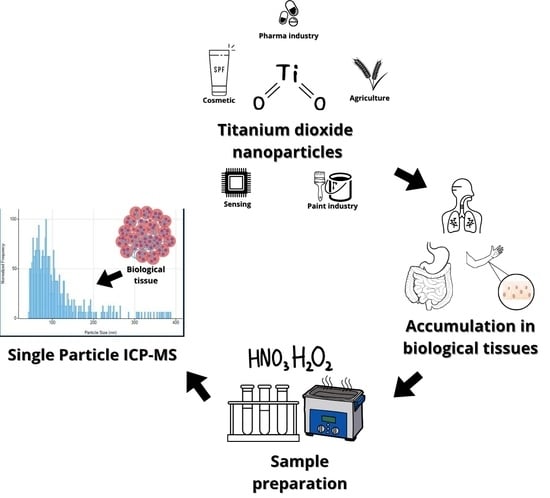
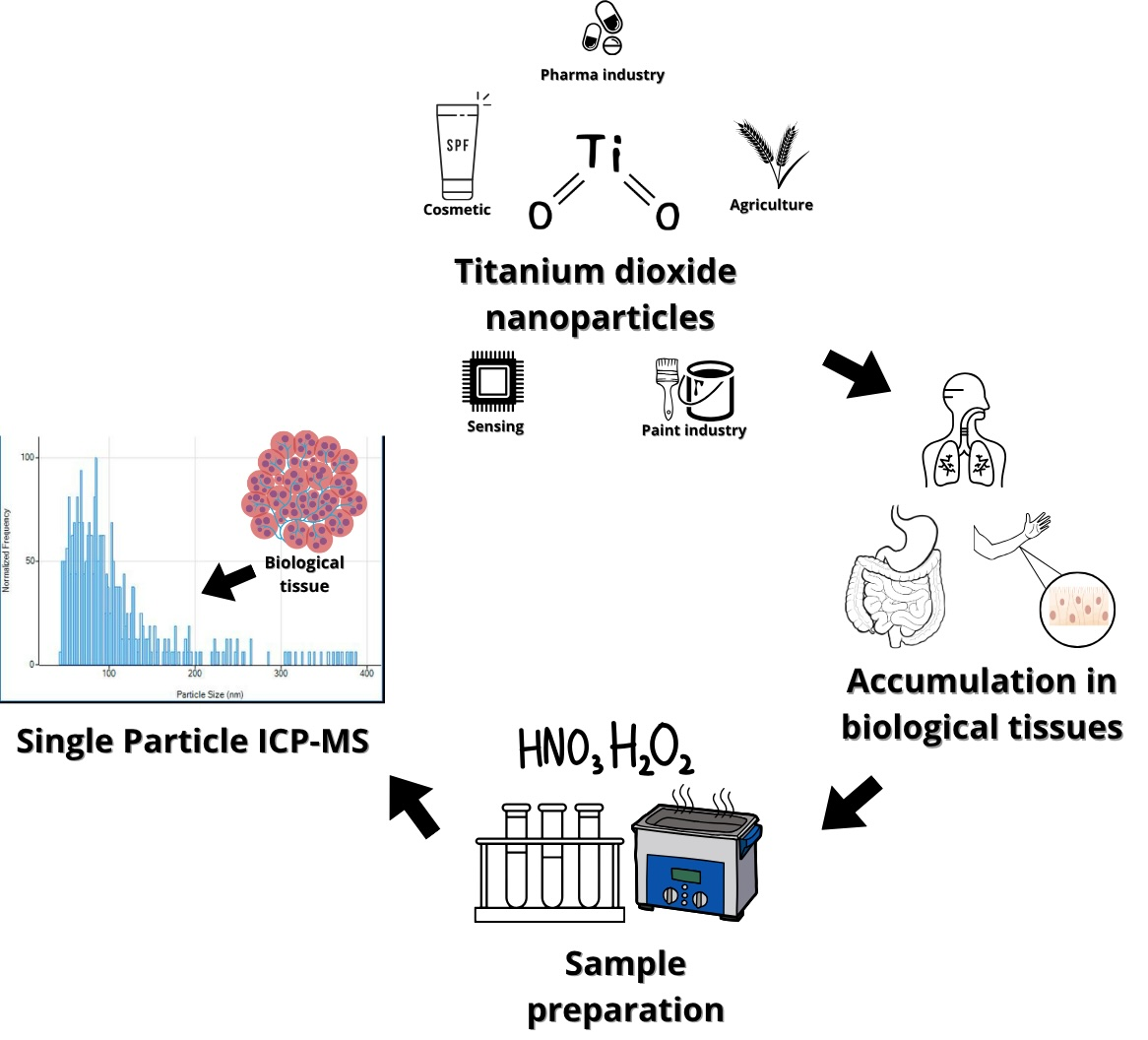
Graphical Abstract

1. Introduction

Titanium dioxide nanoparticles (TiO2-NPs) have been produced and widely used in industry since the twentieth century and are currently among the most produced and utilized engineered nanomaterials (ENMs) [1]. Owing to their widespread applicability, TiO2-NPs are employed in the production of paints and pigments, plastics, paper, cosmetics, catalysts, ceramics, inks, glass, welding materials, and various other products.
With the increasing integration of nanomaterials into daily use and industrial products, the potential for human exposure has been discussed in the scientific literature. Some studies have raised concerns regarding possible toxicological effects associated with TiO2-NPs human and environmental exposure [2], with inhalation being considered a relevant exposure route [3], especially for workers employed in the ENMs sector [4].
Many experimental studies, both in vivo and in vitro, have demonstrated that TiO2-NPs can induce inflammation, oxidative stress, alterations in gene expression, and DNA damage [5,6,7]. Furthermore, agglomeration of TiO2-NPs in submicrometric structures may influence their biological interactions, and large agglomerates do not appear less active than the smaller ones [8].
To evaluate their impact on human health, accurate identification of nanoparticles and their agglomerates—even at trace levels—in biological tissues is becoming critically important [9]. Indeed, mammalian toxicity studies are carried out as part of the safety assessment of new chemicals, including ENMs, and some of these specifically require the detection of ENMs within tissues. For instance, the recently updated OECD inhalation toxicity guidelines [10,11] call for the determination of lung burdens when the material is biopersistent. This recommendation is particularly relevant considering the prolonged regulatory attention devoted to TiO2. For several years, TiO2 was classified as a suspected carcinogen by inhalation [12]; however, this classification has recently been officially withdrawn. The decision reflects the understanding that the adverse effects observed in animal studies were not due to an intrinsic carcinogenicity of TiO2, but rather to secondary consequences of particle biopersistence and lung overload, leading to chronic inflammation [4].
To date, animal organs or tissues are the most commonly analyzed matrices, confirming the continued interest in studying the bioaccumulation, biodistribution, and potential toxicological effects of NPs in animal models [13].
Single-particle inductively coupled plasma mass spectrometry (spICP-MS) has been mentioned among the most recent analytical techniques for NP characterization with a specific focus on the analysis of NPs in biological tissues [14]. spICP-MS has been successfully utilized in various matrices such as food [15,16], biological fluids [17], a few environmental matrices [18,19], and biological tissues [20].
Compared to conventional ICP-MS analysis, spICP-MS enables the detection of nanoparticle mass and number concentrations, as well as size characterization, which are key parameters for exposure studies on NPs [21].
For the analysis of TiO2 in biological tissues, two recent literature reviews [13,22] report that the most commonly adopted extraction protocols involve either enzymatic or alkaline digestion. Enzymatic digestion, while designed to selectively remove the organic matrix, is methodologically demanding: it requires long incubation times, strict control of temperature and pH, and incurs high costs due to the enzymes employed. Alkaline digestion is generally more versatile and less expensive, but it also requires extended incubation, often overnight, and may lead to particle dissolution or agglomeration [23,24], as observed from Ishizaka et al. [25], who found that alkaline digestion resulted in a broader particle size distribution compared with other tissue digestion methods.
In this context, the use of mild acidic digestion emerges as a methodological alternative of particular interest in the case of chemically resistant ENMs. Shaw et al. [26] demonstrated that this approach might enable effective removal of the organic matrix while preserving the particles, with a rapid, straightforward, and low-cost sample preparation.
This study aimed to validate the application of spICP-MS analysis for the detection of TiO2 nano- and submicrometric particles in biological tissues. Drosophila melanogaster was selected for this purpose, in accordance with ethical committee recommendations that encourage avoiding the use of mammalian models when simpler, lower animal organisms are available [27].
The analytical procedure was fully validated based on the ISO/IEC 17025:2017 guideline [28] to ensure its capability to release and characterize bioaccumulated engineered nano- and submicrometric particles. Following validation, the method was applied to Drosophila melanogaster exposed to TiO2 particles to quantify and characterize the bioaccumulated particles in terms of mass (µg Ti/g dry weight), particle number (TiO2 particles/mg dry weight), and size distribution.

2. Materials and Methods

2.1. Chemicals and Samples

A tuning solution (1 μg/L Cerium, Cobalt, Lithium, Thallium, Magnesium, and Yttrium; Agilent Technologies, Santa Clara, CA, USA) was used to calibrate the ICP-MS instrumental conditions.
The transport efficiency of the sample introduction system was evaluated according to the particle size method [29], using a Silver nanoparticle reference standard (Ag-NPs, 60 nm, 0.02 mg/mL, Thermo Fisher Scientific, Waltham, MA, USA) at a concentration of 10 ng/L using a matrix-matched standard.
A high-purity TiO2-NPs standard (Titanium (IV) oxide rutile RM, nominal size <100 nm, Sigma-Aldrich, St. Louis, MO, USA) was used for spICP-MS validation analysis.
Finally, a TiO2-particle powder, supplied by an Italian company that produces titanium dioxide, was used for flies’ exposure; the material properties provided by the manufacturer are shown in Table 1:
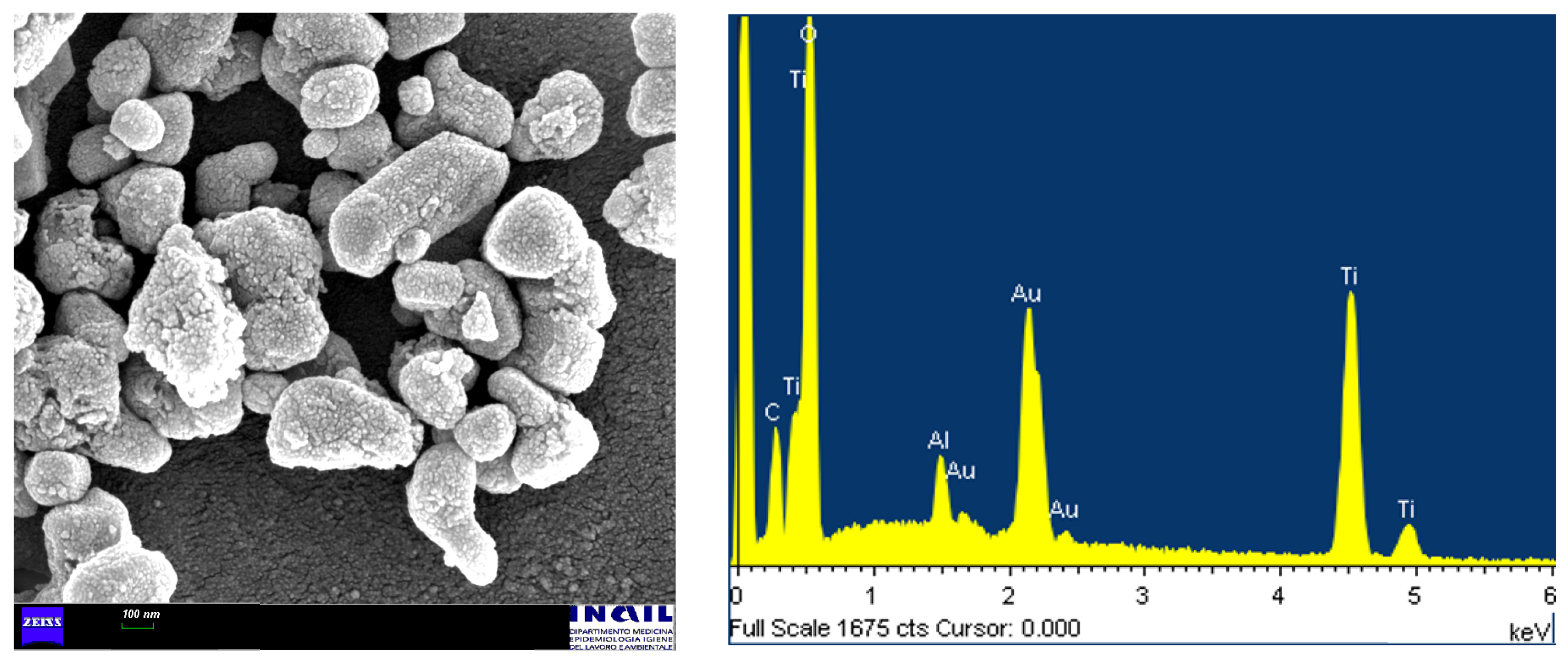
The powder was further characterized in a laboratory. Primary particle morphology and composition were performed using a High-Resolution (HR) Field Emission Scanning Electron Microscope (FE-SEM, Zeiss, Merlin, Oberkochen, Germany) equipped with an Energy Dispersive X-ray Spectrometer (EDS AZtec, Oxford Instruments INCA, High Wycombe, UK); pristine TiO2 powder was dispersed in 2-propanol and sonicated for 15 min, the suspension was subsequently drop-casted on an aluminum stub covered with an aluminum filter and Au-coated for SEM characterization.
Pristine TiO2 powder was dispersed in ultrapure water (UPW) for subsequent characterization analyses. Dynamic Light Scattering (DLS, Zetasizer nano, Malvern Panalytical, Malvern, UK) was used as an additional technique to characterize the particle size and the polydispersity of the material. Finally, using spICP-MS, the chemical composition and the size distribution of TiO2 particles were further characterized; the operating conditions were set following Agilent guidelines [30].

2.2. Drosophila Melanogaster Stock and Sample Treatment

The D. melanogaster individuals used in our study were bred at the Sapienza University of Rome facilities. Colonies were kept in entomological cages within a thermostatic chamber set at 25 ± 1 °C, under a 14:10 h light–dark cycle, and maintained at 70% humidity. The flies were fed a corn flour-based diet consisting of 84.1% water, 0.7% agar, 3.2% table sugar, 3.6% yeast, 7.2% corn flour, 1.0% soy flour, and 0.2% methylparaben dissolved in 25 mL of 70% ethanol [31]. During the study, we are going to refer to these flies as “laboratory-raised flies” that were used for the spICP-MS validation procedure.
For the exposure assessment, in brief, a control group (CTRL) and an exposed group (EXP), consisting of approximately 1000 individuals each, were placed in an exposure chamber using entomological cages (64 × 24 × 24); the controls were exposed only to HEPA-filtered air, while for the exposed group, the TiO2 powder (Table 1) was dispersed within the chamber using a mechanical agitator, and a fan installed inside the chamber was kept running to ensure a homogeneous distribution of the dust. The airborne particle number concentration in the chamber was determined using a Condensation Particle Counter (CPC mod. 3007, TSI Inc., Shoreview, MN, USA); the average concentration was (570 ± 350) particles/cm3.
After exposure, fruit flies from each cage were frozen at −80 °C to halt biological activity. Flies from the same group (laboratory-raised, CTRL and EXP) were homogenized to minimize individual variability, and the resulting biomass was split into aliquots for bioaccumulation analysis.
For the assessment of accumulated TiO2 nano- and submicrometric particles, aliquots were oven-dried at 60 °C for 24 h. At the end of 24 h, the dry weight (3–8 mg) was recorded using an analytical balance (mod. xs105, resolution = 0.01 mg), and the samples were subjected to acid digestion in a hot bath at 90 °C for 20 min using ultrapure nitric acid (HNO3) (65%, RPE, Carlo Erba, Rome, Italy) and hydrogen peroxide (H2O2) (30%, Suprapur, Merck, Darmstadt, Germany) at a ratio of 2:1 (500 µL HNO3, 250 µL H2O2). At the end of the acid digestion, each sample was diluted to 10 mL with deionized water, and a dilution factor (DF) of 1:50 was consistently applied to all samples.

2.3. spICP-MS Experimental Conditions

47Ti was analyzed by spICP-MS/MS (8900 triple quadrupole ICP-MS, Agilent, Santa Clara, CA, United States) using Oxygen (O2) as a reaction gas, following m/z 47 (Q1) → m/z 47 + 16 (Q2).
It is worth noting that in other studies, the analysis of TiO2 with spICP-MS/MS is performed using the more abundant isotope 48Ti in mass-shift mode [30]. This approach is preferred when the suppression of isobaric interferences (like 48Ca) is necessary to achieve lower limit of detection (LoD) values. However, preliminary tests have shown that in this application, the LoD values are mainly determined by background titanium levels measured in matrix blanks. In this work, isotope 47Ti was monitored, and O2 was used as reaction gas to suppress residual polyatomic interferences (e.g., 31P16O+ and 15N16O2+). The isotope 47Ti is less prone to interferences in biological matrices [32] and allows the method to be more easily transferred for single-quadrupole analysis.
The instrumental conditions are reported in Table 2.
Particle number (particles/L), particle diameter (nm), and particle size distribution PSD (nm) were generated by the single nanoparticle application module of the ICP-MS MassHunter software, version 5.1; the theoretical principles underlying spICP-MS are described in Pace et al. [29,33]. Mass (μg/L) concentrations were calculated according to the calibration curve obtained from the validation procedure. All samples were freshly prepared and analyzed on the same day using spICP-MS, immediately after preparation to ensure their stability.

2.4. spICP-MS Method Validation

The spICP-MS method for the determination of TiO2 particles in biological tissues was validated according to the ISO/IEC 17025:2017 guideline [28]. Based on this standard, linearity, LoD, repeatability, and recovery must be determined.
The TiO2-NPs standard was conditioned in a climatic chamber (housing the analytical balance) for 24 h before weighing, with a temperature and relative humidity, respectively, of T (°C) = 20 and (RH%) = 47, according to UNI EN 12341:2023 [34].
A stock suspension was prepared by weighing 1.115 mg ± 0.0001 mg of the standard (analytical balance, Cubis MCA3.6P-2500M, Sartorius Lab Instruments GmbH, Goettingen, Germany) and dispersing it in 2 L of UPW (Arium Comfort I Combined Water System, Sartorius Lab Instruments GmbH, Goettingen, Germany), yielding a final concentration of 0.558 mg/L. The stock suspension was subsequently sonicated using an ultrasound-assisted bath (Elmasonic S 100 (H), Elma Schmidbauer GmbH, Singen, Germany) for 20 min and used to construct the spICP-MS calibration curve for the analytical method validation. In particular, flies reared under controlled conditions (not exposed to titanium dioxide particles) were digested following the procedure described in Section 2.2. and were used to construct the calibration curve in the matrix, using the standard addition procedure, by adding known amounts of TiO2-NPs standard in pooled digested fly samples. Tissue digestate was diluted in 10 mL of UPW; from this solution, a sub-sample was collected with a volume proportional to the DF applied to the samples. Increasing concentrations of TiO2-NP stock suspension were then added to the sub-samples to prepare matrix-matched calibration standards.
To reduce particle aggregation [26], all samples were vortexed for 10 s and sonicated for 10 min prior to analysis. Preliminary DLS measurements were performed to verify the effect of sonication on the TiO2 powder used in this study (Figure S5), showing a reduction in particle size with 10 min of bath sonication. The application range, or linearity interval, was determined as the coefficient of determination (R2) of the nine-point calibration curve (Std ∅ = 0.2 µg/g; Std 1 = 0.7 µg/g; Std 2 = 1.2 µg/g; Std 3 = 1.4 µg/g; Std 4 = 2.9 µg/g; Std 5 = 5.8 µg/g; Std 6 = 14 µg/g; Std 7 = 14 µg/g; Std 8 = 35 µg/g; Std 9 = 70 µg/g); the linearity range between the mass concentration and the particle number concentration was also evaluated.
Following the ISO/IEC 17025:2017 guideline [28], the detection and quantification limits in both terms of mass concentration (LoDCm and LoQCm) and size (LoDs) must be assessed.
Three replicates of each of three aliquots ( n = 9) of tissue digestate obtained from laboratory-reared flies were analyzed, and the estimated mass concentration detection limits, LoDCm and LoQCm, were calculated, respectively, as 3 and 6 times the standard deviation of the average (Equations (1) and (2)), according to Nia et al. [32]. The same approach was adopted to calculate the limit of detection for the particle number concentration.
L o D C m = 3   ×   S n ,
L o Q C m = 6   ×   S n ,
According to Vidmar et al. [15] smallest particle diameter observed in the particle size distribution was considered as the minimum detectable particle diameter. Three aliquots of tissue digestate, each analyzed in triplicate (n = 9), were spiked with a known amount of TiO2-NP stock suspension, and the lower bounds of the particle size distributions, corresponding to the minimum detectable particle diameters, were determined.
The precision was calculated as the percentage relative standard deviation of repeatability (RSD) for three independent replicates performed for five levels of the calibration curve, according to Equation (3):
R S D = S r X ¯ m × 100 ,
where Sr represents the standard deviation and X ¯ m the average value; according to Salou et al. [35], repeatability on size (nm) was determined as RSD (n = 3) of the most frequent size (MFS) obtained for each sample.
The matrix effect (EM) was assessed by comparing the calibration curve obtained in ultrapure water with that constructed on matrix-matched standards, as illustrated in Equation (4):
E M % = s l o p e m a t r i x s l o p e s t d 1 × 100 ,
Accuracy, both in terms of mass and size, was evaluated as the percentage recovery between the mass concentration/mean size obtained in UPW and that obtained in matrix.
Finally, to evaluate the efficiency of the extraction procedure, laboratory-reared flies were spiked with known amounts of TiO2-NPs suspension before the acid digestion procedure. Mass recoveries were assessed by comparing the concentration (μg/g) measured in the spiked digested samples and the spiked concentrations (μg/g), as expressed in Equation (5):
R % = C m d i g C m s p i k e × 100 ,
where   C m d i g is the mass concentration measured after digestion (μg/g) and C m s p i k e is the spiked concentration (μg/g).
Since the particle size for the TiO2-NP standard is not an exact value, it was not possible to compare the size measured after digestion with the certified particle size. The effect of the extraction procedure on particle size was therefore evaluated by comparing the mean diameter (nm) observed in the spiked digested samples with the mean diameter (nm) observed in matrix-matched standards at the spiked concentration. The same process was carried out using the median and the MFS observed in the particle size distribution.

3. Results and Discussion

3.1. Powder Characterization

As mentioned in Section 2.1., the TiO2 powder used for flies’ exposure was characterized with various techniques.
The hydrodynamic diameter (Dh) measured by DLS (Figure S1) was 384.2 ± 2.5 nm, with a polydispersity index (PdI) below 0.2, thus indicating reasonable monodispersion, while spICP-MS analysis resulted in particles with a mean diameter of 302.8 ± 60.0 nm.
As shown in Figure 1, SEM analysis revealed particles with an irregular spherical shape and sizes consistent with those measured by DLS and spICP-MS, as well as a population of smaller nanoparticles (<100 nm) that was not detected by the other techniques.
This smaller fraction is likely not detected by DLS, as it is masked by the stronger scattering of larger particles, nor by spICP-MS, since it can form aggregates in suspension [35]. The differences in the calculated diameters reflect the variability of the measurement principles on which the characterization techniques are based. In particular, DLS provided the highest mean diameter value; the hydrodynamic diameter is often larger than the actual particle size because it includes the solvation layer, and conformational variations that affect particle diffusion [36].

3.2. spICP-MS Validation Performances

Detection limits were reported in Table 3, both in terms of (μg/L; particles/L) and (µg/g tissue; particles/g tissue), together with the results concerning linearity (R2) and precision (RSD).
The calibration curve and the linear dependence between the particle number and mass concentration are reported in Figure S2.
The matrix effect did not exceed 10% of the absolute value (Supplementary Information, Figure S3) and has therefore been considered negligible within the measured concentration range; size recoveries with the spiked concentrations were 95.9% compared to blank analysis.
For precision, both in terms of mass and particle size, RSD values did not exceed 10%, except for the lowest concentration points, which showed higher RSD values. Given the large range of sizes of the TiO2-NP standard, these results are considered acceptable for the purpose of the study. Similar values have also been reported from Peters et al. [37], and Salou et al. [35].
LoDCm values may be influenced by the presence of background noise of dissolved titanium in the digestate, likely originating from acid impurities or released from digestion vials. In any case, background noise was removed from the samples by subtracting the blank sample signal (digested laboratory-reared flies).
Limits of detection were below those observed in other studies, for example, Faucher et Lespes [1] found an LoD and LoQ, respectively, of 0.7 µg/g and 2.3 µg/g, while Nia et al. [32] found an LoQ of 0.1–0.13 µg/g; however, it should be noted that these studies were conducted on different types of tissues (e.g., rat tissue, liver) from those analyzed in the present work. Such differences in matrix composition may affect the validation parameters and partly explain the variability observed in the LoD values. The studies [1,32] quantify only the total titanium content in tissues: particulate titanium is fully solubilized through hydrofluoric acid digestion and subsequently quantified in the dissolved phase. This approach does not allow discrimination between particulate and ionic titanium and does not enable particle size or number characterization; additionally, it also highlights the higher sensitivity of single-particle analysis compared to conventional ICP-MS analysis.
The accuracy of the acid extraction procedure was tested by applying spiking recovery experiments. Two spike concentrations were tested, respectively, 1.7 µg/g and 24.2 µg/g of TiO2-NP standard added to oven-dried homogenate. After digestion, the mass concentration resulted in 76% and 73% of recovery. Low recoveries can be explained by the complexity of the method, which involves multiple critical steps and potential analytical losses due to, for example, particle absorption onto laboratory material surfaces (e.g., test tubes) [22,38]. Some studies suggested that organic components of background matrices may not be completely removed during digestion, and that nanoparticles may bind to the remaining organic residues [39]. Consequently, the adsorption of these organic residues onto the tube walls can further increase the risk of particle loss [22].
Furthermore, when analyzing the TiO2-NP standard in UPW, particles with a diameter below 30 nm were detected. In matrix-matched standards, the LoDs of 55.7 nm do not allow the quantification of a part of this material [37], which may also contribute to low method recoveries. However, it is worth noting that for spICP-MS, some authors have suggested a widening of the procedural recovery to ±25% for metallic ENMs, compared to the recoveries normally accepted (100 ± 10%). In general, for other similar studies, recoveries in the range 70–120% were considered satisfactory [9].
Future studies could improve recoveries on mass concentration, for example, by using stabilizers for the suspension or varying the sample agitation time before analysis, as highlighted by Shaw et al. [26], who demonstrated that modifications of these parameters significantly improve the recoveries.
The ratio between the mean size measured after digestion procedure on spiked samples, compared to matrix-matched standards at the spike concentration, ranged from 89% to 94%, suggesting that acid treatment does not substantially affect TiO2 particle mean size. Given the large range of sizes of the TiO2-NP standard, the median size and the MFS generated from the Mass Hunter software (version 5.1) were also compared, and the ratios between the spiked digested sample and the matrix-matched standard were, respectively, 80% and 102%.
Final concentrations in the fruit flies were calculated considering both the sample dilution and the dry biomass weighed; the results are reported in Table 4.
For each group (CTRL and EXP), three different aliquots were analyzed in replicate (n = 3), so the reported data represent the mean value calculated on nine replicates, with the relative standard deviations.
As shown in Table 4, the application of the method to real samples revealed a clear accumulation of TiO2 particles in exposed flies, as a significant difference was observed between the control and exposed groups. The particle diameter found in the exposed flies shows a 102–103% agreement with the mean size reported by the manufacturer and that characterized in the laboratory (Section 3.1).
PSD of particles identified in one of the digested samples is shown in Figure S4. Based on the number size distribution, the average fraction of particles with diameters < 100 nm is approximately 15%. The pristine TiO2 powder suspended in UPW exhibited 21% of particles below 100 nm in the overall size distribution. The fraction of nanoparticles in the digested samples is slightly underestimated, probably due to the relatively high limits of detection (LoDs), which prevent the quantification of particles smaller than 55.7 nm.
After blank correction (subtraction), the control group’s concentration resulted in 6.7 ± 1.3 µg/g of titanium; however, the particle number concentration was <LoD. These findings highlight the importance of considering background titanium sources when interpreting accumulation data. Indeed, background noise can influence the particle detection threshold, and small particles in the sample can be masked by the background signal and thus remain undetectable [37].
While the method proved robust for the analyzed samples, allowing for distinction between particulate from dissolved forms of titanium, some limitations remain. Complex biological matrices may still influence particle detection and size measurements, and aggregation of particles within tissues could affect particle number quantification. Future studies could integrate spICP-MS with imaging techniques, such as TEM or SEM, to further elucidate particle distribution and aggregation states in tissues. Expanding the method to additional tissues or species could also enhance its utility for environmental monitoring and risk assessment.

4. Conclusions

An analytical method was validated for the determination of submicrometric titanium dioxide (TiO2) particles in the tissues of Drosophila melanogaster exposed via inhalation. The use of a mild acid digestion procedure proved effective in eliminating biological matrix interferences while preserving the physical properties of the analyzed TiO2 particles, representing a rapid, simple, and cost-effective alternative to enzymatic or alkaline approaches that involve long incubation times, strict temperature and pH control, and higher cost.
The study demonstrated good linearity and precision, consistent with findings reported in the literature. The spICP-MS analysis demonstrated a strong ability to discriminate between exposed and unexposed tissues, while simultaneously providing information on particle number concentration, mass concentration, and size distribution of bioaccumulated particles. This represents a significant advantage over conventional ICP-MS analyses, which do not allow such detailed particle characterization.
Future optimization of the protocol could involve the use of dispersing agents, which have been reported to improve recoveries in previous studies.
Finally, the introduction of certified reference standards—both in terms of particle number and size—for a wider range of elements could facilitate the validation of spICP-MS as a standardized, rapid, and effective method for nanoparticle determination in biological tissues.

Supplementary Materials

The following supporting information can be downloaded at: https://www.mdpi.com/article/10.3390/analytica7010009/s1, Figure S1: Dynamic Light Scattering of TiO2 powder; Figure S2: (a) Calibration Curve for TiO2-NPs standard using spICP-MS and (b) linear dependence between the Mass Concentration and the Particle Number Concentration; Figure S3: Calibration Curve for TiO2-NPs standard using matrix-matched samples (red) and UPW (black); Figure S4: spICP-MS time scans for non-spiked tissue digestate (a), and treated 96 h flies digestate (b), PSD (nm) of TiO2-NPs found for stock suspension and in the flies (c); Figure S5. Effect of sonication time/power on mean size (nm) and Polydispersion Index (PdI) of TiO2 suspension: NS (not-sonicated); BS (bath sonicated for 10 min); PSa (probe sonicated, Misonix Sonicator, ultrasonicator processor XL, 10 min 20% amplitude); PSb (10 min 30% amplitude); PSc (10min 40% amplitude); PSd (25 min 20% amplitude).

Author Contributions

Conceptualization, F.S., R.F. and S.C.; formal analysis, F.S.; data curation, F.S., R.F., S.C. and F.T.; writing—original draft preparation, F.S., R.F., S.C., F.T., F.B. and C.N.; writing—review and editing, F.S., S.C. and R.F. All authors have read and agreed to the published version of the manuscript.

Funding

This work was funded by the Italian Workers’ Compensation Authority (INAIL), as part of the Scientific Research Plan 2022–2024.

Data Availability Statement

The original contributions presented in this study are included in the article/Supplementary Material. Further inquiries can be directed to the corresponding author.

Acknowledgments

We thank Daniele Porretta for providing the Drosophila melanogaster specimens and Emanuele Vaccarella for his help in sample collection and homogenization.

Conflicts of Interest

The authors declare no conflicts of interest.

References

  1. Faucher, S.; Lespes, G. Quantification of Titanium from TiO2 Particles in Biological Tissue. J. Trace Elem. Med. Biol. 2015, 32, 40–44. [Google Scholar] [CrossRef]
  2. Geertsen, V.; Tabarant, M.; Spalla, O. Behavior and Determination of Titanium Dioxide Nanoparticles in Nitric Acid and River Water by ICP Spectrometry. Anal. Chem. 2014, 86, 3453–3460. [Google Scholar] [CrossRef]
  3. Baranowska-Wójcik, E.; Szwajgier, D.; Oleszczuk, P.; Winiarska-Mieczan, A. Effects of Titanium Dioxide Nanoparticles Exposure on Human Health—A Review. Biol. Trace Elem. Res. 2020, 193, 118–129. [Google Scholar] [CrossRef] [PubMed]
  4. Shi, H.; Magaye, R.; Castranova, V.; Zhao, J. Titanium Dioxide Nanoparticles: A Review of Current Toxicological Data. Part. Fibre Toxicol. 2013, 10, 15. [Google Scholar] [CrossRef] [PubMed]
  5. Gurr, J.-R.; Wang, A.S.S.; Chen, C.-H.; Jan, K.-Y. Ultrafine Titanium Dioxide Particles in the Absence of Photoactivation Can Induce Oxidative Damage to Human Bronchial Epithelial Cells. Toxicology 2005, 213, 66–73. [Google Scholar] [CrossRef] [PubMed]
  6. Türkez, H.; Geyikoğlu, F. An in Vitro Blood Culture for Evaluating the Genotoxicity of Titanium Dioxide: The Responses of Antioxidant Enzymes. Toxicol. Ind. Health 2007, 23, 19–23. [Google Scholar] [CrossRef]
  7. Wang, J.; Zhou, G.; Chen, C.; Yu, H.; Wang, T.; Ma, Y.; Jia, G.; Gao, Y.; Li, B.; Sun, J. Acute Toxicity and Biodistribution of Different Sized Titanium Dioxide Particles in Mice after Oral Administration. Toxicol. Lett. 2007, 168, 176–185. [Google Scholar] [CrossRef]
  8. Murugadoss, S.; Brassinne, F.; Sebaihi, N.; Petry, J.; Cokic, S.M.; Van Landuyt, K.L.; Godderis, L.; Mast, J.; Lison, D.; Hoet, P.H.; et al. Agglomeration of Titanium Dioxide Nanoparticles Increases Toxicological Responses in Vitro and in Vivo. Part. Fibre Toxicol. 2020, 17, 10. [Google Scholar] [CrossRef]
  9. Laycock, A.; Clark, N.J.; Clough, R.; Smith, R.; Handy, R.D. Determination of Metallic Nanoparticles in Biological Samples by Single Particle ICP-MS: A Systematic Review from Sample Collection to Analysis. Environ. Sci. Nano 2022, 9, 420–453. [Google Scholar] [CrossRef]
  10. OECD. Test No. 412: Subacute Inhalation Toxicity: 28-Day Study; OECD Guidelines for the Testing of Chemicals, Section 4; OECD Publishing: Paris, France, 2018. [Google Scholar] [CrossRef]
  11. OECD. Test No. 413: Subchronic Inhalation Toxicity: 90-Day Study; OECD Guidelines for the Testing of Chemicals, Section 4; OECD Publishing: Paris, France, 2018. [Google Scholar] [CrossRef]
  12. International Agency for Research on Cancer (IARC). Carbon Black, Titanium Dioxide, and Talc. In IARC Monographs on the Evaluation of Carcinogenic Risks to Humans; IARC Scientific Publications: Lyon, France, 2006; Volume 93. [Google Scholar]
  13. Gregar, F.; Baron, D.; Pluháček, T. Advances in ICP-MS-Based Nanoparticle Characterization: Techniques and Challenges in Biological Sample Analysis. J. Sep. Sci. 2025, 48, e70259. [Google Scholar] [CrossRef]
  14. Gajdosechova, Z.; Mester, Z. Recent Trends in Analysis of Nanoparticles in Biological Matrices. Anal. Bioanal. Chem. 2019, 411, 4277–4292. [Google Scholar] [CrossRef]
  15. Vidmar, J.; Hässmann, L.; Loeschner, K. Single-Particle ICP–MS as a Screening Technique for the Presence of Potential Inorganic Nanoparticles in Food. J. Agric. Food Chem. 2021, 69, 9979–9990. [Google Scholar] [CrossRef]
  16. Loeschner, K.; Johnson, M.E.; Montoro Bustos, A.R. Application of Single Particle ICP-MS for the Determination of Inorganic Nanoparticles in Food Additives and Food: A Short Review. Nanomaterials 2023, 13, 2547. [Google Scholar] [CrossRef] [PubMed]
  17. Bocca, B.; Battistini, B.; Leso, V.; Fontana, L.; Caimi, S.; Fedele, M.; Iavicoli, I. Occupational Exposure to Metal Engineered Nanoparticles: A Human Biomonitoring Pilot Study Involving Italian Nanomaterial Workers. Toxics 2023, 11, 120. [Google Scholar] [CrossRef] [PubMed]
  18. Flores, K.; Turley, R.S.; Valdes, C.; Ye, Y.; Cantu, J.; Hernandez-Viezcas, J.A.; Parsons, J.G.; Gardea-Torresdey, J.L. Environmental Applications and Recent Innovations in Single Particle Inductively Coupled Plasma Mass Spectrometry (SP-ICP-MS). Appl. Spectrosc. Rev. 2021, 56, 1–26. [Google Scholar] [CrossRef]
  19. Torregrosa, D.; Grindlay, G.; de la Guardia, M.; Gras, L.; Mora, J. Determination of Metallic Nanoparticles in Air Filters by Means Single Particle Inductively Coupled Plasma Mass Spectrometry. Talanta 2023, 252, 123818. [Google Scholar] [CrossRef]
  20. Clark, N.J.; Clough, R.; Boyle, D.; Handy, R.D. Development of a Suitable Detection Method for Silver Nanoparticles in Fish Tissue Using Single Particle ICP-MS. Environ. Sci. Nano 2019, 6, 3388–3400. [Google Scholar] [CrossRef]
  21. Montaño, M.D.; Olesik, J.W.; Barber, A.G.; Challis, K.; Ranville, J.F. Single Particle ICP-MS: Advances toward Routine Analysis of Nanomaterials. Anal. Bioanal. Chem. 2016, 408, 5053–5074. [Google Scholar] [CrossRef]
  22. Abdolahpur Monikh, F.; Chupani, L.; Vijver, M.G.; Vancová, M.; Peijnenburg, W.J.G.M. Analytical Approaches for Characterizing and Quantifying Engineered Nanoparticles in Biological Matrices from an (Eco)Toxicological Perspective: Old Challenges, New Methods and Techniques. Sci. Total Environ. 2019, 660, 1283–1293. [Google Scholar] [CrossRef]
  23. Gallocchio, F.; Biancotto, G.; Moressa, A.; Pascoli, F.; Pretto, T.; Toffan, A.; Arcangeli, G.; Montesi, F.; Peters, R.; Ricci, A. Bioaccumulation and in Vivo Formation of Titanium Dioxide Nanoparticles in Edible Mussels. Food Chem. 2020, 323, 126841. [Google Scholar] [CrossRef]
  24. Peters, R.J.B.; Oomen, A.G.; Van Bemmel, G.; Van Vliet, L.; Undas, A.K.; Munniks, S.; Bleys, R.L.A.W.; Tromp, P.C.; Brand, W.; Van Der Lee, M. Silicon Dioxide and Titanium Dioxide Particles Found in Human Tissues. Nanotoxicology 2020, 14, 420–432. [Google Scholar] [CrossRef]
  25. Ishizaka, T.; Nagano, K.; Tasaki, I.; Tao, H.; Gao, J.-Q.; Harada, K.; Hirata, K.; Saito, S.; Tsujino, H.; Higashisaka, K.; et al. Optimization and Evaluation of Pretreatment Method for Sp-ICP-MS to Reveal the Distribution of Silver Nanoparticles in the Body. Nanoscale Res. Lett. 2019, 14, 180. [Google Scholar] [CrossRef] [PubMed]
  26. Shaw, B.J.; Ramsden, C.S.; Turner, A.; Handy, R.D. A Simplified Method for Determining Titanium from TiO2 Nanoparticles in Fish Tissue with a Concomitant Multi-Element Analysis. Chemosphere 2013, 92, 1136–1144. [Google Scholar] [CrossRef] [PubMed]
  27. Kiani, A.K.; Pheby, D.; Henehan, G.; Brown, R.; Sieving, P.; Sykora, P.; Marks, R.; Falsini, B.; Capodicasa, N.; Miertus, S.; et al. Ethical Considerations Regarding Animal Experimentation. J. Prev. Med. Hyg. 2022, 63, E255. [Google Scholar] [CrossRef]
  28. ISO/IEC 17025:2017; General Requirements for the Competence of Testing and Calibration Laboratories. International Organization for Standardization (ISO): London, UK, 2017.
  29. Pace, H.E.; Rogers, N.J.; Jarolimek, C.; Coleman, V.A.; Higgins, C.P.; Ranville, J.F. Determining Transport Efficiency for the Purpose of Counting and Sizing Nanoparticles via Single Particle Inductively Coupled Plasma Mass Spectrometry. Anal. Chem. 2011, 83, 9361–9369. [Google Scholar] [CrossRef]
  30. Vidmar, J.; Löschner, K.; Larios, R. Analysis of TiO2 Nanoparticles in Foods and Personal Care Products by Single Particle ICP-QQQ; Agilent Technologies, Inc.: Santa Clara, CA, USA, 2019; Available online: https://www.agilent.com/cs/library/applications/application_TiO2_np_icp-qqq-8900_%205994-1633en_us_agilent.pdf (accessed on 14 July 2025).
  31. Silva-Soares, N.F.; Nogueira-Alves, A.; Beldade, P.; Mirth, C.K. Adaptation to New Nutritional Environments: Larval Performance, Foraging Decisions, and Adult Oviposition Choices in Drosophila Suzukii. BMC Ecol. 2017, 17, 21. [Google Scholar] [CrossRef]
  32. Nia, Y.; Millour, S.; Noël, L.; Krystek, P.; de Jong, W.; Guérin, T. Determination of Ti from TiO2 Nanoparticles in Biological Materials by Different ICP-MS Instruments: Method Validation and Applications. J. Nanomed. Nanotechnol. 2015, 6, 269. [Google Scholar] [CrossRef]
  33. Pace, H.E.; Rogers, N.J.; Jarolimek, C.; Coleman, V.A.; Gray, E.P.; Higgins, C.P.; Ranville, J.F. Single Particle Inductively Coupled Plasma-Mass Spectrometry: A Performance Evaluation and Method Comparison in the Determination of Nanoparticle Size. Environ. Sci. Technol. 2012, 46, 12272–12280. [Google Scholar] [CrossRef]
  34. UNI EN 12341:2023; Ambient Air—Standard Gravimetric Measurement Method for the Determination of the PM10 or PM2.5 Mass Concentration of Suspended Particulate Matter. Ente Nazionale Italiano di Unificazione (UNI): Milan, Italy, 2023.
  35. Salou, S.; Cirtiu, C.-M.; Larivière, D.; Fleury, N. Assessment of Strategies for the Formation of Stable Suspensions of Titanium Dioxide Nanoparticles in Aqueous Media Suitable for the Analysis of Biological Fluids. Anal. Bioanal. Chem. 2020, 412, 1469–1481. [Google Scholar] [CrossRef]
  36. Berne, B.J.; Pecora, R. Dynamic Light Scattering: With Applications to Chemistry, Biology, and Physics; Dover Publications: Mineola, NY, USA, 2000. [Google Scholar]
  37. Peters, R.J.B.; Undas, A.K.; Memelink, J.; van Bemmel, G.; Munniks, S.; Bouwmeester, H.; Nobels, P.; Schuurmans, W.; van der Lee, M.K. Development and Validation of a Method for the Detection of Titanium Dioxide Particles in Human Tissue with Single Particle ICP-MS. Curr. Trends Anal. Bioanal. Chem. 2018, 2, 74–84. [Google Scholar] [CrossRef]
  38. Wagner, S.; Legros, S.; Loeschner, K.; Liu, J.; Navratilova, J.; Grombe, R.; Linsinger, T.P.J.; Larsen, E.H.; Von Der Kammer, F.; Hofmann, T. First Steps towards a Generic Sample Preparation Scheme for Inorganic Engineered Nanoparticles in a Complex Matrix for Detection, Characterization, and Quantification by Asymmetric Flow-Field Flow Fractionation Coupled to Multi-Angle Light Scattering and ICP-MS. J. Anal. At. Spectrom. 2015, 30, 1286–1296. [Google Scholar] [CrossRef]
  39. Fischer, M.; Scholz-Böttcher, B.M. Simultaneous Trace Identification and Quantification of Common Types of Microplastics in Environmental Samples by Pyrolysis-Gas Chromatography–Mass Spectrometry. Environ. Sci. Technol. 2017, 51, 5052–5060. [Google Scholar] [CrossRef]
Figure 1. SEM image of pristine TiO2 powder with the relative EDS spectrum.
Analytica 07 00009 g001
Table 1. TiO2 powder properties according to the manufacturer’s information data sheet.
Technical NameTR92
Crystalline StructureRutile
Chemical CompositionTiO2
Common FormPowder
Density0.80 g/mL
Size (Mean Diameter)0.28–0.30 μm
Surface Area14 m2/g
Table 2. spICP-MS analytical conditions.
InstrumentICP-QQQ 8900 Agilent
Nebulizer gas flow0.73 mL/min
Torch, id injector1.0 mm
Acquisition mode (MS/MS)Q1: m/z 47 → Q2: m/z 63
RF power (W)1550
Sample uptake (mL/min)0.346
Acquisition time (sec)60
Integration time (msec)0.1
Particle density (g/cm3)4.23
Analyte mass fraction *1.67
Nebulization efficiency (%)3.4
* (Molar mass of particle/molar mass of analyte).
Table 3. Validation parameters for spICP-MS method: linearity as the R2 of the 9-point calibration curve; LoD on three aliquots of tissue digestate analyzed in triplicate (n = 9); and precision as RSD on three independent replicates at five calibration levels.
Mass Conc. (μg/L)Mass Conc. (µg/g)Numb Conc. (pt/L)Numb Conc. (pt/g)Size(nm)
LoD0.010.041.1 × 1051.5 × 10555.7 *
LoQ0.030.072.2 × 1053.0 × 105
R20.99890.9986
Mass Conc. (μg/L)
RSD%
Size (nm)
RSD%
Std ∅9.111.5
Std 311.54.1
Std 80.51.2
Std 96.80.7
Std 101.95.1
* Minimum detectable particle size observed in the PSD of TiO2-NP spiked matrix-matched standard.
Table 4. The particle mass concentration and particle number concentration of TiO2-NPs were quantified using the spICP-MS.
CTRL
(n = 9)
EXP
(n = 9)
p-Value
AvgSDAvgSD***
µg/g6.71.380.020.0
Part./mgND-5.0 × 1051.2 × 105
Size(nm)--31017
Mann–Whitney U test was applied to assess significant differences between samples: *** = p < 0.001.
Disclaimer/Publisher’s Note: The statements, opinions and data contained in all publications are solely those of the individual author(s) and contributor(s) and not of MDPI and/or the editor(s). MDPI and/or the editor(s) disclaim responsibility for any injury to people or property resulting from any ideas, methods, instructions or products referred to in the content.