Article

Effect of Submaximal-Dose Semaglutide on MASLD Biopsy-Free Scoring Systems in Patients with Obesity


1
Department of Internal Medicine I., Jessenius Faculty of Medicine in Martin, Comenius University (CU) in Bratislava, Kollarová 2, 03659 Martin, Slovakia
2
Department of Endocrinology, National Institute of Endocrinology and Diabetology, 03491 Ľubochňa, Slovakia
3
Department of Acute and Interventional Cardiology, Mid-Slovakian Institute of Heart and Vessel Diseases (SÚSCCH), 97401 Banska Bystrica, Slovakia
4
Department of Internal Medicine II, Faculty of Medicine, Slovak Medical University (SMU) in Bratislava and F.D. Roosvelt Hospital in Banska Bystrica, Namestie L. Svobodu 1, 97517 Banska Bystrica, Slovakia
*
Authors to whom correspondence should be addressed.
These authors contributed equally to this work.
Submission received: 7 September 2025 / Revised: 25 October 2025 / Accepted: 25 December 2025 / Published: 5 January 2026

Abstract

Introduction: The prevalence of Metabolic Dysfunction-Associated Steatotic Liver Disease (MASLD) is rapidly increasing, possibly becoming the leading cause of chronic liver disease (CLD) in the coming years. Samaglutide (a long-acting glucagon-like peptide receptor agonist 1—GLP-1RA) therapy might be connected with an improved liver function. The aim of the presented study was to assess the impact of semaglutide administered at submaximal doses on biopsy-free scoring systems in patients with obesity and MASLD. Methods: We performed an observational, prospective, post-marketing study. The research included 30 patients (21 being women, mean age 47 ± 14 years) with obesity (Body mass index/BMI/39.7 ± 5.78 kg/m2) and known MASLD. All patients received semaglutide dosed initially 0.25 mg s.c. weekly, which was uptitrated (to a maximal dose of 1.5 mg) over 6 months. MASLD biopsy-free scoring systems (BFSS: SAFE, Fib-4, BARD, NAFLD Fibrosis Score, Fatty Liver Index—FLI, and Hepatic Steatosis Index—HSI) were assessed before and after 6 months of therapy. Results: In this study, a significant change (decrease) in FLI (92.4 ± 9.85 vs. 75.3 ± 21.0, p <  0.001), HSI (50.7 ± 6.78 vs. 45.0 ± 6.42, p < 0.001) and SAFE score (30.8 ± 80.7 vs. 11.2 ± 81.6, p < 0.033) was observed. The changes in the remaining BFSS (BARD, Fib-4 and NAFLD Fibrosis Score) were nonsignificant (p = 0.501; p = 0.303; p = 0.503). Conclusions: In our study, administration of sub-maximally dosed semaglutide was connected with improved FLI, HIS, and SAFE BFSS, suggesting the efficacy of submaximal semaglutide for improvement in MASLD.

1. Introduction

Obesity is a metabolic, chronic, multisystemic disease, characterised by an excessive accumulation and/or improper distribution of fatty tissue and is accompanied with several changes at the endothelial, inflammatory, and hormonal levels. These changes trigger the activation of multiple additional mechanisms that lead to hypertension, type 2 diabetes mellitus (T2D), and metabolic dysfunction-associated steatotic liver disease (MASLD). The prevalence of obesity itself and the prevalence of obesity-related diseases, or the so-called “pandemic of obesity” is growing rapidly worldwide, becoming a serious medical threat [1,2,3].
MASLD—hepatic steatosis (HS) (detected on imaging and/or liver biopsy) and (at least one) of the metabolic or cardiovascular risks: T2D, obesity or overweight, dyslipidaemia, and arterial hypertension. It relates to 5% or more of HS without the presence of other steatotic chronic liver diseases (CLD) (like hemochromatosis, autoimmune hepatitis, Wilson’s disease), and alcohol intake greater than 20 g/day (for females) and 30 g/day (for males), or hepatotoxic drugs use [4]. Although the prevalence of MASLD is high, only 12–40% of cases will experience a progression to metabolic-associated steatohepatitis (MASH)—a more advanced stage of disease intermediating fibrosis and liver-related outcome [5], which involves the presence of inflammation, hepatic cell injury, and functional impairment, and it represents one of the leading causes of hepatic cirrhosis. The pathophysiology of MASLD/MASH is complex. In addition to hepatic dysfunction, MASLD has systemic effects, including an elevated risk for infectious diseases, cardiovascular disorders, cancer, and other metabolic disorders [4,5]. Numerous non-invasive techniques (NITs) such as serum-based markers and imaging aid in the early diagnosis of MASLD and fibrosis. To prevent MASLD progression to fibrosis, advanced liver (hepatic) disease, and HCC—hepatocellular carcinoma, timely detection and effective treatment are essential. Despite lifestyle modification being the primary pillar of treatment, novel medications are being tested and have been introduced for patients with MASLD thanks to developments in the obesity pharmacotherapy [4,5,6,7,8]. Semaglutide is a long-acting glucagon-like peptide 1 receptor agonist (GLP-1RA), which has been demonstrated to be effective for body weight reduction if administrated at a dose of 2.4 mg weekly subcutaneously [9]. Moreover, it has positively affected associated comorbidities. However, a limiting factor remains non-adherence, often related to gastrointestinal tolerance, availability, and relatively high cost [10]. Administering submaximal doses (SMD) may represent an effective strategy to deal with these challenges, leading to improved patient adherence to treatment. As there are no data about the effect of SMD semaglutide on MASLD, this study aimed to assess the impact of SMD of semaglutide in patients with obesity and MASLD on NITs-based/biopsy-free scoring systems (BFSS) used for patients’ MASLD.

2. Methods

2.1. Study Design and Patients

We investigated the effect of semaglutide on patients with obesity through a prospective, observational, post-marketing study. A patient was eligible for recruitment after undergoing a liver ultrasonographic examination verifying hepatic steatosis. MASLD was then diagnosed when at least one of the subsequent cardio-metabolic criteria was present: first BMI ≥ 30 kg/m2 and/or waist circumference ≥ 94 cm (for males), ≥80 cm (for females), second fasting serum levels of glucose ≥5.6 mmol/L and/or 2-h post- glucose load glucose levels ≥ 7.8 mmol/L and/or HbA1c levels ≥ 5.7% (DCCT), third blood pressure (BP) ≥ 130/85 mmHg and/or specific drug treatment with antihypertensive agents, forth plasma triglycerides levels ≥ 1.7, mmol/L and/or treatment with lipid-lowering agents, fifth plasma HDL-lipoproteins levels ≤1.0 mmol/L (for males) and ≤1.3 mmol/L (for females) and/or treatment with lipid lowering agents. Inclusion and exclusion criteria are reported below in Table 1.
Every one of the patients managed at an obesity outpatient clinic was treated with subcutaneous semaglutide at an initial dose of 0.25 mg once weekly, which was continuously uptitrated each month over the period of 6 months to a maximal dose of 1.5 mg once weekly. Before the therapy initiation, blood samples were taken for lipid profile, liver tests, total serum protein, albumin and globulin, C—reactive protein (CRP) and blood count. All enrolled patients reached at least six months of continuous semaglutide administration. Additionally to semaglutide, lifestyle changes including a diet with a deficit of 500 kcal daily compared to predicted energy expenditure, and an increase in (physical) activity (150 min of aerobic activity and two to three strength trainings weekly) were recommended. The patients underwent regular check-ups, which included measuring anthropometric parameters (weight, height, hip and waist circumference, BMI) and careful investigation of potential side effects of semaglutide. This included nausea with vomiting, obstipation, diarrhoea, abdominal pain, changes in mood, and headaches. After 6 months of therapy, blood sampling was performed for analysis of the same set of laboratory parameters that were analysed at the beginning of treatment. Subsequently, BFSS (SAFE, BARD, Fib-4, NAFLD Fibrosis Score, FLI, and HSI) were assessed before and after 6 months of semaglutide administration.
Alcohol consumption excluding the possibility of ALD or MetALD (male 30 g/day or 210 g/wk, female < 20 g/day or 140 g/wk) was ascertained by attending physician at the inclusion and when the study ended [11].
The study was conducted according to all ethical standards and underwent a formal review and approval by a local ethical committee. Patients agreed to participate in the study and signed a written informed consent prior to enrolment.

2.2. Statistical Analysis

The study results were evaluated using the statistical software Jamovi v2.6.26.0 (Sydney, Australia). A boxplot was utilised to check the distribution of continuous variables, and data distribution was examined with the Shapiro–Wilk normality test. Continuous variables are presented using the mean (normal distribution) and median (asymmetrical distribution); variability is expressed as standard deviation (normal distribution) or lower and upper quartiles (asymmetrical distribution). Discrete variables are presented in numbers and percentages. For normal (symmetrical) distribution, statistical significance was analysed with the Student paired t-test, and for abnormal (asymmetrical) distribution, the Mann–Whitney U test was utilised. Nominal variables were tested with the chi-square test. The level of statistical significance was set at a p-value of <0.05. To control for multiple comparisons across the six non-invasive fibrosis and steatosis scores (NAFLD Fibrosis Score, FLI, HSI, BARD, SAFE, and FIB-4), p-values were adjusted using the Bonferroni, Holm–Bonferroni, and Benjamini–Hochberg false discovery rate (FDR) corrections. A two-tailed p < 0.05 was considered statistically significant.

3. Results

3.1. Patients

During the course of this study, we were able to prospectively recruit 30 consecutive cases of patients meeting the study inclusion criteria (21 women, 9 men, average age of 47 ± 14 years). Detailed demographic data are reported in Table 2. As reported, all enrolled patients reached 6 months of semaglutide therapy dosed 0.25–1.5 mg weekly. No serious adverse events and no need for therapy discontinuation for treatment side effects were observed. Six months of SMD semaglutide led to a significant weight loss (from 116 ± 24.5 to 103 ± 22.93 kg, p < 0.01).

3.2. Effect of Semaglutide on MASLD NITs/BFSS

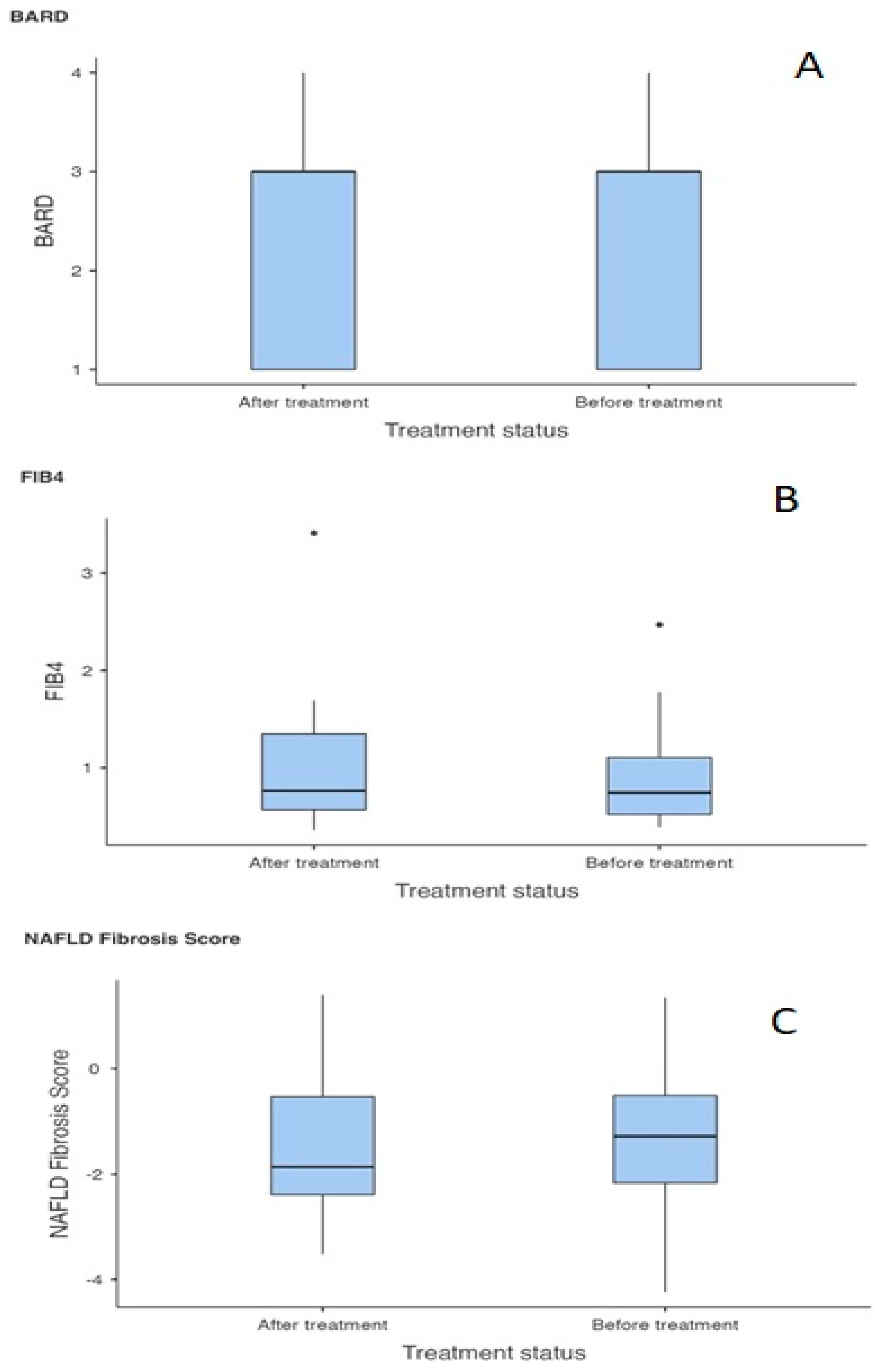
Analysing the impact of semaglutide on MASLD NITs/BFSS, we observed a significant decrease in FLI (p <  0.001), HIS (p < 0.001), and SAFE score (p < 0.033) after 6 months of treatment with semaglutide (Table 3). Baseline FLI before starting treatment was 92.4 (±9.85) (Figure 1A), HIS before starting treatment was 50.7 (±6.78) (Figure 1B), and SAFE score before starting treatment was 30.8 (±80.7) (Figure 1C). FLI after 6 months of semaglutide therapy was 75.3 (±21.0) (Figure 1A), HIS after 6 months of semaglutide treatment was 45.0 (±6.42) (Figure 1B), and SAFE index after 6 months of semaglutide therapy was 11.2 (±81.6) (Figure 1C). After 6 months of treatment with semaglutide, we observed an average 18.5% decrease in FLI (17.1 points), an average 11.24% decrease in HIS (5.7 points), and an average 63.63% decrease in SAFE score (19.6 points) (Figure 1). Changes in other BFSS—FiB-4 (p = 0.303), BARD (p = 0.501), NAFLD Fibrosis Score (p = 0.503) were nonsignificant (Table 3). BARD before starting semaglutide treatment was 2.27 (±1.08) (Figure 2A), Fib-4 before starting treatment with semaglutide was 0.875 (±0.473) (Figure 2A), and NAFLD Fibrosis Score before starting semaglutide treatment was −1.87 (±3.52) (Figure 2B). BARD after 6 months of treatment with semaglutide was 2.37 (±0.999) (Figure 2A), Fib-4 after 6 months of treatment with semaglutide was 0.975 (±0.614) (Figure 2B) and NAFLD Fibrosis Score after 6 months of semaglutide treatment was −1.35 (±1.36) (Figure 2C). After 6 months of treatment with semaglutide, we observed an average 4.41% increase in BARD (0.1 points), an average 11.42% increase in Fib-4 (0.1 points), and an average 27.81% decrease in NAFLD Fibrosis Score (0.52 points) (Figure 2).
As mentioned, to control for multiple comparisons across the six non-invasive fibrosis and steatosis scores (NAFLD Fibrosis Score, FLI, HIS, BARD, SAFE, and FIB-4), p-values were adjusted with Bonferroni, Benjamini–Hochberg false discovery rate (FDR), and Holm–Bonferroni corrections. After adjustment, only the FLI (p_adj = 0.006) and HIS (p_adj = 0.006) remained statistically significant. The SAFE score (p_adj = 0.066, FDR) showed a borderline trend toward significance (Table 4).

4. Discussion

Recently, there have been the first reports regarding a possible positive effect of GLP-1RA therapy on MASLD progression [12,13,14]. Once-weekly 2.4 mg semaglutide showed a mean weight reduction of 14.9–17.4% after 68 weeks of therapy in individuals without diabetes with a mean baseline weight of 100–107 kg participating in The Semaglutide Treatment Effect in People with Obesity trials (STEP), potentially providing clinically meaningful positive therapeutic effect for those with obesity-associated diseases. In the STEP 1 trial (n = 1961 participants enrolled) [9], 2.4 mg of semaglutide weekly reduced the body weight by 14.9% (vs. 2.4% in the patient group receiving placebo). Among patients with T2D, in the STEP 2 study, 2.4 mg of semaglutide achieved a weight reduction of 9.6% from baseline (compared to 3.4% for a placebo). With semaglutide dosed 2.4 mg, 69% of patients recruited in the STEP 2 trial lost ≥ 5% of their initial body weight (compared to 29% with a placebo) [15,16,17,18]. In our study, an average of 11.2% body weight reduction was observed after 6 months of semaglutide at SMD. This observation confirms the good therapeutic efficacy of semaglutide administration in the therapy of obesity also in individuals with MASLD. Moreover, in the settings of SMD of semaglutide, there was no need for treatment discontinuation due to drug intolerance/drug-related side effects (compared to 4.5% of patients in the STEP1 trial [9]). This observation indicates that the use of SMD of semaglutide might achieve similar efficacy with much better treatment tolerance; nevertheless, further investigations will be needed for confirmation.
In our study, 6 NITs/BFSS for both steatosis (FLI, HSI), and fibrosis (NAFLD Fibrosis Score, Fib-4, BARD [for advanced fibrosis F3-F4], SAFE score) were evaluated. After 6 months of SMD of semaglutide, significant changes were found in NITs for steatosis (FLI, HSI). After Bonferroni correction, the changes in SAFE score were not significant, but tended to improve. Evaluating the significantly changed scores, a decline suggesting a lower risk was observed, implying a reduced risk of progression to CLD. Despite the change in weight after treatment being significant, the individual components of biopsy-free scoring systems did not change drastically, and there were also no significant changes in the levels of markers of fibrosis. One can suggest that a longer duration of therapy will be required to achieve more significant changes in the individual components of these scoring systems and in the markers of fibrosis. According to a phase-two double-blind study, Newsome et al. showed that in individuals with biopsy-proven MASH and fibrosis (F1, F2, or F3 fibrosis), subcutaneous semaglutide significantly resolved MASH without worsening (progression) of the fibrosis after 72 weeks of therapy in 59% of patients compared to 17% of individuals, who received a placebo [19]. In this study, maximal semaglutide doses (2.4 mg weekly) were administered. Our observations of significant improvement in NITs suggest that the use of SMD of semaglutide could achieve similar results to maximal doses with much better treatment tolerance. It needs to be mentioned that, in the recent meta-analysis of the use of GLP-1RA in non-diabetic patients (analysing data from 33,354 patients) [20], semaglutide administrated mostly in maximal doses significantly increased the risk of nausea, vomiting, diarrhoea, and constipation, and the reported rated of therapy discontinuation for adverse side effects ranges from 10 to 20%. In our study, no patient discontinued the therapy due to a side effect, and a significant 18.5% reduction in FLI and a significant 11.24% reduction in HSI was found, signalising a clinically meaningful improvement of liver steatosis. However, as this seems to be the first study examining the SMD of semaglutide in terms of MASLD, there is a lack of other studies for comparison of the results. Therefore, studies directly comparing maximal and submaximal semaglutide dosing would be necessary to confirm this suggestion.
Compared to biopsy parameters, including scoring systems and, in our region also to transient elastography/controlled attenuation parameter (TE/CAP) or magnetic resonance-based imaging NITs, the laboratory serum markers-based NITs might be clinically more useful, as the incidence of liver biopsy complications is not negligible and availability of imaging NITs not universal. In a previous study, liver biopsy major complications occurred in 2.44% of patients, minor complications in 9.53% of patients, and the overall liver biopsy-related mortality was 0.01% (64,356 patients undergoing percutaneous biopsy from 2010 to 2020 were evaluated) [21]. Previously published studies suggest that FIB-4 may help in identifying patients at high risk for advanced hepatic fibrosis in a community setting [22,23,24]. Not having seen significant changes in two of three fibrosis-directed NITs is of no surprise considering the length of therapy on the one side and the time-to-progression (or regression for that matter) of at least one METAVIR grade of fibrosis on the other [25]. GLP-1RA improve liver function and histology in several ways. There have been reports of improved insulin signalling and endoplasmic reticulum stress, increased fatty liver acid oxidation and lipolysis, decreased steatosis through the farnesoid X receptor, and decreased liver inflammation through liver X receptor activation. Apart from their direct effects on hepatocytes, GLP-1RA have also been demonstrated to dramatically lower serum C-reactive protein, tumour necrosis factor-α and interleukin-6, all of which are linked to liver inflammation, the onset of hepatocellular carcinoma, and the advancement of non-alcoholic steatohepatitis [26,27,28,29,30,31,32]. In another study in with a mouse model [33], an 11-weeks long administration of semaglutide lead to a decrease in serum liver markers and reduced steatosis, intrahepatic triglycerides, and hepatocellular ballooning on liver histology. Furthermore, an amelioration of the liver expression of markers of new (de novo) lipogenesis and a modification of lipid composition was observed, suggesting a direct hepato-protective effect of semaglutide by modifying the intrahepatic lipid metabolism. It needs to be mentioned that these mechanisms remain still speculative in the absence of direct mechanistic assessment of the impact of GLP-1RA on MASLD.
To further explore the effect of subcutaneous semaglutide, Dusilová et al. conducted a rather similar study to ours, where 16 male patients without diabetes, with obesity and increased hepatic fat content were divided into two groups of eight, where both groups experienced a 16-week dietary intervention and semaglutide therapy phase, which were both conducted in a crossover design without a washout period. Semaglutide treatment significantly reduced liver fat (assessed by MRI), resulting in a 30% decrease in hepatic fat content (HFC) and a 35% decrease in hepatic fat volume (HFV). In contrast, dietary intervention did not significantly affect either HFC or HFV. The effect of semaglutide on the inhibition of new (de novo) lipogenesis was considered as a possible mechanism for how semaglutide achieved this fat reduction [34]. Unfortunately, the impact of semaglutide on BFSS of MASLD was not evaluated in this study. The observation of a considerable increase in the percentage of MASH remission with no progression of fibrosis with semaglutide was confirmed in another recently published study [35]. Although semaglutide dosed 2.4 mg/week administered to individuals with liver cirrhosis associated with MASH in a placebo-controlled, randomised phase 2 study for a period of 48 weeks which led to the resolution of MASH and improvement in liver fibrosis (by 1 stage or more), there was no effect of the therapy on liver morphology. The findings indicated that, in individuals with compensated MASH cirrhosis, semaglutide therapy did not significantly affect liver histology [36]. These observations indirectly indicate that treatment with semaglutide should be probably started in earlier stages of the disease.
Looking at the changes in the individual components of MASLD biopsy-free scoring systems, in our study, the platelet count of our patients was changed [277.35 (±50) × 109/L vs. 269.96 (±49.5) × 109/L], which is similar to that observed by Raoux et al. in patients undergoing bariatric surgery [37]. In hepatic enzymes, we observed a greater decrease in ALT after treatment in comparison to AST changes (26.71% decrease in ALT and 8.61% decrease in AST), which corresponded with previous observations reported by Gasteyger et al., who studied the impact of low-calorie diet on hepatic enzymes in a sample of 147 patients with obesity, who reached significant weight reduction after this therapeutic intervention [38].
Another important issue, which could be probably considered and, looking on our data, studied in more detail is the fact that, in the real world, the majority of semaglutide-treated patients would not reach or stay on maximal drug doses, largely because of drug discontinuation or using the drug in lower maintenance doses [10,39]. This fact was recently demonstrated by Gasoyan et al. [39] who showed that 80.8% of semaglutide or tirzepatide-treated patients were using low maintenance doses of the medications (defined as below 1.7 mg semaglutide and below 10.0 mg for tirzepatide). Importantly, in the mentioned study, the impact of semaglutide therapy on T2D and MASLD parameters was maintained.

5. Limitations

First, the major limitation is the low sample size (30 patients enrolled) and that only individuals of Caucasian race were enrolled. Therefore, our results need to be validated in larger samples of individuals with obesity and could not be applied to individuals of different races. Second, the treatment duration is relatively short. As mentioned, NAFLD Fibrosis Score, Fib-4, and especially BARD (reserved for advanced fibrosis) did not change significantly, which may be due to the short duration of our study. Considering the fact that the main components of these biopsy-free scoring systems (age, hepatic enzymes, thrombocytes and BMI) do not change immediately, it is probable that longer treatment duration would lead to a significant change also in these biopsy-free scoring systems. Third, this was an observational trial, and the study design is another limitation of the study. Furthermore, we did not enrol any control group of patients receiving only lifestyle and dietary modifications, and therefore, it is, in theory, possible that the changes observed might be related to the lifestyle modifications, which were recommended as well. Nevertheless, the potential confounding effect of lifestyle modification itself could not be adequately quantified (excluded). To exclude this effect, a study directly comparing semaglutide-treated patients with a control group of individuals having lifestyle modification therapy only needs to be performed. Forth, only Caucasian patients were enrolled in our study, which limits the generalizability of our results. Although the efficacy of maximally dosed semaglutide appears to be consistent across all the racial and ethnic groups in marketing trials [40], there might be differences in the occurrence of side effects and treatment tolerance [41]. In addition, the response on SMD semaglutide in different racial and ethnic groups have not been examined in available studies so far, and there is no analysis (or sub-analysis) on the effect of semaglutide on MASLD in non-Caucasian individuals. Therefore, the results of our study can be directly applied only on Caucasians, and the effect of the therapy in non-Caucasians needs to be clarified in future research. Finally, we did not perform liver elastography, liver biopsy, or magnetic resonance imaging to assess hepatic fat to confirm the effect of semaglutide on liver fat accumulation while respecting the fact that SMD of semaglutide are difficult to compare with clinical studies.

6. Conclusions

In our study, the therapy with SMD of semaglutide was connected with a significant improvement in steatosis as measured by FLI and HSI. These observations support further research into possible positive effects of semaglutide in patients with MASLD.

Author Contributions

B.F. and M.J.P.—conceptualization of the manuscript (original draft of the manuscript); B.F., T.B., M.J.P., I.S. and M.S.—study design; B.F., M.J.P., Z.M., J.J., A.M., L.K., P.T., N.N., P.L. and I.S.—data collection, analysis and interpretation (clinical data), literature search; M.S., T.B. and M.M.—study supervision, funding; D.J.H., Ľ.S., I.S., T.B., M.M. and M.S.—critical revision of the manuscript. B.F. and M.J.P. share first authorship, they both contributed equally to this work. All authors have read and agreed to the published version of the manuscript.

Funding

Funded by 1/0090/20 and 1/0168/25 projects of the Research Agency of Slovak Ministry of Education, Science, and Sports (VEGA) and by the project H2020—Operational Programme Integrated Infrastructure ITMS 2014+:313011V344.

Institutional Review Board Statement

This research was conducted according to ethical standards. The study protocol was formally re-viewed and approved by the local Ethics Committee (Jessenius Faculty of Medicine in Martin, Ethical approval code EK 38/2024, date of approval 4 June 2024).

Informed Consent Statement

Informed consent was obtained from all subjects involved in the study.

Data Availability Statement

The data presented in this study are available on request from the corresponding author due to privacy or ethical restriction.

Acknowledgments

We would like to thank the funders for their funding.

Conflicts of Interest

The authors declare no conflicts of interest.

References

  1. Mayoral, L.P.-C.; Andrade, G.M.; Mayoral, E.P.-C.; Huerta, T.H.; Canseco, S.P.; Canales, F.J.R.; Cabrera-Fuentes, H.A.; Cruz, M.M.; Santiago, A.D.P.; Alpuche, J.J.; et al. Obesity subtypes, related biomarkers & heterogeneity. Indian J. Med. Res. 2020, 151, 11–21. [Google Scholar] [CrossRef]
  2. Seravalle, G.; Grassi, G. Obesity and hypertension. Pharmacol. Res. 2017, 122, 1–7. [Google Scholar] [CrossRef]
  3. Islam, A.N.M.S.; Sultana, H.; Nazmul Hassan Refat, M.; Farhana, Z.; Abdulbasah Kamil, A.; Meshbahur Rahman, M. The global burden of overweight-obesity and its association with economic status, benefiting from STEPs survey of WHO member states: A meta-analysis. Prev. Med. Rep. 2024, 46, 102882. [Google Scholar] [CrossRef]
  4. European Association for the Study of the Liver (EASL); European Association for the Study of Diabetes (EASD); European Association for the Study of Obesity (EASO). EASL-EASD-EASO Clinical Practice Guidelines on the management of metabolic dysfunction-associated steatotic liver disease (MASLD). J. Hepatol. 2024, 81, 492–542. [Google Scholar]
  5. Huang, D.Q.; Wong, V.W.S.; Rinella, M.E.; Boursier, J.; Lazarus, J.V.; Yki-Järvinen, H.; Loomba, R. Metabolic dysfunction-associated steatotic liver disease in adults. Nat. Rev. Dis. Primers 2025, 11, 14. [Google Scholar] [CrossRef]
  6. Vulchi, J.; Suryadevara, V.; Mohan, P.; Kamalanathan, S.; Sahoo, J.; Naik, D.; Selvarajan, S. Obesity and Metabolic Dysfunction-associated Fatty Liver Disease: Understanding the Intricate Link. J. Transl. Gastroenterol. 2023, 1, 74–86. [Google Scholar] [CrossRef]
  7. Paik, J.M.; Golabi, P.; Younossi, Y.; Mishra, A.; Younossi, Z.M. Changes in the Global Burden of Chronic Liver Diseases From 2012 to 2017: The Growing Impact of NAFLD. Hepatology 2020, 72, 1605–1616. [Google Scholar] [CrossRef]
  8. Younossi, Z.M.; Koenig, A.B.; Abdelatif, D.; Fazel, Y.; Henry, L.; Wymer, M. Global epidemiology of nonalcoholic fatty liver disease-Meta-analytic assessment of prevalence, incidence, and outcomes. Hepatology 2016, 64, 73–84. [Google Scholar] [CrossRef] [PubMed]
  9. Wilding, J.P.H.; Batterham, R.L.; Calanna, S.; Davies, M.; Van Gaal, L.F.; Lingvay, I.; McGowan, B.M.; Rosenstock, J.; Tran, M.T.D.; Wadden, T.A.; et al. STEP 1 Study Group. Once-Weekly Semaglutide in Adults with Overweight or Obesity. N. Engl. J. Med. 2021, 384, 989–1002. [Google Scholar] [CrossRef] [PubMed]
  10. Rodriguez, P.J.; Zhang, V.; Gratzl, S.; Do, D.; Goodwin Cartwright, B.; Baker, C.; Gluckman, T.J.; Stucky, N.; Emanuel, E.J. Discontinuation and Reinitiation of Dual-Labeled GLP-1 Receptor Agonists Among US Adults With Overweight or Obesity. JAMA Netw. Open 2025, 8, e2457349. [Google Scholar] [CrossRef] [PubMed]
  11. Kanwal, F.; Neuschwander-Tetri, B.A.; Loomba, R.; Rinella, M.E. Metabolic dysfunction-associated steatotic liver disease: Update and impact of new nomenclature on the American Association for the Study of Liver Diseases practice guidance on nonalcoholic fatty liver disease. Hepatology 2024, 79, 1212–1219. [Google Scholar] [CrossRef]
  12. Lincoff, A.M.; Brown-Frandsen, K.; Colhoun, H.M.; Deanfield, J.; Emerson, S.S.; Esbjerg, S.; Hardt-Lindberg, S.; Hovingh, G.K.; Kahn, S.E.; Kushner, R.F.; et al. Semaglutide and Cardiovascular Outcomes in Obesity without Diabetes. N. Engl. J. Med. 2023, 389, 2221–2232. [Google Scholar] [CrossRef]
  13. Siddeeque, N.; Hussein, M.H.; Abdelmaksoud, A.; Bishop, J.; Attia, A.S.; Elshazli, R.M.; Fawzy, M.S.; Toraih, E.A. Neuroprotective effects of GLP-1 receptor agonists in neurodegenerative Disorders: A Large-Scale Propensity-Matched cohort study. Int. Immunopharmacol. 2024, 143, 113537. [Google Scholar] [CrossRef] [PubMed]
  14. Apperloo, E.M.; Gorriz, J.L.; Soler, M.J.; Guldris, S.C.; Cruzado, J.M.; Puchades, M.J.; López-Martínez, M.; Waanders, F.; Laverman, G.D.; van der Aart-van der Beek, A.; et al. Semaglutide in patients with overweight or obesity and chronic kidney disease without diabetes: A randomized double-blind placebo-controlled clinical trial. Nat. Med. 2025, 31, 278–285. [Google Scholar] [CrossRef] [PubMed]
  15. Davies, M.; Færch, L.; Jeppesen, O.K.; Pakseresht, A.; Pedersen, S.D.; Perreault, L.; Rosenstock, J.; Shimomura, I.; Viljoen, A.; A Wadden, T.; et al. Semaglutide 2·4 mg once a week in adults with overweight or obesity, and type 2 diabetes (STEP 2): A randomised, double-blind, double-dummy, placebo-controlled, phase 3 trial. Lancet 2021, 397, 971–984. [Google Scholar] [CrossRef]
  16. Wadden, T.A.; Bailey, T.S.; Billings, L.K.; Davies, M.; Frias, J.P.; Koroleva, A.; Lingvay, I.; O’neil, P.M.; Rubino, D.M.; Skovgaard, D.; et al. Effect of Subcutaneous Semaglutide vs Placebo as an Adjunct to Intensive Behavioral Therapy on Body Weight in Adults With Overweight or Obesity: The STEP 3 Randomized Clinical Trial. JAMA 2021, 325, 1403–1413. [Google Scholar] [CrossRef]
  17. Rubino, D.; Abrahamsson, N.; Davies, M.; Hesse, D.; Greenway, F.L.; Jensen, C.; Lingvay, I.; Mosenzon, O.; Rosenstock, J.; Rudofsky, G.; et al. Effect of Continued Weekly Subcutaneous Semaglutide vs Placebo on Weight Loss Maintenance in Adults With Overweight or Obesity: The STEP 4 Randomized Clinical Trial. JAMA 2021, 325, 1414–1425. [Google Scholar] [CrossRef] [PubMed]
  18. Rubino, D.M.; Greenway, F.L.; Khalid, U.; O’neil, P.M.; Rosenstock, J.; Sørrig, R.; Wadden, T.A.; Wizert, A.; Garvey, W.T.; STEP 8 Investigators; et al. Effect of Weekly Subcutaneous Semaglutide vs Daily Liraglutide on Body Weight in Adults With Overweight or Obesity Without Diabetes: The STEP 8 Randomized Clinical Trial. JAMA 2022, 327, 138–150. [Google Scholar] [CrossRef]
  19. Newsome, P.N.; Sanyal, A.J.; Engebretsen, K.A.; Kliers, I.; Østergaard, L.; Vanni, D.; Bugianesi, E.; Rinella, M.E.; Roden, M.; Ratziu, V. Semaglutide 2.4 mg in Participants With Metabolic Dysfunction-Associated Steatohepatitis: Baseline Characteristics and Design of the Phase 3 ESSENCE Trial. Aliment. Pharmacol. Ther. 2024, 60, 1525–1533. [Google Scholar] [CrossRef]
  20. Ismaiel, A.; Scarlata, G.G.M.; Boitos, I.; Leucuta, D.C.; Popa, S.L.; Al Srouji, N.; Abenavoli, L.; Dumitrascu, D.L. Gastrointestinal adverse events associated with GLP-1 RA in non-diabetic patients with overweight or obesity: A systematic review and network meta-analysis. Int. J. Obes. 2025, 49, 1946–1957. [Google Scholar] [CrossRef]
  21. Thomaides-Brears, H.B.; Alkhouri, N.; Allende, D.; Harisinghani, M.; Noureddin, M.; Reau, N.S.; French, M.; Pantoja, C.; Mouchti, S.; Cryer, D.R.H. Incidence of Complications from Percutaneous Biopsy in Chronic Liver Disease: A Systematic Review and Meta-Analysis. Dig. Dis. Sci. 2022, 67, 3366–3394. [Google Scholar] [CrossRef]
  22. European Association for the Study of the Liver. EASL Clinical Practice Guidelines on non-invasive tests for evaluation of liver disease severity and prognosis—2021 update. J. Hepatol. 2021, 75, 659–689. [Google Scholar] [CrossRef]
  23. Bugianesi, E.; Miele, L.; Donnarumma, G.; Grau, K.; Mancuso, M.; Prasad, P.; Leith, A.; Higgins, V. Non-Alcoholic Steatohepatitis Patient Characterization and Real-World Management Approaches in Italy. Pragmat. Obs. Res. 2024, 15, 185–200. [Google Scholar] [CrossRef]
  24. Blanco-Grau, A.; Gabriel-Medina, P.; Rodriguez-Algarra, F.; Villena, Y.; Lopez-Martínez, R.; Augustín, S.; Pons, M.; Cruz, L.-M.; Rando-Segura, A.; Enfedaque, B.; et al. Assessing Liver Fibrosis Using the FIB4 Index in the Community Setting. Diagnostics 2021, 11, 2236. [Google Scholar] [CrossRef]
  25. Harrison, S.A. Nonalcoholic fatty liver disease and fibrosis progression: The good, the bad, and the unknown. Clin. Gastroenterol. Hepatol. 2015, 13, 655–657. [Google Scholar] [CrossRef]
  26. Gupta, N.A.; Mells, J.; Dunham, R.M.; Grakoui, A.; Handy, J.; Saxena, N.K.; Anania, F.A. Glucagon-like peptide-1 receptor is present on human hepatocytes and has a direct role in decreasing hepatic steatosis in vitro by modulating elements of the insulin signaling pathway. Hepatology 2010, 51, 1584–1592. [Google Scholar] [CrossRef]
  27. Sharma, S.; Mells, J.E.; Fu, P.P.; Saxena, N.K.; Anania, F.A. GLP-1 analogs reduce hepatocyte steatosis and improve survival by enhancing the unfolded protein response and promoting macroautophagy. PLoS ONE 2011, 6, e25269. [Google Scholar] [CrossRef]
  28. Lee, J.; Hong, S.-W.; Kim, M.-J.; Moon, S.J.; Kwon, H.; Park, S.E.; Rhee, E.-J.; Lee, W.-Y. Dulaglutide Ameliorates Palmitic Acid-Induced Hepatic Steatosis by Activating FAM3A Signaling Pathway. Endocrinol. Metab. 2022, 37, 74–83. [Google Scholar] [CrossRef]
  29. Errafii, K.; Khalifa, O.; Al-Akl, N.S.; Arredouani, A. Comparative Transcriptome Analysis Reveals That Exendin-4 Improves Steatosis in HepG2 Cells by Modulating Signaling Pathways Related to Lipid Metabolism. Biomedicines 2022, 10, 1020. [Google Scholar] [CrossRef]
  30. Chiquette, E.; Toth, P.P.; Ramirez, G.; Cobble, M.; Chilton, R. Treatment with exenatide once weekly or twice daily for 30 weeks is associated with changes in several cardiovascular risk markers. Vasc. Health Risk Manag. 2012, 8, 621–629. [Google Scholar] [CrossRef]
  31. Derosa, G.; Franzetti, I.G.; Querci, F.; Carbone, A.; Ciccarelli, L.; Piccinni, M.N.; Fogari, E.; Maffioli, P. Exenatide plus metformin compared with metformin alone on β-cell function in patients with Type 2 diabetes. Diabet. Med. 2012, 29, 1515–1523. [Google Scholar] [CrossRef]
  32. Wei, H.; Bu, R.; Yang, Q.; Jia, J.; Li, T.; Wang, Q.; Chen, Y. Exendin-4 Protects against Hyperglycemia-Induced Cardiomyocyte Pyroptosis via the AMPK-TXNIP Pathway. J. Diabetes Res. 2019, 2019, 8905917. [Google Scholar] [CrossRef]
  33. Soto-Catalán, M.; Opazo-Ríos, L.; Quiceno, H.; Lázaro, I.; Moreno, J.A.; Gómez-Guerrero, C.; Egido, J.; Mas-Fontao, S. Semaglutide Improves Liver Steatosis and De Novo Lipogenesis Markers in Obese and Type-2-Diabetic Mice with Metabolic-Dysfunction-Associated Steatotic Liver Disease. Int. J. Mol. Sci. 2024, 25, 2961. [Google Scholar] [CrossRef]
  34. Dusilová, T.; Kovář, J.; Laňková, I.; Thieme, L.; Hubáčková, M.; Šedivý, P.; Pajuelo, D.; Burian, M.; Dezortová, M.; Miklánková, D.; et al. Semaglutide Treatment Effects on Liver Fat Content in Obese Subjects with Metabolic-Associated Steatotic Liver Disease (MASLD). J. Clin. Med. 2024, 13, 6100. [Google Scholar] [CrossRef]
  35. Zhou, D.; Fan, J. Drug treatment for metabolic dysfunction-associated steatotic liver disease: Progress and direction. Chin. Med. J. 2024, 137, 2687–2696. [Google Scholar] [CrossRef]
  36. Loomba, R.; Abdelmalek, M.F.; Armstrong, M.J.; Jara, M.; Kjær, M.S.; Krarup, N.; Lawitz, E.; Ratziu, V.; Sanyal, A.J.; Schattenberg, J.M.; et al. Semaglutide 2·4 mg once weekly in patients with non-alcoholic steatohepatitis-related cirrhosis: A randomised, placebo-controlled phase 2 trial. Lancet Gastroenterol. Hepatol. 2023, 8, 511–522. [Google Scholar] [CrossRef]
  37. Raoux, L.; Moszkowicz, D.; Vychnevskaia, K.; Poghosyan, T.; Beauchet, A.; Clauser, S.; Bretault, M.; Czernichow, S.; Carette, C.; Bouillot, J.-L. Effect of Bariatric Surgery-Induced Weight Loss on Platelet Count and Mean Platelet Volume: A 12-Month Follow-Up Study. Obes. Surg. 2017, 27, 387–393. [Google Scholar] [CrossRef]
  38. Gasteyger, C.; Larsen, T.N.; Vercruysse, F.; Astrup, A. Effect of a dietary-induced weight loss on liver enzymes in obese subjects. Am. J. Clin. Nutr. 2008, 87, 1141–1147. [Google Scholar] [CrossRef]
  39. Gasoyan, H.; Butsch, W.S.; Schulte, R.; Casacchia, N.J.; Le, P.; Boyer, C.B.; Griebeler, M.L.; Burguera, B.; Rothberg, M.B. Changes in weight and glycemic control following obesity treatment with semaglutide or tirzepatide by discontinuation status. Obesity 2025, 33, 1657–1667. [Google Scholar] [CrossRef]
  40. Rubino, D.; Angelene, H.; Fabricatore, A.; Ard, J. Efficacy and safety of semaglutide 2.4 mg by race and ethnicity: A post hoc analysis of three randomized controlled trials. Obesity 2024, 32, 1268–1280. [Google Scholar] [CrossRef]
  41. Iftikhar, P.; Khatri, C.P.; Nanduri, S.R.D.; Ramzan, M.; Sakalabaktula, K.S.K. Assessing the Safety of Semaglutide and Tirzepatide in Black and Asian Populations: A Narrative Review. Cureus 2025, 17, e87188. [Google Scholar] [CrossRef] [PubMed]
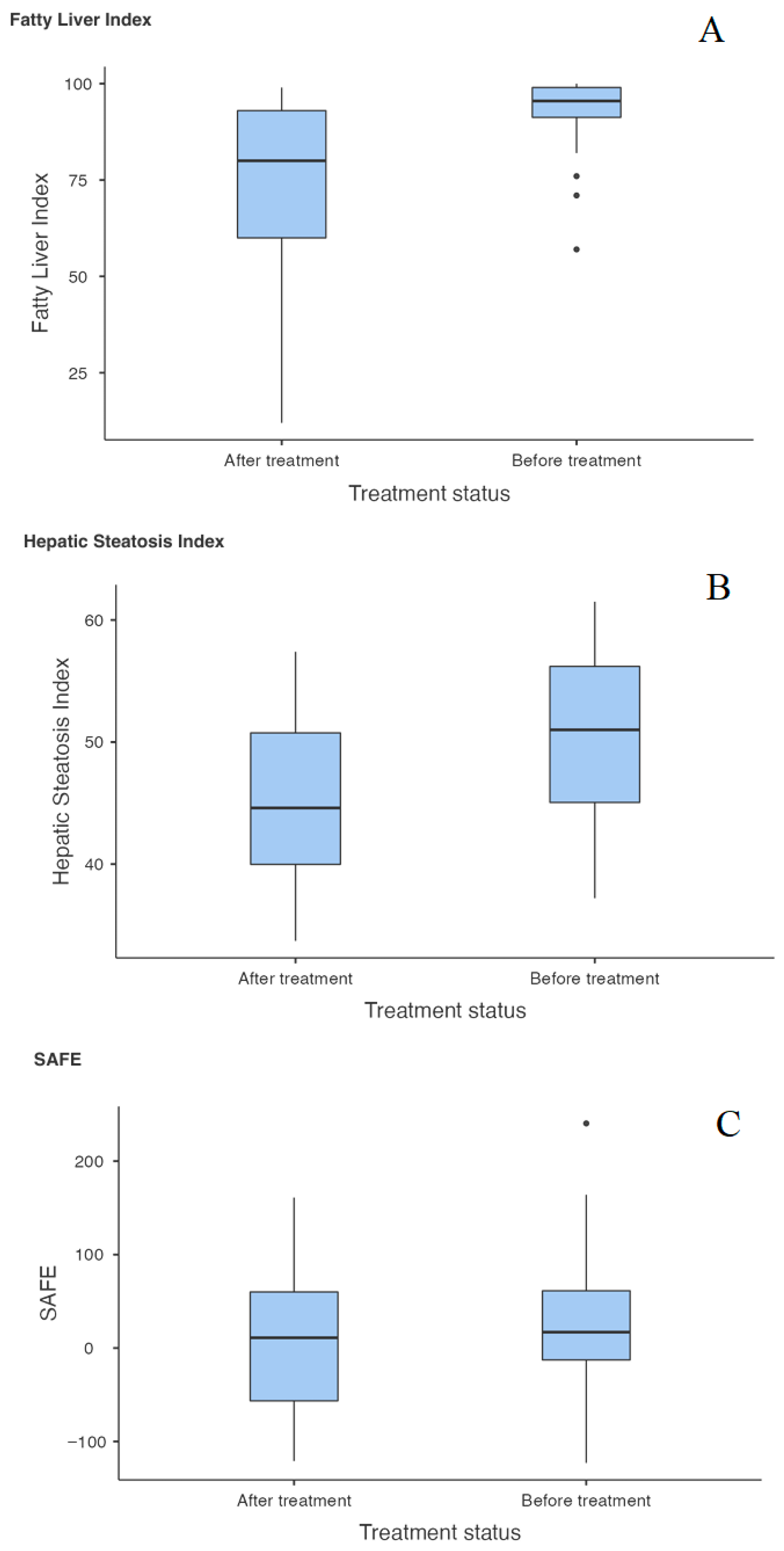
Figure 1. (A)—Boxplots of Fatty Liver Index before and after treatment with GLP-1RA; (B)—Boxplots of Hepatic Steatosis Index before and after treatment with GLP-1RA; (C)—Boxplots of SAFE score and after treatment with GLP-1RA.
Livers 06 00003 g001
Figure 2. (A)—Boxplots of BARD score before and after treatment with GLP-1RA; (B)—Boxplots of Fib-4 before and after treatment with GLP-1RA; (C)—Boxplots of NAFLD Fibrosis Score before and after treatment with GLP-1RA.
Livers 06 00003 g002
Table 1. Study inclusion and exclusion criteria.
Inclusion CriteriaExclusion Criteria
Patients aged 18 + yearsFamily history (FH) of medullary thyroid carcinoma
BMI ≥ 30 kg/m2FH of MEN2 syndrome
MASLDPregnancy
Condition after severe/repeated pancreatitis
Severe liver damage (Child Pugh-C cirrhosis)
Table 2. Demographic data of the patients with obesity and MASLD before the treatment initiation.
Before Treatment InitiationMean ± SD
Number of participants (male/female)30 (9M/21F)
Age (years)47 ± 14
Weight (kg)116 ± 24.5
BMI (kg/m2)39.7 ± 5.78
Waist circumference (cm)120 ± 14
Height/waist ratio0.71 ± 0.07
ALT (μkat/L)0.59 ± 0.38
AST (μkat/L)0.47 ± 0.20
ALP (μkat/L)1.46 ± 0.30
GGT (μkat/L)0.7 ± 0.50
Glycemia (mmol/L)5.4 ± 0.8
Uric Acid (μmol/L)336 ± 63.3
Triacylglycerols (mmol/L)1.74 ± 3.11
Total serum cholesterol (mmol/L)5.51 ± 1.06
HDL (mmol/L)1.25 ± 0.28
LDL (mmol/L)3.66 ± 0.98
Total serum protein (g/L)73.97 ± 3.11
Albumin (g/L)42.0 ± 2.64
Globulin (g/L)31.9 ± 3.0
Bilirubin total (μmol/L)31.9 ± 3.3
Bilirubin conjugated (μmol/L)10.8 ± 5.68
CRP (mg/L)9.32 ± 11.0
Haemoglobin (g/L)144 ± 14.2
Thrombocyte count (×109/L)280.0 ± 51.6
ARB/ACEI use (number of patients)6
Betablocker use (number of patients)12
Statin use (number of patients)5
Blood pressure (mmHg)135/58 ± 18/9
Impaired fasting glucose (number of patients)11
Note: ALT—Alanine Aminotransferase, AST—Aspartate Aminotransferase, GGT—Gamma-glutamyl transferase, ALP—Alkaline Phosphatase, HDL—high density lipoproteins, LDL—low density lipoproteins, CRP—C reactive protein, ARB/ACEi—angiotensin receptor blockers/angiotensin converting enzyme inhibitors.
Table 3. Comparison of BFSS before and after treatment with GLP-1RA.
Statisticdfp
NAFLD Fibrosis Score (BT)NAFLD Fibrosis Score (AT)Student’s t−0.68026.00.503
FLI (BT)FLI (AT)Student’s t6.45028.0<0.001
HIS (BT)HIS (AT)Student’s t8.59829.0<0.001
BARD (BT)BARD (AT)Student’s t−0.68229.00.501
SAFE (BT)SAFE (AT)Student’s t2.24926.00.033
FIB4 (BT)FIB4 (AT)Student’s t−1.04929.00.303
Note. Ha μ Measure 1—Measure 2 ≠ 0.
Table 4. Results of multiple testing correction using Bonferroni, Holm–Bonferroni, and Benjamini–Hochberg (FDR) procedures.
ParameterRaw pBonferroniHolm–BonferroniBenjamini–Hochberg (FDR)
FLI0.0010.0060.0060.003
HSI0.0010.0060.0060.003
SAFE0.0330.1980.1320.066
FIB-40.3031.8180.9090.455
NAFLD Fibrosis Score0.5033.0181.0000.503
BARD0.5013.0061.0000.503
Note: Bold suggests significant difference.
Disclaimer/Publisher’s Note: The statements, opinions and data contained in all publications are solely those of the individual author(s) and contributor(s) and not of MDPI and/or the editor(s). MDPI and/or the editor(s) disclaim responsibility for any injury to people or property resulting from any ideas, methods, instructions or products referred to in the content.