
Gender Differences in Healthy Eating Index as Informed by the Awareness of Diagnosis of Metabolic Dysfunction-Associated Steatotic Liver Disease
 , , , ,
  and
and 
Abstract
1. Introduction
2. Materials and Methods
2.1. Study Population
2.2. Determining Undiagnosed and Diagnosed MASLD
2.3. Healthy Eating Index-2015 Assessment
2.4. Demographic Characteristics
2.5. Lifestyle Patterns
2.6. Metabolic Syndrome and BMI
2.7. Statistical Analysis
3. Results
4. Discussion
5. Conclusions
Supplementary Materials
Author Contributions
Funding
Institutional Review Board Statement
Informed Consent Statement
Data Availability Statement
Conflicts of Interest
References
- Wong, R.J.; Aguilar, M.; Cheung, R.; Perumpail, R.B.; Harrison, S.A.; Younossi, Z.M.; Ahmed, A. Nonalcoholic steatohepatitis is the second leading etiology of liver disease among adults awaiting liver transplantation in the United States. Gastroenterology 2015, 148, 547–555. [Google Scholar] [CrossRef] [PubMed]
- Wong, R.J.; Cheung, R.; Ahmed, A. Nonalcoholic steatohepatitis is the most rapidly growing indication for liver transplantation in patients with hepatocellular carcinoma in the U.S. Hepatology 2014, 59, 2188–2195. [Google Scholar] [CrossRef]
- Estes, C.; Razavi, H.; Loomba, R.; Younossi, Z.; Sanyal, A.J. Modeling the epidemic of nonalcoholic fatty liver disease demonstrates an exponential increase in burden of disease. Hepatology 2018, 67, 123–133. [Google Scholar] [CrossRef]
- Le, P.; Chaitoff, A.; Rothberg, M.B.; McCullough, A.; Gupta, N.M.; Alkhouri, N. Population-Based Trends in Prevalence of Nonalcoholic Fatty Liver Disease in US Adults with Type 2 Diabetes. Clin. Gastroenterol. Hepatol. 2019, 17, 2377–2378. [Google Scholar] [CrossRef]
- Rinella, M.E.; Neuschwander-Tetri, B.A.; Siddiqui, M.S.; Abdelmalek, M.F.; Caldwell, S.; Barb, D.; Kleiner, D.E.; Loomba, R. AASLD practice guidance on the clinical assessment and management of nonalcoholic fatty liver disease. Hepatology 2023, 77, 1797–1835. [Google Scholar] [CrossRef]
- Yanai, H.; Adachi, H.; Hakoshima, M.; Iida, S.; Katsuyama, H. Metabolic-Dysfunction-Associated Steatotic Liver Disease-Its Pathophysiology, Association with Atherosclerosis and Cardiovascular Disease, and Treatments. Int. J. Mol. Sci. 2023, 24, 15473. [Google Scholar] [CrossRef]
- Younossi, Z.M.; Koenig, A.B.; Abdelatif, D.; Fazel, Y.; Henry, L.; Wymer, M. Global epidemiology of nonalcoholic fatty liver disease-Meta-analytic assessment of prevalence, incidence, and outcomes. Hepatology 2016, 64, 73–84. [Google Scholar] [CrossRef]
- Balakrishnan, M.; Patel, P.; Dunn-Valadez, S.; Dao, C.; Khan, V.; Ali, H.; El-Serag, L.; Hernaez, R.; Sisson, A.; Thrift, A.P.; et al. Women Have a Lower Risk of Nonalcoholic Fatty Liver Disease but a Higher Risk of Progression vs Men: A Systematic Review and Meta-analysis. Clin. Gastroenterol. Hepatol. 2021, 19, 61–71.e15. [Google Scholar] [CrossRef]
- Nagral, A.; Bangar, M.; Menezes, S.; Bhatia, S.; Butt, N.; Ghosh, J.; Manchanayake, J.H.; Mamun, A.M.; Shivaram, P.S. Gender Differences in Nonalcoholic Fatty Liver Disease. Euroasian J. Hepatogastroenterol. 2022, 12 (Suppl. S1), S19–S25. [Google Scholar] [CrossRef]
- Khalid, Y.S.; Dasu, N.R.; Suga, H.; Dasu, K.N.; Reja, D.; Shah, A.; McMahon, D.; Levine, A. Increased cardiovascular events and mortality in females with NAFLD: A meta-analysis. Am. J. Cardiovasc. Dis. 2020, 10, 258–271. [Google Scholar]
- Wang, Y.; Kory, N.; BasuRay, S.; Cohen, J.C.; Hobbs, H.H. PNPLA3, CGI-58, and Inhibition of Hepatic Triglyceride Hydrolysis in Mice. Hepatology 2019, 69, 2427–2441. [Google Scholar] [CrossRef]
- Ryan, D.H.; Yockey, S.R. Weight Loss and Improvement in Comorbidity: Differences at 5%, 10%, 15%, and Over. Curr. Obes. Rep. 2017, 6, 187–194. [Google Scholar] [CrossRef]
- Hydes, T.J.; Ravi, S.; Loomba, R.; Gray, M.E. Evidence-based clinical advice for nutrition and dietary weight loss strategies for the management of NAFLD and NASH. Clin. Mol. Hepatol. 2020, 26, 383–400. [Google Scholar] [CrossRef]
- Tseng, T.S.; Lin, W.T.; Ting, P.S.; Huang, C.-K.; Chen, P.-H.; Gonzalez, G.V.; Lin, H.-Y. Sugar-Sweetened Beverages and Artificially Sweetened Beverages Consumption and the Risk of Nonalcoholic Fatty Liver (NAFLD) and Nonalcoholic Steatohepatitis (NASH). Nutrients 2023, 15, 3997. [Google Scholar] [CrossRef] [PubMed]
- Venditti, V.; Bleve, E.; Morano, S.; Filardi, T. Gender-Related Factors in Medication Adherence for Metabolic and Cardiovascular Health. Metabolites 2023, 13, 1087. [Google Scholar] [CrossRef] [PubMed]
- Pasternack, C.; Hervonen, K.; Mansikka, E.; Reunala, T.; Kaukinen, K.; Salmi, T. Sex-differences in Gluten-free Dietary Adherence and Clinical Symptoms in Patients with Long-term Treated Dermatitis Herpetiformis. Acta Derm.-Venereol. 2022, 102, adv00713. [Google Scholar] [CrossRef] [PubMed]
- Chung, M.L.; Moser, D.K.; Lennie, T.A.; Worrall-Carter, L.; Bentley, B.; Trupp, R.; Armentano, D.S. Gender differences in adherence to the sodium-restricted diet in patients with heart failure. J. Card. Fail. 2006, 12, 628–634. [Google Scholar] [CrossRef]
- De Melo, M.; de Sa, E.; Gucciardi, E. Exploring differences in Canadian adult men and women with diabetes management: Results from the Canadian Community Health Survey. BMC Public Health 2013, 13, 1089. [Google Scholar] [CrossRef]
- National Health and Nutrition Examination Survey (NHANES). Centers for Disease Control and Prevention. National Center for Health Statistics. Available online: https://www.cdc.gov/nchs/nhanes/index.html (accessed on 15 February 2024).
- NHANES Survey. Research Ethics Review Board (ERB) Approval. Centers for Disease Control and Prevention (CDC). National Center for Health Statistics (NCHS). Available online: https://www.cdc.gov/nchs/nhanes/about/erb.html (accessed on 15 February 2024).
- Eddowes, P.J.; Sasso, M.; Allison, M.; Tsochatzis, E.; Anstee, Q.M.; Sheridan, D.; Guha, I.N.; Cobbold, J.F.; Deeks, J.J.; Paradis, V.; et al. Accuracy of FibroScan Controlled Attenuation Parameter and Liver Stiffness Measurement in Assessing Steatosis and Fibrosis in Patients with Nonalcoholic Fatty Liver Disease. Gastroenterology 2019, 156, 1717–1730. [Google Scholar] [CrossRef]
- Petroff, D.; Blank, V.; Newsome, P.N.; Shalimar, M.D.; Voican, C.S.; Thiele, M.; de Lédinghen, V.; Baumeler, S.; Chan, W.K.; Perlemuter, G.; et al. Assessment of hepatic steatosis by controlled attenuation parameter using the M and XL probes: An individual patient data meta-analysis. Lancet Gastroenterol. Hepatol. 2021, 6, 185–198. [Google Scholar] [CrossRef]
- Rinella, M.E.; Lazarus, J.V.; Ratziu, V.; Francque, S.M.; Sanyal, A.J.; Kanwal, F.; Romero, D.; Abdelmalek, M.F.; Anstee, Q.M.; Arab, J.P.; et al. A multi-society Delphi consensus statement on new fatty liver disease nomenclature. Hepatology 2023, 78, 1966–1986. [Google Scholar] [CrossRef] [PubMed]
- Hardy, T.; Wonders, K.; Younes, R.; Aithal, G.P.; Aller, R.; Allison, M.; Bedossa, P.; Betsou, F.; Boursier, J.; Brosnan, M.J.; et al. The European NAFLD Registry: A real-world longitudinal cohort study of nonalcoholic fatty liver disease. Contemp. Clin. Trials 2020, 98, 106175. [Google Scholar] [CrossRef] [PubMed]
- National Institute on Alcohol Abuse and Alcoholism (NIAAA). What Is a Standard Drink? Available online: https://www.niaaa.nih.gov/alcohols-effects-health/overview-alcohol-consumption/what-standard-drink#:~:text=In%20the%20United%20States%2C%20one,which%20is%20about%2040%25%20alcohol (accessed on 15 February 2024).
- Centers for Disease Control and Prevention (CDC). National Center for Health Statistics (NCHS). NHANES Questionnaires, Datasets, and Related Documentation. Available online: https://wwwn.cdc.gov/Nchs/Nhanes/ (accessed on 15 February 2024).
- Krebs-Smith, S.M.; Pannucci, T.E.; Subar, A.F.; Kirkpatrick, S.I.; Lerman, J.L.; Tooze, J.A.; Wilson, M.M.; Reedy, J. Update of the Healthy Eating Index: HEI-2015. J. Acad. Nutr. Diet. 2018, 118, 1591–1602. [Google Scholar] [CrossRef]
- U.S. Department of Agriculture (USDA) Food and Nutrition Service. HEI Scores for Americans. Available online: https://www.fns.usda.gov/cnpp/hei-scores-americans (accessed on 21 February 2024).
- Shan, Z.; Li, Y.; Baden, M.Y.; Bhupathiraju, S.N.; Wang, D.D.; Sun, Q.; Rexrode, K.M.; Rimm, E.B.; Qi, L.; Willett, W.C.; et al. Association Between Healthy Eating Patterns and Risk of Cardiovascular Disease. JAMA Intern. Med. 2020, 180, 1090–1100. [Google Scholar] [CrossRef] [PubMed]
- Musso, G.; Gambino, R.; De Michieli, F.; Cassader, M.; Rizzetto, M.; Durazzo, M.; Fagà, E.; Silli, B.; Pagano, G. Dietary habits and their relations to insulin resistance and postprandial lipemia in nonalcoholic steatohepatitis. Hepatology 2003, 37, 909–916. [Google Scholar] [CrossRef]
- Perdomo, C.M.; Fruhbeck, G.; Escalada, J. Impact of Nutritional Changes on Nonalcoholic Fatty Liver Disease. Nutrients 2019, 11, 677. [Google Scholar] [CrossRef]
- Zhang, W.; Wang, X.; Huang, J.; Wang, S.; Yao, Q.; Li, H. Healthy Eating Index-2015 in relation to risk of metabolic dysfunction-associated fatty liver disease among US population: National Health and Nutrition Examination Survey 2017–2018. Front. Nutr. 2022, 9, 1043901. [Google Scholar] [CrossRef]
- Tian, T.; Zhang, J.; Xie, W.; Ni, Y.; Fang, X.; Liu, M.; Peng, X.; Wang, J.; Dai, Y.; Zhou, Y. Dietary Quality and Relationships with Metabolic Dysfunction-Associated Fatty Liver Disease (MAFLD) among United States Adults, Results from NHANES 2017–2018. Nutrients 2022, 14, 4505. [Google Scholar] [CrossRef]
- U.S. Department of agriculture (USDA) Food and Nutrition Service. Food Patterns Equivalence Database. Available online: https://www.ars.usda.gov/northeast-area/beltsville-md-bhnrc/beltsville-human-nutrition-research-center/food-surveys-research-group/docs/fped-overview/ (accessed on 21 February 2024).
- Shams-White, M.M.; Pannucci, T.E.; Lerman, J.L.; Herrick, K.A.; Zimmer, M.; Mathieu, K.M.; Stoody, E.E.; Reedy, J. Healthy Eating Index-2020: Review and Update Process to Reflect the Dietary Guidelines for Americans, 2020–2025. J. Acad. Nutr. Diet. 2023, 123, 1280–1288. [Google Scholar] [CrossRef]
- WHO. World Health Organization (WHO) Guidelines on Physical Activity and Sedentary Behavior; WHO: Geneva, Switzerland, 2020. [Google Scholar]
- NCEPNE. Third Report of the National Cholesterol Education Program (NCEP) Expert Panel on Detection, Evaluation, and Treatment of High Blood Cholesterol in Adults (Adult Treatment Panel III) final report. Circulation 2002, 106, 3143–3421. [Google Scholar] [CrossRef]
- Centers for Disease Control and Prevention (CDC). Defining Adult Overweight and Obesity. Available online: https://www.cdc.gov/bmi/adult-calculator/bmi-categories.html (accessed on 10 July 2025).
- Carol, M.; Perez-Guasch, M.; Sola, E.; Cervera, M.; Martínez, S.; Juanola, A.; Ma, A.T.; Avitabile, E.; Napoleone, L.; Pose, E.; et al. Stigmatization is common in patients with non-alcoholic fatty liver disease and correlates with quality of life. PLoS ONE 2022, 17, e0265153. [Google Scholar] [CrossRef] [PubMed]
- Sattler, K.M.; Deane, F.P.; Tapsell, L.; Kelly, P.J. Gender differences in the relationship of weight-based stigmatisation with motivation to exercise and physical activity in overweight individuals. Health Psychol. Open 2018, 5, 2055102918759691. [Google Scholar] [CrossRef] [PubMed]
- Nickel, F.; Tapking, C.; Benner, L.; Schüler, S.; Ottawa, G.B.; Krug, K.; Müller-Stich, B.P.; Fischer, L. Video Teaching Leads to Improved Attitudes Towards Obesity-a Randomized Study with 949 Participants. Obes. Surg. 2019, 29, 2078–2086. [Google Scholar] [CrossRef] [PubMed]
- Barrea, L.; Verde, L.; Suarez, R.; Frias-Toral, E.; Vásquez, C.A.; Colao, A.; Savastano, S.; Muscogiuri, G. Sex-differences in Mediterranean diet: A key piece to explain sex-related cardiovascular risk in obesity? A cross-sectional study. J. Transl. Med. 2024, 22, 44. [Google Scholar] [CrossRef]
- Leblanc, V.; Begin, C.; Corneau, L.; Dodin, S.; Lemieux, S. Gender differences in dietary intakes: What is the contribution of motivational variables? J. Hum. Nutr. Diet. 2015, 28, 37–46. [Google Scholar] [CrossRef]
- Fagerli, R.A.; Wandel, M. Gender differences in opinions and practices with regard to a “healthy diet”. Appetite 1999, 32, 171–190. [Google Scholar] [CrossRef]
- Gal, A.M.; Arhire, L.I.; Gherasim, A.; Graur, M.; Nita, O.; Dumitrascu, O.; Soimaru, R.M.; Popa, A.D.; Mihalache, L. Association between Diet Quality and Eating Behavior in Type 2 Diabetes Adults: A Cross-Sectional Study. Nutrients 2024, 16, 2047. [Google Scholar] [CrossRef]
- Feraco, A.; Armani, A.; Amoah, I.; Guseva, E.; Camajani, E.; Gorini, S.; Strollo, R.; Padua, E.; Caprio, M.; Lombardo, M. Assessing gender differences in food preferences and physical activity: A population-based survey. Front. Nutr. 2024, 11, 1348456. [Google Scholar] [CrossRef]
- Wang, Y.; Cao, P.; Liu, F.; Chen, Y.; Xie, J.; Bai, B.; Liu, Q.; Ma, H.; Geng, Q. Gender Differences in Unhealthy Lifestyle Behaviors among Adults with Diabetes in the United States between 1999 and 2018. Int. J. Environ. Res. Public Health 2022, 19, 16412. [Google Scholar] [CrossRef]
- Vynckier, P.; Ferrannini, G.; Kotseva, K.; Gevaert, S.; De Bacquer, D.; De Smedt, D. Gender differences in lifestyle management among coronary patients and the association with education and age: Results from the ESC EORP EUROASPIRE V registry. Eur. J. Cardiovasc. Nurs. 2022, 21, 717–723. [Google Scholar] [CrossRef]
- Kouvari, M.; Boutari, C.; Chrysohoou, C.; Fragkopoulou, E.; Antonopoulou, S.; Tousoulis, D.; Pitsavos, C.; Panagiotakos, D.; Mantzoros, C. Mediterranean diet is inversely associated with steatosis and fibrosis and decreases ten-year diabetes and cardiovascular risk in NAFLD subjects: Results from the ATTICA prospective cohort study. Clin. Nutr. 2021, 40, 3314–3324. [Google Scholar] [CrossRef]
- European Association for the Study of the Liver; European Association for the Study of Diabetes; European Association for the Study of Obesity. EASL-EASD-EASO Clinical Practice Guidelines for the management of non-alcoholic fatty liver disease. J. Hepatol. 2016, 64, 1388–1402. [Google Scholar] [CrossRef]
- Gao, V.; Long, M.T.; Singh, S.R.; Kim, Y.; Zhang, X.; Rogers, G.; Jacques, P.F.; Levy, D.; Ma, J. A Healthy Diet is Associated with a Lower Risk of Hepatic Fibrosis. J. Nutr. 2023, 153, 1587–1596. [Google Scholar] [CrossRef]
- Cumpian, N.A.; Gutierrez, J.A.; Wu, W.; Saab, S. Targeting MASLD and MASH in the US Hispanic/Latino Population: A Review. JAMA Intern. Med. 2025, 185, 1376. [Google Scholar] [CrossRef]
- Aboona, M.B.; Faulkner, C.; Rangan, P.; Ng, C.H.; Huang, D.Q.; Muthiah, M.; Rubin, M.I.N.; Han, M.A.T.; Fallon, M.B.; Kim, D.; et al. Disparities among ethnic groups in mortality and outcomes among adults with MASLD: A multicenter study. Liver Int. 2024, 44, 1316–1328. [Google Scholar] [CrossRef]
- Tesfai, K.; Pace, J.; El-Newihi, N.; Martinez, M.E.; Tincopa, M.A.; Loomba, R. Disparities for Hispanic Adults With Metabolic Dysfunction-associated Steatotic Liver Disease in the United States: A Systematic Review and Meta-analysis. Clin. Gastroenterol. Hepatol. 2025, 23, 236–249. [Google Scholar] [CrossRef]
- De Keyzer, W.; Huybrechts, I.; De Vriendt, V.; Vandevijvere, S.; Slimani, N.; Van Oyen, H.; De Henauw, S. Repeated 24-hour recalls versus dietary records for estimating nutrient intakes in a national food consumption survey. Food Nutr. Res. 2011, 55, 7307. [Google Scholar] [CrossRef]



| Men | Women | |||||
|---|---|---|---|---|---|---|
| Subject Recognition of MASLD Diagnosis | Undiagnosed | Diagnosed | Undiagnosed | Diagnosed | ||
| n 1 = 897 | n 1 = 51 | p Value | n 1 = 806 | n 1 = 76 | p Value | |
| Survey-weighted 2 | 95.0% | 5.0% | 92.5% | 7.5% | ||
| Demographic factors | ||||||
| Age (year), mean ± se | 49.4 ± 1.0 | 54.5 ± 3.2 | 0.18 | 52.0 ± 1.0 | 57.3 ± 2.2 | 0.025 |
| Race | ||||||
| non-Hispanic White | 62.6% | 66.6% | 0.17 | 62.9% | 33.3% | 0.006 |
| non-Hispanic Black | 7.5% | 1.5% | 10.1% | 5.7% | ||
| Mexican American/other Hispanic | 19.1% | 24.7% | 18.1% | 38.6% | ||
| others | 10.7% | 7.2% | 8.8% | 22.4% | ||
| Poverty Income Ratio | ||||||
| Below poverty | 11.1% | 9.5% | 0.87 | 17.6% | 16.8% | 0.95 |
| 1–2.99 | 30.7% | 35.4% | 34.8% | 37.3% | ||
| ≥3 | 58.2% | 55.1% | 47.7% | 45.8% | ||
| Lifestyle patterns | ||||||
| Current cigarettes smoker | 11.7% | 9.8% | 0.69 | 15.6% | 1.0% | <0.001 |
| Alcohol use (yes) | 79.1% | 73.1% | 0.44 | 71.7% | 77.4% | 0.44 |
| Insufficient Physical activity 3 | 62.0% | 54.4% | 0.52 | 72.9% | 82.0% | 0.39 |
| Medical conditions (yes) 4 | 65.5% | 89.8% | 0.012 | 73.4% | 88.6% | 0.029 |
| Clinical examination | ||||||
| Large waist circumference 5 | 78.9% | 62.2% | 0.23 | 93.4% | 90.2% | 0.33 |
| Elevated blood pressure 6 | 61.6% | 76.5% | 0.15 | 56.5% | 73.5% | 0.12 |
| Elevated triglycerides 7 | 55.0% | 44.3% | 0.45 | 46.6% | 57.1% | 0.11 |
| Low HDL-C 8 | 40.3% | 39.0% | 0.90 | 51.7% | 36.9% | 0.14 |
| Elevated glucose 9 | 48.1% | 70.4% | 0.028 | 49.2% | 67.6% | 0.006 |
| Metabolic syndrome 10 | 57.9% | 62.2% | 0.76 | 61.0% | 70.1% | 0.10 |
| VCTE Parameters | ||||||
| CAP (dB/m) | 337.8 ± 2.0 | 295.0 ± 34.2 | 0.22 | 335.6 ± 1.8 | 292.9 ± 4.9 | <0.001 |
| LSM (kPa) | 7.1 ± 0.3 | 7.9 ± 1.0 | 0.39 | 7.4 ± 0.5 | 6.6 ± 0.7 | 0.31 |
| Body mass index | ||||||
| normal weight | 4.0% | 6.2% | 0.18 | 5.6% | 10.6% | 0.23 |
| overweight | 23.6% | 41.4% | 23.1% | 24.6% | ||
| obese | 72.5% | 52.4% | 71.3% | 64.8% | ||
| Men | Women | |||||||
|---|---|---|---|---|---|---|---|---|
| Subject Recognition of MASLD Diagnosis | Undiagnosed | Diagnosed | Undiagnosed | Diagnosed | ||||
| n 1 = 897 | n 1 = 51 | p Value | 95% CI | n 1 = 806 | n 1 = 76 | p Value | 95% CI | |
| Survey-weighted 2 | 95.0% | 5.0% | 92.5% | 7.5% | ||||
| Dietary components for HEI-2015 score, mean ± se | ||||||||
| Moderation components (score scale) | ||||||||
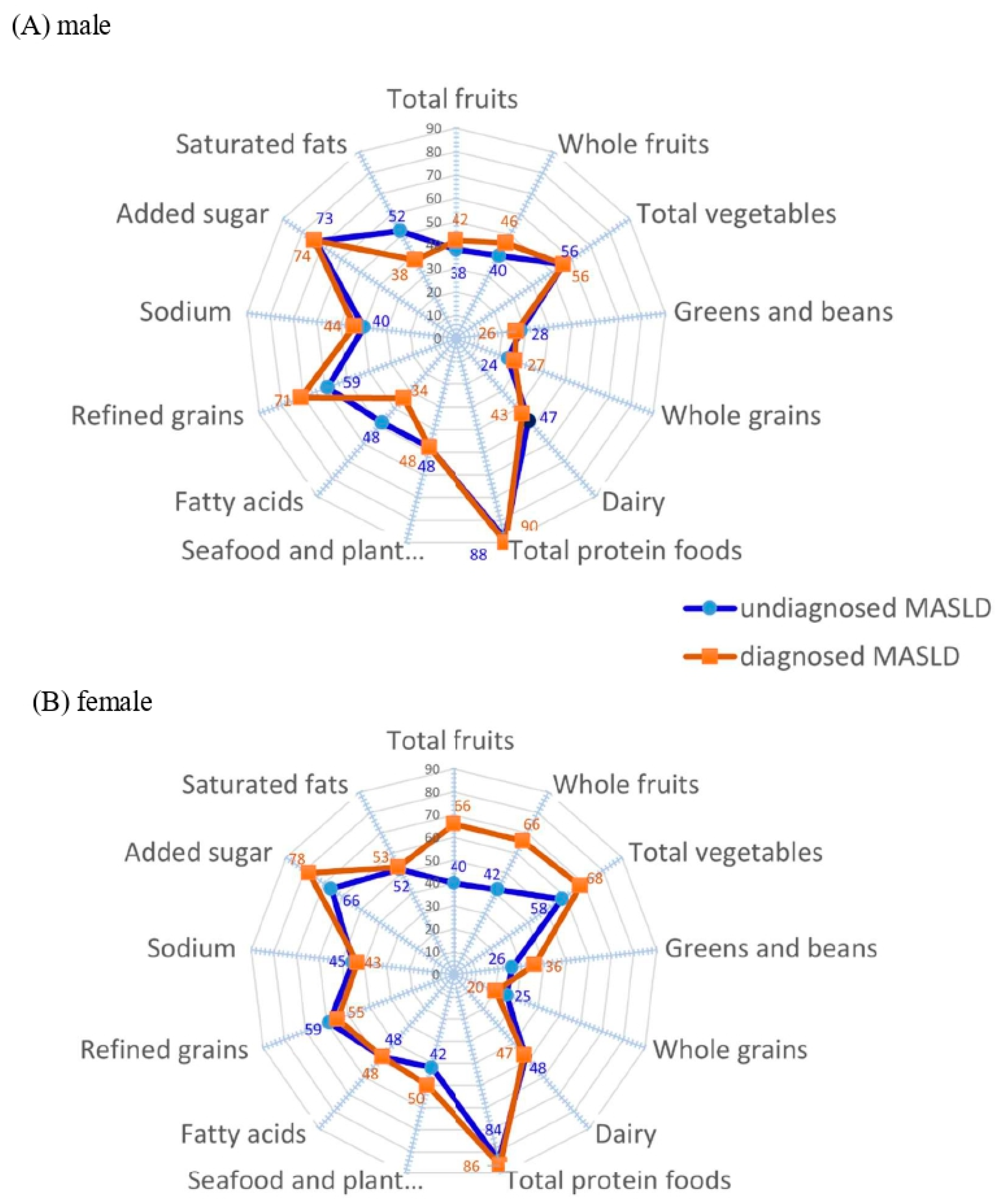
| sodium (0–10) | 4.0 ± 0.1 | 4.4 ± 0.7 | 0.66 | (−1.2, 1.9) | 4.5 ± 0.2 | 4.3 ± 0.7 | 0.81 | (−1.5, 1.2) |
| refined grains (0–10) | 5.9 ± 0.2 | 7.1 ± 0.5 | 0.046 | (0.02, 2.5) | 5.9 ± 0.2 | 5.5 ± 0.5 | 0.47 | (−1.5, 0.7) |
| saturated fats (0–10) | 5.2 ± 0.1 | 3.8 ± 0.9 | 0.11 | (−3.1, 0.3) | 5.2 ± 0.2 | 5.3 ± 0.5 | 0.75 | (−0.9, 1.2) |
| added sugar (0–10) | 7.3 ± 0.1 | 7.4 ± 0.6 | 0.79 | (−1.1, 1.5) | 6.6 ± 0.2 | 7.8 ± 0.2 | <0.001 | (0.7, 1.9) |
| Adequacy components (score scale) | ||||||||
| total vegetables (0–5) | 2.8 ± 0.1 | 2.8 ± 0.2 | 0.95 | (−0.5, 0.5) | 2.9 ± 0.1 | 3.4 ± 0.3 | 0.13 | (−0.2, 1.2) |
| greens and beans (0–5) | 1.4 ± 0.1 | 1.3 ± 0.3 | 0.68 | (−0.7, 0.4) | 1.3 ± 0.1 | 1.8 ± 0.3 | 0.09 | (−0.1, 1.1) |
| total fruits (0–5) | 1.9 ± 0.1 | 2.1 ± 0.5 | 0.71 | (−1.0, 1.5) | 2.0 ± 0.1 | 3.3 ± 0.3 | <0.001 | (0.7, 2.0) |
| whole fruits (0–5) | 2.0 ± 0.1 | 2.3 ± 0.6 | 0.62 | (−1.0, 1.7) | 2.1 ± 0.1 | 3.3 ± 0.4 | 0.017 | (0.2, 2.1) |
| whole grains (0–10) | 2.4 ± 0.2 | 2.7 ± 0.5 | 0.60 | (−0.8, 1.4) | 2.5 ± 0.2 | 2.0 ± 0.5 | 0.32 | (−1.4, 0.5) |
| total dairy (0–10) | 4.7 ± 0.2 | 4.3 ± 0.6 | 0.59 | (−1.5, 0.9) | 4.8 ± 0.1 | 4.7 ± 0.3 | 0.84 | (−0.7, 0.6) |
| total protein foods (0–5) | 4.4 ± 0.04 | 4.5 ± 0.1 | 0.24 | (−0.1, 0.4) | 4.2 ± 0.1 | 4.3 ± 0.1 | 0.15 | (−0.1, 0.4) |
| seafood and plant proteins (0–5) | 2.4 ± 0.1 | 2.4 ± 0.4 | 0.98 | (−0.7, 0.7) | 2.1 ± 0.1 | 2.5 ± 0.1 | 0.06 | (−0.01, 0.8) |
| fatty acids (0–10) | 4.8 ± 0.2 | 3.4 ± 0.8 | 0.09 | (−3.0, 0.2) | 4.8 ± 0.1 | 4.8 ± 0.5 | 0.96 | (−0.9, 1.0) |
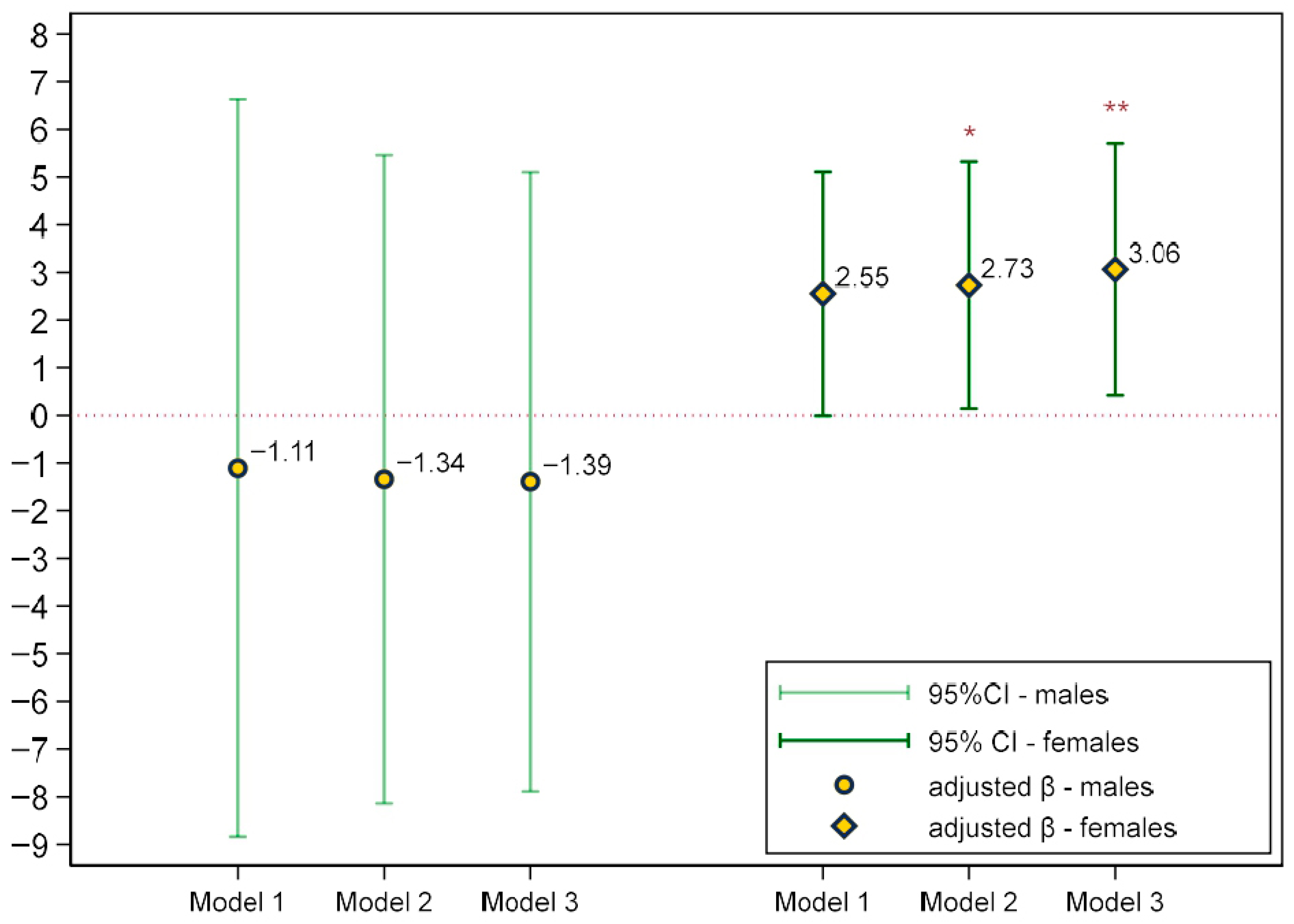
| Total HEI-2015 score | 49.2 ± 0.7 | 48.7 ± 4.2 | 0.92 | (−9.6, 8.7) | 48.7 ± 0.6 | 53.2 ± 1.3 | 0.003 | (1.6, 7.3) |
Disclaimer/Publisher’s Note: The statements, opinions and data contained in all publications are solely those of the individual author(s) and contributor(s) and not of MDPI and/or the editor(s). MDPI and/or the editor(s) disclaim responsibility for any injury to people or property resulting from any ideas, methods, instructions or products referred to in the content. |
© 2025 by the authors. Licensee MDPI, Basel, Switzerland. This article is an open access article distributed under the terms and conditions of the Creative Commons Attribution (CC BY) license (https://creativecommons.org/licenses/by/4.0/).
Share and Cite
Lin, W.-T.; Novack, M.; Liangpunsakul, S.; Huang, C.-K.; Lin, H.-Y.; Chen, P.-H.; Tseng, T.-S.; Ting, P.-S. Gender Differences in Healthy Eating Index as Informed by the Awareness of Diagnosis of Metabolic Dysfunction-Associated Steatotic Liver Disease. Livers 2025, 5, 61. https://doi.org/10.3390/livers5040061
Lin W-T, Novack M, Liangpunsakul S, Huang C-K, Lin H-Y, Chen P-H, Tseng T-S, Ting P-S. Gender Differences in Healthy Eating Index as Informed by the Awareness of Diagnosis of Metabolic Dysfunction-Associated Steatotic Liver Disease. Livers. 2025; 5(4):61. https://doi.org/10.3390/livers5040061
Chicago/Turabian StyleLin, Wei-Ting, Madeline Novack, Suthat Liangpunsakul, Chiung-Kuei Huang, Hui-Yi Lin, Po-Hung Chen, Tung-Sung Tseng, and Peng-Sheng Ting. 2025. "Gender Differences in Healthy Eating Index as Informed by the Awareness of Diagnosis of Metabolic Dysfunction-Associated Steatotic Liver Disease" Livers 5, no. 4: 61. https://doi.org/10.3390/livers5040061
APA StyleLin, W.-T., Novack, M., Liangpunsakul, S., Huang, C.-K., Lin, H.-Y., Chen, P.-H., Tseng, T.-S., & Ting, P.-S. (2025). Gender Differences in Healthy Eating Index as Informed by the Awareness of Diagnosis of Metabolic Dysfunction-Associated Steatotic Liver Disease. Livers, 5(4), 61. https://doi.org/10.3390/livers5040061