
Risk Monitoring of Small Modular Reactors by Grey-Box Models: Feature Extraction and Global Sensitivity Analysis


Abstract
1. Introduction
2. Problem Formulation
3. The Proposed Methodology
3.1. Feature Extraction Using Hilbert–Huang Transform (HHT)
3.2. Calculation of the Kucherenko Indices
3.3. Selection of BB Model Inputs
4. Case Study
5. Results
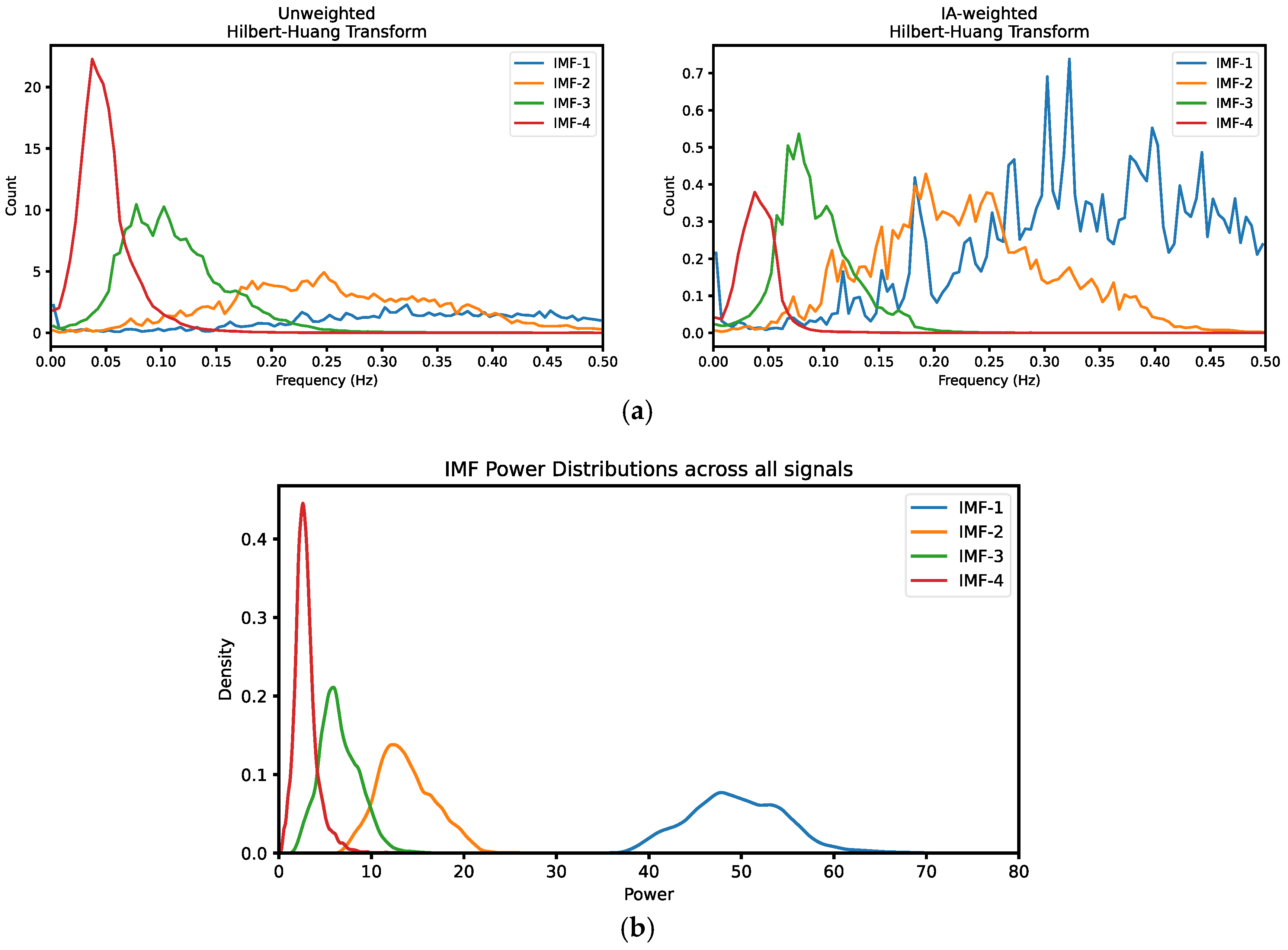
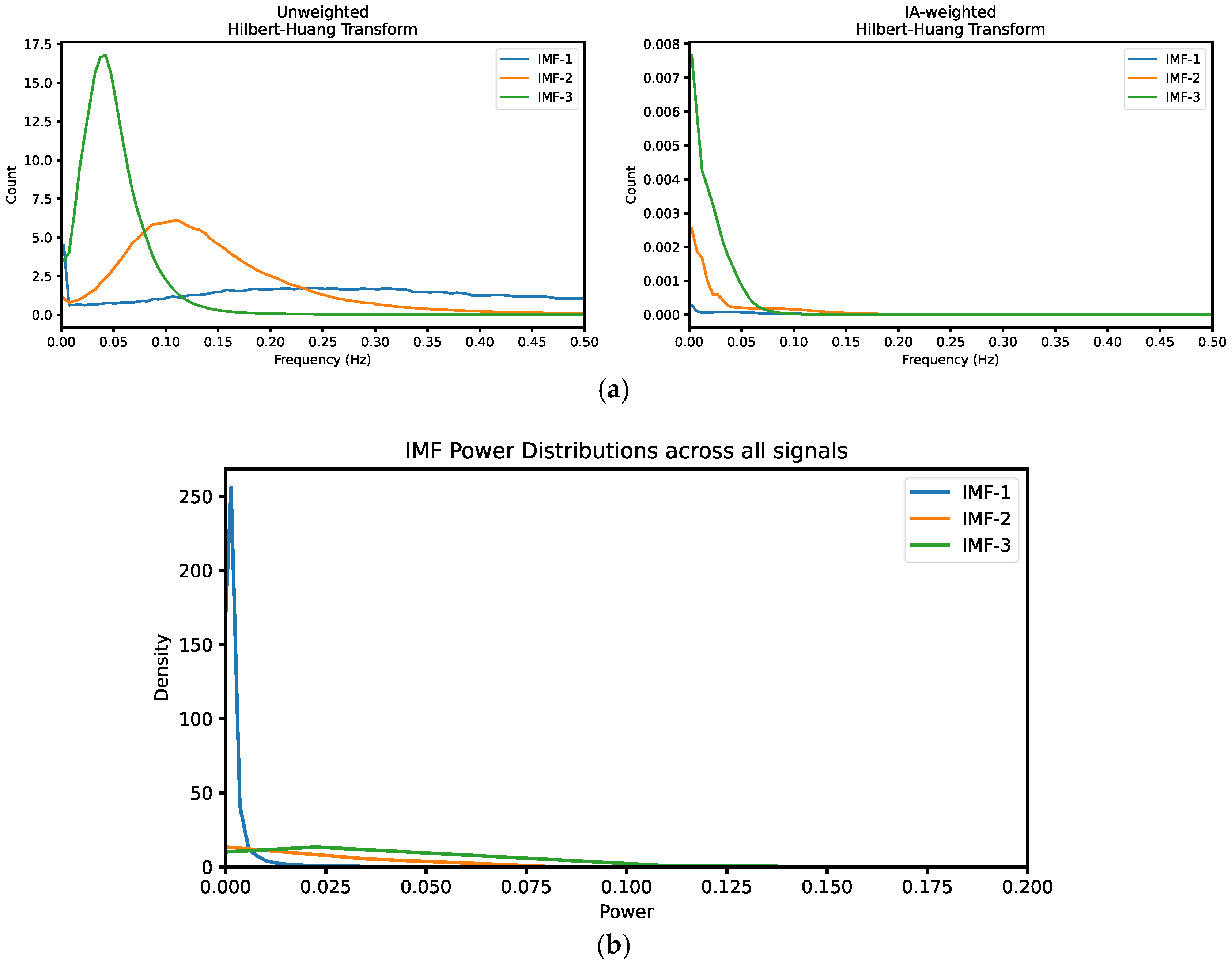
5.1. Feature Extraction with Hilbert–Huang Transform
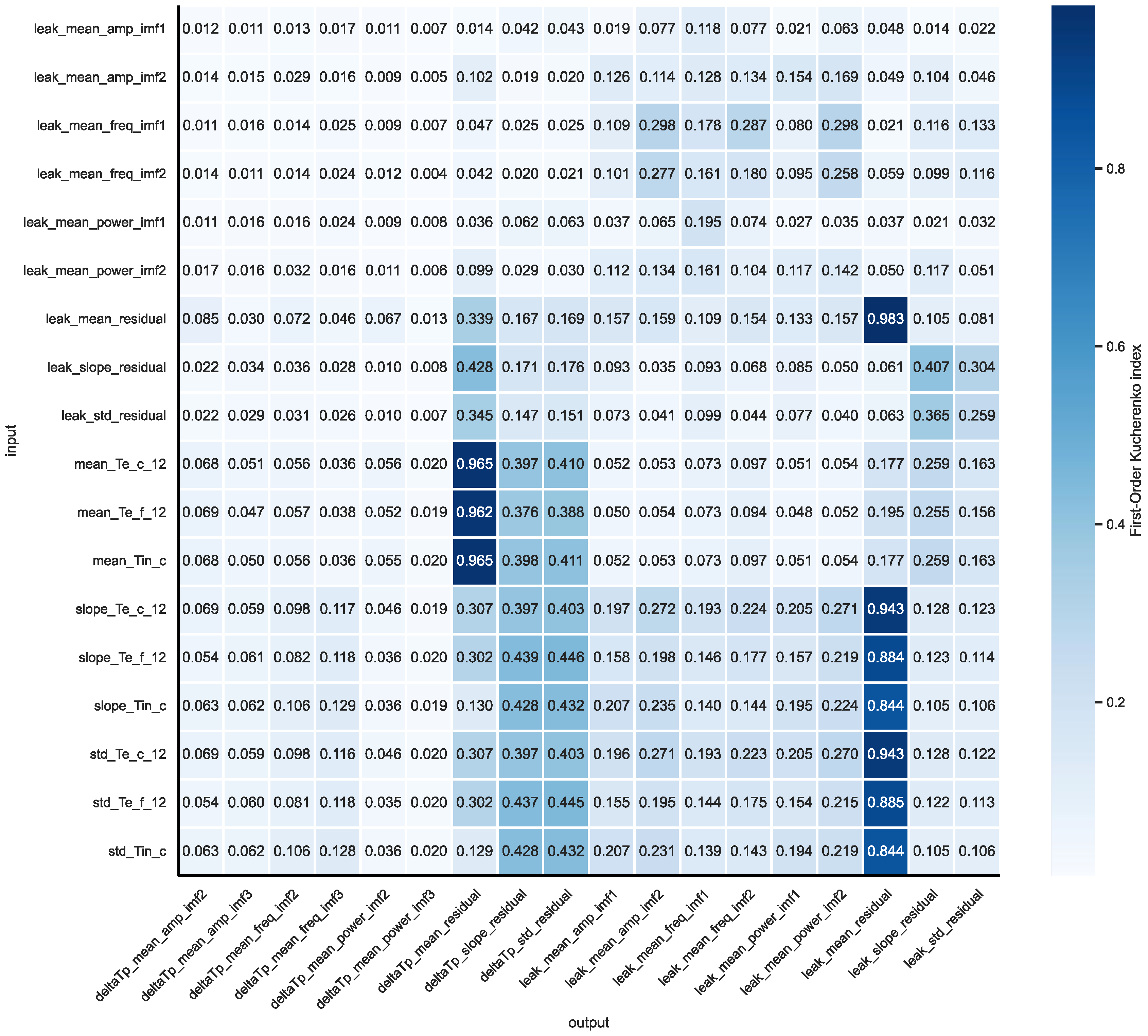
5.2. Sensitivity Analysis with Kucherenko Indices
- The features extracted from the residual of leakage rate achieve high sensitivity indices when predicting autoregressive long-term trends.
- Among the extracted features from the temperature signals, features from the outlet coolant temperature and the inlet coolant temperature present higher sensitivity levels when predicting the residuals of both BB outputs (i.e., denoised long-term trends of coolant leakage rate and the PCT estimation error during the LOCA scenario).
- The extracted features of the leakage rate do not substantially contribute to explaining the variability in the PCT estimation error , which can be explained due to the nonlinear effects of hydraulic phenomena and the thermohydraulic equations of the HF model.
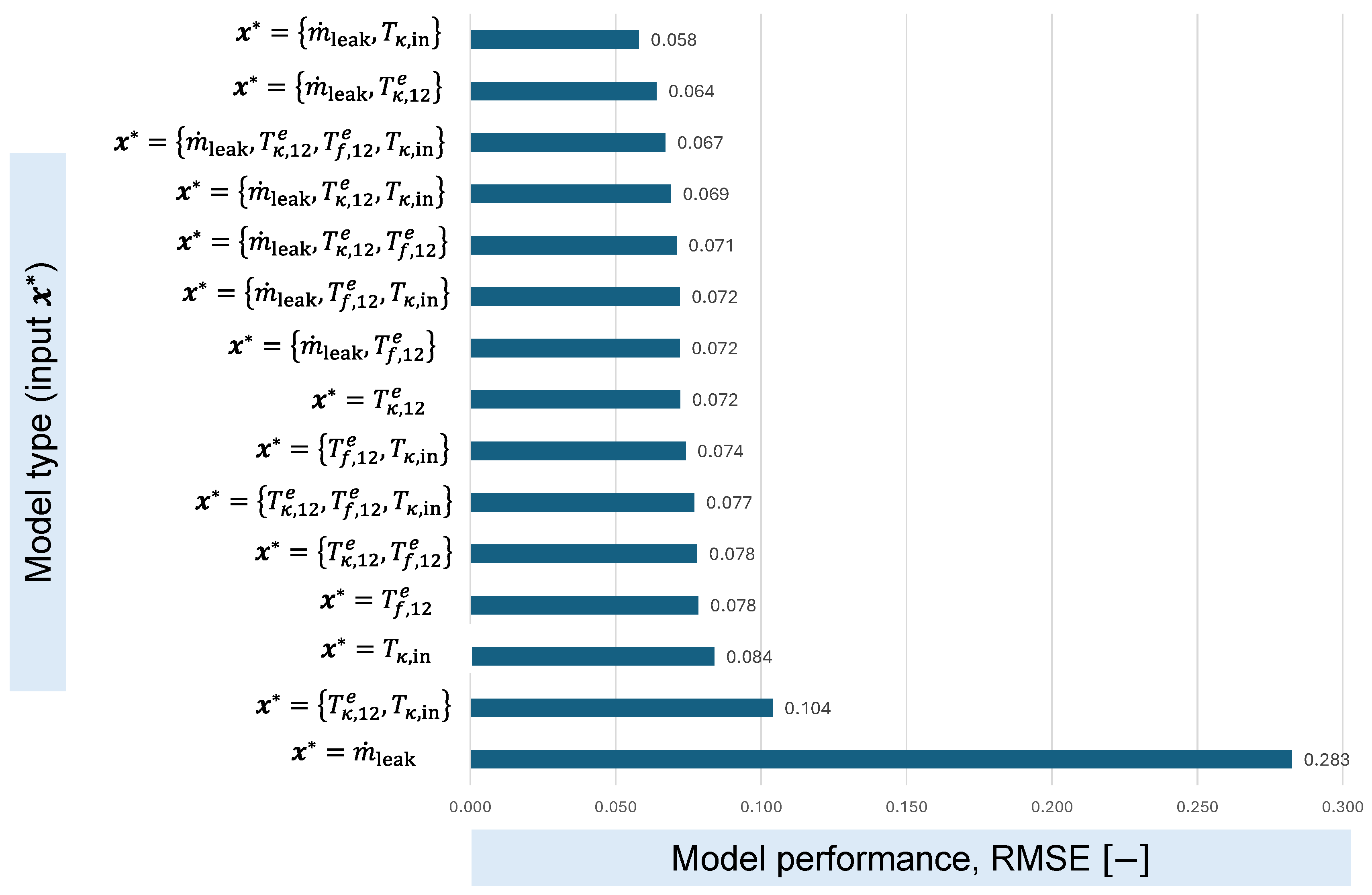
5.3. Selection of BB Model Inputs
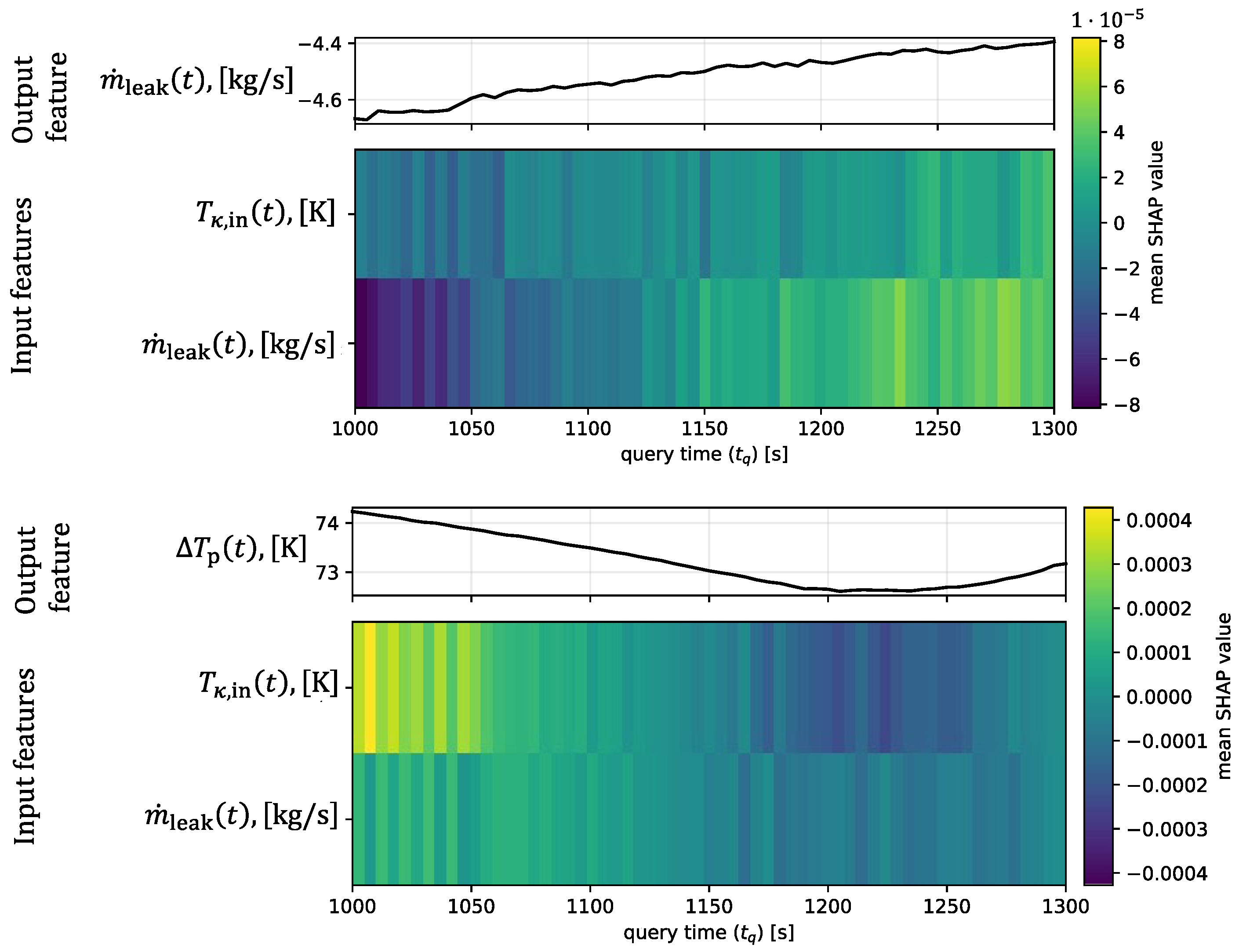
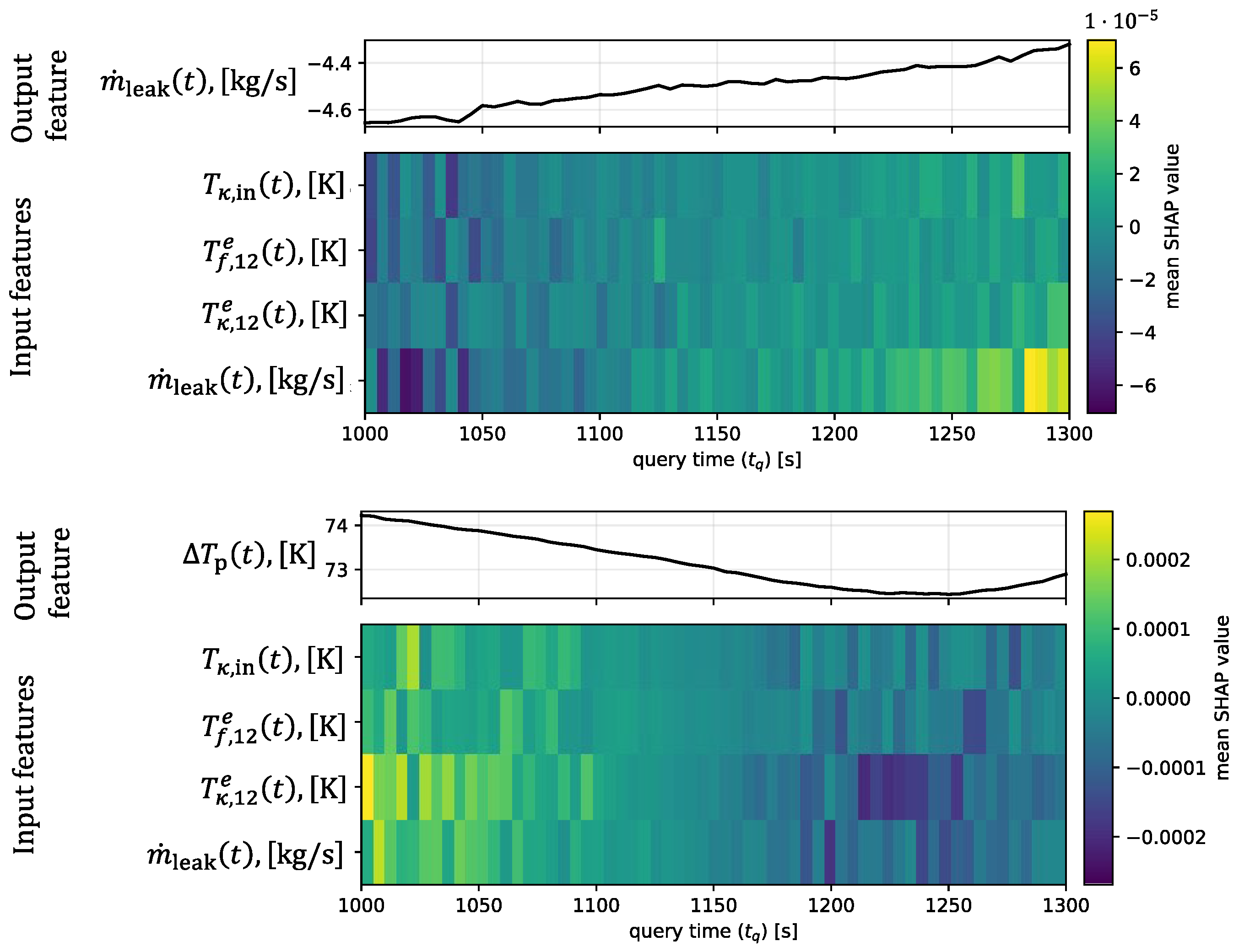
- is shown in Figure 13 (top) to depend mostly on since does not affect the severity of the leakage rate that is instead primarily determined by the rupture break size: initially, the rupture causes a leakage (e.g., −10 kg/s) (negative SHAP values); as the LOCA progresses and the system depressurizes, leakage reduces (e.g., −4 kg/s) (positive SHAP values). This confirms that hydraulic phenomena dominate this output, where the model correctly prioritizes historical leakage data to forecast future leakage rates.
- is shown in Figure 13 (bottom) to depend on : During the early LOCA stage, less coolant inventory means less heat removal, raising the PCT and lowering . The WB model overestimates this PCT rise, requiring a lower PCT correction (). The BB model uses to estimate the coolant inventory state: when is lower (less coolant inventory, e.g., at time ), the model decreases the PCT error correction (lower SHAP values) due to the overestimation by the WB model; when is higher (more coolant inventory, e.g., at ), the model increases the PCT correction (higher SHAP values) to compensate for the error.
- is shown in Figure 14 (top) to depend mostly on , confirming that hydraulic phenomena dominate this output, as previously shown in Figure 13. However, the inlet coolant temperature () and the outlet fuel temperature () show a contribution in terms of the SHAP values during early LOCA stages (e.g., ) that cannot be explained in terms of physical phenomena, as the coolant leakage rate () is primarily injected by means of MC-based random sampling.
- is shown in Figure 14 (bottom) to depend mostly on , exhibiting a similar behavior as the inlet coolant temperature in Figure 13. This is expected, as the outlet coolant temperature can be used as a proxy of the coolant inventory; however, the influence of the inlet coolant temperature () and the outlet fuel temperature () is not clear in terms of SHAP values during late LOCA stages (e.g., ).
6. Conclusions
Author Contributions
Funding
Data Availability Statement
Conflicts of Interest
Nomenclature
| Abbreviations | |
| BB | Black-Box model |
| Bi-LSTM | Bidirectional Long-Short Term Memory |
| CDF | Cumulative Density Function |
| EMD | Empirical Mode Decomposition |
| GB | Gray-Box model |
| HF | High-fidelity model |
| HHT | Hilbert–Huang Transform |
| IA | Instantaneous Amplitude |
| IF | Instantaneous Frequency |
| IMF | Intrinsic Mode Function |
| LOCA | Loss-Of-Coolant Accident |
| LASSO | Least Absolute Shrinkage and Selection Operator |
| MC | Monte Carlo |
| MHD | Magnetohydrodynamic Pump |
| ML | Machine Learning |
| NPP | Nuclear Power Plant |
| PCT | Peak Cladding Temperature |
| PLS | Partial Least Squares |
| PK | Point Kinetic equations |
| PS | Protection System |
| SA | Sensitivity Analysis |
| SMDFR | Small Modular Dual Fluid Reactor |
| SMR | Small Modular Reactor |
| TH | Thermo-Hydraulic model |
| WB | White-Box model |
| Symbols | |
| SMR state-space model | |
| -th measurable input signal | |
| Model output of the SMR state-space model | |
| White-box model output | |
| Gray-box model output | |
| Modeling error estimation | |
| Vector of BB model outputs | |
| Accident-related input signal (coolant leakage rate) | |
| Vector of system design parameters | |
| Discrete time step | |
| Sampling time | |
| Total number of time samples | |
| Memory window length | |
| Prediction window length | |
| Mission time | |
| Number of simulated accident scenarios | |
| Failure (fault-injection) time | |
| Memory matrix of input signals | |
| BB multi-step predicted outputs | |
| -th intrinsic mode function (IMF) of input | |
| -th IMF of output | |
| Residual of input/output signal after Empirical Mode Decomposition | |
| Number of IMFs extracted from input | |
| Number of IMFs extracted from output | |
| Instantaneous Amplitude (IA) of the -th IMF of the -th input | |
| Instantaneous Amplitude of the -th IMF of the -th output | |
| Instantaneous Frequency (IF) of the -th IMF of -th input | |
| Instantaneous Frequency of output -th IMF of the -th output | |
| Mean Instantaneous Amplitude | |
| Mean Instantaneous Frequency | |
| Mean energy of each IMF | |
| Slope coefficient of linear regression of the residual | |
| Mean and standard deviation of input residual | |
| Mean and standard deviation of output residual | |
| Feature vector of the -th input | |
| Feature vector of -th BB model output | |
| Matrix of input feature samples | |
| Matrix of output feature samples | |
| Set of all extracted input features, | |
| Set of all extracted output features, | |
| Input feature sample at scenario time | |
| Output feature sample at scenario time | |
| First-order Kucherenko sensitivity index (features ) | |
| Subset of features corresponding to measurable input | |
| Subset of features belonging to output | |
| Best feature of input for output feature | |
| Grouped sensitivity index for input | |
| Maximum value for each output | |
| Selected measurable input set for BB model | |
| Coolant leakage mass flow rate | |
| Leakage scale parameter | |
| Leakage shape parameter | |
| Leakage additional scale parameter | |
| Leakage disturbance term | |
| Auxiliary Cooling System mass flow | |
| Net coolant mass flow (ACS–leakage) | |
| High-fidelity model | |
| White-box model | |
| Black-box model | |
| Modeling error | |
| BB model output vector | |
| Fuel temperature at node | |
| Wall temperature at node | |
| Coolant temperature at node | |
| Coolant mass flow rate at node | |
| Peak Cladding Temperature (PCT) proxy | |
| Inlet coolant temperature | |
| Outlet coolant temperature | |
| Fuel inlet temperature | |
| Fuel outlet temperature | |
References
- Nuclear Energy Agency. Risk Monitors: The State of The Art Report in their Development and Use at Nuclear Power Plants. OECD. 2004. Available online: https://www.oecd-nea.org/jcms/pl_18136/risk-monitors-the-state-of-the-art-report-soar-in-their-development-and-use-at-nuclear-power-plants-produced-on-behalf-of-the-iaea-and-the-nea-wgrisk?details=true (accessed on 6 June 2022).
- Coble, J.B.; Coles, G.A.; Ramuhalli, P.; Meyer, R.M.; Berglin, E.J.; Wootan, D.W.; Mitchell, M.R. Technical Needs for Enhancing Risk Monitors with Equipment Condition Assessment for Advanced Small Modular Reactors; U.S. Department of Energy: Richland, WA, USA, 2013. [Google Scholar] [CrossRef]
- Williams, Q.J.; Stewart, R.H.; Palmer, T.S.; Palmer, C.J.; Pope, C.; Shields, A.; Ritter, C. Selection of Sampling and Surrogate Modeling Methods for State-Point Evaluations of an AGN-201M Reactor. Nucl. Sci. Eng. 2025, 200, S391–S405. [Google Scholar] [CrossRef]
- Nuclear Energy Agency. Small Modular Reactors: Challenges and Opportunities. 2021. Available online: https://www.oecd-nea.org/upload/docs/application/pdf/2021-03/7560_smr_report.pdf (accessed on 29 April 2026).
- Fossum, K.L.; Bhowmik, P.K.; Sabharwall, P. Droplet Entrainment in Steam Supply System of Water-Cooled Small Modular Reactors: Experiment and Modeling Approaches. J. Nucl. Eng. 2024, 5, 563–583. [Google Scholar] [CrossRef]
- Sarran, L.; Smith, K.M.; Hviid, C.A.; Rode, C. Grey-box modelling and virtual sensors enabling continuous commissioning of hydronic floor heating. Energy 2022, 261, 125282. [Google Scholar] [CrossRef]
- Ahmad, I.; Ayub, A.; Kano, M.; Cheema, I.I. Gray-box soft sensors in process industry: Current practice, and future prospects in era of big data. Processes 2020, 8, 243. [Google Scholar] [CrossRef]
- Hossain, R.; Ahmed, F.; Kobayashi, K.; Koric, S.; Abueidda, D.; Alam, S.B. Virtual sensing-enabled digital twin framework for real-time monitoring of nuclear systems leveraging deep neural operators. npj Mater. Degrad. 2025, 9, 21. [Google Scholar] [CrossRef]
- Gong, L.; Peng, C.; Huang, Q. Deterministic Data Assimilation in Thermal-Hydraulic Analysis: Application to Natural Circulation Loops. J. Nucl. Eng. 2025, 6, 23. [Google Scholar] [CrossRef]
- Tulleken, H.J.A.F. Grey-box modelling and identification using physical knowledge and bayesian techniques. Automatica 1993, 29, 285–308. [Google Scholar] [CrossRef]
- Xue, Y.; Zhang, B.; Su, K.; Li, Y.; Zhu, H.; Pan, H. A preliminary study of digital twin for nuclear reactor dynamics: A synergy of machine learning and model predictive control. Eng. Appl. Artif. Intell. 2025, 153, 110940. [Google Scholar] [CrossRef]
- Pintelas, E.; Livieris, I.E.; Pintelas, P. A Grey-Box Ensemble Model Exploiting Black-Box Accuracy and White-Box Intrinsic Interpretability. Algorithms 2020, 13, 17. [Google Scholar] [CrossRef]
- Sahadath, M.H.; Cheng, Q.; Pan, S.; Ji, W. Characterization of DeepONet Performance for Neutron Transport Modeling. Nucl. Sci. Eng. 2026, 1–21. [Google Scholar] [CrossRef]
- IAEA. Considerations for Deploying Artificial Intelligence Applications in the Nuclear Power Industry; Technical Report No. NR-T-2.16; IAEA: Vienna, Austria, 2025. [Google Scholar] [CrossRef]
- Gu, W.; He, Y.; Wang, D. Critical flow break source term near the outlet of a slit. Prog. Nucl. Energy 2025, 188, 105878. [Google Scholar] [CrossRef]
- Yaseen, M.; Wu, X. Quantification of Deep Neural Network Prediction Uncertainties for VVUQ of Machine Learning Models. Nucl. Sci. Eng. 2023, 197, 947–966. [Google Scholar] [CrossRef]
- Yadav, V.; Agarwal, V.; Jain, P.; Ramuhalli, P.; Zhao, X.; Ulmer, C.; Carlson, J.; Eskins, D.; Iyengar, R. Technical Challenges and Gaps in Digital-Twin-Enabling Technologies for Nuclear Reactor Applications; U.S. Nuclear Regulatory Commission: Washington, DC, USA. Available online: https://www.nrc.gov/docs/ML2136/ML21361A261.pdf (accessed on 2 March 2025).
- Xiong, Q.; Du, P.; Deng, J.; Huang, D.; Song, G.; Qian, L.; Wu, Z.; Luo, Y. Global sensitivity analysis for nuclear reactor LBLOCA with time-dependent outputs. Reliab. Eng. Syst. Saf. 2022, 221, 108337. [Google Scholar] [CrossRef]
- Alexanderian, A.; Gremaud, P.A.; Smith, R.C. Variance-based sensitivity analysis for time-dependent processes. Reliab. Eng. Syst. Saf. 2020, 196, 106722. [Google Scholar] [CrossRef]
- Yu, H.; Chang, L.; Yang, M.; Chen, S.; Li, H.; Wang, J. Time series modeling and forecasting with feature decomposition and interaction for prognostics and health management in nuclear power plant. Energy 2025, 324, 135784. [Google Scholar] [CrossRef]
- Nguyen, H.-P.; Baraldi, P.; Zio, E. Ensemble empirical mode decomposition and long short-term memory neural network for multi-step predictions of time series signals in nuclear power plants. Appl. Energy 2021, 283, 116346. [Google Scholar] [CrossRef]
- Di Maio, F.; Pedroni, N.; Tóth, B.; Burgazzi, L.; Zio, E. Reliability Assessment of Passive Safety Systems for Nuclear Energy Applications: State-of-the-Art and Open Issues. Energies 2021, 14, 4688. [Google Scholar] [CrossRef]
- Harter, J.R.; DeHart, M.D. Uncertainty quantification and sensitivity analysis of a nuclear thermal propulsion reactor startup sequence. Front. Nucl. Eng. 2025, 4, 1628866. [Google Scholar] [CrossRef]
- Zio, E. Advancing nuclear safety. Front. Nucl. Eng. 2024, 2, 1346555. [Google Scholar] [CrossRef]
- Kobayashi, K.; Kumar, D.; Bonney, M.; Chakraborty, S.; Paaren, K.; Usman, S.; Alam, S. Uncertainty Quantification and Sensitivity Analysis for Digital Twin Enabling Technology: Application for BISON Fuel Performance Code. In Handbook of Smart Energy Systems; Springer: Cham, Switzerland, 2023; pp. 1–13. [Google Scholar] [CrossRef]
- Shi, W.; Machida, M.; Yamada, S.; Yoshida, T.; Hasegawa, Y.; Okamoto, K. Inverse estimation scheme of radioactive source distributions inside building rooms based on monitoring air dose rates using LASSO: Theory and demonstration. Prog. Nucl. Energy 2023, 162, 104792. [Google Scholar] [CrossRef]
- Roche, A. Local optimization of black-box functions with high or infinite-dimensional inputs: Application to nuclear safety. Comput. Stat. 2018, 33, 467–485. [Google Scholar] [CrossRef]
- Walker, C.; Ramuhalli, P.; Agarwal, V.; Lybeck, N.J.; Taylor, M. Development of Short-Term Forecasting Models Using Plant Asset Data and Feature Selection. Int. J. Progn. Health Manag. 2022, 13. [Google Scholar] [CrossRef]
- Huang, N.E. Chapter 1: Introduction to the Hilbert-Huang Transform and its related mathematical problems. In Hilbert–Huang Transform and Its Applications, 2nd ed.; Huang, N., Shen, S., Eds.; World Scientific Publishing: Singapore, 2014; Volume 16, pp. 1–26. [Google Scholar] [CrossRef]
- Huang, N.E.; Wu, Z. A review on Hilbert-Huang transform: Method and its applications to geophysical studies. Rev. Geophys. 2008, 46, RG2006. [Google Scholar] [CrossRef]
- Kucherenko, S.; Tarantola, S.; Annoni, P. Estimation of global sensitivity indices for models with dependent variables. Comput. Phys. Commun. 2012, 183, 937–946. [Google Scholar] [CrossRef]
- Sobol′, I.M. Global sensitivity indices for nonlinear mathematical models and their Monte Carlo estimates. Math. Comput. Simul. 2001, 55, 271–280. [Google Scholar] [CrossRef]
- Miqueles, L.; Ahmed, I.; Di Maio, F.; Zio, E. Virtual sensing by Grey-Box modelling within an Importance Sampling Monte Carlo Dynamic Event Tree framework for risk monitoring of Small Modular Reactors. Reliab. Eng. Syst. Saf. 2026, 272, 112629. [Google Scholar] [CrossRef]
- Chen, L.; Huang, H. Global sensitivity analysis for multivariate outputs using generalized RBF-PCE metamodel enhanced by variance-based sequential sampling. Appl. Math. Model. 2024, 126, 381–404. [Google Scholar] [CrossRef]
- Huang, N.E.; Shen, Z.; Long, S.R.; Wu, M.C.; Shih, H.H.; Zheng, Q.; Yen, N.-C.; Tung, C.C.; Liu, H.H. The empirical mode decomposition and the Hilbert spectrum for nonlinear and non-stationary time series analysis. Proc. R. Soc. Lond. Ser. A 1998, 454, 903–995. [Google Scholar] [CrossRef]
- Marelli, S.; Lamas, C.; Sudret, B. UQLab User Manual—Sensitivity Analysis. 2015. Available online: https://www.uqlab.com/sensitivity-user-manual (accessed on 20 February 2025).
- Plischke, E.; Borgonovo, E. Fighting the Curse of Sparsity: Probabilistic Sensitivity Measures From Cumulative Distribution Functions. Risk Anal. 2020, 40, 2639–2660. [Google Scholar] [CrossRef]
- Benoumechiara, N.; Elie-Dit-Cosaque, K. Shapley effects for sensitivity analysis with dependent inputs: Bootstrap and kriging-based algorithms. ESAIM Proc. Surv. 2019, 65, 266–293. [Google Scholar] [CrossRef]
- Lewitz, J.; Huke, A.; Ruprecht, G.; Weißbach, D.; Gottlieb, S.; Hussein, A.; Czerski, K. The Dual Fluid Reactor—An Innovative Fast Nuclear-Reactor Concept with High Efficiency and Total Burnup. Int. J. Nucl. Power 2020, 65, 145–154. [Google Scholar]
- Liu, C.; Luo, R.; Macián-Juan, R. A New Uncertainty-Based Control Scheme of the Small Modular Dual Fluid Reactor and Its Optimization. Energies 2021, 14, 6708. [Google Scholar] [CrossRef]
- Miqueles, L.; Ahmed, I.; Di Maio, F.; Zio, E. Importance Sampling for Monte Carlo Dynamic Event Tree Analysis of Accident Scenarios in New-Generation Nuclear Power Plants. Nucl. Sci. Eng. 2025, 200, 1296–1322. [Google Scholar] [CrossRef]
- Park, J.H.; An, Y.J.; Yoo, K.H.; Na, M.G. Leak flow prediction during loss of coolant accidents using deep fuzzy neural networks. Nucl. Eng. Technol. 2021, 53, 2547–2555. [Google Scholar] [CrossRef]
- Wang, W.; Cammi, A.; Di Maio, F.; Lorenzi, S.; Zio, E. A Monte Carlo-based exploration framework for identifying components vulnerable to cyber threats in nuclear power plants. Reliab. Eng. Syst. Saf. 2018, 175, 24–37. [Google Scholar] [CrossRef]
- Neubauer, A.; Brandt, S.; Kriegel, M. Explainable multi-step heating load forecasting: Using SHAP values and temporal attention mechanisms for enhanced interpretability. Energy AI 2025, 20, 100480. [Google Scholar] [CrossRef]
- Lundberg, S.M.; Allen, P.G.; Lee, S.-I. A Unified Approach to Interpreting Model Predictions. In NIPS’17: Proceedings of the 31st International Conference on Neural Information Processing Systems; Curran Associates, Inc.: Red Hook, NY, USA, 2017; pp. 4768–4777. Available online: https://arxiv.org/pdf/1705.07874 (accessed on 29 April 2026).
- BS IEC 60737:2010; Nuclear Power Plants-Instrumentation Important to Safety-Temperature Sensors (In-Core and Primary Coolant Circuit)-Characteristics and Test Methods. International Electrotechnical Commission (IEC): Geneva, Switzerland, 2010.
- BS IEC 60751:2022; Industrial Platinum Resistance Thermometers and Platinum Temperature Sensors. International Electrotechnical Commission (IEC): Geneva, Switzerland; British Standards Institution: London, UK, 2022.






| Symbol | Notation | Description |
|---|---|---|
| Input variable () | Coolant mass flow leakage rate | |
| Vector of system design parameters () | Nominal coolant mass flow rate in the -th node | |
| Nominal mass contained in the -th node | ||
| Nominal total mass of coolant | ||
| Failure time | ||
| Scale parameter | ||
| Shape parameter | ||
| Scale parameter | ||
| Signal disturbance |
| Notation | Notation (HF Model) | Name |
|---|---|---|
| Mass flow leakage rate | ||
| Outlet coolant temperature | ||
| Outlet fuel temperature | ||
| Inlet coolant temperature | ||
| Temperature of piping wall (PCT Proxy) |
| Notation | Variable | Description |
|---|---|---|
| Vector of WB-based estimates of (proxy of PCT) | ||
| Vector of WB estimated errors of (proxy of PCT) | ||
| Vector of GB-based estimates of (proxy of PCT) |
| Notation | Description | Value |
|---|---|---|
| Memory data length | ||
| Prediction window length | ||
| Number of BB model inputs | ||
| Number of BB model outputs | ||
| BB error correction term | ||
| BB output signal |
| Notation | Description | Value [Units] |
|---|---|---|
| Number of simulated accident scenarios | ||
| Fixed sampling time | ||
| Fixed observed time | ||
| Fixed time index | ||
| Fixed mission time, for each scenario d | ||
| Failure time, sampled for each scenario | ||
| Scale parameter, sampled for each scenario | ||
| Shape parameter, sampled for each scenario | ||
| Scale parameter, sampled for each scenario |
| Feature | Expression () | Expression () |
|---|---|---|
| Mean of Instantaneous Amplitude for each IMF (input) or (output) | ||
| Mean of instantaneous frequency for each IMF (input) or (output) | ||
| Mean Energy for each IMF (input) or (output) | ||
| Slope coefficient (, ) of linear regression, mean (, ) and standard deviation (, ) of the residual (, ). |
| Feature | Expression |
|---|---|
| Slope coefficient () of linear regression -th signal | |
| Mean () of -th input signal | |
| Standard deviation () of the -th input signal |
| Notation | Type of Signal of BB Model | Variable | Extracted Features | Feature Code |
|---|---|---|---|---|
| Input, | Mass flow coolant leakage rate (). Feature vector: | IMFs 1 ()
| leak_mean_amp_imf1 | |
IMFs 1 ()
| leak_mean_power_imf1 | |||
IMFs 1 ()
| leak_mean_freq_imf1 | |||
IMFs 2 ()
| leak_mean_amp_imf2 | |||
IMFs 2 ()
| leak_mean_power_imf2 | |||
IMFs 2 ()
| leak_mean_freq_imf2 | |||
Residual ()
| leak_slope_residual | |||
Residual ()
| leak_mean_residual | |||
Residual ()
| leak_std_residual | |||
| Input, | Outlet coolant temperature (). Feature vector: | Beta coefficient () | slope_Te_f _12 | |
| Mean () | mean_Te_f_12 | |||
| Standard deviation () | std_Te_f_12 | |||
| Input, | Outlet fuel temperature (). Feature vector: | Beta coefficient () | slope_Te_c_12 | |
| Mean () | mean_Te_c_12 | |||
| Standard deviation () | std_Te_c_12 | |||
| Input, | Inlet coolant temperature (. Feature vector: | Beta coefficient () | slope_Tin_c_12 | |
| Mean () | mean_Tin_c_12 | |||
| Standard deviation () | std_Tin_c_12 |
| Type of Signal of BB Model | Variable | Extracted Features | Feature Code |
|---|---|---|---|
| Output | Mass flow coolant leakage rate (). Feature vector: | IMFs 1 ()
| leak_mean_amp_imf1 |
IMFs 1 ()
| leak_mean_power_imf1 | ||
IMFs 1 ()
| leak_mean_freq_imf1 | ||
IMFs 2 ()
| leak_mean_amp_imf2 | ||
IMFs 2 ()
| leak_mean_power_imf2 | ||
IMFs 2 ()
| leak_mean_freq_imf2 | ||
Residual ()
| leak_slope_residual | ||
Residual ()
| leak_mean_residual | ||
Residual ()
| leak_std_residual | ||
| Output | Diff. of Peak Cladding Temperature (). Feature vector: | IMFs 1 ()
| deltaTp_mean_amp_imf2 |
IMFs 1 ()
| deltaTp_mean_power_imf2 | ||
IMFs 1 ()
| deltaTp_mean_freq_imf2 | ||
IMFs 2 ()
| deltaTp_mean_amp_imf3 | ||
| IMFs 2 () Mean Power | deltaTp_mean_power_imf3 | ||
IMFs 2 ()
| deltaTp_mean_freq_imf3 | ||
Residual ()
| deltaTp_slope_residual | ||
Residual ()
| deltaTp_mean_residual | ||
Residual ()
| deltaTp_std_residual |
| 0.157 | 0.298 | 0.195 | 0.287 | 0.154 | 0.298 | 0.983 | 0.407 | 0.304 | |
| 0.197 | 0.272 | 0.193 | 0.224 | 0.205 | 0.271 | 0.943 | 0.259 | 0.163 | |
| 0.158 | 0.198 | 0.146 | 0.177 | 0.157 | 0.219 | 0.885 | 0.255 | 0.156 | |
| 0.207 | 0.235 | 0.140 | 0.144 | 0.195 | 0.224 | 0.844 | 0.259 | 0.163 |
| 0.085 | 0.034 | 0.072 | 0.046 | 0.067 | 0.013 | 0.428 | 0.171 | 0.176 | |
| 0.069 | 0.059 | 0.098 | 0.117 | 0.056 | 0.020 | 0.965 | 0.397 | 0.410 | |
| 0.069 | 0.061 | 0.082 | 0.118 | 0.052 | 0.020 | 0.962 | 0.439 | 0.446 | |
| 0.068 | 0.062 | 0.106 | 0.129 | 0.055 | 0.020 | 0.965 | 0.428 | 0.432 |
| ) | ) | ||
|---|---|---|---|
| 0.3425 | 0.1215 | ||
| 0.3028 | 0.2435 | ||
| 0.2611 | 0.2498 | ||
| 0.2679 | 0.2516 | ||
| Variable | Description | Value [Units] |
|---|---|---|
| Memory data length | ||
| Prediction window length | ||
| Mission time | ||
| Query time | ; early stage of the LOCA scenario; : activation of Protection System (Auxiliary Cooling System); : late stage of the LOCA scenario, with enacted Protection System | |
| Failure time |
| Proposed Method | Full GB Model with 4 Inputs | Regulatory Requirements | |
|---|---|---|---|
| Accuracy (RMSE) [K] | ✓ | ✓ | Accuracy below the tolerance error of current instrumentation (sensor: resistance temperature detector, Class A) [46,47]: K |
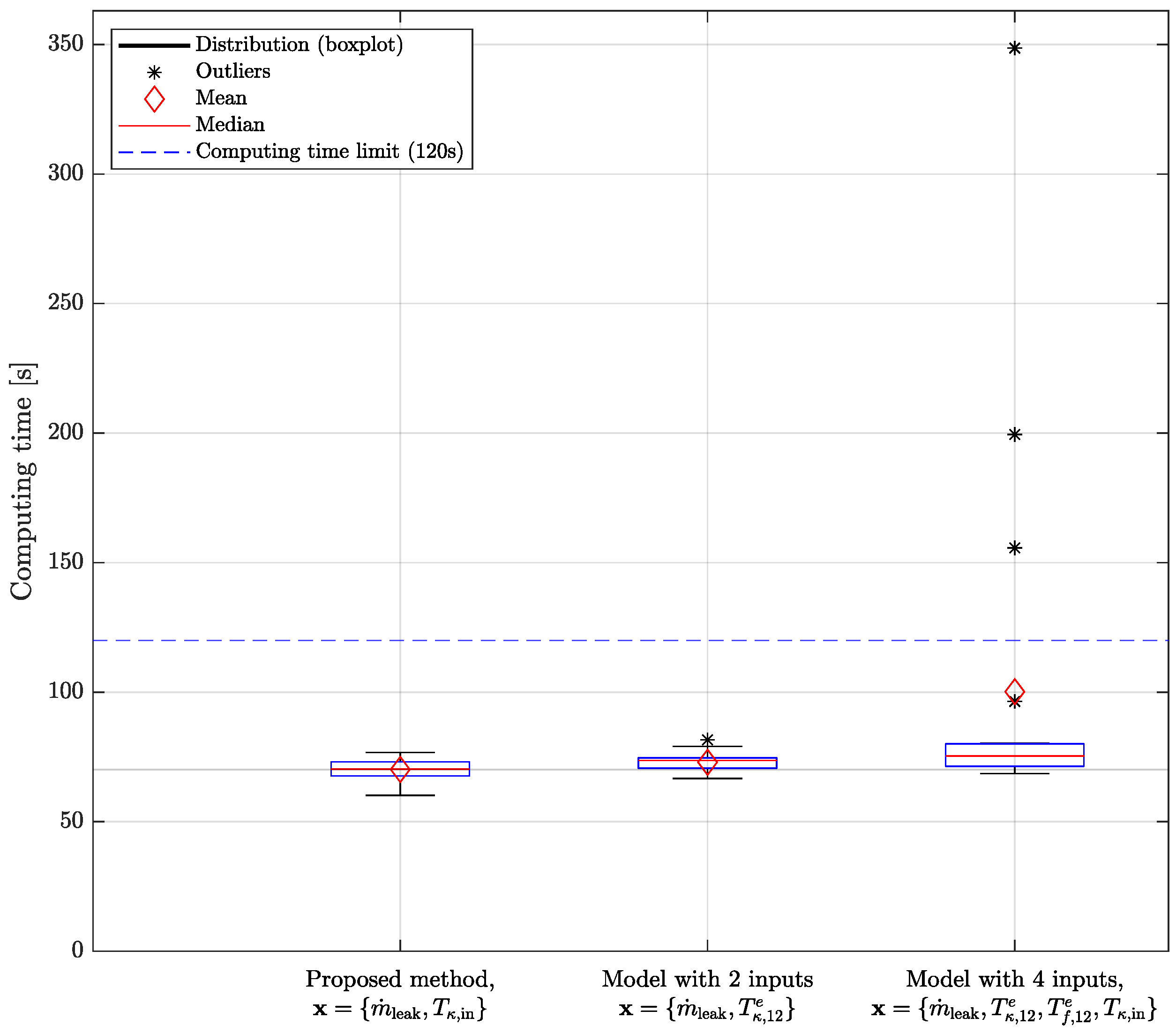
| Mean computing time per query [s] | ✓ | ✗ | Response time of two minutes for risk monitors [1]: [s] |
| Explainability (SHAP values) | ✓ | ✗ | Physical consistency of the model output, based on explainability techniques, to provide end-user trust [14] |
Disclaimer/Publisher’s Note: The statements, opinions and data contained in all publications are solely those of the individual author(s) and contributor(s) and not of MDPI and/or the editor(s). MDPI and/or the editor(s) disclaim responsibility for any injury to people or property resulting from any ideas, methods, instructions or products referred to in the content. |
© 2026 by the authors. Licensee MDPI, Basel, Switzerland. This article is an open access article distributed under the terms and conditions of the Creative Commons Attribution (CC BY) license.
Share and Cite
Miqueles, L.; Ahmed, I.; Di Maio, F.; Zio, E. Risk Monitoring of Small Modular Reactors by Grey-Box Models: Feature Extraction and Global Sensitivity Analysis. J. Nucl. Eng. 2026, 7, 34. https://doi.org/10.3390/jne7020034
Miqueles L, Ahmed I, Di Maio F, Zio E. Risk Monitoring of Small Modular Reactors by Grey-Box Models: Feature Extraction and Global Sensitivity Analysis. Journal of Nuclear Engineering. 2026; 7(2):34. https://doi.org/10.3390/jne7020034
Chicago/Turabian StyleMiqueles, Leonardo, Ibrahim Ahmed, Francesco Di Maio, and Enrico Zio. 2026. "Risk Monitoring of Small Modular Reactors by Grey-Box Models: Feature Extraction and Global Sensitivity Analysis" Journal of Nuclear Engineering 7, no. 2: 34. https://doi.org/10.3390/jne7020034
APA StyleMiqueles, L., Ahmed, I., Di Maio, F., & Zio, E. (2026). Risk Monitoring of Small Modular Reactors by Grey-Box Models: Feature Extraction and Global Sensitivity Analysis. Journal of Nuclear Engineering, 7(2), 34. https://doi.org/10.3390/jne7020034