

Lessons Learned from the Commissioning Process of the 3rd Mochovce NPP Unit in Slovakia

 , , ,
, , ,
Abstract
1. Introduction
- (A)
- (B)
- (C)
- Small and micro modular reactors are involved in the wide commercial use [11].
- (D)
- Reconsider, simplify, refresh, and accelerate 1–2 most promised projects in the frame of Generation IV.
- (E)
- Accelerate activities towards commercial use of thermonuclear fusion (ITER, DEMO).
- (1)
- Very high upfront capital costs and a long realization period in some cases over about 15 years, as well as prolongation of the lifetime of the existing nuclear fleet, can play a crucial role in the realistic consideration of total costs.
- (2)
- Several factors influence the environment in which new nuclear projects (including deep geological repositories) are developed (public acceptance, regulatory risks, fuel supply or geopolitical risks), resulting in cost and construction time overruns.
- (3)
- By the end of the year 2024, 276 reactors worldwide were operating for longer than 30 years. It represents more than 66.5% of power reactors. From a long-term perspective regarding the projected design lifetime, the next 160 reactors [1] will probably be shut down in 2030 if appropriate measures towards long-term operation (LTO) are not taken. This fact causes plenty of uncertainties. Additionally, only 65 (15%) new units have been put into operation during the last decade, and only 31 (7%) units in the decade before. The United States prolonged the operational license of 73 units for up to 60 years. There is a similar trend in other countries, where the operational lifetime approaches 40 years; these countries try to extend the lifetime individually by the decision from periodic safety reviews (PSR).
- (4)
- It is assumed that the decommissioning costs are about 15% of the overnight construction costs, compared to less than 5% at all other energy production technologies. Due to the prolonged lifetime of NPPs, this portion gets relatively smaller in the discounted calculations of electricity generation costs, and the utility (government) obtains additional time for the upgrade of decommissioning plans and financial resources collection.
- (5)
- The nuclear industry is the only one obliged to collect money for the complete decommissioning of nuclear facilities during their operation lifetime.
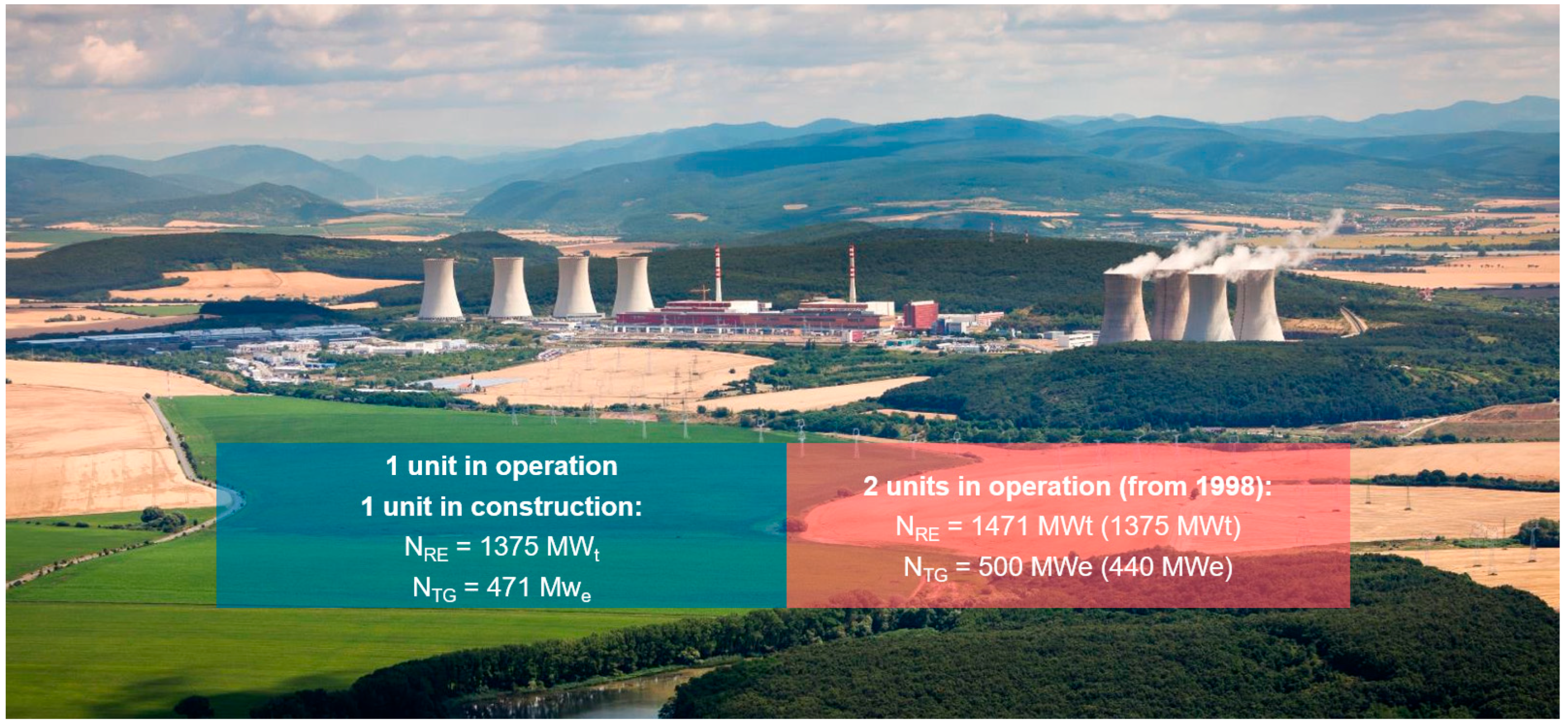
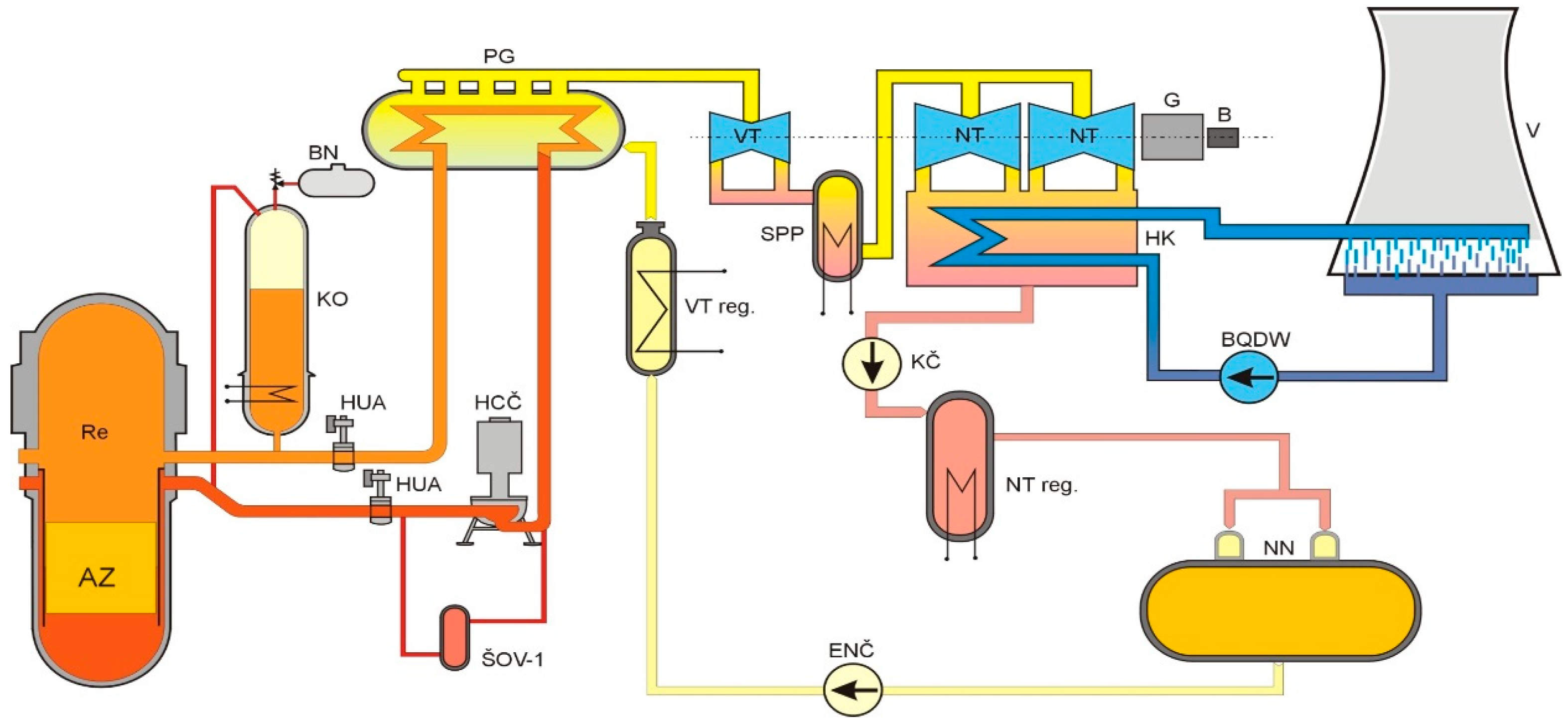
2. NPP Mochovce in Slovak Power Generation
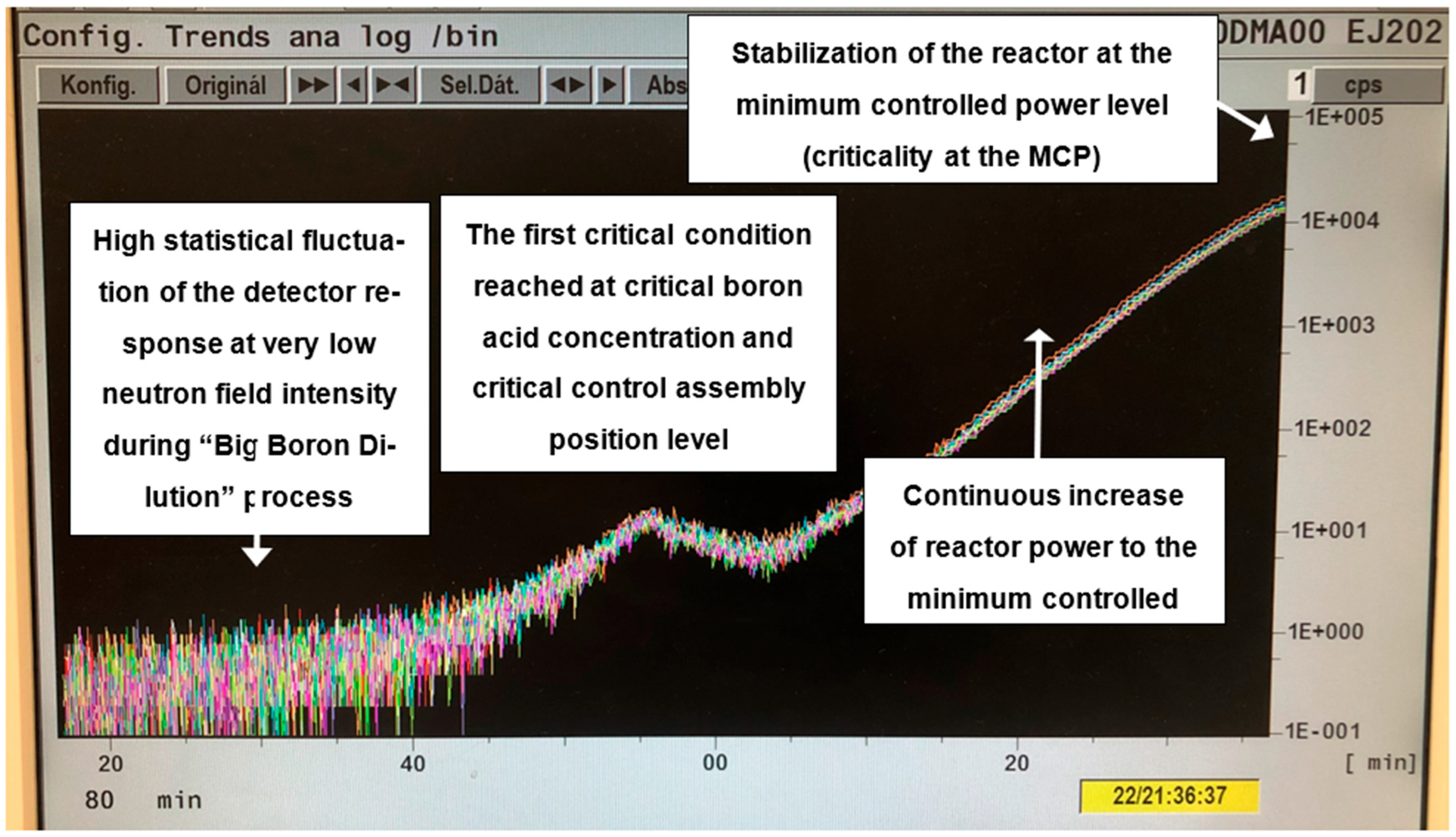
3. Specialty of Mochovce Unit 3 Critical Experiment
- -
- Boric acid concentration of 7.4 g/kg,
- -
- Stabilized reactor power of 6.8 × 10⁻³% Pnom,
- -
- The position of the sixth group of control assemblies of 157.1 cm,
- -
- The temperature of the primary circuit of 201.25 °C,
- -
- The pressure in the primary circuit of 11.88 MPa.
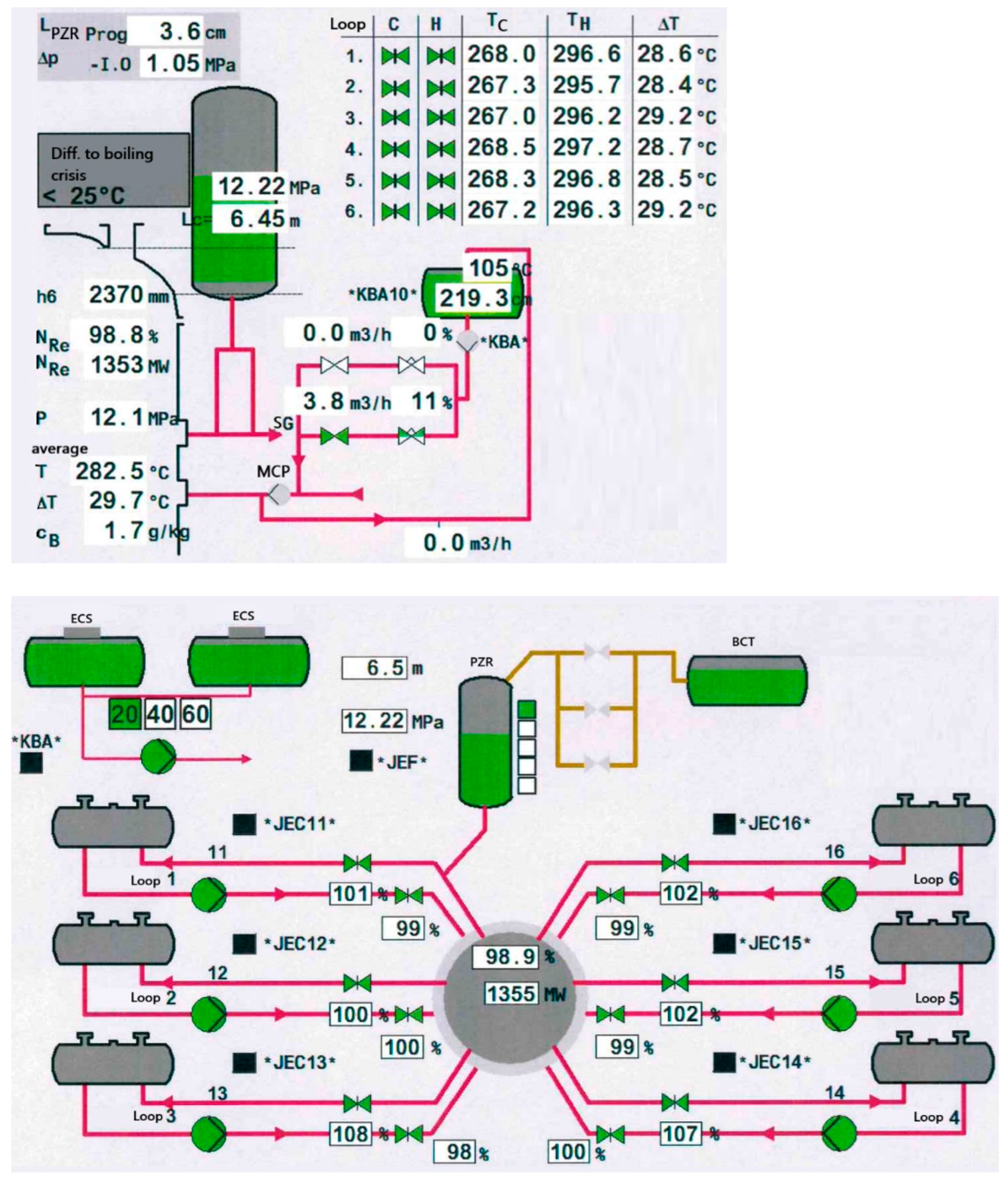
4. Operational Characteristics of Mochovce Unit 3
5. Lessons Learned from NPP Mochovce 3rd Unit Commissioning
- -
- It is necessary to use up-to-date and revised documentation incorporating all changes and corrections during commissioning.
- -
- When signalling unreliable instrumentation data during complex tests, conservative decision-making principles must be followed.
- -
- During PhyC and PowC tests, the main unit parameter controllers should be in automatic mode unless the test requires a different mode.
- -
- Do not allow makeshift solutions that tend to fail and increase the risk of failure (e.g., makeshift generator wake-up solutions).
- -
- An approved, clear, and precise procedure must be used for the simulation and blocking of signals, as well as protection and control, including equipment resetting.
- -
- Clear and unambiguous definition of competencies and responsibilities in examinations and tests.
- -
- Ensure effective communication between all those who prepare, implement and evaluate each test.
- -
- Anticipate that hidden bugs on devices are discovered during PowC tests, and the given test may not be successful the first time. Pay attention to accompanying fault signalling.
- -
- Continuously monitor unit parameters and periodically evaluate deviations from expected parameters.
- -
- Carry out a thorough inspection and diagnosis of current connections on electrical equipment during their progressive loading, which can prevent faults and fire due to insufficiently tightened connections and contacts of electrical wiring.
- -
- Organise regular briefings, preferably at T-48h or T-24h, to ensure accurate test preparation, especially if the test is being taken for the first time.
- -
- Communicate openly, promptly, proactively and efficiently with the Regulatory Authority.
- (A)
- Poor public reception of the NPP commissioning (media, third sector, “green organisations”, etc.)
- (B)
- Mindset changes
- (C)
- Human Factor
- Update service contracts and provide all-round engineering support, especially for equipment other than the MO12.
- Identify operational experiences with critical facilities from the other VVER units for other than the MO12.
- Set up a proper workflow and precisely define the tasks in the preparation, execution and evaluation of tests.
- Record the current state of technology to support effective planning and decision-making.
- Summarise and archive experiences and best practices for the start-up of the MO4.
- Considering the age structure and human potential to maintain critical knowledge into the next period.
- Complete the risk management system, focusing on risks arising from installing new components and equipment in the case of which operational experience or engineering support is unavailable.
- Given the imminent loss of key start-up personnel and subcontractors with the prospect of the MO 4 commissioning in 2–3 years (turnover, retirements, or other projects), it is necessary to retain critical knowledge (including specific nuclear knowledge).
- Before the actual commissioning of the MO4, review in detail the workflow (sequencing of the individual steps) of the preparation, execution and evaluation of the individual tests. During the review, focus on the setup of roles (= who is responsible for …) and the throughput of the whole process for:
- -
- Assessment of the current state of the relevant technological systems for test preparation and execution, including other related technology (auxiliary systems, etc.). The status assessment should also include an assessment of any deficiencies identified in previous operations, which may be long-term.
- -
- Assess and ensure readiness for planned tests (technology, personnel, documentation, collection and evaluation of necessary data).
- -
- Gathering the information needed for the morning briefing should include an assessment of the progress and results of the tests carried out, an assessment of any failure to meet the specified criteria and a decision on the way forward.
- -
- The procedure for recording unresolved non-conformities from previous tests and the process for considering them in decision-making and further action (this may include longer-term non-conformities).
- -
- Direct involvement of the Design Authority in evaluating the test results and participation of its representatives in the morning briefing.
- ○
- Consistently record non-conformances/recommendations from evaluations of individual stages of block start-up with tracking of how they were/are resolved.
- ○
- Ensure a clear definition of responsibilities between the construction and NPP departments for the commissioning of the MO4.
- ○
- Consistent (independent) control of the protocols submitted to the regulatory authority.
- ○
- Use updated and revised documentation incorporating all changes and corrections during the commissioning of MO3.
- This issue of neutron-physical characteristics during physical triggering of the unit. Clarification of discrepancies between the reconstructed reactor core power distribution by the standard in-core monitoring system and the computationally predicted reactor core power distribution. This is performed during the evaluation of power field deformations induced by incorrectly positioning of control assembly at different power levels.
- Safety system response analyses are especially useful for low power levels.
- Monitoring of reactivity balance effects during triggering.
- Correctness and speed of processing of ex-core detector responses. Evaluation of reactor period and reactivity during approaching the critical state. Period measurements during verification of the dynamic properties of the neutron flux measurement system.
- Problems related to separators and lower efficiency of the secondary circuit (ensure transfer of technical solutions from the MO3).
- Ensure the transfer of experience in solving problems with the accuracy of pressure measurements in the primary circuit.
6. Conclusions
Author Contributions
Funding
Data Availability Statement
Conflicts of Interest
Abbreviations
| NPP | Nuclear power plant |
| LTP | Long-term operation |
| IAEA | International atomic energy agency |
| VVER | Water cooled, water moderated energy reactor |
References
- Database on Nuclear Power Reactors, Power Reactor Information System. IAEA Publishing. Available online: https://pris.iaea.org/pris/home.aspx (accessed on 12 January 2024).
- Legal Frameworks for Long-Term Operation of Nuclear Power Reactors; OECD/NEA report No. 7504; OECD Publishing: Paris, France, 2019; p. 180. Available online: https://www.oecd-nea.org/jcms/pl_15154/legal-frameworks-for-long-term-operation-of-nuclear-power-reactors?details=true (accessed on 1 January 2026).
- Lokhov, A.; Huerta, A.; Dufresne, L.; Giraud, A.; Osouf, N. The Economics of Long-Term Operation of Nuclear Power Plants; OECD/NEA Publishing: Paris, France, 2012; p. 116. [Google Scholar]
- Berthélemy, M.; Vaya Soler, A. NEA2020: Unlocking reductions in the construction costs of nuclear, a practical guide for stakeholders. NEA 7530. In Nuclear Technology Development and Economics; OECD Nuclear Energy Agency: Paris, France, 2020; p. 134. Available online: https://www.oecd-nea.org/upload/docs/application/pdf/2020-07/7530-reducing-cost-nuclear-construction.pdf (accessed on 5 October 2024).
- Available online: https://www.wecareeu.org/papers.html (accessed on 9 October 2024).
- Transforming Our World: The 2030 Agenda for Sustainable Development, General Assembly of United Nations, 21 October 2015. Available online: https://documents.un.org/doc/undoc/gen/n15/291/89/pdf/n1529189.pdf (accessed on 9 October 2024).
- Inagaki, T. Assessment and Management of Ageing of Major Nuclear Power Plant Components Important to Safety: PWR Pressure Vessels; IAEA-TECDOC-1556; IAEA: Vienna, Austria, 2007; p. 216. Available online: https://www-pub.iaea.org/MTCD/Publications/PDF/te_1556_web.pdf (accessed on 1 January 2026).
- Ageing Management and Development of a Programme for Long Term Operation of Nuclear Power Plants; IAEA Safety Standards Series No. SSG-48; IAEA: Vienna, Austria, 2019; p. 65. Available online: https://www-pub.iaea.org/MTCD/Publications/PDF/P1814_web.pdf (accessed on 11 January 2026).
- Ageing Management for Nuclear Power Plants: International Generic Ageing Lessons Learned (IGALL); IAEA Safety Reports Series No. 82; IAEA: Vienna, Austria, 2020; p. 110. Available online: https://www-pub.iaea.org/MTCD/Publications/PDF/PUB1895_web.pdf (accessed on 11 January 2026).
- OECD Nuclear Energy Agency. The Economics of Long-Term Operation of Nuclear Power Plants; OECD/NEA Publishing: Paris, France, 2012. [Google Scholar]
- Small Modular Reactors: Challenges and Opportunities; NEA Report No. 7560; OECD: Paris, France, 2021.
- Weibezahn, J.; Steigerwald, B. Fission for Funds: The Financing of Nuclear Power Plants; Copenhagen Business School: Copenhagen, Denmark, 2024. [Google Scholar] [CrossRef]
- NEA2020 Unlocking Reductions in the Construction Costs of Nuclear, A Practical Guide for Stakeholders; NEA 7530; Nuclear Technology Development and Economics: Paris, France; OECD Nuclear Energy Agency: Paris, France, 2024.
- OECD/NEA. Nuclear New Build: Insights into Financing and Project Management; Report No. 7195; OECD/NEA: Paris, France, 2015. [Google Scholar]
- Slugen, V.; Bozik, M.; Hatala, B.; Miklos, M.; Farkas, G. Nuclear Fuel Cycle; Didaktis: Brno, Czech Republic, 2014; p. 178. [Google Scholar]
- Slugeň, V.; Klepac, J.; Markus, J.; Kmosena, J.; Valovic, J.; Chrapan, J.; Rajec, P.; Hutta, J.; Kovac, P.; Feik, K.; et al. Atoms in Slovakia; SNUS: Trnava, Slovakia, 2007; p. 318. ISBN 80-88682-62-2. [Google Scholar]
- Slugeň, V. Safety of VVER-440 Reactors; Springer: Berlin/Heidelberg, Germany, 2011; p. 189. [Google Scholar] [CrossRef]
- International Atomic Energy Agency. Safety of Nuclear Power Plants: Commissioning and Operation; Specific Safety Requirements No. SSR-2/2; IAEA: Vienna, Austria, 2011. [Google Scholar]
- International Atomic Energy Agency. Modifications to Nuclear Power Plants; Safety Standards Series No. NS-G-2.3; IAEA: Vienna, Austria, 2001. [Google Scholar]
- International Atomic Energy Agency. Operational Limits and Conditions and Operating Procedures for Nuclear Power Plants; Safety Standards Series No. NS-G-2.2; IAEA: Vienna, Austria, 2000. [Google Scholar]
- International Nuclear Safety Advisory Group. Management of Operational Safety in Nuclear Power Plants; INSAG Series No. INSAG-13; IAEA: Vienna, Austria, 1999. [Google Scholar]
- Zerger, B.; Noel, M. Nuclear power plant commissioning experience. Prog. Nucl. Energy 2011, 53, 668–672. [Google Scholar] [CrossRef]
- Bruynooge, C.; Noel, M. European clearinghouse/contributing factors to incidents related to reactivity management. Prog. Nucl. Energy 2010, 52, 523–526. [Google Scholar] [CrossRef]
- Noel, M. European clearinghouse—Development areas and priorities in operational experience feedback for nuclear power plants. Nucl. Radiat. Prot. Technol. 2010, 25, 152–156. [Google Scholar] [CrossRef]
- World Nuclear Association. Lessons-Learning in Nuclear Construction Projects; Report No.2018/002; WNA: England, UK, 2018; 24p. [Google Scholar]
- Valo, M.; Kryukov, A.; Gillemot, F.; Debarberis, L.; Kang, K.S. Guidelines for Prediction of Irradiation Embrittlement of Operating WWER-440 Reactor Pressure Vessel; IAEA-TECDOC-1442; International Atomic Energy Agency: Vienna, Austria, 2005; p. 72. Available online: http://www-pub.iaea.org/MTCD/publications/PDF/te_1442_web.pdf (accessed on 1 January 2026).
- Slugen, V.; Simeg Veternikova, J.; Domankova, M.; Gavalec, M.; Petzova, J.; Slnek, D.; Dzubinsky, M.; Shugailo, O.; Szente, I.; Gillemot, F.; et al. VVER long-term operation—A review based on the material studies results from past and ongoing EU-supported research projects. Nucl. Eng. Des. 2025, 435, 11949. [Google Scholar] [CrossRef]
- International Atomic Energy Agency. Knowledge Management for Nuclear Research and Development Organizations; IAEA-TECDOC-1675; IAEA: Vienna, Austria, 2012. [Google Scholar]
- International Atomic Energy Agency. The Impact of Knowledge Management Practices on NPP Organizational Performance—Results of a Global Survey; IAEA-TECDOC-1711; IAEA: Vienna, Austria, 2013. [Google Scholar]
- International Atomic Energy Agency. Knowledge Management and its Implementation in Nuclear Organizations; IAEA Nuclear Energy Series No. NG-T-6.10; IAEA: Vienna, Austria, 2016. [Google Scholar]
- Simonovska, V.; Von Estorff, U. Putting into Perspective the Supply of and Demand for Nuclear Experts by 2020 within the EU-27 Nuclear Energy Sector; Report EUR 25291 EN; Publications Office of the European Union: Petten, The Netherlands, 2012. [Google Scholar]



| Type of Licence | Milestones | Unit 1 | Unit 2 | Unit 3 |
|---|---|---|---|---|
| Designed net capacity Net capacity Gross capacity | 408 MWe 467 MWe 500 MWe | 408 MWe 469 MWe 500 MWe | 440 MWe 440 MWe * 471 MWe * | |
| Construction start date | 13.10.1983 | 13.10.1983 | 27.1.1987 | |
| Permit for commissioning and early use of the building as well as permit for management of nuclear material spent fuel and radioactive waste | Physical start-up (loading of the first fuel assembly into the reactor) | 27.4.1998 | 4.10.1999 | 9.9.2022 |
| First criticality date | 9.6.1998 | 1.12.1999 | 22.10.2022 | |
| First grid connection | 4.7.1998 | 20.12.1999 | 31.1.2023 | |
| 144 h test run (as a part of the energy start-up stage) | 7.–13.10.1998 | 13.–19.3.2000 | 8.–14.10.2023 | |
| Permit for commissioning and early use of the building as well as permit for management of nuclear material spent fuel and radioactive waste | Trial operation | 29.10.1998 | 11.4.2000 | 6.11.2024 |
| Permanent operation | 29.1.1999 | 11.7.2000 |
Disclaimer/Publisher’s Note: The statements, opinions and data contained in all publications are solely those of the individual author(s) and contributor(s) and not of MDPI and/or the editor(s). MDPI and/or the editor(s) disclaim responsibility for any injury to people or property resulting from any ideas, methods, instructions or products referred to in the content. |
© 2026 by the authors. Licensee MDPI, Basel, Switzerland. This article is an open access article distributed under the terms and conditions of the Creative Commons Attribution (CC BY) license.
Share and Cite
Slugeň, V.; Farkas, G.; Veterníková, J.Š.; Bebjak, S.; Andraško, P.; Mráz, M. Lessons Learned from the Commissioning Process of the 3rd Mochovce NPP Unit in Slovakia. J. Nucl. Eng. 2026, 7, 18. https://doi.org/10.3390/jne7010018
Slugeň V, Farkas G, Veterníková JŠ, Bebjak S, Andraško P, Mráz M. Lessons Learned from the Commissioning Process of the 3rd Mochovce NPP Unit in Slovakia. Journal of Nuclear Engineering. 2026; 7(1):18. https://doi.org/10.3390/jne7010018
Chicago/Turabian StyleSlugeň, Vladimír, Gabriel Farkas, Jana Šimeg Veterníková, Slavomír Bebjak, Peter Andraško, and Martin Mráz. 2026. "Lessons Learned from the Commissioning Process of the 3rd Mochovce NPP Unit in Slovakia" Journal of Nuclear Engineering 7, no. 1: 18. https://doi.org/10.3390/jne7010018
APA StyleSlugeň, V., Farkas, G., Veterníková, J. Š., Bebjak, S., Andraško, P., & Mráz, M. (2026). Lessons Learned from the Commissioning Process of the 3rd Mochovce NPP Unit in Slovakia. Journal of Nuclear Engineering, 7(1), 18. https://doi.org/10.3390/jne7010018