1. Introduction
Oil spills and accidental releases of petroleum products remain a major source of environmental contamination, affecting both aquatic and terrestrial ecosystems. The presence of hydrocarbons disrupts air–water gas exchange, introduces toxic compounds into food chains, and leads to long-term persistence of pollutants due to their low biodegradability. The severity of environmental impact depends not only on spill volume but also on oil composition, hydrodynamic conditions, and response time, which collectively determine spreading behavior, weathering processes, and remediation efficiency [
1,
2,
3].
Among available remediation strategies, sorption-based approaches are widely regarded as one of the most effective methods for removing oil from contaminated surfaces, particularly in the case of thin films, dispersed pollutants, and complex environmental conditions where mechanical recovery is inefficient. Compared to dispersants and in situ burning, sorbents enable direct removal of hydrocarbons without introducing secondary contamination. Their performance is governed by multiple parameters, including absorption capacity, selectivity, uptake kinetics, retention stability, and reusability, which must be optimized simultaneously for practical applications [
4,
5,
6,
7,
8].
In this context, cellulose-based materials have attracted increasing attention as sustainable sorbents due to their abundance, low density, biodegradability, and structural versatility. However, native cellulose is intrinsically hydrophilic because of its hydroxyl-rich surface, resulting in poor selectivity toward hydrocarbons in aqueous environments. To overcome this limitation, extensive efforts have been directed toward modifying surface chemistry and engineering pore structure to enhance oleophilicity and facilitate oil transport and retention. As a result, a broad spectrum of materials has been developed, including natural fibers, chemically modified cellulose, aerogels, nanocellulose-based networks, and carbonized derivatives [
9,
10,
11,
12,
13,
14].
Despite substantial progress, the available literature remains highly fragmented. Reported sorption performance is strongly influenced by variations in synthesis methods, pore structure, testing protocols, and oil types, which complicates direct comparison across studies. Most existing reviews focus on specific material classes or modification strategies, often emphasizing isolated performance metrics rather than the underlying relationships between structure, surface properties, and functional behavior. Consequently, the lack of an integrated framework limits the ability to establish general design criteria and hinders the rational selection of sorbents for practical applications [
9,
11,
15,
16].
The present review provides an integrated and comparative interpretation of cellulose-based oil sorbents across different material classes rather than describing individual systems separately. While previous reviews have mainly focused on specific categories such as cellulose aerogels, nanocellulose materials, surface-modified cellulose, or biodegradable sorbents, this review evaluates native cellulose materials, chemically modified cellulose, aerogels, nanocellulose-based systems, and carbonized cellulose within a common processing–structure–property–performance framework. This approach enables the identification of how fabrication routes influence pore architecture, surface wettability, transport pathways, oil retention, cyclic stability, and practical limitations. Therefore, the review emphasizes design-relevant trade-offs and material selection criteria rather than only summarizing maximum reported oil uptake values.
In particular, a systematic understanding of how processing routes control pore architecture and, in turn, govern sorption mechanisms and performance remains insufficiently developed. The interplay between macroporous transport pathways, mesoporous distribution, microporous retention, and surface wettability is often discussed qualitatively, but rarely unified into a coherent structure–property–performance framework. This gap prevents the formulation of predictive guidelines for material design and limits the translation of laboratory-scale results to real-world conditions [
11,
12,
13].
In this review, cellulose-based sorbents are analyzed within a unified processing–structure–property–performance framework that explicitly links fabrication routes to pore architecture, dominant sorption mechanisms, and operational behavior. Beyond summarizing individual material classes, the review compares them using common design-relevant criteria, including oil uptake, selectivity, sorption kinetics, retention stability, reusability, and mechanical durability. This comparative framework is intended to clarify the major trade-offs governing sorbent performance and to support more rational material selection for specific operating conditions.
This review aims to systematize current knowledge on cellulose-based oil sorbents, clarify the relationships between processing, structure, and sorption behavior, and identify design-relevant principles for balancing absorption capacity, selectivity, transport kinetics, retention, and structural stability. In addition, key limitations related to scalability, durability, data comparability, and real-world applicability are critically discussed, and future research directions are outlined.
2. Structural–Functional Basis of Oil Sorption
Oil sorption in cellulose-based materials is governed by the combined effects of surface energy, capillary transport, internal porosity, and the mechanical stability of the structural framework. In its native state, cellulose contains a large number of hydroxyl groups, which impart a hydrophilic character and promote strong interactions with water. As a result, untreated cellulose materials typically absorb both oil and the aqueous phase, leading to low selectivity and limiting their practical applicability in oil spill remediation. For most applications, a reduction in surface energy is required to promote preferential wetting by hydrocarbons rather than water [
4,
9,
10].
For hydrophobized cellulose sorbents, increasing the water contact angle to approximately 120–140° results in a significant reduction in water uptake while maintaining or enhancing oil absorption capacity. This effect is not solely associated with changes in surface chemistry, but also with a modification of interfacial interactions. In the hydrophobic state, water faces an energetic barrier when entering pores, whereas the hydrocarbon phase penetrates the structure more readily. Therefore, sorption selectivity is determined not only by the contact angle, but by a combination of parameters, including surface energy, roughness, porosity, and internal structural architecture. In natural fibers such as kapok, the presence of a waxy surface layer and a hollow internal lumen further enhances oleophilicity even without extensive chemical treatment [
17,
18,
19].
The sorption mechanism in cellulose-based materials can be described as a combination of several modes, including bulk pore filling, capillary transport, and surface adsorption. In fibrous systems, liquid uptake is primarily governed by volumetric filling of accessible pore space. In more developed porous structures, particularly those containing micropores and narrow channels, surface interactions become increasingly important, and part of the absorbed oil is retained not only within the pore volume but also on pore walls. This effect is especially pronounced for high-viscosity oils, which exhibit slower capillary transport but stronger confinement within restricted pore spaces [
6,
7,
19].
The pore architecture of cellulose sorbents is typically hierarchical, consisting of macro-, meso-, and micropores. Macropores act as transport channels, enabling rapid penetration of liquid into the material. Mesopores increase the interfacial area and promote a more uniform distribution of the sorbate throughout the structure. Micropores and narrow capillaries are responsible for oil retention due to high capillary pressure. In systems with a pronounced lumen, such as kapok and milkweed fibers, the internal cavity serves as an additional reservoir, significantly increasing sorption capacity compared to dense fibers. As a result, materials with similar total porosity may exhibit markedly different performance, as efficiency is governed not only by total pore volume but also by pore geometry, connectivity, and accessibility [
17,
20,
21].
Capillary pressure within pores can be described by:
where γ is the interfacial tension, θ is the contact angle, and r is the pore radius.
This relationship indicates that decreasing pore size increases retention forces, while increasing hydrophobicity facilitates oil penetration and water exclusion. However, an important trade-off arises: very small pores enhance retention but hinder the transport of viscous oils, whereas large pores promote rapid uptake but reduce the ability to retain the sorbate under drainage, mechanical stress, or repeated use [
6,
19,
21].
Mechanistically, oil uptake is controlled by the balance between capillary driving force and viscous resistance. A smaller pore radius increases capillary pressure and improves retention, but at the same time it increases flow resistance and slows penetration, especially for high-viscosity oils. Conversely, larger pores promote faster uptake because they reduce hydraulic resistance, but they provide weaker capillary retention and may lead to drainage losses after saturation. Contact angle also modifies this balance: a lower effective contact angle for oil improves capillary entry and accelerates filling, whereas poor wetting reduces penetration even when pore volume is high. Therefore, optimal sorption behavior is usually achieved in hierarchical structures, where macropores provide rapid transport, mesopores distribute the liquid, and micropores contribute to retention.
In the context of cellulose-based oil sorbents, the terms absorption and adsorption should be distinguished. Absorption refers to the penetration and retention of oil within the bulk porous structure of the material, whereas adsorption primarily describes the accumulation of hydrocarbons on the internal or external surface due to intermolecular interactions. In many porous cellulose systems, overall sorption behavior results from a combination of bulk absorption, surface adsorption, and capillary trapping within interconnected pore networks. The relative contribution of these mechanisms depends on pore structure, surface wettability, specific surface area, and oil viscosity.
The kinetics of liquid penetration into porous materials can be described by the Lucas–Washburn equation, according to which capillary uptake depends on pore radius, fluid viscosity, interfacial tension, and surface wettability. This explains why loosely packed fibrous materials with a high fraction of macropores exhibit rapid oil uptake but often limited retention. Oil viscosity also plays a critical role: lighter fractions penetrate quickly but are more prone to desorption, whereas heavier hydrocarbons infiltrate more slowly but are retained more effectively. Temperature further influences this behavior, as increased temperature reduces viscosity and accelerates transport, while potentially decreasing retention stability [
6,
7,
22].
Density and total porosity define the available volume for liquid uptake but do not guarantee high sorption capacity on their own. Ultralight cellulose aerogels exhibit exceptionally high oil absorption due to the combination of low density, high porosity, and a large internal surface area. However, their primary limitation is mechanical instability: under compression, repeated deformation, or cyclic use, structural densification, pore collapse, and reduced recoverability may occur [
23,
24,
25].
Sorption efficiency is influenced not only by static material properties but also by dynamic behavior under realistic conditions. Upon oil saturation, the material must retain its shape, resist structural degradation during handling, and withstand multiple sorption–desorption cycles. This is particularly challenging for ultralow-density systems, where high initial capacity is often accompanied by poor durability. Repeated cycles can lead to pore collapse, channel blockage, and reduced accessible volume, progressively decreasing sorption performance [
9,
11,
26].
In summary, the sorption performance of cellulose-based materials is governed by the combined effects of surface hydrophobicity, hierarchical pore structure, capillary forces, and mechanical stability. Available evidence suggests that favorable sorption performance is associated with hierarchical structures in which macropores support rapid transport, mesopores facilitate liquid distribution, and micropores enhance oil retention. Taken together, these characteristics make cellulose-based materials a promising platform for oil sorption in environmental remediation [
9,
10,
11].
3. Classes of Cellulose-Based Materials
Cellulose-based sorbents used for oil spill remediation comprise a wide range of materials that differ in structure, processing methods, and surface properties. Depending on the degree of treatment of the raw material, they can be classified into several groups: native materials, chemically modified cellulose, aerogels, nanocellulose-based systems, and carbonized structures [
9,
10,
11].
The classification used in this review is based primarily on the dominant structural and processing characteristics of the materials rather than on mutually exclusive composition criteria. Consequently, some systems may simultaneously exhibit features of multiple categories. For example, hydrophobized nanocellulose aerogels can combine nanostructured networks, surface modification, and aerogel-type porous architecture. In such cases, materials were assigned to the category corresponding to their primary governing structure or dominant fabrication strategy in order to avoid double-counting and maintain consistency of comparative analysis.
This classification reflects the transition from natural fibrous systems to engineered materials with controlled pore architecture and tunable surface energy. As processing methods become more advanced, the organization of the pore space evolves from predominantly macroporous structures to hierarchical systems incorporating meso- and micropores. At the same time, surface wettability is deliberately modified, which directly affects sorption capacity, selectivity, and stability during cyclic use [
10,
12,
13].
Each class is characterized by a specific balance of properties. Native cellulose materials offer high availability and rapid oil uptake kinetics but suffer from low selectivity and limited durability. Chemically modified cellulose exhibits enhanced hydrophobicity and improved oil retention; however, its performance strongly depends on the stability of the surface modification layer. Aerogels and nanocellulose-based systems demonstrate high oil absorption capacity due to their ultralow density and highly developed porous network, although their practical application is often limited by mechanical fragility and scalability challenges. Carbonized cellulose-based materials show high hydrophobicity and excellent chemical stability; however, they may require energy-intensive processing and can exhibit slower uptake kinetics depending on pore structure evolution [
9,
10,
11,
12].
Overall, comparison of these classes highlights the direct relationship between processing route, pore architecture, and sorption performance. This classification provides a basis for understanding how structural design governs functional behavior in cellulose-based oil sorbents, which is further analyzed in the following sections.
3.1. Native Materials
Native cellulose materials are natural fibrous sorbents that have not undergone chemical modification. These include cotton, kapok, wood fibers, and various plant residues. Their structure is formed naturally and consists of inter-fiber channels that enable liquid transport, as well as, in some cases, internal cavities (lumens) that can function as reservoirs. The absence of controlled surface chemistry and deliberate tuning of pore architecture determines both the accessibility and ease of use of these materials, as well as the limitations of their sorption performance [
17,
18,
20,
27,
28].
Oil sorption in native materials is governed by capillary uptake and filling of the available pore volume. At the initial stage, the process proceeds rapidly due to the presence of macropores, which ensure efficient transport of liquid into the structure. The penetration kinetics can be described by the Lucas–Washburn equation, according to which the uptake rate depends on pore radius, liquid viscosity, and interfacial tension. As a result, loosely packed fibrous systems exhibit a high initial absorption rate, with a significant portion of oil captured within the first minutes of contact [
6,
7,
29,
30].
An increase in characteristic pore size is accompanied by a decrease in capillary pressure, which leads to reduced liquid retention. In such systems, rapid saturation is followed by desorption under gravity or mechanical stress. This effect is especially pronounced for light oil fractions with low viscosity, where a noticeable loss of sorbate is observed after saturation [
19,
21,
31,
32].
Significant differences in sorption capacity are determined by the internal geometry of the fibers. Fibers with a well-developed hollow structure, such as kapok and milkweed, exhibit significantly higher oil uptake compared to dense fibers. Reported oil uptake values for kapok are typically in the range of 36–45 g/g [
17,
18], whereas cotton reaches approximately 20–25 g/g [
6]. Reported oil absorption capacities for milkweed can approach approximately 100 g/g [
20], as the internal cavity may account for up to 80–90% of the fiber volume [
20]. In such systems, the lumen acts as the main reservoir for liquid, while the inter-fiber space provides transport [
33,
34].
Surface wettability is an additional factor affecting sorption performance. Most native materials are hydrophilic, which leads to simultaneous absorption of water and oil. Kapok is an exception, as its surface is covered with natural waxes, increasing the contact angle to about 150° and providing pronounced oleophilicity [
17]. Nevertheless, even at high hydrophobicity, performance is determined not only by surface properties but also by the material structure [
7,
18,
35].
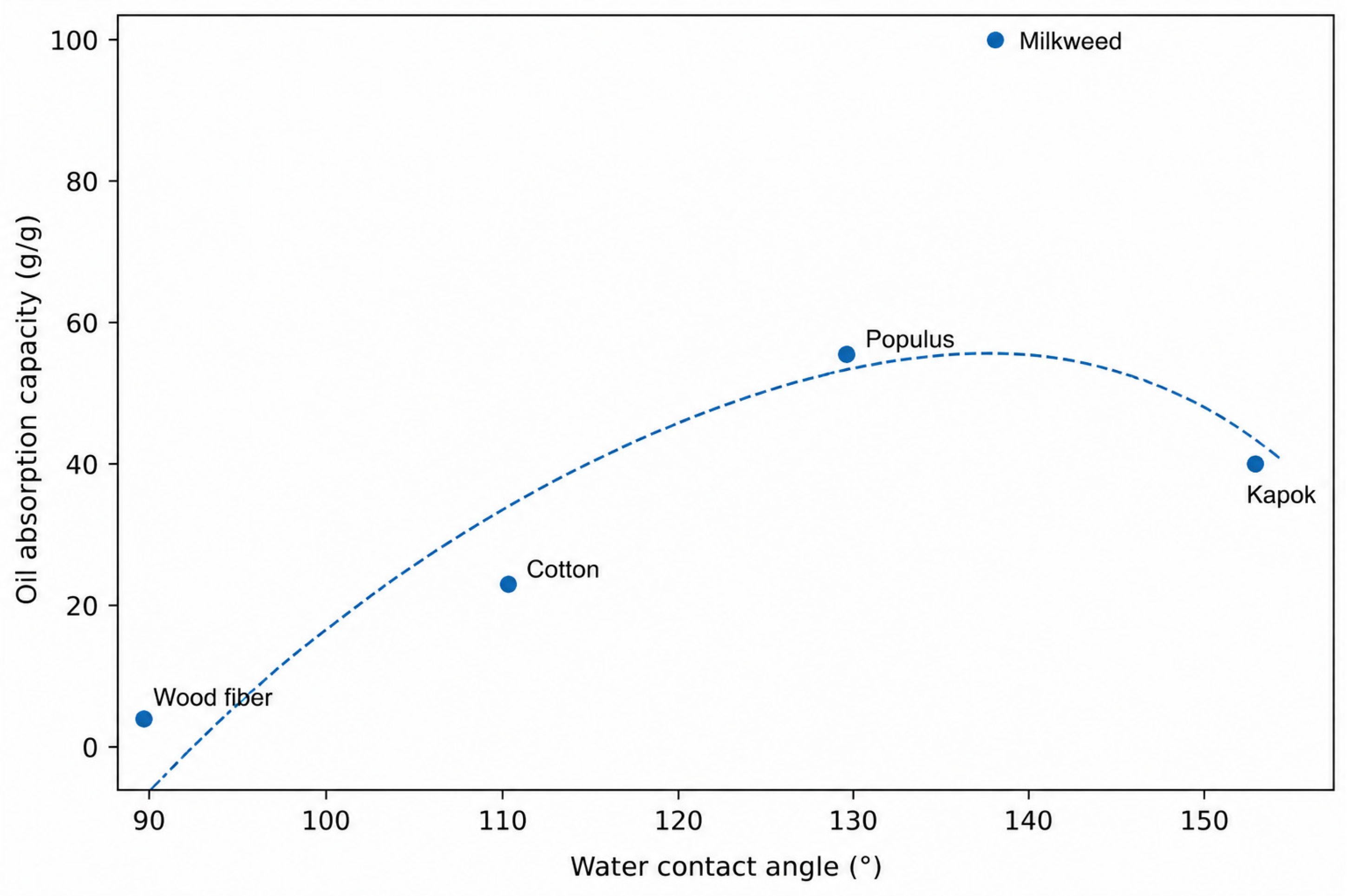
To illustrate the relationship between wettability and sorption capacity,
Figure 1 presents the dependence of oil uptake on contact angle for various native materials. The analysis shows that an increase in contact angle is accompanied by higher oil uptake; however, the relationship is non-linear.
Quantitative characteristics of native cellulose materials are summarized in
Table 1. The reported values are based on data from different studies and reflect general trends, as testing conditions, oil type, and packing density may vary.
The analysis of
Table 1 shows that the highest oil absorption capacity is achieved in systems with a well-developed hollow structure and low density. Even within the same class of materials, an increase in packing density leads to a reduction in accessible volume and a decrease in sorption capacity.
Despite the high initial absorption rate, native materials are generally characterized by limited stability during repeated use. For most reported systems, the number of effective cycles does not exceed 2–3, which is associated with gradual structural densification [
6,
31,
39]. Repeated sorption–desorption cycles lead to structural degradation and reduced oil retention efficiency.
Sorption performance is also strongly influenced by the type of oil and testing conditions. More viscous hydrocarbons are retained more effectively due to their lower mobility, whereas lighter fractions desorb more readily from the porous structure [
19,
21,
28,
30].
The sorption behavior of native cellulose materials is largely governed by the combined effects of fiber geometry, pore size distribution, and surface wettability. In addition to conventional plant fibers, agricultural byproducts such as thermally treated rice husks have also been explored as low-cost sorbents. Their enhanced performance is associated with the development of porous structure and increased surface roughness after thermal treatment [
40,
41].
3.2. Chemically Modified Cellulose
Chemical modification of cellulose is aimed at altering surface properties without significant changes to the bulk structure. In native systems, sorption behavior is primarily governed by fiber geometry and natural morphology, whereas in modified materials, surface chemistry becomes the key factor. This enables targeted control of interfacial interactions and improves the selectivity of oil sorption in aqueous environments [
9,
10,
42,
43].
Native cellulose contains a large number of hydroxyl groups, which create a polar surface with high affinity for water. In addition to conventional surface modification approaches, polymer-based composite systems have also been developed, in which cellulose derived from agricultural waste is incorporated into polymer matrices to enhance mechanical stability and processability. These composites provide improved structural integrity and durability, although their sorption performance depends strongly on interfacial compatibility and dispersion of the cellulose phase. As a result, untreated materials tend to absorb both water and hydrocarbons, reducing their effectiveness. Chemical modification involves partial substitution or shielding of these groups with nonpolar moieties. This leads to a decrease in the polar component of surface energy, an increase in the water contact angle, and the formation of a hydrophobic yet oleophilic surface [
10,
11,
13,
44,
45,
46,
47].
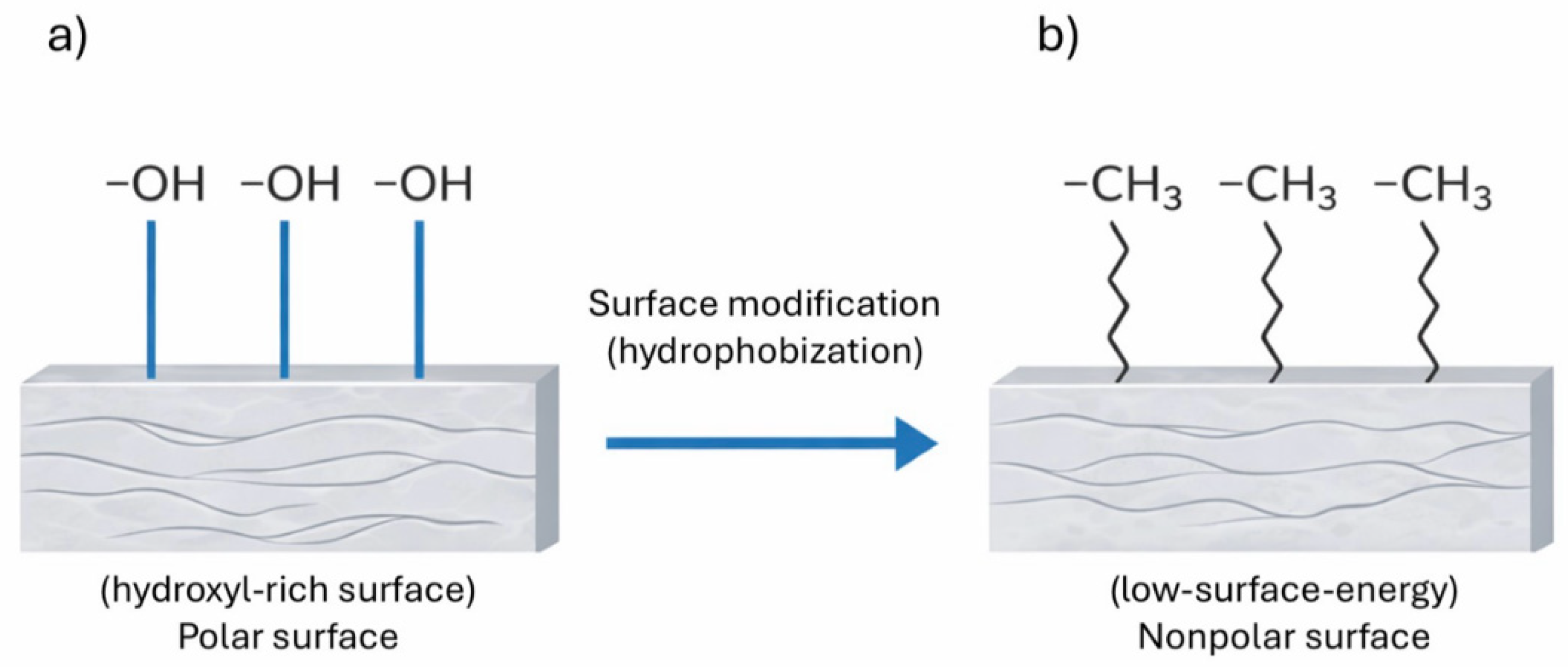
A schematic representation of this transition is shown in
Figure 2, where native cellulose with hydroxyl groups is compared with a modified surface bearing grafted nonpolar chains. The figure illustrates that changes in surface chemistry are accompanied by a reduction in surface energy and a shift in interaction behavior with liquid phases.
In porous structures, not only pore geometry but also interactions with pore walls are important for liquid behavior. Upon transition to a hydrophobic state, water penetration becomes thermodynamically unfavorable, whereas the hydrocarbon phase retains the ability for capillary uptake [
4,
10,
44,
45].
The most common approaches to chemical modification include acetylation, silanization, and functionalization with long-chain organic compounds. Acetylation reduces surface polarity by replacing hydroxyl groups with acetyl moieties [
23]. Silanization forms coatings with very low surface energy and provides high contact angle values [
26]. Modification with fatty acids creates a hydrocarbon-like layer that enhances affinity toward oil [
48]. Regardless of the specific method, all approaches aim to reduce water wettability and strengthen interactions with hydrocarbons [
9,
11,
44,
46,
49].
Recent studies have also explored more sustainable and metal-free polymerization approaches for tailoring cellulose-derived materials. In particular, visible-light-driven organocatalyzed atom-transfer radical polymerization (O-ATRP) has been demonstrated as a promising strategy for controlled modification under mild conditions without the use of transition-metal catalysts. Such approaches may provide improved control over grafted polymer architecture while reducing the environmental concerns associated with conventional metal-catalyzed systems [
50].
A characteristic feature of chemical modification is the preservation of the original porous structure. Density and porosity remain close to those of native materials, which ensures high liquid penetration rates. However, excessive functionalization may lead to the formation of a dense surface layer that partially blocks pore entrances and increases hydrodynamic resistance. In this case, increased hydrophobicity is accompanied by reduced sorption kinetics [
49,
51].
For quantitative comparison of different modification methods,
Table 2 presents values of contact angle, oil absorption capacity, and the number of reuse cycles for specific systems reported in individual studies.
The analysis of
Table 2 shows that increasing the contact angle to values of about 140–160° is accompanied not only by higher oil absorption capacity, but also by improved stability during repeated use [
25,
26]. Unlike native materials, where sorption is mainly governed by structural geometry, in modified systems intermolecular interactions between the surface and hydrocarbons play a significant role. This results in reduced desorption and more stable oil retention, which is particularly important under mechanical stress and during multiple use cycles [
9,
11].
Despite their improved performance, chemically modified materials have several limitations. The most significant of these is the stability of the hydrophobic layer. Exposure to water, ultraviolet radiation, and mechanical stress can lead to partial degradation of functional groups and a decrease in contact angle, accompanied by increased water uptake and reduced selectivity. An additional limitation is the technological complexity of modification processes, which require controlled reaction conditions and subsequent purification, making large-scale production more difficult and increasing costs [
9,
10,
49,
57,
58].
Chemically modified cellulose occupies an intermediate position between native materials and more complex engineered systems. It retains the advantages of a fibrous structure, ensuring rapid liquid transport, while simultaneously providing improved selectivity and stability. However, the maximum performance of such materials remains limited by their original structure, particularly the accessible pore volume and the extent to which it participates in the sorption process [
43,
51].
This limitation indicates the need to move beyond surface modification alone toward the deliberate design of pore architecture. In this context, cellulose aerogels are of particular interest, as their structure is formed artificially and provides nearly complete access to the internal volume, enabling a significant increase in sorption capacity [
11,
12].
In summary, chemical modification significantly improves selectivity and retention stability by altering surface energy, while preserving the original structure. However, the overall sorption capacity remains constrained by the inherent pore architecture, highlighting the limitation of surface modification as a standalone strategy.
3.3. Cellulose Aerogels
Cellulose aerogels are a class of ultralight, highly porous materials formed by removing the liquid phase from a gel while preserving its three-dimensional structure. Unlike native and chemically modified cellulose materials, where surface properties and chemical composition play a significant role, the behavior of aerogels is primarily governed by the geometry of the porous network, including pore size distribution, connectivity, and spatial organization [
11,
12,
59].
A key feature of aerogels is their extremely high porosity (up to 99–99.8%) combined with very low density [
23,
60]. As a result, a continuous three-dimensional network is formed in which nearly the entire volume of the material is accessible for liquid uptake. This fundamentally distinguishes aerogels from fibrous systems, where part of the volume remains inaccessible. For this reason, aerogels exhibit some of the highest oil absorption capacities among cellulose-based sorbents [
11,
23,
59,
61].
Aerogels are typically produced by freeze-drying or supercritical drying, which allow the structure of the initial gel to be preserved without pore collapse. Process parameters such as suspension concentration, freezing rate, and drying conditions determine the resulting morphology. Rapid freezing leads to the formation of a fine porous structure, whereas slower freezing produces larger and more oriented channels, affecting permeability and fluid distribution within the material [
11,
12,
59].
The sorption mechanism in aerogels is multistage and governed by the hierarchical pore structure. At the initial stage, oil rapidly penetrates into macropores due to capillary uptake, ensuring fast saturation of the material. This is followed by redistribution of the liquid into smaller pores, which increases the interfacial contact area. Oil retention occurs in meso- and micropores due to capillary pressure and adhesive interactions. As smaller pores become filled, the sorption rate decreases, reflecting the transition from a transport-dominated regime to a saturation-controlled regime [
6,
7,
21].
Surface wettability provides an additional influence on aerogel performance. Native aerogels remain hydrophilic, which limits their selectivity. After hydrophobization (contact angle 120–150° [
26,
62]), water is expelled from the pore space and preferential filling by the hydrocarbon phase occurs. Nevertheless, the dominant factor governing performance remains the pore network structure rather than surface properties alone [
11,
61].
In aerogels, structural parameters such as density, porosity, and pore size distribution play a primary role in determining sorption performance. Quantitative characteristics of cellulose aerogels are summarized in
Table 3, where density, porosity, oil absorption capacity, and operational parameters of different systems are compared.
Analysis of
Table 3 shows that a decrease in density is accompanied by a significant increase in oil absorption capacity. Ultralight structures provide maximum oil uptake, whereas denser and reinforced aerogels exhibit lower capacity but improved stability during repeated use. This reflects the trade-off between accessible pore volume and mechanical strength of the framework.
The main limitation of aerogels is their low mechanical strength. The thin walls of the porous structure are prone to local instability under compression, which leads to partial loss of pore network connectivity and a reduction in accessible volume. Unlike fibrous materials, where deformation may be partially reversible, structural changes in aerogels are largely irreversible [
11,
12,
65,
66].
Loss of structural integrity directly affects fluid transport within porous materials. An intact interconnected pore network enables efficient liquid penetration and more complete filling of the accessible pore volume, whereas reduced connectivity leads to restricted transport pathways, partial pore filling, and decreased sorption efficiency.
An additional limitation is fatigue degradation during cyclic use. Repeated sorption–desorption and mechanical loading lead to the accumulation of defects and gradual structural degradation, reducing the number of effective cycles, especially in ultralow-density materials [
23,
25]. Technological factors also play an important role: freeze-drying and supercritical drying require high energy input and precise process control, which complicates large-scale production [
11,
59,
67].
Overall, cellulose aerogels provide high sorption performance due to their high porosity, developed internal surface, and efficient utilization of the material volume. However, their practical application requires balancing high absorption capacity with sufficient mechanical stability, which drives the development of reinforced and composite structures.
These limitations highlight the need for more precise control of material structure at finer scales, including pore size, network connectivity, and interfibrillar interactions. In this context, nanocellulose-based systems are of particular interest, as their properties are governed not only by pore architecture but also by structural organization at the nanoscale [
11,
12,
65].
Thus, cellulose aerogels achieve exceptionally high oil absorption due to their ultrahigh porosity and efficient utilization of internal volume. At the same time, their practical application is limited by low mechanical strength and structural instability, reflecting a pronounced trade-off between capacity and durability.
3.4. Nanocellulose
Nanocellulose represents a class of cellulose-based materials whose structural elements are in the nanoscale range. The main types include cellulose nanofibrils (CNF), cellulose nanocrystals (CNC), and bacterial cellulose. These materials are characterized by a high specific surface area and the ability to form an extended network of interfibrillar interactions, resulting in a stable three-dimensional structure with a high degree of connectivity [
10,
12,
13,
68].
A key feature of nanocellulose is its ability to form controlled porous structures at both micro- and nanoscale levels. Unlike native materials, where the structure is largely determined by natural morphology, and aerogels, where macroporosity often dominates, nanocellulose systems allow more precise control over pore size distribution, packing density, and the spatial arrangement of structural elements. As a result, they offer substantial flexibility in tuning sorption and mechanical properties over a broad range [
11,
12,
68,
69].
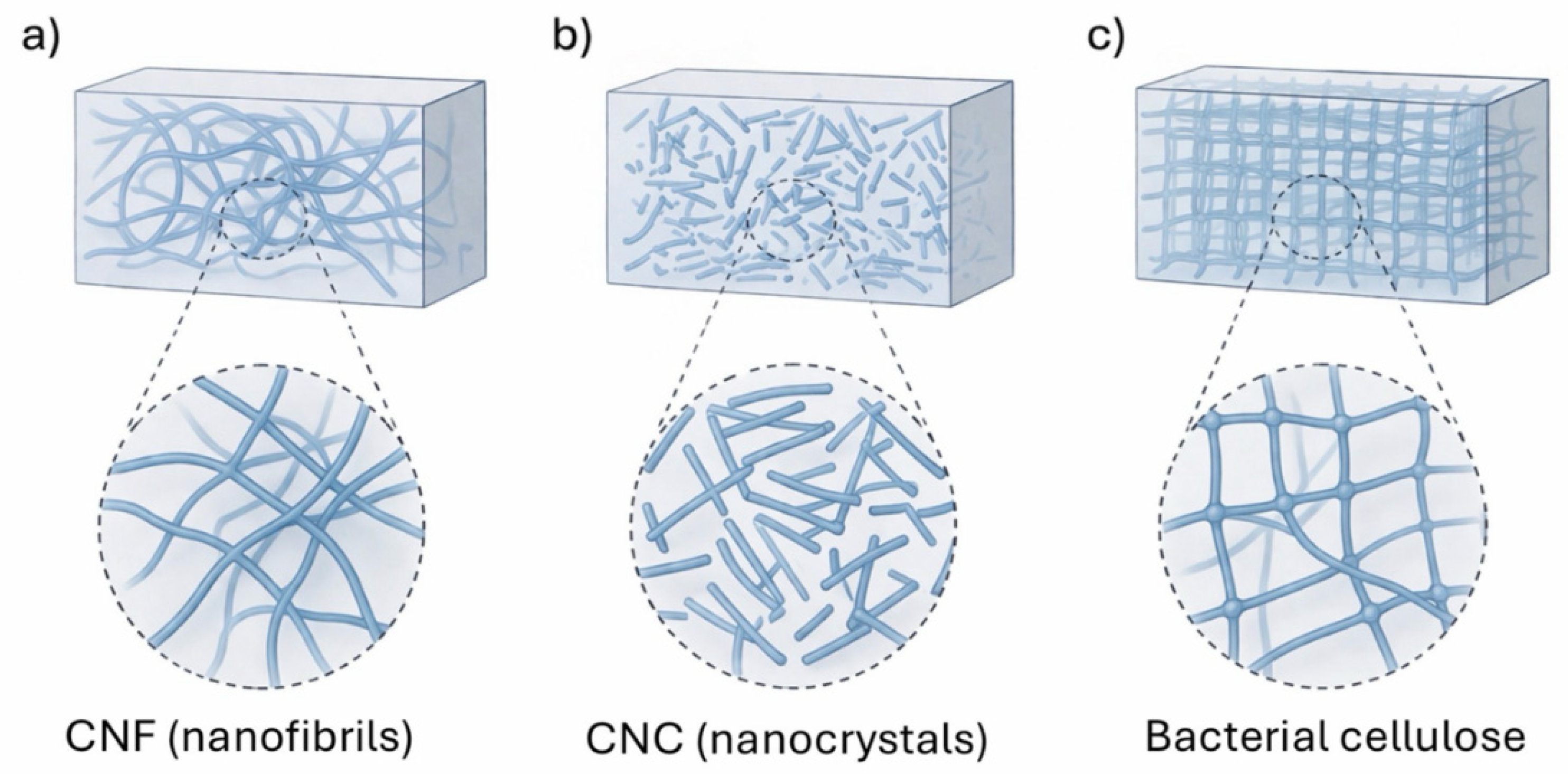
The structural basis of nanocellulose is a percolating network formed by entangled nanofibrils. Mechanical load transfer in such systems occurs through a combination of hydrogen bonding and mechanical interlocking, which ensures efficient stress distribution and reduces the likelihood of local deformation concentration. As a result, nanocellulose combines high porosity with mechanical stability, distinguishing it from aerogels with their fragile frameworks [
12,
23,
68,
70]. The structural differences between CNF-, CNC-, and bacterial cellulose-based architectures are schematically illustrated in
Figure 3.
The sorption mechanism in nanocellulose-based materials is governed by the combination of a highly developed internal surface and a controllable porous structure. In the native state, the surface remains hydrophilic, which limits selectivity. The high specific surface area makes nanocellulose highly responsive to chemical modification, enabling the introduction of hydrophobic and oleophilic properties throughout the entire material volume [
10,
12]. After functionalization, the contact area between the surface and hydrocarbons increases, dispersion interactions are enhanced, and oil retention improves. Unlike macrofibrous systems, where modification mainly affects the outer surface, functional groups in nanocellulose are distributed throughout the entire network, leading to more uniform pore filling [
11,
62,
68,
69].
The sorption kinetics are governed by a combination of capillary transport and diffusion within the pore system [
6,
7]. Compared to aerogels, the process is more uniform but occurs at a lower rate due to smaller pore sizes and a more densely packed structure. At the same time, this architecture provides more stable oil retention and reduces the likelihood of local oversaturation [
12,
23]. Sorption properties are determined by a combination of parameters, including density, porosity, pore size distribution, and contact angle, with network connectivity and interfibrillar spacing playing a key role [
11,
12,
69,
70].
Quantitative characteristics of nanocellulose-based materials are summarized in
Table 4, where oil absorption capacity, density, and operational parameters of different systems are compared.
The analysis of the data shows that nanocellulose provides oil absorption capacities in the range of 50–180 g/g while maintaining higher mechanical stability compared to aerogels. Increasing the contact angle improves selectivity; however, overall performance is determined not only by surface properties but also by structural organization and pore distribution.
Differences between nanocellulose types are determined by their morphology. CNF forms flexible and resilient networks with a high deformation capacity, CNC produces more rigid and ordered structures with lower flexibility, while bacterial cellulose is characterized by a uniform three-dimensional network and high reproducibility of properties. Hybrid systems allow the combination of advantages from different types and provide more balanced performance [
10,
12,
70,
76,
77].
Despite their high performance, nanocellulose-based materials have several limitations, primarily related to processing complexity. Mechanical defibrillation, acid hydrolysis, and biosynthesis require significant energy and time, which limits scalability [
11,
13]. An additional factor is the tendency of nanofibrils to aggregate, leading to closer packing of structural elements, network densification, and a reduction in accessible pore volume. This results in a gradual decrease in porosity and permeability of the structure [
12,
68,
69].
Comparison with other material classes shows that nanocellulose occupies an intermediate position between chemically modified fibrous systems and aerogels. In terms of oil absorption capacity, it is lower than that of highly developed aerogels, but it surpasses them in mechanical stability and cyclic durability. Compared to native materials, nanocellulose offers a higher level of structural control and property reproducibility. Nanocellulose-based materials are considered a promising direction for the development of sorption systems, where high sorption capacity, selectivity, and mechanical strength can be combined through further structural optimization and cost reduction [
68,
69].
Overall, nanocellulose-based materials generally offer a balanced combination of sorption capacity, selectivity, and mechanical stability due to their highly interconnected network structure. However, their performance is influenced by aggregation effects and processing complexity, which can limit accessible porosity and scalability.
3.5. Carbonized Cellulose
Carbonized cellulose represents a class of materials obtained by thermal treatment of cellulose precursors in an inert atmosphere. During pyrolysis, organic components decompose with the removal of oxygen-containing groups, leading to the formation of a carbon matrix with low polarity, a developed porous structure, and high chemical stability. Unlike native and chemically modified materials, the changes in properties in this case affect the entire volume of the structure rather than being limited to the surface layer [
21,
40,
78,
79,
80].
Carbonization is accompanied by significant structural rearrangement, resulting in the formation of carbon domains and aromatic structures that provide inherent hydrophobicity without additional functionalization. As a result, the material becomes resistant to water, organic solvents, and chemically aggressive environments. At the same time, a hierarchical porous structure is formed, with its characteristics determined by pyrolysis conditions, including temperature, heating rate, and gas atmosphere [
11,
21,
78,
81].
At relatively low temperatures, the original fibrous morphology and macroporous structure are partially preserved. With increasing temperature, microporosity (pore radius below 2 nm) develops and the specific surface area increases, reaching values of several hundred square meters per gram. This is accompanied by a shift in the sorption mechanism: the contribution of bulk pore filling decreases, while the role of surface adsorption increases [
19,
21,
78,
79,
81].
The sorption mechanism in carbonized materials is governed by a combination of capillary transport and surface adsorption. Macropores act as transport channels, enabling oil penetration into the structure, while micropores provide regions with high adsorption potential. In these pores, hydrocarbon retention is enhanced by dispersion interactions and confinement effects. A significant fraction of the sorbate is retained on pore surfaces, which improves resistance to desorption and increases selectivity toward hydrocarbons [
6,
19,
21,
82].
The pore size distribution determines the balance between sorption rate and efficiency. A well-developed macroporous structure ensures rapid liquid transport, while an increased fraction of micropores enhances retention. When macropores are insufficient, the process becomes diffusion-limited, especially for viscous oils, resulting in slower kinetics despite high final absorption capacity [
6,
7,
19,
80].
The sorption properties of carbonized materials are determined by density, porosity, specific surface area, and pore size distribution. An increase in microporosity and a decrease in surface polarity enhance oil retention, while the presence of macropores controls the saturation rate. Oil viscosity also plays an important role: light fractions penetrate the structure more rapidly but are less stably retained, whereas heavier hydrocarbons infiltrate more slowly but exhibit stronger retention [
19,
21].
Quantitative characteristics of carbonized materials are summarized in
Table 5, where specific surface area, pore structure, and oil absorption capacity of different systems are compared.
The analysis of
Table 6 shows that an increase in specific surface area and micropore fraction is accompanied by improved oil retention efficiency. Materials with pronounced microporosity exhibit more stable sorbate fixation but are characterized by reduced permeability and slower sorption kinetics. In contrast, structures with a well-developed macroporous network provide rapid liquid transport but show lower retention capacity.
The main limitation of carbonized materials is their brittleness. During pyrolysis, a rigid carbon matrix is formed, which is prone to cracking under mechanical stress [
21,
78]. This leads to the formation of fractures, disruption of structural connectivity, and a decrease in sorption efficiency. The loss of structural integrity is accompanied by a reduction in accessible pore volume and deterioration of performance characteristics [
19,
21,
85].
An additional limitation is the reduction in the fraction of macropores at high degrees of carbonization, which enhances diffusion limitations and decreases structural permeability, particularly when dealing with viscous petroleum products. The energy intensity of the production process also plays a significant role, as high temperatures and the need for a controlled atmosphere increase cost and complicate large-scale implementation [
11,
19,
21,
78].
Comparison with other classes of cellulose-based sorbents shows that carbonized materials occupy a distinct position. In terms of hydrophobicity, they are comparable to chemically modified systems and do not require additional surface treatment. In terms of oil retention stability, they approach aerogels due to their developed microporous structure; however, they are inferior to them in maximum oil absorption capacity and significantly lag behind nanocellulose in mechanical stability [
9,
10,
11,
12].
Overall, carbonized cellulose represents a promising direction for the development of stable hydrophobic sorbents with pronounced adsorption capability. Further progress is associated with the design of hierarchical structures with controlled pore distribution, enabling the combination of high specific surface area, sufficient mechanical strength, and acceptable sorption kinetics, thereby opening opportunities for the development of more efficient and technologically viable materials.
In general, carbonized cellulose materials provide stable hydrophobicity and enhanced oil retention due to their developed microporous structure and carbon matrix. However, their performance is constrained by reduced sorption kinetics and structural brittleness, emphasizing the trade-off between retention efficiency and transport properties.
4. Comparative Analysis of Sorption Performance
A comparison of different classes of cellulose-based materials shows that their sorption performance is governed by a combination of structure, surface properties, and mechanical stability. The transition from native systems to engineered materials is accompanied by a gradual shift in the sorption mechanism, from predominantly capillary-driven filling to a combination of capillary transport and surface adsorption [
6,
9,
19,
86,
87].
The quantitative ranges summarized in this section were compiled from the cited literature and are used to indicate general performance intervals for each material class. These values were not normalized to a single testing protocol because the original studies used different oil types, viscosities, sample densities, contact times, temperatures, salinity levels, drainage procedures, and regeneration methods. Therefore, the comparison is based on reported performance ranges and dominant structure–property trends rather than direct head-to-head ranking under identical experimental conditions.
Native materials are generally characterized by a simple fibrous structure and a predominance of macropores, which enable rapid oil uptake. Reported oil absorption values typically range from 20 to 45 g/g [
6,
7], while hollow fibers can exceed 100 g/g [
20]. Compared to engineered materials, native sorbents generally exhibit 2–5 times lower oil absorption capacity and significantly reduced retention stability, which limits their applicability in demanding environmental conditions. However, high sorption rates are combined with low selectivity and limited stability, as the hydrophilic surface promotes simultaneous water uptake and large pores do not provide reliable oil retention [
9,
21,
86,
87,
88].
Chemically modified cellulose retains the original structure but exhibits fundamentally different behavior due to changes in surface energy. Increasing the contact angle to 120–160° suppresses water absorption and improves selectivity [
26,
62]. Oil absorption capacity increases to 30–120 g/g [
23,
48], and the number of reuse cycles reaches 10–20 [
39]. In these systems, intermolecular interactions between the surface and hydrocarbons play a key role, ensuring more stable oil retention compared to native materials [
9,
11,
86,
88].
Cellulose aerogels demonstrate the highest oil absorption capacities due to their extremely high porosity and nearly complete utilization of material volume. Depending on density and structure, values reach 100–250 g/g [
23,
60]. This corresponds to an increase of approximately 2–4 times compared to chemically modified materials and up to an order of magnitude compared to dense natural fibers, highlighting the dominant role of porosity and accessible volume. The sorption mechanism includes both rapid capillary filling of macropores and retention within meso- and micropores. The main limitation of aerogels is their low mechanical stability, which leads to structural degradation during repeated cycles [
9,
11,
19,
21,
86,
89].
Nanocellulose-based materials provide a more balanced combination of properties. Their oil absorption capacity typically ranges from 50 to 180 g/g [
23,
62], while their structure is characterized by high connectivity and resistance to deformation [
12]. Although their maximum absorption capacity is lower than that of aerogels, nanocellulose-based materials provide significantly improved mechanical stability and cyclic durability, often sustaining performance over a larger number of reuse cycles. Unlike aerogels, these systems demonstrate more stable performance during cyclic use. The sorption mechanism is governed by a developed internal surface and a uniform distribution of functional groups, ensuring effective oil retention at moderate uptake rates [
10,
11].
Carbonized materials occupy a distinct position, as their properties are determined not only by structure but also by the chemical nature of the carbon matrix. The development of microporosity and an increase in specific surface area enhance adsorption mechanisms [
21,
78]. Oil absorption capacity in such systems ranges from 30 to 140 g/g [
21,
40], with high retention stability. However, an increased fraction of micropores leads to slower sorption kinetics, while the brittleness of the carbon framework limits mechanical stability [
19,
78,
87,
88].
For a generalized comparison of different material classes,
Table 6 summarizes the ranges of oil absorption capacity, selectivity, and operational stability.
The values summarized in
Table 6 provide a general overview of reported performance across different classes of cellulose-based sorbents. Within these reported ranges, aerogels generally exhibit the highest oil absorption capacities, which is commonly associated with their extremely high porosity and nearly complete utilization of internal volume. However, such structures often show lower mechanical stability and tend to lose performance more rapidly during repeated use. By contrast, nanocellulose and chemically modified materials more often display a balanced combination of selectivity, oil absorption capacity, and stability under cyclic conditions.
Commercial oil sorbents, particularly polypropylene-based mats/felts and polyurethane foams, remain widely used in practical oil spill response because of their availability, low cost, hydrophobicity, and acceptable mechanical robustness. Therefore, the performance of cellulose-based sorbents should also be considered relative to these mainstream materials. Compared with polypropylene sorbents and polyurethane foams, cellulose aerogels and nanocellulose-based systems often show higher reported oil absorption capacities due to their lower density and more developed porous structures. However, commercial sorbents still retain advantages in scalability, handling stability, and technological maturity. This comparison indicates that cellulose-based sorbents should not be evaluated only by maximum oil uptake, but also by selectivity, reusability, mechanical durability, biodegradability, production cost, and performance under realistic operating conditions, as summarized in
Table 7.
Native materials provide rapid oil uptake due to their developed macroporous structure but are inferior in terms of selectivity and durability. In contrast, carbonized systems exhibit more stable oil retention due to their developed microporosity; however, their performance is limited by slower sorption kinetics and structural brittleness [
9,
21,
78].
The performance of cellulose-based sorbents is determined not by a single parameter but by a combination of pore structure, surface properties, and mechanical stability [
10,
11,
86]. An increase in oil absorption capacity can be achieved either by increasing accessible volume or by enhancing interactions with hydrocarbons; however, in each case, a trade-off arises between sorption rate, retention, and material stability [
6,
19,
88].
From a practical perspective, hybrid systems appear particularly promising because they can combine a developed porous structure, hydrophobic surface, and sufficient mechanical strength. In many reported systems, this combination is associated with improved oil absorption capacity, selectivity, and operational stability, making hybrid materials attractive candidates for real-world oil spill applications [
61,
87].
From a practical standpoint, materials combining hierarchical porosity, hydrophobic selectivity, and sufficient mechanical robustness appear to be the most viable candidates for realistic oil spill response. Although cellulose aerogels often demonstrate the highest reported oil uptake values, their large-scale application remains limited by structural fragility and processing complexity. Native cellulose materials offer low cost and scalability but are constrained by poor selectivity and limited cyclic stability. In contrast, nanocellulose-based and hybrid systems currently appear to provide the most balanced combination of sorption capacity, retention stability, mechanical durability, and structural tunability, making them more promising for practical deployment under variable environmental conditions.
Overall, no single class of materials simultaneously maximizes all performance parameters. Instead, the observed trends confirm that sorption behavior is governed by inherent trade-offs between capacity, selectivity, kinetics, and mechanical stability, emphasizing the need for integrated material design.
A major limitation in the comparative evaluation of cellulose-based sorbents is the lack of standardized testing protocols across the literature. Reported oil uptake values are strongly influenced by oil type, oil/water ratio, contact time, drainage conditions, regeneration procedure, salinity, temperature, and sample packing density. In addition, different studies apply different criteria for evaluating reuse cycles and retention efficiency, which complicates direct comparison between reported systems. Therefore, future progress in this field would benefit from the development of more unified testing methodologies and reporting standards for sorption performance evaluation.
Understanding these relationships allows a transition from descriptive analysis to the development of criteria for material selection and design. The following section discusses the key factors that determine practical performance, as well as approaches to optimization with consideration of operating conditions and industrial requirements.
5. Processing–Structure–Property Relationships
The performance of cellulose-based sorbents is largely governed by the combined effects of processing method, material structure, and surface properties. Variations in processing approach can alter pore architecture, pore size distribution, and interfacial interactions, thereby affecting both sorption kinetics and oil retention stability [
13,
16,
90,
91].
The processing method defines not only the geometry of the structure but also the dominant sorption mechanism. Depending on the level of structural organization (macro-, meso-, or microporosity), different modes of liquid transport and retention are realized, including bulk pore filling, capillary uptake, and surface adsorption [
12,
13,
89].
At minimal processing levels, fibrous structures with a predominance of macropores are formed. Such systems exhibit high permeability and enable rapid liquid transport. In this case, bulk pore filling is the dominant mechanism. An increased fraction of macropores is accompanied by reduced capillary pressure and retention forces, which leads to partial oil desorption under mechanical stress. As a result, high sorption rates are combined with limited retention stability [
13,
28].
Transition to materials formed through a gelation stage leads to the development of three-dimensional porous structures with a combination of macro- and mesopores. This architecture enables uniform liquid distribution and efficient utilization of internal volume. In these systems, sorption is governed by a combination of capillary transport and bulk filling. However, decreasing density and increasing void fraction weaken the mechanical framework, so higher oil absorption capacity is accompanied by reduced resistance to deformation [
16,
65,
68,
92,
93,
94].
The formation of nanoscale structures allows more precise control over material organization. In such systems, micro- and mesopores coexist, enabling both oil retention and its distribution throughout the volume. Reduction in structural dimensions leads to an increase in specific surface area and enhanced interfacial interactions. A well-developed network of interfibrillar bonds improves mechanical stability and helps maintain a balance between sorption capacity and strength. A key limitation is nanofibril aggregation, which reduces accessible porosity [
68,
69,
76,
95].
Thermal treatment results in the formation of carbon structures with a predominance of micropores. Decreasing pore size enhances retention forces and increases the contribution of surface adsorption. These systems provide stable oil retention; however, the reduced fraction of macropores limits liquid transport and slows sorption kinetics, particularly for viscous oils [
12,
84,
96].
To compare the influence of processing methods on structure and sorption performance,
Table 8 presents typical ranges of parameters consistent with the data discussed in
Section 2 and
Section 3.
The analysis of
Table 8 shows that changes in the processing method are accompanied by a transition from macroporous to microporous structures and a shift in the sorption mechanism from rapid liquid uptake to more stable retention. An increased fraction of macropores enhances the sorption rate but reduces retention stability, whereas a higher fraction of micropores improves oil fixation but limits sorption kinetics.
From a practical and economic perspective, conventional polypropylene mats/felts and polyurethane foams remain more mature for large-scale oil spill response because they are inexpensive, widely available, mechanically stable, and compatible with existing recovery practices. Although cellulose aerogels and nanocellulose-based sorbents often show higher reported oil uptake, their production may involve multistep processing, freeze-drying, chemical modification, or controlled nanostructuring, which increases cost and complicates scale-up. Therefore, their practical value should be assessed not only by maximum oil absorption capacity, but also by production cost, reusability, mechanical durability, biodegradability, and end-of-life management. At present, low-cost native or simply modified biomass-derived cellulose sorbents appear more feasible for near-term application, whereas highly engineered cellulose aerogels and nanocellulose systems require further process simplification before direct competition with commercial polymer sorbents [
97,
98].
Structural changes are also reflected in the mechanical properties of the material. A decrease in density and an increase in porosity lead to higher oil absorption capacity but are accompanied by weakening of the structural framework. An increase in specific surface area enhances interfacial interactions and improves selectivity; however, excessive microporosity increases the influence of diffusion limitations [
16,
65,
68,
95].
Sorption performance is governed by a balance of several parameters. High oil absorption capacity, fast sorption rate, and mechanical stability cannot be achieved simultaneously without structural optimization. Improving one parameter inevitably leads to a reduction in others [
16,
69,
89,
90].
In many reported systems, favorable sorption performance is associated with hierarchical porous structures, where macropores support liquid transport, mesopores enable distribution, and micropores enhance retention. At the same time, maintaining the mechanical stability of the framework at high porosity remains essential [
65,
76,
92,
93].
The processing method serves as a fundamental tool for the targeted design of sorption materials. Control over synthesis conditions allows regulation of pore distribution, surface properties, and mechanical stability, enabling the development of materials with tailored performance [
13,
16,
90].
These relationships provide a basis for moving from descriptive analysis to practical application. The following section discusses the requirements for sorbents under real conditions, as well as approaches to their optimization considering operational conditions and technological constraints.
Overall, the processing–structure–property relationship can be considered a fundamental framework for the rational design of cellulose-based sorbents. Control over processing parameters enables the tuning of pore architecture, surface characteristics, and mechanical behavior, which in turn governs sorption performance. The available evidence suggests that favorable sorption performance is generally associated with materials exhibiting a hierarchical porous structure, controlled surface chemistry, and sufficient mechanical stability, thereby enabling a balance between sorption capacity, transport kinetics, and retention efficiency.
6. Limitations and Unresolved Challenges
Despite significant progress in the development of cellulose-based sorbents for oil removal, their practical application remains limited by a set of interrelated factors spanning structure, surface properties, processing methods, and operating conditions. These constraints collectively define the boundaries of achievable performance and highlight the challenges associated with translating laboratory-scale materials into real-world applications [
9,
11,
16].
One of the key limitations is the intrinsic trade-off between porous architecture and mechanical stability. Increasing porosity and reducing density enhance oil absorption capacity by maximizing accessible volume; however, this is inevitably accompanied by weakening of the structural framework. In aerogels, this manifests as structural deformation, pore collapse, and fatigue accumulation under cyclic loading. In nanocellulose systems, aggregation of nanofibrils leads to local densification and reduced accessible porosity. In carbonized materials, the predominance of micropores improves oil retention but restricts transport pathways and slows sorption kinetics. As a result, improving one property is often achieved at the expense of another, reflecting a fundamental materials design constraint [
12,
16,
74,
99].
Surface-related limitations are also critical. Selective oil sorption requires low surface energy and stable hydrophobic functionality; however, such modifications are not always durable. Exposure to water, temperature fluctuations, ultraviolet radiation, and chemically aggressive environments can lead to gradual degradation of surface functional groups. This results in a decrease in contact angle, increased water uptake, and reduced selectivity over time. During repeated sorption–desorption cycles, partial loss of hydrophobicity is commonly observed, significantly limiting long-term performance [
11,
74,
99,
100].
Processing-related challenges further restrict practical implementation. High-performance sorbents, particularly aerogels and nanocellulose-based materials, often rely on energy-intensive and multistep fabrication routes such as freeze-drying, supercritical drying, and mechanical fibrillation. These processes are sensitive to synthesis conditions and difficult to scale. Variations in processing parameters lead to significant changes in pore architecture and material properties, resulting in poor reproducibility when transitioning from laboratory to industrial production [
16,
99,
101].
Most advanced cellulose-based sorbents, particularly aerogels and nanocellulose-derived systems, are still predominantly at the laboratory-scale or proof-of-concept stage of development. Although many studies report high oil absorption capacities under controlled conditions, pilot-scale validation and large-scale field testing remain limited. By contrast, conventional polypropylene-based sorbents already possess substantially higher technological maturity and are widely implemented in practical oil spill response systems. Future progress toward higher technology readiness levels will require validation under realistic operating conditions involving seawater salinity, wave motion, weathered oil, emulsified systems, suspended solids, sunlight exposure, and repeated mechanical recovery cycles.
Under realistic operating conditions, sorption performance may differ substantially from laboratory observations. In real oil spill scenarios, materials are exposed to dynamic environments characterized by waves, currents, salinity variations, and temperature fluctuations. In addition, oil–water emulsions represent a particularly challenging case, as droplet stabilization and interfacial phenomena significantly alter sorption mechanisms compared to bulk oil systems. The presence of suspended solids and co-contaminants can block pores, reduce accessible surface area, and impair transport pathways, leading to decreased efficiency and unpredictable performance [
1,
11,
99,
102].
In practical oil spill response, sorbents are additionally subjected to continuous mechanical deformation caused by waves, currents, and recovery operations, which can accelerate structural degradation and reduce retention stability. Weathered and highly viscous oils often penetrate porous structures more slowly than fresh hydrocarbons, while stable oil–water emulsions can significantly alter transport and trapping mechanisms. Long-term environmental exposure, including sunlight irradiation, microbial activity, and seawater chemistry, may further affect surface wettability, structural integrity, and cyclic performance. Therefore, materials intended for realistic deployment should be evaluated not only under static laboratory conditions, but also under dynamic multiphase environments that more accurately represent field conditions.
Environmental and operational considerations introduce additional constraints. After oil saturation, sorbents must be either regenerated or disposed of. Regeneration methods such as mechanical squeezing, solvent extraction, and thermal treatment are often energy-intensive and may not fully restore the original structure and performance. Repeated regeneration cycles can lead to structural degradation and loss of functionality. Moreover, incineration of oil-laden sorbents may generate toxic emissions, while the use of chemical modifiers can reduce biodegradability and complicate life-cycle assessment [
102,
103,
104].
Although cellulose-based sorbents are commonly considered sustainable and biodegradable alternatives to petroleum-derived materials, their overall environmental advantage depends strongly on the modification and processing route. Hydrophobization using silanes or fluorinated compounds may reduce biodegradability and introduce environmental concerns associated with persistent surface modifiers. In addition, fabrication methods such as freeze-drying, supercritical drying, high-temperature carbonization, and intensive mechanical fibrillation require substantial energy input, which can increase environmental and economic costs. Therefore, sustainability assessment should consider not only the renewable origin of cellulose, but also processing intensity, chemical usage, regeneration efficiency, and end-of-life management.
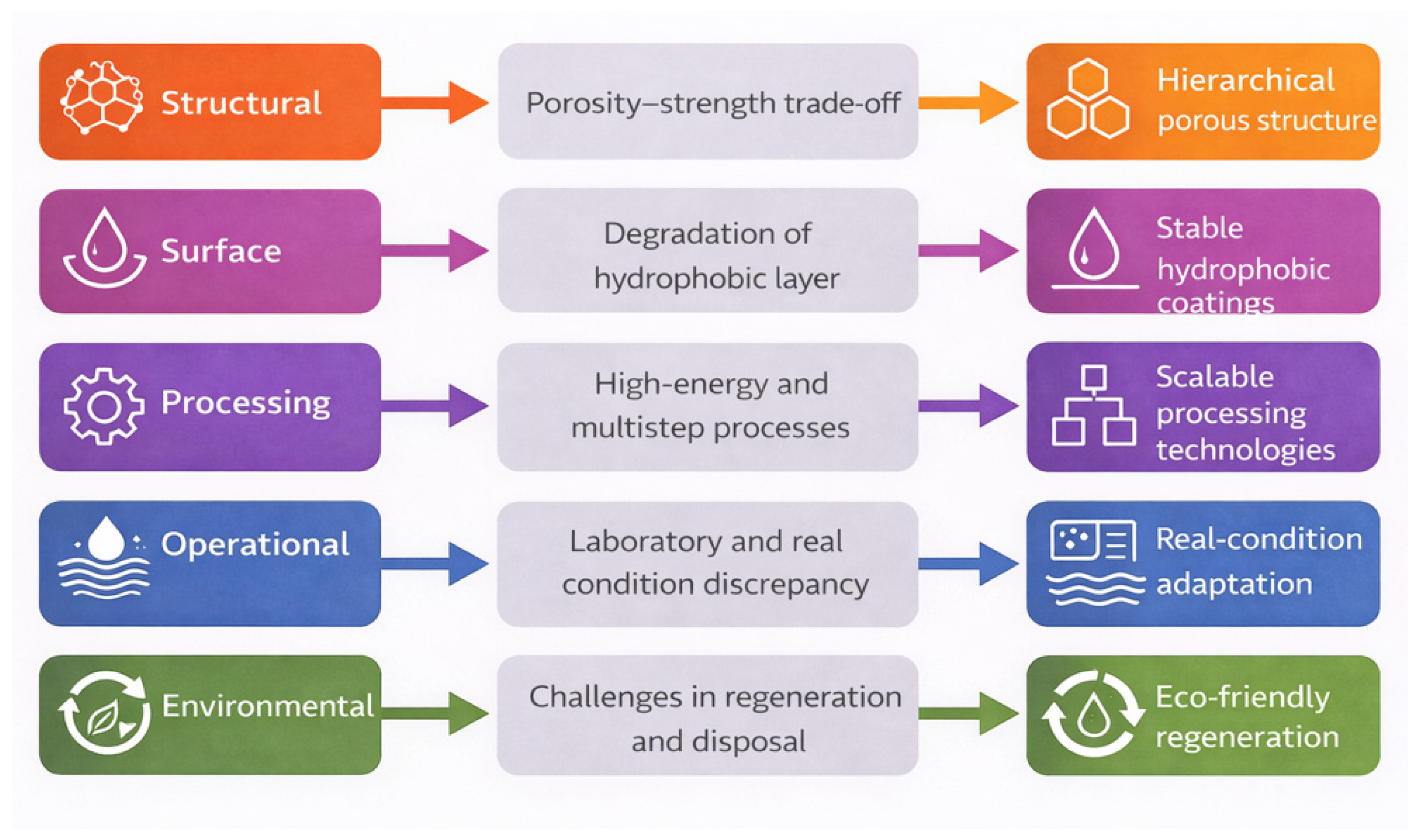
For clarity,
Figure 4 presents a schematic representation of these limitations, grouping them into four main categories: structural, surface-related, processing, and operational. The interactions between these factors illustrate the inherent trade-offs governing sorbent performance and highlight the complexity of material optimization.
The scheme also identifies key directions for overcoming these limitations. These include the development of hierarchical porous structures that balance transport and retention, the design of robust and durable hydrophobic coatings, and the implementation of scalable fabrication methods with controlled structural parameters. In addition, adapting materials to realistic environmental conditions and incorporating multi-phase testing protocols are essential for improving predictive reliability [
11,
16,
99,
101].
Recent studies published during 2024–2026 increasingly focus on multifunctional cellulose-based sorbents, scalable green fabrication methods, and realistic performance evaluation under dynamic environmental conditions. These developments indicate a gradual transition from laboratory-scale materials toward more application-oriented sorption systems [
105,
106,
107].
Future progress in this field is expected to focus on multifunctional and adaptive materials capable of maintaining performance under complex and dynamic conditions. Promising directions include stimuli-responsive sorbents, hybrid systems with controlled multi-scale architecture, and energy-efficient processing routes. Furthermore, the integration of data-driven approaches and predictive modeling offers new opportunities for optimizing material design and bridging the gap between laboratory research and real-world applications [
16,
74,
99,
105,
107].
Overall, the identified limitations demonstrate that further development of cellulose-based sorbents requires a balanced approach that integrates structural design, surface engineering, and operational considerations. Addressing these challenges is essential for the development of reliable, scalable, and high-performance materials for oil spill remediation.
7. Conclusions
This review provides a unified analysis of cellulose-based sorbents for oil removal through the framework of processing–structure–property relationships. The results demonstrate that sorption performance is governed by the interplay between pore architecture, surface characteristics, and mechanical stability, rather than by any single parameter.
A clear evolution is observed from native to engineered materials, accompanied by a shift in dominant sorption mechanisms. Native materials rely on rapid capillary uptake but suffer from low selectivity and poor durability. Chemical modification improves selectivity through surface energy control while preserving structural features. Aerogels achieve the highest oil absorption capacity due to their extreme porosity, yet are limited by mechanical fragility. Nanocellulose-based systems provide a balanced combination of structural control and mechanical stability, while carbonized materials offer enhanced retention due to developed microporosity but exhibit transport limitations and brittleness.
The analysis highlights that performance optimization is inherently constrained by trade-offs. Increasing porosity enhances capacity but weakens structural integrity. Enhancing hydrophobicity improves selectivity but may reduce long-term stability. Increasing microporosity strengthens retention but limits transport. These competing effects indicate that optimal sorbents cannot be achieved by maximizing individual properties, but require coordinated structural design.
Available evidence suggests that one of the most promising design strategies is the development of hierarchical porous systems that integrate transport, distribution, and retention functions across multiple length scales, combined with stable surface modification and sufficient mechanical strength.
From a practical perspective, key challenges remain in scaling production, ensuring long-term stability, achieving reproducibility, and maintaining performance under realistic environmental conditions. Addressing these issues requires a transition from laboratory-scale optimization to application-oriented material design.
Future research should focus on hybrid and multifunctional materials with controlled architecture across multiple scales, as well as on scalable and energy-efficient fabrication methods. Incorporation of realistic testing conditions and lifecycle considerations will be essential for practical implementation.
Overall, the available evidence indicates that the rational design of cellulose-based sorbents should be based on the integration of processing, structure, and performance, providing a practical framework for the development of efficient and reliable materials for oil spill remediation.




 ,
,