
Hydroxypropyl Cellulose Research over Two Decades (2005–2024): A Systematic Review with Bibliometric Analysis and Translational Insights

 ,
,  , , , , , , , , , ,
  and
and
Abstract
1. Introduction
2. Bibliometric Analysis Methods
2.1. Data Source and Retrieval Strategy
2.2. Limitation and Reproducibility
2.3. Analytical Framework and Tools
2.4. Protocol Registration
3. Scientific Output and Research Impact
3.1. Publication Output and Dominance Research Area
3.2. Citation Patterns and Top Ten Cited Publications
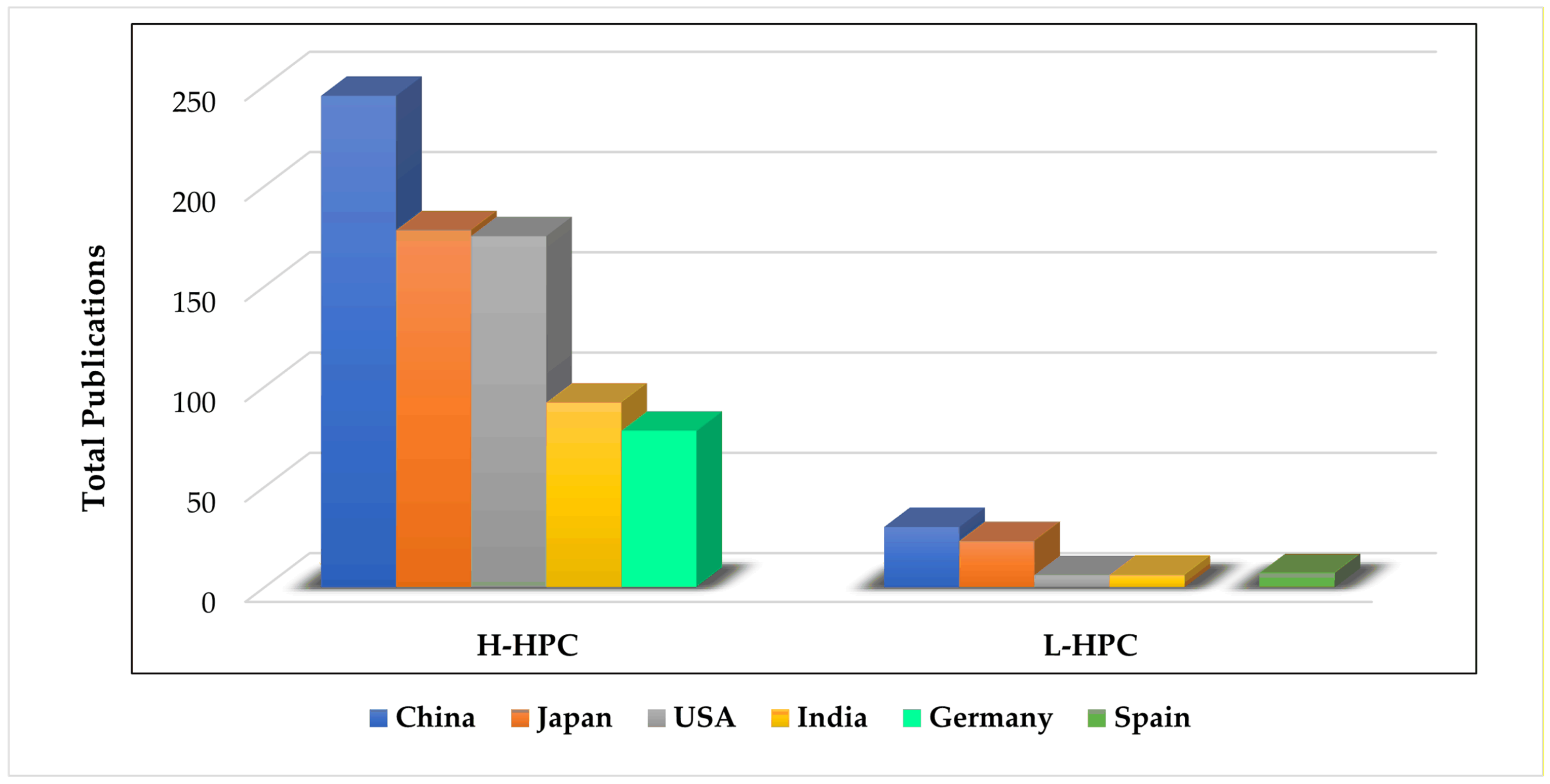
3.3. Geographic Distribution of Publications
3.4. Authorship Dominance and Global Collaboration Patterns
3.4.1. Dominance Factor of Authorship
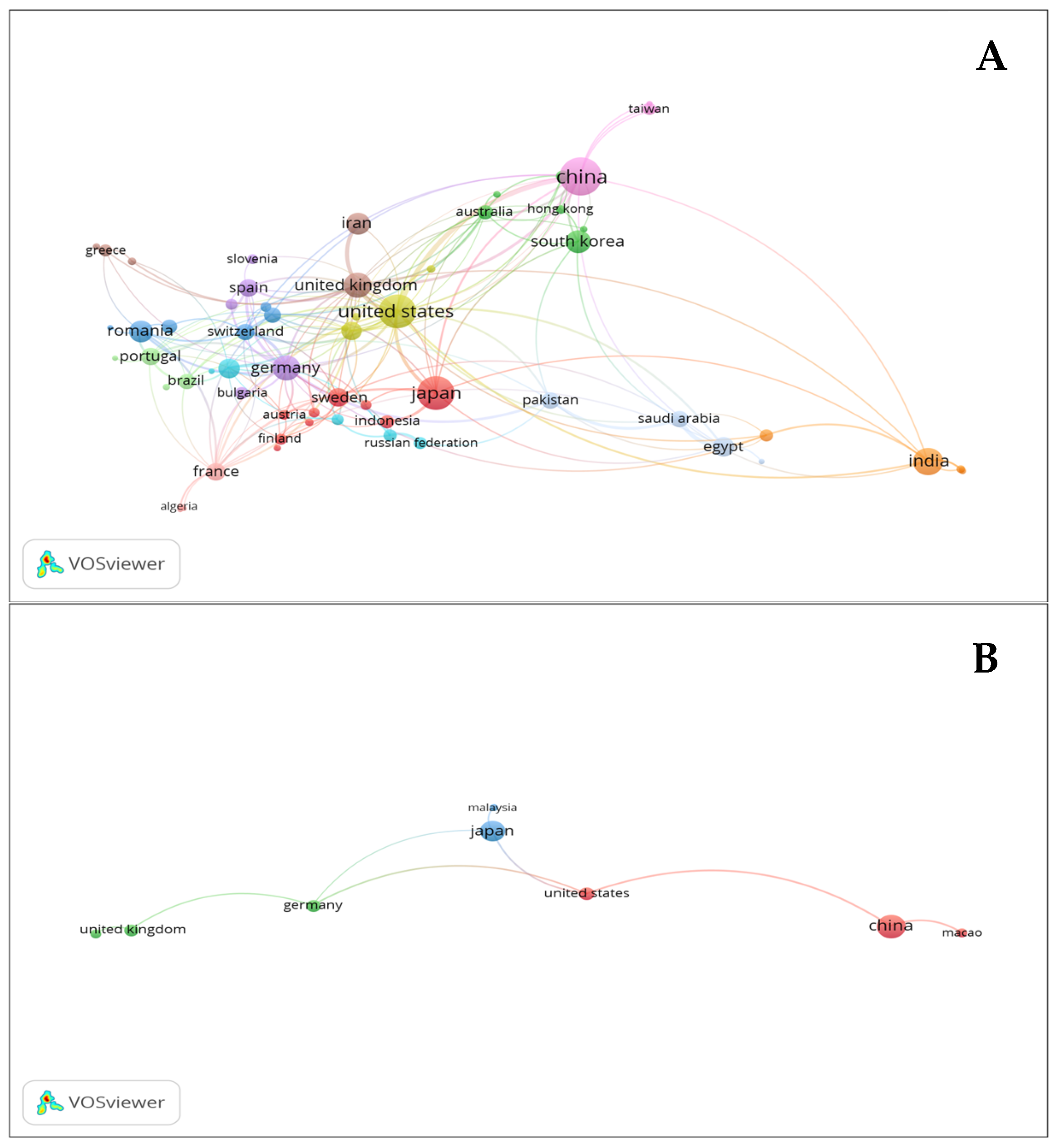
3.4.2. Global Co-Authorship Network Analysis
4. HPC Application Trends: Co-Occurrence Mapping
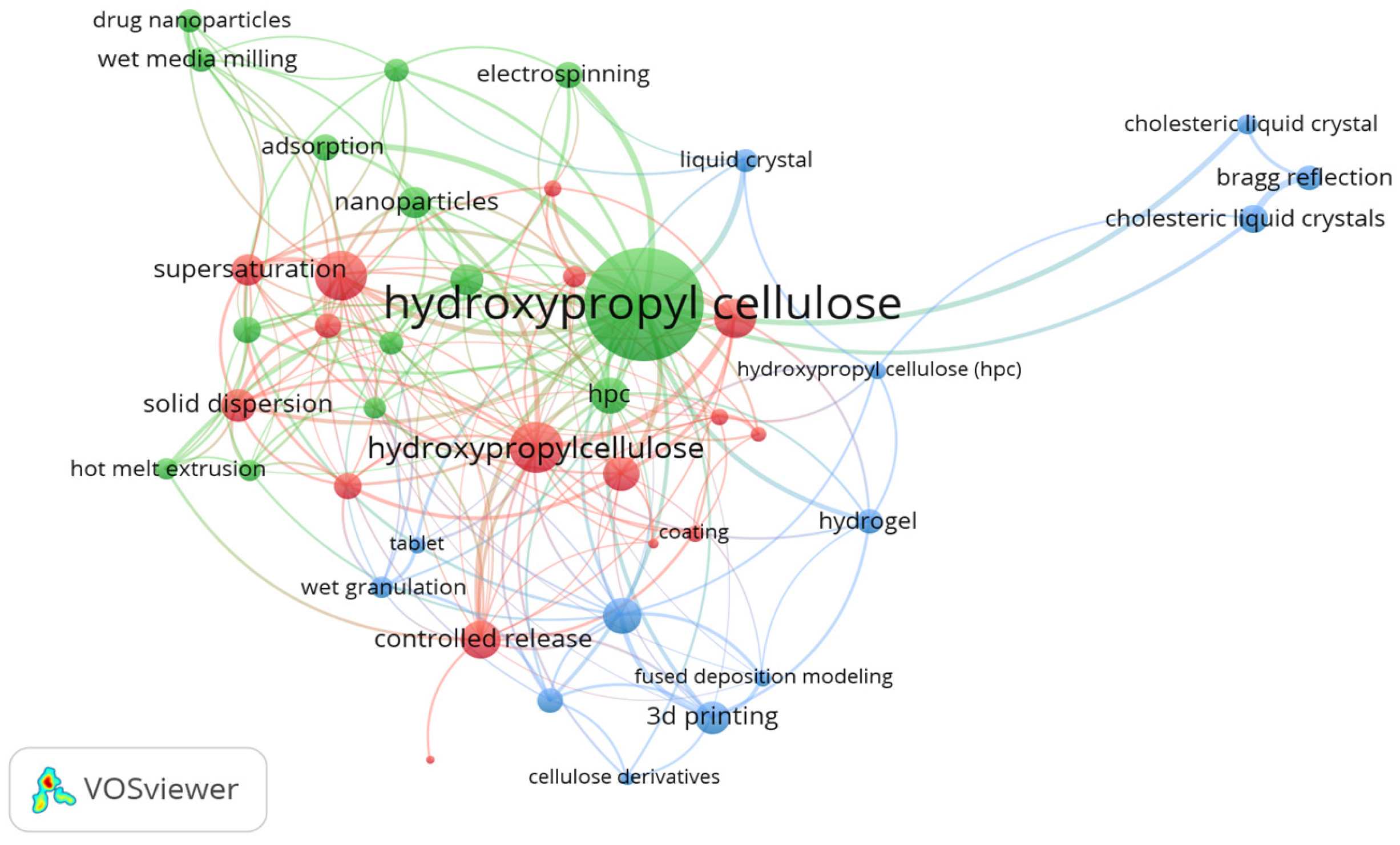
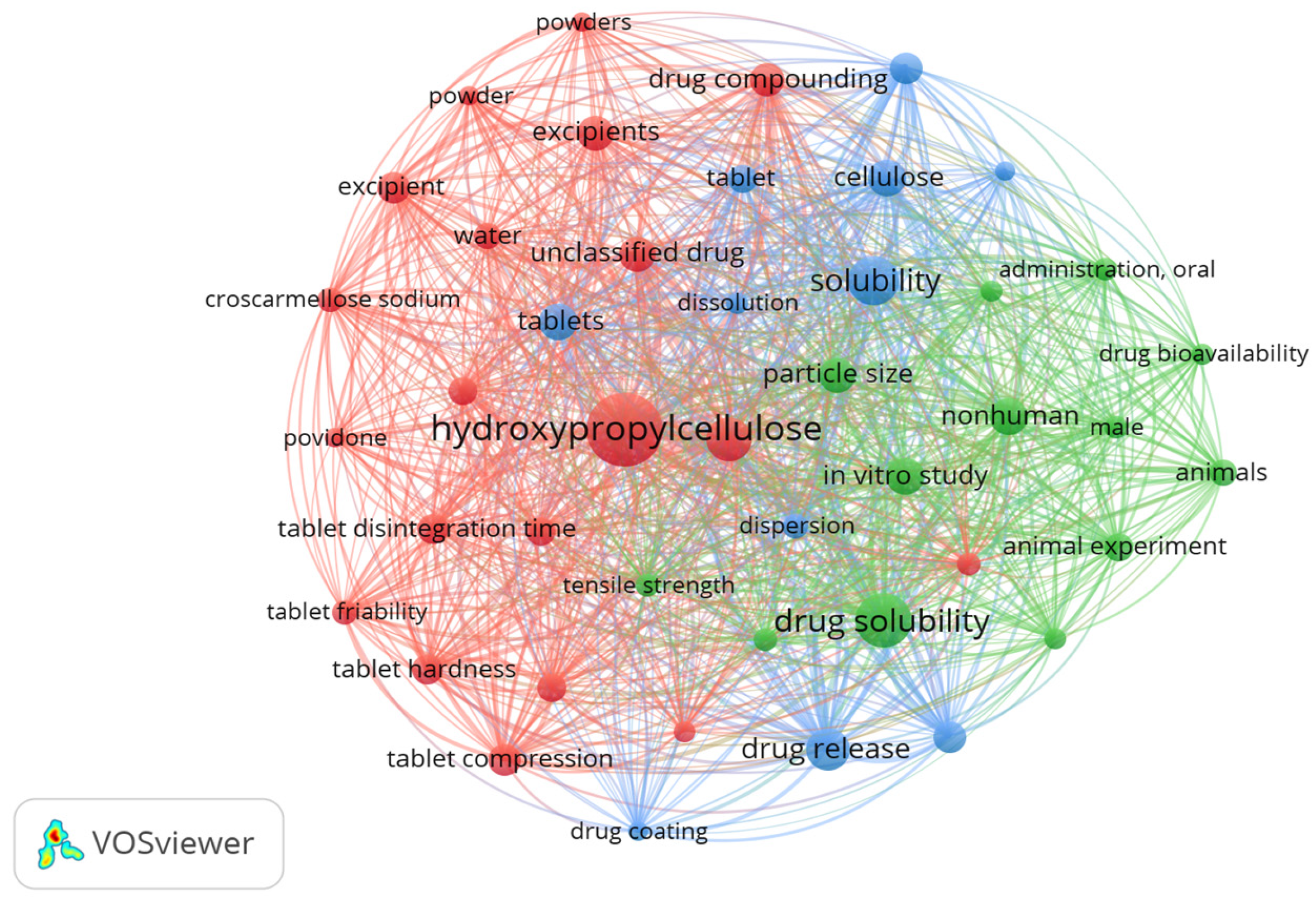
4.1. Co-Occurence Keywords Analysis
- The red cluster, centered on pharmaceutical applications, with strong associations with dissolution, amorphous solid dispersion, solid dispersion, hot-melt extrusion, and controlled/sustained release, underscores the critical function of H-HPC in drug delivery systems.
- The green cluster reflects functional materials and nanotechnology, including nanocomposites, nanoparticles, adsorption, and electrospinning, indicating the utilization of H-HPC in advanced functional materials.
- The blue cluster emphasizes emerging and niche applications, with keywords such as 3D printing, hydrogel, liquid crystal, and cholesteric liquid crystals, the latter linked to Bragg reflection, illustrating the specialized uses of H-HPC in optical and smart materials.
- The red cluster emphasizes excipients and tableting performance, with strong associations to excipients, tablet hardness, tablet compression, disintegration time, tablet friability, and tensile strength, underscoring the established role of L-HPC as a disintegrant and binder in solid dosage forms.
- The green cluster focuses on drug performance and bioavailability, encompassing terms such as drug solubility, bioavailability, in vitro studies, and animal experiments, highlighting the critical contribution of L-HPC to enhancing the dissolution and absorption of poorly soluble drugs.
- The blue cluster reflects the formulation processes and outcomes, including solubility, drug release, drug coating, and compounding, demonstrating the integration of L-HPC into diverse drug delivery strategies.

4.2. Role of H-HPC and L-HPC in Drug Delivery Systems
4.2.1. Solid Dispersions for Drug Solubility Enhancement
4.2.2. Versatile Excipient in Solid Dosage Forms
4.2.3. Advanced Controlled Drug Release Platforms
4.3. H-HPC as a Sustainable Functional Material
4.3.1. Advanced Adsorption
4.3.2. Nanomaterials
4.3.3. Optical and Smart Materials
5. Future Directions and Translational Opportunities of HPC Research
5.1. Green and Sustainable Synthesis
5.2. Advanced Functional Materials
5.3. Industrial Scale-Up and Regulatory Pathways
6. Conclusions
Supplementary Materials
Author Contributions
Funding
Data Availability Statement
Conflicts of Interest
References
- Mantovan, J.; Yamashita, F.; Mali, S. Modification of Orange Bagasse with Reactive Extrusion to Obtain Cellulose-Based Materials. Polysaccharides 2022, 3, 401–410. [Google Scholar] [CrossRef]
- Ungureanu, E.; Mikhailidi, A.; Tofanica, B.M.; Fortună, M.E.; Rotaru, R.; Ungureanu, O.C.; Samuil, C.; Popa, V.I. Sustainable Gels from Polysaccharides in Agriculture. Polysaccharides 2025, 6, 37. [Google Scholar] [CrossRef]
- Pirozzi, A.; Olivieri, F.; Castaldo, R.; Gentile, G.; Donsì, F. Cellulose Isolation from Tomato Pomace: Part II—Integrating High-Pressure Homogenization in a Cascade Hydrolysis Process for the Recovery of Nanostructured Cellulose and Bioactive Molecules. Foods 2023, 12, 3221. [Google Scholar] [CrossRef]
- Sunasee, R.; Hemraz, U.D. Synthetic Strategies for the Fabrication of Cationic Surface-Modified Cellulose Nanocrystals. Fibers 2018, 6, 15. [Google Scholar] [CrossRef]
- Etale, A.; Onyianta, A.J.; Turner, S.R.; Eichhorn, S.J. Cellulose: A Review of Water Interactions, Applications in Composites, and Water Treatment. Chem. Rev. 2023, 123, 2016–2048. [Google Scholar] [CrossRef] [PubMed]
- El Bourakadi, K.; Semlali, F.Z.; Hammi, M.; El Achaby, M. A Review on Natural Cellulose Fiber Applications: Empowering Industry with Sustainable Solutions. Int. J. Biol. Macromol. 2024, 281, 135773. [Google Scholar] [CrossRef] [PubMed]
- Kamthai, S.; Prom-u-thai, C.; Khaw-on, P.; Deenu, A.; Tachai, K. Potential of Agricultural Waste Fibers for Dialdehyde Carboxymethyl Cellulose Production. Polysaccharides 2025, 6, 12. [Google Scholar] [CrossRef]
- Bagheri, M. Preparation of Graft Copolymers of Cellulose Derivatives and Their Use in Recovery Processes. In Cellulose-Based Graft Copolymers; Thakur, V.K., Ed.; CRC Press: Boca Raton, FL, USA, 2015; pp. 356–385. [Google Scholar]
- Cremer, G.; Danthine, S.; Van Hoed, V.; Dombree, A.; Laveaux, A.S.; Damblon, C.; Karoui, R.; Blecker, C. Variability in the Substitution Pattern of Hydroxypropyl Cellulose Affects Its Physico-Chemical Properties. Heliyon 2023, 9, e13604. [Google Scholar] [CrossRef]
- Sheskey, P.J.; Cook, W.G.; Cable, C.G. (Eds.) Handbook of Pharmaceutical Excipients, 8th ed.; Pharmaceutical Press: London, UK, 2017; ISBN 9780857112712. [Google Scholar]
- Younes, M.; Aggett, P.; Aguilar, F.; Crebelli, R.; Dusemund, B.; Filipič, M.; Frutos, M.J.; Gundert-Remy, U.; Galtier, P.; Kuhnle, G.G.; et al. Safety of Low-Substituted Hydroxypropyl Cellulose (L-HPC) to Be Used as a Food Additive in Food Supplements in Tablet Form. Sci. Opin. 2018, 16, e05062. [Google Scholar] [CrossRef]
- Zhang, J.; Wang, S.; Tang, Y.; Liu, F.; Zhao, Y.; Chen, J.; Edgar, K. Dess-Martin Oxidation of Hydroxypropyl and Hydroxyethyl Cellulose, and Exploration of Their Polysaccharide/Polypeptide Hydrogels. Carbohydr Polym 2024, 328, 121732. [Google Scholar] [CrossRef]
- Wu, M.; Wang, H.; Liza, A.A.; Guo, L.; Zhu, W.; Song, J.; Zhang, F.; Liu, Y.; Jin, Y.; Guo, J. Cellulose-Based Photo-Curable Chiral Nematic Ink for Direct-Ink-Writing 3D Printing. Carbohydr. Polym. 2025, 352, 123159. [Google Scholar] [CrossRef]
- Wang, Y.; Tan, X.; Yang, X.; Qi, G.; Tu, Y. Hydroxypropyl Cellulose Thermochromic Hydrogel with Efficient Passive Radiative Cooling and Adjustable Visible Light Transmittance. Sol. Energy Mater. Sol. Cells 2024, 271, 112871. [Google Scholar] [CrossRef]
- Liu, R.; Guo, D.; Du, X.; Du, G.; Zhang, X. Fabrication of Surface-Carbonated Boron Nitride Nanosheets and Their Application as Water-Based Lubrication Additives. Wear 2025, 560–561, 205633. [Google Scholar] [CrossRef]
- Mishra, S.M.; Sauer, A. Effect of Physical Properties and Chemical Substitution of Excipient on Compaction and Disintegration Behavior of Tablet: A Case Study of Low-Substituted Hydroxypropyl Cellulose (L-HPC). Macromol 2022, 2, 113–130. [Google Scholar] [CrossRef]
- Dai, X.; Wang, J.; Yan, B.; Wang, Q.; Shen, Y.; Chen, Y.; Tian, Y. A Novel Lactose/MCC/L-HPC Triple-Based Co-Processed Excipients with Improved Tableting Performance Designed for Metoclopramide Orally Disintegrating Tablets. Pharmaceutics 2024, 16, 959. [Google Scholar] [CrossRef]
- Infante-Neta, A.A.; D’Almeida, A.P.; de Albuquerque, T.L. Bacterial Cellulose in Food Packaging: A Bibliometric Analysis and Review of Sustainable Innovations and Prospects. Processes 2024, 12, 1975. [Google Scholar] [CrossRef]
- Putra, N.R.; Ismail, A.; Sari, D.P.; Nurcholis, N.; Murwatono, T.T.; Rina, R.; Yuniati, Y.; Suwarni, E.; Sasmito, A.; Virliani, P.; et al. A Bibliometric Analysis of Cellulose Anti-Fouling in Marine Environments. Heliyon 2024, 10, e28513. [Google Scholar] [CrossRef]
- de Oliveira, J.P.; da Silva, I.B.; Costa, J.d.S.S.; de Oliveira, J.S.; Oliveira, E.L.; Coutinho, M.L.; de Almeida, M.E.F.; Landim, L.B.; da Silva, N.M.C.; de Oliveira, C.P. Bibliometric Study and Potential Applications in the Development of Starch Films with Nanocellulose: A Perspective from 2019 to 2023. Int. J. Biol. Macromol. 2024, 277, 133828. [Google Scholar] [CrossRef]
- Barrero-Fernández, A.; Aguado, R.; Moral, A.; Brindley, C.; Ballesteros, M. Applications of Cellulose-Based Agents for Flocculation Processes: A Bibliometric Analysis. Cellulose 2021, 28, 9857–9871. [Google Scholar] [CrossRef]
- Donthu, N.; Kumar, S.; Mukherjee, D.; Pandey, N.; Lim, W.M. How to Conduct a Bibliometric Analysis: An Overview and Guidelines. J. Bus. Res. 2021, 133, 285–296. [Google Scholar] [CrossRef]
- Nuar, A.N.A.; Sen, S.C. Examining the Trend of Research on Big Data Architecture: Bibliometric Analysis Using Scopus Database. Procedia Comput. Sci. 2024, 234, 172–179. [Google Scholar] [CrossRef]
- Kirby, A. Exploratory Bibliometrics: Using VOSviewer as a Preliminary Research Tool. Publications 2023, 11, 10. [Google Scholar] [CrossRef]
- Ribas, L.V.d.S.; Segundo, I.G.R.; Carneiro, J.; de Freitas, E.F.; Branco, V.T.F.C. Research Trends on Thermochromic Asphalt Mixtures Functionalization: Bibliometric Analysis and Review. Clean. Mater. 2024, 14, 100273. [Google Scholar] [CrossRef]
- Page, M.J.; McKenzie, J.E.; Bossuyt, P.M.; Boutron, I.; Hoffmann, T.C.; Mulrow, C.D.; Shamseer, L.; Tetzlaff, J.M.; Akl, E.A.; Brennan, S.E.; et al. The PRISMA 2020 Statement: An Updated Guideline for Reporting Systematic Reviews. BMJ 2021, 372, 71. [Google Scholar] [CrossRef] [PubMed]
- Pranckutė, R. Web of Science (WoS) and Scopus: The Titans of Bibliographic Information in Today’s Academic World. Publications 2021, 9, 12. [Google Scholar] [CrossRef]
- Medina-mijangos, R.; Seguí-amórtegui, L. Research Trends in the Economic Analysis of Municipal Solid Waste Management Systems: A Bibliometric Analysis from 1980 to 2019. Sustainability 2020, 12, 8509. [Google Scholar] [CrossRef]
- Zhou, Y.; Wan, C.; Yang, Y.; Yang, H.; Wang, S.; Dai, Z.; Ji, K.; Jiang, H.; Chen, X.; Long, Y. Highly Stretchable, Elastic, and Ionic Conductive Hydrogel for Artificial Soft Electronics. Adv. Funct. Mater. 2019, 29, 1806220. [Google Scholar] [CrossRef]
- Zimmermann, T.; Bordeanu, N.; Strub, E. Properties of Nanofibrillated Cellulose from Different Raw Materials and Its Reinforcement Potential. Carbohydr. Polym. 2010, 79, 1086–1093. [Google Scholar] [CrossRef]
- Pietrzak, K.; Isreb, A.; Alhnan, M.A. A Flexible-Dose Dispenser for Immediate and Extended Release 3D Printed Tablets. Eur. J. Pharm. Biopharm. 2015, 96, 380–387. [Google Scholar] [CrossRef]
- Jiang, B.; He, Y.; Li, B.; Zhao, S.; Wang, S.; He, Y.B.; Lin, Z. Polymer-Templated Formation of Polydopamine-Coated SnO2Nanocrystals: Anodes for Cyclable Lithium-Ion Batteries. Angew. Chem. Int. Ed. 2017, 56, 1869–1872. [Google Scholar] [CrossRef]
- Melocchi, A.; Parietti, F.; Loreti, G.; Maroni, A.; Gazzaniga, A.; Zema, L. 3D Printing by Fused Deposition Modeling (FDM) of a Swellable/Erodible Capsular Device for Oral Pulsatile Release of Drugs. J. Drug Deliv. Sci. Technol. 2015, 30, 360–367. [Google Scholar] [CrossRef]
- Frey, M.W. Electrospinning Cellulose and Cellulose Derivatives. Polym. Rev. 2008, 48, 378–391. [Google Scholar] [CrossRef]
- Chai, X.; Chai, H.; Wang, X.; Yang, J.; Li, J.; Zhao, Y.; Cai, W.; Tao, T.; Xiang, X. Fused Deposition Modeling (FDM) 3D Printed Tablets for Intragastric Floating Delivery of Domperidone. Sci. Rep. 2017, 7, 2829. [Google Scholar] [CrossRef] [PubMed]
- Zhang, Z.; Chen, Z.; Wang, Y.; Zhao, Y. Bioinspired Conductive Cellulose Liquid-Crystal Hydrogels as Multifunctional Electrical Skins. Proc. Natl. Acad. Sci. USA 2020, 117, 18310–18316. [Google Scholar] [CrossRef]
- Goyanes, A.; Allahham, N.; Trenfield, S.J.; Stoyanov, E.; Gaisford, S.; Basit, A.W. Direct Powder Extrusion 3D Printing: Fabrication of Drug Products Using a Novel Single-Step Process. Int. J. Pharm. 2019, 567, 118471. [Google Scholar] [CrossRef]
- Lee, S.Y.; Chun, S.J.; Kang, I.A.; Park, J.Y. Preparation of Cellulose Nanofibrils by High-Pressure Homogenizer and Cellulose-Based Composite Films. J. Ind. Eng. Chem. 2009, 15, 50–55. [Google Scholar] [CrossRef]
- DiNunzio, J.C.; Brough, C.; Hughey, J.R.; Miller, D.A.; Williams, R.O.; McGinity, J.W. Fusion Production of Solid Dispersions Containing a Heat-Sensitive Active Ingredient by Hot Melt Extrusion and Kinetisol® Dispersing. Eur. J. Pharm. Biopharm. 2010, 74, 340–351. [Google Scholar] [CrossRef]
- Shimoda, H.; Taniguchi, K.; Nishimura, M.; Matsuura, K.; Tsukioka, T.; Yamashita, H.; Inagaki, N.; Hirano, K.; Yamamoto, M.; Kinosada, Y.; et al. Preparation of a Fast Dissolving Oral Thin Film Containing Dexamethasone: A Possible Application to Antiemesis during Cancer Chemotherapy. Eur. J. Pharm. Biopharm. 2009, 73, 361–365. [Google Scholar] [CrossRef]
- Shen, B.D.; Shen, C.Y.; Yuan, X.D.; Bai, J.X.; Lv, Q.Y.; Xu, H.; Dai, L.; Yu, C.; Han, J.; Yuan, H.L. Development and Characterization of an Orodispersible Film Containing Drug Nanoparticles. Eur. J. Pharm. Biopharm. 2013, 85, 1348–1356. [Google Scholar] [CrossRef]
- Rawas-Qalaji, M.M.; Estelle, F.; Simons, R.; Simons, K.J. Fast-Disintegrating Sublingual Tablets: Effect of Epinephrine Load on Tablet Characteristics. AAPS PharmSciTech 2006, 7, E72–E78. [Google Scholar] [CrossRef]
- Airaksinen, S.; Karjalainen, M.; Kivikero, N.; Westermarck, S.; Shevchenko, A.; Rantanen, J.; Yliruusi, J. Excipient Selection Can Significantly Affect Solid-State Phase Transformation in Formulation During Wet Granulation. AAPS PharmSciTech 2005, 6, 311–322. [Google Scholar] [CrossRef] [PubMed][Green Version]
- Douroumis, D.D.; Gryczke, A.; Schminke, S. Development and Evaluation of Cetirizine HCl Taste-Masked Oral Disintegrating Tablets. AAPS PharmSciTech 2011, 12, 141–151. [Google Scholar] [CrossRef]
- Dashevsky, A.; Mohamad, A. Development of Pulsatile Multiparticulate Drug Delivery System Coated with Aqueous Dispersion Aquacoat® ECD. Int. J. Pharm. 2006, 318, 124–131. [Google Scholar] [CrossRef] [PubMed]
- Tanaka, N.; Imai, K.; Okimoto, K.; Ueda, S.; Tokunaga, Y.; Ohike, A.; Ibuki, R.; Higaki, K.; Kimura, T. Development of Novel Sustained-Release System, Disintegration-Controlled Matrix Tablet (DCMT) with Solid Dispersion Granules of Nilvadipine. J. Control. Release 2005, 108, 386–395. [Google Scholar] [CrossRef]
- Yan, Y.-D.; Woo, J.S.; Kang, J.H.; Yong, C.S.; Choi, H.-G. Preparation and Evaluation of Taste-Masked Donepezil Hydrochloride Orally Disintegrating Tablets. Biol. Pharm. Bull. 2010, 33, 1364–1370. [Google Scholar] [CrossRef]
- Quinten, T.; Gonnissen, Y.; Adriaens, E.; De Beer, T.; Cnudde, V.; Masschaele, B.; Van Hoorebeke, L.; Siepmann, J.; Remon, J.P.; Vervaet, C. Development of Injection Moulded Matrix Tablets Based on Mixtures of Ethylcellulose and Low-Substituted Hydroxypropylcellulose. Eur. J. Pharm. Sci. 2009, 37, 207–216. [Google Scholar] [CrossRef]
- Tsilika, K. Exploring the Contributions to Mathematical Economics: A Bibliometric Analysis Using Bibliometrix and VOSviewer. Mathematics 2023, 11, 4703. [Google Scholar] [CrossRef]
- Oke, J.A.; Olotu, O.O.; Jen, T.C. Atomic Layer Deposition of Chalcogenide Thin Films: Processes, Film Properties, Applications, and Bibliometric Prospect. J. Mater. Res. Technol. 2022, 20, 991–1019. [Google Scholar] [CrossRef]
- Kek, H.Y.; Tan, H.; Othman, M.H.D.; Lee, C.T.; Ahmad, F.B.J.; Ismail, N.D.; Nyakuma, B.B.; Lee, K.Q.; Wong, K.Y. Transforming Pollution into Solutions: A Bibliometric Analysis and Sustainable Strategies for Reducing Indoor Microplastics While Converting to Value-Added Products. Environ. Res. 2024, 252, 118928. [Google Scholar] [CrossRef]
- Assim Haq, S.; Paudwal, G.; Banjare, N.; Iqbal Andrabi, N.; Wazir, P.; Nandi, U.; Ahmed, Z.; Gupta, P.N. Sustained Release Polymer and Surfactant Based Solid Dispersion of Andrographolide Exhibited Improved Solubility, Dissolution, Pharmacokinetics, and Pharmacological Activity. Int. J. Pharm. 2024, 651, 123786. [Google Scholar] [CrossRef]
- Petkov, V.; Vinarov, Z.; Tcholakova, S. Mechanisms of Dissolution and Crystallization of Amorphous Glibenclamide. Int. J. Pharm. 2024, 666, 124820. [Google Scholar] [CrossRef] [PubMed]
- Wang, X.; Zhang, L.; Ma, D.; Tang, X.; Zhang, Y.; Yin, T.; Gou, J.; Wang, Y.; He, H. Characterizing and Exploring the Differences in Dissolution and Stability Between Crystalline Solid Dispersion and Amorphous Solid Dispersion. AAPS PharmSciTech 2020, 21, 262. [Google Scholar] [CrossRef] [PubMed]
- Pöstges, F.; Kayser, K.; Stoyanov, E.; Wagner, K.G. Boost of Solubility and Supersaturation of Celecoxib via Synergistic Interactions of Methacrylic Acid-Ethyl Acrylate Copolymer (1:1) and Hydroxypropyl Cellulose in Ternary Amorphous Solid Dispersions. Int. J. Pharm. X 2022, 4, 100115. [Google Scholar] [CrossRef] [PubMed]
- Pöstges, F.; Lenhart, J.; Stoyanov, E.; Lunter, D.J.; Wagner, K.G. Phase Homogeneity in Ternary Amorphous Solid Dispersions and Its Impact on Solubility, Dissolution and Supersaturation—Influence of Processing and Hydroxypropyl Cellulose Grade. Int. J. Pharm. X 2023, 6, 100222. [Google Scholar] [CrossRef]
- Sauer, A.; Warashina, S.; Mishra, S.M.; Lesser, I.; Kirchhöfer, K. Downstream Processing of Spray-Dried ASD with Hypromellose Acetate Succinate—Roller Compaction and Subsequent Compression into High ASD Load Tablets. Int. J. Pharm. X 2021, 3, 100099. [Google Scholar] [CrossRef]
- Danda, L.J.d.A.; Schver, G.C.R.d.M.; Sobrinho, J.L.S.; Lee, P.I.; Soares, M.F.d.L.R. Amorphous Solid Dispersions in High-Swelling, Low-Substituted Hydroxypropyl Cellulose for Enhancing the Delivery of Poorly Soluble Drugs. Int. J. Pharm. 2023, 642, 123122. [Google Scholar] [CrossRef]
- Dahma, Z.; Ibáñez-Escribano, A.; Fonseca-Berzal, C.; García-Rodríguez, J.J.; Álvarez-Álvarez, C.; Torrado-Salmerón, C.; Torrado-Santiago, S.; de la Torre-Iglesias, P.M. Development, Characterization, and Cellular Toxicity Evaluation of Solid Dispersion-Loaded Hydrogel Based on Indomethacin. Polymers 2024, 16, 2174. [Google Scholar] [CrossRef]
- Picker-Freyer, K.M.; Dürig, T. Physical Mechanical and Tablet Formation Properties of Hydroxypropylcellulose: In Pure Form and in Mixtures. AAPS PharmSciTech 2007, 8, 82–90. [Google Scholar] [CrossRef]
- Takeuchi, Y.; Ikeda, N.; Tahara, K.; Takeuchi, H. Mechanical Characteristics of Orally Disintegrating Films: Comparison of Folding Endurance and Tensile Properties. Int. J. Pharm. 2020, 589, 119876. [Google Scholar] [CrossRef]
- Takeuchi, Y.; Nishimatsu, T.; Tahara, K.; Takeuchi, H. Novel Use of Insoluble Particles as Disintegration Enhancers for Orally Disintegrating Films. J. Drug Deliv. Sci. Technol. 2019, 54, 101310. [Google Scholar] [CrossRef]
- Gazzaniga, A.; Cerea, M.; Cozzi, A.; Foppoli, A.; Maroni, A.; Zema, L. A Novel Injection-Molded Capsular Device for Oral Pulsatile Delivery Based on Swellable/Erodible Polymers. AAPS PharmSciTech 2011, 12, 295–303. [Google Scholar] [CrossRef]
- Ruan, X.; Gao, X.; Gao, Y.; Peng, L.; Ji, H.; Guo, D.; Jiang, S. Preparation and in Vitro Release Kinetics of Ivermectin Sustained-Release Bolus Optimized by Response Surface Methodology. PeerJ 2018, 2018, e5418. [Google Scholar] [CrossRef] [PubMed]
- Diós, P.; Pernecker, T.; Nagy, S.; Pál, S.; Dévay, A. Influence of Different Types of Low Substituted Hydroxypropyl Cellulose on Tableting, Disintegration, and Floating Behaviour of Floating Drug Delivery Systems. Saudi Pharm. J. 2015, 23, 658–666. [Google Scholar] [CrossRef] [PubMed]
- Saleh-Bey-Kinj, Z.; Heller, Y.; Socratous, G.; Christodoulou, P. 3D Printing in Oral Drug Delivery: Technologies, Clinical Applications and Future Perspectives in Precision Medicine. Pharmaceuticals 2025, 18, 973. [Google Scholar] [CrossRef] [PubMed]
- Patil, H.; Vemula, S.K.; Narala, S.; Lakkala, P.; Munnangi, S.R.; Narala, N.; Jara, M.O.; Williams, R.O.; Terefe, H.; Repka, M.A. Hot-Melt Extrusion: From Theory to Application in Pharmaceutical Formulation—Where Are We Now? AAPS PharmSciTech 2024, 25, 37. [Google Scholar] [CrossRef]
- Nashed, N.; Greenland, B.W.; Majumder, M.; Lam, M.; Ghafourian, T.; Nokhodchi, A. The Effect of Manufacturing Method; Direct Compression, Hot-Melt Extrusion, and 3D Printing on Polymer Stability and Drug Release from Polyethylene Oxide Tablets. Int. J. Bioprint. 2024, 10, 406–424. [Google Scholar] [CrossRef]
- Kim, Y.J.; Choi, Y.R.; Kang, J.H.; Park, Y.S.; Kim, D.W.; Park, C.W. Geometry-Driven Fabrication of Mini-Tablets via 3D Printing: Correlating Release Kinetics with Polyhedral Shapes. Pharmaceutics 2024, 16, 783. [Google Scholar] [CrossRef]
- Arafat, B.; Wojsz, M.; Isreb, A.; Forbes, R.T.; Isreb, M.; Ahmed, W.; Arafat, T.; Alhnan, M.A. Tablet Fragmentation without a Disintegrant: A Novel Design Approach for Accelerating Disintegration and Drug Release from 3D Printed Cellulosic Tablets. Eur. J. Pharm. Sci. 2018, 118, 191–199. [Google Scholar] [CrossRef]
- Forster, J.S.; Souza, D.S.S.; Zambuzi, G.C.; Tartare, V.A.P.; Bega, B.S.; Chagas, R.C.R.; Freitas, O.; Silva, L.L.; Francisco, K.R. Clay-Gelatin/Hydroxypropyl Cellulose Composite Films for Methylene Blue Adsorption. Colloids Surfaces A Physicochem. Eng. Asp. 2024, 700, 134846. [Google Scholar] [CrossRef]
- Guerrero, R.; Acibar, C.; Alarde, C.M.; Maslog, J.; Pacilan, C.J. Evaluation of Pb (II) Removal from Water Using Sodium Alginate/Hydroxypropyl Cellulose Beads. In Proceedings of the E3S Web of Conferences, Bali, Indonesia, 5–7 November 2019; Volume 148. [Google Scholar]
- Cheng, L.; Mo, Z.; Zhang, Q.; Yang, M.; Liao, X.; Qiu, L.; Wang, S.; Yang, X.; Hu, X. Development of Hydroxypropyl Cellulose and Graphene Oxide Modified Molecularly Imprinted Polymers for Separation and Enrichment of Podophyllotoxin. J. Chromatogr. A 2023, 1711, 464452. [Google Scholar] [CrossRef]
- Zhao, W.; Chi, H.; Zhang, X.; Wang, Y.; Li, T. Cellulose/Silsesquioxane Grafted Ti3C2Tx MXene for Synergistically Enhanced Adsorption of Uranium. Colloids Surfaces A Physicochem. Eng. Asp. 2022, 650, 129610. [Google Scholar] [CrossRef]
- Gunaki, M.N.; Masti, S.P.; D’souza, O.J.; Eelager, M.P.; Kurabetta, L.K.; Chougale, R.B.; Kadapure, A.J.; Praveen Kumar, S.K. Fabrication of CuO Nanoparticles Embedded Novel Chitosan/Hydroxypropyl Cellulose Bio-Nanocomposites for Active Packaging of Jamun Fruit. Food Hydrocoll. 2024, 152, 109937. [Google Scholar] [CrossRef]
- Koochakzaei, A.; Ghane, Z.; Mohammadi Achachluei, M. Zinc Oxide Nanoparticles in Leather Conservation: Exploring the Potential of Hydroxypropyl Cellulose/Zinc Oxide Nanocomposite as a Leather Consolidation Agent. Heritage 2023, 6, 7547–7558. [Google Scholar] [CrossRef]
- Huang, L.; Zhang, X.; Deng, L.; Wang, Y.; Liu, Y.; Zhu, H. Sustainable Cellulose-Derived Organic Photonic Gels with Tunable and Dynamic Structural Color. ACS Nano 2024, 18, 3627–3635. [Google Scholar] [CrossRef] [PubMed]
- Chan, C.L.C.; Bay, M.M.; Jacucci, G.; Vadrucci, R.; Williams, C.A.; van de Kerkhof, G.T.; Parker, R.M.; Vynck, K.; Frka-Petesic, B.; Vignolini, S. Visual Appearance of Chiral Nematic Cellulose-Based Photonic Films: Angular and Polarization Independent Color Response with a Twist. Adv. Mater. 2019, 31, e1905151. [Google Scholar] [CrossRef] [PubMed]
- Barty-King, C.H.; Chan, C.L.C.; Parker, R.M.; Bay, M.M.; Vadrucci, R.; De Volder, M.; Vignolini, S. Mechanochromic, Structurally Colored, and Edible Hydrogels Prepared from Hydroxypropyl Cellulose and Gelatin. Adv. Mater. 2021, 33, e2102112. [Google Scholar] [CrossRef] [PubMed]
- Feng, Y.; Wang, S.; Li, Y.; Ma, W.; Zhang, G.; Yang, M.; Li, H.; Yang, Y.; Long, Y. Entanglement in Smart Hydrogels: Fast Response Time, Anti-Freezing and Anti-Drying. Adv. Funct. Mater. 2023, 33, 2211027. [Google Scholar] [CrossRef]
- Ming, Y.; Sun, Y.; Liu, X.; Liu, X.; Wu, Y. Optical Evaluation of a Smart Transparent Insulation Material for Window Application. Energy Convers. Manag. X 2022, 16, 100315. [Google Scholar] [CrossRef]
- Zhang, L.; Xia, H.; Xia, F.; Du, Y.; Wu, Y.; Gao, Y. Energy-Saving Smart Windows with HPC/PAA Hybrid Hydrogels as Thermochromic Materials. ACS Appl. Energy Mater. 2021, 4, 9783–9791. [Google Scholar] [CrossRef]
- Nakamura, A.; Ogai, R.; Murakami, K. Development of Smart Window Using an Hydroxypropyl Cellulose-Acrylamide Hydrogel and Evaluation of Weathering Resistance and Heat Shielding Effect. Sol. Energy Mater. Sol. Cells 2021, 232, 111348. [Google Scholar] [CrossRef]
- Palmieri, E.; Pescosolido, F.; Montaina, L.; Carcione, R.; Petrella, G.; Cicero, D.O.; Tamburri, E.; Battistoni, S.; Orlanducci, S. A Sustainable Hydroxypropyl Cellulose-Nanodiamond Composite for Flexible Electronic Applications. Gels 2022, 8, 783. [Google Scholar] [CrossRef]
- Xia, C.; Shu, X. Propylene Epoxidation with Hydrogen Peroxide. J. Energy Chem. 2025, 105, 869–871. [Google Scholar] [CrossRef]
- Nigussie, G.Y.; Tsai, Y.F.; Yang, T.C.; Yang, C.M.; Yu, S.S.F. An Efficient H2O2-Based Propylene to Propylene Oxide (HPPO) Reaction Catalyzed by ZnO/ZnO2 Materials. J. Mater. Chem. A Mater. 2025, 13, 5261–5274. [Google Scholar] [CrossRef]
- Duval, A.; Avérous, L. Oxyalkylation of Condensed Tannin with Propylene Carbonate as an Alternative to Propylene Oxide. ACS Sustain. Chem. Eng. 2016, 4, 3103–3112. [Google Scholar] [CrossRef]
- Wu, J.; Guo, Z.; Zhang, T.; Jiao, Y.; Kang, H.; Liu, R. Efficient Homogeneous Derivatization of Cellulose in Ditetrabutylammonium Hydrogen Phosphate/Dimethyl Sulfoxide. Cellulose 2025, 32, 7647–7658. [Google Scholar] [CrossRef]
- You, J.; Zhang, X.; Mi, Q.; Zhang, J.; Wu, J.; Zhang, J. Mild, Rapid and Efficient Etherification of Cellulose. Cellulose 2022, 29, 9583–9596. [Google Scholar] [CrossRef]
- Cao, X.; Wu, B.; Chen, J.; Liu, Z.; Yang, Y.; Li, S.; Zhu, H.; Xu, L.; Huang, H. Hydroxypropyl Cellulose-Based Orally Dissolving Film Loaded with Insoluble Dexamethasone for Treatment of Oral Ulcers. Mol. Pharm. 2024, 21, 4012–4023. [Google Scholar] [CrossRef]
- Danda, L.J.d.A.; Amaral, A.R.d.C.; Soares-Sobrinho, J.L.; Soares, M.F.d.L.R. Optimizing Nonsink Dissolution Testing for Amorphous Solid Dispersions: Exploring Sample Handling Variables. Mol Pharm 2024, 21, 1861–1871. [Google Scholar] [CrossRef]
- Tian, W.-X.; Xue, A.-L.; Li, W.-J.; Zheng, M.-Y.; Xian, J.-C.; Hong, Y.-L. Composite Excipients for Preparing Concentrated Water Pills of Personalized Traditional Chinese Medicine Prescriptions by Extruding-Rounding Method. Zhongguo Zhongyao Zazhi 2024, 49, 607–617. [Google Scholar]
- Li, D.; Luo, Q.; Liu, Q.; Chen, S.; Zhang, X.; Zhao, C.; Cheng, J.; Wu, Y.; Song, F. Edible Cellulose-Based Photonic Crystals with Low-Temperature Response for Food Sensing. Carbohydr. Polym. 2025, 367, 124029. [Google Scholar] [CrossRef]
- Ren, H.; Sodipo, I.O.; Dumanli, A.G. Stretchable Cellulosic Cholesteric Liquid Crystal Filaments with Color Response. ACS Appl. Polym. Mater. 2025, 7, 4093–4098. [Google Scholar] [CrossRef]
- Qin, Q.; Xu, Y. Hydroxypropyl Cellulose-Based Meter-Long Structurally Colored Fibers for Advanced Fabrics. Adv. Sci. 2024, 11, e2404761. [Google Scholar] [CrossRef]
- Huang, L.; Zhang, X.; Xu, C.; Wang, J.; Zhang, A.; Liu, Y.; Zhu, H. Chiral Sensing of Amino Acids under Visible Light via Hydroxypropyl Cellulose Gels. Adv. Opt. Mater. 2025, 13, 2500053. [Google Scholar] [CrossRef]
- Mizobuchi, S.; Hirose, K.; Ishii, N.; Kawano, Y.; Hanawa, T. Preparation and Characterization of the Ground Mixture of Rebamipide Commercial Tablets and Hydroxypropyl Cellulose-SSL by Ball-Milling: Application to the Dispersoid of Mouthwash Suspension. Eur. J. Pharm. Biopharm. 2025, 206, 114584. [Google Scholar] [CrossRef] [PubMed]
- Arabyazdi, S.; Givarian, M.; Haghbin Nazarpak, M.; Yazdanpanah, A.; Moztarzadeh, F. Thermo-Responsive Doxorubicin Release from Bioactive Glass/Hydroxypropyl Cellulose Smart Core-Shell Nanoparticles for Bone Cancer Therapy. J. Drug Deliv. Sci. Technol. 2025, 109, 107020. [Google Scholar] [CrossRef]
- Asif Iqbal, M.; Hassan, S.U.; Mahmood, A.; Al-Masry, W.; Lee, J.; Lee, H.J.; Akhter, T.; Park, C.H. Dual Responsive Phase Behavior of Nonionic Cellulose-Based Polymer Brushes by Visible-Light-Driven Organocatalyzed Atom Transfer Radical Polymerization. Int. J. Biol. Macromol. 2025, 305, 140856. [Google Scholar] [CrossRef] [PubMed]
- Martellone, S.; Molino, D.; Arcoraci, D.; Mogli, G.; Serrapede, M.; Ferraro, G.; Pedico, A.; Bocchini, S.; Zaccagnini, P.; Lamberti, A. Hydroxypropyl Cellulose as Fluorine-Free Alternative Binder for Aqueous Supercapacitors. J. Energy Storage 2025, 131, 117532. [Google Scholar] [CrossRef]
- Ye, Z.; Meng, Q.; Yu, H.; Shi, S.; Wang, Y.; Lan, Z.; Liao, J.; Sun, Q.; Shen, X. Cellulose/Chitosan Film Based Triboelectric-Piezoelectric Coupled Nanogenerator for Wearable Mechanosensing and Energy Harvesting. Int. J. Biol. Macromol. 2025, 315, 144647. [Google Scholar] [CrossRef]
- Wang, Y.; Tan, X.; Yang, X.; Qiao, Y.; Tsamis, A.; Qi, G.; Shi, C.; Chen, S. Freeze Resistant Hydroxypropyl Cellulose Hydrogel with Passive Radiative Cooling Performance for Thermochromic Smart Window. Chem. Eng. J. 2025, 510, 161797. [Google Scholar] [CrossRef]





| Properties | Test Conditions | H-HPC * | L-HPC * |
|---|---|---|---|
| Hydroxypropoxy groups (%) | 53.4–80.5 | 5–16 | |
| Bulk density (g/cm3) | ≈5 | 0.21–0.48 ** | |
| pH | 5–8 | 5–7.5 | |
| Moisture content (%) | ≤5 | ≤ 6 | |
| Particle size (µm) | Regular grind | 350–840 | - |
| Particle size (µm) | Fine grind | 45–250 | 40–200 |
| Molecular weight (MW) | 40,000–1,150,000 | 30,000–150,000 *** | |
| Dynamic Viscosity (mPa.s) | 2% of aqueous solution at 20 °C | 2–4000 ** | - |
| Dynamic Viscosity (mPa.s) | 2% of aqueous solution at 25 °C | 150–6500 ** | - |
| Solubility in water | Below 38 °C/40–45 °C | Soluble/Insoluble | Insoluble |
| Solubility in organic solvents | Hot/cold polar organic solvents | Soluble | Insoluble |
| No. | HPC Type | Applications | Key Findings | Reference |
|---|---|---|---|---|
| 1 | H-HPC | Hydrogel for wound dressing | Oxidized HPC obtained via Dess-Martin oxidation exhibited low cytotoxicity and proved suitable for a wound dressing hydrogel cross-linked with α-poly-L-lysine | [12] |
| 2 | H-HPC | Direct-ink-writing (DIW) 3D printing | HPC was cross-linked with acryloyl chloride to yield photonic hydroxypropyl cellulose acrylate (HPCA), enabling photonic crystal inks for color structure 3D printing | [13] |
| 3 | H-HPC | Hydrogel for radiative cooling | HPC hydrogel radiative cooler exhibited high emissivity, strong light modulation, and surface temperature reduction for energy-saving window and building applications | [14] |
| 4 | H-HPC | Surface modification | HPC acted as a surface modifier for Boron Nitride Nanosheets, enabling carbonized nanosheets with stable dispersion and improved lubricant additive performance. | [15] |
| 5 | L-HPC | Tablet disintegration | L-HPC particle size and hydroxypropyl content significantly influence tablet disintegration behavior in formulation design | [16] |
| 6 | L-HPC | Tablet disintegration | L-HPC in lactose/MCC co-processed excipients enabled Orally Disintegrating Tablets (ODTs) with <25 s disintegration and faster drug absorption. | [17] |
| Publication Year | Dominant Research Area (%) | |||
|---|---|---|---|---|
| Materials | Chemistry | Pharmaceutics | Engineering | |
| 2006 | 20.9 | 20.9 | 16.4 | 7.3 |
| 2011 | 20.6 | 14.3 | 21.4 | 11.1 |
| 2015 | 21.7 | 23.9 | 16.7 | 5.8 |
| 2020 | 21.7 | 16.4 | 21.1 | 5.9 |
| 2024 | 24.2 | 16.3 | 7.9 | 12.1 |
| No. | Publication Title | Applications | Cited Reference | Total Citation * |
|---|---|---|---|---|
| 1 | Highly stretchable, elastic, and ionic conductive hydrogel for artificial soft electronics | Tissue engineering | [29] | 838 |
| 2 | Properties of nanofibrillated cellulose from different raw materials and its reinforcement potential | Nanocomposites | [30] | 485 |
| 3 | A flexible-dose dispenser for immediate and extended release 3D printed tablets | 3D printing tablets | [31] | 382 |
| 4 | Polymer-templated formation of polydopamine-coated SnO2 nanocrystals: Anodes for cyclable lithium-ion batteries | Energy storage | [32] | 285 |
| 5 | 3D printing by fused deposition modeling (FDM) of a swellable/erodible capsular device for oral pulsatile release of drugs | Drug delivery systems | [33] | 273 |
| 6 | Electrospinning cellulose and cellulose derivatives | Nanomaterials | [34] | 265 |
| 7 | Fused deposition modeling (FDM) 3D printed tablets for intragastric floating delivery of domperidone | Drug delivery systems | [35] | 249 |
| 8 | Bioinspired conductive cellulose liquid-crystal hydrogels as multifunctional electrical skins | Nanocomposites | [36] | 240 |
| 9 | Direct powder extrusion 3D printing: Fabrication of drug products using a novel single-step process | Drug delivery systems | [37] | 226 |
| 10 | Preparation of cellulose nanofibrils by high-pressure homogenizer and cellulose-based composite films | Nanocomposites | [38] | 221 |
| No. | Publication Title | Applications | Cited Reference | Total Citation * |
|---|---|---|---|---|
| 1 | Fusion production of solid dispersions containing a heat-sensitive active ingredient by hot melt extrusion and Kinetisol® dispersing | Solid dispersion technology | [39] | 125 |
| 2 | Preparation of a fast dissolving oral thin film containing dexamethasone: A possible application to antiemesis during cancer chemotherapy | ODFs | [40] | 108 |
| 3 | Development and characterization of an orodispersible film containing drug nanoparticles | ODFs | [41] | 88 |
| 4 | Fast-disintegrating sublingual tablets: Effect of epinephrine load on tablet characteristics | ODTs | [42] | 75 |
| 5 | Excipient selection can significantly affect solid-state phase transformation in formula wet granulation | ODTs | [43] | 75 |
| 6 | Development and evaluation of cetirizine HCl taste-masked oral disintegrating tablets | ODTs | [44] | 74 |
| 7 | Development of pulsatile multiparticulate drug delivery system coated with aqueous dispersion Aquacoat® ECD | ODTs | [45] | 73 |
| 8 | Development of novel sustained-release system, disintegration-controlled matrix tablet (DCMT) with solid dispersion granules of nilvadipine | ODTs | [46] | 70 |
| 9 | Preparation and evaluation of taste-masked donepezil hydrochloride orally disintegrating tablets | ODTs | [47] | 69 |
| 10 | Development of injection moulded matrix tablets based on mixtures of ethylcellulose and low-substituted hydroxypropylcellulose | ODTs | [48] | 62 |
| No. | Author Name | Total Publication | First Author | Multi-Authored | DF * |
|---|---|---|---|---|---|
| 1 | Talik, P | 6 | 6 | 6 | 1.00 |
| 2 | Li, M | 6 | 5 | 6 | 0.83 |
| 3 | Mohammadi, MR | 6 | 5 | 6 | 0.83 |
| 4 | Angelova, T | 5 | 4 | 5 | 0.80 |
| 5 | Barzic, AI | 5 | 4 | 5 | 0.80 |
| 6 | Echeverria, C | 5 | 4 | 5 | 0.80 |
| 7 | Liu, X | 5 | 4 | 5 | 0.80 |
| 8 | Maghsoodi, M | 5 | 4 | 5 | 0.80 |
| 9 | Rahman, M | 5 | 4 | 5 | 0.80 |
| 10 | Hussain, MA | 13 | 9 | 13 | 0.69 |
| No. | Recent Technologies | Applications | Key Findings | Reference |
|---|---|---|---|---|
| 1 | Photonic sensors | Smart packaging | Edible, low-temperature-responsive photonic crystal sensors from H-HPC and ethanol, enabling real-time, visual monitoring of storage conditions down to −35 °C with tunable color modulation based on ethanol concentration. | [93] |
| 2 | Mechanochromic filaments | Smart wearables and color-shifting materials | Stretchable cholesteric cellulosic liquid crystal filaments from H-HPC in elastomeric tubing, showing mechanochromic response to mechanical deformation with a blue shift and recovery to original color, suitable for scalable applications. | [94] |
| 3 | Structurally colored fibers | Textiles and functional materials | A scalable method for producing H-HPC-based structurally colored fibers with tunable optical properties is presented, offering excellent stability against mechanical treatments, water, and heating. | [95] |
| 4 | Chiral detection gels | Pharmaceutical analysis, biotechnology, and 3D printing | H-HPC gels enable cost-effective, visible-light-based chiral detection, differentiating phenylalanine and alanine enantiomers with high sensitivity, responding to pH changes and offering long-term stability for various applications. | [96] |
| 5 | Mucositis mouthwash suspensions | Oral drug delivery | Dispersoids of rebamipide (RB) tablets with H-HPC prepared via ball-milling demonstrated enhanced dispersion stability and mucosal retention, improving oral delivery and therapeutic efficacy for clinical use. | [97] |
| 6 | Chemohyperthermia nanoparticles | Targeted cancer treatment | Core–shell nanoparticles loaded with doxorubicin from bioactive glass and H-HPC enable magnetic heating and temperature-responsive drug release, offering targeted cancer therapy with enhanced biocompatibility. | [98] |
| 7 | pH- and temperature-responsive polymer brushes | Biomedical, pharmaceutical, and environmental applications | Dual-responsive PVP-g-HPC polymer brushes with LCST near 37 °C under varying pH, enabling cellulose derivatives for stimuli-responsive systems in biomedical applications * | [99] |
| 8 | Supercapacitor electrodes | Energy storage devices | H-HPC serves as a sustainable binder for supercapacitor electrodes, enhancing capacitance and stability across pH environments and providing an eco-friendly alternative to fluorinated binders. | [100] |
| 9 | Triboelectric-piezoelectric nanogenerator | Mechanical energy harvesting, self-powered electronics | A biomass-based triboelectric-piezoelectric nanogenerator was fabricated using H-HPC, CTS, CNT, PVDF, and PDMS, which exhibited enhanced voltage, stability, and sensitivity for mechanical sensing and energy harvesting ** | [101] |
| 10 | Thermochromic smart windows | Energy-saving devices for varying climates | HNE *** hydrogel-based smart windows, exhibit thermochromic capabilities for adjustable solar transmittance and reflectivity, enabling energy-efficient cooling and heating in regions with large temperature differences. | [102] |
Disclaimer/Publisher’s Note: The statements, opinions and data contained in all publications are solely those of the individual author(s) and contributor(s) and not of MDPI and/or the editor(s). MDPI and/or the editor(s) disclaim responsibility for any injury to people or property resulting from any ideas, methods, instructions or products referred to in the content. |
© 2025 by the authors. Licensee MDPI, Basel, Switzerland. This article is an open access article distributed under the terms and conditions of the Creative Commons Attribution (CC BY) license (https://creativecommons.org/licenses/by/4.0/).
Share and Cite
Paramitasari, D.; Amelia, O.; Pudjianto, K.; Musa, M.; Rustiaty, B.; Supriyanti, A.; Meidiawati, D.P.; Putra, O.N.; Pramana, Y.S.; Yassaroh, Y.; et al. Hydroxypropyl Cellulose Research over Two Decades (2005–2024): A Systematic Review with Bibliometric Analysis and Translational Insights. Polysaccharides 2025, 6, 104. https://doi.org/10.3390/polysaccharides6040104
Paramitasari D, Amelia O, Pudjianto K, Musa M, Rustiaty B, Supriyanti A, Meidiawati DP, Putra ON, Pramana YS, Yassaroh Y, et al. Hydroxypropyl Cellulose Research over Two Decades (2005–2024): A Systematic Review with Bibliometric Analysis and Translational Insights. Polysaccharides. 2025; 6(4):104. https://doi.org/10.3390/polysaccharides6040104
Chicago/Turabian StyleParamitasari, Derina, Okta Amelia, Karjawan Pudjianto, Musa Musa, Banon Rustiaty, Arni Supriyanti, Dyah Primarini Meidiawati, Okta Nama Putra, Yanuar Sigit Pramana, Yassaroh Yassaroh, and et al. 2025. "Hydroxypropyl Cellulose Research over Two Decades (2005–2024): A Systematic Review with Bibliometric Analysis and Translational Insights" Polysaccharides 6, no. 4: 104. https://doi.org/10.3390/polysaccharides6040104
APA StyleParamitasari, D., Amelia, O., Pudjianto, K., Musa, M., Rustiaty, B., Supriyanti, A., Meidiawati, D. P., Putra, O. N., Pramana, Y. S., Yassaroh, Y., Yuliati, F., Witoyo, J. E., & Sari, U. K. (2025). Hydroxypropyl Cellulose Research over Two Decades (2005–2024): A Systematic Review with Bibliometric Analysis and Translational Insights. Polysaccharides, 6(4), 104. https://doi.org/10.3390/polysaccharides6040104