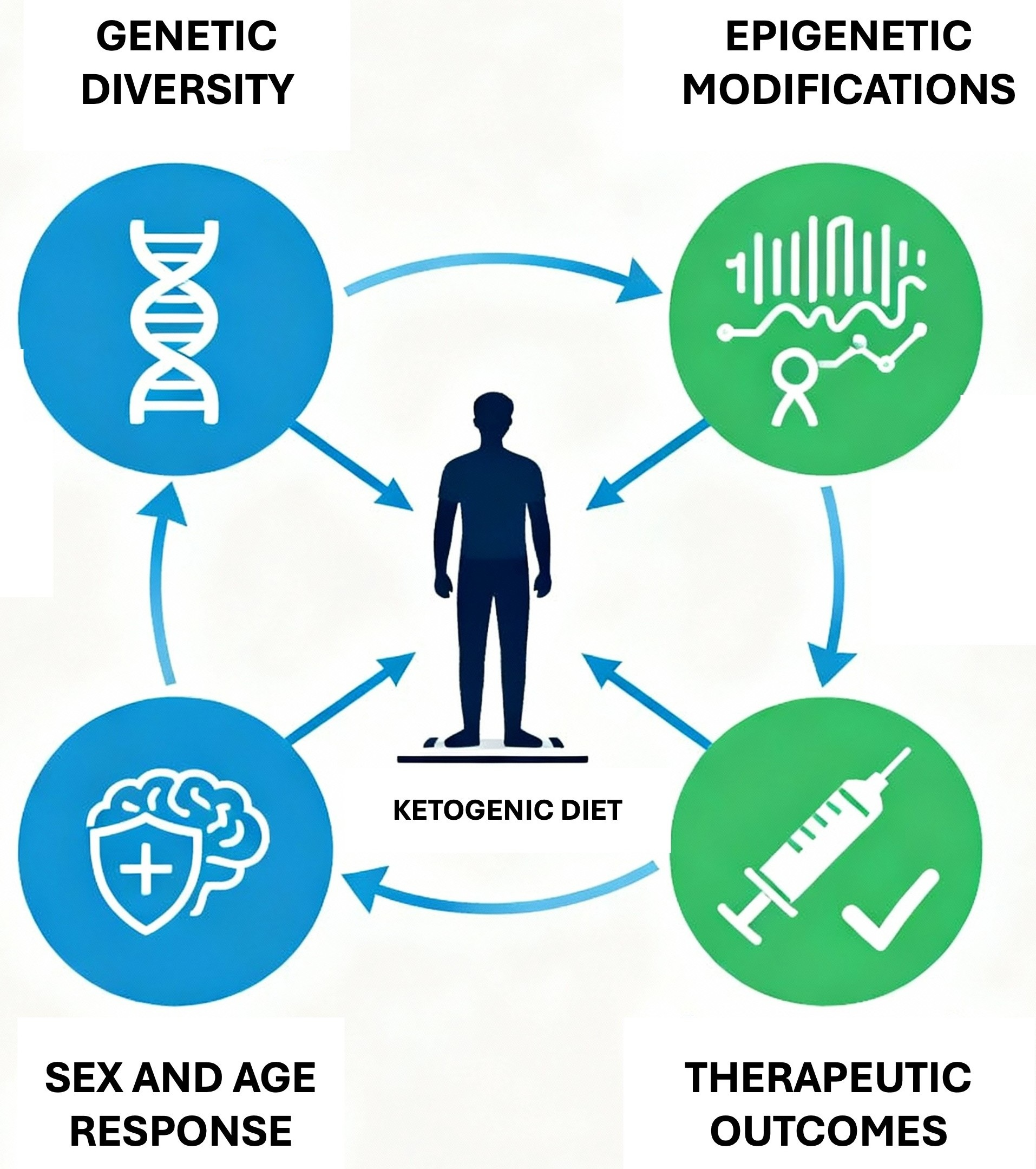

Genetic and Epigenetic Modifiers of Ketogenic Diet Responses: Roles of Sex and Age

 , , ,
, , ,  , and
, and
Abstract
1. Introduction
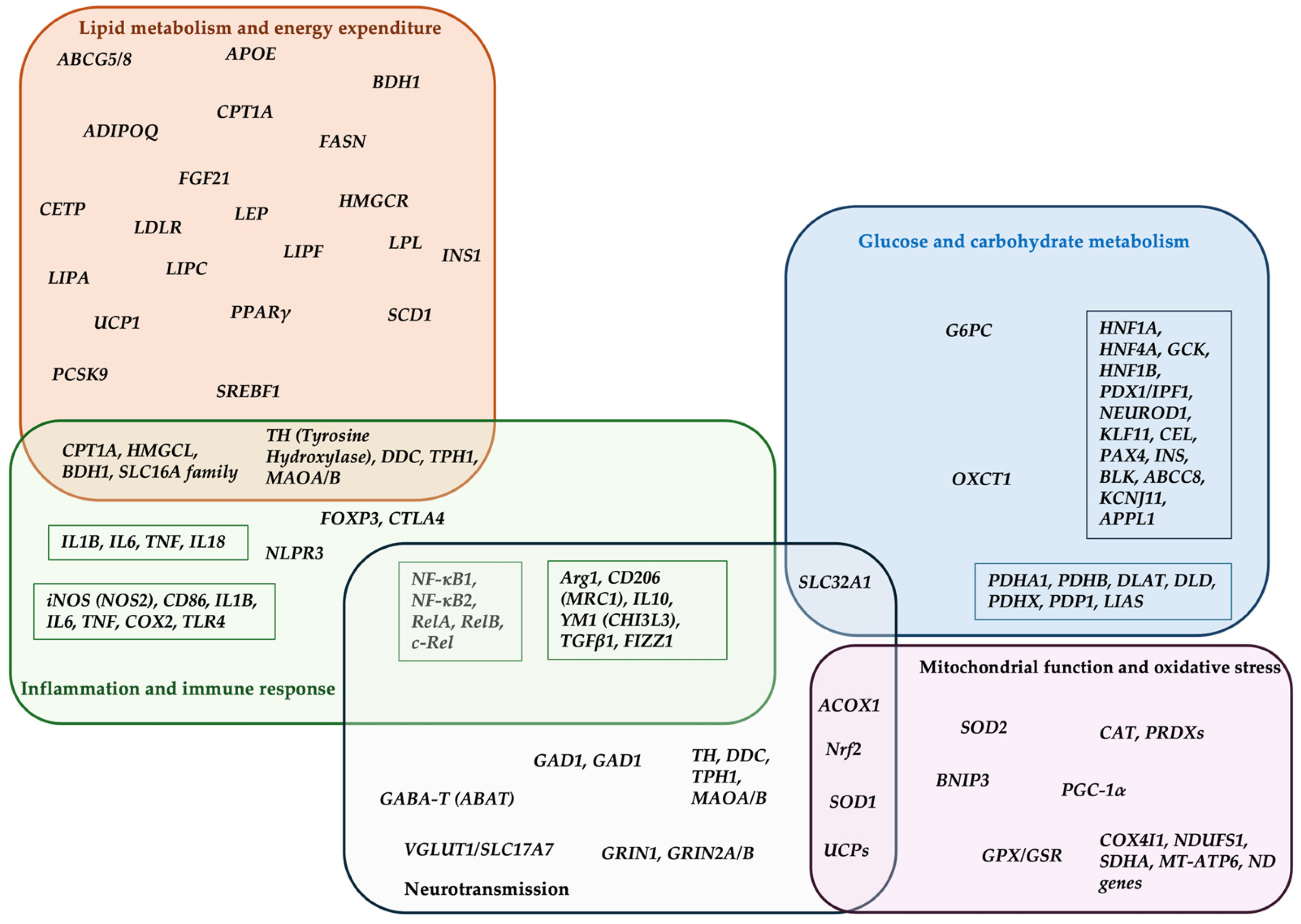
2. Genes and Genetic Diversity Associated with the Response to the Ketogenic Diet
2.1. Glucose and Carbohydrate Metabolism
2.2. Lipid Metabolism and Energy Expenditure
2.3. Inflammation and Immune Response
2.4. Mitochondrial Function and Oxidative Stress
2.5. Neurotransmission
3. Epigenomic Mechanisms Induced by Ketogenic Diet
3.1. DNA Methylation
3.2. Histone Modifications
3.3. MicroRNA Expression
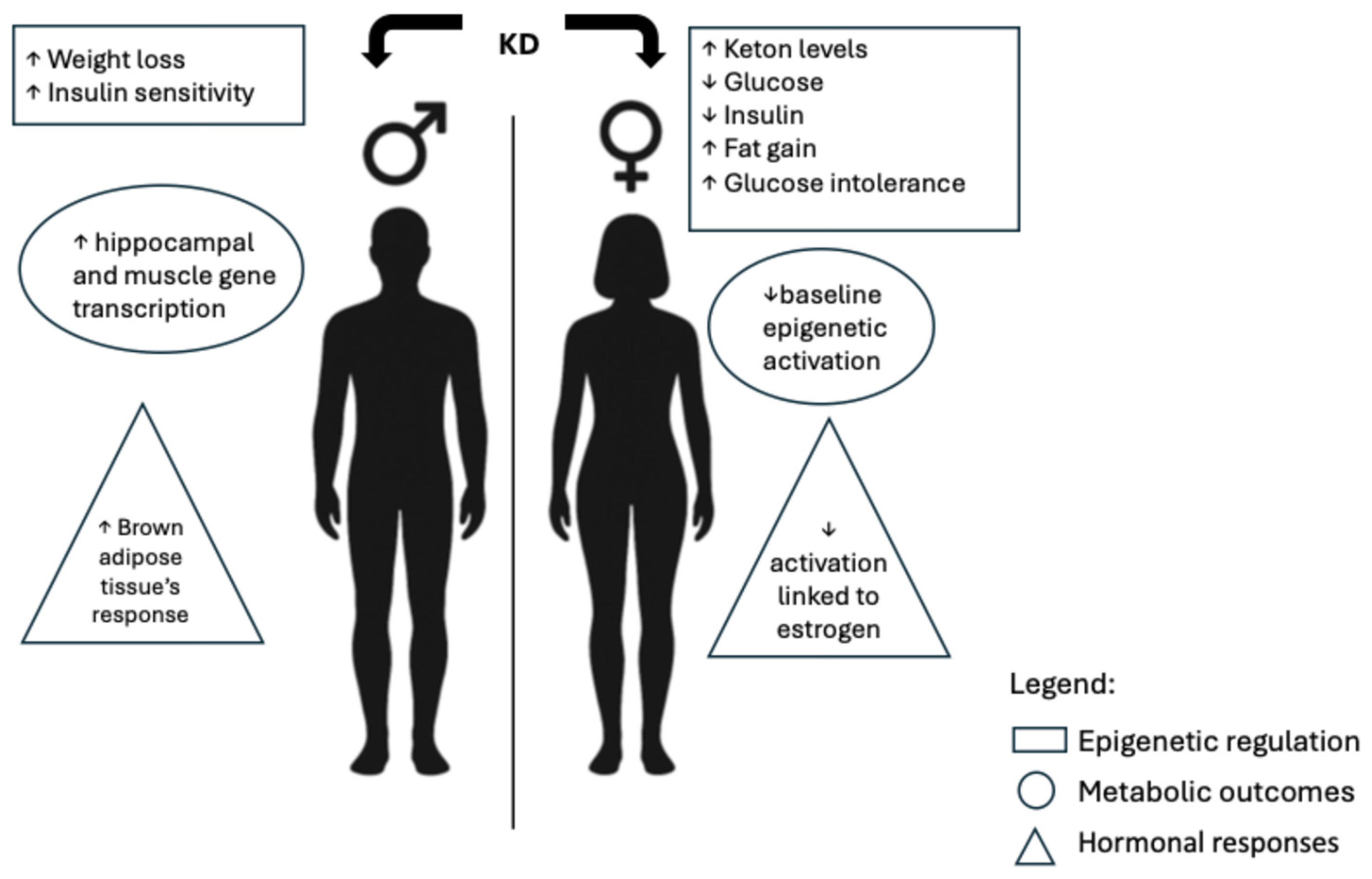
4. Sex Differences: Distinct Epigenetic and Metabolic Effects
5. Age-Related Considerations: Epigenome and Metabolic Flexibility
5.1. Metabolic Improvements with Aging
5.2. Longevity and Neuroprotection
5.3. Potential Risks and Reversibility
6. Knowledge Gaps and Future Directions
7. Conclusions
Author Contributions
Funding
Acknowledgments
Conflicts of Interest
Abbreviations
| ADIPOQ | adiponectin gene |
| APOE | apolipoprotein E |
| BDH1 | 3-hydroxybutyrate dehydrogenase 1 |
| BDNF | brain-derived neurotrophic factor |
| BHB | beta-hydroxybutyrate |
| CETP | cholesteryl ester transfer protein |
| CPT1A | carnitine palmitoyltransferase 1A |
| DAT | dopamine transporter (SLC6A1, SLC6A3 genes) |
| DNMTs | DNA methyltransferases |
| ER | estrogen receptor |
| FASN | fatty acid synthase |
| FGF21 | fibroblast growth factor 21 |
| GLUT1-DS | glucose transporter type 1 deficiency syndrome |
| HDACs | histone deacetylases |
| HMGCR | 3-hydroxy-3-methylglutaryl-coenzyme A reductase |
| KD | ketogenic diet |
| LDLR | low-density lipoprotein receptor |
| LEP | leptin |
| LIPA | lysosomal acid lipase |
| LIPC | hepatic lipase |
| LIPF | gastric lipase |
| LPL | lipoprotein lipase |
| MASLD | metabolic dysfunction-associated steatotic liver disease |
| miRNA | microRNA |
| PCSK9 | proprotein convertase subtilisin/kexin type 9 |
| PPARα | peroxisome proliferator-activated receptor alpha |
| SCD1 | stearoyl-CoA desaturase 1 |
| SLC32A1 | vesicular inhibitory amino acid transporter |
| TNF | tumor necrosis factor alpha |
| UCP1 | uncoupling protein 1 |
References
- Zhu, H.; Bi, D.; Zhang, Y.; Kong, C.; Du, J.; Wu, X.; Wei, Q.; Qin, H. Ketogenic Diet for Human Diseases: The Underlying Mechanisms and Potential for Clinical Implementations. Signal Transduct. Target. Ther. 2022, 7, 11. [Google Scholar] [CrossRef] [PubMed]
- Murray, S.L.; Vyas, G.; Eberhardt, E.; Roche, D.J.O.; Adams, H.A.; Harrington, V.; Kearns, A.; Glassman, M.; Yuen, A.; Chiappelli, J.; et al. Case Report: Metabolic, Inflammatory, and Neurological Improvements after a Ketogenic Diet in a Woman with Treatment-Resistant Schizophrenia and Metabolic Syndrome. Front. Psychiatry 2025, 16, 1710785. [Google Scholar] [CrossRef]
- Galali, Y.; Zebari, S.M.S.; Aj Jabbar, A.; Hashm Balaky, H.; Sadee, B.A.; Hassanzadeh, H. The Impact of Ketogenic Diet on Some Metabolic and Non-Metabolic Diseases: Evidence from Human and Animal Model Experiments. Food Sci. Nutr. 2024, 12, 1444–1464. [Google Scholar] [CrossRef]
- Baylie, T.; Ayelgn, T.; Tiruneh, M.; Tesfa, K.H. Effect of Ketogenic Diet on Obesity and Other Metabolic Disorders: Narrative Review. Diabetes Metab. Syndr. Obes. Targets Ther. 2024, 17, 1391–1401. [Google Scholar] [CrossRef] [PubMed]
- Borrego-Ruiz, A.; Borrego, J.J. Therapeutic Effects of Ketogenic Diets on Physiological and Mental Health. Explor. Foods Foodomics 2025, 3, 101079. [Google Scholar] [CrossRef]
- Ungaro, P.; Nettore, I.C.; Franchini, F.; Palatucci, G.; Muscogiuri, G.; Colao, A.; Macchia, P.E. Epigenome Modulation Induced by Ketogenic Diets. Nutrients 2022, 14, 3245. [Google Scholar] [CrossRef]
- Zhang, Y.; Cochran, J.D.; Souvenir, R.A.; Tai, W.; Xia, R.; Gladwin, B.S.; Barton, N.B.; Pereira, R.O.; Abel, E.D. Sex Differences in Ketogenic Diet Response Reveal Gonadal Hormone Interaction with FGF21 in Mice. J. Endocr. Soc. 2025, 9, bvaf131. [Google Scholar] [CrossRef]
- Jiao, Y.; Chen, X.; Liu, L.; Lu, Y.; Gao, M.; Wang, Q.; Chi, X.; Mo, Y. Sex Differences in Ketogenic Diet: Are Men More Likely than Women to Lose Weight? Front. Nutr. 2025, 12, 1600927. [Google Scholar] [CrossRef]
- Smolensky, I.; Zajac-Bakri, K.; Odermatt, T.S.; Brégère, C.; Cryan, J.F.; Guzman, R.; Timper, K.; Inta, D. Sex-Specific Differences in Metabolic Hormone and Adipose Tissue Dynamics Induced by Moderate Low-Carbohydrate and Ketogenic Diet. Sci. Rep. 2023, 13, 16465. [Google Scholar] [CrossRef]
- Aronica, L.; Volek, J.; Poff, A.; D’agostino, D.P. Genetic Variants for Personalised Management of Very Low Carbohydrate Ketogenic Diets. BMJ Nutr. Prev. Health 2020, 3, 363–373. [Google Scholar] [CrossRef]
- Contreras, A.V.; Torres, N.; Tovar, A.R. PPAR-α as a Key Nutritional and Environmental Sensor for Metabolic Adaptation. Adv. Nutr. 2013, 4, 439–452. [Google Scholar] [CrossRef] [PubMed]
- Lai, C.-Q.; Parnell, L.D.; Das, S.K.; Gardner, C.D.; Ordovás, J.M. Differential Weight-loss Responses of APOA2 Genotype Carriers to Low-carbohydrate and Low-fat Diets: The DIETFITS Trial. Obesity 2025, 33, 1048–1057. [Google Scholar] [CrossRef] [PubMed]
- Dahlin, M.; Stödberg, T.; Ekman, E.; Töhönen, V.; Wedell, A. Genetic Aetiologies in Relation to Response to the Ketogenic Diet in 226 Children with Epilepsy. Brain Commun. 2025, 7, fcaf134. [Google Scholar] [CrossRef] [PubMed]
- Ko, A.; Jung, D.E.; Kim, S.H.; Kang, H.-C.; Lee, J.S.; Lee, S.T.; Choi, J.R.; Kim, H.D. The Efficacy of Ketogenic Diet for Specific Genetic Mutation in Developmental and Epileptic Encephalopathy. Front. Neurol. 2018, 9, 530. [Google Scholar] [CrossRef]
- Li, W.; Gong, M.; Wang, Z.; Pan, H.; Li, Y.; Zhang, C. The Gut Microbiota Changed by Ketogenic Diets Contribute to Glucose Intolerance Rather than Lipid Accumulation. Front. Endocrinol. 2024, 15, 1446287. [Google Scholar] [CrossRef]
- Carmody, R.N.; Varady, K.; Turnbaugh, P.J. Digesting the Complex Metabolic Effects of Diet on the Host and Microbiome. Cell 2024, 187, 3857–3876. [Google Scholar] [CrossRef]
- Park, G.-M.; Lee, S.; Seo, J.Y.; Lim, K.I. A Case of Maturity-Onset Diabetes of the Young Type 4 in Korea. Ann. Pediatr. Endocrinol. Metab. 2022, 28, 149–154. [Google Scholar] [CrossRef]
- Nkonge, K.M.; Nkonge, D.K.; Nkonge, T.N. The Epidemiology, Molecular Pathogenesis, Diagnosis, and Treatment of Maturity-Onset Diabetes of the Young (MODY). Clin. Diabetes Endocrinol. 2020, 6, 20. [Google Scholar] [CrossRef]
- Zhang, L.; Lu, Y.; An, J.; Wu, Y.; Liu, Z.; Zou, M.-H. AMPKα2 Regulates Fasting-Induced Hyperketonemia by Suppressing SCOT Ubiquitination and Degradation. Sci. Rep. 2024, 14, 1713. [Google Scholar] [CrossRef]
- Bosma, K.J.; Rahim, M.; Oeser, J.K.; McGuinness, O.P.; Young, J.D.; O’Brien, R.M. G6PC2 Confers Protection against Hypoglycemia upon Ketogenic Diet Feeding and Prolonged Fasting. Mol. Metab. 2020, 41, 101043. [Google Scholar] [CrossRef]
- Arko, J.J.; Debeljak, M.; Tansek, M.Z.; Battelino, T.; Groselj, U. A Patient with Glycogen Storage Disease Type 0 and a Novel Sequence Variant in GYS2: A Case Report and Literature Review. J. Int. Med. Res. 2020, 48, 300060520936857. [Google Scholar] [CrossRef] [PubMed]
- Weinstein, D.A.; Correia, C.E.; Saunders, A.C.; Wolfsdorf, J.I. Hepatic Glycogen Synthase Deficiency: An Infrequently Recognized Cause of Ketotic Hypoglycemia. Mol. Genet. Metab. 2006, 87, 284–288. [Google Scholar] [CrossRef] [PubMed]
- Maiorana, A.; Caviglia, S.; Greco, B.; Alfieri, P.; Cumbo, F.; Campana, C.; Bernabei, S.M.; Cusmai, R.; Mosca, A.; Dionisi-Vici, C. Ketogenic Diet as Elective Treatment in Patients with Drug-Unresponsive Hyperinsulinemic Hypoglycemia Caused by Glucokinase Mutations. Orphanet. J. Rare Dis. 2021, 16, 424. [Google Scholar] [CrossRef] [PubMed]
- Hoffman, L.S.; Fox, T.J.; Anastasopoulou, C.; Jialal, I. Maturity Onset Diabetes in the Young. In StatPearls; StatPearls Publishing: Treasure Island, FL, USA, 2023. [Google Scholar]
- Goetz, M.; Schröter, J.; Dattner, T.; Brennenstuhl, H.; Lenz, D.; Opladen, T.; Hörster, F.; Okun, J.G.; Hoffmann, G.F.; Kölker, S.; et al. Genotypic and Phenotypic Spectrum of Cytosolic Phosphoenolpyruvate Carboxykinase Deficiency. Mol. Genet. Metab. 2022, 137, 18–25. [Google Scholar] [CrossRef]
- Hutfles, L.J.; Wilkins, H.M.; Koppel, S.J.; Weidling, I.W.; Selfridge, J.E.; Tan, E.; Thyfault, J.P.; Slawson, C.; Fenton, A.W.; Zhu, H.; et al. A Bioenergetics Systems Evaluation of Ketogenic Diet Liver Effects. Appl. Physiol. Nutr. Metab. 2017, 42, 955–962. [Google Scholar] [CrossRef]
- Ganetzky, R.; McCormick, E.M.; Falk, M.J. Primary Pyruvate Dehydrogenase Complex Deficiency Overview. In GeneReviews®; Adam, M.P., Feldman, J., Mirzaa, G.M., Pagon, R.A., Wallace, S.E., Amemiya, A., Eds.; University of Washington: Seattle, WA, USA, 1993. [Google Scholar]
- Sofou, K.; Dahlin, M.; Hallböök, T.; Lindefeldt, M.; Viggedal, G.; Darin, N. Ketogenic Diet in Pyruvate Dehydrogenase Complex Deficiency: Short- and Long-Term Outcomes. J. Inherit. Metab. Dis. 2017, 40, 237–245. [Google Scholar] [CrossRef]
- Alijanpour, S.; Miryounesi, M.; Ghafouri-Fard, S. The Role of Excitatory Amino Acid Transporter 2 (EAAT2) in Epilepsy and Other Neurological Disorders. Metab. Brain Dis. 2022, 38, 1–16. [Google Scholar] [CrossRef]
- Kovermann, P.; Bayat, A.; Fenger, C.D.; Leeuwen, L.; Borovikov, A.; Sharkov, A.; Levrat, V.; Lesca, G.; Perrin, L.; Levy, J.; et al. The Severity of SLC1A2-Associated Neurodevelopmental Disorders Correlates with Transporter Dysfunction. EBioMedicine 2025, 114, 105648. [Google Scholar] [CrossRef]
- Feng, Y.; Zhang, C.; Wei, Z.; Li, G.; Gan, Y.; Liu, C.; Deng, Y. Gene Variations of Glutamate Metabolism Pathway and Epilepsy. Acta Epileptol. 2022, 4, 31. [Google Scholar] [CrossRef]
- Herrero, J.R.; Villarroya, E.C.; Gutiérrez-Solana, L.G.; Alcolea, B.G.; Fernández, B.G.; Macfarland, L.A.P.; Pedrón-Giner, C. Classic Ketogenic Diet and Modified Atkins Diet in SLC2A1 Positive and Negative Patients with Suspected GLUT1 Deficiency Syndrome: A Single Center Analysis of 18 Cases. Nutrients 2021, 13, 840. [Google Scholar] [CrossRef]
- Wang, Y.-Y.; Zhou, Y.-Q.; Luo, L.-J.; Wang, C.-J.; Shen, N.; Li, H.; Wang, J.-W. Ketogenic Diet Therapy in Children with Epilepsy Caused by SLC2A1 Mutations: A Single-Center Single-Arm Retrospective Study. World J. Pediatr. 2024, 20, 517–524. [Google Scholar] [CrossRef]
- Cullingford, T. Peroxisome Proliferator-Activated Receptor Alpha and the Ketogenic Diet. Epilepsia 2008, 49 (Suppl. S8), 70–72. [Google Scholar] [CrossRef]
- Pawlak, M.; Lefebvre, P.; Staels, B. Molecular Mechanism of PPARα Action and Its Impact on Lipid Metabolism, Inflammation and Fibrosis in Non-Alcoholic Fatty Liver Disease. J. Hepatol. 2015, 62, 720–733. [Google Scholar] [CrossRef]
- Badman, M.K.; Pissios, P.; Kennedy, A.R.; Koukos, G.; Flier, J.S.; Maratos-Flier, E. Hepatic Fibroblast Growth Factor 21 Is Regulated by PPARα and Is a Key Mediator of Hepatic Lipid Metabolism in Ketotic States. Cell Metab. 2007, 5, 426–437. [Google Scholar] [CrossRef] [PubMed]
- Simeone, T.A.; Matthews, S.A.; Samson, K.K.; Simeone, K.A. Regulation of Brain PPARgamma2 Contributes to Ketogenic Diet Anti-Seizure Efficacy. Exp. Neurol. 2017, 287, 54–64. [Google Scholar] [CrossRef] [PubMed]
- Pınarbaşı, A.; Pak, M.; Kolay, M.; Arslan, D.Ö.; Aksungar, F.B. Effects of Peroxisome Proliferator Activated Receptor Gamma (PPARγ) Agonist on Fasting Model Applied Neuron Cultures. Turk. J. Biochem. 2022, 47, 41–48. [Google Scholar] [CrossRef]
- Gano, L.B.; Patel, M.; Rho, J.M. Ketogenic Diets, Mitochondria, and Neurological Diseases. J. Lipid Res. 2014, 55, 2211–2228. [Google Scholar] [CrossRef] [PubMed]
- PPARβ/δ Agonist GW0742 Modulates Microglial and Astroglial Gene Expression in a Rat Model of Temporal Lobe Epilepsy. Available online: https://www.mdpi.com/1422-0067/25/18/10015 (accessed on 29 November 2025).
- Williams, K.; Segard, A.; Graf, G.A. Sitosterolemia: Twenty Years of Discovery of the Function of ABCG5 ABCG8. Int. J. Mol. Sci. 2021, 22, 2641. [Google Scholar] [CrossRef]
- Elbanna, M.; Eid, F.; Zaalouk, M.; Latifi, A.N.; Sharma, G. Unmasking a Case of Sitosterolaemia: An Approach for Diagnosis and Management. Eur. J. Case Rep. Intern. Med. 2024, 11, 004541. [Google Scholar] [CrossRef]
- Ellenbroek, J.H.; van Dijck, L.; Töns, H.A.; Rabelink, T.J.; Carlotti, F.; Ballieux, B.E.P.B.; de Koning, E.J.P. Long-Term Ketogenic Diet Causes Glucose Intolerance and Reduced β- and α-Cell Mass but No Weight Loss in Mice. Am. J. Physiol. Endocrinol. Metab. 2014, 306, E552–E558. [Google Scholar] [CrossRef]
- Stoykovich, S.; Gibas, K. APOE Ε4, the Door to Insulin-Resistant Dyslipidemia and Brain Fog? A Case Study. Alzheimers Dement. Diagn. Assess. Dis. Monit. 2019, 11, 264–269. [Google Scholar] [CrossRef] [PubMed]
- Marzolla, V.; Armani, A.; Mammi, C.; Gorini, S.; Camajani, E.; Caprio, M. FRI107 Ketogenic Diet Prevents Development of Atherosclerotic Plaques in Apolipoprotein E Knockout Mice. J. Endocr. Soc. 2023, 7, bvad114.620. [Google Scholar] [CrossRef]
- Wan, S.-R.; Teng, F.-Y.; Fan, W.; Xu, B.-T.; Li, X.-Y.; Tan, X.-Z.; Guo, M.; Gao, C.-L.; Zhang, C.-X.; Jiang, Z.-Z.; et al. BDH1-Mediated βOHB Metabolism Ameliorates Diabetic Kidney Disease by Activation of NRF2-Mediated Antioxidative Pathway. Aging 2023, 15, 13384–13410. [Google Scholar] [CrossRef] [PubMed]
- Genetic Variations of Cholesteryl Ester Transfer Protein and Diet Interactions in Relation to Lipid Profiles and Coronary Heart Disease: A Systematic Review—PMC. Available online: https://pmc.ncbi.nlm.nih.gov/articles/PMC5721696/ (accessed on 6 October 2025).
- Watanabe, M.; Singhal, G.; Fisher, F.M.; Beck, T.C.; Morgan, D.A.; Socciarelli, F.; Mather, M.L.; Risi, R.; Bourke, J.; Rahmouni, K.; et al. Liver Derived FGF21 Is Essential for Full Adaptation to Ketogenic Diet but Does Not Regulate Glucose Homeostasis. Endocrine 2020, 67, 95–108. [Google Scholar] [CrossRef]
- Guo, W.; Cao, H.; Shen, Y.; Li, W.; Wang, W.; Cheng, L.; Cai, M.; Xu, F. Role of Liver FGF21-KLB Signaling in Ketogenic Diet-Induced Amelioration of Hepatic Steatosis. Nutr. Diabetes 2024, 14, 18. [Google Scholar] [CrossRef]
- Merlotti, D.; Cosso, R.; Eller-Vainicher, C.; Vescini, F.; Chiodini, I.; Gennari, L.; Falchetti, A. Energy Metabolism and Ketogenic Diets: What about the Skeletal Health? A Narrative Review and a Prospective Vision for Planning Clinical Trials on This Issue. Int. J. Mol. Sci. 2021, 22, 435. [Google Scholar] [CrossRef]
- Abifadel, M.; Boileau, C. Genetic and Molecular Architecture of Familial Hypercholesterolemia. J. Intern. Med. 2023, 293, 144–165. [Google Scholar] [CrossRef]
- Ministrini, S.; Calzini, L.; Nulli Migliola, E.; Ricci, M.A.; Roscini, A.R.; Siepi, D.; Tozzi, G.; Daviddi, G.; Martorelli, E.-E.; Paganelli, M.T.; et al. Lysosomal Acid Lipase as a Molecular Target of the Very Low Carbohydrate Ketogenic Diet in Morbidly Obese Patients: The Potential Effects on Liver Steatosis and Cardiovascular Risk Factors. J. Clin. Med. 2019, 8, 621. [Google Scholar] [CrossRef]
- Ruaño, G.; Windemuth, A.; Kocherla, M.; Holford, T.; Fernandez, M.L.; Forsythe, C.E.; Wood, R.J.; Kraemer, W.J.; Volek, J.S. Physiogenomic Analysis of Weight Loss Induced by Dietary Carbohydrate Restriction. Nutr. Metab. 2006, 3, 20. [Google Scholar] [CrossRef][Green Version]
- Goldberg, I.J.; Ibrahim, N.; Bredefeld, C.; Foo, S.; Lim, V.; Gutman, D.; Huggins, L.-A.; Hegele, R.A. Ketogenic Diets, Not for Everyone. J. Clin. Lipidol. 2021, 15, 61–67. [Google Scholar] [CrossRef]
- Bagias, C.; Xiarchou, A.; Bargiota, A.; Tigas, S. Familial Partial Lipodystrophy (FPLD): Recent Insights. Diabetes Metab. Syndr. Obes. Targets Ther. 2020, 13, 1531–1544. [Google Scholar] [CrossRef] [PubMed]
- Liu, M.; Zhou, J.; Park, S. Genetic Variants, Bioactive Compounds, and PCSK9 Inhibitors in Hyper-LDL-Cholesterolemia: A GWAS and In Silico Study on Cardiovascular Disease Risk. Nutrients 2025, 17, 1411. [Google Scholar] [CrossRef] [PubMed]
- Cariou, B.; Langhi, C.; Le Bras, M.; Bortolotti, M.; Lê, K.-A.; Theytaz, F.; Le May, C.; Guyomarc’h-Delasalle, B.; Zaïr, Y.; Kreis, R.; et al. Plasma PCSK9 Concentrations during an Oral Fat Load and after Short Term High-Fat, High-Fat High-Protein and High-Fructose Diets. Nutr Metab 2013, 10, 4. [Google Scholar] [CrossRef] [PubMed]
- Wang, H.; Humbatova, A.; Liu, Y.; Qin, W.; Lee, M.; Cesarato, N.; Kortüm, F.; Kumar, S.; Romano, M.T.; Dai, S.; et al. Mutations in SREBF1, Encoding Sterol Regulatory Element Binding Transcription Factor 1, Cause Autosomal-Dominant IFAP Syndrome. Am. J. Hum. Genet. 2020, 107, 34–45. [Google Scholar] [CrossRef]
- The Effect of a Ketogenic Diet on Inflammation-Related Markers: Nutrition Reviews. Available online: https://www.ovid.com/journals/nutrev/fulltext/10.1093/nutrit/nuad175~the-effect-of-a-ketogenic-diet-on-inflammation-related (accessed on 3 November 2025).
- Reddy, N.J.; Benjamin, N.Z.Y.; Reddy, P.H.; Thai, A.; Rawashdeh, H.M.A.; Saravanan, C.; Prajjwal, P.; Tekuru, Y.; Inban, P.; John, J. The Role and Benefits of Ketogenic Diet in Modulating Inflammation in Multiple Sclerosis: A Systematic Review and Meta-Analysis. Disease-A-Month 2025, 71, 102013. [Google Scholar] [CrossRef]
- Monda, A.; La Torre, M.E.; Messina, A.; Di Maio, G.; Monda, V.; Moscatelli, F.; De Stefano, M.; La Marra, M.; Padova, M.D.; Dipace, A.; et al. Exploring the Ketogenic Diet’s Potential in Reducing Neuroinflammation and Modulating Immune Responses. Front. Immunol. 2024, 15, 1425816. [Google Scholar] [CrossRef]
- Rondanelli, M.; Gasparri, C.; Pirola, M.; Barrile, G.C.; Moroni, A.; Sajoux, I.; Perna, S. Does the Ketogenic Diet Mediate Inflammation Markers in Obese and Overweight Adults? A Systematic Review and Meta-Analysis of Randomized Clinical Trials. Nutrients 2024, 16, 4002. [Google Scholar] [CrossRef]
- Goldberg, E.L.; Letian, A.; Dlugos, T.; Leveau, C.; Dixit, V.D. Innate Immune Cell-Intrinsic Ketogenesis Is Dispensable for Organismal Metabolism and Age-Related Inflammation. J. Biol. Chem. 2023, 299, 103005. [Google Scholar] [CrossRef]
- Le, A.; Yeganeh, M.; Buhas, D.; Trempe, M.-J.; Myers, K.A. Monocarboxylate Transporter-1 Deficiency Results in Severe Metabolic Acidosis with Ketogenic Diet in Early Onset Absence Epilepsy: Case Report. Seizure 2020, 74, 31–32. [Google Scholar] [CrossRef]
- Ji, J.; Tang, Y. A Ketogenic Diet Regulates Microglial Activation to Treat Drug Addiction. Front. Pharmacol. 2025, 16, 1462699. [Google Scholar] [CrossRef]
- Sun, W.; Wang, Q.; Zhang, R.; Zhang, N. Ketogenic Diet Attenuates Neuroinflammation and Induces Conversion of M1 Microglia to M2 in an EAE Model of Multiple Sclerosis by Regulating the NF-κB/NLRP3 Pathway and Inhibiting HDAC3 and P2X7R Activation. Food Funct. 2023, 14, 7247–7269. [Google Scholar] [CrossRef] [PubMed]
- Neudorf, H.; Little, J.P. Impact of Fasting & Ketogenic Interventions on the NLRP3 Inflammasome: A Narrative Review. Biomed. J. 2024, 47, 100677. [Google Scholar] [CrossRef]
- Link, V.M.; Subramanian, P.; Cheung, F.; Han, K.L.; Stacy, A.; Chi, L.; Sellers, B.A.; Koroleva, G.; Courville, A.B.; Mistry, S.; et al. Differential Peripheral Immune Signatures Elicited by Vegan versus Ketogenic Diets in Humans. Nat. Med. 2024, 30, 560–572. [Google Scholar] [CrossRef] [PubMed]
- Drabińska, N. Current Perspective About the Effect of a Ketogenic Diet on Oxidative Stress—A Review. Pol. J. Food Nutr. Sci. 2024, 74, 92–105. [Google Scholar] [CrossRef]
- Huang, L.; Li, H.; Zhong, J.; Yang, L.; Chen, G.; Wang, D.; Zheng, G.; Han, H.; Han, X.; Long, Y.; et al. Efficacy and Safety of the Ketogenic Diet for Mitochondrial Disease with Epilepsy: A Prospective, Open-Labeled, Controlled Study. Front. Neurol. 2022, 13, 88094. [Google Scholar] [CrossRef]
- Newell, C.; Shutt, T.E.; Ahn, Y.; Hittel, D.S.; Khan, A.; Rho, J.M.; Shearer, J. Tissue Specific Impacts of a Ketogenic Diet on Mitochondrial Dynamics in the BTBRT+tf/j Mouse. Front. Physiol. 2016, 7, 654. [Google Scholar] [CrossRef]
- Stafford, P.; Abdelwahab, M.G.; Kim, D.Y.; Preul, M.C.; Rho, J.M.; Scheck, A.C. The Ketogenic Diet Reverses Gene Expression Patterns and Reduces Reactive Oxygen Species Levels When Used as an Adjuvant Therapy for Glioma. Nutr. Metab. 2010, 7, 74. [Google Scholar] [CrossRef]
- Pathak, S.J.; Baar, K. Ketogenic Diets and Mitochondrial Function: Benefits for Aging but Not for Athletes. Exerc. Sport Sci. Rev. 2023, 51, 27–33. [Google Scholar] [CrossRef]
- Murugan, M.; Boison, D. Ketogenic Diet, Neuroprotection, and Antiepileptogenesis. Epilepsy Res. 2020, 167, 106444. [Google Scholar] [CrossRef]
- Dutton, S.B.B.; Escayg, A. Genetic Influences on Ketogenic Diet Efficacy. Epilepsia 2008, 49, 67–69. [Google Scholar] [CrossRef]
- Zhao, Z.; Lange, D.J.; Voustianiouk, A.; MacGrogan, D.; Ho, L.; Suh, J.; Humala, N.; Thiyagarajan, M.; Wang, J.; Pasinetti, G.M. A Ketogenic Diet as a Potential Novel Therapeutic Intervention in Amyotrophic Lateral Sclerosis. BMC Neurosci. 2006, 7, 29. [Google Scholar] [CrossRef] [PubMed]
- Greco, T.; Glenn, T.C.; Hovda, D.A.; Prins, M.L. Ketogenic Diet Decreases Oxidative Stress and Improves Mitochondrial Respiratory Complex Activity. J. Cereb. Blood Flow Metab. 2016, 36, 1603–1613. [Google Scholar] [CrossRef] [PubMed]
- Ahola-Erkkilä, S.; Carroll, C.J.; Peltola-Mjösund, K.; Tulkki, V.; Mattila, I.; Seppänen-Laakso, T.; Orešič, M.; Tyynismaa, H.; Suomalainen, A. Ketogenic Diet Slows Down Mitochondrial Myopathy Progression in Mice. Hum. Mol. Genet. 2010, 19, 1974–1984. [Google Scholar] [CrossRef] [PubMed]
- Milder, J.B.; Patel, M. Modulation of Oxidative Stress and Mitochondrial Function by the Ketogenic Diet. Epilepsy Res. 2012, 100, 295–303. [Google Scholar] [CrossRef]
- de Lima, P.A.; de Brito Sampaio, L.P.; Damasceno, N.R.T. Neurobiochemical Mechanisms of a Ketogenic Diet in Refractory Epilepsy. Clinics 2014, 69, 699–705. [Google Scholar] [CrossRef]
- Behnam, B.E.; Raeisi, S.; Bakhtiari, N.; Abbasi, M.M.; Shanehbandi, D. Neurochemical and Genetic Effects of the Ketogenic Diet: Alterations in Brain GABA, Glutamate, and Related Gene. Mol. Biol. Rep. 2025, 52, 968. [Google Scholar] [CrossRef]
- Occurrence of GLUT1 Deficiency Syndrome in Patients Treated with Ketogenic Diet—Epilepsy and Behavior. Available online: https://www.epilepsybehavior.com/article/S1525-5050(14)00004-3/abstract (accessed on 2 November 2025).
- Palmer, S.; Towne, M.C.; Pearl, P.L.; Pelletier, R.C.; Genetti, C.A.; Shi, J.; Beggs, A.H.; Agrawal, P.B.; Brownstein, C.A. SLC6A1 Mutation and Ketogenic Diet in Epilepsy with Myoclonic-Atonic Seizures. Pediatr. Neurol. 2016, 64, 77–79. [Google Scholar] [CrossRef]
- Lin, W.-S.; Lin, S.-J.; Liao, P.-Y.; Suresh, D.; Hsu, T.-R.; Wang, P.-Y. Role of Ketogenic Diets in Multiple Sclerosis and Related Animal Models: An Updated Review. Adv. Nutr. Int. Rev. J. 2022, 13, 2002–2014. [Google Scholar] [CrossRef]
- Moss, S.E.; Poff, A.M.; Moss, A.; DeBlasi, J.M.; D’Agostino, D.P. From Glucose to Histone Modification: Sex-Specific Metabolic Responses to Ketogenic Therapy in VM/Dk Mice. Front. Nutr. 2025, 12, 1554743. [Google Scholar] [CrossRef]
- Lanata, C.M.; Chung, S.A.; Criswell, L.A. DNA Methylation 101: What Is Important to Know about DNA Methylation and Its Role in SLE Risk and Disease Heterogeneity. Lupus Sci. Med. 2018, 5, e000285. [Google Scholar] [CrossRef]
- Pedersen, S.; Kverneland, M.; Nakken, K.O.; Rudi, K.; Iversen, P.O.; Gervin, K.; Selmer, K.K. Genome-Wide Decrease in DNA Methylation in Adults with Epilepsy Treated with Modified Ketogenic Diet: A Prospective Study. Epilepsia 2022, 63, 2413–2426. [Google Scholar] [CrossRef] [PubMed]
- DNA Hypomethylation—An Overview ScienceDirect Topics. Available online: https://www.sciencedirect.com/topics/biochemistry-genetics-and-molecular-biology/dna-hypomethylation (accessed on 3 November 2025).
- Chen, F.; He, X.; Luan, G.; Li, T. Role of DNA Methylation and Adenosine in Ketogenic Diet for Pharmacoresistant Epilepsy: Focus on Epileptogenesis and Associated Comorbidities. Front. Neurol. 2019, 10, 119. [Google Scholar] [CrossRef] [PubMed]
- Crujeiras, A.B.; Izquierdo, A.G.; Primo, D.; Milagro, F.I.; Sajoux, I.; Jácome, A.; Fernandez-Quintela, A.; Portillo, M.P.; Martínez, J.A.; Martinez-Olmos, M.A.; et al. Epigenetic Landscape in Blood Leukocytes Following Ketosis and Weight Loss Induced by a Very Low Calorie Ketogenic Diet (VLCKD) in Patients with Obesity. Clin. Nutr. 2021, 40, 3959–3972. [Google Scholar] [CrossRef] [PubMed]
- Zhou, T.; Cheng, X.; He, Y.; Xie, Y.; Xu, F.; Xu, Y.; Huang, W. Function and Mechanism of Histone β-Hydroxybutyrylation in Health and Disease. Front. Immunol. 2022, 13, 981285. [Google Scholar] [CrossRef]
- Qin, L.; Ma, K.; Yan, Z. Rescue of Histone Hypoacetylation and Social Deficits by Ketogenic Diet in a Shank3 Mouse Model of Autism. Neuropsychopharmacology 2022, 47, 1271–1279. [Google Scholar] [CrossRef]
- Wang, X.; Wu, X.; Liu, Q.; Kong, G.; Zhou, J.; Jiang, J.; Wu, X.; Huang, Z.; Su, W.; Zhu, Q. Ketogenic Metabolism Inhibits Histone Deacetylase (HDAC) and Reduces Oxidative Stress After Spinal Cord Injury in Rats. Neuroscience 2017, 366, 36–43. [Google Scholar] [CrossRef]
- Pietrzak, D.; Kasperek, K.; Rękawek, P.; Piątkowska-Chmiel, I. The Therapeutic Role of Ketogenic Diet in Neurological Disorders. Nutrients 2022, 14, 1952. [Google Scholar] [CrossRef]
- Zhao, M.; Huang, X.; Cheng, X.; Lin, X.; Zhao, T.; Wu, L.; Yu, X.; Wu, K.; Fan, M.; Zhu, L. Ketogenic Diet Improves the Spatial Memory Impairment Caused by Exposure to Hypobaric Hypoxia through Increased Acetylation of Histones in Rats. PLoS ONE 2017, 12, e0174477. [Google Scholar] [CrossRef]
- Sleiman, S.F.; Henry, J.; Al-Haddad, R.; El Hayek, L.; Abou Haidar, E.; Stringer, T.; Ulja, D.; Karuppagounder, S.S.; Holson, E.B.; Ratan, R.R.; et al. Exercise Promotes the Expression of Brain Derived Neurotrophic Factor (BDNF) through the Action of the Ketone Body β-Hydroxybutyrate. eLife 2016, 5, e15092. [Google Scholar] [CrossRef]
- Ketone Body β-Hydroxybutyrate-Mediated Histone β-Hydroxybutyrylation Upregulates Lipolysis and Attenuates Metabolic Syndrome American Journal of Physiology-Cell Physiology American Physiological Society. Available online: https://journals.physiology.org/doi/full/10.1152/ajpcell.00453.2025 (accessed on 3 November 2025).
- Mukai, R.; Sadoshima, J. Ketone Bodies Preserve Mitochondria Through Epigenetics. JACC Basic Transl. Sci. 2023, 8, 1138–1140. [Google Scholar] [CrossRef]
- Suleiman, K.Y.; Akorede, G.J.; Afisu, B.; Onimajesin, A.O.; Saadudeen, A.; Lawal, M.O. The Epigenetic Influence of Diet-Induced Gut Microbiome Changes in Precision Nutrition—A Systematic Review. Gastroenterol. Hepatol. Bed Bench 2025, 18, 270–285. [Google Scholar] [CrossRef] [PubMed]
- Licciardi, P.V.; Ververis, K.; Karagiannis, T.C. Histone Deacetylase Inhibition and Dietary Short-Chain Fatty Acids. ISRN Allergy 2011, 2011, 869647. [Google Scholar] [CrossRef] [PubMed]
- Short-Chain Fatty Acids Activate Acetyltransferase P300 eLife. Available online: https://elifesciences.org/articles/72171 (accessed on 29 November 2025).
- Tang, M.; Wang, W.; Wang, J.; Wang, Y. Alteration of Gut Microbiota by Ketogenic Diet as an Alternative Therapeutic Target for Drug-Resistant Epilepsy. Microorganisms 2025, 13, 2539. [Google Scholar] [CrossRef] [PubMed]
- Epigenetic Regulation by Ketone Bodies in Cardiac Diseases and Repair. Available online: https://cdnsciencepub.com/doi/10.1139/cjpp-2024-0270 (accessed on 3 November 2025).
- Abrego-Guandique, D.M.; Cione, E.; Caroleo, M.C.; Bonilla, D.A.; Cannataro, R. Ketogenic Diet and microRNAs: Focus on Cognitive Function. Front. Nutr. 2025, 12, 1545832. [Google Scholar] [CrossRef]
- Ketogenic Diet and microRNAs Linked to Antioxidant Biochemical Homeostasis. Available online: https://www.mdpi.com/2076-3921/8/8/269 (accessed on 3 November 2025).
- Cannataro, R.; Perri, M.; Gallelli, L.; Caroleo, M.C.; De Sarro, G.; Cione, E. Ketogenic Diet Acts on Body Remodeling and MicroRNAs Expression Profile. Microrna 2019, 8, 116–126. [Google Scholar] [CrossRef]
- Samões, R.; Cavalheiro, A.; Santos, C.; Lopes, J.; Teixeira, C.; Tavares, M.M.; Carvalho, C.; Lemos, C.; e Costa, P.P.; Cavaco, S.; et al. MicroRNAs as Potential Biomarkers of Response to Modified Atkins Diet in Treatment of Adults with Drug-Resistant Epilepsy: A Proof-of-Concept Study. Epilepsy Res. 2024, 208, 107478. [Google Scholar] [CrossRef]
- Ivić, V.; Zjalić, M.; Blažetić, S.; Fenrich, M.; Labak, I.; Scitovski, R.; Szűcs, K.F.; Ducza, E.; Tábi, T.; Bagamery, F.; et al. Elderly Rats Fed with a High-Fat High-Sucrose Diet Developed Sex-Dependent Metabolic Syndrome Regardless of Long-Term Metformin and Liraglutide Treatment. Front. Endocrinol. 2023, 14, 1181064. [Google Scholar] [CrossRef]
- Gerhardt, K. Two to Tango: ERα and Estrogen Balance Cholesterol Metabolism in the Liver. Biol. Reprod. 2016, 94, 131. [Google Scholar] [CrossRef]
- Cherubini, A.; Ostadreza, M.; Jamialahmadi, O.; Pelusi, S.; Rrapaj, E.; Casirati, E.; Passignani, G.; Norouziesfahani, M.; Sinopoli, E.; Baselli, G.; et al. Interaction between Estrogen Receptor-α and PNPLA3 p.I148M Variant Drives Fatty Liver Disease Susceptibility in Women. Nat. Med. 2023, 29, 2643–2655. [Google Scholar] [CrossRef]
- Khalid, K.; Apparow, S.; Mushaddik, I.L.; Anuar, A.; Rizvi, S.A.A.; Habib, A. Effects of Ketogenic Diet on Reproductive Hormones in Women with Polycystic Ovary Syndrome. J. Endocr. Soc. 2023, 7, bvad112. [Google Scholar] [CrossRef]
- Vandel, J.; Dubois-Chevalier, J.; Gheeraert, C.; Derudas, B.; Raverdy, V.; Thuillier, D.; Gaal, L.; Francque, S.; Pattou, F.; Staels, B.; et al. Hepatic Molecular Signatures Highlight the Sexual Dimorphism of Nonalcoholic Steatohepatitis (NASH). Hepatology 2021, 73, 920–936. [Google Scholar] [CrossRef] [PubMed]
- De Souza, L.B.; Martins, K.A.; Cordeiro, M.M.; Rodrigues, Y.d.S.; Rafacho, B.P.M.; Bomfim, R.A. Do Food Intake and Food Cravings Change during the Menstrual Cycle of Young Women? Rev. Bras. Ginecol. Obs. 2018, 40, 686–692. [Google Scholar] [CrossRef] [PubMed]
- Richelsen, B. Increased Alpha 2- but Similar Beta-Adrenergic Receptor Activities in Subcutaneous Gluteal Adipocytes from Females Compared with Males. Eur. J. Clin. Investig. 1986, 16, 302–309. [Google Scholar] [CrossRef]
- Wahrenberg, H.; Lönnqvist, F.; Arner, P. Mechanisms Underlying Regional Differences in Lipolysis in Human Adipose Tissue. J. Clin. Investig. 1989, 84, 458–467. [Google Scholar] [CrossRef]
- Whittaker, J.; Wu, K. Low-Fat Diets and Testosterone in Men: Systematic Review and Meta-Analysis of Intervention Studies. J. Steroid Biochem. Mol. Biol. 2021, 210, 105878. [Google Scholar] [CrossRef]
- Kelly, D.M.; Jones, T.H. Testosterone: A Metabolic Hormone in Health and Disease. J. Endocrinol. 2013, 217, R25–R45. [Google Scholar] [CrossRef]
- Pena-Leon, V.; Perez-Lois, R.; Seoane, L.M. mTOR Pathway Is Involved in Energy Homeostasis Regulation as a Part of the Gut-Brain Axis. Int. J. Mol. Sci. 2020, 21, 5715. [Google Scholar] [CrossRef]
- White, J.P.; Gao, S.; Puppa, M.J.; Sato, S.; Welle, S.L.; Carson, J.A. Testosterone Regulation of Akt/mTORC1/FoxO3a Signaling in Skeletal Muscle. Mol. Cell Endocrinol. 2013, 365, 174–186. [Google Scholar] [CrossRef]
- Troncoso, M.F.; Pavez, M.; Wilson, C.; Lagos, D.; Duran, J.; Ramos, S.; Barrientos, G.; Silva, P.; Llanos, P.; Basualto-Alarcón, C.; et al. Testosterone Activates Glucose Metabolism through AMPK and Androgen Signaling in Cardiomyocyte Hypertrophy. Biol. Res. 2021, 54, 3. [Google Scholar] [CrossRef]
- Furini, C.; Spaggiari, G.; Simoni, M.; Greco, C.; Santi, D. Ketogenic State Improves Testosterone Serum Levels-Results from a Systematic Review and Meta-Analysis. Endocrine 2023, 79, 273–282. [Google Scholar] [CrossRef]
- Ekpruke, C.D.; Borges-Sosa, O.; Hassel, C.A.; Rousselle, D.; Dinwiddie, L.; Babayev, M.; Bakare, A.; Silveyra, P. Sex-Specific Anti-Inflammatory Effects of a Ketogenic Diet in a Mouse Model of Allergic Airway Inflammation. Int. J. Mol. Sci. 2025, 26, 3046. [Google Scholar] [CrossRef] [PubMed]
- Tavalaee, M.; Rahmani, M.; Drevet, J.R.; Nasr-Esfahani, M.H. The NLRP3 Inflammasome: Molecular Activation and Regulation in Spermatogenesis and Male Infertility; a Systematic Review. Basic Clin. Androl. 2022, 32, 8. [Google Scholar] [CrossRef] [PubMed]
- Di Lucente, J.; Persico, G.; Zhou, Z.; Jin, L.-W.; Ramsey, J.J.; Rutkowsky, J.M.; Montgomery, C.M.; Tomilov, A.; Kim, K.; Giorgio, M.; et al. Ketogenic Diet and BHB Rescue the Fall of Long-Term Potentiation in an Alzheimer’s Mouse Model and Stimulates Synaptic Plasticity Pathway Enzymes. Commun. Biol. 2024, 7, 195. [Google Scholar] [CrossRef] [PubMed]
- Li, B.; Yu, Y.; Liu, K.; Zhang, Y.; Geng, Q.; Zhang, F.; Li, Y.; Qi, J. β-Hydroxybutyrate Inhibits Histone Deacetylase 3 to Promote Claudin-5 Generation and Attenuate Cardiac Microvascular Hyperpermeability in Diabetes. Diabetologia 2021, 64, 226–239. [Google Scholar] [CrossRef]
- Chriett, S.; Dąbek, A.; Wojtala, M.; Vidal, H.; Balcerczyk, A.; Pirola, L. Prominent Action of Butyrate over β-Hydroxybutyrate as Histone Deacetylase Inhibitor, Transcriptional Modulator and Anti-Inflammatory Molecule. Sci. Rep. 2019, 9, 742. [Google Scholar] [CrossRef]
- Shimazu, T.; Hirschey, M.D.; Newman, J.; He, W.; Shirakawa, K.; Le Moan, N.; Grueter, C.A.; Lim, H.; Saunders, L.R.; Stevens, R.D.; et al. Suppression of Oxidative Stress by β-Hydroxybutyrate, an Endogenous Histone Deacetylase Inhibitor. Science 2013, 339, 211–214. [Google Scholar] [CrossRef]
- Cochran, J.; Taufalele, P.V.; Lin, K.D.; Zhang, Y.; Dale Abel, E. Sex Differences in the Response of C57BL/6 Mice to Ketogenic Diets. Diabetes 2018, 67, 1884. [Google Scholar] [CrossRef]
- Tsai, H.-W.; Grant, P.A.; Rissman, E.F. Sex Differences in Histone Modifications in the Neonatal Mouse Brain. Epigenetics 2009, 4, 47–53. [Google Scholar] [CrossRef]
- Plaza-Diaz, J.; Izquierdo, D.; Torres-Martos, Á.; Baig, A.T.; Aguilera, C.M.; Ruiz-Ojeda, F.J. Impact of Physical Activity and Exercise on the Epigenome in Skeletal Muscle and Effects on Systemic Metabolism. Biomedicines 2022, 10, 126. [Google Scholar] [CrossRef]
- Zhou, Q.; Yu, L.; Cook, J.R.; Qiang, L.; Sun, L. Deciphering the Decline of Metabolic Elasticity in Aging and Obesity. Cell Metab. 2023, 35, 1661–1671.e6. [Google Scholar] [CrossRef]
- Paoli, A. Ketogenic Diet for Obesity: Friend or Foe? Int. J. Envviron. Res. Public Health 2014, 11, 2092–2107. [Google Scholar] [CrossRef] [PubMed]
- Rhyu, H.-S.; Cho, S.-Y. The Effect of Weight Loss by Ketogenic Diet on the Body Composition, Performance-Related Physical Fitness Factors and Cytokines of Taekwondo Athletes. J. Exerc. Rehabil. 2014, 10, 326–331. [Google Scholar] [CrossRef] [PubMed]
- McGaugh, E.; Barthel, B. A Review of Ketogenic Diet and Lifestyle. Mo. Med. 2022, 119, 84–88. [Google Scholar] [PubMed]
- Borszcz, F.K.; Gabiatti, M.P.; de Lucas, R.D.; Hansen, F. Ketogenic Diets, Exercise Performance, and Training Adaptations. Curr. Opin. Clin. Nutr. Metab. Care 2023, 26, 364–368. [Google Scholar] [CrossRef]
- Dearlove, D.J.; Soto Mota, A.; Hauton, D.; Pinnick, K.; Evans, R.; Miller, J.; Fischer, R.; Mccullagh, J.S.O.; Hodson, L.; Clarke, K.; et al. The Effects of Endogenously- and Exogenously-induced Hyperketonemia on Exercise Performance and Adaptation. Physiol. Rep. 2022, 10, e15309. [Google Scholar] [CrossRef]
- Jeong, H.J.; Kim, H.; Kim, Y.-K.; Park, S.-K.; Kang, D.-W.; Yoon, D. The Ketogenic Diet Suppresses the Cathepsin E Expression Induced by Kainic Acid in the Rat Brain. Yonsei Med. J. 2010, 51, 653–660. [Google Scholar] [CrossRef]
- Hajihassani, O.; Zarei, M.; Roichman, A.; Loftus, A.; Boutros, C.S.; Hue, J.; Naji, P.; Boyer, J.; Tahan, S.; Gallagher, P.; et al. A Ketogenic Diet Sensitizes Pancreatic Cancer to Inhibition of Glutamine Metabolism. bioRxiv 2024. [Google Scholar] [CrossRef]
- Roslund, K.J.; Ramsey, J.J.; Rutkowsky, J.M.; Zhou, Z.; Slupsky, C.M. Two-Month Ketogenic Diet Alters Systemic and Brain Metabolism in Middle-Aged Female Mice. Geroscience 2025, 47, 935–952. [Google Scholar] [CrossRef]
- Suchkov, S.; Salmi, T.S.; Bai, C.-H.; Alizargar, J.; Wu, J.-P.; Suchkov, S.; Salmi, T.S.; Bai, C.-H.; Alizargar, J.; Wu, J.-P. Ketogenic Diet Is Good for Aging-Related Sarcopenic Obesity. In Role of Obesity in Human Health and Disease; IntechOpen: London, UK, 2021; ISBN 978-1-83968-980-2. [Google Scholar]
- Rhyu, H.; Cho, S.-Y.; Roh, H.-T. The Effects of Ketogenic Diet on Oxidative Stress and Antioxidative Capacity Markers of Taekwondo Athletes. J. Exerc. Rehabil. 2014, 10, 362–366. [Google Scholar] [CrossRef]
- Beckett, T.L.; Studzinski, C.M.; Keller, J.N.; Paul Murphy, M.; Niedowicz, D.M. A Ketogenic Diet Improves Motor Performance but Does Not Affect β-Amyloid Levels in a Mouse Model of Alzheimer’s Disease. Brain Res. 2013, 1505, 61–67. [Google Scholar] [CrossRef]
- Douris, N.; Melman, T.; Pecherer, J.M.; Pissios, P.; Flier, J.S.; Cantley, L.C.; Locasale, J.W.; Maratos-Flier, E. Adaptive Changes in Amino Acid Metabolism Permit Normal Longevity in Mice Consuming a Low-Carbohydrate Ketogenic Diet. Biochim. Biophys. Acta 2015, 1852, 2056–2065. [Google Scholar] [CrossRef] [PubMed]
- Eap, B.; Nomura, M.; Panda, O.; Garcia, T.Y.; King, C.D.; Rose, J.P.; Leone, T.C.; Kelly, D.P.; Schilling, B.; Newman, J.C. Ketone Body Metabolism Declines with Age in Mice in a Sex-Dependent Manner. bioRxiv 2022. [Google Scholar] [CrossRef]
- Tammen, S.A.; Dolnikowski, G.G.; Ausman, L.M.; Liu, Z.; Sauer, J.; Friso, S.; Choi, S.-W. Aging and Alcohol Interact to Alter Hepatic DNA Hydroxymethylation. Alcohol Clin. Exp. Res. 2014, 38, 2178–2185. [Google Scholar] [CrossRef] [PubMed]
- Bruce, E.B.; Sakarya, Y.; Kirichenko, N.; Toklu, H.Z.; Sumners, C.; Morgan, D.; Tümer, N.; Scarpace, P.J.; Carter, C.S. ACE2 Activator Diminazene Aceturate Reduces Adiposity but Preserves Lean Mass in Young and Old Rats. Exp. Gerontol 2018, 111, 133–140. [Google Scholar] [CrossRef]
- Zhang, H.J.; Drake, V.J.; Morrison, J.P.; Oberley, L.W.; Kregel, K.C. Selected Contribution: Differential Expression of Stress-Related Genes with Aging and Hyperthermia. J. Appl. Physiol. 2002, 92, 1762–1769. [Google Scholar] [CrossRef]
- Sethi, S.; Ford, J.M. The Role of Ketogenic Metabolic Therapy on the Brain in Serious Mental Illness: A Review. J. Psychiatr. Brain Sci. 2022, 7, e220009. [Google Scholar] [CrossRef]
- Lin, M.; Gong, J.; Wu, L.; Lin, X.; Zhang, Y.; Lin, W.; Huang, H.; Zhu, C. ADCY3: The Pivotal Gene in Classical Ketogenic Diet for the Treatment of Epilepsy. Front. Cell Neurosci. 2024, 18, 1305867. [Google Scholar] [CrossRef]
- Neth, B.J.; Mintz, A.; Whitlow, C.; Jung, Y.; Solingapuram Sai, K.; Register, T.C.; Kellar, D.; Lockhart, S.N.; Hoscheidt, S.; Maldjian, J.; et al. Modified Ketogenic Diet Is Associated with Improved Cerebrospinal Fluid Biomarker Profile, Cerebral Perfusion, and Cerebral Ketone Body Uptake in Older Adults at Risk for Alzheimer’s Disease: A Pilot Study. Neurobiol. Aging 2020, 86, 54–63. [Google Scholar] [CrossRef]
- Murakami, M.; Tognini, P. Molecular Mechanisms Underlying the Bioactive Properties of a Ketogenic Diet. Nutrients 2022, 14, 782. [Google Scholar] [CrossRef]
- Dowis, K.; Banga, S. The Potential Health Benefits of the Ketogenic Diet: A Narrative Review. Nutrients 2021, 13, 1654. [Google Scholar] [CrossRef]
- Harvey, C.J.D.C.; Schofield, G.M.; Williden, M. The Use of Nutritional Supplements to Induce Ketosis and Reduce Symptoms Associated with Keto-Induction: A Narrative Review. PeerJ 2018, 6, e4488. [Google Scholar] [CrossRef]
- Kim, H.J.; Yang, D.; Kim, S.H.; Kim, B.; Kim, H.D.; Lee, J.S.; Choi, J.R.; Lee, S.-T.; Kang, H.-C. The Phenotype and Treatment of SCN2A-Related Developmental and Epileptic Encephalopathy. Epileptic Disord. 2020, 22, 563–570. [Google Scholar] [CrossRef]
- GROLEAU, V.; SCHALL, J.I.; STALLINGS, V.A.; BERGQVIST, C.A. Long-Term Impact of the Ketogenic Diet on Growth and Resting Energy Expenditure in Children with Intractable Epilepsy. Dev. Med. Child Neurol. 2014, 56, 898–904. [Google Scholar] [CrossRef]
- Shalabi, H.; Alotaibi, A.; Alqahtani, A.; Alattas, H.; Alghamdi, Z. Ketogenic Diets: Side Effects, Attitude, and Quality of Life. Cureus 2021, 13, e20390. [Google Scholar] [CrossRef]
- Hernandez, A.; Truckenbrod, L.; Federico, Q.; Campos, K.; Moon, B.; Ferekides, N.; Hoppe, M.; D’Agostino, D.; Burke, S. Metabolic Switching Is Impaired by Aging and Facilitated by Ketosis Independent of Glycogen. Aging 2020, 12, 7963–7984. [Google Scholar] [CrossRef]
- Ketogenic Diet Induces P53-Dependent Cellular Senescence in Multiple Organs Science Advances. Available online: https://www.science.org/doi/10.1126/sciadv.ado1463 (accessed on 4 November 2025).
- Ward, K.E.; Ramsay, J.; Vu, B.J.; Ward, K. A Case of Severe Metabolic Acidosis in the Setting of a Strict Ketogenic Diet. Cureus 2023, 15, e38741. [Google Scholar] [CrossRef]

| Gene | Function | Effect of Gene Mutation | KD |
|---|---|---|---|
| AMPK | Encode the AMP-activated protein kinase (AMPK) enzyme complex | Cause genetic disorders like cardiomyopathy, characterized by left ventricular hypertrophy and glycogen storage | No evidence for human treatment with a KD in these cases to date. Experimental evidence suggests AMPK deficiency would undermine normal ketogenic adaptation [17]. |
| G6PC | Encodes glucose-6-phosphatase | Glycogen storage disease type Ia; | Recommended—Improve glycemic control [18]. |
| GYS2 | Encodes hepatic glycogen synthase (GS) that regulates glycogen synthesis in the liver. | Glycogen storage disease type 0 (GSD-0) [19] | Not recommended—significant risk of hypoglycemia, neurological injury, poor growth, acidosis, and metabolic crises [10,20]. |
| INS1 | Encoding insulin | Diabetes mellitus and beta-cell dysfunction. | Not recommended— [21] |
| “MODY genes” * [22] | Insulin production and blood sugar control | Maturity-Onset Diabetes of the Young Overview (MODY) | Individualized approach based on the specific MODY type. Potentially useful for in patients with mutations in HNF1A and HNF4A |
| PCK1 | Encodes phosphoenolpyruvate carboxykinase 1 (PEPCK-C) | PEPCK deficiency—a rare metabolic disorder characterized by hypoglycemia, growth failure, liver dysfunction, and neurological issues [23]. | Not recommended—increased risk for severe hypoglycemia [24]. |
| “PDH genes” ** | Encodes components of the pyruvate dehydrogenase complex (PDH complex) | PDH Complex Deficiency—Impaired glucose oxidation [25]. | Recommended—bypasses glucose metabolism defect [26] |
| OXCT1 | Encodes the enzyme succinyl-CoA:3-ketoacid CoA transferase (SCOT) | SCOT deficiency | Not recommended—risk of recurrent and severe ketoacidosis crises |
| SLC1A2 | Encodes excitatory amino acid transporter 2 (EAAT2) | Neurological disorders, including epilepsy and amyotrophic lateral sclerosis (ALS) [27,28]. | Recommended—modulates neuronal excitability and neurotransmitter balance [29]. |
| SLC2A1 | Encodes the GLUT1 protein | Glucose Transporter Type 1 Deficiency Syndrome (GLUT1DS) | Recommended—significantly improves seizure control and improves neurological symptoms [30,31] |
| Gene | Function | Effect of Gene Mutation | KD |
|---|---|---|---|
| ABCG5/8 | Encode proteins (sterolins) | Sitosterolemia [39]. | Not recommended—high risks of worsened hypercholesterolemia and atherosclerosis [40]. |
| ADIPOQ | encodes the protein adiponectin | Obesity and T2DM, cardiovascular and renal disease | No evidence for treatment with a KD in these cases to date. The KD is likely to amplify these risks, including greater susceptibility to dyslipidemia, NAFLD, inflammation, and insulin resistance [41]. |
| APOE | Encodes apolipoprotein E | Increases the risk for late-onset Alzheimer’s (APOE e4) Reduces the risk of developing Alzheimer’s disease (APOE e2) | Can be used under strict monitoring and consideration of lipid/cardiovascular risk [42,43]. |
| BDH1 | Encodes the enzyme 3-hydroxybutyrate dehydrogenase 1 | Increased fat accumulation in the liver (hepatic steatosis) and poor energy balance during fasting. It has been linked to diabetes and certain cancers. | Not recommended—disrupts cellular capacity to efficiently utilize ketone bodies, increases susceptibility to oxidative stress, and can worsen energy metabolism in critical organs, especially under ketogenic conditions [44]. |
| CETP | Encodes the cholesteryl ester transfer protein (CETP). | Cholesteryl ester transfer protein (CETP) deficiency | Recommended—compatible with CETP gene mutations and may even show enhanced metabolic benefits [45]. |
| CPT1A | Encodes enzyme carnitine palmitoyltransferase 1A (CPT1A) | CPT1A deficiency | Recommended for Arctic populations Not recommended for non-Arctic populations due to risk of hypoketotic hypoglycemia [10]. |
| FASN | Encodes fatty acid synthase enzyme | Multisystem metabolic disorders, including hypoglycemia, hepatic dysfunction, and impaired energy homeostasis | No evidence for treatment with a KD in these cases to date |
| FGF21 | Encodes the Fibroblast Growth Factor 21 (FGF21) | Increased preference for sugar and alcohol, metabolic syndrome risk. | Can be used, but the metabolic benefits may be diminished or altered depending on the nature of the mutation [46,47]. |
| HMGCR | Encodes the enzyme 3-hydroxy-3-methylglutaryl-coenzyme A reductase | Autosomal recessive limb girdle muscular dystrophy (LGMD) | Effects would depend on the specific functional impact, but there are no clinical series or case reports on this intersection [48]. |
| LDLR | Encodes the low-density lipoprotein (LDL) receptor protein | Familial hypercholesterolemia (FH) | Not recommended—risk of a severe and dangerous increase in LDL cholesterol and cardiovascular complications [10,49]. |
| LEP | Encodes the leptin hormone | Congenital leptin deficiency (CLD) | There is no clinical precedent or published case for using a ketogenic diet in individuals with LEP gene mutations. |
| LIPA | Encodes lysosomal acid lipase (LAL) | Lysosomal Acid Lipase (LAL) Deficiency | Recommended—increase lysosomal acid lipase (LAL) activity and reduce liver steatosis and cardiovascular risk factors, especially in morbid obesity [50]. |
| LIPC | Encodes the hepatic lipase (HL) enzyme | Lysosomal Acid Lipase Deficiency (LAL-D) | Recommended under close lipid monitoring [51]. |
| LIPF | Encodes gastric lipase | Lysosomal Acid Lipase (LAL) Deficiency | Recommended—compatible but may be especially effective for weight loss [10,52]. |
| LPL | Encodes lipoprotein lipase (LPL) enzyme | Familial chylomicronemia syndrome | Not recommended—it may trigger or worsen hypertriglyceridemia, pancreatitis, and systemic lipid overload [53]. |
| UCP1 | Encodes uncoupling protein 1 (UCP1) | Risk of metabolic disorders like obesity | Can be used, but the metabolic benefits may be diminished or altered depending on the nature of the mutation |
| PPAR | Encodes nuclear receptors that regulate genes involved in metabolism, inflammation, and cell development | Familial partial lipodystrophy (FPLD3). severe insulin resistance, partial lipodystrophy, type 2 diabetes and hypertension. | Not recommended—Inefficient due to ectopic lipid accumulation [54]. Personal approach is recommended. |
| PCSK9 | Encodes protein that regulates blood cholesterol levels by promoting the breakdown of low-density lipoprotein (LDL) receptors | Causing high cholesterol and increased cardiovascular risk (GOF) | Can be used, but for GOF there is a risk of excessive LDL cholesterol [55,56]. |
| SCD1 | Encodes the stearoyl-CoA desaturase 1 enzyme | Alters fatty acid profiles and influences metabolic diseases like obesity and insulin resistance, as well as plays a role in cell stress, cancer, and liver function. | There are no clinical reports or studies. Potentially, a KD could cause excessive lipid depletion or hepatic stress. |
| SREBF1 | Encodes the sterol regulatory element-binding protein 1 | Downregulation of FASN, SCD1, ACLY, ACACA, and LDLR genes resulting in reduced lipogenesis and altered lipid homeostasis | There are no clinical reports or studies. Experimental and genetic data only suggest that both SREBF1 loss and ketogenic metabolism suppress lipogenesis via similar pathways [57]. |
| Gene | Function | Effect of Gene Mutation | KD |
|---|---|---|---|
| Cytokine Genes: IL1B, IL6, TNF, IL18 | Pro-inflammatory cytokine | Chronic inflammatory conditions (rheumatoid arthritis), infections and age-related diseases. | The KD is not contraindicated and may offer clinical benefit by suppressing downstream inflammatory signaling [1]. |
| Immune Cell Metabolism Genes * | Encoding the carnitine palmitoyltransferase 1A enzyme, HMG-CoA lyase, 3-hydroxybutyrate dehydrogenase 1, transport proteins (MCTs). | Carnitine palmitoyltransferase 1A (CPT1A) deficiency, HMGCLD, ketone body metabolism, lactate transport defects and exercise-induced hypoglycemia, Allan-Herndon-Dudley syndrome. | Not recommended—All those genes are essential for successful and safe use of the KD. Mutations in these genes can render a KD unsafe or ineffective, so functional assessment or genetic screening may be indicated in high-risk patients or populations [44,62,63]. |
| Microglial Phenotype Genes (M1 -Pro-inflammatory) ** | Encodes proteins widely used as functional and phenotypic markers of the pro-inflammatory (M1) microglial state | Dysregulated immune responses in the central nervous system | Recommended—the KD is not contraindicated. KDs suppress NF-κB and NLRP3 pathways, reducing production of TNF-α, IL-1β, IL-6, and reactive oxygen species [60]. A KD may help reduce the inflammatory consequences of such mutations within the central nervous system [64]. |
| Microglial Phenotype Genes (M2 -Anti-inflammatory) *** | Encodes proteins widely used as functional and phenotypic markers of anti-inflammatory (M2) microglial state | These genes are upregulated under a KD, reflecting a shift from pro-inflammatory (M1) to reparative, neuroprotective microglial polarization. | Recommended—KDs enhance Arg1 and CD206 expression, increase IL-10 and TGF-β release, and activate HCA2 and PPARγ signaling [65]. |
| NF-κB Pathway Genes **** | Regulating immune and inflammatory responses, cell survival, and development | Cancer, immunodeficiency, and chronic inflammation | The KD is not contraindicated and may offer clinical benefit by suppressing downstream inflammatory signaling [1]. |
| NLRP3 | Encodes NLRP3 protein, which is a component of the NLRP3 inflammasome | Cryopyrin-associated periodic syndromes (CAPS): familial cold autoinflammatory syndrome (FCAS), Muckle-Wells syndrome (MWS), and neonatal-onset multisystem inflammatory disorder (NOMID) | Recommended—inhibit NLRP3 inflammasome activation, reduce IL-1β/IL-18 secretion, and ameliorate systemic inflammation [66]. |
| Regulatory T Cell (Treg) Genes: FOXP3, CTLA4 | Encodes FOX4 and CTLA4 proteins | Autoimmune diseases (FOXP3), cancer (CTLA4) | The KD increases the expansion and activation of FOXP3+ regulatory T cells, enhancing immunosuppressive and tolerance functions [67]. |
| Gene | Function | Effect of Gene Mutation | KD |
|---|---|---|---|
| ACOX1 | Encodes peroxisomal straight-chain acyl-CoA oxidase enzyme | Peroxisomal acyl-CoA oxidase deficiency (a loss-of-function mutation) or Mitchell syndrome (a gain-of-function mutation). | Not recommended as a first-line antioxidant therapy. Clinical consideration depends on the specific mutation and patient context. |
| BNIP3 | Encodes a mitochondrial protein called BNIP3 | Altered apoptosis, cancer progression | Recommended—a KD increases BNIP3 expression, facilitating selective removal of damaged mitochondria and maintaining mitochondrial quality [70]. |
| CAT, PRDXs | Encodes a key antioxidant enzyme. | Impair their antioxidant functions, leading to a buildup of oxidative stress and increased risk for various diseases | Recommended—Additional antioxidant defense [71]. |
| Complexes I–V, mitochondrial respiratory chain * | Encodes mitochondrial respiratory chain proteins | Rare autosomal recessive disorders that affect the mitochondrial respiratory chain | Recommended—increased efficiency and reduced production of reactive oxygen species in aging [72]. |
| GPX, GSR | Encode enzymes GPX (Glutathione Peroxidase) and GSR (Glutathione Reductase) | Mutations in the GSR gene can lead to hereditary glutathione reductase deficiency, while GPX gene variants have been associated with an increased risk of cancer and cardiovascular conditions. | Recommended—upregulated during KD, strengthening the cellular redox defense [71]. |
| Nrf2 | Encodes a transcription factor that is a master regulator of the cellular response to oxidative stress | Promoting tumor growth, chemoresistance, and survival | Recommended—Activating NRF2 through the KD can lead to beneficial effects like increased antioxidant production, improved mitochondrial function, and neuroprotection. Clinical consideration depends on the specific mutation and patient context [73]. |
| NQO1 | Encodes the NAD(P)H quinone dehydrogenase 1 (NQO1) enzyme | Can lead to a non-functional or less stable enzyme that may increase susceptibility to certain diseases, including various cancers, neurodegenerative disorders, and cardiovascular issues | Recommended—The effectiveness of a KD may vary based on individual genetic makeup, and the presence of an NQO1 mutation could affect the diet’s therapeutic potential and its impact on outcomes like oxidative stress [74]. |
| SOD1, SOD2 | Encode superoxide dismutase (SOD) enzymes | Mutations in the SOD1 gene are linked to neurodegenerative diseases like amyotrophic lateral sclerosis (ALS), while SOD2 mutations can lead to oxidative stress and tissue damage | Recommended—A ketogenic diet shows promise in models of SOD1 gene mutations, particularly in slowing disease progression, improving motor function, and protecting motor neurons [75]. |
| UCPs | Encodes mitochondrial uncoupling proteins | Increased risk of obesity and related metabolic disorders | Recommended—neuroprotective effects [76]. |
| PGC-1α | Encodes a protein that is a master regulator of mitochondrial biogenesis and a key player in energy metabolism | Type 2 diabetes and insulin resistance. | Recommended—a KD may stimulate PGC-1α and promote mitochondrial number and function, especially in neural tissue [77,78]. |
| Gene | Function | Effect of Gene Mutation | KD |
|---|---|---|---|
| GABA-T (ABAT) | Provides instructions for making the GABA-transaminase enzyme, which breaks down the neurotransmitter GABA in the brain | Causes GABA-T (GABA transaminase) deficiency, a rare, autosomal recessive genetic disorder | The KD’s ability to increase GABA levels by reducing its breakdown may be beneficial for individuals with a GABA-T deficiency. |
| GAD1, GAD2 | Encodes the enzyme glutamate decarboxylase (GAD), which synthesizes the neurotransmitter gamma-aminobutyric acid (GABA) | GAD1 mutations are linked to early-infantile-onset developmental and epileptic encephalopathy, while GAD1 and GAD2 gene variations are associated with an increased risk of anxiety disorders, schizophrenia, and major depression. Specific GAD1 variants may also impact sleep regulation | Recommended—a KD increases expression/activity of GAD, shifting neurotransmitter balance toward GABA and enhancing seizure control [80]. |
| GRIN1, GRIN2A/B | Encodes subunits of the NMDA receptor (NMDAR), a crucial ion channel for excitatory neurotransmission in the brain | Neurodevelopmental disorders, collectively known as GRIN disorders, which can include intellectual disability, epilepsy, and autism spectrum disorder. | Recommended—may be a beneficial treatment, as it can restore NMDAR function in animal models by increasing Grin2a and Grin2b expression through histone acetylation. |
| Monoamine Genes * | Involved in the synthesis, transport, and degradation of neurotransmitters like dopamine and serotonin | range of neurological and psychiatric conditions, such as the behavioral issues seen in Brunner syndrome (MAOA mutation) and potential links to disorders like ADHD, autism spectrum disorder, and Parkinson’s disease (MAOB mutation). | Recommended—alter expression, improving dopaminergic and serotonergic signaling, mood, and neuroprotection [79]. |
| SLC32A1 | Encodes the vesicular inhibitory amino acid transporter (VIAAT), a protein critical for nervous system function | Generalized epilepsy with febrile seizures plus (GEFS+) and developmental and epileptic encephalopathy. Glucose Transporter Type 1 Deficiency Syndrome (GLUT1-DS). | Recommended—highly effective treatment because it provides the brain with an alternative fuel source (ketone bodies) when glucose transport is compromised [31,81]. |
| SLC6A1, SLC6A3 | Encodes the dopamine transporter protein (DAT), which regulates dopamine signaling. | ADHD, Tourette syndrome, and substance abuse, as well as dopamine transporter deficiency syndrome. | Recommended—The diet, which is high in fat and low in carbohydrates, is suggested to help stabilize neurons and may work by affecting GABA reuptake [82]. |
| VGLUT1/SLC17A7 | Encodes the Vesicular Glutamate Transporter 1 protein, which is essential for loading glutamate into synaptic vesicles for neurotransmission in the brain | Various neurological and psychiatric conditions affecting glutamate transport and synaptic function | The preliminary findings suggest that a KD is safe, feasible, and potentially neuroprotective and disease-modifying for patients with MS [83]. |
Disclaimer/Publisher’s Note: The statements, opinions and data contained in all publications are solely those of the individual author(s) and contributor(s) and not of MDPI and/or the editor(s). MDPI and/or the editor(s) disclaim responsibility for any injury to people or property resulting from any ideas, methods, instructions or products referred to in the content. |
© 2025 by the authors. Licensee MDPI, Basel, Switzerland. This article is an open access article distributed under the terms and conditions of the Creative Commons Attribution (CC BY) license (https://creativecommons.org/licenses/by/4.0/).
Share and Cite
Sablić, M.; Čurila, V.; Blažetić, S.; Balog, M.; Heffer, M.; Kokot, A.; Ivić, V. Genetic and Epigenetic Modifiers of Ketogenic Diet Responses: Roles of Sex and Age. Obesities 2025, 5, 92. https://doi.org/10.3390/obesities5040092
Sablić M, Čurila V, Blažetić S, Balog M, Heffer M, Kokot A, Ivić V. Genetic and Epigenetic Modifiers of Ketogenic Diet Responses: Roles of Sex and Age. Obesities. 2025; 5(4):92. https://doi.org/10.3390/obesities5040092
Chicago/Turabian StyleSablić, Marko, Viktoria Čurila, Senka Blažetić, Marta Balog, Marija Heffer, Antonio Kokot, and Vedrana Ivić. 2025. "Genetic and Epigenetic Modifiers of Ketogenic Diet Responses: Roles of Sex and Age" Obesities 5, no. 4: 92. https://doi.org/10.3390/obesities5040092
APA StyleSablić, M., Čurila, V., Blažetić, S., Balog, M., Heffer, M., Kokot, A., & Ivić, V. (2025). Genetic and Epigenetic Modifiers of Ketogenic Diet Responses: Roles of Sex and Age. Obesities, 5(4), 92. https://doi.org/10.3390/obesities5040092