
Article

Anthropometric Indicators of Obesity as Screening Tools for Hypertriglyceridemia in Older Adults: A Cross-Sectional Study


by
Max Wolfgang Farias Paiva
1,
Caio Felipe de Sousa Miranda
1,
Gabriel Alves Godinho
2,
Carlos Daniel Dutra Lopes
1,
Tony Souza Queiroz
1,
Débora Jesus da Silva
3,
Sabrina da Silva Caires
3,
Paulo da Fonseca Valença Neto
4,
Claudio Bispo de Almeida
5,
Cezar Augusto Casotti
3,
Beatriz Cardoso Roriz
6,
Francisco Dimitre Rodrigo Pereira Santos
1,
Octavio Luiz Franco
7,
Danieli Fernanda Buccini
7,
Arthur Barros Fernandes
1,
Hellen Dayanny Ferreira Silva Pinheiro
1 and
Lucas dos Santos
1,*
1
Health Sciences Complex, Faculty of Medicine, State University of Tocantins, Augustinópolis 77960-000, TO, Brazil
2
Department of Health, Faculty of Medicine, Federal University of Tocantins, Palmas 77001-090, TO, Brazil
3
Department of Health, State University of Southwest Bahia, Jequié 45083-900, BA, Brazil
4
Department of Monitoring, Evaluation and Dissemination of Strategic Health Information, Secretariat for Information and Digital Health, Brazilian Ministry of Health, Brasília 70058-900, DF, Brazil
5
Department of Human Sciences, Faculty of Biological Sciences, Bahia State University, Caetité 46400-000, BA, Brazil
6
Department of Health, Faculty of Medicine, Federal University of Northern Tocantins, Araguaína 77826-612, TO, Brazil
7
S-Inova Biotec, Postgraduate Program in Biotechnology, Dom Bosco Catholic University, Campo Grande 79117-900, MS, Brazil
*
Author to whom correspondence should be addressed.
Obesities 2025, 5(4), 93; https://doi.org/10.3390/obesities5040093
Submission received: 25 September 2025 / Revised: 4 December 2025 / Accepted: 8 December 2025 / Published: 14 December 2025

Abstract

Background: Hypertriglyceridemia is a lipid disorder characterized by elevated plasma triglyceride levels, and its prevalence increases with aging. This condition contributes substantially to morbidity and mortality in older adults. In settings with limited access to laboratory testing, especially in developing countries such as Brazil, identifying low-cost and easily applicable screening tools is essential. Objective: To investigate the discriminatory capacity of anthropometric indicators of obesity for screening hypertriglyceridemia in older adults. Methods: A population-based cross-sectional study was conducted with 223 community-dwelling older adults (57% women). Independent variables included body mass index (BMI), waist circumference (WC), abdominal circumference (AC), triceps skinfold thickness (TSF), body adiposity index (BAI), waist-to-hip ratio (WHR), waist-to-height ratio (WHtR), and conicity index (CI). Hypertriglyceridemia was defined as triglyceride levels ≥ 150 mg/dL. Discriminatory performance was assessed using receiver operating characteristic (ROC) curves, and associations were examined using Poisson regression with robust variance. Results: The prevalence of hypertriglyceridemia was 35%. Among older men, AC and CI showed the highest sensitivities (88.90% and 77.40%), while WHR and BMI demonstrated the highest specificities (83.10% and 76.90%). In older women, AC and BMI had the highest sensitivities (95.70% and 87.20%), whereas CI and WHtR exhibited the highest specificities (72.50% and 68.80%). All anthropometric indicators were positively associated with hypertriglyceridemia after adjustment for confounders. Conclusions: AC and CI demonstrated the strongest discriminatory capacity for screening older men with a higher probability of presenting hypertriglyceridemia, while AC and BMI showed the greatest discriminatory capacity among older women. In contrast, WHR and BMI had the highest ability to rule out the condition in older men, whereas CI and WHtR performed this role more effectively in older women. These findings show that low-cost anthropometric indicators can be used in a complementary manner, combining the most sensitive and the most specific measures to support an optimized triage process for hypertriglyceridemia in older adults, particularly in resource-limited settings.

1. Introduction

Hypertriglyceridemia is a metabolic lipid disorder characterized by elevated plasma triglyceride levels. Triglycerides are the main form of lipid storage in the human body and participate in essential steps of lipid metabolism. Its prevalence tends to increase with advancing age and is higher among older adults [1]. A prevalence of 35.80% has been reported among older adults in Peru [2]. In Japan, a prevalence of 23.20% was observed [3], whereas in Brazil, epidemiological investigations indicate prevalence rates ranging from 32% [4] to 48.20% [5] in this population.
This condition is a risk factor for cardiometabolic diseases, such as diabetes mellitus and arterial hypertension, and is associated with a higher likelihood of cardiovascular events and mortality [1]. Given this, its high prevalence represents an important public health concern. This scenario is particularly critical in developing countries, such as Brazil, which face limitations in healthcare service provision, including difficulties in performing laboratory tests on large population groups [6,7].
Population surveys have revealed an association between anthropometric indicators of obesity and dyslipidemia in older adults [7,8,9]. Such evidence suggests a relationship between elevated body fat and lipid disturbances, making it plausible to hypothesize that anthropometric variables may demonstrate accuracy in screening for hypertriglyceridemia in this population. Despite this, a literature search identified only one population-based study with this investigative perspective [9], underscoring the scarcity of research on this topic.
Investigating the potential of accessible epidemiological tools, such as anthropometry, a low-cost, easy-to-apply, and easy-to-interpret procedure, may support the implementation of screening strategies to identify older adults with a higher probability of hypertriglyceridemia. This approach can strengthen health surveillance actions in this population. To this end, the present study aimed to investigate the discriminatory capacity of anthropometric indicators of obesity for screening hypertriglyceridemia in older adults.

2. Materials and Methods

2.1. Study Design, Location, and Population

This cross-sectional epidemiological study was conducted in accordance with the Strengthening the Reporting of Observational Studies in Epidemiology (STROBE) guidelines [10]. It used data from the second wave of a population-based household survey titled Health Conditions and Lifestyle of Older Adults Residing in a Small Municipality: Aiquara Cohort. The survey included a census of older adults registered with the Family Health Strategy and residing in the urban area of Aiquara, Bahia, Brazil, a municipality located in the Central–South region of the state [11]. Aiquara has 4447 inhabitants and ranks 410th out of the 417 municipalities in Bahia in terms of population size. Its Human Development Index (HDI) is 0.583 [12].

2.2. Ethical Considerations

The research was conducted in accordance with the World Medical Association’s Declaration of Helsinki and Resolution No. 466/2012 of the Brazilian National Health Council. The study was approved by the Research Ethics Committee of the State University of Southwest Bahia (Opinion No. 171.464/2012; Certificate of Presentation for Ethical Appreciation No. 10786212.30000.0055). After the study objectives, procedures, and voluntary nature of participation were explained, older adults provided consent by signing the Free and Informed Consent Form.

2.3. Eligibility Criteria

Inclusion criteria were age 60 years or older, not institutionalized, residing in the urban area, and sleeping at least four nights per week in the same household [7]. Exclusion criteria were cognitive impairment identified through the reduced, validated version of the Mini-Mental State Examination (MMSE) [13], using a cutoff < 13 [14]; previous neurological diseases or hearing impairment that hindered comprehension of the interview; not being found after three visit attempts on non-consecutive days and times; and being bedridden or hospitalized [7,15].

2.4. Data Collection

Data were collected from January to July 2015 and were divided into three stages: (1) household interview, (2) anthropometric measurements and clinical evaluation, and (3) blood sample collection. Detailed information on the data collection protocols and stages is available in a previous publication [15].

2.5. Independent Variables (Discriminators)

Body mass was measured using a portable scale (Sanny®, São Bernardo do Campo, Brazil) with a maximum capacity of 180 kg, calibrated using an object of known mass. For this measurement, participants stood still, barefoot, in an upright position, with arms relaxed alongside the body and gaze directed forward [11].
Height was measured using a portable stadiometer with a maximum range of 2.10 m. During the procedure, participants remained still and upright, with feet together and head positioned so that the gaze was parallel to the floor (Frankfurt plane). The shoulder girdle, buttocks, and heels remained in contact with the wall [11].
Tricep skinfold thickness (TSF) was measured using a Lange adipometer® (Beta Technology Inc., Santa Cruz, CA, USA) with 1 mm precision, calibrated prior to use. The measurement was taken on the posterior aspect of the right arm, at the midpoint between the lateral border of the acromion and the olecranon. Body circumferences were measured using a metallic, flexible, and inelastic anthropometric tape (2 m in length, 1 mm precision) (Sanny®, São Bernardo do Campo, Brazil) [11].
Abdominal circumference (AC) was measured at the point of greatest abdominal protrusion between the upper border of the iliac crest and the twelfth rib. Waist circumference (WC) was measured at the narrowest point between these anatomical landmarks. Hip circumference (HC) was measured at the point of greatest gluteal protrusion [13]. The equations used to calculate the remaining anthropometric indicators are presented in Table 1.

2.6. Dependent Variable (Outcome)

Hypertriglyceridemia was defined as triglyceride levels ≥ 150 mg/dL, according to the recommendations of the Brazilian Society of Cardiology [1]. Blood collection was performed in a room provided by the municipal government, under appropriate hygienic conditions and controlled temperature. Venous blood samples were obtained after a 12 h overnight fast by trained healthcare professionals following standard biosafety procedures. Samples were analyzed using SELLECTRA II® (Vital Scientific, Spankeren, The Netherlands) automated technology with a standard colorimetric enzymatic method, as described in Souza et al. [15].

2.7. Adjustment Variables (Covariates)

For multivariable analyses, the following covariates were considered: age (in years), marital status (married or in a stable union, divorced/separated, or widowed), educational level (with or without formal education), self-reported skin color (white or non-white), income (≤1 minimum wage or >1 minimum wage), and frequency of healthcare service use (≥ 2 times per year, once a year, or never). Analyses also accounted for the presence of diabetes mellitus (yes or no), defined as fasting blood glucose ≥ 126 mg/dL [20]; diagnosis of systemic arterial hypertension (yes or no); alcohol consumption (yes or no); and tobacco use (yes or no) [15].
Physical activity (PA) was assessed using the first four domains of the long version of the International Physical Activity Questionnaire (IPAQ) [21]. This instrument has been validated for Brazilian older adults of both sexes [22,23]. Participants were classified as insufficiently active if they accumulated fewer than 150 min per week of moderate-to-vigorous physical activity [24]. Sedentary behavior (SB) was assessed using the fifth domain of the IPAQ [21], which records sitting time on a typical weekday and weekend day. SB was determined by calculating a weighted mean using the following equation: (5 × minutes/day on weekdays + 2 × minutes/day on weekends)/7. The 75th percentile of this mean (430.00 min/day) was adopted as the cutoff point for high SB [15].

2.8. Statistical Analysis

Population characteristics were described using absolute and relative frequencies, means, and standard deviations. Response percentages for each variable were also calculated [25]. The discriminatory capacity of anthropometric indicators of obesity for hypertriglyceridemia was evaluated using parameters derived from Receiver Operating Characteristic (ROC) curve analysis [26]. Initially, the accuracy of each indicator was examined through the area under the ROC curve (AUC) [27]. Subsequently, optimal cutoff points and their respective sensitivity and specificity values were determined using the Youden Index [28].
The association between independent variables and the outcome was examined using Poisson regression with a robust variance estimator, yielding Prevalence Ratios (PR) and 95% Confidence Intervals (95% CI) [29]. Both crude (bivariate) and multivariable (adjusted) models were constructed. Model selection followed the backward elimination method, in which all adjustment variables were initially included and then sequentially removed based on the highest p-values until reaching the critical threshold of 10% [30]. A significance level of 5% (p ≤ 0.05) was adopted for all analyses. Data analyses were performed using the Statistical Package for the Social Sciences (SPSS, version 21.0, IBM Corp., Armonk, NY, USA) and MedCalc (version 19.4.1, MedCalc Software Ltd., Ostend, Belgium).

3. Results

A census was conducted to identify all older adults residing in the urban area of Aiquara, Bahia, Brazil. This process was carried out in collaboration with the local Health Secretariat and based on Family Health Strategy records, which cover the entire municipal territory. All households were visited, resulting in the identification of 379 individuals [15]. Of these, 223 older adults (57% women) comprised the final evaluated sample in this study, as illustrated in Figure 1.
The mean age of participants was 71.80 ± 7.70 years, 71.40 ± 7.10 years among women and 72.5 ± 8.4 years among men. The prevalence of hypertriglyceridemia in the study population was 35% (32.30% among men and 37% among women). Additionally, 90% of participants self-identified as non-white, 86.40% had a household income of one minimum wage or less, 61.90% reported a diagnosis of arterial hypertension, 53.90% had no formal education, and 43% were classified as insufficiently active. Small variations in response percentages reflect voluntary non-response and comply with ethical principles for research involving human participants. All variables had response rates above 98%, indicating minimal missing data. Additional population characteristics are presented in Table 2.
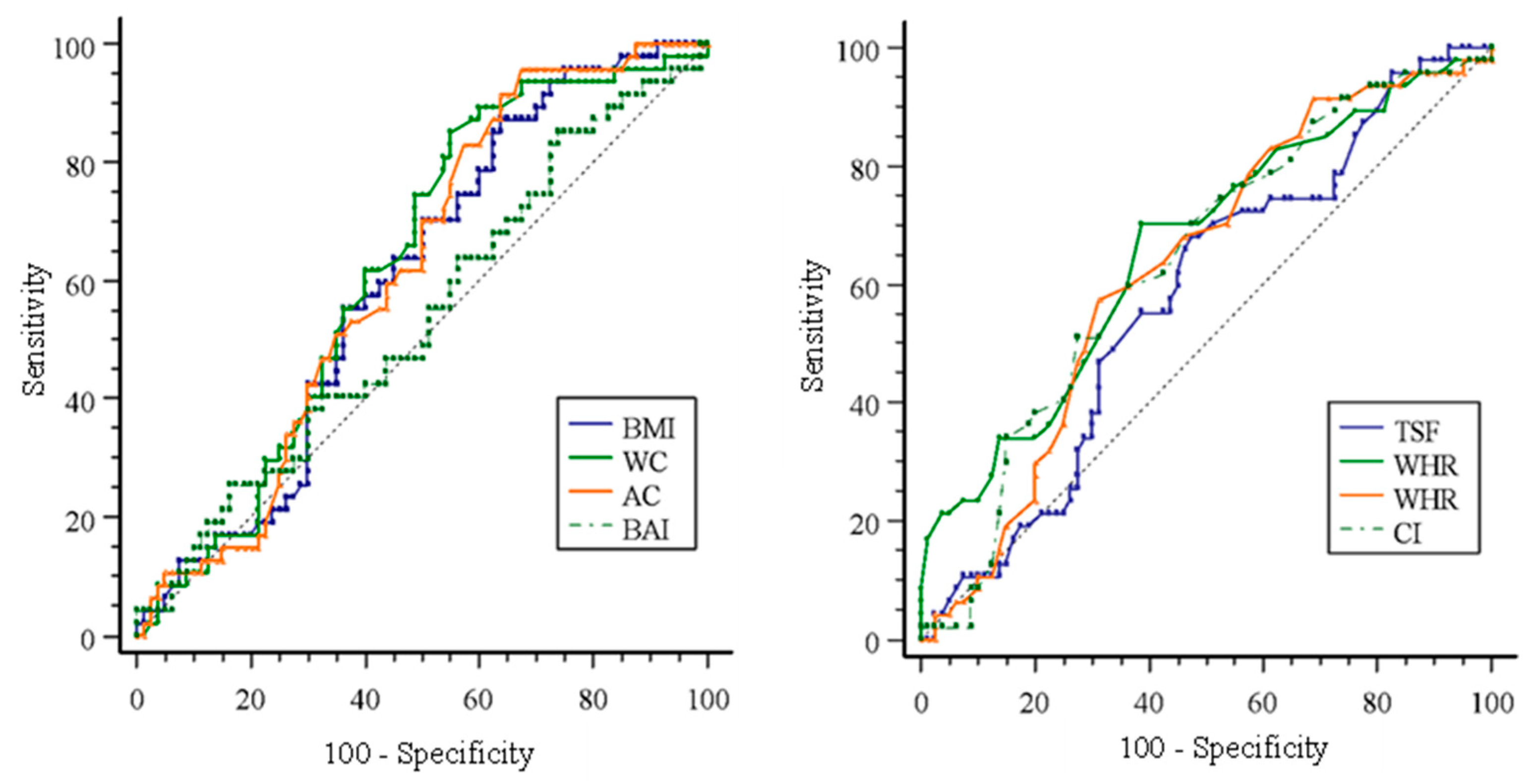
Areas under the ROC curve for anthropometric indicators of obesity used as predictors of hypertriglyceridemia in older men are presented in Figure 2. The analysis showed that BMI, WC, AC, TSF, WHR, WHtR, and CI all demonstrated significant discriminatory capacity, with the lower limits of the 95% confidence intervals for the AUC values exceeding 0.50 (p < 0.05).
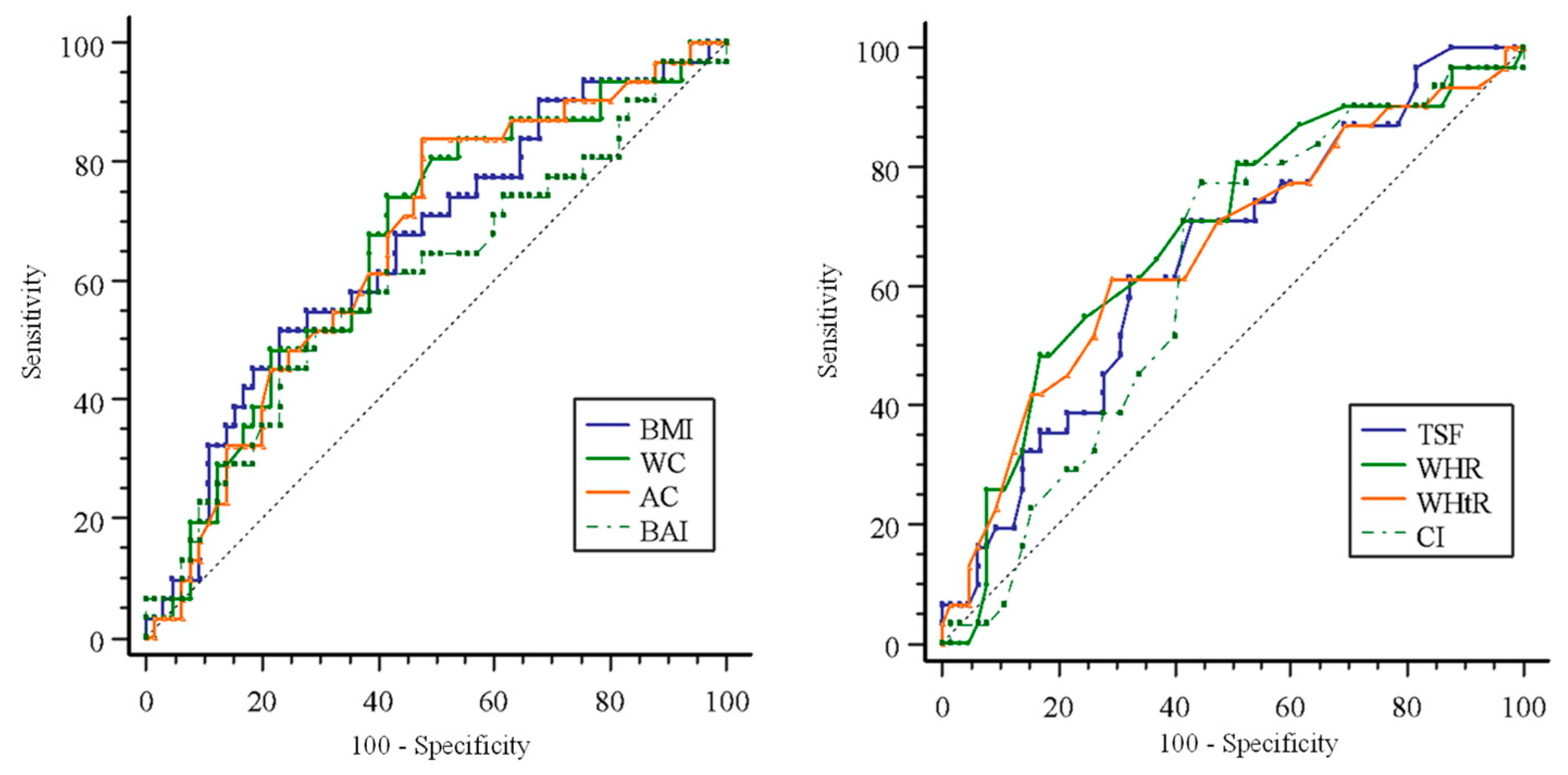
For older women, the anthropometric indicators that demonstrated significant discriminatory capacity for hypertriglyceridemia were BMI, WC, AC, WHR, WHtR, and CI. All of these indicators also had lower limits of the 95% confidence intervals for the AUC values above 0.50 (p < 0.05), as shown in Figure 3.
Among older men, the anthropometric indicators with the highest sensitivity for hypertriglyceridemia were AC at 88.87% (cutoff point: 91 cm) and CI at 77.42% (cutoff point: 1.33). Regarding specificity, WHR showed the best performance at 83.08% (cutoff point: 1.04), followed by BMI at 76.92% (cutoff point: 26.98 kg/m2) (Table 3).
In older women, the indicators with the highest sensitivity were AC at 95.74% (cutoff point: 89 cm) and BMI at 87.23% (cutoff point: 23.48 kg/m2). For specificity, the best performances were observed for CI at 72.50% (cutoff point: 1.38) and WHtR at 68.75% (cutoff point: 0.64) (Table 3).
Analysis of the association between anthropometric indicators of obesity and hypertriglyceridemia, after adjustment for socioeconomic, behavioral, and health-related conditions, showed that participants of both sexes with indicator values at or above their respective cutoff points (identified through ROC curve analysis) had a higher prevalence of hypertriglyceridemia. Details of this association, including prevalence ratios and their 95% confidence intervals, are presented in Table 4.

4. Discussion

This epidemiological study investigates the discriminatory capacity of anthropometric indicators of obesity for screening hypertriglyceridemia in older adults. The main findings showed that, among older men, AC and CI were the most sensitive indicators for detecting hypertriglyceridemia, whereas WHR and BMI demonstrated the highest specificity. Among older women, AC and BMI exhibited the greatest sensitivity, while CI and WHtR showed the best specificity. Additionally, a higher prevalence of hypertriglyceridemia was observed in participants of both sexes whose values were equal to or above the cutoff points identified for the anthropometric indicators of obesity.
These findings are consistent with those of a population-based cross-sectional study conducted with 355 older adults (mean age: 74.2 ± 9.8 years) from Lafaiete Coutinho, Bahia, Brazil, in which anthropometric indicators of obesity also demonstrated discriminatory capacity for hypertriglyceridemia [9]. It is important to note, however, that AC was not assessed in that study, which limits direct comparison with the indicator that showed the greatest sensitivity in the present investigation. Regarding specificity, Alves Júnior et al. [9] reported high WHR values (93.50 percent) among older men, whereas among older women, CI did not exhibit significant accuracy, with WHR presenting the highest specificity (75%).
In screening strategies for large populations, the concepts of sensitivity and specificity are central because they represent essential parameters for the clinical applicability of predictors. Sensitivity reflects the ability of a variable to correctly identify individuals who have the condition of interest (proportion of true positives). Specificity refers to the ability to correctly identify individuals who do not have the condition (proportion of true negatives) [6,7].
Both parameters are complementary and, when applied together or sequentially, can optimize the effectiveness of screening strategies. In the initial phases of screening, prioritizing variables with high sensitivity is recommended because this maximizes the detection of positive cases. This approach is particularly relevant in public health contexts in which the early identification of asymptomatic or underdiagnosed conditions is essential for planning interventions. However, high sensitivity may be associated with an increase in false positives, potentially placing additional demands on healthcare services and requiring further diagnostic verification [6,7].
To mitigate this effect, using predictors with higher specificity at a later stage is recommended. These variables help confirm suspected cases and allow for a more precise distinction between individuals who truly do not have the condition, contributing to the exclusion of false positives. Sequential use of highly sensitive tests followed by instruments with high specificity not only balances the strengths and limitations of each parameter but also strengthens the methodological robustness of screening. This combination provides greater diagnostic reliability, optimizes resource allocation, and supports more accurate clinical and epidemiological decision-making [6,7].
Based on the findings of this study, it is possible to structure an effective screening strategy for hypertriglyceridemia in older adults. Initial screening should prioritize indicators with higher sensitivity. Among older men, AC (88.90%) and CI (77.40%) demonstrated the greatest sensitivity for detecting hypertriglyceridemia, whereas among older women, AC (95.70%) and BMI (87.20%) were the most sensitive indicators. Subsequently, to refine case identification and reduce false positives, predictors with higher specificity should be used. For older men, WHR (83.10%) and BMI (76.90%) showed the highest specificity, while for older women, CI (72.50%) and WHtR (68.80%) demonstrated greater specificity. A detailed screening sequence is presented in the Supplementary Table S1.
The practicality of anthropometric measurements for incorporation into clinical and screening routines is noteworthy, since they can be collected by any healthcare professional with basic technical training. These procedures are simple, quick, and easy to perform. The calculations required to obtain the indicators are mathematically straightforward, generally involving basic operations such as division [6,7].
Regarding the instruments, AC and WHR require only an anthropometric tape [11]. WHR is obtained by dividing WC by HC, both of which are easily measurable [16]. WHtR and CI, in turn, require WC and the individual’s height, obtained using a stadiometer [18]. These instruments are low-cost, portable, and widely available in healthcare services. This reinforces the feasibility of applying these indicators in clinical screening for hypertriglyceridemia, particularly in contexts with limited resources or in more vulnerable populations [6,7].
Recent evidence has highlighted the role of chronic low-grade systemic inflammation in the pathophysiology of dyslipidemias. Diets with higher inflammatory potential have been associated with worse lipid profiles and increased atherogenic indices, although findings related to triglycerides remain inconsistent [31]. Furthermore, cardiometabolic conditions such as lipid-lowering therapy use, hypertension, hypertriglyceridemia, and increased waist circumference have been linked to a higher prevalence of type 2 diabetes mellitus, reinforcing the interrelationship between visceral adiposity, insulin resistance, and lipid dysfunction [32]. These findings align with the biochemical mechanisms underlying obesity-related metabolic alterations described below and support the relevance of anthropometric indicators as accessible tools for metabolic risk screening.
Although dietary patterns were not evaluated in this study, it is important to note that diets high in saturated fat, added sugars, and ultra-processed foods are associated with higher triglyceride concentrations and impaired lipid metabolism in older adults. Such eating habits contribute to systemic low-grade inflammation and metabolic dysfunction, mechanisms that overlap with those involved in hypertriglyceridemia [33,34,35]. This contextual evidence reinforces the biological plausibility of our findings, although detailed dietary assessment was beyond the scope of this investigation.
Given the results obtained in this study, which demonstrate the discriminatory capacity and the association of anthropometric indicators of obesity with hypertriglyceridemia, it is pertinent to consider the underlying pathophysiological mechanisms. Visceral obesity, in particular, is widely recognized as a key determinant of lipid metabolism dysfunctions. Mechanisms described in the literature include hepatic overproduction of Very Low-Density Lipoprotein (VLDL), reduced clearance of lipoprotein remnants, competition between chylomicrons and VLDL for lipoprotein lipase (LPL) action, and disturbances in peripheral lipolysis [36,37].
Moreover, obesity is associated with reduced LPL expression in adipose tissue and decreased LPL activity in skeletal muscle, which further compromises the utilization of circulating triglycerides [36]. Hypertriglyceridemia also induces structural modifications in lipid particles, favoring the formation of Low-Density Lipoprotein (LDL) and Small Dense Low-Density Lipoprotein (sdLDL). These particles, especially sdLDL, have greater atherogenic potential due to the exchange of triglycerides and cholesterol esters between VLDL, LDL, and High-Density Lipoprotein (HDL). This process is mediated by cholesteryl ester transfer protein (CETP) and subsequently by hepatic lipase activity [36,37].
Insulin resistance, a central feature of obesity, stimulates the expression of APOC3 and ANGPTL4, both of which inhibit LPL activity. This mechanism further reduces the hydrolysis of chylomicrons and VLDL, prolonging the circulation of triglyceride-rich lipoproteins [36,38]. As a consequence, hepatic VLDL production increases, along with the formation of atherogenic lipid remnants. These remnants are cleared more slowly by the liver and tend to accumulate in the vascular wall [36,37].
Another relevant mechanism is the intensification of lipolysis in adipocytes, a consequence of peripheral insulin resistance. This process elevates plasma free fatty acid (FFA) concentrations, increasing their hepatic influx and impairing the regulation of apolipoprotein B-100 synthesis, which is essential for triglyceride metabolism [36,38]. In addition to serving as metabolic substrates, FFAs also act as inflammatory mediators, contributing to the chronic low-grade inflammatory state characteristic of obesity. This inflammatory environment further exacerbates lipid dysfunction and promotes the progression of atherosclerotic processes [36,39].
This study has limitations, particularly the possibility of recall bias in some adjustment variables, such as PA level, SB, and hypertension diagnosis, which were collected through self-report. Although validated instruments were used for data collection, some degree of forgetting, underestimation, or overestimation may still occur. To reduce this bias, the MMSE was applied, and only older adults with preserved cognitive function were included.
Conversely, this study presents strengths that enhance the robustness of its findings. Blood triglycerides were measured in a laboratory setting, which represents the gold standard for dyslipidemia diagnosis and ensures precision in outcome assessment. In addition, the regression models were adjusted for socioeconomic, behavioral, and health-related variables, reducing the influence of confounding factors on the observed associations.
The clinical applicability of anthropometric indicators of obesity as operational tools in primary healthcare (PHC) is also noteworthy. Because they are low-cost, simple to perform, and do not require complex laboratory infrastructure, these indicators can be incorporated into routine assessments by trained healthcare professionals. In municipalities such as Aiquara, Bahia, which have small population size, rural characteristics, and limited access to laboratory testing, this strategy offers a viable alternative for initial screening of hypertriglyceridemia in older adults. It is also relevant to highlight that municipalities with fewer than five thousand inhabitants, such as Aiquara, represent approximately 23.10% of all Brazilian municipalities [40].
In this scenario, the routine use of anthropometric indicators represents a strategic clinical alternative, enabling initial risk stratification and early identification of older adults with a higher probability of presenting hypertriglyceridemia. This approach can facilitate selective referral for laboratory testing and optimize the use of available resources. It also expands the problem-solving capacity of PHC, particularly in contexts with structural limitations.
The findings of this research should be interpreted in light of the specific context in which the study was conducted. Considering the sociocultural, economic, and epidemiological diversity of Brazil, a country of continental scale, further investigations in different regions and local realities are recommended. Older adults living in other areas may be exposed to different levels and combinations of risk factors for obesity and hypertriglyceridemia. These variations may influence the validity and applicability of anthropometric indicators as screening tools, particularly in populations with distinct socioeconomic, cultural, and environmental conditions.
The associations observed and the discriminatory capacity of anthropometric indicators of obesity in relation to prevalent cases of hypertriglyceridemia suggest a consistent etiological basis, which reinforces their clinical applicability. Although based on a cross-sectional design, the evidence presented here provides support for future longitudinal investigations. Such studies would allow the estimation of accuracy and operational performance (sensitivity and specificity) of these indicators in the prospective screening of incident cases of hypertriglyceridemia, as well as the quantification of the risk of developing the condition over time. This type of information would expand the usefulness of these indicators in public health surveillance and prevention strategies, particularly in the context of PHC.

5. Conclusions

Evidence indicates that among older men, AC and CI demonstrated the highest capacity to screen for hypertriglyceridemia, whereas WHR and BMI were more effective in identifying those without the condition. Among older women, AC and BMI showed superior performance in screening participants with hypertriglyceridemia, while CI and WHtR were more effective at identifying those without the condition. Additionally, anthropometric indicators of obesity were positively associated with hypertriglyceridemia in the studied population.

Supplementary Materials

The following supporting information can be downloaded at: https://www.mdpi.com/article/10.3390/obesities5040093/s1, Table S1: Practical screening protocol for hypertriglyceridemia in older adults using anthropometric indicators of obesity.

Author Contributions

Conceptualization, M.W.F.P., C.F.d.S.M. and L.d.S.; methodology, M.W.F.P., L.d.S., P.d.F.V.N. and C.B.d.A.; validation, F.D.R.P.S., B.C.R., C.A.C., O.L.F., D.F.B., A.B.F. and H.D.F.S.P.; formal analysis, F.D.R.P.S., B.C.R., C.A.C., O.L.F., D.F.B., A.B.F. and H.D.F.S.P.; investigation, M.W.F.P., C.F.d.S.M., G.A.G., C.D.D.L., T.S.Q., D.J.d.S., S.d.S.C. and L.d.S.; resources, L.d.S., P.d.F.V.N. and C.A.C.; data curation, M.W.F.P., C.F.d.S.M. and L.d.S., writing—original draft preparation, M.W.F.P., C.F.d.S.M., G.A.G., C.D.D.L., T.S.Q., D.J.d.S., S.d.S.C. and L.d.S.; writing—review and editing, P.d.F.V.N., C.B.d.A., F.D.R.P.S., B.C.R., C.A.C., O.L.F., D.F.B., A.B.F., C.A.C., D.J.d.S., S.d.S.C. and L.d.S.; visualization, M.W.F.P., C.F.d.S.M., G.A.G., C.D.D.L., T.S.Q., P.d.F.V.N., C.B.d.A., F.D.R.P.S., B.C.R., C.A.C., O.L.F., D.F.B., A.B.F., C.A.C., D.J.d.S., S.d.S.C. and L.d.S., supervision, D.J.d.S., S.d.S.C. and L.d.S., project administration, L.d.S., P.d.F.V.N., C.B.d.A. and C.A.C.; funding acquisition, L.d.S., P.d.F.V.N., C.B.d.A. and C.A.C. All authors have read and agreed to the published version of the manuscript.

Funding

This research was supported by the Programa de Pesquisa para o SUS (PPSUS; Brazilian Unified Health System Research Program) and the Fundação de Amparo à Pesquisa do Estado da Bahia (FAPESB; Bahia State Research Support Foundation) (grant number: 20/2013/SUS0055/2013).

Institutional Review Board Statement

The research was conducted in accordance with the World Medical Association’s Declaration of Helsinki and Resolution No. 466/2012 of the Brazilian National Health Council. The study was approved by the Research Ethics Committee of the State University of Southwest Bahia (Opinion No. 171.464/2012; Certificate of Presentation for Ethical Appreciation No. 10786212.30000.0055; 17 December 2012).

Informed Consent Statement

Before data collection, all older adults received comprehensive information about the study’s objectives and procedures. Voluntary participation was confirmed by a signed Informed Consent Form from each participant, guaranteeing ethical conduct throughout the investigation.

Data Availability Statement

The data sets generated and analyzed during the study are available from the corresponding author upon request.

Acknowledgments

The authors thank the Municipal Health Department of Aiquara, Bahia, Brazil; the older adults who kindly and voluntarily agreed to participate in the study; the State University of Southwest Bahia; and the State University of Tocantins.

Conflicts of Interest

The authors declare that they have no conflicts of interest.

References

  1. Faludi, A.; Izar, M.; Saraiva, J.; Chacra, A.; Bianco, H.; Neto, A.A.; Bertolami, A.; Pereira, A.; Lottenberg, A.; Sposito, A.; et al. Atualização da diretriz brasileira de dislipidemias e prevenção da aterosclerose–2017. Arq. Bras. Cardiol. 2017, 109, 1–76. [Google Scholar] [CrossRef]
  2. Ramírez, J.P.; Marchena, M.B.; Rebatta, F.B.; Valladares, E.R.; Zamora, R.A. Frecuencia y factores asociados a las enfermedades crónicas no transmisibles en adultos mayores en el Perú, 2005. An. Fac. Med. 2022, 83, 299–306. [Google Scholar] [CrossRef]
  3. Sakai, K.; Koba, S.; Nakamura, Y.; Yokota, Y.; Tsunoda, F.; Shoji, M.; Itoh, Y.; Hamazaki, Y.; Kobayashi, Y. Small dense low-density lipoprotein cholesterol is a promising biomarker for secondary prevention in older men with stable coronary artery disease. Geriatr. Gerontol. Int. 2018, 18, 965–972. [Google Scholar] [CrossRef] [PubMed]
  4. de Souza, F.O.; Júnior, C.Q.d.L.; Siqueira, I.C.; de Oliveira, N.C.; Tavares, R.S.; Rocha, T.M.D.; de Moura, A.L.D. Avaliação do perfil lipídico de pacientes acima de 60 anos de idade atendidos em um laboratório-escola. Rev. Bras. Anal. Clin. 2017, 49, 70–75. [Google Scholar] [CrossRef]
  5. Rosa, C.B.; Agostini, J.A.; Bianchi, P.D.; Garces, S.B.B.; Hansen, D.; Moreira, P.R.; Schwanke, C.H.A. Síndrome metabólica e estado nutricional de idosos cadastrados no HiperDia. Sci. Med. 2016, 26, ID23100. [Google Scholar] [CrossRef]
  6. dos Santos, L.; Pedreira, R.B.S.; Silva, R.R.; Barbosa, R.d.S.; Neto, P.d.F.V.; Casotti, C.A. Anthropometric indicators of adiposity as predictors of systemic arterial hypertension in older people: A cross-sectional analysis. Rev. Nutr. 2023, 36, e220137. [Google Scholar] [CrossRef]
  7. de Souza, Y.S.; dos Santos, L.; da Silva, D.J.; Santos, E.S.; Caires, S.d.S.; Neto, P.d.F.V.; de Almeida, C.B.; Santana, P.d.S.; Barbosa, R.d.S.; Casotti, C.A. Anthropometric indicators of obesity as screening tools for low high-density lipoprotein cholesterol in older adults: A cross-sectional study. Lipids 2025, 60, 327–335. [Google Scholar] [CrossRef]
  8. de Araujo, C.M.; Fernandes, M.H.; Carneiro, J.A.O.; da Silva Coqueiro, R.; Pereira, R. Increased waist circumference as an independent predictor of hypercholesterolemia in community-dwelling older people. Healthc. Low. Resour. Settings 2018, 6, 6468. [Google Scholar] [CrossRef]
  9. Alves Júnior, C.A.; Coqueiro, R.d.S.; Carneiro, J.A.O.; Pereira, R.; Barbosa, A.R.; de Magalhães, A.C.M.; Oliveira, M.V.; Fernandes, M.H. Anthropometric indicators in hypertriglyceridemia discrimination: Application as screening tools in older adults. J. Nurs. Meas. 2016, 24, 215–225. [Google Scholar] [CrossRef]
  10. Cuschieri, S. The STROBE guidelines. Saudi J. Anaesth. 2019, 13, S31–S34. [Google Scholar] [CrossRef]
  11. Casotti, C.A.; Almeida, C.B.; Santos, L.; Valença Neto, P.F.; Carmo, T.B. Condições de saúde e estilo de vida de idosos: Métodos e desenvolvimento do estudo. Prat. Cuid. Rev. Saude Col. 2021, 2, e12643. [Google Scholar]
  12. da Silva, D.J.; dos Santos, L.; de Souza, Y.S.; Neto, P.d.F.V.; Santana, P.d.S.; de Almeida, C.B.; Casotti, C.A. Physical fitness according to the level of physical activity in older people: A cross-sectional analysis. Fisioter. Mov. 2023, 36, e36134. [Google Scholar] [CrossRef]
  13. Icaza, M.G.; Albala, C. Minimental State Examinations (MMSE) del Estudio de Demencia en Chile: Análisis Estadístico. 1999. Available online: https://pesquisa.bvsalud.org/portal/resource/pt/pah-28530 (accessed on 18 April 2025).
  14. Bertolucci, P.H.; Brucki, S.M.; Campacci, S.R.; Juliano, Y. O mini-exame do estado mental em uma população geral: Impacto da escolaridade. Arq. Neuropsiquiatr. 1994, 52, 1–7. [Google Scholar] [CrossRef]
  15. de Souza, Y.S.; dos Santos, L.; da Silva, D.J.; Barbosa, R.d.S.; Pinto, L.L.T.; Neto, P.d.F.V.; Casotti, C.A. Hypertriglyceridemic waist phenotype in older adults: Prevalence and associated factors. Cad. Saude Colet. 2024, 32, e32040610. [Google Scholar] [CrossRef]
  16. WHO Expert Committee. Physical Status: The Use of and Interpretation of Anthropometry, Report of a WHO Expert Committee; World Health Organization: Geneva, Switzerland, 1995. Available online: https://apps.who.int/iris/handle/10665/37003 (accessed on 1 July 2024).
  17. Bergman, R.N.; Stefanovski, D.; Buchanan, T.A.; Sumner, A.E.; Reynolds, J.C.; Sebring, N.G.; Xiang, A.H.; Watanabe, R.M. A better index of body adiposity. Obesity 2011, 19, 1083–1089. [Google Scholar] [CrossRef] [PubMed]
  18. Hsieh, S.; Yoshinaga, H. Waist/height ratio as a simple and useful predictor of coronary heart disease risk factors in women. Intern. Med. 1995, 34, 1147–1152. [Google Scholar] [CrossRef] [PubMed]
  19. Valdez, R. A simple model-based index of abdominal adiposity. J. Clin. Epidemiol. 1991, 44, 955–956. [Google Scholar] [CrossRef] [PubMed]
  20. Cobas, R.; Rodacki, M.; Giacaglia, L.; Calliari, L.E.; Noronha, R.M.; Valerio, C.; Custódio, J.; Scharf, M.; Barcellos, C.R.G.; Tomarchio, M.P.; et al. Diagnóstico do Diabetes e Rastreamento do Diabetes Tipo 2; Diretriz Oficial da Sociedade Brasileira de Diabetes; Sociedade Brasileira de Diabetes: São Paulo, Brazil, 2022. [Google Scholar] [CrossRef]
  21. Craig, C.L.; Marshall, A.L.; Sjöström, M.; Bauman, A.E.; Booth, M.L.; Ainsworth, B.E.; Pratt, M.; Ekelund, U.; Yngve, A.; Sallis, J.F.; et al. International physical activity questionnaire: 12-country reliability and validity. Med. Sci. Sports Exerc. 2003, 35, 1381–1395. [Google Scholar] [CrossRef]
  22. Benedetti, T.R.B.; Antunes, P.C.; Rodriguez-Añez, C.R.; Mazo, G.Z.; Petroski, E.L. Reprodutibilidade e validade do Questionário Internacional de Atividade Física (IPAQ) em homens idosos. Rev. Bras. Med. Esporte 2007, 13, 11–16. [Google Scholar] [CrossRef]
  23. Benedetti, T.B.; Mazo, G.Z.; Barros, M.V.G. Aplicação do questionário internacional de atividades físicas para avaliação do nível de atividades física de mulheres idosas: Validade concorrente e reprodutibilidade teste-reteste. Rev. Bras. Cien Mov. 2004, 12, 25–34. Available online: https://portalrevistas.ucb.br/index.php/rbcm/article/view/538/11870 (accessed on 18 April 2025).
  24. Bull, F.C.; Al-Ansari, S.S.; Biddle, S.; Borodulin, K.; Buman, M.P.; Cardon, G.; Carty, C.; Chaput, J.P.; Chastin, S.; Chou, R.; et al. World Health Organization 2020 guidelines on physical activity and sedentary behaviour. Br. J. Sports Med. 2020, 54, 1451–1462. [Google Scholar] [CrossRef]
  25. Mishra, P.; Pandey, C.M.; Singh, U.; Gupta, A.; Sahu, C.; Keshri, A. Descriptive statistics and normality tests for statistical data. Ann. Card. Anaesth. 2019, 22, 67–72. [Google Scholar] [CrossRef]
  26. Nahm, F.S. Receiver operating characteristic curve: Overview and practical use for clinicians. Korean J. Anesthesiol. 2022, 75, 25–36. [Google Scholar] [CrossRef]
  27. Delong, E.R.; Delong, D.M.; Clarke-Pearson, D.L. Comparing the areas under two or more correlated receiver operating characteristic curves: A nonparametric approach. Biometrics 1988, 44, 837–845. [Google Scholar] [CrossRef]
  28. Martínez-Camblor, P.; Pardo-Fernández, J.C. The Youden index in the generalized receiver operating characteristic curve context. Int. J. Biostat. 2019, 15, 20180060. [Google Scholar] [CrossRef] [PubMed]
  29. Coutinho, L.M.S.; Scazufca, M.; Menezes, P.R. Methods for estimating prevalence ratios in cross-sectional studies. Rev. Saude Publica 2008, 42, 992–998. [Google Scholar] [CrossRef] [PubMed]
  30. Greenland, S.; Daniel, R.; Pearce, N. Outcome modelling strategies in epidemiology: Traditional methods and basic alternatives. Int. J. Epidemiol. 2016, 45, 565–575. [Google Scholar] [CrossRef] [PubMed]
  31. Behzadi, M.; Jowshan, M.R.; Shokri, S.; Hamedi-Shahraki, S.; Amirkhizi, F.; Bideshki, M.V.; Harooni, J.; Asghari, S. Association of dietary inflammatory index with dyslipidemia and atherogenic indices in Iranian adults: A cross-sectional study from the PERSIAN dena cohort. Nutr. J. 2025, 24, 96. [Google Scholar] [CrossRef]
  32. González-Lleó, A.M.; Brito-Casillas, Y.; Martín-Santana, V.; Gil-Quintana, Y.; Tugores, A.; Scicali, R.; Riaño, M.; Hernández-Baraza, L.; Jiménez-Monzón, R.; Girona, J.; et al. Glucose metabolism in heterozygous familial hypercholesterolemia with a founder effect and a high diabetes prevalence: A cross-sectional study. Cardiovasc. Diabetol. 2025, 24, 322. [Google Scholar] [CrossRef]
  33. Barbaresko, J.; Koch, M.; Schulze, M.B.; Nöthlings, U. Ultra-processed food consumption and human health: An umbrella review of systematic reviews with meta-analyses. Am. J. Clin. Nutr. 2024, 119, 835–858. [Google Scholar] [CrossRef]
  34. Kim, S.-H.; Joung, H. Association between the Korean Healthy Diet Score and Metabolic Syndrome: Effectiveness and Optimal Cutoff of the Korean Healthy Diet Score. Nutrients 2024, 16, 3395. [Google Scholar] [CrossRef] [PubMed]
  35. Liu, X.; Wang, X.; Li, X.; Zhang, D. Association between dietary patterns and dyslipidemia in Henan rural adults: A cross-sectional study. Asia Pac. J. Clin. Nutr. 2020, 29, 299–308. [Google Scholar] [PubMed]
  36. Klop, B.; Elte, J.; Cabezas, M. Dyslipidemia in obesity: Mechanisms and potential targets. Nutrients 2013, 5, 1218–1240. [Google Scholar] [CrossRef]
  37. Hassing, H.C.; Surendran, R.P.; Mooij, H.L.; Stroes, E.S.; Nieuwdorp, M.; Dallinga-Thie, G.M. Pathophysiology of hypertriglyceridemia. Biochim. Biophys. Acta 2012, 1821, 826–832. [Google Scholar] [CrossRef]
  38. Borén, J.; Taskinen, M.R.; Björnson, E.; Packard, C.J. Metabolism of triglyceride-rich lipoproteins in health and dyslipidaemia. Nat. Rev. Cardiol. 2022, 19, 577–592. [Google Scholar] [CrossRef]
  39. Jin, X.; Qiu, T.; Li, L.; Yu, R.; Chen, X.; Li, C.; Proud, C.G.; Jiang, T. Pathophysiology of obesity and its associated diseases. Acta Pharm. Sin. B 2023, 13, 2403–2424. [Google Scholar] [CrossRef] [PubMed]
  40. Instituto Brasileiro de Geografia e Estatística (IBGE). População Estimada do País Chega a 212,6 Milhões de Habitantes em 2024; IBGE: Rio de Janeiro, Brazil, 2024. Available online: https://agenciadenoticias.ibge.gov.br/agencia-noticias/2012-agencia-de-noticias/noticias/41111-populacao-estimada-do-pais-chega-a-212-6-milhoes-de-habitantes-em-2024 (accessed on 18 April 2025).
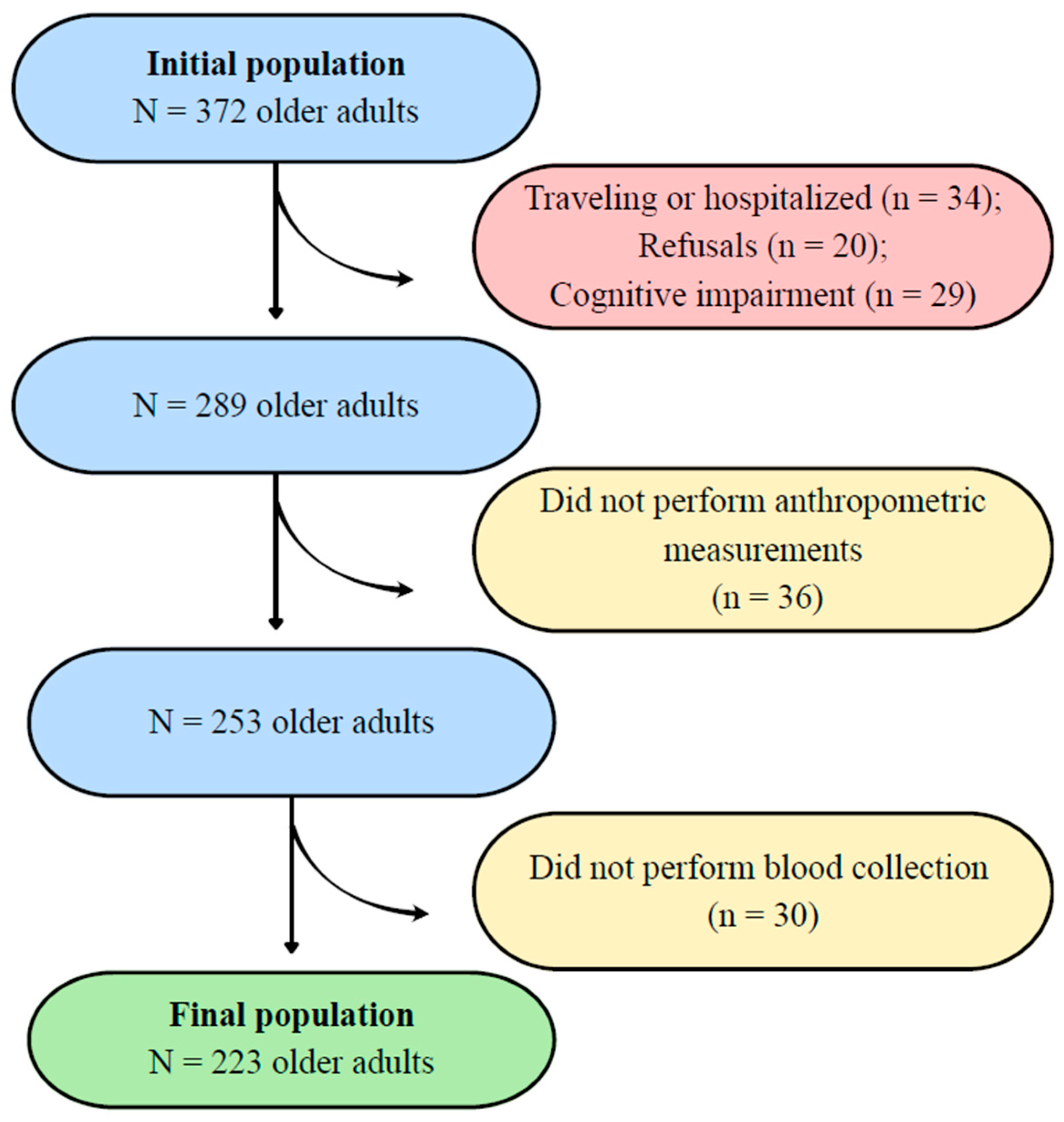
Figure 1. Flowchart illustrating the eligibility process for selecting older adults who participated in the study.
Obesities 05 00093 g001
Figure 2. Receiver operating characteristic curves of anthropometric indicators of obesity for screening hypertriglyceridemia in older men. BMI: body mass index. WC: waist circumference. AC: abdominal circumference. BAI: body adiposity index. TSF: triceps skinfold thickness. WHR: waist-to-hip ratio. WHtR: waist-to-height ratio. The curves illustrate the discriminatory performance of each indicator for identifying hypertriglyceridemia in older adults. Sensitivity is plotted on the y-axis and 100−Specificity on the x-axis. The optimal cutoff points, corresponding sensitivities and specificities, and the AUC values used for interpretation are fully presented in Table 3.
Obesities 05 00093 g002
Figure 3. Receiver operating characteristic curves of anthropometric indicators of obesity for screening hypertriglyceridemia in older women. BMI: body mass index. WC: waist circumference. AC: abdominal circumference. BAI: body adiposity index. TSF: triceps skinfold thickness. WHR: waist-to-hip ratio. WHtR: waist-to-height ratio. The curves illustrate the discriminatory performance of each indicator for identifying hypertriglyceridemia in older adults. Sensitivity is plotted on the y-axis and 100−Specificity on the x-axis. The optimal cutoff points, corresponding sensitivities and specificities, and the AUC values used for interpretation are fully presented in Table 3.
Obesities 05 00093 g003
Table 1. Equations used to estimate anthropometric indicators of obesity in older adults.
AuthorsEquations
WHO [16]BMI: (BM/Ht2)
Bergman et al. [17]BAI: [HC (cm)/Ht (m) √Ht (m)] − 18]
WHO [16]WHR: [WC (cm)/HC (cm)]
Hsieh and Yoshinaga [18]WHtR: [WC (cm)/Ht (cm)]
Valdez [19]CI: [WC (m)/0.109√ (BM/Ht (m))]
WHO: World Health Organization. BMI: body mass index. BAI: body adiposity index. WHR: waist-to-hip ratio. WHtR: waist-to-height ratio. CI: conicity index. HC: hip circumference. WC: waist circumference. BM: body mass. Ht: Height. cm: centimeters. m: meters.
Table 2. Descriptive analysis of socioeconomic, behavioral, and health-related aspects of the study population.
Variables% ResponseN%
Sex100.00
Male 9643.00
Female 12757.00
Age group100.00
60–69 years 8939.90
70–79 years 9241.30
≥80 years 4218.80
Educational level98.20
With formal education 10146.10
Without formal education 11853.90
Marital status100.00
Married or in a stable relationship 11451.10
Divorced/separated 5223.30
Widowed 5725.60
Skin color98.70
White 2210.00
Non-white 19890.00
Income99.10
≤1 minimum wage 19186.40
>1 minimum wage 3013.60
Alcohol consumption99.60
No 17578.80
Yes 4721.20
Tobacco use100.00
No 18783.90
Yes 3616.10
Level of physical activity100.00
Sufficient 12757.00
Insufficient 9643.00
High sedentary behavior100.00
No 16875.30
Yes 5524.70
Seeking healthcare services100.00
≥2 times/year 17879.80
1 time/year 198.50
Never 2611.70
Hypertension100.00
No 8538.10
Yes 13861.90
Diabetes mellitus99.10
No 17578.20
Yes 4620.80
N: absolute frequency. %: percentage.
Table 3. Parameters of the receiver operating characteristic curves of anthropometric indicators of obesity as discriminators of hypertriglyceridemia in older adults of both sexes.
Older Men
VariablesCutoff PointSensitivity
(95% CI)
Specificity
(95% CI)
AUC
(95% CI)
BMI (kg/m2)26.9851.61 (33.10–69.80)76.92 (64.80–86.50)0.66 (0.54–0.77) *
WC (cm)93.0074.19 (55.40–88.20)58.46 (45.60–70.60)0.66 (0.55–0.78) *
AC (cm)91.0088.87 (66.30–94.50)52.31 (39.50–64.90)0.66 (0.55–0.78) *
BAI (%)27.8851.61 (33.10–69.80)70.77 (58.20–81.40) 0.60 (0.47–0.73)
TSF (mm)16.0061.29 (42.20–78.20)67.69 (54.90–78.80)0.65 (0.53–0.76) *
WHR1.0448.39 (30.20–66.90)83.08 (71.70–91.20)0.68 (0.57–0.80) *
WHtR0.5961.29 (42.20–78.20)70.77 (58.20–81.40)0.66 (0.54–0.78) *
CI1.3377.42 (58.90–90.40)55.38 (42.50–67.70)0.62 (0.51–0.73) *
Older Women
VariablesCutoff PointSensitivity
(95% CI)
Specificity
(95% CI)
AUC
(95% CI)
BMI (kg/m2)23.4887.23 (74.30–95.20)36.25 (25.80–47.80)0.60 (0.51–0.70) *
WC (cm)88.0085.11 (71.70–93.80)45.00 (33.80–56.50)0.62 (0.53–0.72) *
AC (cm)89.0095.74 (85.50–99.50)32.50 (22.40–43.90)0.61 (0.52–0.71) *
BAI (%)30.4185.11 (71.70–93.80)26.25 (17.00–37.30) 0.53 (0.43–0.64)
TSF (mm)25.6768.09 (52.90–80.90)52.50 (41.00–63.80) 0.58 (0.48–0.68)
WHR0.9570.21 (55.10–82.70)61.25 (49.70–71.90)0.66 (0.56–0.76) *
WHtR0.6457.45 (42.20–71.70)68.75 (57.40–78.70)0.63 (0.53–0.73) *
CI1.3851.06 (36.10–65.90)72.50 (61.40–81.90)0.64 (0.54–0.73) *
kg/m2: kilogram per square meter. cm: centimeters. %: percentage. BMI: body mass index. WC: waist circumference. AC: abdominal circumference. BAI: body adiposity index. TSF: triceps skinfold thickness. WHR: waist-to-hip ratio. WHtR: waist-to-height ratio. CI: conicity index. Area under the curve (Receiver Operating Characteristic). 95% CI: 95% confidence interval. * p-value < 0.05.
Table 4. Association between anthropometric indicators of obesity and hypertriglyceridemia in older adults of both sexes.
VariablesOlder Men
Prevalence (%)Crude PR
(95% CI)
Adjusted PR
(95% CI) #
BMI (kg/m2) a
<26.98 kg/m223.1011
≥26.98 kg/m251.602.23 (1.30–3.91) *1.90 (1.40–3.40) *
WC (cm) b
<93.00 cm17.4011
≥93.00 cm46.002.64 (1.32–5.31) *2.38 (1.58–7.11) *
AC (cm) c
<91.00 cm12.8011
≥91.00 cm45.603.55 (1.50–8.50) *4.82 (2.03–11.45) *
TSF (mm) b
<16.00 mm21.4011
≥16.00 mm47.502.21 (1.20–4.03) *1.84 (1.05–3.20) *
WHR d
<1.0422.9011
≥1.0457.702.52 (1.47–4.33) *2.49 (1.43–4.32) *
WHtR e
<0.5920.7011
≥0.5950.002.41 (1.33–4.38) *2.32 (1.27–4.22) *
CI f
<1.3316.3011
≥1.3345.302.78 (1.32–5.82) *2.99 (1.32–6.80) *
VariablesOlder Women
Prevalence (%)Crude PR
(95% CI)
Adjusted PR
(95% CI) #
BMI (kg/m2) g
<23.48 kg/m217.1011
≥23.48 kg/m244.602.60 (1.21–5.58) *2.60 (1.24–5.49) *
WC (cm) g
<88.00 cm16.301
≥88.00 cm47.602.92 (1.43–5.98) *2.85 (1.45–5.58) *
AC (cm) g
<89.00 cm7.101
≥89.00 cm45.506.36 (1.64–24.61) *6.42 (1.70–24.31) *
WHR g
<0.9522.2011
≥0.9551.602.32 (1.38–3.90) *2.06 (1.29–3.45) *
WHtR g
<0.6425.7011
≥0.6452.802.06 (1.30–3.20) *1.81 (1.13–2.90) *
CI g
<1.3828.4011
≥1.3852.201.83 (1.18–2.86) *1.60 (1.02–2.52) *
%: percentage. kg/m2: kilogram per square meter. cm: centimeters. %: percentage. BMI: body mass index. WC: waist circumference. AC: abdominal circumference. TSF: triceps skinfold thickness. WHR: waist-to-hip ratio. WHtR: waist-to-height ratio. CI: conicity index. 95% CI: 95% confidence interval. PR: Prevalence Ratio. a Adjusted for age, education, skin color, marital status, and level of physical activity. b Adjusted for age, education, skin color, and level of physical activity. c Adjusted for age, education, skin color, and seeking healthcare services. d Adjusted for age, education, income, and level of physical activity. e Adjusted for age, education, and skin color. f Adjusted for age, marital status, tobacco use, level of physical activity, and seeking healthcare services. g Adjusted for skin color, marital status, and diabetes mellitus. # Adjustment variables presented were those that met the criteria reported in the statistical analysis section (p-value ≤ 0.10), * p-value < 0.05.
Disclaimer/Publisher’s Note: The statements, opinions and data contained in all publications are solely those of the individual author(s) and contributor(s) and not of MDPI and/or the editor(s). MDPI and/or the editor(s) disclaim responsibility for any injury to people or property resulting from any ideas, methods, instructions or products referred to in the content.