2. Review Approach and Scope
Butterfly–plant interactions consist of dynamic ecological interactions, and their reorganization in response to perturbations can reveal how communities respond to environmental stress. These interactions depend on plant availability, butterfly behavior, seasonal timing, habitat context, and pollen movement, all of which can shift with climate, land use, restoration, and disturbance. Because interaction patterns may change before species disappear from a landscape, they provide a useful perspective for examining ecological reorganization beyond species occurrence alone [
11,
12,
15,
29]. This review focuses on butterfly–plant interactions documented through field observations, pollen load evidence, historical specimens, restoration studies, biodiversity collections, and network-based analyses.
This review was guided by the question: how are butterfly–plant interactions reorganized under environmental change? To address this question, we considered studies that documented plant visitation, pollen transport, plant use patterns, non-native plant use, restoration outcomes, phenological mismatch, habitat alteration, drought response, climate effects, or ecological network structure. The emphasis is on plant resource associations, pollen movement, specialization and generalization, interaction rewiring, and changes in network structure. Particular attention was given to studies from the United States, where long-term butterfly records, museum collections, restoration studies, and regional plant use datasets provide important evidence for understanding interaction change. The broader plant–pollinator and mutualistic network literature was included when it provided conceptual support for interpreting interaction loss, network robustness, specialization, generalization, rewiring, and ecological reorganization [
12,
14,
15,
16,
29,
31]. Again, it is relevant to focus on systems in the United States for yielding practical inferences in a country that offers a powerful mix of long-term butterfly records, extensive museum collections, strong environmental gradients, juxtaposed urban/non-native plant systems, and restoration experiments at multiple scales across the country.
The relevant literature was identified using combinations of search terms related to butterfly–plant interactions, pollen loads, plant use records, Lepidoptera pollen transport, flower visitation, museum specimens, non-native plant use, restoration, and plant–pollinator networks. Searches were conducted through academic databases and by screening reference lists from peer-reviewed articles, theses, and formal conservation or research reports. Non-peer-reviewed preprints were not used as core evidence. Because the available studies differ in methods, spatial scales, response variables, and evidence types, this review was designed as a narrative synthesis rather than a formal meta-analysis, with emphasis on recurring ecological patterns and conservation implications. Studies were retained when they provided evidence on butterfly plant use patterns, pollen transport, historical pollen records, interaction networks, restoration contexts, non-native plant associations, or environmental drivers affecting butterfly–plant relationships. Studies focused only on butterfly abundance or distribution were included only when they directly linked population patterns to plant resources, habitat management, restoration, or interaction structure [
15,
17,
18,
19,
31,
32,
33,
34,
35].
For each study, we recorded geographic region, habitat type, butterfly taxon, associated plant taxa or plant community, evidence type, environmental driver, methodological approach, and main ecological finding. Evidence types were grouped into field observations, pollen load records, historical specimen-based evidence, restoration or management studies, non-native plant use studies, and network-based analyses. Environmental drivers were grouped into climate variation, drought, altered precipitation, habitat fragmentation, land use change, non-native plant presence, restoration, disturbance management, and other conservation-related interventions. The synthesis was used to identify recurring patterns in how butterfly–plant interactions are maintained, rewired, simplified, compressed, or lost under environmental change. Particular attention was given to partner shifts, temporal mismatch, reduced plant resource diversity, altered plant availability, changes in the balance between broadly used and specialized plant resources, and weakening of vulnerable specialized links. By connecting observational, historical, restoration-based, and network-based studies, this approach provides a basis for interpreting butterfly–plant interactions as dynamic ecological relationships relevant to conservation and ecological sustainability under changing environmental conditions.
3. Breadth of Butterfly–Plant Interactions in the United States
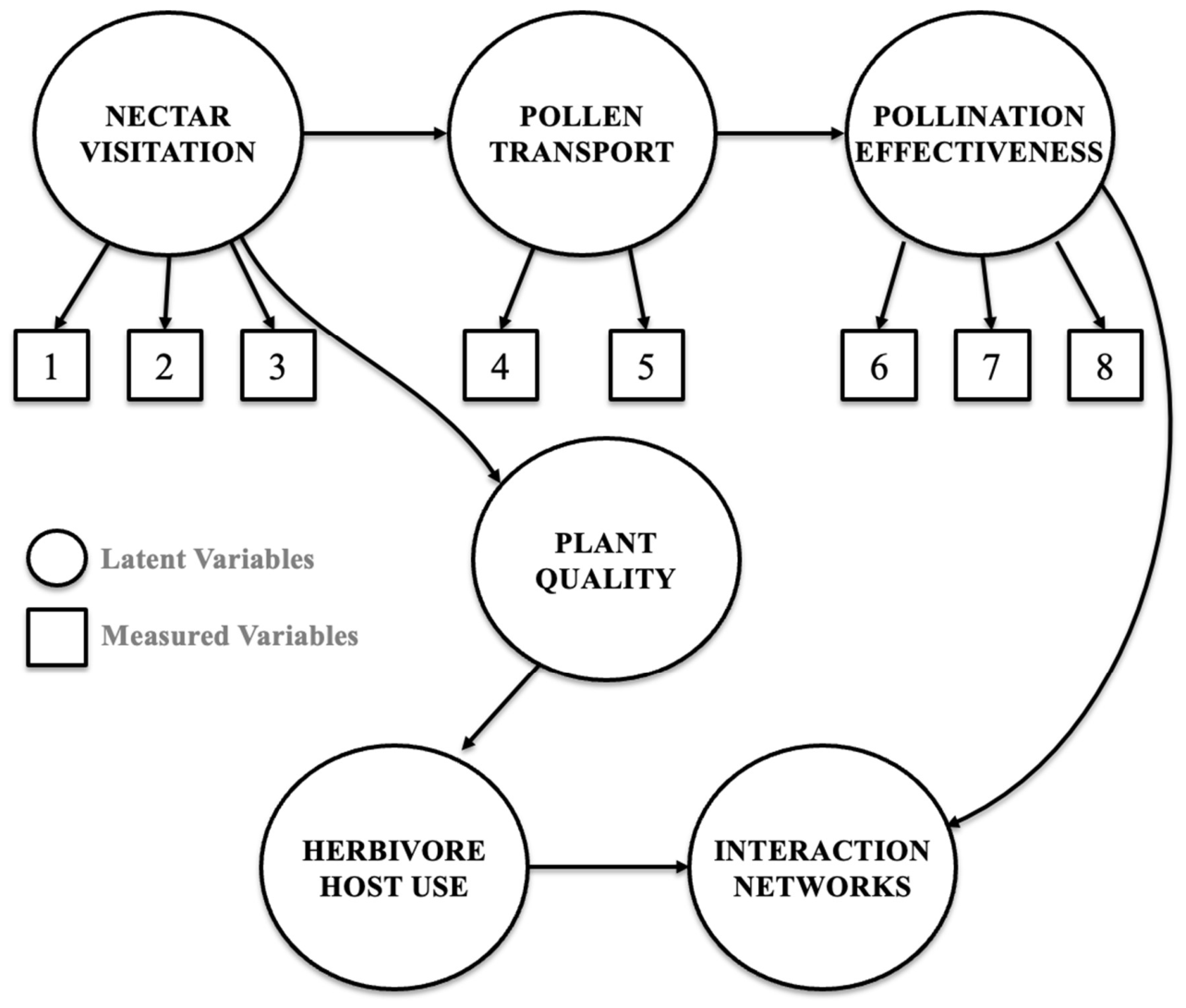
Butterfly–plant interactions in the United States include a broad range of plant use relationships documented through field observations, experiments, pollen load evidence, historical specimens, restoration studies, and network analyses. This review emphasizes flower-visiting butterflies and the plant associations they form through visitation, pollen transport, repeated plant use, movement among plant patches, and interaction network structure. These relationships can reveal changes in plant resource use that may not be evident from butterfly occurrence or abundance records alone. A butterfly species may remain present and even abundant across the landscape, while its plant associations become narrower, more generalized, seasonally mismatched, or reorganized around a different set of available resources. Field observations provide direct evidence of contemporary plant visitation, but visitation should not be treated as equivalent to pollination. Visitation, pollen removal, pollen deposition, and plant reproductive success are related but distinct processes. Early work on skippers raised the question of whether some flower visits represent pollination or nectar theft, and later studies showed that pollination effectiveness can depend on traits such as mouthpart dimensions, floral morphology, and species-specific behavior [
20,
21,
22]. Thus, butterfly–plant interactions are most informative when visitation records are interpreted alongside pollen transport and plant use evidence.
Understanding whether butterflies shift towards being more specialized or more generalized in plant interactions is helpful for interpreting changes in interaction patterns. Some butterflies use a narrow set of plant resources, creating specialized links that may be vulnerable when those resources decline, face phenological shifts, or disappear locally. Other butterflies use a broader range of plants and may shift among resources as availability changes. Generalist interactions can increase flexibility, support interaction diversity, and help networks persist under disturbance. However, generalization can also indicate ecological simplification if many butterflies converge on the same few resilient or widely available plant taxa. This distinction is consistent with broader pollination theory showing that specialization and generalization are context-dependent outcomes shaped by morphology, behavior, resource availability, and ecological opportunity [
16,
29,
36]. Network approaches help place these plant use relationships into community context. Metrics such as connectance, nestedness, modularity, specialization, and interaction turnover can be useful for evaluating whether butterfly–plant relationships are broadly distributed, compartmentalized, rewired, or concentrated around a few resources. However, these metrics must be interpreted ecologically. Higher connectance may indicate flexibility in some systems, but under disturbance or resource limitation it may also reflect compression around fewer available plant resources [
13,
15,
17,
30].
Modified landscapes further show why plant function and plant origin must be considered together. In California, urban and human-altered butterfly communities may rely heavily on non-native plants, particularly where native plant communities have been reduced or reorganized [
34,
35]. Non-native plants may reflect disturbance, but they can also provide nectar, pollen-associated resources, or host use opportunities for some butterflies. This creates a practical conservation challenge: removing non-native plants without replacing their ecological function may further reduce available resources for some butterfly communities. Restoration and management studies show that plant composition, seasonality, disturbance history, and habitat heterogeneity can shape interaction structure. Restored sites may support plant richness or butterfly occurrence without fully restoring plant use relationships. Studies of restored plant–pollinator networks show that interaction recovery can differ from species recovery alone, and prairie restoration work suggests that seed-mix composition and seasonal resource availability can influence butterfly–plant network structure [
31,
32,
33].
Historical collections and pollen load evidence can extend this perspective to longer time series and more substantive inferences. Museum specimens can preserve pollen grains on butterfly bodies, allowing past plant associations to be reconstructed and compared with contemporary patterns. Biodiversity collections therefore provide a foundation for studying plant–insect interactions across long time periods when specimens retain biological traces linked to environmental change [
18]. In the Great Basin and Sierra Nevada, museum-based pollen analyses reconstructed butterfly–pollen networks across historical and contemporary periods, showing that drought and environmental stress can alter pollen associations and network structure in ways not visible from species occurrence records alone [
17,
19]. Together, these evidence streams show that butterfly–plant interactions are dynamic plant use relationships rather than simple visitation records. Observational records, pollen load evidence, restoration studies, non-native plant use studies, and network analyses each capture different dimensions of interaction change. Understanding this breadth is essential for evaluating how butterfly–plant networks respond to environmental change and for developing conservation strategies that protect ecological relationships, not only species presence.
Supplementary Table S1 summarizes the major evidence streams used in this synthesis and their contributions to understanding butterfly–plant interaction reorganization under environmental change.
4. Environmental Drivers of Network Reorganization
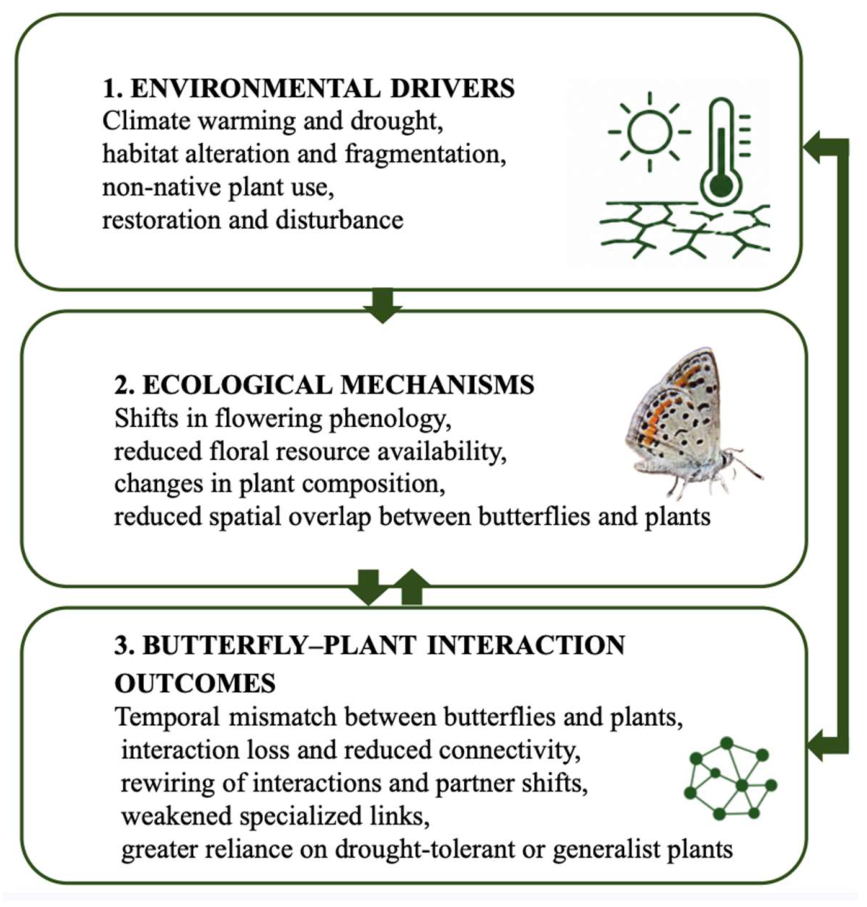
Environmental change can reorganize butterfly–plant interactions by altering the timing, abundance, diversity, and spatial arrangement of plant resources. For flower-visiting butterflies, these shifts can affect which plants are visited, whether pollen is transported among plant species, and how interaction networks are structured across seasons and landscapes. The evidence reviewed here points to several major drivers, including climate variation, drought, altered precipitation, habitat alteration, non-native plant use, restoration, disturbance management, and broader changes in plant resource availability [
13,
14,
15,
17,
19,
31,
32,
33,
34,
35].
Climate variation is especially important because butterfly–plant interactions depend on seasonal synchrony. Warming, drought, altered precipitation, and extreme weather can shift flowering periods, shorten resource windows, reduce floral abundance, and alter the overlap between butterfly activity and plant availability. Long-term plant–pollinator studies show that environmental change can reduce interaction persistence and reorganize network structure even when some species remain present [
12,
14,
15]. In butterfly–pollen networks from the Great Basin and Sierra Nevada, drought and climate stress were associated with reduced pollen abundance, altered plant associations, and changes in network topology, showing that climate effects can be expressed through interaction change as well as species-level responses [
17,
19].
Climate stress can also shift the balance between specialized and generalized interactions. When plant resource diversity declines, butterflies may converge on fewer available or more stress-tolerant plant taxa. This can increase apparent connectance or nestedness, but the pattern may represent ecological compression rather than true resilience. In this context, generalist resource use can provide flexibility, maintain interaction diversity, and help networks persist under disturbance, while the weakening of specialized links may reduce functional diversity and increase vulnerability to future disturbance [
15,
17,
29,
30,
36].
Habitat alteration and fragmentation can further reorganize interactions by reducing spatial overlap between butterflies and plant resources. Fragmented landscapes may separate butterflies from seasonally important plants, limit movement among resource patches, and simplify the plant communities available for visitation and pollen transport. Network and restoration studies show that interaction structure can vary with habitat composition, plant diversity, seasonality, and landscape context, indicating that butterfly occurrence alone may not show whether plant use relationships remain intact [
13,
31,
32]. Non-native plants add another form of interaction reorganization. In urban and human-altered landscapes, introduced plants can provide nectar, pollen-associated resources, or host use opportunities, especially for generalist butterflies that can use a broader range of plant taxa. California studies show that some butterfly communities rely heavily on alien plants, and that novel plant associations can become embedded in modified landscapes [
34,
35]. These patterns complicate restoration because plant origin and ecological function may not always align; removing non-native plants without functional native replacements may reduce available resources and weaken existing butterfly–plant interactions. Restoration and disturbance management can rebuild interaction structure, but their effects depend on plant composition, seasonality, habitat heterogeneity, and disturbance history. Restored sites may increase plant richness or butterfly occurrence without fully restoring plant use relationships, pollen transport, or network continuity. Studies of restored plant–pollinator networks and prairie butterfly–plant systems show that restoration design, seed-mix composition, seasonal resources, habitat mosaics, and refugia can influence whether interactions recover, reorganize, or remain simplified [
31,
32,
33]. Environmental drivers often interact rather than acting alone, with climate stress combining with habitat fragmentation, non-native plant use, restoration history, and changing plant resource availability to alter the balance between generalist and specialized interactions, shift seasonal synchrony, and compress networks around fewer resources. Conservation planning should therefore evaluate not only whether butterfly and plant species persist but also whether the plant use relationships, pollen-associated interactions, resource diversity, and network structure that connect them remain functional under changing environmental conditions.
5. Network Structure, Rewiring, and Interaction Loss
Ecological network analysis provides a framework for examining butterfly–plant interactions as structured relationships rather than isolated visitation records. Species occurrence data can show whether butterflies and plants are present in the same landscape, but they do not show whether plant use relationships remain active, synchronized, or functionally meaningful. Network approaches address this limitation by representing butterflies and plants as interacting components of a community, allowing changes in partner identity, resource breadth, interaction diversity, and network organization to be evaluated through time and across environmental gradients [
12,
13,
15,
16,
17,
18,
29,
30,
36]. Several network properties are useful for interpreting interaction change. Connectance describes the proportion of possible interactions that are realized, nestedness indicates whether species with fewer links interact with subsets of partners used by more broadly connected species, modularity reflects semi-independent interaction groups, specialization measures how narrowly partners are used, and interaction turnover captures changes in partner identity across time or space. Together, these metrics help identify whether butterfly–plant networks are being maintained, rewired, compartmentalized, simplified, or concentrated around fewer widely used plant resources [
13,
15,
16,
17,
19,
29,
30,
32]. Many other network metrics could be examined and discussed, including weighted and species-level descriptors, but, because these are highly correlated with the most widely used and easily interpreted metrics discussed here, we do not include these others.
Environmental change can reorganize networks through interaction loss, rewiring, topological compression, and modular shifts. Interaction loss occurs when a previously documented butterfly–plant interaction disappears or becomes too weak to detect, even when both partners remain present. Such losses may result from phenological mismatch, reduced plant resource availability, habitat fragmentation, drought, disturbance, or changes in butterfly activity, making interaction loss an early indicator of ecological change that may be missed by species lists alone [
11,
12,
14,
15,
17,
19]. However, documenting interaction loss is difficult because networks are shaped by sampling effort, uneven detection, and natural variation in species activity. Rare interactions may be absent from a dataset even when they still occur, and historical comparisons are often limited by incomplete records and uneven natural history information. Therefore, a missing link should not automatically be interpreted as true interaction loss. When repeated records show a consistent directional decline or disappearance of a butterfly–plant interaction across comparable sampling periods, especially alongside changes in phenology, resource availability, or habitat condition, interaction loss can provide meaningful evidence of ecological reorganization.
Rewiring occurs when butterflies shift toward alternative plant partners as environmental conditions change. This may provide flexibility when historical resources decline, but it can also indicate ecological stress if interactions become concentrated around fewer disturbance-tolerant, non-native, or broadly available plant taxa. California studies show that butterfly communities in modified landscapes may rely heavily on alien plants, illustrating how human-altered environments can create novel butterfly–plant associations and complicate restoration decisions [
34,
35]. Rewiring should therefore not be interpreted as recovery per se; it may represent adaptation, resource substitution, or loss of specialized plant use relationships. Topological compression is especially important under drought, warming, habitat alteration, and plant resource simplification. When plant resource diversity declines, butterflies may converge on a smaller set of generalist or persistent plant taxa. This can make a network appear more connected, but higher connectance may reflect reduced resource choice rather than ecological resilience. In butterfly–pollen networks from the Great Basin and Sierra Nevada, drought was associated with increased connectance and nestedness despite reduced pollen abundance, suggesting concentration around fewer available plant resources [
17,
19].
Specialization, generalization, and modularity further shape network responses. Specialized interactions may reflect strong ecological matching, but they can become vulnerable when plant resources decline, face phenological shifts, or disappear locally. Generalist interactions can increase flexibility, support interaction diversity, and help networks persist under disturbance. However, if many butterflies increasingly rely on the same limited set of plant taxa, this pattern may indicate network simplification. Modularity may buffer disturbance when interaction groups remain intact, but it can also reveal vulnerable compartments tied to narrow seasonal windows or restricted habitats [
15,
29,
30,
36]. Restoration and management can influence these patterns by changing plant composition, seasonal resource continuity, disturbance mosaics, and habitat heterogeneity [
31,
32,
33].
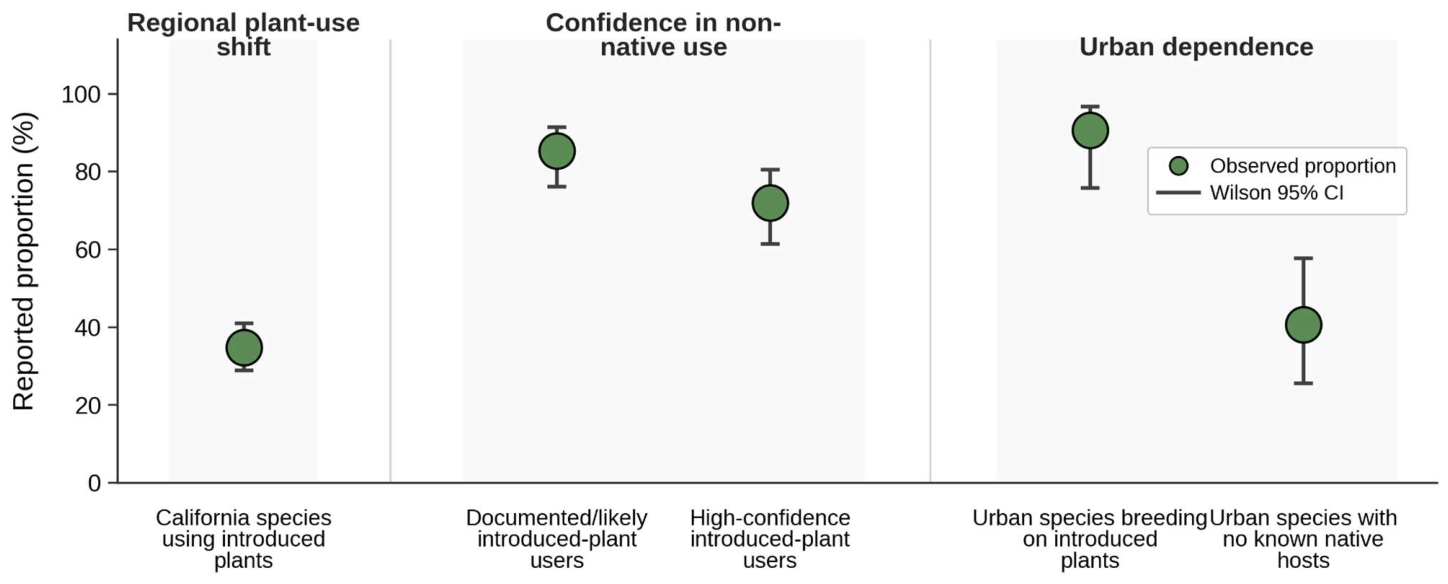
For proportion-based outcomes with reported numerators and denominators, uncertainty was estimated using Wilson 95% confidence intervals. These values provide a descriptive synthesis of non-native plant use by butterflies and are not intended as a meta-analysis (
Figure 3).
6. Synthesis: Interaction Persistence and Reorganization Under Environmental Change
Butterfly–plant interactions provide a sensitive record of ecological change because they depend on the overlap of butterfly activity, plant resource availability, seasonal timing, and habitat structure. Climate warming, drought, habitat alteration, non-native plant availability, restoration, and disturbance management can all alter which plant resources butterflies use and how interaction networks are organized. An important conclusion of this review is that species presence alone is not enough to describe ecological conditions. Butterfly and plant species may remain in the same landscape while their relationships become weaker, less diverse, reorganized toward broader resource use, or concentrated around fewer available resources. Changes in visitation, pollen transport, plant use diversity, and network structure may therefore reveal ecological reorganization before species losses become apparent [
11,
12,
14,
15,
17,
19]. This perspective shifts conservation from a focus on species, and even their abundances, as isolated units toward the relationships that connect them. Species occurrence, habitat area, and plant richness remain important, but they do not necessarily show whether plant use relationships are active, synchronized, or functionally meaningful. Maintaining butterfly–plant interactions requires seasonal resource continuity, habitat heterogeneity, functional connectivity, and plant taxa that support repeated visitation, pollen transport, and network structure. These dimensions are especially important where drought, fragmentation, or land use change reduces floral-resource availability, alters the balance between specialized and generalist plant use, or concentrates interactions around fewer available plant resources [
15,
29,
30,
36].
Restoration should also be evaluated through interaction recovery. A restored site may support plant richness or butterfly occurrence without rebuilding the plant use relationships that sustain butterfly movement, pollen-associated interactions, and network continuity. Restoration studies show that seed-mix composition, seasonality, disturbance history, habitat mosaics, and refugia can influence interaction structure and resource availability [
31,
32,
33]. Thus, restoration outcomes are best interpreted not only by plant cover or butterfly abundance but also by seasonal resource availability, plant use diversity, pollen transport, interaction redundancy, and persistence of butterfly–plant relationships through time. Network approaches are valuable because they show whether butterfly–plant relationships are being maintained, rewired, simplified, or compressed under environmental stress. However, network metrics require ecological interpretation. Higher connectance or nestedness may suggest flexibility in some systems, but, under drought or plant resource loss, these patterns may also indicate concentration around fewer available resources rather than true resilience. Historical butterfly–pollen networks from the Great Basin and Sierra Nevada show that increased connectance and nestedness can occur alongside reduced pollen abundance, suggesting concentration around fewer available plant resources [
17,
19]. Network structure should therefore be interpreted together with resource diversity, redundancy, and seasonal reliability.
Non-native plants further complicate this interpretation. In modified landscapes, introduced plants can become important components of butterfly–plant associations, especially where native plant communities have been reduced or reorganized [
34,
35]. This does not mean that non-native plants should replace native restoration goals. Rather, it shows that plant origin and ecological function must be considered together, particularly when removing non-native resources could reduce nectar, pollen-associated resources, or plant use opportunities for flower-visiting butterflies. Overall, butterfly–plant interactions are dynamic ecological relationships that can shift before species disappear from a landscape. Historical specimens, pollen load evidence, field observations, restoration studies, and network analysis together provide a stronger basis for understanding long-term interaction change. These approaches can identify relationships that have persisted, shifted, or weakened through time and can guide restoration toward maintaining plant resource diversity, seasonal synchrony, habitat heterogeneity, and functional connectivity. In changing environments, biodiversity conservation will require attention not only to butterflies and plants but also to the ecological interactions that support community function, recovery, resilience, and ecological sustainability.
Environmental change is reshaping butterfly–plant interactions across the United States through well-documented shifts in climate, habitat structure, changes in plant resource availability, species introductions, and different land management strategies. The studies reviewed here, along with other studies of restructuring plant–insect interaction networks [
37,
38,
39], have shown that the edges in plant–insect interaction networks can be reorganized long before the nodes (butterfly and plant species) disappear from a landscape, making interaction loss, rewiring, and network reorganization important indicators of ecological change [
37]. The full ecological toolbox, including field and lab methodologies, statistical modeling, and ecological network approaches, can uncover different dimensions of this process and help document declines of interaction diversity. One consistent theme across the butterfly pollination systems reviewed here is that global change parameters can reorganize networks around fewer available plant resources, sometimes producing greater apparent connectivity even as pollen load diversity and interaction diversity decline; this increased connectivity is not necessarily correlated with resilience or with the persistence of focal butterfly–plant interactions. In a rapidly changing world, conserving butterfly diversity and plant communities will require conserving not only species and habitats but also the dynamic webs of ecological interactions that link butterflies to plant communities across space and time.