
Diversity and Composition of Insect Communities Associated with Vachellia farnesiana (L.) Wight & Arn

 , , , and
Abstract
1. Introduction
2. Materials and Methods
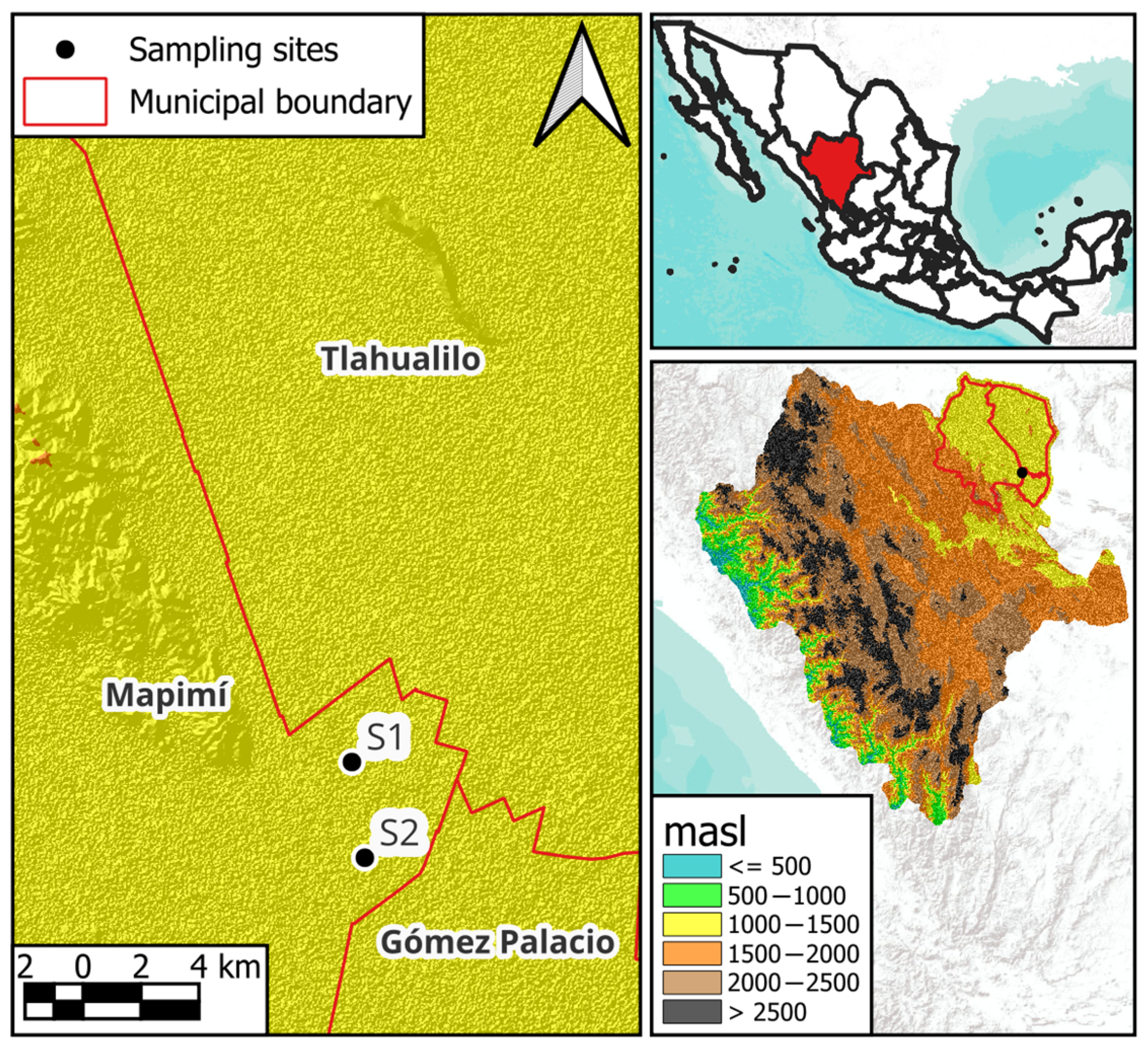
2.1. Study Area
2.2. Sampling Sites
2.3. Fieldwork
2.4. Laboratory Method
2.5. Statistical Analyses
3. Results
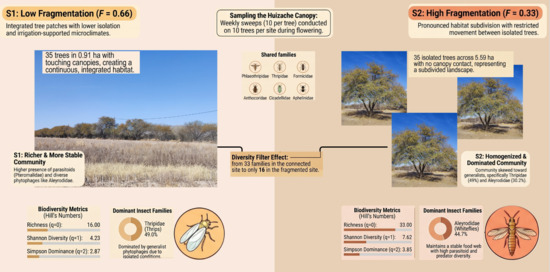
3.1. Sampling Sites
3.2. Absolute Abundance of Insect Families
- Family Aleyrodidae
- Family Pteromalidae
- Family Anthocoridae
- Family Leiodidae
- Family Syrphidae
- Family Formicidae
3.3. Relative Abundance of Families
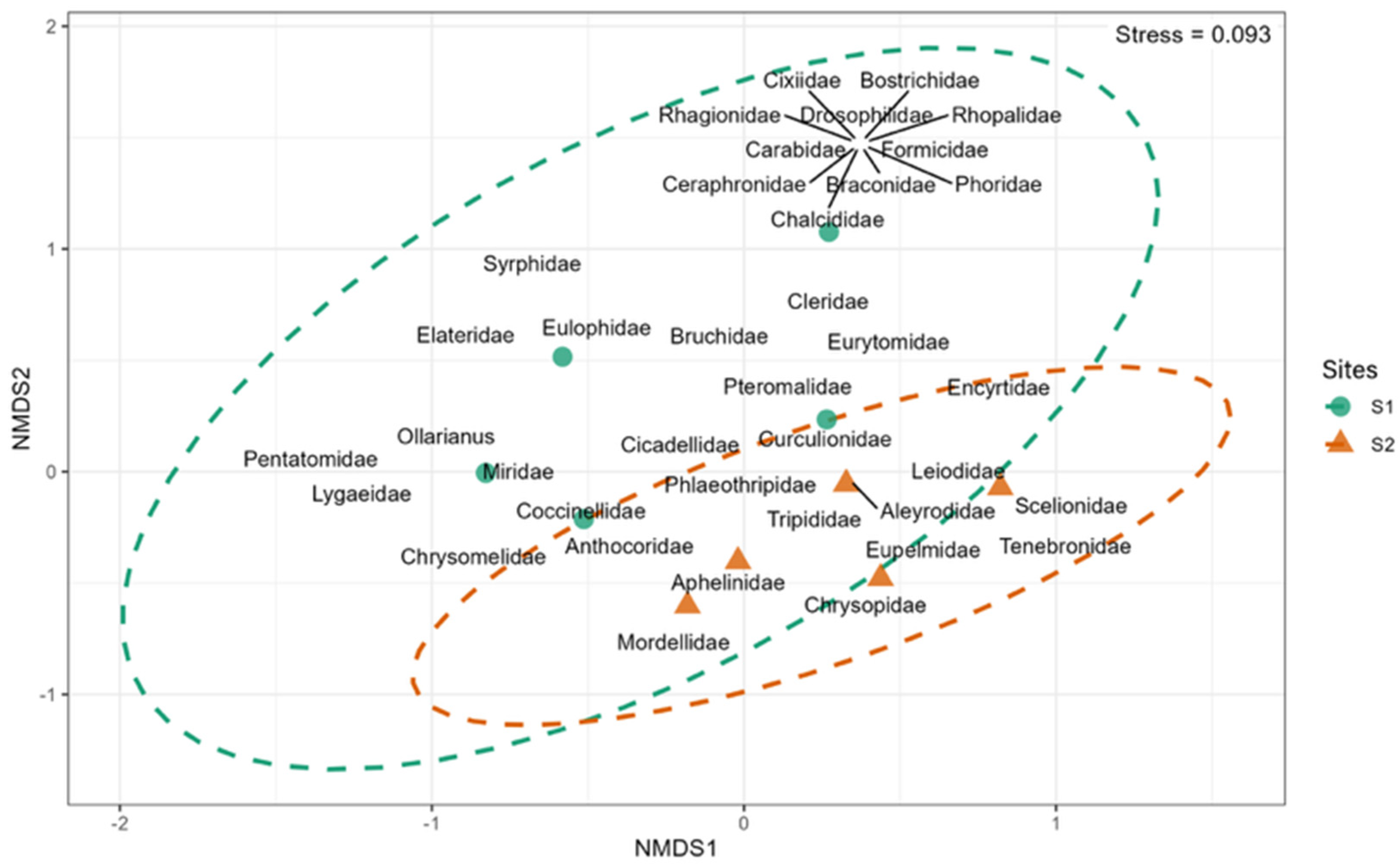
3.4. Diversity Analysis
4. Discussion
5. Conclusions
Author Contributions
Funding
Institutional Review Board Statement
Data Availability Statement
Acknowledgments
Conflicts of Interest
References
- Ramírez-Segura, E.; Márquez-Godoy, E.; Basave-Villalobos, R.A.; Sánchez-Gutiérrez, J.R.; Garay-Martínez, M.; Velázquez-Martínez, O.G.; Gutiérrez-Gutiérrez, J.N. Arbustivas Forrajeras, Una Alternativa para la Ganadería en Zonas Áridas y Semiáridas de México; Instituto Nacional de Investigaciones Forestales, Agrícolas y Pecuarias: Ciudad de México, Mexico, 2024. [Google Scholar]
- Tzortzakaki, O.; Kati, V.; Panitsa, M.; Tzanatos, E.; Giokas, S. Butterfly diversity along the urbanization gradient in a densely-built Mediterranean city: Land cover is more decisive than resources in structuring communities. Landsc. Urban Plan. 2019, 183, 79–87. [Google Scholar] [CrossRef] [Scilit]
- Fahrig, L. Effects of habitat fragmentation on biodiversity. Annu. Rev. Ecol. Evol. Syst. 2003, 34, 487–515. [Google Scholar] [CrossRef] [Scilit]
- Gurrutxaga, M. Índices de Fragmentación y Conectividad para el Indicador de Biodiversidad y Paisaje de la Comunidad Autónoma del País Vasco (CAPV); Technical Report; IKT, S.A. for the Dirección de Biodiversidad; Gobierno Vasco: Vitoria-Gasteiz, Spain, 2003; 31p, Available online: https://www.euskadi.eus/web01-a2ingdib/es/contenidos/documentacion/indicadores_biodiversidad/es_doc/adjuntos/fragmentacion_2003.pdf (accessed on 8 May 2026).
- Taylor, P.D.; Fahrig, L.; Henein, K.; Merriam, G. Connectivity is a vital element of landscape structure. Oikos 1993, 68, 571–573. [Google Scholar] [CrossRef] [Scilit]
- Schiltmeyer, A.V.; Zouhar, K. Vachellia farnesiana, Huisache. In Fire Effects Information System. U.S. Department of Agriculture, Forest Service, Rocky Mountain Research Station, Missoula Fire Sciences Laboratory (Producer). 2020. Available online: https://www.fs.fed.us/database/feis/plants/tree/vacfar/all.html (accessed on 8 May 2026).
- Quiroz-Cardoso, F.; Rojas-Hernández, S.; Olivares-Pérez, J.; Hernández-Castro, E.; Jiménez-Guillén, R.; Córdova-Izquierdo, A.; Villa-Mancera, A.; Abdel-Fattah, S. Composición nutricional, consumo e índices de palatabilidad relativa de los frutos de tres acacias en la alimentación de ovejas y cabras. Arch. Med. Vet. 2015, 47, 33–38. [Google Scholar] [CrossRef] [Scilit]
- Pérez-Cruz, Y.M.; Noveron-Neri, I.A.; Hernández-Rodríguez, D.; Hernández-Mendo, O. El huizache (Vachellia farnesiana): Una alternativa no convencional en la alimentación ovina. Agro-Divulgación 2022, 2, 37–39. Available online: https://agrodivulgacion-colpos.org/index.php/1agrodivulgacion1/article/view/89 (accessed on 8 May 2026).
- Noguez-Inesta, A.; López-Sánchez, A.S.; Carrillo-González, R.; González-Chávez, M.C.A. Uso de leguminosas (Fabaceae) en fitorremediación. Agro Product. 2017, 10, 57–62. [Google Scholar]
- Erkovan, H.I.; Clarke, P.J.; Whalley, R.D.B. A review on general description of Vachellia farnesiana (L.) Wight & Arn. Atatürk Univ. J. Agric. Fac. 2016, 47, 71–76. [Google Scholar]
- Granados-Montelongo, J.A.; Núñez-Colima, J.A.; Trujillo-Zacarías, I.; Cano-del Toro, J.; Chan-Chable, R.J.; Hidalgo-de León, A. Extracto de Acacia farnesiana para el control de larva de Aedes aegypti. Nova Sci. 2021, 13, 1–20. [Google Scholar] [CrossRef] [Scilit]
- García-González, F.; Alvarado-Ruacho, N.M. Whitefly species and their parasitoids associated with huizache Acacia farnesiana (L.) Willd. (Fabales: Fabaceae) in the Bermejillo area of Durango, Mexico. Rev. Chapingo Ser. Zonas Áridas 2016, 15, 9–15. [Google Scholar] [CrossRef] [Scilit]
- Heuzé, V.; Tran, G.; Giger-Reverdin, S.; Lebas, F. Huizache (Acacia farnesiana). Feedipedia 2019. Available online: https://www.feedipedia.org/node/353 (accessed on 8 May 2026).
- Vergara-Pineda, S.; Jones, R.W.; Malda-Barrera, G.; Caltzontzin-Fernández, K.; Obregón-Zúñiga, A.; Cambrón-Sandoval, V.H. Coelocephalapion subornatum (Fall) (Coleoptera: Brentidae: Apioninae) Forms Galls in Stems of Acacia farnesiana (L.) Willd. in Central Mexico. Southwest. Entomol. 2015, 40, 223–226. [Google Scholar] [CrossRef] [Scilit]
- González-Elizondo, M.S.; González-Elizondo, M.; Márquez-Linares, M.A. Ecorregiones. In La Biodiversidad en Durango. Estudio de Estado; CONABIO: Ciudad de México, Mexico, 2017; pp. 59–62. [Google Scholar]
- Schmidt, R.H. A climatic delineation of the ‘real’ Chihuahuan Desert. J. Arid Environ. 1979, 2, 243–250. [Google Scholar] [CrossRef] [Scilit]
- Márquez-Linares, M.A. Resumen ejecutivo. Contexto físico. In La Biodiversidad en Durango. Estudio de Estado; CONABIO: Ciudad de México, Mexico, 2017; pp. 17–18. [Google Scholar]
- Rzedowski, J. Vegetación de México, 1st digital ed.; Comisión Nacional para el Conocimiento y Uso de la Biodiversidad: Ciudad de México, Mexico, 2006. [Google Scholar]
- Turner, M.G. Landscape ecology: The effect of pattern on process. Annu. Rev. Ecol. Syst. 1989, 20, 171–197. [Google Scholar] [CrossRef]
- Johnson, N.F.; Triplehorn, C.A. Borror and DeLong’s Introduction to the Study of Insects, 7th ed.; Cengage Learning: Boston, MA, USA, 2020. [Google Scholar]
- Triplehorn, C.A.; Johnson, N.F.; Borror, D.J. Borror and DeLong’s Introduction to the Study of Insects; Cengage Learning: Boston, MA, USA, 2005. [Google Scholar]
- Fernández, F.; Sharkey, M.J. (Eds.) Introducción a los Hymenoptera de la Región Neotropical; Sociedad Colombiana de Entomología y Universidad Nacional de Colombia: Bogotá, Colombia, 2006. [Google Scholar]
- Chao, A.; Gotelli, N.J.; Hsieh, T.C.; Sander, E.L.; Ma, K.H.; Colwell, R.K.; Ellison, A.M. Rarefaction and extrapolation with Hill numbers: A framework for sampling and estimation in species diversity studies. Ecol. Monogr. 2014, 84, 45–67. [Google Scholar] [CrossRef] [Scilit]
- Ortega-Arenas, L.D.; Carapia-Ruiz, V.E. Moscas blancas (Hemiptera: Aleyrodidae) en México: Estatus, especies, distribución e importancia. Dugesiana 2020, 27, 37–54. [Google Scholar] [CrossRef] [Scilit]
- Haas, M.; Baur, H.; Schweizer, T.; Monje, J.C.; Moser, M.; Bigalk, S.; Krogmann, L. Tiny wasps, huge diversity—A review of German Pteromalidae with new generic and species records (Hymenoptera: Chalcidoidea). Biodivers. Data J. 2021, 9, e77092. [Google Scholar] [CrossRef] [Scilit] [PubMed]
- Bonte, J.; De Hauwere, L.; Conlong, D.; De Clercq, P. Predation capacity, development and reproduction of the southern African flower bugs Orius thripoborus and Orius naivashae (Hemiptera: Anthocoridae) on various prey. Biol. Control 2015, 86, 52–59. [Google Scholar] [CrossRef] [Scilit]
- Symondson, W.O.C.; Sunderland, K.D.; Greenstone, M.H. Can generalist predators be effective biocontrol agents? Annu. Rev. Entomol. 2002, 47, 561–594. [Google Scholar] [CrossRef] [Scilit] [PubMed]
- Schigel, D.S. Fungivory and host associations of Coleoptera: A bibliography and review of research approaches. Mycology 2012, 3, 258–272. [Google Scholar] [CrossRef] [Scilit]
- Dunn, L.; Lequerica, M.; Reid, C.R.; Latty, T. Dual ecosystem services of syrphid flies (Diptera: Syrphidae): Pollinators and biological control agents. Pest Manag. Sci. 2020, 76, 1973–1979. [Google Scholar] [CrossRef] [Scilit] [PubMed]
- Reynolds, S.K.; Clem, C.S.; Fitz-Gerald, B.; Young, A.D. A comprehensive review of long-distance hover fly migration (Diptera: Syrphidae). Ecol. Entomol. 2024, 49, 749–767. [Google Scholar] [CrossRef] [Scilit]
- Folgarait, P.J. Ant biodiversity and its relationship to ecosystem functioning: A review. Biodivers. Conserv. 1998, 7, 1221–1244. [Google Scholar] [CrossRef] [Scilit]
- O’Dowd, D.J.; Green, P.T.; Lake, P.S. Invasional “meltdown” on an oceanic island. Ecol. Lett. 2003, 6, 812–817. [Google Scholar] [CrossRef] [Scilit]
- Andersen, A.N.; Majer, J.D. Ants show the way Down Under: Invertebrates as bioindicators in land management. Front. Ecol. Environ. 2004, 2, 291–298. [Google Scholar] [CrossRef]
- Haddad, N.M.; Brudvig, L.A.; Clobert, J.; Davies, K.F.; Gonzalez, A.; Holt, R.D.; Lovejoy, T.E.; Sexton, J.O.; Austin, M.P.; Collins, C.D.; et al. Habitat fragmentation and its lasting impact on Earth’s ecosystems. Sci. Adv. 2015, 1, e1500052. [Google Scholar] [CrossRef] [Scilit] [PubMed]
- Shi, F.; You, W.; Huang, X. A global meta-analysis of forest edge effects on arthropod abundance and richness. Agric. Ecosyst. Environ. 2026, 404, 110364. [Google Scholar] [CrossRef] [Scilit]
- Byrne, D.N.; Bellows, T.S., Jr. Whitefly biology. Annu. Rev. Entomol. 1991, 36, 431–457. [Google Scholar] [CrossRef]
- Jones, D.R. Plant viruses transmitted by whiteflies. Eur. J. Plant Pathol. 2003, 109, 195–219. [Google Scholar] [CrossRef] [Scilit]
- Reitz, S.R.; Gao, Y.; Kirk, W.D.J.; Hoddle, M.S.; Leiss, K.A.; Funderburk, J.E. Invasion biology, ecology, and management of western flower thrips. Annu. Rev. Entomol. 2020, 65, 17–37. [Google Scholar] [CrossRef] [Scilit] [PubMed]
- Morse, J.G.; Hoddle, M.S. Invasion biology of thrips. Annu. Rev. Entomol. 2006, 51, 67–89. [Google Scholar] [CrossRef] [Scilit] [PubMed]
- Kigathi, R.N.; Poehling, H.-M. Interactions between flower thrips and their host plants: Adaptation and population dynamics. J. Pest Sci. 2012, 85, 317–328. [Google Scholar] [CrossRef] [Scilit]
- Rossetti, M.R.; Tscharntke, T.; Aguilar, R.; Batáry, P. Responses of insect herbivores and herbivory to habitat fragmentation: A hierarchical meta-analysis. Ecol. Lett. 2017, 20, 264–272. [Google Scholar] [CrossRef] [Scilit] [PubMed]
- Belovsky, G.E.; Slade, J.B. Insect herbivory accelerates nutrient cycling and increases plant production. Proc. Natl. Acad. Sci. USA 2000, 97, 14412–14417. [Google Scholar] [CrossRef] [Scilit] [PubMed]
- Frost, C.J.; Hunter, M.D. Insect canopy herbivory and frass deposition affect soil nutrient dynamics and export in oak mesocosms. Ecology 2004, 85, 3335–3347. [Google Scholar] [CrossRef] [Scilit]
- De Swardt, D.B.; Wigley-Coetsee, C.; O’Connor, T.G. Insect outbreaks alter nutrient dynamics in a southern African savanna: Patchy defoliation of Colophospermum mopane savanna by Imbrasia belina larvae. Biotropica 2018, 50, 789–796. [Google Scholar] [CrossRef] [Scilit]
- Ali, M.Y.; Naseem, T.; Holopainen, J.K.; Liu, T.; Zhang, J.; Zhang, F. Tritrophic interactions among arthropod natural enemies, herbivores and plants considering volatile blends at different scale levels. Cells 2023, 12, 251. [Google Scholar] [CrossRef] [Scilit] [PubMed]
- Hwang, B.C.; Giardina, C.P.; Barrios-Garcia, M.N.; Diao, H.; Duboscq-Carra, V.G.; Hemp, A.; Hemp, C.; Jiménez-Castillo, M.; Lobos-Catalán, P.; Mumladze, L.; et al. Insect herbivory releases more nutrients in warmer and drier forests. Glob. Biogeochem. Cycles 2025, 39, e2024GB008367. [Google Scholar] [CrossRef] [Scilit]
- Kucharczyk, H.; Kucharczyk, M.; Zawirska, I. Diversity and ecology of thrips (Thysanoptera, Insecta) assemblages in Słowiński National Park—A biosphere reserve on the Baltic Coast (Northern Poland). Insects 2026, 17, 119. [Google Scholar] [CrossRef] [Scilit] [PubMed]
- Retana-Salazar, A.P.; Rodríguez-Arrieta, J.A. Especies potenciales de thrips (Insecta: Thysanoptera: Thripidae) en la polinización del mango (Mangifera indica L.) en Costa Rica. Rev. Geol. Am. Cent. 2015. [Google Scholar] [CrossRef] [Scilit]
- Pop, C.; Terry, I.; Mound, L.A.; Van der Kooi, C.J. Tiny but significant: On the importance of thrips as pollinators. Ann. Bot. 2025, 136, 669–682. [Google Scholar] [CrossRef] [Scilit] [PubMed]
- Retana-Salazar, A.P.R.; Soto-Rodríguez, G.A.S. Revisión taxonómica del grupo Haplothrips-Karnyothrips (Thysanoptera: Phlaeothripidae). Rev. Biol. Trop. 2007, 55, 627–635. [Google Scholar] [CrossRef] [Scilit]
- Morrone, J.J. Biodiversidad de Curculionoidea (Coleoptera) en México. Rev. Mex. Biodivers. 2014, 85, 312–324. [Google Scholar] [CrossRef] [Scilit]
- Fenoglio, M.S.; Srivastava, D.; Valladares, G.; Cagnolo, L.; Salvo, A. Forest fragmentation reduces parasitism via species loss at multiple trophic levels. Ecology 2012, 93, 2407–2420. [Google Scholar] [CrossRef] [Scilit] [PubMed]
- Jordan-Fragstein, C.C.; Linke, R.; Müller, M.G. Structure–diversity relationships in parasitoids of a central European temperate forest. Forests 2026, 17, 106. [Google Scholar] [CrossRef] [Scilit]
- Gibb, H.; Hochuli, D.F. Habitat fragmentation in an urban environment: Large and small fragments support different arthropod assemblages. Biol. Conserv. 2002, 106, 91–100. [Google Scholar] [CrossRef] [Scilit]
- Resasco, J.; Chacoff, N.P.; Vázquez, D.P. Plant–pollinator interactions between generalists persist over time and space. Ecology 2021, 102, e03359. [Google Scholar] [CrossRef] [Scilit] [PubMed]
- Grajales-Conesa, J.; Meléndez-Ramírez, V.; Cruz-López, L. Aromas florales y su interacción con los insectos polinizadores. Rev. Mex. Biodivers. 2011, 82, 1356–1367. Available online: https://www.scielo.org.mx/pdf/rmbiodiv/v82n4/v82n4a33.pdf (accessed on 8 May 2026).
- Corbet, S.A.; Fussell, M.; Ake, R.; Fraser, A.; Gunson, C.; Savage, A.; Smith, K. Temperature and the pollinating activity of social bees. Ecol. Entomol. 1993, 18, 17–30. [Google Scholar] [CrossRef] [Scilit]
- Díaz-Calafat, J.; Öckinger, E.; Felton, A.; De Frenne, P.; Cousins, S.A.O.; Uria-Diez, J.; Hedwall, P. Fly pollinator foraging in boreal forests is shaped by climate, forest structure and flower resources. Oikos 2025, 2026, e11405. [Google Scholar] [CrossRef] [Scilit]
- Vicens, N.; Bosch, J. Weather-dependent pollinator activity in an apple orchard, with special reference to Osmia cornuta and Apis mellifera (Hymenoptera: Megachilidae and Apidae). Environ. Entomol. 2000, 29, 413–420. [Google Scholar] [CrossRef] [Scilit]
- Graça, M.B.; Somavilla, A. Effects of forest fragmentation on community patterns of social wasps (Hymenoptera: Vespidae) in Central Amazon. Austral Entomol. 2019, 58, 657–665. [Google Scholar] [CrossRef] [Scilit]
- Abrego, L.; Rivera, J.A.; Garrido, A.; Wilkie, E. Revisión bibliográfica del impacto de la fragmentación y la urbanización sobre las comunidades de insectos. Mesoamericana 2024, 26, 33–40. [Google Scholar] [CrossRef] [Scilit]



| Functional Communities | S1 Families | S1 Specimens | S2 Families | S2 Specimens |
|---|---|---|---|---|
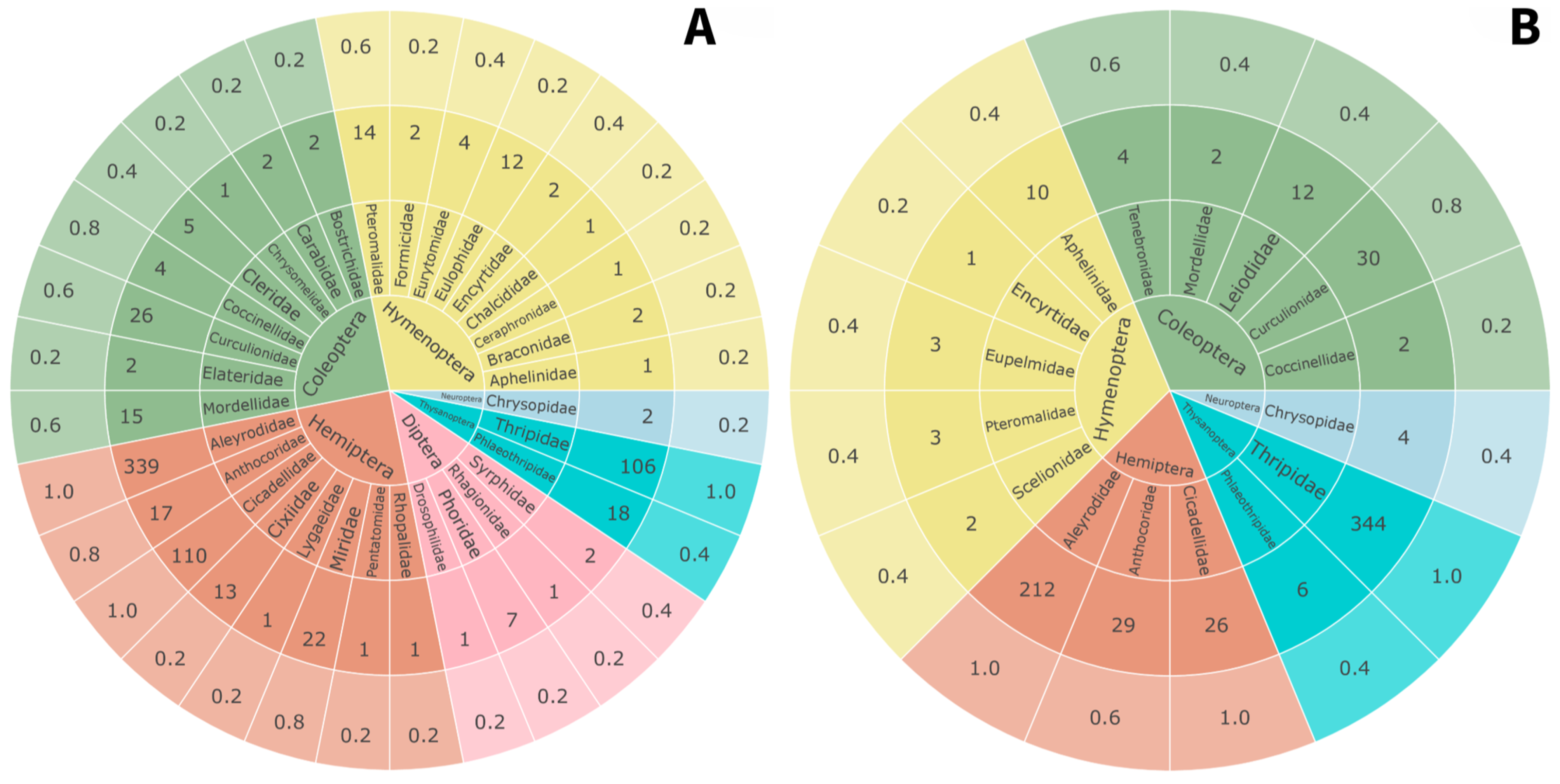
| Phytophages | 10 | 622 | 4 | 612 |
| Parasitoids | 9 | 37 | 5 | 19 |
| Predators | 7 | 31 | 3 | 35 |
| Saprophytes | 7 | 28 | 2 | 22 |
| Pollinators | 2 | 17 | 2 | 2 |
| Omnivores | 1 | 2 | 0 | 0 |
| Total | 36 | 737 * | 16 | 691 * |
| S1 | S2 | ||||
|---|---|---|---|---|---|
| Order | Family | R. A. (%) | Order | Family | R. A. (%) |
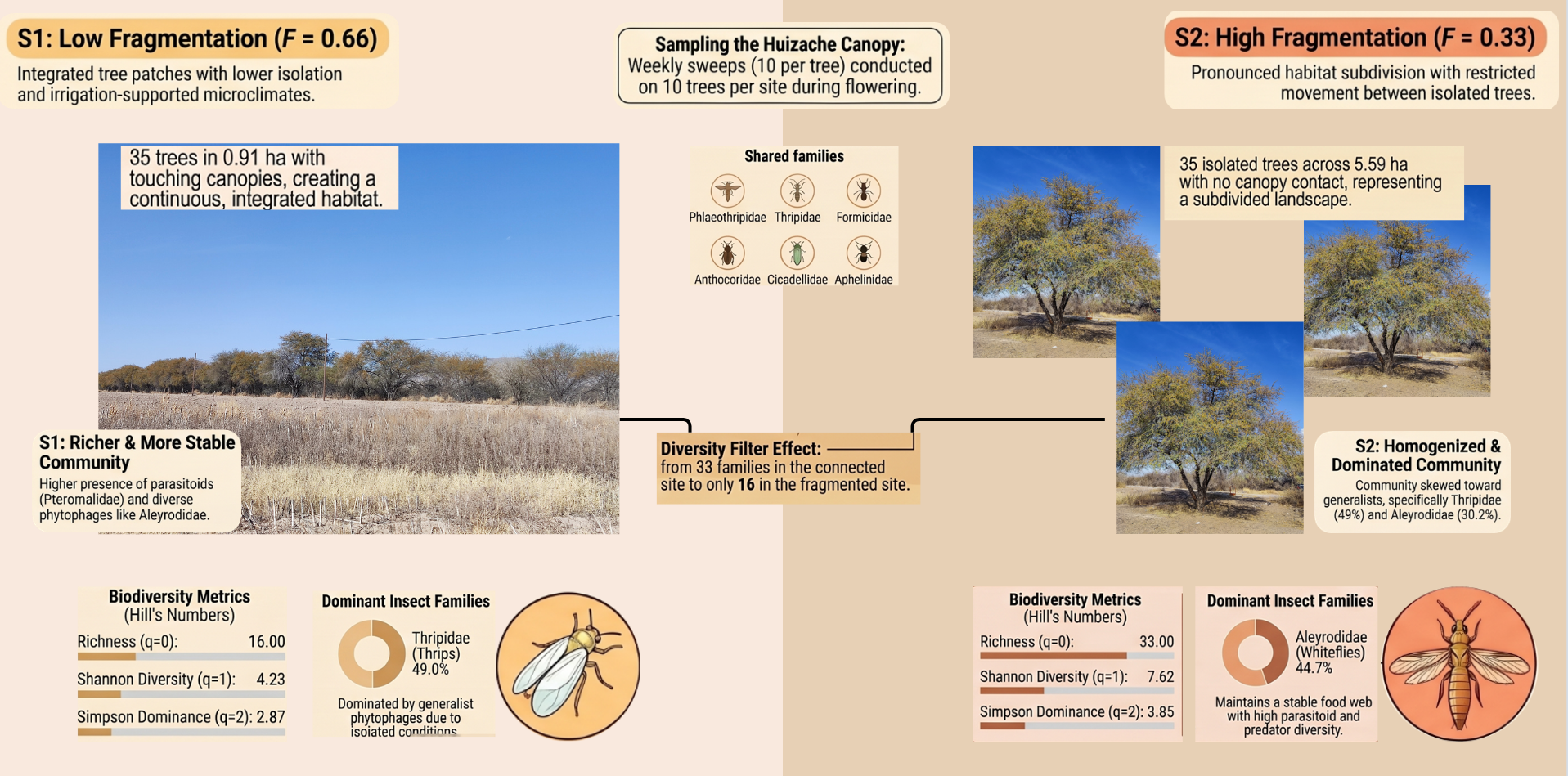
| Hemiptera | Aleyrodidae | 44.7 | Thysanoptera | Thripidae | 49.0 |
| Hemiptera | Cicadellidae | 14.5 | Hemiptera | Aleyrodidae | 30.2 |
| Thysanoptera | Thripidae | 14.0 | Coleoptera | Curculionidae | 4.3 |
| Coleoptera | Curculionidae | 3.4 | Hemiptera | Anthocoridae | 4.1 |
| Hemiptera | Miridae | 2.9 | Hemiptera | Cicadellidae | 3.7 |
| Thysanoptera | Phlaeothripidae | 2.4 | Coleoptera | Leiodidae | 1.7 |
| Hemiptera | Anthocoridae | 2.2 | Hymenoptera | Aphelinidae | 1.4 |
| Coleoptera | Mordellidae | 2.0 | Thysanoptera | Phlaeothripidae | 0.8 |
| Hymenoptera | Pteromalidae | 1.8 | Coleoptera | Tenebronidae | 0.6 |
| Hemiptera | Cixiidae | 1.7 | Neuroptera | Chrysopidae | 0.6 |
| Total | 89.6 | 96.4 | |||
| Hill’s Numbers | S1 | S2 |
|---|---|---|
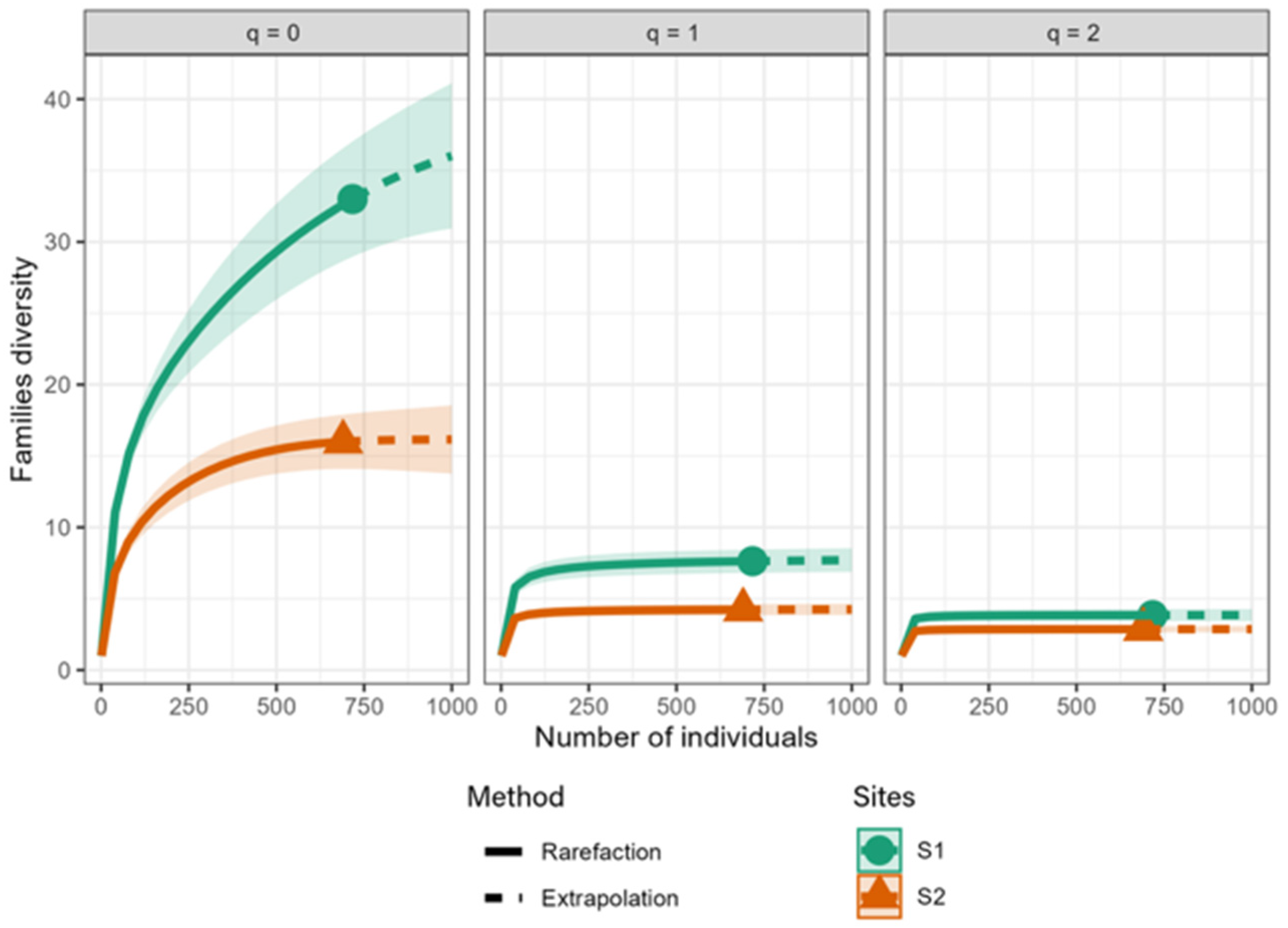
| q = 0 (Richness) | 33.00 | 16 |
| q = 1 (Shannon) | 7.62 | 4.23 |
| q = 2 (Simpson) | 3.85 | 2.87 |
Disclaimer/Publisher’s Note: The statements, opinions and data contained in all publications are solely those of the individual author(s) and contributor(s) and not of MDPI and/or the editor(s). MDPI and/or the editor(s) disclaim responsibility for any injury to people or property resulting from any ideas, methods, instructions or products referred to in the content. |
© 2026 by the authors. Licensee MDPI, Basel, Switzerland. This article is an open access article distributed under the terms and conditions of the Creative Commons Attribution (CC BY) license.
Share and Cite
Sandy-Pacheco, C.A.; Martínez-Estrada, M.; Trucíos-Caciano, R.; Valdez-Cepeda, R.D.; Cortez-Madrigal, H.; Becerra-López, J.L.; García-González, F. Diversity and Composition of Insect Communities Associated with Vachellia farnesiana (L.) Wight & Arn. Ecologies 2026, 7, 70. https://doi.org/10.3390/ecologies7030070
Sandy-Pacheco CA, Martínez-Estrada M, Trucíos-Caciano R, Valdez-Cepeda RD, Cortez-Madrigal H, Becerra-López JL, García-González F. Diversity and Composition of Insect Communities Associated with Vachellia farnesiana (L.) Wight & Arn. Ecologies. 2026; 7(3):70. https://doi.org/10.3390/ecologies7030070
Chicago/Turabian StyleSandy-Pacheco, Clementina Araceli, Moisés Martínez-Estrada, Ramón Trucíos-Caciano, Ricardo David Valdez-Cepeda, Hipolito Cortez-Madrigal, Jorge Luis Becerra-López, and Fabián García-González. 2026. "Diversity and Composition of Insect Communities Associated with Vachellia farnesiana (L.) Wight & Arn" Ecologies 7, no. 3: 70. https://doi.org/10.3390/ecologies7030070
APA StyleSandy-Pacheco, C. A., Martínez-Estrada, M., Trucíos-Caciano, R., Valdez-Cepeda, R. D., Cortez-Madrigal, H., Becerra-López, J. L., & García-González, F. (2026). Diversity and Composition of Insect Communities Associated with Vachellia farnesiana (L.) Wight & Arn. Ecologies, 7(3), 70. https://doi.org/10.3390/ecologies7030070