Article

Diversity and Composition of Insect Communities Associated with Vachellia farnesiana (L.) Wight & Arn


by
Clementina Araceli Sandy-Pacheco
1,
Moisés Martínez-Estrada
2,
Ramón Trucíos-Caciano
3,
Ricardo David Valdez-Cepeda
4,
Hipolito Cortez-Madrigal
5,
Jorge Luis Becerra-López
6 and
Fabián García-González
1,*
1
Unidad Regional Universitaria de Zonas Áridas, Universidad Autónoma Chapingo, Carretera Gómez Palacio- Ciudad Juárez, km 40, Bermejillo 35230, Durango, Mexico
2
Facultad de Ciencias en Física y Matemáticas, Universidad Autónoma de Chiapas, Tuxtla Gutiérrez 29050, Chiapas, Mexico
3
Centro de Investigación Regional Norte Centro, Instituto Nacional de Investigaciones Forestales, Agrícolas y Pecuarias, Boulevard José Santos Valdéz #1200 Pte. Col. Centro, Matamoros 27440, Coahuila, Mexico
4
Centro Regional Universitario Centro Norte, Universidad Autónoma Chapingo, Carretera Zacatecas-Fresnillo, kilómetro 24.5, Morelos 98100, Zacatecas, Mexico
5
Centro Interdisciplinario de Investigación para el Desarrollo Integral Regional, Instituto Politécnico Nacional, Justo Sierra # 28, Centro, Jiquilpan de Juárez 59510, Michoacán, Mexico
6
Facultad de Ciencias Biológicas, Universidad Juarez del Estado de Durango, Ave. Universidad S/N Fraccionamiento Filadelfia, Gómez Palacio 35010, Durango, Mexico
*
Author to whom correspondence should be addressed.
Ecologies 2026, 7(3), 70; https://doi.org/10.3390/ecologies7030070
Submission received: 13 May 2026 / Revised: 10 July 2026 / Accepted: 10 July 2026 / Published: 17 July 2026

Abstract

Vachellia farnesiana is an important shrub in arid and semi-arid ecosystems because it provides resources for diverse insect communities. However, the factors influencing insect assemblages associated with this species under contrasting habitat conditions remain poorly understood. This study evaluated the diversity, composition, and functional groups of insects associated with flowering V. farnesiana at two sites with contrasting tree spatial configurations in Mapimí, Durango, Mexico. Taxonomic diversity was assessed using Hill numbers and sampling coverage, whereas community composition was analyzed using generalized linear latent variable models (GLLVM) and non-metric multidimensional scaling (NMDS). A total of 1461 insects belonging to 6 orders and 33 families were recorded. Although the total abundance was similar between sites, the diversity, community composition, and functional structure differed. Site S1 showed higher richness and diversity (q0 = 33, q1 = 7.62, q2 = 3.85) than S2 (q0 = 16, q1 = 4.23, q2 = 2.87). S1 also supported more parasitoids, predators, and saprophytes, whereas S2 was dominated by phytophagous insects, mainly Aleyrodidae and Thripidae. Sampling coverage was high (S1 = 0.986; S2 = 0.999), indicating adequate representation of both communities. GLLVM detected significant differences in family composition and abundance after accounting for temperature and relative humidity, and NMDS showed partial separation between sites. These findings indicate that habitat characteristics are associated with variation in insect communities linked to V. farnesiana, highlighting its importance as a resource supporting multiple insect functional groups in arid ecosystems.

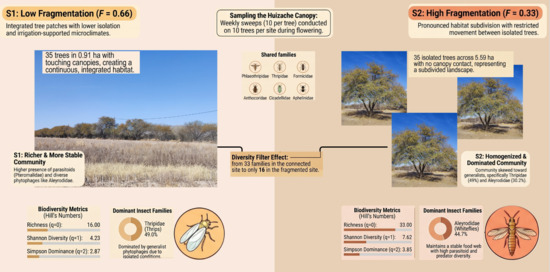
Graphical Abstract

1. Introduction

Woody legumes in arid and semi-arid ecosystems, such as huizache [Vachellia farnesiana (L.) Wight & Arn; Fabaceae] [1], serve as microhabitats that support local biodiversity. However, changes in habitat structure, landscape connectivity, and the spatial distribution of vegetation can influence the diversity, composition, and ecological functions of insect communities by altering resource availability and dispersal opportunities [2,3,4,5]. Huizache is well-adapted to the challenging environmental conditions of arid and semi-arid zones [1]. This species is distributed from the United States to South America and occurs in all Mexican states except Tlaxcala and Mexico City [6]. In Mapimí, Durango (Mexico), the species V. farnesiana is found primarily near both active and abandoned agricultural fields, a pattern that contributes to a decline in tree density and a shift in its population distribution. According to Taylor et al. [7], effective habitat conservation and management require a thorough understanding of the interactions between plants and insects, which can help mitigate or prevent negative impacts on insect diversity.
Huizache is an evergreen tree species that produces yellow flowers in heads emerging from the axils of its thorns; these flowers may be solitary or form clusters of two or three. In some cases, the abundance of flowers gives the trees a yellow appearance. Flowering occurs primarily between December and March, depending on the region [6]. Individual trees can reach heights of up to 10 m and possess compound leaves and pod-shaped fruits, which serve as essential forage resources for sheep, goats, and wildlife [1,7]. The pods protect seeds that are edible for certain animals, such as sheep [8]. The fruits are rich in crude protein and low in digestible fiber. Tannins present in these tissues function as antioxidants and enhance amino acid absorption, which may improve the meat quality for consumers [9]. Beyond its value for livestock, the species exhibits phytoremediation capabilities for toxic elements [10]. The trees also fix atmospheric nitrogen through bacterial symbiosis [8]. Additionally, pod extracts have demonstrated insecticidal efficacy against Aedes (Stegomyia) aegypti (Linnaeus, 1762) larvae [11]. These attributes underscore the multifunctional role of huizache in agroecology and natural resource management in Mexico.
Although Vachellia farnesiana has a wide distribution, the network of interactions between insects and the huizache in the region’s semi-arid, human-altered landscapes has not yet been characterized from the perspective of functional groups. Some studies have documented the whitefly species Tetraleurodes acaciae (Quaintance), and two genera of parasitoids of the order Hymenoptera, Eretmocerus Haldeman 1850 (Aphelinidae) and Signiphora Ashmead, 1880 (Signiphoridae), on huizache trees in Mapimí, Durango [12]. Meanwhile, Heuzé et al. [13] indicate that this plant species can host scale insects (Hemiptera: Coccoidea) and is attractive to bees (Hymenoptera: Apidae). Vergara-Pineda et al. [14] documented several families of the order Hymenoptera (Chalcididae, Eulophidae, Eurytomidae, Ichneumonidae, and Tetracampidae), as well as wasps of the genus Triaspis (Haliday, 1835) (Hymenoptera: Braconidae), as parasitoids of Coelocephalapion subornatum (Fall, 1898) larvae inside galls on V. farnesiana shoots. Therefore, the objective of this study was to evaluate whether differences in host plant density, patch configuration, and the structural connectivity of Vachellia farnesiana were associated with variation in insect diversity, abundance, and community composition.

2. Materials and Methods

2.1. Study Area

The research was conducted in Mapimí, Durango, in the Chihuahua Desert. This region features a landscape of plains and elevations ranging from 1076 to 2200 m above sea level. The geological substrate consists mainly of limestone. The prevailing climate ranges from very dry (BWh) to semi-arid (BSh). The prevailing winds are the trade winds from the northwest, which contribute to the area’s aridity [15]. The study area is characterized by arid climatic conditions, with mild to cold winters and occasional frosts, and average annual temperatures ranging from approximately 13 to 22 °C [16]. The average annual precipitation is 300 mm [17]. These extreme conditions favor the presence of xerophytic vegetation, whose dominant genera are Cercidium, Chilopsis, Condalia, Fouquieria, Opuntia, and Prosopis [18].

2.2. Sampling Sites

Sampling sites were selected based on the presence of 35 V. farnesiana trees taller than 3 m. The spatial structure of the V. farnesiana trees was characterized using ecological metrics that describe the spatial configuration of the habitat [4,5]. At each site, the study area was delineated and the spatial distribution of the individuals was recorded; based on this, the following metrics were obtained: total habitat area (ha), host plant density (trees ha−1), number of patches, area of each patch (m2), average distance between patches (dc) [5], and distances between consecutive patches (m). Host plant density was calculated as the ratio of the number of recorded individuals to the study area (D = N/A), where D corresponds to density (trees ha−1), N to the number of individuals, and A to the study area (ha). Together, these metrics allowed us to characterize the spatial structure of host plants and the structural connectivity among V. farnesiana clusters, providing a quantitative description of the availability and spatial distribution of resources potentially utilized by the associated entomofauna [4,5,19].
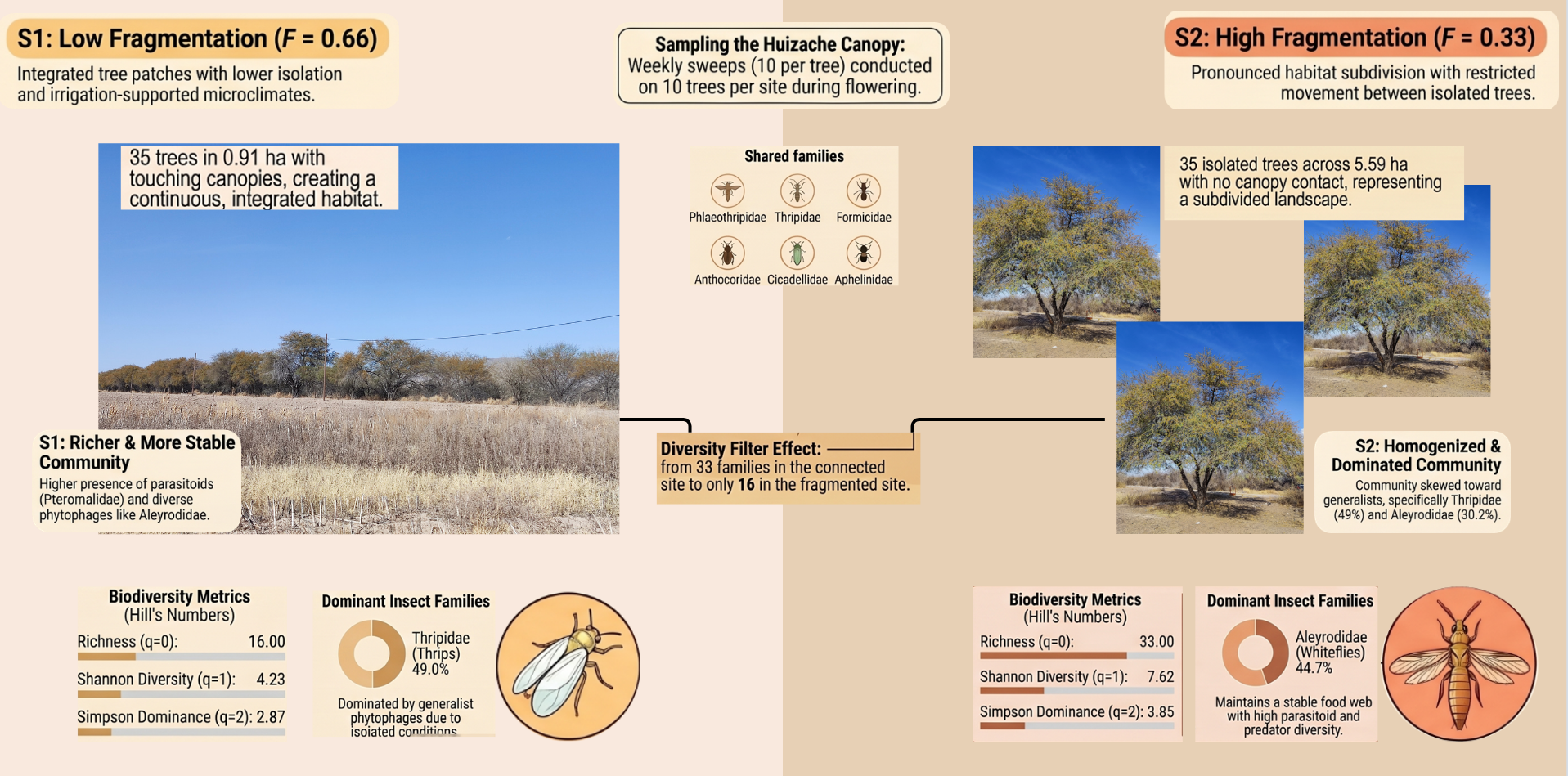
Site 1 (S1) was located near the Regional Unidad Regional Universitaria de Zonas Aridas (URUZA) of the Universidad Autónoma Chapingo (UACh) at coordinates 25°53′34″ N and −103°36′21″ W (Figure 1). This site was characterized by 35 huizache trees covering 0.91 ha. The trees ranged in height from 3 to 6 m and had canopies that, for the most part, touched one another. To the south, S1 borders a cultivated area, and to the north, a wilderness area. Although sorghum was not grown during the insect trapping period, crops are typically planted between April and August each year. This ensures that the huizache trees have access to soil moisture thanks to flood irrigation of the cultivated area and seepage from the irrigation canal.
Site 2 (S2) was located 4 km south of S1, at coordinates 25°51′47″ N and −103°36′3″ W (Figure 1). This site was characterized by having the same number of huizache trees in an area of 5.59 ha. For the most part, the trees did not touch one another and had larger canopies than those at S1, although the tree heights were similar at both sites (3 and 6 m). There were no nearby crops at this site during the sampling period. However, at other times of the year, corn and sorghum crops were observed; but unlike S1, irrigation water did not reach all the trees directly, nor were leaks observed in the irrigation canals, although water did reach those trees adjacent to the croplands during irrigation.

2.3. Fieldwork

Sampling was conducted during the flowering phase of the huizache to record the insects associated with this phenological stage of the plant species and was carried out weekly (17 and 24 February as well as 3, 10, and 17 March 2023). Sampling was conducted between 7:00 and 10:00 a.m., alternating the start time between the two sites. The weekly sample was obtained from collections made in the floral area of 10 randomly selected trees, using 10 sweeps with an entomological net on each tree. Sampling time varied between 30 and 45 min, depending on the trees’ characteristics (height and crown size) and the distance between them. The specimens were then preserved in 1.5 mL polypropylene tubes containing 70% ethyl alcohol. At both sites, relative humidity and temperature were measured at the beginning and end of each sampling using a hygrothermograph (Control Company, Cat. No. 4040, Friendswood, TX, USA).

2.4. Laboratory Method

The insects were mounted according to each specimen’s size. The insects were identified to the family level based on their morphological characteristics, using either an Iroscope N2-14 stereomicroscope (Iroscope, Hermosillo, Sonora, Mexico) or a Carl Zeiss Axioscope A1 compound microscope (Carl Zeiss AG, Oberkochen, BW, Germany). depending on the insect’s size. For the identification of orders, families, and major functional groups, the keys by Johnson & Triplehorn [20], Triplehorn et al. [21], and Fernández and Sharkey [22] were used.

2.5. Statistical Analyses

Statistical analysis of the data was performed using the R statistical environment. To estimate and compare alpha diversity among study sites, Hill’s number (q = 0, 1, 2) was calculated using the iNEXT package in R (Version 4.4.3), which allows for an integrated analysis of family richness (q = 0), Shannon diversity (q = 1), and Simpson’s dominance (q = 2) [23]. In addition, sampling coverage curves for each site were generated based on the Good–Turing estimator [23] to assess the proportion of the community effectively sampled. The effect of sampling site on the taxonomic composition of insects was assessed using a multivariate generalized linear model with latent variables (GLLVM). A negative binomial distribution was used to account for overdispersion in count data, using the GLLVM package (Version 2.0.5). The fixed effect in the model was sampling site, and temperature and relative humidity were included as covariates to control for climatic noise during sampling and to isolate the effect of the habitat’s ecological configuration on insect abundance and diversity. Model performance was evaluated using a likelihood-ratio test comparing the full model with a null model. In addition, the variation in the composition of insect families across sampling sites was visually explored using non-metric multidimensional scaling (NMDS) based on Bray–Curtis dissimilarity matrices.

3. Results

3.1. Sampling Sites

The spatial structure of Vachellia farnesiana differed between the two study sites. A total of 35 trees were assessed at both sites. However, the area occupied by the species was 0.19 ha at S1 and 5.59 ha at S2. Consequently, the density of host plants was 184.21 trees ha−1 at S1 and 6.26 trees ha−1 at S2. In addition, 16 vegetation patches were identified at S1 and 37 at S2. The patch areas ranged from 19.71 to 300.57 m2 in S1, and from 5.59 to 704.02 m2 in S2. The average distance between patches was 16.91 m in S1 and 94.99 m in S2. Likewise, the distances between consecutive patches ranged from 5.21 to 39.76 m in S1 and from 12.39 to 806.87 m in S2.
The results for temperature and relative humidity were as follows. At S1, the average temperature at each sampling point ranged from 6.3 to 27.4 °C; at point S2, the recorded temperatures were slightly lower (between 5.8 and 21 °C). As for relative humidity, at S1 the average minimum was 20.5%, and the maximum was 26%; at point 2, the average minimum was below 20%, and the maximum was 26%.

3.2. Absolute Abundance of Insect Families

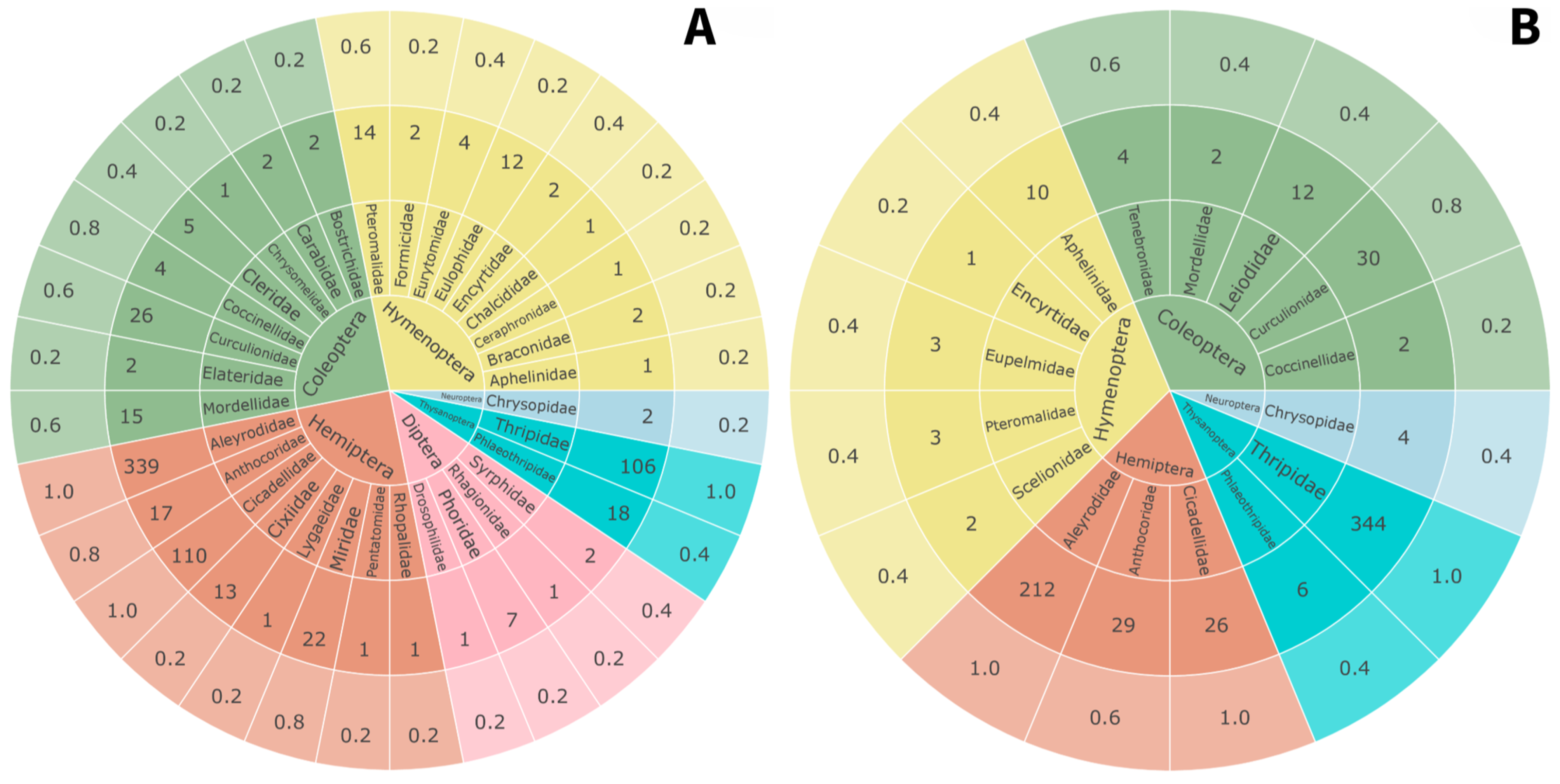
A total of 759 and 702 adult insects were collected at sites S1 (Figure 2A) and S2 (Figure 2B), respectively. A total of 33 specimens could not be identified down to the family level because they were damaged (22 from S1 and 11 from S2). Among them were four Lepidoptera, 23 Diptera, one Hemiptera, and five Hymenoptera. The order with the most identified families was Hymenoptera, with 11 families. The family Pteromalidae stood out for its abundance at S1 and its frequency in the samples (F = 0.6). At S2, the Aphelinidae family stood out for its abundance, although it was collected in only two samplings (F = 0.4). Within the order Coleoptera, the Curculionidae family was the most prominent, with a frequency of over 50% at both sites. The Phoridae family was the most abundant in the order Diptera. A constant presence at both sites and on all sampling dates places (F = 1) the Aleyrodidae (Hemiptera) and Thripidae (Thysanoptera) families as the dominant ones in the entomological community associated with V. farnesiana (Figure 2).
The predominant functional groups at the family level were phytophages and parasitoids, followed by predators in S1. In S2, the largest functional group was parasitoids, followed by phytophages and predators. However, in terms of insect abundance, phytophages outnumbered the other functional groups at both sites (Table 1). Some families are described below.
  • Family Aleyrodidae
The family Aleyrodidae (Hemiptera: Sternorrhyncha), commonly known as whiteflies, comprises phytophagous insects with piercing-sucking mouthparts that feed on the phloem of a wide variety of host plants. In Mexico, 131 species from 30 genera have been identified. Species in this family exhibit a high capacity for colonization and a wide geographic distribution, and they predominate in tropical and subtropical regions. Both nymphs and adults cause direct damage by extracting sap and producing honeydew; furthermore, several species serve as important vectors of phytopathogenic viruses, making them one of the most ecologically and economically significant groups of hemipterans [24].
  • Family Pteromalidae
The family Pteromalidae (Hymenoptera: Chalcidoidea) comprises a highly diverse group of small parasitoid wasps, widely distributed in natural and agricultural ecosystems, whose species employ a wide variety of parasitism strategies targeting the eggs, larvae, and pupae of insects from different orders, and play a fundamental role in the natural regulation of their populations and in biological pest control [25].
  • Family Anthocoridae
The family Anthocoridae (Hemiptera: Heteroptera), known as “pirate” bugs, comprises small predatory hemipterans widely distributed in natural and agricultural ecosystems. The family comprises between 400 and 600 species worldwide. Most are generalist predators that feed on a wide variety of soft-bodied arthropods, including thrips, aphids, whiteflies, mites, psyllids, and lepidopteran eggs, although they may also feed on pollen and other plant resources when prey availability is limited [26]. Thanks to their high foraging capacity, dietary flexibility, and adaptation to diverse habitats (plant type can influence the performance of natural enemies), anthocorids play a fundamental role in the natural regulation of phytophagous insect populations and are important agents of biological control [27].
  • Family Leiodidae
The family Leiodidae is primarily classified as a saprophagous functional group, since most of its species thrive on decaying organic matter and feed on fungi, spores, or myxomycetes; for this reason, they are also considered mycophagous within the saprophagous Coleoptera [28].
  • Family Syrphidae
The family Syrphidae (Diptera), commonly known as flower flies, comprises a diverse group of flies with a wide global distribution, thanks to the migratory ability of some species; furthermore, they play a significant ecological role in natural and agricultural ecosystems. Adults are frequently found near flowers, where they feed on nectar and pollen, making them important pollinators of numerous wild and cultivated plant species. Flies in this family play key roles in pollination and natural biological pest control (during their larval stage) and are considered beneficial insects in agroecosystems [29,30].
  • Family Formicidae
Ants (Hymenoptera: Formicidae) are one of the most abundant and ecologically dominant groups of insects in terrestrial ecosystems. They perform a wide range of ecological functions, including seed dispersal, predation on other arthropods, soil modification, organic matter decomposition, and nutrient cycling, thereby contributing substantially to ecosystem functioning [31]. In addition, they act as predators, and many species exhibit flexible omnivorous behavior that includes exploiting energy resources from honeydew-producing hemipterans, such as aphids and scale insects, with which they establish mutualistic relationships of cooperation and protection [32]. Owing to their high abundance, functional diversity, and sensitivity to environmental disturbance, ants are widely recognized as ecosystem engineers and reliable bioindicators for assessing ecological changes in natural, agricultural, and urban ecosystems [31,33].

3.3. Relative Abundance of Families

The relative abundance of the insect families identified on V. farnesiana at both sampling sites is shown in Table 2. The family with the highest percentage at S1 was Aleyrodidae, at 44.7%; all specimens belonged to the whitefly [Tetraleurodes acaciae (Quaintance) (Hemiptera: Aleyrodidae)]. At S2, the highest relative abundance corresponded to the Thripidae family, at 49.0%. With 10 families, the total reached 89.6% at S1 and 96.4% at S2. This indicates that 10.9% and 3.6% correspond to the relative abundance of rare families at S1 and S2, respectively.

3.4. Diversity Analysis

The diversity analysis using Hill’s indices (q = 0, 1, 2) showed that different ecological configurations of the habitat played an important role as a taxonomic and structural filter at the sampling sites (Table 3, Figure 3).
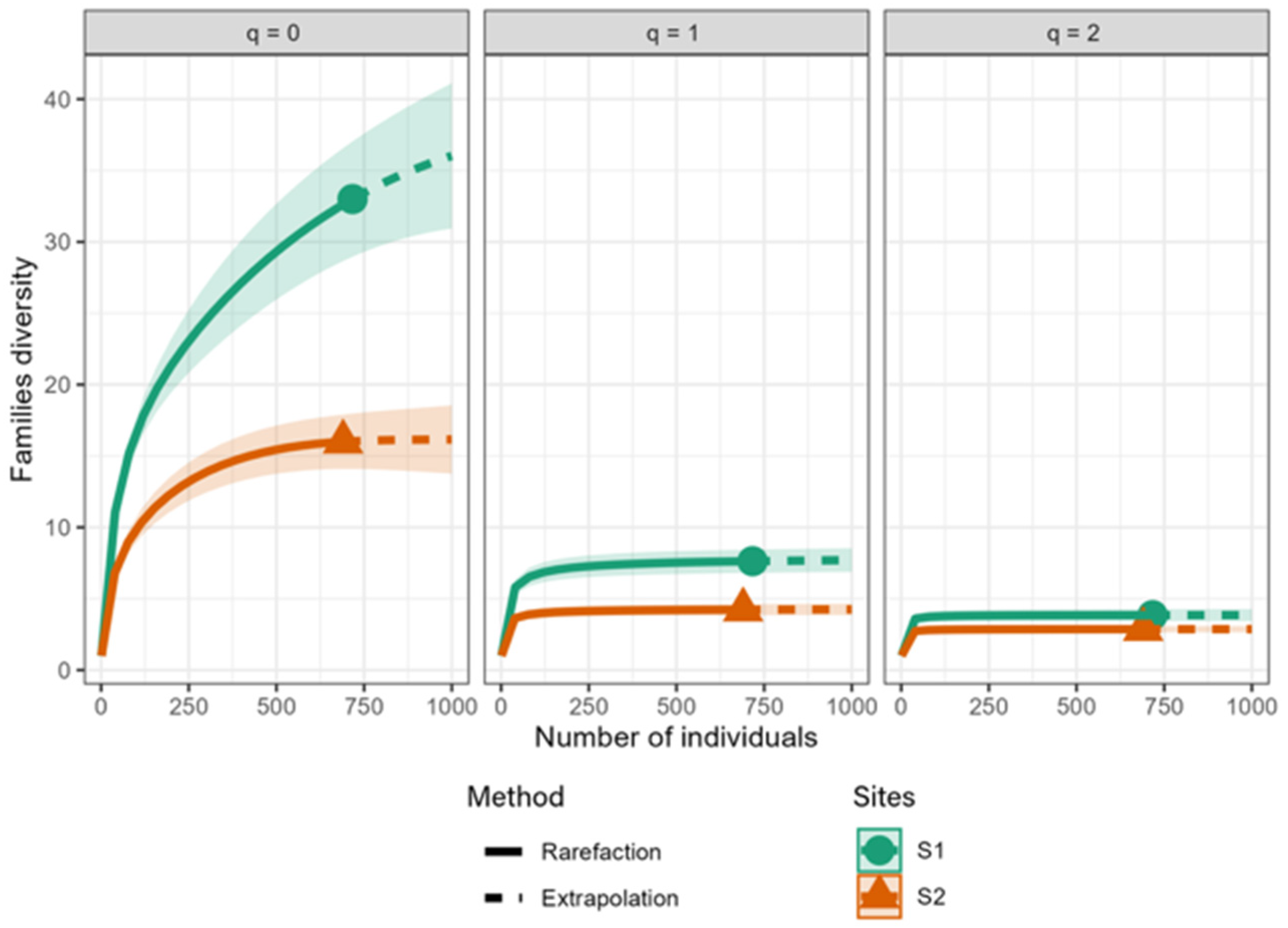
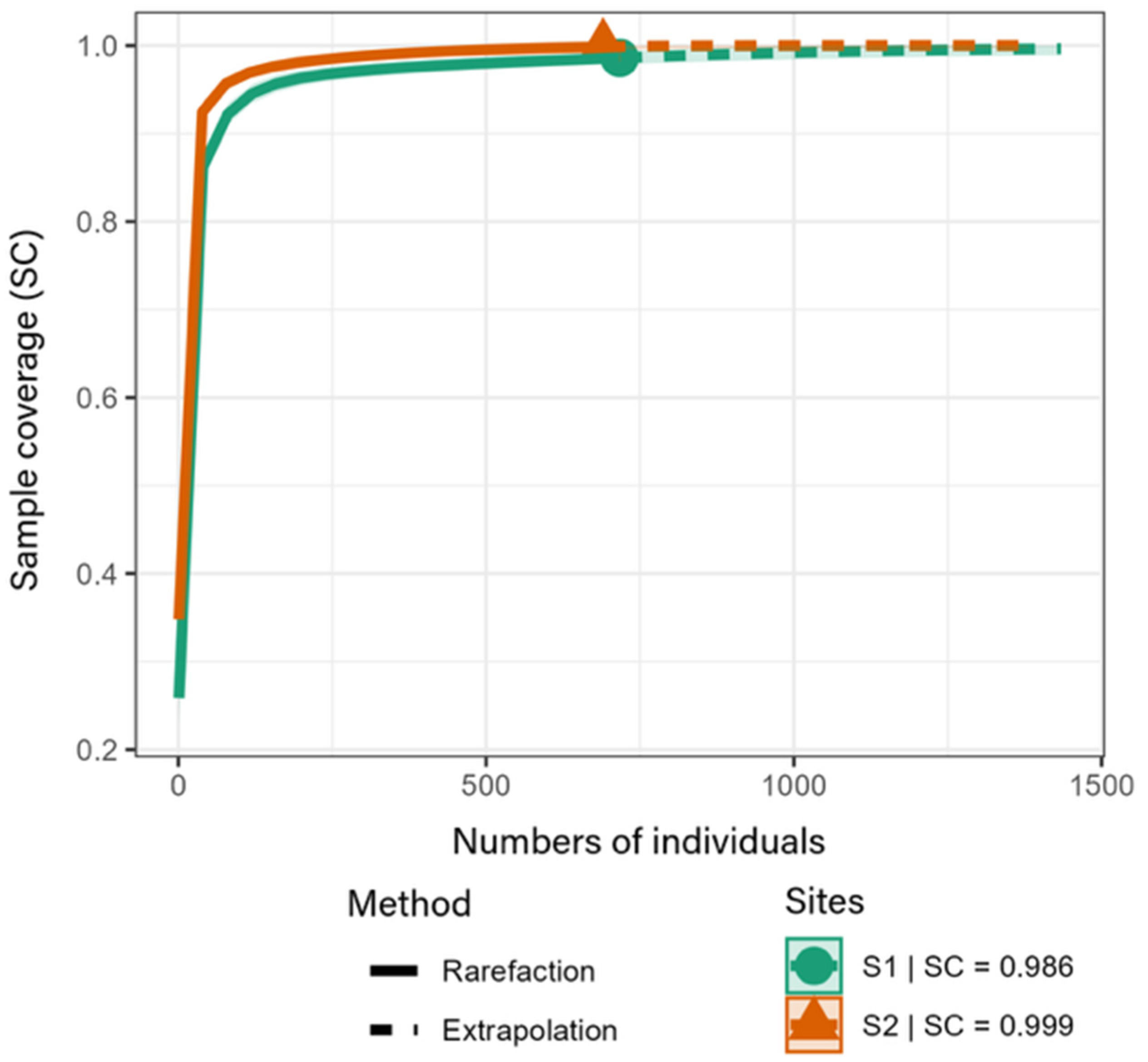
Accumulation curves based on sampling coverage showed a significant trend toward the asymptote at both sites, indicating that sampling was largely complete (Figure 4). Site S1 showed a sampling coverage (SC) of 0.986, slightly lower than that of S2 (SC = 0.999). In both cases, the curves converged toward values slightly less than 1.
When comparing a null model (only the “temperature” and “humidity” variables) of GLLVM to a full model (which included the “sampling site” variable), the likelihood ratio test showed that the “sampling site” variable significantly improved the model fit (D = 60.65; g. l. = 38 and P = 0.011). The results confirm that there is a significant difference in family composition and abundance between sites with different ecological configurations of the host plants, regardless of temperature and relative humidity at the time of insect capture.
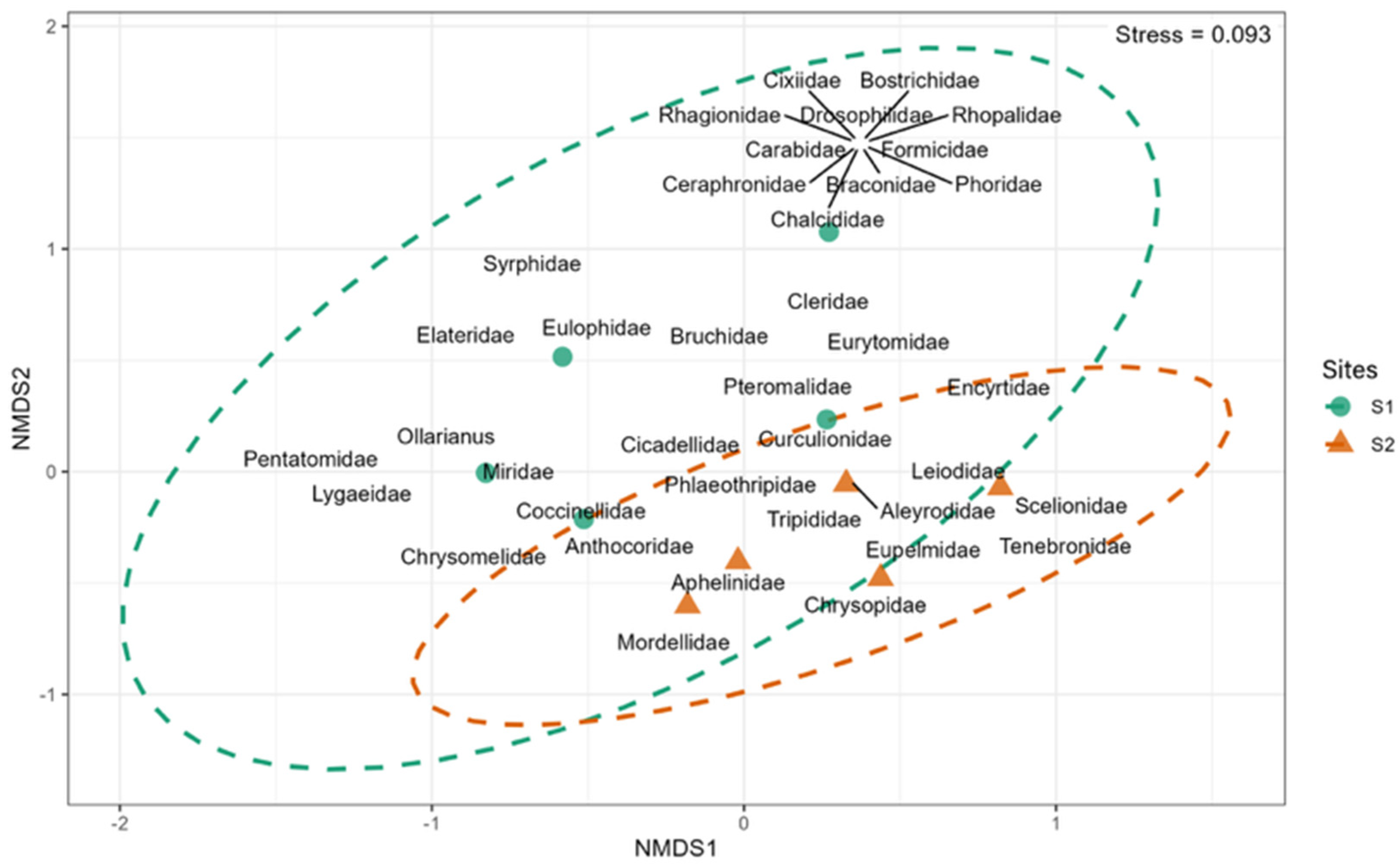
Analysis of the variation in family composition using NMDS showed a partial difference between the two sampling sites (Figure 5). The stress value obtained (S = 0.093) indicates that the two-dimensional representation is appropriate for the data and suggests that the spatial configuration reliably displays the dissimilarity relationships among the samples. The families from S1 (green circle) were distributed along the axes, indicating community heterogeneity. In contrast, S2 (orange triangle) exhibited a more compact, restricted distribution, suggesting a more homogeneous composition than S1. The scatter plots showed an overlap between the sites, indicating that although there is differentiation in family composition, they also share a set of families.

4. Discussion

Although the number of specimens collected in S2 was 57 fewer than in S1, the total abundance was similar, in contrast to the differences observed in community structure. This suggests that under the conditions studied, V. farnesiana can maintain a relatively similar total insect abundance regardless of habitat configuration, while tree distribution influences the composition of the insect community. S1 (the site with the highest tree density and shortest distance between patches), despite the predominance of a single family, exhibits a more uniform distribution—a characteristic typical of ecosystems with less anthropogenic disturbance [34]. In contrast, at S2 (the site with the lowest tree density and greatest distance between patches), abundance favors rapidly colonizing generalist families such as Aleyrodidae and Thripidae; this could be related to edge effects. This is consistent with [35], who indicated that edge environments tend to favor generalist taxa capable of rapidly colonizing available resources. Furthermore, the dispersal ability, wide range of host plants, and ecological plasticity described for numerous Aleyrodidae species facilitate their rapid colonization of new hosts and establishment in diverse environments [36,37]. Likewise, the abundance of the Thripidae family can be explained by its biological characteristics: thrips have short life cycles, high fecundity, and multiple generations per year, which allow them to rapidly increase their population size when environmental conditions and food resources are favorable [38]. Similarly, adults have a great capacity for dispersal through active flight and passive transport by the wind, which facilitates movement between host plants and the colonization of isolated patches of vegetation or new food sources [39,40].
The functional composition of S1 harbors a greater diversity of phytophages, parasitoids, predators, and saprophytes, whereas in S2, parasitoids and phytophages predominate, although in smaller numbers than in S1. These differences are consistent with the contrasting environmental conditions observed between the sites, including vegetation structure and proximity to irrigated farmland, which may increase the habitat’s suitability for higher trophic levels [41].
The predominance of phytophagous insects observed at both sampling sites is ecologically significant, as herbivorous insects perform essential ecosystem functions: they can contribute to biogeochemical cycles by returning nutrients to the soil or trigger chemical defenses that attract predators and parasitoids [42,43,44,45,46]. The high abundance of Thripidae recorded at both sampling sites is also ecologically significant, as many species in this family are closely associated with flowers and may contribute to pollination while feeding on floral resources [47]. In particular, species of the genus Frankliniella have been described as carrying pollen on their bodies and wings, and thrips-mediated pollination has been documented in more than 50 plant families and 102 genera [48,49]. Furthermore, the presence of Phlaeothripidae at both sites indicates that the insect community associated with V. farnesiana includes families with diverse feeding strategies, as this group consists mainly of mycophagous species along with some predatory taxa [49,50]. Similarly, although Curculionidae are predominantly phytophagous, several species also participate in pollination and the decomposition of plant matter, contributing to the nutrient cycle in terrestrial ecosystems [51]. These findings suggest that the dominant phytophagous families associated with V. farnesiana may contribute to multiple ecological processes beyond herbivory.
As for parasitoids, greater abundance was observed in S1 than in S2, suggesting a higher representation of higher trophic levels. Fenoglio et al. [52] demonstrated that a habitat affected by low tree density and reduced connectivity among trees reduces the parasitism rates by decreasing the number of species across multiple trophic levels. Similarly, higher canopy cover is associated with more abundant parasitoid communities [53]. Communities of predators, saprophytes, and detritivores were also more abundant in S1. This pattern is consistent with previous studies indicating that in response to prey abundance and to the fact that habitats with lower tree density and lower tree connectivity are less favorable for higher trophic levels, such as parasitoids and predators, the latter are better suited to groups with more variable trophic functions [54].
Finally, the presence of secondary pollinators (beetles and thrips) at both sites indicates that V. farnesiana serves as a floral resource, even during the sampling period, as noted by Resasco et al. [55]. However, the absence of primary pollinators such as bees, wasps, and butterflies during the collection period can be explained by the environmental conditions during sampling at both sites [56]. As ectotherms, pollinating insects depend on ambient heat to regulate their body temperature to the metabolic levels necessary for flight and foraging; therefore, their activity and visits to flowers are affected by low temperatures [57]. This variable has an even greater impact on their activity than precipitation [58]. Because pollinating insects are ectothermic and poikilothermic, their activity depends largely on ambient temperature, which regulates the metabolic processes necessary for flight and foraging [59]. Previous studies have shown that insect activity decreases markedly below the optimal temperature range (20–30 °C) and drops to a minimum at temperatures below 10 °C [57,59]. Therefore, the relatively cool conditions recorded during the sampling period may have reduced the pollinator activity, offering a plausible explanation for the absence of primary pollinators in the samples, despite their occasional observation at other times of the day under more favorable temperature conditions.
In addition to these short-term climatic influences, the diversity analyses provided further insight into the differences in insect community structure between the two sampling sites. Site 1 (S1) exhibited higher diversity values than Site 2 (S2). The absence of overlap between the 95% confidence intervals of the rarefication curves indicates that this difference is robust under the sampling conditions evaluated. Similar patterns have been described in studies where habitat configuration influences insect diversity.
The high sampling coverage at both sites allows us to state with certainty that the differences observed in community composition are unlikely to be due to incomplete sampling. Consistent with this, the GLLVM analysis showed that differences in the composition and abundance of insect families between S1 and S2 remained significant after accounting for temperature and relative humidity. These results indicate that the variation observed between sampling sites cannot be explained solely by the microclimatic conditions recorded during insect collection. According to Fahrig [4], habitat characteristics, such as resource availability, host plant connectivity, and vegetation structure, can influence plant–insect interactions, leading to differences in the composition and diversity of insect communities. Therefore, the differences detected by the GLLVM are consistent with the contrasting environmental characteristics of the two sampling sites.
The pattern observed in the analysis of the composition and abundance of the insect community across the different sampling sites using the GLLVM model suggests that the difference between sites S1 and S2 is statistically significant and that this difference goes beyond the microclimatic variables (temperature and relative humidity) on the sampling days. This is consistent with the findings of Fahrig [4], who notes that habitat differences influence resource availability, tree connectivity, and interactions between plants and insects, leading to significant changes in insect diversity and composition. The lower diversity observed at site S2 could be explained by the separation of host plants and edge effects, which favor generalist families but not specialists.
The NMDS plot revealed partial separation between S1 and S2, indicating differences in insect family composition while also showing that both sites shared a subset of families. The greater dispersion of samples in S1 suggests a more heterogeneous insect community, whereas the more compact clustering observed in S2 reflects a more homogeneous community composition. Similar patterns have been described in insect communities associated with contrasting habitat configurations. For example, Tzortzakaki et al. [2] reported reduced butterfly diversity in highly urbanized landscapes, whereas Graça and Somavilla [60] found lower wasp diversity in fragmented forests. Similarly, Abrego et al. [61] demonstrated that modifications in habitat configuration can alter local environmental conditions and subsequently influence the structure and composition of insect communities. Collectively, these studies suggest that differences in habitat characteristics, including landscape structure and habitat complexity, may contribute to the composition patterns observed between the two sampling sites.

5. Conclusions

This study provides the first characterization of the insect community associated with Vachellia farnesiana during its flowering stage in the semi-arid region of Mapimí, Durango (Mexico). Although both sampling sites harbored similar numbers of insects, they differed in family diversity, community composition, and functional group structure. Site S1 exhibited greater taxonomic diversity and a higher proportion of parasitoids, predators, and saprophytes, whereas S2 was characterized by the predominance of a few phytophagous families, particularly Aleyrodidae and Thripidae. These differences were consistently supported by diversity analyses, the GLLVM model, and NMDS, indicating that insect communities varied between sampling sites beyond the influence of the microclimatic conditions recorded during sampling. Taken together, these results highlight the importance of habitat characteristics in shaping insect communities associated with V. farnesiana and underscore the ecological value of this shrub as a resource that supports multiple functional groups of insects in arid ecosystems. Future studies should evaluate other phenological phases of V. farnesiana and include other dominant shrub species to determine whether these community patterns remain consistent throughout the annual cycle.

Author Contributions

Conceptualization, C.A.S.-P., F.G.-G., R.D.V.-C. and H.C.-M.; Methodology, C.A.S.-P., F.G.-G., R.D.V.-C., H.C.-M. and R.T.-C.; Research, Writing—original draft, C.A.S.-P.; Formal analysis, C.A.S.-P. and M.M.-E.; Data Curation, C.A.S.-P. and M.M.-E.; Visualization, C.A.S.-P., M.M.-E. and R.T.-C.; Taxonomic identification, C.A.S.-P. and F.G.-G.; Literature review, C.A.S.-P. Writing—review and editing, F.G.-G., R.T.-C., R.D.V.-C., H.C.-M., J.L.B.-L. and M.M.-E.; Funding acquisition, F.G.-G.; Project administration and supervision, F.G.-G. All authors have read and agreed to the published version of the manuscript.

Funding

This research was funded by the Universidad Autónoma Chapingo through project 24178-C-60.

Institutional Review Board Statement

Not applicable.

Data Availability Statement

Data are contained within the article.

Acknowledgments

We would like to thank the Unidad Regional Universitaria de Zonas Áridas at the Universidad Autónoma Chapingo (UACh) for providing the funding for this research.

Conflicts of Interest

The authors declare no conflicts of interest.

References

  1. Ramírez-Segura, E.; Márquez-Godoy, E.; Basave-Villalobos, R.A.; Sánchez-Gutiérrez, J.R.; Garay-Martínez, M.; Velázquez-Martínez, O.G.; Gutiérrez-Gutiérrez, J.N. Arbustivas Forrajeras, Una Alternativa para la Ganadería en Zonas Áridas y Semiáridas de México; Instituto Nacional de Investigaciones Forestales, Agrícolas y Pecuarias: Ciudad de México, Mexico, 2024. [Google Scholar]
  2. Tzortzakaki, O.; Kati, V.; Panitsa, M.; Tzanatos, E.; Giokas, S. Butterfly diversity along the urbanization gradient in a densely-built Mediterranean city: Land cover is more decisive than resources in structuring communities. Landsc. Urban Plan. 2019, 183, 79–87. [Google Scholar] [CrossRef] [Scilit]
  3. Fahrig, L. Effects of habitat fragmentation on biodiversity. Annu. Rev. Ecol. Evol. Syst. 2003, 34, 487–515. [Google Scholar] [CrossRef] [Scilit]
  4. Gurrutxaga, M. Índices de Fragmentación y Conectividad para el Indicador de Biodiversidad y Paisaje de la Comunidad Autónoma del País Vasco (CAPV); Technical Report; IKT, S.A. for the Dirección de Biodiversidad; Gobierno Vasco: Vitoria-Gasteiz, Spain, 2003; 31p, Available online: https://www.euskadi.eus/web01-a2ingdib/es/contenidos/documentacion/indicadores_biodiversidad/es_doc/adjuntos/fragmentacion_2003.pdf (accessed on 8 May 2026).
  5. Taylor, P.D.; Fahrig, L.; Henein, K.; Merriam, G. Connectivity is a vital element of landscape structure. Oikos 1993, 68, 571–573. [Google Scholar] [CrossRef] [Scilit]
  6. Schiltmeyer, A.V.; Zouhar, K. Vachellia farnesiana, Huisache. In Fire Effects Information System. U.S. Department of Agriculture, Forest Service, Rocky Mountain Research Station, Missoula Fire Sciences Laboratory (Producer). 2020. Available online: https://www.fs.fed.us/database/feis/plants/tree/vacfar/all.html (accessed on 8 May 2026).
  7. Quiroz-Cardoso, F.; Rojas-Hernández, S.; Olivares-Pérez, J.; Hernández-Castro, E.; Jiménez-Guillén, R.; Córdova-Izquierdo, A.; Villa-Mancera, A.; Abdel-Fattah, S. Composición nutricional, consumo e índices de palatabilidad relativa de los frutos de tres acacias en la alimentación de ovejas y cabras. Arch. Med. Vet. 2015, 47, 33–38. [Google Scholar] [CrossRef] [Scilit]
  8. Pérez-Cruz, Y.M.; Noveron-Neri, I.A.; Hernández-Rodríguez, D.; Hernández-Mendo, O. El huizache (Vachellia farnesiana): Una alternativa no convencional en la alimentación ovina. Agro-Divulgación 2022, 2, 37–39. Available online: https://agrodivulgacion-colpos.org/index.php/1agrodivulgacion1/article/view/89 (accessed on 8 May 2026).
  9. Noguez-Inesta, A.; López-Sánchez, A.S.; Carrillo-González, R.; González-Chávez, M.C.A. Uso de leguminosas (Fabaceae) en fitorremediación. Agro Product. 2017, 10, 57–62. [Google Scholar]
  10. Erkovan, H.I.; Clarke, P.J.; Whalley, R.D.B. A review on general description of Vachellia farnesiana (L.) Wight & Arn. Atatürk Univ. J. Agric. Fac. 2016, 47, 71–76. [Google Scholar]
  11. Granados-Montelongo, J.A.; Núñez-Colima, J.A.; Trujillo-Zacarías, I.; Cano-del Toro, J.; Chan-Chable, R.J.; Hidalgo-de León, A. Extracto de Acacia farnesiana para el control de larva de Aedes aegypti. Nova Sci. 2021, 13, 1–20. [Google Scholar] [CrossRef] [Scilit]
  12. García-González, F.; Alvarado-Ruacho, N.M. Whitefly species and their parasitoids associated with huizache Acacia farnesiana (L.) Willd. (Fabales: Fabaceae) in the Bermejillo area of Durango, Mexico. Rev. Chapingo Ser. Zonas Áridas 2016, 15, 9–15. [Google Scholar] [CrossRef] [Scilit]
  13. Heuzé, V.; Tran, G.; Giger-Reverdin, S.; Lebas, F. Huizache (Acacia farnesiana). Feedipedia 2019. Available online: https://www.feedipedia.org/node/353 (accessed on 8 May 2026).
  14. Vergara-Pineda, S.; Jones, R.W.; Malda-Barrera, G.; Caltzontzin-Fernández, K.; Obregón-Zúñiga, A.; Cambrón-Sandoval, V.H. Coelocephalapion subornatum (Fall) (Coleoptera: Brentidae: Apioninae) Forms Galls in Stems of Acacia farnesiana (L.) Willd. in Central Mexico. Southwest. Entomol. 2015, 40, 223–226. [Google Scholar] [CrossRef] [Scilit]
  15. González-Elizondo, M.S.; González-Elizondo, M.; Márquez-Linares, M.A. Ecorregiones. In La Biodiversidad en Durango. Estudio de Estado; CONABIO: Ciudad de México, Mexico, 2017; pp. 59–62. [Google Scholar]
  16. Schmidt, R.H. A climatic delineation of the ‘real’ Chihuahuan Desert. J. Arid Environ. 1979, 2, 243–250. [Google Scholar] [CrossRef] [Scilit]
  17. Márquez-Linares, M.A. Resumen ejecutivo. Contexto físico. In La Biodiversidad en Durango. Estudio de Estado; CONABIO: Ciudad de México, Mexico, 2017; pp. 17–18. [Google Scholar]
  18. Rzedowski, J. Vegetación de México, 1st digital ed.; Comisión Nacional para el Conocimiento y Uso de la Biodiversidad: Ciudad de México, Mexico, 2006. [Google Scholar]
  19. Turner, M.G. Landscape ecology: The effect of pattern on process. Annu. Rev. Ecol. Syst. 1989, 20, 171–197. [Google Scholar] [CrossRef]
  20. Johnson, N.F.; Triplehorn, C.A. Borror and DeLong’s Introduction to the Study of Insects, 7th ed.; Cengage Learning: Boston, MA, USA, 2020. [Google Scholar]
  21. Triplehorn, C.A.; Johnson, N.F.; Borror, D.J. Borror and DeLong’s Introduction to the Study of Insects; Cengage Learning: Boston, MA, USA, 2005. [Google Scholar]
  22. Fernández, F.; Sharkey, M.J. (Eds.) Introducción a los Hymenoptera de la Región Neotropical; Sociedad Colombiana de Entomología y Universidad Nacional de Colombia: Bogotá, Colombia, 2006. [Google Scholar]
  23. Chao, A.; Gotelli, N.J.; Hsieh, T.C.; Sander, E.L.; Ma, K.H.; Colwell, R.K.; Ellison, A.M. Rarefaction and extrapolation with Hill numbers: A framework for sampling and estimation in species diversity studies. Ecol. Monogr. 2014, 84, 45–67. [Google Scholar] [CrossRef] [Scilit]
  24. Ortega-Arenas, L.D.; Carapia-Ruiz, V.E. Moscas blancas (Hemiptera: Aleyrodidae) en México: Estatus, especies, distribución e importancia. Dugesiana 2020, 27, 37–54. [Google Scholar] [CrossRef] [Scilit]
  25. Haas, M.; Baur, H.; Schweizer, T.; Monje, J.C.; Moser, M.; Bigalk, S.; Krogmann, L. Tiny wasps, huge diversity—A review of German Pteromalidae with new generic and species records (Hymenoptera: Chalcidoidea). Biodivers. Data J. 2021, 9, e77092. [Google Scholar] [CrossRef] [Scilit] [PubMed]
  26. Bonte, J.; De Hauwere, L.; Conlong, D.; De Clercq, P. Predation capacity, development and reproduction of the southern African flower bugs Orius thripoborus and Orius naivashae (Hemiptera: Anthocoridae) on various prey. Biol. Control 2015, 86, 52–59. [Google Scholar] [CrossRef] [Scilit]
  27. Symondson, W.O.C.; Sunderland, K.D.; Greenstone, M.H. Can generalist predators be effective biocontrol agents? Annu. Rev. Entomol. 2002, 47, 561–594. [Google Scholar] [CrossRef] [Scilit] [PubMed]
  28. Schigel, D.S. Fungivory and host associations of Coleoptera: A bibliography and review of research approaches. Mycology 2012, 3, 258–272. [Google Scholar] [CrossRef] [Scilit]
  29. Dunn, L.; Lequerica, M.; Reid, C.R.; Latty, T. Dual ecosystem services of syrphid flies (Diptera: Syrphidae): Pollinators and biological control agents. Pest Manag. Sci. 2020, 76, 1973–1979. [Google Scholar] [CrossRef] [Scilit] [PubMed]
  30. Reynolds, S.K.; Clem, C.S.; Fitz-Gerald, B.; Young, A.D. A comprehensive review of long-distance hover fly migration (Diptera: Syrphidae). Ecol. Entomol. 2024, 49, 749–767. [Google Scholar] [CrossRef] [Scilit]
  31. Folgarait, P.J. Ant biodiversity and its relationship to ecosystem functioning: A review. Biodivers. Conserv. 1998, 7, 1221–1244. [Google Scholar] [CrossRef] [Scilit]
  32. O’Dowd, D.J.; Green, P.T.; Lake, P.S. Invasional “meltdown” on an oceanic island. Ecol. Lett. 2003, 6, 812–817. [Google Scholar] [CrossRef] [Scilit]
  33. Andersen, A.N.; Majer, J.D. Ants show the way Down Under: Invertebrates as bioindicators in land management. Front. Ecol. Environ. 2004, 2, 291–298. [Google Scholar] [CrossRef]
  34. Haddad, N.M.; Brudvig, L.A.; Clobert, J.; Davies, K.F.; Gonzalez, A.; Holt, R.D.; Lovejoy, T.E.; Sexton, J.O.; Austin, M.P.; Collins, C.D.; et al. Habitat fragmentation and its lasting impact on Earth’s ecosystems. Sci. Adv. 2015, 1, e1500052. [Google Scholar] [CrossRef] [Scilit] [PubMed]
  35. Shi, F.; You, W.; Huang, X. A global meta-analysis of forest edge effects on arthropod abundance and richness. Agric. Ecosyst. Environ. 2026, 404, 110364. [Google Scholar] [CrossRef] [Scilit]
  36. Byrne, D.N.; Bellows, T.S., Jr. Whitefly biology. Annu. Rev. Entomol. 1991, 36, 431–457. [Google Scholar] [CrossRef]
  37. Jones, D.R. Plant viruses transmitted by whiteflies. Eur. J. Plant Pathol. 2003, 109, 195–219. [Google Scholar] [CrossRef] [Scilit]
  38. Reitz, S.R.; Gao, Y.; Kirk, W.D.J.; Hoddle, M.S.; Leiss, K.A.; Funderburk, J.E. Invasion biology, ecology, and management of western flower thrips. Annu. Rev. Entomol. 2020, 65, 17–37. [Google Scholar] [CrossRef] [Scilit] [PubMed]
  39. Morse, J.G.; Hoddle, M.S. Invasion biology of thrips. Annu. Rev. Entomol. 2006, 51, 67–89. [Google Scholar] [CrossRef] [Scilit] [PubMed]
  40. Kigathi, R.N.; Poehling, H.-M. Interactions between flower thrips and their host plants: Adaptation and population dynamics. J. Pest Sci. 2012, 85, 317–328. [Google Scholar] [CrossRef] [Scilit]
  41. Rossetti, M.R.; Tscharntke, T.; Aguilar, R.; Batáry, P. Responses of insect herbivores and herbivory to habitat fragmentation: A hierarchical meta-analysis. Ecol. Lett. 2017, 20, 264–272. [Google Scholar] [CrossRef] [Scilit] [PubMed]
  42. Belovsky, G.E.; Slade, J.B. Insect herbivory accelerates nutrient cycling and increases plant production. Proc. Natl. Acad. Sci. USA 2000, 97, 14412–14417. [Google Scholar] [CrossRef] [Scilit] [PubMed]
  43. Frost, C.J.; Hunter, M.D. Insect canopy herbivory and frass deposition affect soil nutrient dynamics and export in oak mesocosms. Ecology 2004, 85, 3335–3347. [Google Scholar] [CrossRef] [Scilit]
  44. De Swardt, D.B.; Wigley-Coetsee, C.; O’Connor, T.G. Insect outbreaks alter nutrient dynamics in a southern African savanna: Patchy defoliation of Colophospermum mopane savanna by Imbrasia belina larvae. Biotropica 2018, 50, 789–796. [Google Scholar] [CrossRef] [Scilit]
  45. Ali, M.Y.; Naseem, T.; Holopainen, J.K.; Liu, T.; Zhang, J.; Zhang, F. Tritrophic interactions among arthropod natural enemies, herbivores and plants considering volatile blends at different scale levels. Cells 2023, 12, 251. [Google Scholar] [CrossRef] [Scilit] [PubMed]
  46. Hwang, B.C.; Giardina, C.P.; Barrios-Garcia, M.N.; Diao, H.; Duboscq-Carra, V.G.; Hemp, A.; Hemp, C.; Jiménez-Castillo, M.; Lobos-Catalán, P.; Mumladze, L.; et al. Insect herbivory releases more nutrients in warmer and drier forests. Glob. Biogeochem. Cycles 2025, 39, e2024GB008367. [Google Scholar] [CrossRef] [Scilit]
  47. Kucharczyk, H.; Kucharczyk, M.; Zawirska, I. Diversity and ecology of thrips (Thysanoptera, Insecta) assemblages in Słowiński National Park—A biosphere reserve on the Baltic Coast (Northern Poland). Insects 2026, 17, 119. [Google Scholar] [CrossRef] [Scilit] [PubMed]
  48. Retana-Salazar, A.P.; Rodríguez-Arrieta, J.A. Especies potenciales de thrips (Insecta: Thysanoptera: Thripidae) en la polinización del mango (Mangifera indica L.) en Costa Rica. Rev. Geol. Am. Cent. 2015. [Google Scholar] [CrossRef] [Scilit]
  49. Pop, C.; Terry, I.; Mound, L.A.; Van der Kooi, C.J. Tiny but significant: On the importance of thrips as pollinators. Ann. Bot. 2025, 136, 669–682. [Google Scholar] [CrossRef] [Scilit] [PubMed]
  50. Retana-Salazar, A.P.R.; Soto-Rodríguez, G.A.S. Revisión taxonómica del grupo Haplothrips-Karnyothrips (Thysanoptera: Phlaeothripidae). Rev. Biol. Trop. 2007, 55, 627–635. [Google Scholar] [CrossRef] [Scilit]
  51. Morrone, J.J. Biodiversidad de Curculionoidea (Coleoptera) en México. Rev. Mex. Biodivers. 2014, 85, 312–324. [Google Scholar] [CrossRef] [Scilit]
  52. Fenoglio, M.S.; Srivastava, D.; Valladares, G.; Cagnolo, L.; Salvo, A. Forest fragmentation reduces parasitism via species loss at multiple trophic levels. Ecology 2012, 93, 2407–2420. [Google Scholar] [CrossRef] [Scilit] [PubMed]
  53. Jordan-Fragstein, C.C.; Linke, R.; Müller, M.G. Structure–diversity relationships in parasitoids of a central European temperate forest. Forests 2026, 17, 106. [Google Scholar] [CrossRef] [Scilit]
  54. Gibb, H.; Hochuli, D.F. Habitat fragmentation in an urban environment: Large and small fragments support different arthropod assemblages. Biol. Conserv. 2002, 106, 91–100. [Google Scholar] [CrossRef] [Scilit]
  55. Resasco, J.; Chacoff, N.P.; Vázquez, D.P. Plant–pollinator interactions between generalists persist over time and space. Ecology 2021, 102, e03359. [Google Scholar] [CrossRef] [Scilit] [PubMed]
  56. Grajales-Conesa, J.; Meléndez-Ramírez, V.; Cruz-López, L. Aromas florales y su interacción con los insectos polinizadores. Rev. Mex. Biodivers. 2011, 82, 1356–1367. Available online: https://www.scielo.org.mx/pdf/rmbiodiv/v82n4/v82n4a33.pdf (accessed on 8 May 2026).
  57. Corbet, S.A.; Fussell, M.; Ake, R.; Fraser, A.; Gunson, C.; Savage, A.; Smith, K. Temperature and the pollinating activity of social bees. Ecol. Entomol. 1993, 18, 17–30. [Google Scholar] [CrossRef] [Scilit]
  58. Díaz-Calafat, J.; Öckinger, E.; Felton, A.; De Frenne, P.; Cousins, S.A.O.; Uria-Diez, J.; Hedwall, P. Fly pollinator foraging in boreal forests is shaped by climate, forest structure and flower resources. Oikos 2025, 2026, e11405. [Google Scholar] [CrossRef] [Scilit]
  59. Vicens, N.; Bosch, J. Weather-dependent pollinator activity in an apple orchard, with special reference to Osmia cornuta and Apis mellifera (Hymenoptera: Megachilidae and Apidae). Environ. Entomol. 2000, 29, 413–420. [Google Scholar] [CrossRef] [Scilit]
  60. Graça, M.B.; Somavilla, A. Effects of forest fragmentation on community patterns of social wasps (Hymenoptera: Vespidae) in Central Amazon. Austral Entomol. 2019, 58, 657–665. [Google Scholar] [CrossRef] [Scilit]
  61. Abrego, L.; Rivera, J.A.; Garrido, A.; Wilkie, E. Revisión bibliográfica del impacto de la fragmentación y la urbanización sobre las comunidades de insectos. Mesoamericana 2024, 26, 33–40. [Google Scholar] [CrossRef] [Scilit]
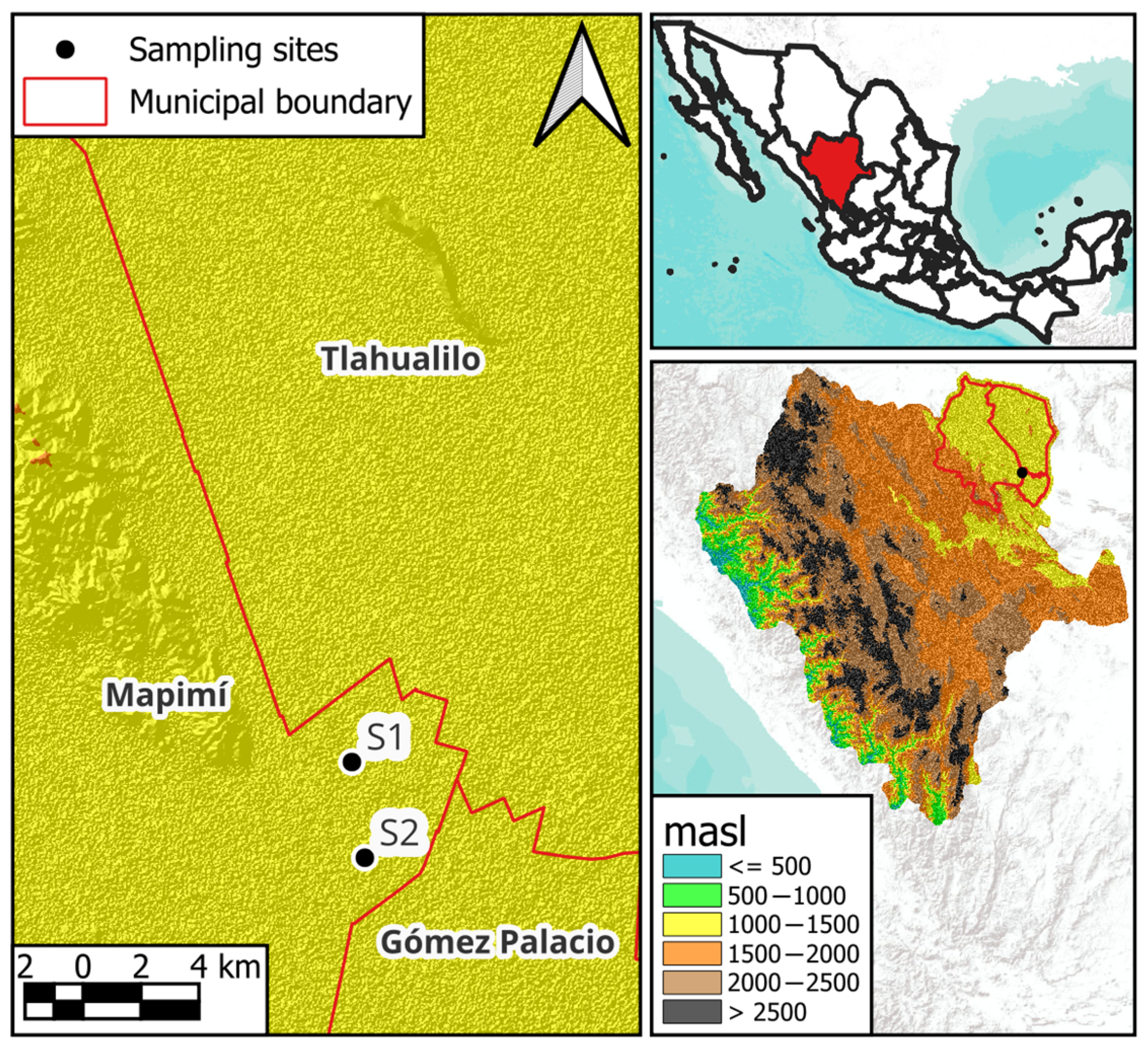
Figure 1. Location of sampling sites for the huizache (Vachellia farnesiana) in Mapimí, Durango, Mexico.
Ecologies 07 00070 g001
Figure 2. Insect families and capture frequency on Vachellia farnesiana during the flowering stage at two sampling sites in Mapimí, Durango, Mexico. (A) Site 1 and (B) Site 2. From the center outward, the following are shown: order, family, abundance of insects, and frequency of occurrence (1 = present 5 times; 0 = not present).
Ecologies 07 00070 g002
Figure 3. Hill’s numbers for insect families found on Vachellia farnesiana at the two sampling sites. The first Hill number (q = 0) corresponds to species richness. The second number (q = 1) represents Shannon diversity. The third number (q = 2) indicates Simpson’s diversity.
Ecologies 07 00070 g003
Figure 4. Accumulation curves based on sampling coverage for Vachellia farnesiana in Mapimí, Durango, Mexico, using the Good–Turing estimator.
Ecologies 07 00070 g004
Figure 5. Composition of insect families associated with Vachellia farnesiana in Mapimí, Durango, Mexico, as determined by NMDS (Bray−Curtis).
Ecologies 07 00070 g005
Table 1. Diversity of family richness and abundance of insects grouped by functional group at two sites with different ecological configurations of the habitat.
Functional CommunitiesS1
Families
S1
Specimens
S2
Families
S2
Specimens
Phytophages106224612
Parasitoids937519
Predators731335
Saprophytes728222
Pollinators21722
Omnivores1200
Total36737 *16691 *
* Unidentified insects were not assigned to any functional group. Note: The classification was based on the predominant functional group within the family, although some insect families may include species with different roles in the ecosystem.
Table 2. Relative abundance of the 10 major families identified during the flowering season of Vachellia farnesiana at two sampling sites in Mapimí, Durango, Mexico.
S1S2
OrderFamilyR. A. (%)OrderFamilyR. A. (%)
HemipteraAleyrodidae44.7ThysanopteraThripidae49.0
HemipteraCicadellidae14.5HemipteraAleyrodidae30.2
ThysanopteraThripidae14.0ColeopteraCurculionidae4.3
ColeopteraCurculionidae3.4HemipteraAnthocoridae4.1
HemipteraMiridae2.9HemipteraCicadellidae3.7
ThysanopteraPhlaeothripidae2.4ColeopteraLeiodidae1.7
HemipteraAnthocoridae2.2HymenopteraAphelinidae1.4
ColeopteraMordellidae2.0ThysanopteraPhlaeothripidae0.8
HymenopteraPteromalidae1.8ColeopteraTenebronidae0.6
HemipteraCixiidae1.7NeuropteraChrysopidae0.6
Total 89.6 96.4
R. A.: Relative abundance.
Table 3. Hill’s numbers for the insect families found on Vachellia farnesiana at both sampling sites in the Mapimí area, Durango.
Hill’s NumbersS1S2
q = 0 (Richness)33.0016
q = 1 (Shannon)7.624.23
q = 2 (Simpson)3.852.87
Disclaimer/Publisher’s Note: The statements, opinions and data contained in all publications are solely those of the individual author(s) and contributor(s) and not of MDPI and/or the editor(s). MDPI and/or the editor(s) disclaim responsibility for any injury to people or property resulting from any ideas, methods, instructions or products referred to in the content.