Article

Non-Random Patterns, Seasonality and Structure of Soil Collembola Communities in the Nestos River Delta, Greece


by
Kleanthis Patsidis
1,*,
Vassilis Detsis
2 and
Giorgos D. Kokkoris
1
1
Department of Marine Sciences, Faculty of Environment, University of the Aegean, 81132 Mytilene, Greece
2
Department of Economics and Sustainable Development, School of Environment, Geography and Applied Economics, Harokopio University of Athens, 17676 Athens, Greece
*
Author to whom correspondence should be addressed.
Ecologies 2026, 7(2), 57; https://doi.org/10.3390/ecologies7020057
Submission received: 31 March 2026 / Revised: 2 June 2026 / Accepted: 3 June 2026 / Published: 12 June 2026
(This article belongs to the Special Issue Advances in Community Ecology: Interactions, Dynamics, and Diversity)

Abstract

A central goal in ecology is to understand whether community assembly follows deterministic rules or is of a stochastic nature. Although species co-occurrence is extensively documented and studied for vertebrates, applying these frameworks to soil Collembola communities in Mediterranean riparian systems provides essential comparative data for community assembly theory. This study examined soil Collembola communities in the Nestos River delta (Greece) across diverse seasons and habitats using thirty-two presence–absence matrices based on abundance data for fifty-four species. These were analyzed using several metrics, each with appropriate randomization algorithms. We studied these metrics across seasons to track community structure changes over time. Additionally, the use of an appropriate multivariate method quantified the influence of soil humidity, while seasonal variations in biomass and diversity were tracked to explore biotic and abiotic influences. In most cases, null hypotheses about the forces structuring these communities could not be rejected, although some instances suggested competitively structured communities. Overall, soil humidity was found to modestly influence community structure, while concordant seasonal trends among biomass and diversity suggest that environmental filtering and biotic interactions shape the observed patterns, with temporal dynamics appearing relatively consistent across habitats within the study year.

1. Introduction

Throughout the fields of ecology and biogeography, an ongoing discourse has existed regarding the characterization of community structure and the identification of patterns [1]. The concept of “nonrandomness” has been investigated for almost a century, with early proponents such as Clements and Phillips considering plant communities as intricate superorganisms, while Gleason maintained the opposing view that associations were merely coincidental [2,3,4,5]. In the same period, Maillefer [6] conducted experiments utilizing marked cards to compare ordered and randomized diversity accumulation curves, revealing that congeners exhibited a higher tendency to coexist than expected by chance. Elton [7] observed that insular or local biotas displayed higher genus-to-species ratios (G/S) compared to corresponding mainland areas, suggesting intense competition on islands. However, Simberloff [8] argued against Elton’s findings, contending that G/S ratios on islands were actually lower than expected by chance.
During the 1950s and 1960s, the spatial analysis of species distributions in relation to one another was introduced in plant ecology [9,10]. Notably, at the end of that period, the influential work of Robert H. MacArthur—from his foundational theory of island biogeography [11] to his later synthesis on geographical ecology [12]—inspired a new generation of ecologists to search for patterns and mathematical principles to support ecological theory. Diamond’s study of island bird communities in the Bismarck Archipelago [13] yielded repeatable patterns, leading him to propose that these patterns were attributable to interspecific competition and culminating in his publication of community assembly rules.
However, Connor and Simberloff [14] contested Diamond’s hypotheses, asserting that patterns explained by interspecific competition could also be ascribed to random colonization of communities. They highlighted the absence of formal tests supporting Diamond’s ideas and established the connection between assembly rules and null model analysis. The null model approach involves comparing various parameters from observed data with the mean of those parameters derived from several Monte Carlo randomized data sets [15].
Subsequently, numerous papers have been published on the subject, with alternating viewpoints on the validity of assembly rules. These studies have revealed evidence of non-random structure in various communities and have examined the role of interspecific competition in determining non-random patterns [16,17,18,19,20,21].
While competition has been the primary focus of most species co-occurrence analyses, alternative mechanisms have also been proposed. Diamond himself acknowledged that co-occurrence patterns can be influenced by shared or different habitat requirements [13]. Other studies have supported this claim, emphasizing the role of habitat conditions and resource availability in shaping species co-occurrence [22,23,24,25,26]. Additionally, factors such as predation and geographic origins have been suggested as influencing co-occurrence patterns [27,28,29,30].
It is important to note that these theories assume stable natural systems and equilibrium within assemblages. However, if one or more species crucial for maintaining equilibrium is eliminated or experiences a drastic reduction in density, a new assemblage with different species composition and structure may emerge, resembling a randomized model [31,32,33,34]. In this study, we adopt the approach of Wilson [35,36], who posits that assembly rules refer to “restrictions on observed patterns”. While focusing on detecting these restrictions through assembly rules, we also aim to uncover the underlying mechanisms behind our results. Sampling for this research was conducted in the Nestos River wider delta area in Northeastern Greece. Although the original assembly rules framework was developed for oceanic islands [13], the underlying concept—that discrete patches support non-random species co-occurrence patterns—can be extended to any well-defined habitat unit. In this study, each sampling point was treated as an equivalent “island”, with local environmental conditions such as litter composition, soil moisture, and root activity acting as key determinants of soil Collembola community structure [37,38,39].
Furthermore, the four key stages of an insect’s life cycle—reproduction, growth and development, hibernation, and mobility/migration—must synchronize with seasonally variable biotic and abiotic requirements. Plant productivity has been identified as a reliable predictor of arthropod biomass, diversity, and richness [40,41,42,43]. Seasonality plays a crucial role in shaping the structure of soil Collembola communities and is therefore a central focus of this research. Additionally, understanding how soil Collembola communities respond to seasonal changes is fundamental for elucidating broader ecological patterns and processes. The intricate interplay between seasonal dynamics and arthropod life history strategies contributes significantly to ecosystem functioning and biodiversity maintenance [39].
As noted above, plant productivity reliably predicts arthropod biomass, diversity, and richness in these systems [40,41,42,43]. One might therefore expect that the abundant organic resources usually existing in riparian forests [44] might be expected to relax competitive pressures among soil Collembola. Nevertheless, several mechanisms can sustain strong interspecific competition even when total resource availability is high. Soil microhabitats are inherently heterogeneous: favorable patches such as root exudates or fungal hotspots are ephemeral and patchily distributed, forcing individuals to compete for the richest microsites [45]. Many Collembola also engage in interference competition, including chemical inhibition, which reduces neighbor fitness regardless of baseline food availability [46]. Resource partitioning allows co-existence through differential consumption of bacteria versus fungi or fresh versus aged detritus [47]. Seasonal fluctuations further intensify competition: in Mediterranean systems, summer drought drastically reduces accessibility of high-quality litter [48], while winter waterlogging limits aerobic decomposition. Disturbances can create ephemeral high-quality resource patches that intensify competition among colonizing Collembola species [49]. Thus, competition remains a plausible structuring force even in resource-rich riparian systems. Biomass is a crucial metric because it measures the total mass of selected living organisms in a specific area at a selected time. It reflects the habitat productivity and quality and indicates underlying differences in primary productivity, microclimate, and resource availability when it changes drastically per season [50]. McGill et al. [51] advocate that total biomass can be interpreted as an emergent property resulting from the distribution and dominance of functional traits, particularly body size and metabolic strategy, thus providing insight into trait-mediated community assembly and ecosystem functioning.
Humidity is also a crucial factor—linked with seasonality—in structuring land arthropod communities, as it displays a critical impact on the survival of the arthropods, their distribution and behavior, affecting their population dynamics and patterns [52,53]. This is especially pronounced in the Mediterranean due to the predictable summer drought [54]. Soil humidity specifically is a foundational abiotic factor for Collembola because it directs the total structure and function of terrestrial ecosystems. It influences arthropods, both directly and indirectly, through their direct water balance, prey availability, pathogens, and plant growth [55,56].
Although the field sampling was conducted in 1993, these data provide a historical baseline for soil Collembola communities in the Nestos River delta prior to the intensification of anthropogenic pressures at one site (Keramoti, see site description) and to the restoration to a closer-to-nature condition in another (poplar forests), as well as to the ongoing climate change in Mediterranean ecosystems. Datasets of this kind across multiple habitats and seasons are scarce [57,58], particularly for soil Collembola. Moreover, the present study applies null model approaches to these data, allowing new insights into community assembly processes that could not previously be explored [21,59,60]. As such, the dataset offers both historical ecological context and novel analytical value, contributing to current discussions on biodiversity patterns and ecosystem functioning. The approach taken is an abductive one; that is, patterns were identified, and then interpretation is suggested post hoc [61,62]. This kind of approach is especially suited when a number of competing models may lead to similar predictions and/or a large number of competing explanations of different origins can be equally plausible [63].
In summary, this study explores the differences in community structure of the soil Collembola communities on the Nestos River delta area, and we set out to look for patterns and assembly rules via null model analysis, supported by biotic and abiotic variables.

2. Materials and Methods

2.1. Site Description

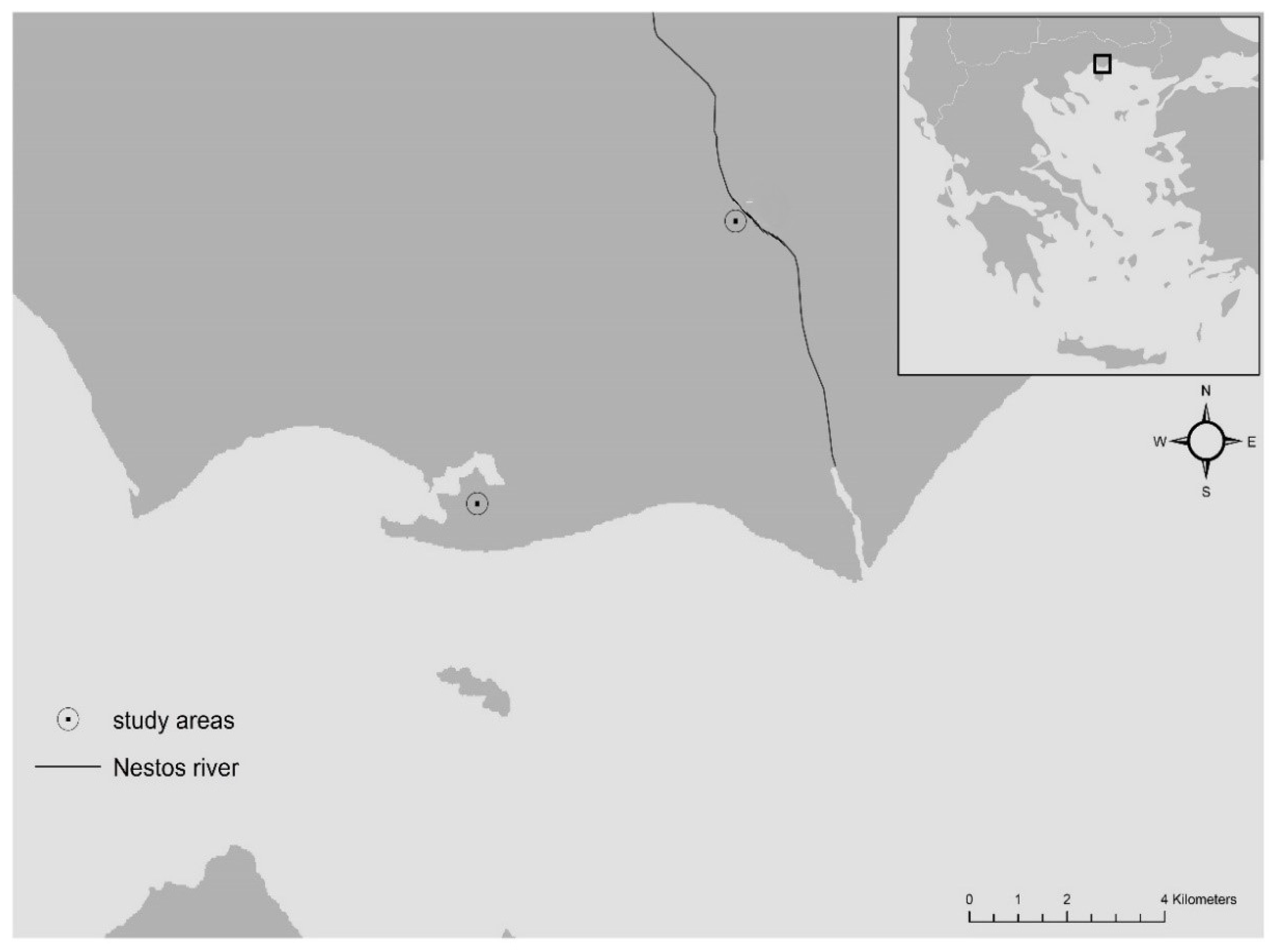
Two distinct research locations were situated in the western segment of the broader delta region of the Nestos River in Northeastern Greece. Originating in Bulgaria’s Rila Mountains, the Nestos River courses through and eventually meets the Aegean Sea in Greece, near the island of Thasos.
The initial study site is positioned at 40.91° N, 24.78° E, situated near the riverbed, and is impervious to floods due to embankments established along the river since the early 1950s (Figure 1). The second study site, located a few kilometers west of the first, has coordinates of 40.86° N, 24.71° E, and is in close proximity to the town of Keramoti (Figure 1). This site is also not prone to flooding, but waterlogged patches occurred after extensive rainfall due to the high water table.
The first study site, outside the dykes, showcases a gradient in soil organic matter content and includes a mix of natural forest—both young and mature—and adjacent poplar stands. The poplar stands replaced part of the hardwood forest cleared in the late 1940s. The natural forest remnants consist mainly of Quercus pedunculiflora, Populus alba, Fraxinus angustifolia, and Fraxinus oxycarpa [64]. In contrast, the second study site, positioned a few kilometers west of the town of Keramoti, is dominated by P. alba, Q. pedunculiflora, Alnus glutinosa, and Ulmus minor [64]. It is divided into three forest sections situated between dunes.
The long-term average weather data (1991–2020) supplied by the Hellenic National Meteorological Service indicate a Mediterranean climate in the western part of the broader Nestos River delta. This climate is defined by a dry season lasting from June to September and a single rainfall peak in January. On average, August is the driest month, while it is also the hottest, and January is the coldest. The region’s climate is of the subcool-subhumid Mediterranean type according to Nahal’s classification [65]. Overall, the Nestos Basin has a Mediterranean climate, with mild, rainy winters and hot, dry summers, particularly in the lower coastal areas [66].

2.2. Soil Collembola at Nestos Wider Delta River Sampling

In both regions, the study sites underwent multiple sampling during seven distinct time periods: July 1991, April 1992, January, April, August, September, and November 1993. There was an exception for the softwood forest, one of the diverse habitat types, which was sampled only in April and November 1993. The decision to conduct sampling across various time periods was deliberate, aiming to avoid potential biases toward a specific stage in the seasonal cycle of the soil Collembola. Several samples were collected from each type of habitat, and marks were strategically placed within the habitats to ensure consistent sampling in the same sub-area. Position markers were employed to guarantee that subsequent sampling activities would occur at precisely the same locations.
The sampling design was stratified random. Sample collection occurred at each site within a few hundred meters. Each sample site exhibited a unique environmental “gradient” confined to each specific area. These described “gradients” deviated from the conventional linear model, representing patchy distributions encompassing a diverse array of scenarios. Consequently, the sampling methodology did not follow a straight-line approach but was designed to encompass the full spectrum of conditions found at each site. The radius did not exceed a few hundred meters where the samples were collected for both areas. Samples were collected, species were identified, and individuals were counted as described in Detsis [67].
In summary, the samples were taken with a steel tool borer and were 5 cm in diameter and included the leaf litter and the upper 5 cm of soil (19.6 cm2 total surface). The animals were extracted by means of a Berlese-Tullgren funnel. In every sample, the species were documented and tallied. In total, there were fifty-four springtail species identified across five distinct habitat types. The habitat types include: a. hardwood forest, b. softwood forest, c. Keramoti Forest, d. mature poplar stand, and e. young poplar stand. Habitats of hardwood and softwood forests, as well as mature and young poplar stands, were located at the first study site. In contrast, the Keramoti forest was located at the second study site, positioned further west [67].
Soil samples were collected also juxtaposedly to each sample used for the extraction of the soil Collembola. These samples were transferred to the laboratory, where they were analyzed to quantify abiotic factors [67].

2.3. Data

We utilized the soil Collembola data obtained from the sampling conducted in the Nestos River delta, as described earlier, but isolated the data for the year 1993 to generate a total of thirty-two presence–absence matrices representing fifty-four distinct species in total. We focused exclusively on 1993 because sampling in other years (1991–1992) was sporadic and did not provide continuous seasonal coverage, making them unsuitable for analyzing temporal changes in community structure. The use of this historical dataset provides a baseline for soil Collembola communities prior to recent environmental changes in Mediterranean ecosystems and enables re-analysis using contemporary null model approaches. Rows represent species and columns represent sample sites. Table 1 displays an example matrix. A list of all species is provided in Appendix A.
Five presence–absence matrices encompassing all areas and habitats were constructed. An additional five matrices were created by excluding data from Keramoti and softwood forests, justified by the significant differences in properties between these habitats and the others. Furthermore, five matrices were developed for the hardwood forest habitat, and another five for the Keramoti forest habitat. Two matrices were derived from the data gathered in the softwood forest habitat, followed by five matrices using data from the mature poplar stand, and finally, five matrices from a combination of data from both mature and young poplar stands. All matrices were constructed for each sampling period available from primary data.
The amalgamation of data from mature and young poplar stand habitats was deemed necessary to ensure a sufficient number of sites in the matrices, as data from the mature poplar stand habitat alone did not yield an adequate number of sampling sites. Mature and young poplar stand habitats are technically the same habitat type in different stages of development, having similar properties. This approach is supported by Li YuanYuan et al. [68], who demonstrated that while Collembola abundance increases with poplar age, the fundamental vertical community structure and taxonomic orders remain consistent across the chronosequence. Collembola biomass was calculated by measuring the length of each specimen under the microscope and applying allometric equations to calculate dry weight [67,69]. We examined changes in total biomass across habitats during 1993.
In our research, we also created time-series for each habitat to reflect how soil humidity changes per habitat for the year 1993. Gravimetric soil moisture was determined by drying the samples at 103 °C [67,69].

2.4. Assessing Community Structure

2.4.1. Co-Occurrence Patterns

In this study, we distinguish between two primary assembly patterns: Segregation occurs when species pairs are found together less often than predicted by null models. Aggregation occurs when species pairs are found together more often than predicted by chance.

2.4.2. Co-Occurrence and Community Structure Metrics and Analyses

For each presence–absence matrix at first, we calculated three metrics: the number of checkerboard species pairs, the C-score, and the V-ratio. A checkerboard pair was defined as two species that never co-occur in any site, following Diamond [13]. The C-score [70] was computed as the average number of checkerboard units across all species pairs, where the checkerboard units for species i and j are (ri − S)(rj − S), with rᵢ and rⱼ the row totals and S the number of sites where both species i and j co-occur. The V-ratio [71] was calculated as the variance of column sums divided by the sum of row variances; values > 1 indicate positive covariance among species, values < 1 indicate negative covariance.
For each matrix, observed community metrics were compared against null distributions generated from 50,000 randomizations using four null algorithms. The choice of algorithm varied by metric: C-score and number of checkerboard pairs were assessed with the fixed–fixed and fixed-equiprobable algorithms; V-ratio was evaluated using fixed–equiprobable, fixed–proportional, and proportional–proportional algorithms.
The null hypothesis assumes that species co-occurrence patterns do not differ from random assembly given constraints on species occurrence frequencies (row totals) and/or site richness (column totals). Significant deviations—higher or lower values than expected—indicate non-random structure, suggesting ecological processes such as competition (segregation) or high co-occurrence (aggregation). Following Gotelli [31], we selected null models with favorable Type I error properties to ensure rigorous inference.
All analyses were conducted in EcoSim 7.0 [72] using a sequential swap algorithm that repeatedly exchanges randomly selected 2 × 2 submatrices (0 1/1 0 pattern) to generate null matrices [70,73]. Despite earlier critiques [74], this algorithm remains robust for detecting non-random patterns with low Type I error rates [1,31]. For each null distribution, EcoSim first performed 30,000 initial random swaps, followed by 50,000 iterations from which statistics were calculated—analogous to reshuffling tiles in a picture puzzle [75]. Additionally, two-tailed Benjamini–Hochberg (BH) Correction [76] across all 224 hypothesis tests was applied to control the false discovery rate, thereby reducing the risk of Type I errors due to multiple comparisons. The BH procedure ranks p-values and compares each to a progressively adjusted threshold, controlling the expected proportion of false positives among the rejected hypotheses. The BH procedure was chosen because it controls the expected proportion of false positives among the rejected hypotheses, offering a more balanced and powerful approach than other traditional methods.
Also, we performed distance-based redundancy analysis (db-RDA) to quantify the influence of soil humidity on community structure [60]. Community dissimilarity was quantified using the Jaccard coefficient, appropriate for binary presence–absence data. Humidity (gravimetric soil moisture) was used as the sole constraining variable to isolate the effect of soil moisture on community composition. Statistical significance of the constrained axis was assessed using a permutation test with 999 permutations [77]. To capture potential temporal variation, we repeated the same db-RDA procedure for each sampling month separately (January, April, August, September, November). All analyses were performed in R using the vegan package [78]. We extended our analysis to characterize community composition using two additional metrics: Sørensen similarity and species richness.
Sørensen similarity [79] was calculated as S = 2c/(a + b), where c is the number of shared species between two sites, and a and b are the respective site totals. Values range from 0 to 1. For each habitat and sampling date, we computed pairwise Sørensen indices among all sample combinations and then derived the mean and standard deviation to quantify average beta-diversity and its variability within habitats. Although widely used, this index treats all species as equally distinct and can be biased by richness gradients [80,81].
Species richness—the number of species per site—was tracked over the sampling period to assess seasonal trajectories within each habitat. Richness remains a fundamental biodiversity metric, with early work linking it to community stability [82].

3. Results

3.1. Null Model Metrics

3.1.1. Number of Checkerboard Species Pairs (Checker)

The number of checkerboard pairs deviated significantly from null expectations in several instances (Table 2 and Table A1). Under the fixed–equiprobable algorithm, eight matrices showed segregation (reduced co-occurrence), and one showed aggregation (increased co-occurrence). Under the fixed–fixed algorithm, fourteen matrices showed segregation, and none showed aggregation. The softwood forest matrices never deviated from randomness under either algorithm. Overall, segregation was the dominant non-random pattern, and the fixed–fixed algorithm detected it more frequently than the fixed–equiprobable algorithm.

3.1.2. The C-Score

The C-score also revealed non-random patterns, though less frequently than the checkerboard metric (Table 2 and Table A1). Under the fixed–equiprobable algorithm, four matrices showed segregation and five showed aggregation. Under the fixed–fixed algorithm, four matrices showed segregation, and none showed aggregation. Again, the softwood forest matrices never deviated from randomness. Aggregation was detected only under the fixed–equiprobable algorithm, mostly in the “all areas” and Keramoti forest matrices.

3.1.3. The V-Ratio

For the V-ratio, results varied strongly by null algorithm (Table 2 and Table A1). Under the fixed–equiprobable algorithm, three matrices showed segregation and eight showed aggregation. Under the fixed–proportional and proportional–proportional algorithms, five matrices showed segregation and none showed aggregation. The softwood forest never showed significant deviation. Aggregation under the fixed–equiprobable algorithm was largely driven by the “all areas” and “all areas excluding Keramoti/softwood” matrices.

3.1.4. Benjamini–Hochberg FDR Correction for Multiple Comparisons

Given the large number of simultaneous hypothesis tests (224 total), we applied the two-tailed Benjamini–Hochberg false discovery rate procedure (FDR = 0.05) to control for Type I errors [76]. EcoSim 7.0 generated two one-tailed probabilities for each test: P (observed ≤ expected) and P (observed ≥ expected). To test for non-random deviation in either direction (segregation or aggregation), we converted these to two-tailed p-values as p2 = 2 × min(P(≤), P(≥)). When the smaller tail probability was zero, we recorded p2 < 0.001. We then applied the Benjamini–Hochberg false discovery rate procedure (FDR = 0.05) to the full set of 224 two-tailed p-values to control for multiple comparisons. After correction, the number of statistically significant findings was substantially reduced. Only thirteen test cases retained their significance, representing robust evidence of non-random community structure. These results, demonstrating specific patterns of aggregation and segregation across habitats and seasons, are detailed in Table 3.

3.2. Timelines

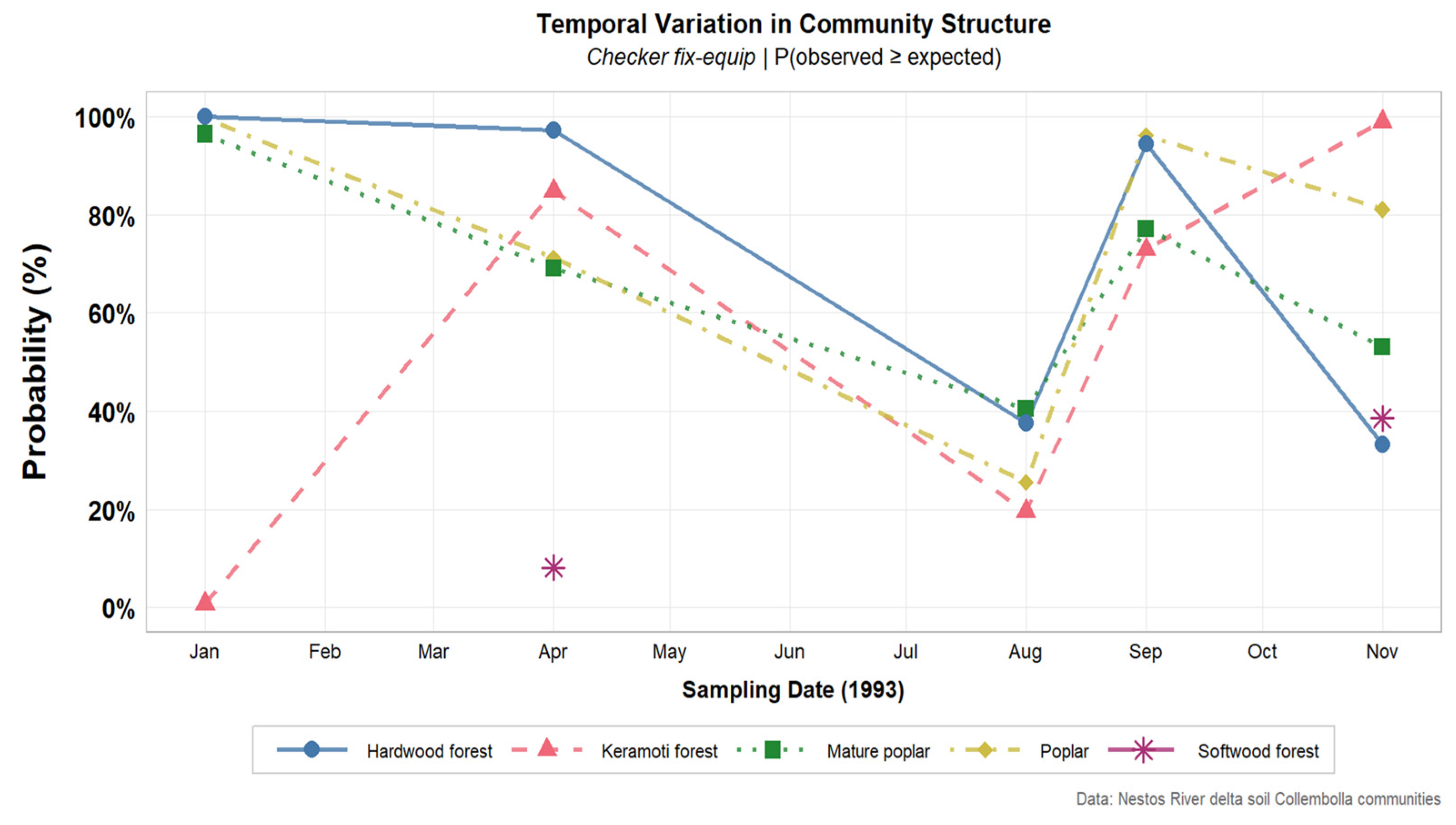
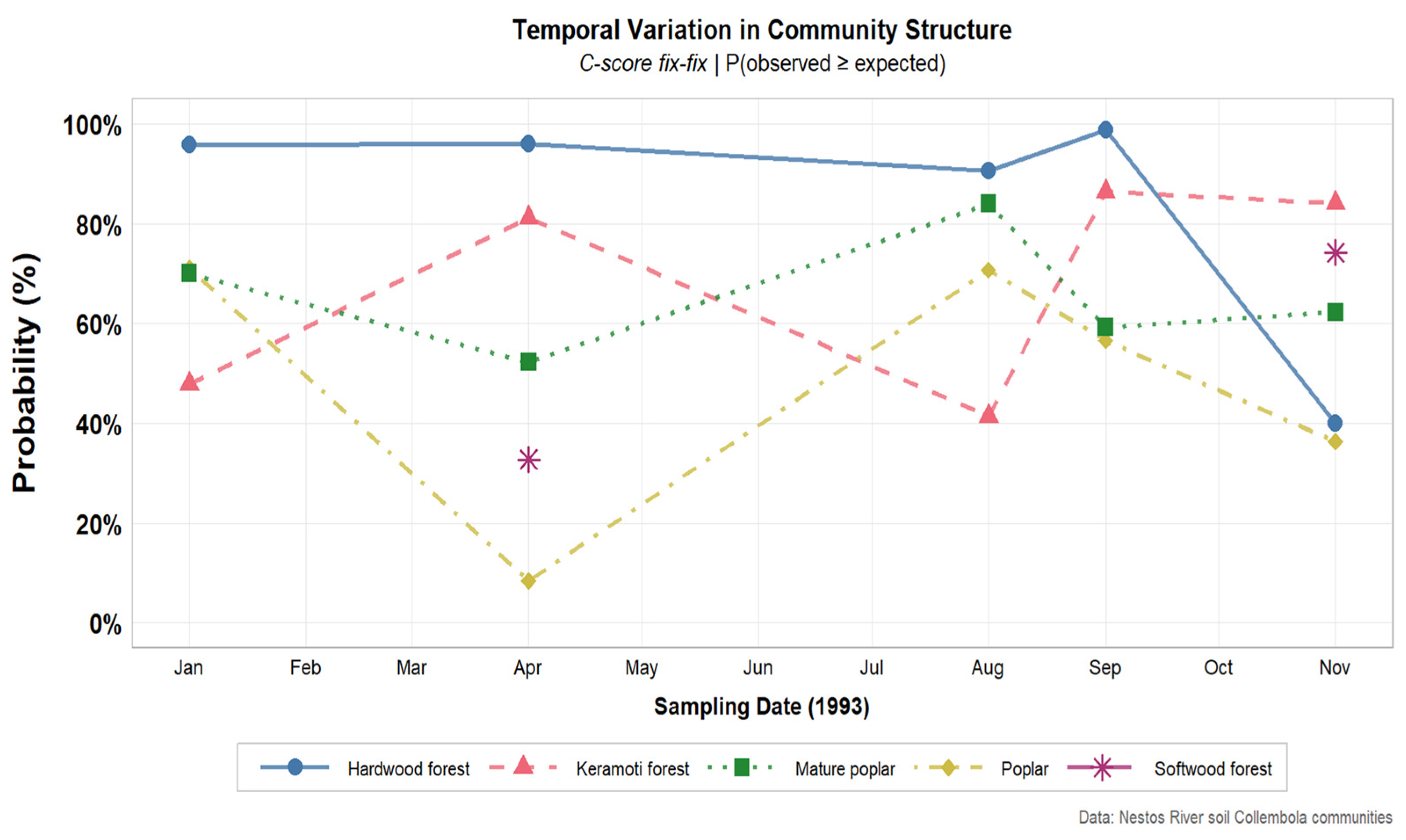
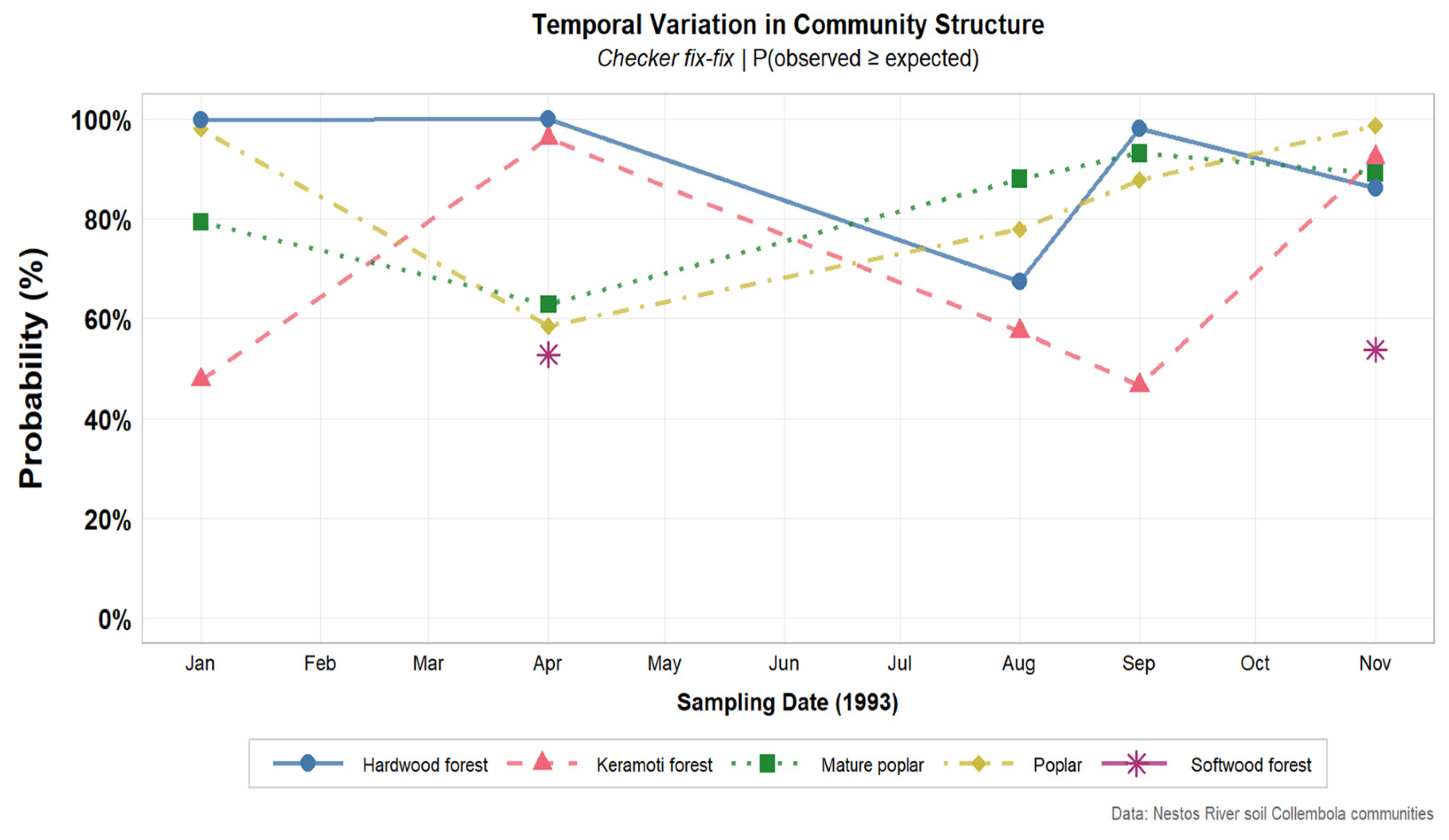
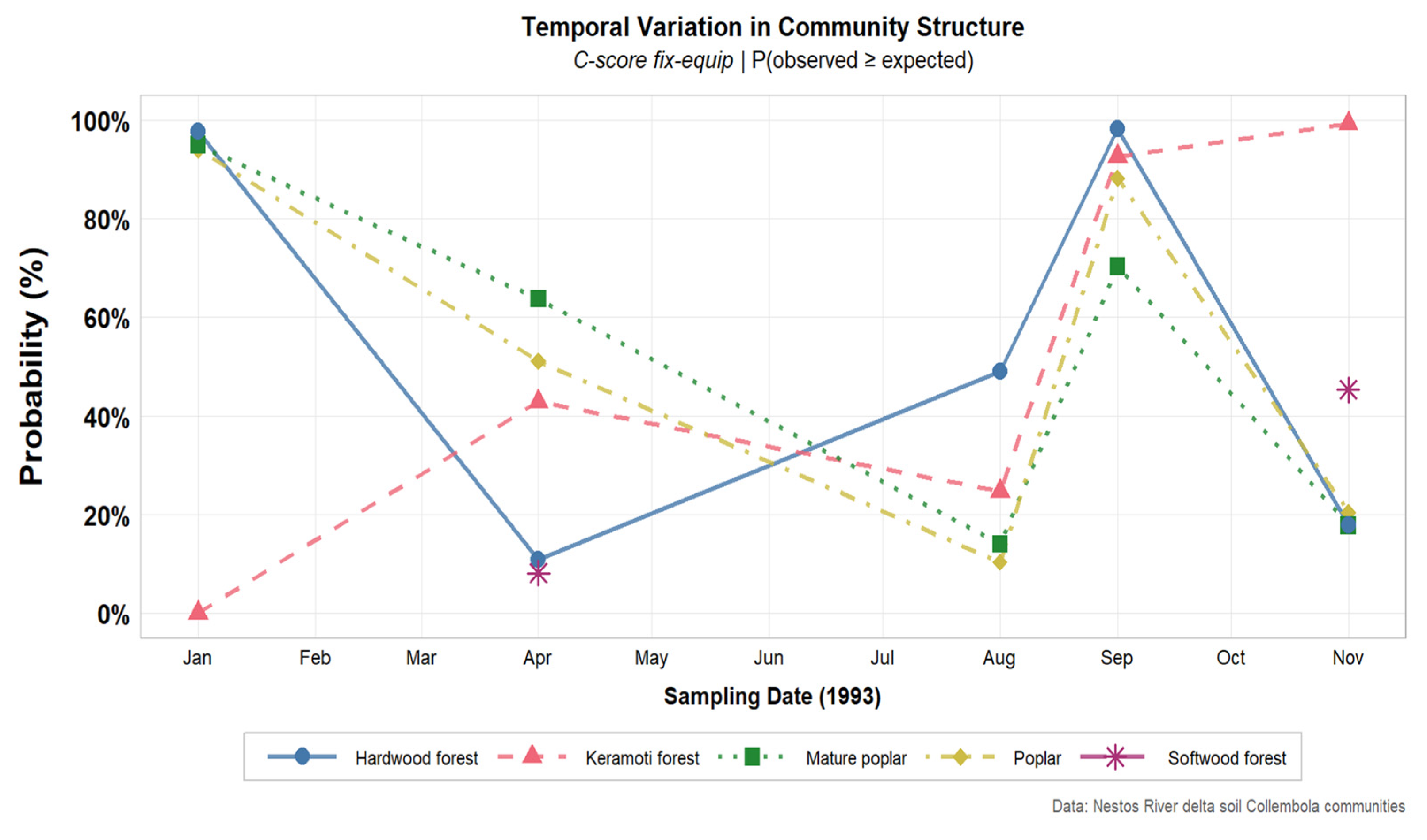
To clarify the observed patterns of co-occurrence metrics, we generated timelines for the number of checkerboard species pairs and the C-score using each algorithmic method applied, specifically for the year 1993 (Figure 2, Figure 3, Figure 4 and Figure 5). These timelines serve as visual representations, showcasing the percentage of indices where the observed values (Pobserved) are greater than or equal to the expected values (Pexpected).
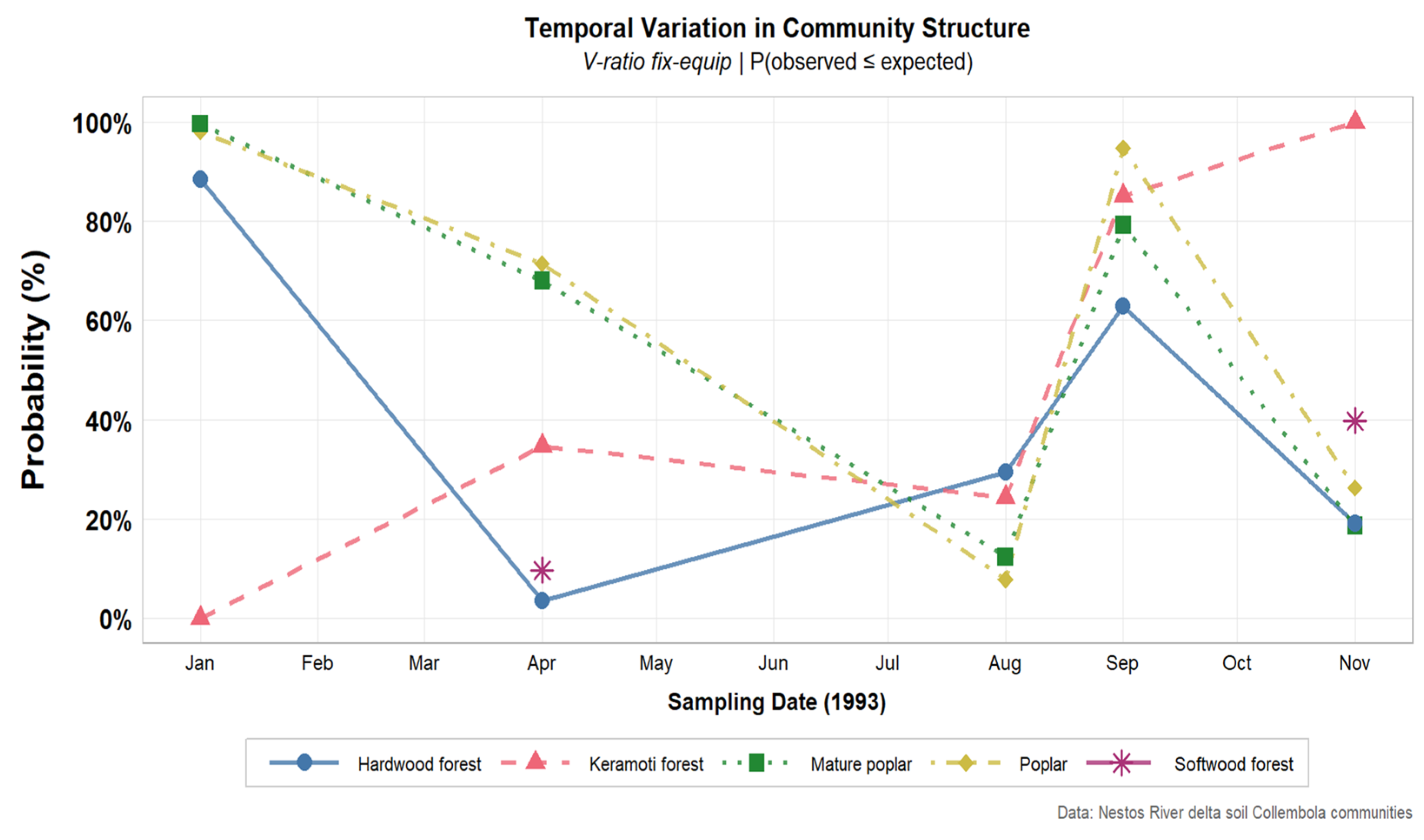
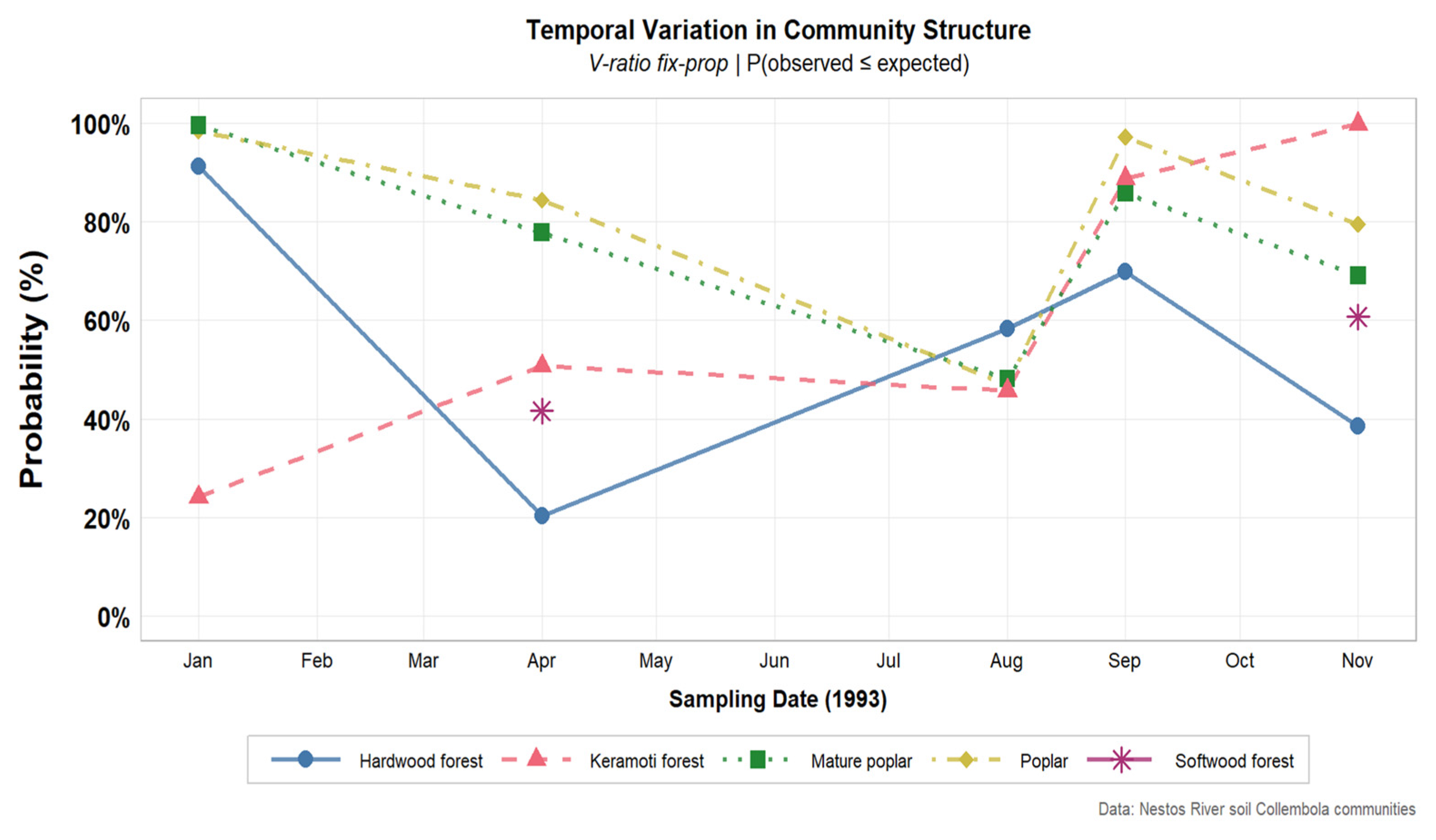
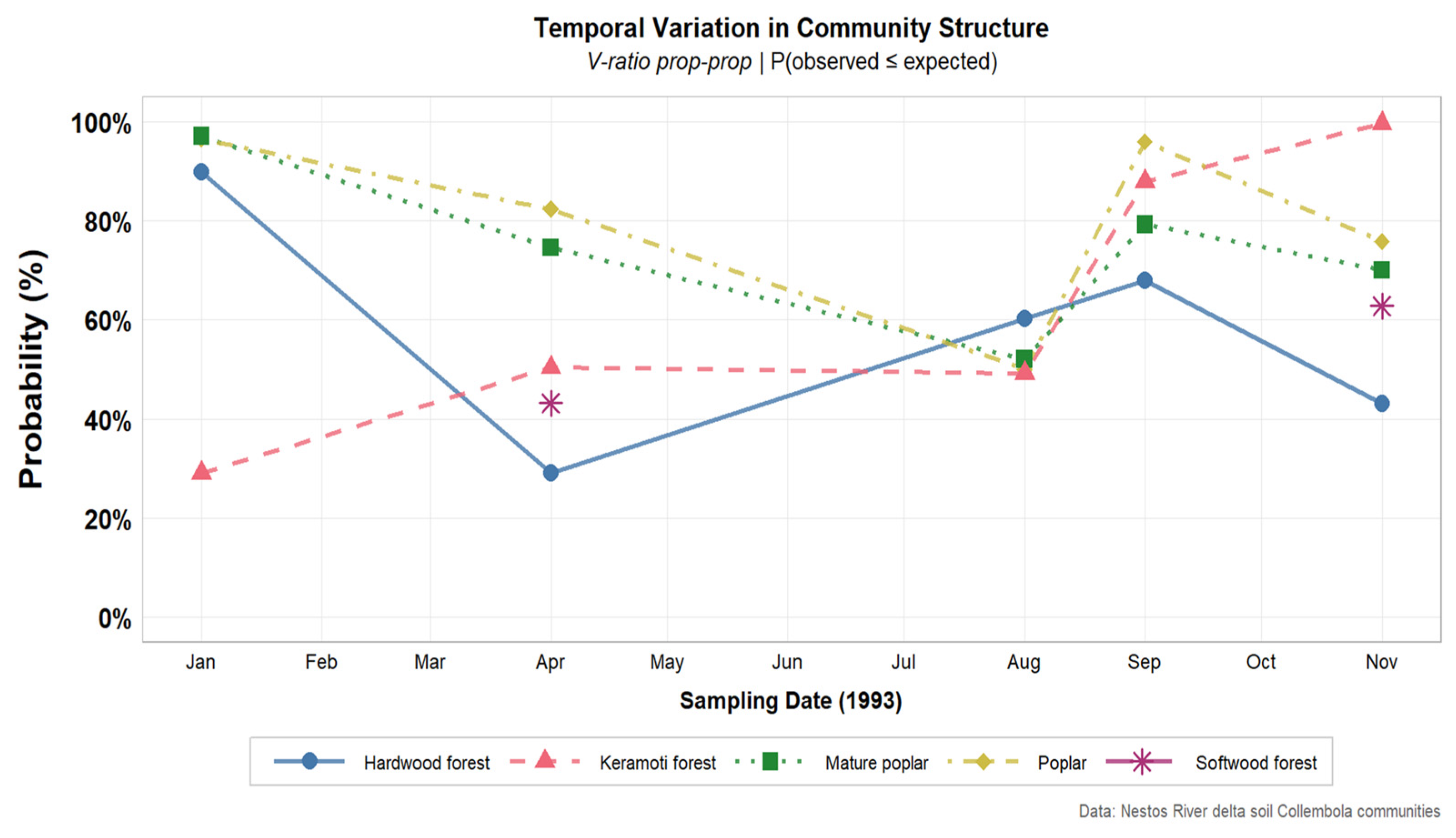
Similarly, timelines were constructed for the V-ratio employing the distinct algorithmic approaches utilized for the same year (Figure 6, Figure 7 and Figure 8). These timelines visualize the percentage of indices where the observed values (Pobserved) are less than or equal to the expected values (Pexpected). In the timeline diagrams, the probability values are depicted for each habitat, metric, and algorithmic method used, based on the samples collected during five time periods: January, April, August, September, and November of 1993. The selection of these specific depictions was intended to indicate the degree of competition present within the biotic communities. Timelines (Figure 2, Figure 3, Figure 4, Figure 5, Figure 6, Figure 7 and Figure 8) show raw deviation patterns without multiple-test correction; corrected significance is summarized in Table 3 and described above.
It is evident that certain soil Collembola communities from different habitats under particular algorithms for each metric exhibit synchronized patterns in their structure during specific time periods, as shown in the timelines.
Specifically, an examination of the timeline diagram for the Checker metric (number of checkerboard species pairs) under the fixed–equiprobable algorithm (Figure 2) shows that in January 1993, the poplar, mature poplar, and hardwood forest habitats had a high percentage of observed values (Pobserved) greater than or equal to the expected values (Pexpected), indicating a high level of aggregation. Keramoti forest, on the other hand, has a very low percentage of observed values (Pobserved) greater than or equal to the expected values (Pexpected), clearly indicating a community of Collembola that is significantly segregated. From April to September 1993, all examined habitats, except for the softwood forest, followed the same pattern, with similar percentages of observed values (Pobserved) greater than or equal to the expected values (Pobserved). This suggests a synchronization among different soil Collembola communities, with the percentage declining in August and rising significantly in September 1993. In November 1993, the Keramoti forest community exhibited the highest percentage of observed values (Pobserved) greater than or equal to the expected values (Pexpected), highlighting a distinct structural difference compared to other communities.
Examining the C-score metric under the same algorithm (Figure 4), it depicts nearly the same changes in the structure of the communities, which is logical since the two metrics are related. This timeline diagram also suggests a synchronization among different soil Collembola communities, which appears with the percentage declining in August in most communities and rising significantly in September 1993. In November 1993, the Keramoti forest once again recorded the highest percentage of observed values (Pobserved) exceeding or matching the expected values (Pexpected), while all other habitats showed a decline.
Under the fixed–fixed algorithm, for both the Checker and C-score metrics (Figure 3 and Figure 5), the pattern observed in the fixed–equiprobable algorithm is not evident in the timeline diagrams, nor does any community appear to synchronize with another. No soil Collembola community in any period shows significant structural segregation. The Collembola community in the Keramoti habitat differs significantly from those in other habitats. It peaks in terms of the number of species combinations in April 1993 and again in November 1993, with the highest percentage of observed values (Pobserved) exceeding or matching the expected values (Pexpected), suggesting an aggregated community structure.
The V-ratio metric, under the three different algorithm methods (Figure 6, Figure 7 and Figure 8), produced timeline diagrams showing in all three the same pattern in changes in the structure of the communities. V-ratio timeline diagrams under fixed–proportional and proportional–proportional algorithms are almost identical, with a similar percentage of observed values (Pobserved) lower than or equal to the expected values (Pexpected). In all three timeline diagrams, the data suggest a synchronization among different communities, with the percentage of expected values (Pexpected) declining in August for most communities and rising significantly in September 1993. In November 1993, the Keramoti forest once again recorded the highest percentage of Pexpected values exceeding or matching the observed values (Pobserved), while all other habitats exhibited a decline. This pattern closely mirrors the trends observed in the C-score metric under the fixed–equiprobable algorithm.
In conclusion, the timelines offer a dynamic portrayal of soil Collembola community interactions, emphasizing the fluctuations and seasonality inherent in their occurrences. They provide valuable insights into the intricate patterns of springtail dynamics throughout the year, enhancing our understanding of community structure and interactions within.

3.3. Other Community Structure Metrics

3.3.1. Sørensen Similarity Index

Seasonal patterns in soil Collembola community composition were assessed by comparing replicate samples within each forest habitat using the Sørensen similarity index. Mean pairwise similarity values (±standard deviation) were calculated for each sampling month in 1993 to quantify temporal variation in community similarity within habitats (Table 4).
Seasonal variation in Collembola community similarity (Sørensen similarity index) differed among the five forest habitats during 1993. In the mature poplar forest, similarity was highest in January (0.469 ± 0.057), declined sharply in April (0.153 ± 0.029), and increased again from August to November (0.300–0.360). The young–mature poplar forest showed relatively constant similarity values throughout the year, ranging from 0.232 ± 0.045 in September to 0.320 ± 0.035 in April. In contrast, the Keramoti forest exhibited a pronounced seasonal increase in similarity, rising steadily from January (0.279 ± 0.054) to November (0.534 ± 0.018).
In the softwood forest, sampling was limited to April and November, with moderate similarity in April (0.341 ± 0.033) and higher values in November (0.458 ± 0.023). The hardwood forest consistently showed the highest similarity among habitats across all sampled months, with values remaining above 0.49 and peaking in April (0.633 ± 0.038).
Taken together, these results demonstrate that the seasonal dynamics of community similarity are strongly mediated by forest habitat type. While some habitats show marked seasonal fluctuations, others, like the hardwood forest, maintain high compositional stability throughout the year.

3.3.2. Species Richness

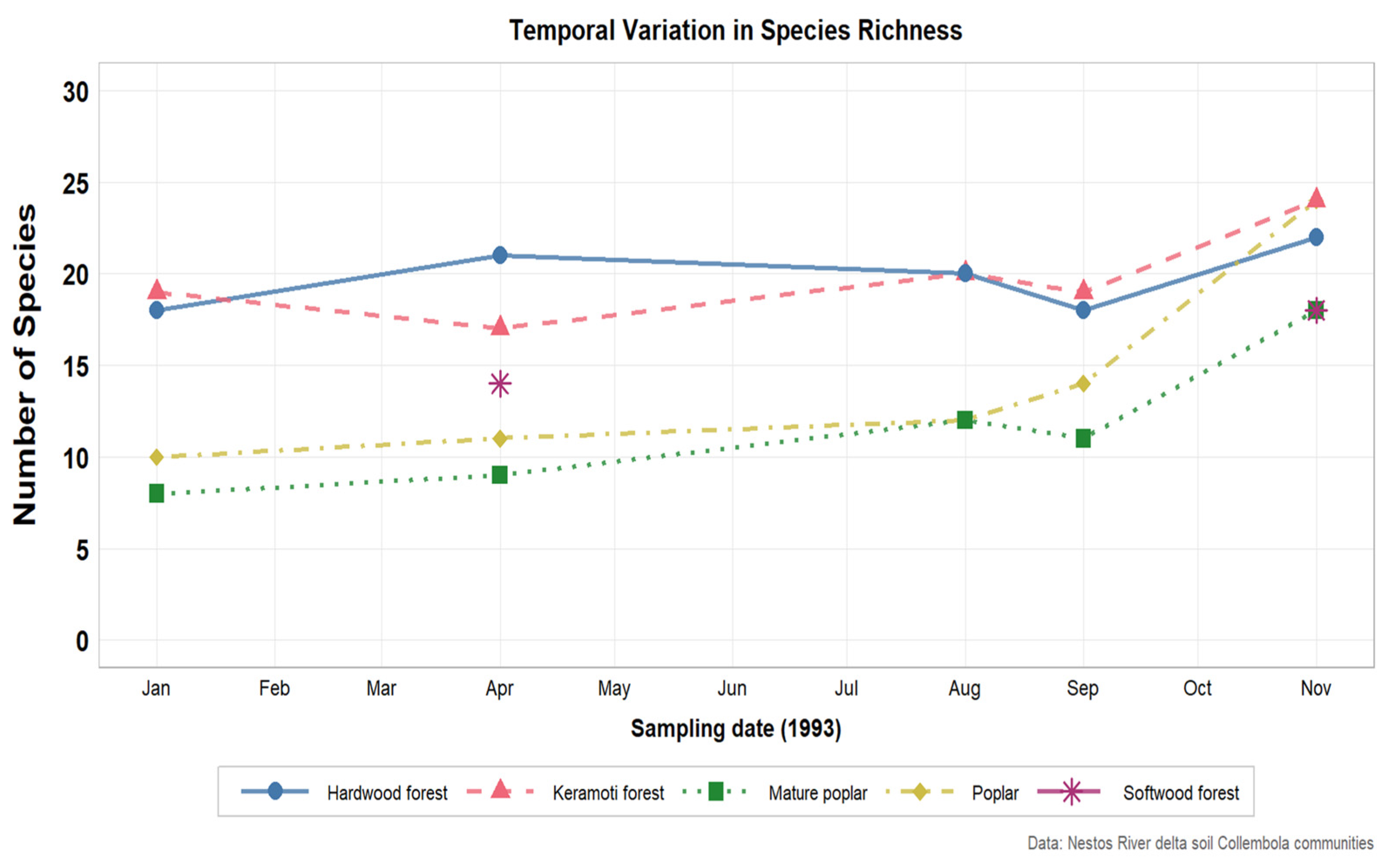
Temporal variation in species richness was observed across all five forest habitats during the 1993 sampling period (Figure 9). Species richness in the hardwood forest remained relatively high and stable throughout the year, with values ranging from 18 to 22 species, showing a slight decline in September followed by an increase in November. The Keramoti forest exhibited moderate seasonal fluctuation, with richness decreasing from January to April, increasing through August, and reaching its highest value in November (24 species).
In the poplar forest, species richness increased gradually from January (10 species) to August (12 species), followed by a pronounced rise in autumn, peaking in November (23 species). The mature poplar forest showed consistently lower richness compared to other habitats, with values increasing steadily from winter to late summer, a slight decrease in September, and a maximum observed in November (18 species). Sampling in the softwood forest was limited to April and November, when species richness increased from 14 to 18 species over this period.
These findings showcase distinct seasonal trajectories of species richness across habitats, with most of the communities achieving their maximum richness in November. The hardwood forest exhibited stable, high richness across all seasons.

3.3.3. Biomass

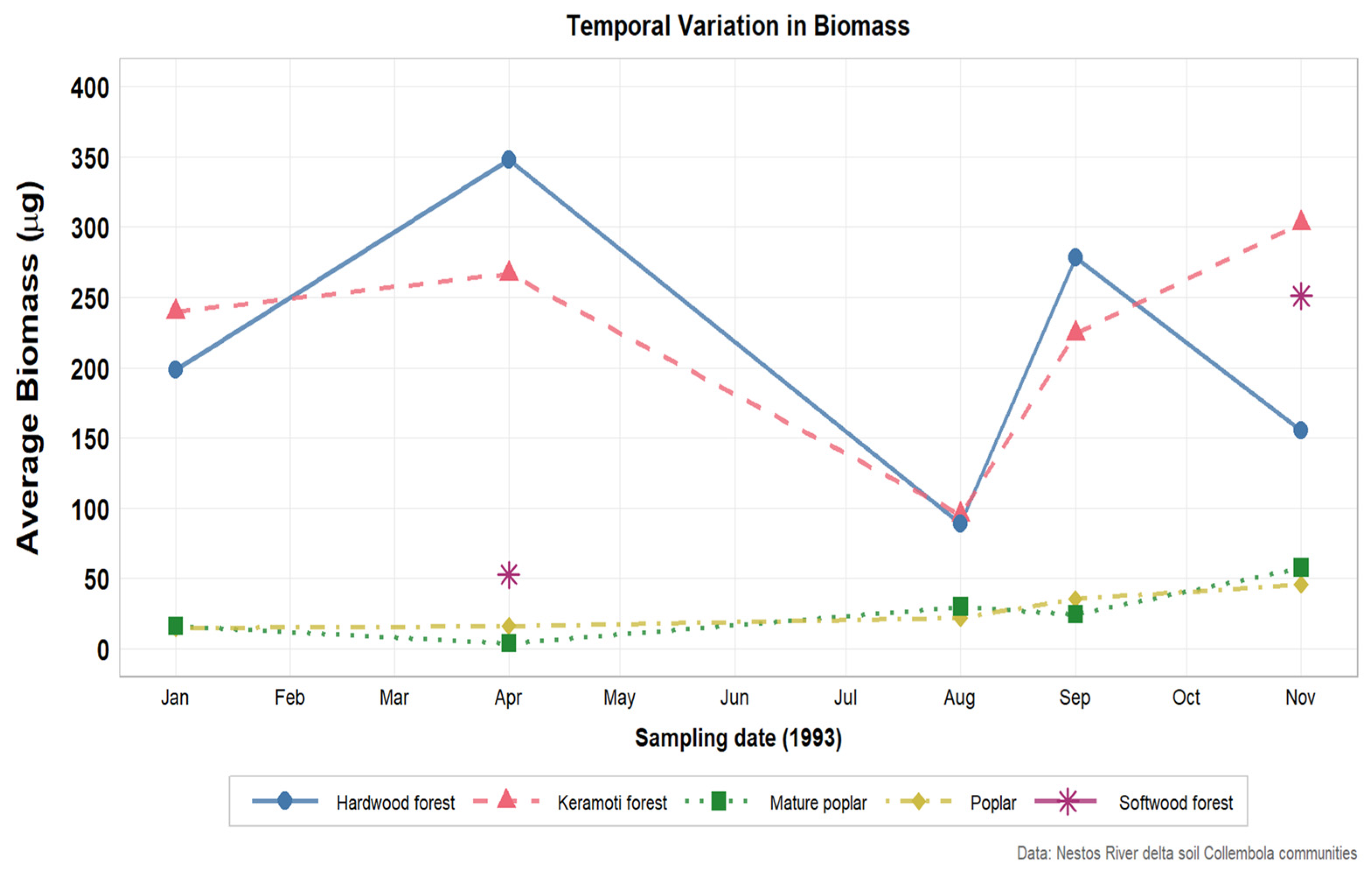
Average soil Collembola biomass per sample varied markedly among forest habitats and sampling periods during 1993 (Figure 10). The hardwood forest exhibited consistently high biomass values across the year, with a pronounced peak in April (348.15 μg), a sharp decline in August (89.16 μg), followed by an increase in September (278.30 μg) and a lower value in November (155.54 μg). Similarly, the Keramoti forest showed high biomass levels throughout the sampling period, increasing from January (239.72 μg) to April (266.82 μg), decreasing substantially in August (95.57 μg), and reaching the highest recorded value in November (302.96 μg).
In contrast, biomass values in poplar and mature poplar forests were considerably lower than those observed in hardwood and Keramoti forests. In the poplar forest, biomass increased progressively from January (15.95 μg) to November (57.45 μg), with a moderate decline observed in September (24.45 μg). The mature poplar forest displayed a steady seasonal increase, rising from 14.55 μg in January to 45.78 μg in November.
Sampling in the softwood forest was limited to April and November. Biomass values increased substantially between these periods, from 52.73 μg in April to 250.98 μg in November.
In general, soil Collembola biomass demonstrated strong habitat-specific seasonality. Hardwood and Keramoti forests showcased high annual biomass with a mid-year dip in August. Poplar habitats maintained substantially lower but steadily increasing levels of biomass. In the softwood forest, there was a dramatic late-season increase in November, distinct from the other habitat types.

3.4. Environmental Variables

Humidity

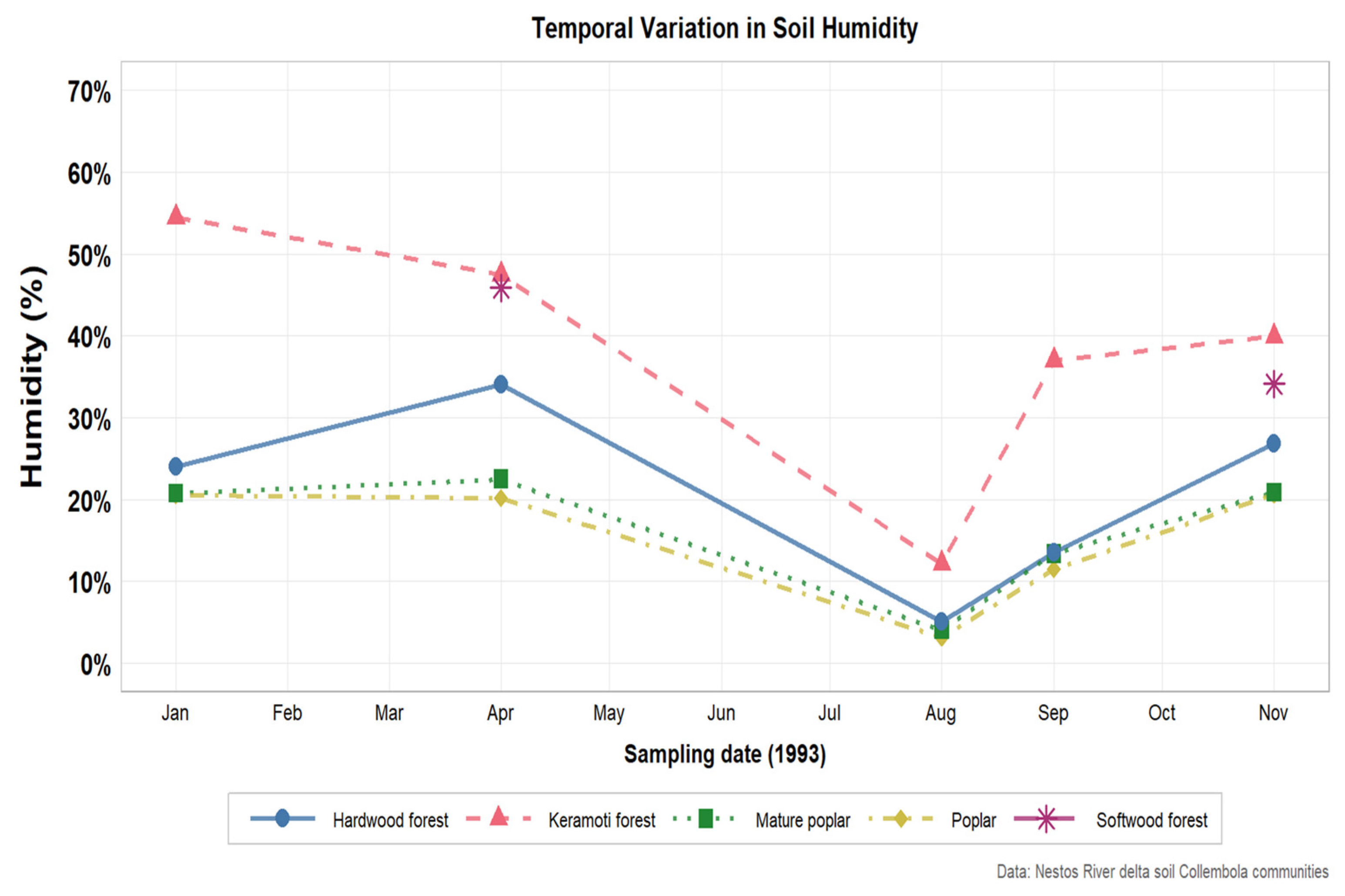
Gravimetric soil moisture recorded during Collembola sampling varied seasonally among forest habitats in 1993 (Figure 11). In the Keramoti forest, humidity values were consistently higher than in other habitats throughout the year, decreasing from January (54.45%) to a minimum in August (12.17%), followed by an increase in September (36.99%) and November (39.90%). A similar seasonal pattern, although at lower absolute values, was observed in the hardwood forest, where humidity increased from January (24.03%) to April (34.01%), declined markedly in August (5.04%), and subsequently rose in September (13.47%) and November (26.80%).
In the poplar and mature poplar forests, humidity values were relatively similar and showed parallel temporal trends. In both habitats, humidity remained around 20–22% during winter and spring, declined sharply in August (3.14% in poplar; 4.04% in mature poplar), and increased again in September and November, reaching values close to those recorded in January.
Sampling in the softwood forest was limited to April and November. Humidity values in this habitat decreased from April (45.84%) to November (34.12%).
Humidity exhibited consistent seasonal dynamics across all habitats. In all habitats, there was a mid-year minimum and recovery in autumn. Keramoti forest consistently maintained the highest humidity levels, while the hardwood and poplar forests experienced much drier conditions throughout the year.

3.5. Influence of Soil Humidity on Community Structure (db-RDA)

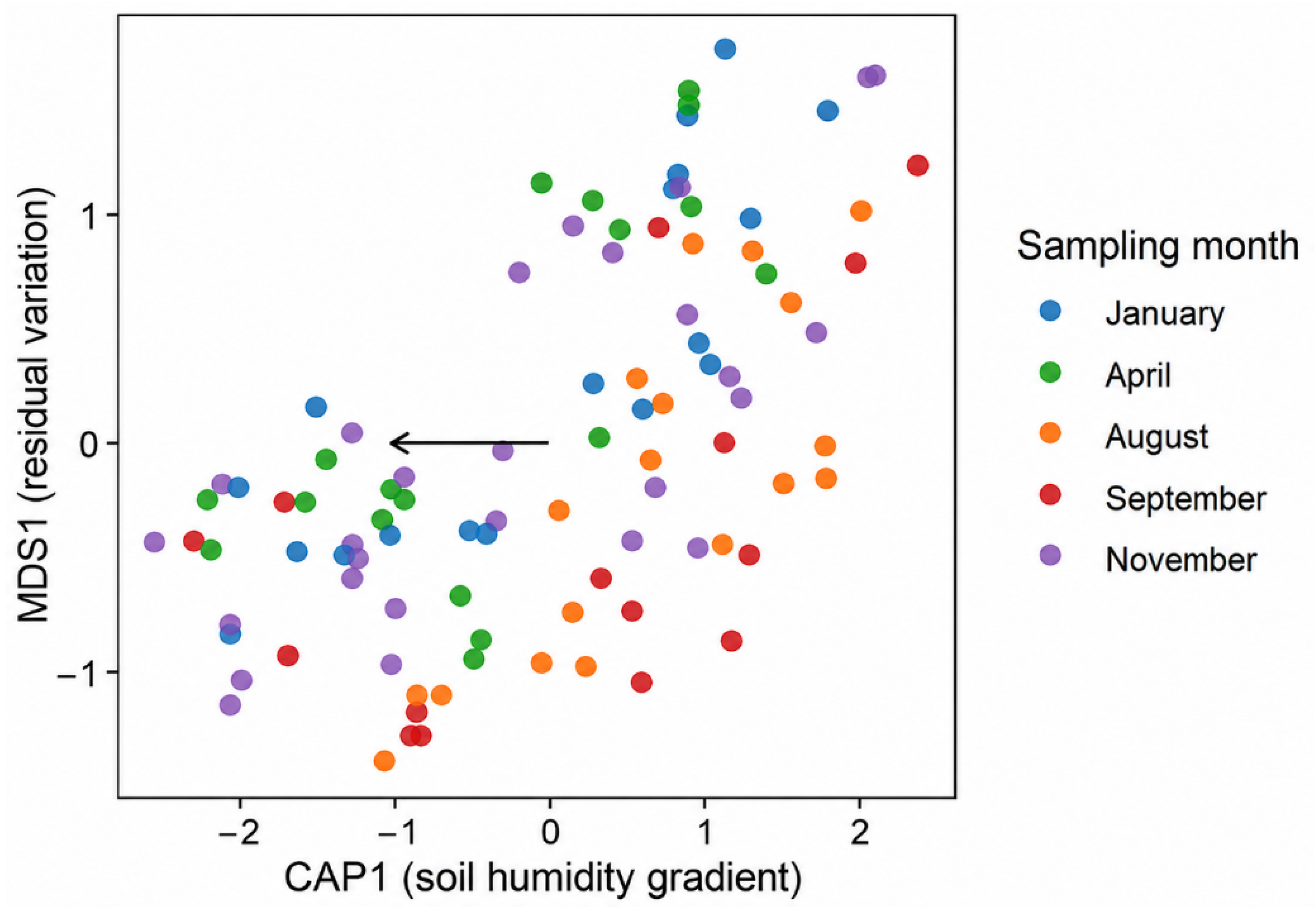
Distance-based redundancy analysis (db-RDA) revealed that humidity marginally but statistically significantly structured soil Collembola community composition in the Nestos River delta (adjusted R2 = 2.33%, F1 = 3.27, p = 0.001, 999 permutations). Although the proportion of variance explained is modest, this is consistent with expectations for soil Collembola communities, where beta-diversity is typically high, and community composition is shaped simultaneously by multiple biotic and abiotic factors, as well as stochastic processes. The significant effect of humidity nonetheless indicates that this variable exerts a detectable and non-random influence on community structure, supporting its ecological relevance as a driver of Collembola distribution in this riparian habitat.
To assess whether this effect varied across seasons, we performed separate db-RDA models for each sampling month (January, April, August, September, November). The results (Table 5, Figure 12) showed that humidity modestly explained community composition in all months except April, with the strongest effect in January (adj. R2 = 9.26%, p = 0.002) and weaker but still significant effects in August (3.53%, p = 0.047), September (5.56%, p = 0.049) and November (2.80%, p = 0.024). No effect was detected in April (0.08%, p = 0.414). These monthly patterns confirm that the influence of soil humidity on Collembola communities is not uniform throughout the year; it is strongest in winter and autumn but absent in spring.

4. Discussion

Soil Collembola communities, with their dynamic structure and sensitivity to seasonal conditions, present a compelling subject for analysis. Employing stochastic null models, species selection plays a crucial role in determining patterns of co-occurrence, directly influencing the detection of non-random assemblages such as aggregation or segregation. The inclusion or exclusion of specific species can significantly impact study outcomes, shaping interpretations of ecological interactions. The selected species pool should be ecologically plausible competitors or interactors that could potentially colonize the sites. Gotelli [31] systematically compared various null model algorithms and co-occurrence indices, highlighting the importance of species selection in identifying meaningful patterns. Similarly, Lehsten and Harmand [83] examined biases in null models, emphasizing the need for careful species inclusion to ensure reliable conclusions.
To account exclusively for the complexity of soil Collembola interactions, we employed stochastic null models without imposing additional species constraints, such as setting a minimum occurrence threshold. Instead, presence–absence matrices were constructed based on “habitat filtering” [22], allowing for a more nuanced representation of species co-occurrence dynamics. Habitat filtering, a key ecological process, drives species assemblages by selecting traits suited to specific environmental conditions, leading to non-random co-occurrence patterns. D’Amen et al. [84] highlighted this influence, showing how habitat filtering shapes species assemblages by structuring communities based on environmental constraints.
The results from applying null models to presence–absence matrices, where habitat filtering was not performed or was done inadequately, do not lead to reliable conclusions, as Table A1 demonstrates. Specifically, the role of competition or facilitation is overestimated, as patterns of species segregation or aggregation might be driven by abiotic factors rather than biotic interactions, while underestimating the influence of environmental selection in shaping species distributions [85]. The null models constructed from the ten total matrices—five presence–absence matrices encompassing all areas and habitats, along with five additional matrices created by excluding data from the Keramoti habitat and softwood forests—produced contradictory results. These inconsistencies arose even when using the same algorithm, occurring at different time periods and across various metrics. The dilution effect produced by including irrelevant or non-interacting species in the analysis obscures or weakens the detection of significant patterns among the focal species, as was highlighted by Gilpin and Diamond [86]. The positive correlation of species, as suggested by Gilpin and Diamond [86], cannot be solely justified by shared distribution strategies or geographical origins. Collembola, known for their wide geographical spread, tend to aggregate due to common preferred habitats and similar frequency of occurrence, rather than selective habitat size criteria.
A notable limitation we encountered was the small dimensions of many matrices, rendering them unable to provide significant insights, irrespective of the analytical method employed [87]. Small presence–absence matrices frequently suffer from low statistical power, making them highly vulnerable to Type II errors, where true ecological patterns of segregation or aggregation remain undetected [88]. Also, small matrices are sensitive to “noise” from rare species, which can obscure non-random patterns that would otherwise be evident in larger datasets [89]. Considering the realism of our approach in the Nestos Collembola sampling context, the fixed–equiprobable algorithm emerged as the most suitable choice, with more defining patterns of synchronization of the soil Collembola communities revealed. The main reason for this is that sampling design standardizes effort across sites, and it does not artificially constrain site richness [31]. This algorithm, assuming equiprobable sites, was consistently applied across all indices and metrics and was recommended for its resilience to Type I errors [1,31].
Analysis of results and constructed timelines showing temporal changes in co-occurrence patterns revealed distinct periods of significant aggregation or segregation among Collembola communities. Notably, January 1993 exhibited significant segregation across various habitats and indices, with Keramoti forest habitat displaying its unique patterns, marked by significant aggregation in January 1993 and significant segregation in September 1993. Seasonal dynamics also played a crucial role [90]; forests in autumn offer rich organic matter for opportunistic colonizers, while wintertime saw heightened interspecific competition due to reduced food availability and ecological separation [38].
Seasonality significantly influences soil Collembola communities, affecting their diversity, distribution, and interactions, including competition [90,91]. Seasonal environmental conditions, such as temperature, humidity, and resource availability, can intensify competition as resources become scarcer. Liu et al. [92] observed higher Collembola abundance in the earlier months (spring to early summer), followed by a gradual decline as environmental conditions became harsher, leading to the aggregation of communities. In our study, an additional peak occurred in autumn—a pattern likely driven by the Mediterranean climate [39].
Across all habitats, species richness, average biomass per sample, relative humidity, and community similarity exhibited concordant temporal trends, indicating strong coupling between abiotic conditions and Collembola community dynamics.
A dominant pattern across all measured variables was the pronounced decline during late summer (August), followed by partial or full recovery in autumn (September–November). August was consistently characterized by low humidity, reduced species richness, lower biomass, and, in several habitats, reduced Sørensen similarity, suggesting both quantitative declines and compositional changes within collembolan assemblages. Drought causes a sharp decline in the populations of Collembola in the surface layers of the soil, while deeper-dwelling populations are less affected [93], and a downward migration can occur [48,94]. This seasonal bottleneck reflects the combined effects of high temperatures and low moisture availability, typical of Mediterranean summer conditions.
The subsequent increase in richness, biomass, and humidity in autumn coincided with higher within-habitat community similarity, particularly in hardwood and Keramoti forests. This pattern suggests a degree of community reassembly or stabilization following summer stress, possibly facilitated by improved microclimatic conditions and renewed resource availability.
January was the coldest month, and sampling directly followed a rainy December (73 mm according to the Hellenic National Meteorological Service). Collembola are active during these colder periods, potentially leading to increased competition when resources are scarce. Waterlogging can also reduce the abundance of soil Collembola [95,96], altering microhabitat conditions, resource availability and affecting the overall dynamics of these communities.
The distinct temporal pattern observed in the Keramoti forest suggests the influence of episodic hydrological processes superimposed on seasonal dynamics. Elevated humidity and altered community similarity early in the sampling period may reflect the influence of episodic hydrological processes—such as sustained soil moisture recharge or localized water table fluctuations—which could have temporarily restructured microhabitats and redistributed Collembola assemblages, leading to increased compositional heterogeneity among samples. Excess humidity can decrease the abundance and species richness of collembolans and predatory mites, while favoring certain mite groups, demonstrating clear shifts in community structure [93]. Waterlogging also shifts the microbial community from fungi (aerobic) to bacteria (anaerobic), disrupting this primary food source of many soil arthropods [97,98]. The subsequent steady increase in Sørensen similarity through the year is consistent with a gradual convergence of community composition, indicating recovery and reassembly as environmental conditions stabilized. Such disturbance–recovery trajectories are characteristic of humid and riparian forest systems, where short-term hydrological events can strongly affect soil Collembola distribution while structurally complex habitats facilitate resilience and community re-establishment over time [99,100]. These variations may also be attributed to the different local conditions of the Keramoti habitat, situated several kilometers away from other sampling sites [101]. Overall, the db-RDA analyses indicate that humidity exerts a statistically significant but modest and seasonally variable influence on soil Collembola community composition. Monthly analyses revealed statistically significant effects of humidity in January (adj. R2 = 9.26%), August (3.53%), September (5.56%) and November (2.80%), whereas no significant relationship was detected in April (adj. R2 = 0.08%). These results suggest that the role of humidity is not constant throughout the year but depends on seasonal environmental conditions and associated ecological processes. The relatively modest proportion of explained variance indicates that humidity represents only one component of a broader set of factors shaping community assembly. Other environmental variables, microhabitat characteristics, resource availability, dispersal processes and species interactions are also likely to contribute substantially to the observed patterns. Nevertheless, the consistent detection of significant humidity effects during four sampling periods supports its ecological relevance as an important environmental filter influencing the distribution and composition of Collembola communities in the Nestos riparian habitats. Taken together, microsite heterogeneity, niche partitioning, interference interactions, and seasonal resource fluctuations may explain why null model analyses of species-rich Collembola communities can detect non-random co-occurrence patterns [102].
Collectively, the results suggest that soil Collembola communities in the Nestos delta are structured by shifting balances between environmental filtering, stochasticity, and biotic interactions. Seasonal drought appears to reduce the influence of environmental filtering and other deterministic assembly processes, leading to more random community organization during summer, whereas wetter periods promote either aggregation through shared habitat tracking or segregation potentially associated with niche differentiation and competition. The differing responses among habitats further indicate that local hydrological conditions modulate these assembly mechanisms. Thus, community structure in Mediterranean riparian soils is not governed by a single assembly rule but by temporally dynamic interactions between abiotic stress and biotic organization.
In conclusion, the study unveils the intricate dynamics of soil Collembola communities, emphasizing the impact of seasonality and the importance of nuanced analytical approaches. The timelines constructed offer a visual representation of these dynamic patterns, contributing valuable insights to the ongoing discourse on Collembola community structures in the Nestos River delta.

Author Contributions

Conceptualization, K.P. and G.D.K.; Data curation, V.D.; Formal analysis, K.P.; Methodology, K.P., V.D. and G.D.K.; Supervision, G.D.K.; Writing—original draft, K.P.; Writing—review and editing, K.P., V.D. and G.D.K. All authors have read and agreed to the published version of the manuscript.

Funding

This research received no external funding.

Data Availability Statement

The data presented in this study are available on request from the corresponding author.

Acknowledgments

The authors sincerely thank the three anonymous reviewers for their thorough and constructive comments, which greatly improved the quality and clarity of this manuscript. The sampling and identification was carried out while VD was at the University of Essen and received financial support from the German Academic Exchange Agency (DAAD).

Conflicts of Interest

The authors declare no conflict of interest.

Appendix A. Species List

Neanuridae
Deutonura phlegraea (Caroli, 1912)
Friesea afurcata (Denis, 1926)
Friesea mirabilis (Tullberg, 1871)
Lathriopyga (s. str.) sp. *
Micranurida pygmaea C.Börner, 1901
Neanura muscorum (R.Templeton, 1836)
Pseudachorutes subcrassus Tullberg, 1871
Hypogastruridae
Ceratophysella engadinensis (Gisin, 1949)
Schoettella ununguiculata (Tullberg, 1869)
Triacanthella travei Cassagnau and Deharveng, 1974
Willemia scandinavica Stach, 1949
Xenylla maritima Tullberg, 1869
Odontellidae
Stachia populosa (Selga, 1963)
Tullbergiidae
Doutnacia cf. xerophila Rusek, 1974
Mesaphorura critica W.N.Ellis, 1976
Mesaphorura krausbaueri C.Börner, 1901
Onychiuridae
Protaphorura fimata (Gisin, 1952)
Protaphorura sp. (armata species group) *
Protaphorura sp. *
Thalassaphorura franzi (J.Stach, 1946)
Isotomidae
Folsomia candida V.Willem, 1902
Folsomia manolachei Bagnall, 1939
Hemisotoma thermophila (Axelson, 1900)
Isotomiella minor (Schäffer, 1896)
Isotomodes sexsetosus da Gama, 1963
Isotomurus palustris (O.F.Müller, 1776)
Parisotoma notabilis (Schäffer, 1896)
Proisotoma minima (K.Absolon, 1901)
Proisotoma minuta (Tullberg, 1871)
Proisotomodes bipunctatus (W.M.Axelson, 1903)
Paronellidae
Megacyphoderus gallicus Delamare Deboutteville, 1948
Entomobryidae
Entomobrya atrocincta Schött, 1896
Entomobrya handschini Stach, 1922
Entomobrya multifasciata (Tullberg, 1871)
Entomobrya nevadensis Steiner, 1959
Lepidocyrtus cyaneus Tullberg, 1871
Lepidocyrtus (Lanocyrtus) lanuginosus (Linnaeus, 1788)
Lepidocyrtus (Lepidocyrtus) paradoxus Uzel, 1890
Pseudosinella sexoculata Schött, 1902
Orchesellidae
Heteromurus major (Moniez, 1889)
Heteromurus (Heteromurus) nitidus (R.Templeton, 1836)
Orchesella balcanica J.Stach, 1960
Oncopoduridae
Oncopodura crassicornis Shoebotham, 1911
Tomoceridae
Tomocerus (Tomocerus) lamelliger (Börner, 1903)
Sminthuridae
Allacma fusca (C.Linnaeus, 1758)
Caprainea marginata (H.Schött, 1893)
Sminthurus viridis (Linnaeus, 1758)
Sphaeridia pumilis (Krausbauer, 1898)
Arrhopalitidae
Arrhopalites cf. caecus (Tullberg, 1871)
Dicyrtomidae
Dicyrtomina saundersi (J.Lubbock, 1862)
Neelidae
Megalothorax cf. minimus V.Willem, 1900
Katiannidae
Sminthurinus aureus (J.Lubbock, 1862)
Sminthurinus elegans (A.Fitch, 1863)
Sminthurinus niger (Lubbock, 1862)
Species marked with * were distinct forms with no published description. Orchesella balcanica and Isotomurus palustris do not appear in the 1993 data, but they are present in the 1991 and 1992 data. More information on the systematics of the listed species is in [66]

Appendix B

Table A1. Results of null model analyses for all presence–absence matrices. Each row represents a matrix. The first three columns indicate the habitat and sampling date, the number of Collembola species, and the number of sites. The remaining columns present results for each co-occurrence index and null model algorithm (see text for details). Entries show significant deviations from the null hypothesis. For Checker and C-score: “S” (segregation) indicates less co-occurrence than expected by chance (Pobserved ≥ Pexpected for ≥95% of simulated communities); “A” (aggregation) indicates more co-occurrence than expected (Pobserved ≤ Pexpected for ≥95% of simulated communities). For V-ratio: “S” (segregation) indicates negative covariance among species (Pobserved ≤ Pexpected for ≥95% of simulated communities); “A” (aggregation) indicates positive covariance (Pobserved ≥ Pexpected for ≥95% of simulated communities). ns = not significant (p > 0.05). One, two, or three letters indicate significance at p ≤ 0.05, p ≤ 0.01, and p ≤ 0.001, respectively. Habitat abbreviations: All areas = all sampled areas; All areas_no_k-a = all areas excluding Keramoti and softwood forest sites; Pa = mature poplar stands; Jp-pa = mixed young and mature poplar stands; Ker = Keramoti forest. * Number of sampling sites ≤ 5; statistical power is low for these matrices, so results should be treated as exploratory.
Habitat/Month-YearNumber of SpeciesNumber of SitesChecker
Fix-Equip
Checker
Fix-Fix
C-Score Fix-EquipC-Score Fix-FixV-Ratio Fix-EquipV-Ratio Fix-PropV-Ratio Prop-Prop
All areas/January 19933021nsSASAAnsns
All areas/April 19933321nsSSSAAAnsAAAnsns
All areas/August 19932920nsnsnsnsnsnsns
All areas/September 19933317nsSSnsnsAnsns
All areas/November 19934231SSSSSSnsnsnsSS
All areas_no_k-a/January 19932013nsSSSSnsAAnsns
All areas_no_k-a/April 19932818nsSSSAAAnsAAAnsns
All areas_no_k-a/August 19932114nsnsnsnsnsnsns
All areas_no_k-a/September 19932411nsSAnsAAnsns
All areas_no_k-a/November 19933623SSSSSnsnsnsnsns
Pa/January 1993 *85SnsnsnsSSSS
Pa/April 1993 *94nsnsnsnsnsnsns
Pa/August 1993 *125nsnsnsnsnsnsns
Pa/September 1993 *115nsnsnsnsnsnsns
Pa/November 1993186nsnsnsnsnsnsns
Jp-pa/January 1993106SSSnsnsSSS
Jp-pa/April 1993116nsnsnsnsnsnsns
Jp-pa/August 1993127nsnsnsnsnsnsns
Jp-pa/September 1993147SnsnsnsnsSS
Jp-pa/November 1993249nsSnsnsnsnsns
Ker/January 1993197AnsAAAnsAAAnsns
Ker/April 1993 *173nsSnsnsnsnsns
Ker/August 1993206nsnsnsnsnsnsns
Ker/September 1993196nsnsnsnsnsnsns
Ker/November 1993248SnsSSnsSSSSSS
Softwood Forest/April 1993 *145nsnsnsnsnsnsns
Softwood Forest/November 1993186nsnsnsnsnsnsns
Hardwood Forest/January 1993187SSSSSSSnsnsns
Hardwood Forest/April 1993217SSSnsSAnsns
Hardwood Forest/August 1993207nsnsnsnsnsnsns
Hardwood Forest/September 1993 *184nsSSSnsnsns
Hardwood Forest/November 1993228nsnsnsnsnsnsns

References

  1. Sanderson, J.G.; Pimm, S.L. Patterns in Nature: The Analysis of Species Co-occurrences; University of Chicago Press: Chicago, IL, USA, 2015. [Google Scholar] [CrossRef]
  2. Clements, F.E. Plant Succession: An Analysis of the Development of Vegetation; Carnegie Institution of Washington: Washington, DC, USA, 1916. [Google Scholar] [CrossRef]
  3. Phillips, J. The biotic community. J. Ecol. 1931, 19, 1–24. [Google Scholar] [CrossRef]
  4. Gleason, H.A. The individualistic concept of the plant association. Bull. Torrey Bot. Club 1926, 53, 7–26. [Google Scholar] [CrossRef]
  5. Nicolson, M.; McIntosh, R.P.; Nicholson, M.H.A. Gleason and the individualistic hypothesis revisited. Bull. Ecol. Soc. Am. 2002, 83, 133–142. [Google Scholar]
  6. Maillefer, A. Le Coefficient Générique de P. Jaccard et sa Signification; Imprimerie Commerciale: Lausanne, Switzerland, 1929. [Google Scholar] [CrossRef]
  7. Elton, C. Competition and the structure of ecological communities. J. Anim. Ecol. 1946, 15, 54–68. [Google Scholar] [CrossRef]
  8. Simberloff, D.S. Taxonomic diversity of island biotas. Evolution 1970, 24, 23–47. [Google Scholar] [CrossRef] [PubMed]
  9. Greig-Smith, P. Quantitative Plant Ecology; Butterworths: London, UK, 1964. [Google Scholar]
  10. Kershaw, K.A. Quantitative and Dynamic Ecology; Cornell University Press: Ithaca, NY, USA, 1964. [Google Scholar]
  11. MacArthur, R.H.; Wilson, E.O. The Theory of Island Biogeography; Princeton University Press: Princeton, NJ, USA, 2001. [Google Scholar] [CrossRef]
  12. MacArthur, R.H. Geographical Ecology: Patterns in the Distribution of Species; Princeton University Press: Princeton, NJ, USA, 1984. [Google Scholar]
  13. Diamond, J.M. Assembly of species communities. In Ecology and Evolution of Communities; Cody, M.L., Diamond, J.M., Eds.; Harvard University Press: Cambridge, MA, USA, 1975; pp. 342–444. [Google Scholar]
  14. Connor, E.F.; Simberloff, D. The assembly of species communities: Chance or competition? Ecology 1979, 60, 1132–1140. [Google Scholar] [CrossRef]
  15. McCoy, E.D.; Heck, K.L. Some observations on the use of taxonomic similarity in large-scale biogeography. J. Biogeogr. 1987, 14, 79–87. [Google Scholar] [CrossRef]
  16. Diamond, J.M.; Gilpin, M.E. Examination of the “null” model of Connor and Simberloff for species co-occurrences on islands. Oecologia 1982, 52, 64–74. [Google Scholar] [CrossRef] [PubMed]
  17. Gotelli, N.J.; McCabe, D.J. Species co-occurrence: A meta-analysis of J.M. Diamond’s assembly rules model. Ecology 2002, 83, 2091–2096. [Google Scholar] [CrossRef]
  18. Morales-Castilla, I.; Matias, M.G.; Gravel, D.; Araújo, M.B. Inferring biotic interactions from proxies. Trends Ecol. Evol. 2015, 30, 347–356. [Google Scholar] [CrossRef]
  19. Tulloch, A.I.T.; Chadès, I.; Lindenmayer, D.B. Species co-occurrence analysis predicts management outcomes for multiple threats. Nat. Ecol. Evol. 2018, 2, 465–474. [Google Scholar] [CrossRef]
  20. Kędzior, R.; Kosewska, A.; Skalski, T. Co-occurrence pattern of ground beetle (Coleoptera, Carabidae) assemblages along pollution gradient in Scotch pine forest. Community Ecol. 2018, 19, 148–155. [Google Scholar] [CrossRef]
  21. Gotelli, N.J.; Graves, G.R. Null Models in Ecology; Smithsonian Institution Press: Washington, DC, USA, 1996. [Google Scholar]
  22. Gotelli, N.J.; Buckley, N.J.; Wiens, J.A. Co-occurrence of Australian land birds: Diamond’s assembly rules revisited. Oikos 1997, 80, 311–324. [Google Scholar] [CrossRef][Green Version]
  23. Jackson, D.A.; Peres-Neto, P.R.; Olden, J.D. What controls who is where in freshwater fish communities: The roles of biotic, abiotic, and spatial factors. Can. J. Fish. Aquat. Sci. 2001, 58, 157–170. [Google Scholar] [CrossRef]
  24. Peres-Neto, P.R. Patterns in the co-occurrence of fish species in streams: The role of site suitability, morphology and phylogeny versus species interactions. Oecologia 2004, 140, 352–360. [Google Scholar] [CrossRef] [PubMed]
  25. Peres-Neto, P.R.; Olden, J.D.; Jackson, D.A. Environmentally constrained null models: Site suitability as occupancy criterion. Oikos 2001, 93, 110–120. [Google Scholar] [CrossRef]
  26. Azeria, E.T.; Fortin, D.; Hébert, C.; Peres-Neto, P.; Pothier, D.; Ruel, J.-C. Using null model analysis of species co-occurrences to deconstruct biodiversity patterns and select indicator species. Divers. Distrib. 2009, 15, 958–971. [Google Scholar] [CrossRef]
  27. Jackson, D.A.; Somers, K.M.; Harvey, H.H. Null models and fish communities: Evidence of nonrandom patterns. Am. Nat. 1992, 139, 930–951. [Google Scholar] [CrossRef] [PubMed]
  28. Holt, R.D.; Polis, G.A. A theoretical framework for intraguild predation. Am. Nat. 1997, 149, 745–764. [Google Scholar] [CrossRef]
  29. Englund, G.; De Stasio, B.T.; Gårdmark, A.; Johansson, F.; Olsson, J.; Sarnelle, O. Predation leads to assembly rules in fragmented fish communities. Ecol. Lett. 2009, 12, 663–671. [Google Scholar] [CrossRef]
  30. Hein, C.L.; Öhlund, G.; Englund, G. Fish introductions reveal the temperature dependence of species interactions. Proc. R. Soc. B 2014, 281, 20132641. [Google Scholar] [CrossRef]
  31. Gotelli, N.J. Null model analysis of species co-occurrence patterns. Ecology 2000, 81, 2606–2621. [Google Scholar] [CrossRef]
  32. Sanders, N.J.; Gotelli, N.J.; Heller, N.E.; Gordon, D.M. Community disassembly by an invasive species. Proc. Natl. Acad. Sci. USA 2003, 100, 2474–2477. [Google Scholar] [CrossRef]
  33. Badano, E.I.; Regidor, H.A.; Núñez, H.A.; Acosta, R.; Gianoli, E. Species richness and structure of ant communities in a dynamic archipelago: Effects of island area and age. J. Biogeogr. 2005, 32, 221–227. [Google Scholar] [CrossRef]
  34. Sanders, N.J.; Gotelli, N.J.; Heller, N.E.; Gordon, D.M. Assembly rules of ground-foraging ant assemblages are contingent on disturbance, habitat and spatial scale. J. Biogeogr. 2007, 34, 1632–1641. [Google Scholar] [CrossRef]
  35. Wilson, J.B. Assembly rules in plant communities. In Ecological Assembly Rules: Perspectives, Advances, Retreats; Weiher, E., Keddy, P.A., Eds.; Cambridge University Press: Cambridge, UK, 1999; pp. 130–164. [Google Scholar]
  36. Wilson, J.B. Guilds, functional types and ecological groups. Oikos 1999, 86, 507–522. [Google Scholar] [CrossRef]
  37. Lavelle, P.; Chauvel, A.; Fragoso, C. Faunal activity in acid soils. In Plant-Soil Interactions at Low pH: Principles and Management; Date, R.A., Grundon, N.J., Rayment, G.E., Probert, M.E., Eds.; Springer: Dordrecht, The Netherlands, 1995; pp. 201–211. [Google Scholar] [CrossRef]
  38. Wardle, D.A.; Bardgett, R.D.; Klironomos, J.N.; Setälä, H.; van der Putten, W.H.; Wall, D.H. Ecological linkages between aboveground and belowground biota. Science 2004, 304, 1629–1633. [Google Scholar] [CrossRef]
  39. Stamou, G.P.; Stamou, G.V.; Papatheodorou, E.M.; Argyropoulou, M.D.; Tzafestas, S.G. Population dynamics and life history tactics of arthropods from Mediterranean-type ecosystems. Oikos 2004, 104, 98–108. [Google Scholar] [CrossRef]
  40. Richardson, S.J.; Press, M.C.; Parsons, A.N.; Hartley, S.E. How do nutrients and warming impact plant communities and their insect herbivores? J. Ecol. 2002, 90, 544–556. [Google Scholar] [CrossRef]
  41. Vinson, M.R.; Hawkins, C.P. Broad-scale geographical patterns in local stream insect genera richness. Ecography 2003, 26, 751–767. [Google Scholar] [CrossRef]
  42. Sweet, S.K.; Asmus, A.L.; Rich, M.E.; Wingfield, J.C.; Gough, L.; Boelman, N.T. NDVI as a predictor of canopy arthropod biomass in the Alaskan arctic tundra. Ecol. Appl. 2015, 25, 779–790. [Google Scholar] [CrossRef] [PubMed]
  43. Beck, J.J.; Alborn, H.T.; Block, A.K.; Christensen, S.A.; Hunter, C.T.; Rering, C.C.; Seidl-Adams, I.; Stuhl, C.J.; Torto, B.; Tumlinson, J.H. Interactions Among Plants, Insects, and Microbes: Elucidation of Inter-Organismal Chemical Communications in Agricultural Ecology. J. Agric. Food Chem. 2018, 66, 6663–6674. [Google Scholar] [CrossRef] [PubMed]
  44. Naiman, R.J.; Décamps, H. The Ecology of Interfaces: Riparian Zones. Annu. Rev. Ecol. Syst. 1997, 28, 621–658. [Google Scholar] [CrossRef]
  45. Widenfalk, L.A.; Malmström, A.; Berg, M.P.; Bengtsson, J. Small-scale Collembola community composition in a pine forest soil—Overdispersion in functional traits indicates the importance of species interactions. Soil Biol. Biochem. 2016, 103, 52–62. [Google Scholar] [CrossRef]
  46. Van Cott, M.T. Competition Among Five Species of Collembola in Laboratory Cultures. Master’s Thesis, California State University, Northridge, CA, USA, 1982. [Google Scholar]
  47. Chahartaghi, M.; Langel, R.; Scheu, S.; Ruess, L. Feeding guilds in Collembola based on nitrogen stable isotope ratios. Soil Biol. Biochem. 2005, 37, 1718–1725. [Google Scholar] [CrossRef]
  48. Detsis, V. Vertical distribution of Collembola. Belg. J. Zool. 2000, 130, 55–59. [Google Scholar]
  49. Leinaas, H.P.; Bengtsson, J.; Janion-Scheepers, C.; Chown, S.L. Indirect effects of habitat disturbance on invasion: Nutritious litter from a grazing resistant plant favors alien over native Collembola. Ecol. Evol. 2015, 5, 3462–3471. [Google Scholar] [CrossRef]
  50. Haddad, N.M.; Tilman, D.; Haarstad, J.; Ritchie, M.; Knops, J.M.H. Contrasting effects of plant richness and composition on insect communities: A Field Experiment. Am. Nat. 2001, 158, 17–35. [Google Scholar] [CrossRef]
  51. McGill, B.J.; Enquist, B.J.; Weiher, E.; Westoby, M. Rebuilding community ecology from functional traits. Trends Ecol. Evol. 2006, 21, 178–185. [Google Scholar] [CrossRef]
  52. McCluney, K.E.; George, T.; Frank, S.D. Water availability influences arthropod water demand, hydration and community composition on urban trees. J. Urban Ecol. 2018, 4, juy003. [Google Scholar] [CrossRef]
  53. Pérez-Fuertes, O.; García-Tejero, S.; Pérez Hidalgo, N.; Mateo-Tomás, P.; Olea, P.P. Irrigation effects on arthropod communities in Mediterranean cereal agro-ecosystems. Ann. Appl. Biol. 2015, 167, 236–249. [Google Scholar] [CrossRef]
  54. Uhl, B.; Wölfling, M.; Bässler, C. Mediterranean moth diversity is sensitive to increasing temperatures and drought under climate change. Sci. Rep. 2022, 12, 14473. [Google Scholar] [CrossRef]
  55. Cloudsley-Thompson, J.L. Adaptations of Arthropoda to arid environments. Annu. Rev. Entomol. 1975, 20, 261–283. [Google Scholar] [CrossRef] [PubMed]
  56. Eisenbeis, G.; Wichard, W. Atlas on the Biology of Soil Arthropods; Springer: Berlin/Heidelberg, Germany, 2012. [Google Scholar]
  57. Magurran, A.E.; Baillie, S.R.; Buckland, S.T.; Dick, J.M.; Elston, D.A.; Scott, E.M.; Smith, R.I.; Somerfield, P.J.; Watt, A.D. Long-term datasets in biodiversity research and monitoring: Assessing change in ecological communities through time. Trends Ecol. Evol. 2010, 25, 574–582. [Google Scholar] [CrossRef] [PubMed]
  58. Hughes, B.B.; Beas-Luna, R.; Barner, A.K.; Brewitt, K.; Brumbaugh, D.R.; Cerny-Chipman, E.B.; Close, S.L.; Coblentz, K.E.; De Nesnera, K.L.; Drobnitch, S.T.; et al. Long-term studies contribute disproportionately to ecology and policy. Bioscience 2017, 67, 271–281. [Google Scholar] [CrossRef]
  59. Ulrich, W.; Gotelli, N.J. Null model analysis of species associations using abundance data. Ecology 2010, 91, 3384–3397. [Google Scholar] [CrossRef]
  60. Legendre, P.; Anderson, M.J. Distance-based redundancy analysis: Testing multispecies responses in multifactorial ecological experiments. Ecol. Monogr. 1999, 69, 1–24. [Google Scholar] [CrossRef]
  61. Barroso-Bergada, D.; Tamaddoni-Nezhad, A.; Varghese, D.; Vacher, C.; Galic, N.; Lavale, V.; Suffert, F.; Bohan, D.A. Unravelling the web of dark interactions: Explainable inference of the diversity of microbial interactions. Adv. Ecol. Res. 2023, 68, 155–183. [Google Scholar] [CrossRef]
  62. Tamaddoni-Nezhad, A.; Bohan, D.A.; Milani, G.A.; Raybould, A.; Muggleton, S. Human-machine scientific discovery. In Human-Like Machine Intelligence; Muggleton, S., Chater, N., Eds.; Oxford University Press: Oxford, UK, 2021; pp. 279–315. [Google Scholar] [CrossRef]
  63. Grosholz, E.; Posteraro, T.; Grigas, A. Scientific Discovery and Inference: Between the Lab and Field in Biology. Topoi 2020, 39, 997–1009. [Google Scholar] [CrossRef]
  64. Efthimiou, G. Structure Analysis, Dynamic and Ecological Meaning of the Riparian Forest of Nestos River. Ph.D. Dissertation, Aristotle University of Thessaloniki, Thessaloniki, Greece, 2000. [Google Scholar]
  65. Nahal, I. The Mediterranean climate from a biological viewpoint. In Ecosystems of the World; Elsevier: Amsterdam, The Netherlands, 1981; Volume 11, pp. 63–86. [Google Scholar]
  66. Proutsos, N.D.; Solomou, A.D.; Koulelis, P.P.; Bourletsikas, A.; Chatzipavlis, N.E.; Tigkas, D. Detecting changes in precipitation trends in Nestos River Basin. In Proceedings of the 10th International Conference on Information and Communication Technologies in Agriculture, Food and Environment (HAICTA 2022), Athens, Greece, 22–25 September 2022; pp. 456–463. [Google Scholar]
  67. Detsis, V. Relationships of some environmental variables to the aggregation patterns of soil microarthropod populations in forests. Eur. J. Soil Biol. 2009, 45, 409–416. [Google Scholar] [CrossRef]
  68. Li, Y.; Chen, H.Y.H.; Song, Q.; Liao, J.; Xu, Z.; Huang, S.; Ruan, H. Changes in Soil Arthropod Abundance and Community Structure across a Poplar Plantation Chronosequence in Reclaimed Coastal Saline Soil. Forests 2018, 9, 644. [Google Scholar] [CrossRef]
  69. Detsis, V. Ökologie und Struktur der Collembolengemeinschaft der Laubwälder des Nestos-Deltas; University of Essen: Essen, Germany, 1995. [Google Scholar]
  70. Stone, L.; Roberts, A. The checkerboard score and species distributions. Oecologia 1990, 85, 74–79. [Google Scholar] [CrossRef]
  71. Schluter, D. A Variance Test for Detecting Species Associations, with Some Example Applications. Ecology 1984, 65, 998–1005. [Google Scholar] [CrossRef]
  72. Gotelli, N.J.; Entsminger, G.L. EcoSim: Null Models Software for Ecology; Version 7; Acquired Intelligence Inc.: Jericho, VT, USA, 2007. [Google Scholar] [CrossRef]
  73. Manly, B.F.J. A note on the analysis of species co-occurrences. Ecology 1995, 76, 1109–1115. [Google Scholar] [CrossRef]
  74. Sanderson, J.G.; Moulton, M.P.; Selfridge, R.G. Null matrices and the analysis of species co-occurrences. Oecologia 1998, 116, 275–283. [Google Scholar] [CrossRef] [PubMed]
  75. Gotelli, N.J.; Entsminger, G.L. Swap algorithms in null model analysis. Ecology 2003, 84, 532–535. [Google Scholar] [CrossRef]
  76. Benjamini, Y.; Hochberg, Y. Controlling the false discovery rate: A practical and powerful approach to multiple testing. J. R. Stat. Soc. Ser. B Stat. Methodol. 1995, 57, 289–300. [Google Scholar] [CrossRef]
  77. Anderson, M.J. A new method for non-parametric multivariate analysis of variance. Austral Ecol. 2001, 26, 32–46. [Google Scholar] [CrossRef]
  78. Oksanen, J.; Blanchet, F.G.; Friendly, M.; Kindt, R.; Legendre, P.; McGlinn, D.; Minchin, P.R.; O’Hara, R.B.; Simpson, G.L.; Solymos, P.; et al. Vegan: Community Ecology Package. R Package Version 2.6-4. 2022. Available online: https://CRAN.R-project.org/package=vegan (accessed on 27 April 2026).
  79. Sørensen, T. A method of establishing groups of equal amplitude in plant sociology. K. Dan. Vidensk. Selsk. Biol. Skr. 1948, 5, 1–34. [Google Scholar]
  80. Wolda, H. Similarity indices, sample size and diversity. Oecologia 1981, 50, 296–302. [Google Scholar] [CrossRef]
  81. Götzenberger, L.; De Bello, F.; Bråthen, K.A.; Davison, J.; Dubuis, A.; Guisan, A.; Lepš, J.; Lindborg, R.; Moora, M.; Pärtel, M.; et al. Ecological assembly rules in plant communities—Approaches, patterns and prospects. Biol. Rev. 2012, 87, 111–127. [Google Scholar] [CrossRef]
  82. MacArthur, R.H. Patterns of species diversity. Biol. Rev. 1965, 40, 510–533. [Google Scholar] [CrossRef]
  83. Lehsten, V.; Harmand, P. Null models for species co-occurrence patterns: Assessing bias and minimum iteration number for the sequential swap. Ecography 2006, 29, 786–792. [Google Scholar] [CrossRef]
  84. D’Amen, M.; Mod, H.K.; Gotelli, N.J.; Guisan, A. Disentangling biotic interactions, environmental filters, and dispersal limitation as drivers of species co-occurrence. Ecography 2018, 41, 1233–1244. [Google Scholar] [CrossRef]
  85. Ulrich, W.; Piwczyński, M.; Maestre, F.T.; Gotelli, N.J. Null model tests for niche conservatism, phylogenetic assortment and habitat filtering. Methods Ecol. Evol. 2012, 3, 930–939. [Google Scholar] [CrossRef]
  86. Gilpin, M.E.; Diamond, J.M. Factors contributing to non-randomness in species co-occurrences on Islands. Oecologia 1982, 52, 75–84. [Google Scholar] [CrossRef]
  87. Biehl, C.C.; Matthews, W.J. Small fish community structure in Ozark streams: Improvements in the Statistical Analysis of Presenceabsence Data. Am. Midl. Nat. 1984, 111, 371–382. [Google Scholar] [CrossRef]
  88. Lavender, T.M.; Schamp, B.S.; Lamb, E.G. The influence of matrix size on statistical properties of co-occurrence and limiting similarity null models. PLoS ONE 2016, 11, e0151146. [Google Scholar] [CrossRef]
  89. Gotelli, N.J.; Ulrich, W. Statistical challenges in null model analysis. Oikos 2012, 121, 171–180. [Google Scholar] [CrossRef]
  90. Susanti, W.I.; Krashevska, V.; Widyastuti, R.; Stiegler, C.; Gunawan, D.; Scheu, S.; Potapov, A.M. Seasonal fluctuations of litter and soil Collembola and their drivers in rainforest and plantation systems. PeerJ 2024, 12, e17125. [Google Scholar] [CrossRef]
  91. Wiwatwitaya, D.; Takeda, H. Seasonal changes in soil arthropod abundance in the dry evergreen forest of north-east Thailand, with special reference to collembolan communities. Ecol. Res. 2005, 20, 59–70. [Google Scholar] [CrossRef]
  92. Liu, R.; Zhu, F.; Song, N.; Yang, X.; Chai, Y. Seasonal Distribution and Diversity of Ground Arthropods in Microhabitats Following a Shrub Plantation Age Sequence in Desertified Steppe. PLoS ONE 2013, 8, e77962. [Google Scholar] [CrossRef]
  93. Lindberg, N.; Bengtsson, J. Population responses of oribatid mites and collembolans after drought. Appl. Soil Ecol. 2005, 28, 163–174. [Google Scholar] [CrossRef]
  94. Hijii, N. Seasonal changes in abundance and spatial distribution of the soil arthropods in a Japanese cedar (Cryptomeria japonica D. Don) plantation, with special reference to collembola and acarina. Ecol. Res. 1987, 2, 159–173. [Google Scholar] [CrossRef]
  95. Zaller, J.G.; Simmer, L.; Santer, N.; Tataw, J.T.; Formayer, H.; Murer, E.; Hösch, J.; Baumgarten, A. Future rainfall variations reduce abundances of aboveground arthropods in model agroecosystems with different soil types. Front. Environ. Sci. 2014, 2, 44. [Google Scholar] [CrossRef]
  96. Marx, M.T.; Wild, A.-K.; Knollmann, U.; Kamp, G.; Wegener, G.; Eisenbeis, G. Responses and adaptations of collembolan communities (Hexapoda: Collembola) to flooding and hypoxic conditions. Pesqui. Agropecu. Bras. 2009, 44, 1002–1010. [Google Scholar] [CrossRef]
  97. Neher, D.A.; Barbercheck, M.E. Soil microarthropods and soil health: Intersection of Decomposition and Pest Suppression in Agroecosystems. Insects 2019, 10, 414. [Google Scholar] [CrossRef]
  98. Maraun, M.; Martens, H.; Migge, S.; Theenhaus, A.; Scheu, S. Adding to ‘the enigma of soil animal diversity’: Fungal feeders and saprophagous soil invertebrates prefer similar food substrates. Eur. J. Soil Biol. 2003, 39, 85–95. [Google Scholar] [CrossRef]
  99. Barrios, E. Soil biota, ecosystem services and land productivity. Ecol. Econ. 2007, 64, 269–285. [Google Scholar] [CrossRef]
  100. Langellotto, G.A.; Denno, R.F. Responses of invertebrate natural enemies to complex-structured habitats: A meta-analytical synthesis. Oecologia 2004, 139, 1–10. [Google Scholar] [CrossRef]
  101. Soininen, J.; McDonald, R.; Hillebrand, H. Distance decay of similarity in ecological communities. Ecography 2007, 30, 3–12. [Google Scholar] [CrossRef]
  102. Sha, D.; Gao, M.; Sun, X.; Wu, D.; Zhang, X. Relative contributions of spatial and environmental processes and biotic interactions in a soil collembolan community. Chin. Geogr. Sci. 2015, 25, 582–590. [Google Scholar] [CrossRef]
Figure 1. Map of the study areas.
Ecologies 07 00057 g001
Figure 2. Temporal changes in co-occurrence patterns: number of checkerboards (fixed–equiprobable) across five habitats. Higher y-axis values (closer to 100%) indicate stronger segregation (reduced co-occurrence). Lower values would indicate aggregation.
Ecologies 07 00057 g002
Figure 3. Temporal changes in co-occurrence patterns: number of checkerboards (fixed–fixed) across five habitats. Higher y-axis values (closer to 100%) indicate stronger segregation (reduced co-occurrence). Lower values would indicate aggregation.
Ecologies 07 00057 g003
Figure 4. Temporal changes in co-occurrence patterns: C-score (fixed–equiprobable) across five habitats. Higher y-axis values (closer to 100%) indicate stronger segregation (reduced co-occurrence). Lower values would indicate aggregation.
Ecologies 07 00057 g004
Figure 5. Temporal changes in co-occurrence patterns: C-score (fixed–fixed) across five habitats. Higher y-axis values (closer to 100%) indicate stronger segregation (reduced co-occurrence). Lower values would indicate aggregation.
Ecologies 07 00057 g005
Figure 6. Temporal changes in co-occurrence patterns: V-ratio (fixed–equiprobable) across five habitats. Higher y-axis values (closer to 100%) indicate stronger segregation (reduced co-occurrence). Lower values would indicate aggregation.
Ecologies 07 00057 g006
Figure 7. Temporal changes in co-occurrence patterns: V-ratio (fixed–proportional) across five habitats. Higher y-axis values (closer to 100%) indicate stronger segregation (reduced co-occurrence). Lower values would indicate aggregation.
Ecologies 07 00057 g007
Figure 8. Temporal changes in co-occurrence patterns: V-ratio (proportional–proportional) across five habitats. Higher y-axis values (closer to 100%) indicate stronger segregation (reduced co-occurrence). Lower values would indicate aggregation.
Ecologies 07 00057 g008
Figure 9. Seasonal changes in soil Collembola richness across five habitats.
Ecologies 07 00057 g009
Figure 10. Seasonal changes in average biomass per sample (μg) across soil Collembola communities.
Ecologies 07 00057 g010
Figure 11. Seasonal changes in soil humidity across five habitats.
Ecologies 07 00057 g011
Figure 12. Annual db-RDA ordination of Collembola communities in the Nestos area during 1993 based on Jaccard dissimilarities. CAP1 represents the constrained axis associated with soil humidity, while MDS1 represents residual variation. Points are colored according to the sampling month. Separate monthly analyses indicated significant effects of humidity in January, August, September and November, but not in April. The arrow indicates the direction of decreasing CAP1 scores along the soil humidity gradient.
Ecologies 07 00057 g012
Table 1. Example of a presence–absence matrix constructed from data obtained from the sampling conducted in the Nestos River delta.
kajan3ka’jan3kbjan3kb’jan3kcjan3kc’jan3kdjan3
Species
Mesaphorura_critica0000001
Mesaphorura_krausbaueri1010011
Protaphorura_fimata1000000
Sphaeridia_pumilis0010000
Sminthurinus_aureus0000010
Isotoma_notabilis1011111
Proisotoma_minuta1011011
Folsomia_malolachei1110000
Lepidocyrtus_lanuginosus0000001
Lepidocyrtus_cyaneus0011110
Pseudosinella_sexoculata0011000
Willemia_scandinavica0001000
Anurida_pygmaea0001001
Xenylla_maritima1010000
Xenyllodes_populosus0011001
Triacanthella_travei0010011
Isotomodes_sexsetosus0000001
Folsomia_candida0001000
Neanura_muscorum0001001
Table 2. Summary of null model results across different metrics and algorithms (S/A/ns).
Habitat MatrixTotal MatricesChecker (Fix-Equip) (S/A/ns)Checker (Fix-Fix) (S/A/ns)C-Score (Fix-Equip) (S/A/ns)C-Score (Fix-Fix) (S/A/ns)V-Ratio (Fix-Equip) (S/A/ns)V-Ratio (Fix-Prop) (S/A/ns)V-Ratio (Prop-Prop) (S/A/ns)
All areas51/0/44/0/10/2/31/0/40/3/21/0/41/0/4
All areas (no Ker/Soft)51/0/44/0/11/2/20/0/50/3/20/0/50/0/5
Mature poplar (Pa) *51/0/40/0/50/0/50/0/51/0/41/0/41/0/4
Poplar (Jp-pa)52/0/32/0/30/0/50/0/51/0/42/0/32/0/3
Keramoti forest (Ker) *51/1/31/0/41/1/30/0/51/1/31/0/41/0/4
Softwood forest *20/0/20/0/20/0/20/0/20/0/20/0/20/0/2
Hardwood forest *52/0/33/0/22/0/33/0/20/1/40/0/50/0/5
Notes: * Habitat contains at least one matrix with fewer than six sampling sites. Null model results from such matrices have limited statistical power and should be interpreted cautiously.
Table 3. Significant null model results retained after Benjamini–Hochberg correction (adjusted p < 0.05).
HabitatMonthMetricAlgorithmAdjusted p-ValueAggregation/Segregation
All areas_no_k-aAprilV-ratiofix-equipp < 0.001Aggregation
All areasNovemberCheckerfix-equipp < 0.0010Segregation
All areas_no_k-aAprilC-scorefix-equipp < 0.001Aggregation
All areas_no_k-aNovemberCheckerfix-fixp < 0.0010Segregation
All areasAprilC-scorefix-equipp < 0.0010Aggregation
All areasAprilV-ratiofix-equipp < 0.0010Aggregation
All areasNovemberCheckerfix-fixp < 0.0010Segregation
All areas_no_k-aAprilCheckerfix-fix0.0034Segregation
All areasAprilCheckerfix-fix0.0139Segregation
KerJanuaryC-scorefix-equip0.0323Aggregation
All areasJanuaryV-ratiofix-equip0.0318Aggregation
KerJanuaryV-ratiofix-equip0.0418Aggregation
Hardwood ForestJanuaryCheckerfix-equip0.0455Segregation
Table 4. Seasonal variation in soil Collembola community similarity (Sørensen Index) within five forest habitats in 1993. Values represent mean pairwise similarity between replicate samples (±standard deviation). NA because it was not sampled.
HabitatJanuaryAprilAugustSeptemberNovember
Mature poplar0.469 ± 0.0570.153 ± 0.0290.300 ± 0.0460.360 ± 0.0160.328 ± 0.043
Young–mature poplar0.313 ± 0.0890.320 ± 0.0350.279 ± 0.0420.232 ± 0.0450.249 ± 0.035
Keramoti forest0.279 ± 0.0540.373 ± 0.0520.472 ± 0.0200.495 ± 0.0210.534 ± 0.018
Softwood forestNA0.341 ± 0.033NANA0.458 ± 0.023
Hardwood forest0.603 ± 0.0250.633 ± 0.0380.498 ± 0.0380.516 ± 0.0480.603 ± 0.015
Table 5. Results of monthly distance-based redundancy analyses (db-RDA) testing the effect of soil humidity on Collembola community composition for each sampling month. Community dissimilarity was calculated using the Jaccard coefficient (presence–absence). Significance was assessed by permutation tests (999 permutations).
MonthAdjusted R2 (%)F-Statisticp-Value
January 19939.262.73550.002
April 19930.081.01370.414
August 19933.531.62290.047
September 19935.561.82430.049
November 19932.801.74940.024
Disclaimer/Publisher’s Note: The statements, opinions and data contained in all publications are solely those of the individual author(s) and contributor(s) and not of MDPI and/or the editor(s). MDPI and/or the editor(s) disclaim responsibility for any injury to people or property resulting from any ideas, methods, instructions or products referred to in the content.