
Article

Biological Activity of Salvia connivens (Lamiaceae) Dichloromethane Extract Against Tenebrio molitor (Tenebrionidae) and its Ecotoxicity on Danio rerio (Cyprinidae)

by
Manolo Rodríguez-Cervantes
1,2,
Antonio Flores-Macías
3,
Rodolfo Figueroa-Brito
4,
Amanda Kim Rico-Chávez
2,
María del Carmen Monroy-Dosta
5,
Salvador Alejandro Ventura-Salcedo
2,
Vanessa Fernanda Pérez-Castro
2,
Mariela González-Rentería
6,
Juan Campos-Guillén
2,
José Alberto Rodríguez-Morales
7,
Karla Elizabeth Mariscal-Ureta
8,* and
Miguel Angel Ramos-López
2,*
1
Doctorado en Ciencias Biológicas y de la Salud, Universidad Autónoma Metropolitana, Ciudad de México C.P. 05348, Mexico
2
Facultad de Química, Universidad Autónoma de Querétaro, Cerro de Las Campanas S/N, Santiago de Querétaro C.P. 76010, Querétaro, Mexico
3
Departamento de Producción Agrícola y Animal, Universidad Autónoma Metropolitana Unidad Xochimilco, Calzada del Hueso 1100, Coyoacán, Ciudad de México C.P. 04960, Mexico
4
Departamento de Interacción Planta-Insecto, Centro de Desarrollo de Productos Bióticos, Instituto Politécnico Nacional, Carretera Yautepec-Jojutla Km. 6, Yautepec C.P. 62731, Morelos, Mexico
5
Departamento del Hombre y su Ambiente, Universidad Autónoma Metropolitana Unidad Xochimilco, Calzada del Hueso 1100, Coyoacán, Ciudad de México C.P. 04960, Mexico
6
División Académica de Ciencias Agropecuarias, Universidad Juárez Autónoma de Tabasco, Autopista Villahermosa-Teapa Km. 25+2, Villahermosa C.P. 86298, Tabasco, Mexico
7
Facultad de Ingeniería, Universidad Autónoma de Querétaro, Cerro de Las Campanas S/N, Santiago de Querétaro C.P. 76010, Querétaro, Mexico
8
Facultad de Derecho, Universidad Autónoma de Querétaro, Cerro de Las Campanas S/N, Santiago de Querétaro C.P. 76010, Querétaro, Mexico
*
Authors to whom correspondence should be addressed.
Ecologies 2026, 7(2), 55; https://doi.org/10.3390/ecologies7020055
Submission received: 28 April 2026 / Revised: 4 June 2026 / Accepted: 6 June 2026 / Published: 10 June 2026

Abstract

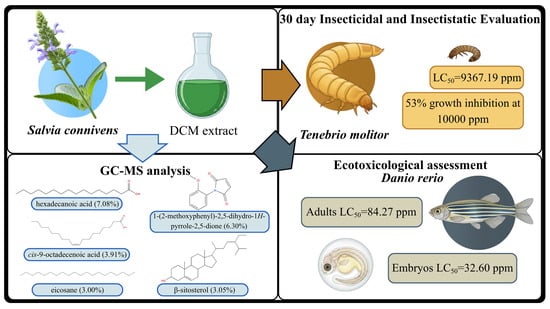
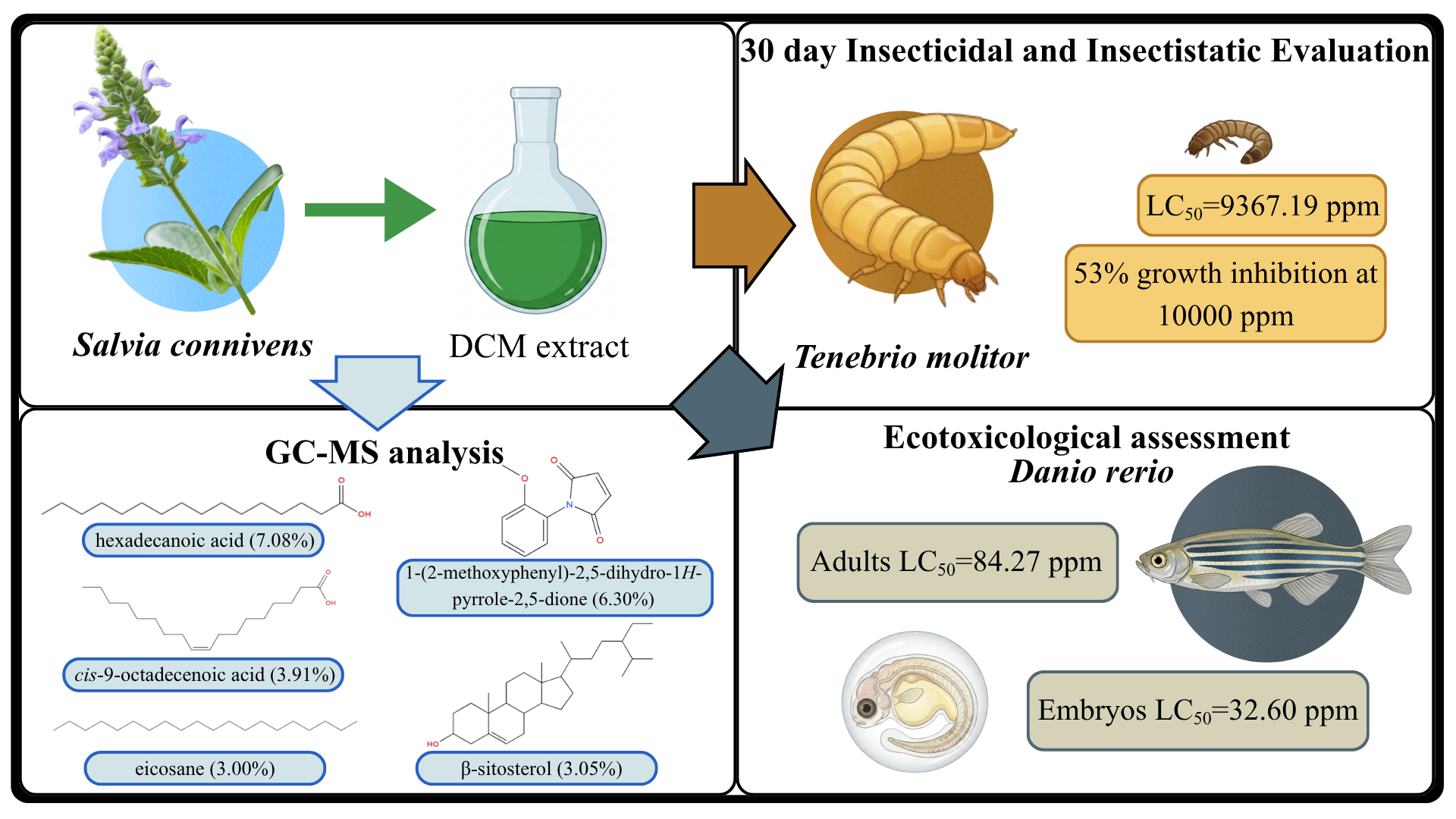
The yellow mealworm (Tenebrio molitor, Linnaeus) is a cosmopolitan pest of stored grains, causing losses up to 15%. Due to the environmental and health risks of synthetic fumigants, botanical alternatives are needed, but their ecotoxicological assessment is also required. Thus, the aim of this study was to assess the insecticidal, insectistatic, and ecotoxicological effects of Salvia connivens (Epling) dichloromethane extract and to identify its compounds. Insecticidal and insectistatic activities were assessed through the consumption of an artificial diet containing the extract over 30 days. Ecotoxicological activity was evaluated through acute toxicity assays on Danio rerio (Hamilton) adults and embryos. The extract showed insecticidal activity against T. molitor achieving 50% mortality at 10,000 ppm (LC50 = 9367.19 ppm). Additionally, at 10,000 ppm larval weight gain was reduced by 53.37% at 30 days compared to the control. Ecotoxicological assays revealed slight toxicity toward D. rerio adults (LC50 = 84.27 ppm) and embryos (LC50 = 32.60 ppm). GC-MS analysis identified hexadecanoic acid (7.08%), 1-(2-methoxyphenyl)-2,5-dihydro-1H-pyrrole-2,5-dione (6.30%), cis-9-octadecenoic acid (3.91%), β-sitosterol (3.05%), and eicosane (3.00%) as the major constituents according to the chromatographic method used. These findings suggest that S. connivens dichloromethane extract is a potential botanical product for T. molitor management.

Graphical Abstract

1. Introduction

The yellow mealworm, T. molitor (Coleoptera: Tenebrionidae), is a cosmopolitan insect native to Europe that infests stored grains and their derivatives [1,2]. This species is classified as a secondary pest as it feeds on grains that have previously been damaged or partially consumed by primary pests [3]. As a result, the production yields of grains and flours can experience losses reaching up to 15% [4].
The conventional way to manage this pest is by applying synthetic fumigants, such as methyl bromide and phosphine [5]. The use of methyl bromide is restricted since the establishment of the Montreal protocol, classifying this compound as an ozone-depleting substance. Consequently, the application of this fumigant is allowed only for quarantine pests and before the shipment of agricultural commodities for exportation and importation [6]. Following its restriction, phosphine became the main substitute to manage this pest. However, like methyl bromide, it can cause neurotoxic and carcinogenic damage to human health [7]. Furthermore, these products have also developed resistance in the target insects they are intended to control. For instance, methyl bromide resistance development has been reported in stored grain insects such as Sitophilus granarius (Linnaeus) (Coleoptera: Curculionidae) and Tribolium castaneum (Herbst) (Coleoptera: Tenebrionidae) [8,9], while resistance to phosphine has been reported in Trogoderma granarium (Everts) (Coleoptera: Dermestidae), Rhyzopertha dominica (Fabricius) (Coleoptera: Bostrichidae), S. granarius and T. castaneum [10]. Due to this, it becomes necessary to develop safe and effective alternatives for the management of this sort of pest.
As an alternative, botanical control employs secondary metabolites produced by plants through essential oils or aqueous and organic extracts [11]. Although plant extracts from different botanical families have demonstrated insecticidal activity against a wide range of insects, plants within the Lamiaceae family are particularly remarkable for their high insecticidal potential [12]. Within this family, the genus Salvia is the most extensive, comprising around 1000 species that are distributed worldwide. Furthermore, these plants are valued because of their biological activity attributed to their secondary metabolites, such as steroids, flavonoids, saponins, alkaloids, phenolic compounds and terpenes [13,14]. Regarding the biological activity of Salvia species, the essential oil of Salvia veneris (Hedge) exhibited toxicity upon contact and fumigation against S. granarius, S. oryzae and T. castaneum larvae [15]. Likewise, Salvia leriifolia (Benth) essential oil showed contact toxicity towards Lasioderma serricorne (Fabricius) (Coleoptera: Anobiidae) adults [16]. Specifically, S. connivens is an endemic species from Mexico that has been shown to produce alkaloids, terpenoids lactones, saponins, tannins and flavones in its secondary metabolism [17,18]. In terms of biological activity against insects, chloroform extract of S. connivens exhibited insecticidal and antifeedant activity through ingestion against Spodoptera frugiperda (J.E. Smith) (Lepidoptera: Noctuidae) larvae [19]. Comparably, the botanical management of stored product pests is mainly explored using essential oils rather than organic extracts. This suggests that further research evaluating the potential of organic extracts could offer valuable alternatives for controlling stored product insects.
Based on this, the use of plant extracts represents an effective alternative for pest management. Nevertheless, the uncontrolled use of these products could lead to negative environmental impacts, such as disruption of aquatic ecosystems, soil contamination, and harm to beneficial insects [20]. Consequently, monitoring environmental contamination is crucial, and some fish species are considered bioindicators due to their hypersensitivity and specific changes upon exposure to alterations in their surrounding environment [21]. The zebrafish, Danio rerio (Cypriniformes: Cyprinidae), is among these organisms and is an extensively used biological model in toxicology and environmental risk assessment of contaminants because of its genome, easy handling, and rapid reproduction under laboratory conditions [22]. A previous study by our research group found insecticidal activity in the methanolic extract of S. connivens leaves against S. frugiperda and T. molitor, showing low ecotoxicological impact as it was non-toxic to Poecilia reticulata (Peters) (adults and juveniles) and D. rerio (adults and embryos) [23]. Following these previous findings, the present study explores the dichloromethane fraction to target medium polarity metabolites, which often contain bioactive compounds in Lamiaceae species [24,25] but whose specific effects and safety margin for aquatic organisms remain to be elucidated for this plant extract. Therefore, the objective of the present study was to assess the insecticidal and insectistatic activity of S. connivens leaf dichloromethane extract against T. molitor, its ecotoxicological effects on D. rerio adults and embryos, and to identify its major compounds.

2. Materials and Methods

2.1. Plant Material Collection

Leaves of S. connivens were collected in the municipality of Guadalcázar, San Luis Potosí, Mexico (22°39′50.3″ N, 100°24′59.5″ W). The gathering of the plant samples occurred between 9:00 and 10:00 AM (Central Standard Time) during its flowering stage. The species was authenticated by the biologist José García-Pérez in the Isidro Palacios herbarium of the Autonomous University of San Luis Potosí under voucher number SLPM 43013.

2.2. Extract Preparation

After collection and authentication, the plant material was moved to the Laboratory of Natural Insecticidal Compounds at the Autonomous University of Querétaro (LNIC-AUQ). The leaves were dehydrated under shade and ambient temperature (20 ± 8 °C) for 14 days. Subsequently, they were ground using an IKA® WERKE M20 mill (Staufen, Germany) until pulverized. The dried and pulverized plant material was subjected to reflux extraction with J.T. Baker® (Phillipsburg, NJ, USA) technical grade dichloromethane in a w/v ratio of 1:5 (plant material to solvent) for 8 h. The solvent was removed using an IKA® RV10 rotatory evaporator (Staufen, Germany) [19].

2.3. Insecticidal and Insectistatic Activity Evaluation

Fifth instar larvae (F4) were randomly selected from a well-established colony at the LNIC-AUQ. The parental stock was originally obtained from a commercial supplier (Tenebrios.com®, Ciudad de México, Mexico) and reared for four generations fed with an artificial diet (Table 1).
The bioassays were designed to evaluate biological activity via ingestion. The concentrations of S. connivens dichloromethane extract were determined by conducting a preliminary bioassay using logarithmic concentrations (0, 0.5, 5, 50, 500, 5000 ppm). Based on the observed mortality, escalating concentrations (0, 500, 1000, 5000, 7000, 10,000 ppm) were selected to more accurately define the upper end of the concentration–response curve.
To evaluate insecticidal and insectistatic activity, the amount of extract required to prepare 50 mL of each concentration was weighted and dissolved with a minimum volume of dichloromethane. Subsequently, this solution was co-dissolved with polyvinylpyrrolidone (PVP) (Merck®, Naucalpan de Juárez, Mexico) at a 1:2 weight ratio (extract: PVP) in methanol, to form a stable dispersion. The solvents were eliminated under vacuum evaporation with a rotatory evaporator [26]. The resulting solid dispersion was re-dissolved in water to prepare a stock solution of 0.05 g mL−1. Afterwards, aliquots of 10, 7, 5, 1, and 0.5 mL were added to prepare 50 mL of diet at each tested concentration (10,000, 7000, 5000, 1000, and 500 ppm), along with the rest of the ingredients. Supplementary PVP was added to ensure all treatments contained a uniform concentration of this reagent. The negative control diet was prepared following the same procedure, including the same concentration of PVP used in the treatments but omitting the plant extract. The mixture was stirred until formation of a homogeneous mixture and then dripped into a 2% calcium chloride solution for encapsulation. Subsequently, the obtained diet capsules were washed three times with distilled water.
For each concentration, 20 individuals were used, which were distributed into four replicates. Specifically, five larvae were confined in a polypropylene Petri dish with a portion of artificial diet which they fed on ad libitum. The diet was replaced every third day for 30 days. During this period, exuviae and feces produced by the insects were removed. The weight of each group of larvae was recorded at 0, 10, 20, and 30 days to determine the mean larval weight at each interval. Additionally, the mortality rate at 30 days was reported. The bioassay was maintained in a climate-controlled chamber at a temperature of 27 ± 2 °C, a photoperiod of 10:14 h (light:dark), and a relative humidity of 40% [23].

2.4. Fish Acclimation and Conditioning

Adult D. rerio individuals were obtained from a mature stock at the Live Feed Chemical Analysis Laboratory of the Autonomous Metropolitan University, Xochimilco Unit. The fish underwent an acclimation period of 14 days before being transferred to 90 cm (L) × 40 cm (W) × 30 cm (H) glass aquariums containing semi-hard reconstituted water (pH: 7.4–7.8, hardness 80–100 mg L−1 as CaCO3), and maintained at 28 ± 3 °C [27].

2.5. Ecotoxicological Activity Evaluation

The assessment of the ecotoxicological activity was conducted following the procedure described by Martínez-Jerónimo et al. (2008) [28]. Adult D. rerio between 75 and 80 days post-hatch were used. The nominal concentrations were 500, 250, 125, 62.5 and 31.2 ppm using the same PVP-assisted dispersion procedure as mentioned with the insecticidal and insectistatic assays, including a negative control consisting of reconstituted semi-hard water with the same concentration of PVP used in the treatments. For each concentration, 12 individuals were randomly assigned to four replicates. Each replicate was placed in a 250 mL circular plastic container with 200 mL of the respective test solution.
Furthermore, assays with D. rerio embryos were carried out following the Organisation for Economic Co-operation and Development guidelines for acute toxicity testing on fish embryos [29]. The same concentrations and dispersion method as in adults were used. The embryos were treated 24 h after fertilization. For each tested concentration, 16 embryos were randomly distributed in four replicates. The embryos were exposed into 24-well microplates, with each embryo placed in an individual well containing two milliliters of the respective tested solution.
Mortality was assessed at 1, 3, 6, 12, 24, 48, 72 and 96 h in both bioassays. At the conclusion of the experiment, surviving individuals were euthanized via immersion in ice water [30]. Afterwards, biological waste was managed in accordance with NOM-087-SEMARNAT-SSA1-2002 [31]. Dead fish were sealed in yellow polyethylene bags bearing the biohazard symbol and frozen to be disposed of by a private contractor employed by the Faculty of Chemistry of the Autonomous University of Querétaro (FC-AUQ).
Likewise, remaining extract solutions from the bioassays were transferred to plastic containers and classified as organic residuals. Afterwards, they were moved to the FC-AUQ temporary hazardous waste storage facility for subsequent management by a specialized company.

2.6. GC-MS Semi-Volatiles Analysis

The dry extract (50 mg) was resuspended in 1000 µL of dichloromethane using a vortex mixer. Then, a 100 µL aliquot was diluted with 400 µL of the same solvent and derivatized by adding 20 µL of N,O-bis(trimethylsilyl)trifluoroacetamide + trimethylchlorosilane (1%) and vortexed at room temperature (27 °C) for 2 min. Subsequently, the extract was filtered through a 0.45 µm polytetrafluoroethylene membrane.
After derivatization, 1 µL of the sample was analyzed using an Agilent® 5975 gas chromatograph system coupled to a 5975C quadrupole mass spectrometer (Agilent Technologies®, Wilmington, DE, USA). Separation was achieved with an HP-5MS capillary column (30 m × 250 µm internal diameter, 0.25 µm film thickness) (J&W®, Folsom, CA, USA). The injector was operated in a split ratio of 1:1 at 250 °C with a helium flow rate of 1 mL min−1. Initially, the oven was set at 100 °C for 1 min. Then, the temperature increased at 6 °C min−1 to 220 °C and held for 8 min. After that, the temperature was raised at 10 °C min−1 to 290 °C. Finally, the temperature increased at 40 °C min−1 to 310 °C, where it was held for 8 min. The mass detector was operated at 70 eV with the ion source at 230 °C and the transfer line at 250 °C.
Compounds were identified by interpreting the fragmentation patterns of their mass spectra in the range of 20–1000 m/z. The data acquisition was performed using MSD ChemStation Software (Agilent technologies®, Santa Clara, CA, USA) version E.02.02.1431. The compounds were identified by comparison with the National Institute of Standards and Technology database (NIST11).
Only compounds with a mass spectral similarity index higher than 80% were reported and considered as tentatively identified. The relative abundance of each compound was calculated according to the total area of all integrated peaks in the chromatogram. Linear retention indexes were calculated using an n-alkane standard (C8–C40) under the same chromatographical conditions.

2.7. Statistical Analysis

All datasets were subjected to a Shapiro–Wilk test to ensure normality, and homogeneity of variances was assessed to determine the application of a parametric or non-parametric analysis. In all cases, data followed a normal distribution (p > 0.1) and equal variances (p > 0.05). Consequently, the data was subjected to a one-way analysis of variance (ANOVA), as well as Tukey’s test to verify the existence of significant differences between means (α = 0.05). Median lethal concentrations (LC50) were calculated using Probit analysis. The analyses mentioned were performed using the Systat 9 statistical package.

3. Results

3.1. Insecticidal Activity of S. connivens Dichloromethane Extract

After 30 days of feeding the larvae with artificial diets at different extract concentrations, a mortality–concentration relation was observed (Table 2). No mortality was observed in the diet without the extract. However, mortality was first recorded at 500 ppm with 10% and was maintained even at 1000 ppm. Meanwhile, mortality slightly increased to 15% at 5000 ppm. In contrast, the insecticidal activity of the extract became significant (F = 6.14; p = 0.002) from 7000 ppm with 45% mortality. The maximum mortality, reaching 50% of the population, was observed at 10,000 ppm. According to the Probit analysis, the LC50 was 9367.19 ppm.

3.2. Insectistatic Activity of S. connivens Dichloromethane Extract

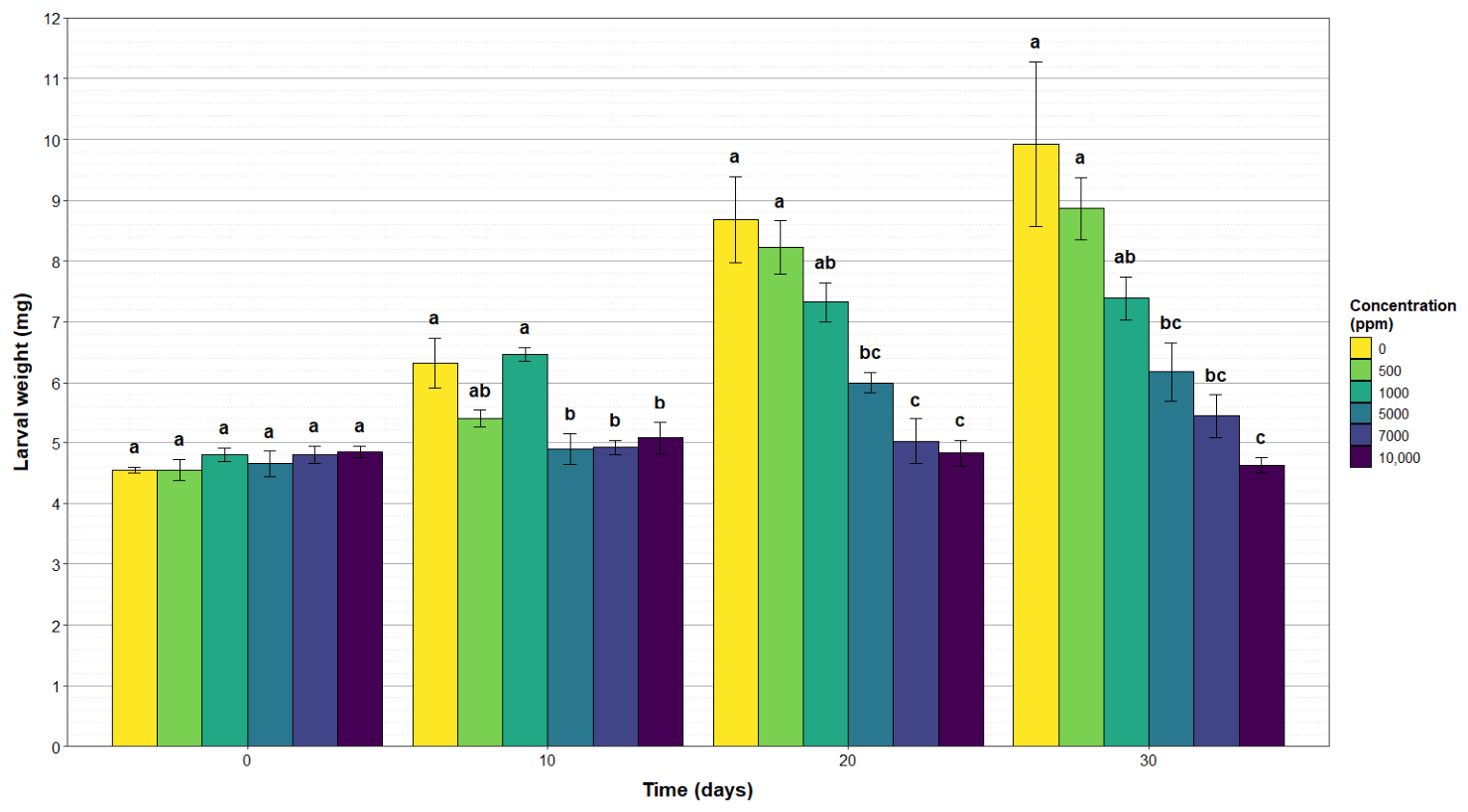
As the larval weight was recorded at 10, 20 and 30 days, different patterns were shown across the three intervals (Figure 1). At 10 days, the ingestion of 500 and 1000 ppm of the extract through the artificial diet exhibited no significant differences in comparison with the control group. Notably, larvae at 1000 ppm yielded a higher larval weight (6.46 mg) than the control (6.32 mg). However, the growth inhibition became significant at higher concentrations, such as 5000, 7000 and 10,000 ppm.
By day 20, a clear concentration–weight loss relation was observed. While the control showed larval growth reflected in an 8.67 mg weight, significant lack of weight gain was observed over 5000 ppm (6.0 mg). At the highest concentration (10,000 ppm), a weight loss was observed compared to its 10 days measurement (from 5.07 to 4.82 mg).
At the last interval, the control group reached its maximum larval weight (9.92 mg), while 10,000 ppm showed the lowest recorded weights (4.62 mg), representing a 53.37% weight reduction over the 30 days experimental period.

3.3. Ecotoxicological Activity of S. connivens Dichloromethane Extract

Following a 96 h exposure of adult D. rerio to the dichloromethane extract, concentration- and time-dependent toxic effects were observed (Table 3). In the control group, no mortality was recorded during the 96 h of exposure. In contrast, toxicity was initially observed at 31.2 ppm after 72 h, with 8.33% of mortality. At 62.5 ppm, mortality began at 3 h of exposure and stopped recording new mortality after 12 h, yielding a cumulative mortality of 33.3%. From 125 ppm, the assay exhibited significant (F = 31.74; p < 0.001) cumulative mortalities, showing mortalities between the 3 h and 72 h intervals, reaching 83.3%. Total mortality was observed at 250 and 500 ppm, with exposure time being the main difference, since the 250 ppm concentration took 6 h to cause the death of all individuals, while the 500 ppm concentration required only 1 h. The calculated LC50 for D. rerio adults was 84.27 ppm.
In D. rerio embryos, a higher toxic effect was observed compared to adults (Table 4). After a 96 h exposure, no mortality was recorded in the control group. However, significant (F = 36.00; p < 0.001) toxicity began at 31.2 ppm, exhibiting a 75% mortality by the 6 h interval, with no mortality recorded after this period. This behavior remained constant up to 62.5 ppm. In contrast, total mortality was reached at 125 ppm, beginning with 25% mortality by the first hour of exposure and reaching 100% by 6 h. The same mortality–time relation was observed at 250 and 500 ppm. In this sense, the LC50 obtained for embryos was 32.60 ppm, indicating that embryos are approximately 2.6 times more sensitive to the S. connivens dichloromethane extract than adults.

3.4. Profiling of Semi-Volatiles via GC-MS

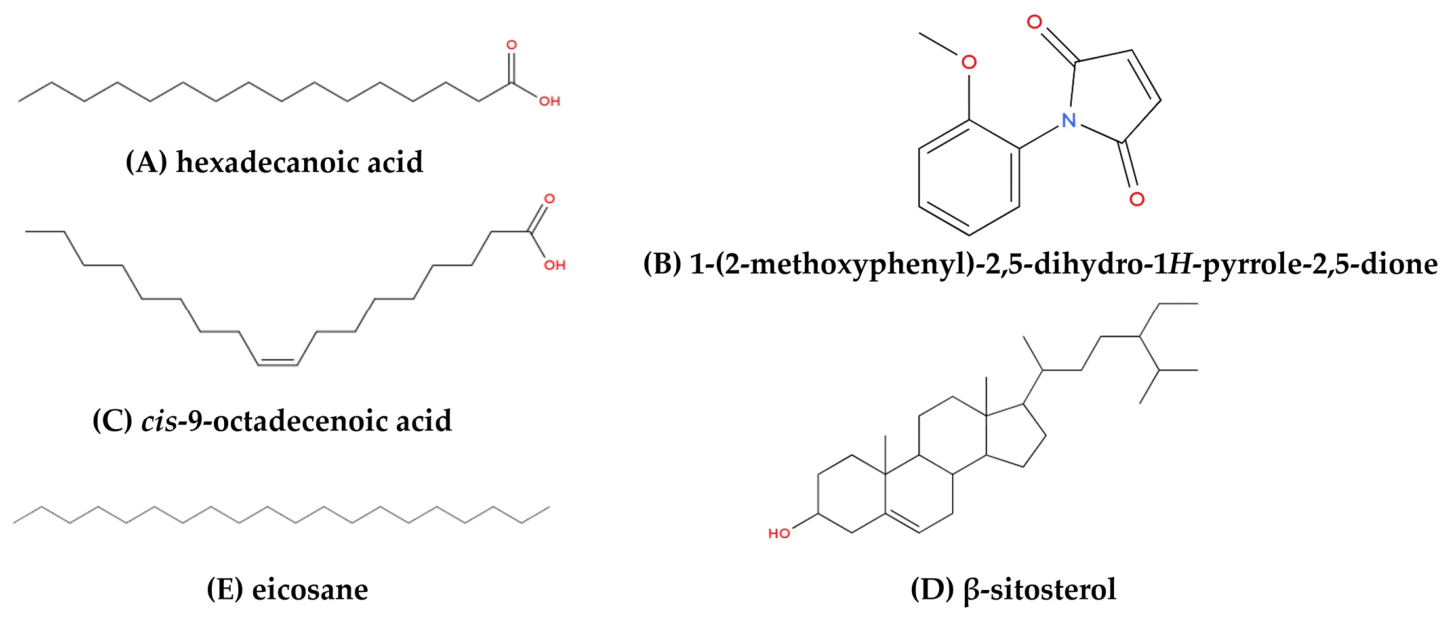
After analyzing the extract, a total of 56 compounds were identified accounting for 42.01% of the total composition. The most abundant component was hexadecanoic acid at 7.08% (A) (Table 5), followed by 1-(2-Methoxyphenyl)-2,5-dihydro-1H-pyrrole-2,5-dione (B), cis-9-octadecenoic acid (C), β-sitosterol (D), and eicosane (E) with abundances of 6.30, 3.91, 3.05, and 3.00%, respectively (Figure 2).

4. Discussion

4.1. Evaluation of the Insecticidal Efficacy of the S. connivens Dichloromethane Extract

The insecticidal activity of dichloromethane extracts from plants of the Lamiaceae family against stored grains pests has been reported. Marouf et al. [25] evaluated the toxic effect of Origanum vulgare (Linnaeus) dichloromethane extract against Tribolium confusum (Du Val) (Coleoptera: Tenebrionidae) and Callosobruchus maculatus (Fabricius) (Coleoptera: Chrysomelidae) through fumigation. After 3 days of exposure, they observed an LC50 of 2446.37 and 4000.58 ppm, respectively. These results are more than twice as much as reported in this work. These differences could be attributed to a distinct mode of action, since we assessed the ingestion mode. Additionally, this could suggest that the ingestion mode could take more time to cause a toxic effect than the fumigation method. In accordance with Shaalan et al. [32], the lower toxicity of S. connivens extract against T. molitor could be attributed to differing extract chemical compositions due to distinct plant species, geographical conditions, and even varying susceptibility among coleopteran insects to these extracts.
In comparison, the biological activity of Lamiaceae dichloromethane extract on an insect from a different order has shown varying levels of efficacy. For instance, Sakr et al. [24] assessed the insecticidal activity of Hyptis brevipes (Poit) against Spodoptera littoralis (Boisduval) (Lepidoptera: Noctuidae) via ingestion. After 4 days where the larvae were fed with castor bean leaves treated with the extract in a range of concentrations from 0 to 50,000 ppm, the highest concentration resulted in total mortality, showing an LC50 of 30,000 ppm. These results are slightly more than three times higher than the ones presented in this work, even at a lesser time of ingestion. This suggests that this Lepidopteran species is potentially less sensitive to extracts from Lamiaceae plants than coleopteran pests.

4.2. Evaluation of the Insectistatic Activity of S. connivens Dichloromethane Extract

While the methanolic extract of S. connivens previously showed approximately five-fold insecticidal activity (LC50 = 1856.94 ppm), the assessed dichloromethane extract revealed an insectistatic effect. The antifeedant effect of dichloromethane extracts of Salvia genus species, as well as the Lamiaceae family, has not previously been studied against stored grain pests or Coleoptera members, although studies assessing this sort of insectistatic activity using Lamiaceae essential oils provide valuable insights.
Kostić et al. [33] determined the phagodeterrent effect of Salvia officinalis (Linnaeus) essential oil against Leptinotarsa decemlineata (Say) (Coleoptera: Chrysomelidae) by spraying 5000 ppm of leaf essential oil into Solanum tuberosum (Linnaeus) (Solanaceae). They observed a damage reduction of 52.3% compared to the control, a result remarkably similar to the 53.37% weight reduction observed in the present study, despite the different chemical nature of the dichloromethane extract to an essential oil.
On the other hand, Yıldırım et al. [34] assessed the antifeedant effect of Mentha longifolia (L. Hudson) essential oil on Subcoccinella vigintiquatuorpunctata (Linnaeus) (Coleoptera: Coccinellidae) through the consumption of Galega oficinales (Linnaeus) (Fabaceae) leaf disks immersed in different essential oil concentrations. A phagodeterrent index of 71.88 was observed at the highest tested concentration (5000 ppm) after 3 days. This result is 19.25% higher than the results obtained in the present study, even at a lower concentration and a shorter ingestion time. These findings suggest that T. molitor could be less susceptible compared to other coleopterans. Furthermore, while a low exposure time (10 days) via ingestion in the present study showed no significant effects at lower concentrations, the prolonged 30 days exposure revealed a significant insectistatic effect.
A particular behavior was observed by day 10 at 1000 ppm, where the larval weight showed a slight increase compared to the control, suggesting a hormetic response. This could be attributed to the stimulation of low-dose xenobiotic in the metabolic activity before any toxic effects are triggered. This is consistent with the robust T. molitor detoxifying pathways. According to Jang et al. [35] and Gao et al. [36], this defense involves Phase I enzymes, such as cytochrome P450 monooxygenases, and Phase II enzymes including glutathione S-transferases that upregulate to neutralize toxins. This could explain why larvae at 1000 ppm maintained their weight during the first 10 days. Nevertheless, the overall weight loss recorded at 10,000 ppm shows the limits of this defense. While these mechanisms reduce immediate mortality, they cause metabolic costs [37], redirecting energy to detoxification processes, resulting in growth inhibition.

4.3. Evaluation of the Ecotoxicological Effects of S. connivens Dichloromethane Extract

While the toxicity of dichloromethane extract from Lamiales plants has not been studied in aquatic animals, related research offers insights. Previous studies have demonstrated that dichloromethane can replace the employment of chloroform due to its capability to extract the same type of natural compounds [38,39]. In this sense, Ali et al. [40] observed that the chloroform fraction of a crude acetonic extract of Ocimum americanum (Linnaeus) had an LC50 of 303.39 ppm against Artemia salina (Linnaeus) (Anostraca: Artemiidae). According to the pesticide toxicity classification for aquatic animals established by Helfrich et al. [41], the extract described in the previous study would fall into the “minimally toxic” category. Nevertheless, the extract assessed in the present study would be classified as “slightly toxic” because it falls in a range of an LC50 between 10 and 100 ppm.
The acute toxicity of extracts with similar polarity against D. rerio embryos has been reported in other plant classifications. Sumana Roy et al. [42] tested the chloroform extract of Leucaena leucocephala (Lam. De Wit) (Fabaceae), observing a 96 h LC50 of 172.94 ppm. While there is a dearth of information on the embryotoxicity of median polarity extracts from the Lamiaceae family on D. rerio, some studies have explored the toxicity of alcoholic extracts within this family. For instance, Nguyen et al. [43] found a LC50 value of 79.61 ppm after 96 h of embryo exposure to Clerodendrum cyrtophyllum (Turcz.) ethanol extract. On the other hand, Ullah et al. [44] observed an LC50 of 5 ppm after exposing zebrafish embryos to Marrubium vulgare (Linnaeus) methanolic extract. The findings of the present study align more with those reported by Nguyen et al., since C. cyrthophyllum ethanol extract was also classified as slightly toxic according to the pesticide toxicity classification for aquatic animals described by Helfrich et al. In contrast, the results reported by Ullah et al. and Sumana Roy et al. fall in the category of moderately and minimally toxic, respectively. This suggests that organic extracts from the Lamiaceae family tend to exhibit slight-to-moderate toxicity toward zebrafish embryos, potentially representing a lower aquatic environment impact.
The results exhibited a difference in susceptibility between the life stages of D. rerio, with embryos (LC50 = 32.60 ppm) being 2.5 times more sensitive than adults (LC50 = 84.27 ppm). According to Loerracher and Braunbeck [45], while D. rerio possesses biotransformation potential from early life stages, these are inferior to those of adults. For instance, key Phase II biotransformation pathways, such as glucuronidation (essential for neutralizing and excreting toxic compounds), are not completely functional in embryonic stages. Thus, the reduced capacity of embryos to detoxify the phytochemicals in the S. connivens dichloromethane extract could lead to higher bioaccumulation and greater mortality compared to mature adult fish.
Additionally, this stands in contrast to the higher concentration required to manage T. molitor larvae (LC50 = 9367.19 ppm). This suggests that the direct use of this extract in open environments can pose a significant hazard to non-target aquatic organisms. Therefore, future field application must prioritize methods to prevent leaching into water bodies.

4.4. Salvia Connivens Dichloromethane Extract GC-MS Semi-Volatiles Analysis

A previous fractionation (hexane/ethyl acetate) of S. connivens dichloromethane extract reported by González-Chávez et al. [46] exhibited the presence of triterpenoids; specifically, they identified oleanolic acid (41.18%), ursolic acid (47.69%), and hydroursolic acid (11.13%). These findings align with our results as we identified the presence of β-sitosterol, a phytosterol triterpene. Other species within the Salvia genus have shown the presence of this metabolite. For instance, the hexane extract of Salvia haematodes (Linnaeus) has shown this compound in an abundance of 20.1% [47]. Additionally, Abdel Ghani et al. [48] profiled light petroleum and dichloromethane fractions of Salvia hispanica (Linnaeus) aerial parts, where they found only β-sitosterol as well as β-sitosterol-O-glucoside in the light petroleum fraction, in contrast to the dichloromethane fraction. Furthermore, the petroleum extract of Salvia bicolor (Desf.) aerial parts exhibited a β-sitosterol amount of 24.75% [49]. Moreover, Salvia cassia (Sam. Ex Rech. f.) dichloromethane extract fractions have shown fatty esters of triterpenes such as of β-amyrin and oleanolic acid [50].
The most abundant compound in the studied extract was hexadecanoic acid, a saturated fatty acid. This aligns with the findings of the S. cassia extract, where its dichloromethane fraction exhibited a high content of fatty acids, such as hexadecanoic acid (24%) and heptadecanoic acid (17%) [50]. Another major constituent of the S. connivens dichloromethane extract was cis-9-octadecenoic acid, an unsaturated fatty acid. Salvia hirosolymitana essential oil has exhibited the presence of a similar unsaturated fatty acid, (Z,Z)-9,12-octadecadienoic acid (linoleic acid), in a proportion of 4.5% [51]. Moreover, the presence of Eicosane (alkane) in other Salvia species has been reported, mainly in essential oils. Salvia bicolor essential oil exhibited eicosane with an abundance of 2.13% [49], while the essential oil of Salvia verticillata (Linnaeus) showed an abundance of 8.5%. Our eicosane abundance is within the range of these previously studied species [52].
While most previous studies report significant concentrations of saturated and unsaturated fatty acids, alkanes and triterpenoids, this study represents the first report of 1-(2-Methoxyphenyl)-2,5-dihydro-1H-pyrrole-2,5-dione, a maleimide, within the S. connivens species and, to our knowledge, within the Salvia genus. The identification of this maleimide is consistent with the chemical diversity of the Lamiaceae family, as this same metabolite has been previously identified in Plectranthus tomentosa (Benth.) [53]. According to Song et al. [54], maleimide moieties act as inhibitors of chitin synthase, essential for the structural integrity and development of insects. This association makes them of great interest due to their potential as specialized insecticides. Consequently, our results suggest that S. connivens could serve as a valuable source of bioactive molecules for the development of sustainable and efficient pest management strategies.
It is important to highlight that the biological activity characterized in this study was evaluated utilizing the crude dichloromethane extract. Because no bioassays were conducted with isolated or pure compounds, attributing the biological activity directly to these specific constituents remains speculative. Most of the extract’s complex phytochemical profile remains unaccounted for, and the overall biological activity could likely stem from synergistic or additive interactions among multiple minor and major metabolites. Therefore, these compounds can only be interpreted as potential contributors, and further research is required to definitively validate the active principles responsible for the insecticidal and insectistatic potential of S. connivens dichloromethane extract against T. molitor.

5. Conclusions

The dichloromethane extract of S. connivens leaves exhibited insecticidal (LC50 = 9367.19 ppm) and insectistatic (53.37% growth inhibition at 10,000 ppm at 30 days) activities against T. molitor. Acute ecotoxicological assays indicated that the extract was slightly toxic to D. rerio adults (LC50 = 84.27 ppm) and embryos (LC50 = 32.60). While this extract can be considered as a potential product for the management of this stored grain pest, future field applications must explore methods that prevent leaching into water bodies. Although the observed insecticidal and insectistatic activities might be associated with its major constituents (hexadecanoic acid (7.08%), 1-(2-Methoxyphenyl)-2,5-dihydro-1H-pyrrole-2,5-dione (6.30%), cis-9-octadecenoic acid (3.91%), β-sitosterol (3.05%) and eicosane (3.00%)), their definitive individual roles remain unconfirmed, as the biological effect could stem from synergistic interactions within the crude extract. Thus, future research should focus on evaluating the insecticidal, insectistatic and ecotoxicological activity of these specific compounds.

Author Contributions

Conceptualization, M.R.-C., S.A.V.-S. and M.A.R.-L.; Data curation, A.K.R.-C.; Formal analysis, M.R.-C., A.F.-M. and V.F.P.-C.; Funding acquisition, M.A.R.-L.; Investigation, M.d.C.M.-D., S.A.V.-S., V.F.P.-C., M.G.-R., J.C.-G., J.A.R.-M., K.E.M.-U. and M.A.R.-L.; Methodology, R.F.-B., A.K.R.-C., M.d.C.M.-D., V.F.P.-C. and M.G.-R.; Resources, R.F.-B., M.d.C.M.-D., M.G.-R. and K.E.M.-U.; Software, A.K.R.-C.; Supervision, R.F.-B., K.E.M.-U. and M.A.R.-L.; Validation, A.F.-M.; Visualization, J.C.-G. and J.A.R.-M.; Writing—original draft, M.R.-C. and S.A.V.-S.; Writing—review and editing, M.R.-C., A.F.-M., J.C.-G., J.A.R.-M., K.E.M.-U. and M.A.R.-L. All authors have read and agreed to the published version of the manuscript.

Funding

This research was funded by the Secretaría de Ciencia, Humanidades, Tecnología e Innovación (SECIHTI), grant number 1310311. This work also received funding from the Universidad Autónoma de Querétaro under the “Química es Evolución 2026” program (project code UAQ-CA-83).

Institutional Review Board Statement

The animal study protocol was approved by the Bioethics Committee of the Chemistry Faculty of the Autonomous University of Querétaro. The approval codes were CBQ24/032 and CBQ24/094, issued on 17 April and 20 August 2024, respectively.

Data Availability Statement

The original contributions presented in this study are included in the article. Further inquiries can be directed to the corresponding author.

Acknowledgments

The authors acknowledge the SECIHTI for the financial support provided to conduct this work.

Conflicts of Interest

The authors declare no conflicts of interest.

References

  1. Jara, D.; Urra, F. Uso de Tenebrio molitor Linnaeus, 1758 (Coleoptera: Tenebrionidae) como agente biológico para la limpieza de osamentas de pequeños vertebrados. Rev. Chil. Entomol. 2022, 48, 505–509. [Google Scholar] [CrossRef]
  2. Vigneron, A.; Jehan, C.; Rigaud, T.; Moret, Y. Immune defenses of a beneficial pest: The mealworm beetle, Tenebrio molitor. Front. Physiol. 2019, 10, 138. [Google Scholar] [CrossRef]
  3. Kadir, M.L.; Dageri, A.; Aslan, T.N. Nanopesticides for managing primary and cecondary stored product pests: Current status and future directions. Heliyon 2025, 11, e42341. [Google Scholar] [CrossRef]
  4. Eski, A.; Murat Gezgin, M. Susceptibility of different life stages of Tenebrio molitor (Coleoptera: Tenebrionidae) to indigenous entomopathogenic fungi. J. Stored Prod. Res. 2022, 98, 102008. [Google Scholar] [CrossRef]
  5. Plata-Rueda, A.; Martínez, L.C.; Santos, M.H.D.; Fernandes, F.L.; Wilcken, C.F.; Soares, M.A.; Serrão, J.E.; Zanuncio, J.C. Insecticidal activity of garlic essential oil and their constituents against the mealworm beetle, Tenebrio molitor Linnaeus (Coleoptera: Tenebrionidae). Sci. Rep. 2017, 7, 46406. [Google Scholar] [CrossRef]
  6. Rogers, C.W.; Marshall, J.M.; Moll, M.; Curl, C. Crop bromide concentrations following methyl bromide fumigation for pale cyst nematode in southeastern Idaho. J. Environ. Qual. 2024, 53, 47–56. [Google Scholar] [CrossRef]
  7. Saini, M.K.; Singh, S.; Sharma, D.K. Alternatives to phosphine fumigation in managing stored grain insect pests. Int. J. Agric. Sci. 2022, 18, 522–534. [Google Scholar] [CrossRef]
  8. Monro, H.A.U.; Upitis, E. Selection of populations of the granary weevil Sitophilus granarius L. more resistant to methyl bromide fumigation. Can. Entomol. 1956, 88, 37–40. [Google Scholar] [CrossRef]
  9. Rajendran, S. Selection for resistance to phosphine or methyl bromide in Tribolium castaneum (Coleoptera: Tenebrionidae). Bull. Entomol. Res. 1992, 82, 119–124. [Google Scholar] [CrossRef]
  10. Wakil, W.; Kavallieratos, N.G.; Usman, M.; Gulzar, S.; El-Shafie, H.A.F. Detection of phosphine resistance in field populations of four key stored-grain insect pests in Pakistan. Insects 2021, 12, 288. [Google Scholar] [CrossRef] [PubMed]
  11. Nikolaou, P.; Marciniak, P.; Adamski, Z.; Ntalli, N. Controlling stored products’ pests with plant secondary metabolites: A review. Agriculture 2021, 11, 879. [Google Scholar] [CrossRef]
  12. Ebadollahi, A.; Ziaee, M.; Palla, F. Essential oils extracted from different species of the Lamiaceae plant family as prospective bioagents against several detrimental pests. Molecules 2020, 25, 1556. [Google Scholar] [CrossRef]
  13. Uysal, I.; Koçer, O.; Mohammed, F.S.; Lekesiz, Ö.; Doğan, M.; Şabik, A.E.; Sevindik, E.; Gerçeker, F.Ö.; Sevindik, M. Pharmacological and nutritional properties: Genus Salvia. Adv. Pharmacol. Pharm. 2023, 11, 140–155. [Google Scholar] [CrossRef]
  14. Wu, H.; Ma, P.-F.; Li, H.-T.; Hu, G.-X.; Li, D.-Z. Comparative plastomic analysis and insights into the phylogeny of Salvia (Lamiaceae). Plant Divers. 2021, 43, 15–26. [Google Scholar] [CrossRef]
  15. Polatoğlu, K.; Karakoç, Ö.C.; Yücel Yücel, Y.; Gücel, S.; Demirci, B.; Demirci, F.; Başer, K.H.C. Insecticidal activity of Salvia veneris Hedge. essential oil against coleopteran stored product insects and Spodoptera exigua (Lepidoptera). Ind. Crops Prod. 2017, 97, 93–100. [Google Scholar] [CrossRef]
  16. Geranmayeh, J.; Hashemi, S.M. Contact toxicity of the essential oils from Salvia leriifolia Benth (Lamiaceae) against Lasioderma serricorne (F.). Biharean Biol. 2014, 8, 106–108. [Google Scholar]
  17. Pérez-Gutiérrez, S.; Zavala-Mendoza, D.; Soto-Peredo, C.; Sánchez-Sánchez, O.; Zavala-Sánchez, M.A. Evaluation of the anti-diarrheal activity of Salvia connivens. Pharm. Biol. 2014, 52, 1467–1470. [Google Scholar] [CrossRef][Green Version]
  18. Bautista, E.; Calzada, F.; Yépez-Mulia, L.; Bedolla-García, B.Y.; Fragoso-Serrano, M.; Pastor-Palacios, G.; González-Juárez, D.E. Salvia connivens, a source of bioactive flavones with amoebicidal and giardicidal activity. Rev. Bras. Farmacogn. 2020, 30, 729–732. [Google Scholar] [CrossRef]
  19. Flores-Macías, A.; Flores-Sánchez, M.A.; León-Herrera, L.R.; Mondragón-Olguín, V.M.; Zavala-Gómez, C.E.; Tapia-Pérez, A.D.; Campos-Guillén, J.; Amaro-Reyes, A.; Sandoval-Cárdenas, D.I.; Romero-Gómez, S.d.J.; et al. Activity of chloroformic extract from Salvia connivens (Lamiales: Lamiaceae) and its principal compounds against Spodoptera frugiperda (Lepidoptera: Noctuidae). Appl. Sci. 2021, 11, 11813. [Google Scholar] [CrossRef]
  20. Popescu, V.S.; Zhang, L.; Papa, G.; Giuliani, C.; Ribaudo, G.; Abate, G.; Bulgari, D.; Mac Sweeney, E.; Pucci, M.; Bottoni, M.; et al. Ecotoxicological evaluation of an aqueous phytoextract of Melia azedarach L. Sci. Total Environ. 2024, 950, 175314. [Google Scholar] [CrossRef]
  21. Dietrich, G.J.; Florek-Łuszczki, M.; Wojciechowska, M.; Wójcik, T.; Bąk-Badowska, J.; Wójtowicz, B.; Zięba, E.; Gworek, B.; Chmielewski, J. Fish as bio-indicators of environmental pollutants and associated health risks to the consumer. J. Elem. 2022, 27, 879–896. [Google Scholar] [CrossRef]
  22. Lai, K.P.; Gong, Z.; Tse, W.K.F. Zebrafish as the toxicant screening model: Transgenic and omics approaches. Aquat. Toxicol. 2021, 234, 105813. [Google Scholar] [CrossRef]
  23. Rodríguez-Cervantes, M.; León-Herrera, L.R.; Ventura-Salcedo, S.A.; Monroy-Dosta, M.d.C.; Rodríguez-deLeón, E.; Bah, M.M.; Campos-Guillén, J.; Amaro-Reyes, A.; Zavala-Gómez, C.E.; Figueroa-Brito, R.; et al. Salvia connivens methanolic extract against Spodoptera frugiperda and Tenebrio molitor and its effect on Poecilia reticulata and Danio rerio. Toxics 2025, 13, 94. [Google Scholar] [CrossRef]
  24. Sakr, H.H.; Roshdy, S.H.; El-Seedi, H.R. Hyptis brevipes (Lamiaceae) extracts strongly inhibit the growth and development of Spodoptera littoralis (Boisd.) larvae (Lepidoptera: Noctuidae). J. Appl. Pharm. Sci. 2013, 3, 83–88. Available online: https://japsonline.com/abstract.php?article_id=1081&sts=2 (accessed on 6 November 2025).
  25. Marouf, A.; Sangari, S.; Jabbari, L. An investigation on fumigant effect of the extract of Origanum vulgare (Lamiales: Lamiaceae) for control of two stored-product beetles. J. Entomol. Soc. Iran 2008, 27, 29–41. Available online: https://jesi.areeo.ac.ir/article_105342_4323fadc89d8f52404833426b1a8aed3.pdf (accessed on 8 November 2025).
  26. Hernández-Caracheo, K.; Guerrero-López, L.; Rodríguez-Sánchez, B.; Rodríguez-Núñez, E.; Rodríguez-Chávez, J.L.; Delgado-Lamas, G.; Campos-Guillén, J.; Amaro-Reyes, A.; Monroy-Dosta, M.d.C.; Zavala-Gómez, C.E.; et al. Evaluation of the insecticidal potential of Heterotheca inuloides acetonic and methanolic extracts against Spodoptera frugiperda and their ecotoxicological effect on Poecilia reticulata. Plants 2023, 12, 3555. [Google Scholar] [CrossRef] [PubMed]
  27. USEPA. Methods for Measuring the Acute Toxicity of Effluents and Receiving Waters to Freshwater and Marine Organisms, 5th ed.; United States Environmental Protection Agency: Washington, DC, USA, 2002; p. 33. [Google Scholar]
  28. Martínez-Jerónimo, F.; Espinosa-Chávez, F. Ensayo de toxicidad aguda con larvas y juveniles de los peces Brachydanio rerio y Poecilia reticulata. In Ensayos Toxicológicos Para la Evaluación de Sustancias Químicas en Agua y Suelo: La Experiencia en México; Ramírez-Romero, P., Mendoza-Cantú, A., Eds.; Instituto Nacional de Ecología, SEMARNAT: Ciudad de Mexico, Mexico, 2008; pp. 115–126. [Google Scholar]
  29. OECD. Test No. 236: Fish Embryo Acute Toxicity (FET) Test OECD Guidelines for the Testing of Chemicals; OECD Publishing: Paris, France, 2013; pp. 115–126. [Google Scholar]
  30. Díaz-Resendiz, K.J.G.; Hermosillo-Escobedo, A.T.; Ventura-Ramón, G.H.; Toledo-Ibarra, G.A.; Girón-Pérez, D.A.; Bueno-Durán, A.Y.; Girón-Pérez, M.I. Death of guppy fish (Poecilia reticulata) leukocytes induced by in vivo exposure to Temephos and Spinosad. Int. J. Environ. Health Res. 2022, 32, 701–711. [Google Scholar] [CrossRef]
  31. Norma Oficial Mexicana NOM-087-SEMARNAT-SSA1-2002, Protección ambiental—Salud ambiental—Residuos Peligrosos biológico-Infecciosos—Clasificación y Especificaciones de Manejo. Available online: https://platiica.economia.gob.mx/normalizacion/nom-087-semarnat-ssa1-2002/ (accessed on 6 September 2025).
  32. Shaalan, E.A.-S.; Canyon, D.; Younes, M.W.F.; Abdel-Wahab, H.; Mansour, A.-H. A review of botanical phytochemicals with mosquitocidal potential. Environ. Int. 2005, 31, 1149–1166. [Google Scholar] [CrossRef] [PubMed]
  33. Kostić, M.; Dražic, S.; Popović, Z.; Stanković, S.; Sivčev, I.; Živanović, T. Developmental and feeding alternations in Leptinotarsa decemlineata Say. (Coleoptera: Hrysomelidae) caused by Salvia officinalis L. (Lamiaceae) essential oil. Biotechnol. Biotechnol. Equip. 2007, 21, 426–430. [Google Scholar] [CrossRef]
  34. Yıldırım, H.; Bekircan, Ç.; Bektaş, E. Antifeedant effects of essential oil of Mentha longifolia subsp. Longifolia L. Hudson (Lamiaceae) on Subcoccinella vigintiquatuorpunctata L. (Coleoptera: Coccinellidae). Biol. Divers. Conserv. 2019, 12, 103–108. [Google Scholar] [CrossRef]
  35. Jang, H.A.; Baek, H.-S.; Kim, B.B.; Kojour, M.A.M.; Patnaik, B.B.; Jo, Y.H.; Han, Y.S. Gene expression of detoxification enzymes in Tenebrio molitor after fungicide Captan exposure. Korean J. Appl. Entomol. 2022, 61, 155–163. [Google Scholar] [CrossRef]
  36. Gao, L.; Chen, H.; Li, J.; Su, Z.; Mao, G.; Zhang, H.; Xie, H.; Song, A. Analysis of key enzymes and mechanisms involving aflatoxin B1 (AFB1) degradation in Tenebrio molitor using ITRAQ technology. Toxicon 2026, 269, 108640. [Google Scholar] [CrossRef]
  37. Wróbel, M.; Dąbrowski, M.; Łuczyński, M.; Waśkiewicz, K.; Bakuła, T.; Nowicki, Ł.; Zielonka, Ł. Bioconversion of deoxynivalenol by mealworm (Tenebrio molitor) larvae: Implications for feed safety and nutritional value. Toxins 2025, 17, 478. [Google Scholar] [CrossRef] [PubMed]
  38. Jaber-Vazdekis, N.E.; Gutierrez-Nicolás, F.; Ravelo, Á.G.; Zárate, R. Studies on tropane alkaloid extraction by volatile organic solvents: Dichloromethane vs. chloroform. Phytochem. Anal. 2006, 17, 107–113. [Google Scholar] [CrossRef] [PubMed]
  39. Cequier-Sánchez, E.; Rodríguez, C.; Ravelo, Á.G.; Zárate, R. Dichloromethane as a solvent for lipid extraction and assessment of lipid classes and fatty acids from samples of different natures. J. Agric. Food Chem. 2008, 56, 4297–4303. [Google Scholar] [CrossRef]
  40. Ali, H.; Nguta, J.; Musila, F.; Ole-Mapenay, I.; Matara, D.; Mailu, J. Evaluation of antimicrobial activity, cytotoxicity, and phytochemical composition of Ocimum americanum L. (Lamiaceae). Evid. Based Complement. Altern. Med. 2022, 2022, 6484578. [Google Scholar] [CrossRef]
  41. Helfrich, L.A.; Weigmann, D.L.; Hipkins, P.; Stinson, E.R. Pesticides and Aquatic Animals: A Guide to Reducing Impacts on Aquatic Systems; Virginia Cooperative Extension: Blacksburg, VA, USA, 2009. [Google Scholar]
  42. Sumana, R.; Lopamudra, D.; Prerona, S. Embryotoxicity and teratogenic effect of chloroform extract of Leucaena leucocephala (Lam.) de Wit (Lam.) de Wit Leaf on zebra fish (Danio rerio). Int. J. Life Sci. Pharma Res. 2022, 10, 167–176. [Google Scholar] [CrossRef]
  43. Nguyen, T.H.; Nguyen, P.-D.; Quetin-Leclercq, J.; Muller, M.; Ly Huong, D.T.; Pham, H.T.; Kestemont, P. Developmental toxicity of Clerodendrum cyrtophyllum Turcz ethanol extract in zebrafish embryo. J. Ethnopharmacol. 2021, 267, 113538. [Google Scholar] [CrossRef] [PubMed]
  44. Ullah, R.; Alqahtani, A.S.; Shahat, A.A.; Nasr, F.; Wadaan, M.A.; Farooq, M. The antiproliferative effects of Marrubium vulgare, and toxicity screening in zebrafish embryos. J. King Saud Univ. Sci. 2024, 36, 103241. [Google Scholar] [CrossRef]
  45. Loerracher, A.-K.; Braunbeck, T. Cytochrome P450-dependent biotransformation capacities in embryonic, juvenile and adult stages of zebrafish (Danio rerio)—A state-of-the-art review. Arch. Toxicol. 2021, 95, 2299–2334. [Google Scholar] [CrossRef]
  46. González-Chávez, M.M.; Ramos-Velázquez, C.S.; Serrano-Vega, R.; Pérez-González, C.; Sánchez-Mendoza, E.; Pérez-Gutiérrez, S. Anti-inflammatory activity of standardized dichloromethane extract of Salvia connivens on macrophages stimulated by LPS. Pharm. Biol. 2017, 55, 1467–1472. [Google Scholar] [CrossRef]
  47. Tundis, R.; Passalacqua, N.G.; Bonesi, M.; Loizzo, M.R. An insight into Salvia haematodes L. (Lamiaceae) bioactive extracts obtained by traditional and green extraction procedures. Plants 2022, 11, 781. [Google Scholar] [CrossRef] [PubMed]
  48. Abdel Ghani, A.E.; Al-Saleem, M.S.M.; Abdel-Mageed, W.M.; AbouZeid, E.M.; Mahmoud, M.Y.; Abdallah, R.H. UPLC-ESI-MS/MS profiling and cytotoxic, antioxidant, anti-inflammatory, antidiabetic, and antiobesity activities of the non-polar fractions of Salvia hispanica L. aerial parts. Plants 2023, 12, 1062. [Google Scholar] [CrossRef]
  49. Ibrahim, T.A. Chemical composition and biological activity of extracts from Salvia bicolor Desf. growing in Egypt. Molecules 2012, 17, 11315–11334. [Google Scholar] [CrossRef] [PubMed]
  50. Halfon, B.; Çetin, Ö.; Kökdil, G.; Topçu, G. Chemical investigation and bioactivity screening of Salvia cassia extracts. Rec. Nat. Prod. 2019, 13, 156–166. [Google Scholar] [CrossRef]
  51. Formisano, C.; Senatore, F.; Arnold, N.A.; Piozzi, F.; Rosselli, S. GC and GC/MS analysis of the essential oil of Salvia hierosolymitana Boiss. growing wild in Lebanon. Nat. Prod. Commun. 2007, 2, 181–184. [Google Scholar] [CrossRef]
  52. Krstic, L.; Malencic, D.; Anackov, G. Structural investigations of trichomes and essential oil composition of Salvia verticillata. Bot. Helv. 2006, 116, 159–168. [Google Scholar] [CrossRef]
  53. Sun, Y.; Liu, T.; Sun, C.; Luo, Q. Chemical constituents of Plectranthus tomentosa extract and its control effect on Tetranychus kanzawai. J. Chem. 2022, 2022, 5609391. [Google Scholar] [CrossRef]
  54. Song, X.; Liu, C.; Chen, P.; Zhang, H.; Sun, R. Natural product-based pesticide discovery: Design, synthesis and bioactivity studies of N-amino-maleimide derivatives. Molecules 2018, 23, 1521. [Google Scholar] [CrossRef]
Figure 1. Tenebrio molitor larval weight exposed to Salvia connivens dichloromethane extract during a 30 days period. Data represent the mean of four independent replicates ± standard error. Statistical significance between groups is indicated using different letters.
Ecologies 07 00055 g001
Figure 2. Chemical structures of the major constituents identified in Salvia connivens dichloromethane extract according to the chromatographical method used.
Ecologies 07 00055 g002
Table 1. Constituents of 50 mL of encapsulated diet for Tenebrio molitor.
ConstituentAmount
Dehydrated ground carrot1.12 g
Ground wheat1.87 g
Yeast0.25 g
Ascorbic acid0.03 g
Neomycin sulphate0.02 g
Potassium phosphate0.07 g
Sodium alginate0.30 g
Distilled water50 mL
Table 2. Larval mortality of Tenebrio molitor exposed to the ingestion of Salvia connivens dichloromethane extracts after 30 days.
Concentration (ppm)Larval Mortality (%)
10,00050 ± 10 a
700045 ± 15 ab
500015 ± 5 abc
100010 ± 5.77 bc
50010 ± 5.77 bc
00 ± ND c
LC509367.19
(7519–13,103.1) ppm
Data represent the mean of four independent replicates ± standard error. Each replicate consisted of a Petri dish with five larvae (n = 20). Statistical significance between groups is indicated using different letters. The LC50 is shown with its 95% confidence intervals. ND stands for “Not determinable”.
Table 3. Acute toxicity of Danio rerio adults exposed to Salvia connivens dichloromethane extract.
Concentration (ppm)Mortality (%)
Time (h)Cummulative
1361224487296
500100-------100 ± 0 a
250252550-----100 ± 0 a
12508.33041.658.338.3316.66083.3 ± 11.2 a
62.508.3316.668.33000033.33 ± 14.2 b
31.20000008.3308.33 ± 8.33 b
0000000000 ± ND b
LC5084.27 (65.64–110.16) ppm
The results represent a mean percentage of 12 measurements. Values in time columns (1–96 h) represent interval mortality. Dashes (-) indicate that no additional mortality occurred in subsequent observation periods of treatment. The cumulative mortality rate is shown ± standard error. Statistical significance between groups is indicated using different letters. The LC50 is shown with its 95% confidence intervals. ND stands for “Not determinable”.
Table 4. Acute toxicity of Danio rerio embryos exposed to Salvia connivens dichloromethane extract.
Concentration (ppm)Mortality (%)
Time (h)Cummulative
1361224487296
50025075-----100 ± 0 a
25025075-----100 ± 0 a
12525075-----100 ± 0 a
62.500750000075 ± 11.2 a
31.200750000075 ± 11.2 a
0000000000 ± ND b
LC5032.60 (19.27–44.65) ppm
The results represent a mean percentage of 16 measurements. Values in time columns (1–96 h) represent interval mortality. Dashes (-) indicate that no additional mortality occurred in subsequent observation periods of treatment. The cumulative mortality rate is shown ± standard error. Statistical significance between groups is indicated using different letters. The LC50 is shown with its 95% confidence intervals. ND stands for “Not determinable”.
Table 5. GC-MS analysis of Salvia connivens dichloromethane extract.
NoRT 1 (min)Tentative CompoundSimilarity IndexAbundance (%)Retention Index
16.25benzoic acid trimethylsilyl ester830.05341224.09
26.99dodecane, 2,6,11-trimethyl-860.11961245.13
37.17sulfurous acid, 2-propyl tetradecyl ester860.28211250.00
47.74dodecane900.21771266.16
58.21nonanoic acid, trimethylsilyl ester800.06751279.27
610.322,5-cyclohexadiene-1,4-dione, 2,6-bis(1,1-dimethylethyl)-970.02851434.99
711.47benzoic acid, 4-ethoxy-, ethyl ester940.19991464.19
811.59pentacosane800.86231467.22
911.97tetradecane800.26731476.86
1012.274-hydroxyphenylethanol, di-TMS940.09681484.57
1112.37hexadecane800.13361487.05
1212.501H-cycloprop[e]azulen-7-ol, decahydro-1,1,7-trimethyl-4-methylene-, [1ar-(1a.alpha.,4a.alpha.,7.beta.,7a.beta.,7b.alpha.)]-970.10261490.36
1312.60caryophyllene oxide870.08031492.84
1413.141,3,5-triazine, 2,4,6-tris[(trimethylsilyl)oxy]-970.12271607.39
1513.33nonadecane860.02641612.62
1613.71dodecanoic acid, trimethylsilyl ester970.05541623.39
1714.468-[.gamma.-hydroxypropylamino]-6-methoxyquinoline900.16011644.93
1815.88tetracosane860.2611685.23
1916.186,6-diethylhoctadecane860.18261693.54
2016.36octadecane900.18061698.77
2116.642-bromo dodecane860.12191814.55
2217.16tetradecanoic acid, trimethylsilyl ester990.20961846.27
2318.252,2-dimethyloctadecane830.12351912.57
2418.79n-pentadecanoic acid, trimethylsilyl ester960.07231946.18
2519.82heptadecane900.28112010.37
2620.41hexadecanoic acid, trimethylsilyl ester997.08912047.89
2721.48heptadecanoic acid, trimethylsilyl ester970.27752114.81
2823.219,12-octadecadienoic acid (Z,Z)-, trimethylsilyl ester991.80792210.68
2923.38cis-9-octadecenoic acid, trimethylsilyl ester963.91882217.96
3023.90octadecanoic acid, trimethylsilyl ester992.71062241.26
3126.66hexadecane, 2-methyl-800.16562349.45
3227.12docosane, 11-butyl-900.03632364.95
3327.68heptacosane900.8842384.13
3429.53eicosanoic acid, trimethylsilyl ester970.63092447.94
3530.15tricosane900.08992469.29
3630.84hexacosane870.05552492.88
3731.00heptadecane, 2-methyl-830.11042498.50
3833.32hentriacontane870.25772630.96
3933.49docosanoic acid, trimethylsilyl ester990.41462643.65
4034.22octadecane, 1-iodo-980.31722696.82
4134.41heptadecane, 3-methyl-930.04782713.33
4235.072-methyloctacosane900.28232771.43
4335.20trans-13-docosenamide840.16532782.86
4435.39octacosane830.30852799.05
4535.52octadecane, 2-methyl-870.09652812.70
4635.66squalene990.5062827.70
4737.76eicosane963.00342999.25
4839.40heneicosane970.90073132.88
4940.15.beta.-sitosterol trimethylsilyl ether993.05573148.00
5040.39estra-1,3,5(10)-trien-17-one, 6-methoxy-3-[(trimethylsilyl)oxy]-, O-methyloxime, (6.beta.)-931.95213152.83
5140.94estra-1,3,5(10)-trien-17-one, 3,4-bis[(trimethylsilyl)oxy]-, O-methyloxime812.16873164.00
5242.30pyridine-3-carboxamide, oxime, N-(2-trifluoromethylphenyl)-910.14383191.40
5342.981-(2-methoxyphenyl)-2,5-dihydro-1H-pyrrole-2,5-dione936.30933213.72
1 RT stands for Retention Time. Major compounds are highlighted in gray.
Disclaimer/Publisher’s Note: The statements, opinions and data contained in all publications are solely those of the individual author(s) and contributor(s) and not of MDPI and/or the editor(s). MDPI and/or the editor(s) disclaim responsibility for any injury to people or property resulting from any ideas, methods, instructions or products referred to in the content.