Communication

An Account of the Ecology of the Parasitic Plant Cistanche phelypaea (L.) Cout. (Orobanchaceae) in the Canary Islands and Implications for Its Conservation


by
Matías Hernández-González
1,2,
Henry Cerbone
3 and
Chris J. Thorogood
3,4,*
1
Departamento de Botánica, Ecología y Fisiología Vegetal, Universidad de La Laguna, Apartado 456, 38200 La Laguna, S/C de Tenerife, Spain
2
Chaboco Natura (Asociación Ambiental Arrecife Natura), C/Guillermo Toledo Duchemín, 13, 35500 Arrecife, Las Palmas, Spain
3
Department of Biology, Life and Mind Building, University of Oxford, South Parks Road, Oxford OX1 3RB, UK
4
University of Oxford Botanic Garden, Rose Lane, Oxford OX1 4AZ, UK
*
Author to whom correspondence should be addressed.
Ecologies 2026, 7(2), 37; https://doi.org/10.3390/ecologies7020037

Submission received: 27 February 2026 / Revised: 14 April 2026 / Accepted: 22 April 2026 / Published: 25 April 2026

Abstract

Parasitic plants are ecologically important because they can exert a profound influence on the surrounding ecosystem. Yet the ecology and host specificity of most parasitic plant species remain poorly known or undocumented. Cistanche phelypaea is a local and elusive parasitic plant in the Canary Islands. We carried out the first qualitative assessment of this plant’s ecology on the islands by examining 10 subpopulations over a 7-year period. We examined aspects of the plant’s ecology, distribution, and specificity for eight potential host species. Our observations suggest that four species are hosts: Afrosalsola divaricata, Bassia tomentosa, Suaeda vera, and Traganum moquinii, all of which are shrubby Amaranthaceae; however, host specificity varies across the plant’s range. Afrosalsola divaricata was inferred to be the predominant host and was parasitised wherever it co-occurred with the parasite (50% of sites). Cases of inferred parasitism on more than one host species at a given site were rare. Eight of the ten subpopulations occur in areas of high footfall or close to urbanisation; some disturbance, if managed sensitively, appears to favour recruitment and population dynamics. Based on our observations, we suggest that the integration of species distribution models (SDMs) with targeted surveys would be a promising route for scaling up from site-level observations to island-wide inference. We lay the groundwork for practical recommendations informed by such surveys; together with our long-term observations on host range, this offers a template for parasitic plant conservation more broadly.

1. Introduction

Host–parasite systems are found across the tree of life and can be ideal models for exploring co-evolutionary and ecological dynamics. Parasitic plants (those which are parasitic on other plants) evolved at least 12 times independently and comprise a diverse group of ~4750 species, representing 1.6% of flowering plants [1]. All parasitic plants possess a haustorium, which is a specialised organ that serves as a ‘physiological bridge’, in other words, a conduit between the host’s and the parasite’s vascular tissues [2]. Parasitic plants show considerable functional diversity, ranging from autotrophic facultative hemiparasites to obligate holoparasites, defined as those that have lost photosynthesis altogether; the most extreme of these, endoparasites, spend their entire life cycles embedded within the tissues of their hosts, emerging only to reproduce [3]. Their cryptic biology is poorly understood, and they can be considered ‘evolutionary enigmas’. Meanwhile many parasitic plants are described as keystone species because they exert a profound influence on the surrounding ecosystem; for example, Rhinanthus, affects plant community diversity by repressing the dominance of grasses [4]. Yet despite their evolutionary intrigue and ecological importance, the ecology and host specificity of most parasitic plants remain poorly understood. Host specificity defines the range and diversity of host species that a parasite is capable of infecting [5]. A preference can exist for a particular host species, genus, family or even multiple families. Host specificity is influenced by multilayered interactions at the molecular and physiological levels—for example, in the form of compatibility checkpoints necessary for successful parasitism—influencing what manifests at the ecological or community level [6]. Host specificity can alter parasite ecology, for example, by influencing abundance and distribution, invasiveness potential, extinction risk, and the dynamics of plant communities more broadly [7]. Yet observational data for most host–parasitic plant interactions are absent.
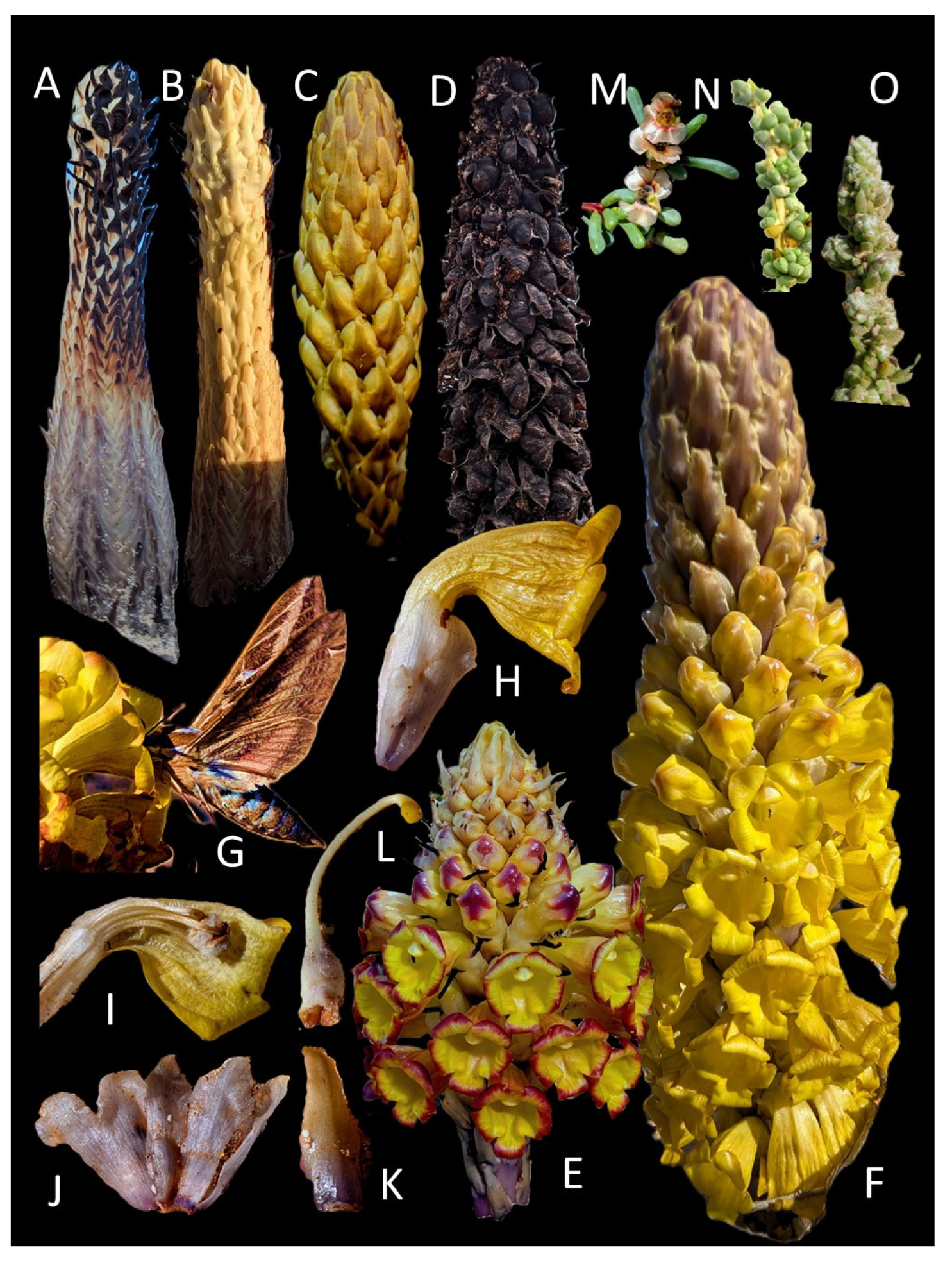
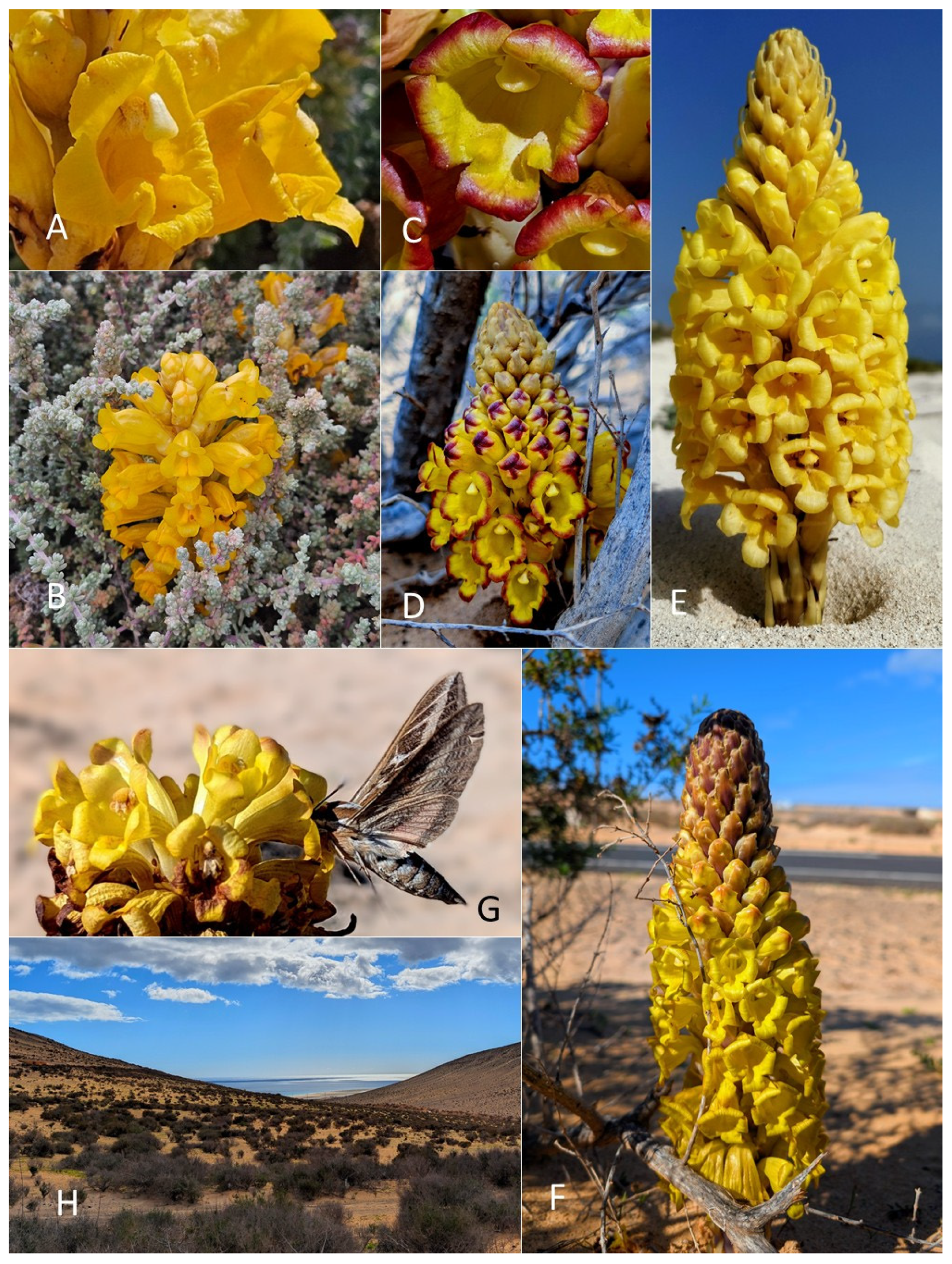
Plants in the genus Cistanche Hoffmanns. & Link (Orobanchaceae) occur in deserts, dunes and saltmarshes from Macaronesia in the West to China and Mongolia in the East [8]. They are parasitic on the roots of (mainly) halophytic shrubs (Figure 1). These plants produce conspicuous, often brightly coloured inflorescences which have earned them the common name ‘desert hyacinths’ [8]. The fleshy underground stems of Cistanche have been a source of traditional food and medicine across the Eurasian continent for centuries or even millennia [8]. Despite this, the genus is subject to considerable confusion, and the taxonomy inconsistently applied [8]. Confusion in Cistanche is a consequence of reduced morphological features hindering identification in the field, poor preservation in herbaria, and the inconsistent application of names. A stabilised taxonomy is needed to enable research into the ecology and conservation of Cistanche. The first phylogenetic assessment of the genus identified three geographically defined clades in East Asia, Northwest Africa and Southwest Asia, together with a ‘widespread clade’ in which phylogenetic resolution was low [9]. Type specimens were largely missing from this work, so how names are to be applied to the plants sequenced remains open to debate. Spanish plants from the mainland and the Canary Islands were unresolved; in the literature, these plants have traditionally been assigned the name Cistanche phelypaea (L.) Cout. [10] or C. lutea (Desf.) Hoffmanns. & Link [11] or these names in combination: C. phelypaea subsp. lutea (Desf.) Fern. Casas & M. Lainz [12]. The application of different names to mainland and Canary Island plants recognises the plants’ differing ecologies and distributions [13]. The mainland Spanish plant occurs in semi-deserts and has creamy, sometimes purple-tinted flowers; this entity has also been named C. violacea (Desf.) Hoffmanns. & Link [14]—an epithet originally applied to purple plants from Tunisia. By contrast, the Atlantic, bright yellow or sometimes purple-edged (Figure 2B) flowered plant known as C. phelypaea—of which the type was described from Portugal—is coastal or intertidal (sometimes submerged by seawater). Based on morphology, geography and ecology, it seems likely that C. phelypaea s.s. extends along the Moroccan Atlantic littoral and into Macaronesia, including the Canary Islands (Figure 2), south to Cape Verde. As recognised by previous authors [12], records east of this region should be treated with caution in the absence of a detailed comparison with a further yellow entity, traditionally referred to as C. tubulosa (Schenk) Hook and widely considered to be a Middle Eastern plant [15].
A recently completed Hyb-Seq-based phylogenomic analysis (Hawkins et al., in rev.) recovered the same widespread clade as Ataei et al. [9]; however, unfortunately, the DNA of specimens from Atlantic populations was not recoverable. Plants sourced from the Canary Islands in the work of Ataei et al. were named C. phelypaea subsp. phelypaea or C. aff. lutea even though their sequences appear in the same poorly resolved ‘widespread clade’. Moreover, because we can find no evidence that more than one Cistanche species exists in the Canary Islands, we continue to refer to plants on the islands exclusively as C. phelypaea (the priority name for Atlantic plants, with a basionym of 1753).
Regarding ecology, little in the way of data exists for most species, irrespective of taxonomic issues. Cistanche phelypaea grows exclusively in or near coastal habitats, differentiating it from related species which mainly grow in true deserts (the similar Middle Eastern species, C. tubulosa, for example). Genus-wide, Cistanche is reported to parasitise a range of families across its range, especially the Amaranthaceae (incl. ex-Chenopodiaceae) and Polygonaceae, less often the Fabaceae, Zygophyllaceae, Tamaricaceae, Rosaceae, Nitrariaceae, and Salvadoraceae [9]. Cistanche phelypaea is reported to grow on Amaranthaceae and, to a lesser extent, Plumbaginaceae [12,14]. It is not always obvious which host species is parasitised in mixed vegetation, so without excavation, all records should be treated with caution.
Here, we present the results of a 7-year qualitative survey of C. phelypaea across its range in the Canary Islands, where surprisingly little information has been recorded regarding the plant’s ecology. Our aims are (i) to bridge this knowledge gap in Cistanche ecology and to inform future conservation practice for this rare and elusive plant and (ii) inspire parasitic plant conservation more broadly.

2. Methods

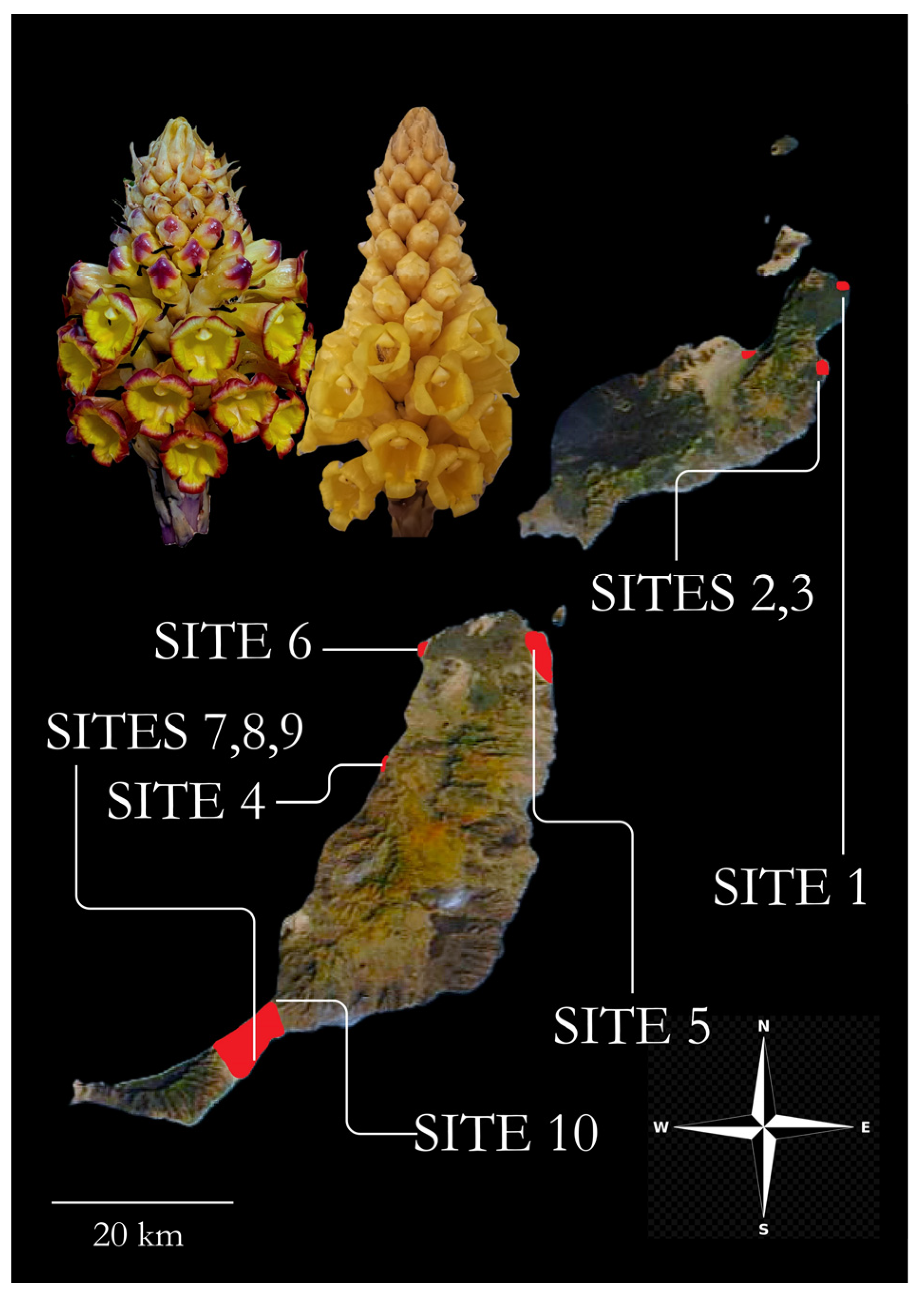
We examined subpopulations across 10 locations in Lanzarote and Fuerteventura, covering the known distribution of Cistanche in the Canary Islands (for dates and locations, see Table 1 and Figure 3). These islands are characterised by an arid to semi-arid climate, with a mean annual precipitation of c. 98 mm in Fuerteventura and 111 mm in Lanzarote (Agencia Estatal de Meteorología, AEMET), high solar radiation, and a strong influence of winds, particularly in coastal areas. Plant communities are dominated by xerophytic shrub and halophytic vegetation, including coastal halophytic and inland communities adapted to dry, sandy or volcanic substrates.
Because it was impossible to record all plants in all places at all times, we prioritised surveying during the peak flowering season from December to March. Because spikes of Cistanche are conspicuous and typically appear in December and the infructescences persist for months, it is unlikely that we would have missed the plant if it was present; nevertheless, due to logistical constraints, we were unable to accurately record host or parasite abundance. To record host specificity, we considered all woody Amaranthaceae (ex-Chenopodiaceae) to be potential hosts based on records in the literature (see Discussion). Because Cistanche spp. are obligate root parasites forming direct haustorial connections with a single host’s roots, parasites must occur within the potential rooting zone of the host. As destructive excavation was unfeasible, host presence was inferred using a fixed-radius proximity criterion. Woody Amaranthaceae produce discrete, localised root systems in arid environments; given that there is no published threshold for these plants, we considered a radius of 3 m2 to be a conservative and ecologically reasonable field-based proxy for potential host association. Due to the mosaic nature of host communities (overlapping canopies), it was beyond the scope of this study to count individual hosts as units. Inferred host–parasite interactions were then analysed and plotted using the networkx package Version 3.4.2 in Python (see link below) to present a visual summary of site-level co-occurrence between C. phelypaea populations and potential and inferred host species.

3. Results

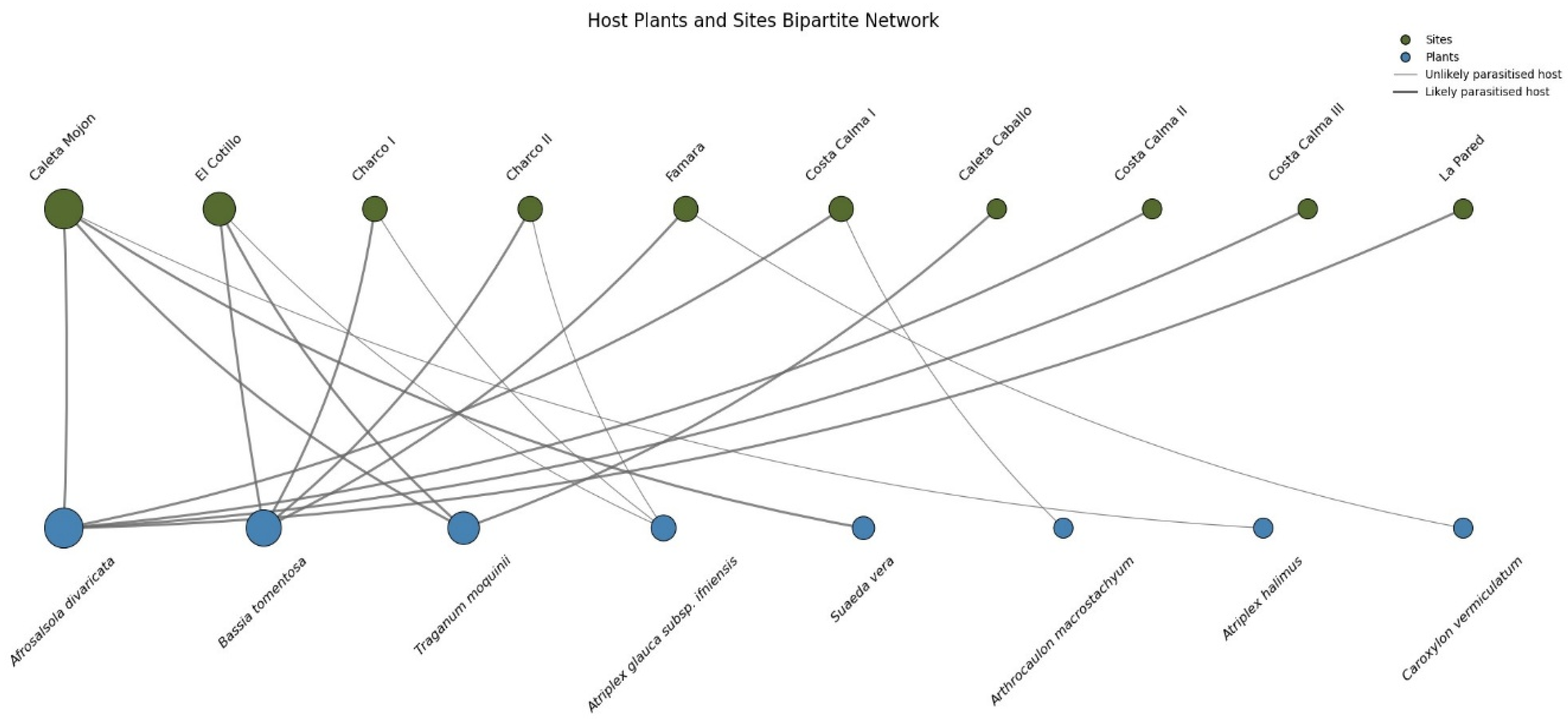
Our observations of C. phelypaea at 10 locations over 7 seasons revealed 4 inferred host species but an uneven association across these hosts (Figure 4): Afrosalsola divaricata (Masson ex Link) Akhani, Bassia tomentosa (Lowe) Maire & Weiller, Suaeda vera Forssk. ex J.F.Gmel., and Traganum moquinii Webb ex Moq. (Figure 1M–O). A further four species, Arthrocaulon macrostachyum (Moric.) Piirainen & G.Kadereit, Atriplex glauca subsp. ifniensis (Caball.) Rivas Mart. et al., Atriplex halimus L. and Caroxylon vermiculatum (L.) Akhani & Roalson, co-occurred with the parasite, but we found no evidence that these potential hosts were ever infected. Only at two sites (Caleta del Mojón, Lanzarote and El Cotillo, Fuerteventura) were multiple host species inferred to be infected (Table 1). Afrosalsola divaricata was inferred to be parasitised whenever it co-occurred with the parasite, at 5 of the 10 sites: this appears to be the dominant host species on the islands.

4. Discussion

4.1. Host Specificity and Distribution

As a genus, Cistanche is reported to parasitise various families across its range, especially Amaranthaceae (inc. ex-Chenopodiaceae), Zygophyllaceae, Tamaricaceae and Plumbaginaceae. Cistanche phelypaea has been reported to grow on various hosts, including Atriplex halimus R.Br., A. portulacoides L., and Suaeda vera Forssk. ex J.F.Gmel. and Salicornia fruticosa (L.) L., in Portugal—the country of the type locality [12,16]. All of these are shrubby Amaranthaceae. Limoniastrum monopetalum (L.) Boiss. and Limonium algarvense Erben in the Plumbaginaceae [12] have also been reported; various other hosts have been named in association with this species, including Arthrocnemum macrostachyum (Moric.) K.Koch (≡Arthrocaulon macrostachyum (Moric.) Piirainen & G.Kadereit) [17] and Tamarix aphylla (L.) H.Karst. [18]; however, in these cases, the records correspond to the similar Middle Eastern species, C. tubulosa (again, reinforcing the need for stabilised taxonomy). Together these records suggest that (i) multiple hosts may be parasitised by C. phelypaea but also that (ii) records may be an artefact of confused taxonomy in the genus, so they need to be interpreted with caution.
Our own observations show that more than one host species is parasitised by C. phelypaea in the Canary Islands and indicate that at least four hosts may be parasitised, all of which are woody Amaranthaceae. This suggests a high degree of specificity at the family level. A further four species of woody Amaranthaceae co-occurred with the parasite, but we found no evidence that these were infected; this also indicates a degree of specificity at the generic level. Nevertheless, at one site in Lanzarote, three inferred hosts were recorded; moreover, seeds collected from plants parasitising Bassia tomentosa in Charco del Palo were planted on a cultivated specimen of Suaeda fruticosa Forssk. ex J.F.Gmel. and successfully established and produced flowering spikes in Oxford. While it falls outside the scope of this study to report the details of this trial, the fact that seeds were collected from one host genus and grew on another (not even present on the islands) shows irrefutably that the parasite can infect more than one genus. Taken together, this suggests that C. phelypaea is able to infect a broad range of woody hosts in the Amaranthaceae and can shift genus; however, parasitism does not extend to all woody species in this family. All C. phelypaea populations were found in coastal stations, mainly on sand dunes, and, to a lesser extent, near seasonally dry salt marshes. We examined inland sand flats (jables) following anecdotal evidence that C. phelypaea occurs near Lajares; however, we found no evidence of the parasite occurring there.
An important limitation of our study is the lack of confirmed evidence of host–parasite interactions by excavation. It is not feasible (nor desirable) to dig up hundreds of plants, especially when they are ecologically sensitive. Given Cistanche is only known to grow on woody hosts and its well-established affinity for Amaranthaceae, we are confident that our observations are sound; nevertheless, at six of the sites, multiple Amaranthaceae hosts were present, and it is possible that overlapping roots extended beyond the conservative 3 m2 radius we defined as the rhizosphere. For this reason, our results should be considered with some caution. Notwithstanding, the data show irrefutably that the plant parasitises multiple hosts across the islands: at sites 8–10, the plant was inferred to grow on Afrosalsola divaricata, which was absent at sites 2–6, where conversely, it grew on Bassia tomentosa and or Traganum moquinii, which were both absent from sites 8–10.
Our data point to a pattern of host specificity varying across the plant’s range on a small archipelago. A useful next step in understanding the distribution of C. phelypaea would be the application of species distribution models (SDMs) to frame our observations in a broader spatial context. SDMs are widely used to relate species occurrences to environmental variables and predict suitable habitats across landscapes [19]. In this system, such models could be particularly informative because the distribution of C. phelypaea appears to be constrained not only by abiotic factors associated with coastal environments (e.g., aridity, substrate, and proximity to the shoreline), but also by the presence and composition of suitable host species. A conceptual SDM framework for C. phelypaea would therefore integrate both abiotic predictors and biotic constraints. Environmental variables describing climate, coastal exposure, and substrate could be combined with spatial data on the distribution of woody Amaranthaceae hosts identified here. Presence-only modelling approaches such as maximum entropy (MaxEnt) are particularly well suited to systems such as this, where reliable absence data are unavailable [20,21]. Host availability could be incorporated either in the form of predictor variables or as a spatial mask defining the accessible niche of the parasite. Such an approach would allow explicit testing of whether the observed distribution of C. phelypaea is primarily explained by environmental conditions alone or whether incorporating host distributions significantly improves predictive performance.
Importantly, our observations suggest that host identity varies across sites within the archipelago, raising the possibility that different host associations may be linked to local environmental conditions. SDMs could therefore be used to explore whether subpopulations associated with different hosts occupy distinct portions of environmental space or whether host switching occurs within a shared abiotic niche. This would provide a quantitative framework for interpreting the spatial variability in host specificity documented here. More broadly, there is increasing recognition that biotic interactions can play a critical role in shaping realised species distributions, yet they remain underrepresented in most SDM applications [22].
Although the number of occurrence records currently available is limited, the integration of SDMs with targeted future surveys offers a promising route for scaling up from site-level observations to island-wide inference. Even preliminary models could help identify unsurveyed areas of potentially suitable habitat, guide field efforts, and support conservation planning by highlighting regions where suitable environmental conditions and host availability coincide. Such approaches also offer the potential to project future changes in habitat suitability under shifting environmental conditions [23], which may be particularly relevant for a species restricted to narrow coastal habitats subject to increasing anthropogenic pressure. More broadly, this system presents an opportunity to develop modelling approaches that explicitly incorporate biotic interactions, thereby improving both predictive performance and ecological realism.

4.2. Observations on Reproductive Ecology and Life Cycle

All Cistanche species produce spikes with tubular, often brightly coloured and/or fragrant flowers that are attractive to insects. During our 7-year survey, we observed a putative pollinator only once (possibly due to strong prevailing winds): a day-flying striped hawk moth (Hyles livornica) visiting a specimen of C. phelypaea growing at El Cotillo, Fuerteventura, in December 2024 (Figure 1G and Figure 2G). The insect visited multiple flowers on two spikes and appeared to be feeding on the nectar and cross-pollinating. We also observed small black Diptera (species unknown) visiting the flowers, which were too small to be viable pollinating agents. These visitors did not appear to be feeding on the plants. We observed a conspicuous fragrance in all specimens of C. phelypaea at anthesis, which was particularly apparent in the evening; coupled with our isolated observation of Hyles livornica, moths are a possible pollinator on the islands.
Studies on the floral visitors of Cistanche are scant. Bees, flies and beetles have been observed visiting these plants in Egypt [24] and China [25], of which bees are the predominant pollinating agent—consistent with pollination in other genera in the Orobanchaceae. It has been suggested that the bright yellow folds of Cistanche flowers in Spain might act as ‘false anthers’ in which inexpert bees, in their efforts to collect pollen, brush against the (true) hairy anthers [12,26]—a strategy that is particularly common in harsh environments, including deserts [27]. Work shows that Cistanche taxa differ in their petal morphology (such as corolla folds) and micromorphology (such as striations), as well as coloration, which may drive divergences in pollination biology [12]. Cistanche deserticola in China is suggested to be mainly selfing [25]. Despite the lack of floral visitors, we observed a high seed-set in C. phelypaea. Further work should determine the mating system of C. phelypaea in the Canary Islands through emasculation, bagging and controlled pollination studies.
Our observations indicate a possible spatial variation in flowering phenology. We observed a peak in inflorescence emergence and anthesis between December and February in populations on Traganum moquinii and Afrosalsola divaricata, while those on Bassia tomentosa appear to peak between March and April, regardless of year or rainfall. While this temporal differentiation may reflect differences in host phenology and physiology, host development is inherently influenced by environmental factors such as temperature, light availability and soil moisture. Therefore, the observed shift may be driven by an interaction between host-specific traits and local environmental conditions rather than by host identity alone. Differences in water relations, or resource allocation among host species under varying microhabitats may influence the timing of resource transfer to the parasite and consequently its reproductive phenology. Further work should explicitly quantify both host phenology and environmental variables to identify their relative contributions to parasite flowering dynamics. Full details of temperature and rainfall are included in the Supplementary Data.

4.3. Considerations for Conservation

In the Canary Islands, Cistanche phelypaea is found only in the east, where populations are sparse (Figure 3). In the absence of population trends and exact areas of occupancy, we do not provide a formal conservation assessment but discuss considerations in light of our observations. The largest population we documented lies in Charco del Palo II, Lanzarote, with the inferred host, Bassia tomentosa (Atriplex glauca subsp. ifniensis was also present but with no evidence of infection). Here, we documented 147 specimens in February 2026; the whole population is likely to be far larger. This population would be a suitable candidate for future work to quantify population dynamics. Another extensive population exists in Jandía, Fuerteventura, where the plant is scattered across much of the isthmus; it is particularly frequent in the Costa Calma area along roadsides and near buildings; here, the plant appears to exclusively parasitise Afrosalsola divaricata (Arthrocaulon macrostachyum was the only other available potential host we documented). An expansion of the road network here in the last decade does not appear to have suppressed the population—it may even have increased it (for reasons relating to disturbance, explained below)—a hypothesis that would require a dedicated study to test it. In the related genus Orobanche, artificial disturbance can facilitate host root–parasite contact, even in regionally rare species [28]. The seeds of Orobanche can remain viable for decades [29], and the same may be true of Cistanche—meaning that disturbance can activate long-dormant seeds. This is because in Orobanchaceae, germination is triggered by host-derived cues called strigolactones and requires close proximity of parasite seeds to host roots, followed by haustorial attachment and vascular connection [30]. Soil (or sand) disturbance can increase infection rates by redistributing seeds and enhancing contact with host root systems [31]. Nevertheless, the requirement for a host population adds an increased sensitivity that must be considered, particularly in the context of development of the touristic coastal areas which are a stronghold for this species. We suggest that future conservation of this species could consider the four inferred hosts we have documented; encouraging these would appear to be an appropriate course of mitigation should a population be threatened by future development activity. In addition to the integration of SDMs with targeted future surveys, a robust conservation management plan should be informed by parasite establishment success, host compatibility across sites, germination requirements, demographic consequences, and restoration feasibility. Our observations lay the groundwork for this future work.

Supplementary Materials

The following supporting information can be downloaded at https://www.mdpi.com/article/10.3390/ecologies7020037/s1. File S1: Average temperature per month (°C) and average rainfall per month (mm).

Author Contributions

Conceptualization, C.J.T.; methodology, C.J.T. and M.H.-G.; software, H.C.; validation, C.J.T.; formal analysis, C.J.T. and H.C.; investigation, M.H.-G.; resources, M.H.-G.; data curation, C.J.T.; writing—original draft preparation, C.J.T. and M.H.-G.; writing—review and editing, M.H.-G., H.C. and C.J.T.; visualization, H.C.; supervision, C.J.T.; project administration, C.J.T. All authors have read and agreed to the published version of the manuscript.

Funding

This research received no external funding.

Data Availability Statement

The original data presented in this study are openly available in Zenodo at https://doi.org/10.5281/zenodo.19469034.

Acknowledgments

We are grateful to Mónica Pérez-Gil and Anaïs Marie Michel for their valuable recommendations regarding some of the sites examined.

Conflicts of Interest

The authors declare no conflict of interest.

References

  1. Nickrent, D.L. Parasitic angiosperms: How often and how many? Taxon 2020, 69, 5–27. [Google Scholar] [CrossRef]
  2. Teixeira-Costa, L. A living bridge between two enemies: Haustorium structure and evolution across parasitic flowering plants. Braz. J. Bot. 2021, 44, 165–178. [Google Scholar] [CrossRef]
  3. Thorogood, C.J.; Teixeira-Costa, L.; Ceccantini, G.; Davis, C.; Hiscock, S.J. Endoparasitic plants and fungi show evolutionary convergence across phylogenetic divisions. New Phytol. 2021, 232, 1159–1167. [Google Scholar] [CrossRef]
  4. Těšitel, J.; Li, A.-R.; Knotková, K.; McLellan, R.; Bandaranayake, P.C.G.; Watson, D.M. The bright side of parasitic plants: What are they good for? Plant Physiol. 2021, 185, 1309–1324. [Google Scholar] [CrossRef] [PubMed]
  5. Wells, K.; Clark, N.J. Host specificity in variable environments. Trends Parasitol. 2019, 35, 452–465. [Google Scholar] [CrossRef]
  6. Thorogood, C.J.; Hiscock, S.J. Compatibility interactions at the cellular level provide the basis for host specificity in the parasitic plant Orobanche. New Phytol. 2010, 186, 571–575. [Google Scholar] [CrossRef]
  7. Hatt, S.A.; Grace, O.M.; Zuntini, A.R.; Cameron, D.D.; Thorogood, C.J. Parasitic plants show striking convergence in host preference across angiosperm lineages. Ann. Bot. 2025, 135, 1135–1146. [Google Scholar] [CrossRef]
  8. Thorogood, C.J.; Leon, C.J.; Lei, D.; Aldughayman, M.; Huang, L.-F.; Hawkins, J.A. Desert hyacinths: An obscure solution to a global problem? Plants People Planet 2021, 3, 302–307. [Google Scholar] [CrossRef]
  9. Ataei, N.; Schneeweiss, G.M.; García, M.A.; Krug, M.; Lehnert, M.; Valizadeh, J.; Quandt, D. A multilocus phylogeny of the non-photosynthetic parasitic plant Cistanche (Orobanchaceae) refutes current taxonomy and identifies four major morphologically distinct clades. Mol. Phylogenetics Evol. 2020, 151, 106898. [Google Scholar] [CrossRef]
  10. González-Montelongo, C.; León, C.; Reyes-Betancort, J.A.; Ramón, J. Plantas vasculares de Macaronesia, excepto Canarias, en el Herbario TFC. Sci. Insul. 2020, 3, 89–116. [Google Scholar] [CrossRef]
  11. Fernández, A.; Santos, A. La vegetación del litoral de Canarias, I. Arthrocnemetea. Lazaroa 1983, 5, 143–155. [Google Scholar]
  12. Piwowarczyk, R.; Carlón, L.; Kasińska, J.; Tofil, S.; Furmańczyk, P. Micromorphological intraspecific differentiation of nectar guides and landing platform for pollinators in the Iberian parasitic plant Cistanche phelypaea (Orobanchaceae). Bot. Lett. 2016, 163, 47–55. [Google Scholar] [CrossRef]
  13. Fernández Casas, J.; Laínz, M. Sobre Cistanche phelypaea (L.) P. Cout. Anu. Soc. Broteriana 1973, 39, 129–130. [Google Scholar]
  14. Ramos-Gutiérrez, I.; Lima, H.; Pajarón, S.; Romero-Zarco, C.; Sáez, L.; Pataro, L.; Molina-Venegas, R.; Rodríguez, M.Á.; Moreno-Saiz, J.C. Atlas of the vascular flora of the Iberian Peninsula. In Flora Iberica; Real Jardín Botánico, CSIC: Madrid, Spain, 2021. [Google Scholar]
  15. Aldughayman, M.; Thorogood, C.J.; Hawkins, J.A. Neotypification of Cistanche tubulosa (Schenk) Wight ex Hook.f.: A name applied to a widely distributed, polyphyletic group of plants. Phytotaxa 2024, 633, 9–16. [Google Scholar] [CrossRef]
  16. Sociedade Portuguesa de Botânica. Flora-On: Flora de Portugal Interactiva; Sociedade Portuguesa de Botânica: Lisboa, Portugal; Available online: www.flora-on.pt (accessed on 4 February 2026).
  17. Fahmy, G.M. Ecophysiology of the holoparasitic angiosperm Cistanche phelypaea (Orobanchaceae) in a coastal salt marsh. Turk. J. Bot. 2013, 37, 908–919. [Google Scholar] [CrossRef]
  18. Abou-Raya, M.A.; El-Sharkawy, M.A.; El-Taifie, A. Host–parasite relationship in Cistanche spp. Hoffmgg. et Link. Libyan J. Agric. 1981, 10, 11–23. [Google Scholar]
  19. Elith, J.; Leathwick, J.R. Species distribution models: Ecological explanation and prediction across space and time. Annu. Rev. Ecol. Evol. Syst. 2009, 40, 677–697. [Google Scholar] [CrossRef]
  20. Phillips, S.J.; Anderson, R.P.; Schapire, R.E. Maximum entropy modeling of species geographic distributions. Ecol. Model. 2006, 190, 231–259. [Google Scholar] [CrossRef]
  21. Elith, J.; Phillips, S.J.; Hastie, T.; Dudík, M.; Chee, Y.E.; Yates, C.J. A statistical explanation of MaxEnt for ecologists. Divers. Distrib. 2011, 17, 43–57. [Google Scholar] [CrossRef]
  22. Wisz, M.S.; Hijmans, R.J.; Li, J.; Peterson, A.T.; Graham, C.H.; Guisan, A. The role of biotic interactions in shaping distributions and realised assemblages of species: Implications for species distribution modelling. Biol. Rev. 2013, 88, 15–30. [Google Scholar] [CrossRef]
  23. Pearson, R.G.; Dawson, T.P. Predicting the impacts of climate change on the distribution of species: Are bioclimateenvelope models useful? Glob. Ecol. Biogeogr. 2003, 12, 361–371. [Google Scholar] [CrossRef]
  24. Aboul-Enein, A.M.; Shalaby, E.A.; Abul-Ela, F.; El-Shemy, H.A. Traditional medicinal plants research in Egypt: Studies of antioxidant and anticancer activities. J. Med. Plants Res. 2012, 6, 689–703. [Google Scholar]
  25. Song, Y.-X.; Guo, S.-H.; Niu, D.-L.; Zheng, G.-Q.; Ma, H.-A.; Li, M. A study on breeding system of the endangered plant Cistanche deserticola. Bull. Bot. Res. 2008, 28, 278–282. [Google Scholar]
  26. Lunau, K. Stamens and mimic stamens as components of floral colour patterns. Bot. Jahrb. Syst. 2006, 127, 13–41. [Google Scholar] [CrossRef]
  27. Herberstein, M.E.; Baldwin, H.J.; Gaskett, A.C. Deception down under: Is Australia a hot spot for deception? Behav. Ecol. 2014, 25, 12–16. [Google Scholar] [CrossRef][Green Version]
  28. Thorogood, C.J.; Rumsey, F.J. The shifting ecology and distribution of one of Britain’s rarest plants: Orobanche picridis (Orobanchaceae). Br. Ir. Bot. 2023, 5, 303–319. [Google Scholar]
  29. Parker, C.; Riches, C.R. Parasitic Weeds of the World: Biology and Control; CAB International: Wallingford, UK, 1993. [Google Scholar]
  30. Cook, C.E.; Whichard, L.P.; Turner, B.; Wall, M.E.; Egley, G.H. Germination of witchweed (Striga lutea Lour.): Isolation and properties of a potent stimulant. Science 1966, 154, 1189–1190. [Google Scholar] [CrossRef]
  31. Parker, C. The parasitic weeds of the Orobanchaceae: Biology and control. Prog. Bot. 2013, 74, 69–132. [Google Scholar] [CrossRef]
Figure 1. The life cycle and morphology of C. phelypaea. (AC) Immature specimens excavated from sand. (D) Infructescence. (E) Purple-edged form typical of the population in Costa Calma, Fuerteventura. (F) Pure yellow form. (G) Day-flying striped hawk moth (Hyles livornica) visiting C. phelypaea. (H) Corolla in profile. (I) Corolla cross section. (J) Calyx. (K) Bract. (L) Pistil. (MO) Inferred hosts: Atriplex glauca subsp. ifniensis; Afrosalsola divaricata; Traganum moquinii; Bassia tomentosa.
Ecologies 07 00037 g001
Figure 2. (A,B) Specimens inferred to parasitise Bassia tomentosa in Charco del Palo, Lanzarote. (C,D) Purple-edged form growing in Costa Calma, Fuerteventura. (E) Pure yellow form growing in Caleta del Mojón, Lanzarote. (F) Plant growing in a semi-ruderal environment in Costa Calma, Fuerteventura. (G) A day-flying striped hawk moth (Hyles livornica) visiting C. phelypaea growing at El Cotillo, Fuerteventura. (H) Typical coastal sand dune habitat of C. phelypaea in Costa Calma, Fuerteventura.
Ecologies 07 00037 g002
Figure 3. Sites examined corresponding to those listed with precise locations in Table 1. Areas in red indicate the known distribution of Cistanche phelypaea (which overlap with sand dunes and sand flats). Cut-outs show phenotypes from Fuerteventura (left: Site 7) and Lanzarote (right: Site 1). Map courtesy of Nasa Worldview.
Ecologies 07 00037 g003
Figure 4. A co-occurrence network of candidate hosts and sites illustrating associations between potential host species (down) and surveyed populations (up). Links indicate the presence of an inferred host species at a given site. Node width is proportional to the number of associations recorded.
Ecologies 07 00037 g004
Table 1. Inferred hosts assessed across the 10 populations/subpopulations. Crosses indicate that a potential host is present at the site examined; crosses in bold indicate a likely (‘inferred’) parasitised host (the species was present within a 3 m2 radius of the parasite).
Potential HostLocation of Subpopulation, with Year of Assessment Indicated
SITE 1: 29.204119, −13.424530.
Caleta del Mojón, Lanzarote (2020, 2021, 2022, 2023, 2024, 2025, 2026)
SITE 2: 29.082328, −13.451892.
Charco del Palo I, Lanzarote (2020, 2021, 2022, 2023, 2024, 2025, 2026)
SITE 3: 29.092336, −13.451531.
Charco del Palo II, Lanzarote (2026)
SITE 4: 28.570348, −14.048063.
Jarugo, Fuerteventura (2026)
SITE 5: 28.715150, −13.861435.
Corralejo, Fuerteventura (2026)
SITE 6: 28.687338, −14.012990.
El Cotillo, Fuerteventura (2024, 2025, 2026)
SITE 7: 28.158884, −14.232199.
Costa Calma I, Fuerteventura (2024, 2025)
SITE 8: 28.150225, −14.243602.
Costa Calma II, Fuerteventura (2024, 2025)
SITE 9: 28.147713, −14.251119.
Costa Calma III, Fuerteventura (2024, 2025)
SITE 10. 28.191983, −14.238874
La Pared, Fuerteventura (2024)
Afrosalsola divaricatax xxxx
Arthrocaulon macrostachyum x
Atriplex glauca subsp. ifniensis xx x
Atriplex halimusx
Bassia tomentosa xx xx
Caroxylon vermiculatum x
Suaeda verax
Traganum moquiniix x x
Disclaimer/Publisher’s Note: The statements, opinions and data contained in all publications are solely those of the individual author(s) and contributor(s) and not of MDPI and/or the editor(s). MDPI and/or the editor(s) disclaim responsibility for any injury to people or property resulting from any ideas, methods, instructions or products referred to in the content.