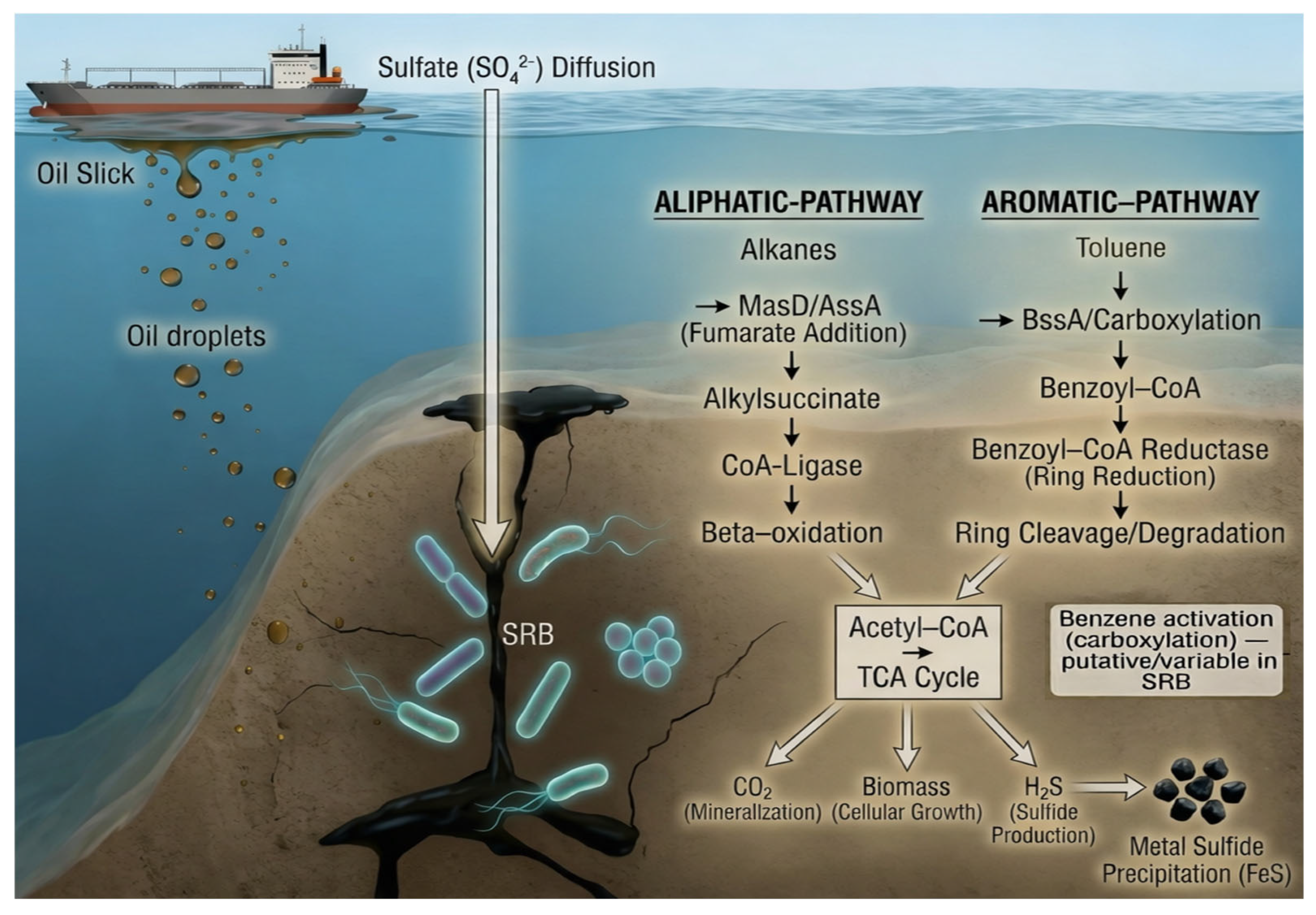

Diversity of Culturable Sulfate-Reducing Bacterial Consortia and Species Capable of Hydrocarbon Degradation Isolated from Marine Environments


Abstract
1. Introduction
2. Anaerobic Alkane Degradation by SRB: Mechanisms, Enzymes, and Syntrophic Partnerships
2.1. Alkane Activation Mechanisms in SRB
2.2. Key Enzymes for Anaerobic Alkane Degradation and Their Distribution
2.3. Syntrophic Interactions Between SRB and Archaea
2.4. Phylogenetic Diversity of Hydrocarbon-Degrading Marine SRB
3. Features of Anaerobic Degradation of Polycyclic Aromatic Hydrocarbons
3.1. Mechanisms of PAH Activation in SRB
3.2. Pathways of Naphthalene and Methylnaphthalene Degradation
3.3. Key Enzymes in Alkylaromatic Hydrocarbon Degradation
3.4. Phylogenetic Diversity and Metabolic Specialization of Aromatic-Degrading SRB
4. The Role of Sulfate-Reducing Bacteria in Bioremediation
5. Discussion
Supplementary Materials
Author Contributions
Funding
Institutional Review Board Statement
Informed Consent Statement
Data Availability Statement
Conflicts of Interest
References
- Jørgensen, B.B.; Findlay, A.J.; Pellerin, A. The biogeochemical sulfur cycle of marine sediments. Front. Microbiol. 2019, 10, 849. [Google Scholar] [CrossRef] [PubMed]
- Beilig, S.; Voskuhl, L.; Geydirici, I.; Tintrop, L.K.; Schmidt, T.C.; Meckenstock, R.U. Coexistence of methanogenesis and sulfate reduction in a sulfate-adapted enrichment culture from an oil reservoir. Appl. Environ. Microbiol. 2025, 91, e0014125. [Google Scholar] [CrossRef] [PubMed]
- Wasmund, K.; Mußmann, M.; Loy, A. The life sulfuric: Microbial ecology of sulfur cycling in marine sediments. Environ. Microbiol. Rep. 2017, 9, 323–344. [Google Scholar] [CrossRef] [PubMed]
- Sekerci, F.; Fischer, S.; Joshi, P.; Peiffer, S.; Kappler, A.; Mansor, M. Sulfur microenvironments as hotspots for biogenic pyrite formation. Sci. Rep. 2025, 15, 20148. [Google Scholar] [CrossRef]
- Kleindienst, S.; Knittel, K. Anaerobic hydrocarbon-degrading sulfate-reducing bacteria at marine gas and oil seeps. In Microbial Communities Utilizing Hydrocarbons and Lipids: Members, Metagenomics and Ecophysiology; McGenity, T.J., Ed.; Springer International Publishing: Cham, Switzerland, 2020; pp. 21–41. [Google Scholar] [CrossRef]
- Kleindienst, S.; Polerecky, L.; Amann, R.; Musat, F.; Knittel, K. In situ metabolic rates of alkane-degrading sulphate-reducing bacteria in hydrocarbon seep sediments revealed by combining CARD-FISH, NanoSIMS, and mathematical modelling. Environ. Microbiol. 2025, 27, e70151. [Google Scholar] [CrossRef]
- Galushko, A.; Minz, D.; Schink, B.; Widdel, F. Anaerobic degradation of naphthalene by a pure culture of a novel type of marine sulphate-reducing bacterium. Environ. Microbiol. 1999, 1, 415–420. [Google Scholar] [CrossRef]
- Zhang, C.; Meckenstock, R.U.; Weng, S.; Wei, G.; Hubert, C.R.J.; Wang, J.H.; Dong, X. Marine sediments harbor diverse archaea and bacteria with the potential for anaerobic hydrocarbon degradation via fumarate addition. FEMS Microbiol. Ecol. 2021, 97, fiab045. [Google Scholar] [CrossRef]
- King, G.E.; Durham, D. Chapter Ten—Hydrocarbon Emissions: Anthropogenic and Natural Sources. In Advances in Chemical Pollution, Environmental Management and Protection; Schug, K.A., Hildenbrand, Z.L., Eds.; Elsevier: Amsterdam, The Netherlands, 2017; Volume 1, pp. 257–274. [Google Scholar] [CrossRef]
- Xu, X.; Liu, W.; Tian, S.; Wang, W.; Qi, Q.; Jiang, P.; Gao, X.; Li, F.; Li, H.; Yu, H. Petroleum hydrocarbon-degrading bacteria for the remediation of oil pollution under aerobic conditions: A perspective analysis. Front. Microbiol. 2018, 9, 2885. [Google Scholar] [CrossRef]
- Abbasian, F.; Lockington, R.; Mallavarapu, M.; Naidu, R. A comprehensive review of aliphatic hydrocarbon biodegradation by bacteria. Appl. Biochem. Biotechnol. 2015, 176, 670–699. [Google Scholar] [CrossRef]
- Kniemeyer, O.; Musat, F.; Sievert, S.M.; Knittel, K.; Wilkes, H.; Blumenberg, M.; Michaelis, W.; Classen, A.; Bolm, C.; Joye, S.B.; et al. Anaerobic oxidation of short-chain hydrocarbons by marine sulphate-reducing bacteria. Nature 2007, 449, 898–901. [Google Scholar] [CrossRef]
- Chen, S.C.; Musat, N.; Lechtenfeld, O.J.; Paschke, H.; Schmidt, M.; Said, N.; Popp, D.; Calabrese, F.; Stryhanyuk, H.; Jaekel, U.; et al. Anaerobic oxidation of ethane by archaea from a marine hydrocarbon seep. Nature 2019, 568, 108–111. [Google Scholar] [CrossRef] [PubMed]
- Hahn, C.J.; Laso-Pérez, R.; Vulcano, F.; Vaziourakis, K.-M.; Stokke, R.; Steen, I.H.; Teske, A.; Boetius, A.; Liebeke, M.; Amann, R.; et al. “Candidatus Ethanoperedens,” a thermophilic genus of archaea mediating the anaerobic oxidation of ethane. mBio 2020, 11, 10-1128. [Google Scholar] [CrossRef] [PubMed]
- Rabus, R.; Boll, M.; Heider, J.; Meckenstock, R.U.; Buckel, W.; Einsle, O.; Ermler, U.; Golding, B.T.; Gunsalus, R.P.; Kroneck, P.M.; et al. Anaerobic Microbial Degradation of Hydrocarbons: From Enzymatic Reactions to the Environment. J. Mol. Microbiol. Biotechnol. 2016, 26, 5–28. [Google Scholar] [CrossRef] [PubMed]
- Mbadinga, S.M.; Wang, L.Y.; Zhou, L.; Liu, J.F.; Gu, J.D.; Mu, B.Z. Microbial communities involved in anaerobic degradation of alkanes. Int. Biodeterior. Biodegrad. 2011, 65, 1–13. [Google Scholar] [CrossRef]
- Callaghan, A.V.; Tierney, M.; Phelps, C.D.; Young, L.Y. Anaerobic Biodegradation of n-Hexadecane by a Nitrate-Reducing Consortium. Appl. Environ. Microbiol. 2009, 75, 1339–1344. [Google Scholar] [CrossRef]
- Heider, J.; Szaleniec, M.; Sünwoldt, K.; Boll, M. Ethylbenzene dehydrogenase and related molybdenum enzymes involved in oxygen-independent alkyl chain hydroxylation. J. Mol. Microbiol. Biotechnol. 2016, 26, 45–62. [Google Scholar] [CrossRef]
- Savage, K.N.; Krumholz, L.R.; Gieg, L.M.; Parisi, V.A.; Suflita, J.M.; Allen, J.; Philp, R.P.; Elshahed, M.S. Biodegradation of low-molecular-weight alkanes under mesophilic, sulfate-reducing conditions: Metabolic intermediates and community patterns. FEMS Microbiol. Ecol. 2010, 72, 485–495. [Google Scholar] [CrossRef]
- Widdel, F.; Knittel, K.; Galushko, A. Anaerobic Hydrocarbon-Degrading Microorganisms: An Overview. In Handbook of Hydrocarbon and Lipid Microbiology; Timmis, K.N., Ed.; Springer: Berlin/Heidelberg, Germany, 2010. [Google Scholar] [CrossRef]
- Davidova, I.A.; Duncan, K.E.; Choi, O.K.; Suflita, J.M. Desulfoglaeba alkanexedens gen. nov., sp. nov., an n-alkane-degrading, sulfate-reducing bacterium. Int. J. Syst. Evol. Microbiol. 2006, 56, 2737–2742. [Google Scholar] [CrossRef]
- Cravo-Laureau, C.; Matheron, R.; Cayol, J.L.; Joulian, C.; Hirschler-Réa, A. Desulfatibacillum aliphaticivorans gen. nov., sp. nov., an n-alkane- and n-alkene-degrading, sulfate-reducing bacterium. Int. J. Syst. Evol. Microbiol. 2004, 54, 77–83. [Google Scholar] [CrossRef]
- Cravo-Laureau, C.; Labat, C.; Joulian, C.; Matheron, R.; Hirschler-Réa, A. Desulfatiferula olefinivorans gen. nov., sp. nov., a long-chain n-alkene-degrading, sulfate-reducing bacterium. Int. J. Syst. Evol. Microbiol. 2007, 57, 2699–2702. [Google Scholar] [CrossRef]
- Meckenstock, R.U.; Safinowski, M.; Griebler, C. Anaerobic degradation of polycyclic aromatic hydrocarbons. FEMS Microbiol. Ecol. 2004, 49, 27–36. [Google Scholar] [CrossRef] [PubMed]
- Jaekel, U.; Musat, N.; Adam, B.; Kuypers, M.; Grundmann, O.; Musat, F. Anaerobic degradation of propane and butane by sulfate-reducing bacteria enriched from marine hydrocarbon cold seeps. ISME J. 2013, 7, 885–895. [Google Scholar] [CrossRef] [PubMed]
- Musat, F. The anaerobic degradation of gaseous, nonmethane alkanes—From in situ processes to microorganisms. Comput. Struct. Biotechnol. J. 2015, 13, 222–228. [Google Scholar] [CrossRef] [PubMed]
- Laso-Pérez, R.; Wegener, G.; Knittel, K.; Widdel, F.; Harding, K.J.; Krukenberg, V.; Meier, D.V.; Richter, M.; Tegetmeyer, H.E.; Riedel, D.; et al. Thermophilic archaea activate butane via alkyl-coenzyme M formation. Nature 2016, 539, 396–401. [Google Scholar] [CrossRef]
- Krukenberg, V.; Riedel, D.; Gruber-Vodicka, H.R.; Buttigieg, P.L.; Tegetmeyer, H.E.; Boetius, A.; Wegener, G. Gene expression and ultrastructure of meso- and thermophilic methanotrophic consortia. Environ. Microbiol. 2018, 20, 1651–1666. [Google Scholar] [CrossRef]
- Cravo-Laureau, C.; Grossi, V.; Raphel, D.; Matheron, R.; Hirschler-Réa, A. Anaerobic n-alkane metabolism by a sulfate-reducing bacterium, Desulfatibacillum aliphaticivorans strain CV2803T. Appl. Environ. Microbiol. 2005, 71, 3458–3467. [Google Scholar] [CrossRef]
- Callaghan, A.V.; Gieg, L.M.; Kropp, K.G.; Suflita, J.M.; Young, L.Y. Comparison of mechanisms of alkane metabolism under sulfate-reducing conditions among two bacterial isolates and a bacterial consortium. Appl. Environ. Microbiol. 2006, 72, 4274–4282. [Google Scholar] [CrossRef][Green Version]
- Gieg, L.M.; Suflita, J.M. Detection of anaerobic metabolites of saturated and aromatic hydrocarbons in petroleum-contaminated aquifers. Environ. Sci. Technol. 2002, 36, 3755–3762. [Google Scholar] [CrossRef]
- Heider, J.; Schühle, K. Anaerobic biodegradation of hydrocarbons including methane. In The Prokaryotes; Rosenberg, E., DeLong, E.F., Lory, S., Stackebrandt, E., Thompson, F., Eds.; Springer: Berlin/Heidelberg, Germany, 2013; pp. 605–634. [Google Scholar] [CrossRef]
- Callaghan, A.V.; Wawrik, B.; Chadhain, S.M.N.; Young, L.Y.; Zylstra, G.J. Anaerobic alkane-degrading strain AK-01 contains two alkylsuccinate synthase genes. Biochem. Biophys. Res. Commun. 2008, 366, 142–148. [Google Scholar] [CrossRef]
- Wilkes, H.; Buckel, W.; Golding, B.T.; Rabus, R. Metabolism of Hydrocarbons in n-Alkane-Utilizing Anaerobic Bacteria. J. Mol. Microbiol. Biotechnol. 2016, 26, 138–151. [Google Scholar] [CrossRef]
- Shou, L.B.; Liu, Y.F.; Zhou, J.; Liu, Z.-L.; Zhou, L.; Liu, J.-F.; Yang, S.-Z.; Gu, J.-D.; Mu, B.-Z. New evidence for a hydroxylation pathway for anaerobic alkane degradation supported by analyses of functional genes and signature metabolites in oil reservoirs. AMB Express 2021, 11, 18. [Google Scholar] [CrossRef] [PubMed]
- Grundmann, O.; Behrends, A.; Rabus, R.; Amann, J.; Halder, T.; Heider, J.; Widdel, F. Genes encoding the candidate enzyme for anaerobic activation of n-alkanes in the denitrifying bacterium, strain HxN1. Environ. Microbiol. 2008, 10, 376–385. [Google Scholar] [CrossRef] [PubMed]
- Khelifi, N.; Amin Ali, O.; Roche, P.; Grossi, V.; Brochier-Armanet, C.; Valette, O.; Ollivier, B.; Dolla, A.; Hirschler-Réa, A. Anaerobic oxidation of long-chain n-alkanes by the hyperthermophilic sulfate-reducing archaeon, Archaeoglobus fulgidus. ISME J. 2014, 8, 2153–2166. [Google Scholar] [CrossRef] [PubMed]
- Kleindienst, S.; Herbst, F.A.; Stagars, M.; von Netzer, F.; von Bergen, M.; Seifert, J.; Peplies, J.; Amann, R.; Musat, F.; Lueders, T.; et al. Diverse sulfate-reducing bacteria of the Desulfosarcina/Desulfococcus clade are the key alkane degraders at marine seeps. ISME J. 2014, 8, 2029–2044. [Google Scholar] [CrossRef]
- Stagars, M.H.; Ruff, S.E.; Amann, R.; Knittel, K. High Diversity of Anaerobic Alkane-Degrading Microbial Communities in Marine Seep Sediments Based on (1-methylalkyl)succinate Synthase Genes. Front. Microbiol. 2016, 6, 1511. [Google Scholar] [CrossRef]
- Meyerdierks, A.; Kube, M.; Lombardot, T.; Knittel, K.; Bauer, M.; Glöckner, F.O.; Reinhardt, R.; Amann, R. Insights into the genomes of archaea mediating the anaerobic oxidation of methane. Environ. Microbiol. 2005, 7, 1937–1951. [Google Scholar] [CrossRef]
- Murali, R.; Yu, H.; Speth, D.; Wu, F.; Metcalfe, K.S.; Crémière, A.; Laso-Pèrez, R.; Malmstrom, R.R.; Goudeau, D.; Woyke, T.; et al. Physiological potential and evolutionary trajectories of syntrophic sulfate-reducing bacterial partners of anaerobic methanotrophic archaea. PLoS Biol. 2023, 21, e3002292. [Google Scholar] [CrossRef]
- Higashioka, Y.; Kojima, H.; Sato, S.; Fukui, M. Microbial community analysis at crude oil-contaminated soils targeting the 16S ribosomal RNA, xylM, C23O, and bcr genes. J. Appl. Microbiol. 2009, 107, 126–135. [Google Scholar] [CrossRef]
- Ommedal, H.; Torsvik, T. Desulfotignum toluenicum sp. nov., a novel toluene-degrading, sulphate-reducing bacterium isolated from an oil-reservoir model column. Int. J. Syst. Evol. Microbiol. 2007, 57, 2865–2869. [Google Scholar] [CrossRef]
- Harms, G.; Zengler, K.; Rabus, R.; Aeckersberg, F.; Minz, D.; Rosselló-Mora, R.; Widdel, F. Anaerobic oxidation of o-xylene, m-xylene, and homologous alkylbenzenes by new types of sulfate-reducing bacteria. Appl. Environ. Microbiol. 1999, 65, 999–1004. [Google Scholar] [CrossRef]
- Kniemeyer, O.; Fischer, T.; Wilkes, H.; Glöckner, F.O.; Widdel, F. Anaerobic Degradation of Ethylbenzene by a New Type of Marine Sulfate-Reducing Bacterium. Appl. Environ. Microbiol. 2003, 69, 760–768. [Google Scholar] [CrossRef]
- Musat, F.; Galushko, A.; Jacob, J.; Widdel, F.; Kube, M.; Reinhardt, R.; Wilkes, H.; Schink, B.; Rabus, R. Anaerobic degradation of naphthalene and 2-methylnaphthalene by strains of marine sulfate-reducing bacteria. Environ. Microbiol. 2009, 11, 209–219. [Google Scholar] [CrossRef]
- So, C.M.; Young, L.Y. Isolation and characterization of a sulfate-reducing bacterium that anaerobically degrades alkanes. Appl. Environ. Microbiol. 1999, 65, 2969–2976. [Google Scholar] [CrossRef] [PubMed]
- Callaghan, A.V.; Morris, B.E.L.; Pereira, I.A.C.; McInerney, M.J.; Austin, R.N.; Groves, J.T.; Kukor, J.J.; Suflita, J.M.; Young, L.Y.; Zylstra, G.J.; et al. The genome sequence of Desulfatibacillum alkenivorans AK-01: A blueprint for anaerobic alkane oxidation. Environ. Microbiol. 2012, 14, 101–113. [Google Scholar] [CrossRef] [PubMed]
- Eskova, A.I.; Ryzhmanova, Y.V.; Trubitsyn, V.E.; Polonik, N.S.; Ponomareva, A.L.; Shcherbakova, V.A. Desulfosporosinus shakirovi sp. nov., a Sulfate-Reducing Bacterium Capable of Degrading Petroleum Hydrocarbons. Microbiology 2025, 94, 374–383. [Google Scholar] [CrossRef]
- Zhang, X.; Young, L.Y. Carboxylation as an initial reaction in the anaerobic metabolism of naphthalene and phenanthrene by sulfidogenic consortia. Appl. Environ. Microbiol. 1997, 63, 4759–4764. [Google Scholar] [CrossRef]
- Davidova, I.A.; Gieg, L.M.; Duncan, K.E.; Suflita, J.M. Anaerobic phenanthrene mineralization by a carboxylating sulfate-reducing bacterial enrichment. ISME J. 2007, 1, 436–442. [Google Scholar] [CrossRef]
- Meckenstock, R.U.; Mouttaki, H. Anaerobic degradation of non-substituted aromatic hydrocarbons. Curr. Opin. Biotechnol. 2011, 22, 406–414. [Google Scholar] [CrossRef]
- Abu Laban, N.; Selesi, D.; Jobelius, C.; Meckenstock, R.U. Anaerobic benzene degradation by Gram-positive sulfate-reducing bacteria. FEMS Microbiol. Ecol. 2009, 68, 300–311. [Google Scholar] [CrossRef]
- Himmelberg, A.M.; Brüls, T.; Farmani, Z.; Weyrauch, P.; Barthel, G.; Schrader, W.; Meckenstock, R.U. Anaerobic degradation of phenanthrene by a sulfate-reducing enrichment culture. Environ. Microbiol. 2018, 20, 3589–3600. [Google Scholar] [CrossRef]
- Meckenstock, R.U.; Annweiler, E.; Michaelis, W.; Richnow, H.H.; Schink, B. Anaerobic naphthalene degradation by a sulfate-reducing enrichment culture. Appl. Environ. Microbiol. 2000, 66, 2743–2747. [Google Scholar] [CrossRef]
- Beller, H.R.; Spormann, A.M. Analysis of the novel benzylsuccinate synthase reaction for anaerobic toluene activation based on structural studies of the product. J. Bacteriol. 1998, 180, 5454–5457. [Google Scholar] [CrossRef] [PubMed]
- Eberlein, C.; Estelmann, S.; Seifert, J.; von Bergen, M.; Müller, M.; Meckenstock, R.U.; Boll, M. Identification and characterization of 2-naphthoyl-coenzyme A reductase, the prototype of a novel class of dearomatizing reductases. Mol. Microbiol. 2013, 88, 1032–1039. [Google Scholar] [CrossRef] [PubMed]
- Boll, M.; Loeffler, C.; Morris, B.E.L.; Kung, J.W. Anaerobic degradation of homocyclic aromatic compounds via arylcarboxyl-coenzyme A esters: Organisms, strategies and key enzymes. Environ. Microbiol. 2014, 16, 612–627. [Google Scholar] [CrossRef] [PubMed]
- Meckenstock, R.U.; Boll, M.; Mouttaki, H.; Koelschbach, J.S.; Tarouco, P.C.; Weyrauch, P.; Dong, X.; Himmelberg, A.M. Anaerobic degradation of benzene and polycyclic aromatic hydrocarbons. J. Mol. Microbiol. Biotechnol. 2016, 26, 92–118. [Google Scholar] [CrossRef]
- Wöhlbrand, L.; Jacob, J.H.; Kube, M.; Mussmann, M.; Jarling, R.; Beck, A.; Amann, R.; Wilkes, H.; Reinhardt, R.; Rabus, R. Complete genome, catabolic sub-proteomes and key-metabolites of Desulfobacula toluolica Tol2, a marine, aromatic compound-degrading, sulfate-reducing bacterium. Environ. Microbiol. 2013, 15, 1334–1355. [Google Scholar] [CrossRef]
- Bryukhanov, A.L.; Khijniak, T.V. Application of Sulfate-reducing Bacteria in Bioremediation from Heavy Metals and Metalloids (Review). Appl. Biochem. Microbiol. 2023, 59, 133–149. [Google Scholar] [CrossRef]
- Xue, J.; Liu, Y.; Shi, K.; Qiao, Y.; Cheng, D.; Bai, Y.; Shen, C.; Jiang, Q. Responses of seawater bacteria in the bioremediation process of petroleum contamination by immobilized bacteria. J. Environ. Chem. Eng. 2022, 10, 107133. [Google Scholar] [CrossRef]
- Muyzer, G.; Stams, A.J. The ecology and biotechnology of sulphate-reducing bacteria. Nat. Rev. Microbiol. 2008, 6, 441–454. [Google Scholar] [CrossRef]
- Vigneron, A.; Alsop, E.B.; Chambers, B.; Lomans, B.P.; Head, I.M.; Tsesmetzis, N. Complementary microorganisms in highly corrosive biofilms from an offshore oil production facility. Appl. Environ. Microbiol. 2016, 82, 2545–2554. [Google Scholar] [CrossRef]
- Krieg, T.; Sydow, A.; Schröder, U.; Schrader, J.; Holtmann, D. Reactor concepts for bioelectrochemical syntheses and energy conversion. Trends Biotechnol. 2014, 32, 645–655. [Google Scholar] [CrossRef] [PubMed]
- Liamleam, W.; Annachhatre, A.P. Electron donors for biological sulfate reduction. Biotechnol. Adv. 2007, 25, 452–463. [Google Scholar] [CrossRef] [PubMed]
- Shi, L.; Müller, S.; Harms, H.; Wick, L.Y. Factors influencing the electrokinetic dispersion of polycyclic aromatic hydrocarbon-degrading bacteria in a laboratory model aquifer. Appl. Microbiol. Biotechnol. 2008, 80, 507–515. [Google Scholar] [CrossRef]
- Mojiri, A.; Zhou, J.L.; Ohashi, A.; Ozaki, N.; Kindaichi, T. Comprehensive review of polycyclic aromatic hydrocarbons in water sources, their effects and treatments. Sci. Total Environ. 2019, 696, 133971. [Google Scholar] [CrossRef] [PubMed]
- Muriel-Millán, L.F.; Millán-López, S.; Pardo-López, L. Biotechnological applications of marine bacteria in bioremediation of environments polluted with hydrocarbons and plastics. Appl. Microbiol. Biotechnol. 2021, 105, 7171–7185. [Google Scholar] [CrossRef]
- Steliga, T.; Jakubowicz, P.; Kapusta, P. Changes in toxicity during in situ bioremediation of weathered drill wastes contaminated with petroleum hydrocarbons. Bioresour. Technol. 2012, 125, 1–10. [Google Scholar] [CrossRef]
- Liang, L.; Song, X.; Kong, J.; Shen, C.; Huang, T.; Hu, Z. Anaerobic biodegradation of high-molecular-weight polycyclic aromatic hydrocarbons by a facultative anaerobe Pseudomonas sp. JP1. Biodegradation 2014, 25, 825–833. [Google Scholar] [CrossRef]
- Pascual, J.; Rodríguez, A.; Delgado, C.E.; Rizo-Patrón, A.; Porcar, M.; Vilanova, C. A Microbial Consortium for the Bioremediation of Sulfate-Rich Wastewater Originating from an Edible Oil Industry. Microbiol. Biotechnol. Lett. 2022, 50, 110–121. [Google Scholar] [CrossRef]
- Wöhlbrand, L.; Dörries, M.; Siani, R.; Medrano-Soto, A.; Schnaars, V.; Schumacher, J.; Hilbers, C.; Thies, D.; Kube, M.; Reinhardt, R.; et al. Key role of Desulfobacteraceae in C/S cycles of marine sediments is based on congeneric catabolic-regulatory networks. Sci. Adv. 2025, 11, eads5631. [Google Scholar] [CrossRef]
- Wang, Y.; Feng, X.; Natarajan, V.P.; Xiao, X.; Wang, F. Diverse anaerobic methane- and multi-carbon alkane-metabolizing archaea coexist and show activity in Guaymas Basin hydrothermal sediments. Environ. Microbiol. 2019, 21, 1344–1355. [Google Scholar] [CrossRef]
- Musat, F.; Chen, S.C.; Musat, N.; Kjeldsen, K.U. Anaerobic oxidation of short-chain volatile alkanes. Trends Microbiol. 2026, 34, 76–88. [Google Scholar] [CrossRef]

Disclaimer/Publisher’s Note: The statements, opinions and data contained in all publications are solely those of the individual author(s) and contributor(s) and not of MDPI and/or the editor(s). MDPI and/or the editor(s) disclaim responsibility for any injury to people or property resulting from any ideas, methods, instructions or products referred to in the content. |
© 2026 by the authors. Licensee MDPI, Basel, Switzerland. This article is an open access article distributed under the terms and conditions of the Creative Commons Attribution (CC BY) license.
Share and Cite
Eskova, A.I.; Isaeva, I.V. Diversity of Culturable Sulfate-Reducing Bacterial Consortia and Species Capable of Hydrocarbon Degradation Isolated from Marine Environments. Ecologies 2026, 7, 31. https://doi.org/10.3390/ecologies7020031
Eskova AI, Isaeva IV. Diversity of Culturable Sulfate-Reducing Bacterial Consortia and Species Capable of Hydrocarbon Degradation Isolated from Marine Environments. Ecologies. 2026; 7(2):31. https://doi.org/10.3390/ecologies7020031
Chicago/Turabian StyleEskova, Alena I., and Irina V. Isaeva. 2026. "Diversity of Culturable Sulfate-Reducing Bacterial Consortia and Species Capable of Hydrocarbon Degradation Isolated from Marine Environments" Ecologies 7, no. 2: 31. https://doi.org/10.3390/ecologies7020031
APA StyleEskova, A. I., & Isaeva, I. V. (2026). Diversity of Culturable Sulfate-Reducing Bacterial Consortia and Species Capable of Hydrocarbon Degradation Isolated from Marine Environments. Ecologies, 7(2), 31. https://doi.org/10.3390/ecologies7020031