Article

Four Decades of Changes in Greek Coastal Lagoons (Amvrakikos Gulf, Northwest Greece): A Multi-Indicator Ecological Analysis


1
Institute of Oceanography, Hellenic Center for Marine Research, 19013 Anavyssos, Attica, Greece
2
Institute of Marine Biological Resources & Inland Waters, Hellenic Centre for Marine Research, 19013 Anavyssos, Attica, Greece
3
Department of Ichthyology and Aquatic Environment (DIAE), School of Agricultural Sciences, University of Thessaly (UTh), Fytokou Street, 38446 Volos, Thessaly, Greece
*
Author to whom correspondence should be addressed.
Ecologies 2026, 7(1), 11; https://doi.org/10.3390/ecologies7010011
Submission received: 22 October 2025 / Revised: 27 December 2025 / Accepted: 13 January 2026 / Published: 19 January 2026

Abstract

Coastal lagoons are highly vulnerable to human and climatic pressures, yet long-term ecological changes remain poorly quantified. We analyzed four decades (1980–2020) of data from fisheries from six lagoons in the Amvrakikos Gulf, Greece, using ecological indicators to assess trophic structure, exploitation status, and ecosystem responses. Cluster analysis of species level fishery production revealed a distinct temporal regime shift in the late 1990s–early 2000s, reflecting a major reorganization of species contributions to total yield. Mean total yield (Y), showed a consistent declining trend across lagoons, ranging from 2.7 ± 2.0 to 7.2 ± 5.0 t km−2. Primary Production Required (PPR) declined (0.8–1.5 × 10¹⁰g C km−2 yr−1), while Mean Temperature of the Catch (MTC) increased in five lagoons (19.0–21.4 °C) and remained stable in one (20.0 ± 0.9 °C). Pelagic to demersal (P/D) ratios generally decreased (0.09–1.26), and Q-90 values were variable (0.8–2.2), highlighting site specific ecological dynamics. Short term yield predictions for 2021–2025 ranged from 0.78 to 6.75 t km−2, remaining comparable to recent historical levels, while the estimated carrying capacities varied from 1.79 to 9.11 t km−2, reflecting contrasting exploitation states among lagoons. These results demonstrate that multi-indicator, fishery-based analyses provide a robust framework for quantifying ecological change and guiding adaptive management in lagoon ecosystems.

1. Introduction

Coastal and marine ecosystems in the Mediterranean are undergoing rapid ecological change, driven by overfishing, habitat degradation, and climate change [1,2,3,4]. To understand these shifts and support sustainable resource management, trophodynamic indicators have been widely applied in marine environments, offering powerful tools for assessing ecosystem status and guiding fisheries policies [5,6,7].
Yet, the application of similar analytical approaches is limited to lagoon areas, despite their unique ecological characteristics and high productivity. Lagoons serve as nurseries for many species, support traditional fishing methods, and, as sensitive systems, they are strongly influenced by both anthropogenic and natural pressures [8,9,10]. Despite their value, the absence of specialized indicators and the lack of systematic monitoring make it difficult to evaluate their condition, as the main sources of knowledge on European coastal lagoons are the regular scientific surveys carried out in the context of the Water Framework Directive, excluding, however, the small lagoons (<0.5 km2), which remain neglected, poorly understood, and ultimately limited or even not managed at all.
The lagoons of the Amvrakikos Gulf (North West Greece), can be cited as a representative example, where they experience significant environmental pressures, including nutrient enrichment, habitat alteration, and water quality changes, alongside fishing activities. Studies by Zoulias et al. [11,12,13,14] have highlighted the need for a multi-criteria and multi-level approach to the management of such areas, taking into account both biological and environmental parameters. The authors propose the use of customized ecological and functional indicators related to productivity, biodiversity, and environmental pressure, which can reflect the complexity of the lagoon ecosystems and support sustainable fisheries management. Similarly, Libralato et al. [15] demonstrated the value of this approach in the Venice Lagoon, where time-series analyses of landing data revealed shifts in food web structure and ecosystem dynamics. Their methodology not only traced historical ecological stages but also proposed actionable indicators to monitor fishing pressure, underscoring the adaptability of such tools across diverse lagoon systems.
Building on these insights, the present study provides a comparative evaluation of six lagoon systems in the Amvrakikos Gulf (Logarou, Rodia–Tsoukalio, Vathi, Pogonitsa, Mazoma, Tsopeli) through fisheries production (Y) and selected ecological indicators: the primary production required to sustain the fishery (PPR), the mean temperature of the catch (MTC), Kempton’s Q-90 biodiversity index, and the pelagic to demersal species ratio (P/D ratio). These parameters are used to assess differences in ecosystem structure and functioning, as well as the sustainability and environmental status of the lagoons. In particular, the study examines temporal shifts in fisheries production, carrying capacity, and exploitation regimes, which reflect broader ecological and anthropogenic influences on lagoon productivity. Applying similar methodologies in comparable systems could improve documentation of long-term ecological changes and support adaptive management of coastal and transitional water bodies.

2. Materials and Methods

2.1. Target Areas

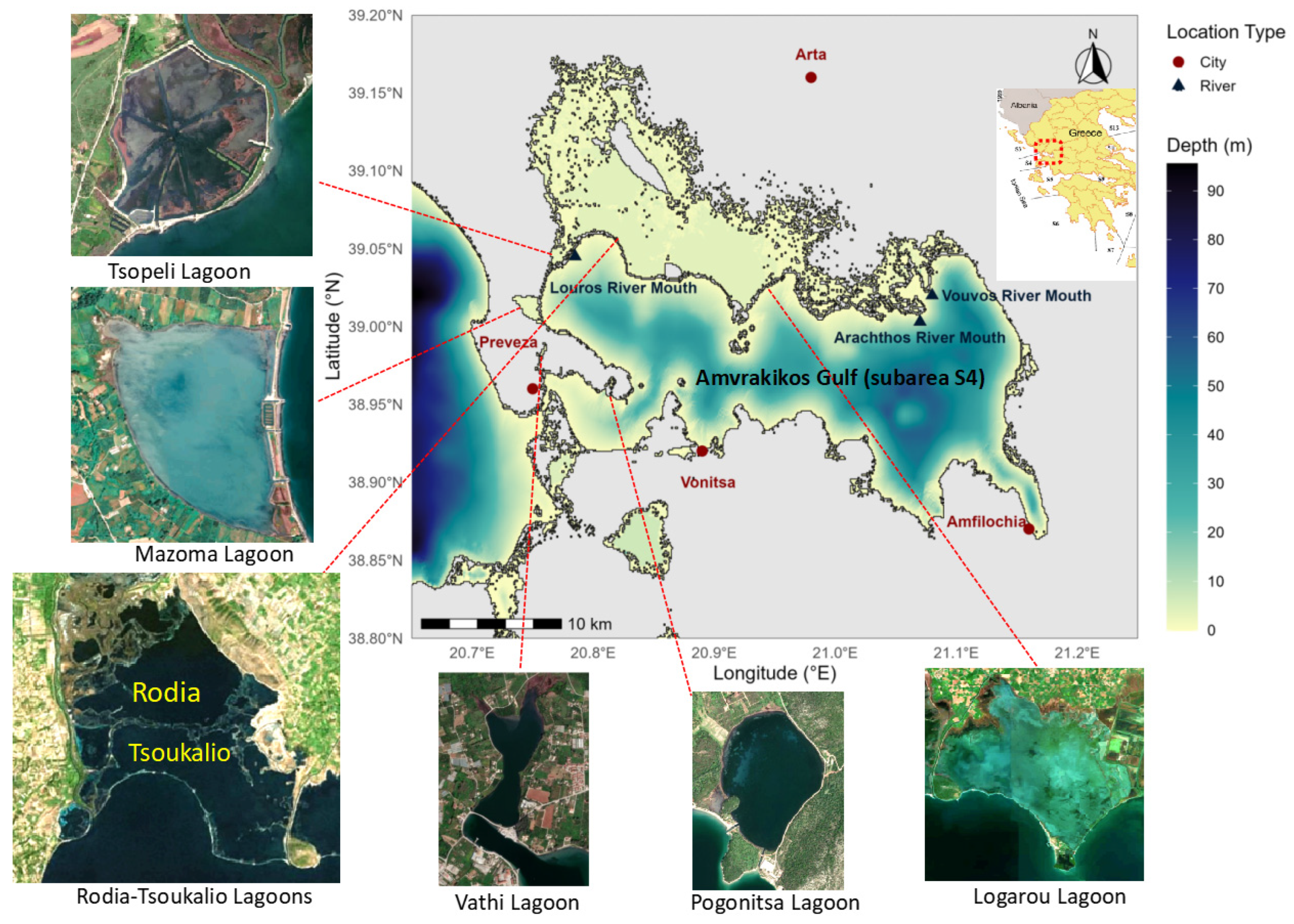
The northern Amvrakikos lagoons (38°58′383″ N, 20°59′500″ E) form a complex of river plains, deltas, and marshes shaped by the inflow of the Louros, Arachthos, and Vouvos rivers (Figure 1). Recognized as a critical habitat, this region has been protected under the RAMSAR International Convention since 1975 [16]. The studied systems act as critical interface ecosystems between the watershed and the semi enclosed Amvrakikos Gulf, receiving freshwater, nutrients, and sediments from the surrounding land. The adjacent watersheds have been subjected to long-term anthropogenic pressures, including agricultural intensification, irrigation, fertilizer use, livestock grazing, hydrological modifications, urbanization, and land use changes from wetlands to croplands, which influence lagoon hydrology, water quality, and biodiversity [17].
The studied lagoons are microtidal systems [18] that vary in size, depth, hydrological connectivity, and degree of human modification, ranging from naturally choked and restricted lagoons to artificially modified systems. They are divided into two regional watersheds: Logarou Lagoon, Rodia–Tsoukalio Lagoon, and Tsopeli Lagoon belong to the Arta watershed, while Vathi, Pogonitsa, and Mazoma are part of the Preveza watershed (Figure 1). These morphological and hydrological differences influence local productivity, species composition, and resilience to anthropogenic pressures, including damming, pollution, water flow modifications, overfishing and aquaculture. Increased nutrient and pollutant influx, in turn, is often associated with agriculture and urban development [19,20]. Reflecting these factors, the studied systems mostly range from good to moderate status [21].
Logarou Lagoon (25.3 km2) is classified as a restricted lagoon [18], with an average depth of 0.5 m and a maximum depth of 1.5 m. It is separated from the Amvrakikos Gulf by a sandy barrier punctuated by seven narrow inlets that function as traditional fish traps. The lagoon is characterized by extensive shallow mudflats, sporadic seagrass patches (Cymodocea nodosa), and fringing salt marshes. Hydrological exchange with the sea is limited, classifying it as a microtidal, low-energy system.
The Rodia–Tsoukalio complex is a multi-basin lagoon system. The Rodia sub-basin (12.87 km2) is a choked lagoon [15], with an average depth of 1.5 m and a maximum depth of 4 m, characterized by extensive palustrine wetlands and brackish marshes fed by substantial freshwater inflow from the Louros River. It is connected via a narrow channel to the Tsoukalio sub-basin (16.41 km2), a restricted lagoon with an average depth of 1 m and a maximum depth of 2.5 m. Tsoukalio is separated from the Amvrakikos Gulf by a narrow barrier featuring nine fish-trap inlets. Key habitats include shallow mudflats, submerged aquatic vegetation in sheltered areas, and channels that facilitate limited tidal exchange. The complex functions as a critical ecotone between riverine inputs and marine influences.
Vathi Lagoon is an artificially modified choked lagoon [18], covering 0.4–0.45 km2. It features a pronounced bathymetric gradient, with an average depth of 3 m and a maximum depth of 12 m in a central depression. The lagoon is entirely enclosed by engineered embankments and communicates with the Amvrakikos Gulf through two gated inlet channels along a 500 m causeway. The deep central basin is surrounded by steep slopes and limited littoral zones, with substrates ranging from soft mud in deeper areas to mixed sand and shell debris along the margins. The system lacks significant natural vegetation but provides structured habitat through its artificial perimeter and depth heterogeneity.
Pogonitsa Lagoon is a natural restricted lagoon [18] with an area of approximately 0.4 km2. It has an average depth of 1.2 m, with deeper channels (maximum depth 2.5 m) occupying about 15% of the basin, primarily near the two narrow natural inlets that connect it to the Amvrakikos Gulf. The lagoon is characterized by a mosaic of habitats including shallow sand and mud flats, localized seagrass patches (Cymodocea nodosa), and gently sloping margins. Limited freshwater input and microtidal exchange result in stable salinity regimes, while the dual inlets promote moderate water renewal. The system retains a largely natural morphometry with minimal anthropogenic alteration beyond traditional fishery structures.
Mazoma Lagoon is a restricted coastal lagoon [18] with an area of 1.8 km2. It is shallow throughout, with a mean depth of 0.5 m; slightly deeper zones (maximum depth 1 m) occupy approximately 25% of the basin, primarily along three natural channels that connect the lagoon to the Amvrakikos Gulf. The lagoon is sheltered from direct marine influence by a 2 km-long natural islet, which restricts wave energy and tidal exchange. Habitats are dominated by extensive shallow mud and sand flats, with occasional submerged vegetation and patchy macroalgal growth in more sheltered areas. The system remains largely unmodified by human infrastructure, retaining a natural morphology that supports moderate hydrological connectivity and habitat heterogeneity.
Tsopeli Lagoon is a restricted coastal lagoon [18], covering 1.1–1.2 km2 and located west of the Louros River delta. It is uniformly shallow, with a mean depth of 0.5 m; localized depressions reach a maximum depth of 1 m and occupy approximately 10% of the lagoon area. The system is characterized by a series of large internal dikes that partition the lagoon into several sub-basins, significantly disrupting natural water circulation and creating heterogeneous habitat patches [22]. Dominant substrates include soft mud and fine sand, with limited submerged aquatic vegetation. The lagoon receives intermittent freshwater influence from the Louros River but maintains limited tidal exchange through its restricted connection to the Amvrakikos Gulf. The pronounced anthropogenic modification through diking has altered both the hydrological regime and benthic habitat structures.
Flowing from these lagoons, the Amvrakikos Gulf, covering ~405 km2 with an average depth of 25 m and maximum depths of up to 65 m, supports high biological productivity, nursery habitats, and small scale fisheries, while its narrow connection to the Ionian Sea via the Preveza Strait limits water exchange and prolongs residence times [23]. The Amvrakikos Gulf is one of the most nutrient enriched areas in Greece and has been classified as having poor to bad ecological status [24]. Together with the adjacent Lefkada region, it is considered as a coherent unit within the Greek Fishery subdivision area 20, due to their shared ecological, hydrological, and socio-economic characteristics (Figure 1).

2.2. Data Sets

Annual landings during the period 1980–2020 were collected for January to December each year. The lagoons have been leased to the same fishery cooperatives since 1971, and the number of member fishermen has varied per season, mainly according to fisheries production [25]. Data based on the logbooks of the corresponding fishery cooperatives were kindly provided by the local fisheries departments of Arta Prefecture and Preveza Prefecture, respectively. In our study, the report of the fishing yields is presented as tonnes per square kilometer (t/km2).
The annual fisheries landings data refer mainly to catches from the fish barrier traps, which account for up to 70% of total landings, and from nets, including trammel nets and fyke nets. In the Rodia and Tsoukalio Lagoons, landings data included those using fishing gear in both lagoons, as well as from the Tsoukalio Lagoon’s outlet to the sea. The barrier traps are passive-fixed fishing gears that form part of a fence (which is a construction hammered into the lakebed, sustaining a net of reeds that separates the lagoons from the sea) and are used from July to January. Trammel nets (mainly 80–88 mm of stretch mesh size in the inner part of the net and 360 mm in the outer panel), and 30 mm stretch mesh fyke nets (specifically used for eel and goby fisheries) are used all year round, but with lower density. Since the late 1980s, the fence and barrier traps have been gradually replaced by cement frame and plastic net installations, with the primary aim of conserving the catch of market-sized fish and assuming that the efficiency of the replaced fishing gear remains stable regardless of changes in the construction materials [26].
The families and species that represent the main catches in the lagoons studied in this work are listed in Table 1. Individual values of Trophic Level (TL) and median temperature preference of species (Ti) were obtained from [27], a global online database compiling species specific ecological and biological information (accessed 24 April 2025), and from [28], which provides modeled estimates of species’ thermal preferences. The commercial categories of the five species of grey mullet (Mugil cephalus Linnaeus, 1758, Chelon labrosus (Risso, 1827), Chelon saliens (Risso, 1810), Chelon auratus (Risso, 1810), and Chelon ramada (Risso, 1827)) were grouped as functional groups (Mugilidae). Due to the lack of detailed data on the recorded goby landings, the TL and Ti values of this group were estimated based on the species Zosterisessor ophiocephalus (Pallas, 1814), as the dominant species in the composition of goby fish assemblages [26].

2.3. Data Analysis

The normality of the time series was assessed using the Anderson–Darling test at a significance level of α = 0.05. The test statistic, A2, was calculated as follows:
A 2   =   n     1 / n i = 1 n ( 2 i 1 ) [ ln F ( X i ) + ln ( 1 F ( X ( n + 1 i ) ) ) ]
where n is the sample size, X(i) are the ordered sample observations, and F(X) is the cumulative distribution function of the hypothesized normal distribution. The calculated A2 value was compared with the critical values provided by [22] for the corresponding sample size. Values exceeding the critical threshold indicate a deviation from normality. The Anderson–Darling test was chosen because it is more sensitive to deviations in the tails of the distribution than other normality tests, making it particularly suitable for environmental datasets that may contain extreme values [29].
A suite of ecological indicators was applied to provide a holistic description of the studied systems, reflecting trends in fishing yields. The following indices were calculated to assess the lagoon ecosystems:
(i) The mean temperature of the catch (MTC) is an indicator of ocean warming on fish communities that leads to increased catches of warmer-water species and decreased catches of colder water species computed from the following Formula (1) [28]:
M T C = i   =   1 n T i Y i i   =   1 n Y i
where n is the total number of species, Ti is the median temperature preference of species I (see Table 1), and Yi is the landings of species i. It is expected to increase with the ocean water temperature.
(ii) The primary production required (PPR) to sustain fisheries is an indicator that measures the level of exploitation of the studied area, accounting for the fraction of Primary Production sequestrated by fisheries. The method is based on the trophic level of the caught species, the energy transfer efficiency between trophic levels, and the primary productivity of the studied system, and is described as (2) [30]:
P P R = i   =   1 n Y i C R   ×   ( 1 T E ) ( T L i     1 )
where Yi is the landings of species i, CR is the conversion rate of wet weight to carbon (fixed at 1:9), TE is the transfer efficiency (fixed at 10%), and TLi is the trophic level of species i (see Table 1). It is expected to increase with increasing fishing pressure.
(iii) The modified Kempton’s index of biodiversity represents the slope of the cumulative species abundance curve between the 10th and 90th percentile, but since it is applied using functional groups and bio masses, the functional groups are considered equivalent to ‘species’ and their biomass is the number of individuals [31]. The index is formulated as (3):
Q 90 = 0.8   ×   n l o g ( Y 2 Y 1 )
where n is the total number of species, and Y1 and Y2 are the landings of the 10th and 90th percentiles in the cumulative abundance distribution, respectively. It is expected to decrease with increasing fishing pressure, pollution, or climate change.
(iv) The Pelagic to Demersal ratio (P/D ratio), between pelagic and demersal species biomass in landings, is an indicator that highlights the influence of nutrient enrichment on fish communities, since nutrient availability has a positive effect on pelagic fish and a negative effect on demersal species, while the trend of the indicator is expected to increase with increasing nutrient availability [32]:
P/D ratio = Landings of pelagic species/Landings of demersal and benthic species
Chronological clustering analysis, with a fourth root transformation in species landing data to down-weight the influence of predominant species [33], and the use of the unweighted pair-group average [34], was applied to identify periods with similar landing composition. The calculated degree of similarity is computed using the Euclidean distances.
Carrying capacity of the lagoons was estimated using the basic Ricker equation [35], in the form of Productiont + 1 = f (Production t) based on the Formula (4):
P t +   1 = P t e r ( 1     P t C C )
where Pt, Pt+1 are the productions at years t and t + 1, respectively, based on the seasonality of the time series, which was found to be 1 for all, r is the intrinsic rate of change of the annual time series values, and CC, the carrying capacity of the system.
A simple linear regression analysis at a 95% confidence level was applied to identify trends in fishing yields, MTC, PPR, Q-90, and P/D ratio indices in each lagoon over the period 1980–2020 [36]. Trends were classified as positive, negative, or stable based on the p-value of the regression slope: a trend was considered stable if the slope was not statistically significant (p > 0.05). Residuals from the regression models were tested for first-order autocorrelation using the Durbin–Watson test [37] at α = 0.05, with values close to 2 indicating no autocorrelation. Trend detection in the time series was further evaluated using the non-parametric Mann–Kendall test at α = 0.05 [38]. To satisfy the test’s independence assumption, lag-1 autocorrelation was assessed, and when significant, an AR(x) model [39] was fitted to adjust the effective sample size. The Mann–Kendall test was then applied to the pre-whitened series to prevent bias in trend estimation. Chronological clustering analysis was performed using the PRIMER software package, version 6.0 [32].

3. Results

3.1. Logarou Lagoon

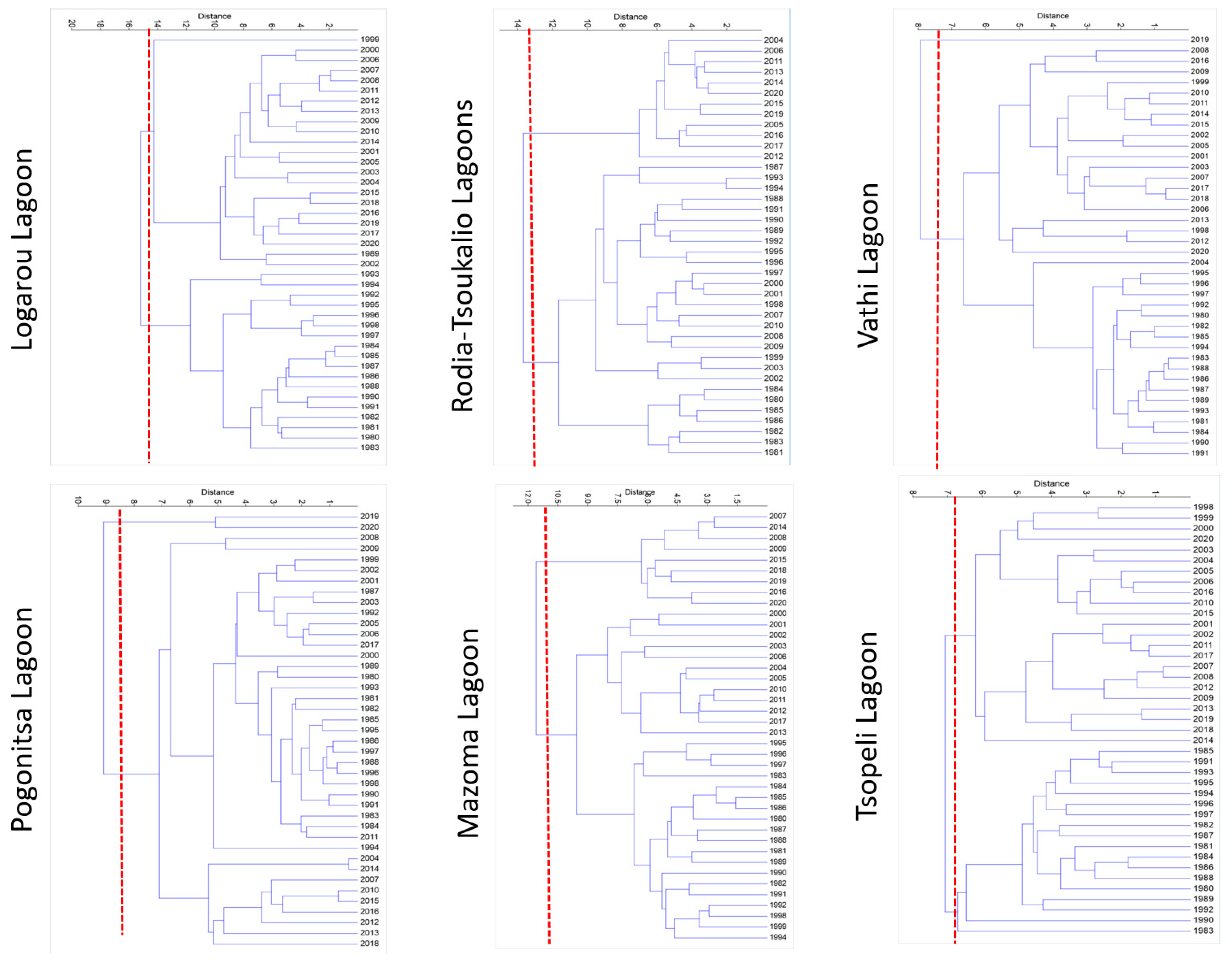
Chronological clustering allowed distinguishing two periods with different landing compositions: 1980–1998 and 1999–2020 (Figure 2). Landings in the first period were dominated by the Mugilidae sp. (53%), eel (29%), and Gobius sp. (9%). In the second period, the Mugilidae sp., landings were also dominant (48%), accompanied by the sea bream (37%) and sea bass landings (6%). On the contrary, the periodicity that arises from the analysis of the annual values of the fishery production of the studied time series showed a different chronological distribution, distinguishing three periods (1980–1989, 1990–2013, 2014–2020), while the yield prediction values for the period 2021–2025 (0.85–0.78 t/km2) are lower than the estimated carrying capacity value (2.58 t/km2) of the system (Table 2).
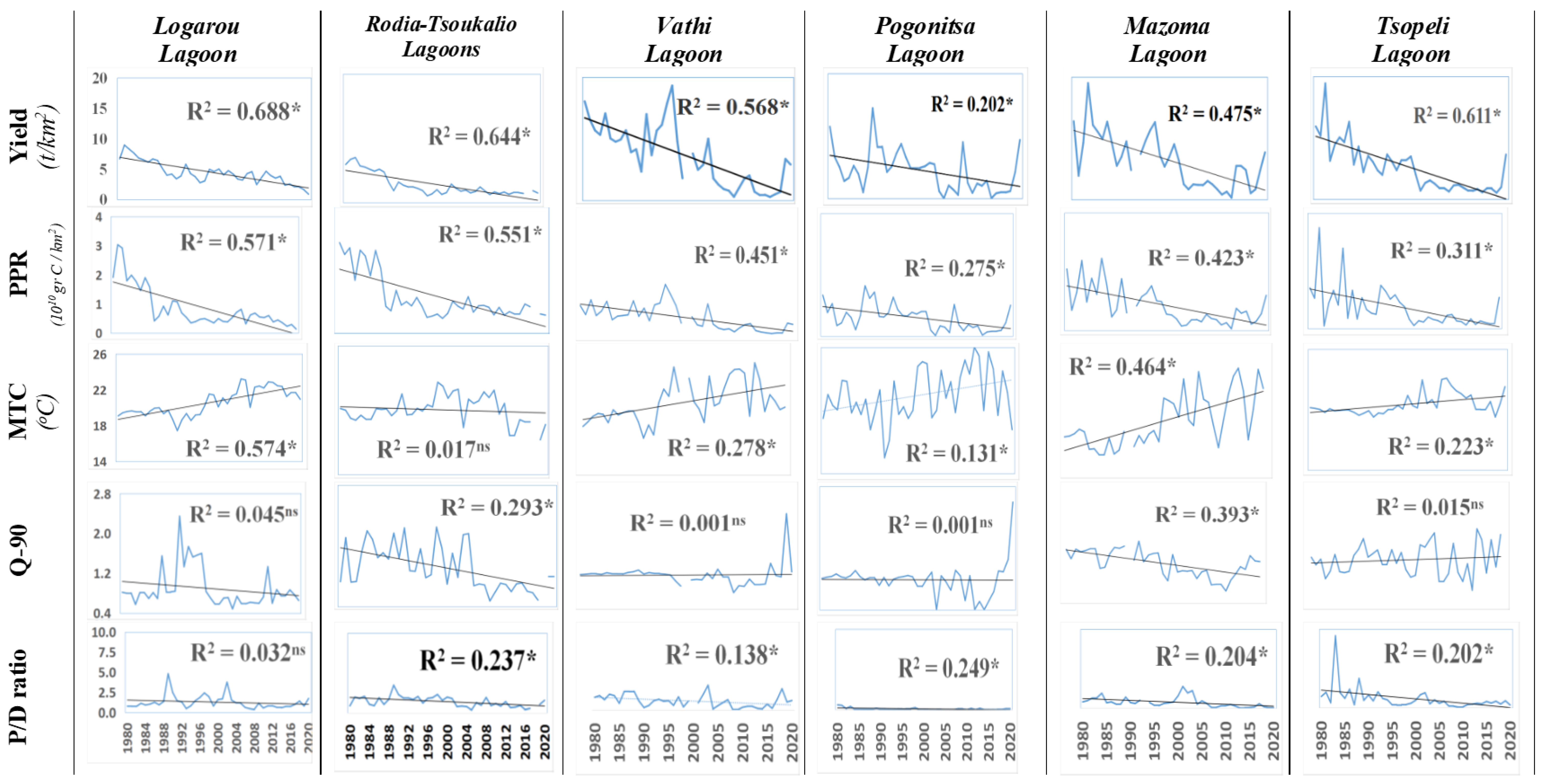
The fishing yield exhibited a continuous decreasing trend (p < 0.05) throughout the study period (Figure 3). Annual values ranged from 0.86 t/km2 in 2020 to 8.94 t/km2 in 1981, with a mean value of 4.39 t/km2 (±1.83). The PPR indicator also showed a significant decreasing trend (p < 0.001) throughout the study period, while the recorded years of the minimum and maximum values (0.14 × 10¹⁰ gr C/km2 in 2020 to 3.04 × 10¹⁰ gr C/km2 in 1981, respectively) fully coincide with the mentioned years of the fishing yield. The recorded mean value is 0.86 × 10¹⁰ gr C/km2 (±0.71). MTC ranged from 17.45 °C in 1993 to 23.24 °C in 2007 with a mean value of 20.56 °C (±1.47), revealing a significant increasing trend over the period of study (p < 0.001). On the contrary, the temporal trend for Q-90 showed a stable status (p > 0.05), ranging from 0.80 in almost the whole time series (except the year 1989 and the period 1993–1998) to 2.35 (1993), with a mean value of 0.99 (±0.35). The P/D ratio also showed no significant trend in the studied period (p > 0.05). Minimum values of 0.36 were observed in 2008, maximum values reached 4.80 in 1989, while the mean value is 1.26 (±0.86) (Table 3).

3.2. Rodia–Tsoukalio Lagoon

Chronological clustering generated two periods with different landing compositions: 1980–2003, 2004–2020 (Figure 2). Landings in the first period were dominated by the eel (43%), Mugilidae (42%) and Gobius (7%). In the second sub-period, Mugilidae and eel contributed 31% and 36%, respectively, while sea bream showed an interesting and stable dynamic with 11%. In contrast, the periodicity analysis of annual fishery production data revealed a distinct chronological pattern, dividing the time series into two phases: 1980–1996, and 1997–2020. Notably, the projected yields for 2021–2025 (1.57–1.58 t/km2) are approaching the values of the system’s carrying capacity (1.79 t/km2; Table 2).
The fishing yield of this lagoon (Figure 3) indicated a clear decreasing trend (p < 0.05). Values ranged from 1.05 t/km2 (in 1997) to 6.97 t/km2 (in 1982), with a mean value of 2.72 t/km2 (±1.70). PPR ranged from 0.27 × 10¹⁰ gr C/km2 in 2000 to 2.19 × 10¹⁰ gr C/km2 in 1981, with a mean value of 0.80 × 10¹⁰ gr C/km2 (±0.58), revealing a significant decreasing trend (p < 0.001). The MTC indicator showed a stable trend throughout the time series period (p > 0.05), ranging from 18.15 °C in 2019 to 21.74 °C in 1999 and a mean value of 20.02 °C (±0.85). On the contrary, the decreasing trend observed for Q-90 is characterized as significant (p < 0.05). Annual values ranged from 0.92 (1980, 1982) to 1.71 (1998), with a mean value of 1.18 (±0.25). A similar decreasing trend was also observed in the P/D ratio (p < 0.05). Minimum values of 0.19 were observed in 2005, maximum values reached 1.74 in 1989, while the recorded mean value is 0.70 (±0.32) (Table 3).

3.3. Vathi Lagoon

Chronological clustering analysis divided the periods into two groups with different fishing compositions: 1980–1997 and 1998–2020 while year 2019, which represented an autonomous cluster due to the significant contribution of the big-scale sand smelt (19%) and the blue crab (18%), was associated with the second period (Figure 2). Landings in the first period and the second period were dominated by Mugilidae (54% and 37%, respectively), sea bream (18% and 45%, respectively), and Gobius (14% and 8% respectively). Contrary to expectations, the temporal analysis of annual fishery production identified no periodicity while yield projections for 2021–2025 (4.72–4.13 t/km2) remain substantially below the system’s carrying capacity (9.11 t/km2; Table 2).
The fishing yield exhibited a continuous decreasing trend (p < 0.05) throughout the study period (Figure 3). Annual values ranged from 0.58 t/km2 in 2016 to 18.61 t/km2 in 1997, with a mean value of 7.15 t/km2 (±5.01). The PPR indicator also showed a significant decreasing trend (p < 0.01), ranging from 0.14 × 10¹⁰ gr C/km2 in 2016 to 2.95 × 10¹⁰ gr C/km2 in 1996, with a mean value of 1.04 × 10¹⁰ gr C/km2 (±0.70). A significant increase in MTC occurred (p < 0.05) throughout the studied period, ranging from 17.34 °C in 1992 to 24.71 °C in 2014, and a mean value of 20.84 °C (±1.94). Kempton’s Q-90 remained stable, suggesting that the overall diversity of dominant species has been preserved despite these structural changes. Annual values ranged from 0.71 (1997), to 1.86 (2019), and the mean value of 0.83 (±0.18). On the contrary, the P/D ratio showed a significantly decreasing trend (p < 0.05). A zero value was recorded in 2009, while the maximum value reached 2.81 in 2003, and the mean value is 0.99 (±0.71) (Table 3).

3.4. Pogonitsa Lagoon

Chronological clustering allowed distinguishing two periods with different landings compositions: 1980–2003 and 2004–2020 while the periods 2008–2009 and 2019–2020 differ due to the recording of the big scale sand smelt (22%) and the blue crab (11%), respectively; however, they can be associated in the second subperiod. Landings in the first period were dominated by Mugilidae (10%), eel (12%), sea bream (48%), and Gobius (20%), while the corresponding recorded values for the second period are 4% for the Mugilidae, 21% for the eel, 54% for the sea bream, and only 5% for the Gobius. The periodicity emerging from the analysis of annual fishery production data generally aligns with the identified chronological clusters (1980–2002 and 2003–2020). Notably, the system’s carrying capacity (5.75 t/km2) falls within the predicted yield range (6.51–5.58 t/km2) for the 2021–2025 period (Table 2).
The fishing yield exhibited a clear decreasing trend (p < 0.001) throughout the study period (Figure 3). Annual values ranged from 0.05 t/km2 in 2004 to 14.49 t/km2 in 1981, with a mean value of 4.45 t/km2 (±3.31). The PPR indicator also showed a significant decreasing trend (p < 0.001) throughout the study period. The recorded minimum and maximum values are 0.03 × 10¹⁰ gr C/km2 in 2004 and 2.87 × 10¹⁰ gr C/km2 in 1989, respectively, and the mean value is 1.05 × 10¹⁰ gr C/km2 (±0.72). MTC ranging from 15.50 °C in 1993 to 26.00 °C in 2012 with a mean value of 21.42 °C (±2.45), revealed a significant increasing trend in the whole period of study (p < 0.05). Similarly, the temporal trend resulting from Q-90 showed an increasing status (p < 0.05), ranging from 0.87 in 1989 to 1.79 (2020, with a mean value of 1.02 (±0.17). On the contrary, the P/D ratio showed a significant decreasing trend in the studied period (p < 0.001). Zero values were observed in the period 2004–2007, maximum values reached 0.58 in 1980, while the mean value is 0.09 (±0.13) (Table 2).

3.5. Mazoma Lagoon

Chronological clustering generated two periods with different landing composition: 1980–2002 and 2003–2020. In the first period, Mugilidae, eel, and Gobius represented 43%, 28% and 22% of the landings, respectively, while the big scale sand smelt (29%) and the sea bream (15%) were dominant in the second period. The periodicity emerging from the analysis of annual fishery production data generally aligns with the identified chronological clusters (1980–2002 and 2003–2020), while the yield prediction values for the period 2021–2025 (6.38–4.52 t/km2) are lower than the estimated carrying capacity value (8.11 t/km2) of the system (Table 2).
The fishing yield of this lagoon (Figure 3) indicated a clear decreasing trend (p < 0.05). Values ranged from 0.26 t/km2 (in 2013) to 19.02 t/km2 (in 1982), with a mean value of 6.34 t/km2 (±4.29). PPR ranging from 0.10 × 10¹⁰ gr C/km2 in 2013 to 4.29 × 10¹⁰ gr C/km2 in 1987, with a mean value of 1.48 × 10¹⁰ gr C/km2 (±1.09) revealed a significant decreasing trend (p < 0.001). The MTC indicator showed a significant increasing trend (p < 0.001), ranging from 15.63 °C in 1987 to 24.18 °C in 2015 and a mean value of 19.00 °C (±2.58). Similarly, the increasing trend for Q-90 is characterized as significant (p < 0.05). Annual values ranged from 1.92 (1983) to 2.70 (2013), and the mean value of 2.15 (±0.16). In the P/D ratio, a significant decreasing trend was observed (p < 0.05). Zero values of 0.19 were recorded in 2013, maximum values reached 2.73 in 2001, while the mean value is 0.70 (±0.64) (Table 3).

3.6. Tsopeli Lagoon

Chronological clustering revealed two major periods with different landing compositions: 1980–2000 and 2001–2020. The first sub-period was dominated by the Mugilidae (51%) and the eel (44%), while the contribution of the sea bream and the Gobius is negligible (<1.5% and <2.5%, respectively). In the second sub-period, Mugilidae and eels represented about 35% of the landings each, while sea bream reached 23% of the total landings, and the Gobius landings had almost been reduced to zero (0.6%). The temporal analysis of annual fishery production identified two phases (1980–2001, 2002–2020), which almost coincided with the chronological clustering analysis, while yield projections for 2021–2025 (6.75–5.09 t/km2) remain substantially below the system’s carrying capacity (7.46 t/km2; Table 2).
The fishing yield exhibited a continuous decreasing trend (p < 0.05) throughout the study period (Figure 3). Annual values ranged from 1.24 t/km2 in 2008 to 18.84 t/km2 in 1982, with a mean value of 5.13 t/km2 (±3.91). The PPR indicator also showed a significant decreasing trend (p < 0.01), ranging from 0.16 × 10¹⁰ gr C/km2 in 1983 to 6.12 × 10¹⁰ gr C/km2 in 1982, with a mean value of 1.26 × 10¹⁰ gr C/km2 (±1.23). A significant increase in MTC occurred (p < 0.05) throughout the studied period, ranging from 19.27 °C in 1993 to 23.14 °C in 2008, and a mean value of 20.55 °C (±1.04). A similar significant increasing trend (p < 0.001) was also observed in the Q-90 indicator. Annual values ranged from 1.24 (1987) to 2.26 (2015), and the mean value of 1.50 (±0.21). On the contrary, the P/D ratio showed a significant decreasing trend (p < 0.05). The minimum value of 0.05 was recorded in 2009, while the maximum value reached 9.16 in 1983, and the mean value is 1.10 (±1.49) (Table 3).

4. Discussion

4.1. Periodicity, Carrying Capacity, and Exploitation States

Chronological clustering of species fishery production data (1980–2020) revealed two main temporal regimes in the studied systems. These regimes closely align with previous observations from [40], indicating consistent temporal patterns across different datasets. Differences between total yield and exploited species yield suggest that while total yield captures broad scale productivity fluctuations, exploited species yield reflects shifts in fishing pressure, trophic interactions, and species composition. Environmental and anthropogenic drivers, including watershed activities, aquaculture, river inflows, fisheries management (fry enrichment), and lagoons ecological status, seem to act synergistically to shape these temporal patterns.
Long-term trends show declines in mullets, Gobies, and European sea bass, alongside stable or increasing gilthead sea bream, reflecting a restructuring of lagoon fish communities toward more resilient taxa. At this point, it must be highlighted the potential impact of the blue crab (Callinectes sapidus) in the trophic chain of the systems. Even though the species has been documented in the Amvrakikos Gulf (Pogonitsa Lagoon) since 2010 [41], no comparable records exist for the other lagoon systems included in our study. Moreover, reported landings of the species are limited to the Vathi, Pogonitsa and Mazoma Lagoons and are available only for the last three years of the time series. Given this restricted spatial and temporal coverage, it is not possible to reliably assess the species’ potential ecological or fishery impacts on the Amvrakikos lagoon systems within the scope of our datasets; nevertheless, its emerging presence may be reflected in the cluster analysis, where distinct sub-groups were observed in the Pogonitsa and Vathi Lagoons during the years when the species landings were recorded. Environmental conditions and fisheries productivity stabilized in the late 1990s early 2000s, transitioning from high fishing production toward a new equilibrium of reduced productivity [13,14].
Comparison of average yield (AY), yield prediction (YP), and carrying capacity (CC) across lagoons indicates distinct exploitation dynamics: Logarou and Rodia–Tsoukalio exhibit AY ≥ CC, suggesting unsustainable exploitation, whereas Vathi, Mazoma, and Tsopeli operate below CC, indicating moderate or under-exploitation. Pogonitsa shows AY < CC but YP > CC, suggesting short term productivity increases or management interventions. These results highlight the importance of aligning fisheries yields with ecological limits to maintain ecosystem resilience in sensitive lagoon environments [42,43,44,45,46].

4.2. Yield and Ecological Indicators Time Series Analysis

We employed a holistic framework of multi-dimensional ecological indicators to decipher the mechanisms driving long term ecosystem reorganization over the past four decades. By leveraging a complementary suite of metrics that integrate structural, functional, and compositional attributes of biological communities, we reconstructed temporal trajectories of ecosystem states and identified critical thresholds indicative of regime shifts. This integrative approach provided an improved understanding of the relative influence of climatic forcing and anthropogenic pressures, offering deeper insights into the processes shaping ecosystem resilience and functional integrity.
Recent studies document substantial land use and land cover changes in the wider Amvrakikos watershed, including expansion of urban and tourism infrastructure and intensification of agriculture and livestock activities [47,48]. However, no integrated basin scale assessment currently links these terrestrial shifts with nutrient inputs, water quality dynamics, and long term fisheries data across the Louros, Arachthos, and Amvrakikos Gulf systems. Thus, although land use change is a plausible driver of ecosystem alteration, the available evidence is insufficient to quantify its contribution or to distinguish it from marine climatic variability. This gap underscores the need for coordinated watershed coastal monitoring.
Similarly, the ecological condition of the Amvrakikos Gulf further illustrates the system’s sensitivity to cumulative pressures. Despite the well oxygenated surface waters, long term assessments show persistent hypoxia below ~25 m, with the eastern sector remaining hypoxic all year round and developing seasonal anoxia below 20 m [17]. Approximately 43% of the seabed and 36% of the water column are permanently hypoxic, with seasonal maxima reaching 70% and 62%, respectively [49]. These environmental constraints coincide with documented declines in several commercially important species (Sparidae species, striped red mullet, mullet and sprat) while fishing effort has increasingly concentrated in fewer high density areas, intensifying exploitation pressure [47,50]. Given these limitations, our interpretation does not infer causality but instead outlines plausible hypotheses on how anthropogenic and environmental drivers may interact. Analyzing each lagoon separately is justified, as the temporal trends of ecological indices and productivity differ among the studied systems, reflecting their unique environmental conditions and exposure to local pressures.
Within this context, the following sections examine how the temporal patterns of ecological indices and lagoon productivity may reflect these broader pressures.

4.2.1. Yield and PPR

The consistent declines in total yield and Primary Production Required (PPR) across the studied lagoons indicate a broad reduction in ecosystem productive capacity. While the present analysis does not allow direct inference of causal mechanisms, the observed patterns align with responses reported for Mediterranean lagoon systems subjected to long term environmental stress [7,44]. Previous studies suggest that changes in hydrological connectivity and water exchange can influence plankton structure and energy transfer within food webs, offering a plausible context for the reduced yields and PPR documented here. Further work integrating hydrological observations, nutrient dynamics, and benthic–pelagic coupling is necessary to evaluate these mechanisms quantitatively [45,46,47,48].
Variation in the magnitude of decline among lagoons likely reflects differences in the intensity and combination of local pressures. Alterations in freshwater inputs, isolation, and evaporation can modify salinity regimes and residence times, potentially restructuring phytoplankton and zooplankton communities [51]. Such changes may reduce trophic transfer efficiency and constrain higher trophic production, contributing to lower fish yields without invoking a single dominant driver [45,46,47,48]. In the Logarou, Rodia–Tsoukalio, and Tsopeli lagoons, additional stressors such as river derived nutrient enrichment, habitat degradation, and vegetation shifts from seagrasses to opportunistic macroalgae have simplified benthic assemblages, increased sediment organic matter, and reduced dissolved oxygen, may further constrain fisheries productivity [52,53,54,55]. Collectively, these pressures have weakened the food web structure and benthic pelagic coupling, lowered ecosystem resilience, and altered primary production pathways [56,57,58,59]. The resulting declines in total yield and PPR therefore reflect a collapse in intrinsic productive capacity rather than a response to changes in fishing pressure [10,53,60,61,62,63]. Although species specific fluctuations occurred, such as temporary seabream increases in the 1990s, these were insufficient to counteract the widespread losses of benthic species observed after 2000 [12,53,64].

4.2.2. Mean Temperature of Catch (MTC)

Observed increases in the Mean Temperature of Catch (MTC) in five lagoons (Logarou, Vathi, Pogonitsa, Mazoma, Tsopeli) suggesting a shift in species composition toward taxa with warmer thermal preferences. This pattern aligns with broader regional trends, such as the reported MTC increase of ~1.17 °C per decade in the adjacent Ionian Sea [65], which has been linked to ocean warming and the tropicalization of Mediterranean ecosystems. The stability of MTC in Rodia–Tsoukalio Lagoon may indicate a degree of thermal resilience, potentially attributable to its semi-enclosed configuration and limited hydrological connectivity, which could restrict the ingress of warm-affinity species. The continued dominance of eurythermal and euryhaline taxa like mullets [46,66,67,68] supports this interpretation. However, the concurrent declines in yield, PPR, and structural indicators (P/D, Q-90) in this lagoon may point to functional changes that are independent of, or perhaps masked by, thermal stability. While these MTC patterns are consistent with climate-mediated community shifts, they remain correlative; establishing a direct causal link to rising temperatures would require concurrent, long-term water temperature and species invasion data, which are not available in the present study.

4.2.3. Pelagic to Demersal Ratio (P/D) and Kempton’s Q-90 Index

The widespread decline in the Pelagic to Demersal (P/D) ratio across most lagoons (excluding Logarou) suggests a potential shift in trophic structure toward benthic-dominated assemblages. Such a shift could be consistent with several interrelated pressures, including nutrient enrichment altering phytoplankton dynamics, climate-related changes, or targeted fishing pressure on pelagic guilds. The relative stability of the P/D ratio in Logarou may indicate a different trajectory of functional group replacement or a lagged response to similar pressures.
Trends in Kempton’s Q-90 index showed spatial variability, with stability in Logarou, Vathi, Pogonitsa, and Tsopeli, but declines in Rodia–Tsoukalio and Mazoma. Stability may reflect compensatory dynamics where the loss of some dominant species is offset by the increase in others, potentially including thermophilic or opportunistic taxa [69,70]. The declines observed in Rodia–Tsoukalio and Mazoma could signal a reduction in the evenness of dominant functional groups, a pattern sometimes associated with sustained environmental stress.
Interpreting these spatial patterns requires caution. While they are coherent with known lagoon dynamics, such as the influence of hydraulic confinement, variable freshwater input from the Arachthos River, and altered nutrient regimes [49,71,72,73], our analysis does not include direct measurements of salinity, water quality, nutrient loads, or benthic community composition over time. Therefore, the proposed drivers (e.g., eutrophication, salinity changes) remain plausible hypotheses derived from the literature on similar systems [11,58,59,63], rather than proven causal agents for the changes observed in our indicator time series. These results, while insightful, are best interpreted as hypothesis generating, setting the stage for the integrated ecological evaluation presented in the following section.

4.2.4. Insights from the Integrated Ecological Evaluation of the Lagoons

The integrated evaluation of ecological indicators across all six lagoons reveals a spectrum of ecosystem states, highlighting both shared patterns of change and site-specific dynamics. This synthesis allows for a comparative, albeit inferential, interpretation of potential functional status and the plausible influence of local and regional drivers.
Logarou Lagoon exhibits trends indicative of ecological adjustment, with declining yield and Primary Production Required (PPR) accompanied by stable P/D ratios and biodiversity (Q-90). This pattern suggests that the lagoon maintains its functional structure despite reductions in productivity and changes in the thermal environment, as reflected in the Mean Temperature of the Catch (MTC), potentially indicating a degree of residual resilience within the system.
Rodia–Tsoukalio Lagoon exhibits synchronous declines in yield, Primary Production Required (PPR), P/D ratio, and Q-90, reflecting a coordinated downturn across multiple ecological metrics. This pattern suggests pronounced functional alterations, likely influenced by the lagoon’s specific hydrological constraints and watershed inputs. Notably, the Mean Temperature of the Catch (MTC) remains stable, indicating that these changes are primarily driven by local environmental pressures rather than climate-mediated shifts in species composition.
Vathi and Pogonitsa Lagoons exhibit declining yields and Primary Production Required (PPR), while Q-90 has remained stable over the four-decade period. Concurrently, the Mean Temperature of the Catch (MTC) shows an increasing trend in both lagoons, suggesting climate driven changes in species composition. Together, these patterns point to a state of ecological transition, in which species turnover offsets declines in overall productivity, a dynamic similarly observed in other stressed coastal systems.
Mazoma and Tsopeli Lagoons exhibit sustained ecological pressure, characterized by declining yield and Primary Production Required (PPR) alongside increasing Mean Temperature of the Catch (MTC), indicating reduced productivity and climate driven shifts in species composition. In the Mazoma Lagoon, the decreasing Q-90 suggests a loss of dominance diversity, whereas in the Tsopeli Lagoon, the increasing Q-90 combined with a declining P/D ratio points to a potential restructuring of the trophic web.
It is critical to emphasize that these interpretations are derived from fisheries dependent indicators and do not constitute direct evidence of specific environmental degradation or pinpoint exact anthropogenic causes. The inferred “states” (e.g., “transition,” “adjustment,” “functional alteration”) are heuristic descriptions based on the multi-metric patterns. They are best viewed as generating hypotheses about differential lagoon vulnerability and response pathways. Confirming these hypotheses and elucidating the precise mechanisms, whether related to watershed pressures, habitat loss, climate effects, or fishing, requires future research that directly couples long term ecological monitoring (e.g., benthos, water quality) with the fisheries-based indicator framework developed here.

5. Conclusions

The long-term analysis of fishery production and ecological indicators across the six studied systems revealed a distinct temporal shift during the late 1990s–early 2000s, consistent with previous observations in similar systems. This shift marked a stabilization of environmental conditions and fisheries productivity at a lower carrying capacity, following a period of higher yields within sustainable limits. Declines in total yield and Primary Production Required (PPR) across all lagoons point to a reduction in ecosystem productivity, driven by organic pollution, hydrological disruption, and a weakening of energy transfer efficiency within the food web.
The comparison of average yield, yield predictions, and carrying capacity revealed four distinct exploitation states across the lagoons: over exploited systems already exceeding capacity (Logarou Lagoon), systems at risk of growth overfishing (Rodia–Tsoukalio Lagoons), under exploited systems operating below their ecological potential (Vathi, Mazoma and Tsopeli Lagoons), and one system showing signs of possible overshooting (Pogonitsa Lagoon). These contrasting trajectories demonstrate that lagoon fisheries are highly heterogeneous and cannot be managed under a single strategy. Instead, adaptive ecosystem-based approaches that balance exploitation with carrying capacity are essential for securing long term sustainability.
All systems exhibited increasing Mean Temperature of Catch (MTC), consistent with climate-driven tropicalization, except the Rodia–Tsoukalio Lagoon, which maintained thermal stability, indicating higher resilience to climate pressures due to reduced anthropogenic stress and a largely intact watershed. Changes in Pelagic to Demersal (P/D) ratios and biodiversity (Kempton’s Q-90) varied among systems, reflecting localized responses to climatic and anthropogenic drivers, including shifts in species composition, eutrophication effects, and altered trophic structures. Interpretation of these indicators is further complicated by the fact that all studied lagoons are located within the Amvrakikos Gulf, a semi-enclosed marine area characterized by substantial hypoxia in deeper layers, which reduces the available fishing grounds and modifies fisheries composition, landings, and ecological baselines.
The multi-indicator framework developed here is transferable to comparable lagoon systems worldwide, providing a standardized approach to detect ecological regime shifts, assess exploitation states, and inform adaptive management strategies for coastal and transitional waters under global change.

Author Contributions

Conceptualization: T.Z.; methodology: T.Z.; software: T.Z., D.K. and A.C.; validation: A.C., S.R., D.V. and D.K.; formal analysis: T.Z., A.C. and D.K.; investigation: T.Z.; resources: T.Z.; data curation: T.Z.; writing, original draft preparation: T.Z.; writing, review and editing: A.C., S.R. and D.K.; visualization: T.Z. and D.K.; supervision: D.K.; project administration: T.Z. All authors have read and agreed to the published version of the manuscript.

Funding

This research received no external funding.

Institutional Review Board Statement

Not applicable.

Informed Consent Statement

Not applicable.

Data Availability Statement

The datasets analyzed from the current study are available from the corresponding author upon reasonable request.

Acknowledgments

The authors wish to thank V. Petaniti, K. Acovitiotis, Ch. Gkanaras and N. Fotou for their kind and analytic provision of the fisheries landing data and for providing information about technical and management issues in the systems studied in this paper.

Conflicts of Interest

The authors declare no conflicts of interest.

References

  1. Coll, M.; Piroddi, C.; Albouy, C.; Ben Rais Lasram, F.; Cheung, W.W.L.; Christensen, V.; Karpouzi, V.S.; Guilhaumon, F.; Mouillot, D.; Paleczny, M. The Mediterranean Sea under Siege: Spatial Overlap between Marine Biodiversity, Cumulative Threats and Marine Reserves. Glob. Ecol. Biogeogr. 2012, 21, 465–480. [Google Scholar] [CrossRef]
  2. Bianchi, C.N.; Morri, C. Global Sea Warming and “Tropicalization” of the Mediterranean Sea: Biogeographic and Ecological Aspects. Biogeogr. J. Integr. Biogeogr. 2003, 24. [Google Scholar] [CrossRef]
  3. MedECC Summary for Policymakers. First Mediterranean Assessment Report. In Climate and Environmental Change in the Mediterranean Basin—Current Situation and Risks for the Future; Cramer, W., Guiot, J., Marini, K., Eds.; Union for the Mediterranean, Plan Bleu, UNEP: Marseille, France, 2020; pp. 11–40. [Google Scholar]
  4. Food and Agriculture Organization. The State of Mediterranean and Black Sea Fisheries; Food and Agriculture Organization: Rome, Italy, 2020.
  5. Tsikliras, A.C.; Tsiros, V.; Stergiou, K.I. Assessing the State of Greek Marine Fisheries Resources. Fish. Manag. Ecol. 2013, 20, 34–41. [Google Scholar] [CrossRef]
  6. Coll, M.; Palomera, I.; Arneri, E. Ecosystem Assessment of the North-Central Adriatic Sea: Towards a Multivariate Reference Framework. Mar. Ecol. Prog. Ser. 2010, 417, 193–210. [Google Scholar] [CrossRef]
  7. Fortibuoni, T.; Giovanardi, O.; Pranovi, F.; Raicevich, S.; Solidoro, C.; Libralato, S. Analysis of Long-Term Changes in a Mediterranean Marine Ecosystem Based on Fishery Landings. Front. Mar. Sci. 2017, 4, 33. [Google Scholar] [CrossRef]
  8. Verdiell-Cubedo, D.; Torralva, M.; Ruiz-Navarro, A.; Oliva-Paterna, F.J. Fish Assemblages in Different Littoral Habitat Types of a Hypersaline Coastal Lagoon (Mar Menor, Mediterranean Sea). Ital. J. Zool. 2013, 80, 104–116. [Google Scholar] [CrossRef]
  9. Cataudella, S.; Crosetti, D.; Massa, F. Mediterranean Coastal Lagoons: Sustainable Management and Interactions among Aquaculture, Capture Fisheries and the Environment. Gen. Fish. Comm. Mediterr. Stud. Rev. 2015, 95, 278. [Google Scholar]
  10. Ligorini, V.; Crayol, E.; Huneau, F.; Garel, E.; Malet, N.; Garrido, M.; Simon, L.; Cecchi, P.; Pasqualini, V. Small Mediterranean Coastal Lagoons under Threat: Hydro-Ecological Disturbances and Local Anthropogenic Pressures (Size Matters). Estuaries Coasts 2023, 46, 2220–2243. [Google Scholar] [CrossRef]
  11. Zoulias, T.; Papadopoulos, A.; Conides, A. An Ecological Evaluation Using Fisheries Landings Time-Series Data: A Case Study of Two Coastal Lagoons in the Ionian Sea (E. Mediterranean, Greece). Estuar. Coast. Shelf Sci. 2019, 216, 229–239. [Google Scholar] [CrossRef]
  12. Zoulias, T.; Kapiris, K.; Reizopoulou, S. Ecological Indicators Based on Fisheries Landing Time-Series Data: An Application to Three Coastal Lagoons in Amvrakikos Gulf (e. Mediterranean, Greece). Vie Milieu Life Environ. 2014, 64, 9–21. [Google Scholar]
  13. Zoulias, T.; Conides, A.; Klaoudatos, D. Study on the Historical Trends of the Fishing Yield and Ecological Indicators of the Amvrakikos Gulf Lagoons (West Greece). In Proceedings of the 5th International Congress on Applied Ichthyology, Oceanography, and Aquatic Environment, Mytilene, Greece, 30 May–2 June 2024; pp. 234–238. [Google Scholar]
  14. Zoulias, T.; Pérez-Ruzafa, A.; Conides, A.; Marcos, C.; Reizopoulou, S.; Vafidis, D.; Klaoudatos, D. Temporal Changes in Fishing Yields, Trophic Dynamics, and Fisheries in Three Mediterranean Lagoons: Logarou and Rodia-Tsoukalio (Greece) and Mar Menor (Spain). Ecologies 2025, 6, 35. [Google Scholar] [CrossRef]
  15. Libralato, S.; Pranovi, F.; Raicevich, S.; Da Ponte, F.; Giovanardi, O.; Pastres, R.; Torricelli, P.; Mainardi, D. Ecological Stages of the Venice Lagoon Analysed Using Landing Time Series Data. J. Mar. Syst. 2004, 51, 331–344. [Google Scholar] [CrossRef]
  16. Hellenic Centre for Marine Research HCMR. Coastal and Transitional Waters Monitoring Program According to Article 8 of the Directive 2000/60/EC. Annual Report of the 14 Water Districts of Greece for the Year 2014; Hellenic Centre for Marine Research: Anavissos, Greece, 2015.
  17. Kountoura, K.; Zacharias, I. Temporal and Spatial Distribution of Hypoxic/Seasonal Anoxic Zone in Amvrakikos Gulf, Western Greece. Estuar. Coast. Shelf Sci. 2011, 94, 123–128. [Google Scholar] [CrossRef]
  18. Tagliapietra, D.; Sigovini, M.; Ghirardini, A.V. A Review of Terms and Definitions to Categorise Estuaries, Lagoons and Associated Environments. Mar. Freshw. Res. 2009, 60, 497–509. [Google Scholar] [CrossRef]
  19. Nicolaidou, A.; Reizopoulou, S.; Koutsoubas, D.; Orfanidis, S.; Kevrekidis, T. Biological Components of Greek Lagoonal Ecosystems: An Overview. Mediterr. Mar. Sci. 2005, 6, 31–50. [Google Scholar] [CrossRef]
  20. Barbone, E.; Rosati, I.; Reizopoulou, S.; Basset, A. Linking Classification Boundaries to Sources of Natural Variability in Transitional Waters: A Case Study of Benthic Macroinvertebrates. Ecol. Indic. 2012, 12, 105–122. [Google Scholar] [CrossRef]
  21. Reizopoulou, S.; Simboura, N.; Sigala, K.; Barbone, E.; Aleffi, F.; Kaisakis, G.; Rosati, I.; Basset, A.; Nicolaidou, A. Assessing the Ecological Status of Mediterranean Coastal Lagoons Using Macroinvertebrates. Comparison of the Most Commonly Used Methods. Mediterr. Mar. Sci. 2014, 15, 602–612. [Google Scholar] [CrossRef][Green Version]
  22. Anonymous Study of the Management of Fisheries Exploitation of Greek Lagoons. Pesca, Task 12. Ministry of Agriculture of Greece, Direction of Aquaculture. Final Report. Unpublished work. 2001; Volume 1, p. 165. (In Greek)
  23. Hellenic Centre for Marine Research HCMR. State-of-the-Lagoon Report for Amvrakikos Lagoon Complex, Western Greece. In ARCH Project (282748) Work Package Report; Hellenic Centre for Marine Research: Anavissos, Greece, 2012; p. 186. [Google Scholar]
  24. Pavlidou, A.; Simboura, N.; Rousselaki, E.; Tsapakis, M.; Pagou, K.; Drakopoulou, P.; Assimakopoulou, G.; Kontoyiannis, H.; Panayotidis, P. Methods of Eutrophication Assessment in the Context of the Water Framework Directive: Examples from the Eastern Mediterranean Coastal Areas. Cont. Shelf Res. 2015, 108, 156–168. [Google Scholar] [CrossRef]
  25. Hellenic Centre for Marine Research HCMR. Study of Fisheries Management of Lakes (Natural and Artificial), Utilization of Water Resources of Mountainous and Disadvantaged Areas of the Prefectures of Aitoloakarnania. Evritania, Karditsa, Boeotia, Arcadia, Ilia, and Achaia. In Final Technical ReportPublished Techn; Hellenic Centre for Marine Research: Anavissos, Greece, 2001. [Google Scholar]
  26. Katselis, G.N.; Moutopoulos, D.K.; Dimitriou, E.N.; Koutsikopoulos, C. Long-Term Changes of Fisheries Landings in Enclosed Gulf Lagoons (Amvrakikos Gulf, W Greece): Influences of Fishing and Other Human Impacts. Estuar. Coast. Shelf Sci. 2013, 131, 31–40. [Google Scholar] [CrossRef]
  27. FishBase World Wide Web Electronic Publication. Available online: https://www.fishbase.org (accessed on 24 April 2025).
  28. Cheung, W.W.L.; Watson, R.; Pauly, D. Signature of Ocean Warming in Global Fisheries Catch. Nature 2013, 497, 365–368. [Google Scholar] [CrossRef]
  29. Anderson, T.W.; Darling, D.A. A Test of Goodness of Fit. J. Am. Stat. Assoc. 1954, 49, 765–769. [Google Scholar] [CrossRef]
  30. Pauly, D.; Christensen, V. Primary Production Required to Sustain Global Fisheries. Nature 1995, 374, 255–257. [Google Scholar] [CrossRef]
  31. Ainsworth, C.H.; Pitcher, T.J. Modifying Kempton’s Species Diversity Index for Use with Ecosystem Simulation Models. Ecol. Indic. 2006, 6, 623–630. [Google Scholar] [CrossRef]
  32. de Leiva Moreno, J.I.; Agostini, V.N.; Caddy, J.F.; Carocci, F. Is the Pelagic-Demersal Ratio from Fishery Landings a Useful Proxy for Nutrient Availability? A Preliminary Data Exploration for the Semi-Enclosed Seas around Europe. ICES J. Mar. Sci. 2000, 57, 1091–1102. [Google Scholar] [CrossRef]
  33. Kaiser, M.J.; Ramsay, K.; Richardson, C.A.; Spence, F.E.; Brand, A.R. Chronic Fishing Disturbance Has Changed Shelf Sea Benthic Community Structure. J. Anim. Ecol. 2000, 69, 494–503. [Google Scholar] [CrossRef]
  34. Legendre, P.; Legendre, L. Numerical Ecology, 3rd ed.; Elsevier: Amsterdam, The Netherlands, 2003. [Google Scholar]
  35. Ricker, W.E. Stock and Recruitment. J. Fish. Board. Canada 1954, 11, 559–623. [Google Scholar] [CrossRef]
  36. Zar, J.H. Biostatistical Analysis, 5th ed.; Pearson Education: London, UK, 2014; ISBN 1-292-02404-6. [Google Scholar]
  37. Durbin, J.; Watson, G.S. Testing for Serial Correlation in Least Squares Regression. III. Biometrika 1971, 58, 1–19. [Google Scholar] [CrossRef]
  38. Helsel, D.; Hirsch, R.; Ryberg, K.; Archfield, S.; Gilroy, E. Statistical Methods in Water Resources; Elsevier: Amsterdam, The Netherlands, 2020. [Google Scholar]
  39. Box, G.E.P.; Jenkins, G.M.; Reinsel, G.C.; Ljung, G.M. Time Series Analysis: Forecasting and Control, 3rd ed.; Grant, J., Riker, E., Eds.; John Wiley and Sons: Hoboken, NJ, USA, 2015; ISBN 1118674928. [Google Scholar]
  40. Moutopoulos, D.K.; Katselis, G.; Kentrou, A.; Koutsikopoulos, C. Indications of a Possible Change in the Fishery Exploitation Pattern in Ionian Sea Lagoons. In Proceedings of the 38th CIESM Congress, Istanbul, Turkey, 9–13 April 2007. [Google Scholar]
  41. Katselis, G.N.; Koutsikopoulos, C. The Establishment of Blue Crab Callinectes Sapidus Rathbun, 1896 in the Lagoon Pogonitsa (Amvrakikos Gulf, Western Greece). Trends Fish. Aquat. Anim. Health 2017, 5, 299–306. [Google Scholar] [CrossRef]
  42. Pauly, D.; Christensen, V.; Guénette, S.; Pitcher, T.J.; Sumaila, U.R.; Walters, C.J.; Watson, R.; Zeller, D. Towards Sustainability in World Fisheries. Nature 2002, 418, 689–695. [Google Scholar] [CrossRef]
  43. Froese, R.; Branch, T.A.; Proelß, A.; Quaas, M.; Sainsbury, K.; Zimmermann, C. Generic Harvest Control Rules for European Fisheries. Fish Fish. 2011, 12, 340–351. [Google Scholar] [CrossRef]
  44. Hilborn, R.; Walters, C.J. Quantitative Fisheries Stock Assessment: Choice, Dynamics and Uncertainty; Chapman & Hall: London, UK, 1992; ISBN 1461535980. [Google Scholar]
  45. Murawski, S.A. Rebuilding Depleted Fish Stocks: The Good, the Bad, and, Mostly, the Ugly. ICES J. Mar. Sci. 2010, 67, 1830–1840. [Google Scholar] [CrossRef]
  46. Elliott, M.; Whitfield, A.K. Challenging Paradigms in Estuarine Ecology and Management. Estuar. Coast. Shelf Sci. 2011, 94, 306–314. [Google Scholar] [CrossRef]
  47. Giovos, I.; Gonzalvo, J.; Ciprian, M.; Gaentlich, M.; Gavriel, E.; Konstas, S.; Kordopatis, P.; Koutsikopoulos, C.; MaGiovo, I.; Gonzalvo, J.; et al. Amvrakikos Gulf: Biodiversity and Threats. Project “Contributing to the Effective Management of the Amvrakikos Gulf National Park”; Greece; 2023. [Google Scholar]
  48. Tzoumas, V.; Klabatsea, R. Interactions between Coastal Cities and Adjacent Protected Ecosystems. The Case of Preveza and the Amvrakikos Gulf. Tech. Ann. 2025, 1. [Google Scholar] [CrossRef]
  49. Georgiou, N.; Fakiris, E.; Koutsikopoulos, C.; Papatheodorou, G.; Christodoulou, D.; Dimas, X.; Geraga, M.; Kapellonis, Z.G.; Vaziourakis, K.-M.; Noti, A. Spatio-Seasonal Hypoxia/Anoxia Dynamics and Sill Circulation Patterns Linked to Natural Ventilation Drivers, in a Mediterranean Landlocked Embayment: Amvrakikos Gulf, Greece. Geosciences 2021, 11, 241. [Google Scholar] [CrossRef]
  50. Papaconstantinou, C.; Farrugio, H. Fisheries in the Mediterranean. Mediterr. Mar. Sci. 2000, 1, 5–18. [Google Scholar] [CrossRef]
  51. Anufriieva, E.; Kolesnikova, E.; Revkova, T.; Shadrin, N. Spatio-Temporal Variability of Zooplankton and Zoobenthos as the Elements of Integrated Zoocenosis in a Marine Lake (Crimea, Black Sea): What Is a General Pattern? J. Sea Res. 2022, 185, 102231. [Google Scholar] [CrossRef]
  52. Valiela, I.; McClelland, J.; Hauxwell, J.; Behr, P.J.; Hersh, D.; Foreman, K. Macroalgal Blooms in Shallow Estuaries: Controls and Ecophysiological and Ecosystem Consequences. Limnol. Oceanogr. 1997, 42, 1105–1118. [Google Scholar] [CrossRef]
  53. Reizopoulou, S.; Nicolaidou, A. Benthic Diversity of Coastal Brackish-water Lagoons in Western Greece. Aquat. Conserv. Mar. Freshw. Ecosyst. 2004, 14, S93–S102. [Google Scholar] [CrossRef]
  54. Nicolaidou, A.; Petrou, K.; Kormas, K.A.; Reizopoulou, S. Inter-Annual Variability of Soft Bottom Macrofaunal Communities in Two Ionian Sea Lagoons. Mar. Biodivers. Hydrobiologia 2006, 555, 89–98. [Google Scholar] [CrossRef]
  55. Vasileiadou, K.; Pavloudi, C.; Kalantzi, I.; Apostolaki, E.T.; Chatzigeorgiou, G.; Chatzinikolaou, E.; Pafilis, E.; Papageorgiou, N.; Fanini, L.; Konstas, S. Environmental Variability and Heavy Metal Concentrations from Five Lagoons in the Ionian Sea (Amvrakikos Gulf, W Greece). Biodivers. Data J. 2016, 4, e8233. [Google Scholar] [CrossRef]
  56. Skoullos, M. Amvrakikos Management Project. Ministry of Environment, Physical Planning and Public Works, European Community Commission, XI Direction, Greek Centre of Productivity; 1992. (In Greek) [Google Scholar]
  57. Ricci, P.; Libralato, S.; Capezzuto, F.; D’Onghia, G.; Maiorano, P.; Sion, L.; Tursi, A.; Solidoro, C.; Carlucci, R. Ecosystem Functioning of Two Marine Food Webs in the North-Western Ionian Sea (Central Mediterranean Sea). Ecol. Evol. 2019, 9, 10198–10212. [Google Scholar] [CrossRef]
  58. Meredith, W.; Casamitjana, X.; Quintana, X.D.; Menció, A. Effects of Morphology and Sediment Permeability on Coastal Lagoons’ Hydrological Patterns. J. Hydrol. 2022, 612, 128259. [Google Scholar] [CrossRef]
  59. Jin, H.; van Leeuwen, C.H.A.; Van de Waal, D.B.; Bakker, E.S. Impacts of Sediment Resuspension on Phytoplankton Biomass Production and Trophic Transfer: Implications for Shallow Lake Restoration. Sci. Total Environ. 2022, 808, 152156. [Google Scholar] [CrossRef] [PubMed]
  60. SoHelFI. State of Hellenic Fisheries; Papaconstantinou, C., Zenetos, A., Vassilopoulou, V., Tserpes, G., Eds.; Hellenic Centre for Marine Research: Anavissos, Greece, 2007; p. 466. [Google Scholar]
  61. Andrisoa, A.; Stieglitz, T.C.; Rodellas, V.; Raimbault, P. Primary Production in Coastal Lagoons Supported by Groundwater Discharge and Porewater Fluxes Inferred from Nitrogen and Carbon Isotope Signatures. Mar. Chem. 2019, 210, 48–60. [Google Scholar] [CrossRef]
  62. Al-Khalidy, H.I.; Al-Haidarey, M.J.S. Impact of Salinity on Primary Production in the Marshes. Indian. J. Ecol. 2019, 46, 614–618. [Google Scholar]
  63. Franco, T.P.; Neves, L.M.; Araújo, F.G. Better with More or Less Salt? The Association of Fish Assemblages in Coastal Lagoons with Different Salinity Ranges. Hydrobiologia 2019, 828, 83–100. [Google Scholar] [CrossRef]
  64. Kentrou, A. Temporal Changes and Seasonal Variations in Fish Production of Lagoons of Preveza (Western Greece). Master’s Thesis, Department of Biology, Ecology, Management and Natural Environment Protection, University of Patras, Patras, Greece, 2005. [Google Scholar]
  65. Tsikliras, A.C.; Peristeraki, P.; Tserpes, G.; Stergiou, K.I. Mean Temperature of the Catch (MTC) in the Greek Seas Based on Landings and Survey Data. Front. Mar. Sci. 2015, 2, 23. [Google Scholar] [CrossRef]
  66. Pérez-Ruzafa, A.; De Pascalis, F.; Ghezzo, M.; Quispe-Becerra, J.I.; Hernández-García, R.; Muñoz, I.; Vergara, C.; Pérez-Ruzafa, I.M.; Umgiesser, G.; Marcos, C. Connectivity between Coastal Lagoons and Sea: Asymmetrical Effects on Assemblages’ and Populations’ Structure. Estuar. Coast. Shelf Sci. 2019, 216, 171–186. [Google Scholar] [CrossRef]
  67. Tsikliras, A.C.; Stergiou, K.I. Mean Temperature of the Catch Increases Quickly in the Mediterranean Sea. Mar. Ecol. Prog. Ser. 2014, 515, 281–284. [Google Scholar] [CrossRef]
  68. Whitfield, A.K.; Able, K.W.; Blaber, S.J.M.; Elliott, M. Fish and Fisheries in Estuaries: A Global Perspective; John Wiley and Sons: Hoboken, NJ, USA, 2022; ISBN 1119705355. [Google Scholar]
  69. Worm, B.; Barbier, E.B.; Beaumont, N.; Duffy, J.E.; Folke, C.; Halpern, B.S.; Jackson, J.B.C.; Lotze, H.K.; Micheli, F.; Palumbi, S.R. Impacts of Biodiversity Loss on Ocean Ecosystem Services. Science 2006, 314, 787–790. [Google Scholar] [CrossRef]
  70. Vergés, A.; Steinberg, P.D.; Hay, M.E.; Poore, A.G.B.; Campbell, A.H.; Ballesteros, E.; Heck, K.L., Jr.; Booth, D.J.; Coleman, M.A.; Feary, D.A. The Tropicalization of Temperate Marine Ecosystems: Climate-Mediated Changes in Herbivory and Community Phase Shifts. Proc. R. Soc. B Biol. Sci. 2014, 281, 20140846. [Google Scholar] [CrossRef] [PubMed]
  71. Conley, D.J.; Paerl, H.W.; Howarth, R.W.; Boesch, D.F.; Seitzinger, S.P.; Havens, K.E.; Lancelot, C.; Likens, G.E. Controlling Eutrophication: Nitrogen and Phosphorus. Science 2009, 323, 1014–1015. [Google Scholar] [CrossRef] [PubMed]
  72. Panagopoulos, I.; Mimikou, M. Assessment of the Changes in the Arachtos River Flow and Sediment Discharges Due to Anthropogenic Interventions. In Proceedings of the Protection and Restoration of the Environment VIII, Chania, Greece, 3–7 July 2006. [Google Scholar]
  73. Stamou, A.I.; Loverdou, L.; Matsoukis, C.; Albanis, T.; Gkesouli, A. Modeling Renewal Times in Amvrakikos Gulf, Greece. Global NEST J. 2012, 14, 386–392. [Google Scholar]
Figure 1. Schematic representation of the studied systems, including subarea 04 (S4) encompassing the Lefkada region and the Amvrakikos Gulf.
Ecologies 07 00011 g001
Figure 2. Analysis of temporal clusters in species landing composition and determination of cut-off linkage thresholds for each study system (1980–2020).
Ecologies 07 00011 g002
Figure 3. Time-series analysis of yield and ecological indicators and trend assessment across the studied systems (“*” = statistically significant trend at level 0.05; “ns” = no statistically significant trend at level 0.05).
Ecologies 07 00011 g003
Table 1. Species composition of landings from the studied systems. P = Pelagic; D = Demersal; TL = Trophic Level values of the recorded species; Ti = inferred median temperature preference for each species. Sources: [27,28].
Scientific NameCommon NameHabitat StrategyTL ValueTi Value
Sarpa salpa (Linaeus, 1758)SalemaP2.0025
MugilidaeMulletsP2.1420
Palaemon adspersus (Rathke, 1836)PrawnD2.8518
Mullus barbatus (Linaeus, 1758)Strip red mulletD3.1017
Solea solea (Linaeus, 1758)Common soleD3.2016
GobiidaeGobiesD3.2412
Diplodus annularis (Linaeus, 1758)Annular sea breamD3.3013
Atherina boyeri Risso, 1810Big-scale sand smeltP3.3014
Diplodus sargus sargus (Linaeus, 1758)White sea breamD3.4022
Lithognathus mormyrus (Linaeus, 1758)Sand stean brasD3.4024
Sparus aurata Linaeus, 1758Gilt head sea breamD3.4526
Dicentrarchus labrax (Linaeus, 1758)Sea bassD3.4714
Callinectes sapidus Rathbun 1896Blue crabD3.7325
Anguilla anguilla (Linaeus, 1758)European eelD3.8520
Belone belone (Linaeus, 1761)GarfishP4.2115
Sepia officinalis (Linaeus, 1758)European common cuttlefishD4.5019
Table 2. Summary of the analysis, forecasting, and carrying capacity of the annual production time series of the 6 lagoons of Amvrakikos Gulf. D-W, Durbin-Watson autocorrelation test; M-K, Mann-Kendal trend test; AR(x), autoregressive ARIMA coefficient at seasonality of x years; MA(x), moving average ARIMA coefficient at seasonality of x years.
Auto
Correlation
TrendARIMA ModelYield Prediction
2021–2025
(in t/km2)
PeriodicityCarrying Capacity
(t/km2 Max Yield/Year)
Logarou LagoonNo;
D-W = 1.713
Yes; Negative
M-K = −0.639
(1, 0, 0), r2 = 0.887
AR (1) = 1
0.85–0.78 1980–1989
1990–2013
2014–2020
2.58
Rodia–Tsoukalio lagoons complexNo;
D-W = 2.039
Yes; Stable
M-K = −0.617
(1, 0, 0,), r2 = 0.968
AR (1) = 1
1.57–1.58 1980–1996
1997–2020
1.79
Vathi lagoonNo;
D-W = 2.116
Yes; Negative
M-K = −0.602
(1, 0, 0), r2 = 0.834
AR (1) = 0.967
4.72–4.13No periodicity9.11
Pogonitsa lagoonNo;
D-W = 1.402
No; Stable
M-K = −0.249
(2, 0, 0), r2 = 0.875
AR (1) = 0.529
AR (2) = 0.381
6.51–5.581980–2002
2003–2020
5.75
Mazoma lagoonNo,
D-W = 1.681
Yes; Negative
M-K = −0.522
(1, 2, 0), r2 = 0.522
AR (1) = 0.977
MA (1) = −0.108
MA (2) = −0.364
6.38–4.521980–2002
2003–2020
8.11
Tsopeli lagoonNo,
D-W = 2.260
Yes; Negative
M-K = −0.649
(1, 0, 0), r2 = 0.951
AR (1) = 0.929
6.75–5.091980–2001
2002–2020
7.46
Table 3. Summary statistics of indicator time series for the studied systems over the period 1980–2020, presenting temporal trends, mean values, standard deviations (in brackets), and ranges (min–max). = Decreasing trend = Increasing trend Ecologies 07 00011 i001 = Stable trend.
IndicatorsLogarou
Lagoon
Rodia–Tsoukalio
Lagoon
Vathi
Lagoon
Pogonitsa
Lagoon
Mazoma
Lagoon
Tsopeli
Lagoon
Yield (t/km2)
4.39 (±1.81)
(0.86–8.94)

2.72 (±1.96)
(1.05–6.97)

7.15 (±4.97)
(0.58–18.61)

4.45 (±3.68)
(0.05–14.49)

6.34 (±4.23)
(0.26–19.02)

5.13 (±3.91)
(1.24–18.84)
PPR
1010 g C km−2 year−1

0.86
(0.14–3.04)

0.80
(0.27–2.19)

1.04
(0.14–2.95)

1.05
(0.03–2.87)

1.48
(0.10–4.29)

1.26
(0.16–6.12)
MTC °C
20.56 (±1.47)
(17.45–23.24)
Ecologies 07 00011 i002
20.02 (±0.85)
(18.15–21.74)

20.84 (±1.94)
(17.34–24.71)

21.42 (±2.45)
(15.50–26.00)

19.00 (±2.58)
(15.63–24.18)

20.55 (±1.04)
(19.27–23.14)
Q-90Ecologies 07 00011 i003
0.99 (±0.35)
(0.48–2.35)

1.18 (±0.25)
(0.92–1.71)
Ecologies 07 00011 i004
0.83 (±0.18)
(0.71–1.86)
Ecologies 07 00011 i005
1.02 (±0.17)
(0.87–1.79)

2.15 (±0.16)
(1.92–2.70)
Ecologies 07 00011 i006
1.50 (±0.21)
(1.24–2.26)
P/D ratioEcologies 07 00011 i007
1.26 (±0.86)
(0.36–4.80)

0.70 (±0.32)
(0.19–1.74)

0.99 (±0.71)
(0.00–2.81)

0.09 (±0.13)
(0.00–0.58)

0.70 (±0.64)
(0.00–2.73)

1.10 (±1.49)
(0.05–9.16)
Disclaimer/Publisher’s Note: The statements, opinions and data contained in all publications are solely those of the individual author(s) and contributor(s) and not of MDPI and/or the editor(s). MDPI and/or the editor(s) disclaim responsibility for any injury to people or property resulting from any ideas, methods, instructions or products referred to in the content.