
Lipid Modulation of Ion Channel Function


Abstract
1. Introduction
Scope and Organization
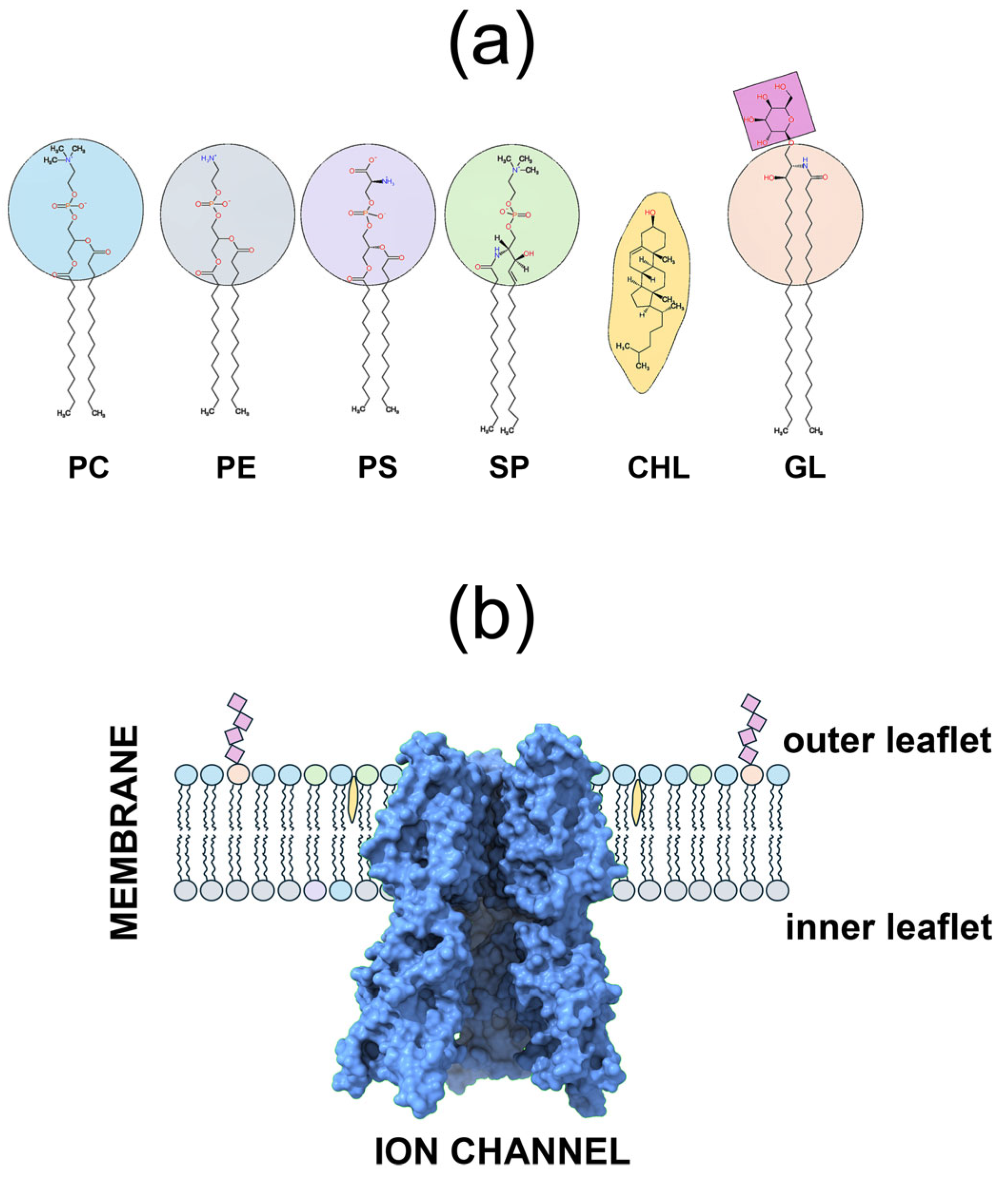
2. Cell Membrane Structure and Physicochemical Properties

3. Molecular Diversity of Ion Channels
4. Membrane Lipids Modulate Ion Channel Function

| Lipid Class | Ion Channel | Mechanistic Mode | Evidence | PDBID | REF |
|---|---|---|---|---|---|
| Acyl-CoA (lo; lipid metabolism) | TRPV5/TRPV6 | II | cryoEM, EP | 8FFO | [49] |
| Anionic PL; inner-leaflet | Pacemaker family | I | EP, MUT | 7TJ6; 7TJ7; 7TJ8 | [50] |
| Bilayer pres; PC | MscL | III | EP, RECON, MD | 2OAR | [51,52,53] |
| Cers (C16:0) | Kv1.3 | III | EP | [54] | |
| Cholesterol | BK (Slo1) | II | EP, RECON | [55,56] | |
| Kir2.x | II | EP, MUT | [57] | ||
| Kv1.3 | III | EP | [58] | ||
| Orai1 | II | MUT, IMG | [59] | ||
| Pentameric ligand-gated ion channels | II | MD, MS | [60,61] | ||
| Piezo1 | IV | EP, IMG | [62] | ||
| TRPV2 | II | cryoEM, EP | 7XEM | [63] | |
| Chol+PIP2 | GIRK2/Kir3.2 | II | cryoEM, RECON | 6XEV | [64] |
| Chol; (caveolin) | CaV1.2 | IV | IMG, BIOCH | [65] | |
| DAG | TRPC3/TRPC6 | II | EP | [66] | |
| GM1+GSL | NMDA receptor | IV | PHARM | [67] | |
| LPA; eicosanoid-r | TRPV1 | II | EP, MUT, PHARM | [68] | |
| LPC; cone-shaped | TREK-1 (K2P2.1) & TRAAK (K2P4.1) | III | EP | [69] | |
| PA+PE | TREK1 (K2P family) | II | cryoEM, RECON, MUT | 8DE7 | [70] |
| PA+PG | KcsA | II | Fluorescence binding/quenching | 1K4C | [71] |
| PG+PA+PS+CL+PIP2 | Kir2.1 | II | RECON, MUT | [72] | |
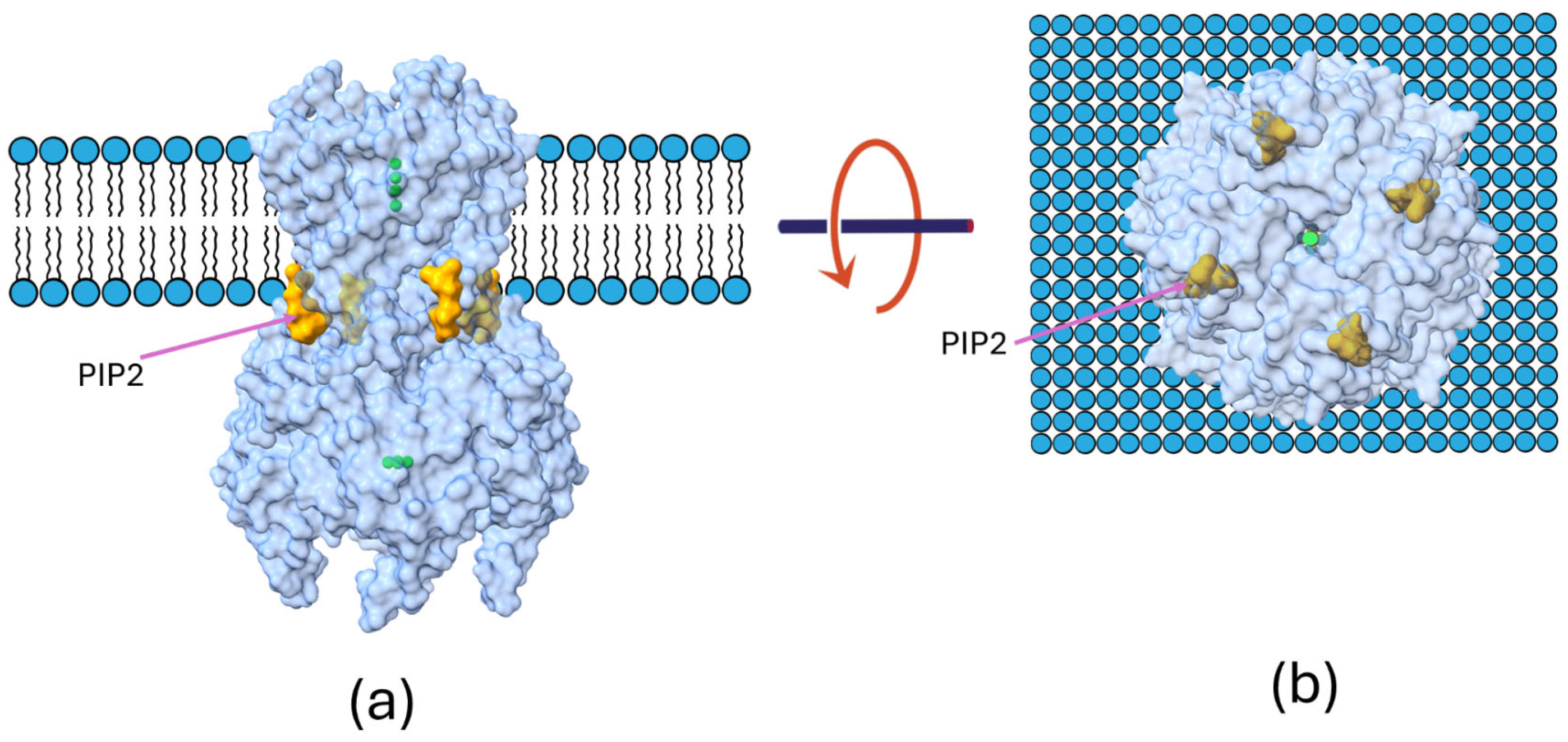
| PIP2 | GIRK2 | I | Xtal, EP | 3SYA | [73] |
| KCNQ1/KCNE3 | I | cryoEM | 6V01 | [74] | |
| KCNQ2/3/Kv7.2/7.3 | I | EP, PHARM, MODEL | [75,76] | ||
| TRPM8 | II | cryoEM, PHARM | 6NR3 | [77] | |
| TRPV5 | I | cryoEM, EP | 6DMU | [78,79] | |
| PIP2; (long-chain) | KATP/Kir6.2/SUR1 | II | cryoEM | 8TI1 | [80] |
| PIP2; PIP2+secondary analog | Kir2.2 | I | Xtal, EP, MUT | 3SPI; 5KUM | [80,81] |
| PS+PC+PE+Chol | CFTR | I | RECON, BIOCH | [82] | |
| PS+PE; headgroup charge | BK/Slo1 | I | RECON | [83] | |
| SM+Cer | PIEZO1 | III | EP, GEN | [84] | |
| TRPC6 | IV | EP, PHARM, BIOCH, GEN | [85] | ||
| SM; SMase D | Orai1/STIM1 | IV | EP, IMG | [86] |
4.1. Phospholipids: Headgroups, Acyl Chains, and Phosphoinositides as Gating Cofactors
4.2. Sphingolipids: Sphingomyelin/Ceramide Remodeling and Sphingolipid Metabolites
4.2.1. Ceramide Platforms and Kv1.3
4.2.2. Sphingomyelinase Disables Piezo1 Inactivation: Sustained Mechanotransduction
4.2.3. Ceramide Effects Beyond Platforms: Direct State Biasing
4.2.4. Sphingosine as a Direct Inhibitor: TRPM7
4.2.5. TRPC6 Ca2+ Entry and Sphingomyelinase
4.3. Glycolipids: Gangliosides and Sulfatide as Modulators and Organizers of Excitability
4.3.1. GM1 Ganglioside and Ca2+ Entry
4.3.2. Gangliosides Tune Voltage-Gated Na+ Channel Excitability
4.3.3. Sulfatide Stabilizes Nodal Channel Clusters In Vivo
4.3.4. Glycolipid-Dependent Raft Signaling to TRPC6 via Soluble α-Klotho
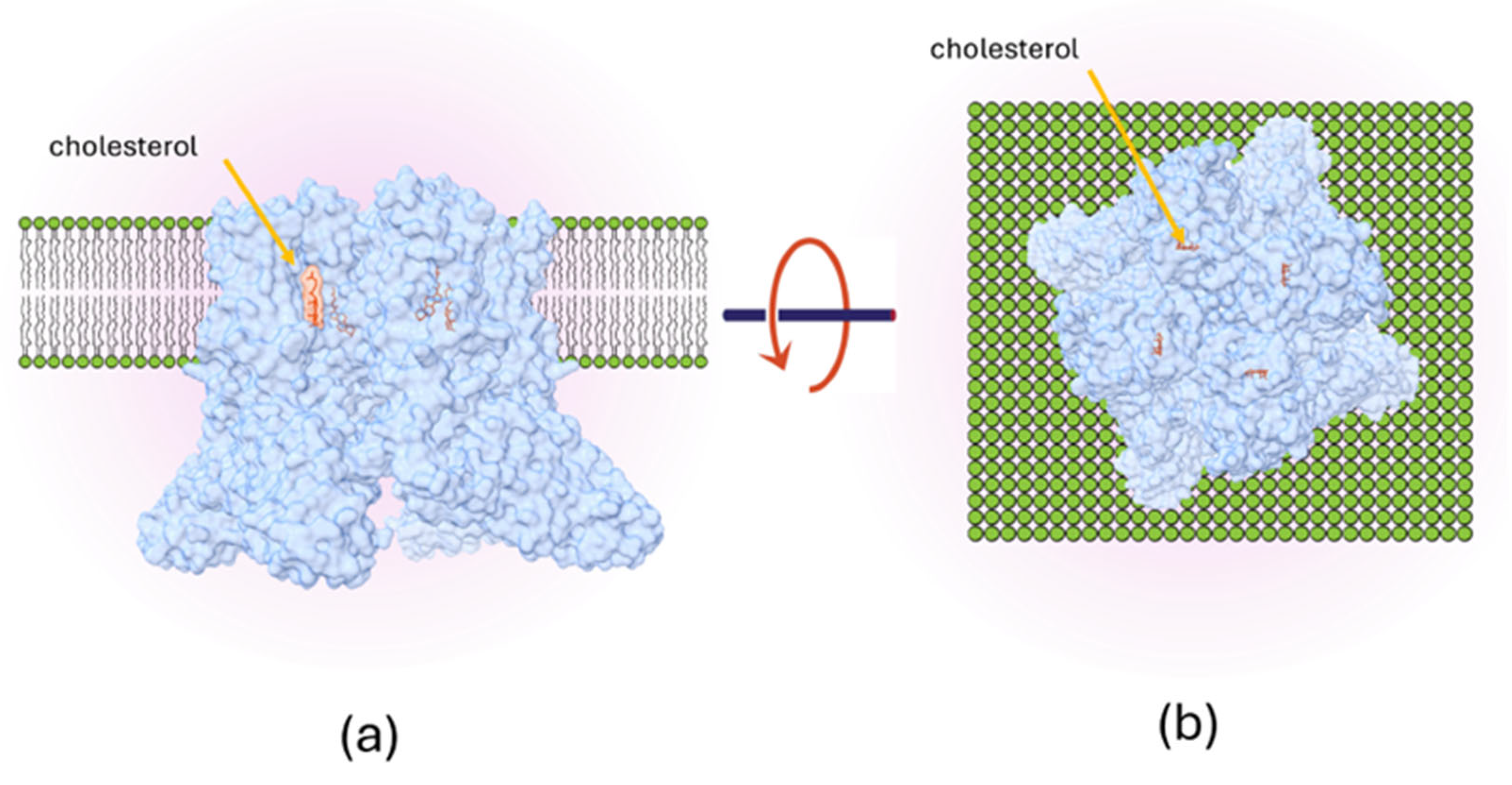
4.4. Cholesterol: Direct Binding, Stereospecific Recognition, and Microdomain Mechanics
4.5. Concluding Synthesis
5. Bioactive Lipids as Modulators of Ion Channels
- Obligate cofactor/electrostatic control, where anionic lipids—especially PIPs—“license” gating and gate coupling by stabilizing permissive conformations [80].
- Specific binding to annular or non-annular pockets (including fenestrations) that allosterically reshape gating energetics; an increasing number of structures and structure-guided studies now map these interactions at residue-level precision [82].
- Bilayer-mediated effects, where lipid shape and packing (thickness, curvature, lateral stress) bias channel energetics—particularly relevant for single-tailed LPLs and mechanosensitive channels [83].
- Nanoscale membrane organization (rafts/caveolae and other microdomains) that co-clusters channels with partners, controls local lipid pools, and integrates lipid signaling with trafficking and phosphorylation cascades [80].
| Bioactive Lipid | Ion Channel | Effect | Mechanism | References |
|---|---|---|---|---|
| Anandamide (AEA) | TRPV1 | Direct activation (gating) | Lipid-access path; allosteric pocket (peripheral) | [104] |
| Lysophosphatidic acid (LPA) | TRPV1 | Direct activation; pain in vivo | C-terminal lysine binding | [68] |
| 20-HETE (eicosanoid) | TRPV1 | Activation & sensitization | Direct/indirect modulation; promotes nociception | [105] |
| Prostaglandins (PGE2, PGI2) | TRPV1 | Sensitization (↓ heat threshold) | EP/IP GPCRs → PKA/PKC signaling | [106,107] |
| 4-Hydroxynonenal (4-HNE) | TRPA1 | Covalent activation | Electrophile adduction to cysteines | [108] |
| Arachidonic acid & other PUFAs; LPC | TRPM8 | PUFAs inhibit; LPC potentiates | Allosteric effects on gating by cold/menthol | [109] |
| 5,6-EET (epoxyeicosatrienoic acid) | TRPV4 | Activation | EET-binding pocket; key residues (e.g., K535) | [110,111] |
| Diacylglycerol (DAG) | TRPC3/6 | Direct activation | Membrane-delimited, PKC-independent | [66] |
| Arachidonic acid (AA), LPC, LPA | K2P (TREK-1/2, TRAAK) | Activation/gating to leak | Inner-leaflet lipid sensing; intracellular LPA gating | [69,112] |
| PUFAs (e.g., DHA analogs) | Kv7/KCNQ1 (IKs) | Activation; V½ shift; rescue of LQTS | Interactions near VSD/pore; subtype-specific | [113] |
| Ceramide | Kv1.3 | Inhibition | Ceramide platforms/rafts; clustering | [93,114] |
| Sphingosine-1-phosphate (S1P) | BK (KCa1.1) | Activation; hyperpolarization | GPCR-dependent/independent reports; cell-type specific | [115] |
| Anandamide; lipoamino acids | Cav3.x (T-type) | Inhibition (CB-independent) | Stabilizes inactivated states; direct block | [116] |
| Endocannabinoids (AEA/2-AG) | Cav2.2 (N-type) | Inhibition | CB1→Gβγ→Cav2.2 inhibition; retrograde control | [117] |
| PUFAs (composition); PA/LPA | Piezo1/2 | Piezo1 sensitivity tuned; PIEZO2 inhibited | Bilayer-mechanics tuning; PLD→PA signaling for PIEZO2 | [118] |
5.1. Class-Specific Highlights with Recent Mechanistic Anchors
5.1.1. Phosphoinositides (PIPs): Anionic Cofactors and Structural Determinants of Gating
5.1.2. Diacylglycerol (DAG) and Related Glycerolipids: Direct Gating and Defined Binding Sites
5.1.3. Phosphatidic Acid (PA): Linking Lipid Metabolism to Mechanotransduction and K2P Gating
5.1.4. Lysophospholipids (LPLs): Direct Lipid Gating, Fenestrations, and Pain-Relevant Signaling
5.1.5. Sphingolipids (Including Ceramides): Bona Fide Bioactive Lipids That Remodel Channel Gating
5.1.6. Fatty Acids and Oxylipins: Rapid Lipid Mediators Intersecting with K2P and TRP Energetics
5.2. Summary and Perspective
6. Lipid Post-Translational Modification of Ion Channels
| Lipid PTM | Ion Channel | Effect | References |
|---|---|---|---|
| S-palmitoylation | Nav1.5 (SCN5A) | ↑ availability and late I_Na; action potential prolongation | [144] |
| Kir6.2 (KATP) | ↑ PIP2 sensitivity; ↑ current | [145] | |
| ENaC (γ subunit) | ↑ open probability; ↑ activity | [149] | |
| TRPV1 | promotes degradation | [142] | |
| BK (KCa1.1) | controls gating/trafficking | [150] | |
| BK (KCa1.1) | control of function and trafficking | [151] | |
| HCN4 | ↑ current density; altered activation kinetics | [146] | |
| Kv1.1 | Regulates channel function/targeting | [152] | |
| CFTR (ABCC7) | Supports maturation and activity; inhibition reduces function | [153] | |
| Myristoylation | BK (KCa1.1/Slo1) | alters current density and gating | [154] |
| ENaC (via myristoylated MLP-1/MARCKS-like protein-1) | ↑ ENaC activity via PIP2-dependent scaffolding | [155] | |
| Prenylation | GIRK (Kir3.x) | required for GPCR→Gβγ activation of GIRK | [156] |
| GPI anchoring | Nav (RB sensory neurons, zebrafish) | required for Nav surface expression and firing | [157] |
| Nav1.2/1.3/1.9 | ↑ Surface channel density via GPI-anchored adhesion molecule | [158] | |
| ENaC | Protease-dependent activation of ENaC; GPI-anchor regulates prostasin availability | [159] | |
| NMDAR | Modulates NMDA receptor activity/excitotoxicity | [160] |
7. Lipid Rafts and Ion Channels
8. Regulation of Ion Channels by the Physicochemical Properties of the Membrane Bilayer
8.1. Surface Charge
8.2. Dipole Potential
8.3. Lateral Pressure Profile & Membrane Tension (Lateral Stress)
8.4. Curvature Elastic Energy
8.5. Lipid Tail Ordering and Membrane Fluidity
8.6. Bilayer Thickness (Hydrophobic Mismatch)
9. Discussion
10. Conclusions
Funding
Data Availability Statement
Acknowledgments
Conflicts of Interest
Abbreviations
| 2-APB | 2-aminoethoxydiphenyl borate |
| ABCC7 | ATP-binding cassette subfamily C member 7 (CFTR) |
| AChR | acetylcholine receptor |
| AEA | anandamide |
| ASIC | acid-sensing ion channel |
| ASM | acid sphingomyelinase |
| ATP | adenosine triphosphate |
| BK | large-conductance Ca2+-activated K+ channel (KCa1.1/Slo1) |
| CALHM | calcium homeostasis modulator (channel family) |
| CaM | calmodulin |
| CaV | voltage-gated Ca2+ channel |
| Cav (CaV) | voltage-gated calcium channel(s) |
| CFTR | cystic fibrosis transmembrane conductance regulator |
| CHL | cholesterol |
| ClC | CLC chloride channel/transporter family |
| CNG | cyclic nucleotide-gated (channel) |
| CRAC | Ca2+ release-activated Ca2+ (channel) |
| cryo-EM | cryo-electron microscopy |
| cryo-ET | cryo-electron tomography |
| CTxB | cholera toxin B subunit |
| DAG | diacylglycerol |
| DRG | dorsal root ganglion |
| EET | epoxyeicosatrienoic acid |
| EM | electron microscopy |
| ENaC | epithelial Na+ channel |
| ENPP2 | ectonucleotide pyrophosphatase/phosphodiesterase 2 |
| ER–PM | endoplasmic reticulum–plasma membrane (junction) |
| FCS | fluorescence correlation spectroscopy |
| FRET | Förster resonance energy transfer |
| FTY720 | fingolimod |
| GABAAR | γ-aminobutyric acid type A receptor (GABAA receptor) |
| GABAAR | γ-aminobutyric acid type A receptor |
| GL | glycolipids |
| GLIC | Gloeobacter violaceus ligand-gated ion channel |
| GM1 | ganglioside GM1 (monosialotetrahexosylganglioside) |
| GPCR | G protein-coupled receptor |
| GPR55 | G protein-coupled receptor 55 |
| GSL | glycosphingolipid(s) |
| HCN | hyperpolarization-activated cyclic nucleotide-gated (channel) |
| hiPSC | human induced pluripotent stem cell |
| iGluR | ionotropic glutamate receptor |
| IUPHAR | International Union of Basic and Clinical Pharmacology |
| K2P | two-pore-domain K+ channel |
| KATP | ATP-sensitive K+ channel |
| KCNMB1 | BK channel β1 subunit (KCNMB1) |
| KCNQ | KCNQ/Kv7 voltage-gated K+ channel family |
| Kir | inward-rectifier K+ channel |
| Kv | voltage-gated K+ channel |
| LPA | lysophosphatidic acid |
| LPC | lysophosphatidylcholine |
| LPI | lysophosphatidylinositol |
| LQTS | long QT syndrome |
| MD | molecular dynamics |
| MRS2 | mitochondrial Mg2+ channel (MRS2 family) |
| MS | mass spectrometry |
| MscL | mechanosensitive channel of large conductance |
| MscS | mechanosensitive channel of small conductance |
| MβCD | methyl-β-cyclodextrin |
| Nav | voltage-gated Na+ channel |
| Nav (NaV) | voltage-gated sodium channel(s) |
| NC-IUPHAR | IUPHAR Committee on Receptor Nomenclature and Drug Classification |
| NMDAR | N-methyl-D-aspartate receptor |
| OA | osteoarthritis |
| ORAI | Orai Ca2+ channel family |
| Orai1 | Orai1 Ca2+ channel (CRAC channel pore subunit) |
| P2X | P2X purinergic receptor family (ATP-gated cation channels) |
| PA | phosphatidic acid |
| PC | phosphatidylcholine |
| PDB | Protein Data Bank |
| PE | phosphatidylethanolamine |
| PG | phosphatidylglycerol |
| PI | phosphatidylinositol |
| PI3K | phosphoinositide 3-kinase |
| PI4K | phosphatidylinositol 4-kinase |
| PI4P | phosphatidylinositol 4-phosphate |
| PIEZO | Piezo mechanosensitive ion channel family |
| PIP2 | phosphatidylinositol 4,5-bisphosphate |
| PIP3 | phosphatidylinositol 3,4,5-trisphosphate |
| PKA | protein kinase A |
| PKC | protein kinase C |
| PLA | phospholipase A |
| PLC | phospholipase C |
| PLD | phospholipase D |
| pLGICs | pentameric ligand-gated ion channels |
| PTEN | phosphatase and tensin homolog |
| PUFA | polyunsaturated fatty acid |
| S1P | sphingosine-1-phosphate |
| S4 | voltage-sensor transmembrane helix 4 |
| SMPD3 | sphingomyelin phosphodiesterase 3 (neutral sphingomyelinase 2) |
| SOAR | STIM1 Orai-activating region |
| SOCE | store-operated Ca2+ entry |
| STIM1 | stromal interaction molecule 1 |
| TASK-1 | TWIK-related acid-sensitive K+ channel 1 (KCNK3) |
| TM4 | transmembrane helix 4 |
| TPC | two-pore channel(s) |
| TRAAK | TWIK-related arachidonic acid-stimulated K+ channel |
| TREK-1 | TWIK-related K+ channel 1 |
| TRP | transient receptor potential (channel superfamily) |
| TRPA1 | transient receptor potential ankyrin 1 |
| TRPC | transient receptor potential canonical |
| TRPM3 | transient receptor potential melastatin 3 |
| TRPM7 | transient receptor potential melastatin 7 |
| TRPM8 | transient receptor potential melastatin 8 |
| TRPV1 | transient receptor potential vanilloid 1 |
| TRPV2 | transient receptor potential vanilloid 2 |
| TRPV4 | transient receptor potential vanilloid 4 |
| VBP | vanilloid-binding pocket |
| VGL | voltage-gated-like |
| VSD | voltage-sensing domain |
References
- Nicolson, G.L.; Ferreira de Mattos, G. Fifty Years of the Fluid-Mosaic Model of Biomembrane Structure and Organization and Its Importance in Biomedicine with Particular Emphasis on Membrane Lipid Replacement. Biomedicines 2022, 10, 1711. [Google Scholar] [CrossRef]
- Townsend, C. Ion Channels. In Reference Module in Biomedical Sciences; Elsevier: Amsterdam, The Netherlands, 2021; ISBN 978-0-12-801238-3. [Google Scholar]
- Alberts, B.; Johnson, A.; Lewis, J.; Raff, M.; Roberts, K.; Walter, P. Ion Channels and the Electrical Properties of Membranes. In Molecular Biology of the Cell, 4th ed.; Garland Science: New York, NY, USA, 2002. [Google Scholar]
- Rosenhouse-Dantsker, A.; Mehta, D.; Levitan, I. Regulation of Ion Channels by Membrane Lipids. Compr. Physiol. 2012, 2, 31–68. [Google Scholar] [CrossRef]
- Saponaro, A.; Lolicato, M. Editorial: The Key Role of Lipids in the Regulation of Ion Channels. Front. Physiol. 2022, 13, 1000082. [Google Scholar] [CrossRef] [PubMed]
- Hudgins, E.C.; Bonar, A.M.; Nguyen, T.; Fancher, I.S. Targeting Lipid—Ion Channel Interactions in Cardiovascular Disease. Front. Cardiovasc. Med. 2022, 9, 876634. [Google Scholar] [CrossRef] [PubMed]
- Ashrafuzzaman, M.; Koeppe, R.E.; Andersen, O.S. Intrinsic Lipid Curvature and Bilayer Elasticity as Regulators of Channel Function: A Comparative Single-Molecule Study. Int. J. Mol. Sci. 2024, 25, 2758. [Google Scholar] [CrossRef] [PubMed]
- Poole, K. The Diverse Physiological Functions of Mechanically Activated Ion Channels in Mammals. Annu. Rev. Physiol. 2022, 84, 307–329. [Google Scholar] [CrossRef]
- Xiao, R.; Liu, J.; Xu, X.S. Mechanosensitive GPCRs and Ion Channels in Shear Stress Sensing. Curr. Opin. Cell Biol. 2023, 84, 102216. [Google Scholar] [CrossRef]
- Mayor, S.; Bhat, A.; Kusumi, A. A Survey of Models of Cell Membranes: Toward a New Understanding of Membrane Organization. Cold Spring Harb. Perspect. Biol. 2023, 15, a041394. [Google Scholar] [CrossRef]
- Dart, C. Lipid Microdomains and the Regulation of Ion Channel Function. J. Physiol. 2010, 588, 3169–3178. [Google Scholar] [CrossRef]
- Levental, I.; Levental, K.R.; Heberle, F.A. Lipid Rafts: Controversies Resolved, Mysteries Remain. Trends Cell Biol. 2020, 30, 341–353. [Google Scholar] [CrossRef]
- Parton, R.G.; del Pozo, M.A.; Vassilopoulos, S.; Nabi, I.R.; Le Lay, S.; Lundmark, R.; Kenworthy, A.K.; Camus, A.; Blouin, C.M.; Sessa, W.C.; et al. Caveolae: The FAQs. Traffic 2020, 21, 181–185. [Google Scholar] [CrossRef] [PubMed]
- Sakamoto, K.; Akimoto, T.; Muramatsu, M.; Sansom, M.S.P.; Metzler, R.; Yamamoto, E. Heterogeneous Biological Membranes Regulate Protein Partitioning via Fluctuating Diffusivity. Proc. Natl. Acad. Sci. USA Nexus 2023, 2, pgad258. [Google Scholar] [CrossRef] [PubMed]
- Torres, M.; Parets, S.; Fernández-Díaz, J.; Beteta-Göbel, R.; Rodríguez-Lorca, R.; Román, R.; Lladó, V.; Rosselló, C.A.; Fernández-García, P.; Escribá, P.V. Lipids in Pathophysiology and Development of the Membrane Lipid Therapy: New Bioactive Lipids. Membranes 2021, 11, 919. [Google Scholar] [CrossRef] [PubMed]
- Cheng, W.W.L.; Arcario, M.J.; Petroff, J.T. Druggable Lipid Binding Sites in Pentameric Ligand-Gated Ion Channels and Transient Receptor Potential Channels. Front. Physiol. 2021, 12, 798102. [Google Scholar] [CrossRef]
- Chen, G.-L.; Li, J.; Zhang, J.; Zeng, B. To Be or Not to Be an Ion Channel: Cryo-EM Structures Have a Say. Cells 2023, 12, 1870. [Google Scholar] [CrossRef]
- Zhu, Z.; Deng, Z.; Wang, Q.; Wang, Y.; Zhang, D.; Xu, R.; Guo, L.; Wen, H. Simulation and Machine Learning Methods for Ion-Channel Structure Determination, Mechanistic Studies and Drug Design. Front. Pharmacol. 2022, 13, 939555. [Google Scholar] [CrossRef]
- Kageyama, H.; Ma, T.; Sato, M.; Komiya, M.; Tadaki, D.; Hirano-Iwata, A. New Aspects of Bilayer Lipid Membranes for the Analysis of Ion Channel Functions. Membranes 2022, 12, 863. [Google Scholar] [CrossRef]
- Kusumi, A.; Tsunoyama, T.A.; Tang, B.; Hirosawa, K.M.; Morone, N.; Fujiwara, T.K.; Suzuki, K.G.N. Cholesterol- and Actin-Centered View of the Plasma Membrane: Updating the Singer–Nicolson Fluid Mosaic Model to Commemorate Its 50th Anniversary. Mol. Biol. Cell 2023, 34, pl1. [Google Scholar] [CrossRef]
- Kalappurakkal, J.M.; Sil, P.; Mayor, S. Toward a New Picture of the Living Plasma Membrane. Protein Sci. 2020, 29, 1355–1365. [Google Scholar] [CrossRef]
- Levental, I.; Lyman, E. Regulation of Membrane Protein Structure and Function by Their Lipid Nano-Environment. Nat. Rev. Mol. Cell Biol. 2023, 24, 107–122. [Google Scholar] [CrossRef]
- Hornburg, D.; Wu, S.; Moqri, M.; Zhou, X.; Contrepois, K.; Bararpour, N.; Traber, G.M.; Su, B.; Metwally, A.A.; Avina, M.; et al. Dynamic Lipidome Alterations Associated with Human Health, Disease and Ageing. Nat. Metab. 2023, 5, 1578–1594. [Google Scholar] [CrossRef] [PubMed]
- Renne, M.F.; Ernst, R. Membrane Homeostasis beyond Fluidity: Control of Membrane Compressibility. Trends Biochem. Sci. 2023, 48, 963–977. [Google Scholar] [CrossRef] [PubMed]
- Doktorova, M.; Symons, J.L.; Zhang, X.; Wang, H.-Y.; Schlegel, J.; Lorent, J.H.; Heberle, F.A.; Sezgin, E.; Lyman, E.; Levental, K.R.; et al. Cell Membranes Sustain Phospholipid Imbalance via Cholesterol Asymmetry. Cell 2025, 188, 2586–2602.e24. [Google Scholar] [CrossRef] [PubMed]
- Zhu, Y.; Porcar, L.; Ravula, T.; Batchu, K.C.; Lavoie, T.L.; Liu, Y.; Perez-Salas, U. Unexpected Asymmetric Distribution of Cholesterol and Phospholipids in Equilibrium Model Membranes. Biophys. J. 2024, 123, 3923–3934. [Google Scholar] [CrossRef]
- Pabst, G.; Keller, S. Exploring Membrane Asymmetry and Its Effects on Membrane Proteins. Trends Biochem. Sci. 2024, 49, 333–345. [Google Scholar] [CrossRef]
- Sauguet, L.; Shahsavar, A.; Poitevin, F.; Huon, C.; Menny, A.; Nemecz, À.; Haouz, A.; Changeux, J.-P.; Corringer, P.-J.; Delarue, M. Crystal Structures of a Pentameric Ligand-Gated Ion Channel Provide a Mechanism for Activation. Proc. Natl. Acad. Sci. USA 2014, 111, 966–971. [Google Scholar] [CrossRef]
- Reinhard, J.; Starke, L.; Klose, C.; Haberkant, P.; Hammarén, H.; Stein, F.; Klein, O.; Berhorst, C.; Stumpf, H.; Sáenz, J.P.; et al. MemPrep, a New Technology for Isolating Organellar Membranes Provides Fingerprints of Lipid Bilayer Stress. EMBO J. 2024, 43, 1653–1685. [Google Scholar] [CrossRef]
- Asis, A.C.; Asaro, A.; D’Angelo, G. Single Cell Lipid Biology. Trends Cell Biol. 2025, 35, 651–666. [Google Scholar] [CrossRef]
- Heberle, F.A.; Doktorova, M.; Scott, H.L.; Skinkle, A.D.; Waxham, M.N.; Levental, I. Direct Label-Free Imaging of Nanodomains in Biomimetic and Biological Membranes by Cryogenic Electron Microscopy. Proc. Natl. Acad. Sci. USA 2020, 117, 19943–19952. [Google Scholar] [CrossRef]
- Sapoń, K.; Mańka, R.; Janas, T.; Janas, T. The Role of Lipid Rafts in Vesicle Formation. J. Cell Sci. 2023, 136, jcs260887. [Google Scholar] [CrossRef]
- Kumarage, T.; Gupta, S.; Morris, N.B.; Doole, F.T.; Scott, H.L.; Stingaciu, L.-R.; Pingali, S.V.; Katsaras, J.; Khelashvili, G.; Doktorova, M.; et al. Cholesterol Modulates Membrane Elasticity via Unified Biophysical Laws. Nat. Commun. 2025, 16, 7024. [Google Scholar] [CrossRef]
- Tripathy, M.; Srivastava, A. Lipid Packing in Biological Membranes Governs Protein Localization and Membrane Permeability. Biophys. J. 2023, 122, 2727–2743. [Google Scholar] [CrossRef] [PubMed]
- Yang, G.-S.; Wagenknecht-Wiesner, A.; Yin, B.; Suresh, P.; London, E.; Baird, B.A.; Bag, N. Lipid-Driven Interleaflet Coupling of Plasma Membrane Order Regulates FcεRI Signaling in Mast Cells. Biophys. J. 2024, 123, 2256–2270. [Google Scholar] [CrossRef] [PubMed]
- Hu, M.; Feng, X.; Liu, Q.; Liu, S.; Huang, F.; Xu, H. The Ion Channels of Endomembranes. Physiol. Rev. 2024, 104, 1335–1385. [Google Scholar] [CrossRef] [PubMed]
- Alexander, S.P.H.; Mathie, A.A.; Peters, J.A.; Veale, E.L.; Striessnig, J.; Kelly, E.; Armstrong, J.F.; Faccenda, E.; Harding, S.D.; Davies, J.A.; et al. The Concise Guide to PHARMACOLOGY 2023/24: Ion Channels. Br. J. Pharmacol. 2023, 180, S145–S222. [Google Scholar] [CrossRef]
- Kefauver, J.M.; Ward, A.B.; Patapoutian, A. Discoveries in Structure and Physiology of Mechanically Activated Ion Channels. Nature 2020, 587, 567–576. [Google Scholar] [CrossRef]
- Mulhall, E.M.; Gharpure, A.; Lee, R.M.; Dubin, A.E.; Aaron, J.S.; Marshall, K.L.; Spencer, K.R.; Reiche, M.A.; Henderson, S.C.; Chew, T.-L.; et al. Direct Observation of the Conformational States of PIEZO1. Nature 2023, 620, 1117–1125. [Google Scholar] [CrossRef]
- Huang, J.; Korsunsky, A.; Yazdani, M.; Chen, J. Targeting TRP Channels: Recent Advances in Structure, Ligand Binding, and Molecular Mechanisms. Front. Mol. Neurosci. 2024, 16, 1334370. [Google Scholar] [CrossRef]
- Bell, D.C.; Leanza, L.; Gentile, S.; Sauter, D.R. News and Views on Ion Channels in Cancer: Is Cancer a Channelopathy? Front. Pharmacol. 2023, 14, 1258933. [Google Scholar] [CrossRef]
- Pliushcheuskaya, P.; Künze, G. Recent Advances in Computer-Aided Structure-Based Drug Design on Ion Channels. Int. J. Mol. Sci. 2023, 24, 9226. [Google Scholar] [CrossRef]
- Dai, G. Signaling by Ion Channels: Pathways, Dynamics and Channelopathies. Mo. Med. 2023, 120, 367–373. [Google Scholar] [PubMed]
- Lai, L.T.F.; Balaraman, J.; Zhou, F.; Matthies, D. Cryo-EM Structures of Human Magnesium Channel MRS2 Reveal Gating and Regulatory Mechanisms. Nat. Commun. 2023, 14, 7207. [Google Scholar] [CrossRef] [PubMed]
- Hill, C.L.; Stephens, G.J. An Introduction to Patch Clamp Recording. In Patch Clamp Electrophysiology. Methods in Molecular Biology; Humana: New York, NY, USA, 2021; Volume 2188, pp. 1–19. [Google Scholar] [CrossRef]
- Verkerk, A.O.; Wilders, R. Injection of IK1 through Dynamic Clamp Can Make All the Difference in Patch-Clamp Studies on hiPSC-Derived Cardiomyocytes. Front. Physiol. 2023, 14, 1326160. [Google Scholar] [CrossRef] [PubMed]
- Dallas, M.L.; Bell, D. Advances in Ion Channel High Throughput Screening: Where Are We in 2023? Expert Opin. Drug Discov. 2024, 19, 331–337. [Google Scholar] [CrossRef]
- Bharambe, N.; Li, Z.; Seiferth, D.; Balakrishna, A.M.; Biggin, P.C.; Basak, S. Cryo-EM Structures of Prokaryotic Ligand-Gated Ion Channel GLIC Provide Insights into Gating in a Lipid Environment. Nat. Commun. 2024, 15, 2967. [Google Scholar] [CrossRef]
- Lee, B.-H.; De Jesús Pérez, J.J.; Moiseenkova-Bell, V.; Rohacs, T. Structural Basis of the Activation of TRPV5 Channels by Long-Chain Acyl-Coenzyme-A. Nat. Commun. 2023, 14, 5883. [Google Scholar] [CrossRef]
- Schmidpeter, P.A.M.; Wu, D.; Rheinberger, J.; Riegelhaupt, P.M.; Tang, H.; Robinson, C.V.; Nimigean, C.M. Anionic Lipids Unlock the Gates of Select Ion Channels in the Pacemaker Family. Nat. Struct. Mol. Biol. 2022, 29, 1092–1100. [Google Scholar] [CrossRef]
- Perozo, E.; Cortes, D.M.; Sompornpisut, P.; Kloda, A.; Martinac, B. Open Channel Structure of MscL and the Gating Mechanism of Mechanosensitive Channels. Nature 2002, 418, 942–948. [Google Scholar] [CrossRef]
- Gullingsrud, J.; Schulten, K. Lipid Bilayer Pressure Profiles and Mechanosensitive Channel Gating. Biophys. J. 2004, 86, 3496–3509. [Google Scholar] [CrossRef]
- Nomura, T.; Cranfield, C.G.; Deplazes, E.; Owen, D.M.; Macmillan, A.; Battle, A.R.; Constantine, M.; Sokabe, M.; Martinac, B. Differential Effects of Lipids and Lyso-Lipids on the Mechanosensitivity of the Mechanosensitive Channels MscL and MscS. Proc. Natl. Acad. Sci. USA 2012, 109, 8770–8775. [Google Scholar] [CrossRef]
- Cs Szabo, B.; Szabo, M.; Nagy, P.; Varga, Z.; Panyi, G.; Kovacs, T.; Zakany, F. Novel Insights into the Modulation of the Voltage-Gated Potassium Channel KV1.3 Activation Gating by Membrane Ceramides. J. Lipid Res. 2024, 65, 100596. [Google Scholar] [CrossRef] [PubMed]
- Bukiya, A.N.; Leo, M.D.; Jaggar, J.H.; Dopico, A.M. Cholesterol Activates BK Channels by Increasing KCNMB1 Protein Levels in the Plasmalemma. J. Biol. Chem. 2021, 296, 100381. [Google Scholar] [CrossRef] [PubMed]
- Bukiya, A.N.; Belani, J.D.; Rychnovsky, S.; Dopico, A.M. Specificity of Cholesterol and Analogs to Modulate BK Channels Points to Direct Sterol-Channel Protein Interactions. J. Gen. Physiol. 2011, 137, 93–110. [Google Scholar] [CrossRef] [PubMed]
- Romanenko, V.G.; Rothblat, G.H.; Levitan, I. Modulation of Endothelial Inward-Rectifier K+ Current by Optical Isomers of Cholesterol. Biophys. J. 2002, 83, 3211–3222. [Google Scholar] [CrossRef]
- Hajdú, P.; Varga, Z.; Pieri, C.; Panyi, G.; Gáspár, R. Cholesterol Modifies the Gating of Kv1.3 in Human T Lymphocytes. Pflug. Arch. 2003, 445, 674–682. [Google Scholar] [CrossRef]
- Derler, I.; Jardin, I.; Stathopulos, P.B.; Muik, M.; Fahrner, M.; Zayats, V.; Pandey, S.K.; Poteser, M.; Lackner, B.; Absolonova, M.; et al. Cholesterol Modulates Orai1 Channel Function. Sci. Signal 2016, 9, ra10. [Google Scholar] [CrossRef]
- Hénault, C.M.; Govaerts, C.; Spurny, R.; Brams, M.; Estrada-Mondragon, A.; Lynch, J.; Bertrand, D.; Pardon, E.; Evans, G.L.; Woods, K.; et al. A Lipid Site Shapes the Agonist Response of a Pentameric Ligand-Gated Ion Channel. Nat. Chem. Biol. 2019, 15, 1156–1164. [Google Scholar] [CrossRef]
- Brannigan, G.; Hénin, J.; Law, R.; Eckenhoff, R.; Klein, M.L. Embedded Cholesterol in the Nicotinic Acetylcholine Receptor. Proc. Natl. Acad. Sci. USA 2008, 105, 14418–14423. [Google Scholar] [CrossRef]
- Ridone, P.; Pandzic, E.; Vassalli, M.; Cox, C.D.; Macmillan, A.; Gottlieb, P.A.; Martinac, B. Disruption of Membrane Cholesterol Organization Impairs the Activity of PIEZO1 Channel Clusters. J. Gen. Physiol. 2020, 152, e201912515. [Google Scholar] [CrossRef]
- Su, N.; Zhen, W.; Zhang, H.; Xu, L.; Jin, Y.; Chen, X.; Zhao, C.; Wang, Q.; Wang, X.; Li, S.; et al. Structural Mechanisms of TRPV2 Modulation by Endogenous and Exogenous Ligands. Nat. Chem. Biol. 2023, 19, 72–80. [Google Scholar] [CrossRef]
- Mathiharan, Y.K.; Glaaser, I.W.; Zhao, Y.; Robertson, M.J.; Skiniotis, G.; Slesinger, P.A. Structural Insights into GIRK2 Channel Modulation by Cholesterol and PIP2. Cell Rep. 2021, 36, 109619. [Google Scholar] [CrossRef] [PubMed]
- Balijepalli, R.C.; Foell, J.D.; Hall, D.D.; Hell, J.W.; Kamp, T.J. Localization of Cardiac L-Type Ca2+ Channels to a Caveolar Macromolecular Signaling Complex Is Required for β2-Adrenergic Regulation. Proc. Natl. Acad. Sci. USA 2006, 103, 7500–7505. [Google Scholar] [CrossRef] [PubMed]
- Hofmann, T.; Obukhov, A.G.; Schaefer, M.; Harteneck, C.; Gudermann, T.; Schultz, G. Direct Activation of Human TRPC6 and TRPC3 Channels by Diacylglycerol. Nature 1999, 397, 259–263. [Google Scholar] [CrossRef] [PubMed]
- Weesner, J.A.; Annunziata, I.; van de Vlekkert, D.; Robinson, C.G.; Campos, Y.; Mishra, A.; Fremuth, L.E.; Gomero, E.; Hu, H.; d’Azzo, A. Altered GM1 Catabolism Affects NMDAR-Mediated Ca2+ Signaling at ER-PM Junctions and Increases Synaptic Spine Formation in a GM1-Gangliosidosis Model. Cell Rep. 2024, 43, 114117. [Google Scholar] [CrossRef]
- Nieto-Posadas, A.; Picazo-Juárez, G.; Llorente, I.; Jara-Oseguera, A.; Morales-Lázaro, S.; Escalante-Alcalde, D.; Islas, L.D.; Rosenbaum, T. Lysophosphatidic Acid Directly Activates TRPV1 through a C-Terminal Binding Site. Nat. Chem. Biol. 2011, 8, 78–85. [Google Scholar] [CrossRef]
- Maingret, F.; Patel, A.J.; Lesage, F.; Lazdunski, M.; Honoré, E. Lysophospholipids Open the Two-Pore Domain Mechano-Gated K+ Channels TREK-1 and TRAAK. J. Biol. Chem. 2000, 275, 10128–10133. [Google Scholar] [CrossRef]
- Schmidpeter, P.A.M.; Petroff, J.T.; Khajoueinejad, L.; Wague, A.; Frankfater, C.; Cheng, W.W.L.; Nimigean, C.M.; Riegelhaupt, P.M. Membrane Phospholipids Control Gating of the Mechanosensitive Potassium Leak Channel TREK1. Nat. Commun. 2023, 14, 1077. [Google Scholar] [CrossRef]
- Marius, P.; Alvis, S.J.; East, J.M.; Lee, A.G. The Interfacial Lipid Binding Site on the Potassium Channel KcsA Is Specific for Anionic Phospholipids. Biophys. J. 2005, 89, 4081–4089. [Google Scholar] [CrossRef]
- Lee, S.-J.; Wang, S.; Borschel, W.; Heyman, S.; Gyore, J.; Nichols, C.G. Secondary Anionic Phospholipid Binding Site and Gating Mechanism in Kir2.1 Inward Rectifier Channels. Nat. Commun. 2013, 4, 2786. [Google Scholar] [CrossRef]
- Whorton, M.R.; MacKinnon, R. Crystal Structure of the Mammalian GIRK2 K+ Channel and Gating Regulation by G Proteins, PIP2, and Sodium. Cell 2011, 147, 199–208. [Google Scholar] [CrossRef]
- Sun, J.; MacKinnon, R. Structural Basis of Human KCNQ1 Modulation and Gating. Cell 2020, 180, 340–347.e9. [Google Scholar] [CrossRef] [PubMed]
- Zhang, H.; Craciun, L.C.; Mirshahi, T.; Rohács, T.; Lopes, C.M.B.; Jin, T.; Logothetis, D.E. PIP(2) Activates KCNQ Channels, and Its Hydrolysis Underlies Receptor-Mediated Inhibition of M Currents. Neuron 2003, 37, 963–975. [Google Scholar] [CrossRef] [PubMed]
- Falkenburger, B.H.; Jensen, J.B.; Hille, B. Kinetics of PIP2 Metabolism and KCNQ2/3 Channel Regulation Studied with a Voltage-Sensitive Phosphatase in Living Cells. J. Gen. Physiol. 2010, 135, 99–114. [Google Scholar] [CrossRef] [PubMed]
- Yin, Y.; Le, S.C.; Hsu, A.L.; Borgnia, M.J.; Yang, H.; Lee, S.-Y. Structural Basis of Cooling Agent and Lipid Sensing by the Cold-Activated TRPM8 Channel. Science 2019, 363, eaav9334. [Google Scholar] [CrossRef]
- Hughes, T.E.T.; Pumroy, R.A.; Yazici, A.T.; Kasimova, M.A.; Fluck, E.C.; Huynh, K.W.; Samanta, A.; Molugu, S.K.; Zhou, Z.H.; Carnevale, V.; et al. Structural Insights on TRPV5 Gating by Endogenous Modulators. Nat. Commun. 2018, 9, 4198. [Google Scholar] [CrossRef]
- Lee, J.; Cha, S.-K.; Sun, T.-J.; Huang, C.-L. PIP2 Activates TRPV5 and Releases Its Inhibition by Intracellular Mg2+. J. Gen. Physiol. 2005, 126, 439–451. [Google Scholar] [CrossRef]
- Driggers, C.M.; Kuo, Y.-Y.; Zhu, P.; ElSheikh, A.; Shyng, S.-L. Structure of an Open KATP Channel Reveals Tandem PIP2 Binding Sites Mediating the Kir6.2 and SUR1 Regulatory Interface. Nat. Commun. 2024, 15, 2502. [Google Scholar] [CrossRef]
- Hansen, S.B.; Tao, X.; MacKinnon, R. Structural Basis of PIP2 Activation of the Classical Inward Rectifier K+ Channel Kir2.2. Nature 2011, 477, 495–498. [Google Scholar] [CrossRef]
- Hildebrandt, E.; Khazanov, N.; Kappes, J.C.; Dai, Q.; Senderowitz, H.; Urbatsch, I.L. Specific Stabilization of CFTR by Phosphatidylserine. Biochim. Biophys. Acta Biomembr. 2017, 1859, 289–293. [Google Scholar] [CrossRef]
- Park, J.B.; Kim, H.J.; Ryu, P.D.; Moczydlowski, E. Effect of Phosphatidylserine on Unitary Conductance and Ba2+ Block of the BK Ca2+-Activated K+ Channel: Re-Examination of the Surface Charge Hypothesis. J. Gen. Physiol. 2003, 121, 375–397. [Google Scholar] [CrossRef]
- Shi, J.; Hyman, A.J.; De Vecchis, D.; Chong, J.; Lichtenstein, L.; Futers, T.S.; Rouahi, M.; Salvayre, A.N.; Auge, N.; Kalli, A.C.; et al. Sphingomyelinase Disables Inactivation in Endogenous PIEZO1 Channels. Cell Rep. 2020, 33, 108225. [Google Scholar] [CrossRef]
- Zeitler, S.; Schumacher, F.; Monti, J.; Anni, D.; Guhathakurta, D.; Kleuser, B.; Friedland, K.; Fejtová, A.; Kornhuber, J.; Rhein, C. Acid Sphingomyelinase Impacts Canonical Transient Receptor Potential Channels 6 (TRPC6) Activity in Primary Neuronal Systems. Cells 2020, 9, 2502. [Google Scholar] [CrossRef]
- Combs, D.J.; Lu, Z. Sphingomyelinase D Inhibits Store-Operated Ca2+ Entry in T Lymphocytes by Suppressing ORAI Current. J. Gen. Physiol. 2015, 146, 161–172. [Google Scholar] [CrossRef]
- Niu, Y.; Tao, X.; Touhara, K.K.; MacKinnon, R. Cryo-EM Analysis of PIP2 Regulation in Mammalian GIRK Channels. eLife 2020, 9, e60552. [Google Scholar] [CrossRef] [PubMed]
- Zangerl-Plessl, E.-M.; Lee, S.-J.; Maksaev, G.; Bernsteiner, H.; Ren, F.; Yuan, P.; Stary-Weinzinger, A.; Nichols, C.G. Atomistic Basis of Opening and Conduction in Mammalian Inward Rectifier Potassium (Kir2.2) Channels. J. Gen. Physiol. 2020, 152, e201912422. [Google Scholar] [CrossRef] [PubMed]
- Rohács, T.; Lopes, C.M.B.; Michailidis, I.; Logothetis, D.E. PI(4,5)P2 Regulates the Activation and Desensitization of TRPM8 Channels through the TRP Domain. Nat. Neurosci. 2005, 8, 626–634. [Google Scholar] [CrossRef] [PubMed]
- Prescott, E.D.; Julius, D. A Modular PIP2 Binding Site as a Determinant of Capsaicin Receptor Sensitivity. Science 2003, 300, 1284–1288. [Google Scholar] [CrossRef]
- Arnold, W.R.; Mancino, A.; Moss, F.R.; Frost, A.; Julius, D.; Cheng, Y. Structural Basis of TRPV1 Modulation by Endogenous Bioactive Lipids. Nat. Struct. Mol. Biol. 2024, 31, 1377–1385. [Google Scholar] [CrossRef]
- Liin, S.I.; Yazdi, S.; Ramentol, R.; Barro-Soria, R.; Larsson, H.P. Mechanisms Underlying the Dual Effect of Polyunsaturated Fatty Acid Analogs on Kv7.1. Cell Rep. 2018, 24, 2908–2918. [Google Scholar] [CrossRef]
- Bock, J.; Szabó, I.; Gamper, N.; Adams, C.; Gulbins, E. Ceramide Inhibits the Potassium Channel Kv1.3 by the Formation of Membrane Platforms. Biochem. Biophys. Res. Commun. 2003, 305, 890–897. [Google Scholar] [CrossRef]
- Qin, X.; Yue, Z.; Sun, B.; Yang, W.; Xie, J.; Ni, E.; Feng, Y.; Mahmood, R.; Zhang, Y.; Yue, L. Sphingosine and FTY720 Are Potent Inhibitors of the Transient Receptor Potential Melastatin 7 (TRPM7) Channels. Br. J. Pharmacol. 2013, 168, 1294–1312. [Google Scholar] [CrossRef]
- Zeitler, S.; Ye, L.; Andreyeva, A.; Schumacher, F.; Monti, J.; Nürnberg, B.; Nowak, G.; Kleuser, B.; Reichel, M.; Fejtová, A.; et al. Acid Sphingomyelinase—A Regulator of Canonical Transient Receptor Potential Channel 6 (TRPC6) Activity. J. Neurochem. 2019, 150, 678–690. [Google Scholar] [CrossRef]
- Carlson, R.O.; Masco, D.; Brooker, G.; Spiegel, S. Endogenous Ganglioside GM1 Modulates L-Type Calcium Channel Activity in N18 Neuroblastoma Cells. J. Neurosci. 1994, 14, 2272–2281. [Google Scholar] [CrossRef]
- Salazar, B.C.; Castaño, S.; Sánchez, J.C.; Romero, M.; Recio-Pinto, E. Ganglioside GD1a Increases the Excitability of Voltage-Dependent Sodium Channels. Brain Res. 2004, 1021, 151–158. [Google Scholar] [CrossRef] [PubMed]
- Ishibashi, T.; Dupree, J.L.; Ikenaka, K.; Hirahara, Y.; Honke, K.; Peles, E.; Popko, B.; Suzuki, K.; Nishino, H.; Baba, H. A Myelin Galactolipid, Sulfatide, Is Essential for Maintenance of Ion Channels on Myelinated Axon But Not Essential for Initial Cluster Formation. J. Neurosci. 2002, 22, 6507–6514. [Google Scholar] [CrossRef] [PubMed]
- Dalton, G.; An, S.-W.; Al-Juboori, S.I.; Nischan, N.; Yoon, J.; Dobrinskikh, E.; Hilgemann, D.W.; Xie, J.; Luby-Phelps, K.; Kohler, J.J.; et al. Soluble Klotho Binds Monosialoganglioside to Regulate Membrane Microdomains and Growth Factor Signaling. Proc. Natl. Acad. Sci. USA 2017, 114, 752–757. [Google Scholar] [CrossRef] [PubMed]
- Wright, J.D.; An, S.-W.; Xie, J.; Lim, C.; Huang, C.-L. Soluble Klotho Regulates TRPC6 Calcium Signaling via Lipid Rafts, Independent of the FGFR-FGF23 Pathway. FASEB J. 2019, 33, 9182–9193. [Google Scholar] [CrossRef]
- Jansson, E.T.; Trkulja, C.L.; Ahemaiti, A.; Millingen, M.; Jeffries, G.D.; Jardemark, K.; Orwar, O. Effect of Cholesterol Depletion on the Pore Dilation of TRPV1. Mol. Pain 2013, 9, 1744–8069. [Google Scholar] [CrossRef]
- Epshtein, Y.; Chopra, A.P.; Rosenhouse-Dantsker, A.; Kowalsky, G.B.; Logothetis, D.E.; Levitan, I. Identification of a C-Terminus Domain Critical for the Sensitivity of Kir2.1 to Cholesterol. Proc. Natl. Acad. Sci. USA 2009, 106, 8055–8060. [Google Scholar] [CrossRef]
- Rosenhouse-Dantsker, A.; Logothetis, D.E.; Levitan, I. Cholesterol Sensitivity of KIR2.1 Is Controlled by a Belt of Residues around the Cytosolic Pore. Biophys. J. 2011, 100, 381–389. [Google Scholar] [CrossRef]
- Muller, C.; Lynch, D.L.; Hurst, D.P.; Reggio, P.H. TRPV1 Activation by Anandamide via a Unique Lipid Pathway. J. Chem. Inf. Model. 2021, 61, 5742–5746. [Google Scholar] [CrossRef] [PubMed]
- Wen, H.; Östman, J.; Bubb, K.J.; Panayiotou, C.; Priestley, J.V.; Baker, M.D.; Ahluwalia, A. 20-Hydroxyeicosatetraenoic Acid (20-HETE) Is a Novel Activator of Transient Receptor Potential Vanilloid 1 (TRPV1) Channel. J. Biol. Chem. 2012, 287, 13868–13876. [Google Scholar] [CrossRef] [PubMed]
- Moriyama, T.; Higashi, T.; Togashi, K.; Iida, T.; Segi, E.; Sugimoto, Y.; Tominaga, T.; Narumiya, S.; Tominaga, M. Sensitization of TRPV1 by EP1 and IP Reveals Peripheral Nociceptive Mechanism of Prostaglandins. Mol. Pain 2005, 1, 3. [Google Scholar] [CrossRef] [PubMed]
- Schnizler, K.; Shutov, L.P.; Van Kanegan, M.J.; Merrill, M.A.; Nichols, B.; McKnight, G.S.; Strack, S.; Hell, J.W.; Usachev, Y.M. Protein Kinase A Anchoring via AKAP150 Is Essential for TRPV1 Modulation by Forskolin and Prostaglandin E2 in Mouse Sensory Neurons. J. Neurosci. 2008, 28, 4904–4917. [Google Scholar] [CrossRef]
- Trevisani, M.; Siemens, J.; Materazzi, S.; Bautista, D.M.; Nassini, R.; Campi, B.; Imamachi, N.; Andrè, E.; Patacchini, R.; Cottrell, G.S.; et al. 4-Hydroxynonenal, an Endogenous Aldehyde, Causes Pain and Neurogenic Inflammation through Activation of the Irritant Receptor TRPA1. Proc. Natl. Acad. Sci. USA 2007, 104, 13519–13524. [Google Scholar] [CrossRef]
- Andersson, D.A.; Nash, M.; Bevan, S. Modulation of the Cold-Activated Channel TRPM8 by Lysophospholipids and Polyunsaturated Fatty Acids. J. Neurosci. 2007, 27, 3347–3355. [Google Scholar] [CrossRef]
- Watanabe, H.; Vriens, J.; Prenen, J.; Droogmans, G.; Voets, T.; Nilius, B. Anandamide and Arachidonic Acid Use Epoxyeicosatrienoic Acids to Activate TRPV4 Channels. Nature 2003, 424, 434–438. [Google Scholar] [CrossRef]
- Berna-Erro, A.; Izquierdo-Serra, M.; Sepúlveda, R.V.; Rubio-Moscardo, F.; Doñate-Macián, P.; Serra, S.A.; Carrillo-Garcia, J.; Perálvarez-Marín, A.; González-Nilo, F.; Fernández-Fernández, J.M.; et al. Structural Determinants of 5′,6′-Epoxyeicosatrienoic Acid Binding to and Activation of TRPV4 Channel. Sci. Rep. 2017, 7, 10522. [Google Scholar] [CrossRef]
- Chemin, J.; Patel, A.; Duprat, F.; Zanzouri, M.; Lazdunski, M.; Honoré, E. Lysophosphatidic Acid-Operated K+ Channels. J. Biol. Chem. 2005, 280, 4415–4421. [Google Scholar] [CrossRef]
- Liin, S.I.; Silverå Ejneby, M.; Barro-Soria, R.; Skarsfeldt, M.A.; Larsson, J.E.; Starck Härlin, F.; Parkkari, T.; Bentzen, B.H.; Schmitt, N.; Larsson, H.P.; et al. Polyunsaturated Fatty Acid Analogs Act Antiarrhythmically on the Cardiac IKs Channel. Proc. Natl. Acad. Sci. USA 2015, 112, 5714–5719. [Google Scholar] [CrossRef]
- Gulbins, E.; Szabo, I.; Baltzer, K.; Lang, F. Ceramide-Induced Inhibition of T Lymphocyte Voltage-Gated Potassium Channel Is Mediated by Tyrosine Kinases. Proc. Natl. Acad. Sci. USA 1997, 94, 7661–7666. [Google Scholar] [CrossRef] [PubMed]
- Kim, M.Y.; Liang, G.H.; Kim, J.A.; Kim, Y.J.; Oh, S.; Suh, S.H. Sphingosine-1-Phosphate Activates BKCa Channels Independently of G Protein-Coupled Receptor in Human Endothelial Cells. Am. J. Physiol. Cell Physiol. 2006, 290, C1000–C1008. [Google Scholar] [CrossRef] [PubMed]
- Chemin, J.; Monteil, A.; Perez-Reyes, E.; Nargeot, J.; Lory, P. Direct Inhibition of T-Type Calcium Channels by the Endogenous Cannabinoid Anandamide. EMBO J. 2001, 20, 7033–7040. [Google Scholar] [CrossRef] [PubMed]
- Guo, J.; Ikeda, S.R. Endocannabinoids Modulate N-Type Calcium Channels and G-Protein-Coupled Inwardly Rectifying Potassium Channels via CB1 Cannabinoid Receptors Heterologously Expressed in Mammalian Neurons. Mol. Pharmacol. 2004, 65, 665–674. [Google Scholar] [CrossRef]
- Gabrielle, M.; Yudin, Y.; Wang, Y.; Su, X.; Rohacs, T. Phosphatidic Acid Is an Endogenous Negative Regulator of PIEZO2 Channels and Mechanical Sensitivity. Nat. Commun. 2024, 15, 7020. [Google Scholar] [CrossRef] [PubMed]
- Rohacs, T. Phosphoinositide Regulation of TRP Channels: A Functional Overview in the Structural Era. Annu. Rev. Physiol. 2024, 86, 329–355. [Google Scholar] [CrossRef]
- Shanbhag, K.; Mhetre, A.B.; Saharan, O.; Devarajan, A.; Rai, A.; Madhusudhan, M.S.; Chakrapani, H.; Kamat, S.S. Chemoproteomics Identifies Protein Ligands for Monoacylglycerol Lipids. Commun. Chem. 2025, 8, 197. [Google Scholar] [CrossRef]
- Clarke, A.; Skerjanz, J.; Gsell, M.A.F.; Wiedner, P.; Erkan-Candag, H.; Groschner, K.; Stockner, T.; Tiapko, O. PIP2 Modulates TRPC3 Activity via TRP Helix and S4-S5 Linker. Nat. Commun. 2024, 15, 5220. [Google Scholar] [CrossRef]
- Pian, P.; Bucchi, A.; Decostanzo, A.; Robinson, R.B.; Siegelbaum, S.A. Modulation of Cyclic Nucleotide-Regulated HCN Channels by PIP(2) and Receptors Coupled to Phospholipase C. Pflug. Arch. 2007, 455, 125–145. [Google Scholar] [CrossRef]
- Chen, Y.; Zang, J.; Guo, W.; Xu, J.; Wei, M.; Quan, L.; Zhu, M.; Zhao, X.; Peng, H.; Wan, Y.; et al. Structural Mechanism of the Agonist Binding on Human TRPC3 Channel. Nat. Commun. 2025, 16, 9343. [Google Scholar] [CrossRef]
- Leinders-Zufall, T.; Storch, U.; Mederos, Y.; Schnitzler, M.; Ojha, N.K.; Koike, K.; Gudermann, T.; Zufall, F. A Diacylglycerol Photoswitching Protocol for Studying TRPC Channel Functions in Mammalian Cells and Tissue Slices. STAR Protoc. 2021, 2, 100527. [Google Scholar] [CrossRef]
- Keck, M.; Hermann, C.; Lützel, K.; Gudermann, T.; Konrad, D.B.; Mederos y Schnitzler, M.; Storch, U. Photoswitchable TRPC6 Channel Activators Evoke Distinct Channel Kinetics Reflecting Different Gating Behaviors. iScience 2024, 27, 111008. [Google Scholar] [CrossRef] [PubMed]
- Stover, L.; Zhu, Y.; Schrecke, S.; Laganowsky, A. TREK2 Lipid Binding Preferences Revealed by Native Mass Spectrometry. J. Am. Soc. Mass. Spectrom. 2024, 35, 1516–1522. [Google Scholar] [CrossRef] [PubMed]
- Ptakova, A.; Zimova, L.; Barvik, I.; Bon, R.S.; Vlachova, V. Functional Determinants of Lysophospholipid- and Voltage-Dependent Regulation of TRPC5 Channel. Cell. Mol. Life Sci. 2024, 81, 374. [Google Scholar] [CrossRef] [PubMed]
- Jacquot, F.; Khoury, S.; Labrum, B.; Delanoe, K.; Pidoux, L.; Barbier, J.; Delay, L.; Bayle, A.; Aissouni, Y.; Barriere, D.A.; et al. Lysophosphatidylcholine 16:0 Mediates Chronic Joint Pain Associated to Rheumatic Diseases through Acid-Sensing Ion Channel 3. Pain 2022, 163, 1999–2013. [Google Scholar] [CrossRef]
- Henze, E.; Burkhardt, R.N.; Fox, B.W.; Schwertfeger, T.J.; Gelsleichter, E.; Michalski, K.; Kramer, L.; Lenfest, M.; Boesch, J.M.; Lin, H.; et al. ATP-Release Pannexin Channels Are Gated by Lysophospholipids. bioRxiv 2025, bioRxiv, 2023.10.23.563601. [Google Scholar] [CrossRef]
- Miranda, W.E.; Guo, J.; Mesa-Galloso, H.; Corradi, V.; Lees-Miller, J.P.; Tieleman, D.P.; Duff, H.J.; Noskov, S.Y. Lipid Regulation of hERG1 Channel Function. Nat. Commun. 2021, 12, 1409. [Google Scholar] [CrossRef]
- Khaltar, B.; Toyoda, F.; Kumagai, K.; Yayama, T.; Tsedenbal, B.; Umeda, K.; Saito, H.; Lkhagvasuren, N.; Kubo, M.; Imai, S. Two-Pore Domain Potassium Channel TREK-1 Contributes to Arachidonic Acid-Induced Ca2+ Signaling in Human Fibroblast-like Synovial Cells. Biochem. Biophys. Rep. 2025, 43, 102098. [Google Scholar] [CrossRef]
- Wang, R.; Chen, Y.Q. Protein Lipidation Types: Current Strategies for Enrichment and Characterization. Int. J. Mol. Sci. 2022, 23, 2365. [Google Scholar] [CrossRef]
- Mesquita, F.S.; Abrami, L.; Linder, M.E.; Bamji, S.X.; Dickinson, B.C.; van der Goot, F.G. Mechanisms and Functions of Protein S-Acylation. Nat. Rev. Mol. Cell Biol. 2024, 25, 488–509. [Google Scholar] [CrossRef]
- Fhu, C.W.; Ali, A. Protein Lipidation by Palmitoylation and Myristoylation in Cancer. Front. Cell Dev. Biol. 2021, 9, 673647. [Google Scholar] [CrossRef] [PubMed]
- Chamberlain, L.H.; Shipston, M.J. The Physiology of Protein S-Acylation. Physiol. Rev. 2015, 95, 341–376. [Google Scholar] [CrossRef] [PubMed]
- Wang, B.; Dai, T.; Sun, W.; Wei, Y.; Ren, J.; Zhang, L.; Zhang, M.; Zhou, F. Protein N-Myristoylation: Functions and Mechanisms in Control of Innate Immunity. Cell. Mol. Immunol. 2021, 18, 878–888. [Google Scholar] [CrossRef] [PubMed]
- Farazi, T.A.; Waksman, G.; Gordon, J.I. The Biology and Enzymology of Protein N-Myristoylation. J. Biol. Chem. 2001, 276, 39501–39504. [Google Scholar] [CrossRef]
- Lanyon-Hogg, T.; Faronato, M.; Serwa, R.A.; Tate, E.W. Dynamic Protein Acylation: New Substrates, Mechanisms, and Drug Targets. Trends Biochem. Sci. 2017, 42, 566–581. [Google Scholar] [CrossRef]
- Casey, P.J. Biochemistry of Protein Prenylation. J. Lipid Res. 1992, 33, 1731–1740. [Google Scholar] [CrossRef]
- Zhang, F.L.; Casey, P.J. Protein Prenylation: Molecular Mechanisms and Functional Consequences. Annu. Rev. Biochem. 1996, 65, 241–269. [Google Scholar] [CrossRef]
- Kinoshita, T. Biosynthesis and Biology of Mammalian GPI-Anchored Proteins. Open Biol. 2020, 10, 190290. [Google Scholar] [CrossRef]
- Zhang, Y.; Zhang, M.; Tang, C.; Hu, J.; Cheng, X.; Li, Y.; Chen, Z.; Yin, Y.; Xie, C.; Li, D.; et al. Palmitoylation by ZDHHC4 Inhibits TRPV1-Mediated Nociception. EMBO Rep. 2025, 26, 101–121. [Google Scholar] [CrossRef]
- Mukherjee, A.; Wang, Z.; Kinlough, C.L.; Poland, P.A.; Marciszyn, A.L.; Montalbetti, N.; Carattino, M.D.; Butterworth, M.B.; Kleyman, T.R.; Hughey, R.P. Specific Palmitoyltransferases Associate with and Activate the Epithelial Sodium Channel. J. Biol. Chem. 2017, 292, 4152–4163. [Google Scholar] [CrossRef]
- Pei, Z.; Xiao, Y.; Meng, J.; Hudmon, A.; Cummins, T.R. Cardiac Sodium Channel Palmitoylation Regulates Channel Availability and Myocyte Excitability with Implications for Arrhythmia Generation. Nat. Commun. 2016, 7, 12035. [Google Scholar] [CrossRef] [PubMed]
- Yang, H.-Q.; Martinez-Ortiz, W.; Hwang, J.; Fan, X.; Cardozo, T.J.; Coetzee, W.A. Palmitoylation of the KATP Channel Kir6.2 Subunit Promotes Channel Opening by Regulating PIP2 Sensitivity. Proc. Natl. Acad. Sci. USA 2020, 117, 10593–10602. [Google Scholar] [CrossRef] [PubMed]
- Congreve, S.D.; Main, A.; Butler, A.S.; Gao, X.; Brown, E.; Du, C.; Choisy, S.C.; Cheng, H.; Hancox, J.C.; Fuller, W. Palmitoylation Regulates the Magnitude of HCN4-Mediated Currents in Mammalian Cells. Front. Physiol. 2023, 14, 1163339. [Google Scholar] [CrossRef] [PubMed]
- Cassinelli, S.; Viñola-Renart, C.; Benavente-Garcia, A.; Navarro-Pérez, M.; Capera, J.; Felipe, A. Palmitoylation of Voltage-Gated Ion Channels. Int. J. Mol. Sci. 2022, 23, 9357. [Google Scholar] [CrossRef]
- Sancho, M.; Kyle, B.D. The Large-Conductance, Calcium-Activated Potassium Channel: A Big Key Regulator of Cell Physiology. Front. Physiol. 2021, 12, 750615. [Google Scholar] [CrossRef]
- Mukherjee, A.; Mueller, G.M.; Kinlough, C.L.; Sheng, N.; Wang, Z.; Mustafa, S.A.; Kashlan, O.B.; Kleyman, T.R.; Hughey, R.P. Cysteine Palmitoylation of the γ Subunit Has a Dominant Role in Modulating Activity of the Epithelial Sodium Channel. J. Biol. Chem. 2014, 289, 14351–14359. [Google Scholar] [CrossRef]
- Tian, L.; Jeffries, O.; McClafferty, H.; Molyvdas, A.; Rowe, I.C.M.; Saleem, F.; Chen, L.; Greaves, J.; Chamberlain, L.H.; Knaus, H.-G.; et al. Palmitoylation Gates Phosphorylation-Dependent Regulation of BK Potassium Channels. Proc. Natl. Acad. Sci. USA 2008, 105, 21006–21011. [Google Scholar] [CrossRef]
- Shipston, M.J. Regulation of Large Conductance Calcium- and Voltage-Activated Potassium (BK) Channels by S-Palmitoylation. Biochem. Soc. Trans. 2013, 41, 67–71. [Google Scholar] [CrossRef]
- Gubitosi-Klug, R.A.; Mancuso, D.J.; Gross, R.W. The Human Kv1.1 Channel Is Palmitoylated, Modulating Voltage Sensing: Identification of a Palmitoylation Consensus Sequence. Proc. Natl. Acad. Sci. USA 2005, 102, 5964–5968. [Google Scholar] [CrossRef]
- McClure, M.L.; Wen, H.; Fortenberry, J.; Hong, J.S.; Sorscher, E.J. S-Palmitoylation Regulates Biogenesis of Core Glycosylated Wild-Type and F508del CFTR in a Post-ER Compartment. Biochem. J. 2014, 459, 417–425. [Google Scholar] [CrossRef]
- Alioua, A.; Li, M.; Wu, Y.; Stefani, E.; Toro, L. Unconventional Myristoylation of Large-Conductance Ca2+-Activated K+ Channel (Slo1) via Serine/Threonine Residues Regulates Channel Surface Expression. Proc. Natl. Acad. Sci. USA 2011, 108, 10744–10749. [Google Scholar] [CrossRef] [PubMed]
- Song, C.; Yue, Q.; Moseley, A.; Al-Khalili, O.; Wynne, B.M.; Ma, H.; Wang, L.; Eaton, D.C. Myristoylated Alanine-Rich C Kinase Substrate-like Protein-1 Regulates Epithelial Sodium Channel Activity in Renal Distal Convoluted Tubule Cells. Am. J. Physiol. Cell Physiol. 2020, 319, C589–C604. [Google Scholar] [CrossRef] [PubMed]
- Yasuda, H.; Lindorfer, M.A.; Woodfork, K.A.; Fletcher, J.E.; Garrison, J.C. Role of the Prenyl Group on the G Protein γ Subunit in Coupling Trimeric G Proteins to A1 Adenosine Receptors. J. Biol. Chem. 1996, 271, 18588–18595. [Google Scholar] [CrossRef]
- Nakano, Y.; Fujita, M.; Ogino, K.; Saint-Amant, L.; Kinoshita, T.; Oda, Y.; Hirata, H. Biogenesis of GPI-Anchored Proteins Is Essential for Surface Expression of Sodium Channels in Zebrafish Rohon-Beard Neurons to Respond to Mechanosensory Stimulation. Development 2010, 137, 1689–1698. [Google Scholar] [CrossRef] [PubMed]
- Rush, A.M.; Craner, M.J.; Kageyama, T.; Dib-Hajj, S.D.; Waxman, S.G.; Ranscht, B. Contactin Regulates the Current Density and Axonal Expression of Tetrodotoxin-Resistant but Not Tetrodotoxin-Sensitive Sodium Channels in DRG Neurons. Eur. J. Neurosci. 2005, 22, 39–49. [Google Scholar] [CrossRef]
- Vallet, V.; Pfister, C.; Loffing, J.; Rossier, B.C. Cell-Surface Expression of the Channel Activating Protease xCAP-1 Is Required for Activation of ENaC in the Xenopus Oocyte. J. Am. Soc. Nephrol. 2002, 13, 588–594. [Google Scholar] [CrossRef]
- Stys, P.K.; You, H.; Zamponi, G.W. Copper-Dependent Regulation of NMDA Receptors by Cellular Prion Protein: Implications for Neurodegenerative Disorders. J. Physiol. 2012, 590, 1357–1368. [Google Scholar] [CrossRef]
- Warda, M.; Tekin, S.; Gamal, M.; Khafaga, N.; Çelebi, F.; Tarantino, G. Lipid Rafts: Novel Therapeutic Targets for Metabolic, Neurodegenerative, Oncological, and Cardiovascular Diseases. Lipids Health Dis. 2025, 24, 147. [Google Scholar] [CrossRef]
- Weinrich, M.; Worcester, D.L.; Bezrukov, S.M. Lipid Nanodomains Change Ion Channel Function. Nanoscale 2017, 9, 13291–13297. [Google Scholar] [CrossRef]
- Savio, L.E.B.; de Andrade Mello, P.; Santos, S.A.C.S.; de Sousa, J.C.; Oliveira, S.D.S.; Minshall, R.D.; Kurtenbach, E.; Wu, Y.; Longhi, M.S.; Robson, S.C.; et al. P2X7 Receptor Activation Increases Expression of Caveolin-1 and Formation of Macrophage Lipid Rafts, Thereby Boosting CD39 Activity. J. Cell Sci. 2020, 133, jcs237560. [Google Scholar] [CrossRef]
- Hong, S.-G.; Ashby, J.W.; Kennelly, J.P.; Wu, M.; Steel, M.; Chattopadhyay, E.; Foreman, R.; Tontonoz, P.; Tarling, E.J.; Turowski, P.; et al. Mechanosensitive Membrane Domains Regulate Calcium Entry in Arterial Endothelial Cells to Protect against Inflammation. J. Clin. Investig. 2024, 134, e175057. [Google Scholar] [CrossRef]
- Lopez, J.J.; Jardín, I.; Jiménez-Velarde, V.; Alvarado, S.; Macías-Díaz, A.; Nieto-Felipe, J.; Martín-Romero, F.J.; Smani, T.; Rosado, J.A. A Subset of Orai1α and Orai1β Subunits Heteromerizes to Form CRAC Channels. Cell Commun. Signal 2025, 23, 260. [Google Scholar] [CrossRef]
- Wan, J.; Hu, Z.; Zhu, H.; Li, J.; Zheng, Z.; Deng, Z.; Lu, J.; Chen, Y.; Chen, G.-L.; Zeng, B.; et al. The Essential Role of Sphingolipids in TRPC5 Ion Channel Localization and Functionality within Lipid Rafts. Pharmacol. Res. 2025, 213, 107648. [Google Scholar] [CrossRef] [PubMed]
- Horváth, Á.; Payrits, M.; Steib, A.; Kántás, B.; Biró-Süt, T.; Erostyák, J.; Makkai, G.; Sághy, É.; Helyes, Z.; Szőke, É. Analgesic Effects of Lipid Raft Disruption by Sphingomyelinase and Myriocin via Transient Receptor Potential Vanilloid 1 and Transient Receptor Potential Ankyrin 1 Ion Channel Modulation. Front. Pharmacol. 2020, 11, 593319. [Google Scholar] [CrossRef] [PubMed]
- Bobkov, D.; Yudintceva, N.; Lomert, E.; Shatrova, A.; Kever, L.; Semenova, S. Lipid Raft Integrity Is Required for Human Leukemia Jurkat T-Cell Migratory Activity. Biochim. Biophys. Acta Mol. Cell Biol. Lipids 2021, 1866, 158917. [Google Scholar] [CrossRef] [PubMed]
- Amsalem, M.; Poilbout, C.; Ferracci, G.; Delmas, P.; Padilla, F. Membrane Cholesterol Depletion as a Trigger of Nav1.9 Channel-Mediated Inflammatory Pain. EMBO J. 2018, 37, e97349. [Google Scholar] [CrossRef]
- Martens, J.R.; O’Connell, K.; Tamkun, M. Targeting of Ion Channels to Membrane Microdomains: Localization of KV Channels to Lipid Rafts. Trends Pharmacol. Sci. 2004, 25, 16–21. [Google Scholar] [CrossRef]
- Cortada, E.; Serradesanferm, R.; Brugada, R.; Verges, M. The Voltage-Gated Sodium Channel Β2 Subunit Associates with Lipid Rafts by S-Palmitoylation. J. Cell Sci. 2021, 134, jcs252189. [Google Scholar] [CrossRef]
- Pérez-Verdaguer, M.; Capera, J.; Martínez-Mármol, R.; Camps, M.; Comes, N.; Tamkun, M.M.; Felipe, A. Caveolin Interaction Governs Kv1.3 Lipid Raft Targeting. Sci. Rep. 2016, 6, 22453. [Google Scholar] [CrossRef]
- Ni, I.; Ji, C.; Vij, N. Second-Hand Cigarette Smoke Impairs Bacterial Phagocytosis in Macrophages by Modulating CFTR Dependent Lipid-Rafts. PLoS ONE 2015, 10, e0121200. [Google Scholar] [CrossRef]
- Jaffrès, P.-A.; Gajate, C.; Bouchet, A.M.; Couthon-Gourvès, H.; Chantôme, A.; Potier-Cartereau, M.; Besson, P.; Bougnoux, P.; Mollinedo, F.; Vandier, C. Alkyl Ether Lipids, Ion Channels and Lipid Raft Reorganization in Cancer Therapy. Pharmacol. Ther. 2016, 165, 114–131. [Google Scholar] [CrossRef] [PubMed]
- Ednie, A.R.; Harper, J.M.; Bennett, E.S. Sialic Acids Attached to N- and O-Glycans Within the Nav1.4 D1S5-S6 Linker Contribute to Channel Gating. Biochim. Biophys. Acta 2015, 1850, 307–317. [Google Scholar] [CrossRef] [PubMed]
- Stocker, P.J.; Bennett, E.S. Differential Sialylation Modulates Voltage-Gated Na+ Channel Gating throughout the Developing Myocardium. J. Gen. Physiol. 2006, 127, 253–265. [Google Scholar] [CrossRef] [PubMed]
- Bennett, E.; Urcan, M.S.; Tinkle, S.S.; Koszowski, A.G.; Levinson, S.R. Contribution of Sialic Acid to the Voltage Dependence of Sodium Channel Gating. A Possible Electrostatic Mechanism. J. Gen. Physiol. 1997, 109, 327–343. [Google Scholar] [CrossRef]
- Tucker, S.J.; Baukrowitz, T. How Highly Charged Anionic Lipids Bind and Regulate Ion Channels. J. Gen. Physiol. 2008, 131, 431–438. [Google Scholar] [CrossRef]
- Jin, R.; He, S.; Black, K.A.; Clarke, O.B.; Wu, D.; Bolla, J.R.; Johnson, P.; Periasamy, A.; Wardak, A.; Czabotar, P.; et al. Ion Currents through Kir Potassium Channels Are Gated by Anionic Lipids. Nat. Commun. 2022, 13, 490. [Google Scholar] [CrossRef]
- Rokitskaya, T.I.; Antonenko, Y.N.; Kotova, E.A. Effect of the Dipole Potential of a Bilayer Lipid Membrane on Gramicidin Channel Dissociation Kinetics. Biophys. J. 1997, 73, 850–854. [Google Scholar] [CrossRef]
- Rokitskaya, T.I.; Kotova, E.A.; Antonenko, Y.N. Membrane Dipole Potential Modulates Proton Conductance through Gramicidin Channel: Movement of Negative Ionic Defects inside the Channel. Biophys. J. 2002, 82, 865–873. [Google Scholar] [CrossRef]
- Efimova, S.S.; Ostroumova, O.S. Modulation of the Dipole Potential of Model Lipid Membranes with Phytochemicals: Molecular Mechanisms, Structure-Activity Relationships, and Implications in Reconstituted Ion Channels. Membranes 2023, 13, 453. [Google Scholar] [CrossRef]
- Ostroumova, O.S.; Efimova, S.S.; Malev, V.V. Modifiers of Membrane Dipole Potentials as Tools for Investigating Ion Channel Formation and Functioning. Int. Rev. Cell Mol. Biol. 2015, 315, 245–297. [Google Scholar] [CrossRef]
- Lundbaek, J.A.; Collingwood, S.A.; Ingólfsson, H.I.; Kapoor, R.; Andersen, O.S. Lipid Bilayer Regulation of Membrane Protein Function: Gramicidin Channels as Molecular Force Probes. J. R. Soc. Interface 2010, 7, 373–395. [Google Scholar] [CrossRef] [PubMed]
- Brohawn, S.G.; Campbell, E.B.; MacKinnon, R. Physical Mechanism for Gating and Mechanosensitivity of the Human TRAAK K+ Channel. Nature 2014, 516, 126–130. [Google Scholar] [CrossRef] [PubMed]
- Brohawn, S.G.; Su, Z.; MacKinnon, R. Mechanosensitivity Is Mediated Directly by the Lipid Membrane in TRAAK and TREK1 K+ Channels. Proc. Natl. Acad. Sci. USA 2014, 111, 3614–3619. [Google Scholar] [CrossRef] [PubMed]
- Goulian, M.; Mesquita, O.N.; Fygenson, D.K.; Nielsen, C.; Andersen, O.S.; Libchaber, A. Gramicidin Channel Kinetics under Tension. Biophys. J. 1998, 74, 328–337. [Google Scholar] [CrossRef]
- Teng, J.; Loukin, S.; Anishkin, A.; Kung, C. The Force-from-Lipid (FFL) Principle of Mechanosensitivity, at Large and in Elements. Pflug. Arch. 2015, 467, 27–37. [Google Scholar] [CrossRef]
- Cox, C.D.; Bavi, N.; Martinac, B. Biophysical Principles of Ion-Channel-Mediated Mechanosensory Transduction. Cell Rep. 2019, 29, 1–12. [Google Scholar] [CrossRef]
- Goforth, R.L.; Chi, A.K.; Greathouse, D.V.; Providence, L.L.; Koeppe, R.E.; Andersen, O.S. Hydrophobic Coupling of Lipid Bilayer Energetics to Channel Function. J. Gen. Physiol. 2003, 121, 477–493. [Google Scholar] [CrossRef]
- Andersen, O.S.; Bruno, M.J.; Sun, H.; Koeppe, R.E. Single-Molecule Methods for Monitoring Changes in Bilayer Elastic Properties. In Methods in Membrane Lipids. Methods in Molecular Biology; Humana: New York, NY, USA, 2007; Volume 400, pp. 543–570. [Google Scholar] [CrossRef]
- Lundbaek, J.A.; Andersen, O.S. Spring Constants for Channel-Induced Lipid Bilayer Deformations. Estimates Using Gramicidin Channels. Biophys. J. 1999, 76, 889–895. [Google Scholar] [CrossRef]
- Ridone, P.; Vassalli, M.; Martinac, B. Piezo1 Mechanosensitive Channels: What Are They and Why Are They Important. Biophys. Rev. 2019, 11, 795–805. [Google Scholar] [CrossRef]
- Clarke, A.L.; Petrou, S.; Walsh, J.V.; Singer, J.J. Modulation of BKCa Channel Activity by Fatty Acids: Structural Requirements and Mechanism of Action. Am. J. Physiol. Cell Physiol. 2002, 283, C1441–C1453. [Google Scholar] [CrossRef]
- Dopico, A.M.; Bukiya, A.N. Lipid Regulation of BK Channel Function. Front. Physiol. 2014, 5, 312. [Google Scholar] [CrossRef] [PubMed]
- Caires, R.; Sierra-Valdez, F.J.; Millet, J.R.M.; Herwig, J.D.; Roan, E.; Vásquez, V.; Cordero-Morales, J.F. Omega-3 Fatty Acids Modulate TRPV4 Function Through Plasma Membrane Remodeling. Cell Rep. 2017, 21, 246–258. [Google Scholar] [CrossRef] [PubMed]
- Vriens, J.; Watanabe, H.; Janssens, A.; Droogmans, G.; Voets, T.; Nilius, B. Cell Swelling, Heat, and Chemical Agonists Use Distinct Pathways for the Activation of the Cation Channel TRPV4. Proc. Natl. Acad. Sci. USA 2004, 101, 396–401. [Google Scholar] [CrossRef] [PubMed]
- Lundbaek, J.A.; Koeppe, R.E.; Andersen, O.S. Amphiphile Regulation of Ion Channel Function by Changes in the Bilayer Spring Constant. Proc. Natl. Acad. Sci. USA 2010, 107, 15427–15430. [Google Scholar] [CrossRef]
- Mobashery, N.; Nielsen, C.; Andersen, O.S. The Conformational Preference of Gramicidin Channels Is a Function of Lipid Bilayer Thickness. FEBS Lett. 1997, 412, 15–20. [Google Scholar] [CrossRef]
- Rusinova, R.; He, C.; Andersen, O.S. Mechanisms Underlying Drug-Mediated Regulation of Membrane Protein Function. Proc. Natl. Acad. Sci. USA 2021, 118, e2113229118. [Google Scholar] [CrossRef]
- Ananchenko, A.; Gao, R.Y.; Dehez, F.; Baenziger, J.E. State-Dependent Binding of Cholesterol and an Anionic Lipid to the Muscle-Type Torpedo Nicotinic Acetylcholine Receptor. Commun. Biol. 2024, 7, 437. [Google Scholar] [CrossRef]
- Suh, B.-C.; Hille, B. PIP2 Is a Necessary Cofactor for Ion Channel Function: How and Why? Annu. Rev. Biophys. 2008, 37, 175–195. [Google Scholar] [CrossRef]
- Lee, A. Lipid Interactions with Ion Channels. Future Lipidol. 2006, 1, 103–114. [Google Scholar] [CrossRef]
- Cox, C.D.; Zhang, Y.; Zhou, Z.; Walz, T.; Martinac, B. Cyclodextrins Increase Membrane Tension and Are Universal Activators of Mechanosensitive Channels. Proc. Natl. Acad. Sci. USA 2021, 118, e2104820118. [Google Scholar] [CrossRef]
- Bavi, N.; Cox, C.D.; Nikolaev, Y.A.; Martinac, B. Molecular Insights into the Force-from-Lipids Gating of Mechanosensitive Channels. Curr. Opin. Physiol. 2023, 36, 100706. [Google Scholar] [CrossRef]
- Jacobson, K.; Liu, P.; Lagerholm, B.C. The Lateral Organization and Mobility of Plasma Membrane Components. Cell 2019, 177, 806–819. [Google Scholar] [CrossRef] [PubMed]
- Bohórquez-Hernández, A.; Gratton, E.; Pacheco, J.; Asanov, A.; Vaca, L. Cholesterol Modulates the Cellular Localization of Orai1 Channels and Its Disposition among Membrane Domains. Biochim. Biophys. Acta (BBA) Mol. Cell Biol. Lipids 2017, 1862, 1481–1490. [Google Scholar] [CrossRef] [PubMed]
- Tedeschi, G.; Scipioni, L.; Papanikolaou, M.; Abbott, G.W.; Digman, M.A. Fluorescence Fluctuation Spectroscopy Enables Quantification of Potassium Channel Subunit Dynamics and Stoichiometry. Sci. Rep. 2021, 11, 10719. [Google Scholar] [CrossRef]
- Wang, Y.; Liu, Y.; Deberg, H.A.; Nomura, T.; Hoffman, M.T.; Rohde, P.R.; Schulten, K.; Martinac, B.; Selvin, P.R. Single Molecule FRET Reveals Pore Size and Opening Mechanism of a Mechano-Sensitive Ion Channel. eLife 2014, 3, e01834. [Google Scholar] [CrossRef]
- Storti, B.; Di Rienzo, C.; Cardarelli, F.; Bizzarri, R.; Beltram, F. Unveiling TRPV1 Spatio-Temporal Organization in Live Cell Membranes. PLoS ONE 2015, 10, e0116900. [Google Scholar] [CrossRef][Green Version]
- Poveda, J.A.; Giudici, A.M.; Renart, M.L.; Molina, M.L.; Montoya, E.; Fernández-Carvajal, A.; Fernández-Ballester, G.; Encinar, J.A.; González-Ros, J.M. Lipid Modulation of Ion Channels through Specific Binding Sites. Biochim. Biophys. Acta 2014, 1838, 1560–1567. [Google Scholar] [CrossRef]
- Will, N.; Hiotis, G.; Nakayama, Y.; Angiulli, G.; Zhou, Z.; Cox, C.D.; Martinac, B.; Walz, T. Lipid Interactions and Gating Hysteresis Suggest a Physiological Role for Mechanosensitive Channel YnaI. Nat. Commun. 2025, 16, 7472. [Google Scholar] [CrossRef]
- Biou, V. Lipid-Membrane Protein Interaction Visualised by Cryo-EM: A Review. Biochim. Biophys. Acta (BBA) Biomembr. 2023, 1865, 184068. [Google Scholar] [CrossRef]
- Kumar, S.; Stover, L.; Wang, L.; Bahramimoghaddam, H.; Zhou, M.; Russell, D.H.; Laganowsky, A. Native Mass Spectrometry of Membrane Protein-Lipid Interactions in Different Detergent Environments. bioRxiv 2024, bioRxiv, 2024.06.27.601044. [Google Scholar] [CrossRef]


Disclaimer/Publisher’s Note: The statements, opinions and data contained in all publications are solely those of the individual author(s) and contributor(s) and not of MDPI and/or the editor(s). MDPI and/or the editor(s) disclaim responsibility for any injury to people or property resulting from any ideas, methods, instructions or products referred to in the content. |
© 2026 by the author. Licensee MDPI, Basel, Switzerland. This article is an open access article distributed under the terms and conditions of the Creative Commons Attribution (CC BY) license.
Share and Cite
Ponce, A. Lipid Modulation of Ion Channel Function. Biophysica 2026, 6, 13. https://doi.org/10.3390/biophysica6010013
Ponce A. Lipid Modulation of Ion Channel Function. Biophysica. 2026; 6(1):13. https://doi.org/10.3390/biophysica6010013
Chicago/Turabian StylePonce, Arturo. 2026. "Lipid Modulation of Ion Channel Function" Biophysica 6, no. 1: 13. https://doi.org/10.3390/biophysica6010013
APA StylePonce, A. (2026). Lipid Modulation of Ion Channel Function. Biophysica, 6(1), 13. https://doi.org/10.3390/biophysica6010013