Systematic Review

Integrating Artificial Intelligence (AI) and Building Information Modeling (BIM) Technologies to Automate CO2 Emission Calculations and Support Low-Carbon Building Design: A Systematic Literature Review

by
Kálita Cristina Araújo
1,*,
Ana Carolina Fernandes Maciel
1 and
Bruno Barzellay Ferreira da Costa
2
1
Faculdade de Engenharia, Universidade Federal de Uberlândia, Uberlândia 38400-902, Brazil
2
Instituto Politécnico, Universidade Federal do Rio de Janeiro, Macaé 27930-560, Brazil
*
Author to whom correspondence should be addressed.
CivilEng 2026, 7(2), 38; https://doi.org/10.3390/civileng7020038
Submission received: 22 April 2026 / Revised: 12 June 2026 / Accepted: 13 June 2026 / Published: 17 June 2026

Abstract

The decarbonization of the Architecture, Engineering, Construction, and Operation (AECO) sector has increased the need to incorporate carbon metrics into design decision-making. This article presents a Systematic Literature Review (SLR), based on the PRISMA protocol, to investigate whether the automation of CO2 emission calculation combined with artificial intelligence has been used to support lower-impact design decisions in BIM-based building design. Searches were conducted in the Scopus, Web of Science, and ScienceDirect databases, considering articles published between 2021 and 2025, resulting in 2567 records. After duplicate removal and successive screening stages, 85 studies composed the final sample, classified into Core studies (BIM + CO2 + AI) and Base studies (BIM + AI, BIM + CO2, BIM + AI + Sustainability, and AI + CO2). The results indicate the predominance of partial integrations and limited representation of Core studies. Although 60% of the studies quantify carbon, only 39% use this quantification to propose, compare, or optimize design alternatives. The findings suggest that BIM + CO2 + AI integration has potential to support low-carbon building design but still requires greater standardization, interoperability, validation, traceability, and operational integration.

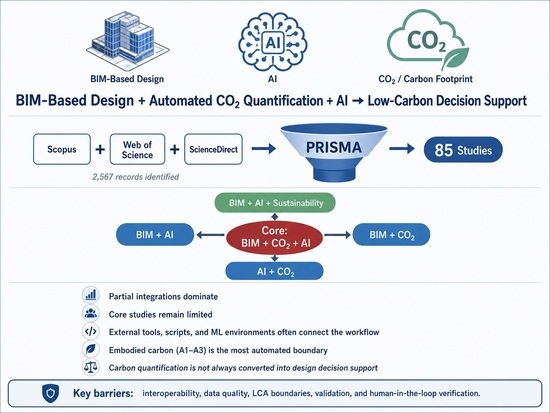
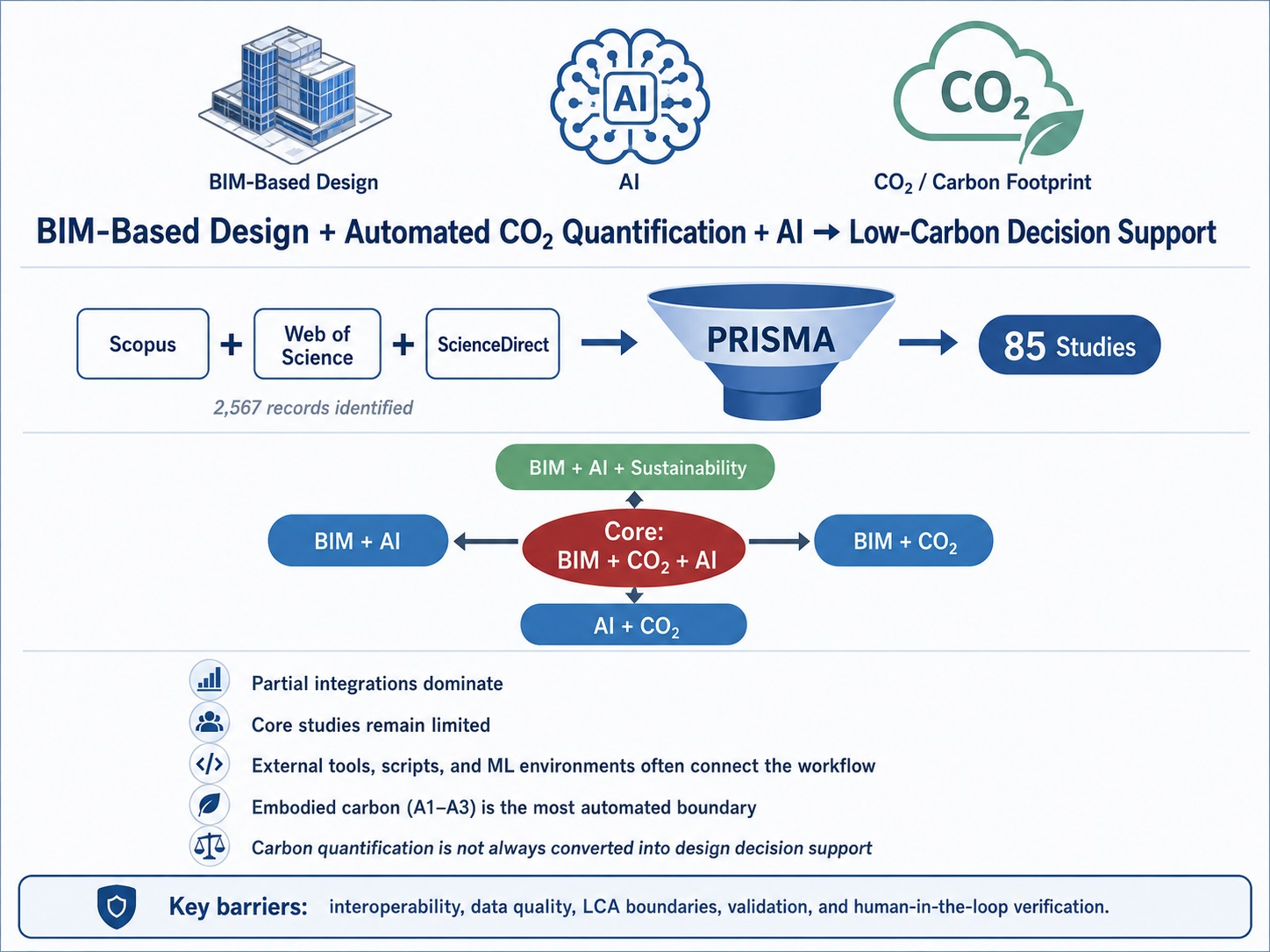
Graphical Abstract

1. Introduction

Climate change has intensified the need to mitigate CO2 emissions across several sectors, and the construction industry has consistently been identified as a relevant contributor to this challenge. In this context, targets aimed at reducing and neutralizing carbon emissions in buildings have gained increasing importance, reinforcing the role of the Architecture, Engineering, Construction, and Operation (AECO) sector towards a low-carbon economy [1].
The quantification of carbon emissions through life cycle assessment (LCA) is a widely used approach for the estimation of the environmental impacts associated with products and buildings [2,3]. Its application depends on clearly defined scopes and system boundaries. According to EN 15978 [4], CO2 emissions can be reported according to life cycle modules: module A refers to product and construction stages; module B refers to use and operation; module C refers to end-of-life stages; and module D refers to benefits beyond the system boundary, such as credits associated with recycling [3,5]. In this article, LCA is not treated as an independent object of review but as the methodological structure that defines and makes CO2 calculations comparable, especially regarding the boundaries considered and the interpretation of results for design decision-making.
Despite its relevance, the application of LCA to buildings still faces important practical limitations. Inventory data collection and impact assessment procedures tend to be labor-intensive, manual, prone to errors, and poorly aligned with the need for rapid feedback in early design stages, when intervention possibilities are broader and less costly [6]. Previous studies have highlighted the potential of BIM–LCA integration to automate inventory and environmental assessment tasks, while pointing to persistent barriers related to the quality and availability of BIM data, interoperability between tools, and lack of standardized structures capable of reducing dependence on manual processes [7,8,9,10].
From a technological perspective, advances in BIM have expanded the ability to access, structure, and integrate design information through APIs, plug-ins, scripts, and visual programming environments. As result, the BIM model can operate as a geometric representation of the building, and as a data source for quantity take-off, linkage to emission factors, performance simulation, and comparison of alternatives. The connection between digital modeling platforms and environmental impact reduction can occur at two complementary levels: at the conceptual level, when preliminary design parameters allow performance trends to be anticipated; and at the operational level, when the model is connected to carbon databases, simulation tools, calculation routines, or optimization modules capable of evaluating alternatives in a more structured way [11].
Beyond BIM–LCA and BIM–AI applications, the recent literature has increasingly discussed the relationship between BIM and digital twin (DT) technologies as part of a broader transition toward life cycle-oriented digital construction. Studies on BIM–DT integration and life cycle management emphasize that BIM can support model-based coordination, quantity extraction, semantic organization, and design documentation, whereas DT extends this logic by connecting digital representations to dynamic data, operational feedback, monitoring, and asset management across the life cycle [12,13,14]. This distinction is relevant for low-carbon building design because environmental impact reduction depends on calculating emissions during design and maintaining reliable information flows across construction, operation, maintenance, reuse, and end-of-life stages [15,16,17,18].
In this broader context, studies on 6D-BIM, digital twins, circular economy, and AI-supported sustainable buildings emphasize obstacles that are directly related to the practical implementation of low-carbon workflows, including stakeholder engagement, interoperability, data governance, circular value chains, life cycle information management, and the creation of value and benefits across the asset life cycle. From this perspective, BIM–CO2–AI integration should not be interpreted only as a technical combination of modeling, carbon databases, and algorithms. It should be acknowledged as part of a wider socio-technical and life cycle-oriented ecosystem, where multiple stakeholders need access to reliable data, transparent assumptions, and verifiable recommendations to support decisions related to materials, energy, operation, circularity, and long-term asset performance [12,18,19,20].
Therefore, these broader BIM–DT and life cycle-oriented issues should not be addressed as separate from BIM–CO2–AI integration. Instead, they represent enabling conditions for transforming carbon calculations into actionable design and asset-management decisions.
In this context, artificial intelligence (AI) has been discussed as a complementary technology to BIM. AI can be understood as the capacity of computational systems to learn from data and perform complex tasks [14,21]. Recent studies indicate that AI techniques have been used to support the optimization of emissions, energy performance, and structural solutions. However, this integration with BIM is still described as relatively uncommon, suggesting an early stage of maturity for BIM–AI applications in the AECO sector, particularly from the perspective of sustainable construction [22,23]. Moreover, recent reviews on BIM, AI, and sustainability highlight promising trends but often emphasize energy efficiency, generic automation, or broad sustainability issues, leaving room for a synthesis specifically focused on automated CO2 calculation and design decision support [20,24].
Despite advances in reviews on BIM–LCA integration, BIM–AI applications, AI applied to sustainability, and carbon emission assessment in the AECO sector [7,8,9,10,11,20,21,22,23,24], the literature still shows limited integration when the focus is on CO2-based design decisions. The incremental contribution of this review is to examine whether automated CO2 calculation, BIM environment, and AI techniques converge to support lower-impact design decisions. To this end, this systematic review distinguishes BIM + CO2 + AI integration from partially integrated studies, which reveal technological, methodological, and operational components that are still maturing.
In light of these findings, this Systematic Literature Review (SLR) addresses the following research question: in BIM-based building design, has the automation of CO2 emission calculation, combined with AI use, been applied to guide lower-impact design decisions? This study focuses on four analytical dimensions. “Carbon calculation” refers to the estimation of CO2 emissions based on quantities, model parameters, emission factors, and life cycle boundaries. “Calculation automation” refers to the use of digital resources, scripts, APIs, software integration, or computational workflows capable of reducing manual steps, accelerating the generation of results, and enabling faster feedback during the design process. “Use of AI” refers to the application of models and techniques with different decision-support functions, including prediction, optimization, alternative generation, NLP/LLMs, and recommender systems. Finally, “lower-impact design decision-making” refers to the use of this information, whether fully or partially integrated, to guide design choices that may reduce carbon emissions.
This review maps BIM + CO2 + AI integration by examining (i) how BIM is used regarding its function, integration, and operationalization; (ii) how CO2 is calculated, considering boundaries, tools, and levels of automation; (iii) which AI functions are used in the studies; and (iv) whether these elements provide effective support for design decision-making. Considering that studies simultaneously integrating BIM, CO2, and AI still represent a limited sample of the literature, partially integrated studies were analyzed for understanding the technological layers that support this convergence. Methodologically, this study adopted a search and screening protocol with study selection and classification by thematic axes, followed by standardized data extraction, enabling comparative synthesis, the identification of patterns, and the proposal of research opportunities.

2. Methods

This study adopted a Systematic Literature Review (SLR) design, conducted in accordance with PRISMA protocol guidelines [25]. Its objective was to identify, select, and synthesize evidence on the integration of BIM, automated CO2 quantification, and artificial intelligence (AI) within the Architecture, Engineering, Construction, and Operation (AECO) sector, with an emphasis on building design.

2.1. Article Search Process

The bibliographic research was conducted in the Scopus, Web of Science, and ScienceDirect databases, since these provide broad coverage and relevance for the international literature in Architecture, Engineering, Construction, and Operation (AECO). The time frame from 2021 to 2025, with searches conducted up to October 2025, was defined to capture recent publications and reflect the acceleration of applications involving automated CO2 calculation and artificial intelligence in BIM environments. The search was limited to English-language publications and to the document type “article”, to prioritize complete, peer-reviewed studies with sufficient methodological detail.
The search strategy was built using four thematic blocks: BIM, carbon, artificial intelligence, and construction/design. Boolean operators were structured exclusively with AND, without using the OR operator, to allow greater control over the search combinations and facilitate the identification of records retrieved in each thematic group.
The search strings were organized into four groups: BIM + AI, Carbon + AI + Construction/Design, BIM + Carbon + Construction/Design, and BIM + Carbon + AI + Construction/Design. The complete combinations used in Scopus, Web of Science, and ScienceDirect are presented in Appendix A.
The searches were applied to title, abstract, and keyword fields, according to the availability and search configuration of each database, and filters were adapted to the options available on each platform. In ScienceDirect, filters were applied for publication period, between 2021 and 2025, article type “research articles”, and subject area “Engineering”. Although the platform did not provide, at the time of the search, a specific filter for English language, no articles in other languages were identified in the retrieved sample. In Web of Science, filters were applied for publication years 2021–2025, document type “articles”, category “Engineering Civil”, and English language. In Scopus, filters were applied for publication years 2021–2025, subject area “Engineering”, document type “articles”, English language, and publication stage “final”.

2.2. Article Selection Process

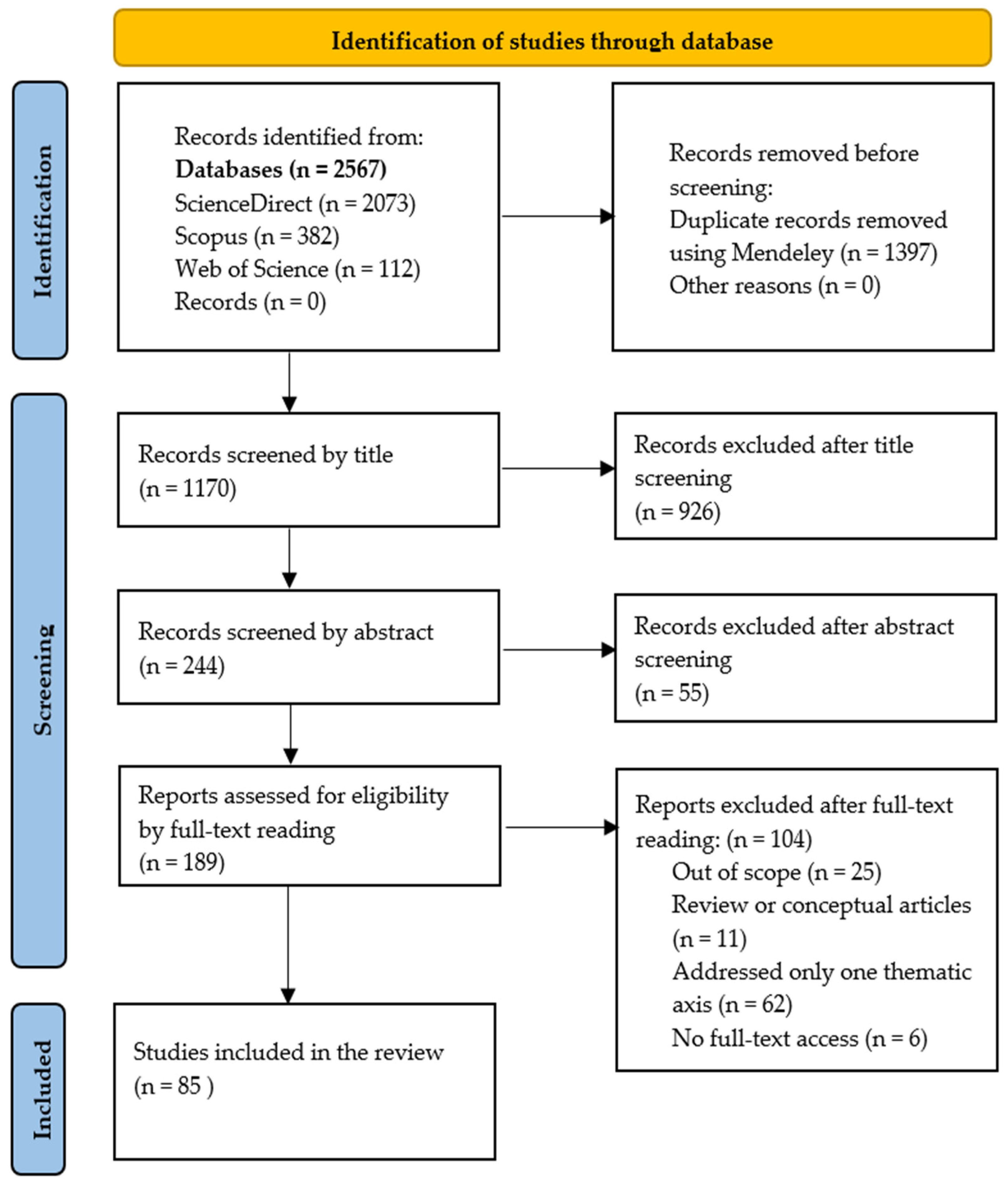
The selection of studies was conducted in sequential stages, as shown in Figure 1: identification of records in the databases, removal of duplicates, screening stages, and final inclusion.
The process was carried out by two independent reviewers, with disagreements solved by consensus. No formal inter-reviewer agreement coefficient, such as Cohen’s Kappa, was calculated, as the adopted procedure prioritized joint discussion and consensus for the final decisions regarding study inclusion, exclusion, and classification.
The retrieved records were managed using Mendeley, which was used to organize references and identify duplicates before screening. As shown in Figure 1, after duplicate removal, the remaining records were screened by title, abstract, and full-text reading. Exclusions during the title and abstract screening stages were mainly guided by thematic alignment with the scope of the review. Studies on carbon emissions unrelated to design or construction in the AECO sector, education-related studies, and AI or BIM applications directed toward domains outside building conception, design, construction, or performance were excluded.

2.3. Eligibility Criteria

During the full-text reading stage, 104 publications were excluded since they did not meet the eligibility criteria defined for this review. The main reason for exclusion was insufficient integration, in other words, articles that addressed only one isolated thematic axis, such as BIM only, AI only, or CO2 only, without sufficient methodological integration with the other dimensions of the review. This decision was necessary since the objective of this study was to analyze how BIM, CO2 calculation, sustainability, and/or AI are articulated in automated workflows or decision-support processes within the AECO sector, and not to map each technology independently.
Review articles were excluded since they did not present their own methodological implementation that would allow a comparable assessment of how the integration between BIM, CO2 quantification, and AI is operationalized in design workflows. Table 1 summarizes the criteria used to distinguish eligible studies, excluded studies, and studies classified as Core or Base.
For eligibility purposes, methodological sufficiency was considered to be met when a study demonstrated alignment between objectives and methods and presented an operational description of the steps performed, such as the use of BIM for extraction, integration, or automation; the calculation of carbon or sustainability metrics; and the implementation of AI techniques, when applicable. Studies in which BIM, AI, carbon, or sustainability were mentioned superficially, without effective use in the methodological procedure, were considered to have insufficient integration or to be purely conceptual studies and were excluded or, when appropriate, not classified within the respective thematic axis.
The eligibility and classification of studies were assessed through six questions applied during the reading process, with the aim of verifying thematic alignment, the presence of methodological implementation, and classification into the Core or Base axes:
  • Does the article use BIM in a practical way in its methodology, such as modeling, data extraction, automation, or integration with other tools?
  • Does the article address carbon emissions, CO2, or LCA as an environmental impact metric?
  • If it does not quantify carbon, does it address sustainability in some other way?
  • Does the article apply AI methods, such as machine learning, deep learning, generative AI, optimization, or related techniques, for analysis, prediction, or design support?
  • Does the study automate processes, such as carbon calculation from BIM, generation of alternatives, or optimization with AI?
  • Is the topic clearly related to the AECO sector?

2.4. Methodological Quality Assessment

During the full-text reading stage, methodological sufficiency was considered as an eligibility criterion. Purely conceptual studies, review articles, and studies that did not present implementation, an experiment, a case study, a simulation, a prototype, a application, or an operational metric were excluded, as they did not allow a comparable assessment of how BIM, CO2, sustainability, and/or AI were effectively operationalized. Thus, the assessment of methodological sufficiency was used to distinguish studies with analyzable methodological applications from those that only discussed the topic at a conceptual or overview level.
After the final sample had been defined, the included studies were analyzed in terms of the quality of the methodological evidence presented. In this second stage, the assessment was not used to exclude additional studies by scoring but to qualify the critical synthesis of the results and identify recurring limitations in BIM–CO2–AI workflows. Aspects related to data reliability, validation, procedural transparency, reproducibility, and relevance to design decision-making were considered. Table 2 presents the criteria used in this analysis.
The validation of the results was later addressed as a cross-cutting limitation of the literature, since the transferability of findings in building carbon studies strongly depends on the climatic context, databases, energy mix, construction typology, and life cycle boundaries adopted.

2.5. Strategy for Classifying Studies into Thematic Axes

The included studies were classified into two main groups: Core and Base. The Core group included studies that simultaneously integrated BIM, CO2 quantification, and AI and were directly aligned with the research question. The Base group included studies with relevant partial integrations, which were used to understand the technological, methodological, and operational components that support full BIM–CO2–AI integration.
Each article was assigned to only one thematic axis, with no overlap between categories for the same study. When an article could fit into more than one axis, classification was by the predominant objective of the study and by the highest level of integration effectively operationalized in the methodology. This decision was made to avoid double counting and to preserve comparability across the thematic axes.
The studies classified as Base were subdivided into four axes, according to the predominant combination effectively operationalized in each article: BIM + AI, BIM + CO2, BIM + AI + Sustainability, and AI + CO2. The BIM + AI axis included studies that integrate BIM and AI for automation, prediction, optimization, alternative generation, semantic interaction, or management support, even without an explicit focus on carbon. The BIM + CO2 axis included studies that use BIM for carbon quantification or for automating carbon calculation, but without systematic application of AI. The BIM + AI + Sustainability axis included studies that connect BIM and AI to environmental metrics, such as energy, comfort, lighting, or retrofit, without explicit CO2 quantification. Finally, the AI + CO2 axis included studies that apply AI directly to carbon estimation, prediction, optimization, or decision support, even when these applications occur outside a structured BIM environment.
This subdivision was used to organize the partial integrations that support the analysis, without treating these categories as equivalent to the Core group. Finally, to deepen the comparative synthesis, the studies within each thematic axis were organized into macro-objectives, allowing recurring patterns to be identified and decision-support mechanisms to be discussed more systematically. Although many articles present secondary objectives and additional contributions, the classification considered the predominant objective of each study.

2.6. Data Extraction Strategy

After the included studies had been classified, standardized extraction of the information required for the comparative synthesis was performed. For this purpose, a data extraction form was applied to the articles read in full, with the aim of recording bibliographic data, methodological design, use of BIM, carbon or sustainability metrics, AI techniques, reported results, validation approaches, trade-offs, and level of integration. This step helped reduce subjectivity in the full-text reading process and ensured greater consistency across the analyzed studies.
The extraction form covered nine main dimensions: screening; bibliographic data; methodological design; use of BIM; carbon/sustainability; use of AI; results and validation; trade-offs and design decision-making; and integration. The model of the extraction form used during full-text reading is presented in Appendix B.

2.7. Classification of Automation Levels in BIM-Based Workflows

Considering that automation appears in different forms across the included studies, a qualitative maturity scale of automation in BIM-based workflows was adopted. This scale was used as an analytical instrument to differentiate basic uses of the model, semi-assisted workflows, automated sustainability-oriented processes, and applications involving basic or advanced AI. Table 3 presents the levels considered in the analysis.
The scale was applied only to studies in which BIM was a methodological component of the workflow. Studies in the AI + CO2 axis were not classified using this scale, as they did not use BIM as a data source, modeling environment, or integration structure. Instead, they were analyzed separately according to the AI functions applied to carbon, such as prediction, estimation, optimization, and decision support. This decision avoids comparing BIM-based workflows with studies that apply AI to carbon outside a structured BIM environment.

3. Results and Discussion

This section presents the results and discussion in two complementary stages. The first subsection analyzes the general characteristics of the sample without segmentation by thematic axis, covering temporal and geographical distribution, study type, AI function, and tools used. The second subsection organizes the results by thematic axis and macro-objective, enabling the comparison of integration patterns, automation levels, life cycle boundaries, methodological limitations, and forms of support for design decision-making.

3.1. General Characterization of the Sample

The general characterization of the sample aims to situate the maturity level of the field before the detailed analysis by thematic axis. Thus, the distribution of studies by axis, year, country, study type, AI function, and tools used is interpreted as preliminary evidence of either fragmentation or consolidation in the integration of BIM, CO2, sustainability, and AI.
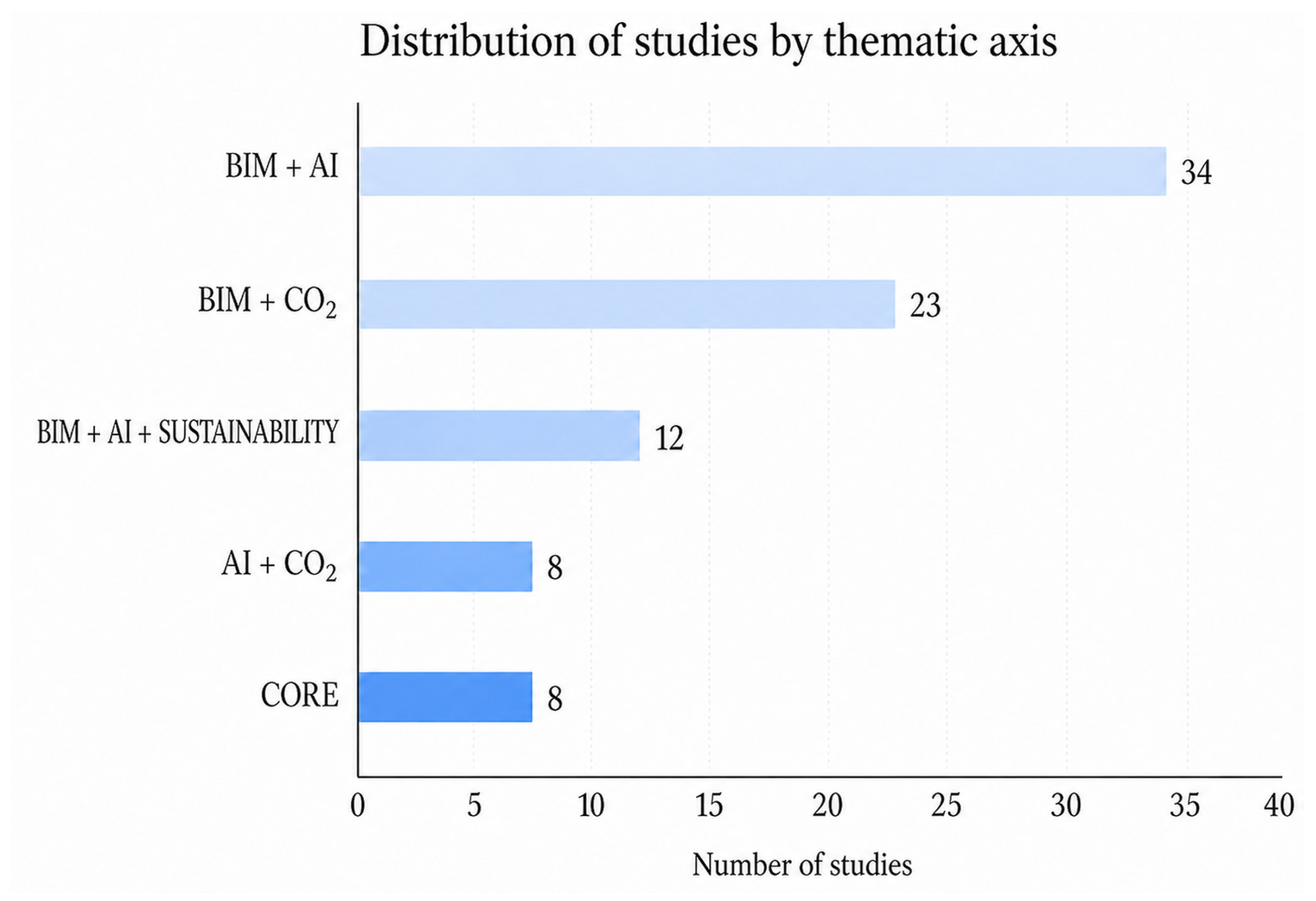
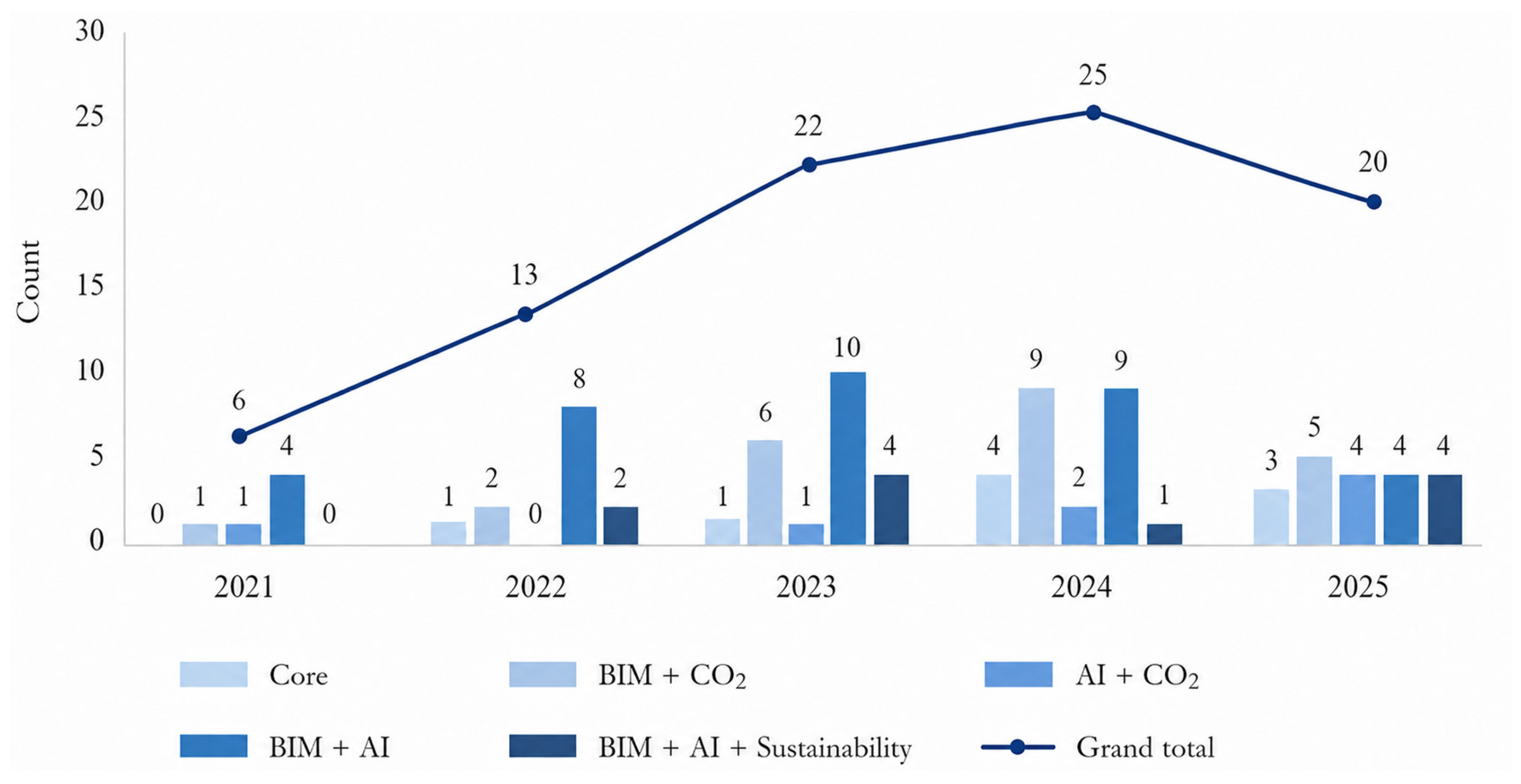
A total of 85 studies were identified [2,3,26,27,28,29,30,31,32,33,34,35,36,37,38,39,40,41,42,43,44,45,46,47,48,49,50,51,52,53,54,55,56,57,58,59,60,61,62,63,64,65,66,67,68,69,70,71,72,73,74,75,76,77,78,79,80,81,82,83,84,85,86,87,88,89,90,91,92,93,94,95,96,97,98,99,100,101,102,103,104,105,106,107,108] and distributed across thematic axes, as shown in Figure 2. This distribution reveals an asymmetry in maturity among the analyzed streams: the BIM + AI and BIM + CO2 axes account for most of the publications, indicating greater exploration of these partial integrations in the AECO sector, whereas AI + CO2 and Core studies remain less represented. This pattern suggests that studies articulating AI and carbon quantification are still scarce and, above all, that few studies simultaneously integrate BIM, automated CO2 calculation, and AI within the same decision-making workflow.
The geographical distribution of the studies was analyzed based on the authors’ country of affiliation, meaning that the same article could contribute to more than one country. The results show a predominance of occurrences in Asia (57%), mainly driven by China and South Korea, followed by Europe (25%), with the United Kingdom standing out. The Americas showed a more moderate participation (9%), while Africa and Oceania appeared with lower representation. No authors with Brazilian affiliations were identified in the analyzed sample. This geographical pattern is relevant because carbon databases, energy mix, climate, construction practices, and material availability are highly context-dependent factors. Therefore, the regional concentration of studies may limit the transferability of models, emission factors, and automated recommendations to other contexts, especially countries with different environmental databases and construction conditions.
Regarding temporal distribution, shown in Figure 3, the volume of publications increased until 2024, followed by a slight decrease in 2025, which may be partly associated with the fact that data collection was conducted before the end of the year. The disaggregation by axis shows that this growth was mainly driven by BIM + AI studies, which expanded from 2022 onward and remained the largest group. The BIM + CO2 axis also gained greater prominence from 2023 onward, reaching its highest point in 2024, indicating recent progress in the literature focused on automated carbon quantification in BIM environments. By contrast, BIM + AI + Sustainability and AI + CO2 maintained a more moderate presence throughout the period, while Core studies remained among the smallest groups, with more noticeable growth only in the final years. This pattern reinforces that the different research streams have evolved at different paces over time.
Regarding the types of studies identified, the sample is mainly composed of method development studies, particularly in two modalities: method development associated with computational experiments (47%) and method development with case studies (35%). This pattern indicates that the literature is still concentrated on methodological proposals tested through simulations, digital models, and applications in specific scenarios, with fewer solutions fully incorporated into professional practice. Method development studies with prototypes represent 12% of the sample, while plug-in development with experimentation accounts for only 6%, suggesting that the materialization of proposals into tools integrated into the BIM environment remains limited. Thus, the distribution by study type reinforces the idea that the field remains predominantly methodological and experimental, and that the automation identified in the literature does not always correspond to transferable, continuous, or professionally implemented workflows.
The functions performed by AI in the analyzed studies were grouped into four main categories. The most frequent category is prediction/forecasting, with approximately 30% of occurrences, indicating the recurrent use of AI to estimate performance variables, such as energy, emissions, or operational metrics, with lower computational cost than full simulations. Next, applications focused on interpreting properties, providing recommendations, and identifying inconsistencies account for 26%, reflecting the growth of approaches oriented toward explanation, checking, and direct user support. Single- and multi-objective optimization represents 25%, highlighting the use of AI as a solution-selection engine. Finally, automatic generation of alternatives accounts for approximately 20%, indicating a still smaller presence of AI applied to the generation of design options.
Table 4 differentiates the main approaches identified, indicating their role in the workflow, the most recurrent data and outputs, and the methodological limitations observed. This distinction is necessary because not every form of computational automation represents the same level of intelligence, integration, or decision support.
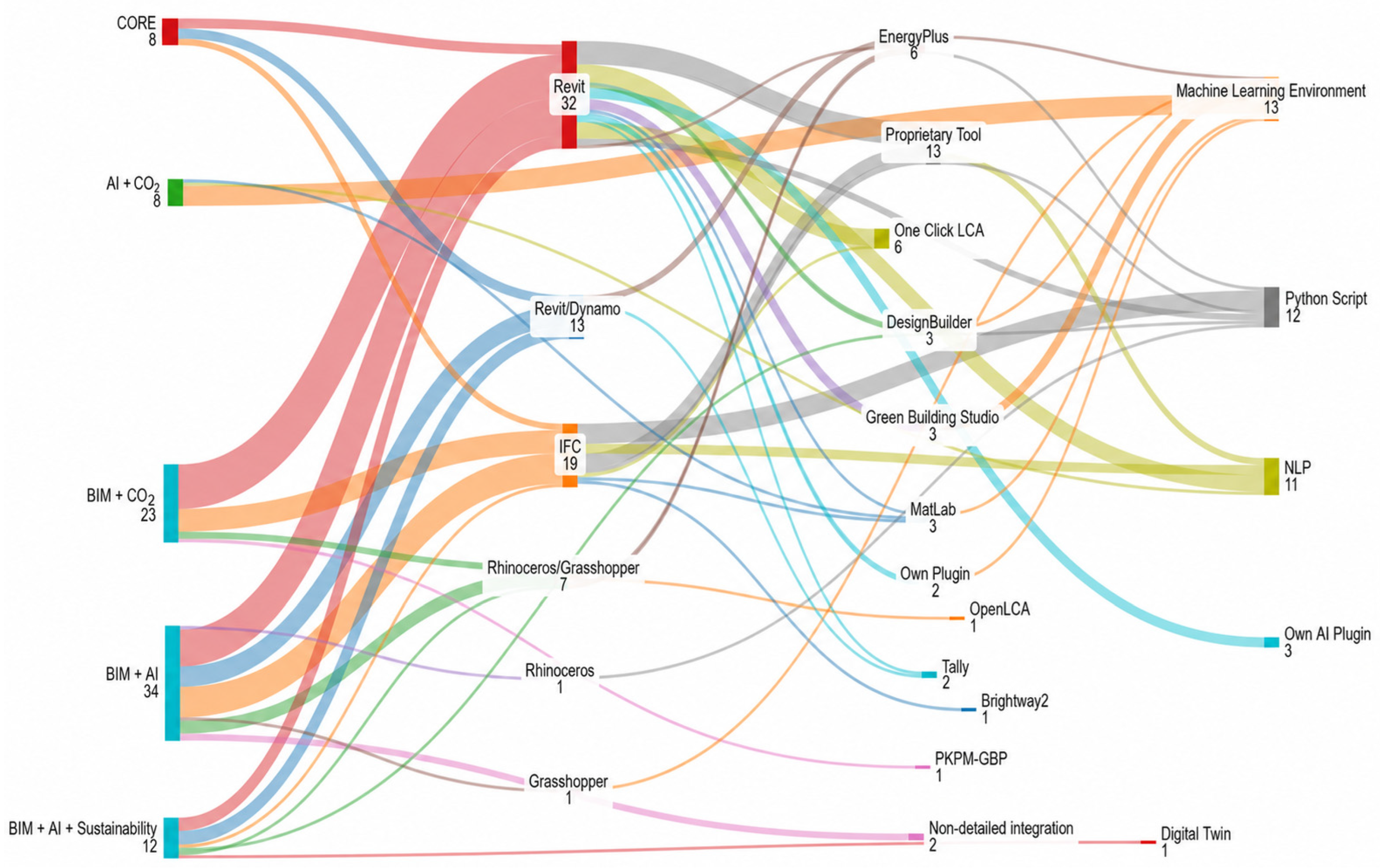
Figure 4 presents a Sankey diagram that synthesizes how the studies operationalize the connection between BIM, CO2 calculation, and AI. The flow highlights the central role of Revit as a model-authoring and organization platform, while IFC appears as a recurring alternative when the objective is to expand interoperability and enable external processing. Tools such as EnergyPlus and DesignBuilder appear in association with energy simulation and operational carbon, whereas LCA/CO2 software, such as One Click LCA and Tally, or custom calculations, are more frequently used for embodied carbon. In the AI layer, the presence of Python, machine learning environments, Dynamo, NLP/LLMs, and optimization models indicates that the intelligent part of the workflow is often implemented as a modular component rather than as a native function of the BIM environment.
The Sankey diagram reveals the fragmented way in which BIM–CO2–AI integration has been constructed. In many studies, BIM provides geometry, quantities, parameters, or semantic structure; environmental calculation occurs in LCA/CO2 tools, simulation environments, or external databases; and AI acts as an additional layer for prediction, optimization, explanation, or recommendation. This configuration can reduce manual steps and accelerate analyses, but it also creates critical dependencies: the semantic quality of the BIM model, consistency of extracted parameters, compatibility between formats, transparency of emission databases, and validation of generated recommendations.
The axis-based reading reinforces this interpretation. In BIM + AI studies, the workflow is concentrated on automation, optimization, and intelligent interfaces applied to the model. In BIM + AI + Sustainability studies, the dominant pattern is based on pipelines connecting parametric BIM, energy/environmental simulation, and ML models. In the BIM + CO2 axis, carbon automation depends mainly on LCA/CO2 software or custom calculations. In AI + CO2 studies, AI acts directly on carbon, but outside a structured BIM workflow. In Core studies, there is an attempt to articulate these layers, although closing the decision-making loop still depends largely on scripts, APIs, external pipelines, and manual validation.
In addition to the tool-flow analysis presented in the Sankey diagram, some general indicators help assess the maturity level of BIM, CO2, and AI integration in the full sample. While the diagram highlights the dependence on external tools, scripts, and modular pipelines, the quantitative indicators show the extent to which this integration actually advances toward carbon quantification and support for design decision-making. Although 60% of the studies performed some type of carbon quantification, only 16% addressed the life cycle in a broad manner. In addition, only 39% of the studies used carbon quantification to propose, compare, or optimize design alternatives, indicating that calculation is still often used as a measurement step rather than as an active decision-making mechanism. This pattern is also observed in BIM + AI studies: despite the growth of this axis, only 17% advanced toward carbon quantification, reinforcing the idea that AI–BIM integration is still rarely mobilized for decisions explicitly oriented toward emission mitigation.

3.2. Analysis by Integration Axis

This subsection presents the results and discussion by thematic axis. For each axis, the studies were organized according to macro-objectives, allowing the purposes and implementation mechanisms to be compared. In addition, for the axes that quantify carbon, the scope of the life cycle boundaries adopted is discussed, as well as the degree of automation and the use of BIM, in order to show how these elements are converted into support for design decision-making. The analysis by thematic axis makes it possible to understand how partial and complete integrations are methodologically structured.

3.2.1. BIM + AI

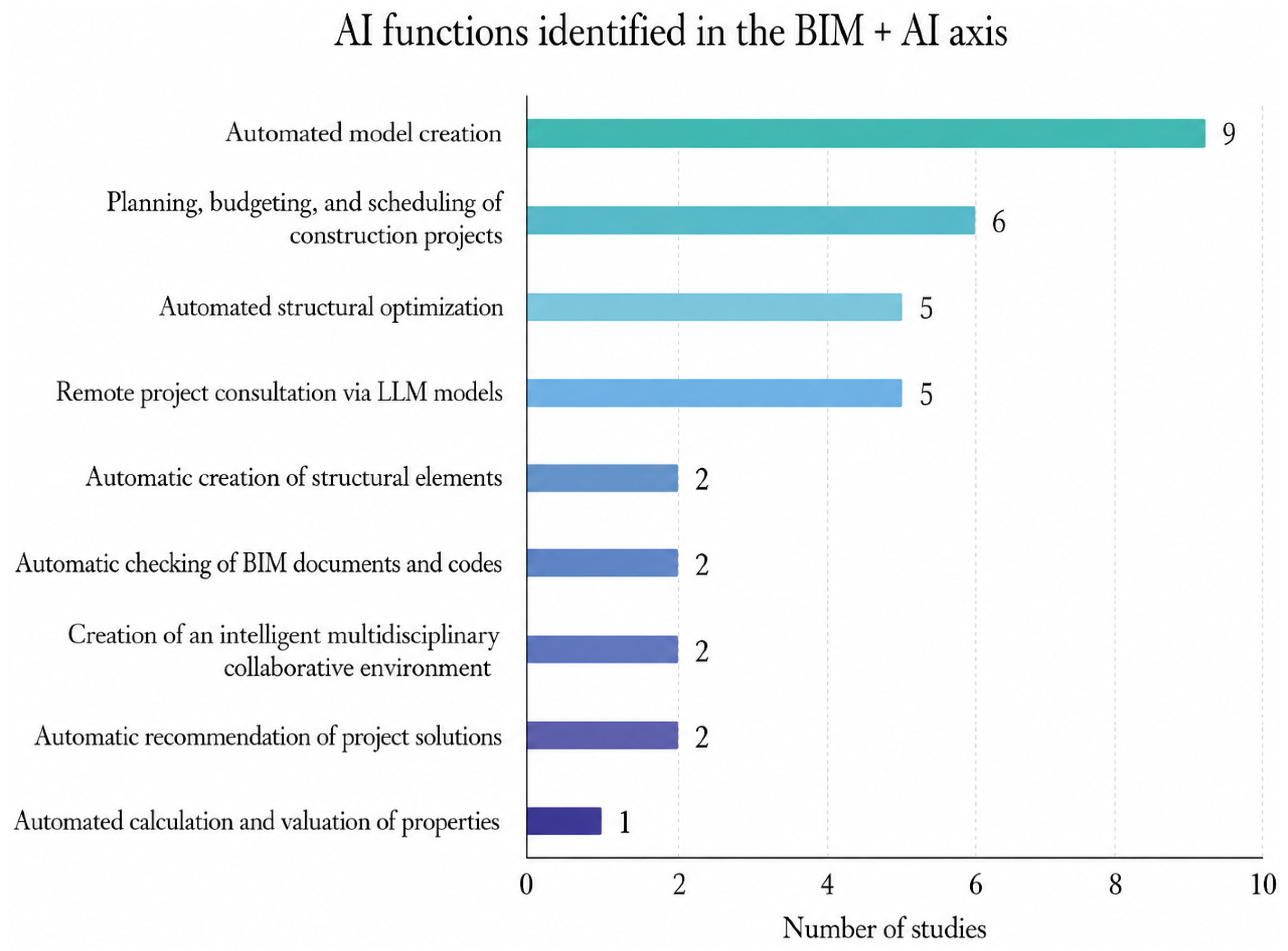
The articles in the BIM + AI axis were included to map the mechanisms through which artificial intelligence has been coupled with BIM in the AECO sector, as well as the most recurrent objectives, functions, and implementation patterns. Although these studies do not directly address CO2 quantification, they are relevant to this review because they reveal technological capabilities that may be transferred or adapted to BIM–CO2–AI workflows, such as process automation, alternative generation, optimization, information interpretation, and decision support. Thus, this axis does not constitute direct evidence of low-carbon building design but serves as a basis for understanding the maturity of AI functions in BIM environments.
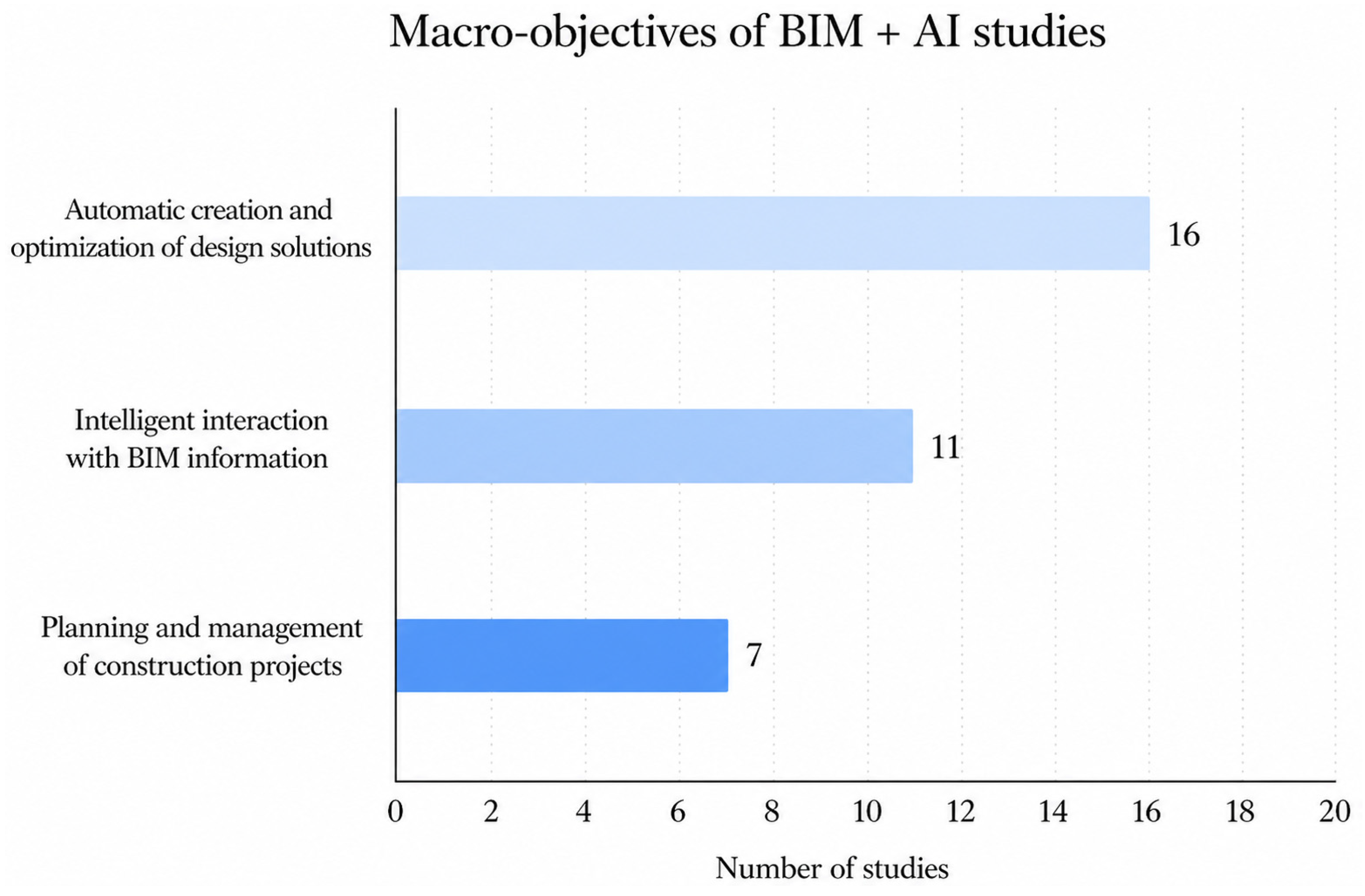
As shown in Figure 5, the studies were organized into three macro-objectives: creation and optimization of design solutions; intelligent interaction with BIM information; and construction planning and management.
The largest group focuses on the automatic creation and optimization of design solutions [26,27,28,29,30,31,32,33,34,35,36,37,38,39,40,41], indicating that a significant part of the literature uses BIM + AI to explore performance alternatives through optimization, generative design, and model-based automation. In these studies, BIM acts as the geometric and parametric basis of the building, while AI algorithms or computational routines automatically explore the solution space, generating or refining layouts, structural systems, modular solutions, and building services based on predefined variables and constraints.
Four main arrangements were identified: (i) generative models and deep learning for segmentation, conditional creation, and conversion into BIM objects; (ii) metaheuristics for constrained optimization; (iii) NLP and recommender systems to translate natural-language requirements into BIM solutions; and (iv) generative design, often implemented in Dynamo, based on predefined rules and constraints and not always associated with machine learning. The reported results indicate practical gains, such as the automatic creation of structural layouts compatible with architectural models [36], rapid generation of layouts and BIM models [26], cost reductions of approximately 23% compared with designs produced by engineers [35], and design time savings of up to 90% [41].
From the perspective of this review, the main contribution of this macro-objective lies in demonstrating that BIM can function as a parametric environment for the automated generation, comparison, and optimization of alternatives. However, because these studies do not incorporate carbon metrics, a gap remains in connecting these capabilities to explicit environmental objectives. Thus, the mechanisms already used to optimize form, layout, structural systems, and performance could be adapted in future research to incorporate carbon, cost, and performance as integrated decision criteria.
The second group corresponds to intelligent interaction with BIM information [42,43,44,45,46,47,48,49,50,51,52]. Its scope is predominantly informational, focusing on model data management, semantic quality, requirement checking, and query interfaces applied to buildings. In this group, BIM acts as a structured information base for project components, while AI is used to interpret, classify, recommend, or query model data. The approaches include (i) classical NLP and supervised learning to classify texts and requirements; (ii) data mining and recommender systems to suggest BIM objects and content; (iii) computer vision and machine learning to recognize objects and attributes, strengthening BIM semantic consistency; and (iv) conversational assistants, including LLM-based solutions for search and interaction with the model.
The results indicate efficiency gains but also reveal important limitations. For example, a GPT-based digital assistant for real-time interaction with BIM models via text or voice in Revit achieved 94% accuracy in simple queries, but only 49.5% in compound queries requiring multiple functions within the same sentence [51]. This result shows that conversational interfaces and recommender systems can facilitate access to BIM information but still present weaknesses in orchestrating complex tasks. For BIM–CO2–AI workflows, this limitation is critical, since low-carbon recommendations require not only model querying but also correct interpretation of materials, quantities, calculation boundaries, emission databases, and technical constraints. Therefore, this macro-objective reinforces the need for validation, traceability, and human verification when LLMs and natural-language interfaces are applied to environmental decision support.
The third group addresses construction planning and management [53,54,55,56,57,58,59], showing the use of BIM + AI to support decisions related to production, scheduling, cost, inspection, and construction management. In this group, BIM acts as an informational basis for converting model elements and attributes into activities, work packages, schedules, and operational decisions. The solutions mainly rely on Revit, Dynamo, Revit API, and 4D/5D tools, such as Navisworks and custom modules. AI functions include schedule optimization with metaheuristics, prediction of the impacts of design changes, deep learning applied to inspection or point clouds, and intelligent interfaces to synthesize information, interpret textual inputs, and signal risks. The reported results indicate relevant gains, such as a reduction of approximately 97% in schedule creation time, from 150 min to 3–4 min [54], as well as a 42% reduction in discrepancies between planning and execution, anomaly detection in approximately 3 min, and an approximately 30% reduction in managerial decision-making time [59].
Although this macro-objective is more closely associated with execution than with building conception, it contributes to the review by demonstrating that BIM data can be converted into automated production and management decisions. The detailed AI functionalities identified in the BIM + AI axis are presented in Appendix C. In summary, this axis shows that the integration between BIM and AI already presents relevant maturity in modeling automation, alternative generation, optimization, intelligent querying, and management support. Therefore, the main contribution of this axis to the review is to reveal computational mechanisms that may be incorporated in future BIM–CO2–AI workflows oriented toward design decision-making.

3.2.2. BIM + AI + Sustainability

The articles in the BIM + AI + Sustainability axis were included to map how the integration between digital modeling and artificial intelligence has been applied to environmental metrics in the AECO sector, even when explicit CO2 emission quantification is not provided. This axis does not directly answer the research question in terms of carbon calculation, but it is relevant because it shows how energy, thermal comfort, daylighting, and retrofit have been incorporated into automated workflows for analysis, prediction, simulation, and optimization. Thus, these studies serve as base literature for identifying methodological mechanisms that may be adapted to BIM–CO2–AI workflows.
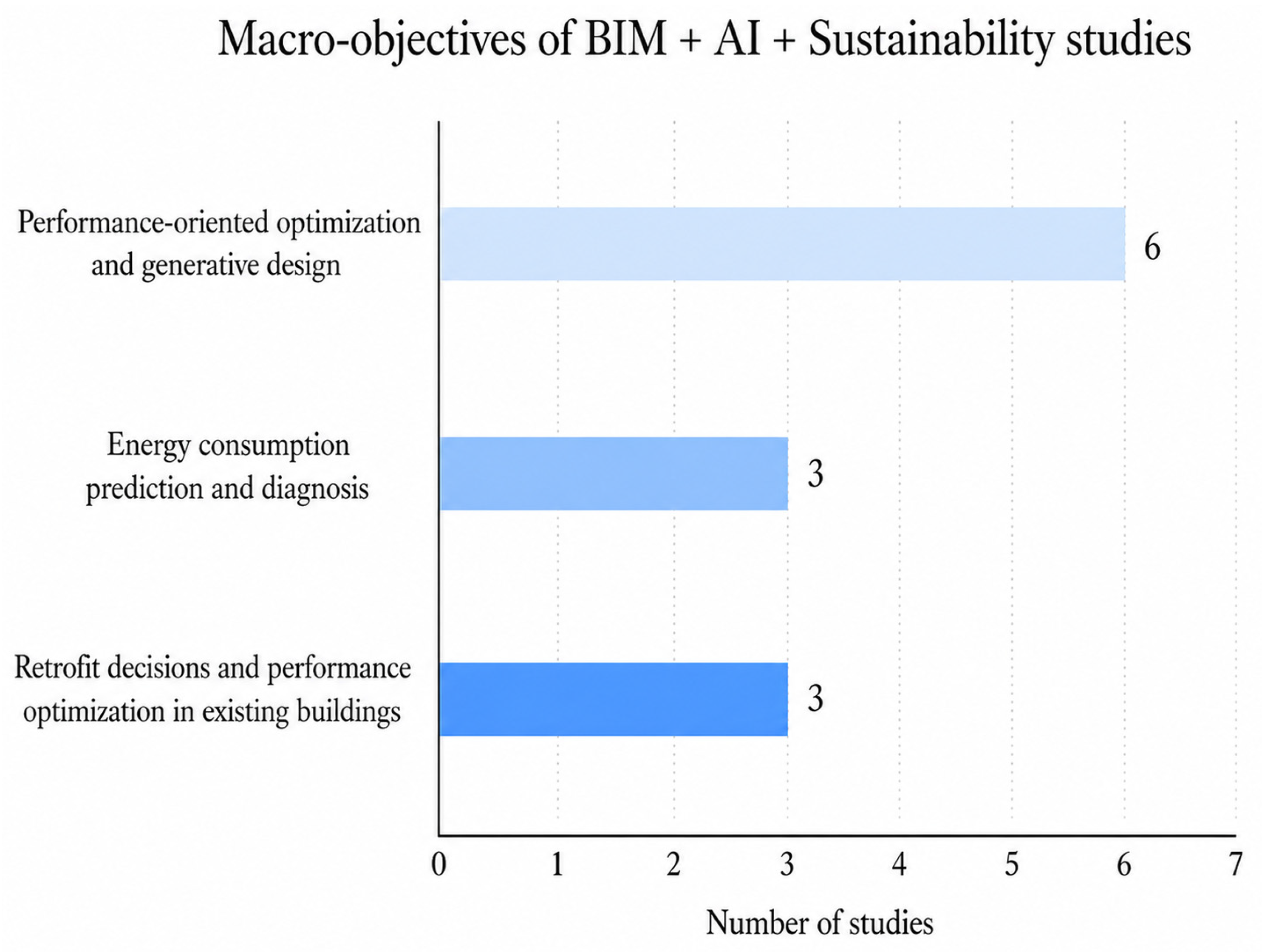
As shown in Figure 6, the studies were organized into three macro-objectives: performance-oriented optimization and generative design; prediction and diagnosis of energy consumption; and retrofit decisions and performance optimization in existing buildings. This distribution reinforces that this axis is more consolidated in applications focused on energy and environmental performance than in explicit carbon assessments, functioning as an intermediate stage between intelligent automation in BIM and full BIM + CO2 + AI integration.
The most representative group comprises studies on performance-oriented optimization and generative design, especially regarding energy and comfort [60,61,62,63,64,65]. These studies focus on decisions related to the envelope, façade, and form parameters, usually structured as parameterized cycles: BIM, generation of alternatives, performance simulation, and selection of solutions through optimization, often using techniques such as NSGA-II and related variants. The reported results indicate measurable gains, such as an approximate reduction of 6.7% in heating load and 3.5% in cooling load in optimized façades [60], Pareto solutions balancing envelope energy and cost, with gains of 8.48% in energy and 7.52% in cost, or 21.17% in cost with minimal energy variation [63], as well as a 37.5% reduction in energy consumption and a 33.5% increase in thermal comfort compared with the initial solution [64].
The contribution of this group lies in demonstrating that BIM and AI are already capable of structuring cycles for the generation, simulation, and selection of environmental alternatives. However, because the metrics analyzed are concentrated on energy, comfort, and daylighting, these studies do not allow direct assessment of whether the optimized alternative also reduces CO2 emissions. The central gap, therefore, is the incorporation of emission factors, LCA boundaries, and carbon indicators into the objective functions already used in these optimization workflows.
Next, there are studies focused on the prediction and diagnosis of energy consumption using BIM-derived data [66,67,68], in which AI acts as a fast estimator or explanatory model to support energy analyses. These studies use datasets derived from simulations or BIM models and train supervised algorithms, especially ensembles, boosting methods, Random Forest, XGBoost, and neural networks, to predict consumption or energy intensity. The results indicate good performance of boosting-based methods, such as FBI_AdaBoost, FBI_XGB, GBM, and FBI-adjusted XGBoost [66,67,68]. In addition, variable-importance analyses identify elements such as roofs, external walls, and windows as relevant factors affecting energy consumption, with variations of approximately 9% to 40% depending on the city [67].
This group is important because it demonstrates the potential of metamodels to reduce repetitive simulations and accelerate the evaluation of alternatives. However, as long as the predicted variable remains limited to energy consumption or energy intensity, the relationship with decarbonization depends on an additional step of conversion into emissions, considering the energy mix, regional factors, and operational assumptions. Thus, these studies represent a relevant methodological basis for future carbon prediction but still constitute a stage prior to explicit CO2 quantification.
Finally, the last group focuses on retrofit decisions and performance optimization in existing buildings [69,70,71], indicating that applications aimed at intervening in the existing building stock are still less frequent, although relevant because they bring BIM + AI closer to real-world contexts. These studies seek to improve the performance of already defined buildings through diagnosis, as-is/as-built modeling, definition of retrofit variables, and thermal or energy evaluation of scenarios. BIM acts as an informational reference and parameterization basis, while AI, when more explicitly applied, functions as an optimization mechanism or predictive model to accelerate the comparison of alternatives.
The contribution of this group lies in showing that BIM + AI can support decisions applied to existing buildings, where the potential for impact reduction may be significant. However, without explicit carbon quantification, energy or thermal gains cannot be directly interpreted as evidence of climate mitigation. To advance toward the BIM + CO2 + AI core, these workflows would need to connect retrofit scenarios to emission factors, avoided operational carbon, embodied carbon from interventions, and trade-offs among energy savings, added materials, cost, and comfort.
Overall, the limitations of the BIM + AI + Sustainability axis involve dependence on BEM, difficulties in generalization across climates and regions, simplified scopes, a limited number of variables, representative periods for CFD, thermal simplifications, and the use of restricted sets of components.

3.2.3. BIM + CO2

The BIM + CO2 axis is closely aligned with the research question, as it investigates how BIM has been used to automate emission quantification, mainly through LCA, and to support comparisons between design scenarios. This group establishes the methodological basis for automated carbon calculation in BIM environments by revealing patterns of quantity extraction, linkage to emission factors, definition of life cycle boundaries, and integration with external tools. Although it generally does not yet incorporate AI systematically, this axis represents an essential intermediate stage in the maturation of BIM–CO2–AI integration.
Regarding the role of BIM, the predominant pattern is its use as a structured data platform and traceable inventory source. However, the success of carbon calculation depends on the informational quality of the model, including consistent classification of elements, material identification, sufficient parameters, and interoperability. Thus, the bottleneck is not only the automation of LCA but also ensuring that the BIM model contains reliable and usable information to support environmental calculation.
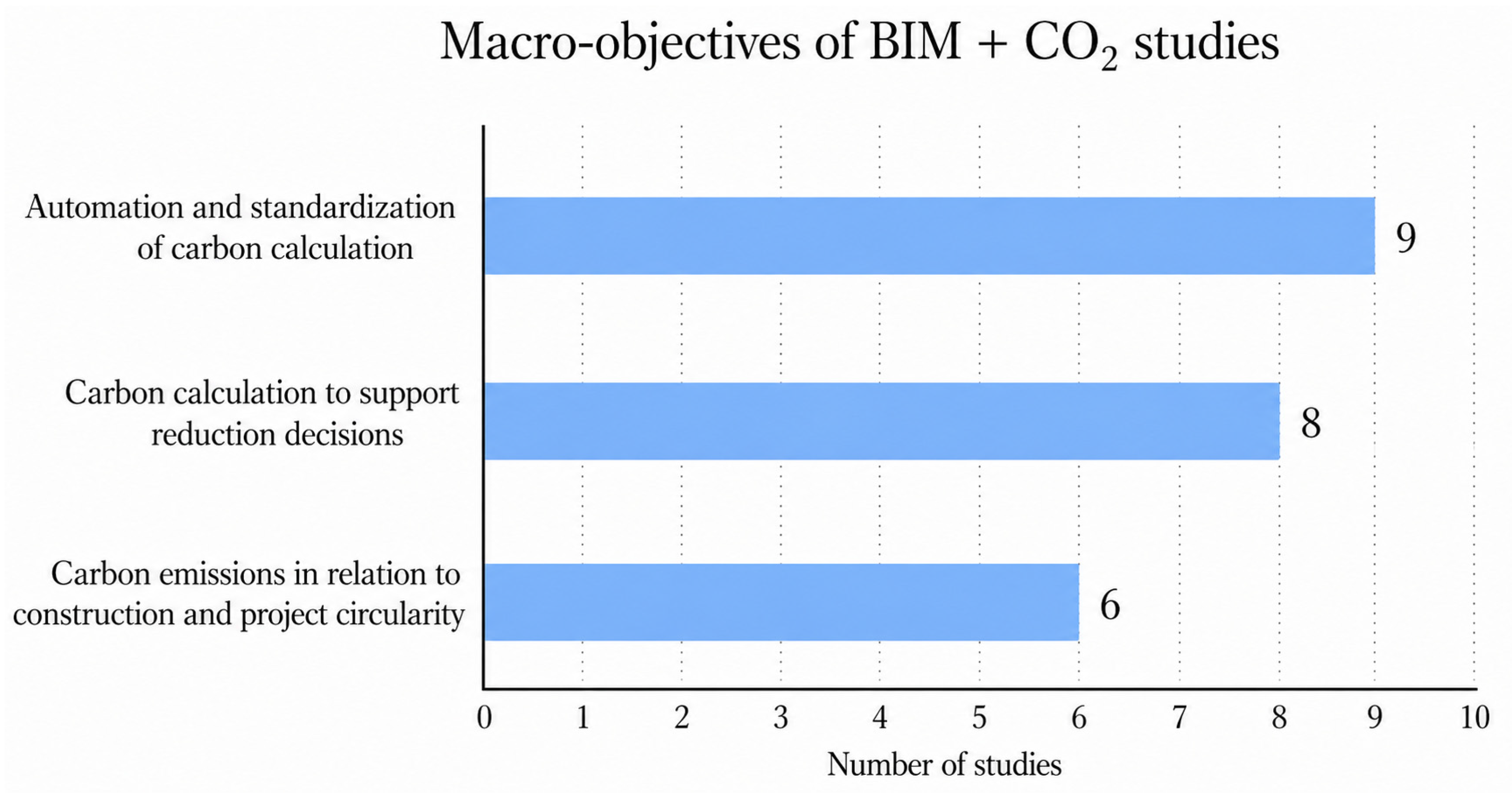
The studies demonstrate three main ways of operationalizing automated CO2 calculation through BIM–LCA: integration with LCA software, with 12 occurrences; use of custom databases and calculations, with 10 occurrences; and development of dedicated plug-ins, with only one occurrence. This pattern indicates that carbon automation still depends mainly on external tools, internal calculations, or intermediate routines, whereas solutions fully integrated into the BIM environment remain less frequent. The studies were grouped into three macro-objectives, as shown in Figure 7.
The most frequent group focuses on the automation and standardization of carbon calculation [72,73,74,75,76,77,78,79,80], bringing together studies aimed at extracting quantities from BIM, mapping materials, and linking them to emission factors, EPDs, databases, or national datasets. These workflows recurrently follow three steps: data extraction from the model, association with emission factors, and consolidation of results according to life cycle boundaries. This group shows that automated quantification makes emissions more traceable by element, category, or component, reducing manual effort and inconsistencies typically associated with spreadsheet-based approaches.
The main contribution of this macro-objective is the consolidation of the inventory and calculation layer that supports future BIM–CO2–AI applications. However, its limitation is that automation remains concentrated on measurement: the studies make carbon more visible and comparable, but do not always advance toward recommendation, optimization, or automated selection of alternatives. Thus, this group demonstrates maturity in the calculation infrastructure but does not yet close the decision-making loop.
The second most frequent macro-objective concerns the use of carbon calculation to support carbon reduction decisions [2,3,81,82,83,84,85,86], using CO2 as a comparative criterion among design scenarios, materials, and mitigation strategies. In these studies, BIM acts as a parameterization and inventory-organization structure, while the assessment of alternatives often depends on complementary tools, such as energy simulation, CFD, or structural analysis. This group stands out for connecting the carbon metric to the selection of alternatives, bringing environmental quantification closer to the decision-making process.
The reported results indicate relevant reductions in different contexts: a value engineering plug-in reported simultaneous reductions of 10% in cost and 15% in embodied carbon [82]; another study identified material combinations capable of reducing embodied carbon by approximately 52%, mainly through substitutions in concrete and steel [83]; and an analysis of ventilation in a public restroom reported a 20.4% reduction in energy consumption and a reduction of 30,681 kg in CO2 [86]. These findings show that carbon calculation can support concrete reduction decisions, but they also indicate that, without automated search and optimization mechanisms, the exploration of alternatives tends to remain limited to scenarios previously defined by the researchers.
The final macro-objective addresses carbon emissions associated with construction execution and design circularity [87,88,89,90,91,92], expanding the analysis to construction, logistics, waste, reuse, circular practices, and, in some cases, digital twins. In these studies, BIM acts as a platform for tracing and organizing distributed information across the production chain, often supported by IFC, BIM servers, databases, extraction routines, and semantic structures such as ontologies. This organization enables the mapping of components, quantities, waste flows, and construction strategies from the perspective of environmental impacts.
The contribution of this group lies in showing that carbon is not limited to material selection during design conception but can also be monitored and reduced through decisions related to execution, logistics, waste, and circularity. At the same time, these studies show that circular decisions require distributed data, traceability, and multiple criteria across the production chain. Therefore, they represent a promising field for future incorporation of AI in multicriteria optimization problems, waste prediction, component tracking, and recommendation of reuse strategies.
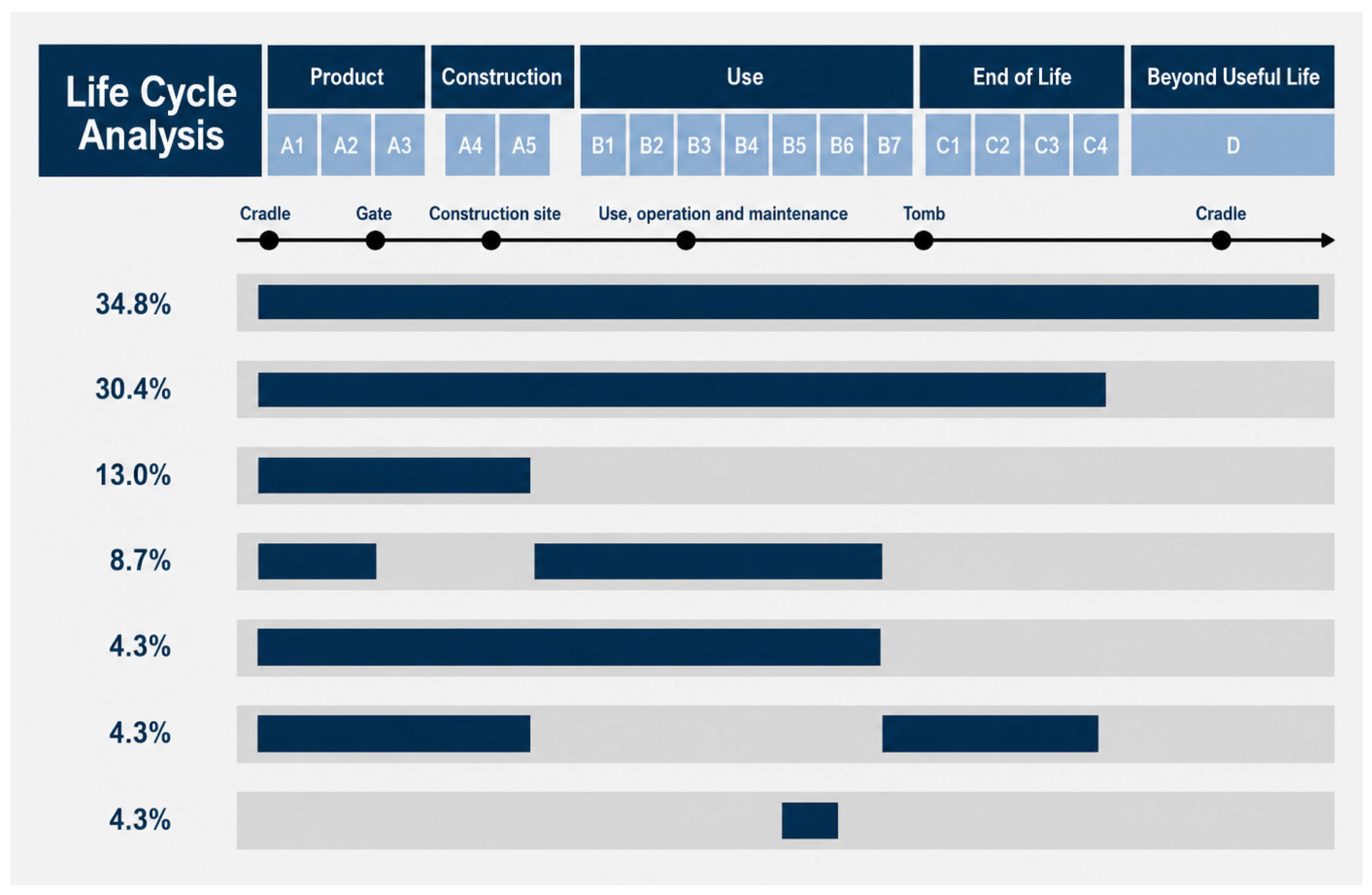
Regarding life cycle scope in the BIM + CO2 sample, Figure 8 shows the predominance of assessments with broader boundaries. Two studies started from A1–A3 and both extended the analysis to the use stage; five adopted A1–A5, two of which also included B1–B7; seven used A1–C4; eight adopted the A1–D approach; and only one study analyzed B6 exclusively, related to operational emissions from building use.
These results indicate that the BIM + CO2 axis presents greater maturity in explicitly defining life cycle boundaries. Even so, even in studies declared as full life cycle assessments, stages such as operation, construction, maintenance, replacements, logistics, and end of life tend to be treated through assumptions, estimates, or secondary data. In practice, the most robust gains in automation and traceability are concentrated in product-stage embodied carbon, especially A1–A3, where BIM offers stronger methodological alignment by enabling direct extraction of quantities and linkage to materials and emission factors.
The relative contribution of life cycle stages varies according to the boundary adopted. In full life cycle assessments, the operational phase may predominate, with B6 accounting for approximately 87.86% of emissions over a 60-year horizon [72], while other studies report operational shares of around 75% and 73% [73,74]. By contrast, when the focus is on construction systems and structure, material production becomes more influential, reaching approximately 92% in one study [76], or 65.7% for module A in a multiscale analysis, with emphasis on steel and concrete [79]. This variation changes the target of interventions: materials and structural systems become central for embodied carbon, while energy, ventilation, comfort, and operation gain relevance in broader or operational scopes.
In addition to boundaries, the results are sensitive to databases and calculation methods. One study reported substantial differences among databases such as ICE, GaBi, and Ecoinvent, with intensities of 0.916, 2.20, and 2.30 tCO2e/m2, respectively [85]. Another identified an approximately 10% discrepancy between a normative procedure and a plug-in [82]. These findings reinforce that using CO2 as a decision criterion requires transparency regarding boundaries, emission factors, environmental databases, and mapping between the BIM inventory and carbon data.
In summary, the BIM + CO2 axis demonstrates greater maturity in the automation of carbon calculation in BIM environments, especially in quantity extraction, component-level traceability, and association with emission databases. However, it also shows that quantifying carbon is not sufficient to guide lower-impact decisions. The central gap lies in transforming measurement into a decision-making process by connecting calculation to mechanisms for exploring alternatives, multicriteria analysis, trade-offs, and verifiable recommendations.

3.2.4. AI + CO2

The AI + CO2 axis brings together studies in which artificial intelligence is directly applied to estimate, predict, optimize, or support decisions related to carbon emissions, even when BIM is not the central element of the process. These studies contribute to the review by highlighting the potential of AI as an analytical layer for carbon, especially in terms of calculation speed, predictive capacity, and decision support. However, because they are not structured within a BIM environment, they provide lower traceability between estimated emissions, building components, quantities, and design alternatives.
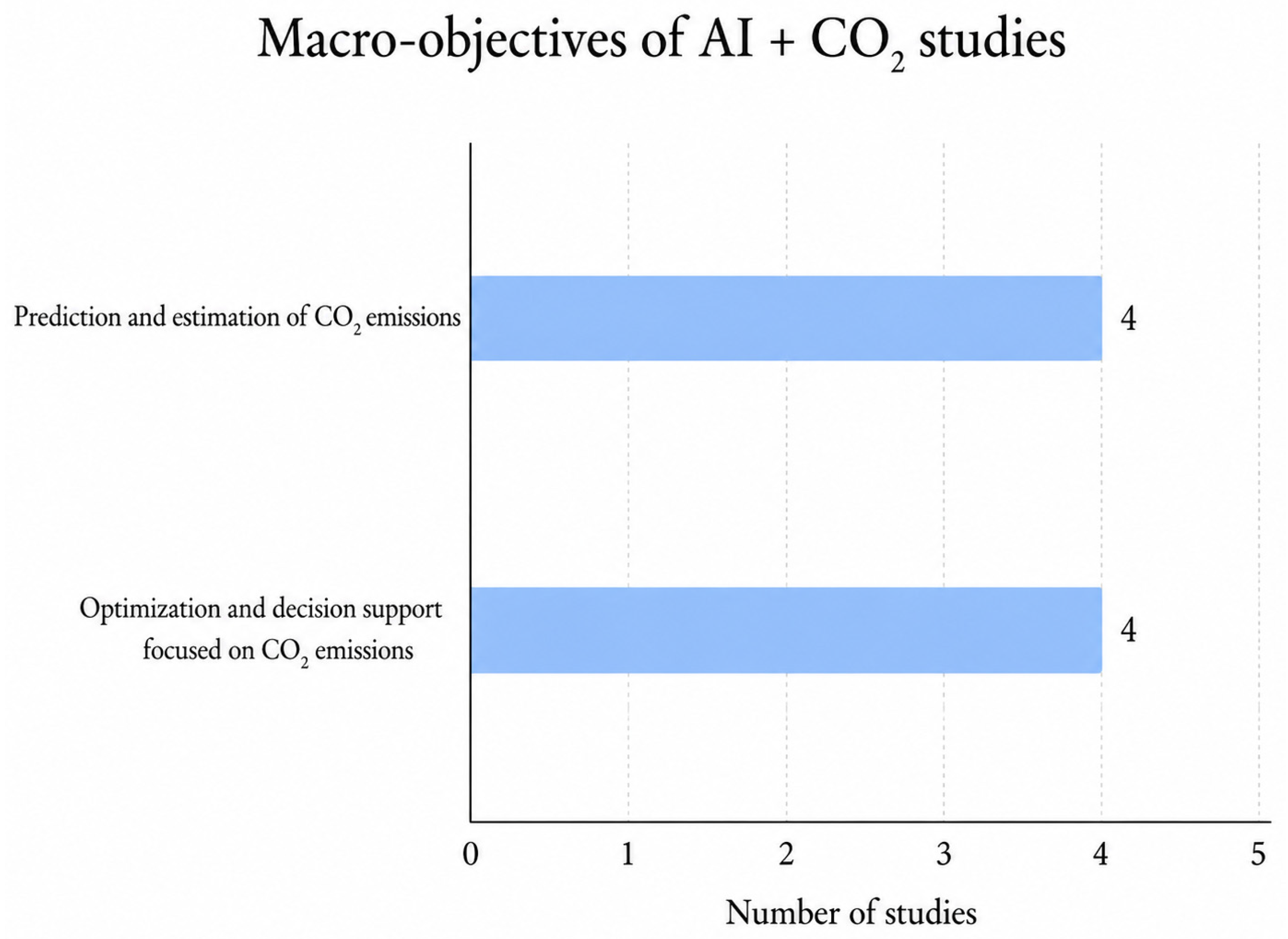
As shown in Figure 9, the studies were organized into two macro-objectives: CO2 prediction and estimation [93,94,95,96], and CO2-oriented optimization and decision support [97,98,99,100]. This distribution shows that the axis is concentrated around two main AI functions: accelerating emission quantification and supporting choices aimed at carbon reduction.
In the first macro-objective, AI is used as a predictive model to estimate CO2 based on variables such as building attributes, materials, construction data, energy consumption, and urban variables. The focus is on accelerating quantification and enabling rapid analyses, rather than optimizing alternatives. This group includes studies ranging from national-scale analyses with millions of records and robust statistical validation [93] to applications with smaller datasets, between 100 and 260 samples [96], or simulation-based studies, which support prototyping but limit generalization [95].
Some studies also test LLMs as assistants for reasoning, rapid feedback, and support for emission estimation [94]. The results indicate satisfactory textual performance in simpler tasks, but limitations in complex topics, formulas, theoretical foundations, and data updating. Thus, LLMs may support the interpretation and communication of carbon estimates, but they do not replace verified databases, transparent methods, and technical validation.
The main contribution of this macro-objective is to demonstrate that AI can reduce estimation time and expand the scale of emission analysis. However, these predictions strongly depend on data quality, including occupancy, climate, typology, energy source, and emission factors. In addition, without a direct link to BIM models, they tend to operate at an aggregated level or outside the design process, making it difficult to associate results with specific elements, materials, construction systems, or design alternatives.
In the second macro-objective, AI acts as a decision, optimization, and control engine, with applications focused on the optimization of cementitious materials, concrete, and reinforcement ratios [97,98,99], as well as operational control strategies in buildings [100]. In the studies on materials, decisions occur at the pre-conception stage and involve input selection, mix design, and embodied CO2 assessment. In the operational case, CO2 is estimated from electricity consumption, with a focus on comfort and energy efficiency.
Taken together, the studies show that approaches based on multi-objective optimization and surrogate models can reduce emissions and costs while preserving technical requirements. The applications include optimal concrete mixes by strength class, Pareto fronts relating cost, embodied CO2, and characteristic strength, structural optimization of beams with reductions in materials, cost, and emissions, and operational control strategies to improve comfort and efficiency. This group demonstrates that AI can support carbon-related decisions when the problem is formalized through clear variables, constraints, and objective functions. However, without BIM integration, the optimized solution tends to remain disconnected from components, quantities, construction details, and traceable changes in the digital model.
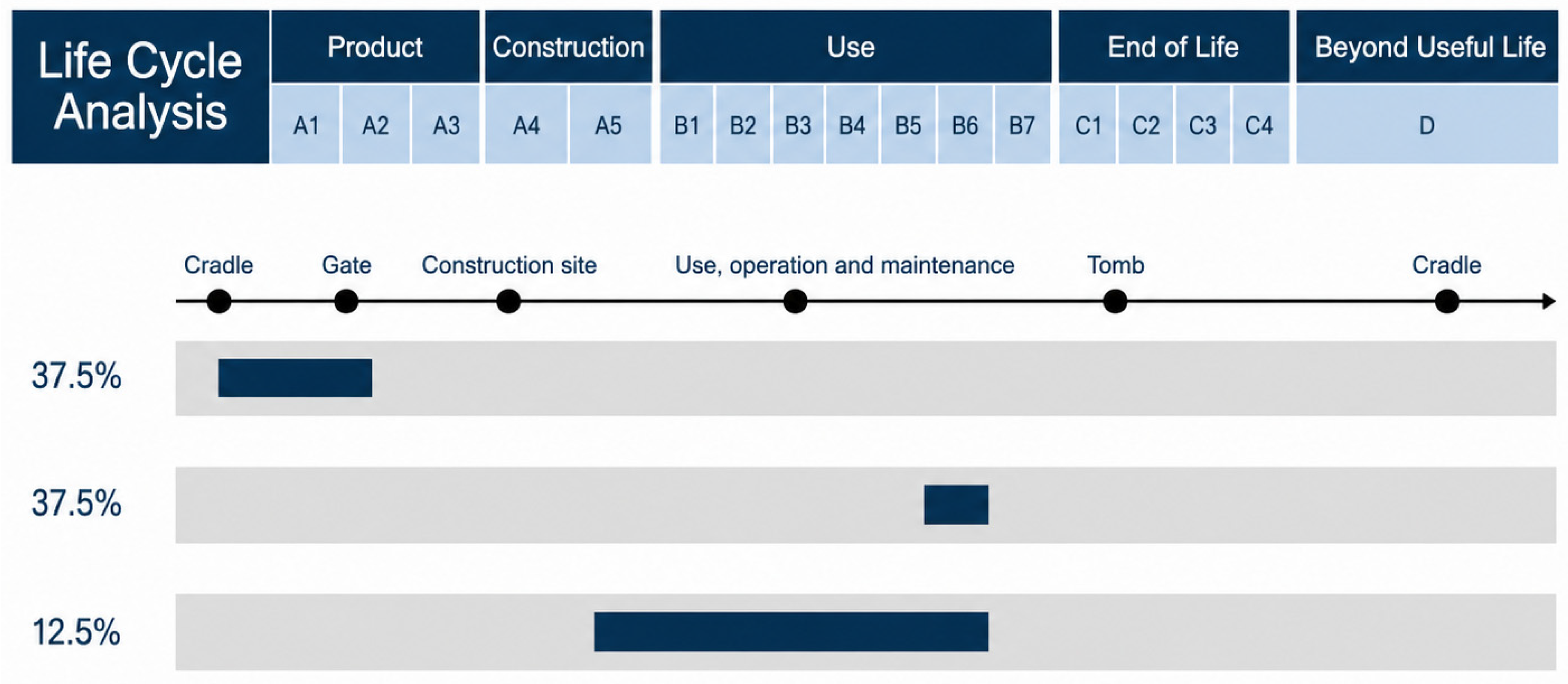
Figure 10 presents the life cycle boundaries adopted in the studies within the AI + CO2 axis. Unlike the BIM + CO2 axis, no approaches with full LCA integration were identified. The studies are distributed between embodied and operational carbon: three adopt A1–A3, focusing on the production of materials and components; three focus exclusively on B6, related to operational emissions derived from energy consumption; one expands the scope to B1–B6, including use-stage phases beyond energy; and one uses emission factors as part of an LLM test, without explicit boundary standardization.
This distribution reveals an important limitation of the axis: although AI is directly applied to carbon, the boundaries remain fragmented between embodied and operational carbon. As a result, predictions or recommendations based on A1–A3 tend to support decisions on materials and mix designs, whereas B6-centered models respond to decisions related to operation, energy, and control. Therefore, the comparability of results depends on the explicit definition of the boundaries, emission factors, and use assumptions adopted in each study.
The studies also report limitations related to the need for experimental validation, data representativeness, and the incorporation of more realistic variables for operational carbon, such as dynamic occupancy, user behavior, climatic conditions, and more accurate emission factors. In summary, the AI + CO2 axis demonstrates that artificial intelligence already has relevant capacity to estimate, predict, optimize, and support decisions related to emissions, especially when structured datasets, well-defined objective functions, and measurable technical criteria are available. However, because it operates mostly outside the BIM environment, this axis still does not close the loop between carbon calculation, digital model, and design decision-making. Its main contribution to BIM–CO2–AI integration is to demonstrate the analytical potential of AI applied to carbon; its central gap lies in connecting this potential to BIM workflows capable of ensuring traceability, interoperability, validation, and direct application to verifiable design alternatives.

3.2.5. Core Studies

Because Core studies represent the integration directly aligned with the research question, they were comparatively analyzed in terms of how BIM, CO2 calculation, and AI are articulated to support design decisions. Table 5 summarizes the eight studies classified in this axis, highlighting the type of integration, the supported decision, and the main methodological limitation. An expanded matrix, with additional details on tools, life cycle boundaries, AI techniques, and validation, is presented in Appendix D.
The comparison of Core studies shows that BIM + CO2 + AI integration already presents promising applications but still occurs in a heterogeneous and predominantly modular manner. In general, BIM provides geometry, quantities, parameters, or semantic data; CO2 calculation is performed through energy simulations, LCA tools, emission factors, or custom calculations; and AI acts as a layer for prediction, optimization, explainability, generation, or recommendation. Even in the most advanced studies, recurring limitations remain, such as incomplete life cycle boundaries, restricted validation, dependence on external modules, absence of automatic feedback to BIM, and difficulty in simultaneously incorporating carbon, cost, comfort, technical performance, and qualitative design criteria. Thus, the Core axis confirms that BIM → CO2 → AI convergence is under consolidation, but still requires greater standardization, validation, and operational integration to support robust lower-impact design decisions.
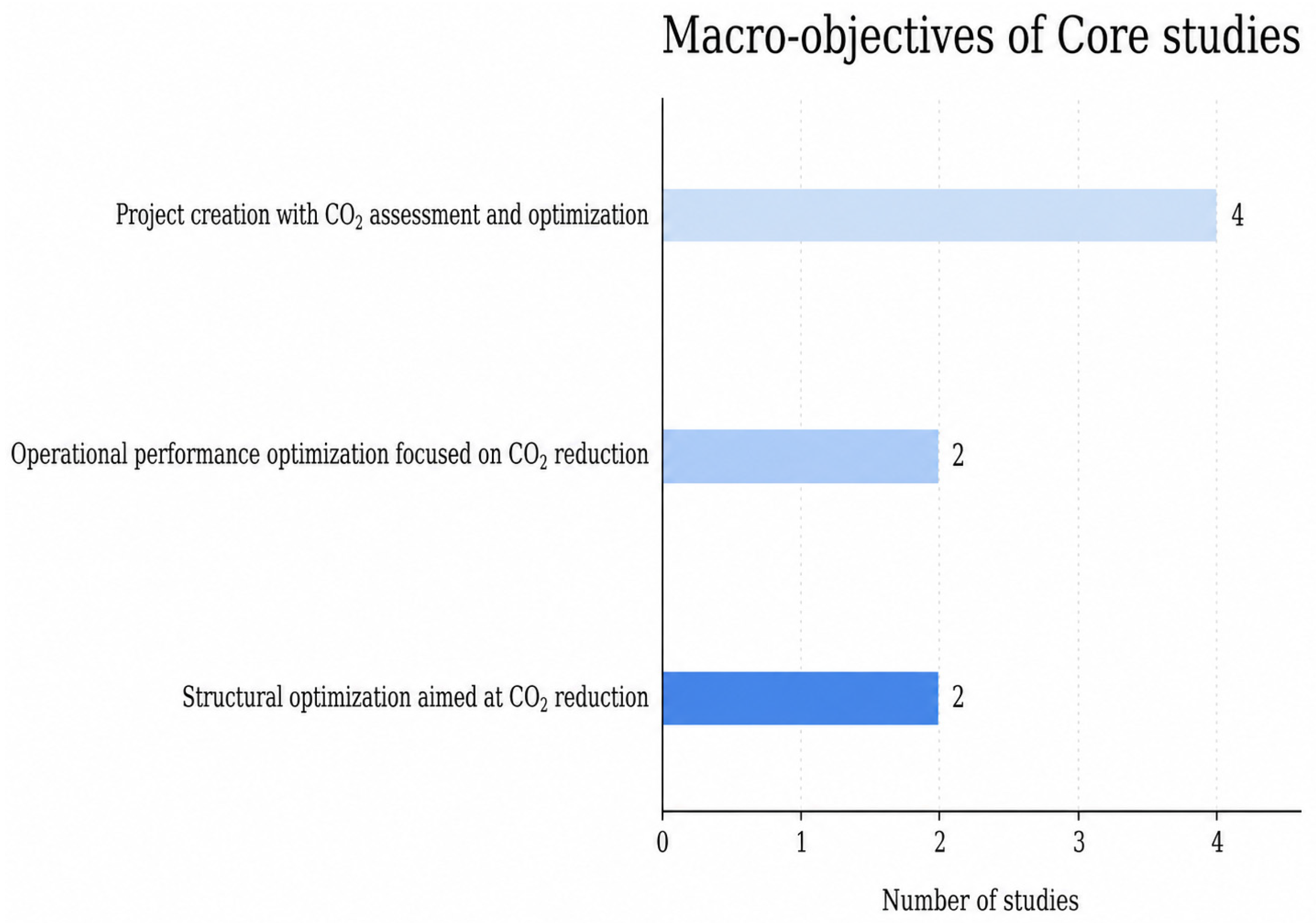
The Core studies were organized into three macro-objectives, as shown in Figure 11: (i) generation of design alternatives with CO2 assessment and optimization; (ii) operational performance optimization focused on CO2 reduction; and (iii) structural optimization aimed at CO2 reduction. These objectives represent the applications closest to the key research question of this review, as they articulate, to varying degrees, BIM, carbon calculation, and AI techniques to support design or performance decisions.
In the assessment and optimization group [101,102,103,104], BIM acts as a parametric environment, a source of quantities, and a support for creating or assessing alternatives. The main advancement of these studies lies in shifting carbon from a late-stage diagnostic metric to a variable considered during design conception, allowing emissions, materials, geometry, performance, and, in some cases, costs to be analyzed before the design is consolidated.
In this stream, AI appears mainly in three forms: multi-objective optimization algorithms, generative/parametric systems, and, more recently, LLMs or knowledge-based models to support querying, recommendation, and requirement capture. The studies show that it is possible to generate alternatives, calculate impacts, and compare solutions through Pareto fronts, predictive models, or recommender systems. The BIM-IGL framework [101], for example, integrates layout generation, hybrid LCA, and impact visualization in BIM, enabling alternatives to be selected based on environmental and performance criteria. Applications using IFC, material databases, and LLMs also demonstrate potential to support the selection of lower-carbon materials, but they also reveal risks of technically inadequate recommendations when there is no grounding in domain knowledge, human validation, or verification mechanisms.
The empirical results of this group indicate relevant contributions, although they remain concentrated in prototypes, case studies, or specific scopes. One study [102] enabled the selection of alternatives through a Pareto front, with visualization of impacts in the BIM model. Another [104] combined BIM/IFC/CDE, LLM + KGQA/RAG, Random Forest, and multi-objective optimization, reporting reductions in energy consumption, cost, carbon, and preliminary modeling time. In high-rise buildings [103], generative design was applied to reduce embodied emissions during the conceptual phase, although with relevant exclusions, such as foundations, operational carbon, and complete structural checks. Therefore, the contribution of this group lies less in offering universally applicable solutions and more in demonstrating promising methodological architectures for integrating alternative generation, environmental assessment, and decision-making.
The second macro-objective focuses on operational performance optimization aimed at CO2 reduction [105,106]. Unlike the first group, these studies mainly treat carbon as a result of energy consumption during the use phase, approaching the B6 life cycle boundary. The workflows generally start from BIM models in Revit, exported via gbXML to DesignBuilder/EnergyPlus, generating simulations that feed predictive models, XAI techniques such as SHAP or LIME, and multi-objective optimization algorithms such as AGE-MOEA. This arrangement reduces dependence on repetitive simulations and allows alternatives to be explored with greater computational speed. In some cases, the studies also report accuracy metrics, creation of Pareto fronts, and uncertainty treatment through Monte Carlo simulation.
Despite their technical robustness, these studies reveal important limits in relation to the question of this review. CO2 calculation remains restricted to operational carbon, without integration with embodied carbon or full LCA; ML, XAI, and optimization modules are mostly executed outside the BIM environment; and validation is mainly based on case studies and simulations, with little evidence of comparison with monitored real-world operational data. Thus, this macro-objective demonstrates a consistent pathway for transforming operational CO2 into a decision variable, but it still does not fully close the loop between BIM, AI-based prediction, recommendation, and automated feedback to the design process.
The third macro-objective brings together studies on structural optimization aimed at CO2 reduction [107,108]. This stream differs from the previous ones because it deals with domains in which the relationship between technical decisions, material consumption, and embodied carbon is more direct. In steel structures, trusses, reinforcement, and reinforced concrete elements, variables such as weight, section, length, waste, splices, and steel consumption can be converted into carbon indicators with greater objectivity than in more subjective architectural problems.
In this group, BIM functions as a source of geometric data, quantities, and technical specifications, while evolutionary algorithms or metaheuristics search for solutions with lower material consumption, waste, cost, or emissions. One study [108] combines Dynamo, Robot Structural Analysis, a genetic algorithm, Revit, and Tally to optimize structural weight and subsequently assess GWP/CO2e. However, in this case, carbon still appears as LCA post-processing, rather than as an objective directly incorporated into the optimization loop. Another study [107], applied to diaphragm walls in urban infrastructure, uses BIM/Revit data and Python to optimize rebar, couplers, cutting patterns, cost, waste, and embodied carbon, demonstrating how decisions at the detailing and production-engineering level can reduce emissions with practical implications for the construction site and supply chain.
The contribution of this stream lies in showing that BIM + CO2 + AI integration can generate practical gains when the problem can be formalized through objective and verifiable variables. However, it also reveals an important limitation: carbon is not always incorporated as an objective function from the beginning. In some cases, AI optimizes weight, geometry, or material consumption, and carbon is assessed only afterward. This gap indicates the need to integrate carbon directly into objective functions, together with cost, structural performance, constructability, and waste.
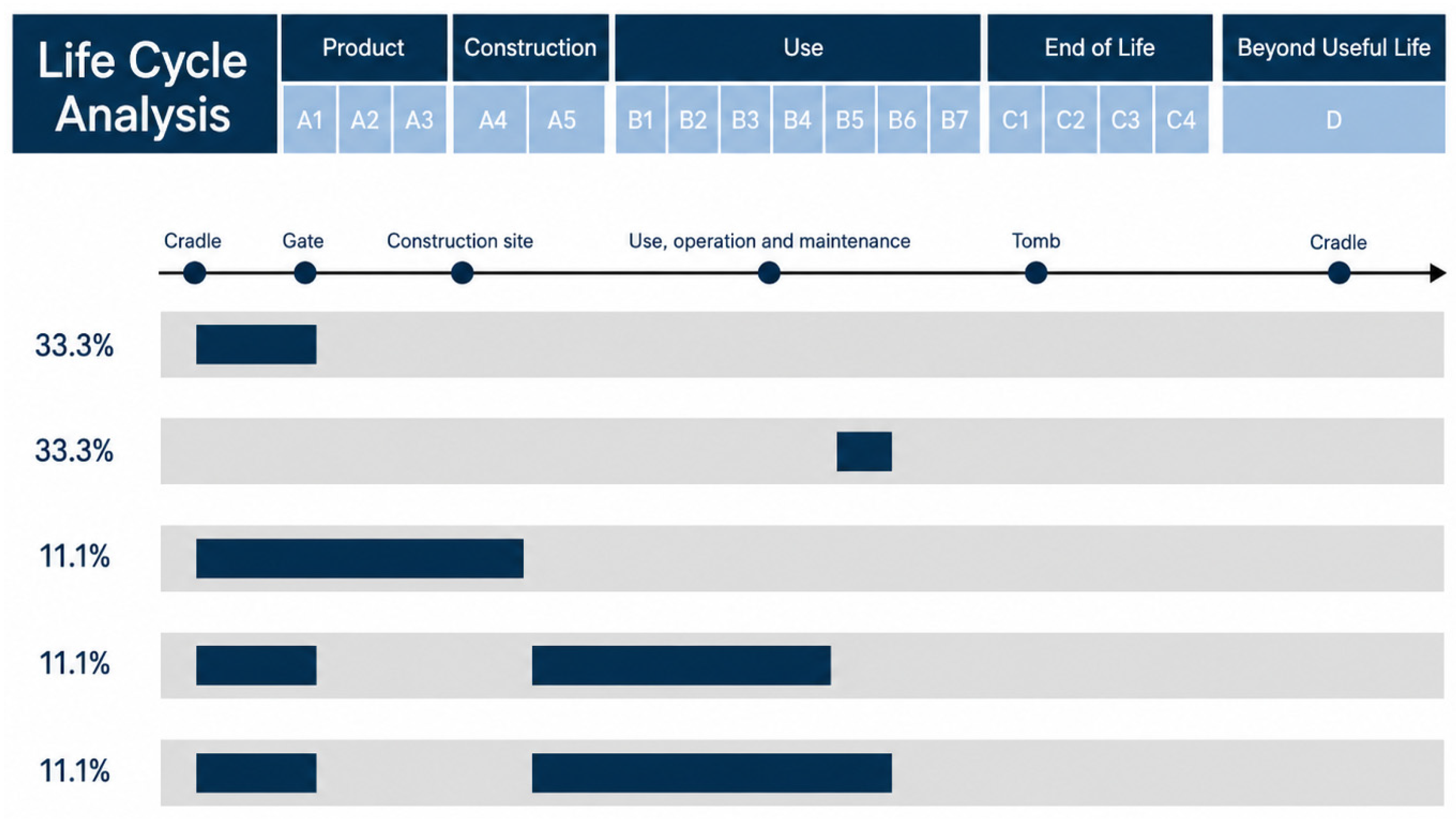
Regarding life cycle boundaries, Figure 12 shows that even Core studies remain segmented between embodied and operational carbon. Among the eight articles, three are restricted to A1–A3, one combines A1–A3 + B1–B5, one adopts A1–A5, one uses A1–A3 + B1–B6, and two focus exclusively on B6.
This result is methodologically relevant because it demonstrates that BIM + CO2 + AI convergence does not occur homogeneously. When the focus is on embodied carbon, the challenges involve inventory, materials, quantities, emission factors, and LCA boundaries. When the focus is on operational carbon, the challenges involve energy simulation, climate data, use behavior, calibration, and validation with real data. Therefore, AI recommendations based on different boundaries are not directly comparable, and future studies should clarify from the outset whether AI supports decisions related to embodied carbon, operational carbon, or combined assessments.
In summary, the Core studies show that BIM + CO2 + AI integration has already moved beyond the purely conceptual stage but has not yet reached full methodological and operational maturity. The field presents promising prototypes and frameworks, especially in alternative generation, metamodeling, XAI, multi-objective optimization, LLMs, and IFC/CDE integration. However, practical consolidation depends on advances in five areas: standardization of carbon boundaries, quality and interoperability of BIM data, direct integration of carbon into decision functions, validation in real cases, and verification mechanisms for AI-generated recommendations.

3.3. Critical Barriers and Implications for BIM–CO2–AI Workflows in Low-Carbon Design Decisions

The joint analysis of the thematic axes shows that the integration of BIM, CO2 calculation, and AI should not be understood as a single or fully consolidated solution, but rather as the progressive articulation of distinct methodological layers. BIM + AI studies show maturity in automation, optimization, generative modeling, and semantic interaction; BIM + CO2 studies consolidate quantity extraction, linkage to emission factors, and inventory automation; BIM + AI + Sustainability studies show the application of AI to energy, comfort, lighting, and retrofit; and AI + CO2 studies demonstrate the potential of predictive models and optimization algorithms applied directly to carbon. However, only the Core studies approach the full convergence investigated in this review, although still in a restricted, modular manner and requiring further validation.
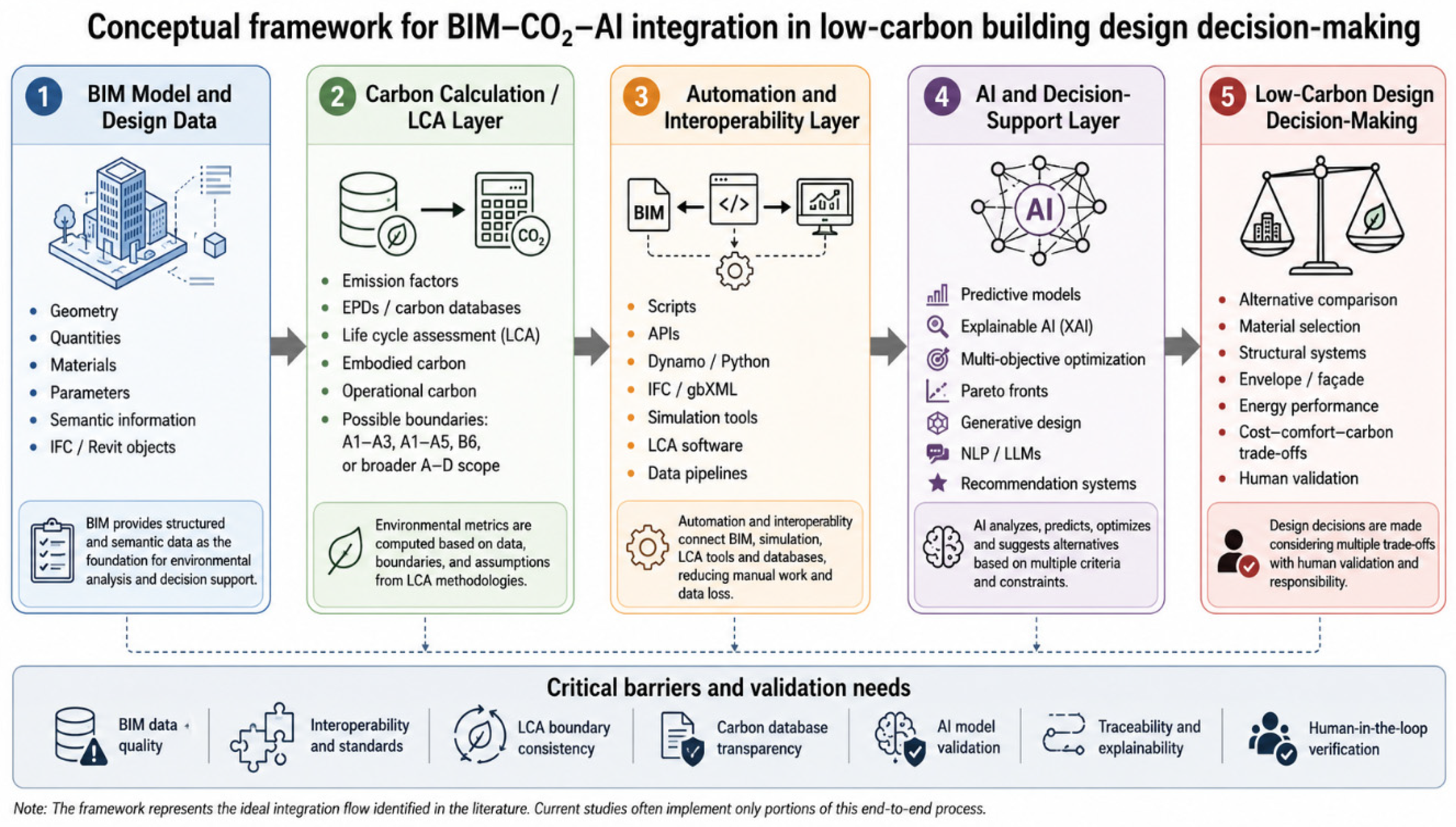
This cross-cutting reading indicates that the central gap in the field does not lie in the isolated absence of BIM, CO2, or AI, but in the difficulty of integrating them into a continuous decision-making workflow. In many studies [101,105,106,107,108], BIM provides geometry, quantities, or parameters; CO2 calculation occurs in LCA software, energy simulations, external databases, or spreadsheets; and AI subsequently acts as a layer for prediction, optimization, explanation, or recommendation. This arrangement enables important advances, but it creates points of fragility between stages, such as data export, semantic loss, parameter inconsistency, incompatibility between formats, absence of automatic feedback of solutions to the model, and difficulty in tracing how a recommendation was produced. Thus, the automation observed in the literature does not always represent full integration but often a sequence of semi-integrated processes that depend on model quality, interoperability between tools, and user validation.
A critical barrier concerns life cycle boundaries and the comparability of results. Studies focused on embodied carbon, especially A1–A3 or A1–A5, tend to support decisions related to materials, construction systems, geometry, structure, and quantities. Studies centered on operational carbon, especially B6, guide decisions related to energy, comfort, HVAC, envelope, and use scenarios. Since each boundary mobilizes different data, assumptions, emission factors, and validation procedures, AI-generated recommendations based on different scopes are not directly comparable [103,105,106]. This limitation is reinforced by BIM + CO2 studies that identify relevant divergences between databases and calculation procedures, indicating that direct comparisons require rigorous standardization of boundaries, emission factors, and mapping methods between BIM inventory and environmental data [83,85].
Another cross-cutting limitation concerns data quality and governance. The reliability of BIM–CO2–AI workflows depends on the consistency of BIM objects, the level of information available, the correct classification of materials and elements, the appropriate association between quantities and emission factors, and the transparency of the databases used. When these elements are not standardized, AI may merely accelerate decisions based on fragile data. This limitation appears especially in predictive models trained with small datasets or datasets derived from specific simulations, in algorithms dependent on simplified objective functions, and in recommender systems based on incomplete material databases or parameters [101,105]. Therefore, the quality of automated decision-making depends not only on the algorithm but also on the reliability of the entire information chain that connects BIM, inventory, environmental calculation, interpretation of results, and validation of recommendations.
The discussion also shows that low-carbon design cannot be reduced to the isolated minimization of emissions. Real design decisions involve trade-offs among carbon, cost, energy performance, thermal comfort, structural performance, material availability, constructability, maintenance, regulatory requirements, and architectural quality. Some Core studies advance in this direction using Pareto fronts, multi-objective optimization, predictive metamodels, XAI, or LLMs to compare alternatives [103,104,105,106,107,108]. However, many workflows still simplify decision criteria or treat carbon as post-processing rather than as a function integrated from the beginning of optimization. Thus, the future contribution of BIM–CO2–AI integration lies less in producing a single “optimal” result and more in making explicit the compromises among alternatives, allowing designers to understand why a solution reduces carbon, what costs or losses are associated with it, and which technical constraints must be observed.
The use of LLMs and natural-language interfaces expands the possibilities for querying, interpretation, and recommendation in BIM–CO2–AI workflows [101,104]. These tools can synthesize information, suggest materials, and facilitate user interaction with technical databases, but they also introduce risks when they are not grounded in reliable data, standards, material databases, and verification mechanisms. Therefore, LLM-based applications should be treated as decision-support tools, not as substitutes for technical validation. In low-carbon workflows, AI-generated recommendations must be verifiable, traceable, and accompanied by human-in-the-loop mechanisms, especially when they involve safety, structural performance, comfort, cost, or regulatory compliance.
From the perspective of professional practice in the AECO sector, the results indicate that the adoption of BIM–CO2–AI workflows depends on conditions that go beyond tool availability. Their implementation requires standardized BIM processes, trained teams, interoperability between platforms, reliable and context-specific carbon databases, clear responsibilities regarding data and validation, and objective criteria for interpreting automated recommendations. Adoption may also be limited by factors such as computational cost, model preparation, information coordination, and integration with real design routines. Thus, the transition from academic prototypes to professional applications requires frameworks that are not only technically sophisticated, but also auditable, understandable, replicable, and compatible with designers’ workflows.
In this sense, the broader BIM and digital twin literature reinforces that BIM–CO2–AI workflows should be evaluated not only by their computational performance but also by their capacity to support integration across stakeholders, life cycle stages, and value chains [12,13,14,18,19]. In practice, low-carbon decision-making requires coordination among designers, engineers, contractors, suppliers, facility managers, owners, and, in some cases, demolition and reuse actors. This reinforces the need to connect carbon quantification with circularity-related information, material traceability, value-chain data, operational feedback, and life cycle-oriented decision processes [15,16,17,18,19]. Therefore, future BIM–CO2–AI frameworks should move beyond isolated model-based calculations and in-corporate stronger links with digital twin principles, Common Data Environments, stakeholder engagement mechanisms, circular economy strategies, and value/benefit assessment across the building life cycle [12,18,19,20].
In summary, the cross-cutting contribution of this review is to demonstrate that BIM–CO2–AI integration should be assessed according to the degree to which it connects five dimensions: BIM data quality, transparent delimitation of carbon calculation, level of automation, effective AI function, and capacity to support design decisions. The literature analyzed presents relevant advances in each dimension, but few studies manage to articulate them fully. The central challenge for future research is not only to automate CO2 calculation or apply AI to BIM models, but to consolidate verifiable, interoperable, and technically validated workflows in which design alternatives are generated, environmentally assessed, compared through multiple criteria, and reintegrated into the decision-making process in a transparent manner.
The application of the N1–N5 scale reveals asymmetric maturity among the BIM-based axes. The BIM + CO2 axis is mostly concentrated at N3, with 21 studies, indicating that BIM-based environmental automation has already advanced beyond simple data extraction or manual/semi-assisted calculation. In this group, maturity lies mainly in inventory structuring, the linkage between model and emission factors, and the operationalization of environmental calculation. By contrast, the BIM + AI axis, with 22 N4 studies and 12 N5 studies, presents higher maturity in the computational layer, especially in optimization, machine learning, generative systems, LLMs, and recommendation.
The BIM + AI + Sustainability axis, with 12 N4 studies, occupies a relevant intermediate position, as it demonstrates that BIM and AI are already combined in environmental workflows oriented toward energy, comfort, lighting, and retrofit. In Core studies, the concentration at N4 and N5, with six N4 studies and two N5 studies, shows that full BIM + CO2 + AI integration has already reached high levels of automation but remains limited in scope. Thus, the N1–N5 scale confirms that the central gap is not the absence of isolated technical capabilities but the difficulty of articulating, within the same workflow, carbon inventory, computational intelligence, interoperability, validation, and effective support for design decision-making.
Based on this cross-cutting analysis, a conceptual framework is proposed to synthesize the layers required for BIM–CO2–AI integration in lower-impact design decisions. This framework does not represent a fully consolidated workflow in the literature but rather an analytical structure derived from the patterns and gaps identified in this review. As shown in Figure 13, integration begins with BIM model data, advances to environmental quantification through emission factors, carbon databases, and life cycle boundaries, depends on automation and interoperability mechanisms to connect tools, incorporates AI methods for prediction, explanation, optimization, and recommendation, and culminates in the comparison of design alternatives with human validation.
This representation reinforces that the main challenge is not only to automate CO2 calculation or apply AI to BIM, but to ensure continuity, traceability, and reliability throughout the entire workflow. Thus, BIM data quality, consistency of LCA boundaries, transparency of carbon databases, validation of AI models, and human verification of recommendations are critical conditions for automated calculation to move beyond a quantification step and effectively support robust design decisions.
The cross-cutting analysis of the studies also makes it possible to identify which design and operation aspects have most frequently been supported by integrations between BIM, CO2, AI, and sustainability. Table 6 synthesizes these aspects without treating the axes as equivalent but indicating how each group contributes to decisions with potential links to environmental performance and low carbon.
Taken together, these aspects show that low-carbon decision support is not limited to material selection or emission calculation. The analyzed integrations already reach different layers of design, such as form, envelope, structure, energy, cost, retrofit, and circularity. However, the simultaneous articulation of these criteria remains limited, indicating that the main opportunity for future research lies in developing multicriteria workflows capable of integrating embodied carbon, operational carbon, technical performance, economic feasibility, and validation of recommendations within the same decision-making process.


4. Limitations of This Review

The results of this study should be interpreted in light of the methodological delimitations adopted. These delimitations do not compromise the objective of the review, but they define the scope of the evidence analyzed and help contextualize the generalizability of the findings. The searches were conducted on Scopus, Web of Science, and ScienceDirect, which are widely used databases in the international literature but do not cover all possible repositories. Therefore, studies indexed exclusively in other databases, conference proceedings, technical reports, standards, institutional documents, or industrial tools may not have been included in the sample. However, this choice allowed the analysis to focus on peer-reviewed scientific articles with greater methodological detail.
The second delimitation concerns the language, time frame, and document type filters. The review considered English-language articles published between 2021 and 2025, which favored the currency of the sample and made it possible to capture recent advances in BIM, automation, CO2 calculation, and AI. On the other hand, this decision restricted the historical scope of the review and may have excluded contributions published in other languages or formats. This delimitation is consistent with the objective of the study, which is to map the recent stage of BIM–CO2–AI integration in scientific publications with greater methodological comparability.
Another limitation arises from the heterogeneity of the included studies. The analyzed studies differ in terms of life cycle boundaries, emission factor databases, software used, automation levels, AI techniques, validation approaches, and design stages considered. This diversity limits direct quantitative comparisons, but it also represents an important finding of this review, as it highlights the methodological fragmentation of the field. In particular, studies focused on embodied carbon, such as A1–A3 or A1–A5, are not directly comparable to studies centered on operational carbon, such as B6, because they rely on different data, assumptions, and validation methods.
The classification of studies into thematic axes also represents an analytical decision. Although each article was assigned to only one axis, based on its predominant objective and the highest level of integration effectively operationalized, some studies present secondary contributions that relate to more than one category. This decision was necessary to avoid overlap and double counting, preserving comparability across the axes. However, it also requires recognizing that the classification represents the predominant contribution of each study.
Finally, this review depends on the information reported by the analyzed articles themselves. In some cases, aspects such as LOD, carbon databases, AI model parameters, code availability, validation in real-world contexts, computational costs, and mechanisms for automatic feedback to BIM were not fully described. Thus, some of the limitations identified may reflect both weaknesses in the studies and gaps in methodological reporting. Even so, the analyzed set of studies makes it possible to identify consistent patterns of partial integration, consolidating maturity, and opportunities for advancing BIM–CO2–AI workflows aimed at supporting lower-impact design decisions.

5. Conclusions

This Systematic Literature Review investigated whether, in BIM-based building design, the automation of CO2 emission calculation combined with artificial intelligence has been applied to guide lower-impact design decisions. The results indicate that this integration already presents practical evidence but remains in a stage of consolidation. The analyzed literature shows relevant advances in BIM + AI, BIM + CO2, BIM + AI + Sustainability, and AI + CO2 workflows; however, full BIM + CO2 + AI convergence still represents a limited subset of the sample, indicating that the technological components exist but are often developed in a partial, modular, or externally dependent manner.
The main theoretical contribution of this review is to demonstrate that BIM–CO2–AI integration should not be understood merely as the sum of three technologies but as a decision-making workflow composed of interdependent layers: BIM data, carbon calculation, automation/interoperability, AI methods, and design decision support. In this regard, the studies classified as Base were important for revealing the components that support full integration, while the Core studies highlighted the applications most closely aligned with the research question. This structure made it possible to show that the field has moved beyond a purely conceptual stage but has not yet reached full methodological and operational maturity.
From a methodological perspective, the findings indicate that BIM is mainly used as a structured source of geometry, quantities, parameters, and semantic information. However, CO2 quantification, environmental simulation, optimization, and recommendation often depend on external tools, scripts, APIs, programming environments, LCA software, or energy simulation platforms. Thus, the automation identified in the literature does not always correspond to an end-to-end integrated workflow, as it still depends on exports, intermediate processing, format integration, and manual validation of results.
Regarding carbon, this review showed that automation is more consolidated when linked to quantities and materials, especially for embodied carbon, and when associated with energy simulations in the case of operational carbon. However, the heterogeneity of life cycle boundaries limits comparability among studies. Studies centered on A1–A3, A1–A5, or B6 respond to different decisions and rely on different data, assumptions, and validation procedures. Therefore, a central gap for future research lies in the transparent definition of LCA boundaries and in the more consistent integration of embodied and operational carbon within automated decision-making workflows.
Regarding artificial intelligence, the studies employ diverse approaches, including predictive models, evolutionary and metaheuristic algorithms, multi-objective optimization, XAI, LLMs, NLP, generative systems, and recommender mechanisms. This diversity demonstrates the potential of AI to accelerate simulations, explore alternatives, explain relevant variables, and support multicriteria decisions. At the same time, it highlights risks and limitations, such as low transferability of models trained on specific datasets, dependence on objective functions in optimization algorithms, and the need for human validation of recommendations generated by LLMs.
The practical contribution of this review is to show that low-carbon design does not depend only on calculating emissions but on transforming this calculation into useful information for comparing, selecting, revising, or recommending design alternatives. The most advanced studies indicate promising pathways through metamodels, Pareto fronts, generative design, IFC/CDE integration, XAI, and AI-assisted recommendations. Even so, relevant challenges remain for professional adoption, including BIM data quality, interoperability between tools, transparency of carbon databases, validation in real cases, traceability of recommendations, and simultaneous incorporation of carbon, cost, comfort, technical performance, constructability, and qualitative design criteria.
In summary, BIM–CO2–AI integration has significant potential to support lower-impact building design decisions, but its consolidation depends on advances in five main areas: standardization of carbon boundaries and emission databases; improvement of the semantic quality and interoperability of BIM data; direct integration of carbon into decision and optimization functions; validation of models in real and monitored contexts; and development of human verification and traceability mechanisms for AI-generated recommendations. The future challenge is not only to automate CO2 calculation or apply AI to BIM, but to build verifiable, comparable, and operationally integrated workflows capable of transforming environmental data into robust, transparent design decisions effectively oriented toward impact reduction.

Author Contributions

Conceptualization, K.C.A., A.C.F.M. and B.B.F.d.C.; methodology, K.C.A. and A.C.F.M.; software, K.C.A.; validation, K.C.A. and A.C.F.M.; formal analysis, K.C.A.; investigation, K.C.A.; resources, K.C.A.; data curation, K.C.A.; writing—original draft preparation, K.C.A.; writing—review and editing, K.C.A., A.C.F.M. and B.B.F.d.C.; visualization, K.C.A.; supervision, A.C.F.M. and B.B.F.d.C.; project administration, A.C.F.M. All authors have read and agreed to the published version of the manuscript.

Funding

This research received no external funding.

Data Availability Statement

No new datasets were generated during this study. The data supporting the findings of this systematic literature review are available within the article and its appendices, including the search strings, database filters, data extraction form, and synthesis tables.

Conflicts of Interest

The authors declare no conflicts of interest.

Abbreviations

The following abbreviations are used in this manuscript:
AECOArchitecture, Engineering, Construction, and Operation
AIArtificial Intelligence
ACOAnt Colony Optimization
AGE-MOEAAdaptive Geometry Estimation Multi-Objective Evolutionary Algorithm
APIApplication Programming Interface
ARAugmented Reality
BEMBuilding Energy Modeling
BIMBuilding Information Modeling
BOBayesian Optimization
BO-LGBMBayesian Optimization + LightGBM
BO-XGBoostBayesian Optimization + XGBoost
C&D wasteConstruction and Demolition Waste
CFDComputational Fluid Dynamics
CMMSComputerized Maintenance Management System
COBieConstruction Operations Building information exchange
CO2Carbon Dioxide
DEDifferential Evolution
DLDeep Learning
EN 15978European Standard for Assessment of the Environmental Performance of Buildings
EPDEnvironmental Product Declaration
EUIEnergy Use Intensity
FBI_AdaBoostAdaBoost Variant Using the Study’s FBI-based Procedure
FBI_XGBXGBoost Variant Using the Study’s FBI-based Procedure
GAGenetic Algorithm
gbXMLGreen Building XML
GBMGradient Boosting Machine
GISGeographic Information System
GPTGenerative Pre-trained Transformer
IFCIndustry Foundation Classes
IoTInternet of Things
LCALife Cycle Assessment
LightGBM/LGBMLight Gradient Boosting Machine
LIMELocal Interpretable Model-agnostic Explanations
LLMLarge Language Model
LOILevel of Information
LODLevel of Development
MAPEMean Absolute Percentage Error
MEPMechanical, Electrical, and Plumbing
MLMachine Learning
NLPNatural Language Processing
NSGA-IINon-dominated Sorting Genetic Algorithm II
ParetoPareto Front/non-dominated Solutions
PointNetDeep Learning Architecture for Point-cloud Processing
PRISMAPreferred Reporting Items for Systematic Reviews and Meta-Analyses
PSOParticle Swarm Optimization
R2Coefficient of determination
RMSERoot Mean Squared Error
SASimulated Annealing
SHAPSHapley Additive exPlanations
SLRSystematic Literature Review
Tree-LIMETree-based Variant of LIME for Tree Models
WOAWhale Optimization Algorithm
XAIExplainable Artificial Intelligence
XGBoost/XGBExtreme Gradient Boosting
YOLOYou Only Look Once (Object Detection)

Appendix A

Appendix A.1. Strings Used in the Search

Table A1. Search strings used in the databases.
GroupSearch String Used
Group 1—BIM + AI“Building Information Modeling” AND “Artificial Intelligence”
Group 2—Carbon + AI + Construction/Design“carbon emission” AND “Artificial Intelligence” AND “design optimization”
“CO2 emission” AND “Artificial Intelligence” AND “design optimization”
Group 3—BIM + Carbon + Construction/Design“BIM” AND “carbon emission” AND “design optimization”
“BIM” AND “CO2 emission” AND “building”
“Building Information Modeling” AND “CO2 emission” AND “building”
“Building Information Modeling” AND “CO2 emission” AND “design optimization”
“BIM” AND “CO2 emission” AND “design optimization”
Group 4—BIM + Carbon + AI + Construction/Design“BIM” AND “carbon emission” AND “AI” AND “building”
“BIM” AND “carbon emission” AND “AI” AND “design optimization”
“BIM” AND “CO2 emission” AND “AI” AND “building”
“BIM” AND “CO2 emission” AND “AI” AND “design optimization”
“Building Information Modeling” AND “carbon emission” AND “Artificial Intelligence” AND “building”
“Building Information Modeling” AND “CO2 emission” AND “Artificial Intelligence” AND “design optimization”
“Building Information Modeling” AND “CO2 emission” AND “Artificial Intelligence” AND “building”
“Building Information Modeling” AND “carbon emission” AND “AI” AND “building”

Appendix A.2. Filters Used from the Search Databases

Table A2. Filters applied in each database.
DatabaseSearch FieldsFilters Applied
ScienceDirectTitle, abstract, and keywords, according to platform availabilityPublication years: 2021–2025; article type: “research articles”; subject area: “Engineering”. No specific English-language filter was available at the search stage, but no non-English articles were identified in the retrieved sample.
Web of ScienceTitle, abstract, and keywordsPublication years: 2021–2025; document type: “articles”; category: “Engineering Civil”; language: English.
ScopusTitle, abstract, and keywordsPublication years: 2021–2025; subject area: “Engineering”; document type: “articles”; language: English; publication stage: “final”.
Note: All search strings were applied to title, abstract, and keyword fields, according to the search configuration available in each database.

Appendix B. Data Extraction Form

Table A3. Standardized data extraction form used in the full-text reading stage.
DimensionExtracted InformationPurpose in the Review
1. Screening and eligibilityMethodological sufficiency; relationship with the AEC/AECO sector; conceptual or review nature; final classification in the SLR as Core or Base study.To verify whether the study met the eligibility criteria and to support its classification in the review.
2. Bibliographic dataTitle; authors; year of publication; journal; country/affiliation; DOI or URL.To characterize the study and support bibliographic organization and traceability.
3. Methodological dataDeclared main objective; type of study; application scope or building typology; evaluation criteria used in the article; software and tools.To identify the methodological design, scope, and technical resources used in each study.
4. BIM axisLevel of BIM use; LOD/4D/5D information, when reported; use of a collaborative environment or Common Data Environment (CDE); BIM platform(s); integration mechanism.To assess how BIM was operationalized and how it supported data extraction, integration, automation, or decision-making.
5. Carbon and sustainability axisWhether the study directly addressed carbon or another sustainability issue; life cycle boundaries adopted, such as A1–A3, A4–A5, B, C, or D; database used, such as EPDs or carbon databases; LCA/CO2 tool; units and metrics; main environmental or energy-related results.To identify how environmental performance was measured and whether carbon quantification was explicitly operationalized.
6. AI axisType of AI technique; software or programming environment used; AI function, such as prediction, classification, generation, or optimization; training data source; maturity level, classified as basic or advanced; level of integration with BIM.To differentiate the role, maturity, and integration level of AI in the analyzed workflows.
7. Extracted resultsMain performance metrics analyzed; main results achieved; type of validation; reported limitations; gaps and future research perspectives.To support the comparative synthesis of findings, limitations, and methodological contributions.
8. Trade-offs and design decision-makingOperationalized trade-offs; decision-making indicators used in the study.To identify whether and how the study supported comparison, selection, optimization, or recommendation of design alternatives.
9. Integration scaleClassification according to the integration/automation scale, from N0 to N5.To assess the maturity of integration among BIM, CO2/sustainability, automation, and AI.
Note: The extraction form was applied during the full-text reading stage to standardize the collection of bibliographic, methodological, technical, and analytical information across the included studies. The N0–N5 scale was later adjusted in the manuscript to focus on BIM-based workflows, with AI + CO2 studies analyzed separately when BIM was not part of the methodological workflow.

Appendix C. AI Functions Identified in the BIM + AI Axis

Figure A1. Detailed AI functions identified in the BIM + AI axis.
Civileng 07 00038 g0a1

Appendix D. Expanded Comparative Synthesis Matrix of Core Studies

Table A4. Expanded comparative synthesis matrix of BIM + CO2 + AI Core studies.
Authors/YearStudy TitleTools/WorkflowCO2/BoundaryAI/FunctionDecision SupportMain Limitation
[105]BIM-supported automatic energy performance analysis for green building design using explainable machine learning and multi-objective optimizationRevit → gbXML → DesignBuilder/EnergyPlus → BO-LGBM/SHAP → AGE-MOEA/PythonOperational CO2, energy, and comfort; use/operation phaseExplainable ML, LightGBM, SHAP, and multi-objective optimizationPareto solutions to reduce energy consumption, CO2 emissions, and discomfort in an educational buildingFocus only on the operational phase; no validation with measured operational data; embodied carbon not considered
[106]BIM Integration with XAI Using LIME and MOO for Automated Green Building Energy Performance AnalysisRevit → gbXML → DesignBuilder/EnergyPlus → BO-LGBM/LIME → AGE-MOEAOperational CO2, energy, and thermal discomfortExplainable ML, LIME/Tree-LIME, and multi-objective optimizationOptimization of envelope, window, and HVAC parameters to improve energy performance, CO2 emissions, and comfortRelatively small dataset; no full LCA; ML and optimization are performed outside Revit
[101]Artificial Intelligence and Digital Tools for Assisting Low-Carbon Architectural Design: Merging the Use of Machine Learning, Large Language Models, and Building Information Modeling for Life Cycle Assessment Tool DevelopmentIFC → BIM-IFC web application → take-off → Ökobaudat → ML/LLMEmbodied footprint by component; comparison between embodied and operational carbonML for initial estimation and LLM for material suggestionsSuggestions of lower-carbon alternatives by component, supporting early design stagesThe LLM may also generate inadequate suggestions; robust ML performance metrics, normative boundaries, and broader validation are lacking
[107]Structural Optimization of Trusses in Building Information Modeling (BIM) Projects Using Visual Programming, Evolutionary Algorithms, and Life Cycle Assessment (LCA) ToolsDynamo → Robot Structural Analysis → GA/PyMoo → Revit/TallyGWP/CO2e assessed through Tally after structural optimizationGenetic algorithm for section optimizationOptimizes structural weight and transfers the solution to Revit for LCA/cost analysisCO2 is not directly included in the objective function; LCA occurs as post-processing; no embedded CO2 × cost Pareto loop
[102]BIM-IGL: a BIM-based framework for automated conceptual design integrating generative design and life cycle assessmentRevit/Dynamo → layout generation → hybrid LCA → BIM-based visualizationGWP and other environmental categories; A1–A3 + maintenance over 40 yearsPareto-based generation/selection in a generative design workflowLayout/material selection through Pareto analysis, with visualization of impacts in BIMPrototype case; focus on walls and maintenance; need to expand elements and life cycle stages A4–A5/B/C/D
[108]Intelligent Rebar Optimization Framework for Urban Transit Infrastructure: A Case Study of a Diaphragm Wall in a Singapore Mass Rapid Transit StationRevit/digital data → Python/CROF + WOACSO → carbon/cost/waste calculationEmbodied carbon of rebars and couplers; quantity × factor calculationWOA/WOACSO metaheuristic, compared with GA and PSOOptimizes cutting patterns, special lengths, couplers, cost, waste, and CO2 in a real infrastructure caseFull LCA boundaries not implemented; dependent on BIM input quality; data/code not fully open
[104]Lifecycle framework for AI-driven parametric generative design in industrialized constructionBIM/IFC/CDE/BCF → LLM + KGQA/RAG → Random Forest → multi-objective optimizationEmbodied and operational carbon; 50-year life cycle assessmentLLM + KGQA/RAG, Random Forest, and multi-objective optimizationGeneration and selection of alternatives considering cost, energy, carbon, and performancePartial scope in the applied case; need to expand the knowledge graph, disciplinary integration, and replicability
[103]Generative design to reduce embodied GHG emissions of high-rise buildingsRevit/Dynamo/Refinery → NSGA-II → EC3/One Click LCA/Ecoinvent factorsEmbodied emissions A1–A5 in high-rise buildingsMulti-objective evolutionary optimizationGeneration of massing/form alternatives to reduce embodied GHG while maintaining FAR and architectural scoreFoundations excluded; operational carbon not included; structure estimated by regression

References

  1. Parece, S.; Resende, R.; Rato, V. Stakeholder Perspectives on BIM-LCA Integration in Building Design: Adoption, Challenges, and Future Directions. Build. Environ. 2025, 284, 113434. [Google Scholar] [CrossRef]
  2. Li, L.; Gao, L.; Zhang, X.; Xu, H.; Jiang, L. Research on Building’s Carbon Emission Calculation and Reduction Strategy Based on Life Cycle Assessment (LCA) and Building in Formation Modeling (BIM): A Case Study in Beijing, China. Buildings 2025, 15, 1403. [Google Scholar] [CrossRef]
  3. Lyu, Y.; Fomin, N.I.; Li, S.; Hu, W.; Xiao, S.; Huang, Y.; Liu, C. Life Cycle Carbon Emission Analysis of Buildings with Different Exterior Wall Types Based on BIM Technology. Buildings 2025, 15, 138. [Google Scholar] [CrossRef]
  4. EN 15978:2011; Sustainability of Construction Works—Assessment of Environmental Performance of Buildings—Calculation Method. European Committee for Standardization (CEN): Brussels, Belgium, 2011.
  5. Zhao, Z.; Liu, C.; Xie, H.; Li, Y.; Zhu, C.; Liu, M. Carbon Accounting and Carbon Emission Reduction Potential Analysis of Sponge Cities Based on Life Cycle Assessment. Water 2023, 15, 3565. [Google Scholar] [CrossRef]
  6. Jankovic, L. Designing Zero Carbon Buildings; Routledge: Oxfordshire, UK, 2024. [Google Scholar] [CrossRef]
  7. Dalla Mora, T.; Bolzonello, E.; Cavalliere, C.; Peron, F. Key Parameters Featuring BIM-LCA Integra-tion in Buildings: A Practical Review of the Current Trends. Sustainability 2020, 12, 7182. [Google Scholar] [CrossRef]
  8. Safari, K.; AzariJafari, H. Challenges and opportunities for integrating BIM and LCA: Methodological choices and framework development. Sustain. Cities Soc. 2021, 67, 102728. [Google Scholar] [CrossRef]
  9. Lu, K.; Jiang, X.; Yu, J.; Tam, V.W.Y.; Skitmore, M. Integration of life cycle assessment and life cycle cost using building information modeling: A critical review. J. Clean. Prod. 2021, 285, 125438. [Google Scholar] [CrossRef]
  10. Teng, Y.; Xu, J.; Pan, W.; Zhang, Y. A systematic review of the integration of building information modeling into life cycle assessment. Build. Environ. 2022, 221, 109260. [Google Scholar] [CrossRef]
  11. Ma, W.; Wang, X.; Wang, J.; Xiang, X.; Sun, J. Generative Design in Building Information Modelling (BIM): Approaches and Requirements. Sensors 2021, 21, 5439, Correction in Sensors 2026, 26, 1261. https://doi.org/10.3390/s26041261. [Google Scholar] [CrossRef] [PubMed]
  12. Badenko, V.; Bolshakov, N.; Celani, A.; Puglisi, V. Principles for Sustainable Integration of BIM and Digital Twin Technologies in Industrial Infrastructure. Sustainability 2024, 16, 9885. [Google Scholar] [CrossRef]
  13. Douglas, D.; Kelly, G.; Kassem, M. BIM, Digital Twin and Cyber-Physical Systems: Crossing and Blurring Boundaries. In Proceedings of the 2021 European Conference on Computing in Construction, Online, 25–27 July 2021. [Google Scholar] [CrossRef]
  14. Rafsanjani, H.N.; Nabizadeh, A.H. Towards Digital Architecture, Engineering, and Construction (AEC) Industry through Virtual Design and Construction (VDC) and Digital Twin. Energy Built Environ. 2023, 4, 169–178. [Google Scholar] [CrossRef]
  15. Kaewunruen, S.; Sresakoolchai, J.; Lin, Y.-H. Digital Twins for Managing Railway Maintenance and Resilience. Open Res. Eur. 2021, 1, 91. [Google Scholar] [CrossRef] [PubMed]
  16. Kaewunruen, S.; Lian, Q. Digital Twin Aided Sustainability-Based Lifecycle Management for Railway Turnout Systems. J. Clean. Prod. 2019, 228, 1537–1551. [Google Scholar] [CrossRef]
  17. Kaewunruen, S.; AbdelHadi, M.; Kongpuang, M.; Pansuk, W.; Remennikov, A.M. Digital Twins for Managing Railway Bridge Maintenance, Resilience, and Climate Change Adaptation. Sensors 2023, 23, 252. [Google Scholar] [CrossRef]
  18. Meng, X.; Lu, W.; Xue, F.; Chen, K. Integration of Digital Twin and Circular Economy in the Construction Industry. Sustainability 2023, 15, 13186. [Google Scholar] [CrossRef]
  19. Kaewunruen, S.; Baniotopoulos, C.; Guo, Y.; Sengsri, P.; Teuffel, P.; Bajare, D. 6D-BIM Applications to Enrich Circular Value Chains and Stakeholder Engagement Within Built Environments. In Proceedings of the 4th International Conference “Coordinating Engineering for Sustainability and Resilience” and Midterm Conference of CircularB “Implementation of Circular Economy in the Built Environment”, Timisoara, Romania, 29–31 May 2024; Ungureanu, V., Bragança, L., Baniotopoulos, C., Abdalla, K.M., Eds.; Lecture Notes in Civil Engineering; Springer: Cham, Switzerland, 2024; Volume 489, pp. 346–356. [Google Scholar] [CrossRef]
  20. Li, J.; Liu, Z.; Han, G.; Demian, P.; Osmani, M. The Relationship Between Artificial Intelligence (AI) and Building Information Modeling (BIM) Technologies for Sustainable Building in the Context of Smart Cities. Sustainability 2024, 16, 10848. [Google Scholar] [CrossRef]
  21. Duan, Y.; Edwards, J.S.; Dwivedi, Y.K. Artificial intelligence for decision making in the era of Big Data—Evolution, challenges and research agenda. Int. J. Inf. Manag. 2019, 48, 63–71. [Google Scholar] [CrossRef]
  22. Itanola, M.; Whang, S.W. The impact of digital technologies on energy-efficient buildings: BIM and AI-based study. Int. J. Sustain. Build. Technol. Urban Dev. 2024, 15, 392–412. [Google Scholar]
  23. Arvizu-Montes, A.; Guerrero-Bustamante, O.; Polo-Mendoza, R.; Martinez-Echevarria, M.J. Inte-grating Life-Cycle Assessment (LCA) and Artificial Neural Networks (ANNs) for Optimizing the Inclusion of Sup-plementary Cementitious Materials (SCMs) in Eco-Friendly Cementitious Composites: A Literature Review. Materials 2025, 18, 4307. [Google Scholar] [CrossRef] [PubMed]
  24. An, Y.; Li, H.; Su, T.; Wang, Y. Determining Uncertainties in AI Applications in AEC Sector and their Corresponding Mitigation Strategies. Autom. Constr. 2021, 131, 103883. [Google Scholar] [CrossRef]
  25. Page, M.J.; McKenzie, J.E.; Bossuyt, P.M.; Boutron, I.; Hoffmann, T.C.; Mulrow, C.D.; Shamseer, L.; Tetzlaff, J.M.; Akl, E.A.; Brennan, S.E.; et al. A declaração PRISMA 2020: Diretriz atualizada para relatar revisões sistemáticas. Rev. Panam. Salud Publica 2022, 46, 1. [Google Scholar] [CrossRef] [PubMed]
  26. Wang, L.; Liu, J.; Zeng, Y.; Cheng, G.; Hu, H.; Hu, J.; Huang, X. Automated building layout generation using deep learning and graph algorithms. Autom. Constr. 2023, 154, 105036. [Google Scholar] [CrossRef]
  27. Malgit, B.; Isikdag, U.; Bekdaş, G.; Yucel, M. A generative design-to-BIM workflow for minimum weight plane truss design. Rev. Constr. 2022, 21, 473–492. [Google Scholar] [CrossRef]
  28. Wang, L.; Zhou, X.; Liu, J.; Cheng, G. Automated layout generation from sites to flats using GAN and transfer learning. Autom. Constr. 2024, 166, 105668. [Google Scholar] [CrossRef]
  29. Ghannad, P.; Lee, Y.C. Automated modular housing design using a module configuration algorithm and a coupled generative adversarial network (CoGAN). Autom. Constr. 2022, 139, 104234. [Google Scholar] [CrossRef]
  30. Birkemo, A.S.; Samarakoon, S.M.K. Application of generative design for structural optimization at the conceptual design phase. WIT Trans. Built Environ. 2021, 205, 139–153. [Google Scholar] [CrossRef]
  31. Yavan, F.; Maalek, R. Reliability-Constrained Structural Design Optimization Using Visual Programming in Building Information Modeling (BIM) Projects. Appl. Sci. 2025, 15, 1025. [Google Scholar] [CrossRef]
  32. Bourahla, N.; Larfi, S.; Souaci, K.; Bourahla, Y.; Tafraout, S. Intelligent automation and optimization of reinforced concrete dual systems for earthquake resisting buildings in a BIM environment. J. Build. Eng. 2023, 76, 107111. [Google Scholar] [CrossRef]
  33. Zhou, Y.; Wang, Y.; Li, C.; Ding, L.; Yang, Z. Health and comfort oriented automatic generative design and optimization of residence space layout: An integrated data-driven and knowledge-based approach. Dev. Built Environ. 2024, 17, 100318. [Google Scholar] [CrossRef]
  34. Li, X.; Lu, W.; Peng, Z. Generative design for modular construction structures based on expert knowledge-informed graph neural networks and meta-heuristics. Autom. Constr. 2025, 179, 106463. [Google Scholar] [CrossRef]
  35. He, Z.; Wang, Y.-H.; Zhang, J. Generative AIBIM: An automatic and intelligent structural design pipeline integrating BIM and generative AI. Inf. Fusion 2025, 114, 102654. [Google Scholar] [CrossRef]
  36. Urbieta, M.; Urbieta, M.; Laborde, T.; Villarreal, G.; Rossi, G. Generating BIM model from structural and architectural plans using Artificial Intelligence. J. Build. Eng. 2023, 78, 107672. [Google Scholar] [CrossRef]
  37. Kim, I.; Shin, J.; Shah, S.H.; Ur Rehman, S.U. Client-centered detached modular housing: Natural language processing-enabled design recommender system. J. Comput. Des. Eng. 2024, 11, 137–157. [Google Scholar] [CrossRef]
  38. Lien, L.-C.; Dolgorsuren, U. BIM-based steel reinforcing bar detail construction design and picking optimization. Structures 2023, 49, 520–536. [Google Scholar] [CrossRef]
  39. Gan, V.J.L. BIM-based graph data model for automatic generative design of modular buildings. Autom. Constr. 2022, 134, 104062. [Google Scholar] [CrossRef]
  40. Puthanveed, R.M.P.; Sathish Kumar, S.D. BIM and GIS integrated utility supply station location optimization and possibilities. J. Appl. Eng. Sci. 2022, 20, 184–1394. [Google Scholar] [CrossRef]
  41. Alavi, H.; Gordo-Gregorio, P.; Forcada, N.; Bayramova, A.; Edwards, D.J. AI-Driven BIM Integration for Optimizing Healthcare Facility Design. Buildings 2024, 14, 2354. [Google Scholar] [CrossRef]
  42. Su, T.; Li, H.; An, Y. A BIM and machine learning integration framework for automated property valuation. J. Build. Eng. 2021, 44, 102636. [Google Scholar] [CrossRef]
  43. Sun, H.; Kim, I. Applying AI technology to recognize bim objects and visible properties for achieving automated code compliance checking. J. Civ. Eng. Manag. 2022, 28, 497–508. [Google Scholar] [CrossRef]
  44. Abdirad, H.; Mathur, P. Artificial intelligence for BIM content management and delivery: Case study of association rule mining for construction detailing. Adv. Eng. Inform. 2021, 50, 101414. [Google Scholar] [CrossRef]
  45. Elghaish, F.; Chauhan, J.K.; Matarneh, S.; Rahimian, F.; Hosseini, M.R. Artificial intelligence-based voice assistant for BIM data management. Autom. Constr. 2022, 140, 104320. [Google Scholar] [CrossRef]
  46. Mitera-Kiełbasa, E.; Zima, K. Automated Classification of Exchange Information Requirements for Construction Projects Using Word2Vec and SVM. Infrastructures 2024, 9, 194. [Google Scholar] [CrossRef]
  47. Sacks, R.; Wang, Z.; Ouyang, B.; Utkucu, D.; Chen, S. Toward artificially intelligent cloud-based building information modelling for collaborative multidisciplinary design. Adv. Eng. Inform. 2022, 53, 101711. [Google Scholar] [CrossRef]
  48. Ceccarelli, L.; Bevilacqua, M.G.; Caroti, G.; Castiglia, R.B.F.; Croce, V. Semantic segmentation through Artificial Intelligence from raw point clouds to H-BIM representation. Disegnarecon 2023, 16, 171–178. [Google Scholar] [CrossRef]
  49. Lin, W.Y. Prototyping a Chatbot for Site Managers Using Building Information Modeling (BIM) and Natural Language Understanding (NLU) Techniques. Sensors 2023, 23, 2942. [Google Scholar] [CrossRef] [PubMed]
  50. Zheng, J.; Fischer, M. Dynamic prompt-based virtual assistant framework for BIM information search. Autom. Constr. 2023, 155, 105067. [Google Scholar] [CrossRef]
  51. Fernandes, D.; Garg, S.; Nikkel, M.; Guven, G. A GPT-Powered Assistant for Real-Time Interaction with Building Information Models. Buildings 2024, 14, 2499. [Google Scholar] [CrossRef]
  52. Jaff, L.; Garg, S.; Guven, G. A Novel Framework for Natural Language Interaction with 4D BIM. Buildings 2025, 15, 1840. [Google Scholar] [CrossRef]
  53. Soman, R.K.; Molina-Solana, M. Automating look-ahead schedule generation for construction using linked-data based constraint checking and reinforcement learning. Autom. Constr. 2022, 134, 104069. [Google Scholar] [CrossRef]
  54. Singh, J.; Anumba, C.J. Real-time pipe system installation schedule generation and optimization using artificial intelligence and heuristic techniques. J. Inf. Technol. Constr. 2022, 27, 173–190. [Google Scholar] [CrossRef]
  55. Abdulfattah, B.S.; Abdelsalam, H.A.; Abdelsalam, M.; Bolpagni, M.; Thurairajah, N.; Perez, L.F.; Butt, T.E. Predicting implications of design changes in BIM-based construction projects through machine learning. Autom. Constr. 2023, 155, 105057. [Google Scholar] [CrossRef]
  56. Alzara, M.; Attia, Y.A.; Mahfouz, S.Y.; Yosri, A.M.; Ehab, A. Building a Genetic Algorithm-Based and BIM-Based 5D Time and Cost Optimization Model. IEEE Access 2023, 11, 122502–122515. [Google Scholar] [CrossRef]
  57. Wefki, H.; Elnahla, M.; Elbeltagi, E. BIM-based schedule generation and optimization using genetic algorithms. Autom. Constr. 2024, 164, 105476. [Google Scholar] [CrossRef]
  58. Chong, H.-Y.; Yang, X.; Goh, C.S.; Luo, Y. BIM and AI Integration for Dynamic Schedule Manage-ment: A Practical Framework and Case Study. Buildings 2025, 15, 2451. [Google Scholar] [CrossRef]
  59. Bagasi, O.; Nawari, N.O.; Alsaffar, A. BIM and AI in Early Design Stage: Advancing Architect–Client Communication. Buildings 2025, 15, 1977. [Google Scholar] [CrossRef]
  60. Ma, W.; Wang, X. BIM-based generative design approach for integral residential energy-efficient façades. Energy Build. 2025, 328, 115118. [Google Scholar] [CrossRef]
  61. Ji, Y.; Wang, W.; He, Y.; Li, L.; Zhang, H.; Zhang, T. Performance in generation: An automatic gener-alizable generative-design-based performance optimization framework for sustainable building design. Energy Build. 2023, 298, 113512. [Google Scholar] [CrossRef]
  62. Ratajczak, J.; Siegele, D.; Niederwieser, E. Maximizing Energy Efficiency and Daylight Performance in Office Buildings in BIM through RBFOpt Model-Based Optimization: The GENIUS Project. Buildings 2023, 13, 1790. [Google Scholar] [CrossRef]
  63. Long, L.D. An AI-driven model for predicting and optimizing energy-efficient building envelopes. Alex. Eng. J. 2023, 79, 480–501. [Google Scholar] [CrossRef]
  64. Hosamo, H.H.; Tingstveit, M.S.; Nielsen, H.K.; Svennevig, P.R.; Svidt, K. Multiobjective optimiza-tion of building energy consumption and thermal comfort based on integrated BIM framework with machine learning-NSGA II. Energy Build. 2022, 277, 112479. [Google Scholar] [CrossRef]
  65. Lee, J.; Cho, W.; Kang, D.; Lee, J. Simplified Methods for Generative Design That Combine Evaluation Techniques for Automated Conceptual Building Design. Appl. Sci. 2023, 13, 12856. [Google Scholar] [CrossRef]
  66. Nguyen, N.-M.; Wiratama, F.; Sulalah, A. Enhancing energy intelligence in Taiwanese office build-ings: Utilizing a novel BIM-derived dataset for AI-driven energy consumption prediction. Energy Build. 2025, 333, 115420. [Google Scholar] [CrossRef]
  67. Mehraban, M.H.; Alnaser, A.A.; Sepasgozar, S.M.E. Building Information Modeling and AI Algorithms for Optimizing Energy Performance in Hot Climates: A Comparative Study of Riyadh and Dubai. Buildings 2024, 14, 2748. [Google Scholar] [CrossRef]
  68. Nguyen, N.M.; Cao, M.T. Energy use intensity analysis of office buildings using green BIM-integrated Interpretable machine learning. J. Build. Eng. 2025, 108, 112760. [Google Scholar] [CrossRef]
  69. Seghier, T.E.; Lim, Y.-W.; Harun, M.F.; Ahmad, M.H.; Samah, A.A.; Majid, H.A. BIM-based retrofit method (RBIM) for building envelope thermal performance optimization. Energy Build. 2022, 256, 111693. [Google Scholar] [CrossRef]
  70. Qiu, J.; Qin, J.; Liao, Y. Integrating artificial intelligence with building information modeling for low-carbon indoor environment optimization. Int. J. Low-Carbon Technol. 2025, 20, 690–701. [Google Scholar] [CrossRef]
  71. Wang, L.; Wang, H.; Li, Y.; Yan, X.; Wang, M.; Guo, M.; Fang, M.; Kong, Y.; Hu, J. The Design and Implementation of an Intelligent Carbon Data Management Platform for Digital Twin Industrial Parks. Energies 2024, 17, 5972. [Google Scholar] [CrossRef]
  72. Kumar, D.; Maurya, K.K.; Mandal, S.K.; Halder, N.; Mir, B.A.; Nurdiawati, A.; Al-Ghamdi, S.G. A Whole-Life Carbon Assessment of a Single-Family House in North India Using BIM-LCA Integration. Buildings 2025, 15, 2195. [Google Scholar] [CrossRef]
  73. Pan, W.; Zhang, H.; Hei, S.; Huang, B.; He, R.; Chai, X.; Shao, Z. A Component-Design-Based Carbon Emission Calculation Method in the Life Cycle of a Prefabricated Building Structural Member System. Buildings 2024, 14, 3994. [Google Scholar] [CrossRef]
  74. Gao, J.; Shen, Z.; Shao, Z.; Pan, X.; Tang, D.; Zhao, K.; Chen, Y.; Lv, H. Carbon Emission Analysis of RC Core Wall-Steel Frame Structures. Appl. Sci. 2024, 14, 7727. [Google Scholar] [CrossRef]
  75. Zubair, M.U.; Ali, M.; Khan, M.A.; Khan, A.; Hassan, M.U.; Tanoli, W.A. BIM- and GIS-Based Life-Cycle-Assessment Framework for Enhancing Eco Efficiency and Sustainability in the Construction Sector. Buildings 2024, 14, 360. [Google Scholar] [CrossRef]
  76. Kurian, R.; Kulkarni, K.S.; Ramani, P.V.; Meena, C.S.; Kumar, A.; Cozzolino, R. Estimation of Carbon Footprint of Residential Building in Warm Humid Climate of India through BIM. Energies 2021, 14, 4237. [Google Scholar] [CrossRef]
  77. Deng, X.; Lu, K. Multi-level assessment for embodied carbon of buildings using multi-source industry foundation classes. J. Build. Eng. 2023, 72, 106705. [Google Scholar] [CrossRef]
  78. Železná, J.; Felicioni, L.; Trubina, N.; Vlasatá, B.; Růžička, J.; Veselka, J. Whole Life Carbon Assess-ment of Buildings: The Process to Define Czech National Benchmarks. Buildings 2024, 14, 1936. [Google Scholar] [CrossRef]
  79. Kathiravel, R.; Feng, H. Structural and embodied carbon performance optimization for low carbon buildings through BIM-based integrated design. J. Build. Eng. 2024, 98, 111008. [Google Scholar] [CrossRef]
  80. Khan, A.M.; Alaloul, W.S.; Musarat, M.A.; Fayyaz, A.M. Optimizing sustainable alternatives in value engineering Decision-Making through BIM-Integrated plugin automation for buildings. Ain Shams Eng. J. 2025, 16, 103373. [Google Scholar] [CrossRef]
  81. Liu, M.; Liu, C.; Xie, H.; Zhao, Z.; Zhu, C.; Lu, Y.; Bu, C. Analysis of the Impact of Photovoltaic Cur-tain Walls Replacing Glass Curtain Walls on the Whole Life Cycle Carbon Emission of Public Buildings Based on BIM Modeling Study. Energies 2023, 16, 7030. [Google Scholar] [CrossRef]
  82. Forastiere, S.; Piselli, C.; Pioppi, B.; Balocco, C.; Sciurpi, F.; Pisello, A.L. Towards Achieving Zero Carbon Targets in Building Retrofits: A Multi-Parameter Building Information Modeling (BIM) Approach Applied to a Case Study of a Thermal Bath. Energies 2023, 16, 4757. [Google Scholar] [CrossRef]
  83. Gan, J.; Li, K.; Li, X.; Mok, E.; Ho, P.; Law, J.; Lau, J.; Kwok, R.; Yau, R. Parametric BIM-Based Lifecycle Performance Prediction and Optimisation for Residential Buildings Using Alternative Materials and Designs. Buildings 2023, 13, 904. [Google Scholar] [CrossRef]
  84. Alotaibi, B.S.; Khan, S.A.; Abuhussain, M.A.; Al-Tamimi, N.; Elnaklah, R.; Kamal, M.A. Life Cycle Assessment of Embodied Carbon and Strategies for Decarbonization of a High-Rise Residential Building. Buildings 2022, 12, 1203. [Google Scholar] [CrossRef]
  85. Meng, Q.; Hu, L.; Li, M.; Qi, X. Assessing the environmental impact of building life cycle: A carbon reduction strategy through innovative design, intelligent construction, and secondary utilization. Dev. Built Environ. 2023, 16, 100230. [Google Scholar] [CrossRef]
  86. Zhao, L.; Zhang, H.; Wang, Q.; Sun, B.; Liu, W.; Qu, K.; Shen, X. Digital Twin Evaluation of Environment and Health of Public Toilet Ventilation Design Based on Building Information Modeling. Buildings 2022, 12, 470. [Google Scholar] [CrossRef]
  87. Han, Y.; Wang, Y.; Zhao, L.; Li, T.; Yang, Z.; Wang, Z.; Wang, H. BIM-Based Analysis and Strategies to Reduce Carbon Emissions of Underground Construction in Public Buildings: A Case on Xi’an Shaanxi, China. Buildings 2024, 14, 2134. [Google Scholar] [CrossRef]
  88. Ullah, H.; Zhang, H.; Huang, B.; Gong, Y. BIM-Based Digital Construction Strategies to Evaluate Carbon Emissions in Green Prefabricated Buildings. Buildings 2024, 14, 1689. [Google Scholar] [CrossRef]
  89. Park, J.; Kim, S.; Lim, J. Integrated Digital Twin and BIM Approach to Minimize Environmental Loads for In-Situ Production and Yard-Stock Management of Precast Concrete Components. Appl. Sci. 2025, 15, 9846. [Google Scholar] [CrossRef]
  90. Yardimci, Y.; Kurucay, E. LCA-TOPSIS Integration for Minimizing Material Waste in the Construction Sector: A BIM-Based Decision-Making. Buildings 2024, 14, 3919. [Google Scholar] [CrossRef]
  91. Boje, C.; Hahn Menacho, Á.J.; Marvuglia, A.; Benetto, E.; Kubicki, S.; Schaubroeck, T.; Navarrete Gutiérrez, T. A framework using BIM and digital twins in facilitating LCSA for buildings. J. Build. Eng. 2023, 76, 107232. [Google Scholar] [CrossRef]
  92. Sivashanmugam, S.; Rodriguez Trejo, S.; Rahimian, F. BIM-integrated semantic framework for con-struction waste quantification and optimisation. Autom. Constr. 2024, 168, 105842. [Google Scholar] [CrossRef]
  93. Beltrán-Velamazán, C.; Monzón-Chavarrías, M.; López-Mesa, B. Predicting Energy and Emissions in Residential Building Stocks: National UBEM with Energy Performance Certificates and Artificial Intelligence. Appl. Sci. 2025, 15, 514. [Google Scholar] [CrossRef]
  94. Cai, J.; Yuan, Y.; Sui, X.; Lin, Y.; Zhuang, K.; Xu, Y.; Zhang, Q.; Ukrainczyk, N.; Xie, T. Chatting about ChatGPT: How does ChatGPT 4.0 perform on the understanding and design of cementitious composite? Constr. Build. Mater. 2024, 425, 135965. [Google Scholar] [CrossRef]
  95. Chen, C.-Y.; Chai, K.K.; Lau, E. AI-Assisted approach for building energy and carbon footprint modeling. Energy AI 2021, 5, 100091. [Google Scholar] [CrossRef]
  96. Salem, K.M.; Rey-Hernández, J.M.; Rey-Martínez, F.J.; Elgharib, A.O. Assessing the accuracy of AI approaches for CO2 emission predictions in buildings. J. Clean. Prod. 2025, 513, 145692. [Google Scholar] [CrossRef]
  97. Zhang, Y.; Peng, J.; Wang, Z.; Xi, M.; Liu, J.; Xu, L. Machine Learning-Assisted Sustainable Mix Design of Waste Glass Powder Concrete with Strength–Cost–CO2 Emissions Trade-Offs. Buildings 2025, 15, 2640. [Google Scholar] [CrossRef]
  98. Le Nguyen, K.; Uddin, M.; Pham, T.M. Generative artificial intelligence and optimisation framework for concrete mixture design with low cost and embodied carbon dioxide. Constr. Build. Mater. 2024, 451, 138836. [Google Scholar] [CrossRef]
  99. Alsakka, F.; Haddad, A.; Ezzedine, F.; Salami, G.; Dabaghi, M.; Hamzeh, F. Generative design for more economical and environmentally sustainable reinforced concrete structures. J. Clean. Prod. 2023, 387, 135829. [Google Scholar] [CrossRef]
  100. Kim, S.; Kang, B.; Lee, S.; Lee, T.; Yoon, G.; Baek, Y.; Choi, M.-I.; Park, S. AI-optimized energy and comfort control for carbon-neutral tropical buildings. J. Build. Eng. 2025, 111, 113415. [Google Scholar] [CrossRef]
  101. Płoszaj-Mazurek, M.; Ryńska, E. Artificial Intelligence and Digital Tools for Assisting Low-Carbon Architectural Design: Merging the Use of Machine Learning, Large Language Models, and Building Information Modeling for Life Cycle Assessment Tool Development. Energies 2024, 17, 2997. [Google Scholar] [CrossRef]
  102. Kim, S.; Namgung, H.; Oh, K.; Lee, J.; Jeong, K.; Hong, T.; Kong, M. BIM-IGL: A BIM-based framework for automated conceptual design integrating generative design and life cycle assessment. Energy Build. 2025, 347, 116401. [Google Scholar] [CrossRef]
  103. Zaraza, J.; McCabe, B.; Duhamel, M.; Posen, D. Generative design to reduce embodied GHG emissions of high-rise buildings. Autom. Constr. 2022, 139, 104274. [Google Scholar] [CrossRef]
  104. Gao, M.Y.; Li, C.; Petzold, F.; Tiong, R.L.K.; Yang, Y. Lifecycle framework for AI-driven parametric generative design in industrialized construction. Autom. Constr. 2025, 174, 106146. [Google Scholar] [CrossRef]
  105. Shen, Y.; Pan, Y. BIM-supported automatic energy performance analysis for green building design using explainable machine learning and multi-objective optimization. Appl. Energy 2023, 333, 120575. [Google Scholar] [CrossRef]
  106. Khan, A.M.; Tariq, M.A.; Rehman, S.K.U.; Saeed, T.; Alqahtani, F.K.; Sherif, M. BIM Integration with XAI Using LIME and MOO for Automated Green Building Energy Performance Analysis. Energies 2024, 17, 3295. [Google Scholar] [CrossRef]
  107. Yavan, F.; Maalek, R.; Toğan, V. Structural Optimization of Trusses in Building Information Modeling (BIM) Projects Using Visual Programming, Evolutionary Algorithms, and Life Cycle Assessment (LCA) Tools. Buildings 2024, 14, 1532. [Google Scholar] [CrossRef]
  108. Widjaja, D.D.; Kim, S. Intelligent Rebar Optimization Framework for Urban Transit Infrastructure: A Case Study of a Diaphragm Wall in a Singapore Mass Rapid Transit Station. Smart Cities 2025, 8, 130. [Google Scholar] [CrossRef]
Figure 1. PRISMA-based flow diagram of study identification, screening, eligibility assessment, and inclusion.
Civileng 07 00038 g001
Figure 2. Distribution of studies by thematic axis.
Civileng 07 00038 g002
Figure 3. Temporal distribution of studies.
Civileng 07 00038 g003
Figure 4. Sankey diagram: Integration of tools used in the studies.
Civileng 07 00038 g004
Figure 5. Macro-objectives of BIM + AI studies.
Civileng 07 00038 g005
Figure 6. Macro-objectives of BIM + AI + Sustainability studies.
Civileng 07 00038 g006
Figure 7. Macro-objectives of BIM + CO2 studies.
Civileng 07 00038 g007
Figure 8. Life cycle assessment boundaries in BIM + CO2 studies.
Civileng 07 00038 g008
Figure 9. Macro-objectives of AI + CO2 studies.
Civileng 07 00038 g009
Figure 10. Life cycle boundaries in AI + CO2 studies.
Civileng 07 00038 g010
Figure 11. Macro-objectives of Core studies.
Civileng 07 00038 g011
Figure 12. Life cycle boundaries in Core studies.
Civileng 07 00038 g012
Figure 13. Conceptual framework for BIM–CO2–AI integration in low-carbon building design decision-making. The colored boxes represent the main workflow layers, the arrows indicate the flow of information and decision support, and the icons illustrate representative data, tools, methods, criteria, and validation needs. The bottom panel summarizes cross-cutting barriers affecting reliability, traceability, and practical implementation.
Civileng 07 00038 g013
Table 1. Eligibility criteria and decision rules applied in the selection of studies.
DimensionInclusion RuleExclusion/Decision Rule
Type of publicationScientific articles in English, published between 2021 and 2025, with full text available.Reviews, purely conceptual studies, publications without full-text access, or studies outside the defined filters were excluded.
Alignment with the AECO sectorStudies related to buildings, design, construction, environmental performance, or digital processes in the AECO sector.Studies from other sectors, educational contexts, or applications without a clear relationship with building conception, design, construction, or performance were excluded.
Effective use of BIM, CO2/sustainability, and/or AIThe study should methodologically use at least two dimensions among BIM, CO2/sustainability, and AI, with alignment to the AECO sector and the presence of automation, computational implementation, or decision support.Merely contextual mentions of BIM, AI, carbon, or sustainability, without methodological application, were considered insufficient integration.
Methodological implementationStudies with an experiment, prototype, case study, simulation, computational application, automated workflow, or operational metric were included.Studies that were only conceptual, without an executed procedure, applied metric, or comparable operational evidence, were excluded.
Table 2. Criteria for assessing methodological sufficiency and quality.
CriterionAspects Observed in the Included Studies
Data reliabilityOrigin and clarity of BIM data, emission factors, carbon databases, simulations, datasets, or input information used.
Method validationPresence of a case study, computational experiment, comparison with a reference, test in an applied scenario, expert validation, or verification of results.
Procedural transparencyClarity in the description of tools, software, algorithms, parameters, steps performed, and integration workflows.
ReproducibilityAvailability of sufficient information to understand, repeat, or adapt the proposed methodological workflow.
Relevance to design decision-makingUse of results to automate, compare, select, recommend, optimize, or revise design alternatives.
Table 3. Classification of automation levels.
LevelDescriptionRelationship with Automation
N1—Basic BIMUse of BIM for modeling, visualization, simple quantity take-off, or initial organization of information.Corresponds to BIM-assisted automation, still strongly dependent on manual or external processing.
N2—BIM + manual or semi-assisted calculation/simulationUse of BIM associated with calculations, simulations, or exports to spreadsheets, software, or external databases.Represents a semi-automated pipeline, with reduced manual steps but still requiring significant user intervention.
N3—BIM + automation of sustainability-oriented processesBIM integration with automated or semi-automated routines involving data transfer between tools.Indicates BIM-based environmental automation, with greater integration between the model and tools, using, for example, Dynamo, IFC, or related workflows.
N4—BIM + automation + basic AIBIM integration with AI or optimization techniques of basic maturity, such as heuristics, evolutionary algorithms, decision trees, ensembles, or classical ML.AI supports prediction, classification, optimization, or recommendation, but generally through more traditional techniques and with lower decision-making autonomy.
N5—BIM + automation + advanced AIMore integrated workflows involving advanced AI, such as deep learning, LLMs, generative AI, DRL, agents, graphs, RAG, or KGQA.Represents a higher maturity level of integration, with potential to support generation, assessment, recommendation, and design decision-making.
Table 4. Main AI and automation approaches identified in the analyzed studies.
ApproachFunction in the WorkflowTypical Data and OutputsObserved Limitations
Predictive modelsEstimate performance, energy, CO2 emissions, comfort, or operational variables with lower computational cost.Use BIM parameters, design variables, simulation data, climate data, or datasets; generate predictions of energy, emissions, comfort, or performance.Depend on data quality and dataset size, require validation, and may have low transferability across contexts.
Optimization algorithmsSearch for alternatives with better performance according to one or more established criteria.Use design variables, constraints, objective functions, simulations, or metamodels; generate optimal solutions, Pareto fronts, or recommended configurations.May simplify trade-offs, depend on objective functions, and face difficulty incorporating qualitative design criteria.
Generative systems and parametric designGenerate or combine design alternatives based on rules, parameters, or constraints.Use geometric, typological, structural, or environmental parameters; generate alternatives for form, layout, envelope, systems, or configurations.Do not always incorporate carbon calculation or close the loop between generation, environmental assessment, and decision-making.
NLP, LLMs, and conversational interfacesSupport queries, interpretation, extraction, or recommendation of information in BIM models and documents.Use BIM data, object properties, technical texts, requirements, or natural-language commands; generate responses, queries, checks, or preliminary recommendations.May produce inaccurate responses, require human validation, and depend on well-grounded technical knowledge.
Recommender and checking systemsSuggest objects, identify inconsistencies, verify requirements, or support choices.Use BIM properties, rules, requirements, usage patterns, or modeling history; generate recommendations, alerts, or compliance checks.Depend on specific rules, databases, or standards, with potentially limited adaptation to other contexts.
Rule-, script-, or API-based automationAutomates data extraction, transformation, calculation, or transfer between tools.Uses BIM data, quantities, parameters, spreadsheets, emission factors, or interoperable files; generates calculations, reports, exports, or updated models.Relevant for automation but does not always constitute AI; depends on the quality of rules, data, and interoperability.
Table 5. Comparative synthesis of BIM + CO2 + AI Core studies.
StudyBIM–CO2–AI IntegrationSupported DecisionMain Limitation
Shen and Pan (2023) [105]Revit, gbXML, and DesignBuilder/EnergyPlus integrated with BO-LGBM, SHAP, and AGE-MOEA to predict and optimize energy, operational CO2, and comfort.Selection of Pareto solutions to reduce energy, CO2, and discomfort.Restricted to the operational phase; no embodied carbon and no validation with monitored real-world data.
Khan et al. (2024) [106]Revit, DesignBuilder/EnergyPlus, BO-LGBM, LIME, and AGE-MOEA to assess operational CO2, energy, and comfort.Optimization of envelope, window, and HVAC parameters.Small dataset, absence of full LCA, and ML/optimization performed outside Revit.
Płoszaj-Mazurek and Ryńska (2024) [101]IFC, web application, automated take-off, Ökobaudat, ML, and LLM for estimating and recommending lower-carbon alternatives.Material suggestion and footprint comparison by component.LLM may generate technically inadequate recommendations; validation remains preliminary.
Yavan, Maalek, and Toğan (2024) [107]Dynamo, Robot Structural Analysis, GA/PyMoo, Revit, and Tally for structural optimization and subsequent GWP/CO2e assessment.Structural weight optimization with subsequent LCA/cost analysis.CO2 is not directly included in the objective function; LCA is used as post-processing.
Kim et al. (2025) [102]Revit/Dynamo, layout generation, hybrid LCA, and Pareto-based selection for GWP and other environmental categories.Selection of layout and materials with visualization of impacts in BIM.Prototype case, focused on walls and maintenance, with still limited life cycle stages.
Widjaja and Kim (2025) [108]BIM/Revit data, Python, CROF, and WOACSO to optimize rebar, cost, waste, and embodied carbon.Optimization of cutting patterns, special lengths, couplers, cost, and emissions.Full LCA boundaries not implemented and dependence on input data quality.
Gao et al. (2025) [104]BIM/IFC/CDE, LLM + KGQA/RAG, Random Forest, and multi-objective optimization for carbon, energy, cost, and performance.Creation and selection of alternatives considering life cycle criteria.Partial scope in the applied case; need to expand the knowledge graph, disciplinary integration, and replicability.
Zaraza et al. (2022) [103]Revit, Dynamo, Refinery/NSGA-II, and EC3/One Click LCA/Ecoinvent factors to reduce embodied emissions A1–A5.Creation of massing/form alternatives to reduce GHG while maintaining FAR and architectural score.Foundations and operational carbon were not included; structure estimated by regression.
Note: This table summarizes the main comparative elements of the Core studies; detailed information is provided in Appendix D.
Table 6. Design and decision aspects supported by the analyzed studies.
Supported AspectMost Recurrent AxesHow It Appears in the StudiesContribution to Decision-MakingRecurring Limitation
Materials and componentsBIM + CO2; AI + CO2; CoreComparison of materials, emission factors, concrete mixes, components, and construction alternatives.Supports the selection of materials with lower impact or a better balance among carbon, cost, and performance.Dependence on carbon databases, emission factors, and LCA boundaries.
Envelope, façade, and formBIM + AI + Sustainability; BIM + AI; CoreParameterization of façades, windows, geometry, massing, WWR, daylighting, energy, and comfort.Enables comparison of form and envelope alternatives in early design stages.Many analyses prioritize energy or comfort without explicit carbon assessment.
Structure and construction systemsBIM + AI; BIM + CO2; Core; AI + CO2Optimization of trusses, sections, reinforcement, concrete, steel, weight, waste, and constructability.Supports reduction in materials, cost, embodied carbon, and waste.CO2 sometimes appears as post-processing rather than as a decision function.
Energy, operation, and environmental performanceBIM + AI + Sustainability; AI + CO2; CoreEnergy simulation, consumption prediction, thermal comfort, HVAC, lighting, and operational control.Supports energy efficiency and reduction in use-phase emissions.Strong dependence on climate, occupancy, energy mix, calibration, and real data.
Cost and multicriteria trade-offsCore; BIM + CO2; AI + CO2; BIM + AI + SustainabilityCarbon–cost comparisons, Pareto fronts, TOPSIS, life cycle cost, materials, and energy.Makes trade-offs among carbon, cost, comfort, performance, and technical requirements explicit.Economic and qualitative criteria remain poorly integrated.
Retrofit, circularity, and executionBIM + CO2; BIM + AI + Sustainability; AI + CO2Retrofit, waste, reuse, circularity, logistics, digital construction, and operation.Expands decision support to operation, renovation, and the production chain.Requires distributed data, traceability, interoperability, and real-world validation.
Disclaimer/Publisher’s Note: The statements, opinions and data contained in all publications are solely those of the individual author(s) and contributor(s) and not of MDPI and/or the editor(s). MDPI and/or the editor(s) disclaim responsibility for any injury to people or property resulting from any ideas, methods, instructions or products referred to in the content.