Article

Dam Breach Parameters in a Cascade Dam Failure Based on a Regional and Site-Specific Seismic Response Analysis Approach


by
P. D. P. O. Peramuna
1,2,
Srikanth Venkatesan
1,*,
N. G. P. B. Neluwala
2,
K. K. Wijesundara
2 and
Saman De Silva
1
1
Department of Civil and Infrastructure Engineering, School of Engineering, RMIT University, Melbourne 3001, Australia
2
Department of Civil Engineering, Faculty of Engineering, University of Peradeniya, Peradeniya 20400, Sri Lanka
*
Author to whom correspondence should be addressed.
CivilEng 2026, 7(1), 9; https://doi.org/10.3390/civileng7010009
Submission received: 8 August 2025 / Revised: 22 September 2025 / Accepted: 28 October 2025 / Published: 2 February 2026

Abstract

Cascade dams describe an arrangement of several dam structures built along a flow path. Failure of one upstream dam in the cascade system can trigger catastrophic consequences to the downstream dams, as evidenced recently in the Edenville Dam and Sanford Dam. Previous research has mainly focused on rainfall-induced dam failures, although recent failures have demonstrated a combination of floods and earthquakes. Moreover, limited studies have analyzed the sensitivity of dam breach parameters, such as dam breach height and width in dams arranged in a cascade system for seismic events. Most hydraulic simulations that model seismic-induced dam failures assume the complete collapse of dams to analyze the downstream consequences. Hence, this study presents a novel analysis in simulating earthquake-induced failures in a cascade dam system, considering the sensitivity of dam breach parameters. In addition, dam breach parameters have been derived from the structural analysis of dams employing Finite Element Models (FEMs) to a critical Peak Ground Acceleration (PGA) of 0.3 g. Two-dimensional hydrodynamic simulations, along with the full dynamic wave equations, are undertaken in the study to model the earthquake-induced cascade dam failures. The results further elaborate on the significance of modeling cascade dam failures in terms of the consecutive arrival of floods and total flow compared to individual dam failures. Sensitivity analysis of dam breach parameters shows that the breach height is more significant than the breach width and breach slope. However, its significance decreases as the dam breach flood flow path increases in distance. The study further confirms the novel utilization of structural analysis to derive dam breach parameters for seismic-induced dam failures of concrete arch dams and rockfill dams, which will guide the optimization of disaster mitigation strategies and the operational resilience of the dams.

1. Introduction

Dams play a critical role in water resource management, encompassing water storage and supply, hydropower generation, flood control, and the provision of recreational and environmental services. Consequently, the global proliferation of dams has led to the formation of cascade dam systems along major rivers to fulfill these multifaceted purposes. Prominent examples include cascade systems in the Mekong River Basin, the upper Yangtze River and its principal tributaries [1], the Dadu River Basin in China, the Tennessee River in the United States, and the Columbia River in Canada. Globally, these cascade systems predominantly comprise large dams situated along major rivers and their tributaries [2], typically defined as structures exceeding 15 m in height from crest to foundation and possessing a storage capacity greater than 3 hm3.
Given the interconnected nature of cascade systems, the failure of one dam can trigger cascading effects, rendering such events more complex and hazardous than isolated dam failures. This underscores the importance of assessing the vulnerability of cascade dams to natural hazards, such as seismic activity and extreme rainfall. For instance, Pradel, et al. [3] documented how heavy rainfall precipitated the failure of the upstream Edenville Dam, subsequently overwhelming the downstream Sanford Dam and necessitating the evacuation of over 11,000 residents. Similarly, the catastrophic failure of dams along the Wadi Derna River in Libya in September 2023 stands as one of the most severe events of this nature.
Although the literature has predominantly focused on rainfall-induced failures in cascade dam systems [4,5], earthquake-induced dam failures may pose even greater risks due to their abrupt onset and potential for widespread impact [6]. The seismic events in Turkey in February 2023, which affected multiple dams, have further emphasized the urgency of seismic risk assessment for these infrastructures. Accordingly, this study investigates the seismic response and failure behavior of a closely spaced cascade dam system composed of large dams, with a focus on understanding the implications of earthquake-induced failures on downstream regions.
Cascade dam systems may include Concrete Faced Rockfill Dams (CFRDs), concrete arch dams, and clay core rockfill dams (CCRDs) [7,8,9]. The CFRD is a type of embankment dam with rockfill materials in the core and reinforced concrete slab on the upstream side as the primary anti-seepage structure [10,11]. The CCRD is a conventional rockfill dam similar to the CFRD, but these dams have a clay core in their center [12]. The concrete arch dam is made from conventional concrete blocks but is less thick than similar concrete dams [13]. Therefore, it is essential to investigate the dam breach configurations of these different types of dams for an earthquake-induced failure to reduce the uncertainty related to dam breach modeling [14]. On the other hand, dam management is presently focused on the probability of risk and the potential consequences of an uncertain risk event [15,16]. On these accounts, it is more evident that the dam breach configuration must be derived considering the probability of occurrence of earthquakes. Therefore, structural engineering analyses are adopted in this study to derive dam breach parameters for concrete arch dams and CCRDs in relation to the probability of occurrence, which are the first of their kind to the best of the authors’ knowledge. The use of the interdisciplinary approach based on the structural engineering evaluations for the generation of dam breach parameters for CFRDs has been presented in Peramuna, et al. [17].
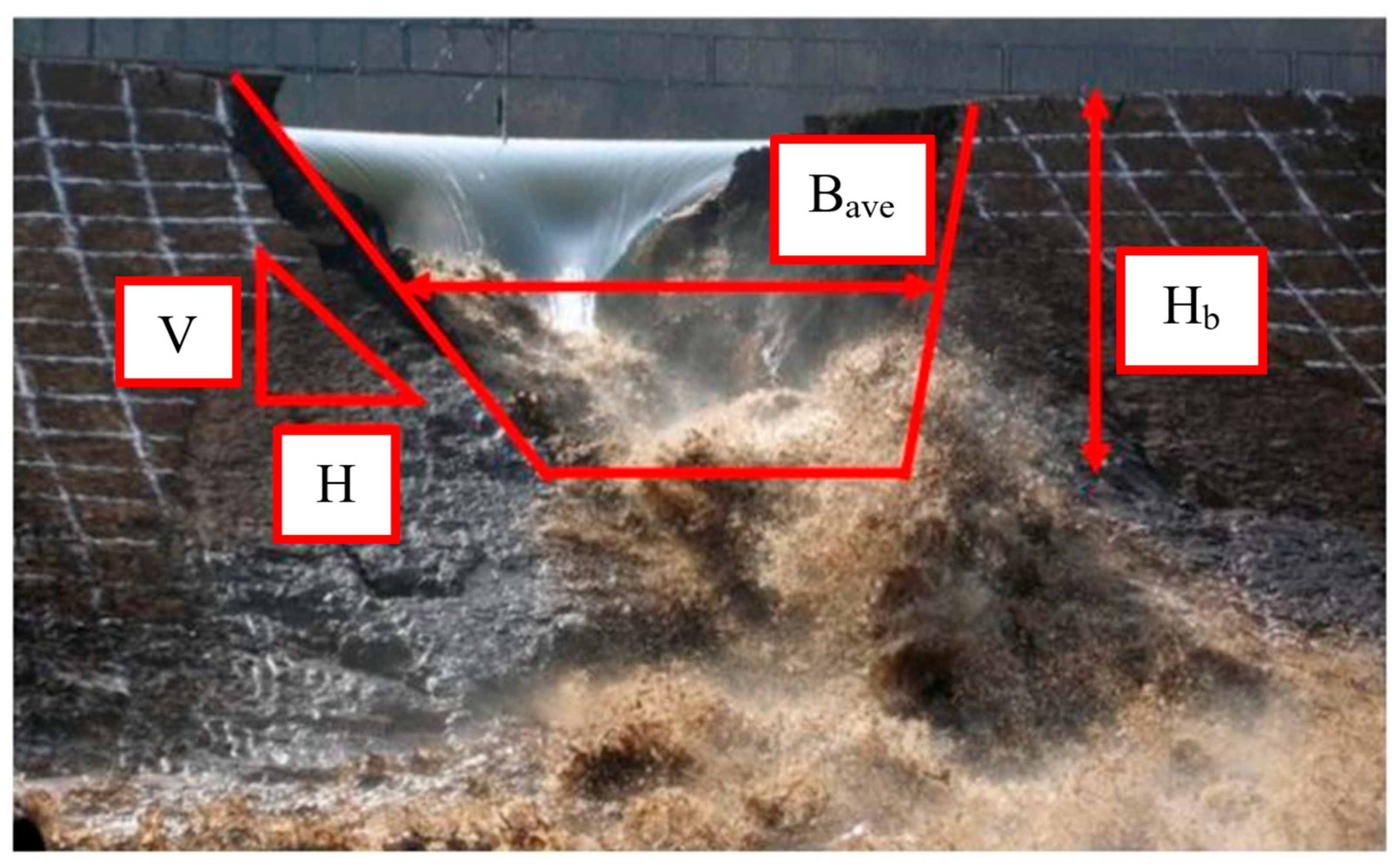
The dam breach configuration includes the shape and location of the dam break, with the breach formation time (tf), which have to be defined to simulate the dam breach floods in hydrodynamic models. The shape of the dam break (Figure 1) is defined using parameters such as breach height (Hb) and average breach width (Bave), along with the breach slope (as a ratio H:1V). The breach height (Hb) is the vertical extent from the top of the dam to the average invert elevation of the breach, as shown in Figure 1. In general, the methods to obtain the dam break configurations for hydraulic modeling are listed as follows: (1) use of dam breach parameters from a similar breached dam, (2) incorporating guidelines from authorities, such as the Federal Energy Regulatory Commission (FERC), that provide upper and lower bounds of breach parameters, (3) using multiple regression-based methods based on a database of past dam breaches, and (4) use of physically based models. However, the guidelines mainly focused on reservoir levels and dam geometry, providing a large range of dam breach parameters. Physically based simulations model the physical breaching process using soil mechanics and erosion equations, which are more related to embankment dam failures due to overtopping and piping. Furthermore, no concrete dams have experienced catastrophic failure due to earthquakes, and these methods are mostly focused on rainfall-induced dam failures. In summary, all these methods are not focused on the probability of occurrence of natural hazards, which guide the risk management mode of a dam. In the literature, only a few studies have modeled earthquake-induced dam failures, and entire dam collapse has been considered, which is linked with huge uncertainty [1,18,19]. Nonetheless, Finite Element Models (FEMs) are widely used in structural engineering to analyze the response of dams to earthquake loading. Therefore, the use of structural analysis of concrete arch dams and CCRDs using FEM predictions to ascertain the failure profiles of dams in this study is more justifiable.
In a seismic event, the failure modes for concrete arch dams can be listed as follows: (1) excessive contraction joint opening combined with cantilever tensile cracking near the dam crest or movements of abutment rock wedges formed by rock discontinuities (Pacoima Dam during the 1971 earthquake), (2) crushing of concrete in the arch direction (concrete spalling), and (3) foundation failure, or in certain cases, sliding along the gently sloped dam–abutment interface [21,22,23,24]. Similarly, the failure modes for CCRDs for a seismic event can be listed as follows: (1) overtopping of the dam crest due to seismic settlements and/or slope movements and (2) excessive leakage and formation of a seepage channel [25,26]. Moreover, the response of dams may vary for a seismic event depending on the dam type [6], dam geometry [27], and the magnitude of the input ground motion [27]. Moreover, Hariri-Ardebili [23] has recommended nonlinear time history analysis using FEMs for large dams to evaluate the seismic response of dams. Thus, outputs of such FEM studies of dams are utilized to derive the dam breach parameters for each type of dam, considering input ground motion using Peak Ground Acceleration (PGA) and dam geometry for quantitative risk analysis of dams in this study. Hence, based on the above discussions, it can be validated that the proposed methodology of utilizing FEM studies is more reliable and appropriate.
Cascade dam failures have been studied by researchers, such as Marche, et al. [28], Dewals, Erpicum, Detrembleur, Archambeau and Pirotton [19], Liu, et al. [29], and Říha, Kotaška and Petrula [5], who mainly examine flood-induced dam failures. In addition, some studies have adopted a statistical approach to define the risk in cascade dams [6,16]. However, these studies have not considered the hydraulic modeling of the dam break phenomenon that encompasses the holistic impact of the scenario, the probability of occurrence, and the associated consequences in a cascade dam system. Therefore, the cascade dam breach phenomenon for an earthquake of the 2475-year return period is analyzed in this study, addressing the triple aspects of the scenario, probability of occurrence, and the associated consequences. Additionally, 2D hydrodynamic models are utilized in the study to compare the flood characteristics due to the greater accuracy with a reasonable computation time due to recent computational advances [30].
Mutual superposition and enhancement effects of multisource flooding can be identified as the significant differences between single and cascade dam breaks [18]. As the flooding dynamics in a cascade dam system are different from individual dam failures, the risk level of each cascade reservoir is recommended to be evaluated [31]. From the literature, the following factors have been identified as more crucial when determining the risk of cascade dam failures for rainfall-induced dam failures: distance between the dams, rate of breaching of upper dam, relative dam height in a successive break, initial reservoir water levels in the synchronous break, characteristics of the floodplain, discharge capacity of lower reservoirs, and time of pre-warning of the dam breach [1,5,18,29]. Although most of these factors are still valid for seismic-induced failure, the rate of breaching of the upper dam will be sudden during a seismic event. On the other hand, few studies have analyzed the significance of a cascade dam system response compared to an individual dam failure in large dams, especially in a seismic event. Therefore, this study presents the comprehensive response of both individual dam failure and the response of the same failed dam for an upstream dam failure subjected to the same seismic response. This quantitative analysis utilized in the study is more suitable for more effective dam safety management, which can also be categorized as a staged approach [32].
Dam breach parameters are critical in assessing the risk of dam failure, which contributes to the epistemic uncertainty of dam breach flood modeling. Some studies have addressed this issue by assessing the sensitivity of individual dam breach parameters through stochastic modeling [33,34]. From these studies, the breach formation time, the final width at the bottom of the breach, and the final elevation of the bottom of the breach are found to be more significant for rainfall-induced dam failures. However, the response of the dam breach parameters needs to be extensively analyzed for seismic response in dams. In addition, limited studies have compared this phenomenon, especially when positioned in a cascade dam system. Therefore, the study investigated the sensitivity of the following dam breach parameters: breach height, breach width, and breach side slopes for seismic-induced dam breach flood modeling. Assessing the sensitivity of a 10% increment and a 10% decrement in breach parameters in the individual dams when positioned as a cascade system for a seismic event is a novel aspect, to the best of the authors’ knowledge.
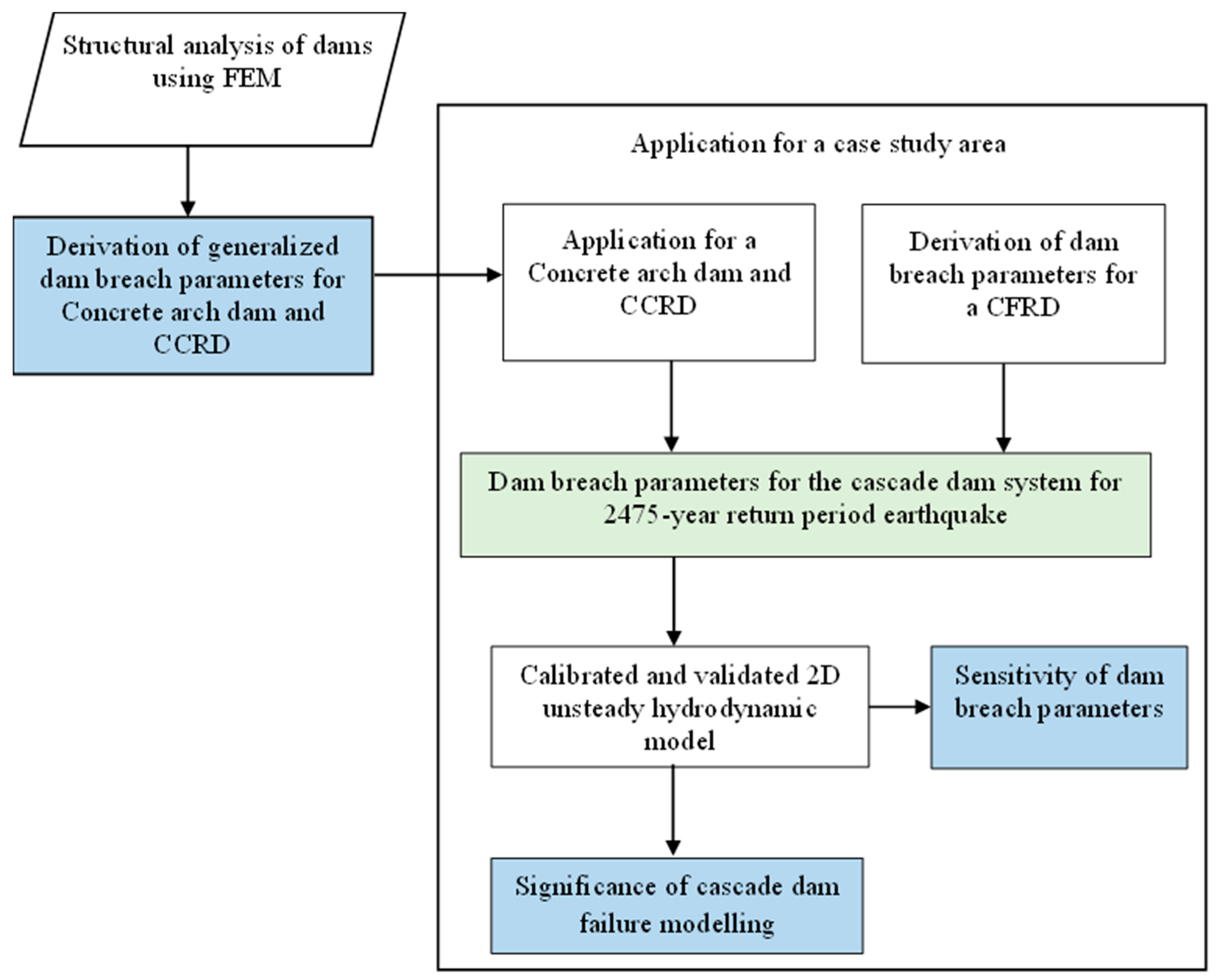
In summary, the conceptual framework of the study is presented in Figure 2. The framework of the study discusses the novel approach to developing generalized dam breach parameters of the concrete arch dam and the CCRD from the FEM analyses. Subsequently, the cascade dam system with the CFRD, the concrete arch dam, and the CCRD are analyzed for the seismic response compared to an individual dam failure and to evaluate the uncertainty of the following dam breach parameters: breach height, width, and slope. Two-dimensional hydrodynamic models are employed in all the simulations, which helps to analyze the risk more effectively. Additionally, the dam break flood characteristics, such as flow discharge and flood travel time, together with the inundation area, which is vital for emergency action plans, are considered in the framework.

2. Methodology

2.1. Study Area with the Cascade Dam System

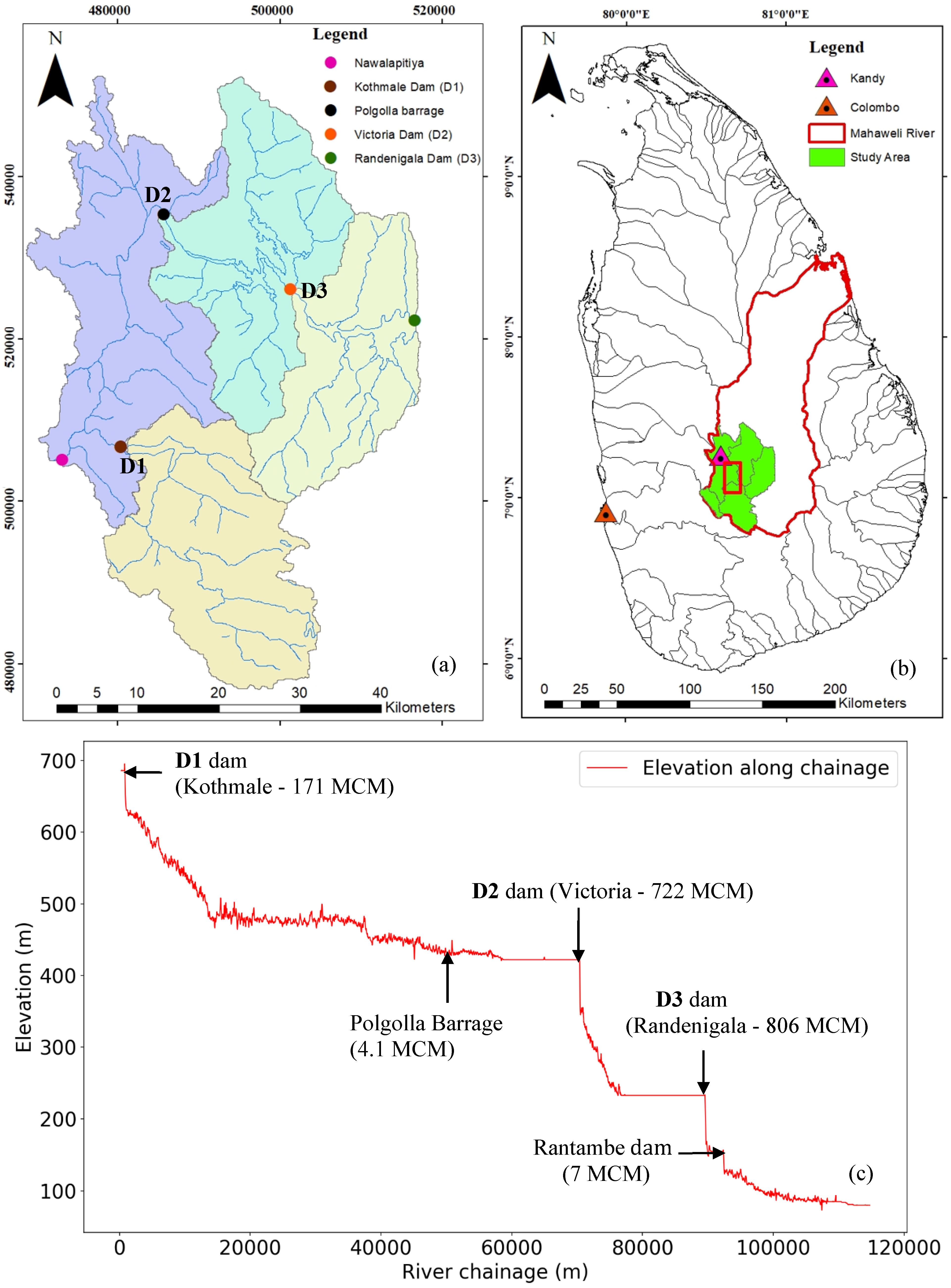
Among the cascade dam systems in the world, the cascade dam system that exists in the Mahaweli River, in Sri Lanka, an island in the South Asian region, was selected for the following reasons. The cascade dam system has four significant dams (Table 1), which comprise different types of dams, CFRDs, concrete arch dam, CCRDs, and concrete gravity that lie at the origin of the Mahaweli River and cover a catchment area of 3200 km2 [35]. Moreover, the cascade dam system exists in the Mahaweli River (Figure 3), which significantly benefits from both the southwest and northeast monsoons [36,37]. Additionally, the cascade dam system is widely known for its significant contribution to storing water for the generation of hydroelectricity and agricultural activities while also providing space for flood control [38]. Furthermore, these dams have different storage capacities (Table 1), which might create catastrophic consequences downstream. In addition, it can be seen that there is a distance of 70 km between the D1 and D2 dams, and there are steep and mild gradients in the terrain profile shown in Figure 3c. However, there is a higher gradient between the D2 and D3 dams, with a distance between them of around 20 km. Hence, the first three dams are analyzed in this study for their prominent storage capacity, dam geometry, dam type, and terrain characteristics (Table 1), which makes the selection of this study area ideal for investigating the consequences.

2.2. Critical PGA

In this study, the selection of the probability of occurrence of an earthquake, is based on the existing design factors and analysis of historical events. According to the International Commission Of Large Dams (ICOLD) guidelines, the design basis earthquake is 475 years, and the safety evaluation earthquake is 10,000 years [39]. Moreover, the National Earthquake Hazard Reduction Program (NEHRP) suggests a 2475-year return period as the earthquake design regulations, and this has also been utilized in the studies of Read and Vogel [40], Horspool, et al. [41], and Du and Padgett [42] to determine the risk from extreme events. Thus, in this study, the 2475-year return period earthquake was selected for model simulations, considering overall design considerations. PGA is used to define the seismic hazard of a dam site. Hence, 0.3 g PGA was considered for a 2475-year return period of an earthquake for the study area, which is also recommended by Seneviratne, et al. [43] and Gamage and Venkatesan [44].

2.3. Derivation of Generalized Dam Breach Parameters for Seismic-Induced Failure

Assigning dam break parameters is crucial in dam break studies. Hence, this study investigates the use of structural analysis outputs from FEMs to determine the failure mechanism of concrete arch dams and CCRDs under seismic loading. The development of the derivation of dam breach parameters for CFRDs from the FEM has been presented in Peramuna, Neluwala, Wijesundara, Venkatesan, De Silva and Dissanayake [17], which demonstrates the potential of FEM analysis in the development of such parameters. Thus, it proves that the understanding of the failure modes of dams for seismic response can be taken from the FEM analysis, which is utilized in the derivation of generalized dam break parameters. Furthermore, by understanding the failure modes through FEMs, it is possible to improve the accuracy of earthquake-induced dam break modeling.

2.3.1. For Concrete Arch Dams

Amunugama [45] has developed a 3D FEM using MiDAS, considering fluid–structure interaction and having fixed boundary conditions at the dam–foundation interface (no-slip condition) for a concrete arch dam. In the study, nonlinear time history analysis has been conducted for 0.1 g PGA, representing a 475-year return period, and 0.3 g PGA, which has a 2475-year return period. The study has shown that for 0.1 g PGA, minor damage (i.e., minor concrete cracking) or no damage could be expected. Furthermore, it has been shown that only the structure above the spillway opening block exceeds the anticipated tensile stress of 2.9 MPa for grade 30 concrete. However, this area incorporates structural steel reinforcements to tolerate these tensile stresses. The same no-damage phenomenon has also been observed for 0.1 g PGA in the structural analysis of a 210 m high concrete arch dam by Wang, et al. [46].
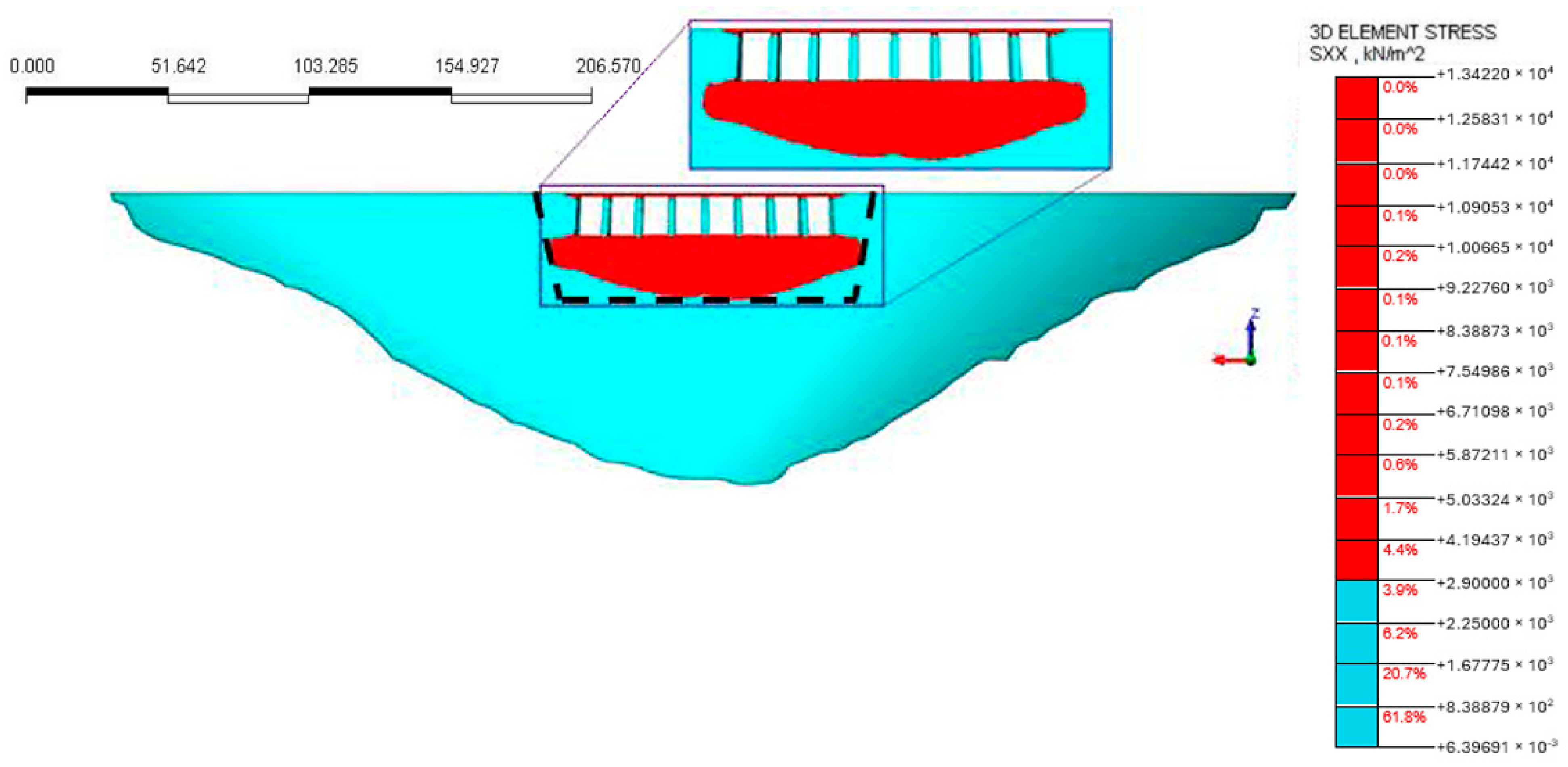
The study of Amunugama [45] has shown that for 0.3 g PGA, the entire spillway area could be damaged, and a threat exists regarding the development and propagation of severe concrete cracking, which leads to a series of damages, including concrete splitting, uncontrolled spilling, and cavitation of concrete, which ultimately leads to a dam breach. The region susceptible to failure is illustrated in Figure 4, which shows high stress around the spillway. High stress can be found from mid-crest to 0.65 H and 0.25 L in the horizontal range.
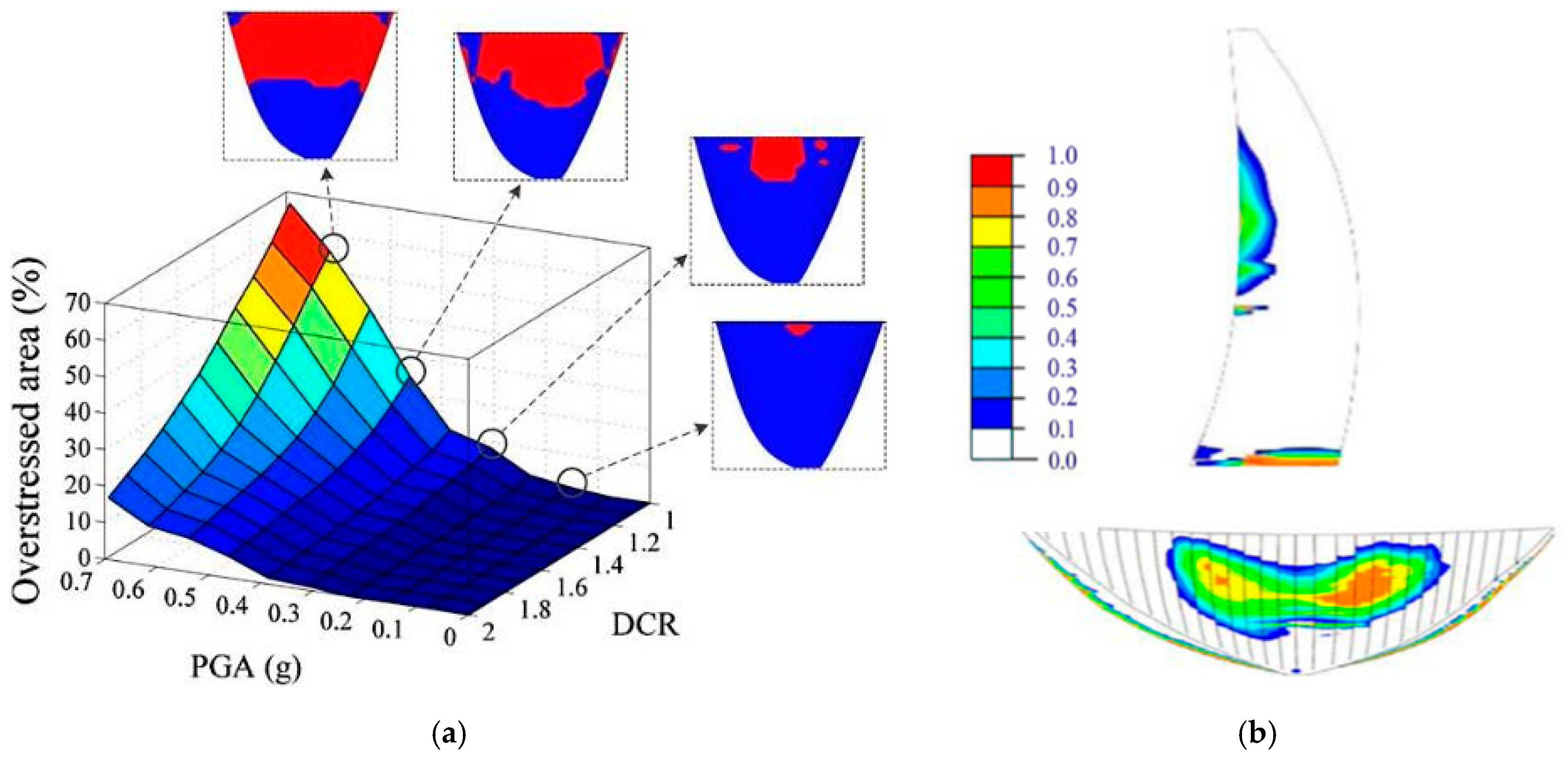
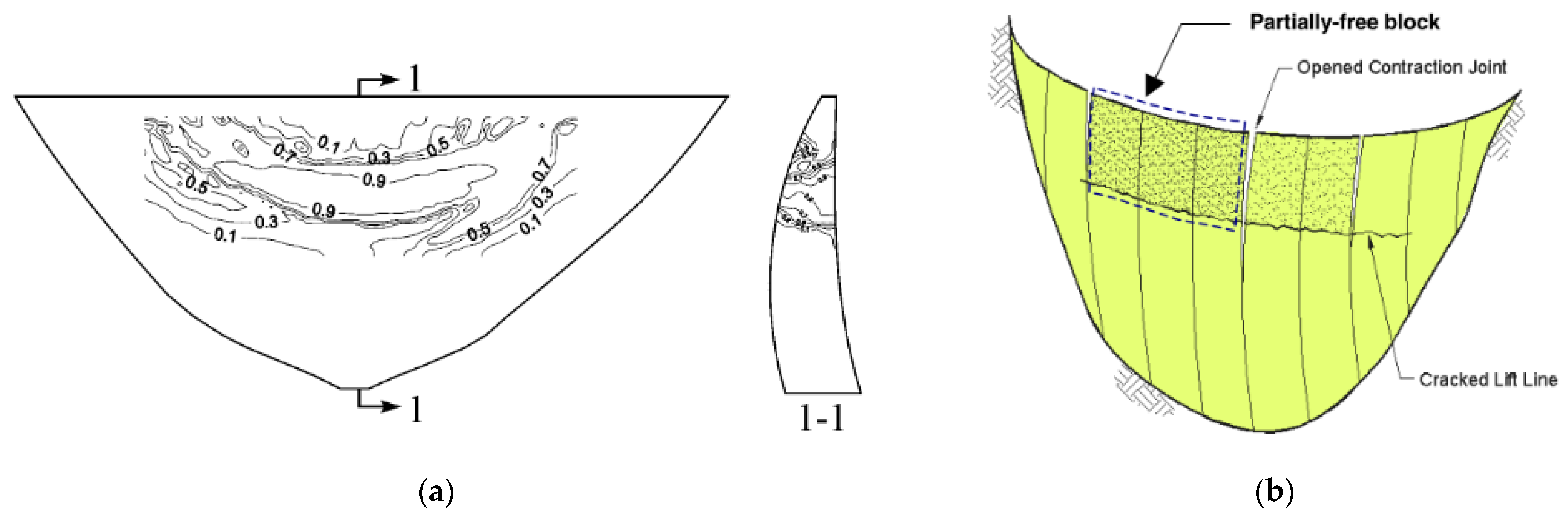
The same failure profile is observed in Hariri-Ardebili and Saouma [47] for 0.3 g PGA, as depicted in Figure 5a. In addition, it shows that the upper portion of the dam is the most overstressed area, and, therefore, that area is more vulnerable to failure in other PGAs as well. Similarly, Wang, Zhang, Jin and Zhang [46] show that the upper portion of the 210 m high arch dam has a higher stress for a PGA of 0.3 g, which is shown in Figure 5b. According to Pan, et al. [48], the most severely damaged region is in the upper portion of the dam, which has a high serious stiffness degradation for 0.56 g PGA, as shown in Figure 6a, which confirms the findings of Hariri-Ardebili and Saouma [47]. In addition, Ghanaat [24] showed that concrete arch dams can fail from the vertical contraction joints opening that releases tensile arch stresses but increases tensile cantilever stresses. It may exceed the tensile strength of the concrete, developing horizontal cracks. Hence, the developed partially free blocks bounded by the opened contraction joints and cracks may become unstable, leading to dam failure, as demonstrated in Figure 6b. In conclusion, the knowledge of the failure regions is utilized to identify the dam breach location and failure surface.

2.3.2. For CCRD

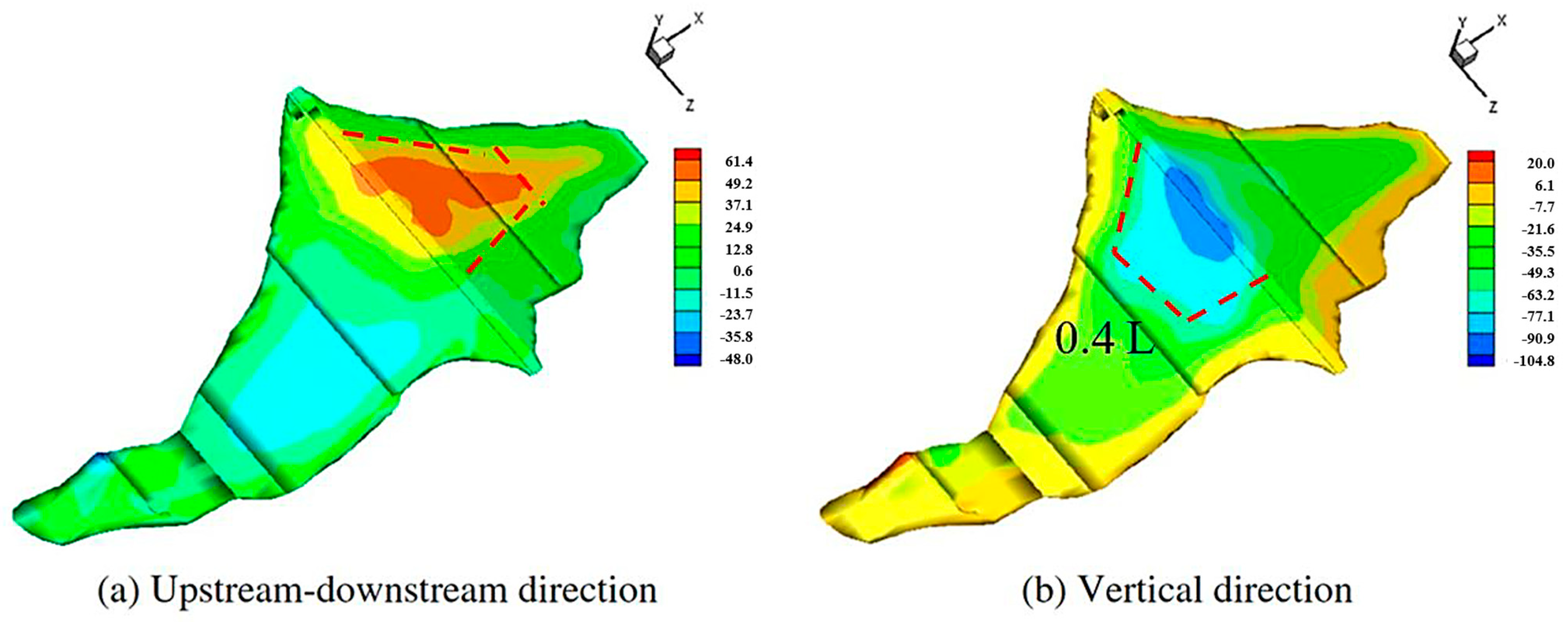
The major failure mechanism for seismic excitations is the formation of cracks and deformation of rockfill embankment [49,50], which leads to the hydraulic fracturing of internal zones in CCRDs. Wei, et al. [51] performed a 3D FEM analysis on a CCRD for 3.2 m/s2 (0.32 g) and presented the distribution of residual deformation after the earthquake (Figure 7). The study has presented that the maximum vertical displacement induced by the earthquake occurs at the middle of the dam crest, approximately 0.33% of the dam height. Furthermore, due to water pressure at the full supply level of the reservoir, the downstream displacement is much higher than the upstream displacement. Thus, the study concluded that moderate damage to the dam could occur due to the seismic subsidence of the CCRD. From the residual deformation pattern of the earthquake, the failure surface for a CCRD can be identified, as shown in the region enclosed by red lines in Figure 7.
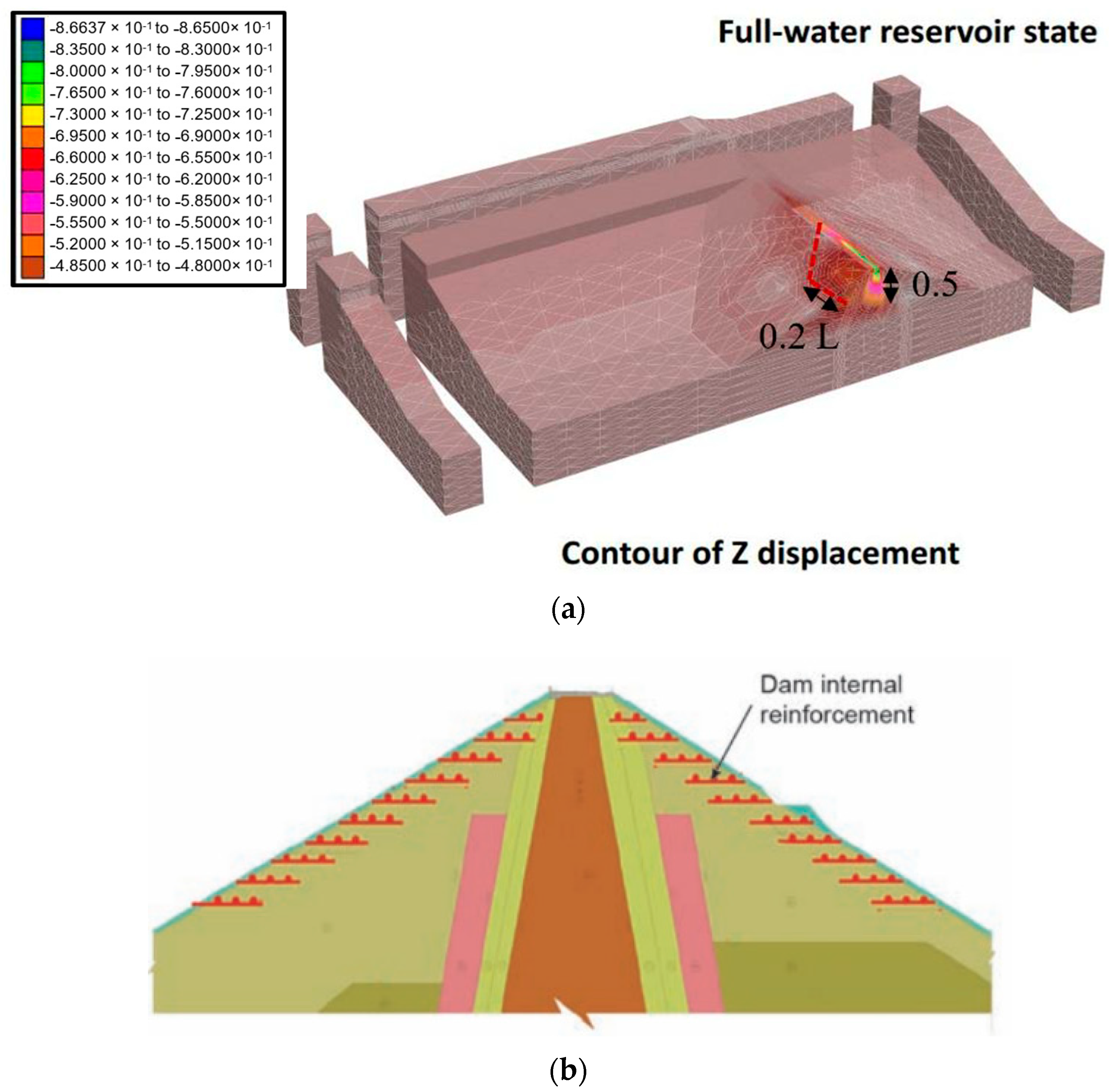
In addition, Sunbul, et al. [52] have developed a 3D FEM model for a CCRD at the full water reservoir state and observed the displacements for a seismic response of 0.4 g PGA. The results presented significant deformation of the CCRD dam (Figure 8a). From the results, the failure surface can be identified as the region enclosed by red lines. Several anti-seismic measures have been utilized in the middle and upper parts of the CCRD dams; for example, in the Nuozhadu CCRD dam, as presented in Figure 8b.

2.4. Two-Dimensional Hydrodynamic Model Development

Flow modeling reproduces free surface flow dynamics and is essential for identifying the flow hydraulics of dam breach floods for emergency action plans [53]. There are two main types: physical and numerical modeling. Physical models are actual structures, while numerical models are physically based, conceptual tools. Numerical models, preferred for convenience, use partial differential equations related to mass and momentum. They can easily be reprogrammed to examine past and hypothetical events. As recommended in the literature, this study employs 2D hydrodynamic models to analyze the impact on the cascade dam system (Figure 2). Given the study area’s steep and mild terrain gradients, 2D simulations are particularly suitable [54]. However, 3D models are limited by the unavailability of data and high computational costs for the large study area.
In this study, 2D hydrodynamic models were developed using the Hydrologic Engineering Center’s River Analysis System (HEC-RAS) for each of the three dams separately to reduce computational time. The HEC-RAS has been widely used in literature for dam break flood modeling [55], which allows 2D unsteady hydraulic flow propagation based on Shallow Water Equations (SWEs). SWEs derived from Navier–Stokes equations are the most recommended approach in modeling dam breach flood propagation [56]. This study employed the full dynamic wave equation to reproduce the dynamics of dam break flows accurately [53]. The approach of utilizing full dynamic wave equations is consistent with recommendations due to the ability to model highly dynamic and varying flow regimes with greater accuracy [57,58,59]. In this study, reservoir drawdown was modeled using the dynamic routing method, which uses the St. Venant equations that conserve mass and momentum [60]. Furthermore, the dynamic routing method is recommended whenever reservoir bathymetry is available compared to level pool routing in the literature [61].
Terrain, which defines the surface elevation in the models, is highly influential in model accuracy. Hence, a high-resolution Digital Elevation Model (DEM) was created utilizing both high- and low-resolution datasets, like LiDAR, local DEM, SRTM, reservoir bathymetry, and surveyed river cross-sections [62]. The developed DEM was analyzed with other low-resolution global datasets and was found to be accurate [62]. Similarly, following the same methodology, DEMs were developed for D2 and D3 catchment basins using MERIT, local DEM, and reservoir bathymetry.
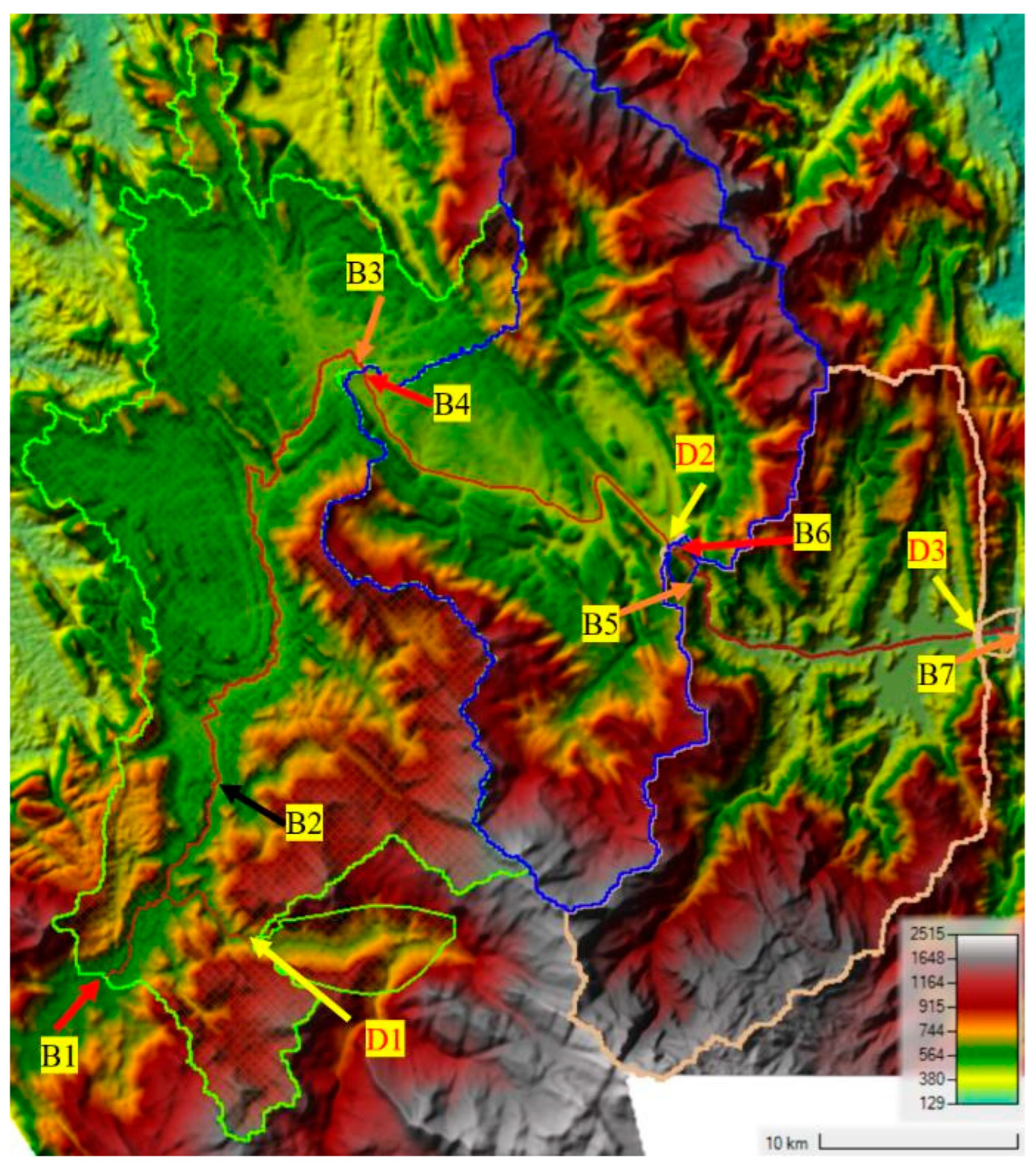
The D1 study area is enclosed in green (Figure 9), in which the reservoir and downstream of the D1 dam were modeled as separate 2D areas connected with the D1 dam connection. The main water path (and/or the river profile) is represented by the red line in Figure 9. In the 2D model for the D1 study area, the most upstream boundary condition (B1) was set at Nawalapitiya, with an average inflow of 40 m3/s based on observed data. The dam break flow is generated from the derived dam breach parameters for the D1 dam during an earthquake. Furthermore, an inflow of 105 m3/s discharged from the Kothmale powerplant (B2) was also included. The downstream boundary condition (B3) was located close to the Polgolla barrage, where outflow was determined using the normal depth. Friction slope equivalent to the slope of the channel was input as the normal depth. In the 2D model for the D2 catchment area bound by blue (Figure 9), the upstream boundary condition is at the Polgolla barrage (B4), and the downstream boundary is placed 5 km after the D2 dam (B5), which defines outflow using normal depth. Similarly, in the 2D model for the D3 catchment area represented by beige (Figure 9), the upstream boundary condition (B6) is just after the D2 dam, and the downstream boundary (B7) is placed 5 km after the D3 dam that defines outflow using normal depth.
The Eulerian–Lagrangian Shallow Water Equation solver (SWE-ELM) was employed for the simulations in the study, which is recommended to model different flow regimes in flash floods [53,60]. Moreover, the optimum mesh sizes for the three study areas were derived from sensitivity analysis. The optimum mesh sizes for the D1, D2, and D3 study areas are 200 m, 55 m, and 50 m, respectively. The 10 m unstructured mesh was utilized around the river profile and in the reservoir. The time step was 5 s to simulate the dam break flood dynamics, and the simulations were extended for a total duration of two days.
Model calibration and validation of input parameters were conducted for past flood data from 2021 and 2022, as calibration for hypothetical dam breaks is impractical. The roughness coefficients, which represent the obstruction to flow, were calibrated in the study. The roughness coefficient was spatially varied according to the land cover type and was derived from Chow [63] and Coon [64]. The calibrated roughness coefficients were 0.15 for forests, 0.04 for water bodies, 0.035 for agricultural lands, 0.03 for bare lands, and 0.04 for residential areas, reflecting the dominant land covers in the study regions.

2.5. Modeling the Seismic-Induced Dam Breaks

As the modeling scenarios, the individual dam failures in a seismic event were first modeled in all three dams for the 2475-year return period earthquake. Next, individual dam failures in downstream dams combined with the upstream dam breach flow that occurred due to seismic-induced dam failure were modeled. After that, the dam breach parameters were varied between a 10% increment and a 10% decrement in each dam consecutively to assess the sensitivity of dam breach parameters in a cascade dam failure. That means the first dam breach parameters of the D1 dam were analyzed for a 10% increment and decrement. Subsequently, the D2 dam breach parameters were changed between a 10% increment and a 10% decrement by keeping the original dam breach parameters of the D1 dam. Here, the upstream dam breach flow from the D1 dam was utilized as input boundary conditions to the downstream dams. Similarly, the sensitivity of dam breach parameters in the D3 dam was assessed by having the original dam breach parameters in upstream dams. In all the simulations, the sunny day scenario was adopted along with the assumption of full reservoir capacity of each dam. Bottom outlet gates and spillway gates are opened once the reservoir reaches its full capacity during normal dam operations. However, it was assumed in the study that due to the earthquake, the functionality of the bottom gates and spillways is lost.
Accurate prediction of flood characteristics such as flow discharge, flood extent, and flood arrival time is crucial for effective emergency action plans [65]. Flood arrival time is particularly critical given the rapid and uncontrolled nature of the dam break floods, and, particularly, in a cascade dam failure. As shown in Ge, et al. [66], the dam breach flood arrival time determines the time for safe evacuation of the inhabitants. Especially, in cascade dam failure, the flood arrival time is important, as consecutive flood peaks can occur at the same location. On the other hand, flood extent, representing the area potentially covered by water, is also essential in estimating flood risk. In summary, flood arrival time, total flow, and peak flow discharge were used as flood characteristics to indicate the difference between cascade and individual dam failures. Particularly, the sensitivity of dam breach parameters was discussed using flood arrival time, time series of flow discharge, peak flow discharge, and total flow in this study.

3. Results and Discussion

As identified to be one of the major contributors to the economy of the country [37], cascade dam breach simulations due to a seismic response have been performed to evaluate potential consequences. Three main findings of the study are presented under the following sections: (1) generalized dam breach parameters for concrete arch dams and CCRDs, (2) consequences of a cascade dam failure due to a seismic response, and (3) sensitivity of dam breach parameters in a cascade dam system.

3.1. Generalized Dam Break Parameters

3.1.1. For Concrete Arch Dams

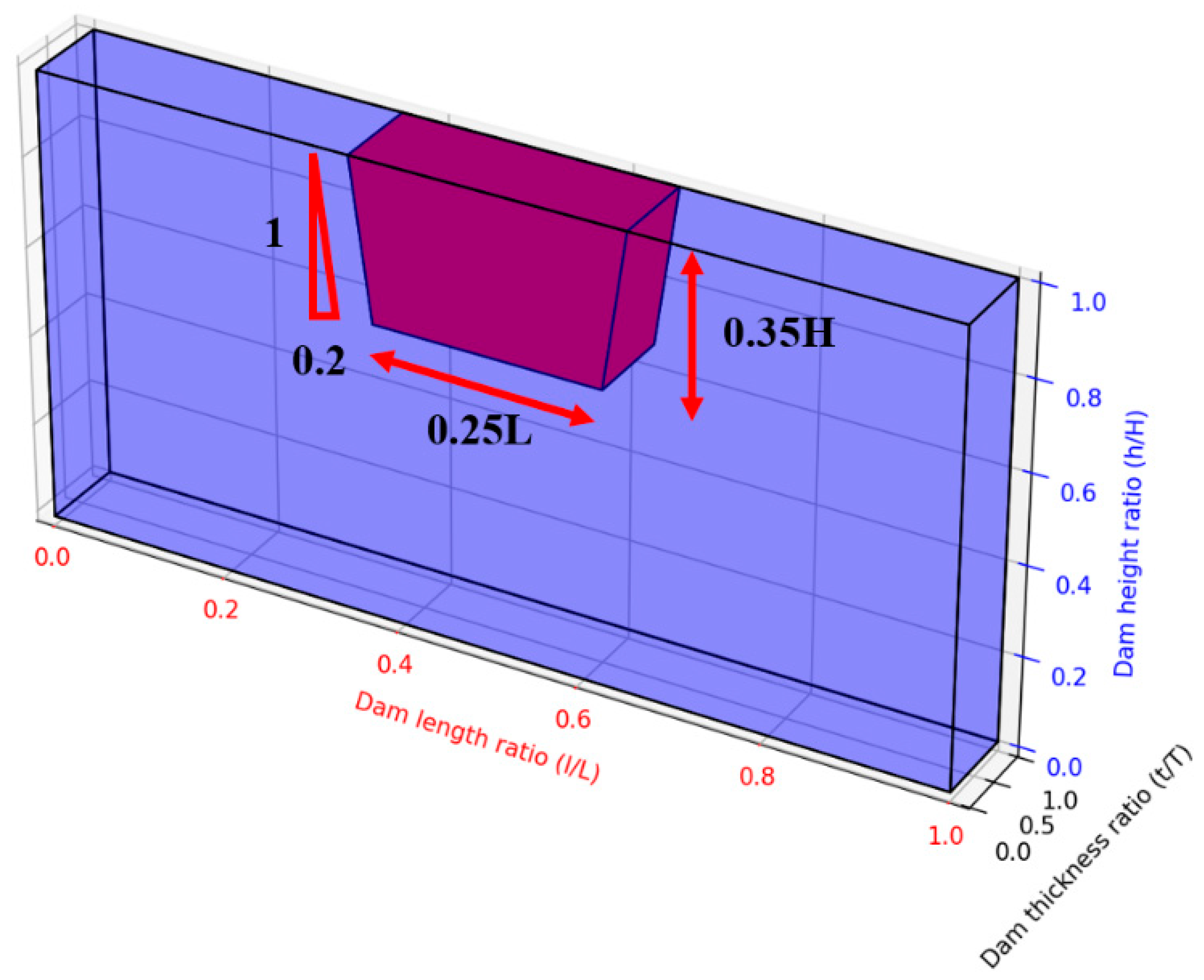
Based on the above discussions, the generalized dam breach configuration for a concrete arch dam subjected to a 0.3 g PGA can be attained, as shown in Figure 10. In the generalized dam breach parameters for concrete arch dams, the bottom dam breach width (Bave) is estimated to be 0.25 times the dam crest length, while the dam breach height (Hb) is 0.35 times the dam height extending from the middle of the dam. In addition, the dam breach slope is 0.2:1 (H:V). Given the brevity of earthquake events (typically less than one minute), the failure time of a concrete arch dam due to an earthquake can be considered instantaneous.

3.1.2. For CCRDs

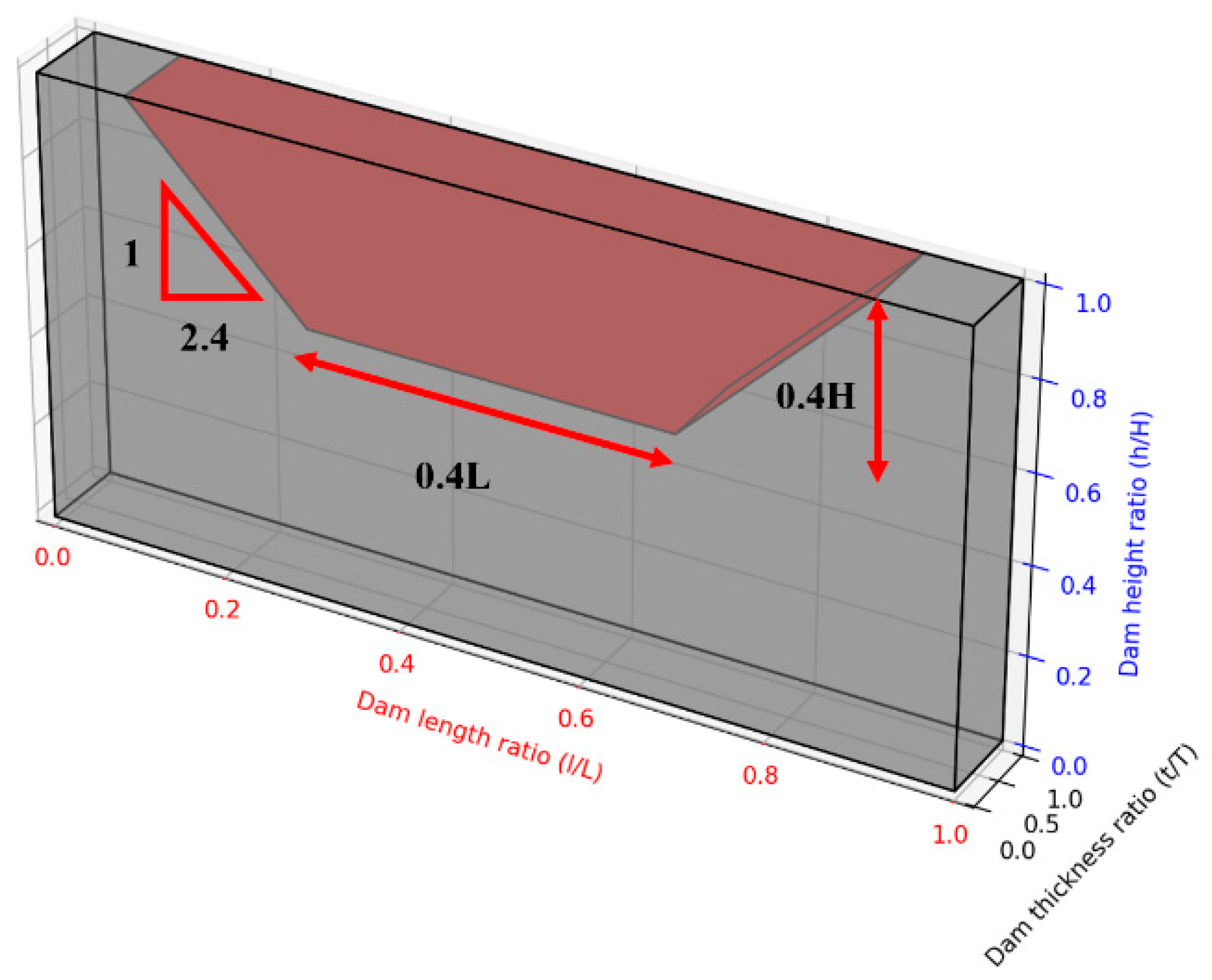
Analysis of the FEM results yields a generalized dam breach configuration for a CCRD dam subjected to a 0.3 g PGA seismic excitation, which is depicted in Figure 11. The bottom dam breach width (Bave) is estimated as 0.4 times the dam crest length, while the dam breach height (Hb) is 0.4 times the dam height extending from the middle for a 2475-year return period. The dam breach slope is 2.4:1 (H:V), and similar to other dam types, the failure time for a CCRD can occur within a minute due to the earthquake loading.

3.2. Derivation of Dam Breach Parameters for the Case Study Dams

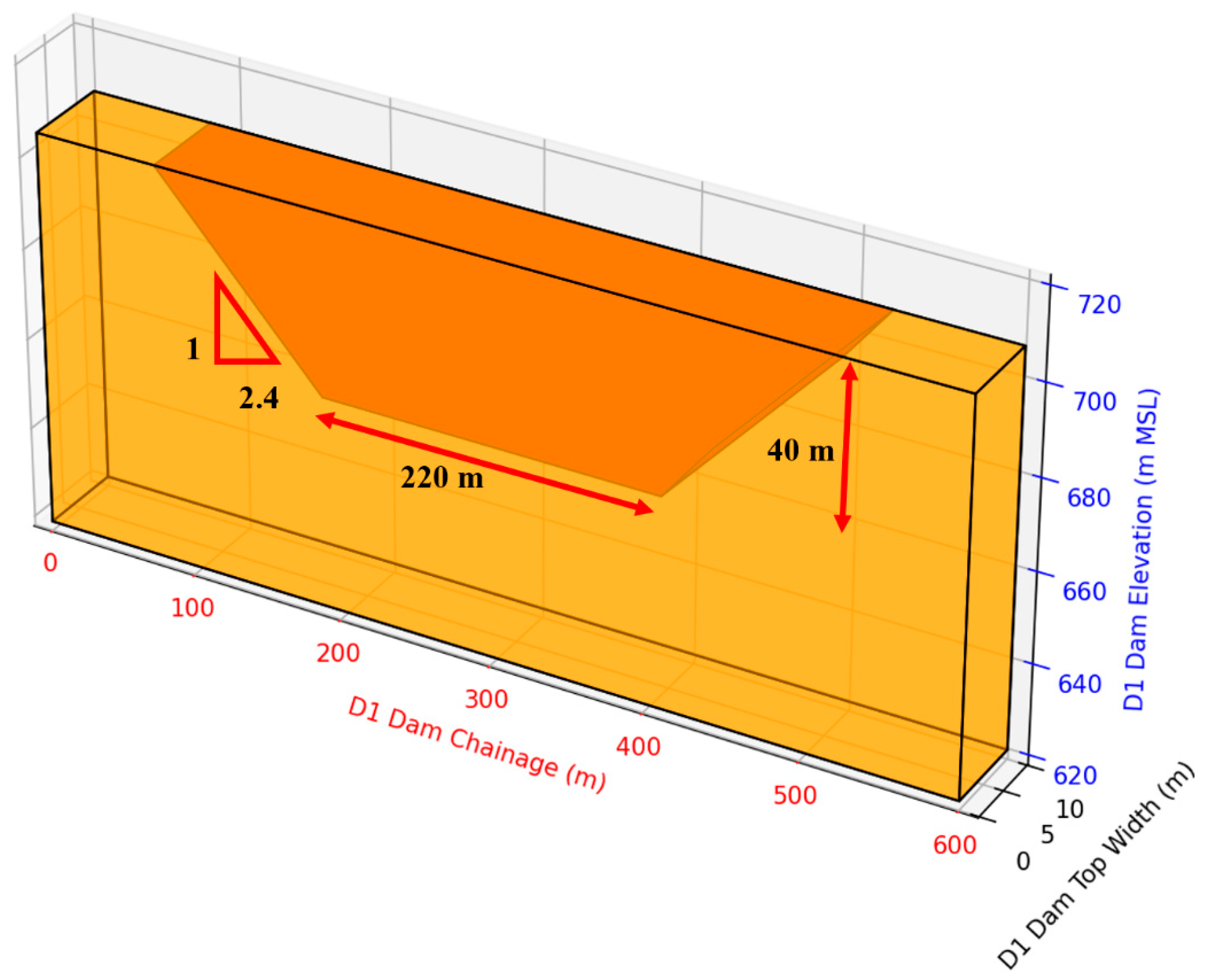
In this section, the derived generalized dam breach parameters are applied to the case study area to define the exact dam breach parameters in a seismic event in the cascade dam system. Peramuna, Neluwala, Wijesundara, Venkatesan, De Silva and Dissanayake [17] have proposed the generalized dam breach parameters for the CFRD dam for 0.3 g PGA, and as D1 is a CFRD dam, based on the geometry, the dam breach parameters are derived, as depicted in Figure 12. In a seismic-induced dam failure, the dam breach formation time can be considered to be significantly smaller. Therefore, the breach formation time of all the dams was taken as 10 s.
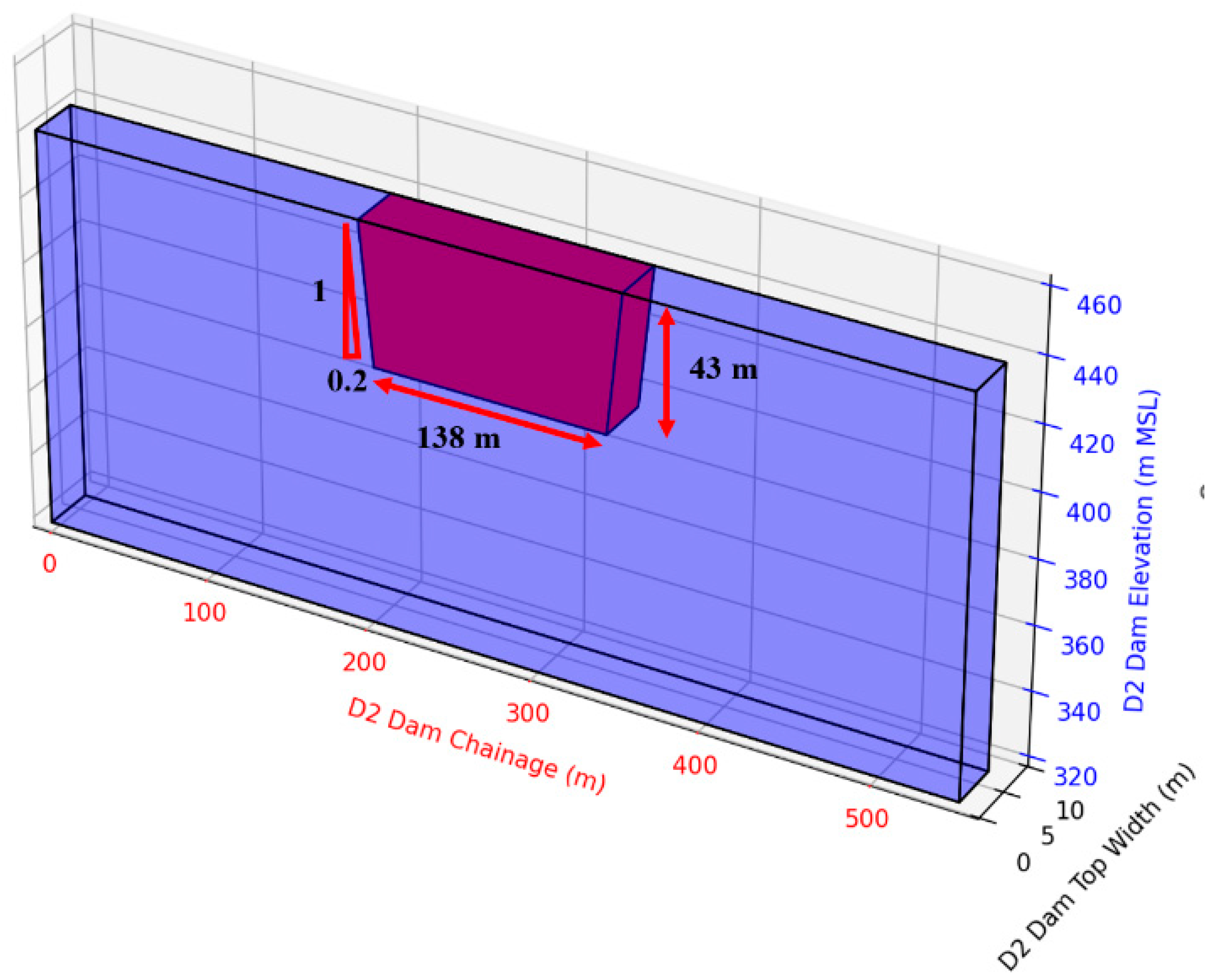
The second dam in the cascade dam system (D2) is a concrete arch dam, which is the highest dam in the cascade dam system. The dam breach parameters derived for the D2 dam for 0.3 g PGA from the generalized dam breach parameters are depicted in Figure 13. An evaluation of the derived dam breach parameters and the existing guidelines of agencies is depicted in Table 2, although the probabilistic occurrence of natural hazards is not specified. The average breach width is overestimated in all the agency guidelines, considering the entire or complete dam failures. The slope of the breach is considered to be the valley wall slope, and the formation time of failure is relatively small in all the guidelines. It is noteworthy that the breach height has not been specified in these guidelines. This study demonstrates that complete dam failure is unlikely for a 2475-year return period earthquake. Additionally, the derived dam breach parameters from the FEM analysis offer more concise values compared to the broad ranges provided by guidelines, validating the applicability to probabilistic earthquake scenarios.
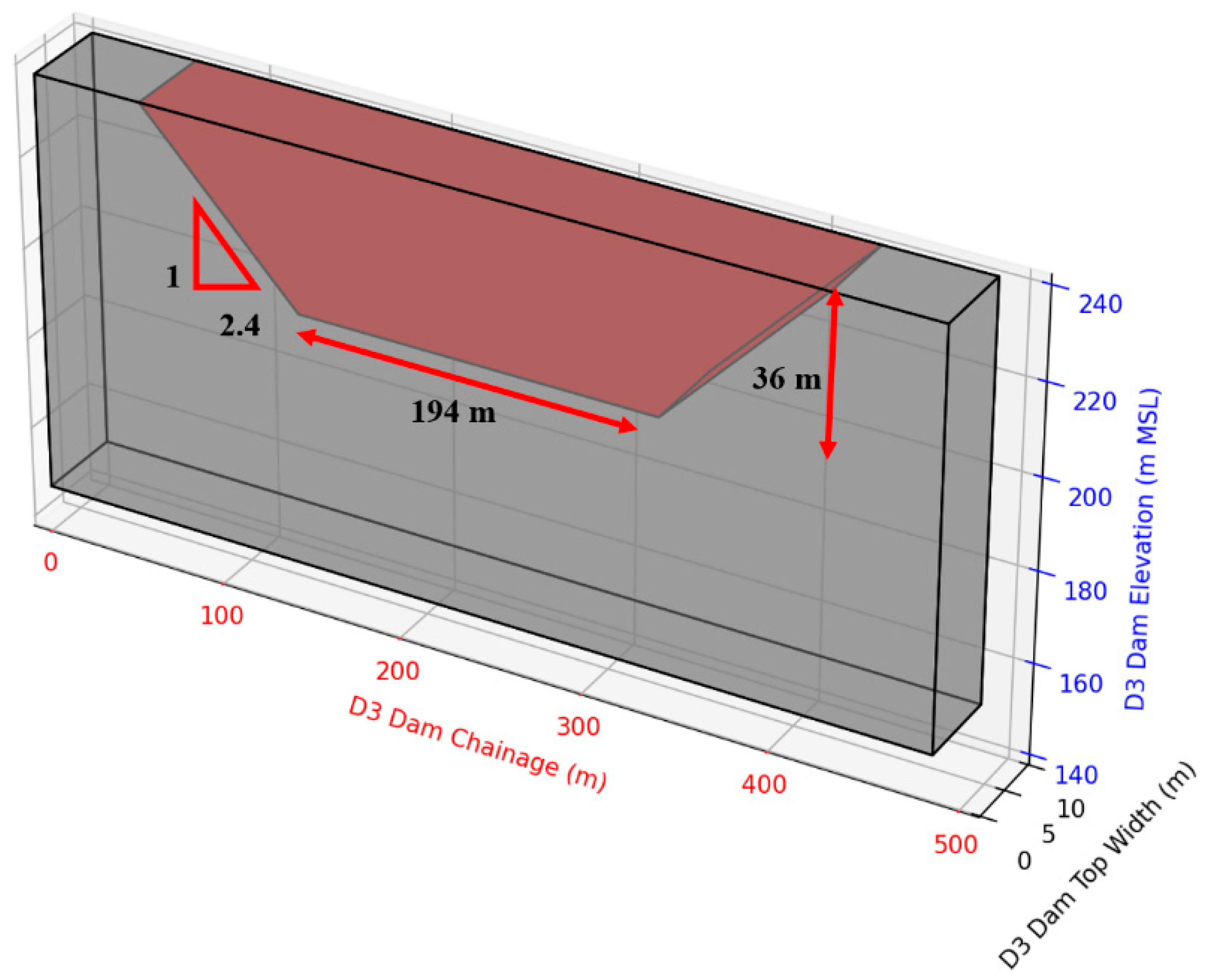
The D3 dam is a clay core rockfill dam with the highest storage capacity in the cascade dam system, and it is the third dam in the cascade dam system. The dam breach parameters derived for the D3 dam for 0.3 g PGA from the generalized dam breach parameters are depicted in Figure 14. To refine the understanding of the derived dam breach parameters of CCRDs with the existing guidelines of agencies, a comparison was made, as shown in Table 3. It is clear that the average breach width was in the range specified by the agency guidelines. Contrastingly, both the slope of the breach and the formation time of failure deviated from the range specified. On the other hand, breach height has not been specified in these guidelines. Nevertheless, the derivation of dam breach parameters from FEM analysis has offered more precise and probabilistic estimates for CCRDs compared to the broad ranges provided by the guidelines. Hence, this proves that the methodology adopted in the study to derive dam breach parameters, which are especially connected with the probabilistic occurrence of earthquakes, is more reliable and appropriate. To further refine the understanding of the dam breach parameters on dam break flood modeling, a sensitivity analysis was conducted, as presented in this paper.

3.3. Modeling of Seismic-Induced Failure of a Cascade Dam System

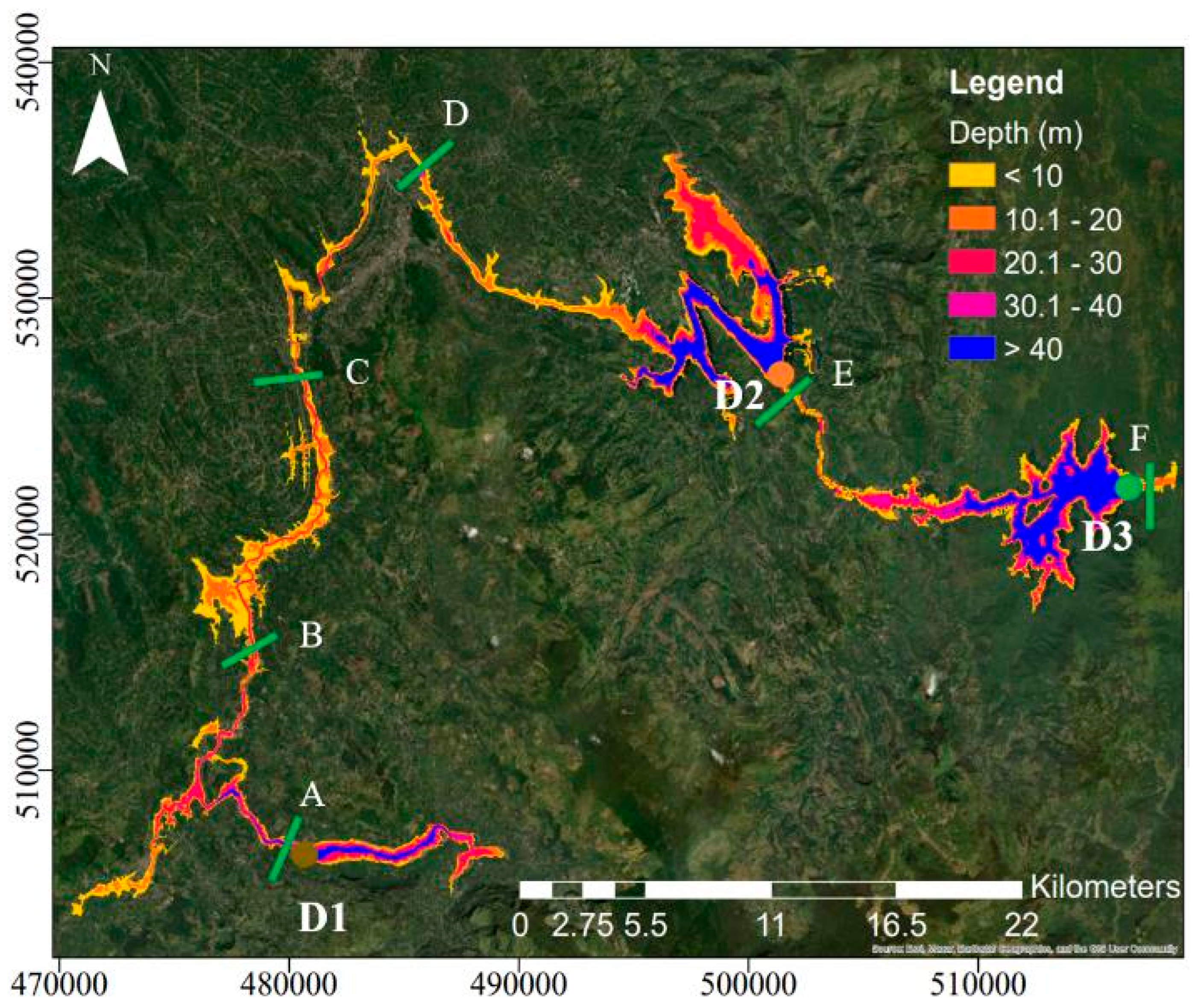
The derived dam breach parameters for dams in Section 3.2 were utilized in 2D hydrodynamic models to model the dam breach in the cascade dam system. The scenario of all three dams being exposed to a 2475-year return period seismic event was simulated, and the maximum inundation depth obtained from the numerical model is shown in Figure 15.
From Figure 15, it is clear that downstream of the D1 dam is severely impacted, and the floodplain area has been inundated along the river. Moreover, the flood depth around the vicinity of the D1 dam is around 40 m, and it has decreased along the path when it reaches D, which is 46 km away from the D1 dam. There is no considerable floodplain inundation from D until the reservoir of D2, and similarly, there is no considerable floodplain inundation downstream of the D2 dam. The reason is that D marks the upstream of the reservoir of D2, and due to the topographic features of the area, the upstream flood flow has not propagated to the floodplain. Furthermore, due to the simultaneous failure of dams, the capacity of the D2 reservoir might have considerably increased the capacity to contain the upstream flood flow, as the water inside D2 has already flown out of the reservoir. Similarly, due to the shorter distance between the D2 and D3 reservoirs and the occurrence of simultaneous failure along with the topographic features of the area, significant floodplain propagation cannot be seen. However, the flood depth downstream of the D2 and D3 dams is around 25–35 m.
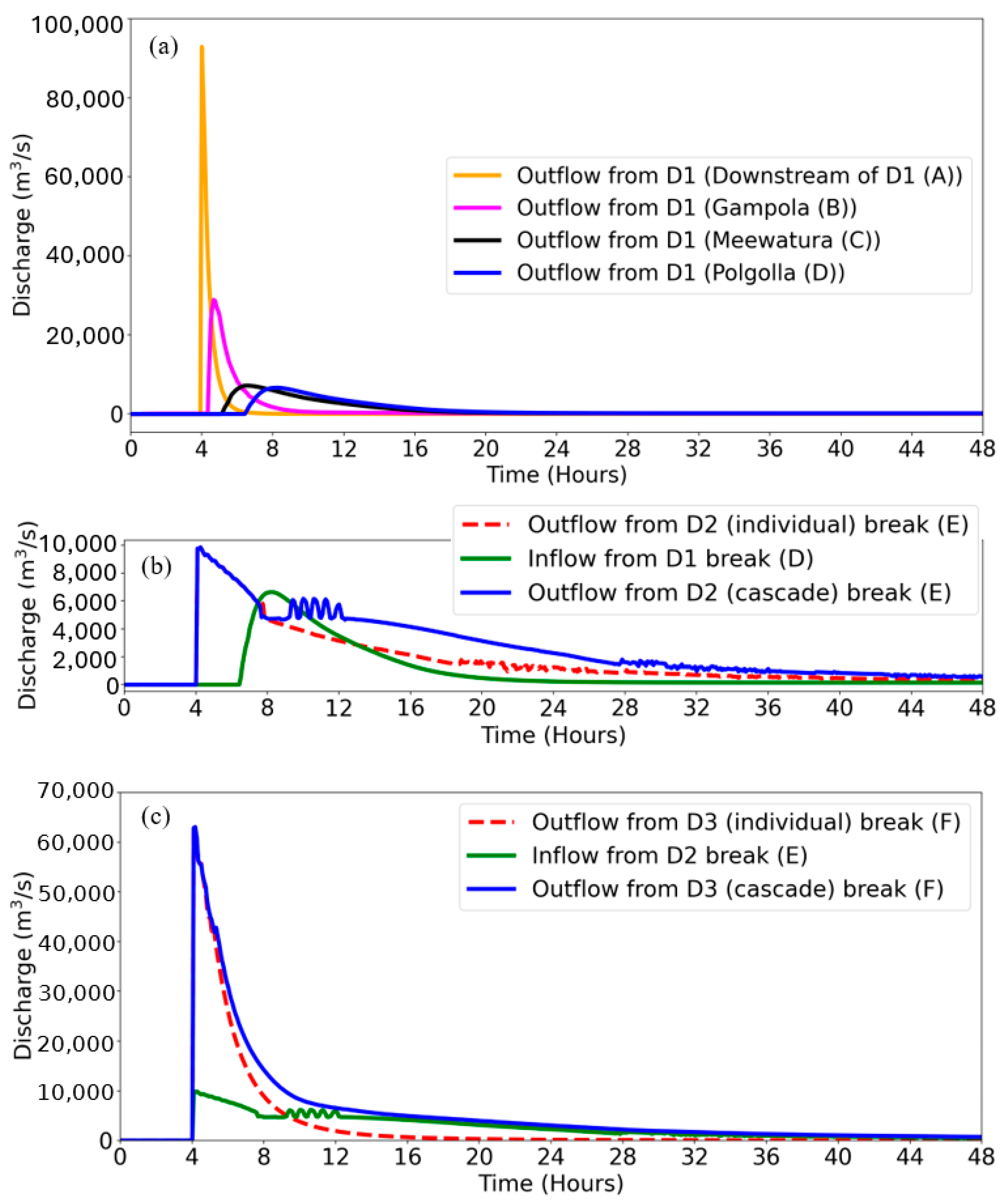
Further analysis of the flood behaviors can be identified from the flow discharge of the dams, as shown in Figure 16. The D1 dam (CFRD), which is the most upstream dam, has a reservoir with 171 MCM capacity, and the peak discharge due to seismic-induced dam failure is nearly 95,000 m3/s (Figure 16a). Over 46 km, the flood peak has attenuated close to 6500 m3/s, which is 7% of the initial dam breach peak flow. This result implies that dam-to-dam spacing is more significant in attenuating the flood peak of the upstream dam breach.
The comparison between the individual dam failures and cascade dam failures is presented in Figure 16b for the D2 dam (concrete arch) using the flow hydrograph (Figure 16b. D2, being a concrete arch dam, has a smaller dam breach size than the D1 (CFRD) dam, which is derived from the generalized dam breach parameters. Also, the D2 reservoir has a higher storage capacity than the D1 reservoir. Therefore, the dam breach peak flow from the seismic-induced failure is around 9500 m3/s, which shows that the dam breach geometry is more significant. Nevertheless, it denotes a high deviation of flow discharge in an individual dam breach compared with the cascade dam breach for the same dam. Moreover, an excess total discharge of 137 MCM was discharged in a cascade dam failure compared to the individual dam failure. The inflow from the upstream dam breach at the entrance to the D2 reservoir is 163 MCM, implying that 15% of the inflow from the upstream flow is contained inside the D2 reservoir. Thus, it is observed that there is an outflow of 85% of the upstream dam breach flow that is discharged at the D2 dam. That means there are two consecutive waterfronts within a 5 h time interval, greater than 6000 m3/s, leaving from the D2 dam due to seismic-induced cascade dam failure. Furthermore, a fluctuation of discharge can be observed in the cascade dam failure hydrograph (blue line in Figure 16b), which is probably due to the discharge of inflow from the upstream dam (D1) breach. This fluctuation can be interpreted as the incoming wave from the upstream dam (D1) breach flow entering the D2 reservoir with high energy, diffracted a couple of times by the D2 dam, and finally settling in the D2 reservoir. In summary, it can be shown that due to the partial failure of the concrete arch dam during a 2475-year seismic event, a second large flood wave is discharged after 5 h of seismic-induced concrete arch dam breach flood in the cascade dam system. These findings prove that even though the storage capacity of the D2 dam is higher, it is essential to evaluate the response of the intermediate dam for a seismic event in a cascade dam system, which is significant.
Furthermore, the comparison between the individual and cascade dam failures is presented in Figure 16c for the D3 using the flow hydrograph. The peak discharge due to the seismic event is around 55,000 m3/s, which is higher than the D2 dam. It denotes a high deviation of flow discharge in an individual dam breach compared with the cascade dam breach for the same dam. Moreover, an excess total discharge of 412 MCM was discharged in a cascade dam failure compared to the individual dam failure. The inflow from the upstream dam breach is 435 MCM, implying that only 5% of the inflow from the upstream flow is attenuated and stored in the second reservoir. Furthermore, it can be seen that there is no significant fluctuation of discharge in the cascade dam failure hydrograph (blue line in Figure 16c), as shown in Figure 16b, and there is only one major waterfront. That implies that the effect of the upstream dam breach flood is superimposed on the seismic-induced dam breach flood flow of D3. This might be due to the shorter distance between D2 and D3 dams and the geometry of the partial dam breach in D3. It has allowed 95% of the inflow to the reservoir from the upstream two dam breaches to leave the dam, even though it has the highest capacity in the cascade dam system. This phenomenon shows that dam-to-dam spacing is more significant than the storage capacity in a seismic-induced cascade dam failure.
From the model predictions, it is clear that studying cascade dam failures in a specific region is significant for a seismic event that will lead to such a cascade dam failure. In addition, it was found that dam-to-dam spacing and dam breach geometry are more significant in a cascade dam failure due to a seismic event, which will govern whether the dam breach outflow is enhanced, or multiple wavefronts are generated.

3.4. Sensitivity of Dam Breach Parameters in a Cascade Dam Failure

The dam breach geometry is shown to be significant in a cascade dam system for seismic-induced failure in this study in Section 3.3. Therefore, the effect of a 10% increment and 10% decrement in dam breach geometry, including dam breach slope, width, and height, is further investigated to analyze the sensitivity in each dam in a cascade dam system.

3.4.1. For the CFRD (D1) in the Cascade Dam System

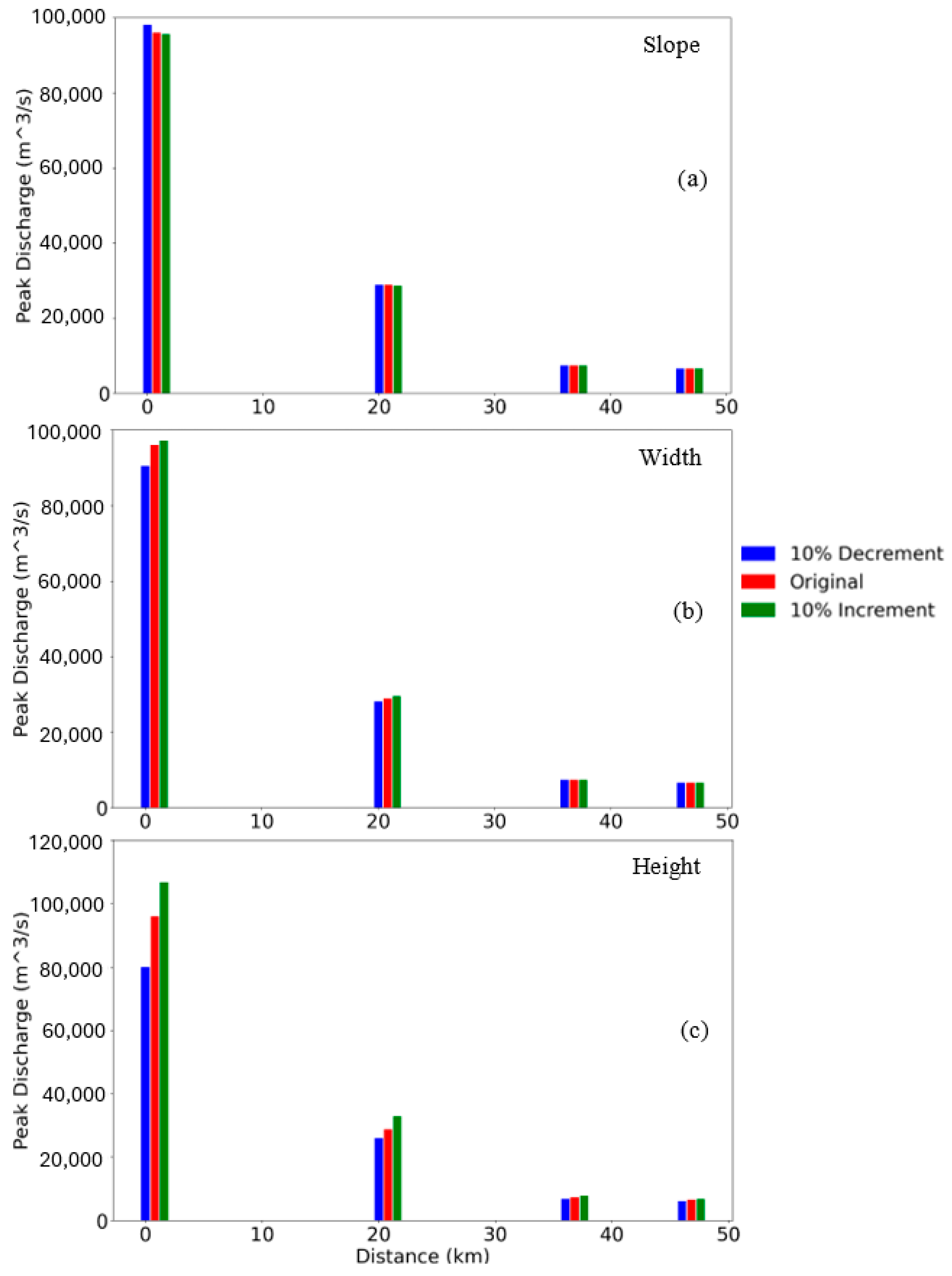
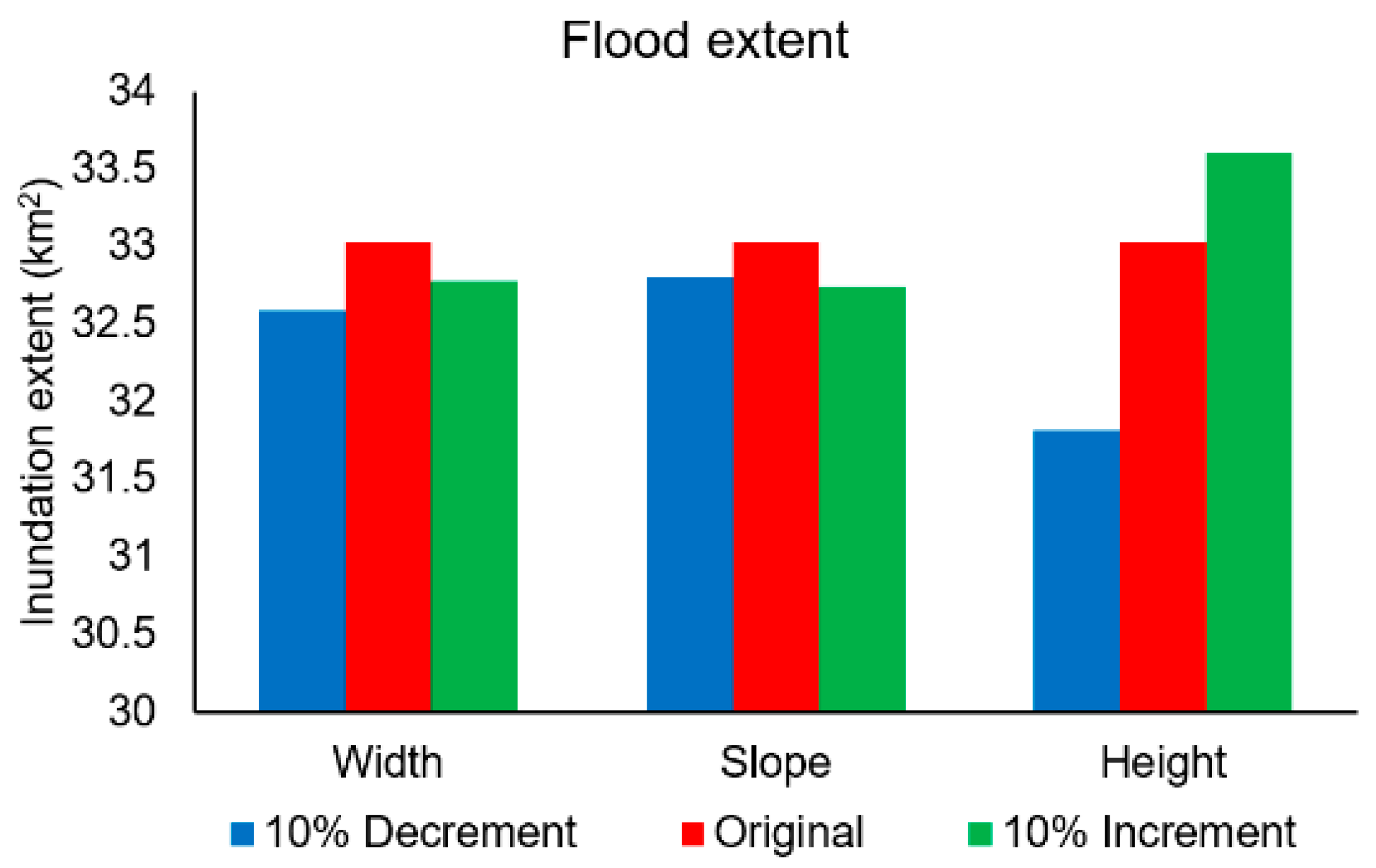
The model predictions due to variation of dam breach slope, width, and height in the CFRD dam (D1) in an earthquake-induced failure are presented in Figure 17. As the dam spacing is higher between D1 and D2, the results can be employed to identify the sensitivity of each dam breach parameter along the flood flow path. The variation of peak discharge for the original value, 10% increment and 10% decrement in slope (Figure 17a) and width (Figure 17b), is shown to be negligible in D1. However, for the dam breach height, there is a deviation of 11% and 16% in 10% increments and 10% decrements, respectively, with the original near the dam breach location (Figure 17c). During a 20 km distance, the deviation gets reduced to 10% in both cases when compared with the original value. When the dam breach flood wave propagates 46 km downstream, the deviation in both scenarios gets reduced to 5%. On the other hand, it was observed that flood arrival time remained unaffected by variations in all three parameters. Nevertheless, the flood extent responded significantly to the variation of breach height compared to the width and slope of the breach (Figure 18). A 10% decrease in breach height has reduced the inundation extent by 4%. Thus, it can be concluded that height is more significant than the slope and width of the breach, and the significance of the variation of height gets reduced along the distance that flood flow propagates in earthquake-induced dam failures.

3.4.2. For the Concrete Arch (D2) in the Cascade Dam System

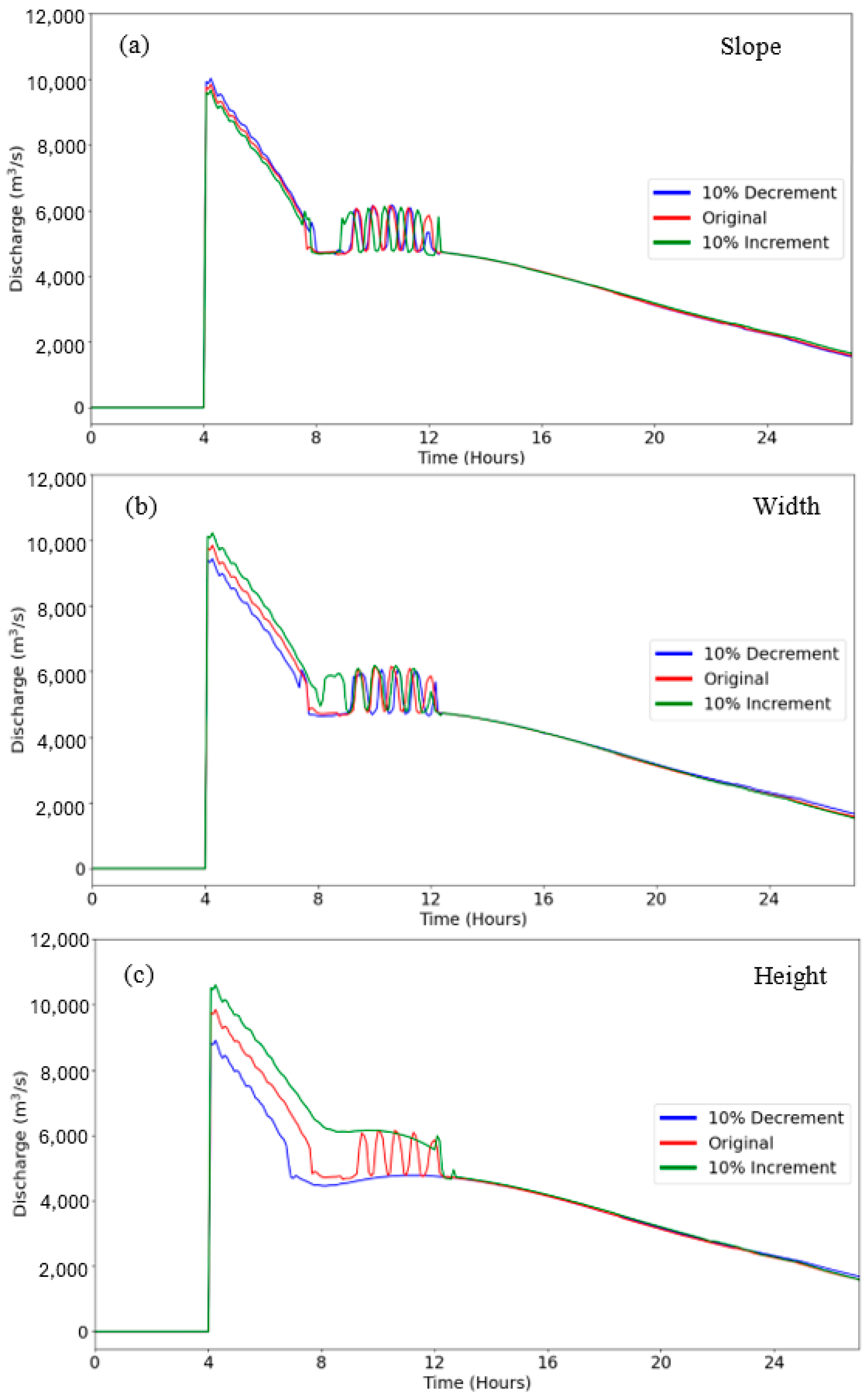
The sensitivity of the breach slope, width, and height of the concrete arch dam (D2) for the seismic-induced dam failure was analyzed with the incoming wave from the upstream dam (D1) breach flood flow to evaluate the significance in a cascade dam failure. When the flow hydrographs were compared, it was found that breach height is more significant than the other two parameters (Figure 19) for a seismic-induced dam failure. Furthermore, it was found that the response of the variation of parameters of the D2 dam to the incoming wave from the upstream dam (D1) breach is significant. For example, the fluctuation of the peak discharge is absent in both the 10% increment and 10% decrement of height, whereas there is a fluctuation in the original value. The reason is that when the dam breach height is higher, there is enough space for the flood wave to pass through easily. When the dam breach height is lower, the incoming wave is blocked from spilling and contained in the reservoir. Similarly, the 10% increment of slope and width has allowed the incoming wave to pass through more quickly than in other scenarios. Thus, it can be concluded that dam breach height is more significant than the slope and width of the breach in a cascade dam failure and for a seismic-induced dam failure.
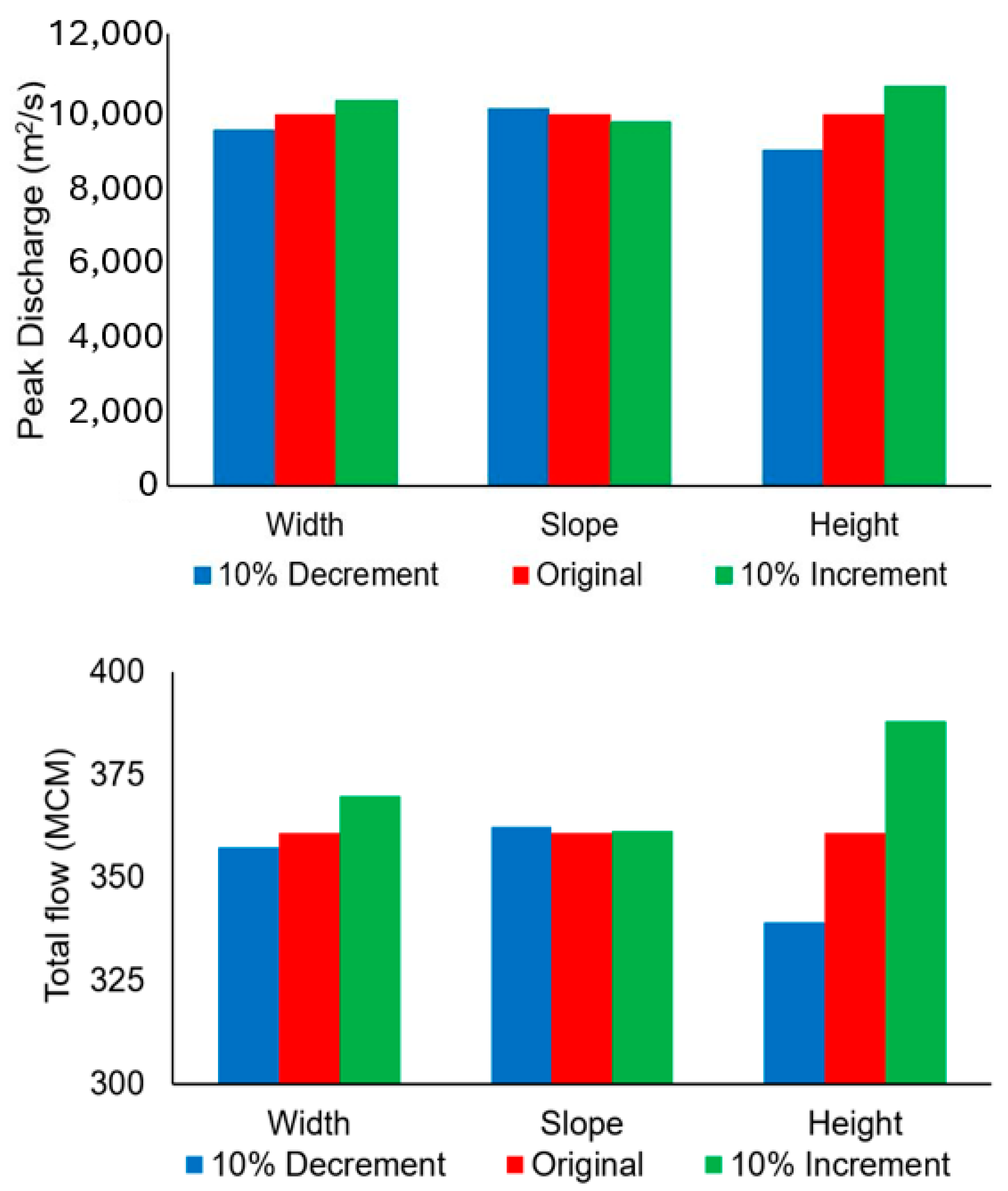
The deviation of peak discharge and total flow was analyzed, and similarly, breach height was found to be more sensitive than the other two parameters (Figure 20). The variation of peak discharge for a 10% increment and 10% decrement in height was 10% and 8%, respectively. For slope and width, the deviation was 2% and 4% in both variations. Similarly, the variation of total flow for a 10% increment and 10% decrement in height was 8% and 7%, respectively. The 10% variation of slope in peak discharge shows that with a 10% decrement, it has increased the peak discharge slightly, and for the 10% decrement, it has decreased the peak discharge slightly. However, the total flow is almost the same, and there is no high significance compared to other parameters. Width is a moderate dam breach parameter that shows a deviation of 4% for the 10% increments and decrements in both observations. Furthermore, it can be concluded that breach height is significant for seismic-induced concrete arch dam failure.

3.4.3. Dam Failure of the Final Dam in the Cascade Dam System

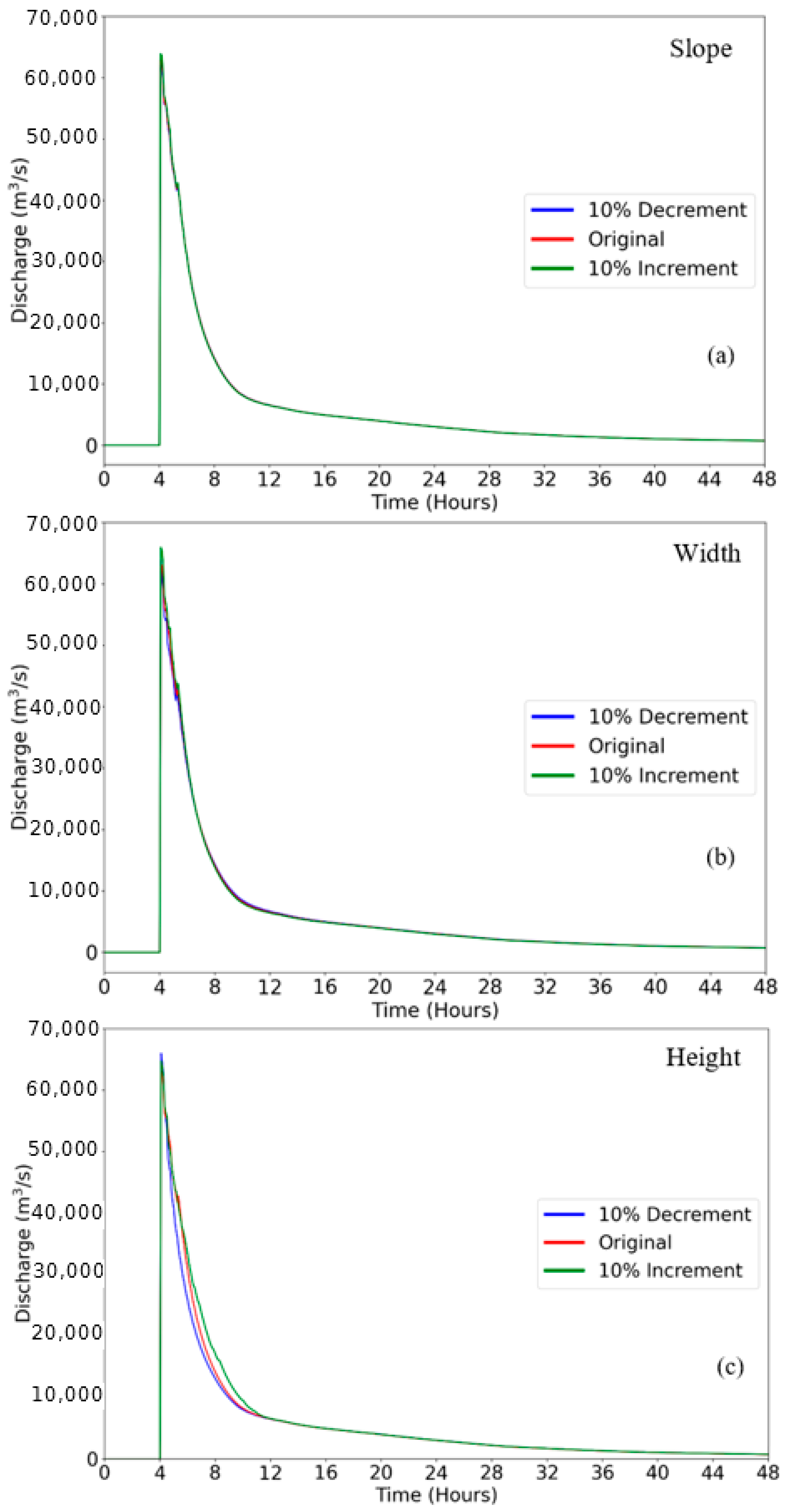
The sensitivity of the breach slope, width, and height for the flood characteristics for the D3 dam in the cascade dam system, which is a CCRD due to an earthquake, was evaluated. Here, the performance of the partially failed CCRD (D3) was analyzed when the two upstream dams (D1 and D2) breached, with flood flow reaching the dam in all scenarios.
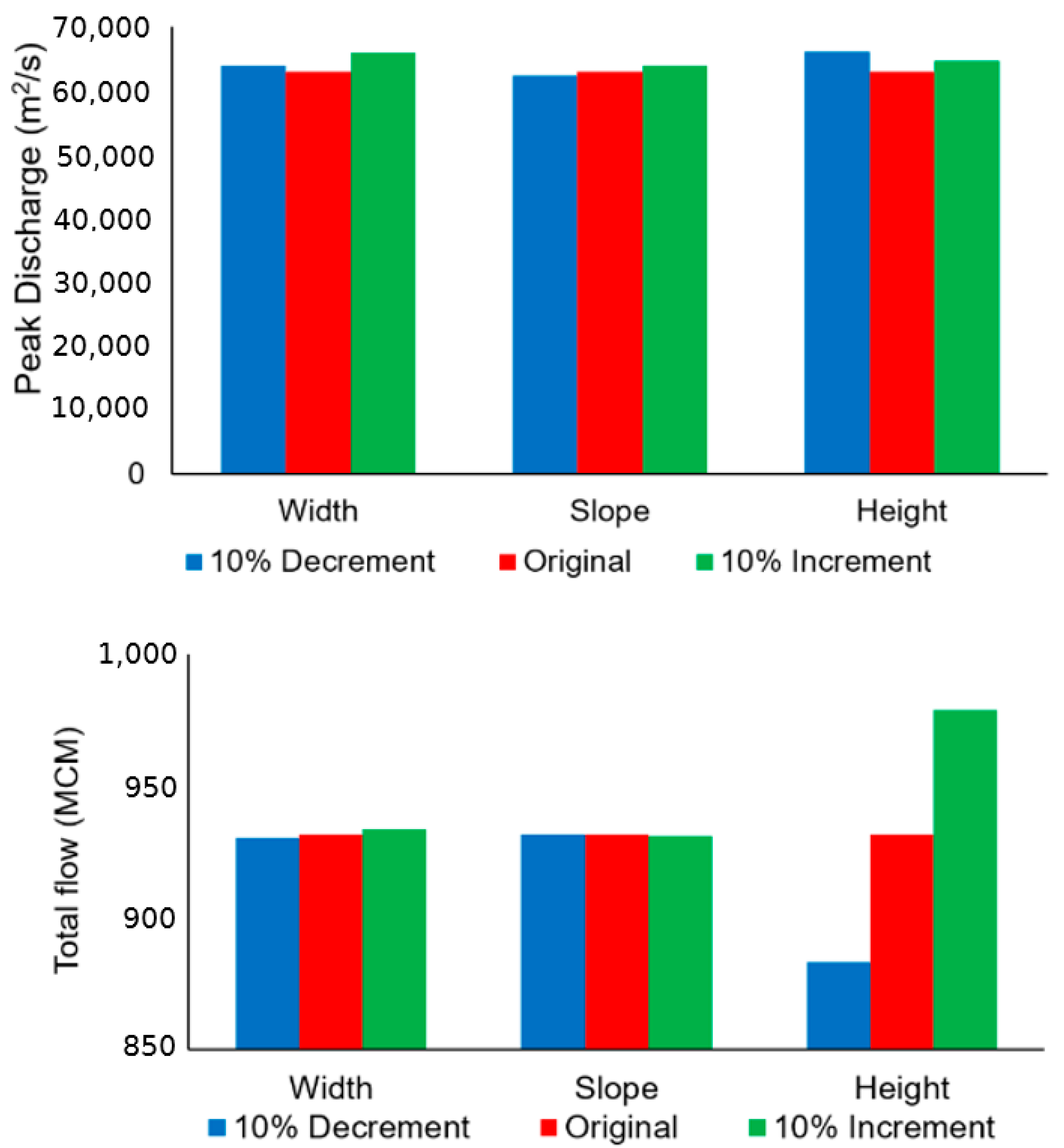
As the dam spacing of the D2 and D3 dams is lower, the dam breach flow has been enhanced, as discussed previously. When the dam breach parameters are varied, the effect on the individual dam failure cannot be seen; rather, the combined effect of cascade dam failure can be observed. When the flow hydrographs were compared, it was found that the breach width was moderately significant while the dam breach slope was less significant (Figure 21). The variation of peak discharge for the variation in slope is around 1.2% and there is no change in the total flow. Furthermore, the response of width for the peak discharge is 5% and 1.3% in 10% increments and 10% decrements, respectively. In addition, the variation of total flow for the variation of width is 1.5 MCM for both the increment and decrement. The dam breach geometry, particularly breach height, has responded significantly to the effect of the incoming wave from the two upstream dam breaches (Figure 21). When there is a 10% increment in height, the peak flow discharge has reached 64,750 m3/s, and in a 10% decrement of height, the peak flow discharge has reached 66,030 m3/s (Figure 22). The reason might be that when the dam breach height is higher, there is enough space for the flood wave to pass through easily. When the dam breach height is lower, the incoming wave is blocked, but due to the momentum of the incoming wave, the peak flow increases by 5%. The total flow variation in both the 10% increment and 10% decrement of height is the same (5%), implying that the dam breach height controls the total flow discharge (Figure 22). Therefore, the dam breach height is more significant than the other parameters.

4. Conclusions

The study explored the application of FEM analysis for the seismic response of earthquakes to derive generalized dam breach parameters and assessed the performance of these parameters in a cascade dam failure. Based on the results, the following conclusions can be drawn.
  • The results indicate that the use of structural outputs from the FEM for the generation of dam breach parameters is a novel and effective approach that can be employed in hydrodynamic models to model earthquake-induced dam breach failures.
  • The generalized dam breach parameters vary depending on the dam type for the same PGA. The failure surface of the concrete arch dam is smaller compared to CFRDs and CCRDs. Therefore, the presence of a concrete arch dam in a cascade dam system would improve the overall performance during an earthquake event.
  • There is a significant difference in the flood characteristics in a cascade dam failure and individual dam failure. Therefore, it is recommended to simulate cascade dam failure when the conditions are met rather than considering one individual dam failure for disaster mitigation strategies.
  • Dam breach height can be considered a more significant parameter for earthquake-induced dam failures in the CFRD, concrete arch, and CCRD when the reservoirs are at full capacity. There has been a 10–30% deviation of peak discharge in all the dams for a 10% increment of breach height.
  • Breach width can be identified as a moderately significant parameter, and the dam breach slope is less significant for earthquake-induced dam failure modeling.
  • The most sensitive dam breach parameter is the dam breach height, and it gets reduced between the distance of 20 km and 40 km. The most sensitivity dam breach parameter is the dam breach height and it gets reduced between the distance of 20 km and 40 km. Hence, it can be seen that the sensitivity of dam breach parameters is reduced with the distance traveled by the dam breach flow.
  • When cascade dam failures are investigated, the inflow from upstream dam failure will be discharged depending on the dam breach geometry and dam-to-dam spacing.
  • In the latter dams of the cascade dam system, if the dam-to-dam spacing is lower, even though the dam breach height and width are increased or decreased, the peak discharge will be increased to allow the incoming upstream dam breach wave to pass.
  • In the latter dams of the cascade dam system, if the dam-to-dam spacing is lower, the total flow discharged will be varied by 5% for a variation of 10% in dam breach height.
  • The sensitivity analysis shows the significance of the critical dam breach parameters, such as height and width, that need to be controlled for the safe operation and design of dams.

Limitations

Potential impacts of seismic-induced phenomena, such as debris creation, accumulation, and transport, along with alterations to roughness coefficients, were considered negligible in the study. Future studies on assessing these phenomena are recommended.

Author Contributions

P.D.P.O.P.: Conceptualization, Formal analysis, Investigation, Writing—original draft, Writing—review & editing, Validation, Visualization. S.V.: Conceptualization, Writing—review & editing, Supervision. N.G.P.B.N.: Conceptualization, Writing—review & editing, Supervision. K.K.W.: Conceptualization, Writing—review & editing, Supervision. S.D.S.: Conceptualization, Writing—review & editing, Supervision. All authors have read and agreed to the published version of the manuscript.

Funding

The first author acknowledges the funding received from RMIT University, Australia and University of Perdeniya, Sri Lanka as Phd Scholarship.

Data Availability Statement

Data will be made available along with the PhD thesis publication of the first author.

Acknowledgments

The authors express sincere gratitude to RMIT University, Australia, for provision of computational resources. The U.S. Army Corps of Engineers is greatly acknowledged for freely distributing the HEC-RAS v6.3 software. The support from the Mahaweli Authority of Sri Lanka and the Irrigation Department of Sri Lanka for data collection is greatly acknowledged.

Conflicts of Interest

The authors declare no conflict of interest.

References

  1. Cao, Z.; Huang, W.; Pender, G.; Liu, X. Even more destructive: Cascade dam break floods. J. Flood Risk Manag. 2014, 7, 357–373. [Google Scholar] [CrossRef]
  2. Tosun, H.; Tosun, T.V.; Hariri-Ardebili, M.A. Total risk and seismic hazard analysis of large embankment dams: Case study of Northwest Anatolia, Turkey. Life Cycle Reliab. Saf. Eng. 2020, 9, 329–338. [Google Scholar] [CrossRef]
  3. Pradel, D.; Lobbestael, A.; Brooks, C.N.; Dobson, R.; Marion, N.; Oommen, T.; Esser, A.J.; Athanasopoulos-Zekkos, A.; Zekkos, D.; Clark, M. The May 19, 2020, Failure of Edenville Dam near Midland, Michigan. In Geo-Extreme 2021; American Society of Civil Engineers: Reston, VA, USA, 2021; pp. 266–274. [Google Scholar]
  4. Cai, W.; Zhu, X.; Peng, A.; Wang, X.; Fan, Z. Flood Risk Analysis for Cascade Dam Systems: A Case Study in the Dadu River Basin in China. Water 2019, 11, 1365. [Google Scholar] [CrossRef]
  5. Říha, J.; Kotaška, S.; Petrula, L. Dam break modeling in a cascade of small earthen dams: Case study of the Čižina River in the Czech Republic. Water 2020, 12, 2309. [Google Scholar] [CrossRef]
  6. Tosun, H.; Hariri-Ardebili, M.A. Post-2023 Türkiye earthquake risk assessment of cascade dams in upper Euphrates basin. Water Secur. 2024, 21, 100164. [Google Scholar] [CrossRef]
  7. Lempérière, F. Dams and Floods. Engineering 2017, 3, 144–149. [Google Scholar] [CrossRef]
  8. Ma, H.; Chi, F. Major Technologies for Safe Construction of High Earth-Rockfill Dams. Engineering 2016, 2, 498–509. [Google Scholar] [CrossRef]
  9. Qu, Y.; Zou, D.; Chen, K.; Liu, J. Three-dimensional refined analysis of seismic cracking and anti-seismic measures performance of concrete face slab in CFRDs. Comput. Geotech. 2021, 139, 104376. [Google Scholar] [CrossRef]
  10. Modares, M.; Quiroz, J.E. Structural Analysis Framework for Concrete-Faced Rockfill Dams. Int. J. Geomech. 2016, 16, 04015024. [Google Scholar] [CrossRef]
  11. Ao, J.; Zhou, M.; Zhang, B.; Fang, N. Seismic response analysis of concrete-faced rockfill dams with dual mortar contact method. Comput. Geotech. 2022, 148, 104819. [Google Scholar] [CrossRef]
  12. Kartal, M.E.; Çavuşli, M.; Geniş, M. 3D Nonlinear Analysis of Atatürk Clay Core Rockfill Dam Considering Settlement Monitoring. Int. J. Geomech. 2019, 19, 04019034. [Google Scholar] [CrossRef]
  13. Moradloo, A.J.; Adib, A.; Pirooznia, A. Damage analysis of arch concrete dams subjected to underwater explosion. Appl. Math. Model. 2019, 75, 709–734. [Google Scholar] [CrossRef]
  14. Lee, K.H. Simulation of Dam-Breach Outflow Hydrographs Using Water Level Variations. Water Resour. Manag. 2019, 33, 3781–3797. [Google Scholar] [CrossRef]
  15. Wang, T.; Li, Z.; Ge, W.; Zhang, H.; Zhang, Y.; Sun, H.; Jiao, Y. Risk consequence assessment of dam breach in cascade reservoirs considering risk transmission and superposition. Energy 2023, 265, 126315. [Google Scholar] [CrossRef]
  16. Zhang, R.; Wang, B.; Zhao, F.; Guan, X. Seismic hazard and risk analysis for cascade dams situated in Dadu Basin, China. Stoch. Environ. Res. Risk Assess. 2023, 37, 4161–4173. [Google Scholar] [CrossRef]
  17. Peramuna, P.D.P.O.; Neluwala, N.G.P.B.; Wijesundara, K.K.; Venkatesan, S.; De Silva, S.; Dissanayake, P.B.R. Novel approach to the derivation of dam breach parameters in 2D hydrodynamic modeling of earthquake induced dam failures. Sci. Total Environ. 2024, 927, 171505. [Google Scholar] [CrossRef] [PubMed]
  18. Zhou, Z.; Wang, X.; Chen, W.; Deng, S.; Liu, M. Numerical Simulation of Dam-Break Flooding of Cascade Reservoirs. Trans. Tianjin Univ. 2017, 23, 570–581. [Google Scholar] [CrossRef]
  19. Dewals, B.; Erpicum, S.; Detrembleur, S.; Archambeau, P.; Pirotton, M. Failure of dams arranged in series or in complex. Nat. Hazards 2010, 56, 917–939. [Google Scholar] [CrossRef]
  20. Zhang, J.; Li, Y.; Xuan, G.; Wang, X.; Li, J. Overtopping breaching of cohesive homogeneous earth dam with different cohesive strength. Sci. China Ser. E Technol. Sci. 2009, 52, 3024–3029. [Google Scholar] [CrossRef]
  21. Wieland, M. Seismic design and performance criteria for large dams and methods of dynamic analysis. In Proceedings of the International Dam Safety Conference 2019, Bhubaneswar, India, 13–14 February 2019; pp. 13–14. [Google Scholar]
  22. Wang, J.T.; Lv, D.D.; Jin, F.; Zhang, C.H. Earthquake damage analysis of arch dams considering dam–water–foundation interaction. Soil Dyn. Earthq. Eng. 2013, 49, 64–74. [Google Scholar] [CrossRef]
  23. Hariri-Ardebili, M. Concrete dams: From failure modes to seismic fragility. In Encyclopedia of Earthquake Engineering; Springer: Berlin/Heidelberg, Germany, 2016; pp. 1–26. [Google Scholar] [CrossRef]
  24. Ghanaat, Y. Failure modes approach to safety evaluation of dams. In Proceedings of the 13th World Conference on Earthquake Engineering, Vancouver, BC, Canada, 1–6 August 2004; p. 16. [Google Scholar]
  25. Wieland, M. Criteria for the selection of dam types in areas of high seismicity. In Proceedings of the ICOLD Annual Meeting, Johannesburg, South Africa, 18 May 2016. [Google Scholar]
  26. Wieland, M.; Ahlehagh, S. Are higher seismic safety standards required for dams forming dam cascades along rivers. In Proceedings of the 5th Asia-Pacific Group International Symposium on Dams (APG 2019), New Delhi, India, 24–27 February 2021. [Google Scholar]
  27. Zhang, Y.; Kong, X.; Zou, D.; Xu, B. Tensile stress responses of CFRD face slabs during earthquake excitation and mitigation measures. Int. J. Geomech. 2017, 17, 04017120. [Google Scholar] [CrossRef]
  28. Marche, C.; Gagnon, J.; Quach, T.-T.; Kahawita, R.; Beauchemin, P. Simulation of dam failures in multidike reservoirs arranged in cascade. J. Hydraul. Eng. 1997, 123, 950–961. [Google Scholar] [CrossRef]
  29. Liu, Z.; Guo, X.; Zhou, X.; Fu, H.; Xia, Q.; Li, S. Cascading dam breach process simulation using a coupled modeling platform. Sci. China Technol. Sci. 2018, 62, 1455–1466. [Google Scholar] [CrossRef]
  30. Ferrari, A.; Vacondio, R.; Mignosa, P. High-resolution 2D shallow water modelling of dam failure floods for emergency action plans. J. Hydrol. 2023, 618, 129192. [Google Scholar] [CrossRef]
  31. Wang, T.; Li, Z.; Ge, W.; Zhang, Y.; Jiao, Y.; Zhang, H.; Sun, H.; van Gelder, P. Risk assessment methods of cascade reservoir dams: A review and reflection. Nat. Hazards 2023, 115, 1601–1622. [Google Scholar] [CrossRef]
  32. Bowles, D.S.; Anderson, L.R.; Glover, T.F. A role for risk assessment in dam safety management. In Proceedings of the 3rd International Conference on Hydropower, Trondheim, Norway, 30 June–2 July, 1997; Citeseer: Princeton, NJ, USA, 1997. [Google Scholar]
  33. Bellos, V.; Tsakiris, V.K.; Kopsiaftis, G.; Tsakiris, G. Propagating Dam Breach Parametric Uncertainty in a River Reach Using the HEC-RAS Software. Hydrology 2020, 7, 72. [Google Scholar] [CrossRef]
  34. Sarchani, S.; Koutroulis, A.G. Probabilistic dam breach flood modeling: The case of Valsamiotis dam in Crete. Nat. Hazards 2022, 114, 1763–1814. [Google Scholar] [CrossRef]
  35. CRIP-DBIP. Volume 6: Computational Framework Specific to Mahaweli Basin; Mahaweli Authority Sri Lanka: Colombo, Sri Lanka, 2018; CRIPDBIP-MWG-Z-RP-0599.
  36. Lin, Z.; Shelton, S. Interdecadal change of drought characteristics in Mahaweli river basin of Sri Lanka and the associated atmospheric circulation difference. Front. Earth Sci. 2020, 8, 306. [Google Scholar] [CrossRef]
  37. Selvarajah, H.; Koike, T.; Rasmy, M.; Tamakawa, K.; Yamamoto, A.; Kitsuregawa, M.; Zhou, L. Development of an integrated approach for the assessment of climate change impacts on the hydro-meteorological characteristics of the Mahaweli river basin, Sri Lanka. Water 2021, 13, 1218. [Google Scholar] [CrossRef]
  38. Perera, H.; Fernando, S.; Gunathilake, M.B.; Sirisena, T.; Rathnayake, U. Evaluation of satellite rainfall products over the Mahaweli River Basin in Sri Lanka. Adv. Meteorol. 2022, 2022, 1926854. [Google Scholar] [CrossRef]
  39. International Commission on Large Dams (ICOLD). Selecting Seismic Parameters for Large Dams: Guidelines (Bulletin 148); International Commission on Large Dams (ICOLD): Paris, France, 2016. [Google Scholar]
  40. Read, L.K.; Vogel, R.M. Reliability, return periods, and risk under nonstationarity. Water Resour. Res. 2015, 51, 6381–6398. [Google Scholar] [CrossRef]
  41. Horspool, N.; Elwood, K.; Gerstenberger, M. Risk-targeted hazard spectra for seismic design in New Zealand. Bull. N. Z. Soc. Earthq. Eng. 2021, 54, 73–86. [Google Scholar]
  42. Du, A.; Padgett, J.E. Multivariate return period-based ground motion selection for improved hazard consistency over a vector of intensity measures. Earthq. Eng. Struct. Dyn. 2021, 50, 415–435. [Google Scholar] [CrossRef]
  43. Seneviratne, H.; Wijesundara, K.; Perera, L.; Dissanayake, P. A macro seismic hazard zonation for Sri Lanka. Eng. J. Inst. Eng. Sri Lanka 2020, 53, 37–44. [Google Scholar] [CrossRef]
  44. Gamage, P.; Venkatesan, S. Evaluation of seismic hazard in low to moderate seismic regions, Sri Lanka—A case study. J. Seismol. 2019, 23, 579–611. [Google Scholar] [CrossRef]
  45. Amunugama, A.R.M.H.B. Fluid-Structure Interaction Response of Victoria Dam under an Earthquake Loading. Master’s Thesis, University of Peradeniya, Peradeniya, Sri Lanka, 2015. [Google Scholar]
  46. Wang, J.T.; Zhang, M.X.; Jin, A.Y.; Zhang, C.H. Seismic fragility of arch dams based on damage analysis. Soil Dyn. Earthq. Eng. 2018, 109, 58–68. [Google Scholar] [CrossRef]
  47. Hariri-Ardebili, M.; Saouma, V. Quantitative failure metric for gravity dams. Earthq. Eng. Struct. Dyn. 2015, 44, 461–480. [Google Scholar] [CrossRef]
  48. Pan, J.; Zhang, C.; Wang, J.; Xu, Y. Seismic damage-cracking analysis of arch dams using different earthquake input mechanisms. Sci. China Ser. E Technol. Sci. 2009, 52, 518–529. [Google Scholar] [CrossRef]
  49. Torisu, S.S.; Sato, J.; Towhata, I.; Honda, T. 1-G model tests and hollow cylindrical torsional shear experiments on seismic residual displacements of fill dams from the viewpoint of seismic performance-based design. Soil Dyn. Earthq. Eng. 2010, 30, 423–437. [Google Scholar] [CrossRef]
  50. Ma, H.; Chi, F. Technical progress on researches for the safety of high concrete-faced rockfill dams. Engineering 2016, 2, 332–339. [Google Scholar] [CrossRef]
  51. Wei, K.; Chen, S.; Li, G.; Han, H. Application of a generalised plasticity model in high earth core dam static and dynamic analysis. Eur. J. Environ. Civ. Eng. 2020, 24, 979–1012. [Google Scholar] [CrossRef]
  52. Sunbul, A.B.; Cavusli, M.; Kartal, M.E.; Sunbul, F. A case study on 3d non-linear analysis of a clay core rockfill dam. Eurasia Proc. Sci. Technol. Eng. Math. 2017, 1, 388–396. [Google Scholar]
  53. Nistoran, D.E.G.; Ionescu, C.S.; Simionescu, Ș.M. Assessing the impact of an arch-dam breach magnitude and reservoir inflow on flood maps. J. Hydroinformatics 2024, 26, 33–50. [Google Scholar] [CrossRef]
  54. Pilotti, M.; Milanesi, L.; Bacchi, V.; Tomirotti, M.; Maranzoni, A. Dam-Break Wave Propagation in Alpine Valley with HEC-RAS 2D: Experimental Cancano Test Case. J. Hydraul. Eng. 2020, 146. [Google Scholar] [CrossRef]
  55. Eldeeb, H.M.; Ibrahim, A.; Mowafy, M.H.; Zeleňáková, M.; Abd-Elhamid, H.F.; Pietrucha-Urbanik, K.; Ghonim, M.T. Assessment of Dams’s Failure and Flood Wave Hazards on the Downstream Countries: A Case Study of the Grand Ethiopian Renaissance Dam (GERD). Water 2023, 15, 1609. [Google Scholar] [CrossRef]
  56. Zhang, Y.; Li, Z.; Wang, J.; Ge, W.; Guo, X.; Wang, T. Influence of soil infiltration and geomorphic change on main parameters of dam-break floods. Nat. Hazards 2023, 115, 2223–2236. [Google Scholar] [CrossRef]
  57. Mitsopoulos, G.; Panagiotatou, E.; Sant, V.; Baltas, E.; Diakakis, M.; Lekkas, E.; Stamou, A. Optimizing the performance of coupled 1D/2D hydrodynamic models for early warning of flash floods. Water 2022, 14, 2356. [Google Scholar] [CrossRef]
  58. Psomiadis, E.; Tomanis, L.; Kavvadias, A.; Soulis, K.X.; Charizopoulos, N.; Michas, S. Potential Dam Breach Analysis and Flood Wave Risk Assessment Using HEC-RAS and Remote Sensing Data: A Multicriteria Approach. Water 2021, 13, 364. [Google Scholar] [CrossRef]
  59. Marangoz, H.O.; Anilan, T. Two-dimensional modeling of flood wave propagation in residential areas after a dam break with application of diffusive and dynamic wave approaches. Nat. Hazards 2022, 110, 429–449. [Google Scholar] [CrossRef]
  60. Bout, B.; Jetten, V.G. The validity of flow approximations when simulating catchment-integrated flash floods. J. Hydrol. 2018, 556, 674–688. [Google Scholar] [CrossRef]
  61. Goodell, C.; Wahlin, B. Dynamic and level pool reservoir drawdown: A practical comparison for dam breach modeling. In Proceedings of the 33rd IAHR Congress, Vancouver, BC, Canada, 9–14 August 2009. [Google Scholar]
  62. Peramuna, P.; Neluwala, N.; Wijesundara, K.; Dissanayake, P.; De Silva, S.; Venkatesan, S. Development of a digital elevation model integrating different datasets for an area of Mahaweli Basin, Sri Lanka. In 12th International Conference on Structural Engineering and Construction Management: Proceedings of the ICSECM 2021; Springer Nature: Singapore, 2022; pp. 427–441. [Google Scholar]
  63. Chow, V.T. Open-Channel Hydraulics; McGram-Hill Book Company: New York, NY, USA, 1959. [Google Scholar]
  64. Coon, W.F. Estimation of Roughness Coefficients for Natural Stream Channels with Vegetated Banks; Water-Supply Paper 2441; U.S. Geological Survey: Reston, VA, USA, 1998.
  65. van Alphen, J.; Martini, F.; Loat, R.; Slomp, R.; Passchier, R. Flood risk mapping in Europe, experiences and best practices. J. Flood Risk Manag. 2009, 2, 285–292. [Google Scholar] [CrossRef]
  66. Ge, W.; Jiao, Y.; Wu, M.; Li, Z.; Wang, T.; Li, W.; Zhang, Y.; Gao, W.; van Gelder, P. Estimating loss of life caused by dam breaches based on the simulation of floods routing and evacuation potential of population at risk. J. Hydrol. 2022, 612, 128059. [Google Scholar] [CrossRef]
Figure 1. Dam breach parameters: average breach width (Bave), breach slope (as a ratio H:1V), and breach height (Hb) depicted from the dam breach test of the Nanjing Hydraulic Institute conducted by Zhang, et al. [20].
Civileng 07 00009 g001
Figure 2. Conceptual framework of the study.
Civileng 07 00009 g002
Figure 3. (a) Location of dams in the cascade dam system with its own catchments, (b) Location of dams in the Mahaweli basin of Sri Lanka and (c) terrain profile of the cascade dam system along the Mahaweli river.
Civileng 07 00009 g003
Figure 4. Failure region considering the resultant stress distribution for 0.3 g PGA in a concrete arch dam developed in the study of Amunugama [45].
Civileng 07 00009 g004
Figure 5. (a) Percentage of the overstressed area on the upstream face of an arch dam as a function of the Demand Capacity Ratio (DCR) and PGA of the applied excitation (Hariri-Ardebili and Saouma [47]) (DCR = ratio of the calculated stresses or strains in the dam body to the tensile strength of mass concrete or its equivalent strain) and (b) failure mode in Wang, Zhang, Jin and Zhang [46] at a PGA of 0.3 g.
Civileng 07 00009 g005
Figure 6. (a) Stiffness degradation for 0.56 g PGA in Pan, Zhang, Wang and Xu [48] and (b) free blocks created by opened joints and cracked lift lines presented in Ghanaat [24].
Civileng 07 00009 g006
Figure 7. Distribution of residual deformation after an earthquake of 0.32 g (units in cm, Wei, Chen, Li and Han [51]).
Civileng 07 00009 g007
Figure 8. (a) Displacement of a CCRD at full reservoir state for a seismic response of 0.4 g (Sunbul, Cavusli, Kartal and Sunbul [52]) and (b) internal reinforcement in the Nuozhadu CCRD dam as anti-seismic measures (presented in Ma and Chi [50]).
Civileng 07 00009 g008
Figure 9. Details of the domain for HEC-RAS simulations and the boundary conditions.
Civileng 07 00009 g009
Figure 10. Generalized dam breach configuration for 0.3 g PGA for a concrete arch dam.
Civileng 07 00009 g010
Figure 11. Generalized dam breach configuration for 0.3 g PGA for a CCRD.
Civileng 07 00009 g011
Figure 12. Breach configuration of the D1 dam (CFRD) for 0.3 g PGA.
Civileng 07 00009 g012
Figure 13. Derived dam breach parameters with their location in D2 (concrete arch) for 0.3 g PGA.
Civileng 07 00009 g013
Figure 14. Derived dam breach parameters and the location for D3 (CCRD) for 0.3 g PGA.
Civileng 07 00009 g014
Figure 15. Maximum inundation depth for the cascade dam failure for a 2475-year earthquake.
Civileng 07 00009 g015
Figure 16. (a) Flow discharge from the D1 dam break and attenuation of flow discharge until the upstream boundary of the D2 dam, (b) comparison of individual and cascade dam failure for the D2 dam, and (c) comparison of individual and cascade dam failure for the D3 dam in the cascade dam system.
Civileng 07 00009 g016
Figure 17. Deviation of peak discharge for original value (red), 10% increment, and 10% decrement in (a) slope, (b) width, and (c) height in CFRDs.
Civileng 07 00009 g017
Figure 18. Deviation of inundation extent for original value (red), 10% increment, and 10% decrement in width, slope, and height in CFRDs.
Civileng 07 00009 g018
Figure 19. Flow hydrograph for variation in (a) slope, (b) width, and (c) height in concrete arch dams.
Civileng 07 00009 g019
Figure 20. Peak discharge and total flow for original value (red), 10% increment, and 10% decrement in width, slope, and height in concrete arch dams.
Civileng 07 00009 g020
Figure 21. Flow hydrograph for variation in (a) slope, (b) width, and (c) height in CCRDs.
Civileng 07 00009 g021
Figure 22. Peak discharge and total flow for original value (red), 10% increment, and 10% decrement in width, slope, and height in CCRDs.
Civileng 07 00009 g022
Table 1. Characteristics of the dams in the cascade system.
Dam Number in the CascadeDam NameType of DamCapacity (MCM)Dam Height (m)Dam Crest Length (m)
D1KothmaleCFRD17187600
D2VictoriaConcrete arch 722122550
D3RandenigalaCCRD80691485
D4RantambeConcrete gravity741.5420
Table 2. Analysis of the dam breach parameters for concrete arch dams.
AgencyBave (m)
(L—Length of Dam = 522)
Slope (H:V)tf (hrs)
COE 1980Entire DamValley wall slopeLess than or equal to 0.1
FERCEntire Dam0 to valley wallsLess than or equal to 0.1
NWS(0.8 × L) to L = 418 to 5220 to valley wallsLess than or equal to 0.1
COE 2007(0.8 × L) to L = 418 to 5220 to valley wallsLess than or equal to 0.1
Derived dam breach parameters138 (BBottom)
147 (Bave)
0.2:10.001 (less than 1 min)
Table 3. Analysis of dam breach parameters for CCRD dams.
AgencyBaveT (m)
(HD—Height of Dam = 91)
Slope (H:V)tf (hrs)
COE 1980(0.5 to 3.0) × HD = 45–2730:1 to 1:10.5 to 4.0
FERC(1.0 to 5.0) × HD = 91–4550:1 to 1:10.1 to 1.0
NWS(2.0 to 5.0) × HD = 45–4550:1 to 1:10.1 to 1.0
COE 2007(0.5 to 5.0) × HD = 45–4550:1 to 1:10.1 to 4.0
FEMA, 2013(0.5 to 5.0) × HD = 45–4550:1 to 1:10.1 to 4.0
Derived dam breach parameters194 (BBottom)
280 (Bave)
2.4:10.001 (less than 1 min)
Disclaimer/Publisher’s Note: The statements, opinions and data contained in all publications are solely those of the individual author(s) and contributor(s) and not of MDPI and/or the editor(s). MDPI and/or the editor(s) disclaim responsibility for any injury to people or property resulting from any ideas, methods, instructions or products referred to in the content.