Article

Rigid Inclusions for Soft Soil Improvement: A State-of-the-Art Review of Principles, Design, and Performance

1
Department of Civil Engineering, Urmia University, Urmia 57561-51818, Iran
2
Department of Civil Engineering, Islamic Azad University, Zanjan 45137-66731, Iran
3
3SR Laboratory/Polytech, Université Grenoble Alpes, 38000 Saint-Martin-d’Hères, France
4
Department of Civil, Environmental, and Construction Engineering, University of Central Florida, 12800 Pegasus Drive, Orlando, FL 32816, USA
*
Author to whom correspondence should be addressed.
CivilEng 2026, 7(1), 6; https://doi.org/10.3390/civileng7010006
Submission received: 23 November 2025 / Revised: 16 December 2025 / Accepted: 9 January 2026 / Published: 21 January 2026
(This article belongs to the Section Geotechnical, Geological and Environmental Engineering)

Abstract

Construction on soft, highly compressible soils increasingly requires reliable ground improvement solutions. Among these, Rigid Inclusions (RIs) have emerged as one of the most efficient soil-reinforcement techniques. This paper synthesizes evidence from over 180 studies to provide a comprehensive state-of-the-art review of RI technology encompassing its governing mechanisms, design methodologies, and field performance. While the static behavior of RI systems has now been extensively studied and is supported by international design guidelines, the response under cyclic and seismic loading, particularly in liquefiable soils, remains less documented and subject to significant uncertainty. This review critically analyzes the degradation of key load-transfer mechanisms including soil arching, membrane tension, and interface shear transfer under repeated loading conditions. It further emphasizes the distinct role of RIs in liquefiable soils, where mitigation relies primarily on reinforcement and confinement rather than on drainage-driven mechanisms typical of granular columns. The evolution of design practice is traced from analytical formulations validated under static conditions toward advanced numerical and physical modeling frameworks suitable for dynamic loading. The lack of validated seismic design guidelines is high-lighted, and critical knowledge gaps are identified, underscoring the need for advanced numerical simulations and large-scale physical testing to support the future development of performance-based seismic design (PBSD) approaches for RI-improved ground.

1. Introduction

The rapid expansion of modern infrastructure increasingly necessitates construction on soft, highly compressible soils. These soils are characterized by low shear strength and high settlement potential [1]. Early studies on pile-supported embankments, such as those by Jenck et al. [2,3], demonstrated that excessive differential deformations can severely compromise the serviceability and long-term safety of critical infrastructure [2,3,4].
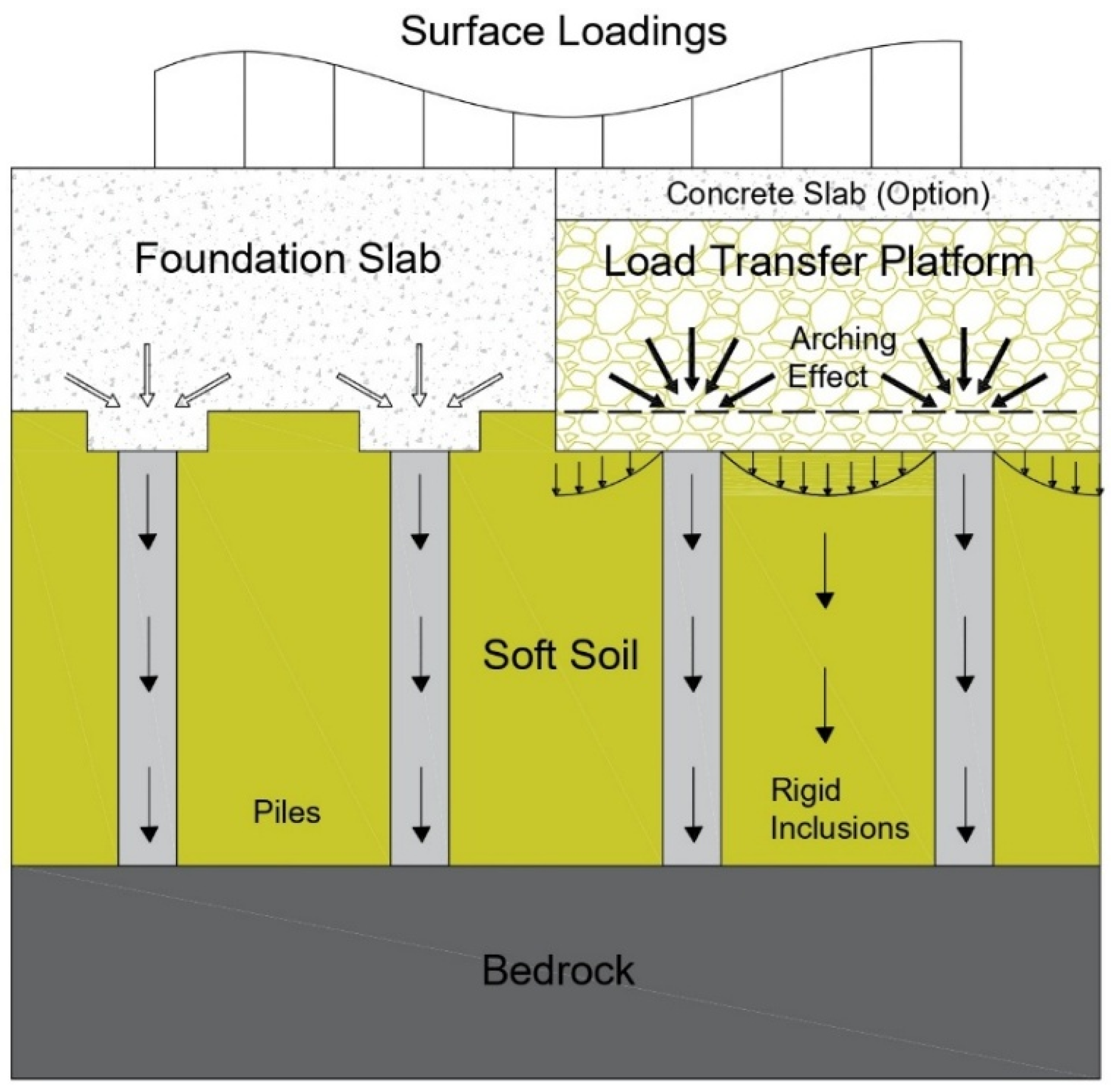
Among available solutions, rigid inclusions (RIs) are widely adopted for soft soil reinforcement. RIs are high-stiffness vertical columns, typically installed with a load transfer platform (LTP). They can be end-bearing on a stiff stratum or floating within competent intermediate layers, exhibiting a marked stiffness contrast with the surrounding soil [5]. Figure 1 illustrates the fundamental load-transfer mechanism in the soil–inclusion–platform–structure system. Flexible inclusions rely on lateral confinement and bulging resistance, whereas RIs act as structural elements that mobilize limited lateral soil reaction [1,6]. This distinction makes RIs particularly effective in very soft soils, although issues such as negative skin friction, creep settlement, and installation disturbance in organic or peat layers require careful consideration [7,8,9,10].
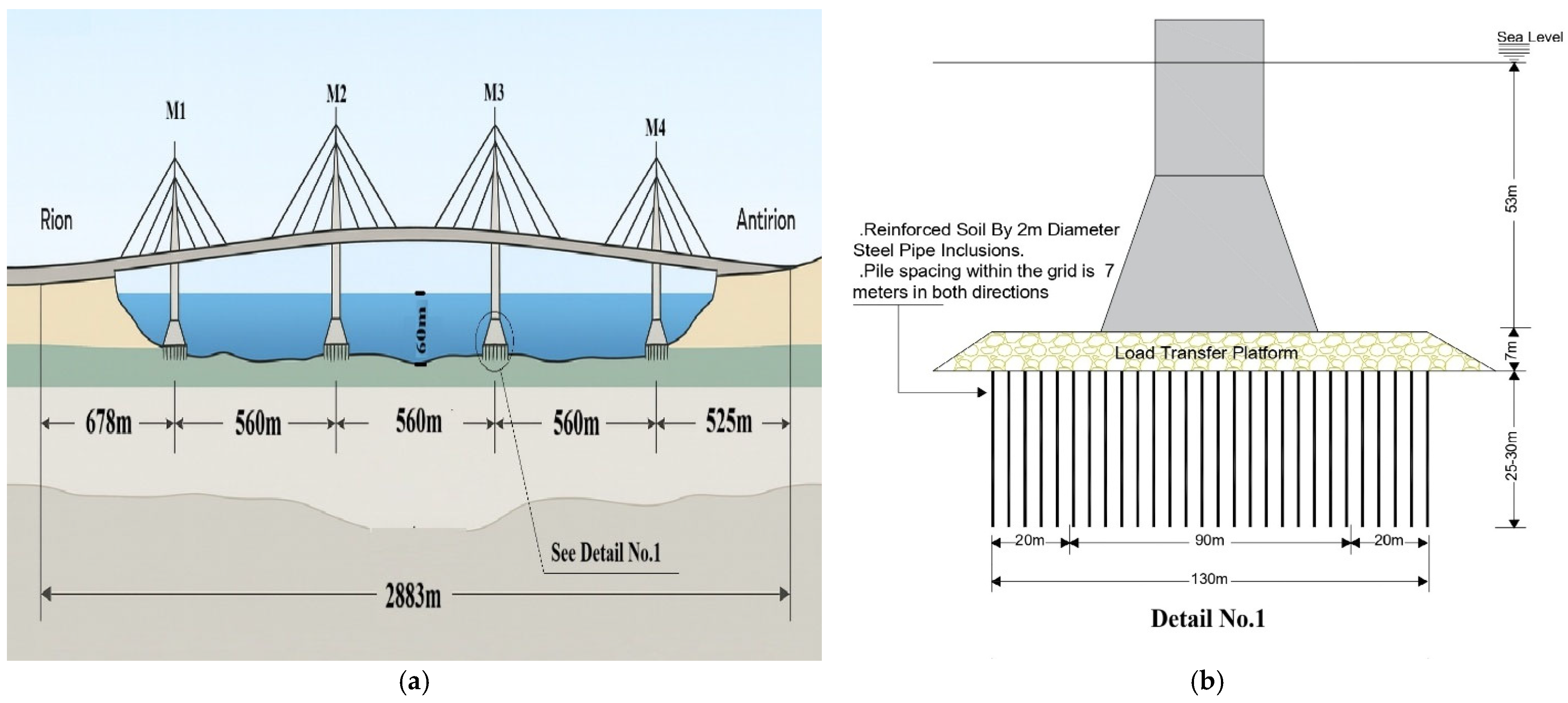
Historically, the concept of pile-supported platforms dates back to the ancient bathhouse of Masada (37–31 BCE), where capped columns distributed floor loads onto the foundation [11]. Modern RI technology, introduced in the late 1970s, has since evolved into a globally recognized ground improvement solution [1,6]. Applications include high-speed railways [12,13], large LNG storage facilities [14], and industrial and hydraulic structures such as factories and water tanks where long-term monitoring has confirmed their reliable performance [15,16]. Field observations across diverse soil profiles (e.g., the lacustrine clays of Mexico City) further demonstrate the robustness of RI systems [17,18]. True RI+LTP systems (i.e., with a distinct geosynthetic-reinforced load transfer platform) have been particularly successful in the projects listed above; some earlier or regional applications cited in the literature did not include a formal LTP and are therefore not strictly comparable [19].
The widespread use of RIs has inspired extensive research and the formulation of national and international design frameworks. The French ASIRI Project [6,20] remains particularly influential, providing large-scale experimental data that have guided analytical and numerical modeling in European practice [21]. While the static performance of RIs is relatively well documented and design methods are considered mature for many typical conditions, significant discrepancies between guidelines and field performance still occur in highly organic, heterogeneous, or peat soils [7,8,9]. Moreover, most existing guidelines still focus on static conditions [22], with limited consideration of cyclic or seismic behavior and an absence of codified seismic design approaches.
Beyond technical efficiency, contemporary ground improvement must also address economic feasibility and sustainability. RIs have proven cost-effective compared with deep foundations, reducing material consumption and construction time [19,23,24,25]. Yet, the high embodied carbon of cementitious materials remains a concern. Recent life-cycle assessments suggest that substituting traditional binders with low-carbon or waste-derived alternatives can achieve significant CO2 reduction, although reported values vary considerably depending on system boundaries and functional units adopted in each study [26,27,28]. Experimental and analytical studies have extensively validated the key mechanism of soil arching within these systems, providing a fundamental basis for established design guidelines in Europe and beyond [29,30,31,32,33,34].
This state-of-the-art review synthesizes findings from more than 180 peer-reviewed studies published between 2000 and 2025. The literature was systematically retrieved from Scopus and Web of Science using targeted keywords related to rigid inclusions, load transfer platforms, cyclic/seismic loading, and liquefaction. Unlike previous reviews (e.g., ASIRI [6], van Eekelen & Han [11]), the present work places particular emphasis on the cyclic and seismic performance of RI systems and on the current limitations of existing design guidelines in earthquake-prone regions. The main objectives are:
  • Identify knowledge gaps that hinder the development of codified seismic design protocols,
  • Critically assess the applicability and limitations of existing static-oriented design methods under cyclic and seismic loading, particularly in liquefiable soils, and
  • Highlight research needs and potential directions for the future development of performance-based seismic design approaches.
The paper is structured as follows: Section 2 discusses fundamental governing mechanisms; Section 3 reviews analytical, numerical, and physical modeling; Section 4 synthesizes system performance under static, cyclic, and seismic loading; Section 5 compares international frameworks and outlines a roadmap toward PBD; and Section 6 concludes with key findings and future research priorities.

2. Fundamental Principles and Governing Mechanisms

2.1. System Components: A Composite Structure

An RI system operates as a composite framework, where load transfer occurs through the interaction of three principal components: the RIs, the load transfer platform (LTP), and the surrounding soft soil [1,22,25,35]. The inclusions are typically end-bearing, high-stiffness columns arranged in a regular grid. They provide structural support by channeling loads to an underlying competent bearing stratum [29,30,31]. This composite mechanism, relying on stiff elements to bridge soft deposits, has also been applied successfully in other hybrid foundation systems such as raft foundations supported by disconnected piles [36].
The LTP, generally composed of compacted granular fill, redistributes vertical stresses toward the inclusions primarily through the soil arching mechanism, as confirmed by numerous analytical and numerical studies [22,32,33,35,37,38,39]. Its performance can be further enhanced through geosynthetic reinforcement, which mobilizes the tensioned membrane effect [34,40,41,42]. More recent advances include cement- or lime-stabilized fills within the LTP, which significantly increase stiffness and durability [31,43,44,45,46].

2.2. Key Load Transfer Mechanisms: A Critical Analysis

The performance of RI systems is governed by the combined action of multiple load-transfer mechanisms: Soil arching, the tensioned membrane effect, and soil–inclusion interaction, whose relative contributions are strongly influenced by the system geometry and the mechanical properties of the constituent materials [21,22,47,48,49].

2.2.1. Soil Arching Mechanism: Evolution from Conceptual Models to Design-Oriented Frameworks

The dominant load-transfer process within the LTP is soil arching, a mechanism by which vertical stresses are redistributed from the deforming subsoil to the rigid inclusion heads [50,51]. It develops due to differential settlements between the soft subsoil and inclusions, leading to a three-dimensional stress redistribution within the LTP [29,52,53,54,55]. Full mobilization of soil arching typically requires a height-to-clear spacing ratio H/(s − a) ≥ 1.4–2.0, below which only partial arching develops [11,56].
Early analytical models, such as those of Hewlett and Randolph, idealized the arch as a hemispherical dome [29]. Later refinements, including Kempfert et al., proposed a vault-shaped geometry forming the basis of the German EBGEO guideline [34]. The Dutch CUR226 framework, supported by extensive experimental studies by Van Eekelen et al., further improved the model by explicitly considering stress distribution on the reinforcement layer [5,57,58]. Subsequent works extended these frameworks to cohesive and unsaturated subsoils under non-uniform loading [44,59,60,61,62]. While these analytical formulations provide robust design tools, their assumptions of soil homogeneity and isotropy limit their ability to capture time-dependent effects such as creep and consolidation under complex field conditions [52,60].
In practice, the choice of arching model depends on the design stage. Simplified models are suitable for preliminary assessment, whereas advanced formulations embedded in CUR226 [33], EBGEO [63], and BS8006 [64] are preferred for detailed design [21,40,65]. However, none of these analytical approaches explicitly account for seismic or cyclic loading, which restricts their applicability in earthquake-prone environments. Validation has primarily relied on static experiments, 1g small-scale tests [47,48,49,66], centrifuge modeling [21,57,60,67,68,69,70,71], and full-scale field monitoring [72,73,74,75].
Overall, soil arching remains the principal mechanism governing stress transfer in LTPs. Unlike flexible stone columns that rely primarily on drainage and lateral confinement, RIs emphasize axial load transfer with minimal reliance on surrounding soil reaction [1,6]. However, analytical arching models, rooted in static and idealized assumptions, cannot capture cyclic degradation or dynamic redistribution, reinforcing the need for coupled numerical–experimental approaches introduced in Section 3.

2.2.2. Tensioned Membrane Mechanism in Geosynthetic-Reinforced Load Transfer Platforms

The incorporation of geosynthetics (e.g., geogrids) at the base of the LTP mobilizes the tensioned membrane effect. As the subsoil settles, the reinforcement deflects downward, developing tensile resistance whose vertical component directly supports the overlying fill and reduces the stress transmitted to the soft subsoil [11,34,76,77].
The efficiency of this mechanism primarily depends on the tensile stiffness of the reinforcement and the magnitude of its deflection [20,59]. Although it enhances overall load transfer, its contribution is difficult to separate from soil arching in practice [38,60]. Centrifuge experiments have quantitatively demonstrated that stiffer LTPs, reinforced with multiple geosynthetic layers, achieve higher load-transfer efficiency [21,61].
While these findings have clarified membrane behavior under static loading, its long-term performance and degradation under cyclic and seismic conditions remain poorly understood, representing a critical direction for future physical and numerical research [68,78,79].
Table 1 summarizes the most influential parameters and their quantitative effects on load transfer efficiency, providing clear design thresholds supported by field and experimental evidence.

2.3. Mechanics of Soil–Inclusion Interaction and Time-Dependent Behavior

Mobilization of shaft resistance along inclusions is as critical as stress transfer within the LTP. This interaction, governed by interface shear transfer, is highly sensitive to time-dependent soil processes such as creep and consolidation [3,6,81,82]. Accordingly, the soil–inclusion system evolves over time, with its load-transfer mechanism often differing immediately after construction.
The following subsections examine two dominant aspects:
(1) Development of negative skin friction and the neutral plane, which define axial load transfer; and
(2) Consolidation and creep, which control the long-term evolution of settlement and stress redistribution.

2.3.1. Development and Role of Negative Skin Friction and the Neutral Plane in RI Systems

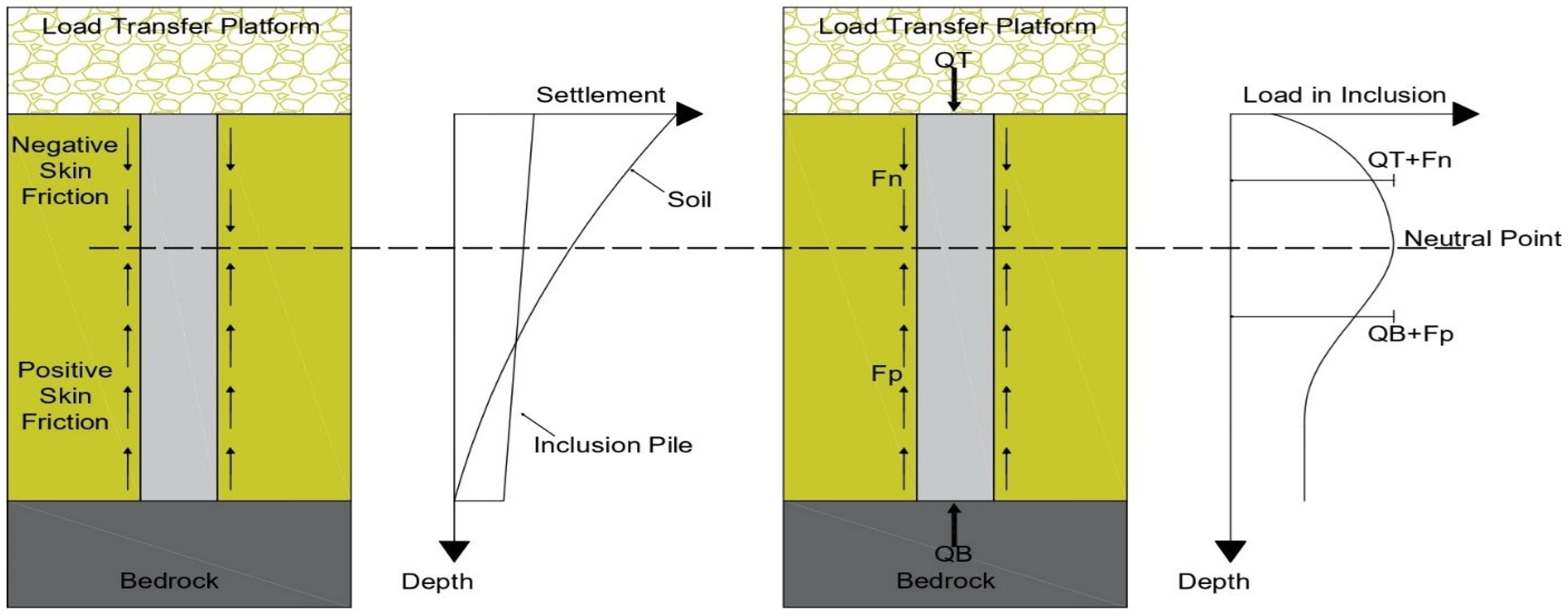
Because the surrounding compressible soil possesses much lower stiffness than the inclusions, it settles more in the upper zone, mobilizing downward shear stresses along the inclusion shaft, which are commonly termed negative skin friction (NSF) [1,6,82]. In RI systems, NSF forms an integral part of the load-transfer mechanism, transferring part of the embankment load from the settling soil to the inclusion and thereby increasing its axial demand [6,83]. At greater depths, the relative displacement reverses, mobilizing positive skin friction that transfers load from the inclusion back to the soil. The point of zero relative movement, also known as the neutral plane, marks the depth of maximum axial load within the inclusion [1,6,84]. Accurate prediction of this depth is crucial for structural design; however, due to uncertainties in analytical estimation, it is often calibrated using instrumented field data or advanced numerical simulations [21,56,85,86,87].
The interplay of settlement, negative skin friction, and the resulting axial load distribution along the inclusion is conceptually summarized in Figure 2. Key quantitative parameters from selected field and numerical studies are summarized in Table 2, highlighting the influence of geosynthetics, soil creep, pile geometry, and consolidation.

2.3.2. Time-Dependent Effects of Consolidation and Creep in RI Systems

In saturated cohesive soils, the performance of RI systems is strongly governed by time-dependent processes. Installation of inclusions often generates excess pore-water pressures, and subsequent consolidation directly controls the mobilization of shaft resistance and the evolution of soil arching [54,85,88]. Fluctuations in groundwater levels or excess pore pressures generated during seismic loading can temporarily degrade soil arching efficiency by reducing effective stresses and shear strength, particularly through the loss of matric suction in the embankment fill [48,89,90]. Over longer periods, creep deformation in soft soils leads to progressive settlement and gradual stress redistribution throughout the system’s service life [91].
While several numerical models incorporate consolidation effects [66], most analytical frameworks still neglect long-term creep, causing discrepancies between theoretical predictions and field performance [61,67,85]. Field monitoring of Prestressed high-strength concrete (PHC) pile-supported embankments, for instance, revealed continuous changes in the neutral plane and shaft resistance during consolidation, demonstrating that long-term system behavior fundamentally diverges from the as-built condition [86].
Overall, consolidation enhances shaft resistance and redistributes loads toward inclusions, whereas long-term creep diminishes arching efficiency. Together, these mechanisms redefine load sharing and must be explicitly integrated into PBD verification [54,86,91].

2.4. Installation Techniques and Geotechnical Implications

Installation methods for RIs are generally classified as displacement techniques (e.g., Controlled Modulus Columns, CMCs) and non-displacement techniques (e.g., Continuous Flight Auger, CFA piles) [6,45,92]. Displacement methods densify the surrounding soil and increase lateral stresses, enhancing shaft resistance, though they may induce substantial disturbance in sensitive cohesive soils [93,94]. In such soils, this disturbance often manifests as the creation of a remolded “smear zone” with elevated pore pressures and reduced shear strength, requiring a time-dependent “set-up” period for strength regain [93,94]. In contrast, non-displacement methods minimize disturbance but produce spoil that requires careful handling and disposal [95,96].
The choice of installation technique has a profound impact on soil–inclusion interaction, yet this factor is often oversimplified or neglected in analytical models [6,20,94,96,97]. The long-term mobilization of shaft friction is primarily governed by the evolution of interface shear strength and lateral stress, both of which are highly sensitive to the installation method and soil type [53,66,83,94]. Consequently, the initial in situ state of the soil (e.g., stress, density, fabric) is fundamentally altered by the installation process, establishing the baseline conditions for all subsequent mechanical behavior [81,94].
These installation effects have direct implications for system performance under various loading conditions. For instance, the altered soil stiffness and fabric around the inclusion can significantly influence the system’s response to cyclic or dynamic loading, a consideration not typically captured in static design frameworks [68,98]. Collectively, the mechanisms and installation effects described above define the multi-scale behavior of RI systems. Their interdependence highlights the necessity for advanced analytical, numerical, and experimental frameworks, which are further discussed in Section 3.

3. Methodologies for Analysis and Design

The design of RI systems is a complex process that builds on the soil–structure interaction mechanisms described in Section 2. Over recent decades, design methodologies have evolved from simplified analytical formulations to advanced numerical simulations and large-scale physical modeling. Each modeling tier complements the limitations of the preceding one: analytical models offer conceptual clarity, numerical methods capture nonlinear and dynamic complexity, and physical experiments validate mechanistic realism under controlled conditions.
This section reviews these methodological frameworks, emphasizing their theoretical foundations, practical relevance, and inherent limitations. The discussion progresses from analytical to numerical and physical approaches, providing a structured transition toward PBD principles.

3.1. Analytical Design Methods: A Critical Review

Analytical methods constitute the conceptual foundation for the preliminary and code-based design of rigid inclusion systems. They provide mechanistically idealized frameworks that simplify complex soil–structure interaction processes into tractable formulations for estimating key design parameters. Most of these approaches are grounded in the two governing mechanisms: (a) soil arching, and (b) the tensioned membrane effect [40,41,54].

3.1.1. Refinement and Limitations of Arching-Based Analytical Models

The analytical understanding of RI systems has evolved through the progressive refinement of arching-based models that describe stress transfer within the LTP. Early formulations such as the hemispherical arch concept proposed by Hewlett and Randolph (1988) [29] provided the first rational description of how load is redirected from compressible soil to rigid inclusions. Later extensions, notably BS 8006-1 (2010) [64], institutionalized this concept but introduced significant simplifications. These simplified approaches, which often assume uniform stress transfer, can lead to large errors: they may over-predict reinforcement strains by up to 50% [40], underestimate geosynthetic force by ~64% in granular fill benchmarks (365 kN/m vs. 1008 kN/m) [99], and overestimate field-measured forces by up to 120% in other conditions [100], illustrating their parametric instability.
Subsequent experimental validations led to more realistic stress-transfer formulations. The German EBGEO (2011) [63] guideline, derived from the vaulted arch model of Kempfert et al. (2004) [34], adopted a parabolic stress distribution, improving accuracy for subsoil reaction. This offers improved accuracy for granular fills, predicting ~85% of the FE-derived force [99]. However, its performance is variable; it can overestimate the stress concentration ratio (n) by approximately 400% [40], indicating sensitivity to arching height and soil stiffness. The Dutch CUR226 (2016) [33] framework further advanced this understanding through extensive full-scale and centrifuge testing by Van Eekelen et al. [11,33]. It introduced an inverted triangular stress distribution on the reinforcement layer, achieving a closer match with field-measured settlements and more economical designs [4,8,9,58,72,101]. This superior performance is quantified in comparative studies: the CUR226 method demonstrates the smallest average deviation from field-measured geosynthetic strains and tensile forces among major design guidelines [40]. Its explicit modeling of subsoil support is a key differentiator, leading to more realistic load distributions. However, its accuracy is not universal; in a specific granular fill benchmark, it predicted a reinforcement force (~365 kN/m) similar to the conservative BS 8006 estimate and significantly lower than 3D FE results (~1008 kN/m) [99]. This indicates that while CUR226’s mechanistic basis is robust, leading to excellent agreement in many field cases [40], its predictions for reinforcement load can remain conservative in certain geometric configurations. The most recent analytical models, such as the multi-interaction formulation by Pham et al. [51], explicitly couple soil, inclusion, and reinforcement behavior to capture nonlinear load transfer.
Comparative assessments of major international frameworks (BS 8006, EBGEO, CUR226 [33,63,64]) reveal that, while they share a common mechanistic foundation, their differing assumptions regarding arch geometry and boundary conditions yield significant discrepancies in predicted settlements and tensile strains [40,54,102]. For instance, in a controlled benchmark, the predicted maximum geosynthetic strain varies from 0.6% (BS 8006 and CUR226) to 1.43% (EBGEO), compared to a 3D FE result of 1.68% [99]. BS 8006 tends to produce overly conservative or unconservative estimates depending on the parameter, whereas CUR226, which was calibrated mainly for granular soils, may underestimate reinforcement strains in highly compressible or organic deposits [54,99]. The EBGEO method, while an improvement, can overestimate the stress concentration ratio by approximately 400% compared to field measurements [40]. Moreover, the generalization of these guidelines remains limited due to their calibration against specific experimental datasets. Without site-specific validation, predicted stress concentration ratios and settlements may deviate substantially in heterogeneous ground conditions [11,40]. A comparative summary of the fundamental assumptions, outputs, and key characteristics of these major guidelines is provided in Table 3.
Overall, these analytical frameworks provide an indispensable foundation for preliminary design and mechanistic understanding but remain constrained by their simplified representation of stress paths and soil–structure interaction. Critically, they are not applicable to dynamic or seismic loading conditions, as they cannot account for inertia, cyclic degradation, or pore pressure generation [11,98,103]. Their inherent inability to capture stress-dependent stiffness, nonlinear compressibility, and time-dependent effects underscores the necessity for advanced numerical modeling approaches capable of simulating coupled, nonlinear, and dynamic behaviors.

3.1.2. Integrated Limitations and Design Relevance of Analytical Frameworks

Analytical frameworks remain essential tools for preliminary design of RI systems [8,39,62]; however, their intrinsic assumptions (chiefly the static formulation) restrict their applicability under cyclic or seismic loading [11]. Even pseudo-static and three-dimensional analytical extensions cannot fully represent time-dependent soil–structure interaction or cyclic degradation effects [98,104].
Comparative reviews of analytical methods for geosynthetic-reinforced, pile-supported embankments show that they oversimplify nonlinear soil behavior, cumulative deformation, and dynamic boundary conditions [105]. Similar deficiencies have been reported for RIs in liquefiable soils, where static-based formulations fail to reproduce stiffness degradation, pore-pressure buildup, and post-liquefaction settlement [103,106]. These limitations confirm that current analytical guidelines, though valuable for static conditions, cannot reliably address complex dynamic or seismic responses.
Furthermore, notable discrepancies exist among international design frameworks such as BS 8006, EBGEO, and CUR226, arising from differing assumptions regarding arching geometry, reinforcement stiffness, and stress distribution [33,34,101]. Selecting a suitable analytical model must therefore depend on project-specific conditions, deformation tolerances, and acceptable performance risk levels [40,99].
While these frameworks provide a consistent foundation for preliminary design, their inability to represent nonlinear, stress-dependent, and cyclic soil–structure interactions necessitates the use of advanced numerical models (see Section 3.2). Numerical approaches yield more accurate and economical predictions of settlement, load transfer, and reinforcement demand [4,98,107]. Ultimately, analytical methods retain their relevance as first-level tools within a PBD process, but higher-fidelity numerical modeling remains indispensable for realistic seismic and long-term assessments.

3.2. Numerical Modeling Approaches: Capabilities and Limitations

Unlike the analytical methods discussed in Section 3.1, numerical modeling overcomes most inherent simplifications of analytical formulations. It enables realistic simulation of complex geometries, nonlinear and stress-dependent soil behavior, and fully coupled dynamic soil–structure interaction, providing detailed insights into load-transfer mechanisms among the subsoil, the LTP, and the inclusions [98,108,109]. These capabilities make numerical modeling indispensable for advanced design and performance-based assessment, particularly in seismic environments where analytical models fail to capture cyclic degradation and interaction effects. Consequently, numerical simulations have become the preferred framework for evaluating the efficiency, stability, and long-term response of RI systems under both static and dynamic conditions.

3.2.1. Continuum Modeling (FEM/FDM): Approaches in 2D and 3D

Continuum-based approaches, primarily the Finite Element Method (FEM) and Finite Difference Method (FDM), remain the most widely used tools for analyzing RI systems [11,98,109]. Two-dimensional (2D) models, typically formulated under plane-strain or axisymmetric assumptions, are computationally efficient and useful for parametric studies. This critical limitation is explicitly acknowledged in contemporary 3D studies, which state that 2D plane-strain “models cannot account well for [the] interactions between soil layers and structural elements in both vertical and horizontal directions” essential for realistic arching [98].
Three-dimensional modeling therefore represents the state-of-the-art, explicitly reproducing the inclusion grid geometry and realistic stress fields [110,111,112,113,114]. The necessity of a full 3D representation is underscored by quantitative benchmarks showing that even a simplified 3D model (a quarter-model) can introduce a discrepancy of approximately 5% compared to a full 3D simulation [98], implying greater inaccuracies in 2D approximations. Quantitative comparisons between 3D simulations and full-scale field measurements confirm their superior predictive capability. For instance, a rigorous 3D finite difference (FLAC3D) back-analysis of the full-scale embankment by Nunez et al. [59] demonstrated high accuracy, predicting settlement in an unreinforced zone within 0.03 m (≈9% error) of the field-measured value. In contrast, simplified 2D approaches tend to underestimate stress concentration on inclusion heads, leading to unconservative design outcomes [100,115]. Despite these advantages, widespread practical application of 3D analysis remains limited by computational demands and the challenge of defining realistic boundary conditions. Broader adoption will depend on improving computational efficiency and developing simplified yet robust 3D frameworks that balance accuracy with design practicality [98,109].

3.2.2. Hybrid and Multi-Scale Numerical Modeling: From Continuum to Particle-Level Frameworks

Beyond continuum formulations, recent advances in DEM and coupled FEM–DEM approaches have expanded numerical modeling capabilities for RI systems. DEM provides a particle-scale perspective, representing the granular LTP as an assembly of interacting particles and allowing direct observation of micromechanical mechanisms such as particle interlocking, contact evolution, and force-chain formation [116]. These simulations reveal the fundamental interactions governing stress transfer and arching within granular layers.
Despite their high fidelity, DEM applications remain constrained by severe scale effects and substantial computational cost, which restrict their use to small-scale or academic studies rather than practical design [79,117]. However, recent efforts to couple DEM with continuum approaches (FEM–DEM) have bridged particle-scale insights with engineering-scale behavior, improving predictive accuracy for cyclic and seismic responses [117]. Advances in GPU-accelerated solvers and enhanced computational power have made DEM more feasible for near-field analyses and localized phenomena such as arching collapse or pore-pressure buildup, yet full-scale implementation remains rare in engineering practice [118,119].
Hybrid FEM–DEM models are particularly promising for dynamic problems, as they simultaneously capture localized grain-scale deformation and global stress redistribution under cyclic or seismic loading [117,120]. These frameworks enable a mechanistic understanding of how local particle rearrangements influence macroscopic system stiffness and damping, critical for predicting cyclic degradation and energy dissipation.
Integrating these particle-based insights into practical workflows requires intermediate-fidelity models, such as macro-element formulations, that can retain essential nonlinear and rate-dependent behaviors without the computational burden of full DEM simulations [117,120]. While 3D continuum analyses remain the primary tool for design verification [3,4,41], hybrid approaches provide a vital bridge between experimental observation and engineering design, particularly in capturing the multi-scale mechanisms that govern the performance of RI systems under cyclic and seismic conditions.

3.2.3. The Critical Role of Constitutive Modeling in Numerical Simulation

The correct definition of boundary conditions (BCs) is as critical as constitutive model selection for reliable numerical simulations of RI systems. BCs govern the interaction between the finite model and the infinite ground, controlling stress distribution, deformations, and wave propagation. For static analysis, lateral boundaries should be placed at least 3–5 times the inclusion length from the pile group to avoid artificial confinement [66,121], while the base is typically fixed. In dynamic analyses, absorbing or viscous boundaries are essential to prevent spurious wave reflections and correctly simulate energy radiation [122,123,124]. Unit-cell models often employ periodic boundaries. Improper BCs can distort results, such as overestimating stiffness or misrepresenting liquefaction patterns, compromising the validity of the entire simulation.
Beyond dimensionality considerations, the reliability of numerical simulations primarily depends on the adopted constitutive models for both soil and inclusion materials. RIs are typically represented as linear-elastic elements [66,98,125,126], whereas soils exhibit highly nonlinear, stress-dependent, and often cyclic degradation behavior that challenges realistic modeling. Table 4 summarizes the main constitutive models employed in RI analyses.
A clear methodological shift has occurred from classical Mohr–Coulomb formulations to advanced models such as the Hardening Soil (HS) model, which more accurately captures stiffness dependency and nonlinear stress–strain response [4,38,121,127]. For dynamic and seismic applications, advanced elastoplastic models such as Dafalias–Manzari, UBCSAND, and PM4Sand are essential to reproduce cyclic mobility and pore-pressure generation. These formulations have shown strong agreement with centrifuge and shaking table experiments, yielding far higher fidelity than conventional models [10,122,123,128,129,130,131,132].
The main limitation of these advanced models lies in their demanding calibration requirements, which necessitate extensive laboratory testing. As a result, a persistent gap remains between research-oriented platforms (e.g., OpenSees, FLAC) and the simplified constitutive laws available in most commercial software [10,133]. Bridging this gap requires standardized calibration protocols and shared parameter databases to enable consistent application of advanced constitutive models in engineering practice.
Table 4. Comparative Summary of Common Soil Constitutive Models for RI Systems Analysis.
Constitutive ModelKey
Feature
Primary ApplicationLimitations in RI Context
Mohr-Coulomb
[66]
Simplicity; minimal parameters (c, φ, ψ).Preliminary static analysis; first-order estimation of stability.Oversimplified for settlement: Cannot model stress-dependent stiffness, plastic hardening, or small-strain behavior. May overpredict deformations.
Hardening Soil (HS)
[121,127]
Stress-dependent stiffness (E50, Eᴜref); distinguishes primary loading/unloading.Detailed static analysis and settlement prediction for embankments and platforms.Primarily for monotonic loading: Standard formulation lacks robust cyclic degradation rules. Calibration: Requires triaxial test data for stiffness moduli.
HS-Small
[8]
Captures high stiffness at very small strains (G0, γ0.7).Dynamic analysis (non-liquefiable); projects where vibration-induced settlements are critical.High parameterization: Reliable calibration requires advanced laboratory tests (e.g., bender elements, resonant column) to determine small-strain thresholds (γ0.7), which are often not available for routine projects.
PM4Sand
[130]
Stress-ratio controlled liquefaction triggering; built-in fabric changes effects.Seismic analysis and liquefaction assessment in clean sandy deposits.Sand-specific: Not applicable to silts, clays, or gravels. Calibration-sensitive: Predictions highly sensitive to 15+ input parameters (e.g., φfc, nb, Go). Requires high-quality cyclic simple shear/triaxial data.
UBCSAND
[129,131]
Captures accumulation of shear strains and pore pressure during cyclic loading.Seismic performance and liquefaction-induced deformation analysis in sands.Sand-specific and history-dependent: Calibration parameters (e.g., n1, n2, n3) are tied to specific laboratory test curves. Extrapolation to field conditions carries significant uncertainty.
Dafalias-Manzari
[122]
Advanced anisotropic critical state theory; models cyclic mobility and post-liquefaction.Fundamental research and high-stakes projects where precise simulation of cyclic soil response is paramount.Research-grade complexity: Requires extensive expertise for calibration (>20 parameters). Computational cost is high. Rarely justified for routine RI design.

3.3. Experimental Modeling: Critical Evaluation of Physical Techniques

Experimental modeling remains indispensable for validating analytical assumptions and capturing soil–structure interaction mechanisms under controlled boundary conditions [21,70,72,134,135]. Physical tests complement numerical simulations by revealing load-transfer modes and failure mechanisms otherwise inaccessible through computation alone. Different scales, from 1g models to full-scale field trials, offer distinct but interrelated insights into RI system behavior.

3.3.1. 1g Small-Scale Model Tests

Small-scale 1g models provide a cost-effective and accessible method for qualitative observation of deformation mechanisms and stress redistribution within the Load Transfer Platform (LTP) and the surrounding soil [49,53,136,137,138]. The advent of non-intrusive techniques, such as Digital Image Correlation (DIC), has significantly enhanced this capability, allowing for detailed visualization of soil arching formation, force chain evolution, and progressive degradation under both static and cyclic loading [53,134,137].
However, these models cannot replicate in situ effective stress conditions, leading to well-documented scaling distortions that preclude reliable quantitative extrapolation to prototype scale [139]. The fundamental limitation is the violation of stress similitude; in a 1g environment, confining stresses are geometrically scaled down, resulting in soil behavior (strength, stiffness, and dilatancy) that is not representative of field conditions [135]. For example, in granular materials, the low confining pressure leads to disproportionately high dilation and shear strength, which can severely overestimate the efficacy of soil arching and underpredict settlements [49]. Consequently, design parameters derived directly from 1g tests—such as the stress concentration ratio (n), absolute pile load, or reinforcement strain—can be significantly misleading. Authors of such studies often explicitly caution that their experiments are intended for mechanism understanding rather than quantitative assessment and that materials may simulate behavior “only qualitatively and not quantitatively” [49,135].
Therefore, while 1g models are invaluable tools for identifying failure modes, validating conceptual numerical models, and studying the fundamental mechanics of soil-inclusion interaction, their results must be used with caution. They should serve primarily for mechanistic interpretation and conceptual calibration, not for direct quantitative prediction of field performance. For reliable quantitative design, validation against centrifuge modeling or field data, which correctly replicate stress levels, remains essential [11,139].

3.3.2. Centrifuge and Shaking Table Experimental Modeling

To address the stress-scaling limitations inherent in 1g tests, advanced experimental techniques (e.g., centrifuge and shaking table modeling) are essential for simulating realistic stress-dependent soil behavior, particularly under seismic loading [139]. While several centrifuge and shaking table studies have been performed on piled rafts or generic pile-supported embankments, these systems are referenced in this review only as analogues where they share the same arching–membrane load-transfer mechanisms. They are not classified as strict RI+LTP systems, and their results are used to complement, rather than replace, evidence from true rigid-inclusion case histories.
Geotechnical Centrifuge Modeling: By applying controlled centrifugal acceleration, centrifuge modeling reproduces prototype stress–strain conditions, enabling accurate investigation of consolidation, stress redistribution, and liquefaction mechanisms [60,61,67,139,140,141]. It provides high-fidelity datasets for calibrating constitutive models and validating numerical simulations, especially under cyclic or post-liquefaction conditions [98]. However, practical challenges persist, including difficulties in reproducing geosynthetic flexural stiffness, soil–inclusion interface properties, and full similitude for composite systems, as well as the high cost and complexity of instrumentation [61,139].
Shaking Table Modeling: Large-scale shaking table tests uniquely capture seismic deformation patterns and soil–pile–structure interaction mechanisms. Studies such as Li et al. (2024) [142] have elucidated the dynamic evolution of load transfer and validated performance-based seismic design principles for RI systems [11,143]. Nonetheless, experiments specifically targeting RI-reinforced liquefiable soils remain rare [103,142], leaving significant uncertainty in assessing seismic deformation and long-term stability.
Overall, centrifuge and shaking table modeling remain indispensable for understanding nonlinear soil–structure interactions beyond the reach of purely numerical formulations. Targeted, large-scale dynamic testing thus represents a key frontier for bridging current knowledge gaps in the seismic performance of RI-improved foundations [11,103].

3.3.3. Instrumented Full-Scale Field Monitoring

Instrumented full-scale testing provides the most direct and comprehensive evidence of RI system performance under real in situ conditions, although the findings remain inherently site-specific and dependent on monitoring duration [11,56]. These large-scale investigations reveal the combined effects of construction methods, soil variability, and environmental influences, offering essential benchmarks for model calibration and code development.
Landmark projects such as the French ASIRI [6,20] program and the Dutch Kyoto Road [73] embankment have been pivotal in defining the empirical foundations of modern design guidelines [72,144,145]. It is important to recognize that these and many other well-documented case histories originate predominantly from specific geographical regions (e.g., Western Europe, North America) and soil types (e.g., soft clays, granular fills), and may reflect local construction practices and inclusion types. More recent studies expanded these datasets by evaluating innovative LTP materials and monitoring long-term RI behavior in challenging soils, including lacustrine clays and peat [9,75]. Complementary large-scale shaking table experiments have also contributed valuable seismic validation data [124].
Despite their value, full-scale programs remain inherently site-specific, limiting generalization and long-term assessment. Monitoring durations are often short, leaving key uncertainties regarding creep, consolidation, and progressive degradation over design lifespans [46,146]. Sustained, multi-year monitoring initiatives are therefore required to close the gap between short-term research campaigns and real-life engineering practice.

3.3.4. Towards an Integrated Multi-Scale Experimental Framework

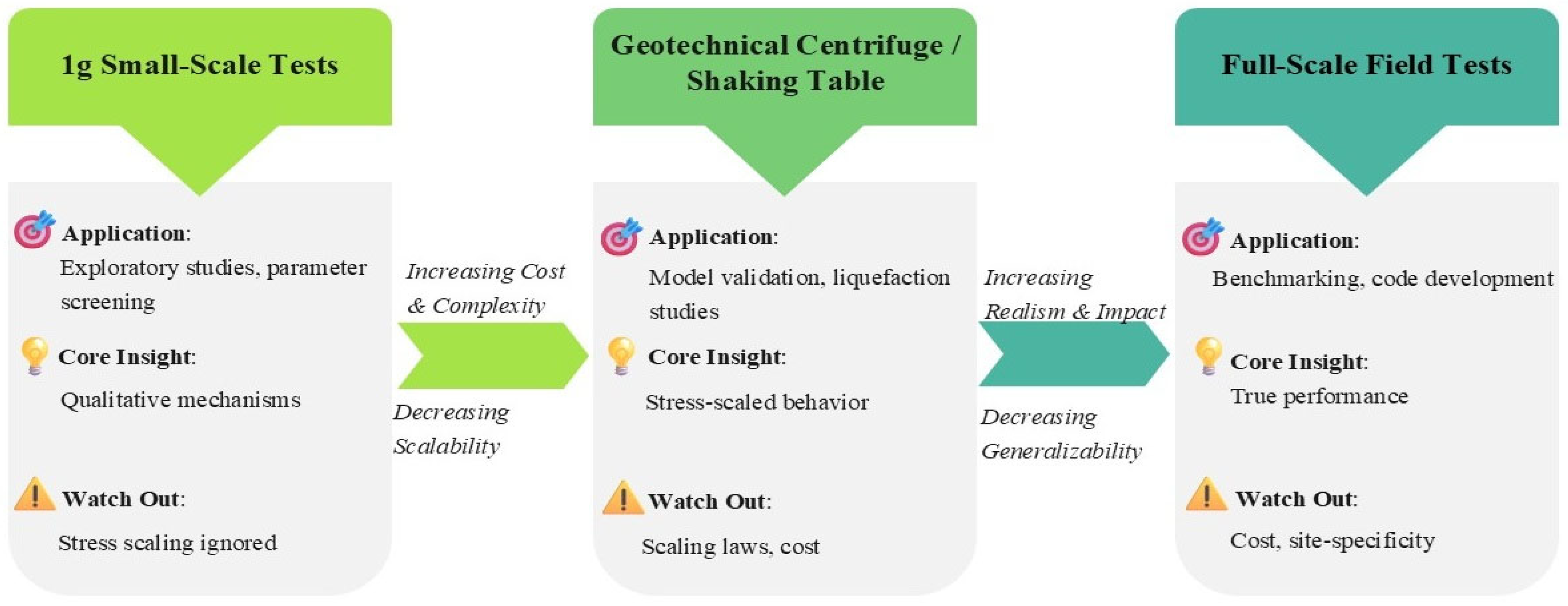
Collectively, the discussed experimental methods establish a hierarchical, complementary framework for understanding the multi-scale behavior of RI systems [11]. While 1g model tests offer qualitative insights into deformation and interaction mechanisms, centrifuge and shaking table experiments provide quantitative data under realistic stress and dynamic conditions, serving as essential tools for validating numerical models [38,60,140,142,147]. At the highest fidelity, instrumented full-scale monitoring delivers direct in situ evidence of long-term system performance [9,46,56].
Despite significant advances, a clear disconnect persists among these experimental scales [11]. Bridging this gap demands an integrated cross-scale validation strategy, in which a representative case study is consistently investigated across all modeling levels (i.e., 1g, centrifuge, and field scale). Such integration would enhance numerical calibration and ensure reliable extrapolation of laboratory findings to field-scale behavior.
Ultimately, this multi-scale validation hierarchy (conceptually illustrated in Figure 3) forms the empirical backbone linking experimental research to engineering practice and supports the development of PBD methodologies for RI systems [56,61,72,133,136,137,140,144].

3.4. Synthesis of Design and Analysis Approaches

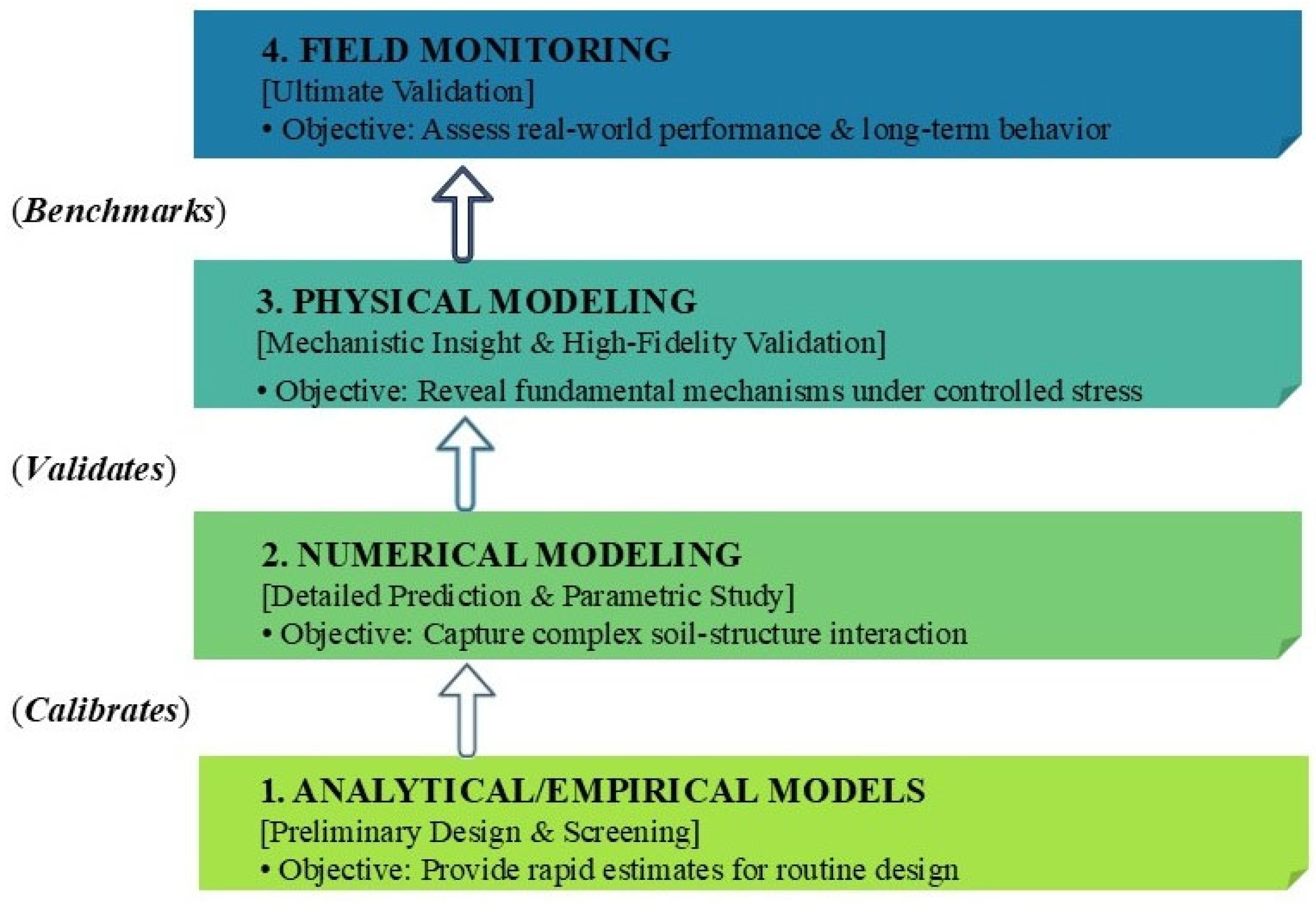
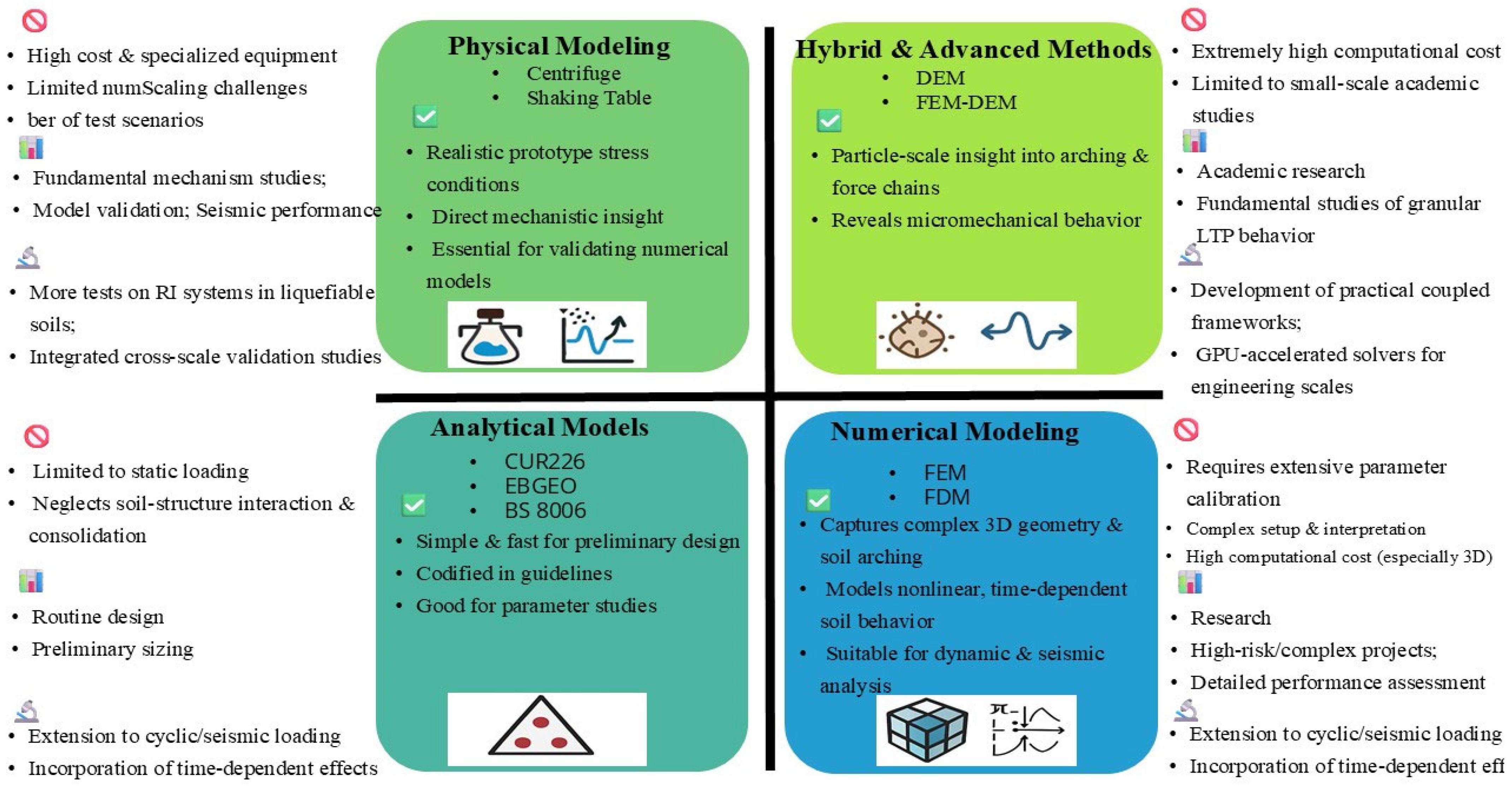
The analytical, numerical, and physical modeling approaches reviewed in this chapter form a complementary validation hierarchy, conceptually illustrated in Figure 4. As shown in Figure 4, higher-fidelity physical and numerical models are used to calibrate and constrain simpler analytical methods, ensuring that design checks remain both computationally efficient and consistent with observed multi-scale behavior. This hierarchy also aligns with the Technology Readiness Level (TRL) concept introduced to geotechnical earthquake engineering by Pecker [148], linking increasing model sophistication with technological maturity and implementation readiness.
A comparative synthesis of these methodologies, highlighting the trade-offs between computational efficiency, physical realism, and practical applicability, is summarized in Figure 5. To translate this conceptual hierarchy into actionable guidance for practitioners, a decision framework based on project phase, risk level, and geotechnical complexity is proposed. For preliminary design of low-to-medium risk projects in relatively uniform soils, analytical methods (e.g., CUR226, EBGEO) are often sufficient. For final design of significant structures, detailed performance assessment, or complex soil conditions (e.g., liquefaction), 2D numerical modeling (FEM/FDM) becomes essential. High-fidelity 3D numerical analysis or advanced coupled methods (e.g., FEM-DEM) should be reserved for high-risk, critical projects or for validating simplified models where novel mechanisms are involved. Physical modeling (centrifuge, shaking table) is recommended for ultimate validation in such high-stakes scenarios or for fundamental study of unprecedented conditions. This tiered approach ensures that methodological sophistication is matched to practical necessity, directly linking the validation hierarchy to engineering decision-making.
Together, this hierarchy and comparative analysis provide the methodological foundation for the performance evaluation of RI systems under static, cyclic, and seismic loading, developed further in Section 5.

3.5. Performance-Based Design (PBD) Principles: Link to Eurocode 8

Performance-Based Design (PBD) aligns engineering decisions with explicit performance objectives under defined hazard levels. Eurocode 8 (EN 1998-1) formalizes this philosophy through two fundamental performance levels: (1) the “No-collapse” requirement (Ultimate Limit State, ULS), ensuring structural integrity under a rare, intense seismic event (e.g., 475-year return period); and (2) the “Damage limitation” requirement (Serviceability Limit State, SLS), restricting deformations (e.g., inter-story drift ≤ 0.5–1.0% of height) under more frequent shaking to maintain serviceability. For Rigid Inclusion (RI) systems, this translates into quantifiable criteria: controlling total/differential settlements (SLS) and preventing geotechnical failure (e.g., arching collapse, inclusion buckling) or structural rupture (ULS). The code further mandates deformation-based verification (§ 4.3.4) and capacity-design principles to ensure ductile response [149]. However, EN 1998-5 (Geotechnical Aspects) lacks specific provisions for RI-improved ground, creating a critical gap. Bridging this gap requires adapting EC8’s PBD framework to RIs through advanced numerical modeling (e.g., PM4Sand for liquefaction), probabilistic treatment of uncertainties, and validation via centrifuge/large-scale testing.

4. Performance of RI Systems Under Static, Cyclic, and Seismic Loading Conditions

Evaluating the in situ performance of RI systems is crucial for validating design assumptions and quantifying load-transfer efficiency under complex loading conditions. Analytical and numerical methods alone cannot fully reproduce the variability of field conditions or nonlinear soil–structure interaction; therefore, performance evaluation must combine laboratory experiments, centrifuge modeling, and instrumented field data to bridge the gap between prediction and in situ behavior. This section synthesizes experimental and field-based observations to assess RI system performance under static, cyclic, and seismic loading.
The core argument is that, although static performance of RI systems has been extensively studied with generally good outcomes, cyclic and seismic loading fundamentally modify load-transfer mechanisms, challenging static-based design methods and highlighting the need for performance-based seismic design frameworks.

4.1. Behavior Under Static and Monotonic Loading

RI systems are primarily implemented to improve the load-bearing performance of structures founded on soft or highly compressible soils. Their effectiveness under static or monotonic loading is evaluated through two fundamental performance indicators: increased bearing capacity and, more critically, settlement reduction [6,56].

4.1.1. Mechanistic Insights and Settlement Control

The remarkable settlement reduction achieved by RI systems arises from two interdependent mechanisms:
(1) efficient vertical load transfer to the high-stiffness inclusions, which decreases stress on the compressible subsoil [56,59]; and (2) a transformation of the global failure mode from shallow local yielding to a deep block-type mechanism, as consistently identified in numerical analyses [4,66,112,127].
This transformation integrates inclusions and surrounding soil into a composite ground mass that behaves as a single load-bearing block forming the theoretical foundation of modern RI design. Field and large-scale experiments [9,56,72] confirm this improvement across various applications, including high-speed railways [12,13], industrial foundations, and storage silos [14,16,110].
Particularly at transition zones such as bridge approaches, in situ monitoring has recorded significant pressure differentials above and below the reinforcement layer, directly evidencing soil arching as the governing load-transfer mechanism [150].

4.1.2. Stress Concentration and Load Transfer Efficiency

The load-transfer efficiency of RI systems is typically expressed by the stress concentration ratio (n), defined as the ratio between the vertical stress acting on inclusion heads (σp) and that carried by the surrounding subsoil (σs) [6,11]. Unless otherwise stated, n in this review is evaluated at the base of the LTP (or at the geosynthetic layer when present), at the end of construction or primary consolidation, and refers to cell-averaged vertical stresses on inclusion heads and adjacent subsoil. Reported n values range from approximately 4 to >50, depending on subsoil compressibility, inclusion spacing, and embankment geometry [22,40,54,56,59].
Table 5 synthesizes quantitative data from key field, experimental, and numerical studies. Lower ratios (≈5–15) are typical for low embankments or stiff subsoils where differential settlement is limited [40,49,59], whereas higher ratios (>20–30) are consistently reported for tall embankments over highly compressible clays, where full arching mobilization leads to high load-transfer efficiency [56,59,151]. Several studies show that the stress transfer efficacy (E) can increase from ~0.18 (unreinforced) to >0.85 when a single geotextile layer is included [56,59].
Inclusion of high-stiffness geosynthetics, building on the mechanisms described in Section 2.2, converts the LTP into an active load-distribution layer [33,41,57,101]. However, conventional numerical models based on simplified constitutive laws (e.g., Mohr–Coulomb) often fail to capture this stress-dependent stiffness or nonlinear compressibility [21,62,83]. More advanced formulations, such as the Hardening Soil (HS) or Hypoplasticity with intergranular strain models, yield improved accuracy by capturing stress-dependent stiffness, small-strain nonlinearity, and accumulation behavior under cyclic loading [118,119,127].
Their reliable application hinges on extensive laboratory testing (e.g., triaxial tests with local strain measurement, resonant column tests) to calibrate multiple parameters (e.g.,  E 50 r e f E o e d r e f E u r r e f γ 0.7 R i n t e r ), which are often not routinely available in practice [122]. This calibration gap is particularly acute for organic soils, peat, or structured clays, where advanced models are most needed but standard parameters are scarce or inadequately defined [9].
Recent field monitoring also indicates that time-dependent consolidation influences arching efficiency, leading to gradual evolution of stress redistribution and variation in n during post-construction stages [86].

4.1.3. Long-Term Performance and Knowledge Gaps

Despite considerable progress in understanding the mechanisms for static load transfer, key uncertainties persist regarding the long-term field performance of RI systems. Extended monitoring data are scarce, often limited to a few years, which constrains the assessment of time-dependent phenomena such as creep and progressive consolidation, particularly in organic or peat soils [9,145].
Furthermore, the structural integrity and durability of the LTP remain insufficiently understood, especially under localized loading and environmental effects such as wet–dry or freeze–thaw cycles [8,11,46,97]. Discrepancies among international design guidelines in predicting settlements and stress concentration ratios (n) highlight the need for harmonized, empirically validated design frameworks [22,33,40].
Even under static conditions, the upward migration of the neutral plane and the development of negative skin friction are frequently oversimplified or neglected, despite consistent field evidence demonstrating their influence on settlement behavior [85,86]. These unresolved uncertainties provide the foundation for evaluating whether conventional static mechanisms can sustain structural integrity under cyclic and seismic conditions, as explored in the following sections.

4.2. Dynamic and Seismic Response of RIs

The dynamic performance of RI systems remains a crucial yet insufficiently explored aspect of ground improvement practice. Cyclic and seismic loadings introduce additional complexity arising from time-dependent soil–structure interactions, progressive degradation, and the evolution of stress transfer mechanisms [6,11,38,78,98].
Cyclic loading from traffic, high-speed railways, and industrial vibrations induces cumulative settlements, arching degradation, and partial loss of interface shear capacity within the LTP and surrounding subsoil. Under stronger dynamic and seismic excitation, these effects intensify through nonlinear stress redistribution, pore-pressure generation, and potential liquefaction [98,103,106].
Understanding the transition from stable cyclic shakedown to dynamic instability is essential for developing PBD approaches. This transition depends on key parameters such as inclusion stiffness, spacing, and area replacement ratio, which jointly control the balance between stiffness enhancement, damping behavior, and liquefaction resistance [108,152,153].
Section 4.2.1, Section 4.2.2, Section 4.2.3, Section 4.2.4 and Section 4.2.5 synthesize experimental, numerical, and field evidence governing RI response under cyclic and seismic loading. Table 6 provides a consolidated quantitative summary of key studies, which is discussed in terms of three core mechanisms: cyclic deformation and arching degradation, stiffness–damping interaction, and liquefaction mitigation, leading to the identification of outstanding research gaps.

4.2.1. Cyclic Deformation and Shakedown Behavior

Under cyclic loading, RI systems exhibit a gradual accumulation of permanent settlements governed by two interrelated mechanisms: (1) progressive rearrangement of particles within the LTP, and (2) development of shear strains in the soft subsoil [61,78,98,154]. Both laboratory and centrifuge tests confirm that deformation initially increases rapidly and then stabilizes toward a “shakedown” state once the cyclic stress amplitude falls below a critical threshold [69,78]. When this threshold is exceeded, progressive plastic strain accumulation continues, leading to residual settlements and long-term performance degradation.
Building on the mechanisms described in Section 2.2, geosynthetic reinforcement plays a decisive role in controlling cyclic deformation [61,77,155]. Reinforcement enhances lateral confinement, promotes uniform stress redistribution, and mitigates stress concentration on inclusion heads [155,156].
This cyclic stability is particularly relevant for high-speed railways and industrial foundations, where millions of load repetitions occur during service life [12,98,157,158]. Field and 1g physical models (see Table 6) indicate that, although initial settlements may increase noticeably during the first loading cycles, systems with adequate geometry (e.g., H/s above arching thresholds) and reinforcement tend to stabilize, underscoring the need to design for the post-shakedown phase rather than relying solely on static analyses.
Table 6. Quantitative Evidence and Design Implications from Cyclic/Seismic Studies of Rigid Inclusion Systems.
Study TypeKey Cyclic/Dynamic FindingQuantitative ResultRelevance to RI Design
1g Physical Models
(Houda et al. 2016,2019; Insoog 2020) [68,137,154]
Cyclic degradation of soil arching & settlement accumulationEfficiency ↓ up to 40% after 50 cycles; Settlement ≈ 10–14 mm after 50 cyclesDemonstrates need for cyclic-aware design
Centrifuge Tests
(Blanc et al. 2013; Okyay et al. 2013) [67,140]
Load transfer reduction under cyclic loadingPile force ↓ ~20% during unloading; extra soft soil settlement Validates quasi-static cyclic behavior
Field Monitoring
(Van Eekelen et al. 2007; Okyay et al. 2012) [15,73]
Real-structure response to traffic/tank cyclesLoad transfer ↓ ≈30% on working days; slight reduction after first fill-empty cycleConfirms arching dependency on load history
Seismic Numerical Models (Lopez & Dias 2022; Bouabdallah et al. 2023) [108,159]RI systems reduce inertial forces vs. conventional pilesBase shear ↓ up to 15%; inter-story drift ↓ from 2.66% to 1.87%Supports RI superiority in seismic regions
High-Speed Rail Models (Jiang et al. 2014; Zhang et al. 2023) [98,158]RIs reduce settlement & vibration under dynamic train loadsSettlement ↓ up to 58%; vibration amplification minimized below 150 km/hApplicability to high-frequency cyclic loads
Liquefaction Mitigation
(Jawad et al. 2023)
[103]
RIs reduce liquefaction-induced deformations via reinforcement/confinementHorizontal displacement ↓ 80%; vertical settlement ↓ 91%Distinct from drainage-based stone columns
Geosynthetic Enhancement (Lehn et al. 2016; Han et al. 2014) [155,160]Geogrid stabilizes arching under cyclic traffic loadsSettlements stabilize after ≈25 cycles with geogrid; H/s ≥ 1.4 for stabilityHighlights role of reinforcement in cyclic performance

4.2.2. Cyclic Degradation of Arching and Load-Transfer Efficiency

The most critical mechanism controlling long-term cyclic response in RI systems is the progressive degradation of soil arching within the LTP. Repeated load–unload cycles induce irreversible strain accumulation, particle rearrangement, and fabric evolution, which gradually weaken the arching structure and reduce load-transfer efficiency [38,98,154].
Both numerical (FEM, DEM) and physical tests consistently show a decline in the stress concentration ratio (n) with increasing cycles, confirming the partial loss of efficiency in stress redistribution between inclusions and subsoil [38,98]. As summarized in Table 6, centrifuge and 1g tests report reductions in mobilized pile load and system efficiency of the order of 20–40% after limited cycles, with an increasing share of load carried by the compressible subsoil as cyclic amplitude rises [154,156]. Arching degradation is thus nonlinear, most pronounced during initial cycles, and highly sensitive to cyclic stress amplitude.
Geosynthetic reinforcement substantially mitigates this degradation. Acting as a tensioned membrane and shear-transfer interface, it confines lateral soil movement and preserves the structural integrity of the LTP. Higher tensile stiffness and optimal layer configuration improve arching stability, maintaining higher n-values even under sustained cyclic loads [61,77,155].
Ultimately, the cyclic degradation of soil arching represents a key limiting factor in RI design under repeated dynamic loading. Understanding its evolution is essential for defining reliable performance thresholds and integrating cyclic resilience into future PBD frameworks.

4.2.3. Seismic Soil–Structure Interaction: Stiffness–Damping Trade-Off

During seismic excitation, RIs modify ground response through a complex stiffness–damping interaction [98,108,152,161]. A grid of stiff inclusions increases the composite shear stiffness of the improved soil mass, thereby shortening the site’s natural period [152,153]. This frequency-dependent behavior is critical, as evidenced by a 17–45% reduction in pile bending moments with increased excitation frequency [106]. This stiffening effect can be beneficial by reducing deformations but may also shift the site frequency toward resonance, a risk explicitly highlighted when the system period coincides with dominant spectral content [108,159,162].
The overall system response thus results from a delicate balance between stiffness amplification and damping enhancement, where the granular load transfer platform itself can act as a zone of energy dissipation [106], a phenomenon highly sensitive to the inclusion spacing, area replacement ratio, and subsoil stratigraphy [109,159].
Empirical and numerical analyses consistently indicate that at low replacement ratios, damping dominates and improves stability, whereas excessive stiffness at higher ratios can trigger resonance effects and magnify accelerations [98,108,153]. Hence, seismic optimization of RI grids should aim for a balanced stiffness–damping ratio, ensuring adequate energy dissipation without inducing dynamic amplification.
These findings emphasize the necessity of performance-based seismic design (PBSD) frameworks that explicitly account for stiffness–damping interactions and their inherent frequency dependence, often neglected in current design standards.

4.2.4. Liquefaction Mechanisms: Reinforcement–Confinement vs. Drainage

The seismic performance of RIs in liquefiable soils is governed by reinforcement and confinement rather than drainage mechanisms, distinguishing them fundamentally from permeable column systems such as gravel drains [103,106,163]. During shaking, RIs act as stiff, impermeable inclusions that reinforce the surrounding soil matrix and enhance confinement, thereby reducing cyclic shear strains and delaying pore-pressure generation [164,165,166].
Current interpretation of the available experimental and numerical evidence suggests that three primary, interdependent mechanisms contribute to this behavior: (1) Reinforcement mechanism: RIs absorb a significant portion of the cyclic shear stress, lowering the Cyclic Stress Ratio (CSR) in adjacent liquefiable zones and suppressing triggering [163,167,168]; (2) Confinement mechanism: The inclusion grid increases the mean effective confining pressure, improving the Cyclic Resistance Ratio (CRR) and enhancing soil stability under repeated loading [165,169]; and (3) Drainage contrast: Unlike gravel or sand columns that dissipate excess pore water pressure (EPWP) through drainage, RIs limit its buildup through stress redistribution, not permeability [103,170].
It is important to frame this three-mechanism scheme as a working hypothesis that effectively rationalizes observed macro-scale performance. While supported by numerical studies and comparisons with drainage-based techniques, this interpretation faces inherent limitations. Dedicated physical model tests (e.g., centrifuge tests) that isolate and quantify the individual contributions of reinforcement, confinement, and pore-pressure redistribution around a grid of RIs remain scarce in the literature [106,171,172]. Furthermore, advanced constitutive models capable of fully capturing the complex coupled stress-pore pressure response during seismic loading continue to be a subject of research [106]. Therefore, while the reinforcement-confinement framework provides a valuable conceptual model for design, its quantitative validation at the mechanism level requires further targeted investigation.
The efficacy of this reinforcement-confinement approach is quantitatively demonstrated in numerical studies, which show RIs can reduce liquefaction-induced horizontal displacements by up to 80% and vertical settlements by 91% in improved ground [103]. This performance is distinct from that of drainage-based stone columns, as RIs achieve mitigation by reducing the CSR within the soil matrix rather than accelerating pore-pressure dissipation.
Centrifuge and shaking-table experiments demonstrate that the RI–soil system evolves dynamically through the initiation, buildup, and dissipation phases of liquefaction, with deformation modes and bending moments varying spatially across the inclusion grid [171,172,173]. RIs effectively reduce post-liquefaction settlement and prevent catastrophic shear failure, yet their capacity to suppress pore-pressure generation remains limited [103,167,174]. Thus, liquefaction mitigation by RIs arises from structural reinforcement and confinement effects, not drainage. Recognizing this distinction is crucial for developing PBD frameworks that explicitly capture these mechanisms and their interaction under seismic conditions.

4.2.5. Outstanding Gaps and Research Roadmap

Despite substantial progress in understanding the cyclic and seismic response of RIs, several fundamental gaps persist between research findings and design practice. The most critical limitations can be summarized as follows:
Limited Validation Data: Current evidence base is imbalanced. It relies heavily on 1g physical models, which, while useful for qualitative mechanism identification, suffer from well-known scaling issues that preclude direct quantitative extrapolation. Furthermore, dedicated dynamic physical modeling is scarce: centrifuge tests targeting RI systems are limited [67,140], and large-scale shaking table experiments are virtually absent, with only two relevant studies identified [124,143]. Most critically, there is a stark absence of instrumented field case histories documenting RI performance during strong seismic events. This imbalance creates a significant gap between mechanistic understanding derived from simplified models and validated design practice [20,56,139].
Lack of Calibrated Numerical Frameworks: Although advanced constitutive models such as PM4Sand and Dafalias–Manzari have shown high fidelity for liquefaction analyses [175], their application to RI–soil systems remains underdeveloped. Laboratory investigations have examined liquefaction triggering [176], but validation of fully coupled RI–soil systems remains extremely limited. Validation of coupled hydro-mechanical behavior and grid-scale effects under seismic loading is urgently required [103,130,177].
Absence of Codified Seismic Design Procedures: No internationally recognized guideline yet exists for performance-based seismic design of RIs. The brittle bending response of unreinforced inclusions, combined with complex kinematic demands in liquefiable soils, remains poorly quantified [178].
Sustainability and Life-Cycle Considerations: Environmental impacts and embodied carbon associated with RI construction materials are rarely integrated into design frameworks, despite growing emphasis on sustainable infrastructure [26,27,28].
To bridge these gaps, a coordinated research roadmap is proposed:
  • Develop large-scale dynamic experiments (centrifuge and shaking table) with full instrumentation, specifically designed to validate numerical models for RI systems under seismic and cyclic loading
  • Establish open-access databases linking laboratory, numerical, and, when available, field observations to enable parameter standardization and model calibration
  • Formulate codified performance-based guidelines integrating seismic, cyclic, and environmental design metrics explicitly addressing identified failure modes and system-level performance.
Bridging these dimensions, i.e., scientific rigor, numerical validation, and sustainability, will enable a new generation of resilient and performance-based RI design frameworks, forming the foundation for the forward-looking synthesis presented in Section 5.

5. Discussion: Key Findings and Outstanding Research Issues

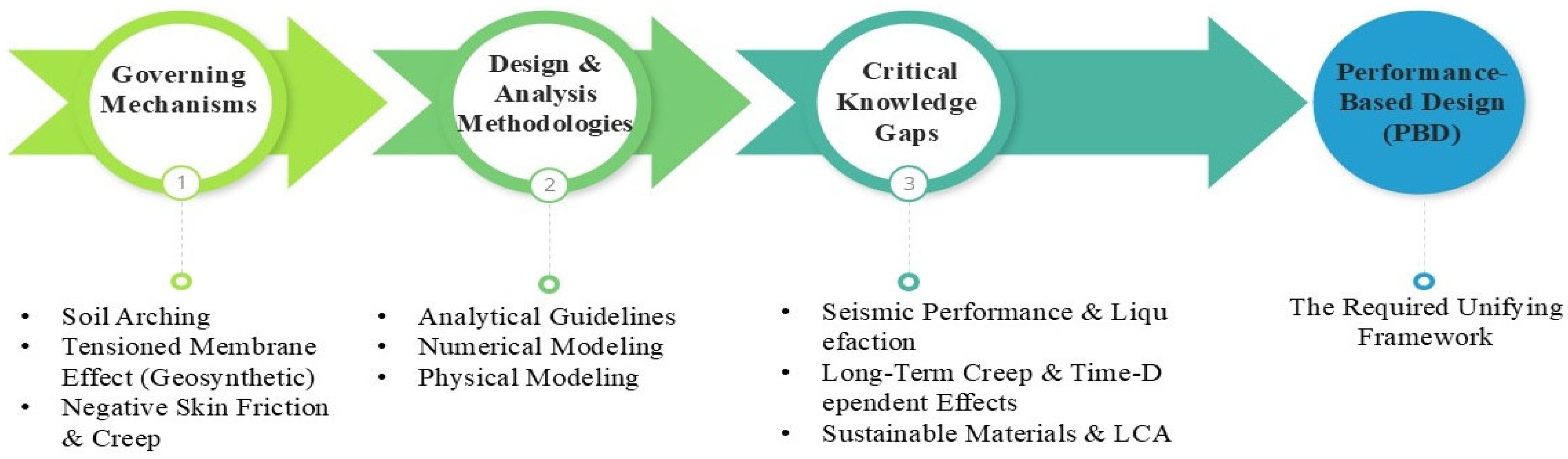
This review has consolidated the current state-of-the-art understanding of RI systems, covering their governing mechanisms, design evolution, and performance under static, cyclic, and seismic loading conditions. The preceding sections have traced the progression from simplified analytical formulations to advanced numerical and experimental frameworks and clarified how these complementary approaches collectively shape RI system behavior. Figure 6 conceptually illustrates the interconnections among the governing mechanisms, design strategies, and critical knowledge gaps identified throughout this study. It highlights how physical mechanisms dictate system behavior, design and analysis methodologies provide tools with different levels of fidelity and practicality, and knowledge gaps constrain the effective use of these tools. Addressing these gaps is the pathway toward a unified Performance-Based Design (PBD) framework at the diagram’s center. The synthesis underscores that advancing the design and application of RI systems requires a holistic, performance-based approach, one that explicitly integrates these interdependencies rather than pursuing isolated methodological refinements.
This discussion evaluates the key findings emerging from the reviewed literature, compares the strengths and limitations of existing design methodologies, and highlights unresolved discrepancies and open questions that define the agenda for future research.

5.1. Synthesis of Key Influencing Parameters

The performance of RI systems results from the coupled interaction of multiple governing parameters rather than any single factor. Analytical, numerical, and experimental investigations consistently highlight the area replacement ratio (a/s)2 as the most influential design parameter, directly controlling load-transfer efficiency and settlement magnitude [11,22,29,40,63,64,99]. Yet its effect is strongly modulated by geometric, mechanical, and material characteristics, as summarized below.
System Geometry (H/(s − a) Ratio): The ratio between the embankment or LTP height and clear inclusion spacing determines the development and stability of soil arching [29,32,101]. A critical height is required for full arch mobilization, typically when H/(s − a) ranges from 1.4 to 2.0, beyond which further increases yield diminishing returns [11,33,37,49].
Subsoil Compressibility: Differential settlement induced by compressible subsoil is the main trigger for soil arching and membrane action. The highest efficiency, which is expressed through elevated stress-concentration ratios (n), occurs in highly compressible soils [52,56,59]. In soft, saturated clays, displacement-type inclusions may temporarily enhance load transfer by generating negative skin friction and suction effects during consolidation, explaining the superior performance observed in weak ground [94,96].
Geosynthetic Reinforcement Stiffness: High-stiffness reinforcement enhances LTP confinement, maintains arch integrity, and improves load redistribution [33,77]. Its role becomes critical under cyclic or seismic loading, where it mitigates arch degradation and differential settlements [61,78,98].
Material Stiffness Contrast: The stiffness contrast between inclusions and surrounding soil governs the degree of differential settlement needed for arching mobilization [53,119]. Increasing inclusion modulus raises stress concentration and reduces settlements [66,83]. Similarly, stiffer or treated LTP materials (e.g., cement- or lime-stabilized fills) further enhance load-transfer uniformity, particularly beneath high embankments or stringent settlement limits [9,43,46].
Collectively, these parameters interact in a strongly coupled manner. Effective RI design therefore demands simultaneous optimization of geometry, material stiffness, and reinforcement properties within an integrated framework forming the analytical foundation for the PBD approaches discussed in the subsequent sections.

5.2. Sustainability, Life-Cycle Assessment and Low-Carbon Solutions

The current practice for RI systems remains constrained by unresolved scientific and practical uncertainties. Therefore, a fully PBD framework that unifies static, cyclic, and seismic performance is required.
Scientific Gaps: The foremost research deficiency is the absence of experimentally validated seismic design frameworks for RIs, particularly in liquefiable soils [103,106]. Sophisticated numerical models provide a strong methodological foundation for conventional pile systems [179,180]. This stems from the hydraulic contrast between Drainage Gravel Columns (DGCs) and impermeable concrete inclusions, necessitating a distinct research focus on non-draining systems [70,170]. Equally critical is the limited understanding of long-term soil–inclusion interactions governed by creep, consolidation, and progressive negative skin friction [85] and of the durability of system components, such as the LTP, geosynthetic reinforcement, and concrete inclusions, under environmental degradation (e.g., wet–dry, freeze–thaw, or chemical attack) [97,107], which calls for multi-decade field monitoring and coupled chemo-mechanical modeling.
Practical Gaps: Translating research into engineering design remains hindered by limited codification and validation. Although dynamic centrifuge modeling [122,141] and advanced numerical simulations [98,130] have enhanced understanding, these tools have not yet evolved into standardized, engineering-ready methodologies [99,104,109]. The scarcity of long-term field monitoring data remains a fundamental limitation for calibration and validation [9,16,56,59,72]. Recent life-cycle assessments demonstrate that low-carbon binders suitable for rigid inclusions can reduce CO2-eq emissions by 22–90% compared to ordinary Portland cement (cradle-to-gate) [181,182,183]. Typical practical reductions range from 40 to 80% for fly ash/GGBS blends, recycled concrete powder, and alkali-activated/geopolymer systems, depending on replacement level and system boundaries (Table 7). Evaluating sustainability trade-offs between RIs and alternative ground-improvement systems is therefore a rapidly growing research frontier.
The Path Forward: Addressing these gaps demands an integrated, interdisciplinary approach that combines geotechnical, structural, and sustainability perspectives. Future frameworks should link high-fidelity numerical modeling with field-based monitoring to quantify time-dependent degradation while embedding environmental and economic metrics within PBD. This synthesis, which is grounded in empirical validation and life-cycle thinking, will enable RI systems to achieve both structural reliability and long-term sustainability, guiding the transition toward resilient, performance-based ground improvement practice.

5.3. A Critical Comparison of Design Methodologies

A persistent gap remains between advanced research-oriented computational methods and the simplified empirical approaches prevalent in engineering practice [11,84,99]. Bridging this divide requires clarifying the complementary roles and inherent limitations of analytical, numerical, and physical methodologies.
Analytical vs. Numerical Approaches: Analytical design frameworks, such as CUR226 [33], EBGEO [63], BS 8006 [64], remain indispensable for preliminary design due to their simplicity and rapid applicability. However, their idealized assumptions (i.e., predefined arch geometries, neglect of consolidation, and limited soil-structure interaction) reduce reliability in heterogeneous or time-dependent conditions [40,54,101,105].
Conversely, 3D numerical modeling explicitly captures soil–inclusion interactions, stress redistribution, and arching effects [2,21,66]. Despite their superior accuracy, practical application is limited by computational cost and the calibration required for advanced constitutive models (e.g., Hardening Soil, Hypoplasticity, PM4Sand) [98,129,130,133]. Consequently, most routine designs still rely on simplified 2D plane-strain analyses due to their computational efficiency. However, comparative numerical studies have demonstrated that such 2D plane-strain models can overpredict soil arching efficiency compared to more realistic 3D analyses, as they cannot fully capture the three-dimensional stress redistribution [21]. This inherent limitation may lead to non-conservative designs with underestimated settlements for complex pile arrangements or loading conditions [2].
Physical vs. Numerical Validation: Centrifuge experiments [60,67,140] remain the benchmark for validating numerical simulations under realistic stress conditions, while 1g small-scale tests [37,57] provide valuable mechanistic insight into soil–structure interaction. This complementary use of physical tests as benchmarks and numerical models for interpolation and extrapolation is what we refer to as their strong synergy. Yet discrepancies persist between model predictions and field performance [56,59,72], primarily due to the inability to replicate installation effects of displacement inclusions such as soil remolding, excess pore-pressure generation, and inherent heterogeneity [9,94,96].
Bridging Research and Practice: This methodological divide highlights a critical challenge: research progresses through sophisticated 3D models calibrated with centrifuge data, whereas design practice still depends on empirical or 2D analytical frameworks for cost efficiency. A realistic path forward lies in developing intermediate-fidelity frameworks that embed validated numerical insights into design-oriented formulations [40,99]. Such hybrid approaches should balance computational efficiency and physical realism, enabling accurate predictions of settlement, arching, and cyclic response without exhaustive parameter calibration. To realize this in practice, the development of intermediate-fidelity design tools is essential. Such tools could include:
(1) Calibrated macro-element models that capture the key nonlinear load-deformation response of the RI-LTP system for rapid dynamic analysis;
(2) Pre-computed 3D unit-cell solutions packaged as design charts or simple software interfaces, derived from extensive parametric finite-element studies; and
(3) AI-based meta-models trained on high-fidelity simulation databases to predict critical performance indicators (e.g., stress concentration ratio, settlement) for common design scenarios.
The validation of such tools against high-quality centrifuge data is a critical next step for bridging the research-practice divide.
The persistent gap between research and practice is clearly reflected in the current state of international design guidelines. A comparative synthesis of their scope, mechanistic assumptions, and treatment of dynamic and sustainability issues is presented in Table 8 and Table 9.

5.4. Influence of Installation-Induced Effects on Long-Term Performance

The installation technique (displacement or non-displacement) exerts a lasting influence on the mechanical and hydraulic behavior of RI systems [94,96]. Displacement methods densify surrounding soils and elevate lateral stresses, enhancing shaft resistance and system stiffness. However, in sensitive clays they can induce remolding, generate excess pore pressure, and alter in situ stress regimes, thus influencing long-term performance [94,96].
These installation-induced modifications also govern the cyclic and seismic response of RI systems. In granular soils, densification and increased confinement from displacement techniques elevate the CRR by raising mean effective stress, improving both settlement control and liquefaction resistance [166,169]. In contrast, non-displacement methods cause minimal disturbance but lack such confinement benefits, offering lower resilience under cyclic loading. Quantifying and incorporating these contrasting effects into seismic design remains a pressing research need.
A representative example is the Rion–Antirion Bridge (Greece), where displacement inclusions combined with a granular sliding layer provided controlled seismic energy dissipation without structural damage [148] (see Figure 7). It should be noted that this is a highly specialized foundation system with a seismic isolation layer, and its design principles are not directly transferable to conventional RI embankments. Conversely, non-displacement installations may produce weaker soil–inclusion interfaces with reduced adhesion and frictional resistance, compromising stability under repeated loading [53,69,134,154].
Despite their significance, installation-induced effects remain oversimplified or ignored in most numerical models [66,83]. Simulations seldom capture changes in soil fabric, density, or stress redistribution following installation, leading to discrepancies between predicted and observed long-term performance. Furthermore, the scarcity of extended full-scale monitoring, particularly over service periods exceeding decades, limits the calibration of PBD models [9,16,56,59,72]. Addressing these limitations requires integrating installation effects into advanced constitutive frameworks and conducting long-duration field observations to validate design assumptions.

5.5. Concluding Remarks: Transition Toward Performance-Based Design

This review underscores the ongoing shift toward performance-based design (PBD) for rigid inclusion (RI) systems, driven by projects in seismically active and liquefiable environments [98,103,104,130]. The core PBD objectives—improving seismic reliability, optimizing decisions via life-cycle metrics, and achieving demonstrable resilience—necessitate moving beyond simplified analytical models [34,62] and integrating advanced numerical simulations with well-instrumented experimental validation [9,56,60,141], building on the multi-scale validation hierarchy outlined in Section 3.3 and Section 3.4.
However, as highlighted by Pecker (2023) [148], innovation must balance scientific soundness with practical applicability. To address the constraints of high computational demands, a lack of standardized seismic guidelines, and scarce long-term performance data [16,98,100] and to translate the PBD paradigm into practice, a structured, phased research and implementation roadmap is essential. This roadmap must prioritize actions that generate validated design tools and data for practitioners. Table 10 proposes a coordinated roadmap spanning the next decade, organized into three sequential phases with clear priorities and deliverables.
The successful execution of this roadmap requires sustained collaboration among researchers, practicing engineers, and standardization bodies. By systematically addressing the gaps in validation data, tool availability, and codification, this plan charts a concrete path to transform RI design from a predominantly empirical and prescriptive exercise into a predictive and performance-based framework, ensuring the economic, environmental, and seismic resilience of future infrastructure.

6. Conclusions and Future Research Directions

This review has synthesized the current state of knowledge on RIs for soft soil improvement, covering governing mechanisms, design evolution, and performance under static, cyclic, and seismic loading. The main key conclusions of this review are:
  • Static and cyclic performance.
    The static behavior of RI systems is now well understood and reliably predicted as discussed in Section 5.5 [29,33,52]. Under Cyclic loading, progressive degradation of arching and the cumulation of settlements are observed, while geosynthetic reinforcement plays a critical role in mitigating these effects [38,78,98].
  • Seismic Performance:
    The seismic response of RI systems, particularly in liquefiable soils, remains a major frontier of research. In contrast to permeable stone columns, concrete inclusions mitigate liquefaction primarily through reinforcement and confinement rather than drainage mechanisms [70,103]. A key scientific gap concerns the limited understanding of nonlinear flexural behavior and the potential for brittle failure of unreinforced inclusions under seismic kinematic demands [178]. To date, no comprehensive or experimentally validated seismic design methodologies are available [106,109,142,178].
  • Long-term behavior.
    Long-term performance is governed by consolidation, creep, and negative skin friction. However, these processes remain insufficiently quantified due to scarcity of multi-decade field monitoring data [85,97].
  • Practical Integration.
    A persistent disconnect exists between advances in research and routine engineering practice, driven by high computational cost, software constraints, and the challenges associated with calibrating advanced constitutive models [11,133]. Bridging this gap requires the development of intermediate-fidelity tools that strike an appropriate balance between physical realism and computational efficiency [125,129].
The absence of codified seismic design provisions for RI systems underscores the urgent need for a dedicated performance-based design (PBD) framework. To this end, a concrete and prioritized three-phase roadmap has been proposed in Section 5.5 (Table 10), spanning the development of benchmarking datasets (1–3 years), intermediate-fidelity design tools (3–5 years), and formal code integration (beyond 5 years).
The Priority directions for future research can be:
  • Conduct large-scale dynamic centrifuge tests and instrumented field experiments to generate open-access validation datasets.
  • Develop practical intermediate-fidelity design tools, such as macro-element models, design charts, and AI-based meta-models, calibrated against these datasets.
  • Integrate sustainability indicators, including life-cycle assessment (LCA/LCCA) and long-term durability considerations, into PBD verification.
  • Draft RI-specific seismic provisions for international standards (e.g., Eurocode 8—Part 5 or a dedicated seismic appendix to ASIRI guidelines).
Beyond its technical synthesis, this review establishes a conceptual framework that links static, cyclic, and seismic performance within a unified performance-based design perspective. Future research should focus on validating this framework through full-scale, well-instrumented field studies, thereby enabling RI systems to evolve to-ward solutions that are not only structurally reliable but also resilient and sustainable over their entire service life.

Author Contributions

Conceptualization, N.B., H.B. and D.D.; methodology, H.B.; validation, N.B. and H.B.; formal analysis, H.A.; investigation, N.B.; resources, M.V.; data curation, N.B. writing—original draft preparation, N.B. and D.D.; writing—review and editing, D.D.; visualization, N.B.; supervision, D.D. All authors have read and agreed to the published version of the manuscript.

Funding

This research received no external funding.

Data Availability Statement

All the date come from the literature review.

Conflicts of Interest

The authors declare no conflict of interest.

References

  1. Simon, B. General report S5 rigid inclusions and stone columns. In Proceedings of the International Symposium on Ground Improvement (IS-GI), Brussels, Belgium, 30 May–1 June 2012; pp. 127–168. [Google Scholar]
  2. Jenck, O.; Dias, D.; Kastner, R. Three-Dimensional Numerical Modeling of a Piled Embankment. Int. J. Geomech. 2009, 9, 102–112. [Google Scholar] [CrossRef]
  3. Jenck, O.; Dias, D.; Kastner, R. Two-Dimensional Physical and Numerical Modeling of a Pile-Supported Earth Platform over Soft Soil. J. Geotech. Geoenviron. Eng. 2007, 133, 295–305. [Google Scholar] [CrossRef]
  4. Pham, T.A.; Tran, Q.-A.; Villard, P.; Dias, D. Numerical Analysis of Geosynthetic-Reinforced and Pile-Supported Embankments Considering Integrated Soil-Structure Interactions. Geotech. Geol. Eng. 2023, 42, 185–206. [Google Scholar] [CrossRef]
  5. Eekelen, S.J.M. Basal Reinforced Piled Embankments, Experiments, Field Studies and the Development and Validation of a New Analytical Design Model. Ph.D. Thesis, Delft University of Technology, Delft, The Netherlands, 2015. [Google Scholar]
  6. Briancon, L.; Haza-Rosier, E.; Thorel, L.; Dias, D.; Combarieu, O. Recommendations for the Design, Construction and Control of Rigid Inclusions Ground Improvements; Presses des Ponts: Paris, France, 2012. [Google Scholar]
  7. Swift, S.S.; Pearlman, S.L. Rigid Inclusions: A Spectrum of Applicability. In IFCEE 2024; Moug, D.M., Ed.; American Society of Civil Engineers (ASCE): Dallas, TX, USA, 2024; pp. 315–325. [Google Scholar]
  8. El-Gendy, S.; Fayed, A.; El-Mossallamy, Y. Behavior of Embankments Constructed on Soft Soil Deposits Reinforced with Rigid Inclusions. Int. J. Eng. Adv. Technol. 2020, 9, 2014–2020. [Google Scholar] [CrossRef]
  9. Himawan, A.S.A.; Irsyam, M.; Mikhail, R.; Suhendra, I.; Rifai, M.; Beckhaus, K.; Widodo, Y.; Moormann, C.; Schweiger, H.F.; Hakim, A.M.; et al. Full-scale trial embankment and numerical analysis of mortar column inclusion and high-strength geotextile-reinforced load transfer platform on peat. Built Env. 2024, 10, 1379851. [Google Scholar] [CrossRef]
  10. Zarrabi, M.; Yniesta, S. Recent Advanced Constitutive Models for Liquefaction and Cyclic Softening Analysis. In Proceedings of the 72nd Canadian Geotechnical Conference, St. John’s, NL, Canada, 29 September–2 October 2019; p. 7. [Google Scholar]
  11. Eekelen, S.J.M.; Han, J. Geosynthetic-reinforced pile-supported embankments: State of the art. Geosynth. Int. 2020, 27, 112–141. [Google Scholar] [CrossRef]
  12. Burtin, P.; Racinais, J. Embankment on Soft Soil Reinforced by CMC Semi-Rigid Inclusions for the High-speed Railway SEA. Procedia Eng. 2016, 143, 355–362. [Google Scholar] [CrossRef]
  13. Liu, H.; Ng, C.W.W.; Fei, K. Performance of a Geogrid-Reinforced and Pile-Supported Highway Embankment over Soft Clay: Case Study. J. Geotech. Geoenviron. Eng. 2007, 133, 1483–1493. [Google Scholar] [CrossRef]
  14. Bernuy, C.; Hor, B.; Kim, S.; Song, M.; Alqoud, S. LNG tanks on rigid inclusions: Kuwait. Innov. Infrastruct. Solut. 2018, 3, 80. [Google Scholar] [CrossRef]
  15. Briançon, L.; Okyay, U. Monitoring and numerical investigations of rigid inclusion reinforced concrete water tanks. In Proceedings of the 3rd International Conference on New Developments in Soil Mechanics and Geotechnical Engineering, Near East University, Nicosia, North Cyprus, 6–7 December 2021; p. 5. [Google Scholar]
  16. Briançon, L.; Dias, D.; Simon, C. Monitoring and numerical investigation of rigid inclusions reinforced industrial building. Can. Geotech. J. 2015, 52, 150323235727006. [Google Scholar] [CrossRef]
  17. Colorado-Urrea, G.; Gonzalez, Y.; Wang, H.; Zapata-Medina, D.; Carranza-Argote, J. Rigid inclusions performance as ground improvement for lacustrine clays. IOP Conf. Ser. Earth Environ. Sci. 2024, 1336, 012008. [Google Scholar] [CrossRef]
  18. Zarate, I.; Flores, F. Modeling of Massive Soil Improvement Based on Rigid Inclusions in Mexico City; Itasca International, Inc.: Minneapolis, MN, USA, 2024. [Google Scholar]
  19. Polańska, B.; Rainer, J. Rigid Inclusion Ground Improvements as an Alternative to Pile Foundation; IOP Publishing: Bristol, UK, 2020. [Google Scholar]
  20. Briançon, L.; Thorel, L.; Simon, B. ASIRI+: French National Research Program on Soil Reinforcement with Rigid Inclusions. In Advances in Transportation Geotechnics IV; Tutumluer, E.S., Ed.; Springer Nature Switzerland AG: Cham, Switzerland, 2022; pp. 659–665. [Google Scholar]
  21. Girout, R.; Blanc, M.; Dias, D.; Thorel, L. Numerical analysis of a geosynthetic-reinforced piled load transfer platform—Validation on centrifuge test. Geotext. Geomembr. 2014, 42, 525–539. [Google Scholar] [CrossRef]
  22. Wang, K.; Ye, J.; Wang, X.; Qiu, Z. The Soil-Arching Effect in Pile-Supported Embankments: A Review. Buildings 2024, 14, 126. [Google Scholar] [CrossRef]
  23. Nguyen, L. Optimal Design of Rigid Inclusions and Stone Columns Using Multiobjective Optimization. Int. J. Geomech. 2023, 23, 04022272. [Google Scholar] [CrossRef]
  24. Varaksin, S. The Penetration of Ground Improvement into the Realms of Deep Foundations. Constr. Geotech. 2020, 11, 106–125. [Google Scholar] [CrossRef] [PubMed]
  25. Varaksin, S.; Hamidi, B.; Racinais, J. The thin line between deep foundations and soil improvement abstract. PNRPU Constr. Arch. Bull. 2014, 9–32. [Google Scholar] [CrossRef][Green Version]
  26. Barbhuiya, S.; Das, B.; Adak, D.; Kapoor, K.; Tabish, M. Low carbon concrete: Advancements, challenges and future directions in sustainable construction. Discov. Concr. Cem. 2025, 1, 3. [Google Scholar] [CrossRef]
  27. Saldanha, R.; Núñez, V.; Lotero, A.; Consoli, N. Life cycle assessment of green binder for organic soil stabilization. Transp. Geotech. 2024, 49, 101398. [Google Scholar] [CrossRef]
  28. Ahmad, M.R.; Fernández-Jiménez, A.; Chen, B.; Leng, Z.; Dai, J.-G. Low-carbon cementitious materials: Scale-up potential, environmental impact and barriers. Transp. Geotech. 2024, 455, 139087. [Google Scholar] [CrossRef]
  29. Hewlett, W.J.; Randolph, M.F. Analysis of piled embankments. Ground Eng. 1988, 21, 12–18. [Google Scholar]
  30. Eekelen, S.J.M.; Bezuijen, A.; Oung, O. Arching in piled embankments; experiments and design calculations. In Proceedings of the BGA International Conference on Foundations, Innovations, Observations, Design and Practice, Dundee, Scotland, 2–5 September 2003; pp. 885–894. [Google Scholar]
  31. Garcia, J.A.B.; Rebolledo, J.F.R.; Mützenberg, D.V.d.S.; Caicedo, B.; Gitirana, G.d.F.N. Experimental Investigation of a Load-Transfer Material for Foundations Reinforced by Rigid Inclusions. J. Geotech. Geoenviron. Eng. 2021, 147, 04021110. [Google Scholar] [CrossRef]
  32. Rui, R.; Tol, F.; Xia, Y.-Y.; Eekelen, S.J.M.; Hu, G. Evolution of Soil Arching: 2D Analytical Models. Int. J. Géoméch. 2018, 18, 04018056. [Google Scholar] [CrossRef]
  33. Eekelen, S.J.M.v.; Brugman, M.H.A. Design Guideline Basal Reinforced Piled Embankments; Stichting Deltares: Delft, The Netherlands, 2016. [Google Scholar]
  34. Kempfert, H.G.; Alexiew, D. German recommendations for reinforced embankments on pile-similar elements. In Proceedings of the 3rd European Geosynthetics Conf (Eurogeo3), Munich, Germany, 1–3 March 2004; p. 6. [Google Scholar]
  35. Briançon, L.; Kastner, R.; Simon, B.; Dias, D. Etat des connaissances-Amélioration des sols par inclusions rigides. Proc. Int. Symp. Ground Improv. 2004, 12, 15–44. [Google Scholar]
  36. Wubetu, F. Improved Performance of Raft Foundation Using Detached Pile Columns in Loose Subsoil Conditions. Adv. Civ. Eng. 2022, 2022, 4002545. [Google Scholar] [CrossRef]
  37. Rui, R.; Han, J.; Eekelen, S.J.M.; Wan, Y. Experimental Investigation of Soil-Arching Development in Unreinforced and Geosynthetic-Reinforced Pile-Supported Embankments. J. Geotech. Geoenviron. Eng. 2018, 145, 04018103. [Google Scholar] [CrossRef]
  38. Pham, V.H.; Dias, D. 3D Numerical Modeling of Rigid Inclusion-Improved Soft Soils Under Monotonic and Cyclic Loading-Case of a Small-Scale Laboratory Experiment. Appl. Sci. 2021, 11, 1426. [Google Scholar] [CrossRef]
  39. Widodo, Y.; Kamaruddin, S.; Nazir, R.; Alatas, I.; Himawan, A.; Mikhail, R. The Role of High Tensile Geotextile Above Rigid Inclusions to Support Embankment on Peat. Civ. Eng. Archit. 2024, 12, 1327–1337. [Google Scholar] [CrossRef]
  40. Pham, T.; Dias, D. Comparison and evaluation of analytical models for the design of geosynthetic-reinforced and pile-supported embankments. Geotext. Geomembr. 2021, 49, 528–549. [Google Scholar] [CrossRef]
  41. Pham, T. Analysis of geosynthetic-reinforced pile-supported embankment with soil-structure interaction models. Comput. Geotech. 2020, 121, 103438. [Google Scholar] [CrossRef]
  42. Pham, T. Design and analysis of geosynthetic-reinforced and floating column-supported embankments. Int. J. Geotech. Eng. 2022, 16, 1276–1292. [Google Scholar] [CrossRef]
  43. Okyay, U.; Dias, D. Use of lime and cement treated soils as pile supported load transfer platform. Eng. Geol. 2010, 114, 34–44. [Google Scholar] [CrossRef]
  44. Pham, T.; Wijesuriya, K.; Dias, D. Analytical model for the design of piled embankments considering cohesive soils. Geosynth. Int. 2022, 29, 369–388. [Google Scholar] [CrossRef]
  45. Smith, M. Part I: Selection and Design of Rigid Inclusions. DFI J. J. Deep Found. Inst. 2023, 17, 1–9. [Google Scholar] [CrossRef]
  46. Mannah, J.; Chalak, C.; Farhat, H.; Briançon, L.; Grange, S.; Varain, K.; Dias, D.; Lenoir, T. Study of the Behaviour of Treated Load Transfer Platform on Rigid Inclusions. In Geotechnical Engineering Challenges to Meet Current and Emerging Needs of Society; CRC Press: London, UK, 2024; pp. 2440–2444. [Google Scholar]
  47. Yun-min, C.; Wei-ping, C.; Chen, R.-P. An experimental investigation of soil arching within basal reinforced and unreinforced piled embankments. Geotext. Geomembr. 2008, 26, 164–174. [Google Scholar] [CrossRef]
  48. Sloan, J.A. Column-Supported Embankments: Full-Scale Tests and Design Recommendations. Ph.D. Thesis, Virginia Polytechnic Institute, Blacksburg, VA, USA, 2011. [Google Scholar]
  49. Rui, R.; Tol, F.; Xia, Y.Y.; Eekelen, S.J.M.; Hu, G. Investigation of Soil-Arching Development in Dense Sand by 2D Model Tests. Geotech. Test. J. 2016, 39, 20150130. [Google Scholar] [CrossRef]
  50. Deb, K.; Mohapatra, S.R. Analysis of stone column-supported geosynthetic-reinforced embankments. Appl. Math. Model. 2013, 37, 2943–2960. [Google Scholar] [CrossRef]
  51. Pham, T. Behavior of piled embankment with multi-interaction arching model. Géotech. Lett. 2020, 10, 582–588. [Google Scholar] [CrossRef]
  52. Chevalier, B.; Villard, P.; Combe, G. Investigation of Load Transfer Mechanisms in Geotechnical Earth Structures with Thin Fill Platforms Reinforced by Rigid Inclusions. Int. J. Géoméch. 2011, 11, 239–250. [Google Scholar] [CrossRef]
  53. Eskisar, T.; Otani, J.; Hironaka, J. Visualization of soil arching on reinforced embankment with rigid pile foundation using X-ray CT. Geotext. Geomembr. 2012, 32, 44–54. [Google Scholar] [CrossRef]
  54. Pham, T.; Dias, D. A simplified model for the analysis of piled embankments considering arching and subsoil consolidation. Geotext. Geomembr. 2022, 50, 408–431. [Google Scholar] [CrossRef]
  55. Deb, K. A mathematical model to study the soil arching effect in stone column-supported embankment resting on soft foundation soil. Appl. Math. Model. 2010, 34, 3871–3883. [Google Scholar] [CrossRef]
  56. Briançon, L.; Simon, B. Performance of Pile-Supported Embankment over Soft Soil: Full-Scale Experiment. J. Geotech. Geoenviron. Eng. 2011, 138, 551–561. [Google Scholar] [CrossRef]
  57. van Eekelen, S.; Bezuijen, A.; Lodder, H.; van Tol, A. Model experiments on piled embankments. Part I. Geotext. Geomembr. 2012, 32, 69–81. [Google Scholar] [CrossRef]
  58. van Eekelen, S.J. The 2016-update of the Dutch Design Guideline for Basal Reinforced Piled Embankments. Procedia Eng. 2016, 143, 582–589. [Google Scholar] [CrossRef]
  59. Nunez, M.A.; Briançon, L.; Dias, D. Analyses of a pile-supported embankment over soft clay: Full-scale experiment, analytical and numerical approaches. Eng. Geol. 2013, 153, 53–67. [Google Scholar] [CrossRef]
  60. Blanc, M.; Thorel, L.; Girout, R.; Almeida, M. Geosynthetic reinforcement of a granular load transfer platform above rigid inclusions: Comparison between centrifuge testing and analytical modelling. Geosynth. Int. 2014, 21, 37–52. [Google Scholar] [CrossRef]
  61. Wu, D.; Luo, C.; Gao, Z.; Li, D.; Xu, C. Effect of Different Reinforced Load Transfer Platforms on Geosynthetic-Reinforced Pile-Supported Embankment: Centrifuge Model Test. KSCE J. Civ. Eng. 2022, 26, 630–649. [Google Scholar] [CrossRef]
  62. Borges, J.; Gonçalves, M. Jet-grout column-reinforced soft soils incorporating multilayer geosynthetic-reinforced platforms. Soils Found. 2016, 56, 57–72. [Google Scholar] [CrossRef]
  63. Braeu, G. Recommendations for Design and Analysis of Earth Structures Using Geosynthetic Reinforcements—EBGEO, 2nd ed.; The German Geotechnical Society: Berlin, Germany, 2012. [Google Scholar]
  64. BS 8006-1:2010; Code of Practice for Strengthened/Reinforced Soils and Other Fills. BSI: London, UK, 2010.
  65. Lődör, K.; Móczár, B. Design and Modelling Process of Soil Improvement with Concrete Strengthening Elements. Period. Polytech. Civ. Eng. 2020, 64, 287–295. [Google Scholar] [CrossRef]
  66. Alsirawan, R. Analysis of Embankment Supported by Rigid Inclusions Using Plaxis 3D. Acta Tech. Jaurinensis 2021, 14, 455–476. [Google Scholar] [CrossRef]
  67. Blanc, M.; Rault, G.; Thorel, L.; Almeida, M. Centrifuge investigation of load transfer mechanisms in a granular mattress above a rigid inclusions network. Geotext. Geomembr. 2013, 36, 92–105. [Google Scholar] [CrossRef]
  68. Houda, M. Comportement sous Chargement Cyclique des Massifs de sol Renforcés par Inclusions Rigides: Expérimentations en Laboratoire et Modélisation Numérique. Ph.D. Thesis, Université Grenoble Alpes, Saint-Martin-d’Hères, France, 2016. [Google Scholar]
  69. Houda, M.; Jenck, O.; Emeriault, F. Soft soil improvement by rigid inclusions under vertical cyclic loading: Numerical back analysis. Eur. J. Environ. Civ. Eng. 2018, 25, 409–428. [Google Scholar] [CrossRef]
  70. Tiznado, J.C.; Dashti, S.; Ledezma, C. Centrifuge and Numerical Modeling of an Embankment on Liquefiable Soils Treated with Dense Granular Columns; American Society of Civil Engineers (ASCE)—Geo-Institute: Reston, VA, USA, 2022. [Google Scholar]
  71. Rasouli, H.; Saeedi Azizkandi, A.; Baziar, M.H.; Modarresi, M.; Shahnazari, H. Centrifuge modeling of non-connected piled raft system. Int. J. Civ. Eng. 2015, 13, 114–123. [Google Scholar]
  72. van Eekelen, S.J.M.; Zwaan, R.A.; Nancey, A.; Hazenkamp, M.; Jung, Y.H. Field measurements in a partly submerged woven geotextile-reinforced pile-supported embankment. IOP Conf. Ser. Mater. Sci. Eng. 2022, 1260, 012046. [Google Scholar] [CrossRef]
  73. Eekelen, S.J.M.; Van, M.; Bezuijen, A. The Kyoto Road, a full-scale test. Measurements and calculations; La route de Kyoto, un remblai sur pilotis. Test grandeur nature et calculs. In Proceedings of the ECSMGE, Madrid, Spain, 24–27 September 2007; p. 6. [Google Scholar]
  74. Hemada, A.; Abdelaal, A.; Abd El Fattah, T. Assessment of the Eeeicincy of Rigid Inclusions as a Settelment Control System—Case Syudy. In Proceedings of the International Conference on Advances in Structural and Geotechnical Engineering, Hurghada, Egypt, 29 March–1 April 2021. [Google Scholar]
  75. Buschmeier, B.; Masse, F.; Swift, S.; Walker, M. Full Scale Instrumented Load Test for Support of Oil Tanks on Deep Soft Clay Deposits in Louisiana using Controlled Modulus Columns. In Proceedings of the TC 211 International Symposium on Ground Improvement, Brussels, Belgium, 31 May–1 June 2012; p. 14. [Google Scholar]
  76. Poulos, H. Piled raft foundations: Design and applications. Geotechnique 2001, 51, 95–113. [Google Scholar] [CrossRef]
  77. Pham, T. Load-deformation of piled embankments considering geosynthetic membrane effect and interface friction. Geosynth. Int. 2020, 27, 275–300. [Google Scholar] [CrossRef]
  78. Aqoub, K.; Mohamed, M.; Sheehan, T. Analysis of unreinforced and reinforced shallow piled embankments under cyclic loading. Geosynth. Int. 2019, 27, 182–199. [Google Scholar] [CrossRef]
  79. Jenck, O.; Dias, D.; Kastner, R. Discrete element modelling of a granular platform supported by piles in soft soil—Validation on a small scale model test and comparison to a numerical analysis in a continuum. Comput. Geotech. 2009, 36, 917–927. [Google Scholar] [CrossRef]
  80. Boussetta, S.; Bouassida, M.; Dinh, Q.; Canou, J.; Dupla, J.-C. Physical modeling of load transfer in reinforced soil by rigid inclusions. Int. J. Geotech. Eng. 2012, 6, 331–341. [Google Scholar] [CrossRef]
  81. Acar, Y.; Mollamahmutoglu, M. The Effect of Components’ Characteristics on Rigid Inclusion System on Soft Soil. Iran. J. Sci. Technol. Trans. Civ. Eng. 2023, 47, 1125–1137. [Google Scholar] [CrossRef]
  82. Chow, L.C.; Han, J.; Reuter, G. Field Monitoring of Negative Skin Friction on Rigid Inclusion Columns under Embankments. In Geo-Congress 2020; American Society of Civil Engineers (ASCE)—Geo-Institute: Reston, VA, USA, 2020. [Google Scholar]
  83. Salah, M.; Yassamina, N. 3D Numerical modeling of Soft soil Improved by Rigid Inclusions Supported an Embankment. Eng. Technol. J. 2022, 40, 636–648. [Google Scholar] [CrossRef]
  84. Gómez, R.; Melentijevic, S. Comparative analysis of analytical and numerical calculation methods for soil improvement by rigid inclusions. In Proceedings of the 15th Pan-American Conference on Soil Mechanics and Geotechnical, Buenos Aires, Argentina, 15–18 November 2015; p. 8. [Google Scholar]
  85. Liang, R.; Yin, Z.-Y.; Yin, J.-H.; Wu, P. Numerical analysis of time-dependent negative skin friction on pile in soft soils. Comput. Geotech. 2022, 155, 105218. [Google Scholar] [CrossRef]
  86. Wang, G.; Zhang, X.; Liu, X.; Chang, Z.; Liu, Z.; Li, Y. Development of a Neutral Plane in PHC-Supported Embankments over Soft Soils: A Case Study of a Motor-Racing Circuit. Int. J. Geomech. 2024, 24, 05023013. [Google Scholar] [CrossRef]
  87. Alielahi, H.; Rad, M.; Derakhshan, A. 3D Numerical Modeling of Negative Skin Friction Effects on Tapered Piles in Soft Soils. Indian Geotech. J. 2024, 55, 1031–1043. [Google Scholar] [CrossRef]
  88. Sun, T.; Yan, R.W.M.; Su, D. Fully Coupled Consolidation Analysis of Shear Strength Mobilization and Dragload of a Pile Subject to Negative Skin Friction. Int. J. Geomech. 2013, 15, 04014057. [Google Scholar] [CrossRef]
  89. Briançon, L.; Simon, B. Pile-supported embankment over soft soil for a high-speed line. Geosynth. Int. 2017, 24, 293–305. [Google Scholar] [CrossRef]
  90. Song, J.; Chen, K.; Li, P.; Zhang, Y.; Sun, C. Soil arching in unsaturated soil with different water table. Granul. Matter 2018, 20, 78. [Google Scholar] [CrossRef]
  91. Liu, J.; Gao, H.; Liu, H. Finite element analyses of negative skin friction on a single pile. Acta Geotech. 2012, 7, 239–252. [Google Scholar] [CrossRef]
  92. Cirión, A.; Paulín, J.; Racinais, J.; Glandy, M. Displacement rigid inclusions. In Proceedings of the 18th International Conference on Soil Mechanics and Geotechnical Engineering, Paris, France, 2–6 September 2013; p. 3. [Google Scholar]
  93. Basu, P.; Prezzi, M.; Basu, D. Drilled Displacement Piles—Current Practice and Design. DFI J. J. Deep Found. Inst. 2010, 4, 3–20. [Google Scholar] [CrossRef]
  94. Samy, M.; Ahmed, A.; Fayed, A.; Sorour, T.; Hammad, M. Installation effect of rigid inclusions in soft clay improvement. Ain Shams Eng. J. 2023, 14, 102552. [Google Scholar] [CrossRef]
  95. Bustamante, M.; Gianeselli, L. Installation parameters and capacity of screwed piles. In Deep Foundations on Bored and Auger Piles; CRC Press: London, UK, 2020; pp. 95–108. [Google Scholar]
  96. Nguyen, H.H. Effects of Installation Sequence of Concrete Rigid Inclusions by Ground-Displacement Piling Method on Previously Installed Columns. Ph.D. Thesis, University of Technology Sydney (UTS), Sydney, Australia, 2018. [Google Scholar]
  97. Larisch, M. Concrete for Rigid Inclusions—Potential Risks and Their Mitigation Strategies. In Proceedings of the 5th International Conference on Transportation Geotechnics (ICTG), Sydney, Australia, 1 January 2025; pp. 365–373. [Google Scholar]
  98. Zhang, J.; Dias, D.; Jenck, O. 3D numerical modeling of a rigid inclusion reinforced railway embankment under cyclic loading. Transp. Geotech. 2023, 41, 101003. [Google Scholar] [CrossRef]
  99. Nobahar, M.; Abu-Farsakh, M.Y.; Izadifar, M. Evaluating the mechanisms and performance of Geosynthetic-Reinforced Load Transfer Platform of pile-supported embankments design methods. Geotext. Geomembr. 2024, 52, 1112–1133. [Google Scholar] [CrossRef]
  100. King, D.; Bouazza, A.; Gniel, J.; Rowe, R.; Bui, H. Serviceability design for geosynthetic reinforced column supported embankments. Geotext. Geomembr. 2017, 45, 261–279. [Google Scholar] [CrossRef]
  101. Eekelen, S.J.M.; Bezuijen, A.; Tol, F. An analytical model for arching in piled embankments. Geotext. Geomembr. 2013, 39, 78–102. [Google Scholar] [CrossRef]
  102. Rodríguez Rebolledo, J.; Pérez León, R.; Carvalho, J. Performance Evaluation of Rigid Inclusion Foundations in the Reduction of Settlements. Soils Rocks 2019, 42, 265–279. [Google Scholar] [CrossRef]
  103. Jawad, H.S.H.A.; Mashhour, I.M.; Akl, S.A.Y.; Abu-keifa, M.A. Effectiveness of concrete rigid inclusions for coastal reclaimed liquefiable soils. Ain Shams Eng. J. 2023, 14, 101857. [Google Scholar] [CrossRef]
  104. Shen, Y.; Pérez-Herreros, J.; Cuira, F.; Burlon, S.; Semblat, J.-F. Seismic bearing capacity of shallow foundations on soil reinforced by rigid inclusions. In Geotechnical Engineering Challenges to Meet Current and Emerging Needs of Society; CRC Press: Boca Raton, FL, USA, 2024; pp. 1974–1979. [Google Scholar]
  105. Ariyarathne, P.; Liyanapathirana, D. Review of existing design methods for geosynthetic-reinforced pile-supported embankments. Soils Found. 2015, 55, 17–34. [Google Scholar] [CrossRef]
  106. Lopez Jimenez, G.; Dias, D.; Jenck, O. Effect of the soil-pile-structure interaction in seismic analysis—Case of liquefiable soils. Acta Geotech. 2018, 14, 1509–1525. [Google Scholar] [CrossRef]
  107. Yoon, B.; Lee, W.; Choo, H.; Lee, C. Application of a combined arching model in the load transfer platform of rigid inclusion system with raft through FEM evaluation. Transp. Geotech. 2025, 50, 101459. [Google Scholar] [CrossRef]
  108. Bouabdallah, F.; Goudjil, K.; Messast, S. The Effect of Rigid Inclusions on the Dynamic Response of Highway Embankment. Eng. Technol. Appl. Sci. Res. 2023, 13, 9843–9848. [Google Scholar] [CrossRef]
  109. Benmerabet, O.; Messioud, S.; Beghila, R.; Dias, D. Impact of the rigid piles on the dynamic response of the soil-inclusions-mattress-slab system under seismic excitations. Res. Eng. Struct. Mater. 2025, 21, 513–534. [Google Scholar] [CrossRef]
  110. Rebolledo, J.F.R.; Santiago, I.M.; Bernardes, H.C.; Mendes, T.A. Performance evaluation of rigid inclusions for settlement control of grain silos in tropical soils. Soils Rocks 2022, 45, e2022004822. [Google Scholar] [CrossRef]
  111. Peet, T.C.; Eekelen, S.J.M. 3D numerical analysis of basal reinforced piled embankments. In Proceedings of the 10th International Conference on Geosynthetics, ICG 2014, Berlin, Germany, 21–25 September 2014; p. 8. [Google Scholar]
  112. Dias, D.; Simon, B. Spread foundations on rigid inclusions subjected to complex loading: Comparison of 3D numerical and simplified analytical modelling. Am. J. Appl. Sci. 2015, 12, 533–541. [Google Scholar] [CrossRef]
  113. Pham, V.H.; Dias, D. 3D modeling of Soft Soil Improvement by Rigid Inclusions/Complex and Cyclic Loading. Ph.D. Thesis, Université Grenoble Alpes, Saint-Martin-d’Hères, France, 2018. [Google Scholar]
  114. Alsirawan, R.; Koch, E.; Alnmr, A. Proposed Method for the Design of Geosynthetic-Reinforced Pile-Supported (GRPS) Embankments. Sustainability 2023, 15, 6196. [Google Scholar] [CrossRef]
  115. Han, J.; Gabr, M. Numerical Analysis of Geosynthetic-Reinforced and Pile-Supported Earth Platforms over Soft Soil. J. Geotech. Geoenviron. Eng. 2002, 128, 44–53. [Google Scholar] [CrossRef]
  116. Chevalier, B.; Briançon, L.; Villard, P.; Combe, G. Prediction of Load Transfers in Granular Layers Used in Rigid Inclusions Technique—Experimental and Discrete Element Method Analysis. In Proceedings of the GeoFlorida 2010: Advances in Analysis, Modeling & Design, Fratta DOs, West Palm Beach, FL, USA, 20–24 February 2010; pp. 1718–1726. [Google Scholar]
  117. O’Sullivan, C. Particle-Based Discrete Element Modeling: Geomechanics Perspective. Int. J. Geomech. 2011, 11, 449–464. [Google Scholar] [CrossRef]
  118. Lai, H.J.; Zheng, J.-j.; Zhang, R.-J.; Zhang, R.; Cui, M.-J. Discrete element analysis of development and load-transfer mechanism of soil arching within piled embankment. Yantu Lixue/Rock Soil Mech. 2015, 36, 646–650. [Google Scholar] [CrossRef]
  119. Lai, H.; Zheng, J.-j.; Cui, M.-J.; Chu, J. “Soil arching” for piled embankments: Insights from stress redistribution behaviour of DEM modelling. Acta Geotech. 2020, 15, 2117–2136. [Google Scholar] [CrossRef]
  120. Shen, Y.; Pérez-Herreros, J.; Cuira, F.; Semblat, J.-F.; Burlon, S. Seismic soil-structure interaction study of inclusion reinforced foundations with a macro-element. J. Phys. Conf. Ser. 2024, 2647, 082016. [Google Scholar] [CrossRef]
  121. Alsirawan, R.; Koch, E. The finite element modeling of rigid inclusion-supported embankment. Pollack Period. 2022, 17, 86–91. [Google Scholar] [CrossRef]
  122. Kutter, B.; Manzari, M.; Zeghal, M. Model Tests and Numerical Simulations of Liquefaction and Lateral Spreading; Springer Nature Switzerland AG: Cham, Switzerland, 2020. [Google Scholar]
  123. Kassas, K.; Anastasopoulos, I.; Adamidis, O. Parametric study of the boundary effects imposed by different types of centrifuge containers. In Proceedings of the 10th International Conference on Physical Modelling in Geotechnics 2022 (ICPMG2022), Daejeon, Republic of Korea, 19–23 September 2022; p. 4. [Google Scholar]
  124. Xu, C.; Dou, P.; Du, X.; El Naggar, M.H.; Miyajima, M.; Chen, S. Large shaking table tests of pile-supported structures in different ground conditions. Soil Dyn. Earthq. Eng. 2020, 139, 106307. [Google Scholar] [CrossRef]
  125. Yu, Y.; Bathurst, R.J.; Damians, I.P. Modified unit cell approach for modelling geosynthetic-reinforced column-supported embankments. Geotext. Geomembr. 2016, 44, 332–343. [Google Scholar] [CrossRef]
  126. Hor, B.; Song, M.-J.; Jung, M.-H.; Song, Y.-H.; Park, Y.-H. A 3D FEM analysis on the performance of disconnected piled raft foundation. Jpn. Geotech. Soc. Spec. Publ. 2016, 2, 1238–1243. [Google Scholar] [CrossRef]
  127. Alsirawan, R.; Alnmr, A.; Koch, E. Experimental and Numerical Investigation of Geosynthetic-Reinforced Pile-Supported Embankments for Loose Sandy Soils. Buildings 2023, 13, 2179. [Google Scholar] [CrossRef]
  128. Lee, J.-s.; Lee, S.-u.; Ko, K.-W. Effect of Strong Motion on Liquefaction-Induced Settlement of Shallow Foundations using 3D Numerical Analysis. KSCE J. Civ. Eng. 2024, 28, 3224–3236. [Google Scholar] [CrossRef]
  129. Voyagaki, E.; Kishida, T.; Aldulaimi, R.; Mylonakis, G. A chart solution for the calibration of UBCSAND model. Jpn. Geotech. Soc. Spec. Publ. 2024, 10, 1527–1532. [Google Scholar] [CrossRef]
  130. Boulanger, R.; Ziotopoulou, K. PM4Sand Version 3: A Sand Plasticity Model for Earthquake Engineering Applications; University of California Davis: Davis, CA, USA, 2015. [Google Scholar]
  131. Chou, J.-C.; Yang, H.-T.; Lin, D.-G. Calibration of Finn Model and UBCSAND Model for Simplified Liquefaction Analysis Procedures. Appl. Sci. 2021, 11, 5283. [Google Scholar] [CrossRef]
  132. Ehterami, A.A.; Ebrahimian, B.; Noorzad, A. Seismic fragility analysis of hunchbacked gravity quay walls using a multi-intensity measure approach. Results Eng. 2025, 26, 104691. [Google Scholar] [CrossRef]
  133. Xu, B.; Athanasopoulos-Zekkos, A. Calibration and assessment of sand-based constitutive models for gravel cyclic response via numerical single element analyses. Soil Dyn. Earthq. Eng. 2025, 196, 109461. [Google Scholar] [CrossRef]
  134. Houda, M.; Jenck, O.; Emeriault, F. Physical evidence of the effect of vertical cyclic loading on soil improvement by rigid piles: A small-scale laboratory experiment using Digital Image Correlation. Acta Geotech. 2014, 11, 325–346. [Google Scholar] [CrossRef]
  135. Muir Wood, D. Geotechnical Modelling; CRC Press: London, UK, 2004. [Google Scholar]
  136. Dinh, Q. Étude sur Modèle Physique des Mécanismes de Transfert de Charge dans les Sols Renforcés par Inclusions Rigides. Application au Dimensionnement. Ph.D. Thesis, École Nationale des Ponts et Chaussées (ENPC), Champs-sur-Marne, France, 2009. [Google Scholar]
  137. Houda, M.; Jenck, O.; Emeriault, F. Rigid pile improvement under vertical cyclic loading: 1g laboratory small-scale modelling. Int. J. Phys. Model. Geotech. 2019, 19, 89–103. [Google Scholar] [CrossRef]
  138. Khoshemehr, G.A.; Bahadori, H. Investigating the dynamic response of deep soil mixing and gravel drain columns in the liquefiable layer with different thickness. Geomech. Eng. 2023, 34, 665–681. [Google Scholar] [CrossRef]
  139. Garnier, J.; Gaudin, C.; Springman, S.M.; Culligan, P.J.; Goodings, D.; Konig, D.; Kutter, B.; Phillips, R.; Randolph, M.F.; Thorel, L. Catalogue of Scaling Laws and Similitude Questions in Geotechnical Centrifuge Modelling. Int. J. Phys. Model. Geotech. 2007, 3, 01–23. [Google Scholar] [CrossRef]
  140. Okyay, U.; Dias, D.; Thorel, L.; Rault, G. Centrifuge Modeling of a Pile-Supported Granular Earth-Platform. J. Geotech. Geoenviron. Eng. 2013, 140, 04013015. [Google Scholar] [CrossRef]
  141. Suyang, F.e.n.g.; Riqing, X.u.; Kang, C.h.e.n.g.; Jianlin, Y.u.; Jia, Q. Centrifuge Model Test on the Performance of Geogrid-Reinforced and Pile-Supported Embankment over Soft Soil. Soil Mech. Found. Eng. 2020, 57, 244–251. [Google Scholar] [CrossRef]
  142. Li, Z.; El Naggar, M.H.; Dai, G.; Liu, H.; Luan, Y.; Gong, W. Seismic isolation effect of unconnected piles-caisson foundation: Large-scale shake table tests. Soil Dyn. Earthq. Eng. 2024, 176, 108304. [Google Scholar] [CrossRef]
  143. Zhang, C.; Feng, Z.; Guan, Y.; Chen, H.; Wang, F.; Xu, B. Study on Liquefaction Resistance of Pile Group by Shaking Table Test. Adv. Civ. Eng. 2022, 2022, 5074513. [Google Scholar] [CrossRef]
  144. Bohn, C.; Szymkiewicz, F.; Briançon, L.; Lambert, S.; Garnier, P.; Carpinteiro, L. Essais de Chargment de Semelles sur Inculisions Rigides Static Load Tests on Raft on Rigid Inclusions. In Proceedings of the French National Convention on Geotechnics and Engineering Geology, Lyon, France, 28–30 June 2022. [Google Scholar]
  145. Briançon, L.; Simon, B. Full-scale experiments of pile-supported earth platform under a concrete floor slab and an embankment. In Proceedings of the New Techniques for Design and Construction in Soft Clays, Guarujá, Brazil, 22–23 May 2010; p. 12. [Google Scholar]
  146. Masse, F.; Potter-Weight, A.; Swift, S.; Buschmeier, B. Rigid Inclusions: Current State of Practice in North America; American Society of Civil Engineers (ASCE)—Geo-Institute: Reston, VA, USA, 2020. [Google Scholar]
  147. Vasef, M.; Marefat, M.S.; Ghalandarzadeh, A. Experimental and numerical investigation of the seismic behavior of reinforced concrete frames with restricted ductility. Soil Dyn. Earthq. Eng. 2024, 187, 109004. [Google Scholar] [CrossRef]
  148. Pecker, A. Interrelationships between practice, standardisation and innovation in geotechnical earthquake engineering. Bull. Earthq. Eng. 2023, 21, 3091–3132. [Google Scholar] [CrossRef]
  149. Fardis, M.; Carvalho, E.; Elnashai, A.; Faccioli, E.; Pinto, P.; Plumier, A. Designer’s Guide to EN 1998-1 and 1998-5: Eurocode 8: Design Provisions for Earthquake Resistant Structures; Thomas Telford Ltd.: London, UK, 2005. [Google Scholar]
  150. Zhang, J.; Zheng, J.-j.; Zhao, D.; Chen, S. Field study on performance of new technique of geosynthetic-reinforced and pile-supported embankment at bridge approach. Sci. China Technol. Sci. 2015, 59, 162–174. [Google Scholar] [CrossRef]
  151. Zhang, C.; Jiang, G.; Liu, X.; Buzzi, O. Arching in geogrid-reinforced pile-supported embankments over silty clay of medium compressibility: Field data and analytical solution. Comput. Geotech. 2016, 77, 11–25. [Google Scholar] [CrossRef]
  152. Han, I. Principles and Practice of Ground Improvement; John Wiley & Sons: Hoboken, NJ, USA, 2015. [Google Scholar]
  153. Lopez Jimenez, G.; Dias, D. Seismic loading response of piled systems on soft soils—Influence of the Rayleigh damping. Geomech. Eng. 2022, 29, 155–170. [Google Scholar] [CrossRef]
  154. Insoog, N. Investigation of Physical Model on Soft Soil Reinforced by Rigid Inclusions under Cyclic Loading. Int. J. Geomate 2020, 19, 37–43. [Google Scholar] [CrossRef]
  155. Lehn, J.; Moormann, C.; Aschrafi, J. Numerical Investigations on the Load Distribution over the Geogrid of a Basal Reinforced Piled Embankment under Cyclic Loading. Procedia Eng. 2016, 143, 435–444. [Google Scholar] [CrossRef]
  156. Eekelen, S.J.M.; Bezuijen, A.; Lodder, H.J.; Tol, F. Model experiments on piled embankments. Part II. Geotext. Geomembr. 2012, 32, 82–94. [Google Scholar] [CrossRef]
  157. Wang, D.; Sánchez, M.; Briaud, J.L. Numerical study on the effect of rigid inclusions on existing railroads. Int. J. Numer. Anal. Methods Geomech. 2019, 43, 2772–2796. [Google Scholar] [CrossRef]
  158. Jiang, Y.; Han, J.; Zheng, G. Numerical analysis of a pile–slab-supported railway embankment. Acta Geotech. 2014, 9, 499–511. [Google Scholar] [CrossRef]
  159. Lopez Jimenez, G.; Dias, D. Dynamic soil-structure interaction effects in buildings founded on vertical reinforcement. CivilEng 2022, 3, 573–593. [Google Scholar] [CrossRef]
  160. Han, G.-x.; Gong, Q.-m.; Zhou, S.-h. Soil Arching in a Piled Embankment under Dynamic Load. Int. J. Geomech. 2014, 15, 04014094. [Google Scholar] [CrossRef]
  161. Lombardi, D.; Bhattacharya, S. Modal analysis of pile-supported structures during seismic liquefaction. Earthq. Eng. Struct. Dyn. 2014, 43, 119–138. [Google Scholar] [CrossRef]
  162. Zhan-Fang, H.; Bai, X.-H.; Yin, C.; Liu, Y.-Q. Numerical analysis for the vertical bearing capacity of composite pile foundation system in liquefiable soil under sine wave vibration. PLoS ONE 2021, 16, e0248502. [Google Scholar] [CrossRef]
  163. Hwang, Y.-W.; Dashti, S.; Kirkwood, P. Impact of Ground Densification on the Response of Urban Liquefiable Sites and Structures. J. Geotech. Geoenviron. Eng. 2022, 148, 04021175. [Google Scholar] [CrossRef]
  164. Lopez Jimenez, G.; Dias, D.; Pisitsopon, P. Static and Dynamic Behavior of Pile Supported Structures in Soft Soil. Ph.D. Thesis, Université Grenoble Alpes (UGA), Saint-Martin-d’Hères, France, 2019. [Google Scholar]
  165. Martin, G.R.; Finn, W.D.L.; Seed, H.B. Fundamentals of Liquefaction under Cyclic Loading. J. Geotech. Geoenviron. Eng. 1975, 101, 423–438. [Google Scholar] [CrossRef]
  166. Abdoun, T.; Dobry, R.; O’Rourke, T.D.; Goh, S.H. Pile Response to Lateral Spreads: Centrifuge Modeling. J. Geotech. Geoenviron. Eng. 2003, 129, 869–878. [Google Scholar] [CrossRef]
  167. Bhattacharya, S.; Madabhushi, G.; Bolton, M. An alternative mechanism of pile failure in liquefiable deposits during earthquakes. Geotechnique 2004, 54, 203–213. [Google Scholar] [CrossRef]
  168. Finn, W.D.L.; Fujita, N. Piles in liquefiable soils: Seismic analysis and design issues. Soil Dyn. Earthq. Eng. 2002, 22, 731–742. [Google Scholar] [CrossRef]
  169. Boulanger, R.; Ziotopoulou, K. Formulation of a sand plasticity plane-strain model for earthquake engineering applications. Soil Dyn. Earthq. Eng. 2013, 53, 254–267. [Google Scholar] [CrossRef]
  170. Saboya, F.; Tibana, S.; Reis, R.M.; Fonte-Boa, T.; Almeida, M.d.S.S.d.; Marques, M.E.S. Centrifuge Modeling of Soft Soil Reinforced with Granular Columns. Geotech. Geol. Eng. 2021, 39, 2955–2967. [Google Scholar] [CrossRef]
  171. Deng, W.; Wang, C.; Ou, Q.; Ding, X.; Luan, L.; Xu, Y.; Feng, H. Seismic response of pile-supported embankment in unequal thickness liquefiable soil with V shape underlying stratum. Soil Dyn. Earthq. Eng. 2024, 182, 108757. [Google Scholar] [CrossRef]
  172. Liu, X.; Wang, R.; Zhang, J.-M. Centrifuge shaking table tests on 4 × 4 pile groups in liquefiable ground. Acta Geotech. 2018, 13, 1405–1418. [Google Scholar] [CrossRef]
  173. Hung, W.-Y.; Sitepu, F.; Wang, Y.-H.; Lee, Y.-L. Centrifuge Modeling of Laterally Loaded Monopile During Different Liquefaction Phases. Int. J. Civ. Eng. 2024, 23, 229–241. [Google Scholar] [CrossRef]
  174. Wang, R.; Liu, X.; Zhang, J.-M. Numerical analysis of the seismic inertial and kinematic effects on pile bending moment in liquefiable soils. Acta Geotech. 2017, 12, 773–791. [Google Scholar] [CrossRef]
  175. Larki, A. Response Analysis of Disconnected Piled Raft Foundation During Earthquake Using Dafalias-Manzari Model. Master’s Thesis, Isfahan University of Technology, Isfahan, Iran, 2021. [Google Scholar]
  176. Adampira, M.; Derakhshandi, M.; Ghalandarzadeh, A. Experimental Study on Seismic Response Characteristics of Liquefiable Soil Layers. J. Earthq. Eng. 2019, 25, 1287–1315. [Google Scholar] [CrossRef]
  177. Ramirez, J.; Barrero, A.; Chen, L.; Ghofrani, A.; Dashti, S.; Taiebat, M.; Arduino, P. Capabilities and Limitations of Different Numerical Tools in Capturing Seismic Site Performance in a Layered Liquefiable Site; American Society of Civil Engineers: Austin, TX, USA, 2018. [Google Scholar]
  178. Gingery, J.R.; Humire, F. Flexural Behavior of Rigid Inclusions and Implications for Seismic Performance. In Geotechnical Frontiers; American Society of Civil Engineers (ASCE): Reston, VA, USA, 2025; pp. 326–336. [Google Scholar]
  179. Wang, R.; Fu, P.; Zhang, J.-M. Finite element model for piles in liquefiable ground. Comput. Geotech. 2016, 72, 1–14. [Google Scholar] [CrossRef]
  180. Zheng, G.; Zhang, W.; Zhou, H.; Forcellini, D.; Zhao, J.; Zhang, T. 3D Numerical Modeling of the Inertial and Kinematic Interactions of Inclined Pile Groups in Liquefiable Soils. Int. J. Geomech. 2024, 24, 04024161. [Google Scholar] [CrossRef]
  181. Yang, K.-H.; Jung, Y.-B.; Cho, M.-S.; Tae, S.-H. Effect of supplementary cementitious materials on reduction of CO2 emissions from concrete. J. Clean. Prod. 2015, 103, 774–783. [Google Scholar] [CrossRef]
  182. Luga, E.; Mustafaraj, E.; Corradi, M.; Atiș, C.D. Alkali-Activated Binders as Sustainable Alternatives to Portland Cement and Their Resistance to Saline Water. Materials 2024, 17, 4408. [Google Scholar] [CrossRef]
  183. Almutairi, A.L.; Tayeh, B.A.; Adesina, A.; Isleem, H.F.; Zeyad, A.M. Potential applications of geopolymer concrete in construction: A review. Case Stud. Constr. Mater. 2021, 15, e00733. [Google Scholar] [CrossRef]
Figure 1. Transfer of load in the soil-inclusion-platform-structure system.
Civileng 07 00006 g001
Figure 2. Settlement and load distribution in a rigid inclusion ground improvement system.
Civileng 07 00006 g002
Figure 3. Comparative Summary of Experimental Physical Modeling Approaches in Geotechnical Engineering.
Civileng 07 00006 g003
Figure 4. Conceptual hierarchy of modeling and validation approaches applied to the PBD of RIs. Each successive level refines, calibrates, and validates the assumptions of the preceding one, forming an integrated multi-scale framework for reliable and practice-oriented design.
Civileng 07 00006 g004
Figure 5. Comparative Synthesis of Design and Analysis Methodologies for RI Systems ([33,63,64]).
Civileng 07 00006 g005
Figure 6. Interlinking Core Mechanisms, Design Approaches, and Research Frontiers in Rigid Inclusion Systems.
Civileng 07 00006 g006
Figure 7. General overview of the Rion–Antirion Bridge (a) and geotechnical foundation detail illustrating pile-reinforced ground and load-transfer platform configuration (b).
Civileng 07 00006 g007
Table 1. Summary of Key Quantitative Findings on Soil Arching and Load Transfer in Rigid Inclusion (RI) Systems.
Influencing
Parameter
Optimal Range/ValueEffect on System PerformanceKey Numerical ResultSupporting Evidence (Source)
Height-to-Clear Spacing Ratio (H/(s − a))≥1.4–2.0Full mobilization of soil arching and efficient load transferCritical for achieving arching; load transfer efficiency (E) increases significantly within this rangeEekelen & Han (2020) [11];
Briançon & Simon (2011) [56].
Internal Friction Angle of Platform Fill (φ)30° to 40°+Significant increase in load transfer efficiency and nLoad efficiency ↑ up to ~30–40% with higher φPham & Dias (2022)
[54].
Mean Particle Size of Platform Fill (d50)Coarser gradation preferredMarked increase in load transfer efficiency and reduction in settlementDramatically higher efficiency with coarser materialsBoussetta et al. (2012) [80].
Number of Geosynthetic Layers1 to 2 layers typicalReduces total/differential settlementDifferential settlement ↓ 62–68%; max. settlement ↓ 32–37%Briançon & Simon (2011) [56];
Alsirawan (2021) [66].
Inclusion/Column Stiffness (Ecol)>2–5 GPaMajor settlement reduction up to thresholdSettlement reduction plateaus for Ecol > ~2 GPaAcar & Mollamahmutoglu (2023) [81].
Subsoil Consolidation Degree (U)Increases over time (0 → 1)Increases arching efficiency and geosynthetic tensionTension & differential settlement increase nonlinearlyPham & Dias (2022)
[54].
Pile Spacing (s)Closer spacingIncreases stress concentration ratio (n)Measured n ≈ 15 to >30, inversely related to sBriançon & Simon (2011) [56].
Use of Geosynthetic ReinforcementPresent vs. absentReduces differential and total settlementDifferential settlement ↓ 62–68%Briançon & Simon (2011) [56];
Blanc et al. (2013) [21].
Table 2. Summary of key quantitative parameters for negative skin friction (NSF) and neutral plane depth (NPD) from field monitoring and numerical studies.
Study
(Reference)
Soil Profile & LoadingNeutral Plane Depth (NPD)Max. NSF MagnitudeKey Controlling Factors & Observations
Chow et al. (2020) [82] (Field Monitoring)• Embankment (5.8 m) on stiff clay layer.
• Pile L = 10.8 m, D = 0.39 m.
NPD ≈ 0.5 L (Mid-depth, within stiff clay layer).
(~5.4 m depth)
β = 0.6–2.8
Dragload ≈ 1268 kN
(~11.4 MPa pile stress)
• Soil stratigraphy is dominant: NP anchored within a stiff clay layer, preventing further downward migration.
• High variability in β highlights sensitivity to local load transfer and soil conditions.
Wang et al. (2024) [86] (Case Study: PHC Piles)• Soft soil (13 m thick).
• Embankment load: 110 kPa.
• With/without geogrid.
Final NPD (after 300 days):
• Without geogrid: 0.44L0 (5.72 m)
• With geogrid: 0.34L0 (4.42 m)
L0 = soft layer thickness
Max. NSF:
• Without geogrid: 28.0 kPa
• With geogrid: 23.4 kPa (16.4% reduction)
• Geosynthetic reinforcement raises the NP and reduces NSF by improving load distribution and reducing differential settlement.
• NP migrates upwards over time (from ~0.85L0 to final depth) due to consolidation.
Liang et al. (2023) [85] (Time-Dependent Numerical Analysis)• Soft clay.
• Embankment load: 34 kPa.
• Analysis with/without creep.
Normalized NPD (L_NP/L0):
• No creep: ~0.70
• With creep (Cae = 0.02): ~0.68
Dragload increases with time and creep. After 50 years with Cae = 0.02, dragload is 1.13× the non-creep value.• Soil creep slightly raises the NP and increases long-term dragload significantly.
• Highlights the importance of long-term, time-dependent analysis for soft clays.
Alielahi et al. (2024) [87] (3D FEM: Tapered Piles)• Cohesive fine-grained soil (20 m).
• Surcharge: 50 kPa.
• Pile L = 20 m.
For a single straight pile:
NPD = 15 m (0.75 L)
For a tapered pile (α = 0.57°):
NPD = 16.1 m (0.805 L) (7.3% increase)
Max. NSF:
• Straight pile: 18 kPa
• Tapered pile (α = 0.57°): 26.4 kPa (46.7% increase)
• Pile taper angle significantly increases NSF and slightly deepens the NP.
• In pile groups, corner piles experience the highest NSF.
Sun et al. (2013) [88] (Coupled Consolidation Analysis)• Normally consolidated soft clay.
• Surcharge: 40 kPa.
• Parametric study.
For no head load (P_head = 0):
NPD ≈ 0.65–0.70 L
Conservative design value:
NPD ≈ 0.75 L
Dragload for a 25 m pile ≈ 300 kN (matching field data).
Calculated using β-method (μ = 0.27).
• Applied head load (from structure) can significantly raise the NP (e.g., to 0.2 L for short piles).
• Provides a robust analytical framework for coupled consolidation analysis.
Table 3. Comparative Summary of Key Analytical Design Guidelines.
BS 8006 (2010) [64]EBGEO (2012) [63]CUR226 (2016) [33]
Assumed Arch ShapeCivileng 07 00006 i001
Hemispherical Dome
Civileng 07 00006 i002
Vaulted/Prismatic
Civileng 07 00006 i003
Not explicitly defined (Empirical)
Load Pattern on GeosyntheticCivileng 07 00006 i004
Uniform
Civileng 07 00006 i005
Parabolic
Civileng 07 00006 i006
Inverted Triangular
Subsoil
Support
Fully ignored. Most conservative.Partially considered via a subgrade reaction modulus.Explicitly modeled via spring-bed reaction. Soil carries part of the load.
Validation
Basis
Original UK full-scale trials and limited model tests.German large-scale tests, field monitoring, and numerical validation.Extensive Dutch full-scale tests (BREP, Vecht), centrifuge modeling, and systematic numerical validation.
Key OutputsGeosynthetic tension (T), Stress ratio (n).Detailed vertical stress, Geosynthetic strain, Pile load.Geosynthetic strain (ε), Load distribution coefficients (α, β).
Typical
Conservatism/Accuracy (Quantitative Evidence)
Conservative and Unpredictable:
• Underestimates Force: Predicts ~36% of 3D FE tensile force (365.6 vs. 1008 kN/m) [98].
• Severe Overestimation in Field: Overestimates field-measured geosynthetic tension by up to 120% in case studies [40].
More Realistic than BS 8006, Variable Accuracy:
• Predicts ~85% of FE tensile force (861 vs. 1008 kN/m) [99].
• Can overestimate the stress concentration ratio (n) by ~400% [40].
• Provides better agreement for differential settlement [40].
Most Economical & Best Overall Agreement:
• In a specific numerical scenario, it predicted a force similar to BS 8006 (~365 kN/m), less than FE [99].
• However, shows the closest overall fit to field data: Exhibits the smallest average deviation from a wide range of field-measured geosynthetic strains and tensions among major methods [40].
Main Practical LimitationOversimplified arching model: Ignoring subsoil support can lead to uneconomical overdesign (if high safety factors are used) or unsafe underdesign (if they are not).Complex for routine design: Requires estimation of uncertain subsoil parameters (e.g., modulus of subgrade reaction).Relatively new: Requires familiarity with the concentric arches concept.
Table 5. Quantitative Performance Data from Key Field and Numerical Studies on RI-Stabilized Systems Study.
[Ref.]Soil Profile, Reinforcement & GeometryKey Quantitative Performance IndicatorsMajor Finding/Insight
FIELD MONITORING STUDIES
Nunez et al. (2012) [59]V. Soft Clay
1 L GTX/2 L GGR
H = 5.0 m, s = 1.7 m, a = 0.37 m
Stress Efficacy (E): 0.18 (Unreinforced) → 0.89 (GTX)
Settlement: 260 mm → 70–105 mm (≈73% reduction with GTX)
A single geotextile layer (J = 750 kN/m) achieved higher stress transfer efficiency (E = 0.89) than two geogrid layers (E = 0.74), highlighting the critical role of reinforcement configuration.
Briançon & Simon (2011) [56]Soft Clay
1 L GTX/2 L GGR
H = 5.0 m, s = 2.0 m, a = 0.38 m
Load Transfer: ~18% (no LTP) → ~77–88% (with LTP)
Settlement: 260 mm → 65–70 mm (≈75% reduction)
Max. Geosyn. Strain: 0.6–0.8%
The LTP is essential for efficient load transfer. Similar final settlements were achieved with different reinforcements, but stress distribution within the LTP differed significantly.
Liu et al. (2007) [13]Soft Silty Clay
1 L GGR (J = 1180 kN/m)
H = 5.6 m, s = 3.0 m, a = 1.0 m
Stress Concentration (n): ~14
Avg. Pile Stress (σp): 570–674 kPa
Settlement: 104 mm (final)
A low area replacement ratio (8.7%) sufficed for effective load transfer via soil arching, demonstrating the system’s efficiency under high embankments.
Van Eekelen et al. (2022) [72]Organic Peat
2 L Woven GTX
H = 1.51 m, s ≈ 2.27 m, a = 0.75 m
Max. Geotextile Strain: ~1.8%
Settlement: ~100 mm (subsoil)
Groundwater Effect: Strain decreased with rising water table.
The CUR226 concentric arches model provided safe predictions even for geotextile-reinforced, partially submerged embankments.
Yu et al.
(2016)
[125]
Soft Clay
1 L GGR (J = 2000 kN/m)
H = 5.0 m, s = 2.8 m,
a = 0.7 m
Stress Reduction Ratio (SRR): 0.218–0.360
Max. Geosyn. Load: 11–40 kN/m (sensitive to model)
Modeling lateral spreading of the embankment and subsoil significantly increases predicted geosynthetic load (by a factor of ~3–4).
NUMERICAL & INDUSTRIAL CASE STUDIES
Zhang et al. (2016) [151]Med. Compressible Silty Clay
1 L GGR (J = 2000 kN/m)
H ≈ 10–12 m, s = 1.8–2.0 m, a = 0.5–1.0 m
Pile Efficacy (Ep): 24–71%
Subgrade Reaction (k1): 100–300 kPa/m
Max. Geogrid Strain: ≈0.6% (measured)
A new 3D analytical model for triangular pile patterns reliably predicted performance, with measured geogrid strains well below design values (0.6% vs. 2%).
Rebolledo et al. (2022) [110]Porous Tropical Clay
None
H = 1.2 m (LTP), s = 2.0 m, a = 0.7 m
Grain Silo
Settlement Reduction: ≈70% (340 mm → 100 mm)
Angular Distortion: 1/34 → 1/510 (>90% reduction)
Load on Central Piles: ↓ ~30%
RIs enabled drastically reduced differential settlement (to <1/400) for heavy industrial foundations, allowing optimization of traditional pile design.
Bohn et al. (2022) [144]Not Specified Load Test on Raft
None (LTP: 0–0.3 m granular)
a = 0.27 m, L = 4.5 m
Group Creep Load: 850–950 kN
Load Distribution: Never uniform; eccentric load → >95% on 2 piles.
Single Pile Capacity: ~180–220 kN (cyclic reduced by 20%)
Field tests confirmed that load is never evenly distributed among RIs in a group. A thin granular layer (0.1 m) improved distribution but did not achieve uniformity.
Table 7. Life-Cycle CO2 Reduction Potential of Low-Carbon Binders for Rigid Inclusions (Cradle-to-Gate, A1–A3).
Ref.Binder/MaterialCO2-eq Reduction vs. OPC (%)Notes/Boundary Conditions
(Yang et al., 2015) [181]Fly Ash/GGBS blended cement22–48%Up to 60% replacement; nonlinear with strength class
(Jagadesh et al., 2024) [182]Recycled Concrete Powder (RCP)46–90%40% replacement yields 85–90% GWP reduction; excludes transport
(Luga et al., 2024) [182]Alkali-activated/geopolymer (slag + FA)60–80%Best performance with local waste precursors
(Almutairi et al., 2021) [183]Alkali-activated/geopolymer (FA-based)50–80%Depends on precursor & activator; up to 80% reported in construction applications
Table 8. Comparative Summary of Design Principles and Mechanistic Frameworks for Ground Reinforcement Systems.
Key AspectASIRI (2012) [6]BS 8006-1 (2010) [64]EBGEO (2012) [63]CUR226 (2016) [33]This Review
Scope & ApplicationRigid inclusions for soft compressible soils; static design of load-transfer platforms (§ 1.2, § 2.3).Reinforced soil structures and geosynthetic fills; limit-state design (§ 6.2).Geosynthetic-reinforced earth structures; classification by geotechnical category (Table 3.2).Basal reinforced piled embankments; design procedures + worked examples (Ch. 4).State-of-the-art review of RIs in soft soils, synthesizing static design principles and critically evaluating their evolving application under seismic loading [11,98,103].
Load Transfer MechanismSoil arching through LTP transferring load to rigid columns (§ 2.3, Figure 4.1).Tensile membrane and shear interaction between soil and reinforcement (Sec. 6.4).Combined arching and tensile membrane behavior (§ 9.6.5).Concentric-arch model for basal reinforcement (Ch. 4).Integrates arching (ASIRI/CUR) and tensile membrane (BS/EBGEO) mechanisms [29,34,40,57,58].
Design Philosophy & Safety FactorsEmpirical–analytical static design; field validation required (§ 3.1).Partial factors for materials and loads (γm, γf) (§ 6.3).Reduction factors A1–A5 for geosynthetics (A5 = dynamic actions) (§ 2.2.4.10).Probabilistic partial factors and model factor for piled embankments (§ 2.6–2.7).Recommends model-factor approach (CUR) + dynamic A5-type reductions (EBGEO) for RIs [121,129].
Numerical Modeling & Constitutive ApproachAnalytical and 2D/3D numerical checks (§ 4.2).Numerical methods allowed, but code focuses on design rules (§ 9.1).Encourages validated numerical analysis; cautions against blind use (§ 9.7).Provides 2D/3D FEM guidance and validation examples (Ch. 6).Advocates 3D cyclic FEM using PM4Sand, UBCSAND, Dafalias–Manzari models [121,122,130].
Installation EffectsDifferentiates displacement/non-displacement methods (§ 5.1).Provides construction tolerances and QC procedures (§ 10.2).Notes influence on long-term stiffness and durability (§ 5.3).Defines applicability limits: spacing ≤ 2.5 m, κ range 0.5–4 (Table 4.2).Evaluates remolding, shaft friction, monitoring requirements [45,92,94,96].
Table 9. Comparative Evaluation of Performance, Seismic Behavior, Sustainability, and Future Directions in Ground Reinforcement Systems.
Key AspectASIRI (2012) [6]BS 8006-1(2010) [64]EBGEO (2012) [63]CUR226 (2016) [33]This Review
Field Validation/PerformanceASIRI full-scale tests show settlement reduction ≈ 70–90% (§ 6.4).Based on decades of field practice in reinforced fills (§ 11).Recommends instrumentation and monitoring for calibration (§ 9.8).Validated by full-scale projects and examples (§ 7).Summarizes field and lab data showing settlement reduction 70–90% [56,59,151].
Dynamic/Seismic/Liquefaction BehaviorOut of scope; static-focused; no guidelines for liquefiable soils (§ 7.1).Annex F covers earthquake resistance for reinforced fills; not for RIs.Defines A5 dynamic reduction factor and arching reduction under cyclic loads (§ 9.6.5).Addresses traffic and dynamic loads; no seismic design for liquefaction (§ 2.5, 6).Identifies major gap for RIs in liquefiable soils; calls for shaking-table & 3D cyclic FEM studies [103,104,106,167,170].
Sustainability & MaterialsNotes binder efficiency; environmental aspect not considered (§ 8.2).Includes durability requirements and material specs (§ 12).Considers design life and durability of geosynthetics (§ 2.5).Focus on constructability; LCA not addressed (Ch. 8).Incorporates LCA and low-carbon binders (geopolymers, slag, fly ash).
Future Guideline NeedsSuggests further field validation for static design (§ 8.5).Recommends harmonization with Eurocode 7 updates.Highlights need for dynamic and creep calibration for geosynthetics (§ 9.9).Proposes continuous model updates based on field data (Ch. 9).Highlights the necessity for a next-generation, performance-based framework (e.g., “ASIRI+”) that integrates seismic and sustainability criteria [11,103,104].
Table 10. A Phased Roadmap for Developing a Performance-Based Design Framework for Rigid Inclusion Systems.
PhaseTimeframePriorityPrimary ObjectiveKey Actions & DeliverablesExpected Outcome for Practice
Benchmarking & Data GenerationShort-Term (1–3 years) HighEstablish open-access, high-quality validation datasets.• Conduct 2–3 fully instrumented centrifuge or large-scale shaking table tests on representative RI configurations.
• Publish complete datasets as community benchmarks.
Provides essential data to calibrate and validate advanced constitutive models (e.g., PM4Sand, UBCSAND) for RI-improved ground.
Tool Development & CalibrationMedium-Term (3–5 years)HighDevelop and disseminate intermediate-fidelity design tools.• Create an open-access database of calibrated model parameters.
• Develop simplified 3D macro-models or design charts from parametric numerical studies.
Equips practitioners with practical, validated tools that balance accuracy and computational effort.
Codification & ImplementationLong-Term (5+ years)MediumIntegrate outcomes into draft code provisions and monitoring protocols.• Draft a proposed code appendix for seismic design of RIs (e.g., for Eurocode 7).
• Establish guidelines for instrumented long-term monitoring of new projects.
Initiates the formal regulatory transition towards PBD and creates a feedback loop of field data.
Disclaimer/Publisher’s Note: The statements, opinions and data contained in all publications are solely those of the individual author(s) and contributor(s) and not of MDPI and/or the editor(s). MDPI and/or the editor(s) disclaim responsibility for any injury to people or property resulting from any ideas, methods, instructions or products referred to in the content.