

Technical Note

Closure of a Pleural Defect Using a Collagen Pad During Robotic Thymectomy: A Preliminary Experience


by
Alfonso Fiorelli
1,*,
Beatrice Leonardi
1,
Vincenzo Di Filippo
1,
Francesca Capasso
1,
Massimo Ciaravola
2,
Giovanni Liguori
3 and
Francesco Coppolino
2
1
Thoracic Surgery Unit, University of Campania “Luigi Vanvitelli”, 80138 Naples, Italy
2
Anesthesiology Unit, University of Campania “Luigi Vanvitelli”, 80138 Naples, Italy
3
Anesthesiology Unit, AORN Antonio Cardarelli, 80131 Naples, Italy
*
Author to whom correspondence should be addressed.
Surgeries 2026, 7(1), 33; https://doi.org/10.3390/surgeries7010033
Submission received: 29 December 2025 / Revised: 15 February 2026 / Accepted: 4 March 2026 / Published: 5 March 2026
(This article belongs to the Special Issue Cardiothoracic Surgery, 2nd Edition)

Abstract

Background/Objectives: Robotic thymectomy has become the preferred approach for the management of thymoma. Although robotic surgery allows for precise dissection, the contralateral pleura may accidentally be opened during thymus gland dissection, resulting in a tension pneumothorax due to the escape of CO2 through the defect into the contralateral pleura or to significant postoperative air leaks and delayed drain removal. To prevent this potential complication, closure of the pleural defect is indicated. This procedure may be challenging using stitches or clips, especially during robotic surgery, as the pleura is a thin structure. Methods: We reported our preliminary experience in closing a pleural defect through application of a collagen pad; after applying the pad over the defect, gentle and uniform pressure was applied using a dry sponge for 2 min to seal the tissue surface. The pad closed the defect and formed a barrier that blocked the escape of CO2 into the contralateral pleura. Results: This procedure was successfully performed in three consecutive patients to repair a defect in the contralateral pleura that occurred during RATS thymectomy for the management of B1 thymoma (n = 2) and B2 thymoma (n = 1). No intraoperative and postoperative complication was found, and six-month follow-up showed no recurrence. Conclusions: Closing pleural defects with a collagen pad is a promising technique to enhance safety during robotic thymectomy.

1. Introduction

Surgery is the treatment of choice for the management of both malignant and benign thymus disorders, and minimally invasive surgery (MIS) is the preferred approach [1,2,3]. Accidental opening of the contralateral pleura during thymus dissection may result in potential life-threatening complications, such as CO2 tension pneumothorax, that require prompt chest drainage.
Herein, we report a new technique, namely the use of a collagen pad (Hemopatch® RT, Baxter Healthcare SA Zurich, Switzerland), to close a pleural defect that occurred during RATS thymectomy with the objective of preventing a significant contralateral simple pneumothorax that might compromise ventilation during surgery and minimizing postoperative air leak through the defect.

2. Materials and Methods

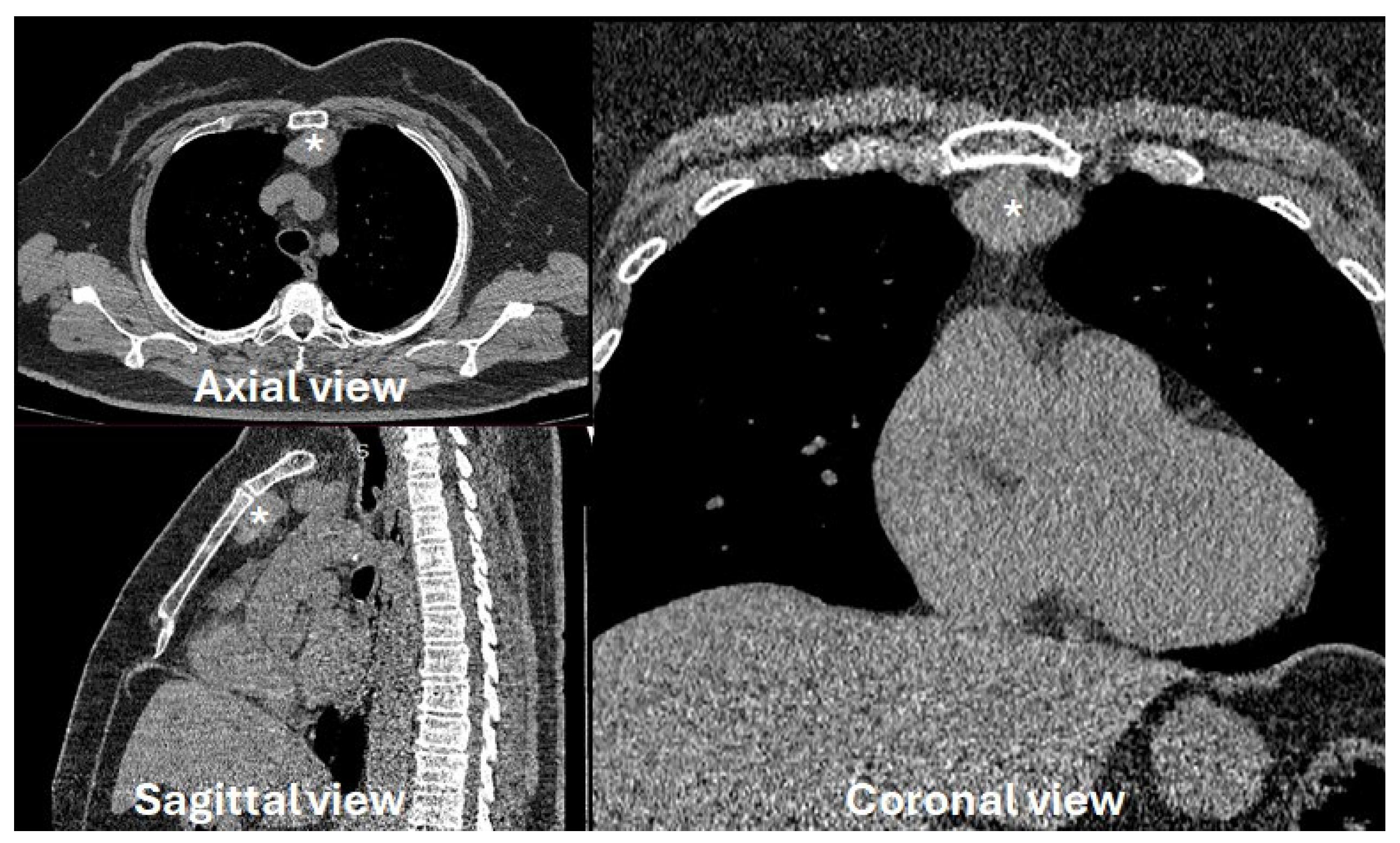
This procedure was applied in three consecutive patients to repair a defect in the contralateral pleura that occurred during RATS thymectomy for the management of thymoma. The three cases of pleural defect closure occurred in the early phase of our RATS thymectomy experience, which currently includes 60 procedures. In all cases, the tumor was discovered during the assessment of a persistent cough. Patients did not have neuromuscular symptoms and blood tests did not show autoantibodies for myasthenia gravis. At the fluorodeoxyglucose-positron emission tomography/computed tomography scan (PET/CT scan), the tumor had a mean size of 35 ± 5 mm, a mean standardized uptake value (SUV) of 2.7 ± 0.5, and was lateralized on the left side (Figure 1). No fine-needle biopsy of the lesion was performed. Following multidisciplinary board discussion, RATS radical thymectomy using a left-sided approach was recommended.
The authors obtained signed authorization from all patients to publish the information disclosed in this study. The clinical data are only available on request due to privacy reasons.

2.1. Surgical Technique

In all cases, the operation was performed using the da Vinci Xi robot system under general anesthesia and single-lung ventilation. The patient was positioned at a 30° angle using a bean bag; their left arm was parallel to the bed while their right arm was oriented along their body to expose the axillary region. A standard three-port approach was used with the three trocars placed between the third and fifth intercostal space and between the midaxillary and midclavicular lines. Three robotic arms were used. The left-arm hand (Arm 1) was equipped with fenestrated bipolar forceps, the right-arm hand (Arm 3) with Maryland bipolar forceps, and Arm 2 with the camera. No assistant access was used and CO2 was insufflated during the entire procedure at 8 mmHg and 20 mL/min flow.
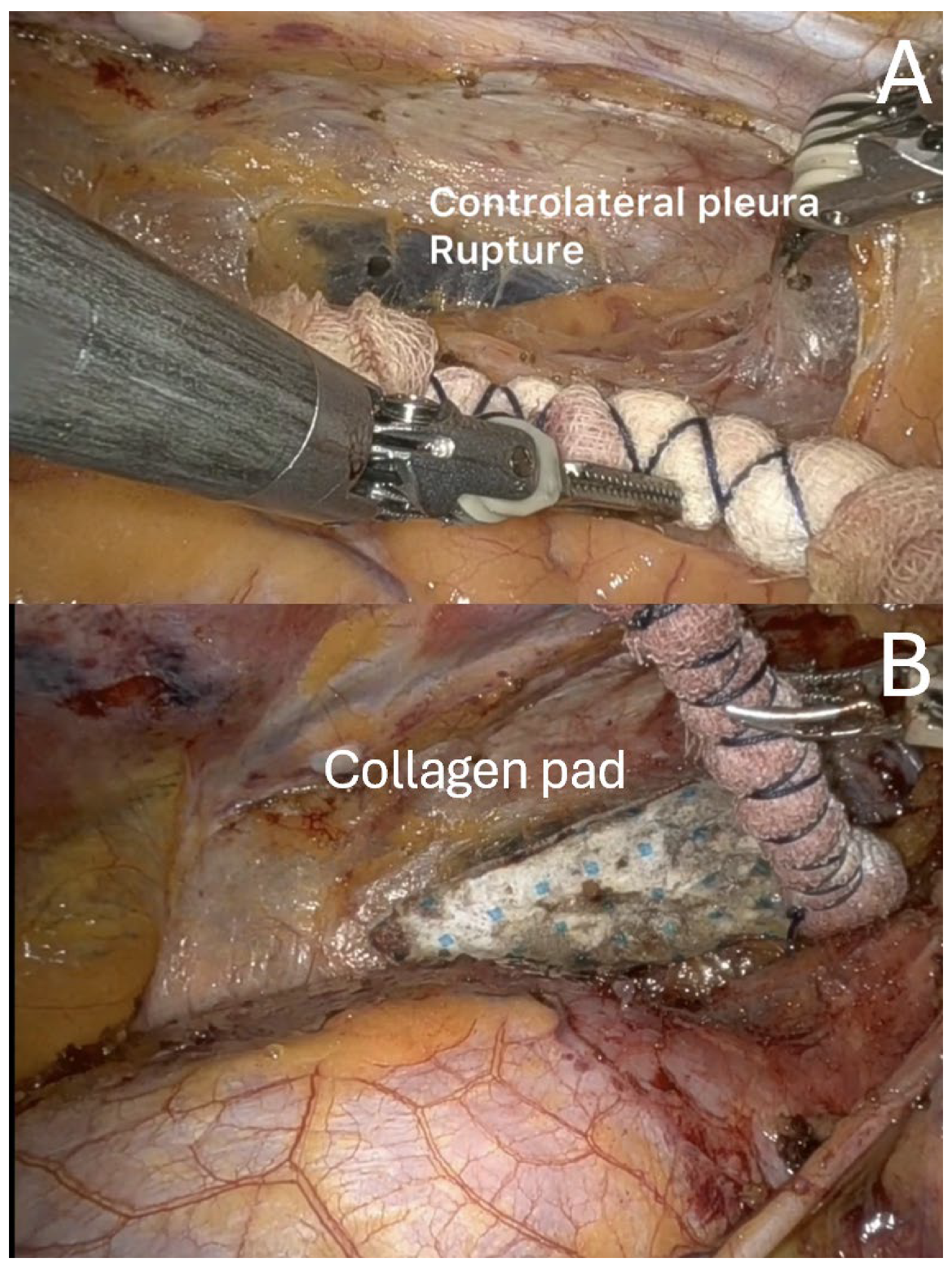
The resection started as inferiorly as possible with the removal of pericardiophrenic fatty tissue and proceeded upward along the anterior bord of the phrenic nerve. The left inferior horn of the thymus was dissected from the pericardium; the thymic gland was then separated from the retrosternal area until the right inferior horn and right mediastinal pleura were found. The dissection was made with the Maryland forceps, and during this maneuver, the contralateral pleura was opened (Figure 2A).
The lower portion of the thymus was raised upward, the left innominate vein was found, and the dissection continued along its border up to the neck; the superior horns were then localized and divided from the inferior portion of the thyroid gland. During the dissection, the thymic veins were identified and resected. After complete dissection of the upper poles, the specimen was fully free and retracted caudally to complete the en-bloc resection of the thymoma and fatty mediastinal tissue. During the procedure, a defect was identified in the upper mediastinal pleura, with a diameter ranging between 4 and 6 mm. This breach triggered no adverse physiological shifts, with SpO2, ETCO2, and airway pressures remaining stable. Upon discovery, CO2 insufflation was reduced.
The pleural defect was closed by applying Hemopatch® (Figure 2B, Video S1); the pad size selected was 45 × 90 mm in one case and 45 × 45 in two cases. In all cases, a minimum margin overlap of 1 cm was achieved with the pad. CO2 insufflation was then restored. Arm 1 was extracted, and the pad was rolled up with forceps and delivered into the chest through the port. It was then applied to the defect and held against it with a sponge under gentle pressure for 2 min to permit adhesion. After closing the defect, CO2 insufflation was restored to verify the integrity of the seal, ensuring that no clinically relevant pneumothorax occurred, and subsequently the specimen was placed in an Endobag and retrieved through the camera trocar, which was enlarged if necessary. A single 28 Fr drainage was then positioned in the anterior mediastinum, the lung inflated, and other wounds closed. The patient was extubated and then transferred to the ward.

2.2. Tips and Pitfalls

For successful defect closure, maintaining a dry surgical field is essential; excess fluid can compromise the adhesive properties of the pad. Correct orientation is equally critical: the active side must be placed directly onto the pleura with the blue dotted side facing upwards. To ensure a robust seal and effective hemostasis, gentle, uniform pressure should be applied using a dry sponge for 2 min. A primary pitfall is inadequate coverage; the pad must overlap the defect margins by 1–2 cm, making the selection of an appropriate size crucial. Failure typically occurs if the field is too wet, the orientation is reversed, or the overlap is insufficient to withstand CO2 pressure, potentially allowing CO2 to escape into the contralateral pleura.

3. Results

The procedure was completed in 137 ± 2.5 min. No intraoperative or postoperative complication occurred (Table 1). In all cases, the chest drainage was removed on postoperative day 1 and the patient discharged on postoperative day 2. Histological diagnosis was B1 thymoma in two cases and B2 thymoma in one case: Masaoka Stage I in two cases and Masaoka Stage II in one. Six-month follow-up showed no recurrence.

4. Discussion

Thymectomy is the mainstay of treatment for early-stage thymic tumor in patients fit for surgery. The extent of resection is still debated and depends on the presence of thymoma with or without myasthenia gravis. Generally, removal of the thymus and surrounding fatty tissue of the mediastinum and the neck is indicated in non-myasthenic thymoma patients, as in our cases, while extended bilateral thymectomy by opening both pleural cavities is recommended in myasthenic thymoma patients [4,5]. Several papers and meta-analyses [1,2,3] showed that video-assisted thoracoscopic surgery (VATS) and/or RATS thymectomy were associated with fewer complications, shorter hospital stay, and higher acceptance of surgery in comparison to traditional open approaches. In the future, RATS thymectomy is expected to become the standard thymectomy procedure due to the several advantages over VATS, such as high-resolution 3D vision, a reduction in hand tremors, and 360-degree articulation of surgical instruments.
Although RATS allows for precise dissection, the contralateral pleura may be accidentally opened during dissection of the thymus gland from the retrosternal area, as in our cases. The repair of small-sized defects could be deemed unnecessary, but we prefer to close such defects to prevent CO2 escaping through the defect into the contralateral pleura, resulting in right pneumothorax.
Similarly, some authors [6,7,8,9] reported CO2 tension pneumothorax occurring during laparoscopy due to congenital diaphragmatic defects or accidental diaphragmatic lesions, resulting in acute respiratory failure managed by prompt insertion of chest drainage.
In addition to this, pneumothorax and tension pneumothorax occur in approximately 1–3% of patients following RATS thymectomy, representing a known postoperative complication [10]. Abd-Elsayed et al. reported the rare occurrence of bilateral pneumothorax following right subclavian catheter insertion after thymectomy in a myasthenic patient that was attributed to the possible accidental communication between the two pleural spaces [11].
While our standard approach to pleural repair involves sutures or clips, these techniques can be technically demanding during RATS due to the fragility of the pleural tissue. Consequently, we opted to utilize Hemopatch®. It is typically used for controlling bleeding and air leaks in several types of thoracic procedures [9], but no authors, before the present study, have used it for this scope. Hemopatch® consists of a bovine-derived collagen pad; the active side (white color) is coated with a thin layer of reactive pentaerythritol polyethylene glycol ether tetrasuccinimidyl glutarate (NHS-PEG), while the nonactive side is marked with blue squares. For the success of the procedure, the active side was placed directly onto the pleura and the blue dotted side facing upwards. Then, gentle and uniform pressure was applied to the pad using a dry sponge for 2 min to seal tissue surface. In this way, the pad formed a barrier that blocked the escape of CO2 into the contralateral pleural and assured a hemostatic effect, if needed. The pad should have a 1–2 cm margin overlap on the pleural defect; thus, the choice of appropriate size was crucial. Moreover, the trocar was cleaned and dried to aid in the application of the pad and prevent any pad damage.
Some limitations of our initial experience are the small number of patients included, stemming from the rare occasion of accidental pleural opening, the cost of the pad, ranging between 140 and 240 euros depending on the size, and the additional time required to place the pad. This technique may be employed in a selected pool of patients to overcome cost limitations.

5. Conclusions

Our preliminary experience suggests that a collagen pad is a feasible and safe option for repairing incidental pleural defects during RATS thymectomy when the surgeon deems closure necessary. Future research involving larger cohorts is required to establish its comparative advantage and cost–benefit ratio over other management strategies.

Supplementary Materials

The following supporting information can be downloaded at: https://www.mdpi.com/article/10.3390/surgeries7010033/s1, Video S1. The video shows the main steps of the robotic procedure, including the en-bloc resec-tion of the thymoma and fatty mediastinal tissue, and the repair of the pleura defect by applying Hemopatch®.

Author Contributions

Conceptualization, A.F.; methodology V.D.F.; software, F.C. (Francesca Capasso); validation, M.C.; formal analysis, V.D.F. and F.C. (Francesco Coppolino); investigation, M.C.; resources, G.L.; data curation, B.L. and F.C. (Francesco Coppolino); writing—original draft preparation, A.F.; writing—review and editing, B.L.; visualization, F.C. (Francesco Coppolino); supervision, A.F. All authors have read and agreed to the published version of the manuscript.

Funding

This research received no external funding.

Institutional Review Board Statement

The study was conducted in accordance with the Declaration of Helsinki, and approved by the Institutional Review Board “Comitato etico territoriale Campania 2 (protocol code 27317/2024, 30 October 2024).

Informed Consent Statement

Informed consent was obtained from all subjects involved in the study.

Data Availability Statement

The data presented in this study are available on reasonable request from the corresponding author.

Conflicts of Interest

The authors declare no conflicts of interest.

References

  1. Salfity, H.V.; Timsina, L.; Ceppa, D.P.; Birdas, T.J. Minimally invasive surgery in the management of resectable thymoma: A retrospective analysis from the National Cancer Database. J. Thorac. Dis. 2021, 13, 6353–6362. [Google Scholar] [CrossRef] [PubMed]
  2. Falkson, C.B.; Bezjak, A.; Darling, G.; Gregg, R.; Malthaner, R.; Maziak, D.E.; Yu, E.; Smith, C.A.; McNair, S.; Ung, Y.C.; et al. The management of thymoma: A systematic review and practice guideline. J. Thorac. Oncol. 2009, 4, 911–919. [Google Scholar] [CrossRef] [PubMed]
  3. Burt, B.M.; Yao, X.; Shrager, J.; Antonicelli, A.; Padda, S.; Reiss, J.; Wakelee, H.; Su, S.; Huang, J.; Scott, W. Determinants of Complete Resection of Thymoma by Minimally Invasive and Open Thymectomy: Analysis of an International Registry. J. Thorac. Oncol. 2017, 12, 129–136. [Google Scholar] [CrossRef] [PubMed]
  4. Fiorelli, A.; Natale, G.; Freda, C.; Santini, M. Is thymomectomy equivalent to complete thymectomy in non-myasthenic patients with early-stage thymoma? Interact. Cardiovasc. Thorac. Surg. 2019, 28, 399–403. [Google Scholar] [CrossRef] [PubMed]
  5. Tassi, V.; Ceccarelli, S.; Zannori, C.; Gili, A.; Daddi, N.; Bellezza, G.; Ascani, S.; Liberati, A.M.; Puma, F. Could thymomectomy be a reasonable option for non-myasthenic thymoma patients? J. Thorac. Dis. 2017, 9, 3817–3824. [Google Scholar] [CrossRef] [PubMed]
  6. Chae, M.S.; Kwak, J.; Roh, K.; Kim, M.; Park, S.; Choi, H.J.; Park, J.; Shim, J.W.; Lee, H.M.; Kim, Y.S.; et al. Pneumoperitoneum-induced pneumothorax during laparoscopic living donor hepatectomy: A case report. BMC Surg. 2020, 20, 206. [Google Scholar] [CrossRef] [PubMed]
  7. Park, H.J.; Kim, D.K.; Yang, M.K.; Seo, J.E.; Kwon, J.H. Carbon dioxide pneumothorax occurring during laparoscopy-assisted gastrectomy due to a congenital diaphragmatic defect: A case report. Korean J. Anesthesiol. 2016, 69, 88–92. [Google Scholar] [CrossRef] [PubMed]
  8. Wahba, R.W.; Tessler, M.J.; Kleiman, S.J. Acute ventilatory complications during laparoscopic upper abdominal surgery. Can. J. Anaesth. 1996, 43, 77–83. [Google Scholar] [CrossRef] [PubMed]
  9. Lombardo, C.; Lopez-Ben, S.; Boggi, U.; Gutowski, P.; Hrbac, T.; Krska, L.; Marquez-Rivas, J.; Russello, D.; York, E.; Zacharias, M. Hemopatch® is effective and safe to use: Real-world data from a prospective European registry study. Updates Surg. 2022, 74, 1521–1531. [Google Scholar] [CrossRef] [PubMed]
  10. Comacchio, G.M.; Schiavon, M.; Zirafa, C.C.; De Palma, A.; Scaramuzzi, R.; Meacci, E.; Bongiolatti, S.; Monaci, N.; Lyberis, P.; Novellis, P.; et al. Robotic thymectomy in thymic tumours: A multicentre, nation-wide study. Eur. J. Cardiothorac. Surg. 2024, 65, ezae178. [Google Scholar] [CrossRef] [PubMed]
  11. Abd-Elsayed, A.A.; Ghaly, T.; Farag, E.; Esa, W.A.S. Bilateral pneumothoraces following a right subclavian catheter insertion after thymectomy for a patient with a myasthenic crisis. Ochsner J. 2013, 13, 256–258. [Google Scholar] [PubMed]
Figure 1. Multiplanar CT scan reconstruction showing a 35 mm left thymoma (*) in a 49-year-old non-myasthenic female patient.
Surgeries 07 00033 g001
Figure 2. Intraoperative view showing pleural defect (A) successfully closed through application of Hemopatch® (B).
Surgeries 07 00033 g002
Table 1. Characteristics of study population.
VariablesPatient 1Patient 2Patient 3
Age (years old)414967
SexFemaleFemaleMale
Co-morbidityNone NoneHypertension
Tumor size (mm)40 3530
SUV2.93.52.1
Histology B1 thymomaB2 thymomaB1 thymoma
Masaoka StageIIII
Operative time (minutes)138140135
Chest drainage output (mL)200150100
Duration of chest drainage (day)111
Length of hospital stay (day)222
Disclaimer/Publisher’s Note: The statements, opinions and data contained in all publications are solely those of the individual author(s) and contributor(s) and not of MDPI and/or the editor(s). MDPI and/or the editor(s) disclaim responsibility for any injury to people or property resulting from any ideas, methods, instructions or products referred to in the content.