
Analysis of the Outcomes Studied in the Application of Invasive and Non-Invasive Vagus Nerve Stimulation in Clinical and Preclinical Studies Involving Stroke—A Scoping Review
 , and
, and
Abstract
1. Introduction
2. Materials and Methods
2.1. Search Strategy
2.2. Eligibility Criteria
2.3. Data Selection and Extraction Procedure
3. Results
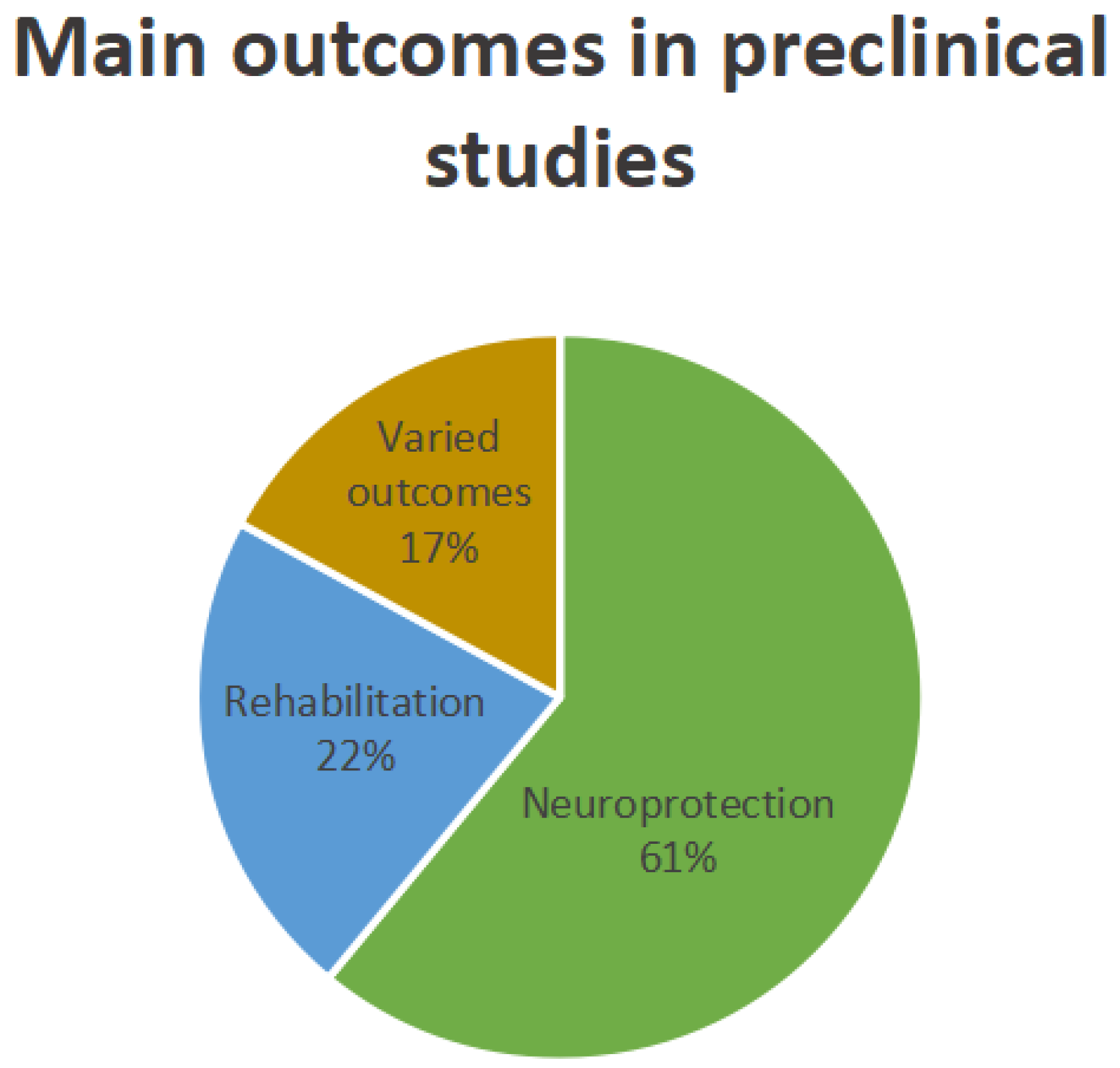
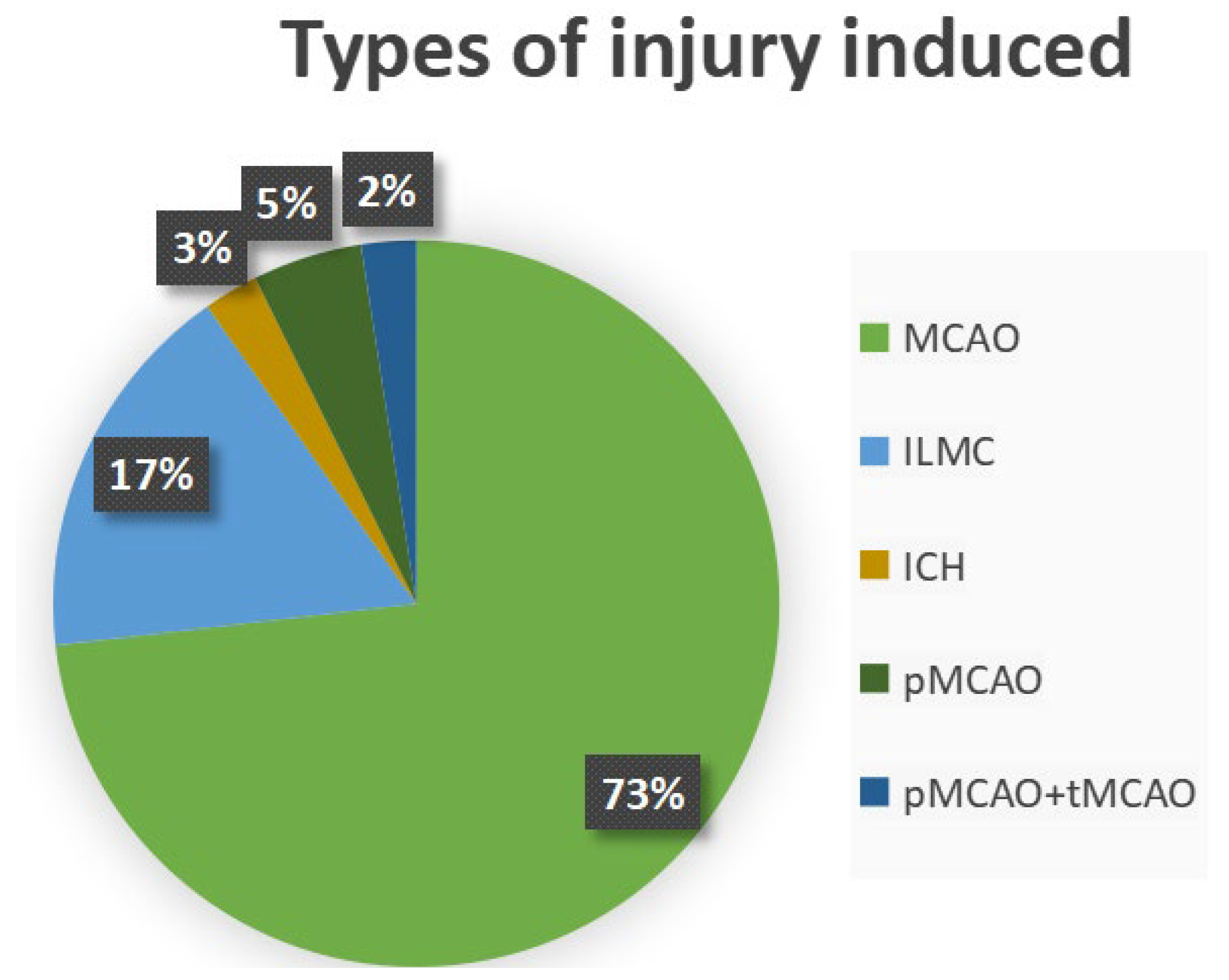
3.1. Overall Characteristics of the Experimental Studies

| Author/Year | Injury/Sample | Time-Point of Intervention | Intervention | Outcomes/Results |
|---|---|---|---|---|
| taVNS | ||||
| Wang et al., 2025 [18] | MCAO n = 48 male C57BL/6N | Hyperacute stroke | Intensity: 0.2 mA Frequency: 2/15 Hz Duration: 30 min daily for 3 days | To verify the effects of taVNS on cardiac dysfunction. Result: significant. |
| Ay et al., 2015 [20] | MCAO n = 31 males Wistar | Hyperacute stroke | Intensity: 0.5 mA Frequency: 20 Hz Duration: 1 h | To determine whether taVNS activated the same vagal nuclei activated by the gold standard cVNS and whether this was associated with a reduction in infarct volume and improvement in functional outcomes. Result: significant. |
| Li et al., 2020 [47] | MCAO n = 64 male SD | Hyperacute stroke | Intensity: 0.5 mA Frequency: 20 Hz Duration: 1 h | To investigate the effects of taVNS on axonal plasticity through the activation of α7nAChR in animal models of stroke. Results: significant. |
| Zhao et al., 2022 [48] | MCAO n = 48 male SD | Hyperacute stroke | Intensity: 1.0 mA Frequency: 10 Hz Duration: 30 min daily for 7 days | To evaluate the effects of taVNS on inflammation in the ischemic penumbra and motor cortex, expression and phosphorylation of Cx43, and neurological function in animal models of stroke. Result: significant. |
| Li et al., 2020 [49] | MCAO n = 72 males SD | Hyperacute stroke | Intensity: 0.5 mA Frequency: 20 Hz Duration: 1 h | To investigate whether PPAR-γ was involved in the pro-angiogenic activity induced by taVNS and its mechanism after ischemic brain injury. Results: significant. |
| Ma et al., 2016 [50] | MCAO n = 218 males SD | Hyperacute stroke | Intensity: 0.5 mA Frequency: 20 Hz Duration: 1 h | To investigate the effects of taVNS on the expression of GDF11 in the spleen, plasma, and peri-infarct cerebral cortex, and its receptor ALK5. Results: significant. |
| Jiang et al., 2016 [51] | MCAO n = 224 males SD | Hyperacute stroke | Intensity: 0.5 mA Frequency: 20 Hz Duration: 1 h daily for 21 days | To investigate the effects of taVNS on functional recovery, neovascularization, and the expression of pro-angiogenic mediators. Results: significant. |
| Wu et al., 2018 [52] | MCAO n = 70 males SD | Acute stroke | Intensity: 0.8 mA Frequency: 15 Hz Duration: 1 h daily for 5 days | To verify the effects of taVNS on cognitive impairment resulting from stroke and the role of the non-neuronal cholinergic system in the management of acetylcholine release and reuptake. Results: significant. |
| Gong et al., 2025 [53] | MCAO n = 10 male C57BL/6J | Acute stroke | Intensity: 1.0 mA Frequency: 20 Hz Duration: 30 min for 5 days | To investigate the effects of taVNS on the temporal dynamics and mitigation of ferroptosis and neurological recovery. Results: significant. |
| Long et al., 2022 [54] | MCAO n = 65 SD | Not specified | Intensity: 2.0 mA Frequency: 20 Hz Duration: 30 min daily for 3 weeks | To investigate the effects of taVNS on dysphagia symptoms and white matter damage in animals with dysphagia after ischemic stroke. Results: significant. |
| tcVNS | ||||
| Ay et al., 2016 [19] | MCAO n = 54 males | Hyperacute stroke in spontaneously hypertensive rats | 1 msec duration, 5 kHz, 12 V sine waves repeated at 25 Hz. Duration: 1 h. | To explore the safety and efficacy of a non-invasive tcVNS approach using surface electrodes applied to the skin overlying the vagus nerve in the neck in a model of MCAO in rats. Result: significant. |
| Yang et al., 2022 [55] | tMCAO n = 32 males | Hyperacute stroke in spontaneously hypertensive rats | 1 ms pulses width of 5 kHz sinewaves, repeated at 25 Hz, at an average voltage of 15 V. Duration: 45 min. | To verify the hypothesis that nVNS reduced neuron-derived IL-1β and neuroinflammation in acute ischemia, using a SHR model of MCAO/RP. Result: significant. |
| Yang et al., 2018 [56] | MCAO n = 32 males | Hyperacute stroke in spontaneously hypertensive rats | 1 msec pulses width of 5 kHz sinewaves, repeated at 25 Hz, at an average voltage of 15 V. Duration: 45 min. | To investigate the effects of nVNS on the reduction in ischemic infarct size, associated with the protection of the blood–brain barrier. Result: significant. |
| Zhao et al., 2019 [57] | MCAO n = 20 males C57BL/6 | 24 h before MCAO | 1 ms pulses, width of 5 kHz sinewaves, repeated at 25 Hz, with an average voltage of 15 V Duration: 1 h. | To investigate the effects of VNS on reducing ischemia/reperfusion-induced injury and the M2 action of microglia through the inhibition of IL-17A expression. Results: significant. |
| iVNS | ||||
| Sun et al., 2012 [21] | tMCAO/pMCAO n = 32 males SD | Hyperacute stroke | Intensity: 0.5 mA Frequency: 20 Hz Duration: 1 h | To examine the effects of VNS on cerebral infarct volume and neuroprotection in animals exposed to pMCAO and tMCAO. Result: significant. |
| Liu et al., 2023 [22] | MCAO n = 96 males SD | Hyperacute stroke | Intensity: 0.5 mA Frequency: 20 Hz Duration: 1 h | To investigate whether VNS is a new potential therapeutic option for ischemic stroke and whether α7nAChR is associated with the VNS-mediated shift in the microglial phenotype after ischemic brain injury. Result: significant. |
| Tang et al., 2022 [23] | MCAO n = 23 males SD | Hyperacute stroke | Intensity: 0.5 mA Frequency: 20 Hz Duration: 1 h | To verify the influence of α7nAChR on mediating the neuroprotection induced by VNS in inhibiting pyroptosis in ischemia–reperfusion brain injury. Result: significant. |
| Lu et al., 2017 [24] | pMCAO n = 108 males SD | Hyperacute stroke | Intensity: 0.5 mA Frequency: 20 Hz Duration: 1 h | To investigate the effects of VNS on neuroprotection by evaluating neurological function and infarct volume, and identify whether α7nAChR plays a role in VNS-mediated neuroprotection. Result: significant. |
| Jiang et al., 2015 [25] | MCAO n = 360 males SD | Hyperacute stroke | Intensity: 0.5 mA Frequency: 20 Hz Duration: 1 h | To examine the stimulation efficiency of VNS by measuring the expression of α7nAChR in neurons and astrocytes, and by determining neurological scores, infarct volume, and neuronal apoptosis. Also, to explore the molecular effects of miR-210 in the VNS response by assaying the levels of three oxidative stress markers and caspase 3 activity in ischemic stroke. Result: significant. |
| Tang et al., 2025 [26] | MCAO n = male SD | Hyperacute stroke | Intensity: 0.5 mA Frequency: 20 Hz Duration: 1 h | To verify the effects of VNS on the regulation of PANoptosis through Sirt1. Result: significant |
| Jiang et al. 2024 [27] | MCAO n = male C57BL/6 | Hyperacute stroke | Intensity: 0.5 mA Frequency: 20 Hz Duration: 1 h daily for 3 or 28 days | To evaluate the role of VNS in the secretion of Neuromedin U and its receptors on astrocytes and the regulation of A1/A2 polarization of astrocytes. Result: significant. |
| Wang et al. 2024 [28] | MCAO n = male SD | Hyperacute stroke | Intensity: adjusted Frequency: 15 Hz Duration: 20 min daily for 3 days | To investigate whether VNS can modulate mast cell degranulation via α7nAChRs or other pathways, causing damage to the blood–brain barrier and intestinal barrier. Result: significant. |
| Zhang et al., 2021 [29] | MCAO n = 150 males SD | Hyperacute stroke | Intensity: 0.5 mA Frequency: 20 Hz Duration: 1 h | To evaluate the effects of VNS on microglial polarization through the inhibition of the TLR4 pathway in microglia in ischemic stroke injury. Result: significant. |
| Zhang et al., 2016 [30] | MCAO n = 272 animals SD | Hyperacute stroke | Intensity: 0.5 mA Frequency: 20 Hz Duration: 1 h | To investigate the function of L-PGDS and its involvement in the anti-apoptotic activity induced by VNS. Result: significant. |
| Du et al., 2022 [31] | MCAO n = 80 males C57BL/6J | Hyperacute stroke | Intensity: 1.0 mA Frequency: 5 Hz Duration: 10 min daily for 5 days | To evaluate the protective effect of VNS on cerebral ischemic injury by analyzing changes in proteins and signaling pathways. Result: significant. |
| Ekıcı et al., 2013 [32] | MCAO n = 21 males Wistar | Hyperacute stroke | Intensity: 1.0 mA Frequency: 20 Hz Duration: 30 min | To investigate the effects of VNS in ischemia–reperfusion injury by measuring infarct area and neurological scores, and to analyze oxidative stress markers. Result: significant. |
| Ay et al., 2011 [33] | MCAO n = 32 males Wistar | Hyperacute stroke | Intensity: 0.5 mA Frequency: 20 Hz Duration: 1 h | To explore whether infarct-reducing effect of VNS is mediated by an increase in cerebral blood flow. Result: non-significant. |
| Lindemann et al., 2020 [58] | pMCAO n = male Wistar | Hyperacute stroke | Intensity: 0.5 mA Frequency: 25 Hz Duration: 1 h | To determine the effects of VNS (invasive and non-invasive) on inhibiting spreading depolarization in animal models of focal ischemia. Result: significant. |
| Hiraki et al., 2012 [34] | MCAO n = 28 males SD | Hyperacute stroke | Intensity: 0.5 mA Frequency: 20 Hz Duration: 1 h | To investigate the effect of VNS on infarct volume and neurological recovery up to three weeks following transient focal cerebral ischemia. Results: significant. |
| Jiang et al., 2015 [35] | MCAO n = 160 males SD | Hyperacute stroke | Intensity: 0.5 mA Frequency: 20 Hz Duration: 1 h | To investigate the role of endogenous PPAR-γ in anti-inflammatory actions induced by VNS during reperfusion after stroke, a mechanism thought to reduce neuronal injury in the brain. Results: significant. |
| Liu et al., 2016 [36] | MCAO n = 34 males SD | Hyperacute stroke | Intensity: 1.0 mA Frequency: 20 Hz Duration: 10 min | To analyze the contribution of VNS in the recovery of learning and memory after I/R injury and the involved mechanisms. Results: significant. |
| Xie et al., 2023 [37] | MCAO n = 200 mice | Hyperacute/acute stroke | Intensity: 0.5 mA Frequency: 5 Hz Duration: 1 h for 3 days | To hypothesize that VNS achieves cerebral protection by influencing NF-kB-related neuroinflammation via USP10 regulation. To clarify the protective effects of VNS following ischemic stroke and explore the underlying mechanisms. Result: significant. |
| Tan et al. 2024 [38] | MCAO n = 60 SPF-grade male SD | Acute stroke | Intensity: adjusted Frequency: 15 Hz Duration: 30 min daily for 7 days | To analyze the effects of VNS on myocardial atrophy. Results: significant. |
| Hays et al., 2016 [39] | ILMC n = 344 rats | Acute stroke | Intensity: 0.8 mA Frequency: 30 Hz Duration: 5 weeks | To evaluate the effects of VNS paired with rehabilitation training on improving forelimb function in animals with ischemic injury aged at least 18 months. Results: significant. |
| Khodaparast et al. 2014 [40] | ILMC n = 17 female SD | Acute stroke | Intensity: 0.8 mA Frequency: 30 Hz Duration: 25 days | To evaluate whether the addition of VNS to motor rehabilitation can enhance recovery from cortical ischemia. Results: significant. |
| Meyers et al., 2018 [41] | ILMC n = 19 females SD | Acute stroke | Intensity: 0.8 mA Frequency: 30 Hz Duration: 6 weeks | To test whether ENV could promote generalization, lasting recovery, and structural plasticity in motor networks. Results: significant. |
| Khodaparast et al., 2013 [42] | ILMC n = 19 females SD | Acute stroke | Intensity: 0.8 mA Frequency: 30 Hz Duration: Fifty sessions, 30 min each session | To evaluate whether the delivery of VNS during rehabilitative training can enhance recovery of forelimb strength in a model of ischemic stroke. Results: significant. |
| Hays et al., 2014 [43] | ILMC n = 32 females SD | Acute stroke | Intensity: 0.8 mA Frequency: 30 Hz Duration: 25 days | To test the effectiveness of different stimulation paradigms to restore forelimb strength after ischemic lesion of the motor cortex in rats. Results: significant. |
| Hays et al., 2014 [44] | ICH n = 26 females SD | Acute stroke | Intensity: 0.8 mA Frequency: 30 Hz Duration: 5 weeks | To evaluate whether VNS paired with rehabilitative training can improve recovery of motor function beyond rehabilitative training without VNS in a rat model of ICH. Result: significant. |
| Pruitt et al. 2020 [46] | ILMC n = 32 females SD | Acute stroke | Intensity: 0.4, 0.8, and 1.6 mA Frequency: 30 Hz Duration: 5 weeks | To investigate the stimulation intensity to optimize motor function recovery in an animal model of ischemic stroke. Result: significant for moderate intensity. |
| Khodaparast et al., 2016 [45] | ILMC n = 29 females SD | Chronic stroke | Intensity: 0.8 mA Frequency: 30 Hz Duration: 5 weeks | To determine whether VNS-paired rehabilitative training enhances recovery of forelimb function when the therapy is initiated during the chronic phase after a combined cortical and subcortical ischemic stroke. Results: significant. |
3.2. Effects of VNS on Neuroprotection After Stroke
3.2.1. Nicotinic Acetylcholine Receptor (α7nAChR)
3.2.2. Neuroinflammatory Mechanisms
3.2.3. Cerebral Infarct Volume
3.2.4. Pro-Angiogenesis
3.3. Effects of VNS on Motor, Functional, or Cognitive Rehabilitation
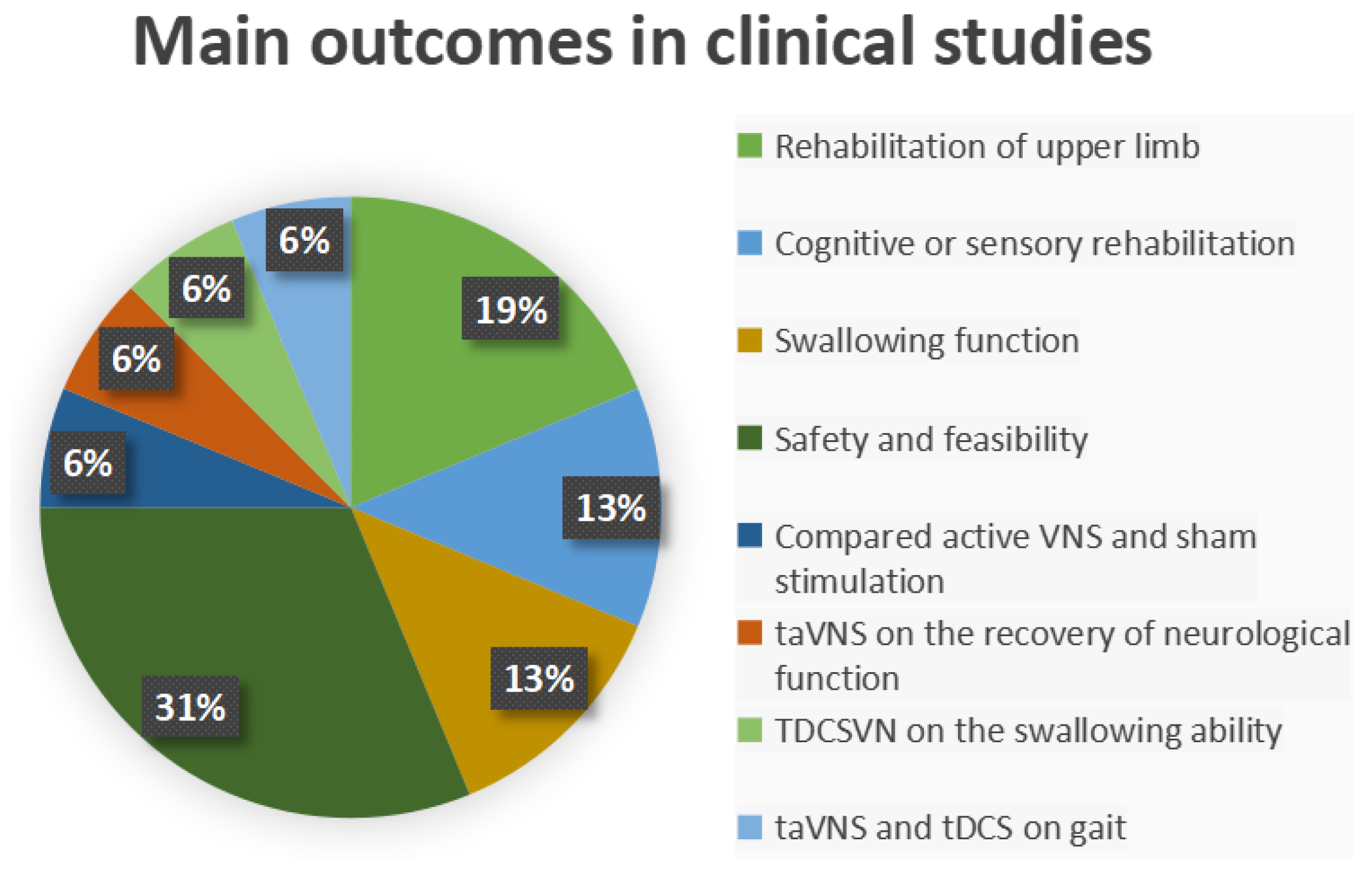
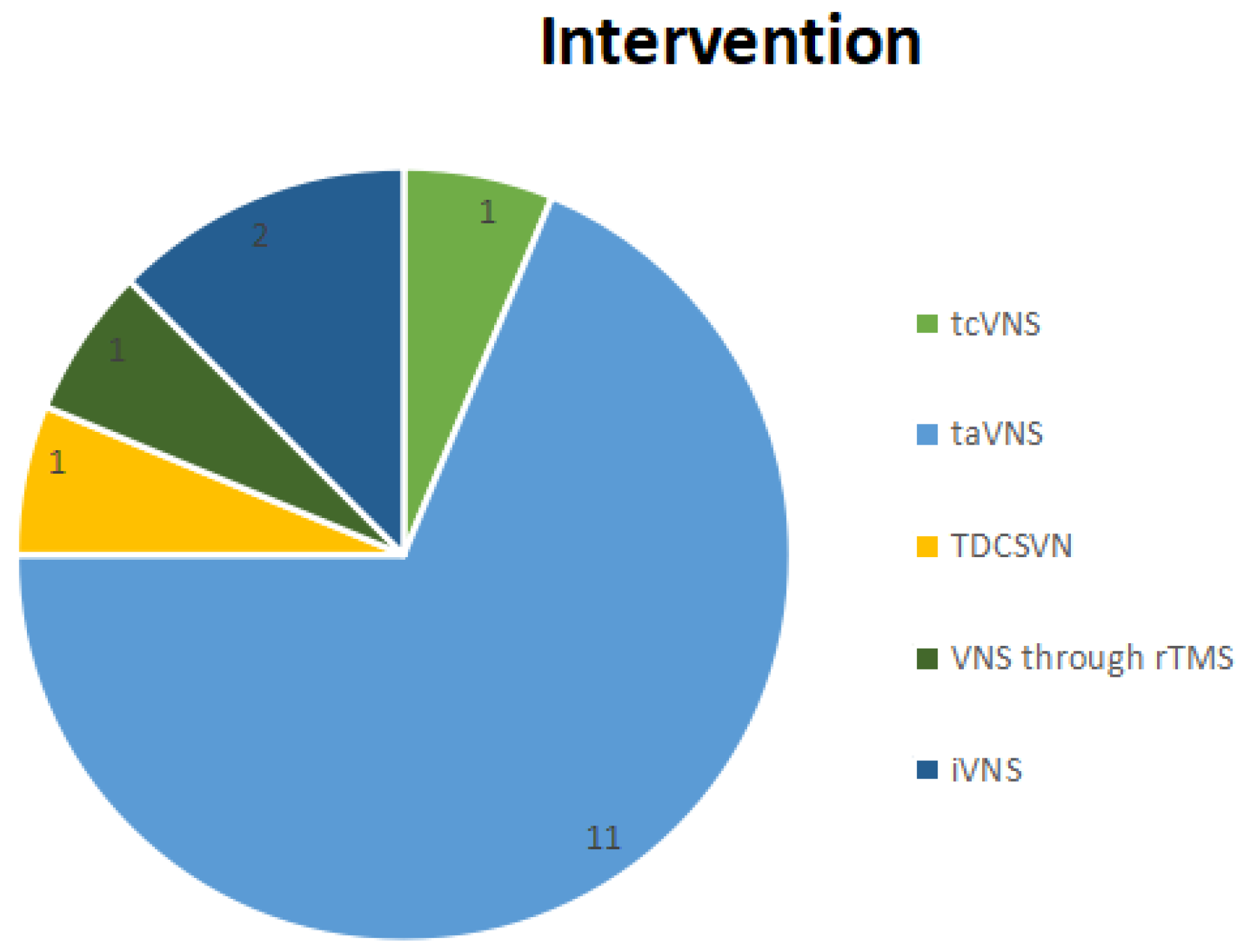
3.4. Overall Characteristics of the Clinical Studies
| Author/Year | Study Design | Time-Point of Intervention | Outcomes/Results |
|---|---|---|---|
| tcVNS | |||
| Arsava et al. 2022 [68] | Randomized, sham-controlled, open-label, multicenter trial | Hyperacute stroke | Safety and feasibility of nVNS when delivered immediately after confirmed imaging diagnosis of acute stroke, within 6 h of symptom onset. Results: significant. |
| taVNS | |||
| Li et al. 2022 [64] | Two-group, pragmatic, double-blinded, randomized controlled trial | Subacute stroke | Motor and sensory functions and emotional response. Results: significant. |
| Wang et al. 2024 [74] | Double-blind, randomized controlled clinical trial | Subacute stroke | Gait of subacute post-stroke individuals. Results: significant. |
| Liu et al. 2024 [72] | Double-blind, randomized, placebo-controlled trial | Subacute stroke | Level of depression; daily life function; and serum levels of CREB1, BDNF, and 5-HT. Results: significant. |
| Wang et al. 2022 [66] | Double-blind, prospective, randomized controlled clinical trial | Subacute stroke | Swallowing function in acute stroke patients. Results: significant. |
| Wu et al. 2020 [69] | Prospective, single-blinded, randomized controlled trial | Subacute stroke | Efficacy and safety of taVNS in the recovery of upper limb motor function. Results: significant. |
| Wang et al., 2024 [59] | Double-blinded, randomized, controlled pilot trial | Subacute stroke | Upper extremity function. Results: significant. |
| Zhang et al., 2025 [62] | Prospective randomized controlled clinical trial | Subacute stroke | Central nervous system remodeling and neurological function recovery. Results: significant. |
| Yan et al., 2025 [67] | Prospective randomized controlled clinical trial | Subacute stroke | Swallowing dysfunction and assessment of serum levels of IL-1β and IL-8. Results: significant. |
| Capone et al., 2017 [61] | Double-blind, semirandomized, sham-controlled trial | Chronic stroke | Upper limb in chronic stroke. Results: significant. |
| Chang et al., 2021 [60] | Double-blind, sham-controlled, repeated measures trial | Chronic stroke | Upper limb motor function. Results: significant. |
| Colombo et al., 2023 [63] | Single session, single-blind, sham-controlled study with a within-subject design | Not specified | Upper limb motor function and cognitive function in individuals with stroke. Results: significant to motor function, non-significant to cognitive function. |
| TDCSVN | |||
| Kimberley et al., 2018 [70] | Randomized, sham stimulation-controlled, fully blinded trial | Chronic stroke | Safety, feasibility, and efficacy of VNS combined with upper limb rehabilitation. Results: significant. |
| VNS through rTMS | |||
| Lin et al., 2018 [65] | Sham-controlled, double-blinded parallel study | Chronic stroke | Swallowing function in patients with stroke involving the brainstem. Results: significant. |
| iVNS | |||
| Dawson et al., 2016 [71] | Randomized open active comparator study with blinded objective end point assessment | Chronic stroke | Upper limb motor function. Results: significant. |
| Dawson et al., 2021 [73] | Pivotal, randomized, blinded, controlled trial | Chronic stroke | Upper limb motor function. Results: significant. |
| Author/Year | Age of Participants | Gender | Duration of Disease | |||||||||
|---|---|---|---|---|---|---|---|---|---|---|---|---|
| tcVNS | ||||||||||||
| Arsava et al., 2022 [68] | tcVNS 71 ± 14 | Sham 71 ± 11 | F(17); M(27) | Symptom onset time within 6 h | ||||||||
| taVNS | ||||||||||||
| Li et al., 2022 [64] | taVNS 69.2 ± 12.3 | taVNS sham + Rehab 68.3 ± 12.1 | taVNS F(50); M(15) | taVNS sham + Rehab F(47); M(14) | taVNS 10.8 ± 7.7 days | taVNS sham + Rehab 10.4 ± 6.9 days | ||||||
| Wang et al., 2024 [74] | tDCS 63.16 (5.75) | taVNS 60.82 (6.19) | taVNS + tDCS 61.54 (5.78) | Control 61.94(3.28) | tDCS F(24); M(18) | taVNS F(23); M(21) | taVNS + tDCS F(21); M(22) | Control F(23); M(17) | tDCS 20.05 (4.28) days | taVNS 19.24 (5.83) days | taVNS + tDCS 18.98 (4.56) days | Control 18.89 (5.17) days |
| Liu et al., 2024 [72] | taVNS 64.3 (10.1) | taVNS sham 62.6 (9.2) | taVNS F(18); M(22) | taVNS sham F(15); M(25) | taVNS 17.3(7.1) days | taVNS sham 18.4(6.8) days | ||||||
| Wang et al., 2022 [66] | taVNS 60.26 ± 5.65 | taVNS sham 58.25 ± 6.86 | taVNS F(10); M(9) | taVNS sham F(12); M(8) | taVNS 22.00 ± 3.35 days | taVNS sham 23.70 ± 2.95 days | ||||||
| Wu et al., 2020 [69] | taVNS 64.50 ± 9.97 | taVNS sham 61.82 ± 10.63 | taVNS F(5); M(5) | taVNS sham F(3); M(8) | taVNS 36.30 ± 9.23 days | taVNS sham 35.55 ± 6.47 days | ||||||
| Wang et al., 2024 [59] | VNS 55(11) | VNS sham 57(11) | VNS F(2); M(18) | VNS sham F(5); M(15) | VNS 3.20(2.04) months | VNS sham 4.15(1.60) months | ||||||
| Zhang et al., 2025 [62] | tVNS + Rehab 62.67 ± 7.34 | Rehab 61.59 ± 7.87 | tVNS + Rehab F(25); M(38) | Rehab F(25); M(36) | tVNS + Rehab 4.28 ± 1.46 months | Rehab 4.22 ± 1.38 months | ||||||
| Yan et al., 2025 [67] | TDCSVN ≤60 y: 26 >60 y: 30 | Rehab ≤60 y: 28 >60 y: 29 | TDCSVN F(18); M(38) | Rehab F(21); M(36) | Within 3 months after the stroke | |||||||
| Capone et al., 2017 [61] | tVNS 53.71 ± 5.88 | tVNS sham 55.60 ± 7.12 | tVNS F(3); M(4) | tVNS sham F(2); M(3) | tVNS 93.71 ± 38.81 months | tVNS sham 46.00 ± 21.85 months | ||||||
| Chang et al., 2021 [60] | 59.02 ± 1.98 | F(18); M(18) | 2.16 ± 0.39 years | |||||||||
| Colombo et al., 2023 [63] | 45 to 79 | F(4); M(6) | Not specified | |||||||||
| TDCSVN | ||||||||||||
| Kimberley et al., 2018 [70] | VNS 59.5 ± 7.4 | Control VNS 60.0 ± 13.5 | VNS F(4); M(4) | Control VNS F(4); M(5) | VNS 18(11–43) months | Control VNS 18(6.3–53) months | ||||||
| VNS through rTMS | ||||||||||||
| Lin et al., 2018 [65] | rTMS real 68.5 ± 12.8 | rTMS sham 72.9 ± 12.2 | rTMS real F(1); M(12) | rTMS sham F(6); M(9) | rTMS real 25.2 ± 42.2 months | rTMS sham 21.6 ± 19.5 months | ||||||
| iVNS | ||||||||||||
| Dawson et al., 2016 [71] | VNS + Rehab 57.9 ± 17.2 | Rehab 60.7 ± 10.7 | VNS + Rehab F(2); M(7) | Rehab F(2); M(9) | VNS + Rehab 1.8 ± 1.0 year | Rehab 1.7 ± 1.3 year | ||||||
| Dawson et al., 2021 [73] | VNS 59.1 ± 10.2 | Control VNS 61.1 ± 9.2 | VNS F(34); M(19) | Control VNS F(36); M(19) | VNS 3.1 ± 2.3 years | Control VNS 3.3 ± 2.6 years | ||||||
| Author/Year | Intensity | Frequency | Duration |
|---|---|---|---|
| tcVNS | |||
| Arsava et al., 2022 [68] | adjusted (0 to 40) | 25 Hz | ? |
| taVNS | |||
| Li et al., 2022 [64] | 1.71 ± 0.5 mA | 20 Hz | 20 min for 20 sessions |
| Wang et al., 2024 [74] | Adjusted (tDCS: 2.0 mA 30 min/day) | 25 Hz | 30 min for 20 sessions |
| Liu et al., 2024 [72] | 1.82 ± 0.4 mA | 20 Hz | 45 min daily for 28 days |
| Wang et al., 2022 [66] | 1.83 ± 0.5 mA | 25 Hz | 30 min for 30 sessions in 15 days |
| Wu et al., 2020 [69] | adjusted | 20 Hz | 30 min daily for 15 days |
| Wang et al., 2024 [59] | 6.55 ± 1.57 mA | 25 Hz | 1 h for 20 sessions |
| Zhang et al., 2025 [62] | adjusted | 4 and 20 Hz | 30 min for 24 sessions |
| Yan et al., 2025 [67] | adjusted | 4 and 20 Hz | 30 min for 24 sessions |
| Capone et al., 2017 [61] | adjusted | 20 Hz | 10 sessions |
| Chang et al., 2021 [60] | 0.1 to 5.0 mA | 30 Hz | 9 sessions |
| Colombo et al., 2023 [63] | 0.8 mA | ? | 1 session |
| TDCSVN | |||
| Kimberley et al., 2018 [70] | 1 mA | 20 Hz | 20 sessions |
| VNS through rTMS | |||
| Lin et al., 2018 [65] | adjusted | 5 Hz | 10 sessions |
| iVNS | |||
| Dawson et al., 2016 [71] | 0.8 mA | 30 Hz | 18 sessions |
| Dawson et al., 2021 [73] | 0.6 to 1.0 mA | 30 Hz | 18 sessions |
4. Discussion
5. Conclusions
6. Limitations
Author Contributions
Funding
Data Availability Statement
Acknowledgments
Conflicts of Interest
References
- Carod-Artal, F.J. Determining quality of life in stroke survivors. Expert Rev. Pharmacoeconomics Outcomes Res. 2012, 12, 199–211. [Google Scholar] [CrossRef] [PubMed]
- Shi, K.; Tian, D.-C.; Li, Z.-G.; Ducruet, A.F.; Lawton, M.T.; Shi, F.-D. Global brain inflammation in stroke. Lancet Neurol. 2019, 18, 1058–1066. [Google Scholar] [CrossRef] [PubMed]
- Feigin, E.L.; Brainin, M.; Norrving, B.; Martins, S.; Sacco, R.L.; Hacke, W.; Fisher, M.; Pandian, J.; Lindsay, P. World Stroke Organizations (WSO): Global Stroke Fact Sheet 2022. Int. J. Stroke 2022, 17, 18–29. [Google Scholar] [CrossRef] [PubMed]
- Rajati, F.; Rajati, M.; Rasulehvandi, R.; Kazeminia, M. Prevalence of stroke in the elderly: A systematic review and meta-analysis. Interdiscip. Neurosurg. 2023, 32, 101746. [Google Scholar] [CrossRef]
- Wolf, P.A.; Kannel, W.B. Atrial fibrillation as an independent risk factor for stroke: The Framingham Study. Stroke 1991, 22, 8. [Google Scholar] [CrossRef]
- Lucas-Noll, J.; Clua-Espuny, J.L.; Lleixà-Fortuño, M.; Gavaldà-Espelta, E.; Queralt-Tomas, L.; Panisello-Tafalla, A.; Carles-Lavila, M. The costs associated with stroke care continuum: A systematic review. Health Econ. Rev. 2023, 13, 32. [Google Scholar] [CrossRef]
- Gittins, M.; Lugo-Palacios, D.; Vail, A.; Bowen, A.; Paley, L.; Bray, B.; Tyson, S. Stroke impairment categories: A new way to classify the effects of stroke based on stroke-related impairments. Clin. Rehabil. 2020, 35, 446–458. [Google Scholar] [CrossRef]
- Shahid, J.; Kashif, A.; Shahid, M.K. A Comprehensive Review of Physical Therapy Interventions for Stroke Rehabilitation: Impairment-Based Approaches and Functional Goals. Brain Sci. 2023, 13, 717. [Google Scholar] [CrossRef]
- Saway, B.F.; Palmer, C.; Hughes, C.; Triano, M.; Suresh, R.E.; Gilmore, J.; George, M.; Kautz, S.A.; Rowland, N.C. The evolution of neuromodulation for chronic stroke: From neuroplasticity mechanisms to brain-computer interfaces. Neurotherapeutics 2024, 21, e00337. [Google Scholar] [CrossRef]
- Komisaruk, B.R.; Frangos, E. Vagus nerve afferent stimulation: Projection into the brain, reflexive physiological, perceptual, and behavioral responses, and clinical relevance. Auton. Neurosci. Basic Clin. 2022, 237, 102908. [Google Scholar] [CrossRef]
- Chen, Z.; Liu, K. Mechanism and application of vagus nerve stimulation. Curr. Issues Mol. Biol. 2025, 47, 122. [Google Scholar] [CrossRef] [PubMed]
- Zhang, J.; Zhou, F.; Roberts, N.; Yuan, Q.; Wang, M.; Wu, G.; Yang, W.; Fu, P.; Wang, M.; Hu, J. Invasive or non-invasive vagus nerve stimulation modulation of brain function and remodeling after stroke: A review. Int. J. Surg. 2025, 111, 2148–2161. [Google Scholar] [CrossRef] [PubMed]
- FDA—Food and Drug Administration (2005) Summary of Safety and Effectiveness Data. Available online: https://www.accessdata.fda.gov/cdrh_docs/pdf/p970003s050b.pdf (accessed on 25 January 2024).
- Ben-Menachem, E.; Revesz, D.; Simon, B.J.; Silberstein, S.S. Surgically implanted and non-invasive vagus nerve stimulation: A review of efficacy, safety and tolerability. Eur. J. Neurol. 2015, 22, 1260–1268. [Google Scholar] [CrossRef] [PubMed]
- Yakunina, N.; Kim, S.S.; Nam, E. Optimization of Transcutaneous Vagus Nerve Stimulation Using Functional MRI. Neuromodulation Technol. Neural Interface 2017, 20, 290–300. [Google Scholar] [CrossRef]
- Badran, B.W.; Dowdle, L.T.; Mithoefer, O.J.; LaBate, N.T.; Coastworth, J.; Brown, J.C.; DeVries, W.H.; Austelle, C.W.; McTeague, L.M.; George, M.S. Neurophysiologic effects of transcutaneous auricular vagus nerve stimulation (taVNS) via electrical stimulation of the tragus: A concurrent taVNS/fMRI study and review. Brain Stimul. 2018, 11, 492–500. [Google Scholar] [CrossRef]
- Ouzzani, M.; Hammady, H.; Fedorowicz, Z.; Elmagarmid, A. Rayyan—A web and mobile app for systematic reviews. Syst. Rev. 2016, 5, 210. [Google Scholar] [CrossRef]
- Wang, W.; Wang, M.; Ma, C.; Zhang, Y.; Li, X.; Wei, Y.; Fu, X.; Zhang, L.; Liu, T.; Li, W. Transcutaneous auricular vagus nerve stimulation attenuates stroke-heart syndrome: The role of parasympathetic activity. Exp. Neurol. 2025, 385, 115094. [Google Scholar] [CrossRef]
- Ay, I.; Nasser, R.; Simon, B.; Ay, H. Transcutaneous Cervical Vagus Nerve Stimulation Ameliorates Acute Ischemic Injury in Rats. Brain Stimul. 2016, 9, 166–173. [Google Scholar] [CrossRef]
- Ay, I.; Napadow, V.; Ay, H. Electrical Stimulation of the Vagus Nerve Dermatome in the External Ear is Protective in Rat Cerebral Ischemia. Brain Stimul. 2015, 8, 7–12. [Google Scholar] [CrossRef]
- Sun, Z.; Baker, W.; Hiraki, T.; Greenberg, J.H. The effect of right vagus nerve stimulation on focal cerebral ischemia: An experimental study in the rat. Brain Stimul. 2012, 5, 1–10. [Google Scholar] [CrossRef]
- Liu, Y.; Wang, S.; Ma, J.; Yu, L.; Jia, G. Vagus nerve stimulation is a potential treatment for ischemic stroke. Neural Regen. Res. 2023, 18, 825–831. [Google Scholar] [CrossRef] [PubMed]
- Tang, H.; Li, J.; Zhou, Q.; Li, S.; Xie, C.; Niu, L.; Ma, J.; Li, C. Vagus nerve stimulation alleviated cerebral ischemia and reperfusion injury in rats by inhibiting pyroptosis via α7 nicotinic acetylcholine receptor. Cell Death Discov. 2022, 8, 54. [Google Scholar] [CrossRef] [PubMed]
- Lu, X.-X.; Hong, Z.-Q.; Tan, Z.; Sui, M.-H.; Zhuang, Z.-Q.; Liu, H.-H.; Zheng, X.-Y.; Yan, T.-B.; Geng, D.-F.; Jin, D.-M. Nicotinic Acetylcholine Receptor Alpha7 Subunit Mediates Vagus Nerve Stimulation-Induced Neuroprotection in Acute Permanent Cerebral Ischemia by a7nAchR/JAK2 Pathway. Med. Sci. Monit. 2017, 23, 6072–6081. [Google Scholar] [CrossRef] [PubMed]
- Jiang, Y.; Li, L.; Tan, X.; Liu, B.; Zhang, Y.; Li, C. miR-210 mediates vagus nerve stimulation-induced antioxidant stress and anti-apoptosis reactions following cerebral ischemia/reperfusion injury in rats. J. Neurochem. 2015, 134, 173–181. [Google Scholar] [CrossRef]
- Tang, H.; Wen, J.; Wang, L.; Yang, Q.; Qin, T.; Ren, Y.; Zhao, Y.; Li, C.; Li, J.; Cao, H.; et al. Vagus nerve stimulation inhibits PANoptosis and promotes neurofunctional recovery of cerebral ischemic stroke in a Sirt1-dependent manner. Neurochem. Int. 2025, 184, 105950. [Google Scholar] [CrossRef]
- Jiang, X.; Yang, W.; Liu, G.; Tang, H.; Zhang, R.; Zhang, L.; Li, C.; Li, S. VNS facilitates the neurological function recovery after ischemia/reperfusion injury by regulating the A1/A2 polarization of astrocytes through the NMU-NMUR2 pathway. Neurochem. Int. 2024, 183, 105918. [Google Scholar] [CrossRef]
- Wang, Y.; Tan, Q.; Pan, M.; Yu, J.; Wu, S.; Tu, W.; Li, M.; Jiang, S. Minimally invasive vagus nerve stimulation modulates mast cell degranulation via the microbiota-gut-brain axis to ameliorate blood-brain barrier and intestinal barrier damage following ischemic stroke. Int. Immunopharmacol. 2024, 132, 112030. [Google Scholar] [CrossRef]
- Zhang, L.; Liu, Y.; Wang, S.; Long, L.; Zang, Q.; Ma, J.; Yu, L.; Jia, G. Vagus nerve stimulation mediates microglia M1/2 polarization via inhibition of TLR4 pathway after ischemic stroke. Biochem. Biophys. Res. Commun. 2021, 577, 71–79. [Google Scholar] [CrossRef]
- Zhang, L.; Ma, J.; Jin, X.; Jia, G.; Jiang, Y.; Li, C. L-PGDS Mediates Vagus Nerve Stimulation-Induced Neuroprotection in a Rat Model of Ischemic Stroke by Suppressing the Apoptotic Response. Neurochem. Res. 2016, 42, 644–655. [Google Scholar] [CrossRef]
- Du, L.; Yang, Z.; Sheng, H.; Liu, M.; Sun, Q.; Ciobica, A. Effects of Long-Term Vagus Nerve Electrical Stimulation Therapy on Acute Cerebral Infarction and Neurological Function Recovery in Post MCAO Mice. Oxidative Med. Cell. Longev. 2022, 2022, 8131391. [Google Scholar] [CrossRef]
- Ekici, F.; Karson, A.; Dillioglugil, M.O.; Gurol, G.; Kir, H.M.; Ateş, N. The effects of vagal nerve stimulation in focal cerebral ischemia and reperfusion model. Turk. Neurosurg. 2013, 23, 451–457. [Google Scholar] [CrossRef] [PubMed][Green Version]
- Ay, I.; Sorensen, A.G.; Ay, H. Vagus nerve stimulation reduces infarct size in rat focal cerebral ischemia: An unlikely role for cerebral blood flow. Brain Res. 2011, 1392, 110–115. [Google Scholar] [CrossRef] [PubMed]
- Hiraki, T.; Baker, W.; Greenberg, J.H. Effect of vagus nerve stimulation during transient focal cerebral ischemia on chronic outcome in rats. J. Neurosci. Res. 2012, 90, 887–894. [Google Scholar] [CrossRef] [PubMed]
- Jiang, Y.; Li, L.; Liu, B.; Zhang, Y.; Chen, Q.; Li, C. PPARγ Upregulation Induced by Vagus Nerve Stimulation Exerts Anti-Inflammatory Effect in Cerebral Ischemia/Reperfusion Rats. Med. Sci. Monit. 2015, 21, 268–275. [Google Scholar] [CrossRef]
- Liu, A.-F.; Zhao, F.-B.; Wang, J.; Lu, Y.-F.; Tian, J.; Zhao, Y.; Gao, Y.; Hu, X.-J.; Liu, X.-Y.; Tan, J.; et al. Effects of vagus nerve stimulation on cognitive functioning in rats with cerebral ischemia reperfusion. J. Transl. Med. 2016, 14, 101. [Google Scholar] [CrossRef]
- Xie, C.; Gao, X.; Liu, G.; Tang, H.; Li, C. USP10 is a potential mediator for vagus nerve stimulation to alleviate neuroinflammation in ischaemic stroke by inhibiting NF-κB signalling pathway. Front. Immunol. 2023, 14, 1130697. [Google Scholar] [CrossRef]
- Tan, Q.; Ruan, Y.; Wu, S.; Jiang, Y.; Fu, R.; Gu, X.; Yu, J.; Wu, Q.; Li, M.; Jiang, S. Vagus nerve stimulation (VNS) inhibits cardiac mast cells activation and improves myocardial atrophy after ischemic stroke. Int. Immunopharmacol. 2024, 139, 112714. [Google Scholar] [CrossRef]
- Hays, S.A.; Ruiz, A.; Bethea, T.; Khodaparast, N.; Carmel, J.B.; Rennaker, R.L.; Kilgard, M.P. Vagus nerve stimulation during rehabilitative training enhances recovery of forelimb function after ischemic stroke in aged rats. Neurobiol. Aging 2016, 43, 111–118. [Google Scholar] [CrossRef]
- Khodaparast, N.; Hays, S.A.; Sloan, A.M.; Fayyaz, T.; Hulsey, D.R.; Rennaker, I.R.L.; Kilgard, M.P. Vagus Nerve Stimulation Delivered During Motor Rehabilitation Improves Recovery in a Rat Model of Stroke. Neurorehabil. Neural Repair 2014, 28, 698–706. [Google Scholar] [CrossRef]
- Meyers, E.C.; Solorzano, B.R.; James, J.; Ganzer, P.D.; Lai, E.S.; Rennaker, R.L.; Kilgard, M.P.; Hays, S.A. Vagus Nerve Stimulation Enhances Stable Plasticity and Generalization of Stroke Recovery. Stroke 2018, 49, 710–717. [Google Scholar] [CrossRef]
- Khodaparast, N.; Hays, S.A.; Sloan, A.M.; Hulsey, D.R.; Ruiz, A.; Pantoja, M.; Rennaker, R.L.; Kilgard, M.P. Vagus nerve stimulation during rehabilitative training improves forelimb strength following ischemic stroke. Neurobiol. Dis. 2013, 60, 80–88. [Google Scholar] [CrossRef] [PubMed]
- Hays, S.A.; Khodaparast, N.; Ruiz, A.; Sloan, A.M.; Hulsey, D.R.; Rennaker, R.L.; Kilgard, M.P. The timing and amount of vagus nerve stimulation during rehabilitative training affect poststroke recovery of forelimb strength. NeuroReport 2014, 25, 676–682. [Google Scholar] [CrossRef] [PubMed]
- Hays, S.A.; Khodaparast, N.; Hulsey, D.R.; Ruiz, A.; Sloan, A.M.; Rennaker, R.L.; Kilgard, M.P. Vagus Nerve Stimulation During Rehabilitative Training Improves Functional Recovery After Intracerebral Hemorrhage. Stroke 2014, 45, 3097–3100. [Google Scholar] [CrossRef] [PubMed]
- Khodaparast, N.; Kilgard, M.P.; Casavant, R.; Ruiz, A.; Qureshi, I.; Ganzer, P.D.; Rennaker, I.R.L.; Hays, S.A. Vagus Nerve Stimulation During Rehabilitative Training Improves Forelimb Recovery After Chronic Ischemic Stroke in Rats. Neurorehabil. Neural Repair 2016, 30, 676–684. [Google Scholar] [CrossRef]
- Pruitt, D.T.; Danaphongse, T.T.; Lutchman, M.; Patel, N.; Reddy, P.; Wang, V.; Parashar, A.; Rennaker, R.L.; Kilgard, M.P.; Hays, S.A. Optimizing Dosing of Vagus Nerve Stimulation for Stroke Recovery. Transl. Stroke Res. 2020, 12, 65–71. [Google Scholar] [CrossRef]
- Li, J.; Zhang, Q.; Li, S.; Niu, L.; Ma, J.; Wen, L.; Zhang, L.; Li, C. α7nAchR mediates transcutaneous auricular vagus nerve stimulation-induced neuroprotection in a rat model of ischemic stroke by enhancing axonal plasticity. Neurosci. Lett. 2020, 730, 135031. [Google Scholar] [CrossRef]
- Zhao, J.-J.; Wang, Z.-H.; Zhang, Y.-J.; Wang, W.-J.; Cheng, A.-F.; Rong, P.-J.; Shan, C.-L. The mechanisms through which auricular vagus nerve stimulation protects against cerebral ischemia/reperfusion injury. Neural Regen. Res. 2022, 17, 594–600. [Google Scholar] [CrossRef]
- Li, J.; Zhang, K.; Zhang, Q.; Zhou, X.; Wen, L.; Ma, J.; Niu, L.; Li, C. PPAR-γ Mediates Ta-VNS-Induced Angiogenesis and Subsequent Functional Recovery after Experimental Stroke in Rats. BioMed Res. Int. 2020, 2020, 8163789. [Google Scholar] [CrossRef]
- Ma, J.; Zhang, L.; He, G.; Tan, X.; Jin, X.; Li, C. Transcutaneous auricular vagus nerve stimulation regulates expression of growth differentiation factor 11 and activin-like kinase 5 in cerebral ischemia/reperfusion rats. J. Neurol. Sci. 2016, 369, 27–35. [Google Scholar] [CrossRef]
- Jiang, Y.; Li, L.; Ma, J.; Zhang, L.; Niu, F.; Feng, T.; Li, C. Auricular vagus nerve stimulation promotes functional recovery and enhances the post-ischemic angiogenic response in an ischemia/reperfusion rat model. Neurochem. Int. 2016, 97, 73–82. [Google Scholar] [CrossRef]
- Wu, Q.; Zhang, J.; Zhang, L. Transcutaneous vagus nerve stimulation regulates cognitive deficit in the stroke rats by non-neuronal cholinergic system. Int. J. Clin. Exp. Med. 2018, 11, 2023–2031. [Google Scholar]
- Gong, H.; Zheng, F.; Niu, B.; Wang, B.; Xu, L.; Yang, Y.; Wang, J.; Tang, X.; Bi, Y. Auricular Transcutaneous Vagus Nerve Stimulation Enhances Post-Stroke Neurological and Cognitive Recovery in Mice by Suppressing Ferroptosis Through α7 Nicotinic Acetylcholine Receptor Activation. CNS Neurosci. Ther. 2025, 31, e70439. [Google Scholar] [CrossRef] [PubMed]
- Long, L.; Zang, Q.; Jia, G.; Fan, M.; Zhang, L.; Qi, Y.; Liu, Y.; Yu, L.; Wang, S. Transcutaneous Auricular Vagus Nerve Stimulation Promotes White Matter Repair and Improves Dysphagia Symptoms in Cerebral Ischemia Model Rats. Front. Behav. Neurosci. 2022, 16, 811419. [Google Scholar] [CrossRef] [PubMed]
- Yang, L.Y.; Bhaskar, K.; Thompson, J.; Duval, K.; Torbey, M.; Yang, Y. Non-invasive vagus nerve stimulation reduced neuron-derived IL-1β and neuroinflammation in acute ischemic rat brain. Brain Hemorrhages 2022, 3, 45–56. [Google Scholar] [CrossRef]
- Yang, Y.; Yang, L.Y.; Orban, L.; Cuylear, D.; Thompson, J.; Simon, B.; Yang, Y. Non-invasive vagus nerve stimulation reduces blood-brain barrier disruption in a rat model of ischemic stroke. Brain Stimul. 2018, 11, 689–698. [Google Scholar] [CrossRef]
- Zhao, X.-P.; Zhao, Y.; Qin, X.-Y.; Wan, L.-Y.; Fan, X.-X. Non-invasive Vagus Nerve Stimulation Protects Against Cerebral Ischemia/Reperfusion Injury and Promotes Microglial M2 Polarization Via Interleukin-17A Inhibition. J. Mol. Neurosci. 2019, 67, 217–226. [Google Scholar] [CrossRef]
- Lindemann, J.; Rakers, C.; Matuskova, H.; Simon, B.J.; Kinfe, T.; Petzold, G.C.; Boltze, J. Vagus nerve stimulation reduces spreading depolarization burden and cortical infarct volume in a rat model of stroke. PLoS ONE 2020, 15, e0236444. [Google Scholar] [CrossRef]
- Wang, M.-H.; Wang, Y.-X.; Xie, M.; Chen, L.-Y.; He, M.-F.; Lin, F.; Jiang, Z.-L. Transcutaneous auricular vagus nerve stimulation with task-oriented training improves upper extremity function in patients with subacute stroke: A randomized clinical trial. Front. Neurosci. 2024, 18, 1346634. [Google Scholar] [CrossRef]
- Chang, J.L.; Coggins, A.N.; Saul, M.; Paget-Blanc, A.; Straka, M.; Wright, J.; Datta-Chaudhuri, T.; Zanos, S.; Volpe, B.T. Transcutaneous Auricular Vagus Nerve Stimulation (tAVNS) Delivered During Upper Limb Interactive Robotic Training Demonstrates Novel Antagonist Control for Reaching Movements Following Stroke. Front. Neurosci. 2021, 15, 767302. [Google Scholar] [CrossRef]
- Capone, F.; Miccinilli, S.; Pellegrino, G.; Zollo, L.; Simonetti, D.; Bressi, F.; Florio, L.; Ranieri, F.; Falato, E.; Di Santo, A.; et al. Transcutaneous Vagus Nerve Stimulation Combined with Robotic Rehabilitation Improves Upper Limb Function after Stroke. Neural Plast. 2017, 2017, 7876507. [Google Scholar] [CrossRef]
- Zhang, J.; Xing, Y.; Du, W.; Liu, L.; Di, X. Analysis of the effect of combined rehabilitation training and transcutaneous vagus nerve electrical stimulation on promoting central nervous system remodeling in stroke patients. Brain Res. 2025, 1851, 149460. [Google Scholar] [CrossRef] [PubMed]
- Colombo, M.; Aggujaro, S.; Lombardi, N.; Pedrocchi, A.; Molteni, F.; Guanziroli, E. Motor and Cognitive Modulation of a Single Session of Transcutaneous Auricular Vagus Nerve Stimulation in Post Stroke Patients: A Pilot Study. IEEE Open J. Eng. Med. Biol. 2023, 4, 292–299. [Google Scholar] [CrossRef] [PubMed]
- Li, J.-N.; Xie, C.-C.; Li, C.-Q.; Zhang, G.-F.; Tang, H.; Jin, C.-N.; Ma, J.-X.; Wen, L.; Zhang, K.-M.; Niu, L.-C. Efficacy and safety of transcutaneous auricular vagus nerve stimulation combined with conventional rehabilitation training in acute stroke patients: A randomized controlled trial conducted for 1 year involving 60 patients. Neural Regen. Res. 2022, 17, 1809–1813. [Google Scholar] [CrossRef] [PubMed]
- Lin, W.-S.; Chou, C.-L.; Chang, M.-H.; Chung, Y.-M.; Lin, F.-G.; Tsai, P.-Y. Vagus nerve magnetic modulation facilitates dysphagia recovery in patients with stroke involving the brainstem—A proof of concept study. Brain Stimul. 2018, 11, 264–270. [Google Scholar] [CrossRef]
- Wang, Y.; He, Y.; Jiang, L.; Chen, X.; Zou, F.; Yin, Y.; Li, J.; Li, C.; Zhang, G.; Ma, J.; et al. Effect of transcutaneous auricular vagus nerve stimulation on post-stroke dysphagia. J. Neurol. 2022, 270, 995–1003. [Google Scholar] [CrossRef]
- Yan, X.; Zhang, X.; Huang, C.; Jiang, Y.; Wan, C. Applications of transcranial direct current stimulation over vagus nerve on dysphagia after stroke. J. Neurophysiol. 2025, 133, 464–471. [Google Scholar] [CrossRef]
- Arsava, E.M.; Topcuoglu, M.A.; Ay, I.; Ozdemir, A.O.; Gungor, I.L.; Isikay, C.T.; Nazliel, B.; Kozak, H.H.; Ozturk, S.; Yilmaz, I.A.; et al. Assessment of safety and feasibility of non-invasive vagus nerve stimulation for treatment of acute stroke. Brain Stimul. 2022, 15, 1467–1474. [Google Scholar] [CrossRef]
- Wu, D.; Ma, J.; Zhang, L.; Wang, S.; Tan, B.; Jia, G. Effect and Safety of Transcutaneous Auricular Vagus Nerve Stimulation on Recovery of Upper Limb Motor Function in Subacute Ischemic Stroke Patients: A Randomized Pilot Study. Neural Plast. 2020, 2020, 8841752. [Google Scholar] [CrossRef]
- Kimberley, T.J.; Pierce, D.; Prudente, C.N.; Francisco, G.E.; Yozbatiran, N.; Smith, P.; Tarver, B.; Engineer, N.D.; Dickie, D.A.; Kline, D.K.; et al. Vagus Nerve Stimulation Paired With Upper Limb Rehabilitation After Chronic Stroke. Stroke 2018, 49, 2789–2792. [Google Scholar] [CrossRef]
- Dawson, J.; Pierce, D.; Dixit, A.; Kimberley, T.J.; Robertson, M.; Tarver, B.; Hilmi, O.; McLean, J.; Forbes, K.; Kilgard, M.P.; et al. Safety, Feasibility, and Efficacy of Vagus Nerve Stimulation Paired With Upper-Limb Rehabilitation after Ischemic Stroke. Stroke 2016, 47, 143–150. [Google Scholar] [CrossRef]
- Liu, C.; Tang, H.; Ma, J.; Liu, G.; Niu, L.; Li, C.; Li, J. Transcutaneous auricular vagus nerve stimulation for post-stroke depression: A double-blind, randomized, placebo-controlled trial. J. Affect. Disord. 2024, 354, 82–88. [Google Scholar] [CrossRef]
- Dawson, J.; Liu, C.Y.; E Francisco, G.; Cramer, S.C.; Wolf, S.L.; Dixit, A.; Alexander, J.; Ali, R.; Brown, B.L.; Feng, W.; et al. Vagus nerve stimulation paired with rehabilitation for upper limb motor function after ischaemic stroke (VNS-REHAB): A randomised, blinded, pivotal, device trial. Lancet 2021, 397, 1545–1553. [Google Scholar] [CrossRef] [PubMed]
- Wang, L.; Wang, L.; Wang, Z.; Zhao, H.; Wu, J.; Gao, F.; Tang, H. Efficacy observation of combined transcutaneous vagus nerve stimulation and transcranial direct current stimulation on gait in 169 subacute stroke patients. J. Rehabil. Med. 2024, 56, jrm40348. [Google Scholar] [CrossRef] [PubMed]
- Tuo, Q.; Zhang, S.; Lei, P. Mechanisms of neuronal cell death in ischemic stroke and their therapeutic implications. Med. Res. Rev. 2021, 42, 259–305. [Google Scholar] [CrossRef] [PubMed]
- Li, Y.; Zhang, J. Animal models of stroke. Anim. Model. Exp. Med. 2021, 4, 204–219. [Google Scholar] [CrossRef] [PubMed]
- Jayaraj, R.L.; Azimullah, S.; Beiram, R.; Jalal, F.Y.; Rosenberg, G.A. Neuroinflammation: Friend and foe for ischemic stroke. J. Neuroinflamm. 2019, 16, 142. [Google Scholar] [CrossRef]
- Dalton, E.J.; Jamwal, R.; Augoustakis, L.; Hill, E.; Johns, H.; Thijs, V.; Hayward, K.S. Prevalence of Arm Weakness, Pre-Stroke Outcomes and Other Post-Stroke Impairments Using Routinely Collected Clinical Data on an Acute Stroke Unit. Neurorehabilit. Neural Repair 2024, 38, 148–160. [Google Scholar] [CrossRef]
- Chin, L.F.; Hayward, K.S.; Brauer, S. Upper limb use differs among people with varied upper limb impairment levels early post-stroke: A single-site, cross-sectional, observational study. Top. Stroke Rehabil. 2020, 27, 224–235. [Google Scholar] [CrossRef]
- Pollock, A.; Farmer, S.E.; Brady, M.C.; Langhorne, P.; Mead, G.E.; Mehrholz, J.; van Wijck, F. Interventions for improving upper limb function after stroke. Cochrane Database Syst. Rev. 2014, 11, CD010820. [Google Scholar] [CrossRef]
- Divani, A.A.; Vazquez, G.; Barrett, A.M.; Asadollahi, M.; Luft, A.R. Risk Factors Associated With Injury Attributable to Falling Among Elderly Population With History of Stroke. Stroke 2009, 40, 3286–3292. [Google Scholar] [CrossRef]
- Bates, B.T.; Dufek, J.S.; Davis, H.P. The effect of trial size on statistical power. Med. Sci. Sports Exerc. 1992, 24, 1059–1065. [Google Scholar] [CrossRef]
- Green, S.B. Patient heterogeneity and the need for randomized clinical trials. Control. Clin. Trials 1982, 3, 189–198. [Google Scholar] [CrossRef]
- Cuzick, J. The importance of long-term follow up of participants in clinical trials. Br. J. Cancer 2023, 128, 432–438. [Google Scholar] [CrossRef]


Disclaimer/Publisher’s Note: The statements, opinions and data contained in all publications are solely those of the individual author(s) and contributor(s) and not of MDPI and/or the editor(s). MDPI and/or the editor(s) disclaim responsibility for any injury to people or property resulting from any ideas, methods, instructions or products referred to in the content. |
© 2026 by the authors. Licensee MDPI, Basel, Switzerland. This article is an open access article distributed under the terms and conditions of the Creative Commons Attribution (CC BY) license.
Share and Cite
Zambetta, M.L.; Prati, J.M.; de Russo, T.L.; Gianlorenço, A.C.L. Analysis of the Outcomes Studied in the Application of Invasive and Non-Invasive Vagus Nerve Stimulation in Clinical and Preclinical Studies Involving Stroke—A Scoping Review. NeuroSci 2026, 7, 9. https://doi.org/10.3390/neurosci7010009
Zambetta ML, Prati JM, de Russo TL, Gianlorenço ACL. Analysis of the Outcomes Studied in the Application of Invasive and Non-Invasive Vagus Nerve Stimulation in Clinical and Preclinical Studies Involving Stroke—A Scoping Review. NeuroSci. 2026; 7(1):9. https://doi.org/10.3390/neurosci7010009
Chicago/Turabian StyleZambetta, Mariana Lara, José Mário Prati, Thiago Luiz de Russo, and Anna Carolyna Lepesteur Gianlorenço. 2026. "Analysis of the Outcomes Studied in the Application of Invasive and Non-Invasive Vagus Nerve Stimulation in Clinical and Preclinical Studies Involving Stroke—A Scoping Review" NeuroSci 7, no. 1: 9. https://doi.org/10.3390/neurosci7010009
APA StyleZambetta, M. L., Prati, J. M., de Russo, T. L., & Gianlorenço, A. C. L. (2026). Analysis of the Outcomes Studied in the Application of Invasive and Non-Invasive Vagus Nerve Stimulation in Clinical and Preclinical Studies Involving Stroke—A Scoping Review. NeuroSci, 7(1), 9. https://doi.org/10.3390/neurosci7010009