Spinal Cavernous Malformations: A Narrative Review


Abstract
1. Introduction
1.1. Epidemiology
1.2. Diagnosis and Imaging Studies
2. Presentation, Natural Course, and Bleeding Rate in SCCMs
3. Treatment Options and Management Considerations
3.1. Surgical vs. Conservative Treatment, Surgical Considerations, and Outcome of Surgery
3.2. Timing of Surgery
4. Conclusions
Author Contributions
Funding
Data Availability Statement
Acknowledgments
Conflicts of Interest
References
- Gross, B.A.; Du, R.; Popp, A.J.; Day, A.L. Intramedullary spinal cord cavernous malformations. Neurosurg. Focus 2010, 29, E14. [Google Scholar] [CrossRef] [PubMed]
- Li, X.; Zhang, H.; Ren, J. Intraoperative changes in electrophysiological monitoring can be used to predict clinical outcomes in patients with spinal cavernous malformation. Open Med. 2024, 19, 20241008. [Google Scholar] [CrossRef] [PubMed]
- Hegde, A.; Mohan, S.; Tan, K.K.; Lim, C.C. Spinal cavernous malformations: Magnetic resonance imaging and associated findings. Singap. Med. J. 2012, 53, 582–586. [Google Scholar] [PubMed]
- Utomo, S.A.; Bajamal, A.H.; Yueniwati, Y.; Parenrengi, M.A.; Fauziah, D. Multiple spinal intramedullary cavernous angiomas with bleeding episode mimicking an intramedullary tumor. J. Radiol. Case Rep. 2022, 16, 15–22. [Google Scholar] [CrossRef] [PubMed] [PubMed Central]
- Izi, Z.; El Haddad, S.; Allali, N.; Chat, L. Spinal Cord Cavernous Malformation: A Case Report. Glob. Pediatr. Health 2023, 10, 2333794X231184317. [Google Scholar] [CrossRef] [PubMed] [PubMed Central]
- Zabramski, J.M.; Wascher, T.M.; Spetzler, R.F.; Johnson, B.; Golfinos, J.; Drayer, B.P.; Brown, B.; Rigamonti, D.; Brown, G. The natural history of familial cavernous malformations: Results of an ongoing study. J. Neurosurg. 1994, 80, 422–432. [Google Scholar] [CrossRef]
- Draheim, K.M.; Fisher, O.S.; Boggon, T.J.; Calderwood, D.A. Cerebral cavernous malformation proteins at a glance. J. Cell Sci. 2014, 127, 701–707. [Google Scholar] [CrossRef] [PubMed] [PubMed Central]
- Ren, J.; Jiang, N.; Bian, L.; Dmytriw, A.A.; Zeng, G.; He, C.; Sun, L.; Li, X.; Ma, Y.; Yu, J.; et al. Natural history of spinal cord cavernous malformations: A multicenter cohort study. Neurosurgery 2022, 90, 390–398. [Google Scholar] [CrossRef]
- Jeon, J.S.; Kim, J.E.; Chung, Y.S.; Oh, S.; Ahn, J.H.; Cho, W.S.; Son, Y.J.; Bang, J.S.; Kang, H.S.; Sohn, C.H.; et al. A risk factor analysis of prospective symptomatic haemorrhage in adult patients with cerebral cavernous malformation. J. Neurol. Neurosurg. Psychiatry 2014, 85, 1366–1370. [Google Scholar] [CrossRef]
- Nikoubashman, O.; Di Rocco, F.; Davagnanam, I.; Mankad, K.; Zerah, M.; Wiesmann, M. Prospective hemorrhage rates of cerebral cavernous malformations in children and adolescents based on MRI appearance. Am. J. Neuroradiol. 2015, 36, 2177–2183. [Google Scholar] [CrossRef]
- Al-Shahi Salman, R.; Hall, J.M.; Horne, M.A.; Moultrie, F.; Josephson, C.B.; Bhattacharya, J.J.; Counsell, C.E.; Murray, G.D.; Papanastassiou, V.; Ritchie, V.; et al. Untreated clinical course of cerebral cavernous malformations: A prospective, population-based cohort study. Lancet Neurol. 2012, 11, 217–224. [Google Scholar] [CrossRef]
- Horne, M.A.; Flemming, K.D.; Su, I.C.; Stapf, C.; Jeon, J.P.; Li, D.; Maxwell, S.S.; White, P.; Christianson, T.J.; Agid, R.; et al. Clinical course of untreated cerebral cavernous malformations: A meta-analysis of individual patient data. Lancet Neurol. 2016, 15, 166–173. [Google Scholar] [CrossRef]
- Chen, B.; Herten, A.; Saban, D.; Rauscher, S.; Radbruch, A.; Schmidt, B.; Zhu, Y.; Jabbarli, R.; Wrede, K.H.; Kleinschnitz, C.; et al. Hemorrhage from cerebral cavernous malformations: The role of associated developmental venous anomalies. Neurology 2020, 95, e89–e96. [Google Scholar] [CrossRef] [PubMed]
- Ardeshiri, A.; Özkan, N.; Chen, B.; Stein, K.P.; Miller, D.; Hütter, B.O.; Sandalcioglu, I.E.; Sure, U. A retrospective and consecutive analysis of the epidemiology and management of spinal cavernomas over the last 20 years in a single center. Neurosurg. Rev. 2016, 39, 269–276. [Google Scholar] [CrossRef] [PubMed]
- Ohnishi, Y.I.; Nakajima, N.; Takenaka, T.; Fujiwara, S.; Miura, S.; Terada, E.; Yamada, S.; Kishima, H. Conservative and surgical management of spinal cord cavernous malformations. World Neurosurg. X 2019, 5, 100066. [Google Scholar] [CrossRef] [PubMed]
- Reitz, M.; Burkhardt, T.; Vettorazzi, E.; Raimund, F.; Fritzsche, E.; Schmidt, N.O.; Regelsberger, J.; Westphal, M.; Eicker, S.O. Intramedullary spinal cavernoma: Clinical presentation, microsurgical approach, and long-term outcome in a cohort of 48 patients. Neurosurg. Focus 2015, 39, E19. [Google Scholar] [CrossRef]
- Liang, J.T.; Bao, Y.H.; Zhang, H.Q.; Huo, L.R.; Wang, Z.Y.; Ling, F. Management and prognosis of symptomatic patients with intramedullary spinal cord cavernoma: Clinical article. J. Neurosurg. Spine 2011, 15, 447–456. [Google Scholar] [CrossRef]
- Kharkar, S.; Shuck, J.; Conway, J.; Rigamonti, D. The natural history of conservatively managed symptomatic intramedullary spinal cord cavernomas. Neurosurgery 2007, 60, 865–872. [Google Scholar] [CrossRef]
- Goyal, A.; Rinaldo, L.; Alkhataybeh, R.; Kerezoudis, P.; Alvi, M.A.; Flemming, K.D.; Williams, L.; Diehn, F.; Bydon, M. Clinical presentation, natural history and outcomes of intramedullary spinal cord cavernous malformations. J. Neurol. Neurosurg. Psychiatry 2019, 90, 695–703. [Google Scholar] [CrossRef]
- Labauge, P.; Bouly, S.; Parker, F.; Gallas, S.; Emery, E.; Loiseau, H.; Lejeune, J.P.; Lonjon, M.; Proust, F.; Boetto, S.; et al. Outcome in 53 patients with spinal cord cavernomas. Surg. Neurol. 2008, 70, 176–181. [Google Scholar] [CrossRef]
- Mitha, A.P.; Turner, J.D.; Abla, A.A.; Vishteh, A.G.; Spetzler, R.F. Outcomes following resection of intramedullary spinal cord cavernous malformations: A 25-year experience. J. Neurosurg. Spine 2011, 14, 605–611. [Google Scholar] [CrossRef] [PubMed]
- Gembruch, O.; Schemuth, H.P.; Teuber-Hanselmann, S.; Mönninghoff, C.; Ahmadipour, Y.; Sure, U.; Lemonas, E. Lumbar extradural, intra- and extraforaminal cavernoma causing lumbar pain: A case report and review of the literature. Open J. Clin. Med. Case Rep. 2016, 2, 1169. [Google Scholar]
- Kivelev, J.; Laakso, A.; Niemelä, M.; Hernesniemi, J. A proposed grading system of brain and spinal cavernomas. Neurosurgery 2011, 69, 807–813. [Google Scholar] [CrossRef] [PubMed]
- Badhiwala, J.H.; Farrokhyar, F.; Alhazzani, W.; Yarascavitch, B.; Aref, M.; Algird, A.; Murty, N.; Kachur, E.; Cenic, A.; Reddy, K.; et al. Surgical outcomes and natural history of intramdullary spinal cord cavernous malformations: A single-center series and meta-analysis of individual patient data. J. Neurosurg. Spine 2014, 21, 662–676. [Google Scholar] [CrossRef]
- Zevgaridis, D.; Medele, R.J.; Hamburger, C.; Steiger, H.J.; Reulen, H.J. Cavernous haemangiomas of the spinal cord: A review of 117 cases. Acta Neurochir. 1999, 141, 237–245. [Google Scholar] [CrossRef]
- Li, J.; Chen, G.; Gu, S.; Liu, X.; Shou, J.; Gu, W.; Gao, X.; Xu, Q.; Che, X.; Xie, R. Surgical outcomes of spinal cord intramedullary cavernous malformation: A retrospective study of 83 patients in a single center over a 12-year period. World Neurosurg. 2018, 118, e105–e114. [Google Scholar] [CrossRef]
- Azad, T.D.; Veeravagu, A.; Li, A.; Zhang, M.; Madhugiri, V.; Steinberg, G.K. Long-term effectiveness of gross-total resection for symptomatic spinal cord cavernous malformations. Neurosurgery 2018, 83, 1201–1208. [Google Scholar] [CrossRef]
- Zhang, L.; Yang, W.; Jia, W.; Kong, D.; Yang, J.; Wang, G.; Xu, Y. Comparison of outcome between surgical and conservative management of symptomatic spinal cord cavernous malformations. Neurosurgery 2016, 78, 552–561. [Google Scholar] [CrossRef]
- Sandalcioglu, I.E.; Wiedemayer, H.; Gasser, T.; Asgari, S.; Engelhorn, T.; Stolke, D. Intramedullary spinal cord cavernous malformations: Clinical features and risk of hemorrhage. Neurosurg. Rev. 2003, 26, 253–256. [Google Scholar] [CrossRef]
- Akers, A.L.; Albanese, J.; Alcazar-Felix, R.J.; Al-Shahi Salman, R.; Awad, I.A.; Connolly, E.S.; Danehy, A.; Flemming, K.D.; Gordon, E.; Hage, S.; et al. Guidelines for the diagnosis and clinical management of cavernous malformations of the brain and spinal cord: Consensus recommendations based on a systematic literature review by the Alliance to Cure Cavernous Malformation Clinical Advisory Board Experts Panel. Neurosurgery 2026, 98, 3–22. [Google Scholar] [CrossRef]
- Santos, A.N.; Rauschenbach, L.; Darkwah Oppong, M.; Gembruch, O.; Saban, D.; Chen, B.; Herten, A.; Schmidt, B.; Li, Y.; Özkan, N.; et al. Natural course of untreated spinal cord cavernous malformations: A follow-up study within the initial 5 years after diagnosis. J. Neurosurg. Spine 2022, 36, 1030–1034. [Google Scholar] [CrossRef]
- Bian, L.G.; Bertalanffy, H.; Sun, Q.F.; Shen, J.K. Intramedullary cavernous malformations: Clinical features and surgical technique via hemilaminectomy. Clin. Neurol. Neurosurg. 2009, 111, 511–517. [Google Scholar] [CrossRef] [PubMed]
- Aoyama, T.; Hida, K.; Houkin, K. Intramedullary cavernous angiomas of the spinal cord: Clinical characteristics of 13 lesions. Neurol. Med. -Chir. 2011, 51, 561–566. [Google Scholar] [CrossRef] [PubMed]
- Kurokawa, R.; Endo, T.; Takami, T. Acceptance of early surgery for treatment of spinal cord cavernous malformation in contemporary Japan. Neurospine 2023, 20, 587–594. [Google Scholar] [CrossRef] [PubMed]
- Santos, A.N.; Rauschenbach, L.; Gull, H.H.; Olbrich, A.; Dinger, T.F.; Darkwah Oppong, M.; Rieß, C.; Chen, B.; Lenkeit, A.; Schmidt, B.; et al. Natural course of cerebral and spinal cavernous malformations: A complete ten-year follow-up study. Sci. Rep. 2023, 13, 15490. [Google Scholar] [CrossRef]
- Anson, J.A.; Spetzler, R.F. Surgical resection of intramedullary spinal cord cavernous malformations. J. Neurosurg. 1993, 78, 446–451. [Google Scholar] [CrossRef]
- Hijikata, Y.; Ueda, S.; Yasuhara, T.; Umebayashi, D.; Endo, T.; Takami, T.; Mizuno, M.; Hida, K.; Hoshimaru, M. Description of the diversity in surgical indication and surgical strategies for primary spinal cord tumors: A nationwide survey by the Neurospinal Society of Japan. Neurospine 2022, 19, 1122–1129. [Google Scholar] [CrossRef]
- Rios-Zermeno, J.; Ghaith, A.K.; Navarro-Garcia de Llano, J.P.; El-Hajj, V.G.; Ortega-Ruiz, O.R.; Greco, E.; Goyal, A.; Ravindran, K.; Kumar, J.S.; Williams, L.N.; et al. Surgical versus conservative management of spinal cord cavernous malformations: A systematic review and comparative meta-analysis. J. Neurosurg. Spine 2025, 42, 509–519. [Google Scholar] [CrossRef]
- Nagoshi, N.; Tsuji, O.; Nakashima, D.; Takeuchi, A.; Kameyama, K.; Okada, E.; Fujita, N.; Yagi, M.; Matsumoto, M.; Nakamura, M.; et al. Clinical outcomes and prognostic factors for cavernous hemangiomas of the spinal cord: A retrospective cohort study. J. Neurosurg. Spine 2019, 31, 271–278. [Google Scholar] [CrossRef]
- Lu, D.C.; Lawton, M.T. Clinical presentation and surgical management of intramedullary spinal cord cavernous malformations. Neurosurg. Focus 2010, 29, E12. [Google Scholar] [CrossRef]
- Liao, D.; Wang, R.; Shan, B.; Chen, H. Surgical outcomes of spinal cavernous malformations: A retrospective study of 98 patients. Front. Surg. 2023, 9, 1075276. [Google Scholar] [CrossRef]
- Maslehaty, H.; Barth, H.; Petridis, A.K.; Doukas, A.; Mehdorn, H.M. Symptomatic spinal cavernous malformations: Indication for microsurgical treatment and outcome. Eur. Spine J. 2011, 20, 1765–1770. [Google Scholar] [CrossRef] [PubMed]
- McCormick, P.C.; Michelsen, W.J.; Post, K.D.; Carmel, P.W.; Stein, B.M. Cavernous malformations of the spinal cord. Neurosurgery 1988, 23, 459–463. [Google Scholar] [CrossRef] [PubMed]
- Cai, Z.; Hong, X.; Dai, W.; Zhang, Z.; Liang, Q.; Ding, X.; Sun, W. Surgical outcomes of symptomatic intramedullary spinal cord cavernous malformations: Analysis of consecutive cases in a single center. Neurospine 2023, 20, 810–821. [Google Scholar] [CrossRef] [PubMed]
- Duan, Y.; Mao, R.; Qin, X.; Liao, Y.; Li, J.; Chen, G. The long-term outcome in a cohort of 52 patients with symptomatic intramedullary spinal cavernous hemangioma after microsurgery and emergency rescue surgery. Front. Med. 2022, 9, 872824. [Google Scholar] [CrossRef]
- Jallo, G.I.; Freed, D.; Zareck, M.; Epstein, F.; Kothbauer, K.F. Clinical presentation and optimal management for intramedullary cavernous malformations. Neurosurg. Focus 2006, 21, e10. [Google Scholar] [CrossRef]
- Deutsch, H.; Jallo, G.I.; Faktorovich, A.; Epstein, F. Spinal intramedullary cavernoma: Clinical presentation and surgical outcome. J. Neurosurg. 2000, 93, 65–70. [Google Scholar] [CrossRef]
- Ren, J.; Hong, T.; He, C.; Li, X.; Ma, Y.; Yu, J.; Ling, F.; Zhang, H. Surgical approaches and long-term outcomes of intramedullary spinal cord cavernous malformations: A single-center consecutive series of 219 patients. J. Neurosurg. Spine 2019, 31, 123–132. [Google Scholar] [CrossRef]
- Cornips, E.M.J.; Vinken, P.A.C.P.; Ter Laak-Poort, M.; Beuls, E.A.M.; Weber, J.; Vles, J.S.H. Intramedullary cavernoma presenting with hematomyelia: Report of two girls. Child’s Nerv. Syst. 2010, 26, 391–398. [Google Scholar] [CrossRef]
- Tian, A.; Cui, Z.; Ren, J.; Ren, Y.; Ye, M.; Li, G.; He, C.; Li, X.; Zeng, G.; Hu, P.; et al. Surgical timing and long-term outcomes in patients with severe haemorrhagic spinal cord cavernous malformations. Stroke Vasc. Neurol. 2024, 9, 439–445. [Google Scholar] [CrossRef]
- Imagama, S.; Ito, Z.; Ando, K.; Kobayashi, K.; Hida, T.; Ito, K.; Tsushima, M.; Ishikawa, Y.; Matsumoto, A.; Morozumi, M.; et al. Optimal timing of surgery for intramedullary cavernous hemangioma of the spinal cord in relation to preoperative motor paresis, disease duration, and tumor volume and location. Glob. Spine J. 2017, 7, 246–253. [Google Scholar] [CrossRef]


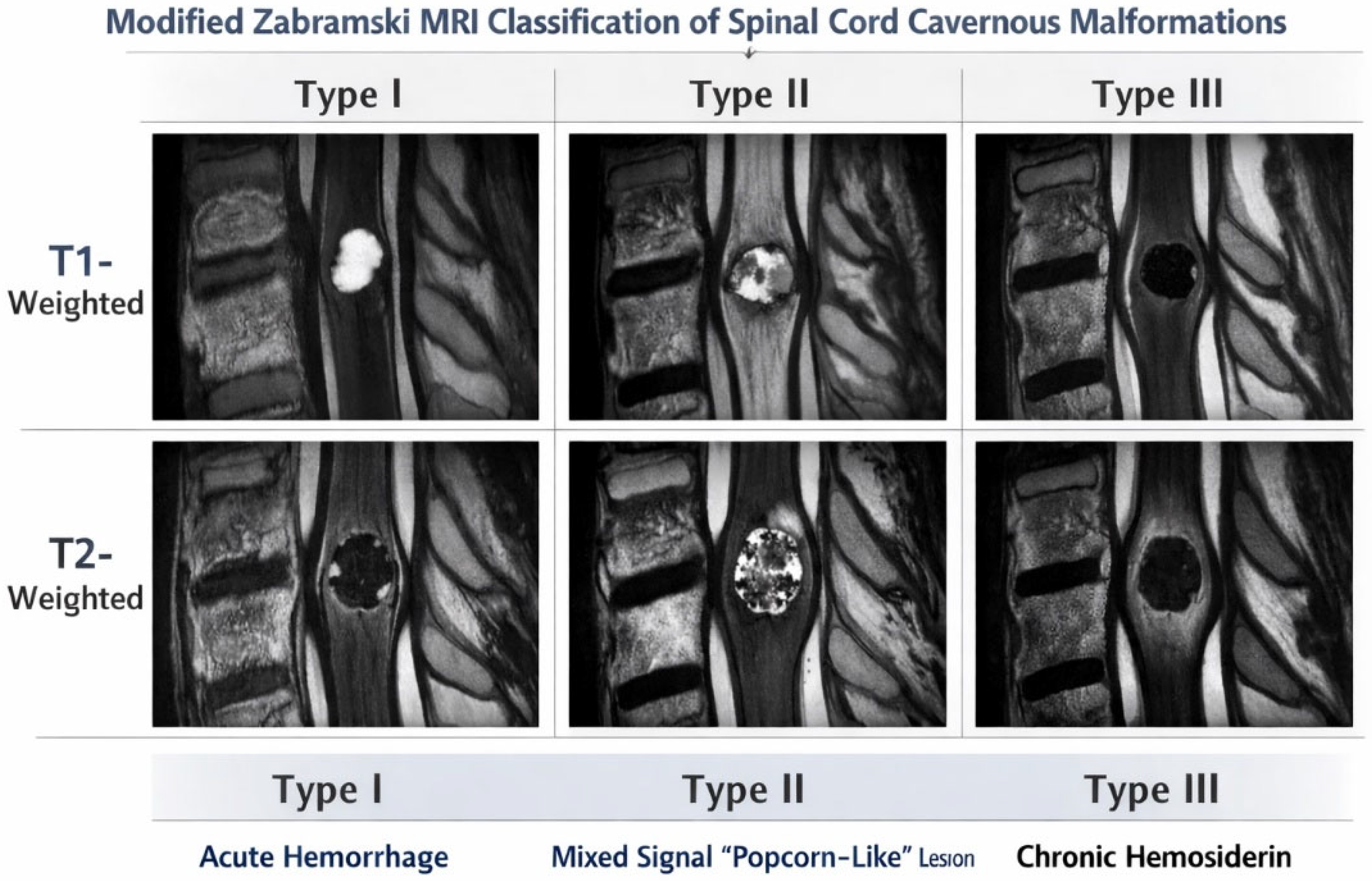
| T1-Weighted Image | T2-Weighted Image | |
|---|---|---|
| Type I | Hyper | Hyper or hypo |
| Type II | Mixed (hyper and hypo) | Mixed (hyper and hypo) |
| Type III | Iso to hypo | Hypo |
| Author(s) | Year | Title | Journal | Annual Hemorrhage Rate | Symptomatic Rate | Number of Patients | Improved | Same | Worse | Prognosticators of Worse Outcome | Scale Used to Assess Neurological Function | Reference Number |
|---|---|---|---|---|---|---|---|---|---|---|---|---|
| Ren et al. | 2022 | Natural History of Spinal Cord Cavernous Malformations | Neurosurgery. | 8.5% | 100% | 305 | Not reported | Not reported | Not reported | Prior hemorrhage, pediatric patients, familial form, subsequent hemorrhage, worse baseline neurological status | MMS | [8] |
| Santos et al. | 2022 | Natural course of untreated spinal cord cavernous malformations | J Neurosurg Spine. | 10% | 91.5% | 71 | Not reported | Not reported | Not reported | Prior hemorrhage | MMS | [31] |
| Liang et al. | 2011 | Management and prognosis of symptomatic patients with intramedullary spinal cord cavernoma | J Neurosurg Spine. | Not reported | Not reported | 11 | 5 | 6 | 0 | Aminoff–Logue | [17] | |
| Kharkar et al. | 2007 | The natural history of conservatively managed symptomatic intramedullary spinal cord cavernomas | Neurosurgery. | Not reported | 100% | 10 | 9 | 0 | 1 | MMS | [18] |
| Author | Year | Title | Journal | Number of Patients | Improved | Same | Worse | Significant Predictors of Better Outcome | Significant Predictors of Worse Outcome | Scale Used to Assess Neurological Status | Reference Number |
|---|---|---|---|---|---|---|---|---|---|---|---|
| Ardeshiri et al. | 2016 | A retrospective and consecutive analysis of the epidemiology and management of spinal cavernomas over the last 20 years in a single center | Neurosurg Rev. | 20 | 4 | 16 | 0 | Superficial location, early surgery (<3 months) | - | Frankel | [14] |
| Ohnishi et al. | 2020 | Conservative and surgical management of spinal cord cavernous malformations | World Neurosurg X. | 13 | 11 | 2 | 0 | - | - | MMS | [15] |
| Reitz et al. | 2015 | Intramedullary spinal cavernoma: clinical presentation, microsurgical approach, and long-term outcome in a cohort of 48 patients | Neurosurg Focus. | 48 | 11 | 34 | 3 | - | Thoracolumbar localization, worse Preoperative neurological status | ASIA, Epstein and Cooper | [16] |
| Liang et al. | 2011 | Management and prognosis of symptomatic patients with intramedullary spinal cord cavernoma | J Neurosurg Spine. | 64 | 23 | 35 | 6 | - | Small lesion, ventral location | Aminoff–Logue | [17] |
| Kharkar et al. | 2007 | The natural history of conservatively managed symptomatic intramedullary spinal cord cavernomas | Neurosurgery. | 4 | 1 | 2 | 1 | - | - | MMS | [18] |
| Goyal et al. | 2019 | Clinical presentation, natural history and outcomes of intramedullary spinal cord cavernous malformations | J Neurol Neurosurg Psychiatry. | 32 | - | - | - | - | Large, symptomatic, prior hemorrhage | [19] | |
| Labauge et al. | 2008 | Outcome in 53 patients with spinal cord cavernomas | Surg Neurol. | 37 | 20 | 6 | 11 | Posterior location | Anterior location | MMS | [20] |
| Mitha et al. | 2011 | Outcomes following resection of intramedullary spinal cord cavernous malformations | J Neurosurg Spine. | 80 | 5 | 66 | 9 | Anteroposterior diameter | - | Frankel | [21] |
| Liao et al. | 2022 | Surgical outcomes of spinal cavernous malformations | Front Surg. | 98 | 41 | 50 | 7 | Dorsal or superficial lesion, symptoms < 3 months | Ventral or lateral deep lesions, symptoms > 3 months | ASIA | [41] |
| Lu and Lawton | 2010 | Clinical presentation and surgical management of intramedullary spinal cord cavernous malformations | Neurosurg Focus. | 22 | 9 | 11 | 2 | - | Presence of dysesthesia and longer duration of symptoms | MMS | [40] |
| Maslehaty et al. | 2011 | Symptomatic spinal cavernous malformations: indication for microsurgical treatment and outcome | Eur Spine J. | 14 | 7 | 0 | 7 | - | - | Frankel, MMS | [42] |
| McCormik et al. | 1988 | Cavernous malformations of the spinal cord | Neurosurgery. | 6 | 5 | 1 | 0 | - | - | - | [43] |
| Cai et al. | 2023 | Surgical outcomes of symptomatic intramedullary spinal cord cavernous malformations | Neurospine. | 29 | 19 | 4 | 6 | Lower preoperative MMS, prolonged course, chronic onset of disease | Acute onset, smaller lesion, higher MMS on presentation, recurrent hemorrhage | MMS | [44] |
| Azad et al. | 2018 | Long-term effectiveness of gross-total resection for symptomatic spinal cord cavernous malformations | Neurosurgery. | 32 | 7 | 23 | 1 | Preoperative and improved immediate postoperative Frankel grade | - | Frankel, Aminoff–Logue | [27] |
| Sandalciog lu et al. | 2003 | Intramedullary spinal cord cavernous malformations | Neurosurg Rev. | 10 | 4 | 6 | 0 | - | - | Frankel | [29] |
| Li et al. | 2018 | Surgical outcomes of spinal cord intramedullary cavernous malformation | World Neurosurg. | 63 | 19 | 39 | 5 | Duration of symptoms < 3 months | Duration of symptoms > 3 months | MMS | [26] |
| Gembruch et al. | 2016 | Lumbar extradural, intra- and extraforaminal cavernoma causing lumbar pain | Open Jounal of Clinical and Medical Case Reports. | - | - | - | - | - | - | - | [22] |
| Nagoshi et al. | 2019 | Clinical outcomes and prognostic factors for cavernous hemangiomas of the spinal cord | J Neurosurg Spine. | 57 | - | - | - | - | Larger lesion, unstable gait | MMS, ASIA | [39] |
| Kurokawa et al. | 2023 | Acceptance of early surgery for treatment of spinal cord cavernous malformation in contemporary Japan | Neurospine. | 160 | - | - | 18 | - | - | MMS | [34] |
| Duan et al. | 2022 | The long-term outcome in a cohort of 52 patients with symptomatic intramedullary spinal cavernous hemangioma after microsurgery and emergency rescue surgery | Front Med (Lausanne). | 52 | 25 | 25 | 2 | Emergency rescue surgery (ERS) for deteriorative patients | Ventral lesion, longer course of disease, lesion at lumbosacral segment | Modified Aminoff–Logue | [45] |
| Jallo et al. | 2006 | Clinical presentation and optimal management for intramedullary cavernous malformations | Neurosurg Focus. | 26 | - | - | - | - | - | - | [46] |
| Deutsch et al. | 2000 | Spinal intramedullary cavernoma: clinical presentation and surgical outcome | J Neurosurg. | 16 | - | - | - | - | - | - | [47] |
| Ren et al. | 2019 | Surgical approaches and long-term outcomes of intramedullary spinal cord cavernous malformations | J Neurosurg Spine. | 219 | 189 | - | 23 | Preoperative mild neurological and disability status, cervically located lesions | Mild preoperative function and thoracolumbar-level lesions, moderate-depth lesions (embedded lesions) | ASIA | [48] |
| Author (s) | Year | Title | Journal | Annual Hemorrhage Rate | Symptomatic Rate | No of Patients | Surgical | Conservative | Prognosticators of Worse Outcome | Scale Used to Assess Neurological Function | Reference Number |
|---|---|---|---|---|---|---|---|---|---|---|---|
| Kharkar et al. | 2007 | The natural history of conservatively managed symptomatic intramedullary spinal cord cavernomas | Neurosurgery. | Not reported | 100% | 14 | 4 | 10 | Not reported | MMS | [18] |
| Goyal et al. | 2019 | Clinical presentation, natural history and outcomes of intramedullary spinal cord cavernous | J Neurol Neurosurg Psychiatry. | 5.5% | - | 85 | 32 | 53 | Presence of symptoms Larger size > 1 cm Prior hemorrhage | - | [19] |
| Sandalcioglu et al. | 2003 | Intramedullary spinal cord cavernous malformations | Neurosurg Rev. | 4.5% | 100% | 10 | 10 | 0 | - | Frankel | [29] |
| Zhang et al. | 2016 | Comparison of outcome between surgical and conservative management of symptomatic spinal cord cavernous malformations | Neurosurgery. | 3.9% | 100% | - | - | 27 | - | MMS, KPS | [28] |
| Badhiwala et al. | 2014 | Surgical outcomes and natural history of intramedullary spinal cord cavernous malformations | J Neurosurg Spine. | 2.1% | - | - | - | 47 | Symptom duration > 5 years | - | [24] |
| Santos et al. | 2023 | Natural course of cerebral and spinal cavernous malformations | Sci Rep. | 6.7% | - | 6 | - | - | Prior hemorrhage Spinal cord localization | - | [35] |
| Ardeshiri et al. | 2016 | A retrospective and consecutive analysis of the epidemiology and management of spinal cavernomas over the last 20 years in a single center. | Neurosurg Rev. | - | - | 25 | 20 | 5 | - | Frankel | [14] |
| Ohnishi et al. | 2020 | Conservative and surgical management of spinal cord cavernous malformations | World Neurosurg X. | 3.7% | - | 18 | 13 | 5 | - | MMS | [15] |
| Liang et al. | 2011 | Management and prognosis of symptomatic patients with intramedullary spinal cord cavernoma | J Neurosurg Spine. | - | - | 96 | 81 | 15 | - | Aminoff–Logue | [17] |
| Labauge et al. | 2008 | Outcome in 53 patients with spinal cord cavernomas | Surg Neurol. | - | 98% | 53 | 40 | 13 | Anterior location | MMS | [20] |
| Nagoshi et al. | 2019 | Clinical outcomes and prognostic factors for cavernous hemangiomas of the spinal cord | J Neurosurg Spine. | - | - | 66 | 57 | 9 | Unstable gait prior to surgery, worse preoperative neurological surgery, large lesion size | MMS, ASIA, JOA | [39] |
| Studies | Year | Title | Journal | No. of Patients | Timing of Surgery | Neurological Status | Worse Outcomes | Prognosticators of Outcome | Reference Number |
|---|---|---|---|---|---|---|---|---|---|
| Imagama et al. | 2017 | Optimal timing of surgery for intramedullary cavernous hemangioma of the Spinal cord in relation to preoperative motor paresis, disease duration, and tumor volume and location | Global Spine J. | 41 | Early surgery in asymptomatic patients with thoracic tumors and large tumor size | N (no preoperative paresis), CR (complete preoperative motor recovery), NCR (no complete recovery) | Disease duration from onset thoracic location, tumor volume | Complete preoperative motor recovery, stable gait | [51] |
| Kurokawa et al. | 2023 | Acceptance of early surgery for treatment of spinal cord cavernous malformation in contemporary Japan | Neurospine. | 160 | >7 days after presentation | MMS | Surgery after 3 months of onset of symptoms for patients with MMS score/grade V, partial or subtotal resection | Presentation to the hospital for surgery, symptom onset to surgery | [34] |
Disclaimer/Publisher’s Note: The statements, opinions and data contained in all publications are solely those of the individual author(s) and contributor(s) and not of MDPI and/or the editor(s). MDPI and/or the editor(s) disclaim responsibility for any injury to people or property resulting from any ideas, methods, instructions or products referred to in the content. |
© 2026 by the authors. Licensee MDPI, Basel, Switzerland. This article is an open access article distributed under the terms and conditions of the Creative Commons Attribution (CC BY) license.
Share and Cite
Safdar, A.; Osman, A.; Motiei-Langroudi, R. Spinal Cavernous Malformations: A Narrative Review. NeuroSci 2026, 7, 17. https://doi.org/10.3390/neurosci7010017
Safdar A, Osman A, Motiei-Langroudi R. Spinal Cavernous Malformations: A Narrative Review. NeuroSci. 2026; 7(1):17. https://doi.org/10.3390/neurosci7010017
Chicago/Turabian StyleSafdar, Aleeza, Ali Osman, and Rouzbeh Motiei-Langroudi. 2026. "Spinal Cavernous Malformations: A Narrative Review" NeuroSci 7, no. 1: 17. https://doi.org/10.3390/neurosci7010017
APA StyleSafdar, A., Osman, A., & Motiei-Langroudi, R. (2026). Spinal Cavernous Malformations: A Narrative Review. NeuroSci, 7(1), 17. https://doi.org/10.3390/neurosci7010017