

The Role of Vitamin D in Parkinson’s Disease: Evidence from Serum Concentrations, Supplementation, and VDR Gene Polymorphisms


Abstract
1. Introduction
2. Methodology
2.1. Primary and Secondary Outcomes
2.2. Literature Search Strategy
2.3. Inclusion and Exclusion Criteria
2.4. Data Extraction
2.5. Quality Assessment
2.6. Statistical Analysis
2.7. Definitions
3. Results
3.1. Study Selection
3.2. Quality Assessment
3.3. Meta-Analysis
3.3.1. VitD Serum in PD
3.3.2. VitD Insufficiency in PD
3.3.3. VitD Deficiency in PD
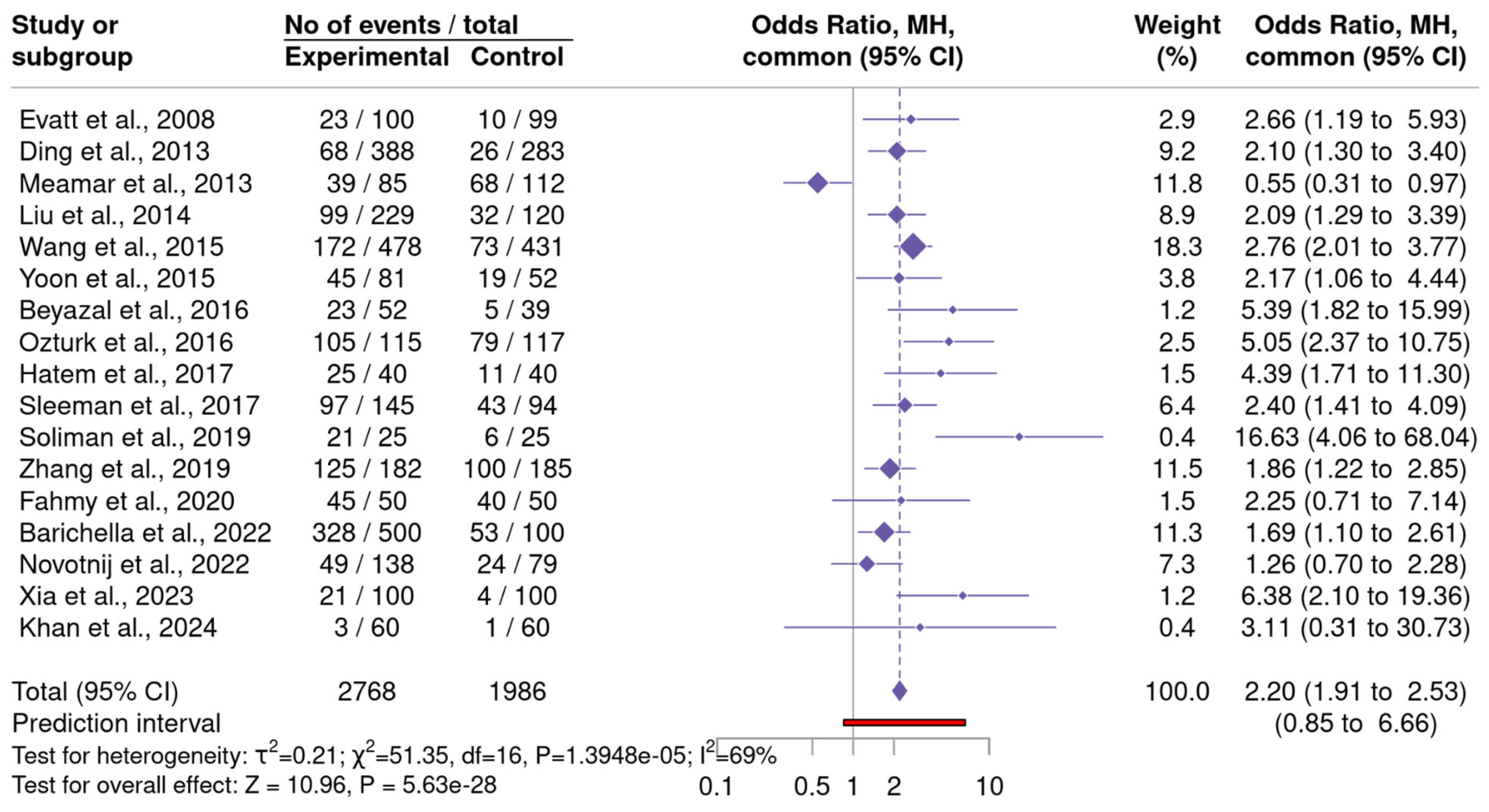
3.3.4. VitD Serum and PD Incidence
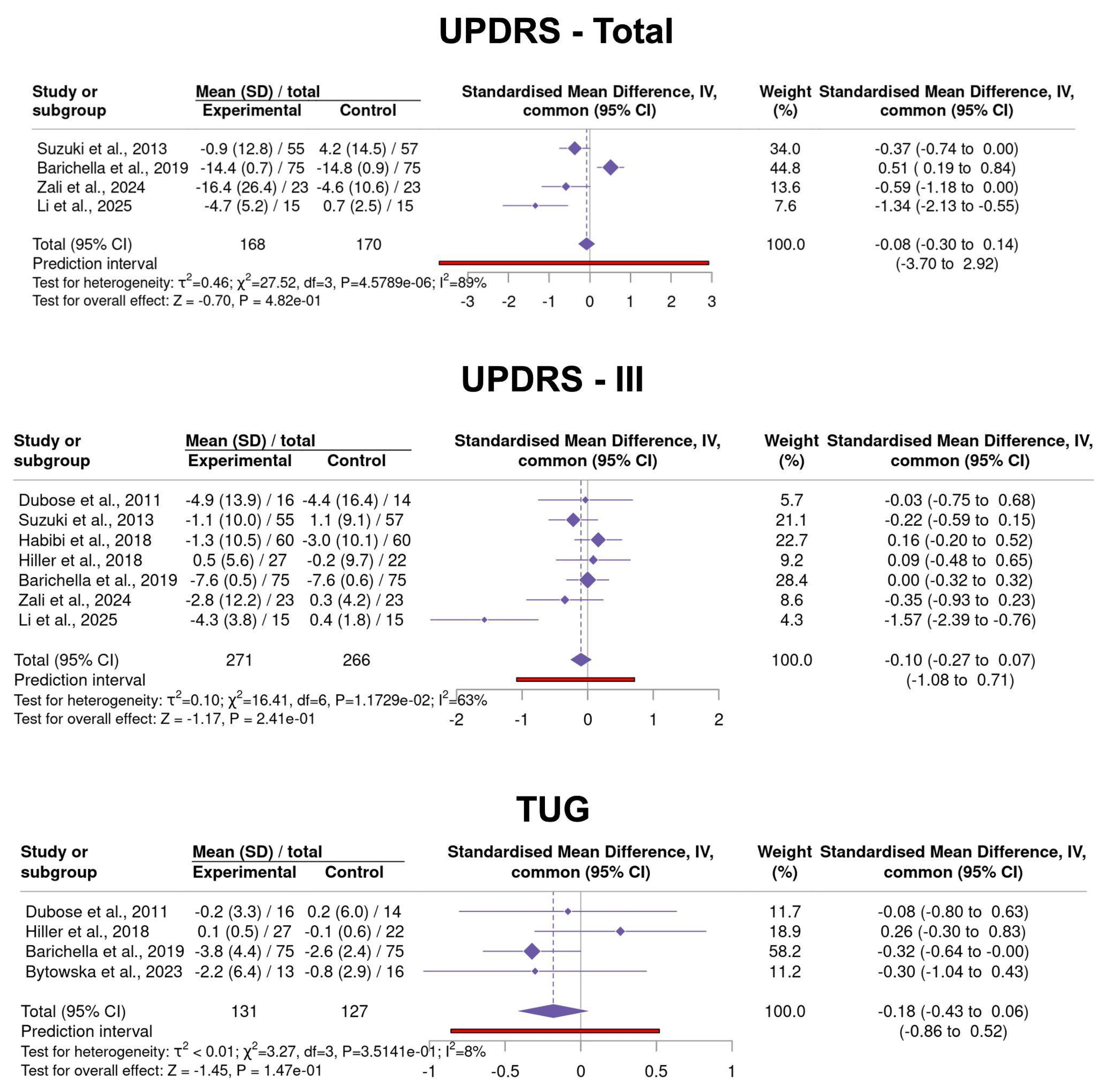
3.3.5. VitD Supplementation in PD
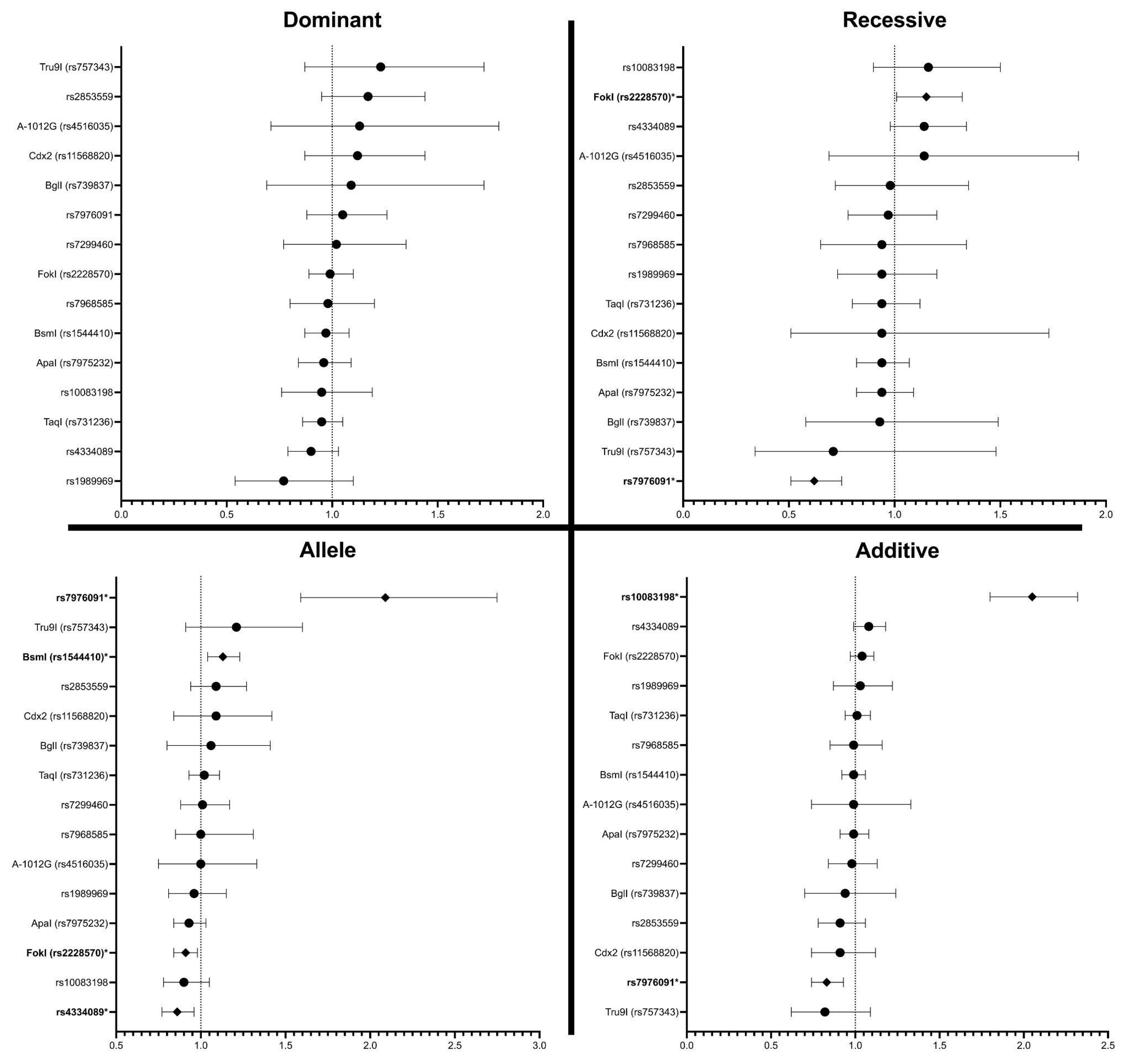
3.3.6. VitD Polymorphism
4. Discussion
4.1. Summary of Results
4.2. Motor and Non-Motor PD Symptoms
4.3. Outdoors Sunlight Exposure
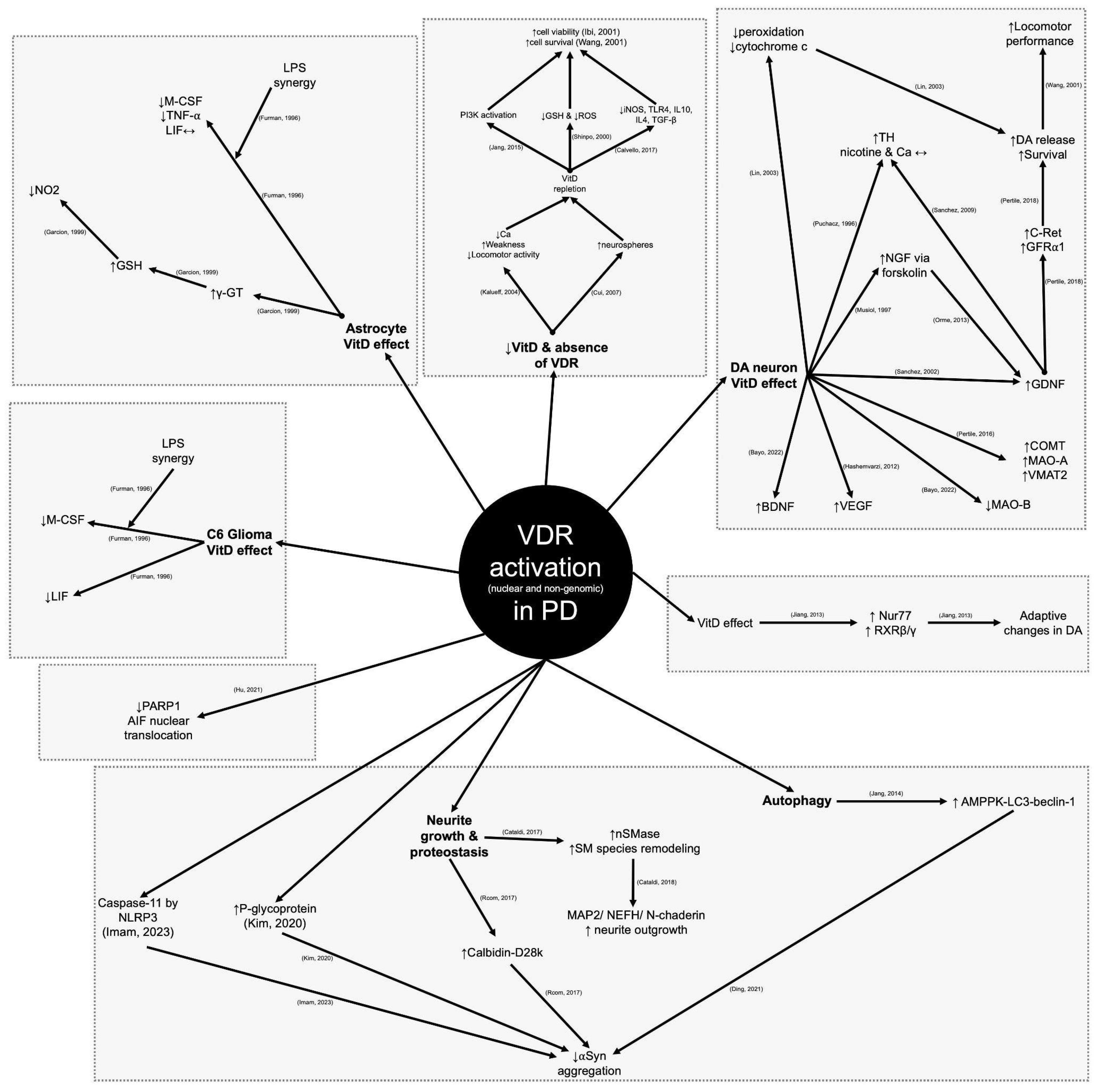
4.4. In Vitro and In Vivo Studies with VitD and PD
4.4.1. In Vitro
4.4.2. In Vivo
4.4.3. Computational Modeling
4.4.4. Human Studies
4.5. VitD Polymorphisms and PD
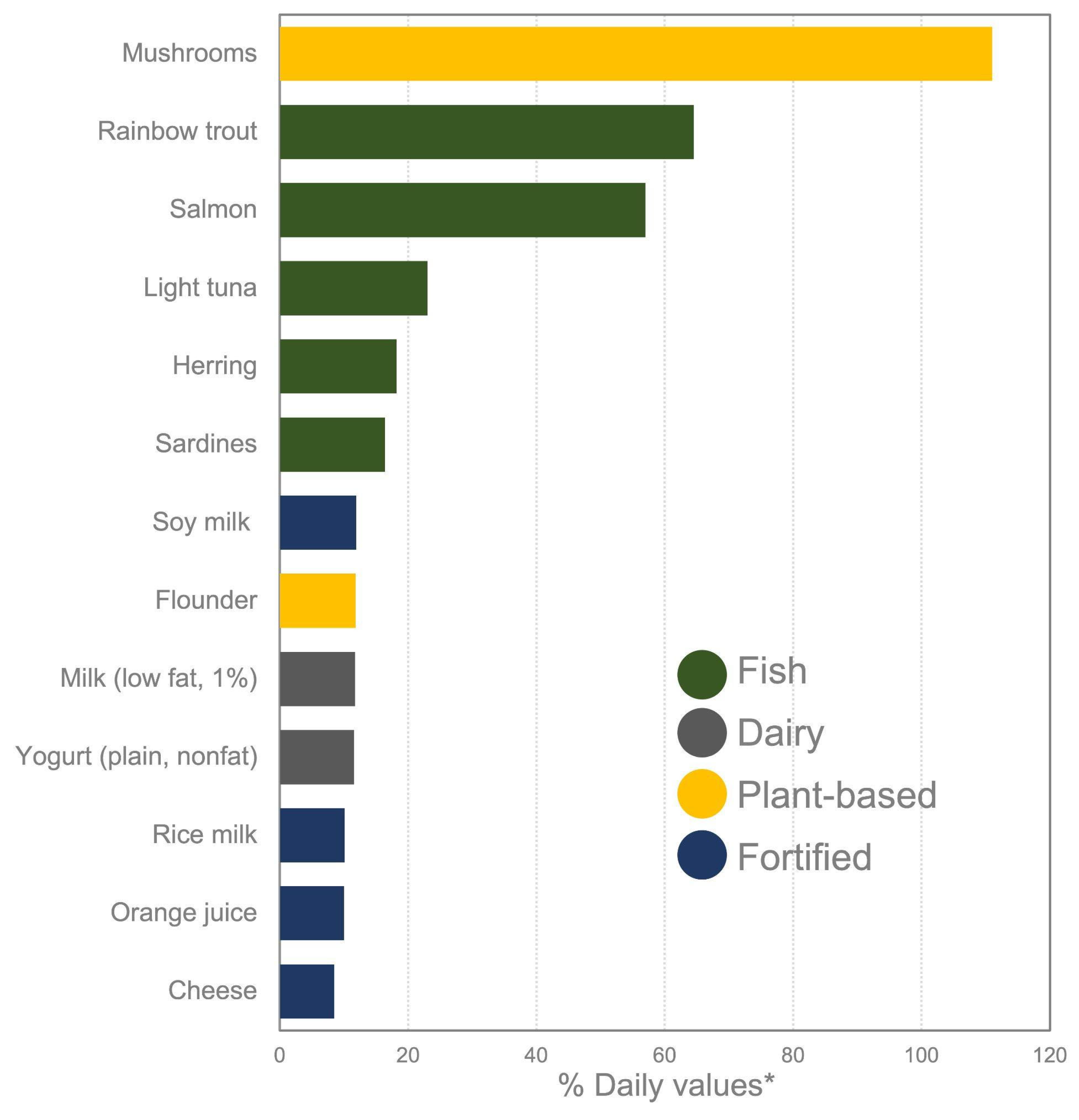
4.6. Dietary Intake of VitD and PD
4.7. Amount of VITD and Recommendations
4.8. Conflicting Results
5. Future Studies
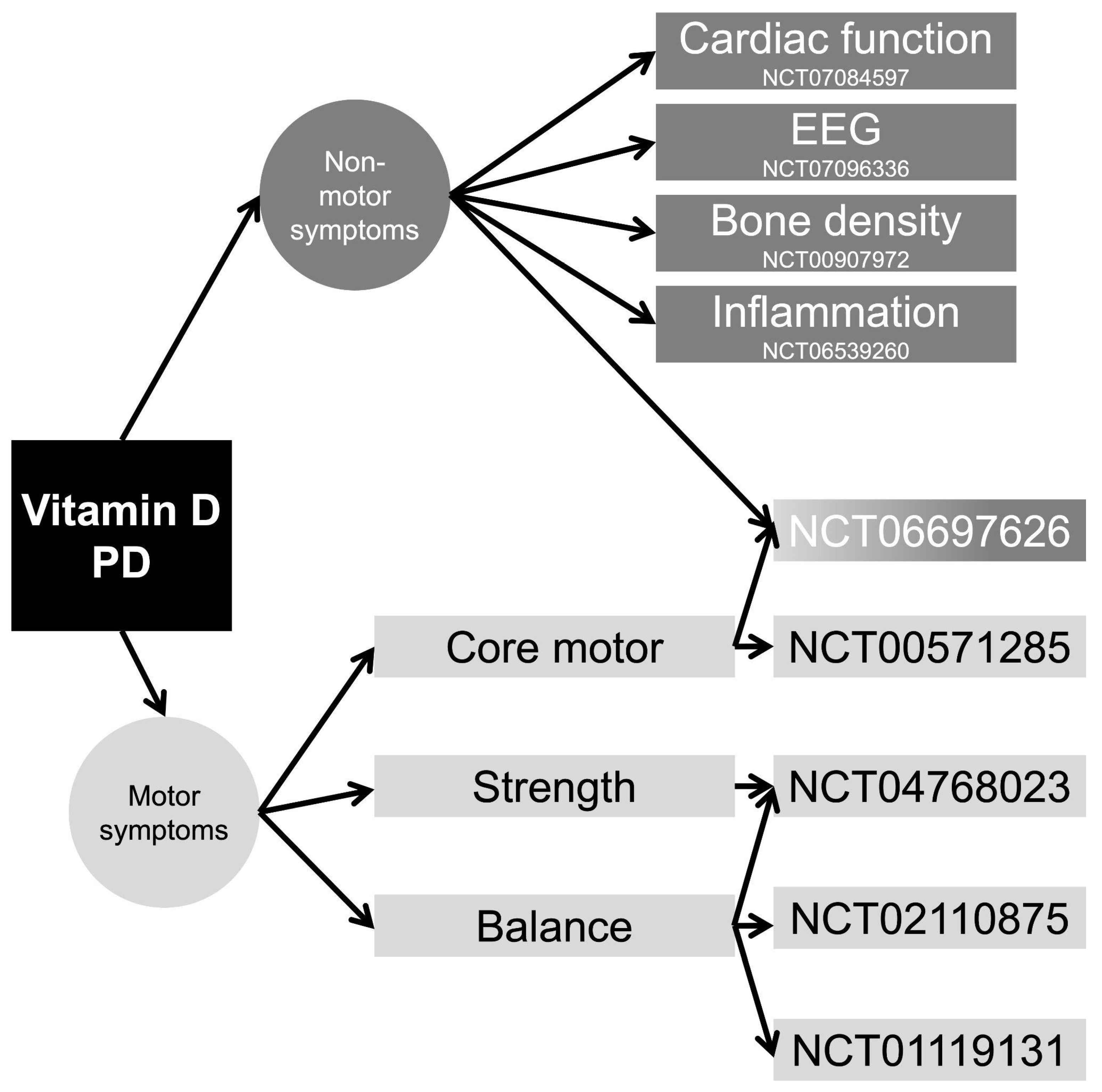
Clinical Trials
6. Conclusions
Supplementary Materials
Author Contributions
Funding
Data Availability Statement
Conflicts of Interest
Abbreviations
| AUC | Area under the curve |
| BAZ1B | Bromodomain adjacent to zinc finger domain 1B |
| BDNF | Brain-derived neurotrophic factor |
| BST-1 | Bone marrow stromal cell antigen 1 |
| CAT | Catalase |
| CSF | Cerebrospinal fluid |
| DA | Dopamine |
| DATATOP | Deprenyl and tocopherol antioxidative therapy of parkinsonism |
| fMRI | Functional MRI |
| GAK | Cyclin G associated kinase |
| GDNF | Glial cell-line-derived neurotrophic factor |
| GSH | Glutathione |
| GSR | Glutathione reductase |
| HC | Healthy control |
| HDAC1 | Histone Deacetylase 1 |
| HLA-DRA | Major Histocompatibility Complex, Class II, DR Alpha |
| HR | Hazard ratio |
| H&Y | Hoehn and Yahr scale |
| IVW | Inverse-variance weighted |
| LRRK2 | Leucine-Rich Repeat Kinase 2 |
| MAO-B | Monoamine oxidase-B |
| MCI | Mild cognitive impairment |
| MDA | Malondialdehyde |
| MMSE | Mini-mental state examination |
| MR | Mendelian randomization |
| MRI | Magnetic resonance imaging |
| MSA | Multiple system atrophy |
| NCOA2 | Nuclear receptor coactivator 2 |
| NMDA | N-methyl-D-aspartate |
| NMSS | Non-motor symptoms scale for PD |
| NOS | Newcastle-Ottawa scale |
| NSC | Neural stem cell |
| OH | Orthostatic hypotension |
| OR | Odds ratio |
| PARS | Parkinson associated risk syndrome |
| PD | Parkinson’s disease |
| QoL | Quality of life |
| ROT | Rotenone |
| RR | Relative risk |
| RXR | Retinoid X receptor |
| SD | Standard deviation |
| SFXN2 | Sideroflexin 2 |
| SHH | Sonic hedgehog |
| SMARCA4 | SWI/SNF related, matrix associated, actin dependent regulator of chromatin subfamily a member 4 |
| SMARCC1 | SWI/SNF Related, Matrix Associated, Actin Dependent Regulator of Chromatin Subfamily C Member 1 |
| SMARCD1 | SWI/SNF Related, Matrix Associated, Actin Dependent Regulator of Chromatin Subfamily D Member 1 |
| SMARCE1 | SWI/SNF Related, Matrix Associated, Actin Dependent Regulator of Chromatin Subfamily E Member 1 |
| SMD | Standard mean deviation |
| SOD | Superoxide dismutase |
| STBD1 | Starch binding domain 1 |
| SUPT16H | Suppressor of Ty 16 homolog |
| TH | Tyrosine hydroxylase |
| TNF-α | Tumor necrosis factor-alpha |
| TOP2B | DNA topoisomerase II beta |
| Treg | Regulatory T cell |
| UPDRS | Unified PD rating scale |
| UPDRS-II | UPDRS Part II |
| UPDRS-III | UPDRS Part III |
| UV-B | Ultraviolet B |
| VDR | Vitamin D receptor |
| VitD | Vitamin D |
| VPA | Valproic acid |
| αSyn | α-Synuclein |
| 1,25(OH)2D3 | 1,25-dihydroxyvitamin D3 |
| 25(OH)D3 | 25-hydroxyvitamin D3 |
References
- Pringsheim, T.; Jette, N.; Frolkis, A.; Steeves, T.D.L. The Prevalence of Parkinson’s Disease: A Systematic Review and Meta-Analysis. Mov. Disord. 2014, 29, 1583–1590. [Google Scholar] [CrossRef] [Scilit]
- Rissardo, J.P.; Caprara, A.L. A Narrative Review on Biochemical Markers and Emerging Treatments in Prodromal Synucleinopathies. Clin. Pract. 2025, 15, 65. [Google Scholar] [CrossRef] [Scilit]
- Ben-Shlomo, Y.; Darweesh, S.; Llibre-Guerra, J.; Marras, C.; San Luciano, M.; Tanner, C. The Epidemiology of Parkinson’s Disease. Lancet 2024, 403, 283–292. [Google Scholar] [CrossRef] [Scilit]
- Zhou, Z.; Zhou, R.; Zhang, Z.; Li, K. The Association Between Vitamin D Status, Vitamin D Supplementation, Sunlight Exposure, and Parkinson’s Disease: A Systematic Review and Meta-Analysis. Med. Sci. Monit. 2019, 25, 666–674. [Google Scholar] [CrossRef] [Scilit] [PubMed]
- Derex, L.; Trouillas, P. Reversible Parkinsonism, Hypophosphoremia, and Hypocalcemia under Vitamin D Therapy. Mov. Disord. 1997, 12, 612–613. [Google Scholar] [CrossRef] [Scilit] [PubMed]
- Raggi, A.; Ferri, R. The Role of Vitamins in Neurodegeneration: A Brief Review of Mechanisms, Clinical Evidence, and Therapeutic Perspectives. Psychogeriatrics 2025, 25, e70071. [Google Scholar] [CrossRef] [Scilit]
- Ibi, M.; Sawada, H.; Nakanishi, M.; Kume, T.; Katsuki, H.; Kaneko, S.; Shimohama, S.; Akaike, A. Protective Effects of 1α,25-(OH)2D3 Against the Neurotoxicity of Glutamate and Reactive Oxygen Species in Mesencephalic Culture. Neuropharmacology 2001, 40, 761–771. [Google Scholar] [CrossRef] [Scilit]
- Wang, J.Y.; Wu, J.N.; Cherng, T.L.; Hoffer, B.J.; Chen, H.H.; Borlongan, C.V.; Wang, Y. Vitamin D3 Attenuates 6-Hydroxydopamine-Induced Neurotoxicity in Rats. Brain Res. 2001, 904, 67–75. [Google Scholar] [CrossRef] [Scilit]
- Marras, C.; Canning, C.G.; Goldman, S.M. Environment, Lifestyle, and Parkinson’s Disease: Implications for Prevention in the Next Decade. Mov. Disord. 2019, 34, 801–811. [Google Scholar] [CrossRef] [Scilit] [PubMed]
- Bellou, V.; Belbasis, L.; Tzoulaki, I.; Evangelou, E.; Ioannidis, J.P.A. Environmental Risk Factors and Parkinson’s Disease: An Umbrella Review of Meta-Analyses. Park. Relat. Disord. 2016, 23, 1–9. [Google Scholar] [CrossRef] [Scilit]
- Fullard, M.E.; Duda, J.E. A Review of the Relationship Between Vitamin D and Parkinson Disease Symptoms. Front. Neurol. 2020, 11, 454. [Google Scholar] [CrossRef] [Scilit]
- Al-Kuraishy, H.M.; Al-Gareeb, A.I.; Selim, H.M.; Alexiou, A.; Papadakis, M.; Negm, W.A.; Batiha, G.E.-S. Does Vitamin D Protect or Treat Parkinson’s Disease? A Narrative Review. Naunyn-Schmiedeberg’s Arch. Pharmacol. 2024, 397, 33–40. [Google Scholar] [CrossRef] [Scilit]
- Zheng, Z.; Chen, M.; Feng, S.; Zhao, H.; Qu, T.; Zhao, X.; Ruan, Q.; Li, L.; Guo, J. VDR and Deubiquitination Control Neuronal Oxidative Stress and Microglial Inflammation in Parkinson’s Disease. Cell Death Discov. 2024, 10, 150. [Google Scholar] [CrossRef] [Scilit]
- Li, C.; Qi, H.; Wei, S.; Wang, L.; Fan, X.; Duan, S.; Bi, S. Vitamin D Receptor Gene Polymorphisms and the Risk of Parkinson’s Disease. Neurol. Sci. 2015, 36, 247–255. [Google Scholar] [CrossRef] [Scilit]
- Wang, Z.; Xia, H.; Ding, Y.; Lu, R.; Yang, X. No Association Between Genetically Predicted Vitamin D Levels and Parkinson’s Disease. PLoS ONE 2024, 19, e0313631. [Google Scholar] [CrossRef] [Scilit] [PubMed]
- Rahnemayan, S.; Ahari, S.G.; Rikhtegar, R.; Riyahifar, S.; Sanaie, S. An Umbrella Review of Systematic Reviews with Meta-Analysis on the Role of Vitamins in Parkinson’s Disease. Acta Neurol. Belg. 2023, 123, 69–83. [Google Scholar] [CrossRef] [Scilit] [PubMed]
- Page, M.J.; McKenzie, J.E.; Bossuyt, P.M.; Boutron, I.; Hoffmann, T.C.; Mulrow, C.D.; Shamseer, L.; Tetzlaff, J.M.; Akl, E.A.; Brennan, S.E.; et al. The PRISMA 2020 Statement: An Updated Guideline for Reporting Systematic Reviews. BMJ 2021, 372, n71. [Google Scholar] [CrossRef] [Scilit]
- De Vries, E.; Schoonvelde, M.; Schumacher, G. No Longer Lost in Translation: Evidence that Google Translate Works for Comparative Bag-of-Words Text Applications. Polit. Anal. 2018, 26, 417–430. [Google Scholar] [CrossRef] [Scilit]
- Wells, G.A.; Shea, B.; O’Connell, D.; Peterson, J.; Welch, V.; Losos, M.; Tugwell, P. The Newcastle-Ottawa Scale (NOS) for Assessing the Quality of Nonrandomised Studies in Meta-Analyses 2000. Available online: https://web.archive.org/web/20210716121605id_/www3.med.unipmn.it/dispense_ebm/2009-2010/Corso%20Perfezionamento%20EBM_Faggiano/NOS_oxford.pdf (accessed on 17 September 2025).
- McGuinness, L.A.; Higgins, J.P.T. Risk-of-bias VISualization (robvis): An R Package and Shiny Web App for Visualizing Risk-of-Bias Assessments. Res. Synth. Methods 2021, 12, 55–61. [Google Scholar] [CrossRef] [Scilit]
- DerSimonian, R.; Laird, N. Meta-Analysis in Clinical Trials. Control. Clin. Trials 1986, 7, 177–188. [Google Scholar] [CrossRef] [Scilit] [PubMed]
- Lee, J.; Kim, K.W.; Choi, S.H.; Huh, J.; Park, S.H. Systematic Review and Meta-Analysis of Studies Evaluating Diagnostic Test Accuracy: A Practical Review for Clinical Researchers-Part II. Statistical Methods of Meta-Analysis. Korean J. Radiol. 2015, 16, 1188–1196. [Google Scholar] [CrossRef] [Scilit]
- Beheshti, A.; Chavanon, M.-L.; Christiansen, H. Emotion Dysregulation in Adults with Attention Deficit Hyperactivity Disorder: A Meta-Analysis. BMC Psychiatry 2020, 20, 120. [Google Scholar] [CrossRef] [Scilit]
- Liu, H.-M.; Zheng, J.-P.; Yang, D.; Liu, Z.-F.; Li, Z.; Hu, Z.-Z.; Li, Z.-N. Recessive/Dominant Model: Alternative Choice in Case-Control-Based Genome-Wide Association Studies. PLoS ONE 2021, 16, e0254947. [Google Scholar] [CrossRef] [Scilit] [PubMed]
- Holick, M.F.; Binkley, N.C.; Bischoff-Ferrari, H.A.; Gordon, C.M.; Hanley, D.A.; Heaney, R.P.; Murad, M.H.; Weaver, C.M. Evaluation, Treatment, and Prevention of Vitamin D Deficiency: An Endocrine Society Clinical Practice Guideline. J. Clin. Endocrinol. Metab. 2011, 96, 1911–1930. [Google Scholar] [CrossRef] [Scilit]
- McCartney, C.R.; McDonnell, M.E.; Corrigan, M.D.; Lash, R.W. Vitamin D Insufficiency and Epistemic Humility: An Endocrine Society Guideline Communication. J. Clin. Endocrinol. Metab. 2024, 109, 1948–1954. [Google Scholar] [CrossRef] [Scilit] [PubMed]
- Tesi, N.; van der Lee, S.; Hulsman, M.; Holstege, H.; Reinders, M.J.T. snpXplorer: A Web Application to Explore Human SNP-Associations and Annotate SNP-Sets. Nucleic Acids Res. 2021, 49, W603–W612. [Google Scholar] [CrossRef] [Scilit] [PubMed]
- Abou-Raya, S.; Helmii, M.; Abou-Raya, A. Bone and Mineral Metabolism in Older Adults with Parkinson’s Disease. Age Ageing 2009, 38, 675–680. [Google Scholar] [CrossRef] [Scilit]
- Evatt, M.L.; Delong, M.R.; Khazai, N.; Rosen, A.; Triche, S.; Tangpricha, V. Prevalence of Vitamin D Insufficiency in Patients with Parkinson Disease and Alzheimer Disease. Arch. Neurol. 2008, 65, 1348–1352. [Google Scholar] [CrossRef] [Scilit]
- van den Bos, F.; Speelman, A.D.; van Nimwegen, M.; van der Schouw, Y.T.; Backx, F.J.G.; Bloem, B.R.; Munneke, M.; Verhaar, H.J.J. Bone Mineral Density and Vitamin D Status in Parkinson’s Disease Patients. J. Neurol. 2013, 260, 754–760. [Google Scholar] [CrossRef] [Scilit]
- Serdaroğlu Beyazal, M.; Kırbaş, S.; Tüfekçi, A.; Devrimsel, G.; Küçükali Türkyılmaz, A. The Relationship of Vitamin D with Bone Mineral Density in Parkinson’s Disease Patients. Eur. Geriatr. Med. 2016, 7, 18–22. [Google Scholar] [CrossRef] [Scilit]
- Yoon, J.H.; Park, D.K.; Yong, S.W.; Hong, J.M. Vitamin D Deficiency and its Relationship with Endothelial Dysfunction in Patients with Early Parkinson’s Disease. J. Neural Transm. 2015, 122, 1685–1691. [Google Scholar] [CrossRef] [Scilit]
- Wang, J.; Yang, D.; Yu, Y.; Shao, G.; Wang, Q. Vitamin D and Sunlight Exposure in Newly-Diagnosed Parkinson’s Disease. Nutrients 2016, 8, 142. [Google Scholar] [CrossRef] [Scilit]
- Ding, H.; Dhima, K.; Lockhart, K.C.; Locascio, J.J.; Hoesing, A.N.; Duong, K.; Trisini-Lipsanopoulos, A.; Hayes, M.T.; Sohur, U.S.; Wills, A.-M.; et al. Unrecognized Vitamin D3 Deficiency is Common in Parkinson Disease: Harvard Biomarker Study. Neurology 2013, 81, 1531–1537. [Google Scholar] [CrossRef] [Scilit] [PubMed]
- Wang, L.; Evatt, M.L.; Maldonado, L.G.; Perry, W.R.; Ritchie, J.C.; Beecham, G.W.; Martin, E.R.; Haines, J.L.; Pericak-Vance, M.A.; Vance, J.M.; et al. Vitamin D from Different Sources is Inversely Associated with Parkinson Disease. Mov. Disord. 2015, 30, 560–566. [Google Scholar] [CrossRef] [Scilit]
- Knekt, P.; Kilkkinen, A.; Rissanen, H.; Marniemi, J.; Sääksjärvi, K.; Heliövaara, M. Serum Vitamin D and the Risk of Parkinson Disease. Arch. Neurol. 2010, 67, 808–811. [Google Scholar] [CrossRef] [Scilit] [PubMed]
- Topal, K.; Paker, N.; Bugdayci, D.; Ozer, F.; Tekdos, D. Bone Mineral Density and Vitamin D Status with Idiopathic Parkinson’s Disease; Springer: London, UK, 2010; Volume 21, pp. 141–142. [Google Scholar]
- Senel, K.; Alp, F.; Baykal, T.; Melikoglu, M.; Erdal, A.; Ugur, M. Preliminary Study: Is There a Role of Vitamin D in Parkinson Disease? Springer: London, UK, 2011; Volume 22, p. 167. [Google Scholar]
- Meamar, R.; Maracy, M.; Chitsaz, A.; Ghazvini, M.R.A.; Izadi, M.; Tanhaei, A.P. Association Between Serum Biochemical Levels, Related to Bone Metabolism and Parkinson’s Disease. J. Res. Med. Sci. 2013, 18, S39–S42. [Google Scholar]
- Petersen, M.S.; Bech, S.; Christiansen, D.H.; Schmedes, A.V.; Halling, J. The role of vitamin D levels and vitamin D receptor polymorphism on Parkinson’s disease in the Faroe Islands. Neurosci. Lett. 2014, 561, 74–79. [Google Scholar] [CrossRef] [Scilit]
- Liu, Y.; Zhang, B.-S. Serum 25-Hydroxyvitamin D Predicts Severity in Parkinson’s Disease Patients. Neurol. Sci. 2014, 35, 67–71. [Google Scholar] [CrossRef] [Scilit]
- Ozturk, E.A.; Gundogdu, I.; Tonuk, B.; Kocer, B.G.; Tombak, Y.; Comoglu, S.; Cakci, A. Bone Mass and Vitamin D Levels in Parkinson’s Disease: Is There Any Difference Between Genders? J. Phys. Ther. Sci. 2016, 28, 2204–2209. [Google Scholar] [CrossRef] [Scilit]
- Hatem, A.K. The State of Vitamin D in Iraqi Patients with Parkinson Disease. Al Kindy Coll. Med. J. 2019, 13, 137–141. [Google Scholar] [CrossRef] [Scilit]
- Sleeman, I.; Aspray, T.; Lawson, R.; Coleman, S.; Duncan, G.; Khoo, T.K.; Schoenmakers, I.; Rochester, L.; Burn, D.; Yarnall, A. The Role of Vitamin D in Disease Progression in Early Parkinson’s Disease. J. Park. Dis. 2017, 7, 669–675. [Google Scholar] [CrossRef] [Scilit]
- Ahangar, A.A.; Saadat, P.; Hajian, K.; Kiapasha, G. The Association Between Low Levels of Serum Vitamin D and the Duration and Severity of Parkinson’s Disease. Arch. Neurosci. 2018, 5, e61085. [Google Scholar] [CrossRef] [Scilit]
- Mollenhauer, B.; Zimmermann, J.; Sixel-Döring, F.; Focke, N.K.; Wicke, T.; Ebentheuer, J.; Schaumburg, M.; Lang, E.; Friede, T.; Trenkwalder, C. Baseline Predictors for Progression 4 Years After Parkinson’s Disease Diagnosis in the De Novo Parkinson Cohort (DeNoPa). Mov. Disord. 2019, 34, 67–77. [Google Scholar] [CrossRef] [Scilit]
- Soliman, R.H.; Oraby, M.I.; Hussein, M.; Abd El-Shafy, S.; Mostafa, S. Could Vitamin D Deficiency Have an Impact on Motor and Cognitive Function in Parkinson’s Disease? Egypt. J. Neurol. Psychiatry Neurosurg. 2019, 55, 34. [Google Scholar] [CrossRef] [Scilit]
- Zhang, H.-J.; Zhang, J.-R.; Mao, C.-J.; Li, K.; Wang, F.; Chen, J.; Liu, C.-F. Relationship Between 25-Hydroxyvitamin D, Bone Density, and Parkinson’s Disease Symptoms. Acta Neurol. Scand. 2019, 140, 274–280. [Google Scholar] [CrossRef] [Scilit]
- Fahmy, E.M.; Elawady, M.E.; Sharaf, S.; Heneidy, S.; Ismail, R.S. Vitamin D Status in Idiopathic Parkinson’s Disease: An Egyptian Study. Egypt. J. Neurol. Psychiatry Neurosurg. 2020, 56, 45. [Google Scholar] [CrossRef] [Scilit]
- Ogura, H.; Hatip-Al-Khatib, I.; Suenaga, M.; Hatip, F.B.; Mishima, T.; Fujioka, S.; Ouma, S.; Matsunaga, Y.; Tsuboi, Y. Circulatory 25(OH)D and 1,25(OH)2D as Differential Biomarkers Between Multiple System Atrophy and Parkinson’s Disease Patients. eNeurologicalSci 2021, 25, 100369. [Google Scholar] [CrossRef] [Scilit] [PubMed]
- Barichella, M.; Cereda, E.; Iorio, L.; Pinelli, G.; Ferri, V.; Cassani, E.; Bolliri, C.; Caronni, S.; Pusani, C.; Schiaffino, M.G.; et al. Clinical Correlates of Serum 25-Hydroxyvitamin D in Parkinson’s Disease. Nutr. Neurosci. 2022, 25, 1128–1136. [Google Scholar] [CrossRef] [Scilit]
- Kakimoto, A.; Ogura, H.; Suenaga, M.; Mishima, T.; Fujioka, S.; Ouma, S.; Matsunaga, Y.; Tsuboi, Y. Role of Cytochrome P450 for Vitamin D Metabolisms in Patients with Neurodegenerative Disorders. Clin. Park. Relat. Disord. 2022, 7, 100162. [Google Scholar] [CrossRef] [Scilit]
- Novotnij, D.A.; Zhukova, N.G.; Shperling, L.P.; Stolyarova, V.A.; Zhukova, I.A.; Agasheva, A.E.; Shtaimets, S.V.; Druzhinina, O.A.; Shirokikh, I.V. Vitamin D and other Indicators of Calcium-Phosphorus Metabolism as Possible Predictors of Parkinson’s Disease. S.S. Korsakov J. Neurol. Psychiatry 2022, 122, 56–64. [Google Scholar] [CrossRef] [Scilit]
- Wu, H.; Khuram Raza, H.; Li, Z.; Li, Z.; Zu, J.; Xu, C.; Yang, D.; Cui, G. Correlation Between Serum 25(OH)D and Cognitive Impairment in Parkinson’s Disease. J. Clin. Neurosci. 2022, 100, 192–195. [Google Scholar] [CrossRef] [Scilit]
- Yakşi, E.; Yaşar, M.F. Bone Mineral Density and Vitamin D Levels in Parkinson’s Disease: A Retrospective Controlled Study. Northwestern Med. J. 2022, 2, 51–58. [Google Scholar] [CrossRef] [Scilit]
- Džoljić, E.; Matutinović, M.S.; Stojković, O.; Veličković, J.; Milinković, N.; Kostić, V.; Ignjatović, S. Vitamin D Serum Levels and Vitamin D Receptor Genotype in Patients with Parkinson’s Disease. Neuroscience 2023, 533, 53–62. [Google Scholar] [CrossRef] [Scilit] [PubMed]
- Sooragonda, B.G.; Sridharan, K.; Benjamin, R.N.; Prabhakar, A.T.; Sivadasan, A.; Kapoor, N.; Cherian, K.E.; Jebasingh, F.K.; Aaron, S.; Mathew, V.; et al. Do Bone Mineral Density, Trabecular Bone Score, and Hip Structural Analysis Differ in Indian Men with Parkinson’s Disease? A Case-Control Pilot Study from a Tertiary Center in Southern India. Ann. Indian Acad. Neurol. 2023, 26, 496–501. [Google Scholar] [CrossRef] [Scilit]
- Xia, M.; Zhou, Q. Correlation Between 25-Hydroxy-Vitamin D and Parkinson’s Disease. IBRO Neurosci. Rep. 2024, 16, 162–167. [Google Scholar] [CrossRef] [Scilit]
- Khan, M.S.H.; Mouri, U.K.; Islam, M.R.; Rahman, T.; Rahman, A.; Ahmed, J.U. Relationship of Vitamin D Deficiency with Non-Motor Functions of Parkinson’s Disease. Bangladesh J. Med. 2024, 35, 82–87. [Google Scholar] [CrossRef] [Scilit]
- Milanowski, J.; Nuszkiewicz, J.; Lisewska, B.; Lisewski, P.; Szewczyk-Golec, K. Adipokines, Vitamin D, and Selected Inflammatory Biomarkers among Parkinson’s Disease Patients with and Without Dyskinesia: A Preliminary Examination. Metabolites 2024, 14, 106. [Google Scholar] [CrossRef] [Scilit]
- Rahman, A.; Ahmed, M.J.; Russel, A.H.M.; Hossain, M.A.; Huq, M.N.; Khan, S.M.D.; Rahman, M.M.; Paul, B.; Saha, P.K. Association Between Serum Vitamin D Level and Parkinson’s Disease: Case Control Study in a Tertiary Level Hospital, Bangladesh. Bangladesh J. Med. 2024, 35, 180–186. [Google Scholar] [CrossRef] [Scilit]
- Xu, Y.; Wang, E.; Zhang, Q.; Liu, J.; Luo, W. Vitamin D and Focal Brain Atrophy in PD with Non-Dementia: A VBM Study. Front. Hum. Neurosci. 2024, 18, 1474148. [Google Scholar] [CrossRef] [Scilit]
- DuBose, S. Effects of Vitamin D Supplementation on Motor Symptoms of Patients with Parkinson’s Disease. Master’s Thesis, Rollins School of Public Health, Atlanta, GA, USA, 2011. [Google Scholar]
- Suzuki, M.; Yoshioka, M.; Hashimoto, M.; Murakami, M.; Noya, M.; Takahashi, D.; Urashima, M. Randomized, Double-Blind, Placebo-Controlled Trial of Vitamin D Supplementation in Parkinson Disease. Am. J. Clin. Nutr. 2013, 97, 1004–1013. [Google Scholar] [CrossRef] [Scilit]
- Habibi, A.H.; Anamoradi, A.; Shahidi, G.A.; Razmeh, S.; Alizadeh, E.; Kokhedan, K.M. Treatment of Levodopainduced Dyskinesia with Vitamin D: A Randomized, Double-Blind, Placebo-Controlled Trial. Neurol. Int. 2018, 10, 7737. [Google Scholar] [CrossRef] [Scilit]
- Hiller, A.L.; Murchison, C.F.; Lobb, B.M.; O’Connor, S.; O’Connor, M.; Quinn, J.F. A Randomized, Controlled Pilot Study of the Effects of Vitamin D Supplementation on Balance in Parkinson’s Disease: Does Age Matter? PLoS ONE 2018, 13, e0203637. [Google Scholar] [CrossRef] [Scilit]
- Barichella, M.; Cereda, E.; Pinelli, G.; Iorio, L.; Caroli, D.; Masiero, I.; Ferri, V.; Cassani, E.; Bolliri, C.; Caronni, S.; et al. Muscle-Targeted Nutritional Support for Rehabilitation in Patients with Parkinsonian Syndrome. Neurology 2019, 93, e485–e496. [Google Scholar] [CrossRef] [Scilit]
- Bytowska, Z.K.; Korewo-Labelle, D.; Berezka, P.; Kowalski, K.; Przewłócka, K.; Libionka, W.; Kloc, W.; Kaczor, J.J. Effect of 12-Week BMI-Based Vitamin D3 Supplementation in Parkinson’s Disease with Deep Brain Stimulation on Physical Performance, Inflammation, and Vitamin D Metabolites. Int. J. Mol. Sci. 2023, 24, 10200. [Google Scholar] [CrossRef] [Scilit] [PubMed]
- Zali, A.; Hajyani, S.; Salari, M.; Tajabadi-Ebrahimi, M.; Mortazavian, A.M.; Pakpour, B. Co-Administration of Probiotics and Vitamin D Reduced Disease Severity and Complications in Patients with Parkinson’s Disease: A Randomized Controlled Clinical Trial. Psychopharmacology 2024, 241, 1905–1914. [Google Scholar] [CrossRef] [Scilit] [PubMed]
- Li, D.; Ma, X.; Zhang, W.; Zhong, P.; Li, M.; Liu, S. Impact of Vitamin D3 Supplementation on Motor Functionality and the Immune Response in Parkinson’s Disease Patients with Vitamin D Deficiency. Sci. Rep. 2025, 15, 25154. [Google Scholar] [CrossRef] [Scilit]
- Kim, J.-S.; Kim, Y.-I.; Song, C.; Yoon, I.; Park, J.-W.; Choi, Y.-B.; Kim, H.-T.; Lee, K.-S. Association of Vitamin D Receptor Gene Polymorphism and Parkinson’s Disease in Koreans. J. Korean Med. Sci. 2005, 20, 495–498. [Google Scholar] [CrossRef] [Scilit] [PubMed]
- Han, X.; Xue, L.; Li, Y.; Chen, B.; Xie, A. Vitamin D Receptor Gene Polymorphism and its Association with Parkinson’s Disease in Chinese Han Population. Neurosci. Lett. 2012, 525, 29–33. [Google Scholar] [CrossRef] [Scilit]
- Liu, H.; Han, X.; Zheng, X.; Li, Y.; Xie, A. Association of Vitamin D Receptor Gene Polymorphisms with Parkinson Disease. Zhonghua Yi Xue Yi Chuan Xue Za Zhi 2013, 30, 13–16. [Google Scholar] [CrossRef] [Scilit]
- Lv, Z.; Tang, B.; Sun, Q.; Yan, X.; Guo, J. Association Study Between Vitamin d Receptor Gene Polymorphisms and Patients with Parkinson Disease in Chinese Han Population. Int. J. Neurosci. 2013, 123, 60–64. [Google Scholar] [CrossRef] [Scilit]
- Török, R.; Török, N.; Szalardy, L.; Plangar, I.; Szolnoki, Z.; Somogyvari, F.; Vecsei, L.; Klivenyi, P. Association of Vitamin D Receptor Gene Polymorphisms and Parkinson’s Disease in Hungarians. Neurosci. Lett. 2013, 551, 70–74. [Google Scholar] [CrossRef] [Scilit]
- Lin, C.-H.; Chen, K.-H.; Chen, M.-L.; Lin, H.-I.; Wu, R.-M. Vitamin D Receptor Genetic Variants and Parkinson’s Disease in a Taiwanese Population. Neurobiol. Aging 2014, 35, 1212.e11–1212.e13. [Google Scholar] [CrossRef] [Scilit]
- Gatto, N.M.; Sinsheimer, J.S.; Cockburn, M.; Escobedo, L.A.; Bordelon, Y.; Ritz, B. Vitamin D Receptor Gene Polymorphisms and Parkinson’s Disease in a Population with High Ultraviolet Radiation Exposure. J. Neurol. Sci. 2015, 352, 88–93. [Google Scholar] [CrossRef] [Scilit]
- Fazeli, A.; Motallebi, M.; Jamshidi, J.; Movafagh, A.; Ghaedi, H.; Emamalizadeh, B.; Kashani, K.; Darvish, H. Vitamin D Receptor Gene rs4334089 Polymorphism and Parkinson’s Disease in Iranian Population. Basal Ganglia 2016, 6, 157–160. [Google Scholar] [CrossRef] [Scilit]
- Kang, S.Y.; Park, S.; Oh, E.; Park, J.; Youn, J.; Kim, J.S.; Kim, J.-U.; Jang, W. Vitamin D Receptor Polymorphisms and Parkinson’s Disease in a Korean Population: Revisited. Neurosci. Lett. 2016, 628, 230–235. [Google Scholar] [CrossRef] [Scilit] [PubMed]
- Meamar, R.; Javadirad, S.M.; Chitsaz, N.; Asadian Ghahfarokhi, M.; Kazemi, M.; Ostadsharif, M. Vitamin D Receptor Gene Variants in Parkinson’s Disease Patients. Egypt. J. Med. Human Genet. 2017, 18, 225–230. [Google Scholar] [CrossRef] [Scilit]
- Mohammadzadeh, R.; Pazhouhesh, R. Association of VDR FokI and ApaI Genetic Polymorphisms with Parkinson’s Disease Risk in South Western Iranian Population. Acta Medica Int. 2016, 3, 111–115. [Google Scholar] [CrossRef] [Scilit]
- Gezen-Ak, D.; Alaylıoğlu, M.; Genç, G.; Gündüz, A.; Candaş, E.; Bilgiç, B.; Atasoy, İ.L.; Apaydın, H.; Kızıltan, G.; Gürvit, H.; et al. GC and VDR SNPs and Vitamin D Levels in Parkinson’s Disease: The Relevance to Clinical Features. Neuromolecular Med. 2017, 19, 24–40. [Google Scholar] [CrossRef] [Scilit]
- Tanaka, K.; Miyake, Y.; Fukushima, W.; Kiyohara, C.; Sasaki, S.; Tsuboi, Y.; Oeda, T.; Shimada, H.; Kawamura, N.; Sakae, N.; et al. Vitamin D Receptor Gene Polymorphisms, Smoking, and Risk of Sporadic Parkinson’s Disease in Japan. Neurosci. Lett. 2017, 643, 97–102. [Google Scholar] [CrossRef] [Scilit] [PubMed]
- Hu, W.; Wang, L.; Chen, B.; Wang, X. Vitamin D Receptor rs2228570 Polymorphism and Parkinson’s Disease Risk in a Chinese Population. Neurosci. Lett. 2020, 717, 134722. [Google Scholar] [CrossRef] [Scilit]
- Agliardi, C.; Guerini, F.R.; Zanzottera, M.; Bolognesi, E.; Meloni, M.; Riboldazzi, G.; Zangaglia, R.; Sturchio, A.; Casali, C.; Di Lorenzo, C.; et al. The VDR FokI (rs2228570) Polymorphism is Involved in Parkinson’s Disease. J. Neurol. Sci. 2021, 428, 117606. [Google Scholar] [CrossRef] [Scilit]
- Fahmy, E.M.; Elawady, M.E.; Sharaf, S.; Heneidy, S.; Ismail, R.S. Vitamin D Receptor Gene Polymorphisms and Idiopathic Parkinson Disease: An Egyptian Study. Egypt. J. Neurol. Psychiatry Neurosurg. 2021, 57, 102. [Google Scholar] [CrossRef] [Scilit]
- Redenšek, S.; Kristanc, T.; Blagus, T.; Trošt, M.; Dolžan, V. Genetic Variability of the Vitamin D Receptor Affects Susceptibility to Parkinson’s Disease and Dopaminergic Treatment Adverse Events. Front. Aging Neurosci. 2022, 14, 853277. [Google Scholar] [CrossRef] [Scilit]
- Canales-Cortés, S.; Rodríguez-Arribas, M.; Galindo, M.F.; Jordan, J.; Casado-Naranjo, I.; Fuentes, J.M.; Yakhine-Diop, S.M.S. Vitamin D Receptor Polymorphisms in a Spanish Cohort of Parkinson’s Disease Patients. Genet. Test. Mol. Biomark. 2024, 28, 59–64. [Google Scholar] [CrossRef] [Scilit]
- Kundu, N.C.; Kundu, A.; Khalil, M.I.; Joy, K.M.N.I.; Sen, M.; Hasan, Z.; Sahabuddin, M.; Rafi, M.A.; Hasan, M.J. A Case-Control Study on Vitamin D Receptor Gene Polymorphisms in Patients with Parkinson’s Disease in Bangladesh. Sci. Rep. 2025, 15, 12333. [Google Scholar] [CrossRef] [Scilit]
- Gröninger, M.; Sabin, J.; Kaaks, R.; Amiano, P.; Aune, D.; Castro, N.C.; Guevara, M.; Hansen, J.; Homann, J.; Masala, G.; et al. Associations of Milk, Dairy Products, Calcium and Vitamin D Intake with Risk of Developing Parkinson’s Disease Within the EPIC4ND Cohort. Eur. J. Epidemiol. 2024, 39, 1251–1265. [Google Scholar] [CrossRef] [Scilit]
- Veronese, N.; Nova, A.; Fazia, T.; Riggi, E.; Yang, L.; Piccio, L.; Huang, B.-H.; Ahmadi, M.; Barbagallo, M.; Notarnicola, M.; et al. Contribution of Nutritional, Lifestyle, and Metabolic Risk Factors to Parkinson’s Disease. Mov. Disord. 2024, 39, 1203–1212. [Google Scholar] [CrossRef] [Scilit]
- Gatto, N.M.; Paul, K.C.; Sinsheimer, J.S.; Bronstein, J.M.; Bordelon, Y.; Rausch, R.; Ritz, B. Vitamin D Receptor Gene Polymorphisms and Cognitive Decline in Parkinson’s Disease. J. Neurol. Sci. 2016, 370, 100–106. [Google Scholar] [CrossRef] [Scilit] [PubMed]
- Guo, Y.; Zhuang, X.-D.; Xian, W.-B.; Wu, L.-L.; Huang, Z.-N.; Hu, X.; Zhang, X.-S.; Chen, L.; Liao, X.-X. Serum Klotho, Vitamin D, and Homocysteine in Combination Predict the Outcomes of Chinese Patients with Multiple System Atrophy. CNS Neurosci. Ther. 2017, 23, 657–666. [Google Scholar] [CrossRef] [Scilit] [PubMed]
- Thaler, A.; Omer, N.; Giladi, N.; Gurevich, T.; Bar-Shira, A.; Gana-Weisz, M.; Goldstein, O.; Kestenbaum, M.; Cedarbaum, J.M.; Orr-Urtreger, A.; et al. Biochemical Markers for Severity and Risk in GBA and LRRK2 Parkinson’s Disease. J. Neurol. 2021, 268, 1517–1525. [Google Scholar] [CrossRef] [Scilit] [PubMed]
- Moghaddasi, M.; Mamarabadi, M.; Aghaii, M. Serum 25-Hydroxyvitamin D3 Concentration in Iranian Patients with Parkinson’s Disease. Iran. J. Neurol. 2013, 12, 56–59. [Google Scholar]
- Peterson, A.L.; Mancini, M.; Horak, F.B. The Relationship Between Balance Control and Vitamin D in Parkinson’s Disease-a Pilot Study. Mov. Disord. 2013, 28, 1133–1137. [Google Scholar] [CrossRef] [Scilit]
- Peterson, A.L.; Murchison, C.; Zabetian, C.; Leverenz, J.B.; Watson, G.S.; Montine, T.; Carney, N.; Bowman, G.L.; Edwards, K.; Quinn, J.F. Memory, Mood, and Vitamin D in Persons with Parkinson’s Disease. J. Park. Dis. 2013, 3, 547–555. [Google Scholar] [CrossRef] [Scilit] [PubMed]
- Canlı, M.; Yetiş, A.; Kuzu, Ş.; Valamur, İ.; Duran, S.; Sahin, B.E.; Kocaman, H.; Yıldız, N.T.; Alkan, H. Investigation of the Relationship Between Fatigue with Vitamin D, Disease Stage, Anxiety and Physical Activity Level in Patients with Parkinson’s Disease. J. Health Sci. Med. 2024, 7, 296–300. [Google Scholar] [CrossRef] [Scilit]
- Jang, W.; Park, J.; Kim, J.S.; Youn, J.; Oh, E.; Kwon, K.Y.; Jo, K.D.; Lee, M.K.; Kim, H.-T. Vitamin D Deficiency in Parkinson’s Disease Patients with Orthostatic Hypotension. Acta Neurol. Scand. 2015, 132, 242–250. [Google Scholar] [CrossRef] [Scilit] [PubMed]
- Kwon, K.Y.; Jo, K.D.; Lee, M.K.; Oh, M.; Kim, E.N.; Park, J.; Kim, J.S.; Youn, J.; Oh, E.; Kim, H.-T.; et al. Low Serum Vitamin D Levels May Contribute to Gastric Dysmotility in de novo Parkinson’s Disease. Neurodegener. Dis. 2016, 16, 199–205. [Google Scholar] [CrossRef] [Scilit]
- Kim, J.E.; Oh, E.; Park, J.; Youn, J.; Kim, J.S.; Jang, W. Serum 25-Hydroxyvitamin D3 Level May be Associated with Olfactory Dysfunction in de Novo Parkinson’s Disease. J. Clin. Neurosci. 2018, 57, 131–135. [Google Scholar] [CrossRef] [Scilit]
- Meamar, R.; Shaabani, P.; Tabibian, S.R.; Aghaye Ghazvini, M.R.; Feizi, A. The Effects of Uric Acid, Serum Vitamin D3, and Their Interaction on Parkinson’s Disease Severity. Park. Dis. 2015, 2015, 463483. [Google Scholar] [CrossRef] [Scilit] [PubMed]
- Lawton, M.; Baig, F.; Toulson, G.; Morovat, A.; Evetts, S.G.; Ben-Shlomo, Y.; Hu, M.T. Blood Biomarkers with Parkinson’s Disease Clusters and Prognosis: The Oxford Discovery Cohort. Mov. Disord. 2020, 35, 279–287. [Google Scholar] [CrossRef] [Scilit]
- Lv, L.; Zhang, H.; Tan, X.; Qin, L.; Peng, X.; Bai, R.; Xiao, Q.; Tan, C.; Liao, H.; Yan, W.; et al. Assessing the Effects of Vitamin D on Neural Network Function in Patients with Parkinson’s Disease by Measuring the Fraction Amplitude of Low-Frequency Fluctuation. Front. Aging Neurosci. 2021, 13, 763947. [Google Scholar] [CrossRef] [Scilit]
- Chitsaz, A.; Maracy, M.; Basiri, K.; Izadi Boroujeni, M.; Tanhaei, A.P.; Rahimi, M.; Meamar, R. 25-Hydroxyvitamin d and Severity of Parkinson’s Disease. Int. J. Endocrinol. 2013, 2013, 689149. [Google Scholar] [CrossRef] [Scilit] [PubMed]
- Arici Duz, O.; Helvaci Yilmaz, N. Nocturnal Blood Pressure Changes in Parkinson’s Disease: Correlation with Autonomic Dysfunction and Vitamin D Levels. Acta Neurol. Belg. 2020, 120, 915–920. [Google Scholar] [CrossRef] [Scilit]
- Lien, C.-Y.; Lu, C.-H.; Chang, C.-C.; Chang, W.-N. Correlation Between Hypovitaminosis D and Nutritional Status with The Severity of Clinical Symptoms and Impaired Cognitive Function in Patients with Parkinson’s Disease. Acta Neurol. Taiwan. 2021, 30, 63–73. [Google Scholar]
- Santangelo, G.; Raimo, S.; Erro, R.; Picillo, M.; Amboni, M.; Pellecchia, M.T.; Pivonello, C.; Barone, P.; Vitale, C. Vitamin D as a Possible Biomarker of Mild Cognitive Impairment in Parkinsonians. Aging Ment. Health 2021, 25, 1998–2002. [Google Scholar] [CrossRef] [Scilit]
- Russel, A.H.M.; Ali, Z.; Saha, P.K.; Rahman, A.; Haque, J.A.; Akhter, A.; Ahmed, M.J.; Rahman, M.M.; Khan, S.M.D.; Paul, B.; et al. Association of 99MTC-Hmpao Spect Measured Regional Cerebral Blood Flow and Serum Vitamin D Level with Clinical Staging of Parkinson’s Disease. Bangladesh J. Med. 2023, 34, 112–120. [Google Scholar] [CrossRef] [Scilit]
- Zhang, J.; Sokal, I.; Peskind, E.R.; Quinn, J.F.; Jankovic, J.; Kenney, C.; Chung, K.A.; Millard, S.P.; Nutt, J.G.; Montine, T.J. CSF Multianalyte Profile Distinguishes Alzheimer and Parkinson Diseases. Am. J. Clin. Pathol. 2008, 129, 526–529. [Google Scholar] [CrossRef] [Scilit]
- Tassorelli, C.; Berlangieri, M.; Buscone, S.; Bolla, M.; De Icco, R.; Baricich, A.; Pacchetti, C.; Cisari, C.; Sandrini, G. Falls, Fractures and Bone Density in Parkinson’s Disease—A Cross-Sectional Study. Int. J. Neurosci. 2017, 127, 299–304. [Google Scholar] [CrossRef] [Scilit]
- Deng, X.; Saffari, S.E.; Liu, N.; Xiao, B.; Allen, J.C.; Ng, S.Y.E.; Chia, N.; Tan, Y.J.; Choi, X.; Heng, D.L.; et al. Biomarker Characterization of Clinical Subtypes of Parkinson Disease. NPJ Park. Dis. 2022, 8, 109. [Google Scholar] [CrossRef] [Scilit]
- Alexoudi, A.; Kesidou, L.; Gatzonis, S.; Charalampopoulos, C.; Tsoga, A. Effectiveness of the Combination of Probiotic Supplementation on Motor Symptoms and Constipation in Parkinson’s Disease. Cureus 2023, 15, e49320. [Google Scholar] [CrossRef] [Scilit]
- Huang, Y.; Tian, S.; Qiu, K.; Xie, J.; Pan, A.; Liu, G.; Liao, Y. Outdoor Light Spending Time, Genetic Predisposition and Incident Parkinson’s Disease: The Mediating Effect of Lifestyle and Vitamin D. J. Health Popul. Nutr. 2025, 44, 235. [Google Scholar] [CrossRef] [Scilit]
- Hu, L.; Shi, Y.; Zou, X.; Lai, Z.; Lin, F.; Cai, G.; Liu, X. Association of Time Spent Outdoors with the Risk of Parkinson’s Disease: A Prospective Cohort Study of 329,359 Participants. BMC Neurol. 2024, 24, 10. [Google Scholar] [CrossRef] [Scilit]
- Kenborg, L.; Lassen, C.F.; Ritz, B.; Schernhammer, E.S.; Hansen, J.; Gatto, N.M.; Olsen, J.H. Outdoor Work and Risk for Parkinson’s Disease: A Population-Based Case-Control Study. Occup. Environ. Med. 2011, 68, 273–278. [Google Scholar] [CrossRef] [Scilit] [PubMed]
- Kravietz, A.; Kab, S.; Wald, L.; Dugravot, A.; Singh-Manoux, A.; Moisan, F.; Elbaz, A. Association of UV Radiation with Parkinson Disease Incidence: A Nationwide French Ecologic Study. Environ. Res. 2017, 154, 50–56. [Google Scholar] [CrossRef] [Scilit]
- Zhu, D.; Liu, G.; Lv, Z.; Wen, S.; Bi, S.; Wang, W. Inverse Associations of Outdoor Activity and Vitamin D Intake with the Risk of Parkinson’s Disease. J. Zhejiang Univ. Sci. B 2014, 15, 923–927. [Google Scholar] [CrossRef] [Scilit] [PubMed]
- Kwon, E.; Gallagher, L.G.; Searles Nielsen, S.; Franklin, G.M.; Littell, C.T.; Longstreth, W.T.J.; Swanson, P.D.; Checkoway, H. Parkinson’s Disease and History of Outdoor Occupation. Park. Relat. Disord. 2013, 19, 1164–1166. [Google Scholar] [CrossRef] [Scilit] [PubMed]
- Furman, I.; Baudet, C.; Brachet, P. Differential Expression of M-CSF, LIF, and TNF-Alpha Genes in Normal and Malignant Rat Glial Cells: Regulation by Lipopolysaccharide and Vitamin D. J. Neurosci. Res. 1996, 46, 360–366. [Google Scholar] [CrossRef] [Scilit]
- Puchacz, E.; Stumpf, W.E.; Stachowiak, E.K.; Stachowiak, M.K. Vitamin D Increases Expression of the Tyrosine Hydroxylase Gene in Adrenal Medullary Cells. Mol. Brain Res. 1996, 36, 193–196. [Google Scholar] [CrossRef] [Scilit]
- Musiol, I.M.; Feldman, D. 1,25-Dihydroxyvitamin D3 Induction of Nerve Growth Factor in L929 Mouse Fibroblasts: Effect of Vitamin D Receptor Regulation and Potency of Vitamin D3 Analogs. Endocrinology 1997, 138, 12–18. [Google Scholar] [CrossRef]
- Garcion, E.; Sindji, L.; Leblondel, G.; Brachet, P.; Darcy, F. 1,25-Dihydroxyvitamin D3 Regulates the Synthesis of Gamma-Glutamyl Transpeptidase and Glutathione Levels in Rat Primary Astrocytes. J. Neurochem. 1999, 73, 859–866. [Google Scholar] [CrossRef] [Scilit]
- Shinpo, K.; Kikuchi, S.; Sasaki, H.; Moriwaka, F.; Tashiro, K. Effect of 1,25-Dihydroxyvitamin D3 on Cultured Mesencephalic Dopaminergic Neurons to the Combined Toxicity Caused by L-Buthionine Sulfoximine and 1-Methyl-4-Phenylpyridine. J. Neurosci. Res. 2000, 62, 374–382. [Google Scholar] [CrossRef] [Scilit]
- Cui, X.; McGrath, J.J.; Burne, T.H.J.; Mackay-Sim, A.; Eyles, D.W. Maternal Vitamin D Depletion Alters Neurogenesis in the Developing Rat Brain. Int. J. Dev. Neurosci. 2007, 25, 227–232. [Google Scholar] [CrossRef] [Scilit]
- Orme, R.P.; Bhangal, M.S.; Fricker, R.A. Calcitriol Imparts Neuroprotection in Vitro to Midbrain Dopaminergic Neurons by Upregulating GDNF Expression. PLoS ONE 2013, 8, e62040. [Google Scholar] [CrossRef] [Scilit]
- Jang, W.; Kim, H.J.; Li, H.; Jo, K.D.; Lee, M.K.; Song, S.H.; Yang, H.O. 1,25-Dyhydroxyvitamin D3 Attenuates Rotenone-Induced Neurotoxicity in SH-SY5Y Cells Through Induction of Autophagy. Biochem. Biophys. Res. Commun. 2014, 451, 142–147. [Google Scholar] [CrossRef] [Scilit]
- Jang, W.; Park, H.-H.; Lee, K.-Y.; Lee, Y.J.; Kim, H.-T.; Koh, S.-H. 1,25-Dyhydroxyvitamin D3 Attenuates L-DOPA-Induced Neurotoxicity in Neural Stem Cells. Mol. Neurobiol. 2015, 51, 558–570. [Google Scholar] [CrossRef] [Scilit]
- Pertile, R.A.N.; Cui, X.; Eyles, D.W. Vitamin D signaling and the Differentiation of Developing Dopamine Systems. Neuroscience 2016, 333, 193–203. [Google Scholar] [CrossRef] [Scilit]
- Cataldi, S.; Arcuri, C.; Hunot, S.; Légeron, F.-P.; Mecca, C.; Garcia-Gil, M.; Lazzarini, A.; Codini, M.; Beccari, T.; Tasegian, A.; et al. Neutral Sphingomyelinase Behaviour in Hippocampus Neuroinflammation of MPTP-Induced Mouse Model of Parkinson’s Disease and in Embryonic Hippocampal Cells. Mediat. Inflamm. 2017, 2017, 2470950. [Google Scholar] [CrossRef] [Scilit] [PubMed]
- Rcom-H’cheo-Gauthier, A.N.; Meedeniya, A.C.B.; Pountney, D.L. Calcipotriol Inhibits α-Synuclein Aggregation in SH-SY5Y Neuroblastoma Cells by a Calbindin-D28k-Dependent Mechanism. J. Neurochem. 2017, 141, 263–274. [Google Scholar] [CrossRef] [Scilit] [PubMed]
- Cataldi, S.; Arcuri, C.; Hunot, S.; Mecca, C.; Codini, M.; Laurenti, M.E.; Ferri, I.; Loreti, E.; Garcia-Gil, M.; Traina, G.; et al. Effect of Vitamin D in HN9.10e Embryonic Hippocampal Cells and in Hippocampus from MPTP-Induced Parkinson’s Disease Mouse Model. Front. Cell. Neurosci. 2018, 12, 31. [Google Scholar] [CrossRef] [Scilit]
- Pertile, R.A.N.; Cui, X.; Hammond, L.; Eyles, D.W. Vitamin D Regulation of GDNF/Ret Signaling in Dopaminergic Neurons. FASEB J. 2018, 32, 819–828. [Google Scholar] [CrossRef] [Scilit] [PubMed]
- Hu, J.; Wu, J.; Wan, F.; Kou, L.; Yin, S.; Sun, Y.; Li, Y.; Zhou, Q.; Wang, T. Calcitriol Alleviates MPP+- and MPTP-Induced Parthanatos Through the VDR/PARP1 Pathway in the Model of Parkinson’s Disease. Front. Aging Neurosci. 2021, 13, 657095. [Google Scholar] [CrossRef] [Scilit]
- Zhang, Y.; Ji, W.; Zhang, S.; Gao, N.; Xu, T.; Wang, X.; Zhang, M. Vitamin D Inhibits the Early Aggregation of α-Synuclein and Modulates Exocytosis Revealed by Electrochemical Measurements. Angew. Chem. Int. Ed. 2022, 61, e202111853. [Google Scholar] [CrossRef] [Scilit]
- de Siqueira, E.A.; Magalhães, E.P.; de Assis, A.L.C.; Sampaio, T.L.; Lima, D.B.; Marinho, M.M.; Martins, A.M.C.; de Andrade, G.M.; de Barros Viana, G.S. 1α,25-Dihydroxyvitamin D3 (VD3) Shows a Neuroprotective Action Against Rotenone Toxicity on PC12 Cells: An In Vitro Model of Parkinson’s Disease. Neurochem. Res. 2023, 48, 250–262. [Google Scholar] [CrossRef] [Scilit]
- Sanchez, B.; Lopez-Martin, E.; Segura, C.; Labandeira-Garcia, J.L.; Perez-Fernandez, R. 1,25-Dihydroxyvitamin D3 Increases Striatal GDNF mRNA and Protein Expression in Adult Rats. Mol. Brain Res. 2002, 108, 143–146. [Google Scholar] [CrossRef] [Scilit]
- Lin, A.M.Y.; Fan, S.F.; Yang, D.M.; Hsu, L.L.; Yang, C.H.J. Zinc-Induced Apoptosis in Substantia Nigra of Rat Brain: Neuroprotection by Vitamin D3. Free Radic. Biol. Med. 2003, 34, 1416–1425. [Google Scholar] [CrossRef] [Scilit]
- Kalueff, A.V.; Lou, Y.-R.; Laaksi, I.; Tuohimaa, P. Impaired Motor Performance in Mice Lacking Neurosteroid Vitamin D Receptors. Brain Res. Bull. 2004, 64, 25–29. [Google Scholar] [CrossRef] [Scilit]
- Burne, T.H.J.; McGrath, J.J.; Eyles, D.W.; Mackay-Sim, A. Behavioural Characterization of Vitamin D Receptor Knockout Mice. Behav. Brain Res. 2005, 157, 299–308. [Google Scholar] [CrossRef] [Scilit]
- Kim, J.-S.; Ryu, S.-Y.; Yun, I.; Kim, W.-J.; Lee, K.-S.; Park, J.-W.; Kim, Y.-I. 1alpha,25-Dihydroxyvitamin D3 Protects Dopaminergic Neurons in Rodent Models of Parkinson’s Disease through Inhibition of Microglial Activation. J. Clin. Neurol. 2006, 2, 252–257. [Google Scholar] [CrossRef] [Scilit]
- Smith, M.P.; Fletcher-Turner, A.; Yurek, D.M.; Cass, W.A. Calcitriol Protection Against Dopamine Loss Induced by Intracerebroventricular Administration of 6-Hydroxydopamine. Neurochem. Res. 2006, 31, 533–539. [Google Scholar] [CrossRef] [Scilit] [PubMed]
- Sanchez, B.; Relova, J.L.; Gallego, R.; Ben-Batalla, I.; Perez-Fernandez, R. 1,25-Dihydroxyvitamin D3 Administration to 6-Hydroxydopamine-Lesioned Rats Increases Glial Cell Line-Derived Neurotrophic Factor and Partially Restores Tyrosine Hydroxylase Expression in Substantia Nigra and Striatum. J. Neurosci. Res. 2009, 87, 723–732. [Google Scholar] [CrossRef] [Scilit] [PubMed]
- Cui, X.; Pelekanos, M.; Burne, T.H.J.; McGrath, J.J.; Eyles, D.W. Maternal Vitamin D Deficiency Alters the Expression of Genes Involved in Dopamine Specification in the Developing Rat Mesencephalon. Neurosci. Lett. 2010, 486, 220–223. [Google Scholar] [CrossRef] [Scilit] [PubMed]
- Cass, W.A.; Peters, L.E.; Fletcher, A.M.; Yurek, D.M. Evoked Dopamine Overflow is Augmented in the Striatum of Calcitriol Treated Rats. Neurochem. Int. 2012, 60, 186–191. [Google Scholar] [CrossRef] [Scilit] [PubMed]
- Dean, E.D.; Mexas, L.M.; Cápiro, N.L.; McKeon, J.E.; DeLong, M.R.; Pennell, K.D.; Doorn, J.A.; Tangpricha, V.; Miller, G.W.; Evatt, M.L. 25-Hydroxyvitamin D Depletion Does Not Exacerbate MPTP-Induced Dopamine Neuron Damage in Mice. PLoS ONE 2012, 7, e39227. [Google Scholar] [CrossRef] [Scilit]
- Hashemvarzi, S.A.; Samadi, B.; Khazaeli, N. Preconditioning Effect of Aerobic Exercise with Vitamin D3 Intake on VEGF Levels in 6-OHDA-Lesioned Rat Model of Parkinson’s Disease. J. Basic. Clin. Pathophysiol. 2017, 5, 1–8. [Google Scholar]
- Jiang, P.; Zhang, W.-Y.; Li, H.-D.; Cai, H.-L.; Xue, Y. Repeated Haloperidol Administration Has No Effect on Vitamin D Signaling but Increase Retinoid X Receptors and Nur77 Expression in Rat Prefrontal Cortex. Cell. Mol. Neurobiol. 2013, 33, 309–312. [Google Scholar] [CrossRef] [Scilit]
- Cass, W.A.; Peters, L.E.; Fletcher, A.M.; Yurek, D.M. Calcitriol Promotes Augmented Dopamine Release in the Lesioned Striatum of 6-Hydroxydopamine Treated Rats. Neurochem. Res. 2014, 39, 1467–1476. [Google Scholar] [CrossRef] [Scilit]
- Li, H.; Jang, W.; Kim, H.J.; Jo, K.D.; Lee, M.K.; Song, S.H.; Yang, H.O. Biochemical Protective Effect of 1,25-Dihydroxyvitamin D3 Through Autophagy Induction in the MPTP Mouse Model of Parkinson’s Disease. Neuroreport 2015, 26, 669–674. [Google Scholar] [CrossRef] [Scilit] [PubMed]
- Mark, K.A.; Dumas, K.J.; Bhaumik, D.; Schilling, B.; Davis, S.; Oron, T.R.; Sorensen, D.J.; Lucanic, M.; Brem, R.B.; Melov, S.; et al. Vitamin D Promotes Protein Homeostasis and Longevity via the Stress Response Pathway Genes skn-1, ire-1, and xbp-1. Cell Rep. 2016, 17, 1227–1237. [Google Scholar] [CrossRef] [Scilit]
- Calvello, R.; Cianciulli, A.; Nicolardi, G.; De Nuccio, F.; Giannotti, L.; Salvatore, R.; Porro, C.; Trotta, T.; Panaro, M.A.; Lofrumento, D.D. Vitamin D Treatment Attenuates Neuroinflammation and Dopaminergic Neurodegeneration in an Animal Model of Parkinson’s Disease, Shifting M1 to M2 Microglia Responses. J. Neuroimmune Pharmacol. 2017, 12, 327–339. [Google Scholar] [CrossRef] [Scilit]
- Cass, W.A.; Peters, L.E. Reduced Ability of Calcitriol to Promote Augmented Dopamine Release in the Lesioned Striatum of Aged Rats. Neurochem. Int. 2017, 108, 222–229. [Google Scholar] [CrossRef] [Scilit]
- Lima, L.A.R.; Lopes, M.J.P.; Costa, R.O.; Lima, F.A.V.; Neves, K.R.T.; Calou, I.B.F.; Andrade, G.M.; Viana, G.S.B. Vitamin D Protects Dopaminergic Neurons Against Neuroinflammation and Oxidative Stress in Hemiparkinsonian Rats. J. Neuroinflammation 2018, 15, 249. [Google Scholar] [CrossRef] [Scilit] [PubMed]
- Kim, H.; Shin, J.-Y.; Lee, Y.-S.; Yun, S.P.; Maeng, H.-J.; Lee, Y. Brain Endothelial P-Glycoprotein Level Is Reduced in Parkinson’s Disease via a Vitamin D Receptor-Dependent Pathway. Int. J. Mol. Sci. 2020, 21, 8538. [Google Scholar] [CrossRef] [Scilit]
- Ding, M.-Y.; Peng, Y.; Li, F.; Li, Z.-Q.; Wang, D.; Zhou, G.-C.; Wang, Y. Andrographolide Derivative as Antagonist of Vitamin D Receptor to Induce Lipidation of Microtubule Associate Protein 1 Light Chain 3 (LC3). Bioorg. Med. Chem. 2021, 51, 116505. [Google Scholar] [CrossRef] [Scilit]
- Araújo de Lima, L.; Oliveira Cunha, P.L.; Felicio Calou, I.B.; Tavares Neves, K.R.; Facundo, H.T.; Socorro de Barros Viana, G. Effects of Vitamin D (VD3) Supplementation on the Brain Mitochondrial Function of Male Rats, in the 6-OHDA-Induced Model of Parkinson’s Disease. Neurochem. Int. 2022, 154, 105280. [Google Scholar] [CrossRef] [Scilit]
- Bayo-Olugbami, A.; Nafiu, A.B.; Amin, A.; Ogundele, O.M.; Lee, C.C.; Owoyele, B.V. Vitamin D Attenuated 6-OHDA-Induced Behavioural Deficits, Dopamine Dysmetabolism, Oxidative Stress, and Neuro-Inflammation in Mice. Nutr. Neurosci. 2022, 25, 823–834. [Google Scholar] [CrossRef] [Scilit] [PubMed]
- Magdy, A.; Farrag, E.A.E.; Hamed, S.M.; Abdallah, Z.; El Nashar, E.M.; Alghamdi, M.A.; Ali, A.A.H.; Abd El-Kader, M. Neuroprotective and Therapeutic Effects of Calcitriol in Rotenone-Induced Parkinson’s Disease Rat Model. Front. Cell. Neurosci. 2022, 16, 967813. [Google Scholar] [CrossRef] [Scilit] [PubMed]
- da Costa, R.O.; Gadelha-Filho, C.V.J.; de Aquino, P.E.A.; Lima, L.A.R.; de Lucena, J.D.; Ribeiro, W.L.C.; Lima, F.A.V.; Neves, K.R.T.; de Barros Viana, G.S. Vitamin D (VD3) Intensifies the Effects of Exercise and Prevents Alterations of Behavior, Brain Oxidative Stress, and Neuroinflammation, in Hemiparkinsonian Rats. Neurochem. Res. 2023, 48, 142–160. [Google Scholar] [CrossRef] [Scilit]
- Imam, R.A.; Abdel-Hamed, M.R. Vitamin D3 Promotes Oligodendrogenesis and Modulates Synucleinopathy in Lead-Induced Nigral Pars Compacta Neurotoxicity in Rats. Folia Morphol. 2023, 82, 42–52. [Google Scholar] [CrossRef] [Scilit]
- Khosravi, F.; Mirzaei, S.; Hojati, V.; Hashemi, M.; Entezari, M. Co-Administration of Vitamins B12 and D During Pregnancy Have Strong Neuroprotective Effects in Parkinson Disease. Mol. Neurobiol. 2023, 60, 1986–1996. [Google Scholar] [CrossRef] [Scilit]
- Claro da Silva, T.; Hiller, C.; Gai, Z.; Kullak-Ublick, G.A. Vitamin D3 Transactivates the Zinc and Manganese Transporter SLC30A10 via the Vitamin D Receptor. J. Steroid Biochem. Mol. Biol. 2016, 163, 77–87. [Google Scholar] [CrossRef] [Scilit] [PubMed]
- Jiang, P.; Zhang, L.-H.; Cai, H.-L.; Li, H.-D.; Liu, Y.-P.; Tang, M.-M.; Dang, R.-L.; Zhu, W.-Y.; Xue, Y.; He, X. Neurochemical Effects of Chronic Administration of Calcitriol in Rats. Nutrients 2014, 6, 6048–6059. [Google Scholar] [CrossRef] [Scilit]
- Dygaĭ, A.M.; Sherstoboev, E.I.; Gol’dberg, E.D. The Role of SC-1(+)- and Thy-1(+)-Cells in the Regulation of Cytokine Production by Cells of the Bone Marrow Regenerating After Cytostatic Action. Biulleten’ Eksp. Biol. Med. 1998, 125, 374–377. [Google Scholar]
- Kesavapany, S.; Amin, N.; Zheng, Y.-L.; Nijhara, R.; Jaffe, H.; Sihag, R.; Gutkind, J.S.; Takahashi, S.; Kulkarni, A.; Grant, P.; et al. p35/cyclin-Dependent Kinase 5 Phosphorylation of Ras Guanine Nucleotide Releasing Factor 2 (RasGRF2) Mediates Rac-Dependent Extracellular Signal-Regulated Kinase 1/2 Activity, Altering RasGRF2 and Microtubule-Associated Protein 1b Distribution in Neurons. J. Neurosci. 2004, 24, 4421–4431. [Google Scholar] [CrossRef] [Scilit]
- Carpenter, T.O. Mineral Regulation of Vitamin D Metabolism. Bone Miner. 1989, 5, 259–269. [Google Scholar] [CrossRef] [Scilit] [PubMed]
- Kattar, S.D.; Gulati, A.; Margrey, K.A.; Keylor, M.H.; Ardolino, M.; Yan, X.; Johnson, R.; Palte, R.L.; McMinn, S.E.; Nogle, L.; et al. Discovery of MK-1468: A Potent, Kinome-Selective, Brain-Penetrant Amidoisoquinoline LRRK2 Inhibitor for the Potential Treatment of Parkinson’s Disease. J. Med. Chem. 2023, 66, 14912–14927. [Google Scholar] [CrossRef] [Scilit] [PubMed]
- Gul, F.H.; Bozkurt, N.M.; Nogay, N.H.; Unal, G. The Neuroprotective Effect of 1,25-Dyhydroxyvitamin D3 (Calcitriol) and Probiotics on the Rotenone-Induced Neurotoxicity Model in SH-SY5Y Cells. Drug Chem. Toxicol. 2025, 48, 72–83. [Google Scholar] [CrossRef] [Scilit] [PubMed]
- Joseph, K.M. Muralidhara Combined Oral Supplementation of Fish Oil and Quercetin Enhances Neuroprotection in a Chronic Rotenone Rat Model: Relevance to Parkinson’s Disease. Neurochem. Res. 2015, 40, 894–905. [Google Scholar] [CrossRef] [Scilit]
- Rahimmi, A.; Khademerfan, M. Selenium and Resveratrol Attenuate Rotenone-Induced Parkinson’s Disease in Zebrafish Model. Mol. Biol. Rep. 2025, 52, 823. [Google Scholar] [CrossRef] [Scilit]
- Pal, R.; Das, N.; Basu, B.R. Exploring Vitamin D and its Analogues as a Possible Therapeutic Intervention in Targeting Inflammatory Mediators in Neurodegenerative Disorders Like Parkinson’s Disease. bioRxiv 2025, 2025.01.10.632401. [Google Scholar] [CrossRef] [Scilit]
- Mazzetti, S.; Barichella, M.; Giampietro, F.; Giana, A.; Calogero, A.M.; Amadeo, A.; Palazzi, N.; Comincini, A.; Giaccone, G.; Bramerio, M.; et al. Astrocytes Expressing Vitamin D-Activating Enzyme Identify Parkinson’s Disease. CNS Neurosci. Ther. 2022, 28, 703–713. [Google Scholar] [CrossRef] [Scilit]
- Permadi, N.G.A.; Meidiary, A.; Laksmidewi, A.P. The Low Serum Vitamin D Levels as a Risk Factor for Cognitive Impairment in Parkinson’s Disease: A Literature Review. Int. J. Sci. Adv. 2025, 6, 240–248. [Google Scholar] [CrossRef] [Scilit]
- Almokhtar, M.; Wikvall, K.; Ubhayasekera, S.J.K.A.; Bergquist, J.; Norlin, M. Motor Neuron-Like NSC-34 Cells as a New Model for the Study of Vitamin D Metabolism in the Brain. J. Steroid Biochem. Mol. Biol. 2016, 158, 178–188. [Google Scholar] [CrossRef] [Scilit]
- Malaguarnera, L.; Marsullo, A.; Zorena, K.; Musumeci, G.; Di Rosa, M. Vitamin D3 Regulates LAMP3 Expression in Monocyte Derived Dendritic Cells. Cell. Immunol. 2017, 311, 13–21. [Google Scholar] [CrossRef] [Scilit]
- Rizk, S.K.; Ali, E.A.; Sheref, A.A.M.; Tayel, S.G.; El Derbaly, S.A. Vitamin D and Canagliflozin Combination Alleviates Parkinson’s Disease in rats Through Modulation of RAC1/NF-κB/Nrf2 Interaction. Immunopharmacol. Immunotoxicol. 2025, 47, 328–344. [Google Scholar] [CrossRef] [Scilit]
- Verma, R.; Kim, J.Y. 1,25-Dihydroxyvitamin D3 Facilitates M2 Polarization and Upregulates TLR10 Expression on Human Microglial Cells. Neuroimmunomodulation 2016, 23, 75–80. [Google Scholar] [CrossRef] [Scilit]
- Manjari, S.K.V.; Maity, S.; Poornima, R.; Yau, S.-Y.; Vaishali, K.; Stellwagen, D.; Komal, P. Restorative Action of Vitamin D3 on Motor Dysfunction Through Enhancement of Neurotrophins and Antioxidant Expression in the Striatum. Neuroscience 2022, 492, 67–81. [Google Scholar] [CrossRef] [Scilit]
- Kumar, P.T.; Antony, S.; Nandhu, M.S.; Sadanandan, J.; Naijil, G.; Paulose, C.S. Vitamin D3 Restores Altered Cholinergic and Insulin Receptor Expression in the Cerebral Cortex and Muscarinic M3 Receptor Expression in Pancreatic Islets of Streptozotocin Induced Diabetic Rats. J. Nutr. Biochem. 2011, 22, 418–425. [Google Scholar] [CrossRef] [Scilit] [PubMed]
- Chen, B.; Wen, X.; Jiang, H.; Wang, J.; Song, N.; Xie, J. Interactions Between Iron and α-Synuclein Pathology in Parkinson’s Disease. Free Radic. Biol. Med. 2019, 141, 253–260. [Google Scholar] [CrossRef] [Scilit] [PubMed]
- Gooch, H.; Cui, X.; Anggono, V.; Trzaskowski, M.; Tan, M.C.; Eyles, D.W.; Burne, T.H.J.; Jang, S.E.; Mattheisen, M.; Hougaard, D.M.; et al. 1,25-Dihydroxyvitamin D Modulates L-type Voltage-Gated Calcium Channels in a Subset of Neurons in the Developing Mouse Prefrontal Cortex. Transl. Psychiatry 2019, 9, 281. [Google Scholar] [CrossRef] [Scilit] [PubMed]
- Ogundele, O.M.; Nanakumo, E.T.; Ishola, A.O.; Obende, O.M.; Enye, L.A.; Balogun, W.G.; Cobham, A.E.; Abdulbasit, A. -NMDA R/+VDR Pharmacological Phenotype as a Novel Therapeutic Target in Relieving Motor-Cognitive Impairments in Parkinsonism. Drug Chem. Toxicol. 2015, 38, 415–427. [Google Scholar] [CrossRef] [Scilit]
- Fetahu, I.S.; Höbaus, J.; Kállay, E. Vitamin D and the Epigenome. Front. Physiol. 2014, 5, 164. [Google Scholar] [CrossRef] [Scilit]
- Xie, Y.; Chen, L.; Chen, J.; Chen, Y. Calcitriol Restrains Microglial M1 Polarization and Alleviates Dopaminergic Degeneration in Hemiparkinsonian Mice by Boosting Regulatory T-Cell Expansion. Brain Behav. 2024, 14, e3373. [Google Scholar] [CrossRef] [Scilit]
- Bayo-Olugbami, A.; Nafiu, A.B.; Amin, A.; Ogundele, O.M.; Lee, C.C.; Owoyele, B.V. Cholecalciferol (VD3) Attenuates L-DOPA-Induced Dyskinesia in Parkinsonian Mice Via Modulation of Microglia and Oxido-Inflammatory Mechanisms. Niger. J. Physiol. Sci. 2022, 37, 175–183. [Google Scholar] [CrossRef] [Scilit] [PubMed]
- Sirajo, M.U.; Oyem, J.C.; Badamasi, M.I. Supplementation with Vitamins D3 and a Mitigates Parkinsonism in a Haloperidol Mice Model. J. Chem. Neuroanat. 2024, 135, 102366. [Google Scholar] [CrossRef] [Scilit] [PubMed]
- Umar, M.S.; Ibrahim, B.M. Vitamin A and vitamin D3 Protect the Visual Apparatus During the Development of Dopamine-2 Receptor Knockout Mouse Model of Parkinsonism. J. Complement. Integr. Med. 2023, 20, 577–589. [Google Scholar] [CrossRef] [Scilit]
- Zhang, P.; Rhodes, J.S.; Garland, T.J.; Perez, S.D.; Southey, B.R.; Rodriguez-Zas, S.L. Brain Region-Dependent Gene Networks Associated with Selective Breeding for Increased Voluntary Wheel-Running Behavior. PLoS ONE 2018, 13, e0201773. [Google Scholar] [CrossRef] [Scilit]
- John Marshal, J.; Kuriakose, B.B.; Alhazmi, A.H.; Muthusamy, K. Mechanistic Insights into the Role of Vitamin D and Computational Identification of Potential Lead Compounds for Parkinson’s Disease. J. Cell. Biochem. 2023, 124, 434–445. [Google Scholar] [CrossRef] [Scilit]
- Bytowska, Z.K.; Korewo-Labelle, D.; Kowalski, K.; Libionka, W.; Przewłócka, K.; Kloc, W.; Kaczor, J.J. Impact of 12 Weeks of Vitamin D3 Administration in Parkinson’s Patients with Deep Brain Stimulation on Kynurenine Pathway and Inflammatory Status. Nutrients 2023, 15, 3839. [Google Scholar] [CrossRef] [Scilit] [PubMed]
- Alaylıoğlu, M.; Dursun, E.; Genç, G.; Şengül, B.; Bilgiç, B.; Gündüz, A.; Apaydın, H.; Kızıltan, G.; Gürvit, H.; Hanağası, H.; et al. Genetic Variants of Vitamin D Metabolism-Related DHCR7/NADSYN1 Locus and CYP2R1 Gene Are Associated with Clinical Features of Parkinson’s Disease. Int. J. Neurosci. 2022, 132, 439–449. [Google Scholar] [CrossRef] [Scilit]
- Hasuike, Y.; Endo, T.; Koroyasu, M.; Matsui, M.; Mori, C.; Yamadera, M.; Fujimura, H.; Sakoda, S. Bile Acid Abnormality Induced by Intestinal Dysbiosis Might Explain Lipid Metabolism in Parkinson’s Disease. Med. Hypotheses 2020, 134, 109436. [Google Scholar] [CrossRef] [Scilit]
- Oda, Y.; Sihlbom, C.; Chalkley, R.J.; Huang, L.; Rachez, C.; Chang, C.-P.B.; Burlingame, A.L.; Freedman, L.P.; Bikle, D.D. Two Distinct Coactivators, DRIP/Mediator and SRC/p160, are Differentially Involved in Vitamin D Receptor Transactivation During Keratinocyte Differentiation. Mol. Endocrinol. 2003, 17, 2329–2339. [Google Scholar] [CrossRef] [Scilit]
- Oak, A.S.W.; Bocheva, G.; Kim, T.-K.; Brożyna, A.A.; Janjetovic, Z.; Athar, M.; Tuckey, R.C.; Slominski, A.T. Noncalcemic Vitamin D Hydroxyderivatives Inhibit Human Oral Squamous Cell Carcinoma and Down-regulate Hedgehog and WNT/β-Catenin Pathways. Anticancer. Res. 2020, 40, 2467–2474. [Google Scholar] [CrossRef] [Scilit]
- Zhang, J.; Chalmers, M.J.; Stayrook, K.R.; Burris, L.L.; Wang, Y.; Busby, S.A.; Pascal, B.D.; Garcia-Ordonez, R.D.; Bruning, J.B.; Istrate, M.A.; et al. DNA Binding Alters Coactivator Interaction Surfaces of the Intact VDR-RXR Complex. Nat. Struct. Mol. Biol. 2011, 18, 556–563. [Google Scholar] [CrossRef] [Scilit]
- Feldman, D.; Malloy, P.J. Mutations in the Vitamin D Receptor and Hereditary Vitamin D-Resistant Rickets. BoneKEy Rep. 2014, 3, 510. [Google Scholar] [CrossRef] [Scilit]
- Gholipour, M.; Honarmand Tamizkar, K.; Niknam, A.; Hussen, B.M.; Eslami, S.; Sayad, A.; Ghafouri-Fard, S. Expression Analysis of Vitamin D Receptor and Its Related Long Non-Coding RNAs in Peripheral Blood of Patients with Parkinson’s Disease. Mol. Biol. Rep. 2022, 49, 5911–5917. [Google Scholar] [CrossRef] [Scilit]
- Hu, T.-M.; Chung, H.-S.; Ping, L.-Y.; Hsu, S.-H.; Tsai, H.-Y.; Chen, S.-J.; Cheng, M.-C. Differential Expression of Multiple Disease-Related Protein Groups Induced by Valproic Acid in Human SH-SY5Y Neuroblastoma Cells. Brain Sci. 2020, 10, 545. [Google Scholar] [CrossRef] [Scilit]
- Wang, L.; Maldonado, L.; Beecham, G.W.; Martin, E.R.; Evatt, M.L.; Ritchie, J.C.; Haines, J.L.; Zabetian, C.P.; Payami, H.; Pericak-Vance, M.A.; et al. DNA Variants in CACNA1C Modify Parkinson Disease Risk Only when Vitamin D Level is Deficient. Neurol. Genet. 2016, 2, e72. [Google Scholar] [CrossRef] [Scilit]
- Butler, M.W.; Burt, A.; Edwards, T.L.; Zuchner, S.; Scott, W.K.; Martin, E.R.; Vance, J.M.; Wang, L. Vitamin D Receptor Gene as a Candidate Gene for Parkinson Disease. Ann. Hum. Genet. 2011, 75, 201–210. [Google Scholar] [CrossRef] [Scilit] [PubMed]
- Zeng, Z.; Xiong, L.; Cen, Y.; Hong, G.; Shen, Y.; Luo, X. Associations of Dietary Intakes with Parkinson’s Disease: Findings from a Cross-Sectional Study. Int. J. Vitam. Nutr. Res. 2024, 95, 36422. [Google Scholar] [CrossRef] [Scilit] [PubMed]
- Yong, Y.; Dong, H.; Zhou, Z.; Zhu, Y.; Gu, M.; Li, W. Serum 25-Hydroxyvitamin D Concentrations and Their Impact on All-Cause Mortality in Parkinson’s Disease: Insights from National Health and Nutrition Examination Survey 1999–2020 data. Front. Nutr. 2024, 11, 1423651. [Google Scholar] [CrossRef] [Scilit]
- Turcu-Stiolica, A.; Naidin, M.-S.; Halmagean, S.; Ionescu, A.M.; Pirici, I. The Impact of the Dietary Intake of Vitamin B12, Folic Acid, and Vitamin D3 on Homocysteine Levels and the Health-Related Quality of Life of Levodopa-Treated Patients with Parkinson’s Disease-A Pilot Study in Romania. Diagnostics 2024, 14, 1609. [Google Scholar] [CrossRef] [Scilit] [PubMed]
- Evatt, M.L.; DeLong, M.R.; Kumari, M.; Auinger, P.; McDermott, M.P.; Tangpricha, V. High Prevalence of Hypovitaminosis D Status in Patients with Early Parkinson Disease. Arch. Neurol. 2011, 68, 314–319. [Google Scholar] [CrossRef] [Scilit]
- Baert, F.; Matthys, C.; Mellaerts, R.; Lemaître, D.; Vlaemynck, G.; Foulon, V. Dietary Intake of Parkinson’s Disease Patients. Front. Nutr. 2020, 7, 105. [Google Scholar] [CrossRef] [Scilit]
- Ferguson, C.C.; Knol, L.L.; Halli-Tierney, A.; Ellis, A.C. Dietary Supplement Use is High Among Individuals with Parkinson Disease. South. Med. J. 2019, 112, 621–625. [Google Scholar] [CrossRef] [Scilit] [PubMed]
- Demay, M.B.; Pittas, A.G.; Bikle, D.D.; Diab, D.L.; Kiely, M.E.; Lazaretti-Castro, M.; Lips, P.; Mitchell, D.M.; Murad, M.H.; Powers, S.; et al. Vitamin D for the Prevention of Disease: An Endocrine Society Clinical Practice Guideline. J. Clin. Endocrinol. Metab. 2024, 109, 1907–1947. [Google Scholar] [CrossRef] [Scilit] [PubMed]
- Philippou, E.; Hirsch, M.A.; Heyn, P.C.; van Wegen, E.E.H.; Darwish, H. Vitamin D and Brain Health in Alzheimer and Parkinson Disease. Arch. Phys. Med. Rehabil. 2024, 105, 809–812. [Google Scholar] [CrossRef] [Scilit]
- Chatterjee, R.; Chatterjee, K.; Sen, C. Reversible Parkinsonism Due to Vitamin D Toxicity. J. Neurosci. Rural. Pract. 2017, 8, 305–306. [Google Scholar] [CrossRef] [Scilit]
- Kosakai, A.; Ito, D.; Nihei, Y.; Yamashita, S.; Okada, Y.; Takahashi, K.; Suzuki, N. Degeneration of Mesencephalic Dopaminergic Neurons in Klotho Mouse Related to Vitamin D Exposure. Brain Res. 2011, 1382, 109–117. [Google Scholar] [CrossRef] [Scilit]
- Kuhn, W.; Karp, G.; Müller, T. No Vitamin D Deficiency in Patients with Parkinson’s Disease. Degener. Neurol. Neuromuscul. Dis. 2022, 12, 127–131. [Google Scholar] [CrossRef] [Scilit]
- Fullard, M.E.; Xie, S.X.; Marek, K.; Stern, M.; Jennings, D.; Siderowf, A.; Willis, A.W.; Chen-Plotkin, A.S. Vitamin D in the Parkinson Associated Risk Syndrome (PARS) study. Mov. Disord. 2017, 32, 1636–1640. [Google Scholar] [CrossRef] [Scilit] [PubMed]
- Shrestha, S.; Lutsey, P.L.; Alonso, A.; Huang, X.; Mosley, T.H.J.; Chen, H. Serum 25-Hydroxyvitamin D Concentrations in Mid-Adulthood and Parkinson’s Disease Risk. Mov. Disord. 2016, 31, 972–978. [Google Scholar] [CrossRef] [Scilit]
- Luthra, N.S.; Kim, S.; Zhang, Y.; Christine, C.W. Characterization of Vitamin D Supplementation and Clinical Outcomes in a Large Cohort of Early Parkinson’s Disease. J. Clin. Mov. Disord. 2018, 5, 7. [Google Scholar] [CrossRef] [Scilit]
- Miyake, Y.; Tanaka, K.; Fukushima, W.; Sasaki, S.; Kiyohara, C.; Tsuboi, Y.; Yamada, T.; Oeda, T.; Miki, T.; Kawamura, N.; et al. Lack of Association of Dairy Food, Calcium, and Vitamin D Intake with the Risk of Parkinson’s Disease: A Case-Control Study in Japan. Park. Relat. Disord. 2011, 17, 112–116. [Google Scholar] [CrossRef] [Scilit]
- Larsson, S.C.; Singleton, A.B.; Nalls, M.A.; Richards, J.B. No Clear Support for a Role for Vitamin D in Parkinson’s Disease: A Mendelian Randomization Study. Mov. Disord. 2017, 32, 1249–1252. [Google Scholar] [CrossRef] [Scilit]
- Anderson, C.; Checkoway, H.; Franklin, G.M.; Beresford, S.; Smith-Weller, T.; Swanson, P.D. Dietary Factors in Parkinson’s Disease: The Role of Food Groups and Specific Foods. Mov. Disord. 1999, 14, 21–27. [Google Scholar] [CrossRef] [PubMed]
- Chen, H.; Zhang, S.M.; Hernán, M.A.; Willett, W.C.; Ascherio, A. Diet and Parkinson’s Disease: A Potential Role of Dairy Products in Men. Ann. Neurol. 2002, 52, 793–801. [Google Scholar] [CrossRef] [Scilit] [PubMed]
- Altun, I.G.; Barut, B.Ö.; Bulut, A.; Padir, N.; Inan, R. The Relationship Between Pain and Vitamin D in Parkinson’s Disease. South. Clin. Istanb. Eurasia 2021, 32, 395–399. [Google Scholar] [CrossRef] [Scilit]
- Voltan, G.; Cannito, M.; Ferrarese, M.; Ceccato, F.; Camozzi, V. Vitamin D: An Overview of Gene Regulation, Ranging from Metabolism to Genomic Effects. Genes 2023, 14, 1691. [Google Scholar] [CrossRef] [Scilit]
- Jiang, W.; Ju, C.; Jiang, H.; Zhang, D. Dairy Foods Intake and Risk of Parkinson’s Disease: A Dose-Response Meta-Analysis of Prospective Cohort Studies. Eur. J. Epidemiol. 2014, 29, 613–619. [Google Scholar] [CrossRef] [Scilit]
- Lv, L.; Tan, X.; Peng, X.; Bai, R.; Xiao, Q.; Zou, T.; Tan, J.; Zhang, H.; Wang, C. The Relationships of Vitamin D, Vitamin D Receptor Gene Polymorphisms, and Vitamin D Supplementation with Parkinson’s Disease. Transl. Neurodegener. 2020, 9, 34. [Google Scholar] [CrossRef] [Scilit] [PubMed]
- Uthaiah, C.A.; Beeraka, N.M.; Rajalakshmi, R.; Ramya, C.M.; Madhunapantula, S.V. Role of Neural Stem Cells and Vitamin D Receptor (VDR)-Mediated Cellular Signaling in the Mitigation of Neurological Diseases. Mol. Neurobiol. 2022, 59, 4065–4105. [Google Scholar] [CrossRef] [Scilit]
- Wang, C.; Wang, Y.-L.; Xu, Q.-H. Integrating Network Pharmacology with Molecular Docking and Dynamics to Uncover Therapeutic Targets and Signaling Mechanisms of Vitamin D3 in Parkinson’s Disease. Mol. Divers. 2025, 29, 5661–5677. [Google Scholar] [CrossRef] [Scilit] [PubMed]



| Category | Feature | Summary | References |
|---|---|---|---|
| PD risk | VitD serum | Sufficient VitD levels are associated with PD protection (HR 0.83) | Veronese et al. (2024) [91] |
| VDR | Almost all VDR SNPs did not have correlation with PD, and had higher HWE | Read Figure 7 | |
| PD vs. MSA | VitD levels associated with Klotho and homocysteine are able to differentiate PD than MSA (AUC = 0.81, SN 71%, SP 78%) | Guo et al. (2017) [93] | |
| Genetic | VitD deficiency was correlated to non-genetic cases of PD (β = −0.61) | Thaler et al. (2021) [94] | |
| Motor symptoms | Severity | VitD deficiency more commonly found in individuals with severe PD | Ahangar et al. (2018) [45] |
| Age of onset | VitD was negatively correlated with PD age of onset (r = −0.29) | Fahmy et al. (2020) [49] | |
| Freezing | Freezing is more common in VitD deficiency | Moghaddasi et al. (2013) [95] | |
| Balance and falls | Low VitD associated with falls; high-dose supplements may help younger patients. | Peterson et al. (2013) [96] | |
| Non-motor symptoms | Cognition | Higher VitD levels are associated with better verbal fluency (β = 0.26) and memory (β = 0.19) | Peterson et al. (2013) [97] |
| Fatigue | Fatigue severity was correlated with lower VitD levels (r = −0.85) | Canlı et al. (2024) [98] | |
| Mood | Worsening depression and anxiety in PD patients with VitD deficiency | Zhang et al. (2019) [48] | |
| OH | Patients with VitD deficiency more commonly have OH (OR 39.56) | Jang et al. (2015) [99] | |
| GI autonomic dysfunction | VitD deficiency was correlated with gastroparesis (r = −0.34) | Kwon et al. (2016) [100] | |
| Olfactory | Lower VitD correlated with poorer smell identification (β = 0.38) | Kim et al. (2018) [101] | |
| Scales | UPDRS | VitD serum negatively correlated to UPDRS scores (r = −0.34) | Meamar et al. (2015) [102] |
| UPDRS-II | VitD levels were correlated to worse baseline activities of daily living (β0 − 0.75) | Lawton et al. (2020) [103] | |
| UPDRS-III | VitD was correlated with worsening motor symptoms (β − 2.79) | Barichella et al. (2020) [51] | |
| fMRI | fMRI | More commonly low-frequency fluctuation in PD patients with VitD deficiency | Lv et al. (2021) [104] |
| Gene | Chromosomal Location | Role | Response | Reference |
|---|---|---|---|---|
| C-Ret | 10q11.2 | Supports neuronal survival and antioxidant defense | ↑ | Pertile et al. (2018) [133] |
| GDNF | 5p13 | Promotes dopaminergic neuron health and neurotransmission | ↑ | Pertile et al. (2018) [133] |
| Nurr1 | 2q22–23 | Essential for dopamine neuron development and maintenance | ↑ | Cui et al. (2010) [144] |
| p57kip2 | 11p15.5 | Involved in differentiation and maturation of dopamine neurons | ↑ | Cui et al. (2010) [144] |
| SLC30A10 | 2q32.3 | Regulates metal ion balance (Ca2+, Zn2+, Fe2+, Mn2+) | ↑ | Claro da Silva et al. (2016) [163] |
| SLC39A2 | 14q11.2 | Participates in metal ion homeostasis | ↓ | Claro da Silva et al. (2016) [163] |
| TH | 11p15 | Key enzyme in dopamine synthesis | ↑ | Jiang et al. (2014) [164] |
| BST-1 (CD157) | 4p15 | Associated with vulnerability of dopaminergic neurons | ↑ | Dygaĭ et al. (1998) [165] |
| GAK | 4p16 | Involved in neuronal development | ↑ | Kesavapany et al. (2004) [166] |
| STBD1 | 4q21.1 | Brain function not yet established | ↔ | Carpenter et al. (1989) [167] |
| HLA-DRA | 6p21.3 | Brain role remains unclear | ↓ | Carpenter et al. (1989) [167] |
| SFXN2 | 10q24.32 | Expressed in neural ectodermal tissues | ↔ | Carpenter et al. (1989) [167] |
| LRRK2 | 12q12 | Plays a role in neurogenesis and neurite extension | ↔ | Kattar et al. (2023) [168] |
| Population Group | Status | Recommended Dose | Goal Serum Level |
|---|---|---|---|
| General Adults (Adults to 74 yrs) | Routine intake | 50–70 yrs: 600 IU/day; against routine supplementation | Maintain ≥ 20 ng/mL |
| 70–74 yrs: 800 IU/day | Maintain ≥ 20 ng/mL | ||
| Deficient (<29 ng/mL) | 1000–2000 IU/day or 50,000 IU/week × 6–8 wks | 30–40 ng/mL | |
| Obese and Deficient | 80,000–100,000 IU/week × 6 wks, then 2000–4000 IU/day | ≥30 ng/mL | |
| Diabetes and pre-diabetes | 3500 IU/day | ≥30 ng/mL | |
| Older Adults (≥75 yrs) | Routine intake | ~900 IU/day; suggested empiric supplementation a | Maintain ≥ 20 ng/mL |
| Deficient (<20 ng/mL) | 2000 IU/day or 50,000 IU/week × 8 wks | 30–40 ng/mL | |
| Obese and Deficient | 80,000–100,000 IU/week × 6 wks, then 2000–4000 IU/day | ≥30 ng/mL |
Disclaimer/Publisher’s Note: The statements, opinions and data contained in all publications are solely those of the individual author(s) and contributor(s) and not of MDPI and/or the editor(s). MDPI and/or the editor(s) disclaim responsibility for any injury to people or property resulting from any ideas, methods, instructions or products referred to in the content. |
© 2025 by the authors. Licensee MDPI, Basel, Switzerland. This article is an open access article distributed under the terms and conditions of the Creative Commons Attribution (CC BY) license (https://creativecommons.org/licenses/by/4.0/).
Share and Cite
Rissardo, J.P.; Caprara, A.L.F. The Role of Vitamin D in Parkinson’s Disease: Evidence from Serum Concentrations, Supplementation, and VDR Gene Polymorphisms. NeuroSci 2025, 6, 130. https://doi.org/10.3390/neurosci6040130
Rissardo JP, Caprara ALF. The Role of Vitamin D in Parkinson’s Disease: Evidence from Serum Concentrations, Supplementation, and VDR Gene Polymorphisms. NeuroSci. 2025; 6(4):130. https://doi.org/10.3390/neurosci6040130
Chicago/Turabian StyleRissardo, Jamir Pitton, and Ana Leticia Fornari Caprara. 2025. "The Role of Vitamin D in Parkinson’s Disease: Evidence from Serum Concentrations, Supplementation, and VDR Gene Polymorphisms" NeuroSci 6, no. 4: 130. https://doi.org/10.3390/neurosci6040130
APA StyleRissardo, J. P., & Caprara, A. L. F. (2025). The Role of Vitamin D in Parkinson’s Disease: Evidence from Serum Concentrations, Supplementation, and VDR Gene Polymorphisms. NeuroSci, 6(4), 130. https://doi.org/10.3390/neurosci6040130