1. Introduction
Cooperatives are central to the social economy because they combine financial intermediation with member ownership, democratic participation, and community-based development. In many emerging economies, savings and credit cooperatives extend financial services to households, informal workers, micro-enterprises, and local communities underserved by formal banking institutions. Their importance therefore lies not only in financial inclusion, but also in community resilience, local participation, accountability, and sustainable local economic life [
1,
2,
3,
4].
Despite this developmental significance, cooperative financial institutions often operate within regulatory environments designed primarily for commercial banks. Deposit insurance systems, which are widely used to protect depositors, prevent bank runs, and maintain confidence in financial systems, have historically been developed within banking-sector frameworks [
5,
6,
7,
8]. These frameworks generally assume shareholder ownership, centralized risk management, hierarchical governance, prudential supervision, and a relatively clear separation between depositors, owners, managers, and regulators. Such assumptions do not fully correspond to the institutional logic of savings and credit cooperatives, where members may simultaneously act as savers, borrowers, users, owners, and participants in collective governance.
This article argues that cooperative financial protection should be understood as a problem of institutional governance rather than merely as a technical extension of banking regulation. Financial safety nets are not institutionally neutral. Their effectiveness depends on whether regulatory design is congruent with the governance structure, ownership relations, incentive systems, and accountability mechanisms of the institutions to which they are applied [
9,
10,
11]. When bank-oriented regulatory models are applied to member-based cooperative institutions without sufficient adaptation, they may create institutional mismatch, distort incentives, weaken member accountability, and reduce the internal trust relations that support cooperative resilience.
For this reason, the article distinguishes between deposit insurance and deposit protection. The term deposit insurance is used when referring to conventional banking-sector models of depositor compensation and financial safety nets. The term deposit protection is used when referring to cooperative-specific arrangements that extend beyond ex post compensation and include preventive governance mechanisms, federated risk sharing, peer monitoring, early intervention, and governance-aligned incentives. This distinction is necessary because the central issue is not whether cooperative members should be protected, but how protection can be designed without displacing the cooperative logic of member ownership, democratic control, and mutual accountability.
For clarity, this article uses the term protected cooperative claims to refer to members’ withdrawable savings and savings-like balances recorded as liabilities of the cooperative, including voluntary savings and other redeemable member balances where applicable under cooperative rules. These claims are analytically distinct from conventional bank deposits because the claimant is not only an external depositor but may also be a member-owner, borrower, user, and participant in cooperative governance. They are also distinct from cooperative equity, mandatory capital contributions, retained reserves, and borrower obligations, which should not automatically receive the same form of protection. Therefore, the object of protection in this article is not bank deposits in the strict legal sense, but member-savings claims whose protection must be designed in a way that preserves member accountability and cooperative control.
Indonesia provides a relevant case for examining this problem. The country has a large cooperative sector, and savings and credit cooperatives play an important role in supporting financial inclusion and local economic participation. However, many cooperatives continue to face persistent institutional fragility, including uneven governance quality, fragmented supervision, weak managerial capacity, limited technological integration, and insufficient member protection. These challenges have been intensified by major failures among savings and loan cooperatives, including KSP Indosurya, KSP Sejahtera Bersama, KSP Lima Garuda, and Koperasi Jasa Wahana Berkah Sentosa. These cases generated large financial losses, weakened public confidence, and exposed serious gaps in governance oversight, risk management, transparency, and member protection [
12,
13].
The Indonesian debate has become more urgent after recent financial sector reforms. Law No. 4 of 2023 on Financial Sector Development and Strengthening reconfigured the boundary between cooperative supervision and financial sector regulation by recognizing that certain cooperatives may conduct activities within the financial services sector [
14]. This development has brought renewed attention to the distinction between closed-loop cooperatives, which primarily serve their own members, and open-loop cooperatives, which may conduct financial service activities involving broader public exposure, higher risk complexity, and stronger consumer-protection implications. POJK 47/2024 further regulates cooperatives in the financial services sector by setting out mechanisms related to licensing, scope of activities, capital, institutional transition, supervision, and consumer protection for cooperatives that choose to become financial service institutions [
15]. In 2025, OJK also announced that it had received from the Ministry of Cooperatives a list of cooperatives conducting activities in the financial services sector, including open-loop cooperatives requiring regulatory follow-up [
16].
These regulatory changes create an important institutional design challenge. On the one hand, stronger oversight and protection mechanisms are necessary to restore confidence, protect members, and prevent future cooperative failures. On the other hand, if cooperative deposit protection is designed merely as an extension of bank-based deposit insurance, it may undermine the distinctive governance mechanisms of cooperatives, including member participation, peer monitoring, federated solidarity, and mutual accountability. A regulatory mechanism intended to enhance stability may therefore weaken the very governance structures that make cooperative finance socially embedded and institutionally resilient.
Although deposit insurance has been widely examined in relation to banking stability, moral hazard, and crisis prevention [
6,
7,
17], its institutional suitability for cooperative financial systems remains less developed. Cooperative finance differs from commercial banking in ownership, governance, incentives, and accountability [
1,
18,
19,
20,
21], while European cooperative banking systems show that stability may also be supported through federated risk sharing, mutual guarantees, peer monitoring, and internal solidarity mechanisms [
22,
23,
24,
25,
26,
27].
This article addresses that gap by asking: under what institutional conditions can deposit protection for savings and credit cooperatives strengthen member protection without weakening cooperative governance? The question is not whether cooperative members should be protected, but how protection should be designed when members are not merely external depositors but also owners, users, borrowers, and participants in collective governance. To answer this question, the article develops a contextualized framework for cooperative deposit protection that links financial safety net design with governance congruence, institutional resilience, and social economy sustainability.
This article adopts a conceptual, institutional and comparative policy analysis. It does not estimate the statistical determinants of cooperative failure or the causal effect of protection on performance. Instead, it examines how financial protection can be institutionally designed when the regulated organizations differ from commercial banks in ownership, accountability, incentives, and social function. Using Indonesia as an emerging-economy case and European cooperative protection arrangements as comparative references, the article develops a governance-sensitive framework for cooperative deposit protection.
The article makes three contributions. First, it shows how financial protection affects the institutional sustainability of member-based organizations. Second, it extends financial safety net theory by arguing that protection depends not only on coverage, funding, and supervision, but also on governance compatibility. Third, it proposes the Contextualized Cooperative Deposit Protection Design (CC-DPD) framework, which combines external safeguards with federated risk pooling, tiered eligibility, peer monitoring, early intervention, and governance-aligned incentives.
The remainder of the article is organized as follows.
Section 2 develops the theoretical foundation by integrating institutional economics, financial safety net theory, and cooperative governance.
Section 3 explains the conceptual institutional research design, source selection, and comparative analytical procedure.
Section 4 examines Indonesia’s cooperative finance context and derives comparative lessons from European cooperative protection arrangements.
Section 5 presents the interpretive findings and develops the CC-DPD framework.
Section 6 discusses the theoretical and policy implications for social economy resilience and inclusive financial governance.
Section 7 concludes.
2. Theoretical Framework
This section integrates institutional economics, financial safety net theory, and cooperative governance to explain why financial protection designed for commercial banks cannot be directly transferred to savings and credit cooperatives. The central concept is governance congruence: the alignment between regulatory mechanisms and the organizational logic of the regulated institution. For cooperatives, protection should reinforce member ownership, democratic control, mutual accountability, peer monitoring, and federated solidarity rather than displace them.
2.1. Institutional Congruence and Regulatory Transferability
Institutional economics emphasizes that economic behavior is shaped by formal and informal rules that structure incentives, enforcement, coordination, and legitimacy [
9,
10]. Institutional theory also highlights normative and cognitive structures that influence organizational conduct and acceptance [
28]. Regulatory effectiveness therefore depends not only on formal rules, but on their fit with organizational and social structures. When models are transferred without adaptation, institutional incongruence may emerge between standardized rules and local governance logics [
11].
This problem is central to cooperative finance. Commercial banks generally separate depositors, owners, managers, and regulators, whereas cooperative members may simultaneously be savers, borrowers, users, owners, and governance participants. This overlapping role structure changes the meaning of protection: members are not merely external claimants to be compensated, but also actors involved in monitoring, decision-making, risk bearing, and organizational accountability.
Governance congruence is therefore used here as an analytical criterion for assessing whether protection reinforces or displaces the accountability, incentive, and trust structures through which cooperatives govern financial risk. A governance-congruent mechanism strengthens internal control, transparent risk governance, peer discipline, and federated coordination. A governance-incongruent mechanism may provide formal coverage while weakening the member-based accountability needed to prevent failure.
To make the concept operational, governance congruence is defined in this article as the degree of fit between a protection mechanism and the cooperative’s ownership structure, decision-making rules, accountability relations, and risk-control capacity. It has four dimensions: role congruence, which recognizes the overlapping position of members as savers, borrowers, owners, and governance participants; incentive congruence, which links protection benefits to prudent behavior and member oversight; accountability congruence, which aligns external protection with internal audit, member reporting, and supervisory discipline; and institutional-capacity congruence, which assesses whether cooperatives and federations have the administrative, technological, and financial capacity to implement protection rules.
For practical assessment, governance congruence may be observed through indicators such as audited financial statements, transparent member reporting, separation between management and supervisory boards, effective annual member meetings, related-party lending controls, liquidity monitoring, complaint-handling mechanisms, federation reporting, external audit compliance, and documented corrective-action procedures. These indicators are not presented as a final regulatory checklist, but as analytical criteria for evaluating whether protection strengthens or weakens cooperative accountability.
The theoretical originality of governance congruence lies in linking institutional-fit theory with financial safety net design. In this article, governance congruence functions as a conceptual lens for identifying institutional mismatch, an analytical framework for comparing bank-based insurance and cooperative protection, an operational criterion for assessing eligibility and governance readiness, and a normative principle requiring protection to reinforce rather than replace cooperative accountability. Future empirical research may test whether cooperatives with stronger audit, reporting, member-control, and early-warning systems face lower distress risk and lower protection-fund exposure.
2.2. Financial Safety Nets and the Limits of Bank-Centric Deposit Insurance
Financial safety net theory examines arrangements used to preserve stability, prevent contagion, and maintain public confidence. Deposit insurance protects depositors and reduces panic-driven withdrawals [
5,
6], but poorly designed guarantees can increase moral hazard, reduce market discipline, and encourage risk-taking [
7,
8,
17]. Conventional deposit insurance often assumes shareholder ownership, professional management, prudential regulation, centralized risk control, and a clear distinction between depositors and owners.
Recent post-crisis policy guidance has also broadened the deposit-insurance debate beyond reimbursement speed and coverage limits. IADI guidance on financial cooperatives emphasizes early detection, timely intervention, and resolution approaches that preserve the cooperative structure where feasible [
29]. The IADI’s work on the 2023 banking turmoil and the revised Core Principles further highlight governance, crisis preparedness, resolution coordination, system-wide contagion, and adaptation to changing financial structures [
30,
31]. Recent IMF and World Bank financial safety net work similarly stresses that deposit protection must be embedded in a coherent architecture of supervision, resolution, funding, crisis management, and institutional capacity [
32,
33]. These developments support the article’s argument that protection design is institutional and governance-sensitive, not merely compensatory.
The recent literature positions deposit protection beyond reimbursement speed and coverage limits. It emphasizes governance, resolution authority, contingency planning, macro-financial stability, and institutional capacity. This broader framing is particularly relevant for cooperative finance, where protection may fail through governance breakdown and trust erosion as much as through liquidity panic.
These assumptions become problematic in cooperatives. If protection is designed as a simple external guarantee, members may become less engaged in monitoring management, while managers may face weaker pressure from member-owners. The result may be greater dependence on external protection and weaker internal discipline. Cooperative deposit protection should therefore extend beyond compensation after failure to include preventive governance, peer monitoring, federated risk sharing, early intervention, tiered eligibility, and governance-aligned incentives.
2.3. Cooperative Governance and Member-Based Accountability
Cooperative governance theory emphasizes member ownership, democratic participation, mutual responsibility, and collective benefit rather than shareholder profit maximization [
1,
18,
19,
20]. This identity shapes how trust, accountability, and risk are organized. Cooperative governance also resonates with theories of collective action and self-governance, which emphasize locally embedded rules, mutual monitoring, and collective accountability [
34].
Cooperatives can support resilience through relational proximity, local knowledge, member participation, peer monitoring, and collective accountability, although these advantages depend on governance quality, transparency, managerial competence, member engagement, audit practices, and effective supervision [
1,
21]. Resilience thinking similarly emphasizes adaptability, coordination, and early response to disruption [
35]. For cooperative finance, resilience is therefore not only balance-sheet strength but also the capacity to detect risk, mobilize support, preserve trust, and adapt before institutional distress becomes systemic.
European cooperative banking systems provide comparative support for this logic. Their stability is often reinforced by federated protection, mutual guarantee schemes, peer monitoring, and internal support mechanisms [
22,
23,
24,
25,
26,
27]. The lesson is not mechanical transplantation, but that cooperative protection can be designed as a governance arrangement embedded in federated accountability, peer discipline, and mutual support.
2.4. Integrated Theoretical Logic and Proposition
The integrated framework reveals a structural tension between bank-centric deposit insurance and cooperative governance. Bank-centric models prioritize external guarantees, centralized insurance funds, supervisory control, and compensation after failure. Cooperative finance also depends on internal accountability, member participation, peer discipline, and federated solidarity. If protection ignores these features, it may protect savings formally while weakening the governance structures that sustain cooperative resilience.
Based on this logic, the article advances the following proposition: the effectiveness of deposit protection for savings and credit cooperatives is conditional upon governance congruence between the design of protection mechanisms and the organizational logic of cooperative finance. This proposition challenges the assumption that deposit insurance can be transferred across financial institutions without institutional adaptation.
2.5. Toward the Contextualized Cooperative Deposit Protection Design (CC-DPD) Framework
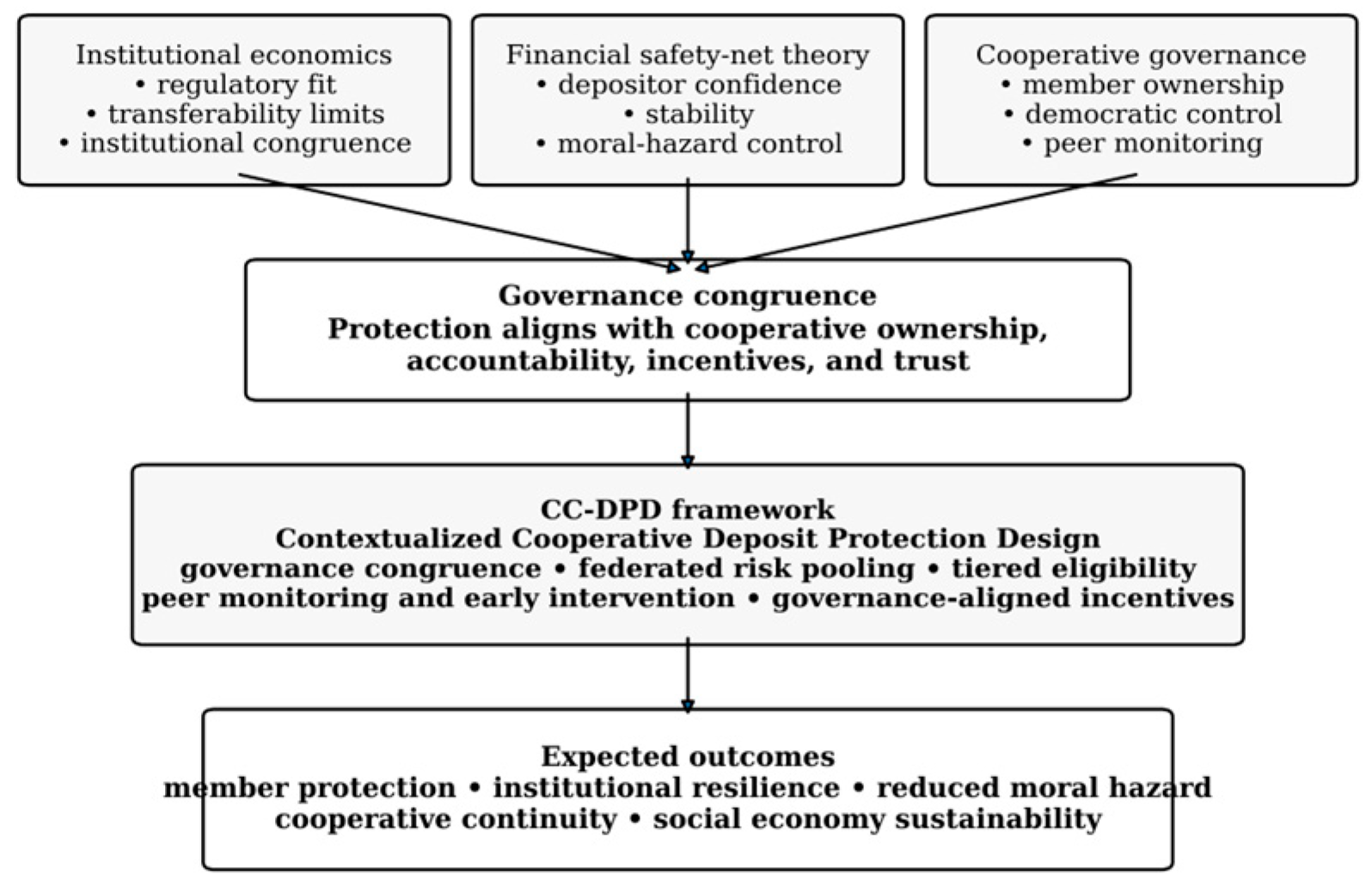
Building on this proposition, the article develops CC-DPD as a governance-sensitive protection model that combines formal member protection with cooperative-specific mechanisms of accountability, risk sharing, peer discipline, early intervention, and governance-aligned incentives. It does not reject deposit insurance as a safety net instrument; rather, it reconfigures deposit protection so that it fits cooperative institutional logic. Its principles are governance congruence, federated risk pooling, tiered eligibility, peer monitoring and early intervention, and governance-aligned incentives.
The integrated logic is summarized in
Figure 1, which links institutional economics, financial safety net theory, and cooperative governance to CC-DPD and its expected outcomes. The framework positions cooperative deposit protection as an institutionally embedded mechanism whose effectiveness depends on alignment between regulatory design and cooperative governance.
3. Methodology
3.1. Research Design
This article uses a conceptual institutional research design combined with comparative policy analysis. The design is appropriate because the article examines institutional suitability and governance alignment rather than statistical prediction. It asks how protection mechanisms can be designed when the regulated organizations differ from commercial banks in ownership, accountability, incentives, and social function.
The study is both theory-oriented and design-oriented. It uses institutional economics, financial safety net theory, and cooperative governance literature to assess the transferability of bank-based deposit insurance to savings and credit cooperatives. This lens is applied to Indonesia’s cooperative finance context and compared with selected European cooperative protection arrangements, especially Germany’s Institutional Protection Scheme, to identify governance principles rather than a directly transplantable model.
Germany was selected as the primary comparative case because its cooperative banking system provides a well-established example of institutional protection in which federated solidarity, supervisory coordination, peer discipline, and early intervention are embedded within a mature cooperative-bank governance structure. The case is not treated as a directly transferable template; it is used as a benchmark for identifying design principles and for clarifying the institutional conditions that Indonesia would need to adapt.
3.2. Source Selection and Documentary Corpus
The analysis uses secondary sources and documentary materials relevant to cooperative financial protection, institutional governance, financial safety net design, and social economy resilience. The corpus includes four source categories: Indonesian regulatory and policy documents, including materials on financial sector reform and cooperatives conducting financial service activities; international policy documents and institutional reports on financial inclusion, deposit insurance, and cooperative finance; peer-reviewed literature on institutional economics, financial safety nets, cooperative governance, cooperative banking, and resilience; and publicly available documentation on major Indonesian cooperative default cases.
Sources were included when they were directly relevant to cooperative finance, regulatory transferability, Indonesian financial sector governance, financial safety net design, or comparative cooperative protection mechanisms. Default cases were not used to produce a statistical sample; they served as contextual evidence of governance vulnerability, member-protection gaps, supervisory fragmentation, and trust erosion.
The Indonesian cooperative default cases were selected purposively because they are publicly documented, widely discussed in policy debates, and illustrate different dimensions of member-protection failure. The selection criteria were large reported financial exposure, public relevance for cooperative-sector trust, evidence of governance or accountability problems, and relevance to the current regulatory debate on supervision and protection. The cases are therefore used to sharpen institutional diagnosis, not to claim statistical representativeness of all Indonesian cooperatives.
3.3. Analytical Procedure and Dimensions
The analysis proceeded in four stages. First, it mapped the institutional assumptions of conventional bank-based deposit insurance, including ownership, depositor protection, risk control, supervision, moral hazard, and resolution. Second, it mapped cooperative governance characteristics, particularly member ownership, democratic participation, overlapping member roles, mutual accountability, peer monitoring, and federated solidarity. Third, it examined Indonesia’s cooperative finance context, major default cases, fragmented supervision, and recent regulatory transition. Fourth, it used European cooperative protection arrangements, especially Germany’s Institutional Protection Scheme, to identify principles such as federated risk pooling, mutual support, peer monitoring, early intervention, and network-based stabilization.
Four analytical dimensions guided the interpretation: ownership and governance structure; accountability and trust formation; risk-sharing and stabilization mechanisms; and governance congruence and institutional resilience. These dimensions allowed the article to compare bank-centric insurance assumptions with cooperative protection needs and to identify conditions under which deposit protection strengthens rather than weakens cooperative governance.
Documentary sources were analyzed through qualitative content coding rather than numerical aggregation. Coding focused on recurring institutional themes such as ownership structure, protected claims, supervisory authority, funding rules, risk monitoring, intervention powers, member accountability, and resolution options. The CC-DPD framework was then developed through a synthesis matrix linking each diagnosed governance problem with a corresponding design response.
3.4. Framework Development Strategy and Boundaries
CC-DPD was developed through conceptual synthesis rather than statistical induction. The synthesis combined theoretical propositions from institutional economics, financial safety net theory, and cooperative governance; contextual diagnosis of Indonesia’s cooperative vulnerabilities; and comparative principles from European cooperative protection arrangements. Each CC-DPD component corresponds to a diagnosed problem: governance congruence addresses institutional mismatch, federated risk pooling addresses fragmented stabilization capacity, tiered eligibility addresses cooperative heterogeneity, peer monitoring and early intervention address delayed risk detection, and governance-aligned incentives address moral hazard.
The framework-development process followed a transparent problem-response logic: institutional mismatch required governance congruence; fragmented stabilization capacity required federated risk pooling; cooperative heterogeneity required tiered eligibility; delayed risk detection required peer monitoring and early intervention; and moral-hazard risk required governance-aligned incentives. This logic clarifies why CC-DPD is a conceptual framework derived from theory, Indonesian institutional diagnosis, and comparative policy evidence, rather than a purely normative proposal.
Several boundaries should be acknowledged. The article does not provide econometric testing, survey evidence, or direct measurement of member behavior. Indonesian default cases are used as contextual illustrations rather than a complete dataset. European arrangements provide governance principles rather than directly transferable models because legal systems, cooperative maturity, supervisory capacity, technological infrastructure, and federation strength differ across countries. These boundaries are consistent with the article’s purpose: developing a conceptual and policy-oriented framework for future empirical testing and regulatory discussion.
4. Institutional Context and Comparative Analysis
4.1. Cooperative Finance and Regulatory Transition in Indonesia
Indonesia’s cooperative financial sector occupies an important but institutionally vulnerable position within the country’s social economy. Savings and credit cooperatives, commonly organized as Koperasi Simpan Pinjam (KSP), provide financial access to households, informal workers, micro-enterprises, and local communities that are often underserved by formal banking institutions. Their role is therefore not limited to financial intermediation. Cooperatives also support community-based economic participation, local resilience, member solidarity, and inclusive development [
1,
2,
4].
From a social economy perspective, cooperatives are expected to combine financial services with democratic governance, member participation, and collective accountability. Unlike commercial banks, which are organized around shareholder ownership and profit-oriented intermediation, cooperatives are designed to serve members and embed financial relations within social and organizational trust. This makes their resilience important not only for financial stability, but also for sustaining local socio-economic systems and member-based economic participation [
1,
21].
However, Indonesia’s cooperative sector continues to face institutional challenges, including uneven governance quality, limited managerial capacity, weak technological integration, fragmented supervision, limited financial literacy among members, and insufficient member protection. These weaknesses have been reflected in major cooperative default cases such as KSP Indosurya, KSP Sejahtera Bersama, KSP Lima Garuda, and Koperasi Jasa Wahana Berkah Sentosa. These cases generated large reported financial losses and weakened public confidence, but more importantly, they exposed weaknesses in governance oversight, risk management, transparency, accountability, and member protection [
12,
13].
The cases in
Table 1 are not treated as a statistically representative sample of cooperative failure. They are used as contextual evidence of institutional vulnerability. Their relevance lies in showing that cooperative distress is rarely a purely financial problem. It is also a governance problem involving weak internal control, inadequate supervision, limited transparency, insufficient member accountability, and delayed corrective intervention. A deposit protection mechanism that focuses only on reimbursing members after failure would therefore address the consequences of collapse without addressing the institutional conditions that allow failure to occur.
To strengthen the empirical grounding of this contextual diagnosis, two cases are particularly illustrative. KSP Indosurya shows how very large member-savings exposure can emerge when cooperative governance, transparency, and risk control fail to keep pace with financial expansion. The problem was not limited to an ex post inability to repay members; it also reflected weak preventive controls, unclear accountability, and delayed corrective intervention. KSP Sejahtera Bersama illustrates a related but distinct problem: liquidity pressure and repayment distress became more damaging because monitoring, governance discipline, and resolution pathways were insufficiently clear. These examples support the need for a protection design that screens governance quality before protection is granted, requires early-warning reporting, and links corrective intervention to member-protection mechanisms.
Analytically, these failures reveal three linked mechanisms of protection failure. The first is governance breakdown, where board oversight, member control, audit discipline, and risk disclosure are insufficient to constrain managerial expansion. The second is supervisory delay, where warning signals are not translated quickly into corrective action, restricted operations, or restructuring. The third is trust erosion, where members lose confidence not only in one cooperative but also in the wider cooperative sector. CC-DPD responds to these mechanisms by making protection conditional on governance screening, early-warning disclosure, federation-based monitoring, and credible resolution pathways.
Indonesia’s regulatory environment has recently entered a transitional phase. Law No. 4 of 2023 on Financial Sector Development and Strengthening reconfigured the relationship between cooperative supervision and financial sector regulation by recognizing that certain cooperatives may conduct activities within the financial services sector [
14]. This is significant because it challenges the assumption that all cooperatives can be governed only through conventional cooperative regulation. Some cooperatives may remain closed-loop member-based institutions, while others may operate in ways that resemble financial service providers with broader risk exposure and stronger consumer-protection implications.
POJK 47/2024 further clarifies the regulatory treatment of cooperatives in the financial services sector by setting out mechanisms related to licensing, scope of activities, capital, institutional transition, supervision, and consumer protection for cooperatives that choose to become financial service institutions [
15]. The regulation is particularly relevant because it introduces a differentiated perspective on cooperative supervision. Cooperatives that collect funds or provide financing beyond their own membership circle may generate risks that are different from those of closed-loop cooperatives. In this context, the distinction between closed-loop and open-loop cooperatives becomes central to deposit protection design.
A closed-loop cooperative primarily serves its own members and operates within a relatively bounded circle of mutual accountability. In such institutions, member-based governance, social proximity, and internal control may play a stronger role in risk discipline. An open-loop cooperative, by contrast, may collect funds from or provide financing to parties beyond its immediate membership base, including members of other cooperatives or non-member parties, depending on the applicable regulatory criteria. Such activities increase the need for external supervision, consumer protection, prudential safeguards, and clearer institutional accountability [
15]. In 2025, OJK announced that it had received from the Ministry of Cooperatives a list of 21 open-loop cooperatives conducting activities in the financial services sector for regulatory follow-up [
16].
For analytical purposes, this article distinguishes three cooperative categories. Closed-loop cooperatives primarily mobilize and use funds within a defined membership community; their main risks concern internal governance, transparency, and member oversight. Open-loop cooperatives conduct financial service activities with broader public exposure or cross-membership transactions; their main risks include consumer-protection gaps, liquidity stress, regulatory arbitrage, and contagion to sectoral trust. Hybrid or transitioning cooperatives occupy an intermediate position: they retain cooperative legal identity but increasingly operate with bank-like scale, products, or external market exposure. This transitional category is important because supervision and protection should change as the cooperative’s risk profile changes.
The distinction also implies differentiated supervision. Closed-loop cooperatives may require stronger member education, internal control, and federation-based monitoring. Open-loop cooperatives should face stricter licensing, prudential reporting, external audit, consumer-protection standards, and resolution rules. Hybrid cooperatives require transition tests to determine whether they should remain under cooperative supervision, enter the financial services regulatory perimeter, or be subject to a staged combination of cooperative and prudential requirements.
These developments create a core institutional design dilemma. Stronger supervision and protection are needed, especially for cooperatives with broader financial service risks. Yet a uniform bank-centric deposit insurance model would not fit all cooperatives. Closed-loop, open-loop, and transitioning cooperatives differ in governance capacity, member accountability, risk exposure, technological readiness, and supervisory needs. Cooperative deposit protection in Indonesia should therefore be differentiated, governance-sensitive, and conditional on eligibility standards rather than applied as a one-size-fits-all guarantee.
4.2. Lessons from European Cooperative Protection Arrangements
European cooperative banking systems offer useful comparative insights because they show that financial protection for cooperative institutions can be organized through governance-based solidarity mechanisms rather than relying exclusively on centralized compensation after failure. The purpose of examining these systems is not to suggest direct transplantation to Indonesia, but to identify governance principles that may inform a more context-sensitive model of cooperative deposit protection.
Studies of European cooperative banking systems show that cooperative stability can be supported through federated networks, mutual guarantee systems, peer monitoring, internal discipline, and collective support mechanisms [
22,
23,
24,
25,
26,
27]. These mechanisms are important because they shift the logic of financial protection from a purely compensatory model toward a preventive model. Rather than waiting for institutional failure, cooperative protection arrangements can identify weaknesses earlier, mobilize network support, and preserve institutional continuity.
Germany’s Institutional Protection Scheme provides one of the most relevant examples. In contrast to conventional deposit insurance systems that primarily compensate depositors after institutional failure, the German cooperative protection arrangement emphasizes institutional continuity, mutual support, early intervention, peer monitoring, and network-based stabilization. Protection is therefore embedded within the governance structure of the cooperative banking network. Its objective is not only to protect depositors, but also to prevent institutional failure and preserve confidence in the broader cooperative financial system [
22,
24,
27].
Institutionally, Germany’s cooperative protection logic operates through a dense network structure in which local cooperative banks, regional auditing associations, central cooperative institutions, and protection arrangements are linked through reporting, monitoring, and intervention channels. Funding is not limited to ex post compensation; it is connected to a mutual support logic that can mobilize resources before failure becomes unavoidable. Peer monitoring is supported by regular auditing and network oversight, while early intervention may include governance correction, liquidity support, merger support, or other stabilization measures intended to preserve institutional continuity.
The German case is also important because it illustrates a dual protection logic. Cooperative banks operate within a framework in which statutory deposit protection and institutional protection mechanisms coexist. This does not eliminate the need for formal depositor safeguards, but it places such safeguards within a wider institutional architecture of prevention, mutual responsibility, and collective discipline. For cooperative finance, this is conceptually significant because the failure of one institution can damage trust in the broader cooperative network. A preventive protection scheme therefore functions not only as a financial buffer but also as a reputational and governance coordination mechanism.
Several principles can be drawn from European cooperative protection arrangements. First, financial protection can be organized through federated risk sharing rather than only through a centralized compensation fund. Second, peer monitoring can complement formal supervision by allowing institutions within a network to observe, discipline, and support one another. Third, early intervention can reduce the probability of institutional failure before member losses occur. Fourth, protection can be linked to internal governance standards, creating incentives for transparency, prudent risk management, and cooperative accountability. Fifth, mutual support mechanisms can preserve institutional continuity when temporary liquidity or solvency pressures arise.
These principles are relevant to Indonesia only with contextual adaptation. Indonesia’s cooperative sector differs from European cooperative banking systems in legal status, institutional maturity, federation strength, supervisory capacity, technology, managerial quality, and member participation. The key lesson is therefore not to copy Germany’s Institutional Protection Scheme, but to design cooperative deposit protection as a governance arrangement that combines formal safeguards with network-based accountability, federated risk pooling, peer monitoring, early intervention, and governance-aligned incentives.
A broader comparative view also supports this interpretation. Cooperative financial systems in the Netherlands, Austria, and France show that federated structures, network discipline, central cooperative institutions, and prudential supervision can interact in different ways while still preserving cooperative identity. Credit union systems in Canada similarly demonstrate that cooperative or member-owned financial institutions may rely on statutory or sector-specific protection arrangements combined with prudential oversight. In several developing-country settings, however, protection mechanisms have been more difficult to institutionalize where federations are weak, reporting systems are fragmented, and supervisory capacity is limited. These differences indicate that the principles behind CC-DPD may travel across contexts, but the institutional instruments must be adapted to the maturity of cooperative networks, regulatory capacity, and the credibility of supervisory enforcement.
To make the limits of policy transferability explicit, the German Institutional Protection Scheme should be treated as a source of design principles rather than a model for direct adoption. The most important differences between the German and Indonesian contexts are summarized in
Table 2.
This comparison reinforces the need for cautious transferability. Indonesia cannot simply reproduce the German arrangement because cooperative federations, reporting infrastructure, audit quality, enforcement capacity, and member financial literacy remain uneven. A feasible adaptation should begin with narrower pilots, minimum eligibility thresholds, stronger disclosure rules, and gradual federation capacity building before any broad protection commitment is introduced.
4.3. Comparative Diagnosis: From Institutional Mismatch to Governance Design
The comparison between Indonesia’s cooperative finance context and European cooperative protection arrangements reveals a central institutional contrast. In Indonesia, cooperative financial protection remains underdeveloped, while regulatory reform is still in transition from conventional cooperative supervision toward differentiated supervision for cooperatives conducting financial service activities. In European cooperative banking systems, by contrast, financial protection is more closely embedded within federated governance structures, mutual support mechanisms, and institutional protection arrangements.
This contrast clarifies the institutional mismatch at the center of this article. Bank-centric deposit insurance models are built around assumptions of external protection, centralized insurance funds, prudential supervision, and depositor compensation. Cooperative financial systems require protection mechanisms that also recognize member ownership, mutual accountability, peer discipline, internal trust relations, and collective risk sharing. When these characteristics are ignored, protection may become formally credible but institutionally misaligned.
Table 3 shows that the main issue is not whether deposit protection is desirable, but which institutional logic should guide its design. A purely bank-centric model would not address the governance failures underlying cooperative distress, while reliance on internal cooperative governance alone would be insufficient for open-loop and large cooperatives with complex financial service activities. Indonesia therefore needs a hybrid protection architecture that combines external safeguards with cooperative-specific governance mechanisms.
The argument should therefore not be read as a rejection of every bank-based instrument. Large open-loop cooperatives that operate in ways similar to commercial financial institutions may require selected bank-style elements, including prudential reporting, fit-and-proper governance requirements, risk-based contributions, external audit, clear payout rules, and resolution planning. The central objection is to one-size-fits-all transplantation. Bank-based instruments may be useful when they are adapted to cooperative ownership, member accountability, and differentiated risk profiles.
This diagnosis provides the foundation for the CC-DPD framework developed in the next section. CC-DPD builds on the principle that cooperative deposit protection should be differentiated, governance-congruent, and preventive. It should combine formal member protection with federated risk pooling, tiered eligibility, peer monitoring, early intervention, and governance-aligned incentives. In this way, deposit protection can support not only financial confidence, but also institutional resilience and the sustainability of the social economy.
5. Interpretive Findings and Framework Development
5.1. Institutional Mismatch and Trust Erosion
The first interpretive finding is that bank-centric deposit insurance and cooperative deposit protection are based on different institutional logics. Conventional deposit insurance systems are generally designed for commercial banks, where depositors, shareholders, managers, and regulators occupy relatively distinct institutional roles. Savings and credit cooperatives operate through a different logic. Members may simultaneously act as savers, borrowers, users, owners, and governance participants. This overlapping role structure changes the relationship between protection, accountability, risk bearing, and trust.
The implication is that the central question is not simply whether cooperatives should have deposit protection, but how such protection should be institutionally designed. If deposit insurance is introduced as a direct extension of banking regulation, it may formally protect members’ savings while leaving unresolved the governance problems that contribute to cooperative failure. In such cases, protection may address the consequences of institutional collapse but not the conditions that generate vulnerability.
The Indonesian cooperative finance context illustrates this dilemma. Major cooperative default cases show that financial losses were closely connected to governance failure, weak oversight, inadequate transparency, limited member accountability, and insufficient risk management [
12,
13]. These cases indicate that cooperative distress is not only a liquidity or solvency problem. It is also a problem of institutional accountability and trust. A protection mechanism that compensates members after failure but does not strengthen governance screening, transparency, early intervention, and member control would remain incomplete.
This mismatch also affects the formation of trust. In conventional deposit insurance theory, confidence is often generated through external guarantees and the credibility of the financial safety net [
5,
6]. In cooperative finance, however, trust is also embedded in member participation, relational proximity, democratic control, peer monitoring, and collective ownership. When external guarantees are introduced without reinforcing these internal mechanisms, they may unintentionally reduce member vigilance and weaken cooperative accountability. The mismatch is therefore not merely legal or administrative; it concerns whether protection mechanisms preserve or displace the internal governance capacities of cooperatives.
5.2. Governance-Based Resilience as an Alternative Stability Logic
The second interpretive finding is that cooperative financial stability can be supported through governance-based resilience mechanisms. Conventional bank-centric models often emphasize depositor compensation after institutional failure. By contrast, cooperative protection arrangements can also be preventive. They can seek to detect institutional weakness early, mobilize network support, discipline risky behavior, and preserve institutional continuity before failure occurs.
This preventive logic is consistent with comparative lessons from European cooperative banking systems. Studies of cooperative banking structures show that financial stability can be supported through federated solidarity, peer monitoring, mutual support, internal stabilization mechanisms, and early intervention [
22,
23,
24,
25,
26,
27]. Germany’s Institutional Protection Scheme is particularly instructive because it demonstrates that cooperative financial protection can be organized not only around depositor reimbursement, but also around institutional continuity, mutual responsibility, and network-based discipline.
Governance-based resilience has four important implications for cooperative deposit protection. First, protection should not be limited to ex post compensation. It should also include ex ante mechanisms for risk detection, intervention, and institutional rehabilitation. Second, cooperative networks and federations can play a role in monitoring, support, and discipline, provided that their authority, capacity, and accountability are clearly defined. Third, member protection should be linked to governance performance so that poorly governed cooperatives do not receive unconditional guarantees. Fourth, resilience should be understood not only as the survival of individual cooperatives, but also as the preservation of trust in the broader cooperative sector.
For Indonesia, this finding is particularly important because recent regulatory reforms have introduced a more differentiated view of cooperatives conducting financial service activities [
14,
15]. Closed-loop cooperatives, open-loop cooperatives, and cooperatives transitioning into regulated financial service institutions differ in public exposure, governance capacity, risk profile, and supervisory needs. A governance-based protection model should therefore be differentiated rather than uniform. It should combine formal safeguards with internal and network-based accountability mechanisms.
5.3. The CC-DPD Framework as a Contextualized Institutional Governance Model
The synthesis of institutional mapping, Indonesian regulatory context, cooperative default cases, and comparative policy analysis leads to the formulation of the Contextualized Cooperative Deposit Protection Design (CC-DPD) framework. CC-DPD is proposed as a governance-sensitive protection model for savings and credit cooperatives. It is not intended to replicate bank deposit insurance. Instead, it redesigns member protection around the institutional characteristics of cooperatives: member ownership, democratic control, mutual accountability, federated solidarity, and embedded social trust.
The framework rests on five interrelated design principles. First, governance congruence requires that protection mechanisms reinforce rather than replace cooperative accountability. Eligibility for protection should therefore depend not only on financial indicators but also on governance quality, transparency, audit practices, internal control, and member-control mechanisms. Second, federated risk pooling allows risks to be shared across cooperative networks or federations, translating the cooperative principle of solidarity into a formal stabilization mechanism. Third, tiered eligibility recognizes the heterogeneity of cooperatives by differentiating protection levels, contribution rates, and supervisory requirements according to size, risk profile, governance capacity, and openness of membership. Fourth, peer monitoring and early intervention embed risk detection within cooperative networks before institutional distress becomes systemic. Fifth, governance-aligned incentives reduce moral hazard by linking protection benefits to demonstrable improvements in transparency, risk management, democratic accountability, audit compliance, and corrective action.
The moral-hazard risk is addressed through conditional protection rather than unconditional guarantees. In CC-DPD, managers and boards of cooperatives would face stronger incentives to avoid excessive risk-taking because access to protection, contribution rates, and the scope of coverage would depend on governance performance, audit compliance, related-party lending controls, liquidity discipline, transparent member reporting, and timely corrective action. Cooperatives that expand into open-loop financial service activities without meeting eligibility standards would receive restricted or delayed access to protection. This design also reduces regulatory arbitrage by preventing weakly governed cooperatives from using the cooperative legal form to obtain bank-like protection while avoiding bank-like prudential discipline.
CC-DPD therefore reframes cooperative deposit protection as both a financial and institutional governance arrangement. Its purpose is not only to compensate members after failure, but also to prevent failure by strengthening the organizational conditions that sustain cooperative resilience. This distinction is crucial for Indonesia because cooperative failures have exposed weaknesses not only in liquidity and solvency, but also in supervision, accountability, transparency, risk governance, and member protection.
Table 4 shows that CC-DPD is a layered governance architecture rather than a single instrument. Governance congruence defines the design principle; federated risk pooling provides stabilization capacity; tiered eligibility differentiates participation; peer monitoring and early intervention create preventive capacity; and governance-aligned incentives reduce moral hazard. Together, these elements shift cooperative deposit protection from narrow compensation toward resilience-oriented governance.
5.4. Implementation Pathway for CC-DPD in Indonesia
In practical terms, CC-DPD can be introduced through a phased pathway rather than as an immediate nationwide guarantee. The sequence begins with defining protected member-savings claims, then screening cooperatives for governance, audit, capital, liquidity, reporting, and membership-openness criteria. It then establishes a federation-linked stabilization or protection pool, introduces early-warning reporting and corrective action, and defines resolution options such as rehabilitation, merger, temporary administration, asset-and-liability transfer, payout, or exclusion when governance standards are not met.
Table 5 translates the CC-DPD framework into a practical sequence of regulatory and cooperative-sector actions. It shows that implementation should begin with claim definition and eligibility screening, not with immediate universal compensation. This staged approach is intended to protect members while preventing moral hazard, regulatory arbitrage, and premature dependence on external guarantees.
Implementation success should be assessed through financial and governance indicators, including audited statements, timely regulatory reporting, liquidity adequacy, non-performing loan trends, related-party exposure, concentration risk, complaint resolution, corrective-action completion, federation monitoring coverage, resolution or payout time, and member understanding of protected and unprotected claims. These indicators would help policymakers evaluate whether CC-DPD improves protection without weakening cooperative accountability.
A feasible implementation strategy would begin with pilot testing among large or open-loop cooperatives with sufficient reporting capacity, followed by phased expansion to other cooperatives that meet minimum governance and audit standards. During the pilot stage, regulators and federations could test claim definitions, eligibility criteria, contribution formulas, early-warning indicators, and intervention protocols before moving toward wider adoption.
Table 6 translates CC-DPD into regulatory practice by specifying the functions of the risk pool, governance scorecard, contribution formula, peer-monitoring process, eligibility status, early-intervention triggers, and closed-loop/open-loop differentiation.
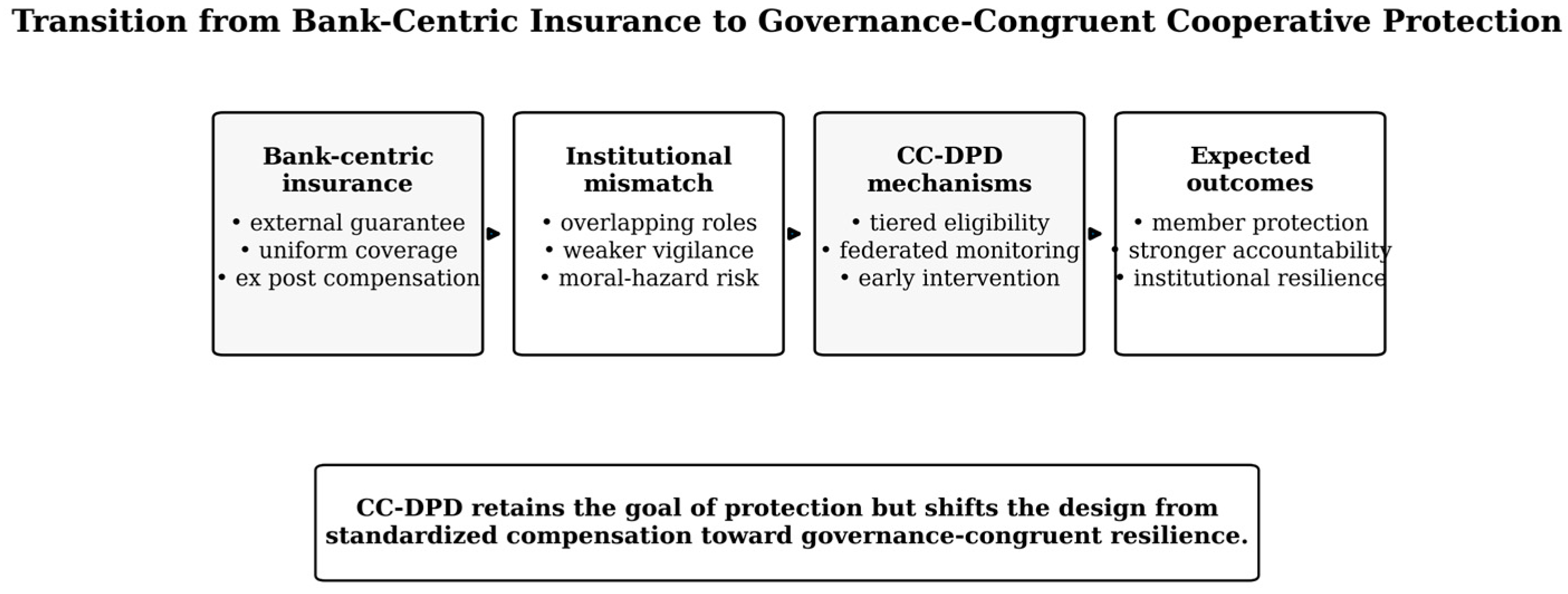
5.5. Institutional Transition from Bank-Centric Insurance to Cooperative Protection
CC-DPD implies a shift in the logic of protection. Bank-centric models prioritize depositor confidence, centralized insurance funds, prudential supervision, and compensation after failure. These functions remain important, but for cooperatives they must be integrated with member accountability, cooperative governance, and network-based support.
Figure 2 illustrates this transition. The figure shows how cooperative protection moves from a bank-centric logic toward a governance-congruent model. The starting point is institutional mismatch: the direct transfer of bank deposit insurance to cooperatives. The transition pathway consists of governance congruence, federated risk pooling, tiered eligibility, peer monitoring, early intervention, and governance-aligned incentives. The expected outcomes are member protection, reduced moral hazard, stronger accountability, institutional resilience, and social economy sustainability.
Figure 2 clarifies that CC-DPD does not reject depositor protection; it redesigns protection around cooperative institutional logic. Unlike the bank-centric model, which emphasizes external guarantees, uniform rules, and ex post compensation, CC-DPD links protection with member-based governance, federated risk pooling, peer monitoring, early intervention, and context-sensitive incentives.
5.6. Social Economy Implications
The final interpretive finding is that cooperative deposit protection should be understood within social economy resilience. Savings and credit cooperatives are community-based institutions that support economic participation, mutual assistance, local trust, and financial inclusion. Their failure may therefore undermine not only individual savings, but also access to local finance, community trust, informal economic networks, and confidence in the cooperative form.
For this reason, the design of cooperative deposit protection has broader social implications. A poorly designed protection system may stabilize deposits in a narrow technical sense but weaken cooperative governance in the long term. Conversely, a governance-sensitive protection system may strengthen both financial confidence and social economy resilience. This is particularly relevant in emerging economies, where cooperatives often serve groups that remain underserved by formal banking institutions and where institutional trust is central to inclusive development [
1,
4].
Together, the interpretive findings support the article’s central argument: bank-centric deposit insurance is insufficient for cooperative financial systems unless redesigned around cooperative governance principles. In Indonesia, CC-DPD offers a conceptual pathway for aligning member protection, regulatory reform, federated accountability, and institutional resilience.
7. Conclusions
This article reexamined the applicability of bank-centric deposit insurance to savings and credit cooperatives in Indonesia. It argued that cooperative deposit protection cannot be treated as a technical extension of banking regulation because cooperatives are based on member ownership, democratic participation, mutual accountability, and embedded social trust.
The analysis showed that financial protection mechanisms are not institutionally neutral. When regulatory frameworks designed for commercial banks are applied to cooperatives without contextual adaptation, they may generate institutional mismatch. Such mismatch may weaken member accountability, reduce peer-based discipline, distort incentives, and undermine the trust relations that support cooperative resilience. This issue is particularly important in Indonesia, where savings and credit cooperatives contribute to financial inclusion and local economic participation but continue to face challenges of governance quality, supervision, institutional capacity, and public trust.
Drawing on institutional economics, financial safety net theory, cooperative governance literature, Indonesia’s post-P2SK regulatory transition, and comparative lessons from European cooperative protection arrangements, the article proposed the Contextualized Cooperative Deposit Protection Design (CC-DPD) framework. CC-DPD conceptualizes cooperative deposit protection as institutional governance by integrating external safeguards with governance congruence, federated risk pooling, tiered eligibility, peer monitoring, early intervention, and governance-aligned incentives.
The article contributes to institutional economics by emphasizing governance congruence as a condition for regulatory effectiveness. It extends financial safety net theory by showing that depositor protection must be adapted to institutional diversity. It also contributes to social economy and cooperative governance debates by demonstrating that financial protection can either reinforce or weaken the social foundations of cooperative resilience.
From a policy perspective, Indonesia should avoid a one-size-fits-all approach to cooperative deposit protection. A more suitable framework would combine formal member protection with differentiated governance requirements, risk-based contributions, federation-based monitoring, early intervention, and corrective supervision. This is especially relevant for distinguishing closed-loop cooperatives from open-loop cooperatives and for designing protection mechanisms that reflect differences in governance capacity, risk exposure, and public accountability.
Because this article is conceptual and interpretive, CC-DPD requires further empirical validation. Future research should examine its operational feasibility through stakeholder interviews, comparative case studies, institutional performance analysis, member-behavior research, and simulations of federated risk pooling. More broadly, the Indonesian case shows that inclusive financial governance in emerging economies requires protection mechanisms sensitive to institutional diversity, organizational identity, and the social foundations of economic resilience.





 ,
,