1. Introduction
University–employer alliances have positioned themselves as a device of organizational innovation to connect academic capabilities with productive needs and public challenges. In recent literature, these alliances are described as multi-actor arrangements that mobilize knowledge, coordinate expectations, and enable circuits of applied learning; their potential depends not only on the number of agreements but also on the quality of the organizational design that sustains cooperation and the return of learning to the curriculum [
1,
2,
3]. In corporate governance terms, these alliances are relevant because they entail shared responsibilities—such as decisions about roles, oversight, success criteria, data use, student protection, and the distribution of benefits—that can affect the reputation, compliance, and performance of the organizations involved. When an alliance is sustainability-oriented, understood here as responsible value distribution, actor protection, and organizational resilience of collaboration over time, the evaluation standard rises: it is not enough to demonstrate efficiency or employability; it becomes necessary to justify public value, manage risks, and ensure that benefits do not concentrate in the actor with the greatest bargaining power.
In this article, “corporate governance” is used in an applied sense relevant to employers participating in university–employer alliances: the set of accountability, risk oversight, control, and stakeholder-facing decision arrangements through which an organization governs partnerships that may affect reputation, compliance, resource allocation, and value distribution. In practice, alliance governance becomes a corporate governance issue when decisions about roles, monitoring, incentives, data use, and benefit/risk allocation are not merely operational but shape accountability and exposure across stakeholders [
2,
4,
5]. Accordingly, “sustainability” is specified here as the capacity of the alliance to remain stable and legitimate over time by (i) protecting participants (especially students) through explicit safeguards, (ii) preventing short-term metric capture, (iii) ensuring responsible value distribution and transparent risk management, and (iv) sustaining curricular return as an organizational learning loop rather than a one-off deliverable [
3,
6,
7].
In this context, Technological Mediation is part of the core of innovation. Platforms, repositories, and tracking systems condition access and participation, shape the kinds of interaction, and provide information to assess progress and decisions; therefore, digital design is not a neutral “support” but a component that can deepen co-creation—or, if reduced to compliance, turn collaboration into an administrative formality [
8,
9,
10]. The sustainability of an alliance depends, to a large extent, on the capacity of its architecture (organizational and digital) to sustain deliberation, transparency, follow-up, and co-responsibility over time [
1,
8].
The expansion of university–employer alliances has been accompanied by a frequent drift toward instrumental arrangements in which the word “collaboration” is used as a label for transactional relationships centered on placement, resources, or institutional marketing, without curricular transformation or an explicit ethical horizon [
5,
11,
12]. This slippage occurs because institutions tend to govern what is most visible and quantifiable—such as the number of agreements, hours, deliverables, certifications, and short-term metrics. When those indicators replace the formative telos (purpose), the alliance stabilizes as a strategic linkage but loses educational authenticity. Moreover, the centrality of the employer in employability discourses can shift the focus from formation to efficiency, generating asymmetries in the distribution of risks (overload, precarization, exposure to unprotected environments) and benefits (reputation, data, intellectual property, productive solutions) [
4,
6,
13].
An illustrative case is the expansion of micro-credentials. They can close skills gaps and support labor trajectories, but they can also fragment formation into units of market value if they are not articulated with a social responsibility framework and an intensive curricular criterion [
14,
15]. In scenarios of accelerated digitalization, the platform can reinforce instrumental drift if it is designed to record compliance and production rather than to document deliberation, reflective learning, and curricular return. In short, the risk is not the alliance itself but its governance: without explicit criteria, collaboration can drift toward instrumental linkage and become ungovernable.
This article proposes a theoretical–conceptual framework with managerial output to maximize the sustainability of university–employer alliances through:
A governance framework based on a hierarchy of “support entities” that orders ends and means.
An explicit layer of digital governance that makes cooperation auditable.
A compact verification tool for auditing without collecting new field data.
In this sense, the contribution is twofold. First, it proposes an operational definition of “Collaborative Education” as a multi-actor arrangement that, in contexts of digitalization, may be technologically mediated and oriented by social responsibility, offering a shared language amid the proliferation of labels and the lack of common terminology in the literature [
1,
2]. Second, it translates that definition into decision domains (who decides what, with what evidence, under what risks), so that collaboration becomes governable and comparable, even in institutional contexts with different capacities.
Accordingly, this article poses the following research question: What minimum governance components (organizational and digital) enable the design, sustenance, and auditing of university–employer alliances oriented by Social Responsibility, preventing their instrumental drift over time?
The article is organized as follows:
Section 2 delimits the concept of Collaborative Education;
Section 3 specifies the theoretical–conceptual design and the method’s outputs;
Section 4 develops the substance–accidents rule and the formative telos as a governance criterion;
Section 5 presents the minimum architecture of seven support entities;
Section 6 distinguishes authentic collaboration from instrumental linkage as a sustainability criterion;
Section 7 positions Technological Mediation as the core of digital governance;
Section 8 integrates the hybrid architecture and its implications for employer co-responsibility;
Section 9 provides a minimum checklist for document auditing and platform design review;
Section 10 discusses contributions and tensions; and
Section 11 closes with conclusions and a future agenda.
2. Conceptual Delimitation of Collaborative Education
In recent years, efforts have increased to articulate diverse forms of collaboration between universities and their social, community, and productive environment, giving rise to a variety of initiatives and labels in the literature [
1]. In this field, work-integrated learning is used to describe situated learning integrated in the workplace, where cooperation and computational artifacts mediate practices and collective learning [
16]. Likewise, in China, the integration of education and industry in applied universities is discussed by reference to the German case, highlighting employability-linked learning and governance recommendations (e.g., decentralization to respond to regional needs) [
17]. However, this terminological emergence is not always accompanied by a clear conceptual definition of what makes a university–employer agreement genuinely educational and social—and therefore also a matter of responsibility.
To prevent the concept of “Collaborative Education” from becoming a label adaptable to any agreement, this article adopts a nominal definition with verifiable criteria. Collaborative Education is understood as a multi-actor institutional arrangement (university, employers, and other relevant actors) organized around situated problems and explicit formative objectives, sustained especially through Technological Mediation, and oriented by social responsibility as a criterion of legitimacy and authenticity [
18,
19]. The definition assumes that the arrangement’s value does not depend on the volume of alliances but on the clarity with which objectives, roles, responsibilities, and management/follow-up mechanisms are agreed upon to sustain collaboration and manage uncertainty [
3,
4].
Within organizations, it has been shown that the quality of shared knowledge influences the effects of knowledge exchange on exploration and exploitation capabilities (ambidexterity) and, through that pathway, on organizational performance [
20]. Since education no longer depends (knowledge management) on a single institution, operationally, the definition of Collaborative Education translates into three features. First, a multi-actor relational structure that is not limited to a bilateral exchange but integrates differentiated roles and requires attention to networked decision arrangements; in polycentric configurations, decision-making processes influence what is recognized as knowledge and who benefits [
1], while a multi-stakeholder perspective in higher education institutions helps map actors and expectations in complex relationships [
2]. Second, Technological Mediation as relational infrastructure: platforms, repositories, and interaction environments provide continuity to cooperation and make interactions and evidence visible; therefore, digitalization adds relational complexity and must be considered in the arrangement’s design [
2], and its implementation requires attention to stakeholder perceptions, frameworks, and metrics to avoid a merely instrumental adoption [
8]. Third, Social Responsibility as an explicit normative orientation: it orders ends and means and demands that collaboration be justified by its contribution to social challenges and by the management of risks and effects; within this horizon, the need for intersectoral collaboration to address complex challenges and advance toward a more sustainable and just world is emphasized [
6], and Social Responsibility is positioned as a normative field associated with organizational ethics and stakeholder demands [
5].
In institutional language, “collaboration” is often confused with operational cooperation or administrative coordination. In this article, coordination refers to task alignment without purpose deliberation; cooperation describes mutual assistance without co-design or redistribution of responsibilities; and linkage indicates a strategic interface with the environment (internships, placement, resource acquisition) without sustained curricular transformation. Therefore, the proposed demarcation criterion requires minimum evidence such as shared decisions on success criteria, explicit participation rules, and a mechanism for returning learning to the curriculum.
This conceptual confusion is not a minor academic detail: it increases the risk of governing through short-term indicators and of treating Technological Mediation as a sign of modernization without formative impact. In the absence of criteria, implementation can be reduced to adoption and compliance, disconnected from relevant frameworks and metrics to evaluate actors’ effects and experiences [
8]. Conversely, when digital environments are designed to sustain interaction and collaboration (e.g., through immersive platforms and virtual contexts), they can strengthen continuity of joint work and improve the comparability of practices across projects [
21].
The central distinction in this article is between transformational collaboration and instrumental collaboration. The former is characterized by the centrality of formative purpose (telos) and Social Responsibility; the latter tends to understand collaboration as a means to an end and to privilege external incentives and short-term results [
7,
12]. In the field of strategic alliances, this instrumental logic is expressed as cooperation aimed at creating value, accessing resources, expanding, or sharing risks, and it usually depends on coordination, alignment of interests, and trust mechanisms [
13].
The operational criterion of authenticity is not moralistic but a rule of governance. Based on these approaches—and as an operationalization to evaluate university–employer agreements—an alliance is authentic if:
- (a)
The formative purpose is explicit and exceeds the logic of immediate employability.
- (b)
Explicit conditions of care and protection exist for students and other actors.
- (c)
The distribution of benefits and risks is declared and reviewed.
- (d)
There is evidence of returning learning to the curriculum and to institutional practices.
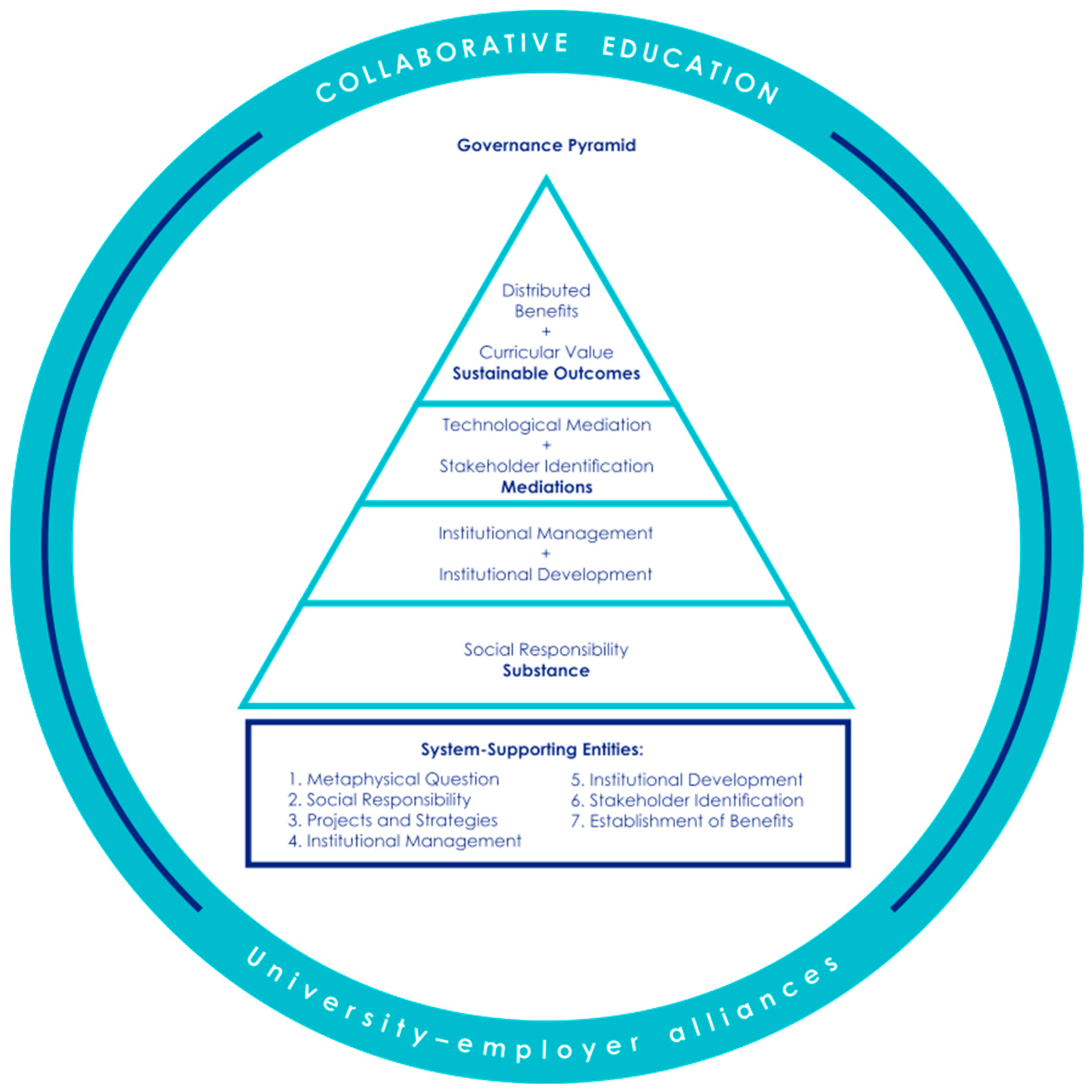
To turn Collaborative Education into a governable object, this article proposes a minimum architecture of seven entities: (1) Metaphysical question; (2) Social Responsibility; (3) Projects and strategies; (4) Institutional management; (5) Institutional development; (6) Stakeholder identification; and (7) Establishment of benefits. This architecture makes it possible to order ends and means, assign responsibilities, and audit coherence without relying on field data collection.
As shown in
Figure 1, the system is governed by an ordering logic: formative telos and Social Responsibility function as constitutive criteria, while organizational arrangements and Technological Mediation remain configurable but auditable. The governance implication is managerial: committees should decide what is non-negotiable (identity criteria) before optimizing what is variable (tools, incentives, platform settings), preventing instrumental drift driven by short-term metrics.
Glossary (Operational Terms for Consistency)
Collaborative Education (CE): A multi-actor, technologically mediated educational arrangement in which universities and employers co-design learning-related projects under explicit governance rules, with Social Responsibility as a criterion for legitimacy and sustainability. CE is not defined by the presence of partnerships or platforms but by auditable decision arrangements (roles, evidence rules, safeguards) that protect participants and secure curricular return over time.
University–employer alliance: A structured collaboration between a higher education institution and an employer for learning, projects, or credentialing. In this paper, an alliance is “governable” when decision rights, accountability, evidence, and risks are explicitly specified and traceable.
Authentic (transformational) collaboration: A collaboration in which formative telos, participant protection, co-decision, and curricular return are non-negotiable and evidenced through deliberative and formative artifacts (not only outputs). It is assessed through documentary and platform-design evidence.
Instrumental (strategic) linkage: A partnership oriented primarily to short-term metrics (agreements, hours, deliverables, placements) where platform artifacts substitute for formative evidence and curricular transformation, increasing the likelihood of capture and unequal value distribution.
Social Responsibility (as governance criterion): A decision rule requiring justified distribution of benefits and risks, stakeholder protection (especially students), and public-value orientation, documented through policies, safeguards, and traceable deliberation rather than rhetorical statements.
Technological Mediation/Digital governance: The platform layer is treated as governance infrastructure—shaping participation, evidence visibility, incentives, and asymmetries. Digital governance refers to auditable controls (access rights, consent, decision logs, retention rules, transparency of evaluation use) that prevent surveillance-extractive practices and metric capture.
Substance–accidents heuristic: A governance prioritization rule that distinguishes non-negotiable identity conditions (purpose/telos and social responsibility) from configurable design choices (tools, metrics, formats, platform features). Decisions that improve outputs but undermine telos or safeguards must be re-governed.
Curricular return: The documented mechanism by which collaboration outcomes inform curriculum (adjustments, competencies, assessment criteria, learning pathways). It is the core sustainability loop that differentiates CE from one-off deliverables.
3. Article Design and Method
This article adopts a theoretical–conceptual design aimed at producing a governance artifact composed of: (i) a conceptual framework, (ii) an explicit layer of digital governance, and (iii) a compact verification tool. This responds to two recurrent conditions: first, the expansion of multi-actor arrangements in higher education and their interaction with society requires comparable criteria to distinguish configurations, roles, and decision processes [
1]; second, in university–environment collaborations, measuring effects and impacts is complex due to the diversity of expectations, temporalities, and dimensions (tangible and intangible), making a reading reduced to simple indicators insufficient [
3]. Likewise, Technological Mediation is often adopted as part of institutional transformation, but its implementation demands frameworks and metrics that consider actor acceptance, pedagogical effects, and the sustainability of technological integration [
8].
3.1. Conceptual Development Procedure (Transparency)
To enhance transparency in a theoretical–conceptual contribution, the framework was developed through an explicit sequence of design steps grounded in the literature on multi-actor collaborations, impact/governance challenges, and digital mediation in higher education. First, the problem was delimited as “instrumental drift” in university–employer alliances, i.e., the displacement of formative purpose by short-term metrics and compliance artifacts [
3,
12]. Second, the literature scope was bounded to three intersecting domains: (i) university–environment multi-stakeholder arrangements and governance/impact issues [
1,
2]; (ii) alliance dynamics, incentives, and value capture in partnerships [
7,
13]; and (iii) educational digitalization and governance needs for technology implementation [
8,
9,
10].
Third, constructs were selected using a pragmatic criterion: each construct had to (a) address a recurrent governance decision in alliances, and (b) be auditable through documentary traces (rules, minutes, role definitions, platform settings) without requiring field data collection. Fourth, constructs were ordered using the substance–accidents heuristic as a governance prioritization rule: identity/purpose and social responsibility operate as non-negotiable criteria, while organizational and technological design choices remain configurable under that constraint [
22,
23,
24]. Fifth, concepts were translated into decision domains (who decides, which evidence counts, which risks are accepted, which safeguards apply), aligning the framework with managerial governance language [
1,
8]. Finally, the matrix and checklist were prototyped as minimal artifacts for document auditing and platform design review, and iteratively refined to ensure internal coherence and usability across organizational contexts [
21,
25].
The method proceeds in two moves:
Conceptual ordering: The definition of Collaborative Education and its normative core are formalized, and the substance–accidents distinction is introduced as an analytical resource inspired by the Aristotelian tradition to prioritize components and avoid the inversion of ends [
22,
24]. In this key, social responsibility functions as a constitutive criterion and the formative telos as a normative compass of legitimacy [
12,
24].
Translation into governance: Each concept becomes a decision domain (who decides, what evidence is accepted, what risks are assumed, what safeguards are activated). This translation makes it possible to locate Technological Mediation as a decisive site of governance: where environments, tools, and methodologies are configured, and practical rules of interaction and assessment are defined—with effects on participation, evidence, and coordination among actors [
8,
9].
In this way, the method produces three articulated deliverables, ready for institutional (university) and corporate (employer) application, with particular emphasis on sustainability and digital governance.
3.2. Segment 1: Hierarchy of Support Entities (Framework)
The first product is an ontological hierarchy of seven support entities that structure the Collaborative Education system in the university–employer alliance. These entities are: (1) the metaphysical question, (2) social responsibility, (3) the establishment of projects and strategies, (4) institutional management, (5) institutional development, (6) stakeholder identification, and (7) the establishment of benefits.
The hierarchy clarifies that these entities do not occupy the same ontological plane: some function as foundations, others as operational conditions, and others as mediations to ensure relevance and sustainability.
The identity criterion specifies the non-negotiable limits of the arrangement and the formative telos that must subordinate metrics, tools, and agreements.
Social responsibility is assumed as a constitutive normative criterion that orders priorities and evaluation based on the impacts of decisions and actions on society and the environment, preventing the system from being reduced to merely managerial or procedural logic [
5,
12].
Technological Mediation and institutional ethos are treated as operational implementation dimensions: decisions about technological integration influence pedagogical practices, administrative structures, sustainability, and actor acceptance; therefore, they can enable co-responsibility or drift into purely procedural uses [
8].
Table 1 summarizes this hierarchy and provides its governance reading as a prioritization rule for committees (identity criteria constrain operational and technological choices).
3.3. Segment 2: Governance Principles (Derived from the Framework)
The second product is a set of governance principles that act as rules for design and evaluation, aligned with innovation and sustainability:
Primacy of telos: Ethical–formative purpose orders indicators and practices.
Social responsibility as a decision criterion: It defines priorities and evaluation, not merely discursive legitimation.
Subsidiarity of accidents: Technologies, formats, and protocols are adaptable without loss of identity, provided they do not displace the substance.
Intentional digital governance: Technology requires reflective integration, metrics, and safeguards to produce meaningful change.
Traceability and transparency: Decisions and evidence must be intelligible and auditable to sustain co-responsibility.
Co-responsibility in multi-actor networks: Design must recognize relationships, asymmetries, and coordination among actors.
3.4. Segment 3: Checklist for Design, Evaluation, and Redesign
The third product is a checklist organized by governance and digital governance domains. Its function is to enable a practical evaluation without data collection, through document auditing, rules review, and platform design examination in an authentic university–employer alliance.
The verification tool is presented in
Section 9 as a minimum checklist for document auditing and platform design review.
5. The Seven Support Entities of the Collaborative Education System
The seven support entities function as a minimum architecture to design and audit Collaborative Education without losing the normative core in university–employer projects. They are proposed as a managerial map that makes it possible to answer, in a structured way, five governance questions: purpose, actors, decisions, evidence, and risks.
Metaphysical question (identity criterion: substance and telos). It delimits the horizon of meaning: what makes the system recognizable, which limits are non-negotiable, and what counts as success from a formative perspective. This is not an abstract exercise; its managerial function is to prevent the alliance from being reduced to an efficiency or reputation device and to sustain coherence over time.
Social responsibility. It operates as substance: an authenticity criterion that orders ends and means. It defines the orientation toward public value, the need to protect actors, and the obligation to distribute benefits and manage risks explicitly.
Projects and strategies. This is the mode of materializing telos: it defines which problems are addressed, with what approach, and what formative products are expected. In Collaborative Education, projects are not “external tasks” to the curriculum; they are vehicles for producing curricular knowledge and assessable learning.
Institutional management. It encompasses rules, roles, processes, and accountability mechanisms. It includes criteria for selecting alliances, approval mechanisms, protection protocols, and assessment schemes. Its absence can produce ambiguity, arbitrariness, or capture by short-term indicators.
Institutional development. It refers to organizational–institutional–corporate capacities: a culture of collaboration, tutor training, infrastructure, digital maturity, and organizational competencies to sustain alliances. Without institutional development, Collaborative Education depends on individual efforts and becomes fragile under turnover or crisis.
Stakeholder identification. It defines who the relevant actors are, how they are incorporated, and under what rules they participate. In multi-actor alliances, legitimacy and sustainability depend on participation being deliberative rather than merely symbolic, and on mechanisms to reduce asymmetries.
Establishment of benefits. It specifies what benefits are expected, for whom, and under what distribution criteria; it also makes risks and compensations explicit. Without this entity, cooperation tends to concentrate benefits in the actor with the greatest negotiating capacity and to displace risks onto students or communities.
The architecture is not merely a list; in this article it is organized hierarchically to avoid the inversion of ends. Entities (I) and (II) are foundational because they define identity and orientation; (III), (IV), and (V) are operational conditions because they make execution and sustenance possible; and (VI) and (VII) are mediations because they translate purpose into participation and value distribution. This hierarchy is proposed as a rule of correction: if benefits, metrics, or the platform begin to govern purpose, that is taken as a sign of misalignment and goals, roles, responsibilities, and safeguards are reviewed—consistent with recommendations to agree on objectives, responsible parties, expectations, and clear frameworks in university–industry collaborations [
21,
25] and with cautions about using metrics as decision criteria [
8]. The hierarchy also enables contextual flexibility: project formats and digital tools can change as long as the substantive core is not weakened, considering the need for adaptation and flexibility amid changes in digital and institutional environments [
10,
21].
Each entity is translated into a decision domain with responsible parties, minimum evidence, and risks. For example, social responsibility defines criteria to select projects and protect actors; institutional management defines assessment and accountability rules; and Technological Mediation defines what is recorded, who accesses it, and how deliberation is documented. This translation helps move from declarative collaboration to governable collaboration, assigning responsibilities and making explicit the decision arrangements that influence who benefits and how knowledge is produced in multi-actor agreements [
1]. It also draws on recommended practices to delimit objectives, roles, responsibilities, and safeguards in university–industry collaborations [
21] and on evidence of operational challenges that require design and management in employer-linked formative experiences [
29]. An expected result is increased coherence among institutional strategy, curricular practices, and commitments to stakeholders, consistent with approaches linking Social Responsibility, ethics, and effects on interested parties [
5].
For all these reasons, Technological Mediation and institutional ethos are asserted to be “tests” where it becomes visible whether the system operates as authentic collaboration or as a bureaucratic procedure in the university–employer relationship; therefore, digital governance (data, transparency, inclusion, protection) must be designed from Social Responsibility as substance.
The minimum operationalization by entity is summarized in the checklist in
Section 9.
Taken together, the seven entities make it possible to govern university–employer alliances as a system because they define meaning, coherence, stability, relevance, and sustainability of participation. Above all, they enable a control point: assessing whether Social Responsibility acts as a substance that orders means and ends or whether collaboration is reduced to an instrumental arrangement driven by immediate indicators.
6. Authentic vs. Instrumental Collaboration
Social Responsibility is proposed in this article as a demarcation criterion because it enables an operational decision about which initiatives can claim coherence with Collaborative Education when projects are implemented between universities and employers. Understood as the responsibility for impacts on society and the environment, Social Responsibility orients portfolio, design, and assessment decisions toward public value and safeguards, rather than being reduced to a rhetorical add-on [
5,
12]. This distinction is relevant in environments where governance rewards short-term outputs: without a substantive criterion, the system tends to optimize what is quantifiable and communicable (e.g., reputation or financial benefits) rather than what is formative [
4].
For purposes of document auditing, a collaboration can be classified as “authentic” when it meets at least five verifiable thresholds: (i) an explicit formative purpose not reducible to employability/efficiency; (ii) documented co-decision (minutes, agreements, responsible parties); (iii) a declared distribution of benefits and risks by actor; (iv) safeguards to protect participants (including the digital dimension); and (v) evidence of curricular return (adjustments, criteria, repositories of lessons learned). The repeated absence of these thresholds indicates drift toward instrumental linkage.
From a managerial perspective, Social Responsibility is not an “additional end”; it is a design condition. It is expressed in explicit rules: criteria for project selection with social and curricular relevance; participation and transparency mechanisms to sustain trust among actors; and safeguards to manage tensions between performance and sustainability objectives [
6,
30]. It is also expressed in decisions about data and evidence: what information is collected, how it is used, and who benefits from the knowledge generated.
This proposal uses two ideal types to facilitate diagnosis and correction, based on (i) the idea of telos or purpose as an anchor of legitimacy, (ii) multi-actor relational complexity and its ethical dilemmas, and (iii) experiences of university–employer curricular co-design [
2,
24,
29]. Authentic or transformational collaboration is characterized by:
Explicit formative telos.
Co-design or co-decision on success criteria.
Evidence of curricular return.
Safeguards to reduce asymmetries and protect actors.
In contrast, instrumental or strategic collaboration—often grouped institutionally under the term “linkage”—is characterized by:
Success defined by volume, visibility, or placement.
The platform used as a compliance registry.
Concentrated benefits.
Limited evidence of curricular transformation.
The usefulness of the approach is not to label “good” and “bad” but to indicate which mechanisms must change to move an arrangement toward authenticity. For example, an initially instrumental alliance can be reoriented if collaboration ceases to be understood as a “means to an end” and is redesigned from a relational approach, with clear objectives, participation in co-design, communication, and monitoring and evaluation that sustain learning and its curricular integration [
7,
29].
Likewise, three considerations are identified as threats to sustainability:
- (a)
Short-term metrics: The focus can shift toward outputs or the immediate needs of the external partner; therefore, the formative experience and situated learning must be explicitly protected [
25].
- (b)
Reputational instrumentalization: Social Responsibility can be oriented toward image benefits, increasing the risk that reputation dominates over the public value declared [
5].
- (c)
Digital capture: Technological Mediation can be implemented with non-holistic measures centered on control and operational tracking, without sufficient safeguards against ethical risks such as privacy and data security, especially when students participate [
8,
10].
In all three cases, correction requires redesigning rules and incentives and, critically, redesigning evaluation and minimum documentation to make visible co-design, actor protection, and curricular return [
8,
29].
Importantly, Technological Mediation is not introduced as an add-on to this ontology but as one of its highest-leverage accidents. Because platforms scale what is visible, comparable, and rewardable, they can quietly replace the formative telos with compliance metrics—an especially likely pathway for teleological substitution in university–employer alliances. The next section therefore treats digital infrastructure as a primary governance domain where substantive alignment is either protected or eroded.
7. Technological Mediation as the Core: Digital Governance for Sustainability
Technological Mediation is the core because it stabilizes practices over time: it defines interaction flows, makes certain activities visible, and hides others. Consequently, every technological decision is a governance decision. Choosing a platform implies deciding which actors have a voice, which practices are recorded, what counts as evidence, and which incentives are activated. Therefore, technology implementation requires criteria for evaluation and review (what works, for whom, and under what metrics), as well as ethical considerations in its adoption [
8]. From the substance–accidents perspective, platforms are high-stakes accidents: they scale incentives and definitions of evidence, so—without explicit safeguards—the platform’s default categories can become the alliance’s de facto purpose.
Under pressure to show results and outputs that respond to organizational needs, technology can be oriented toward traceability and compliance control; however, that design can push collaboration toward an instrumental logic by privileging observable products over deliberation, reflective learning, and formative return [
8,
25].
A sustainability approach requires the opposite: designing the digital system to enable participation, transparency, and co-responsibility.
Platforms do not merely “store” information; they can configure interaction. The design of permissions, roles, interfaces, and recording categories can produce asymmetries (who decides, who justifies, who is evaluated) or distribute agency (who co-evaluates, who proposes, who challenges). Therefore, digital governance must ask: Does the platform enable participation and shared review, or does it merely capture evidence for unilateral purposes? [
8].
7.1. Digital Governance as Contested Terrain (Platform Choice Is Endogenous to Power)
In university–employer alliances, digital infrastructures are rarely neutral tools adopted “after” governance; they are frequently selected through the same power dynamics that governance seeks to correct. Dominant actors may prefer opaque platforms, asymmetric permission structures, or proprietary repositories precisely because these designs reduce deliberative traceability and consolidate control over evidence, visibility, and evaluation [
8]. Therefore, platform selection and configuration must be treated as a first-order governance domain, not a technical implementation detail.
Accordingly, the framework specifies boundary conditions for when digital tools act as mechanisms of substantive alignment versus when they accelerate commodification of the alliance: when the digital layer enables role-balanced participation, justified decision trails, revisable agreements, and protected formative evidence, it supports telos alignment; when it privileges unilateral monitoring, product-only reporting, and restricted visibility, it becomes an accelerant of instrumental drift [
5,
10,
25]. In practice, this requires negotiated minimum rights: shared auditability of decision trails, transparency of evaluation use, data minimization, and enforceable rules against surveillance-extractive practices [
9,
10].
Because digital infrastructures are endogenous to power dynamics in university–employer alliances,
Table 3 summarizes boundary conditions under which digital tools align with substance versus accelerate commodification. These boundary conditions are revisited in
Section 10 as contingencies that determine when substance-oriented governance is viable versus fragile.
From a management standpoint, this question translates into rules:
- (a)
Deliberative evidence (minutes, justified decisions, revisable agreements) in addition to products.
- (b)
Feedback and co-evaluation mechanisms.
- (c)
Traceability that enables auditing of decisions, not only execution.
Sustainability requires explicit ethical safeguards. Digital governance must include limits on monitoring and data use, privacy protection, clear access rules, and transparency about how information is used for evaluation and recognition. In education in the digital era, privacy and data security are central ethical concerns, as is equity in the face of access gaps and digital literacy [
10].
Likewise, design must consider security, student data privacy, and accessibility as ecosystem conditions [
9]. Therefore, digital governance must declare mechanisms for consent, data minimization, security, accessibility, and auditing.
7.2. Minimal Auditable Digital Governance Requirements (Evidence and Controls)
For practical auditing, the digital layer should distinguish at least three types of evidence, because each type serves a different governance function. Output-only evidence (deliverables) is insufficient to prevent instrumental drift; deliberative and formative evidence are required to demonstrate co-decision, safeguards, and curricular return [
8,
25].
Table 4 operationalizes this distinction and specifies minimal controls that are auditable without field data collection.
Table 4 summarizes a minimal evidence typology for digital governance—deliberative, formative, and output evidence—together with auditable controls that prevent extractive monitoring and “compliance capture” in university–employer platforms.
Minimum requirements (non-exhaustive) for auditability include: (i) role-based permissions that reflect governance responsibilities; (ii) decision logs with version control that preserve justifications and revisions; (iii) explicit consent and data minimization rules, especially for students; (iv) data retention and deletion schedules; and (v) transparency about how platform data are used for evaluation and recognition [
8,
9,
10]. These controls treat technology as governance infrastructure that reshapes voice, visibility, and accountability in the alliance rather than as a neutral container. In this sense, auditability is a counter-power mechanism: it keeps the alliance’s governing rationale visible and revisable, so that platform defaults and short-term metrics (accidents) cannot silently become the de facto purpose (substance) of the collaboration.
To sustain authentic collaboration, digital design must enable co-responsibility, not only recordkeeping. Four components are recommended in platform architecture:
- (a)
Shared repositories with version control for products and agreements.
- (b)
Reflective logs to document learning and dilemmas.
- (c)
Deliberation forums to negotiate expectations and review decisions.
- (d)
Co-evaluation to make collaborative learning assessable.
The closing point in implementing university–employer projects is curricular evaluation and adjustment, since that is where it is verified whether the arrangement produced sustainable learning and institutional improvements. In curricular management terms, evaluation is part of the implementation and improvement cycle [
31], and telos helps distinguish the essential from the accessory [
24].
9. Checklist for Design and Evaluation
The following lists are designed for rapid verification in committees and project teams in the university–employer interaction. Their logic is operational: if a point is not covered documentarily, it is recorded as a risk to correct before scaling. The goal is not to bureaucratize through checklists but to make explicit minimum criteria and decisions to sustain coherence and sustainability of the arrangement [
12,
21].
Essential governance checklist:
A1. Purpose: Explicit formative telos not reduced to employability.
A2. Social responsibility: Public value and actor protection criteria.
A3. Roles: Clear responsibilities among university–employer–others.
A4. Benefits/risks: Declared and revisable distribution.
Essential digital governance checklist:
A1. Data: purpose, minimization, and limits of use.
A2. Transparency: who accesses, who evaluates, what is reported.
A3. Accessibility: conditions for equitable participation.
A4. Deliberative traceability: agreements and justifications with version control.
A5. Anti-instrumental design: support for co-evaluation and curricular return.
Recommended application without data collection: document auditing and platform analysis
Document audit (purpose, rules, roles, benefits, and protection).
Review of evaluation and recognition rules.
Inspection of platform design (permissions, evidence, traceability, safeguards). This use enables early detection of instrumental drift and correction before outcomes are measured.
Worked example (hypothetical) of matrix + checklist application.
Context. A Faculty of Engineering and a manufacturing employer agree on a semester-long collaborative project. The alliance reports success mainly through hours completed and deliverables uploaded to a platform (output evidence).
Step 1: Matrix scan (
Table 3). The audit team reviews documents and platform settings. Findings: (a) Purpose is stated as “employability and placement”, with no explicit curricular return mechanism. (b) Platform records deliverables but lacks decision logs or co-evaluation. (c) Data-use rules for student logs are absent. Typical risks flagged: telos dilution, compliance capture, and digital capture [
8,
25].
Step 2: Checklist diagnosis (
Section 9). Governance checklist: A1 (telos beyond employability) = not met; and A4 (benefit/risk distribution) = partially met (no student protection clauses). Digital governance checklist: A4 (deliberative traceability) = not met; and A5 (anti-instrumental design) = not met.
Step 3: Corrective governance actions (no new data required). (i) Redefine success criteria to include curricular return (a required curriculum-return note and revision meeting each cycle); (ii) add a role-based decision log with version control for agreements and justifications; (iii) implement co-evaluation artifacts and reflective logs with consent and data minimization; and (iv) formalize benefit/risk and data/IP clauses in an agreement registry [
4,
21]. The alliance can then be re-classified via the traffic-light tool (
Table 6) before scaling.
Checklist. Verification list.
- A.
Governance (purpose, rules, benefits)
A1. Does the alliance have an explicit purpose that exceeds employability/efficiency in the curriculum?
A2. Is social responsibility defined as a criterion for prioritization and evaluation (not as an annex)?
A3. Is collaboration formally distinguished from instrumental linkage in institutional language?
A4. Are there accountability rules and roles for the university and stakeholders?
A5. Are expected benefits defined and publicly justified?
A6. Are stakeholders considered along with participation mechanisms?
- B.
Digital governance (data, evidence, co-responsibility)
B1. Does the platform foster open dialogue, feedback, and shared documentation (not only compliance)?
B2. Is what counts as evidence defined (learning, ethical deliberation, agreements), not only “deliverables”?
B3. Are explicit decisions in place for data protection and transparency in information use?
B4. Is extractive surveillance avoided and are the rights of all persons protected, especially students’?
B5. Does the platform support shared repositories, reflective logs, forums, and co-evaluation?
B6. Does the evidence make visible the return of learning to the curriculum (not a “black box”)?
- C.
Coherence test (risk of extensive growth without intensive growth)
C1. Does the alliance avoid being reduced to agreements, certificates, and activities without qualitative transformation?
C2. Do institutional incentives reward ethical quality and transformation, not only the volume of agreements or institutional indicators?
A decision “traffic light” is also proposed for governance committees, useful for prioritizing corrective actions in the university–employer relationship (Collaborative Education).
Table 6 synthesizes the traffic light for committee use.
10. Discussion
The contribution of this proposal is realized across three articulated planes. First, innovation: it treats the alliance as an organizational and digital design, not merely as an agreement, and shows how Technological Mediation must be evaluated through frameworks and metrics because it affects practices and evidence of implementation [
8]; it also draws on multi-actor network approaches in which decision arrangements influence who benefits and what is recognized as knowledge [
1]. Second, governance: it translates concepts into decision domains and operable criteria to make responsibilities explicit and review effects in multi-actor collaborations [
2,
3]. Third, sustainability: it installs formative telos as a substantive criterion to order means and ends, and links benefit and expectation management with transparent discussions in collaboration [
4,
24]. Unlike approaches centered only on impact metrics or agreements, this framework shifts the focus toward decision domains, minimum evidence, and digital safeguards as conditions of sustainability.
Positioning within governance scholarship. The framework contributes to governance research by specifying a minimal, auditable set of decision domains for alliance governance that can be used as an accountability device in employer participation. In this sense, “corporate governance” is extended from intra-firm oversight to inter-organizational arrangements where accountability, risk exposure, and stakeholder legitimacy depend on documented roles, evidence rules, and benefit/risk allocation [
2,
3,
4]. The novelty is not only normative (social responsibility) but structural: it turns governance into an auditable architecture (decision logs, evidence categories, safeguards) that can be reviewed before outcomes are measured, which responds to recurring difficulties in measuring impacts and attributing effects in university–industry collaborations [
3].
Managerial and policy implications. For universities, the framework supports portfolio governance: selecting projects by public value and curricular integration, setting protection protocols, and enforcing curricular return as a condition for scaling [
6,
25]. For employers, it reframes alliance participation as co-responsibility: accepting traceable co-decision, transparent data/IP rules, and safeguards that reduce reputational and ethical risk [
4,
5]. For multi-actor environments, the digital layer enables practical accountability through auditable controls (access rights, consent, decision logs, retention rules), which is critical when educational technologies shape stakeholder perceptions and institutional sustainability [
8,
10].
Contingencies and expected failure modes. The framework assumes that tensions between educational purpose and market incentives are real rather than exceptional. Instrumental drift is expected when incentives reward volume and visibility, when power asymmetries concentrate benefits, or when platforms are configured for compliance capture rather than deliberative traceability [
5,
8,
13]. Therefore, sustainability should be read as the capacity to keep the alliance governable under pressure by making trade-offs explicit, documenting justifications, and activating safeguards that protect students and preserve curricular return over time [
6,
7].
From Normative Prescription to Contingency Explanation (Antecedents of Mission Drift)
To move beyond listing tensions, the framework specifies antecedents that make substance-oriented governance either viable or fragile. Instrumental drift is most likely when (a) incentive regimes reward volume/visibility over curricular return, (b) resource dependence concentrates bargaining power and narrows redesign discretion, (c) institutional logics diverge (speed/compliance vs. deliberation/formation), and (d) the digital layer is configured to privilege unilateral control over deliberative traceability [
3,
8,
13]. Conversely, substance-oriented governance becomes more viable when alliances retain discretionary space for redesign, when decision rights are explicitly distributed across support entities, and when digital controls enforce minimum transparency, revision capacity, and actor protection [
1,
2,
10]. In this sense, the proposal is not “organizations should do this,” but “under these conditions, these governance mechanisms mitigate mission drift.”
To move from normative prescription to an explanatory, contingency-based account,
Table 7 condenses the minimal conditions that make substance-oriented governance viable and the signals of fragility.
The proposed framework enables governance of recurrent tensions: market incentives vs. public mission (image, efficiency, and benefits versus impacts and public value) and instrumental vs. relational collaboration (means to an end versus cooperation with formative meaning) [
5,
7]. The substance–accidents rule functions as a prioritization criterion: a decision can improve visible metrics yet weaken telos or purpose, which should be corrected [
23,
26].
As a conceptual framework, the proposal is transferable across institutional contexts because it operates through decisions and minimum evidence rather than unique models. Adaptability is supported by the entity hierarchy and the digital layer as a mechanism for traceability, review, and improvement, incorporating privacy, security, and accessibility requirements in digital educational ecosystems [
9,
21].
11. Conclusions
This article argues that the sustainability of university–employer alliances is not achieved through more agreements, platforms, or deliverables, but through better governance: ordering ends and means, protecting participants, distributing benefits and risks transparently, and making deliberation auditable over time. The core contribution is a governance artifact that integrates an ontological prioritization rule (substance–accidents + formative telos) with an operational translation into decision domains and minimal digital safeguards.
Theoretical contribution. The substance–accidents heuristic advances the debate on “Collaborative Education” by offering a practical criterion to distinguish constitutive identity conditions (purpose and social responsibility) from configurable design choices (tools, formats, incentives, technological features). This prevents a common inversion in multi-actor collaborations where what is measurable becomes what is governing. In doing so, the framework clarifies why conceptual ambiguity enables instrumental drift and why an explicit ordering logic is required for definitional rigor and evaluability [
1,
12,
23,
24].
Managerial and policy implications. The framework provides three implementable outputs: (i) a hierarchy of seven support entities that functions as a governance map for committees and managers; (ii) governance principles that specify accountability, benefit/risk distribution, and deliberative traceability; and (iii) an audit-ready matrix and checklist applicable through document auditing and platform design review. For universities, it supports portfolio governance and curricular return as a scaling condition; for employers, it reframes participation as co-responsibility with explicit safeguards on data, protection, and incentives, reducing ethical and reputational exposure [
2,
3,
4,
5].
Limitations and future research. The main limitation is inherent to a theoretical–conceptual approach: the framework does not estimate causal magnitudes or effects; instead, it specifies design rules and auditable governance conditions. Future research can (i) validate the matrix and checklist through comparative case designs across sectors and geographies; (ii) examine how digital governance controls (access rights, decision logs, consent, retention rules) shape participation, equity, and curricular return; and (iii) study governance conditions for scaling micro-credentials without curricular fragmentation by analyzing pathway design (stand-alone vs. stackable) and integration into evaluation and curriculum adjustment cycles [
14,
31]. Overall, the framework offers a common, governance-oriented language for designing, auditing, and correcting alliances to sustain authentic collaboration under real organizational constraints.