
Article

From Practice to Territory: Experiences of Participatory Agroecology in the AgrEcoMed Project

by
Lucia Briamonte
*,
Domenica Ricciardi
,
Michela Ascani
and
Maria Assunta D’Oronzio
Council for Agricultural Research and Economics (CREA)—Research Centre for Agricultural Policies and Bioeconomy, 00184 Roma, Italy
*
Author to whom correspondence should be addressed.
World 2026, 7(2), 19; https://doi.org/10.3390/world7020019
Submission received: 17 December 2025 / Revised: 16 January 2026 / Accepted: 22 January 2026 / Published: 26 January 2026

Abstract

The environmental and social crises affecting global agri-food systems highlight the need for a profound transformation of production models and their territorial relations. In this context, agroecology, understood as science, practice, and movement, has emerged as a paradigm capable of integrating ecological sustainability, social equity, and community participation. Within this framework, the work carried out by CREA in the AgrEcoMed project (new agroecological approach for soil fertility and biodiversity restoration to improve economic and social resilience of Mediterranean farming systems), funded by the PRIMA programme, investigates agroecology as a social and political process of territorial regeneration. This process is grounded in co-design with local stakeholders, collective learning, and the construction of multi-actor networks for agroecology in the Mediterranean. The Manifesto functions as a tool for participatory governance and value convergence, aiming to consolidate a shared vision for the Mediterranean agroecological transition. The article examines, through an analysis of the existing literature, the role of agroecological networks and empirically examines the function of the collective co-creation of the Manifesto as a tool for social innovation. The methodology is based on a participatory action-research approach that used local focus groups, World Café, and thematic analysis to identify the needs of the companies involved. The results highlight the formation of a multi-actor network currently comprising around 90 members and confirm the effectiveness of the Manifesto as a boundary object for horizontal governance. This demonstrates how sustainability can emerge from dialogue, cooperation, and the co-production of knowledge among local actors.

1. Introduction

The environmental, economic, and social crises affecting global agri-food systems in recent decades [1] have called into question the prevailing models of agricultural production and land management, highlighting the need for profound change in how food is produced, distributed, and consumed. As Einstein observed in the 1930s, crisis brings progress: in the current context, the fragility of the agro-industrial food system represents the crisis necessary to trigger the agroecological transition [2]. The COVID-19 pandemic has accentuated the fragility of the agro-industrial food system, which fails to guarantee the right to food established in the 1948 Universal Declaration of Human Rights. In response to mounting environmental and social pressures, alternative initiatives have emerged since the late twentieth century, with a focus on small-scale agriculture, local food networks, and agroecological practices [3] and aiming to strengthen ecological, economic, and social resilience in agri-food systems and their territories. Such initiatives often arise from the bottom up, driven by communities, farmers, researchers, and citizen networks experimenting with new relationships with land and territory [4,5,6]. In this context, the ecological transition must harness the potential of agroecology, food sovereignty, participation, and mutualism. These approaches can generate bottom-up change, redesigning environmental, economic, social, and territorial dimensions through established practices, and thereby drive the rethinking of local food systems [7].
Agroecology is not merely a set of sustainable agricultural techniques but a socio-ecological paradigm, integrating scientific knowledge, local expertise, and collective action, functioning simultaneously as science, practice, and social movement [8,9]. Beyond ecological production methods, it advances a transformation in the relationships between people, the environment, and institutions, oriented towards food sovereignty, territorial regeneration, and ecological justice [10,11].
Agroecology constitutes one of the most advanced forms of integration across ecology, agronomy, and the social sciences [12]. Originating as an agronomic approach in the 1970s, it has progressively developed into a transformative paradigm that synthesises scientific knowledge, farming practices, and collective action, while encompassing ecological, economic, cultural, and political dimensions [9,13]. The systemic changes it promotes, affecting both farms and rural economies, are driven by the social, organisational, and epistemic innovations that agroecology fosters [14].
Agroecology integrates traditional farmers’ knowledge and techniques with contemporary scientific approaches to produce healthy and diverse food while minimising external inputs, thereby conserving soil and agrobiodiversity. Beyond its technical dimension, it also constitutes a political movement that strengthens farmers’ organisations and holds the potential to foster broad, sustainable agricultural and social transformation [15].
Since the 1980s, agroecology has progressively expanded its scope beyond the agricultural sector, assuming a social dimension that encourages critical reflection on food consumption patterns. This perspective underscores the interconnections between production, distribution, consumption, and ecological sustainability, representing a genuine paradigm shift [16]. Such transformation arises from a growing awareness of the limitations inherent in the economic growth model and from recognition of the central role of food systems in development processes, proposing innovative strategies for managing and utilising natural resources [17,18,19,20]. In its broadest and most widely acknowledged interpretation in the literature, agroecology emerges as a multidimensional concept: simultaneously an agricultural practice and a socio-political movement. It encompasses sustainable production, the valorisation of traditional knowledge, biodiversity enhancement, a reduction in external inputs, and resilience. Crucially, it extends beyond agronomy to embrace an integral framework in which social variables play a decisive role [9,17,21,22,23].
Agroecology, as a transformative concept, seeks to redesign agricultural systems and their constituent components. Over time, it has undergone significant conceptual evolution, gaining recognition across multiple institutional levels. What initially emerged as a set of agricultural practices is now acknowledged within both academic and institutional spheres as an eco-social paradigm, integrating environmental, social, economic, and political dimensions, and offering the potential to guide agri-food systems towards greater equity and sustainability [23].
At the institutional level, the Food and Agriculture Organisation (FAO) formally recognised agroecology’s role in transforming agri-food systems during the International Symposium on Agroecology for Food Security and Nutrition in Rome in 2014 [24]. This recognition was further consolidated at the 163rd session of the FAO Council in 2019, with the adoption of the Ten Elements of Agroecology [25]. Accelerating the transformation of food systems requires the adoption of an agroecological approach guided by both the thirteen principles of the High Level Panel of Experts (HLPE) of the Committee on World Food Security (CFS) and the Ten Elements of Agroecology endorsed by the FAO in 2019. Together, these frameworks provide a coherent basis for building sustainable, resilient, and inclusive production systems.
As a holistic approach to sustainable agricultural production, agroecology operates in harmony with nature and ecosystem services. It enhances farm resilience and diversity, thereby serving as a mechanism capable of driving the comprehensive transformation of agricultural and food systems [16]. Agroecological practices contribute to reducing CO2 emissions, fostering biodiversity, regenerating soil quality, and strengthening climate resilience, while simultaneously revitalising local knowledge. They also advance food security and economic autonomy, with women and young people assuming pivotal roles in reshaping their communities [26].
Grounded in a systemic and trans-disciplinary vision of agriculture, agroecology views agroecosystems as integral components of territories and the human communities that inhabit them [4,21].
From a theoretical perspective, it can be positioned within the broad spectrum of local initiatives and networks that have emerged and been studied in recent decades. These initiatives act in a transformative manner on agri-food systems, often at the local scale. Such initiatives are commonly referred to as alternative food networks (AFNs), a term that highlights both their distinction from the mainstream agri-food system and their transformative potential. AFNs aim to reorient food systems towards social, environmental, and economic sustainability, while promoting inclusiveness and democratic participation to a greater extent than conventional models. Frequently spontaneous and bottom-up in nature, AFNs function as laboratories for experimenting with innovative approaches and practices. Their participatory dynamics contribute to the social and economic development of local communities, strengthen resilience, and enhance both material and immaterial local resources [9,27].
Summarising the perspectives outlined above, three fundamental dimensions emerge in agroecology [5,10]:
-
Ecological, focused on conserving natural resources and safeguarding biodiversity;
-
Social, aimed at promoting equity, inclusion, and autonomy within rural communities;
-
Political, centred on fostering participation and advancing food sovereignty.
Given agroecology’s characteristics, and it being a relational practice that fosters trust, cooperation, and mutual recognition between actors within the agri-food system [28], the agroecological transition requires the adoption of a systemic approach capable of integrating the three fundamental dimensions.
Agroecological networks constitute the organisational framework through which the vision of agroecology is operationalized. By linking farmers, institutions, researchers, and citizens, they create arenas for co-learning and social innovation. Networking thus emerges as a pivotal dimension. Within the Mediterranean context, marked by ecological vulnerability yet enriched by cultural and agricultural heritage, such networks acquire strategic relevance. They function not merely as platforms for exchange, but as genuine systems of distributed governance, where knowledge is collaboratively generated and disseminated [29].
These networks evolve into socio-ecological infrastructures underpinning territorial bioeconomies, capable of valorising local resources, traditional knowledge, and regenerative practices. Agroecology, in this sense, extends beyond food production to foster relationships and novel forms of ecological citizenship. As infrastructures of transition, they serve as interfaces between science and practice, institutions and communities, across both local and global scales. Moreover, they facilitate territorial regeneration, advancing new models of local bioeconomy grounded in proximity, cooperation, and sustainability [30,31].
The recent literature highlights the role of agroecological networks as a central component in the ecological transition of food systems [31,32]. These networks are not merely assemblages of actors engaged in sustainable practices; rather, they constitute socio-ecological infrastructures that enable the circulation of knowledge, resources, and innovations across territories, communities, and institutions. As Levidow, Sansolo, and Schiavinatto [17,33] observe, agroecological solidarity networks (EcoSol) in Latin America exemplify the territorialization of local food systems. By integrating agroecology with a solidarity economy, they foster territorial markets, short supply chains, and resilience practices, thereby challenging the prevailing agri-food model. One of the main contributions of agroecological networks lies in the co-creation of knowledge. Research by Pagliarino [34] demonstrates how farmers, researchers, and citizens can establish learning communities in which technical-scientific expertise and local knowledge converge, generating context-specific solutions. In this way, networks operate as enabling environments, fostering both incremental and radical innovation in soil management, biodiversity conservation, and agricultural practices.
At the same time, the literature emphasises that agroecological networks play a crucial role in embedding agroecology within local contexts. Networks such as the Civic Food Networks examined in Italy [23] contribute to the development of localised food systems grounded in trust-based relationships between producers and consumers, short supply chains, and the valorisation of ecological and cultural specificities. In this perspective, agroecology is conceived not merely as a set of production practices, but as a territorial process that interlinks soil, communities, markets, and institutions.
Agroecological networks also perform a political mediation function, fostering forms of polycentric governance. Through coalitions, co-design platforms, territorial pacts, and multi-stakeholder partnerships, they enable diverse local actors to shape food policies and territorial planning, thereby exercising their right to preserve and develop products through supply chain management that is sustainable, equitable, and culturally respectful [35]. The literature on food policies and food sovereignty highlights the transformative capacity of networks in democratising decision-making arenas, advancing participation and food democracy [36], and positioning the agroecological transition as a collective societal choice.
Finally, studies on grassroots responses to crises, for instance, networks active during the pandemic in Italy (2021), highlight the capacity of agroecological networks to strengthen the resilience of territorial systems, mitigating vulnerability and dependence on global supply chains. Through mechanisms of mutualism, resource exchange, and the rapid reorganisation of food distribution, these networks have proven essential in safeguarding continuity, equity, and access to food.
Within this theoretical framework, CREA, through the AgrEcoMed project (New agroecological approach for soil fertility and biodiversity restoration to improve economic and social resilience of Mediterranean farming systems), funded by the PRIMA programme, sought to strengthen the social dimension of agroecology by fostering participatory networks across the Mediterranean. The project’s approach is grounded in territorial co-design, mutual learning between actors, and the definition of shared principles of sustainability.
This research describes the different stages of the process followed to co-construct an agroecological network, understood as a collaborative group that connect farmers, researchers, and communities to share knowledge, support practices, and influence policies. The analysis focuses on their contribution to building territorialized, sustainable, and resilient food systems [12,13,14]. Specifically, the goal is to highlight how these networks arise through forms of co-design and collective learning, supported by animation activities [15,16].
The establishment of the Mediterranean Agroecology Network is founded on a shared document, the Mediterranean Agroecology Manifesto, bringing together common principles, values, and lines of action [17]. The Manifesto is a participatory governance mechanism. It provides a platform through which diverse actors, including farmers, local authorities, researchers, businesses, and citizens, can align with a common vision of agroecological transition [18].
The article highlights the significance of agroecological networks as key settings for the social and cultural construction of sustainability. It stresses the role of networking as a mechanism that stimulates territorial innovation and analyses the process leading to the development of the Manifesto, highlighting its contribution to strengthening the interconnections between practices, values, and territories [19]. Core elements such as sustainability, agroecology, solidarity, and participation characterize these initiatives, which have demonstrated the capacity to adapt to varied local contexts while at the same time cultivating relationships and networks across the global landscape [20].
The article pursues two main objectives. First, it contributes to the scientific debate on agroecology as a socio-territorial paradigm that integrates ecological, economic, and social dimensions [37]. Second, it presents an empirical analysis of the AgrEcoMed experience, with the aim of identifying tools and methodologies that support participatory agroecological transition pathways in the Mediterranean context. In this setting, knowledge generated within networks is shown to be essential for transforming agri-food systems towards sustainability [22].
The originality of this work lies in filling a specific gap in the literature: while agroecology is widely analysed as a theory or set of practices, few empirical studies demonstrating how symbolic and organizational tools—such as a co-produced Manifesto—act concretely as “boundary objects.” This article demonstrates that these tools are not mere declarations of intent, but actual horizontal governance infrastructures capable of aligning heterogeneous actors, facilitating collective learning, and structuring a network’s identity in vulnerable territories [12].
The article is divided into three main sections. The first outlines the theoretical framework of agroecology and examines the role of territorial networks. The second presents the methodological approach employed in the AgrEcoMed project. The third discusses the results obtained, with particular attention to the processes of co-construction of the Manifesto and to the prospects of the Mediterranean Agroecological Network.

2. Materials and Methods

This study adopted a participatory action-research (PAR) approach, conceptualised as an interactive co-design process aimed at transforming agroecology from a set of agricultural practices into a broader social and political process of territorial regeneration [38]. The approach focused on building a multi-stakeholder network, by engaging farmers, institutions, associations, and research bodies in collective learning processes. These processes enabled the integration of researchers’ scientific knowledge with the experiential and situated knowledge of local actors, supporting the co-production of solutions and shared ownership outcomes.
Project activities began in the Murge and Bradano Agroecological District (Puglia and Basilicata, Italy), covering an area of approximately 250,000 hectares with a strong specialisation in cereal cropping. This context was treated as a privileged field laboratory for the introduction of agroecological rotations and green manure strategies. The district participated in AgrEcoMed activities from the proposal and approval phase onward.
During the initial phase, approximately twenty farms were selected using purposive sampling, prioritising farms within (or connected to) the district that were already aware of the strategic role of territorial networks in agroecological transition processes. Over time, participation expanded in both size and heterogeneity through word of mouth and integration with other national and international CREA research projects. In particular, sustainability-oriented practices were incorporated from (i) the medicinal plant sector (within the MEPLASUS international cooperation project); (ii) regional and extra-regional cereal sector (e.g., PROTEAGRI and SPIA); and (iii) organic production networks (e.g., ACOSAIPP, etc.). In addition, practices identified within AgrEcoMed were integrated through a public notice addressed to both Italian farms with agroecology experience and farms based in the partner countries (Spain, Tunisia and Morocco), with the aim of establishing and scaling an agroecological network across the Mediterranean. Further participation emerged spontaneously through peer-to-peer diffusion among farmers committed to environmental sustainability and social inclusion. The participant group included the following:
  • Farms and agritourism businesses with diversified production systems;
  • Research institutions, universities and regional development agencies;
  • Food districts, professional organisations, organic production networks, etc.
To facilitate dialogue between diverse actors, the territorial animation process was supported by specific participatory tools (focus groups and World Café formats). Meetings were designed not as dissemination events but as inclusive co-design workshops to define principles and priority actions. This approach highlights the role of networks as socio-ecological infrastructures that sustain innovation and collaborative governance processes [39]. Two types of participatory activities were implemented:
  • Focus groups (two events) on The agroecology network: the needs of farms and opportunities for development. These meetings were structured as ‘guided’ interactions to bring out critical issues and opportunities, as well as to gather useful inputs for defining shared development trajectories from an agroecological perspective.
  • World Cafés (two events) and additional inter-farm meetings under the theme Creating connections—Towards the Mediterranean Agroecology Network. This phase culminated in the collective drafting of the policy document, the Manifesto for Agroecology in the Mediterranean.
Feedback gathered during participatory meetings was transcribed, organised, and analysed using thematic analysis, following Braun and Clarke’s framework [40,41,42]. This methodology allowed for the identification, coding, and interpretation of recurring themes, which were useful in reconstructing the main needs, priorities, and orientations that emerged from the participant discussions. To ensure the validity of the interpretations, the results were presented back to participants in subsequent meetings, enabling discussion and refinement. This interactive process strengthened the alignment of the Manifesto with both the productive base’s demands and the epistemic plurality of the network. Finally, the Manifesto was presented in national and international institutional and scientific forums to test its external relevance and policy uptake potential, while also supporting the expansion of network membership.
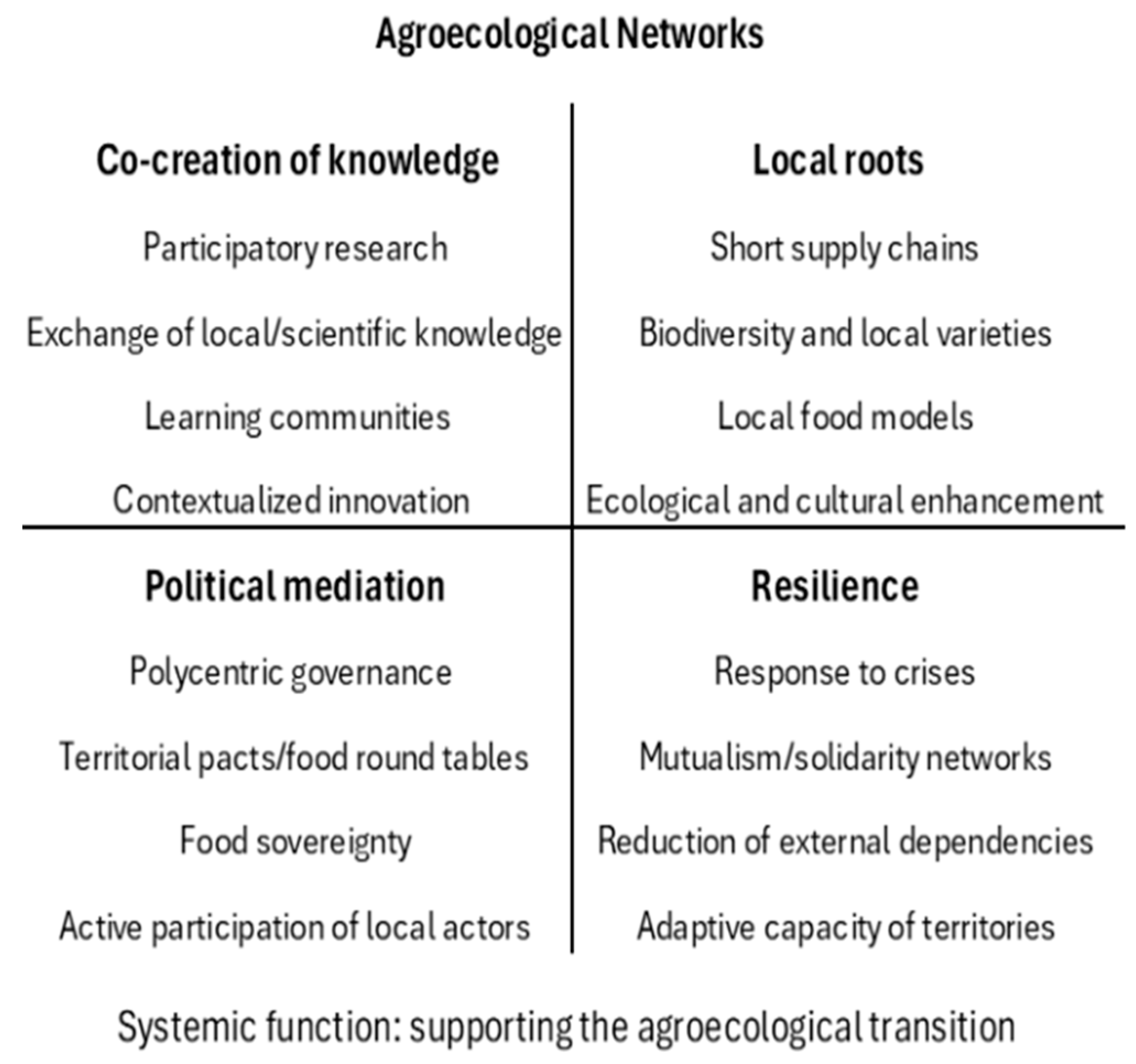
The conceptual framework builds on the notion of boundary objects introduced by Star and Griesemer (1989), later elaborated by Trompette and Vinck (2009) [41,43], interpreting the Manifesto as a tool capable of fostering convergence between scientific knowledge and local expertise, while ensuring adaptive flexibility. Network effectiveness was analysed through four interconnected functions:
  • Co-creation of knowledge and participatory learning, promoting collaborative innovation between farmers, researchers and citizens;
  • Territorial anchoring of agroecological practices, integrating sustainability into local contexts and cultural specificities;
  • Political and participatory mediation in food governance, promoting polycentric and democratic decision-making processes [10,44];
  • Socio-ecological resilience of territories and communities, strengthening adaptability and reducing dependence on global supply chains.
The four functional areas are summarised in Figure 1, which illustrates their complementary roles: co-creation of knowledge promotes shared innovation among local actors; territorial anchoring consolidates identity and resources; political and participatory mediation improves the capacity to influence policies; and resilience ensures adaptation to crises. Their synergistic interaction positions agroecological networks as strategic socio-ecological infrastructures for territorial transitions [33,45,46].
The activity carried out has highlighted how collective declarative instruments are fundamental for translating agroecology principles, such as diversity, justice, autonomy and territorialisation, into contextualised and recognisable forms within local practices [9].
Across European and Latin American agroecological networks, manifestos and charters often operate as instruments of political mutualism, connecting heterogeneous experiences while preserving the openness and flexibility necessary for adaptation to local contexts [47,48,49].
Within this theoretical framework, the decision by an initial group of farms to adopt a manifesto is consistent with the evidence in the international literature. The Manifesto is in fact a socio-organisational infrastructure capable of defining common guidelines, strengthening the legitimacy of the network, facilitating cooperation between heterogeneous actors, and supporting locally rooted co-design processes for agroecological transition.
The next steps of the project involve the development of policy briefs closely linked to issues identified through participatory activities and those expected to emerge in forthcoming ad hoc local meetings, translating local actors’ needs into operational recommendations for public policies.

3. Results

AgrEcoMed results indicate that agroecological transition is not merely a technical evolution but a dynamic, collective process capable of transforming networking into a socio-ecological infrastructure for territorial regeneration. Participatory action-research has also shown that sustainability emerges from dialogue and the co-production of knowledge between heterogeneous actors.
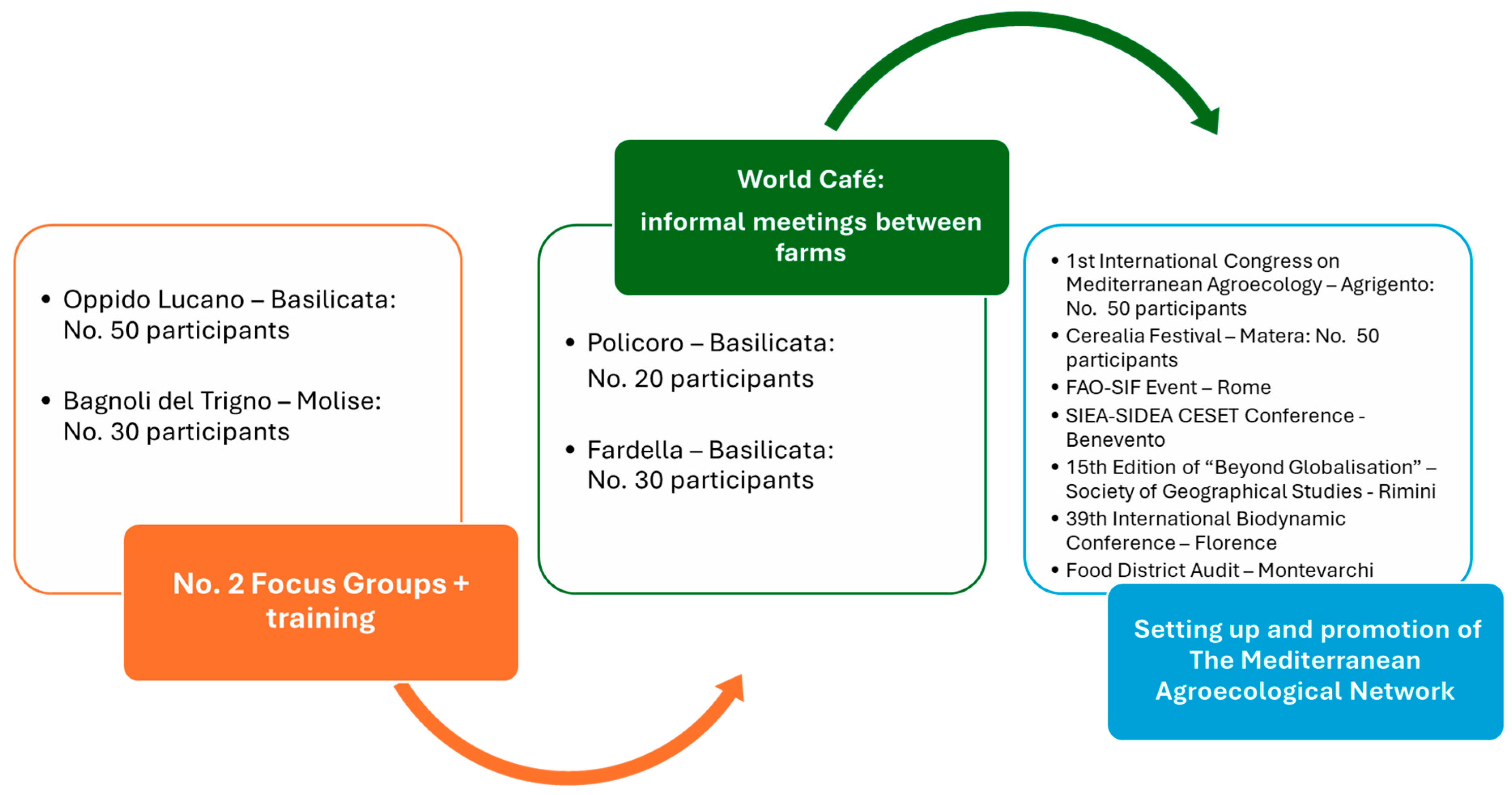
The process of building the network comprised three methodological stages, aimed at promoting collective learning (Figure 2).
The initial animation phase (2024) allowed for a participatory needs assessment. Two living labs were organised, within which two focus groups were conducted on The agroecology network: the needs of farms and opportunities for development. The first meeting was held in Oppido Lucano (PZ) on 26 July 2024, followed by a second in Bagnoli del Trigno (IS) on 25 October 2024. Overall, approximately 80 farms from Basilicata, Puglia, Sicily, Molise, and Abruzzo participated, alongside institutional stakeholders and research centres.
Thematic analysis of the discussions revealed that, despite operating in diverse production contexts, the companies share the need for participatory governance to address common challenges. Emergent needs were grouped into three priority lines of action:
-
Strengthening supply chains: particularly strategic Mediterranean supply chains (e.g., cereal supply chain) requiring investment in agronomic and social innovation, including links with medicinal plants and legumes.
-
Synergy between research and farming practice: emphasising technology transfer, not “top-down” but based on joint experimentation with regenerative practices and biodiversity management.
-
Development of social capital: strengthening relationships through workshops, continuous training, and political mutualism.
In order to implement these lines of action, participants identified the creation of a Mediterranean agroecological network as essential, conceived not as a technical agreement, but as a relational system based on trust, reciprocity, and mutual recognition of knowledge [37,50].
The second phase of consolidation and networking (2025) marked a shift towards more informal forms of collaboration and exchanges of knowledge in the field [22,51], enabling the development of the network and the Manifesto. The network, a central component of the agroecological agenda, contributed to the generation of social capital and the strengthening of collective adaptive capacity, critical in addressing the environmental and socio-economic challenges of Mediterranean territories [11,36].
The process continued with meetings at the participating farms, with two World Cafés titled Creating connections—Towards the Mediterranean Agroecological Network: the first in Policoro (MT) in April 2025 and the second in Fardella (PZ) in May 2025, involving an additional 50 participants.
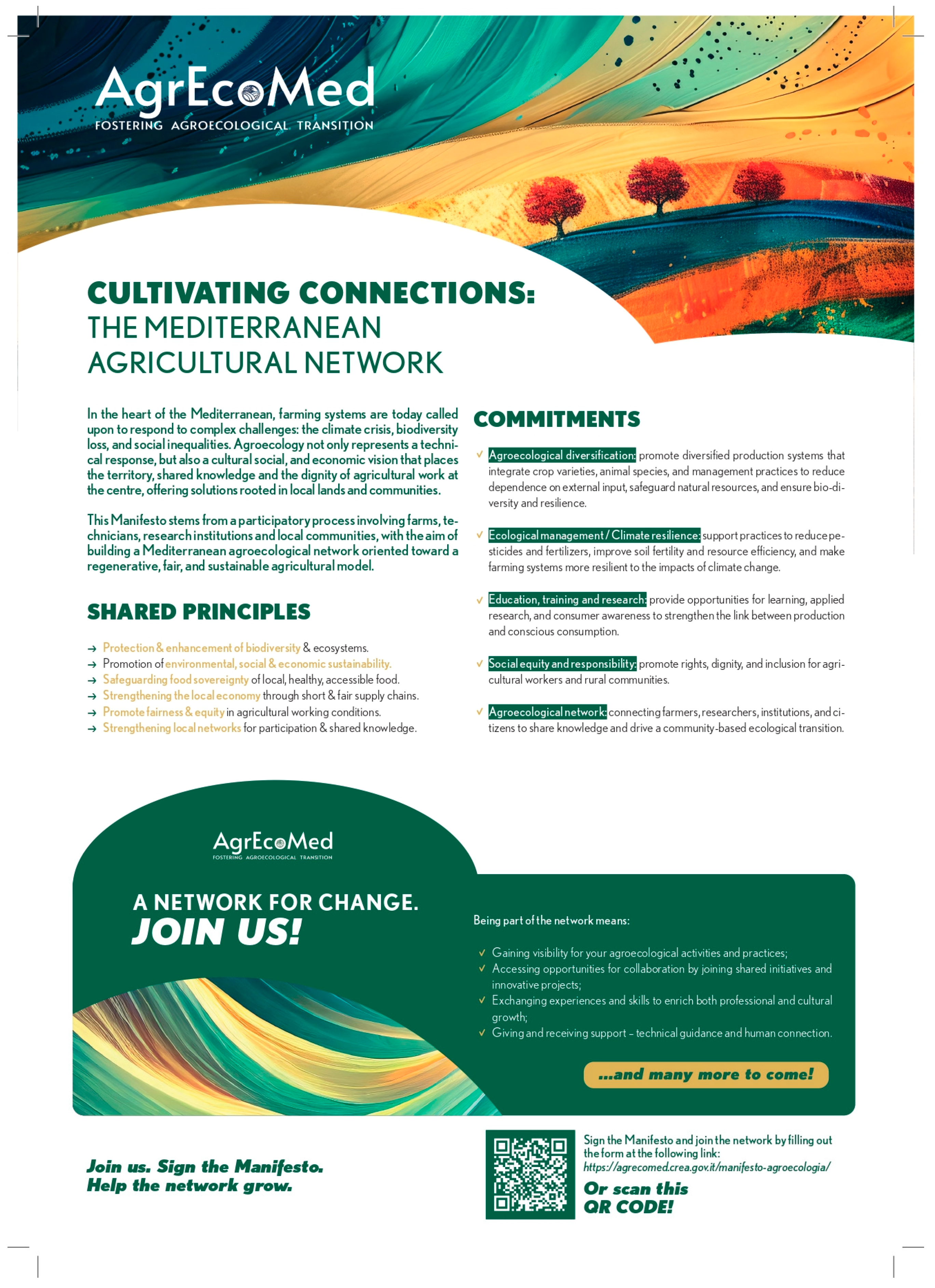
A central outcome was the co-construction of the Mediterranean Agroecological Network and the identification of the Manifesto Cultivating connections: the Mediterranean Agroecological Network (Figure 3) as a boundary object capable of facilitating interaction between researchers, farmers, policy makers while ensuring the flexibility to respect local specificities and sustainability practices [33,41,43,52].
The AgrEcoMed experience thus supports an understanding of agroecology not only as a sustainable agronomic practice, but as a social infrastructure connecting people, knowledge, and territories, while preserving farms’ autonomy to decide whether and how to participate according to their own priorities [53,54].
Within this process, the Manifesto performed three key functions:
-
Identity and linguistic function, fostering a shared language grounded in equity, solidarity, and food sovereignty, while valuing diverse viewpoints [17], thereby strengthening belonging and network stability;
-
Horizontal governance mechanism, operating as an “agroecological constitution” that guides collective action, strategic choices, and future projects, through mutual recognition of values rather than formal regulatory force [47,55,56];
-
External legitimisation, positioning the network as an authoritative interface for institutions, linking local practices and sectoral policy arenas [57,58].
The Manifesto simultaneously functions as a symbolic tool, supporting a shared narrative of Mediterranean agroecology [59], and as an operational framework of values and commitments that can guide local practices, projects, and strategies. Its open and non-prescriptive nature enables the coexistence of different approaches and the continuous evolution of its content through collective discussion, debate, and negotiation. Rather than imposing rules, it promotes dynamic principles of cooperation, social justice, biodiversity, mutualism, and intergenerational responsibility. From a governance standpoint, it is horizontal and generative: it does not centralise but connects; it does not regulate normatively, but guides through shared values and dialogical practices. This orientation aligns with the polycentric nature of agroecological transition, which requires institutions capable of adapting to local contexts [6]. Finally, the network strengthens food sovereignty as territorial self-determination: the right of communities to decide how to produce, distribute, and consume food fairly and sustainably [5,60].
The final phase (2025) focused on network visibility and international positioning.
The Manifesto was presented in high-profile scientific and institutional contexts, including TALK Agroecology, co-creation and knowledge sharing: strategies for sustainable agriculture, held as part of the 1st International Congress of Mediterranean Agroecology (Agrigento, June 2025); the SIEA-SIDEA-CESET Conference Territories, Food and Society between Global Challenges and Complexities (Benevento, July 2025); the FAO Science and Innovation Forum 2025 (Rome, October 2025); the CREA event The Mediterranean that nourishes: women, grains, memories and connections to cultivate—Cerealia Festival (Matera, 15 October 2025); the Food Districts Audit (Montevarchi, 17 October 2025); the 39th International Biodynamic Conference (Florence, November 2025); and the 15th Edition of the Study Day Beyond Globalisation (Rimini, 15 December 2025), organised by the Society of Geographical Studies. These events contributed to strengthening the network’s visibility and consolidating food sovereignty as a principle of territorial self-determination and institutional relevance.
To date, the Mediterranean Agroecological Network includes around 90 formal members, including farmers, researchers, and technicians. Membership is obtained by signing the Manifesto and issuing a membership certificate, transforming scattered knowledge into a collective force with the potential to influence the future territorial bioeconomy of the Mediterranean. This process demonstrates that participatory research is capable of generating social innovation processes in which science is intertwined with local experience. This dynamic promotes bottom-up innovation processes, in which technical experimentation is part of a broader process of socio-territorial transformation.

4. Conclusions

The AgrEcoMed experience shows that agroecological transition in the Mediterranean cannot be reduced to a technical or regulatory pathway alone; it requires participatory processes where knowledge emerges through dialogue between different actors. In this sense, participatory action-research allows agroecology to be framed as a paradigm of socio-environmental innovation, capable of activating processes of territorial regeneration through dialogue and the co-production of knowledge.
Three main conclusions summarise the project’s contribution:
  • Agroecology as a common good: research should act as a facilitator for learning and cooperation where scientific knowledge is combined with farmers’ experiential knowledge and other forms of local expertise.
  • Inclusive and polycentric participation: the network operates as a relational system based on trust and reciprocity, enabling local adaptation and enhancing capacity to engage sectoral policies.
  • The Manifesto as a driver of cooperation: functioning as an instrument of legitimisation and convergence, the Manifesto is not only a reference point for values but also a crucial tool in the agroecological transition, an operational mechanism ensuring joint planning and collective action, without negating the differences between participants and territories.
Theoretically, the work contributes to the literature by showing how co-produced symbolic and organisational tools act as mechanisms of social co-regulation. The Manifesto serves as an “agroecological constitution”, offering a matrix of shared values, such as equity, solidarity, and food sovereignty, that guides local practices towards a common vision of sustainability.
From a policy perspective, the Mediterranean Agroecological Network is a laboratory for territorial bioeconomy, with the potential to influence future European and Mediterranean sectoral policies through democratic participation and community self-determination [61].
Looking forward, a key challenge is consolidating the network as a platform for transnational cooperation, mainly with Spain, Tunisia, and Morocco, already project partners and hosts of multiple living labs on agroecology and the integration of agroecology with territorial bioeconomy strategies. Another priority is strengthening the educational dimension to ensure the transmission of values to new generations and the development of targeted policy briefs so that action-research outputs can be translated into concrete actions and interventions responding to local agroecological needs and requirements of interactive cooperation.
Ultimately, AgrEcoMed results confirm that agroecological transition is built not only in fields but also through the quality of relationships. The Manifesto and the network emerging from it represent an open-ended process for shaping a future Mediterranean grounded in agroecological principles.

Author Contributions

Conceptualization, L.B.; methodology, L.B.; formal analysis, L.B., D.R., M.A., and M.A.D.; investigation, L.B., D.R., M.A., and M.A.D.; writing—original draft preparation, L.B., D.R., M.A., and M.A.D.; writing—review and editing, L.B., D.R., M.A., and M.A.D.; supervision, L.B.; project administration, M.A.D.; funding acquisition, M.A.D. All authors have read and agreed to the published version of the manuscript.

Funding

This research was funded by project funded by the Italian Ministry of university—Call 2021, Section 2—Thematic area 2-Farming systems, under the PRIMA programme (PRIMA21_00018) supported by the European Union.

Institutional Review Board Statement

Ethical review and approval were waived for this study because data were collected through a focus group involving adult participants and were anonymised during transcription and analysis. No personally identifiable or sensitive personal data were collected, and results are reported exclusively in aggregated and anonymous form. With regard to data protection, the study was conducted in compliance with the applicable EU legal framework, in particular Regulation (EU) 2016/679 (General Data Protection Regulation—GDPR). The Italian Data Protection Code (Legislative Decree No. 196/2003, as amended by Legislative Decree No. 101/2018) was also fully observed.

Informed Consent Statement

In the study, participation was voluntary and informed consent was collected in a simplified oral form prior to data collection. According to Italian regulations and the guidance of the Italian Data Protection Authority (Garante per la protezione dei dati personali), research in the social sciences that is non-medical in nature does not require a “reinforced” informed consent as in clinical or biomedical research. However, participants must always be adequately informed and participation must be voluntary. In this context, the Garante clarifies that, for non-medical scientific research—particularly in the social sciences—informed consent may be simplified, oral, or integrated into the information notice, but should not be entirely omitted, except in specific cases such as historical archives.

Data Availability Statement

The original contributions presented in this study are included in the article. Further inquiries can be directed to the corresponding author.

Conflicts of Interest

The authors declare no conflicts of interest.

References

  1. Patel, R.; Moore, J.W. A History of the World in Seven Cheap Things: A Guide to Capitalism, Nature, and the Future of the Planet; University of California Press: Berkeley, CA, USA, 2019; ISBN 978-0-520-96637-6. [Google Scholar]
  2. Einstein, A.; de Regny, E.V.; Mauro, W. Il Mondo Come Io Lo Vedo; Newton & Compton: Rome, Italy, 2005. [Google Scholar]
  3. Piccoli, A. Sistemi di Garanzia Partecipata: Agroecologia e Democrazia Economica Nella Filiera Agro-Alimentare; Franco Angeli: Milano, Italy, 2024; ISBN 978-88-351-6767-9. [Google Scholar]
  4. Calame, M. Comprendre L’agroécologie: Origines, Principes et Politiques; ECLM: Paris, France, 2016; ISBN 978-2-84377-202-3. [Google Scholar]
  5. De Schutter, O. The Political Economy of Food Systems Reform. Eur. Rev. Agric. Econ. 2017, 44, 705–731. [Google Scholar] [CrossRef]
  6. Geels, F.W. Socio-Technical Transitions to Sustainability. In Oxford Research Encyclopedia of Environmental Science; Oxford University Press: Oxford, UK, 2018; ISBN 978-0-19-938941-4. [Google Scholar]
  7. Ecchia, G.; Ganugi, G.; Prandini, R. (Eds.) Verso (Eco)Sistemi di Innovazione Sociale: Un Percorso di Capacity Building; Vite parallele, Ibridazioni e Società Mutagena—Open Access; Franco Angeli: Milano, Italy, 2024; ISBN 978-88-351-6749-5. [Google Scholar]
  8. Vanni, F.; Viganò, L.; Povellato, A.; Longhitano, D.; Nino, P.; Marandola, D. Agroecologia e PAC un’Analisi Degli Strumenti Della Programmazione Post 2022; Rete Rurale Nazionale Ministero delle Politiche Agricole Alimentari e Forestali: Rome, Italy, 2020; ISBN 978-88-3385-093-1. [Google Scholar]
  9. Wezel, A.; Bellon, S.; Doré, T.; Francis, C.; Vallod, D.; David, C. Agroecology as a Science, a Movement and a Practice. A Review. Agron. Sustain. Dev. 2009, 29, 503–515. [Google Scholar] [CrossRef]
  10. Gliessman, S. Transforming Food Systems with Agroecology. Agroecol. Sustain. Food Syst. 2016, 40, 187–189. [Google Scholar] [CrossRef]
  11. Tornaghi, C.; Dehaene, M. Resourcing an Agroecological Urbanism: Political, Transformational and Territorial Dimensions; Routledge Studies in Food, Society and the Environment; Routledge: New York, NY, USA, 2021; ISBN 978-1-138-35968-0. [Google Scholar]
  12. Corrado, A. Agroecologia e Transizione Agroecologica: Prospettive e Concetti Chiave per La Territorializzazione della Trasformazione Agroalimentare; Critica sociologica: 233, 1; Fabrizio Serra: Pisa, Italy, 2025. [Google Scholar]
  13. Maino, F. Agire Insieme: Coprogettazione e Coprogrammazione per Cambiare il Welfare: Sesto Rapporto sul Secondo Welfare; Percorsi di Secondo Welfare: Milano, Italy, 2023; ISBN 979-12-80161-36-9. [Google Scholar]
  14. Stanghellini, A.; Gillini, G.M.; Brunod, M. (Eds.) Co-Progettazione: Significati Pratiche e Prospettive; Erickson: Trento, Italy, 2025; ISBN 978-88-590-4303-4. [Google Scholar]
  15. Agroecology Coalition. La Coalizione per la Trasformazione del Sistema Alimentare Attraverso l’Agroecologia; IFAD: Rome, Italy, 2024; p. 8. [Google Scholar]
  16. CORDIS, European Commission. Agroecologia: Una Transizione Verso Sistemi Agricoli e Alimentari Sostenibili, Rispettosi Degli Ecosistemi e a Impatto Climatico Zero. Available online: https://cordis.europa.eu/article/id/430692-agroecology-transitioning-toward-sustainable-climate-and-ecosystem-friendly-farming-and-food/it (accessed on 4 October 2025).
  17. Levidow, L.; Pimbert, M.; Vanloqueren, G. Agroecological Research: Conforming—Or Transforming the Dominant Agro-Food Regime? Agroecol. Sustain. Food Syst. 2014, 38, 1127–1155. [Google Scholar] [CrossRef]
  18. Gava, O.; Vanni, F.; Schwarz, G.; Guisepelli, E.; Vincent, A.; Prazan, J.; Weisshaidinger, R.; Frick, R.; Hrabalová, A.; Carolus, J.; et al. Governance Networks for Agroecology Transitions in Rural Europe. J. Rural Stud. 2025, 114, 103482. [Google Scholar] [CrossRef]
  19. Nimmo, E.R.; Nelson, E.; Gómez-Tovar, L.; García, M.M.; Spring, A.; Lacerda, A.E.B.; De Carvalho, A.I.; Blay-Palmer, A. Building an Agroecology Knowledge Network for Agrobiodiversity Conservation. Conservation 2023, 3, 491–508. [Google Scholar] [CrossRef]
  20. Oteros-Rozas, E.; Ravera, F.; García-Llorente, M. How Does Agroecology Contribute to the Transitions towards Social-Ecological Sustainability? Sustainability 2019, 11, 4372. [Google Scholar] [CrossRef]
  21. IFOAM EU Group. Position Paper on Agroecology Organic and Agroecology: Working to Transform Our Food System; IFOAM EU Group: Brussels, Belgium, 2019. [Google Scholar]
  22. Anderson, C.R.; Maughan, C.; Pimbert, M.P. Transformative Agroecology Learning in Europe: Building Consciousness, Skills and Collective Capacity for Food Sovereignty. Agric. Hum. Values 2019, 36, 531–547. [Google Scholar] [CrossRef]
  23. Bocchi, S. Agroecologia per Nuovi Paradigmi Distrettuali Integrati. Sci. Territ. Riv. Studi Territ. 2018, 6, 77–84. [Google Scholar]
  24. Carrieri De Souza, M.; Rover, O.J.; Forno, F. Food Networks and Agroecology in the Province of Trento—Italy. Front. Sustain. Food Syst. 2023, 7, 1130082. [Google Scholar] [CrossRef]
  25. Knickel, K.; Redman, M.; Darnhofer, I.; Ashkenazy, A.; Calvão Chebach, T.; Šūmane, S.; Tisenkopfs, T.; Zemeckis, R.; Atkociuniene, V.; Rivera, M.; et al. Between Aspirations and Reality: Making Farming, Food Systems and Rural Areas More Resilient, Sustainable and Equitable. J. Rural Stud. 2018, 59, 197–210. [Google Scholar] [CrossRef]
  26. Motta, R. Social Movements as Agents of Change: Fighting Intersectional Food Inequalities, Building Food as Webs of Life. Sociol. Rev. 2021, 69, 603–625. [Google Scholar] [CrossRef]
  27. Barberi, P. Agroecologia: Un Nuovo Paradigma per la Sostenibilità dei Sistemi Agroalimentari e la Salute dell’Umanità e dell’Ambiente. Cesalpino 2019, 48, 3–6. [Google Scholar]
  28. Altieri, M.A. Agroecology: The Science of Sustainable Agriculture, 2nd ed.; CRC Press: Boca Raton, FL, USA, 2018; ISBN 978-0-429-96401-5. [Google Scholar]
  29. Borsari, B. From Agroecology to Food Systems Sustainability: An Evolutionary Path Shifting Toward Sustainable Agriculture and Development. In Handbook of Sustainability Science in the Future; Springer: Cham, Switzerland, 2022; pp. 1–18. ISBN 978-3-030-68074-9. [Google Scholar]
  30. Iuliano, B.; Cartmill, A.D.; Davis, S.C.; Kerr, A.C.; Perfecto, I. Human Dimensions: Agroecology for Just and Sustainable Food Systems. Bull. Ecol. Soc. Am. 2021, 102, e01871. [Google Scholar] [CrossRef]
  31. Altieri, M.A.; Funes-Monzote, F.R.; Petersen, P. Agroecologically Efficient Agricultural Systems for Smallholder Farmers: Contributions to Food Sovereignty. Agron. Sustain. Dev. 2012, 32, 1–13. [Google Scholar] [CrossRef]
  32. Gargano, G.; Licciardo, F.; Verrascina, M.; Zanetti, B. The Agroecological Approach as a Model for Multifunctional Agriculture and Farming towards the European Green Deal 2030—Some Evidence from the Italian Experience. Sustainability 2021, 13, 2215. [Google Scholar] [CrossRef]
  33. Migliorini, P.; Gkisakis, V.; Gonzalvez, V.; Raigón, M.D.; Bàrberi, P. Agroecology in Mediterranean Europe: Genesis, State and Perspectives. Sustainability 2018, 10, 2724. [Google Scholar] [CrossRef]
  34. Mouratiadou, I.; Wezel, A.; Kamilia, K.; Marchetti, A.; Paracchini, M.L.; Bàrberi, P. The Socio-Economic Performance of Agroecology. A Review. Agron. Sustain. Dev. 2024, 44, 19. [Google Scholar] [CrossRef]
  35. Pelchor Chicaiza, J.S.; De La Fuente De Val, G. Agroecología y Desarrollo Rural: Un Enfoque Integral Para La Sostenibilidad Agrícola. Perspect. Rural. 2025, 23, 1–39. [Google Scholar] [CrossRef]
  36. Carrascosa-García, M.; Chable, V.; De Santis, G.; Gori, F.; Gudinchet, M.; Iossa, M.I.; Lazzaro, M.; Maneo, G. Manual on the Integration of Cultivated Biodiversity in Local Organic and Agroecology-Oriented Food Policies. Available online: https://www.researchgate.net/publication/398580742_Manual_on_the_Integration_of_Cultivated_Biodiversity_in_Local_Organic_and_Agroecology-oriented_Food_Policies_LiveSeeding_Project (accessed on 4 October 2025).
  37. Belliggiano, A.; Conti, M. L’agroecologia Come Formula di Sostenibilità e Recupero dei Saperi Locali. Perspect. Rural. Nueva Época 2020, 3, 375–400. [Google Scholar]
  38. Orefice, P. La Ricerca Azione Partecipativa: Teoria e Pratiche; Liguori: Napoli, Italy, 2006; ISBN 978-88-207-4485-4. [Google Scholar]
  39. Levidow, L.; Sansolo, D.; Schiavinatto, M. Territorialising Local Food Systems for an Agroecological Transition in Latin America. Land 2023, 12, 1577. [Google Scholar] [CrossRef]
  40. Clarke, A.E.; Star, S.L. The Social Worlds Framework: A Theory/Methods Package. Handb. Sci. Technol. Stud. 2008, 3, 113–137. [Google Scholar]
  41. Star, S.L.; Griesemer, J.R. Institutional Ecology, ‘Translations’ and Boundary Objects: Amateurs and Professionals in Berkeley’s Museum of Vertebrate Zoology, 1907–1939. Soc. Stud. Sci. 1989, 19, 387–420. [Google Scholar] [CrossRef]
  42. Braun, V.; Clarke, V. Using Thematic Analysis in Psychology. Qual. Res. Psychol. 2006, 3, 77–101. [Google Scholar] [CrossRef]
  43. Trompette, P.; Vinck, D. Revisiting the Notion of Boundary Object. Rev. d’Anthropol. Connaiss. 2009, 31, 3–25. [Google Scholar] [CrossRef]
  44. Rosset, P.; Altieri, M.A. Agroecology: Science and Politics; Agrarian Change and Peasant Studies; Fernwood Publishing: Black Point, NS, Canada, 2017; ISBN 978-1-85339-994-7. [Google Scholar]
  45. Era Urbana e Disordine del Mondo. Geografie per Interpretare Il Presente. Book of Abstracts XXXIV Congresso Geografico Italiano Torino, Campus Luigi Einaudi e Castello del Valentino, 3–5 September 2025. Available online: https://www.dist.polito.it/news/(idnews)/26672 (accessed on 4 October 2025).
  46. Lamonaca, E.; Bouzid, A.; Caroprese, M.; Ciliberti, M.G.; Cordovil, C.M.d.S.; Karatzia, M.-A.; Keskin, M.; Lazereg, M.; Lidga, C.; Panniello, U.; et al. A Framework towards Resilient Mediterranean Eco-Solutions for Small-Scale Farming Systems. Agric. Food Secur. 2023, 11, 65. [Google Scholar] [CrossRef]
  47. Chambers, R. Participatory Rural Appraisal (PRA): Challenges, Potentials and Paradigm. World Dev. 1994, 22, 1437–1454. [Google Scholar] [CrossRef]
  48. Altieri, M.A.; Nicholls, C. Agroecology: Challenges and Opportunities for Farming in the Anthropocene. Int. J. Agric. Nat. Resour. 2020, 47, 204–215. [Google Scholar] [CrossRef]
  49. Sabourin, E.; Grisa, C.; Niederle, P.; Pereira Leite, S.; Milhorance, C.; Damasceno Ferreira, A.; Sauer, S.; Andriguetto-Filho, J.M. Le Démantèlement Des Politiques Publiques Rurales et Environnementales Au Brésil. Cah. Agric. 2020, 29, 31. [Google Scholar] [CrossRef]
  50. Dal Borgo, A.G.; Capocefalo, V. Funzioni, Valori, Progetti: Il Contributo delle Pratiche Agroecologiche Nei Processi di Rigenerazione Socio-Territoriale; Società di Studi Geografici: Florence, Italy, 2024; ISBN 978-88-946901-4-9. [Google Scholar]
  51. Méndez, V.E.; Bacon, C.M.; Cohen, R. Agroecology as a Transdisciplinary, Participatory, and Action-Oriented Approach. Agroecol. Sustain. Food Syst. 2013, 37, 3–18. [Google Scholar] [CrossRef]
  52. Van Der Ploeg, J.D.; Barjolle, D.; Bruil, J.; Brunori, G.; Costa Madureira, L.M.; Dessein, J.; Drąg, Z.; Fink-Kessler, A.; Gasselin, P.; Gonzalez De Molina, M.; et al. The Economic Potential of Agroecology: Empirical Evidence from Europe. J. Rural Stud. 2019, 71, 46–61. [Google Scholar] [CrossRef]
  53. Ostrom, E. Governing the Commons: The Evolution of Institutions for Collective Action; Cambridge University Press: Singapore, 1990; ISBN 978-0-521-40599-7. [Google Scholar]
  54. Vulcano, G. Reti Agroecologiche e Mutuali, Scenari Post Crescita in Bioeconomia e Territori: Oltre la Crescita Analisi, Casi di Studio, Esperienze e Pratiche Territoriali; Ciervo, M., Ed.; 2024; Volume 11, Available online: https://www.researchgate.net/publication/388453351_Reti_agroecologiche_e_mutuali_scenari_post_cresc (accessed on 4 October 2025).
  55. Pimbert, M. Food Sovereignty, Agroecology and Biocultural Diversity: Constructing and Contesting Knowledge; Routledge Studies in Food, Society and the Environment; Routledge: Abingdon, UK; Oxford, UK; New York, NY, USA, 2018; ISBN 978-1-138-95535-6. [Google Scholar]
  56. Rivera-Ferre, M.G. The Resignification Process of Agroecology: Competing Narratives from Governments, Civil Society and Intergovernmental Organizations. Agroecol. Sustain. Food Syst. 2018, 42, 666–685. [Google Scholar] [CrossRef]
  57. Hassanein, N. Practicing Food Democracy: A Pragmatic Politics of Transformation. J. Rural Stud. 2003, 19, 77–86. [Google Scholar] [CrossRef]
  58. Renting, H.; Schermer, M.; Rossi, A. Building Food Democracy: Exploring Civic Food Networks and Newly Emerging Forms of Food Citizenship. Int. J. Sociol. Agric. Food 2012, 19, 289–307. [Google Scholar] [CrossRef]
  59. Lazzeroni, M.; Berti, G.; Bruno, R.; Rossi, A. Le Regioni Del Cibo: Processi, Politiche, Narrazioni1. Riv. Geogr. Ital. 2023, 2023, 152–172. [Google Scholar] [CrossRef]
  60. Résilience Alimentaire et Sécurité Nationale: Oser le Sujet & le Lier à Celui de L’effondrement; 2020; ISBN 978-2-491168-02-5. Available online: https://staging-public.s3.fr-par.scw.cloud/guide-stefane-linou-resiliencealimentaireetsecuritenationale-66f8234f1952a385052021.pdf (accessed on 4 October 2025).
  61. Pisanelli, S.; Maffi, L. Radici storiche dell’agroecologia. Idee e buone pratiche per una sostenibilità socio-ambientale. Stor. E Futuro 2023, 58, 51. [Google Scholar] [CrossRef]
Figure 1. Functions and roles of agroecological networks as socio-ecological infrastructures. Source: authors’ elaboration based on the literature.
World 07 00019 g001
Figure 2. Process of co-construction of the Mediterranean Agroecological Network. Source: authors’ elaboration.
World 07 00019 g002
Figure 3. The Manifesto Cultivating connections: the Mediterranean Agroecological Network. Source: https://agrecomed.crea.gov.it/ (accessed on 15 November 2025).
World 07 00019 g003
Disclaimer/Publisher’s Note: The statements, opinions and data contained in all publications are solely those of the individual author(s) and contributor(s) and not of MDPI and/or the editor(s). MDPI and/or the editor(s) disclaim responsibility for any injury to people or property resulting from any ideas, methods, instructions or products referred to in the content.