



Ambidextrous Management and Eco-Innovation Strategies in Small- and Medium-Sized Manufacturing Enterprises: Responses to Decarbonization and the Renewable Energy Market—A Multi-Round Qualitative Examination

Abstract
1. Introduction
- How do external stakeholder pressures interact with internal capability constraints when SMEs attempt eco-innovation?
- How do exploration and exploitation manifest in SMEs with limited resources?
- What types of support mechanisms enable SMEs to balance short-term operational demands with long-term environmental innovation?
- What mechanisms uniquely characterize SME responses to decarbonization relative to existing theoretical models?
2. Theoretical Framework
2.1. External Stakeholder Pressure and Eco-Innovation
2.2. Absorptive Capacity as an Interpretive Capability
2.3. Organizational Ambidexterity and Sustainability Transitions
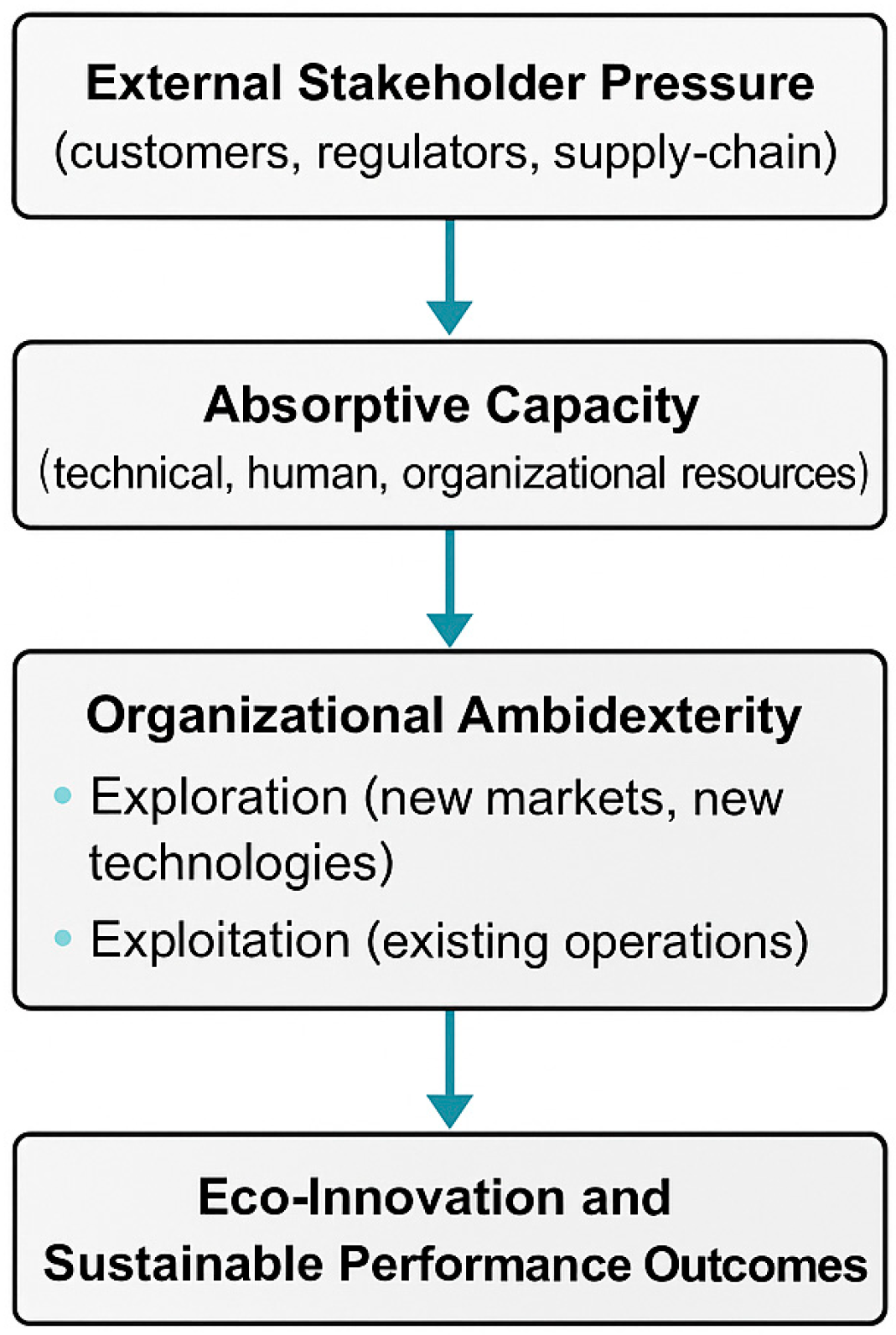
2.4. Integrated Conceptual Pathway: Linking Pressure, Capacity, and Ambidexterity
- External pressure initiates a need for environmental action.
- Absorptive capacity filters and interprets this pressure, shaping how SMEs understand technological and regulatory changes.
- Organizational ambidexterity becomes the behavioral outcome of this interaction, determining whether firms can engage in both exploration (new markets, new technologies) and exploitation (existing operations).
- These interactions, in turn, influence eco-innovation and sustainable performance outcomes.
2.5. Summary of Theoretical Propositions
- P1. External stakeholder pressure is a primary driver of SME engagement in decarbonization and renewable-energy initiatives.
- P2. The degree to which SMEs can translate external pressure into eco-innovation depends on their absorptive capacity.
- P3. Limited resources make ambidextrous behavior structurally difficult for SMEs, particularly when exploration is externally imposed.
- P4. Eco-innovation in SMEs is most effectively supported through policy architectures that reinforce both exploration-oriented and exploitation-oriented capabilities.
3. Methods
3.1. Participants
3.2. Questionnaire Content
- Internal challenges in expanding sales and orders of renewable-energy–related equipment;
- Support measures required for renewable-energy market entry;
- Needs related to decarbonization management;
- Challenges in balancing existing and new businesses;
- Requests for public support programs.
3.3. KJ Method Procedure
- Extraction of unit statements (“opinion cards”)
- 2.
- Independent coding by multiple researchers
- 3.
- Cluster formation using inductive grouping
- 4.
- Labeling of clusters
- 5.
- Construction of hierarchical maps
- 6.
- Validation
Coding Reliability and Validation
3.4. Table Structure and Presentation
4. Results
4.1. Internal Challenges in Expanding Sales and Orders of Renewable-Energy–Related Equipment
Interpretation
4.2. Expected Support Measures for Renewable-Energy–Related Market Entry
Interpretation
4.3. Required Support for Implementing Decarbonization Management
Interpretation
4.4. Challenges in Implementing Decarbonization Management
Interpretation
4.5. Challenges in Balancing Existing and New Businesses
Interpretation
4.6. Requests for Public Support in Balancing Existing and New Businesses
Interpretation
5. Discussion
5.1. Eco-Innovation in SMEs: Externally Induced and Internally Constrained
5.2. The Ambidexterity Dilemma Under Resource Scarcity
5.3. The Multi-Level Nature of Support Needs
- financial and investment mechanisms,
- technical and expert assistance,
- human resource development,
- administrative simplification,
- market creation and business matching,
- regional collaboration and platform formation.
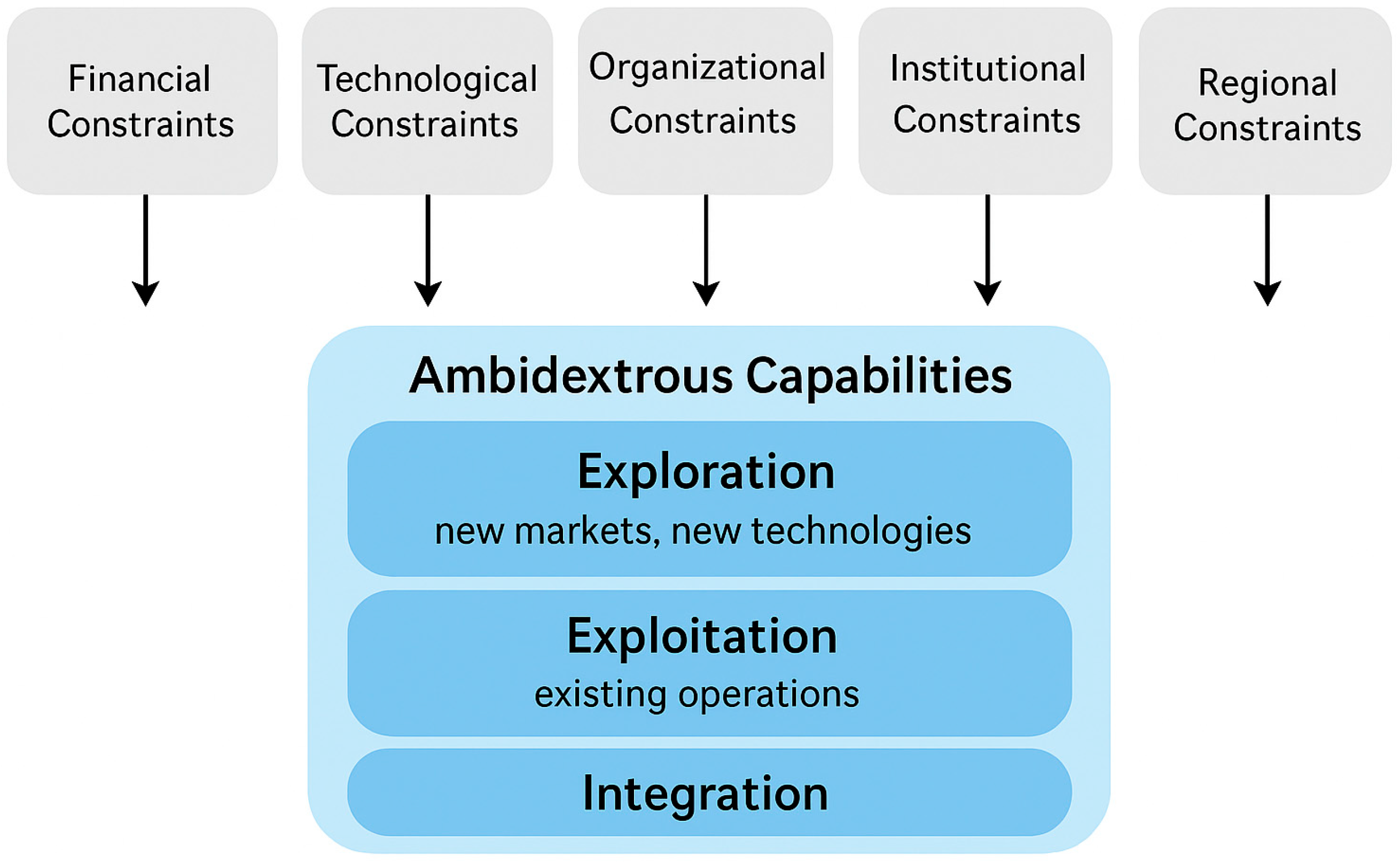
5.4. Toward an Ambidextrous Eco-Innovation Support Framework
- (1)
- Exploration-oriented support
- R&D subsidies and prototyping assistance
- technology scouting and expert consultation
- market development programs and business matching
- ESG finance and risk-sharing mechanisms
- (2)
- Exploitation-oriented support
- energy-efficiency upgrades
- process optimization and production support
- quality control system enhancements
- long-term financing for operational stability
- workforce retention and upskilling
- (3)
- Integrative institutional support
- administrative streamlining
- standardized decarbonization guidelines
- regional coordination platforms
- intermediary organizations facilitating knowledge transfer
5.5. Theoretical Contributions
- Identification of the exposure gap:
- 2.
- Conceptualization of the externally induced ambidexterity dilemma:
- 3.
- Integration of eco-innovation, absorptive capacity, and ambidexterity in a unified framework:
5.6. Practical and Policy Implications
- combining financial instruments with long-term technical support;
- reducing administrative complexity and clarifying institutional expectations;
- establishing regional clusters and intermediary organizations to address scale disadvantages;
- strengthening SME human resource development and cross-firm knowledge exchange;
- implementing risk-sharing schemes with financial institutions.
5.7. Limitations and Future Research
6. Conclusions
6.1. External Pressure Drives SME Eco-Innovation, but Internal Capacity Gaps Persist
6.2. SMEs Face an Externally Induced Ambidexterity Dilemma
6.3. A Multi-Dimensional, Ambidextrous Support Architecture Is Necessary
- exploration-oriented support,
- exploitation-oriented support, and
- integrative institutional support.
6.4. Final Remarks
Funding
Institutional Review Board Statement
Informed Consent Statement
Data Availability Statement
Acknowledgments
Conflicts of Interest
Appendix A

| Opinion Card (Excerpt) | Assigned Cluster | Category |
|---|---|---|
| “We lack engineers who can handle renewable-energy technologies.” | HR-07 | Human Resource Limitations |
| “Subsidy application procedures are too complex for small firms.” | INST-04 | Administrative and Institutional Burdens |
| “We need clearer guidelines for decarbonization management.” | INFO-03 | Information Provision and Institutional Clarity |
| “Existing production already uses all available manpower.” | ORG-11 | Organizational Capacity Constraints |
| “Entering the renewable-energy market requires large upfront investments.” | FIN-02 | Financial Burdens |
References
- Horbach, J. Determinants of Environmental Innovation—New Evidence from German Panel Data Sources. Res. Policy 2008, 37, 163–173. [Google Scholar] [CrossRef]
- Horbach, J.; Rammer, C.; Rennings, K. Determinants of Eco-Innovations by Type of Environmental Impact. Ecol. Econ. 2012, 78, 112–122. [Google Scholar] [CrossRef]
- del Río, P.; Romero-Jordán, D.; Peñasco, C. Analysing Firm-Specific and Type-Specific Determinants of Eco-Innovation. Technol. Econ. Dev. Econ. 2017, 23, 270–295. [Google Scholar] [CrossRef]
- Tushman, M.L.; O’Reilly, C.A. Ambidextrous Organizations: Managing Evolutionary and Revolutionary Change. Calif. Manag. Rev. 1996, 38, 8–30. [Google Scholar] [CrossRef]
- Birkinshaw, J.; Zimmermann, A.; Raisch, S. How Do Firms Adapt to Discontinuous Change? Bridging the Dynamic Capabilities and Ambidexterity Perspectives. Calif. Manag. Rev. 2016, 58, 36–58. [Google Scholar] [CrossRef]
- Triguero, A.; Moreno-Mondéjar, L.; Davia, M.A. Drivers of Different Types of Eco-Innovation in European SMEs. Ecol. Econ. 2013, 92, 25–33. [Google Scholar] [CrossRef]
- Cohen, W.M.; Levinthal, D.A. Absorptive Capacity: A New Perspective on Learning and Innovation. Adm. Sci. Q. 1990, 35, 128–152. [Google Scholar] [CrossRef]
- Flatten, T.C.; Engelen, A.; Zahra, S.A.; Brettel, M. A Measure of Absorptive Capacity: Scale Development and Validation. Eur. Manag. J. 2011, 29, 98–116. [Google Scholar] [CrossRef]
- Gupta, A.K.; Smith, K.G.; Shalley, C.E. The Interplay between Exploration and Exploitation. Acad. Manag. Rev. 2006, 31, 693–706. [Google Scholar] [CrossRef]
- O’Reilly, C.A.; Tushman, M.L. Organizational Ambidexterity: Past, Present, and Future. Acad. Manag. Perspect. 2013, 27, 324–338. [Google Scholar] [CrossRef]
- Raisch, S.; Birkinshaw, J.; Probst, G.; Tushman, M.L. Organizational Ambidexterity: Balancing Exploitation and Exploration for Sustained Performance. Organ. Sci. 2009, 20, 685–695. [Google Scholar] [CrossRef]
- Kesidou, E.; Demirel, P.; Zhang, S. Eco-Innovation and Organizational Ambidexterity in SMEs. Bus. Strateg. Environ. 2023, 32, 2301–2318. [Google Scholar] [CrossRef]
- Kawakita, J. The KJ Method: A Scientific Approach to Problem Solving; Kawakita Research Institute: Tokyo, Japan, 1975. [Google Scholar]
| Code | Summary | Category |
|---|---|---|
| R101, R103, R107, R110, R118, R121, R127 | Difficulty in developing sales channels; limited customer base | Market and distribution constraints |
| R104, R106, R113, R120, R126 | Insufficient technical capability; inadequate product development systems | Technology and product development challenges |
| R105, R111, R117, R124, R128, R129 | Significant financial burden of capital investment | Financial and capital investment burdens |
| R108, R112, R116, R119 | Lack of engineers; difficulty in developing human resources | Human resource and organizational capability constraints |
| R102, R114, R123, R130 | Concerns about policy trends and changing demand | Uncertainty in demand and policy environment |
| R109, R115, R122, R125, R131–R134 | Lack of information; insufficient collaboration networks | Information and collaboration gaps |
| Code | Summary | Category |
|---|---|---|
| R202, R204, R210, R218, R220, R232, R239 | Support for equipment acquisition, subsidy expansion, loan programs | Financial and investment support |
| R205, R211, R213, R222, R227, R233 | Technical training, expert dispatch, certification support | Human resources and technical support |
| R201, R207, R212, R214, R219, R225, R236, R240 | Trade fairs, sales channel introduction, matching support | Market development and matching |
| R203, R209, R217, R228, R230, R234, R237 | Information on markets, policy support, application assistance | Information and regulatory support |
| R208, R215, R224, R226, R231, R235, R238, R241–R243 | Regional networks, industry–government–academia collaboration | Regional and collaborative support |
| Code | Summary | Category |
|---|---|---|
| R301, R306, R315, R325, R333, R341 | Subsidies, low-interest loans, support for capital investment in energy-saving equipment | Financial support |
| R302, R308, R317, R322, R329, R336, R344 | Technical assistance, expert dispatch, energy diagnosis | Technical and specialized support |
| R303, R309, R316, R321, R332, R340 | Training and development of staff for decarbonization tasks | Human resource development |
| R304, R310, R318, R326, R334, R342 | Provision of accurate information, standardization, policy guidelines | Information provision and institutional clarity |
| R305, R311, R319, R327, R335, R343 | Business matching, collaboration among firms, supply chain cooperation | Market and collaboration support |
| R307, R312, R320, R328, R337, R345–R348 | Regional platforms, municipal-level initiatives, community cooperation | Regional and local government support |
| Code | Summary | Category |
|---|---|---|
| R401, R407, R415, R426, R433 | Cost burden of compliance, return-on-investment uncertainty | Financial constraints |
| R402, R408, R413, R421, R429 | Lack of internal expertise, difficulty evaluating emissions | Technical and analytical limitations |
| R403, R409, R417, R422, R431 | Excessive paperwork, inconsistent systems, unclear standards | Administrative and institutional burdens |
| R404, R410, R416, R425, R432 | Supply chain pressure, competitive disadvantages | Market-structure challenges |
| R405, R411, R418, R423, R430 | Weak internal governance, insufficient leadership commitment | Organizational and governance issues |
| R406, R412, R419, R424, R434–R437 | Regional disparities in support programs, infrastructure gaps | Regional and infrastructural constraints |
| Code | Summary | Category |
|---|---|---|
| R501, R507, R516, R524, R531 | Shortage of financial resources for both existing and new business activities | Financial resource allocation conflicts |
| R502, R508, R517, R526, R533 | Lack of personnel capable of engaging in new projects | Human resource shortages |
| R503, R509, R518, R525, R530 | Weak organizational systems for handling dual operations | Organizational limitations |
| R504, R510, R519, R527, R534 | Difficulty in developing new technologies or products | Technological development gaps |
| R505, R512, R520, R528, R535 | Equipment shortages, facility constraints | Equipment and facility limitations |
| R506, R511, R521, R529, R536–R538 | Limited market information, difficulty securing demand | Market and customer uncertainty |
| Code | Summary | Assigned Category |
|---|---|---|
| R601, R606, R612, R624, R632 | Direct subsidies, tax relief, low-interest loans | Financial support |
| R602, R607, R613, R621, R629 | Training programs, dispatch of specialists | Human resource support |
| R603, R608, R614, R622, R630 | Streamlined administrative procedures, simplified requirements | Institutional reform |
| R604, R609, R615, R623, R631 | Technology platforms, collaborative R&D | Technology and innovation support |
| R605, R610, R616, R620, R633 | Support for market creation and matching | Market support |
| R611, R617, R618, R625, R634–R638 | Local government support, community-level initiatives | Regional and community support |
Disclaimer/Publisher’s Note: The statements, opinions and data contained in all publications are solely those of the individual author(s) and contributor(s) and not of MDPI and/or the editor(s). MDPI and/or the editor(s) disclaim responsibility for any injury to people or property resulting from any ideas, methods, instructions or products referred to in the content. |
© 2025 by the author. Licensee MDPI, Basel, Switzerland. This article is an open access article distributed under the terms and conditions of the Creative Commons Attribution (CC BY) license (https://creativecommons.org/licenses/by/4.0/).
Share and Cite
Kokubun, K. Ambidextrous Management and Eco-Innovation Strategies in Small- and Medium-Sized Manufacturing Enterprises: Responses to Decarbonization and the Renewable Energy Market—A Multi-Round Qualitative Examination. World 2025, 6, 160. https://doi.org/10.3390/world6040160
Kokubun K. Ambidextrous Management and Eco-Innovation Strategies in Small- and Medium-Sized Manufacturing Enterprises: Responses to Decarbonization and the Renewable Energy Market—A Multi-Round Qualitative Examination. World. 2025; 6(4):160. https://doi.org/10.3390/world6040160
Chicago/Turabian StyleKokubun, Keisuke. 2025. "Ambidextrous Management and Eco-Innovation Strategies in Small- and Medium-Sized Manufacturing Enterprises: Responses to Decarbonization and the Renewable Energy Market—A Multi-Round Qualitative Examination" World 6, no. 4: 160. https://doi.org/10.3390/world6040160
APA StyleKokubun, K. (2025). Ambidextrous Management and Eco-Innovation Strategies in Small- and Medium-Sized Manufacturing Enterprises: Responses to Decarbonization and the Renewable Energy Market—A Multi-Round Qualitative Examination. World, 6(4), 160. https://doi.org/10.3390/world6040160

