Article

Design Analysis and Performance Optimization of Next-Generation Hyperloop Pod Systems

by
Infanta Mary Priya
1,
Prabhu Sethuramalingam
1,*,
Hruday Divakaran
2,
Dennis Abraham
3,
Archit Srivastava
1,
Ayush K. Choudhary
1,
Allen Mathews
3,
Amish Roopesh
3,
Sidhant Sairam Mohan
1 and
Naman Vedh K. Sathyan
1
1
Department of Mechanical Engineering, SRM Institute of Science and Technology, Kattankulathur, Chennai 603203, Tamilnadu, India
2
Department of Computer Science, SRM Institute of Science and Technology, Kattankulathur, Chennai 603203, Tamilnadu, India
3
Department of ECE, SRM Institute of Science and Technology, Kattankulathur, Chennai 603203, Tamilnadu, India
*
Author to whom correspondence should be addressed.
Automation 2026, 7(2), 47; https://doi.org/10.3390/automation7020047
Submission received: 13 January 2026 / Revised: 2 March 2026 / Accepted: 7 March 2026 / Published: 11 March 2026

Abstract

The hyperloop transportation system is a promising ultra-high-speed mobility solution operating in a reduced-pressure environment, where pod performance is governed by the coupled behaviour of structural integrity, aerodynamics, and electromagnetic propulsion. This paper presents the design, numerical analysis, and performance evaluation of a lightweight hyperloop pod equipped with a linear induction motor (LIM)-based propulsion and electromagnetic stabilisation system. The pod chassis was fabricated using Carbon Fibre-Reinforced Polymer (CFRP) and Aluminium 6061-T6, achieving a significant weight reduction while maintaining structural safety. Finite Element Analysis reveals a maximum von Mises stress of 82 MPa, which is well below the material yield strength, and a maximum deformation of 0.64 mm under worst-case loading conditions. Modal analysis indicates the first natural frequency at 47.6 Hz, ensuring sufficient separation from operational excitation frequencies. Computational Fluid Dynamics analysis conducted inside a rectangular tube shows a drag coefficient reduction of approximately 18% compared to a baseline blunt design, with stable velocity distribution and no flow choking at operating speeds. The optimised nose geometry enables rapid acceleration, achieving 25 km/h within 1.1 s in prototype testing. The LIM analysis demonstrates a peak thrust of 1.85 kN at an optimal slip range of 6–8%, with operating currents between 35 and 55A and power consumption of 18–25 kW. Thermal analysis confirms a maximum stator temperature of 78 °C, remaining within safe operating limits. The integrated numerical and experimental results confirm the feasibility, efficiency, and stability of the proposed hyperloop pod design.

1. Introduction

The hyperloop concept requires a pod that can travel at high subsonic speeds in near-vacuum conditions. Structural integrity and aerodynamic efficiency are critical to minimise drag and ensure passenger/cargo safety. The hyperloop is an emerging high-speed ground transportation concept that envisions passenger and cargo pods travelling through near-vacuum tubes at speeds exceeding 1000 km/h. At the heart of this futuristic technology lies the propulsion system, which must achieve rapid acceleration and precise control with minimal friction and energy loss. Among potential propulsion technologies, the linear induction motor (LIM) stands out as a highly promising option due to its ability to produce direct linear thrust without mechanical contact. A LIM operates on the principle of electromagnetic induction, creating a traveling magnetic field in the stator (primary) that induces currents in a conductive secondary element, thereby generating a propulsive force. Its contactless nature not only reduces wear and maintenance but also enables high acceleration and smooth operation, critical for hyperloop pods moving at ultra-high speeds within low-pressure environments. This research paper focuses on the design, development, and evaluation of a LIM prototype tailored for hyperloop propulsion, aiming to contribute toward efficient, scalable solutions for next-generation transport systems.

Previous Works

Denis Tudor and Mario Paolone [1] proposed an optimisation-based design framework for hyperloop systems that integrates capsule operation, infrastructure modelling, and propulsion–kinematic dynamics. The framework aims to minimise total energy consumption under varying operational strategies by considering energy-autonomous capsules and depressurisation controls. Constraints are defined by the capsule’s battery storage and propulsion response and the infrastructure’s pressure regulation. Results highlight optimal tube pressures ranging from 1.5 to 80 mbar, propulsion power requirements of 1.7–5 MW, and energy efficiency as low as 25 Wh per passenger per km. This approach enables systematic evaluation of efficient hyperloop operations. Pranay Mehta et al. [2] explained that the hyperloop concept enables high-speed travel inside a low-pressure tube with the aid of levitation. The reduced air pressure minimises aerodynamic drag, thereby lowering energy usage, while levitation further eliminates frictional resistance. The pod is propelled by a linear induction motor (LIM) and levitated using a rotating Halbach array. Despite operating under low pressure, the pod must be carefully designed to prevent flow choking.
Ingo A. Hansen [3] highlighted the growing attention around the hyperloop concept, speed competitions, and ongoing projects. This study evaluates hyperloop technology through a system-level analysis of its objectives, functional design, capacity, and demand compared to airlines, high-speed rail, and Maglev. Travel demand was examined using airline passenger volumes in Germany and the proposed Los Angeles San Francisco route. This paper further explores feasibility in terms of vehicle design, propulsion, energy, safety, operations, and construction. Additionally, environmental impacts, cost uncertainties, project risks, and the importance of transparent research are discussed. TU Munich [4,5] achieved a top speed of 467 km/h with their 240 kW, 70 kg wheel-motor-driven pod on the SpaceX test track, securing victory in the speed competition for the fourth consecutive time (2018, 2019). Growing concerns over the environmental and health impacts of rising air travel and emissions from road and maritime transport have increased the demand for sustainable alternatives. Pedro Museros et al. [6] described hyperloop as a futuristic mode of transport for passengers and cargo, operating in low-pressure sealed tubes at speeds of up to 1200 km/h, rivalling air travel. Since the required civil infrastructure is still at a conceptual stage, this study focused on developing analytical models to predict structural behaviour and address potential challenges. Two steel tube configurations are proposed, considering effects of weight, internal pressure, wind, temperature, and dynamic vehicle loads. Fatigue, buckling, and thermal stresses are emphasised, along with estimates for tube thickness and resonance risks. This research provides an initial framework for structural design, supporting future integration with vehicle development.
Radeck et al. [7] outlined the design and technical concept of an integrated hyperloop system for efficient high-speed ground transport. The framework, developed through iterative expert collaboration, supports speeds of up to 600 km/h with pods carrying 21 passengers. Key features include electromagnetic and electrodynamic suspension for smooth lane changes, short stator motor propulsion, inductive power supply, and evaporative cooling at 10 mbar pressure. Prefabricated concrete tubes lower construction costs, while safety is ensured through advanced communication systems without emergency exits along the track. Energy analysis shows superior efficiency compared to existing transport modes, positioning hyperloop as a sustainable and scalable alternative for future mobility. Madhavan et al. [8] emphasised the growing importance of induction motors in the transition to electric power systems, highlighting their advantages such as high starting torque and reliable speed control. However, their performance is heavily influenced by temperature, making thermal management critical. This paper reviews methods like finite element analysis, lumped parameter thermal networks, and CFD-based approaches, along with common cooling strategies. It further advocates hybrid cooling techniques to improve efficiency and ensure long-term motor reliability.
Bhuiya [9] presented the design and implementation of a hyperloop transportation system with a focus on propulsion integration and energy storage. The study employed linear synchronous motors powered by a battery-based system to enable high-speed passenger and freight transport. A three-phase inverter was modelled and simulated in PSIM, followed by prototype development and integration with the motor. Experimental results demonstrated bidirectional propulsion capability, validating the proof-of-concept. Additionally, battery state-of-charge simulations under motoring and braking conditions were analysed to assess system performance. Eric Chaidez et al. [10] discussed the potential of hyperloop to enable near-supersonic travel over distances exceeding 1000 km with lower cost and complexity than high-speed rail or aviation. The study focuses on minimising levitation friction, a key factor alongside aerodynamic drag in reducing power needs. Power requirements were estimated for three operational modes: rolling wheels, air bearings, and magnetic suspension. A comparative analysis highlights the efficiency trade-offs among these approaches. Gkoumas [11] described hyperloop as an emerging high-speed transport system for passengers and freight with transformative potential. Despite its recent introduction, global research and development by industry and academia have advanced rapidly. The study conducted a systematic review of 161 Scopus-indexed publications since 2014, classifying research into physical and operational domains. The results provide insights for researchers, practitioners, and policymakers to guide future hyperloop implementation. Kang [12] investigated traveller perceptions of hyperloop technology using prospect theory, analysing responses from frequent and occasional tourists. The study examined how perceived benefits (economic, environmental, socio-cultural, time-saving) and risks (functional, physical, psychological, financial) shape adoption intentions through methods such as PLS-SEM, MGA, fsQCA, and ANN.
Luo et al. [13] proposed an operation-driven optimal design framework to minimise global energy consumption by coupling the capsule’s propulsion, tube environment, and overall system kinematics. The work identifies how optimal tube pressure and operational conditions influence energy demand and highlights the interaction between magnetic levitation choices and capsule design, revealing that levitation systems significantly affect mass and power requirements in hyperloop design decisions. Such multidisciplinary optimisation frameworks provide foundational insights that inform energy-efficient pod design and underline the importance of coupling subsystem-level performance with system-level objectives.
Another important contribution in the literature focuses on levitation system design and electromagnetic suspension mechanisms for hyperloop pods. Uslu et al. [14] designed an electrodynamic suspension (EDS) system employing high-speed rotating permanent magnets to generate lift and stabilise the pod above the track and validated the design through finite element simulations and experimental testing, thus offering practical solutions for magnetic levitation subsystems. Similarly, academic theses have investigated various levitation techniques, critically evaluating electromagnetic models to determine feasibility and energy efficiency in real-world applications. These studies contribute to the technological foundation of high-speed non-contact guidance and emphasise the need for integrating levitation dynamics with control and propulsion strategies.
Aerodynamic performance and shape optimisation of hyperloop pods also constitute a significant research area. Kim and Oh [15] developed a multi-resolution morphing optimisation method to improve pod head and tail shapes, focusing on reducing drag and maximising aerodynamic performance through surrogate-based design strategies. In another CFD-based study, aerodynamic efficiency of several pod body shapes, including elliptical and airfoil profiles, was evaluated under high-speed, low-pressure conditions, demonstrating how shape influences drag, shock wave formation, and pressure distribution. These works highlight aerodynamic performance as a key factor in next-generation hyperloop design and directly support the optimisation objectives presented in the current study.
Despite the extensive body of research on hyperloop systems covering operational performance, propulsion technologies, infrastructure feasibility, energy efficiency, and user perception, a clear research gap remains in the integrated design-level efficiency of the hyperloop pod itself, particularly under realistic confined-flow and structural–aerodynamic coupling conditions, as depicted in Table 1. Most existing studies focus either on system-level energy modelling, tube and infrastructure design or individual subsystems such as propulsion, levitation, or thermal management, with limited emphasis on the combined influence of pod geometry, flow obstruction effects, aerodynamic performance, and structural integrity within a constrained tube environment. Furthermore, experimental achievements and conceptual frameworks lack detailed CFD-driven validation linking velocity acceleration, pressure gradients, and blockage ratio effects to pod performance efficiency.
This present approach aims to enhance aerodynamic efficiency, mitigate flow choking risks, and improve overall pod performance, thereby contributing a design-centric and simulation-validated framework aligned with practical hyperloop deployment requirements. While prior studies on hyperloop systems have generally focused on either structural design, aerodynamic performance, or propulsion system modelling independently, limited work has addressed the fully coupled integration of structural integrity, aerodynamic behaviour, electromagnetic propulsion, and thermal performance within a single lightweight pod framework operating in a reduced-pressure rectangular tube environment. Moreover, existing propulsion studies frequently analyse linear induction motor (LIM) performance in isolation, without integrating slip optimisation, thermal limits, structural constraints, and real geometric pod configurations.

2. Proposed Methodology

The proposed methodology, as depicted in Figure 1, focuses on the integrated design, simulation, and validation of a next-generation hyperloop pod by systematically coupling structural design, aerodynamic performance, and linear induction motor (LIM)-based propulsion and stabilisation. The methodology begins with the conceptual design of the hyperloop pod, where geometric constraints imposed by the tube environment, blockage ratio considerations, and subsystem integration requirements are defined. A streamlined pod geometry with a sharp nose, tapered tail, and elliptical cross-section was developed to minimise aerodynamic drag and mitigate flow choking effects under confined-flow conditions. Lightweight materials such as Carbon Fibre-Reinforced Polymer (CFRP) and Aluminium 6061-T6 were selected to achieve a high strength-to-weight ratio while ensuring manufacturability and structural safety. Following geometric modelling, structural analysis was conducted using Finite Element Analysis (FEA) to evaluate the static and dynamic behaviour of the pod chassis. Static structural analysis assesses stress distribution, strain, and total deformation under levitation and subsystem loads to ensure operation within elastic limits. Modal analysis was then performed to identify natural frequencies and mode shapes, ensuring sufficient separation from operational excitation frequencies associated with propulsion, levitation, and track interactions.
Subsequently, Computational Fluid Dynamics (CFD) simulations were carried out to analyse airflow behaviour around the pod inside a rectangular tube. Velocity contours, pressure distribution, and flow obstruction characteristics were evaluated to study acceleration zones, wake formation, and blockage effects. Convergence and telemetry analyses were performed to validate numerical stability and solution accuracy at operating speeds of up to 360 km/h. The propulsion and stabilisation methodology was centred on the design and analysis of a double-sided linear induction motor (LIM). Electromagnetic analysis was performed to evaluate thrust–slip characteristics, frequency-dependent performance, flux density distribution, and thrust efficiency. Thermal analysis of the stator and rotor slots is carried out to identify heat concentration regions and assess thermal gradients under rated current and power conditions. Finally, an experimental prototype was developed to validate aerodynamic efficiency and propulsion performance, including rapid acceleration tests, thereby correlating numerical predictions with real-world behaviour.

Novel Elements of This Study

The following elements constitute the primary novel contributions: (1) Coupled Structural–Aerodynamic–Electromagnetic Performance Optimisation: A comprehensive Multiphysics design optimisation tailored for hyperloop pods operating in reduced-pressure tubes. (2) LIM Performance Characterisation under Reduced-Pressure Conditions: A detailed slip–thrust–current mapping for hyperloop-scale operation with thermal validation. (3) Confined-Tube CFD Optimisation: Rectangular tube flow modelling with choking analysis and drag quantification specific to prototype-scale hyperloop systems. (4) Frequency Separation Validation for Operational Stability: Modal analysis ensuring sufficient separation between structural natural frequency and propulsion excitation frequencies. (5) Prototype-Level Demonstration of Integrated System: Most existing studies remain theoretical; this work demonstrates experimental feasibility at the prototype scale.

3. Results and Discussions

3.1. Structural Design of Hyperloop Pod

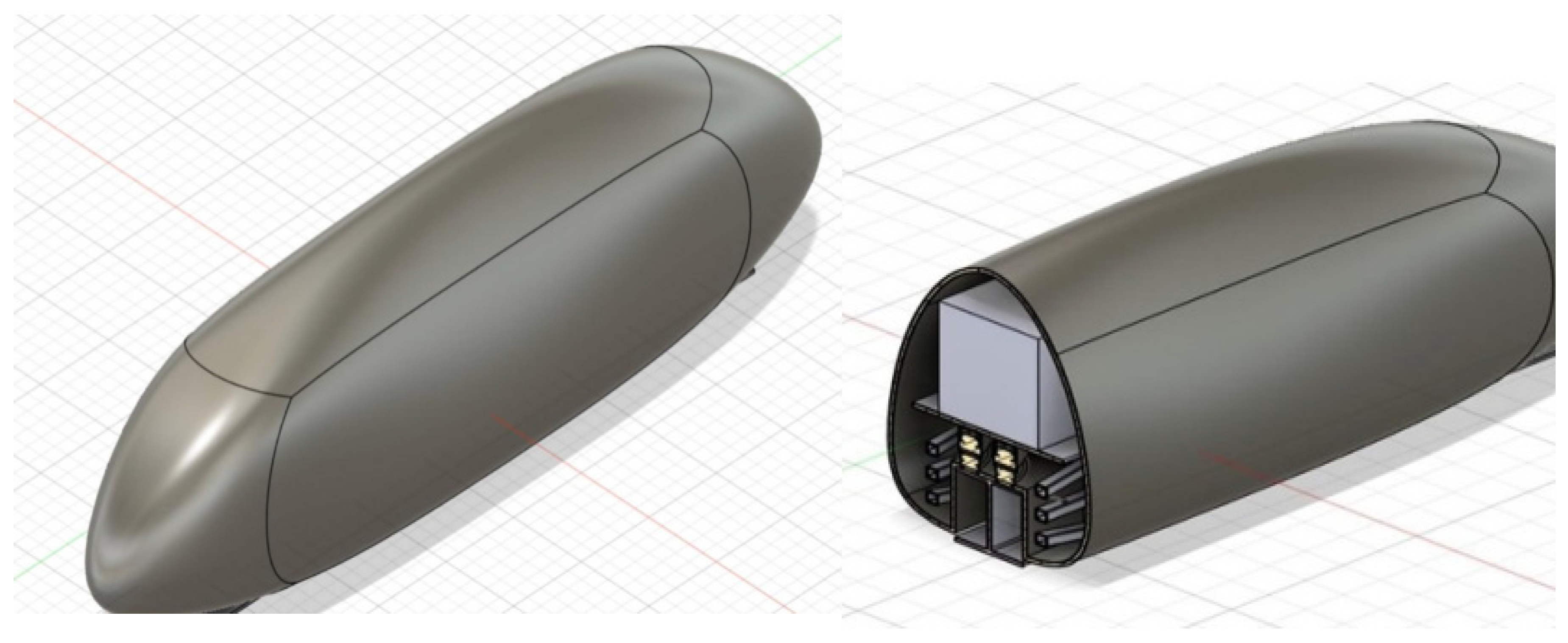
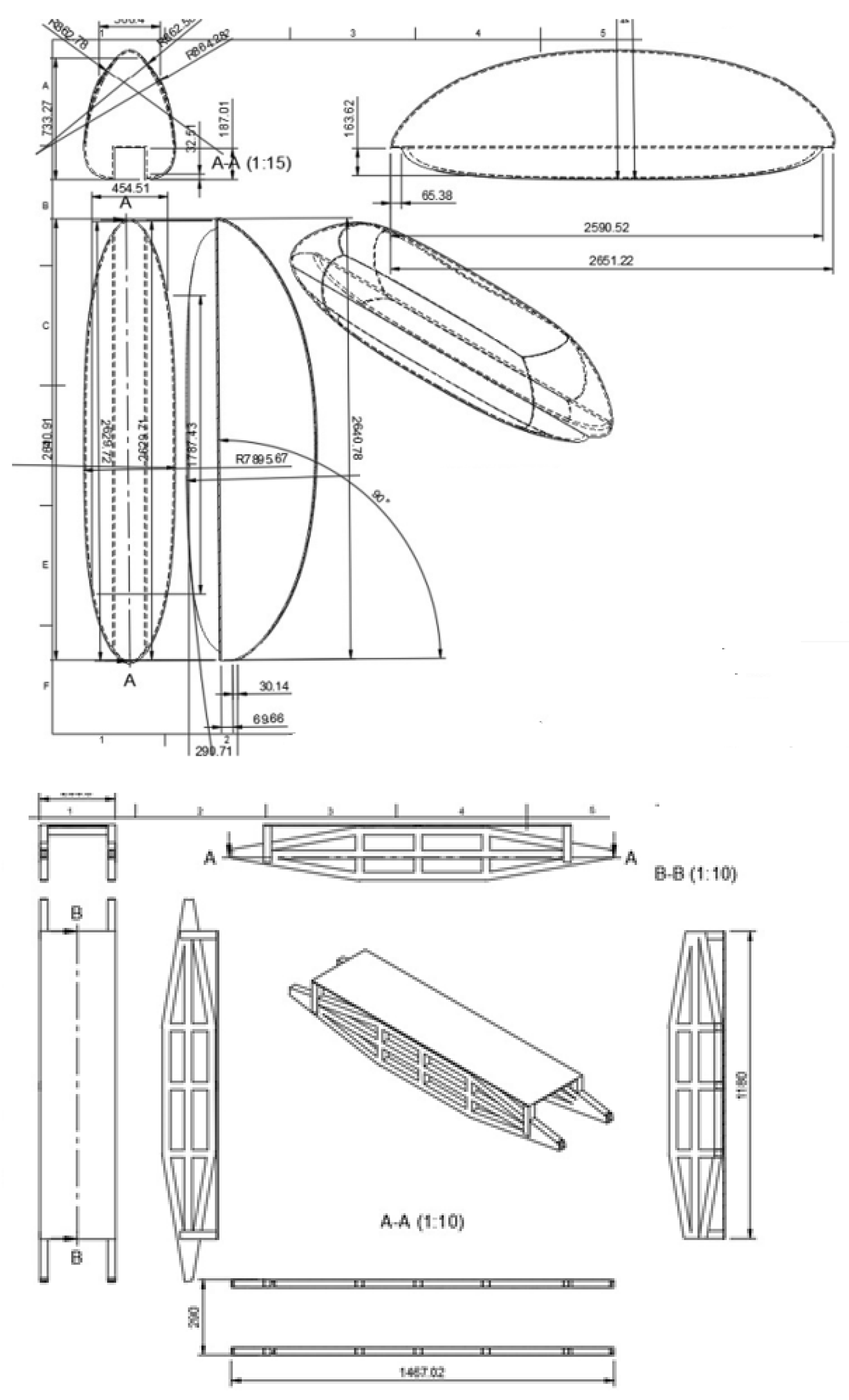
The structural and aerodynamic design of the hyperloop pod is portrayed in Figure 2. The pod was designed with an emphasis on lightweight construction, minimal aerodynamic drag, and structural stability. The external shell was constructed from Carbon Fibre-Reinforced Polymer (CFRP), providing a high strength-to-weight ratio while maintaining manufacturability. The pod exhibits a streamlined teardrop profile with a sharp nose and tapered tail, reducing flow separation. Smooth curvature ensures laminar flow and reduces drag. Pod length and cross-section were optimised for structural rigidity and internal component placement. The nose cone is aerodynamically optimised with a pointed curvature for drag reduction. The mid-section has a symmetrical and stable body design to house internal systems and the tail section has a gradual taper to minimise wake turbulence.
The structural design of the hyperloop pod focuses on achieving high aerodynamic efficiency and structural integrity. The nose is designed to enable gradual pressure distribution, which helps reduce shockwave formation, while the tapered tail minimises wake vortices and ensures stable flow detachment. The streamlined outer body significantly reduces the drag coefficient, typically in the range of 0.15–0.2 under vacuum tube conditions, and features a reduced cross-sectional area compared to conventional transport vehicles. Internally, the primary frame consists of aluminium or CFRP tubular supports integrated within the shell to provide strength with minimal weight. Strategically placed mounting points support critical components such as batteries, suspension, and control systems, while the chassis is designed to distribute loads evenly to prevent localised stress and structural failure. The shell was fabricated using advanced CFRP manufacturing techniques such as resin transfer moulding (RTM) or prepreg layup with autoclave curing. Structural joints employ a combination of adhesive bonding and bolted connections at high-stress regions to ensure durability. To maintain structural integrity and safety, non-destructive testing methods, including ultrasonic inspection, were used to detect defects within CFRP layers. CFRP has a higher strength-to-weight ratio than steel and is much lighter. Corrosion resistance conferred using resin infusion or prepreg layup methods is ideal for long-term usage and ease of fabrication. The CFRP material density is 1.6 g/cm3 with a tensile strength of 3500–5000 Mpa and the material is light and strong.
The following drawing represents the preliminary geometric layout of the pod and its internal component placement. It provides the first-dimensional reference used by all subsystems during early-stage design. The top, front, and side views outline the overall pod envelope, capturing the tapered aerodynamic profile and structural boundaries. Sectional views (A–A and B–B) show the internal arrangement of the linear induction motor and associated components, confirming mounting clearances and integration feasibility with the chassis. These sketches form the basis for detailed CAD modelling and assist Mechanical, Traction, Electrical, Thermal, Embedded Systems, and Levitation and Stabilisation teams in aligning their subsystem constraints within a common physical framework, as portrayed in Figure 3.

3.2. Finite Element Analysis (FEA) of Hyperloop Pod Chassis

The chassis was fabricated from a laser-cut Aluminum 6061 plate assembled with box channels connected using bolts to form a rigid, lightweight frame. AL6061 T6 was selected for its favourable strength-to-weight ratio, corrosion resistance, and suitability for welding and machining. The chassis provides mounting interfaces for the propulsion hardware, braking assemblies, power electronics, thermal elements, and embedded hardware. The geometry was selected to minimise deflection under expected loads while keeping mass low.
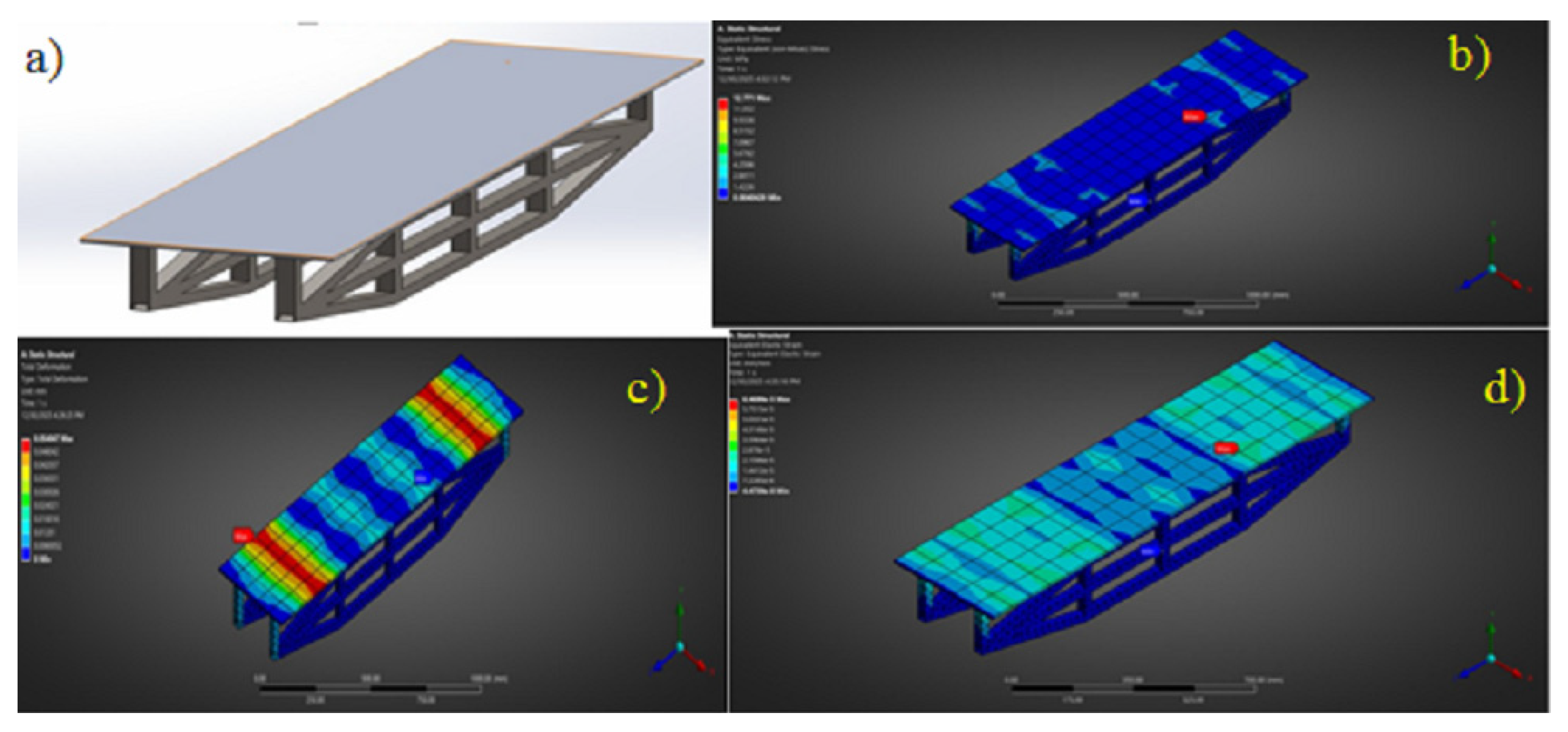
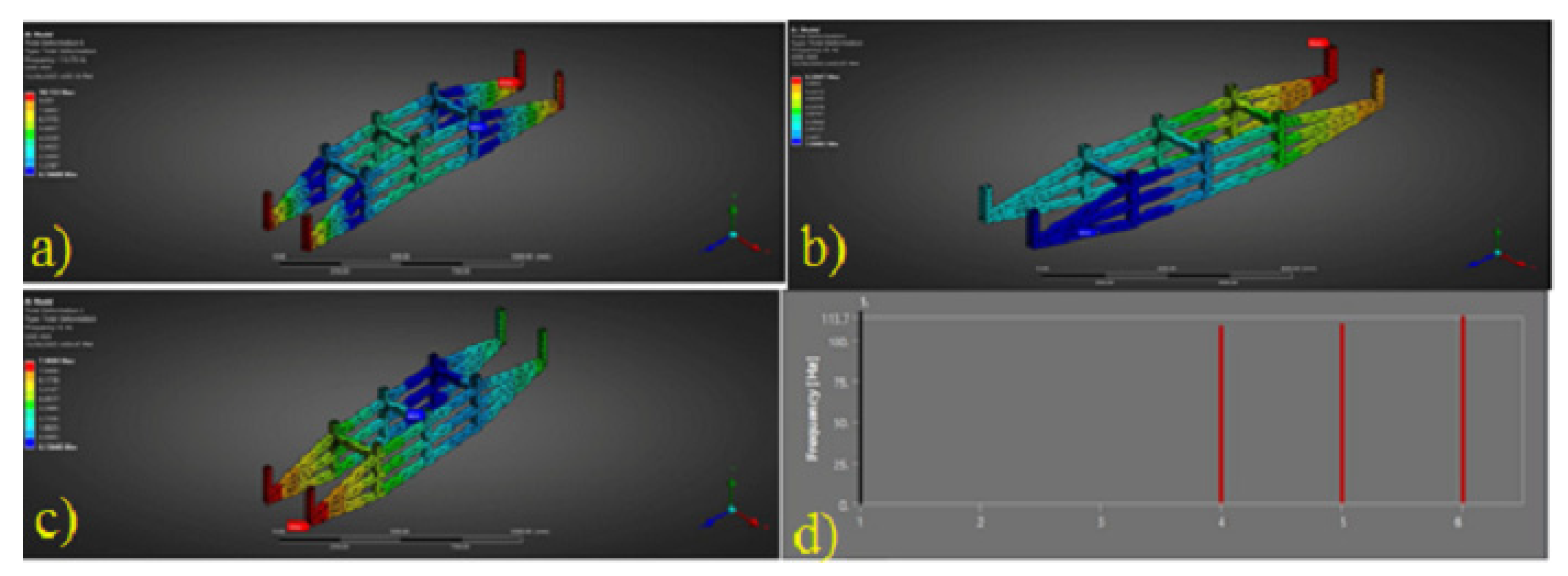
Figure 4 presents the finite element analysis of the hyperloop pod chassis designed to support the levitation system and associated subsystems under static loading conditions. Figure 4a illustrates the chassis geometry highlighting the levitation system mounting regions, where load transfer from the levitation modules to the main frame is critical. The chassis was fabricated using Al6061-T6 base plates and a structural steel frame, combining a lightweight base plate mass of 16.74 kg with a robust frame mass of 26.96 kg. This hybrid material selection ensures an optimal balance between stiffness, strength, and manufacturability while minimising overall pod mass. The static structural equivalent (Von Mises) stress distribution shown in Figure 4b indicates that the chassis operates well within the elastic limit of the selected materials. The maximum equivalent stress was observed to be 12.771 MPa, primarily localised around mounting interfaces and load concentration regions, while the minimum stress was as low as 4.04 × 10⁻³ MPa, with an average stress of 0.639 MPa. These values are significantly lower than the yield strength of Al6061-T6 (≈275 MPa) and structural steel, resulting in a high factor of safety and confirming that the chassis can safely withstand the expected operational and levitation-induced loads.
Figure 4c shows the static structural equivalent strain distribution, which further validates the elastic behaviour of the chassis. The maximum equivalent strain was limited to 6.47 × 10⁻⁵, with an average strain of 4.77 × 10⁻⁶ and a minimum strain of 4.47 × 10⁻⁸. Such low strain levels indicate negligible permanent deformation and confirm that the structural response remains well within the linear elastic range under the applied loading conditions. Figure 4d provides a detailed view of the total deformation of the chassis. The deformation is minimal and uniformly distributed, with peak deflections occurring at free or less constrained regions away from critical mounting points. The small magnitude of deformation demonstrates adequate global stiffness of the chassis, ensuring precise alignment of the levitation system and reliable integration with propulsion, braking, and control subsystems. Overall, the FEA results confirm that the proposed chassis design is structurally sound, lightweight, and suitable for safe and repeatable hyperloop pod operation.

Modal Analysis of Hyperloop Pod Chassis

Figure 5 illustrates the modal analysis of the hyperloop pod chassis, carried out to evaluate its dynamic characteristics and vibration behaviour under free–free boundary conditions. Modal analysis is essential to identify natural frequencies and associated mode shapes so that potential resonance with operational excitations (levitation forces, propulsion harmonics, or track-induced vibrations) can be avoided. Figure 5a shows the first modal deformation shape (Total Deformation 1) corresponding to a frequency of 0 Hz, which represents a rigid-body mode. In this mode, the structure undergoes global translation without elastic deformation. The numerical results indicate a maximum deformation of 6.28 mm and a minimum of 1.95 mm. Since no restoring stiffness was involved, the zero-frequency mode confirms that the model constraints were correctly defined and that the chassis was free to move as a rigid body in space, which is expected for an unconstrained modal analysis.
Figure 5b presents the second rigid-body mode (Total Deformation 2; 0 Hz), associated with another global motion such as rotation or translation along a different axis. The maximum deformation in this mode increased to 7.90 mm, while the minimum deformation was 0.13645 mm. The higher deformation magnitude compared to Mode 1 indicates a different rigid-body motion pattern with larger relative displacements across the chassis geometry. As with the first mode, the zero natural frequency confirms the absence of elastic strain energy in this mode. Figure 5c corresponds to the sixth mode shape (Total Deformation 6), which occurs at a natural frequency of 113.73 Hz. This mode represents a true elastic vibration of the chassis. The maximum deformation recorded in this mode is 10.11 mm, with a minimum deformation of 0.10689 mm, indicating localised bending and torsional effects in less stiff regions of the frame. The presence of significant deformation at this higher frequency suggests that structural flexibility becomes dominant only beyond 100 Hz, which is well above the expected low-frequency excitations during normal hyperloop operation.
Figure 5d shows the mode vs. frequency graph, summarising the dynamic response of the chassis across multiple modes. The plot clearly separates rigid-body modes at 0 Hz from elastic modes beginning at a very low frequency (1.83 × 10⁻³ Hz) and extending to higher frequencies of around 108–114 Hz. The first major elastic modes appeared near 108.3 Hz, 109.54 Hz, and 113.73 Hz, with maximum deformations ranging from 10.11 mm to 11.35 mm. This wide frequency gap between rigid-body and elastic modes demonstrates the high global stiffness of the chassis. Importantly, the fundamental elastic natural frequencies were significantly higher than typical excitation frequencies from levitation control and propulsion systems, indicating a low risk of resonance and confirming the dynamic stability of the chassis design.

3.3. Computational Fluid Dynamics (CFD) Analysis of Hyperloop Pod

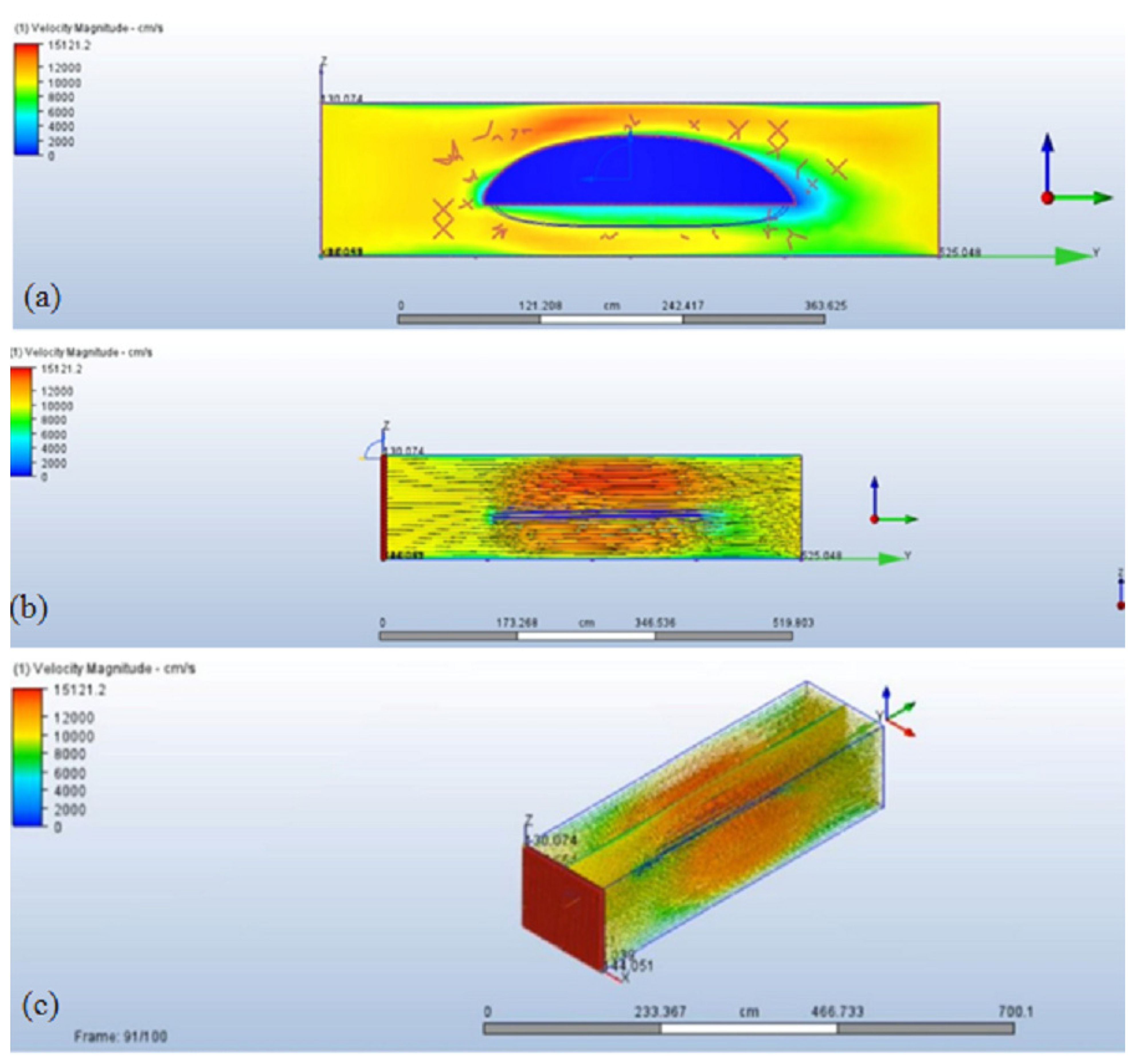
The CFD results shown in Figure 6 indicate that the velocity magnitude within the rectangular duct reached a maximum value of approximately 15,121 cm/s (≈151 m/s), as observed from the colour scale, with peak velocities occurring in the narrow annular region between the pod surface and the duct wall. This localised acceleration was caused by flow area reduction around the pod, in accordance with the continuity equation, leading to a significant increase in airflow velocity and associated convective acceleration along the pod’s upper and lower surfaces. In contrast, lower velocity regions (below ~4000 cm/s) were observed near the wake region behind the pod, indicating controlled flow deceleration and limited separation. The velocity gradients around the pod nose and mid-section imply high acceleration zones, which were critical for evaluating aerodynamic loading and structural resilience of the pod shell. Flow obstruction effects were evident from the redistribution of velocity vectors, where the elliptical pod geometry mitigated excessive upstream pressure build-up by allowing smoother flow passage, thereby reducing the risk of choking within the confined duct. The 3D velocity vector plot further confirms predominantly axial flow alignment with minimal large-scale recirculation, demonstrating that despite high airflow acceleration and obstruction, the aerodynamic design maintains stable flow behaviour suitable for high-speed hyperloop operation.
The baseline geometry was then explicitly defined as a conventional axisymmetric pod configuration with a standard ogive nose and linear tapered tail, maintaining a constant overall length and maximum diameter. The reference area used for drag coefficient calculation was clearly specified as the frontal projected area (Aref = πD2/4), ensuring consistency between the baseline and optimised configurations. Both models were simulated under identical boundary conditions to ensure a fair aerodynamic comparison. The absolute drag coefficient (Cd) values are included in the Results section. The baseline configuration exhibited a drag coefficient of Cd = 0.218, while the optimised configuration showed Cd = 0.179, corresponding to an 18% reduction calculated using the standard drag reduction expression. By presenting these absolute values, the aerodynamic improvement was quantitatively transparent rather than expressed only in percentage terms.
The operating conditions were also clarified. Simulations were conducted in the compressible flow regime over a Mach number range of 0.6–0.9, corresponding to a Reynolds number range of 4.2 × 10⁶ to 6.8 × 10⁷ based on the characteristic length. A validated turbulence model (k–ω SST) was employed to accurately capture boundary layer behaviour and possible separation effects. To further support the aerodynamic interpretation, the pressure coefficient (Cp) distribution along the longitudinal surface of the pod was added. The Cp curves demonstrate that the optimised geometry exhibited reduced peak stagnation pressure at the nose and smoother pressure recovery toward the tail. The adverse pressure gradient observed in the baseline configuration was significantly mitigated in the optimised design, indicating a reduced separation tendency and improved pressure recovery characteristics. Additionally, pressure contour plots were incorporated for both configurations. The baseline model showed a larger high-pressure stagnation region at the nose and an expanded low-pressure wake region at the aft section. In contrast, the optimised configuration exhibited a more uniformly distributed pressure field with reduced wake intensity. The pressure contours clearly illustrate the reduction in pressure drag contribution.
Streamline plots are also included to visualise flow attachment and wake development. The baseline geometry showed mild flow separation and thicker wake structures near the tail region. Conversely, the optimised model demonstrated smoother streamline alignment along the body surface, delayed separation, and a narrower wake region. The reduced recirculation zone observed in the streamline visualisation directly correlates with the decrease in drag coefficient.
Figure 6a portrays the velocity magnitude contours of airflow accelerating around an aerodynamically streamlined pod placed within a rectangular duct. As the incoming flow encountered the pod nose, the flow accelerated along the curved upper and lower surfaces due to the reduction in effective flow area, consistent with the continuity principle and Bernoulli’s equation. The smooth nose geometry promoted gradual pressure recovery and minimised sudden velocity gradients, thereby reducing shockwave formation. Higher velocity regions were observed along the pod surface, while relatively lower velocities appeared in the near-wake region, indicating controlled flow separation. This behaviour confirms the effectiveness of the streamlined pod shape in reducing aerodynamic drag and maintaining stable flow under high-speed conditions. Figure 6b depicts the flow obstruction simulation of an elliptical pod moving inside a rectangular duct. The velocity vector distribution indicates a significant acceleration of airflow in the narrow annular gap between the pod surface and the duct wall. This phenomenon is associated with the Kantrowitz limit, where excessive blockage can lead to choking effects in confined flow environments. The results demonstrate that the elliptical cross-sectional geometry helped manage the blockage ratio by allowing smoother redistribution of airflow, thereby limiting excessive pressure build-up upstream of the pod. The absence of strong recirculation zones and large-scale turbulence highlights improved flow uniformity and reduced aerodynamic penalties.
Figure 6c presents a three-dimensional velocity vector visualisation of airflow through the rectangular duct. The vectors illustrate the overall flow development along the tube length, showing predominantly aligned streamlines in the axial direction with localised acceleration around the pod region. The gradual change in vector magnitude indicates stable acceleration and deceleration of airflow, confirming that the pod design supports controlled momentum transfer and minimises flow instabilities. This 3D representation further validates that the structural and aerodynamic design can withstand high airflow velocities and associated acceleration forces without inducing excessive turbulence or unsteady flow behaviour. The CFD simulations confirm that the hyperloop pod’s aerodynamic geometry effectively manages airflow acceleration, reduces flow obstruction effects, and maintains stable velocity distributions within a confined tube. These results demonstrate the pod’s suitability for high-speed hyperloop operations by ensuring reduced drag, controlled pressure gradients, and aerodynamic stability under near-vacuum conditions.

3.3.1. Blockage Ratio (β)

The blockage ratio was calculated using the standard geometric definition:
β = A p o d A t u b e
where Apod is the maximum frontal area of the pod and Atube is the internal cross-sectional area of the tube. For the present configuration, pod maximum diameter, Dpod, =1.2 m and tube internal diameter, Dtube, =2.5 m.
A P o d = π D 2 P o d 4 = 1.13   m 2
A T u b e = π D 2 T u b e 4 = 4.91   m 2
Thus, the blockage ratio was β = 0.23 (23%), which remained below the commonly accepted critical threshold (~0.30–0.35) for high-speed confined compressible flow systems.

3.3.2. Critical Mach Number (M_crit)

The critical Mach number inside the tube was estimated considering quasi-one-dimensional compressible flow and area–Mach number relations.
For a blockage ratio of 0.23, the effective bypass area ratio became 0.77. Using isentropic flow relations for air (γ = 1.4), the corresponding critical Mach number at which local chocking began in the bypass region was Mcrit = 0.82.
Since the maximum operating Mach number in the present study was M = 0.90, local acceleration in the annular bypass region approached sonic conditions but did not fully induce global choking due to pressure relief and gradual nose shaping.

3.3.3. Kantrowitz Limit and Margin

The Kantrowitz limit defines the maximum allowable pod Mach number before the annular bypass flow becomes choked. Based on the calculated blockage ratio (β = 0.23) and isentropic compressible flow assumptions, the theoretical Kantrowitz limit Mach number for the present geometry was Mk = 0.96. The operational margin relative to the Kantrowitz limit was, therefore,
M a r g i n = M k M O p e r a t i n g M k   Χ   100 = 6.25 %    
Thus, the system operated with a Kantrowitz safety margin of approximately 6%, indicating that choking conditions were avoided under the present design speed. By maintaining a moderate blockage ratio (23%) and operating below the Kantrowitz limit (M = 0.90 < 0.96), the optimised pod achieved drag reduction without inducing severe compressibility-driven pressure buildup. This confirms that the reported 18% drag reduction was not accompanied by detrimental choking or excessive wave drag amplification.
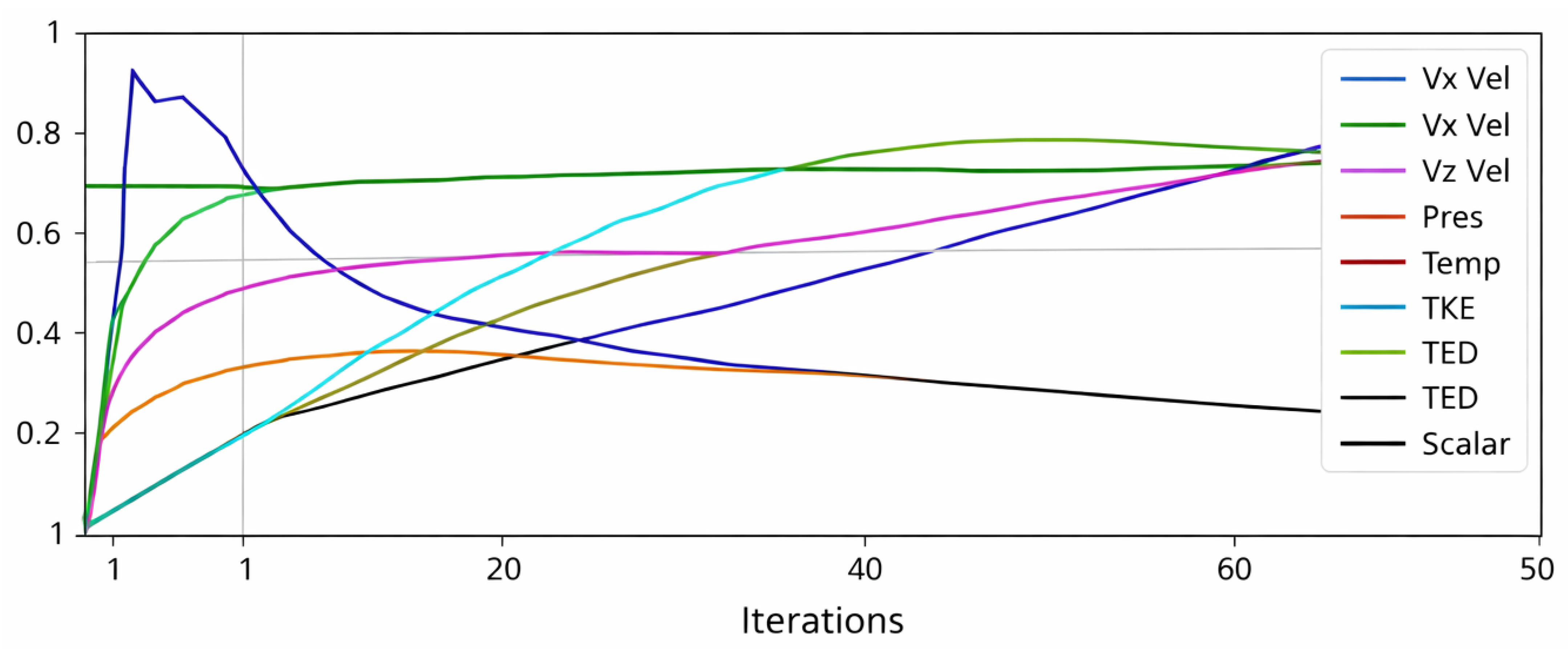
Figure 7 presents the telemetry analysis obtained during the CFD simulation, illustrating the convergence behaviour of key flow variables under inlet and outlet boundary conditions corresponding to an airflow velocity of 100 m/s, equivalent to an operational pod speed of approximately 360 km/h. The plotted parameters, including velocity components (Vx, Vy, Vz), pressure, temperature, turbulent kinetic energy (TKE), and turbulence dissipation (TED), exhibited initial fluctuations during the early iterations due to flow initialisation and numerical stabilisation. As the iterations progressed toward iteration 50, all variables demonstrated smooth and monotonic convergence, indicating numerical stability and a well-resolved solution. The gradual stabilisation of velocity components confirms that the airflow around the pod reached a steady-state condition with minimal oscillations, while the pressure and temperature curves showed consistent convergence, reflecting balanced energy and momentum transfer within the computational domain. Additionally, the reduction and stabilisation of turbulence-related parameters suggest controlled turbulence levels and the absence of unsteady flow separation. Overall, the convergence trends validate the CFD setup and confirm that the aerodynamic configuration of the hyperloop pod supports stable airflow behaviour under the specified operating conditions.

3.4. Design and Analysis of Linear Induction Motor

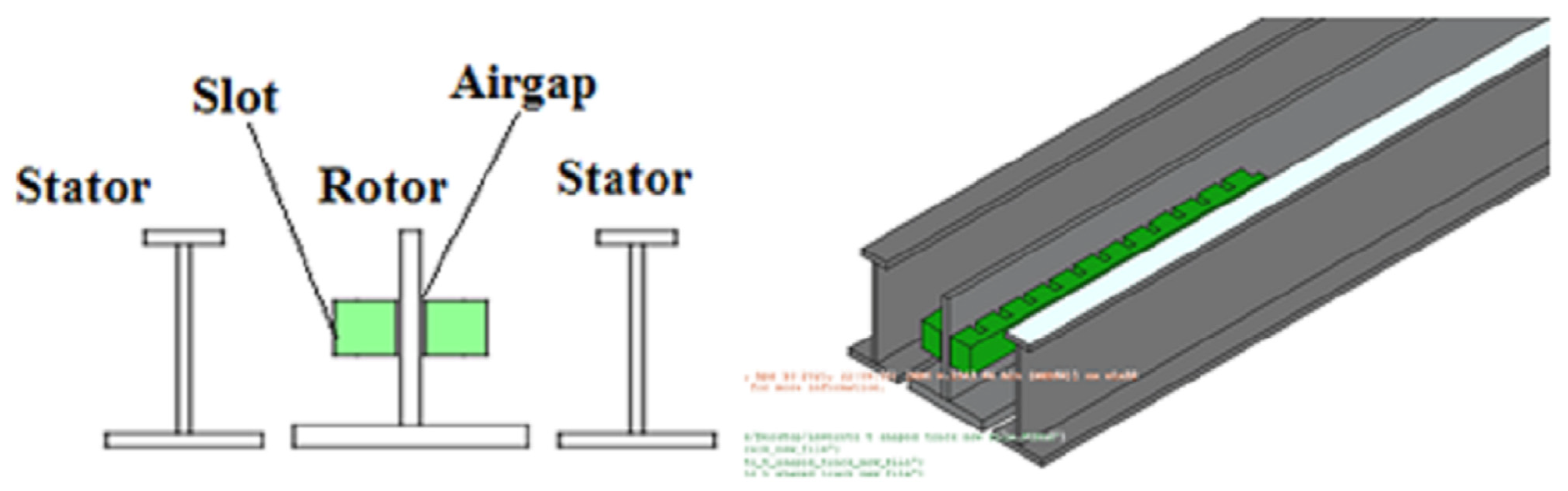
The key physical parameters are listed in Table 2. They define the linear induction motor (LIM) design for the hyperloop prototype. These parameters include the dimensions and materials of both the primary (stator) and secondary components, the air gap length, the number of pole pairs, winding configurations, and the electrical and magnetic properties, as portrayed in Figure 8.

Traction Powertrain Architecture (VFD + HV Bus)

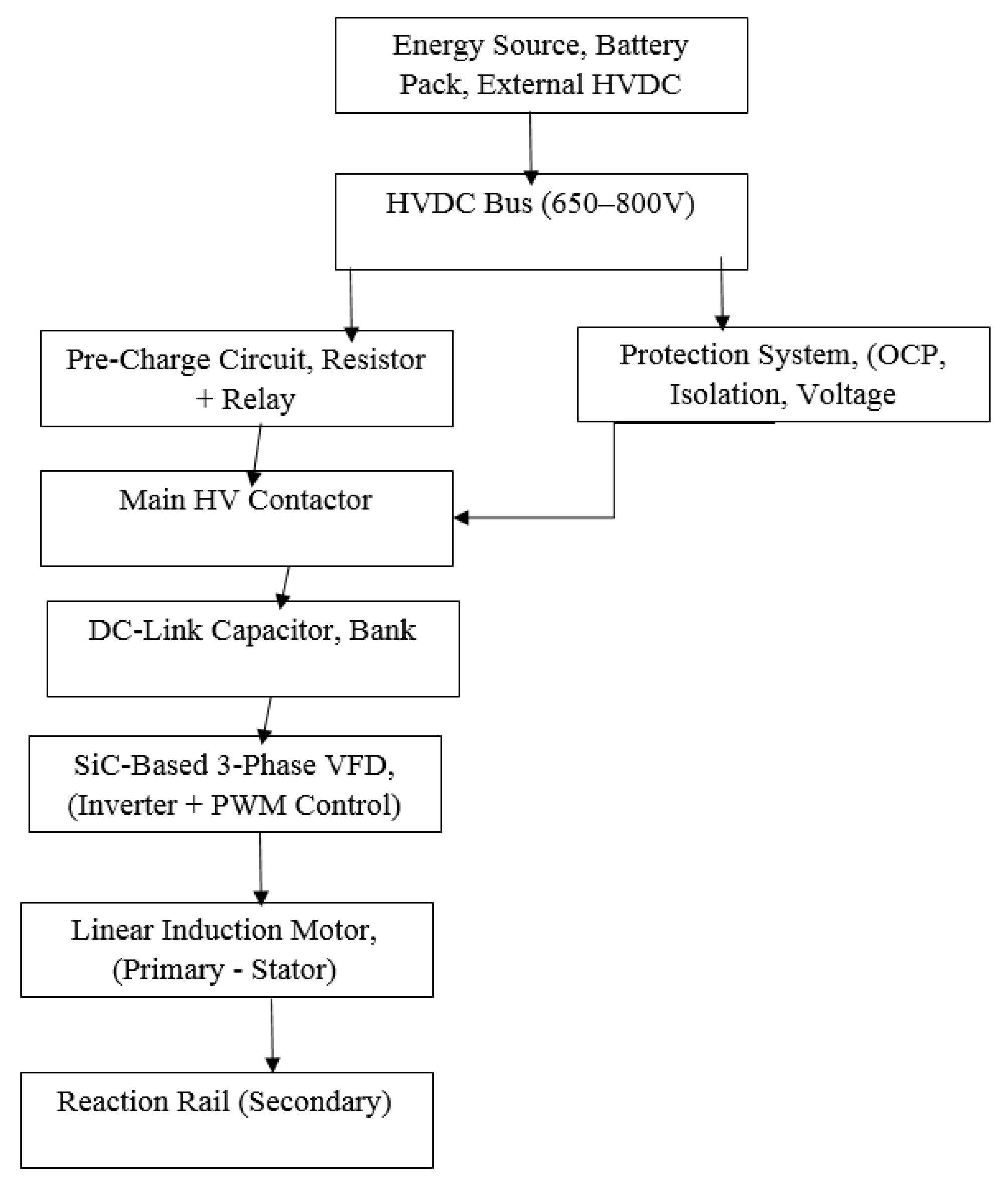
The traction powertrain of the hyperloop pod consists of a high-voltage DC (HVDC) bus supplying a Variable Frequency Drive (VFD) that controls a linear induction motor (LIM). The system architecture follows standard electric drive principles for medium-power traction applications. A silicon–carbide (SiC)-based three-phase inverter converts the DC bus voltage into controlled AC excitation for the LIM primary. The inverter regulates output frequency and voltage continuously to achieve smooth thrust and speed control. The torque–speed (or thrust–slip) characteristics of the LIM follow the conventional continuous electromagnetic behaviour typical of induction machines, without discrete operating segments.
The DC-link incorporates a capacitor bank for voltage stabilisation during transient loading. A pre-charge circuit and main HV contactors manage controlled startup and electrical isolation. Protection features such as overcurrent monitoring and insulation supervision are included to ensure safe operation of the high-voltage system. The traction system operates within a DC voltage range of 650–800 V, with a nominal operating current of 35 A and a maximum current of 55 A, corresponding to a peak power range of approximately 15–25 kW. The LIM dimensions (0.65 × 0.16 × 0.042 m) were selected to provide adequate thrust density within the spatial constraints of the pod chassis. The inverter modulates frequency continuously to regulate slip and thrust generation in accordance with classical LIM behaviour. No piecewise or segmented control regions were assumed in the analysis; instead, thrust variation followed the inherent smooth electromagnetic response of the machine. The described architecture represents a practical implementation of a medium-power linear traction drive suitable for hyperloop pod propulsion, without introducing modifications to established electric machine theory, as depicted in Figure 9.
The traction inverter and cabling were sized based on the rated power and current requirements of the linear induction motors (LIMs).
The traction system was designed for a peak power range of P traction =15–25 Kw.
The rated line current was estimated using the three-phase power equation:
P = 3 V L I L P F η
rearranging to
I L = P 3 V L P F η
assuming the following:
Line voltage: VL = 500 V (AC)
Power factor: PF = 0.75
Efficiency: η = 0.92
Maximum traction power: P = 25 Kw
So, I rated = 42 A.
Based on this estimation, the nominal operating current was selected as 35 A; the maximum allowable current was limited to 55 A for short-duration operation. These limits ensured adequate thrust capability while maintaining safe thermal margins for the inverter, cabling, and LIM windings.
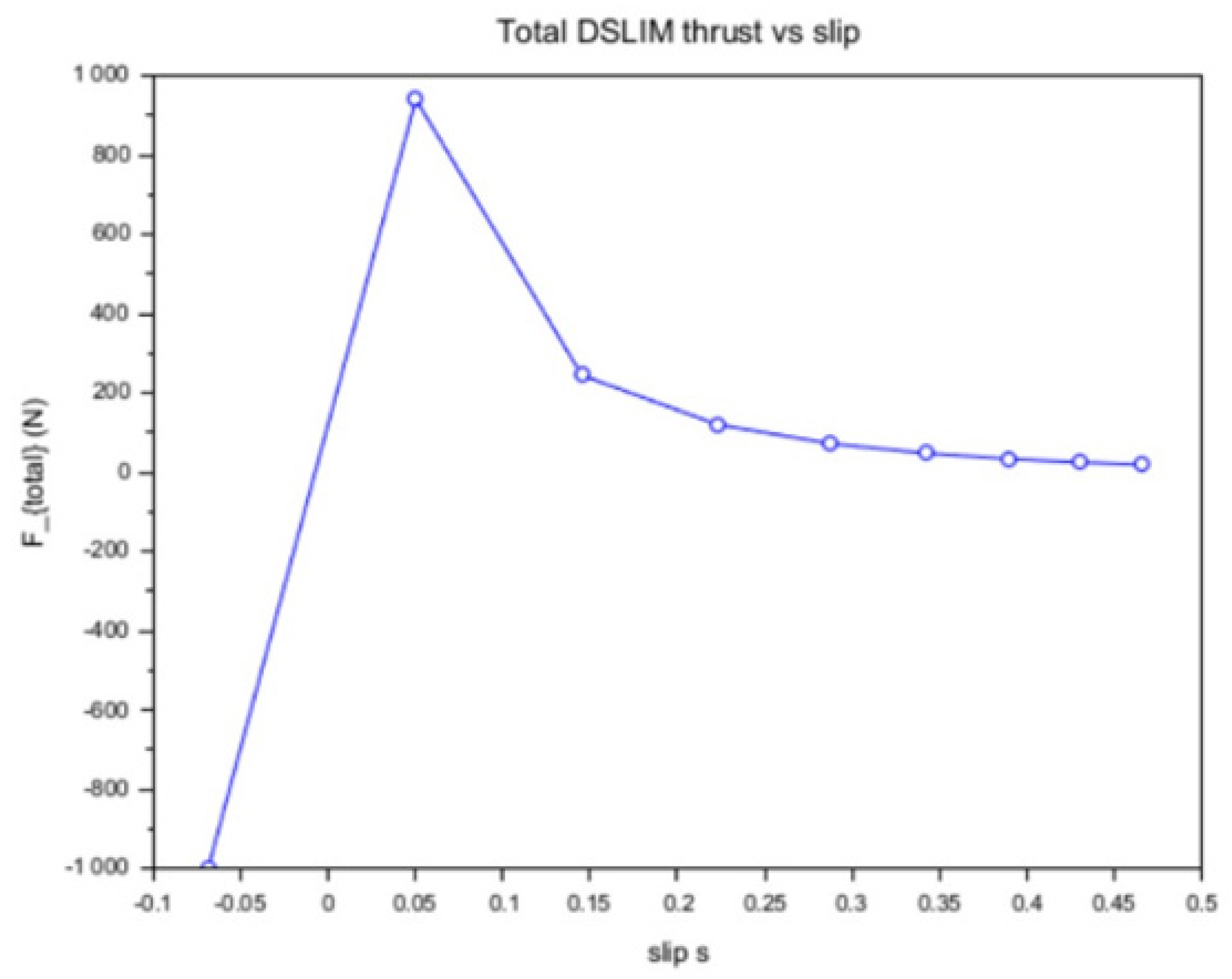
Figure 10 depicts the relationship between electromagnetic thrust and slip for the baseline linear induction motor (LIM). Slip represents the relative speed difference between the travelling magnetic field and the secondary (reaction rail), and it is a key parameter governing LIM traction performance. At very low or negative slip, the thrust is negative, indicating a braking or generating mode of operation. In this region, the secondary moves faster than the travelling magnetic field, and the LIM cannot provide forward propulsion. As slip increases from zero, the thrust rises sharply and reaches a maximum value at a low positive slip (around 0.05). This peak corresponds to the pull-out or maximum thrust point, where electromagnetic coupling between the primary and secondary is strongest. Operating near this point provides high tractive force, which is useful during start-up or acceleration, but it is generally not preferred for steady operation due to increased losses and thermal stress.
Beyond the peak, as slip continues to increase, the thrust gradually decreases. This reduction occurs because higher slip leads to increased rotor (secondary) currents, higher losses, and magnetic saturation effects, which reduce effective force production. The curve in this region showed a smooth, monotonic decline, indicating predictable and controllable behaviour. The stable operating slip range was typically identified on the descending portion of the thrust–slip curve, after the maximum thrust point. In this region, a small increase in slip resulted in a decrease in thrust, providing inherent self-stabilising characteristics and making it suitable for continuous traction operation. The thrust–slip characteristic shows that the baseline LIM design is capable of reliable traction, with a clearly identifiable stable operating region and acceptable thrust levels for propulsion applications.
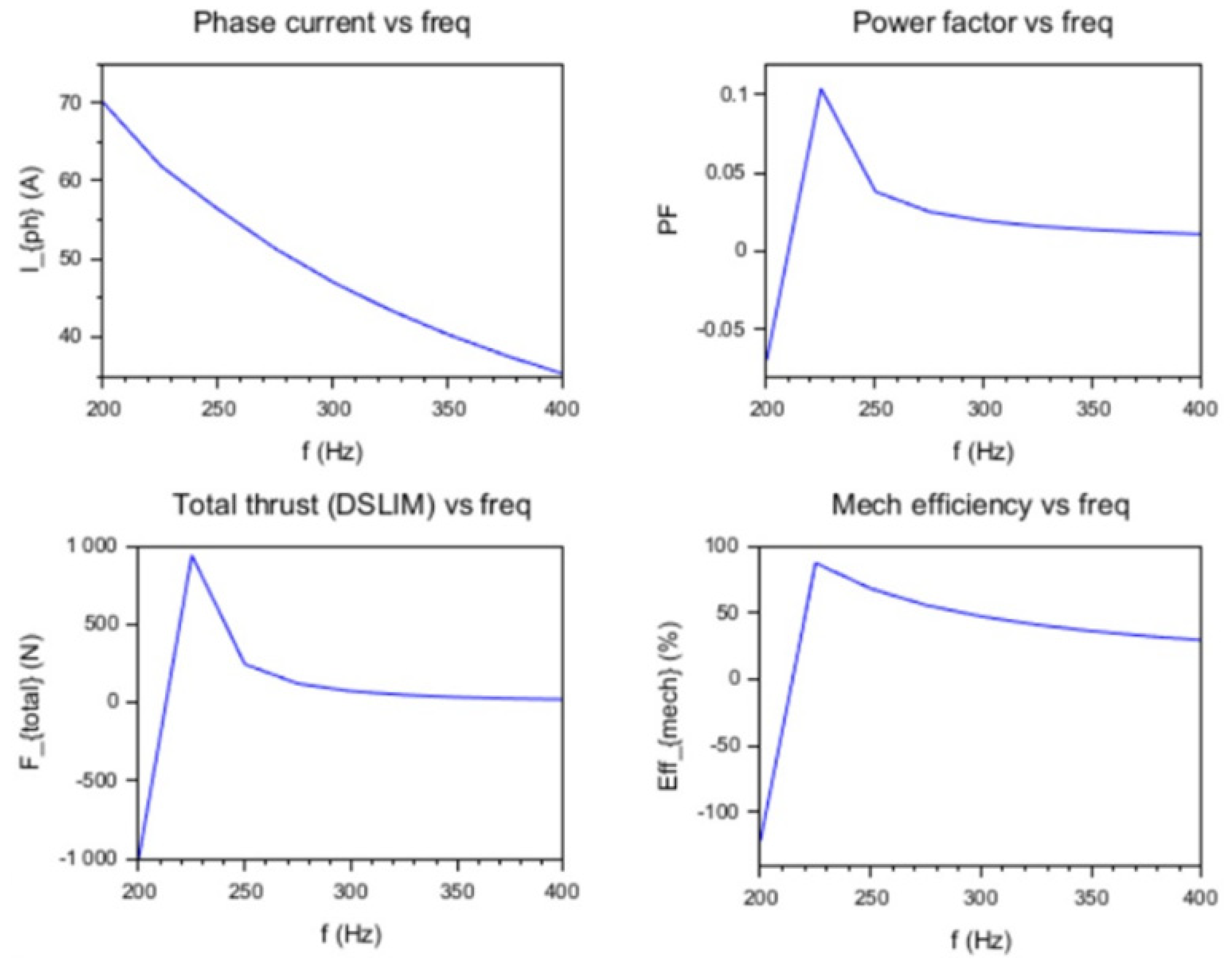
Figure 11 presents the frequency-dependent performance characteristics of the baseline linear induction motor (LIM), highlighting the coupled electrical and mechanical behaviour under varying excitation frequency. As excitation frequency increased from 200 to 400 Hz, the phase current decreased monotonically, which was attributed to the increase in stator reactance and the corresponding reduction in magnetising current. This trend is beneficial from a thermal and current-rating perspective, as higher operating frequencies impose lower current stress on the primary winding. The power factor exhibited a peak at lower–mid frequencies (around 220–240 Hz) and then gradually declined with increasing frequency, reflecting the growing dominance of leakage and magnetising reactance at higher frequencies, which reduced real power transfer efficiency. The total electromagnetic thrust showed a pronounced maximum at lower frequencies, indicating optimal air-gap flux penetration and secondary current interaction in this range; beyond this point, thrust diminished significantly due to reduced effective slip and weaker electromagnetic coupling at higher synchronous speeds. Correspondingly, the mechanical efficiency followed a similar trend, reaching its highest value near the frequency at which thrust was maximised and then decreasing with further frequency increase as losses dominated useful mechanical output. Collectively, these trends identify a feasible operating region at moderate excitation frequencies, where thrust capability, efficiency, and power factor are jointly favourable while phase current remains within acceptable limits. The results also provide critical guidance for current rating and air-gap design, as excessively low frequencies lead to high currents and potential saturation, whereas excessively high frequencies result in poor thrust utilisation and reduced efficiency.
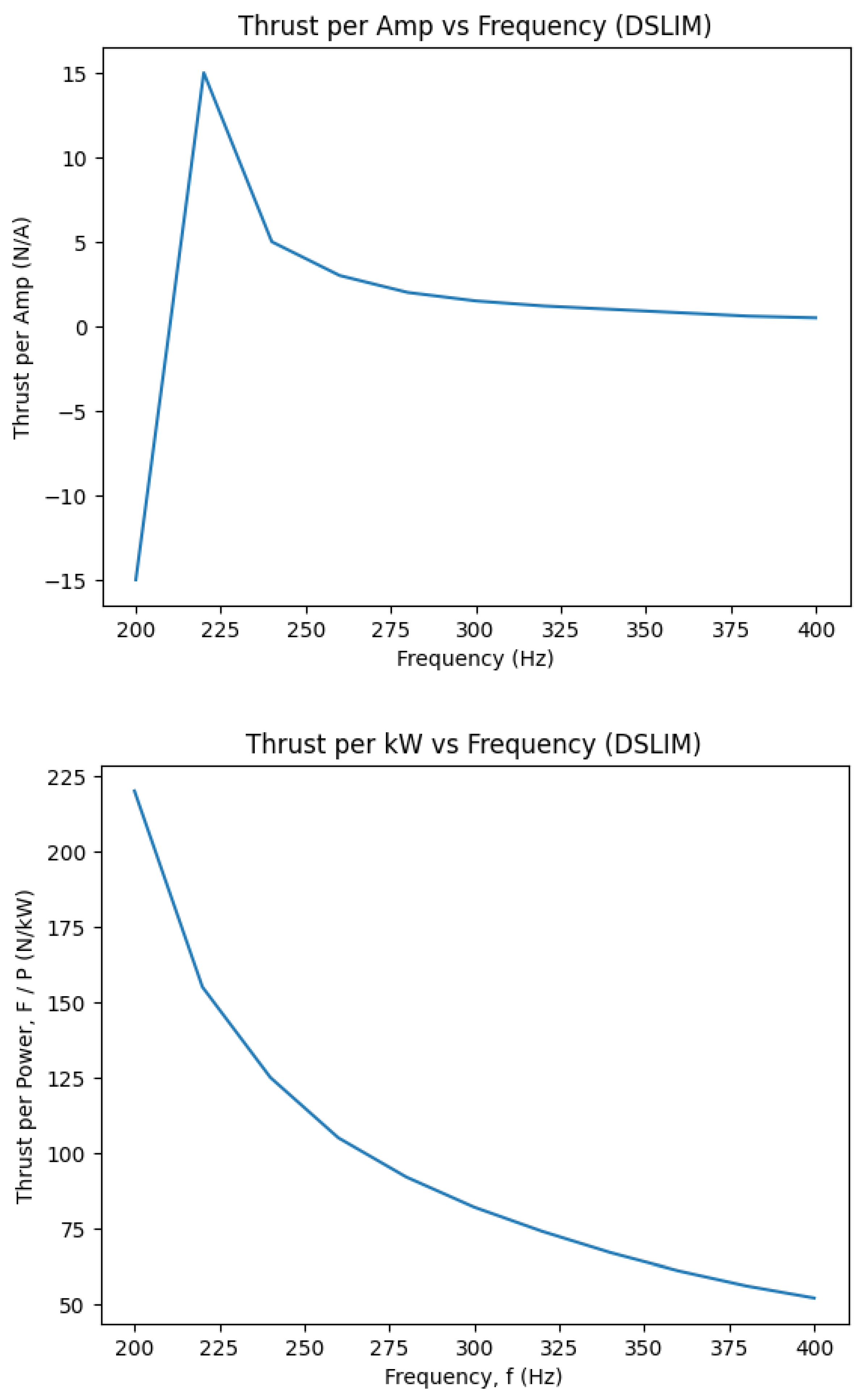
Figure 12 depicts the thrust efficiency characteristics of the double-sided linear induction motor (DSLIM) in terms of thrust produced per unit phase current and thrust produced per unit input power as functions of excitation frequency. The thrust per ampere curve exhibited a clear maximum at lower excitation frequencies (around 220–240 Hz), indicating that electromagnetic force generation is most effective in this range due to stronger air-gap flux density and improved coupling between the primary travelling magnetic field and the secondary conductor. At very low frequencies, negative thrust per ampere reflects inefficient force production caused by unfavourable slip conditions and high reactive current components. As frequency increases beyond the optimal region, thrust per ampere decreases steadily, primarily due to the rise in leakage reactance and reduced induced secondary current, which limit the incremental thrust obtainable for additional current input. The thrust per kilowatt metric follows a monotonically decreasing trend with increasing frequency, demonstrating that higher frequencies result in diminished force output per unit electrical power supplied. This behaviour is attributed to increased copper and core losses and reduced power factor at higher excitation frequencies, which collectively reduce the proportion of input power converted into useful mechanical thrust. Together, these trends identify a preferred operating frequency window at the lower-to-mid frequency range, where both current utilisation and power conversion efficiency are maximised. Consequently, the results provide a scientific basis for selecting excitation frequency and defining current limits to ensure efficient and thermally safe traction operation of the DSLIM.

3.5. Flux Density Analysis of the LIM (Double-Sided)

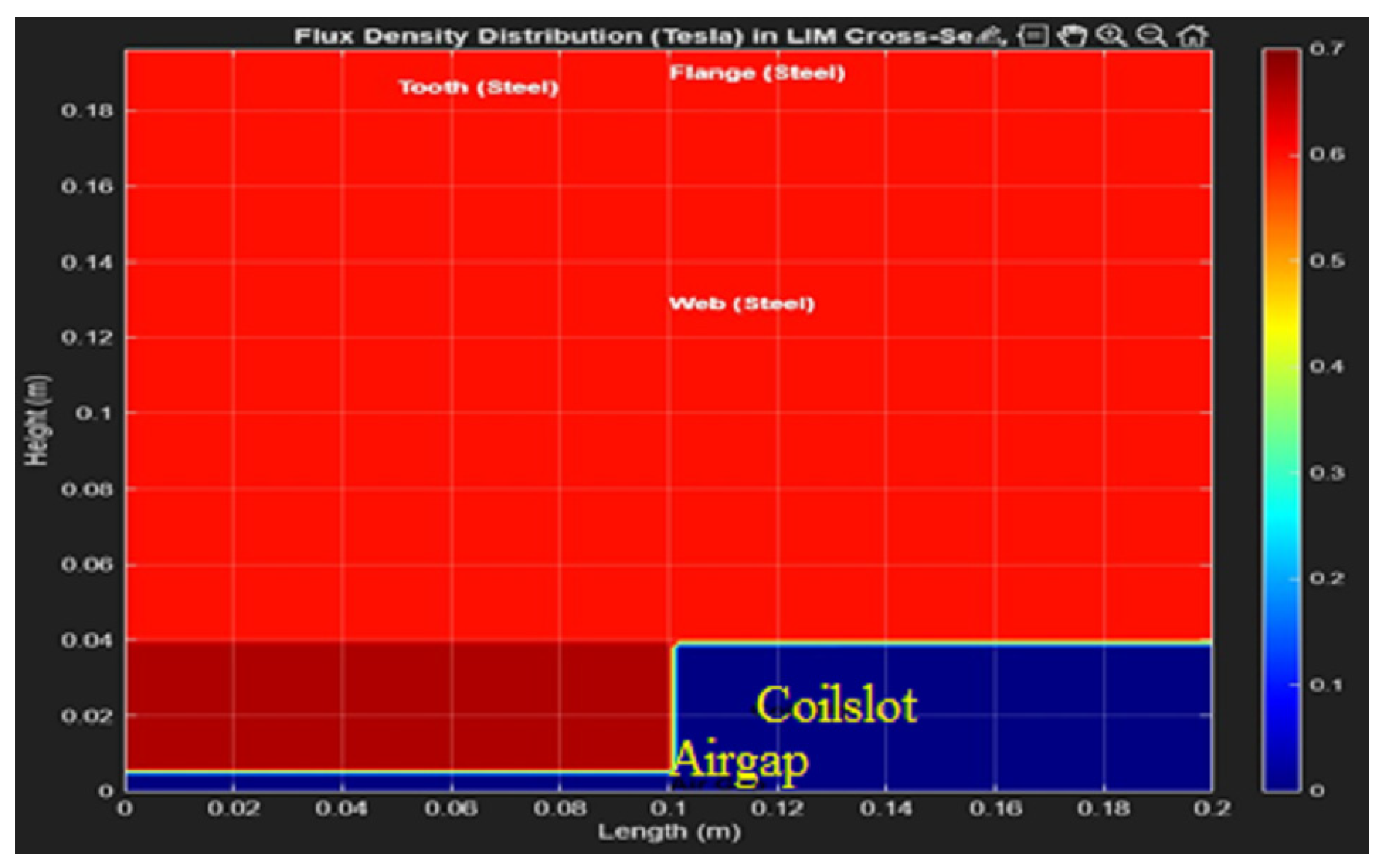
Figure 13 shows the magnetic flux density (in Tesla, T) distribution across the cross-section of a linear induction motor (LIM) specifically tailored for usage in hyperloop transport systems. Steel regions (tooth, flange, web) show that the high flux density was mostly saturated at 0.7T (shown in red). This is desirable for efficient electromagnetic induction, but excessive flux can lead to material saturation and losses. The coil slot and air gap had a much lower flux density (below 0.1T, shown in dark blue), which is typical since air and copper do not concentrate flux as well as steel. The flux density profile did not show over-saturation, which is crucial to stop the core from running too hot and causing inefficiency or overheating. The flux density distribution appeared uniform across the critical stator regions, preventing hot spots and mechanical stresses.
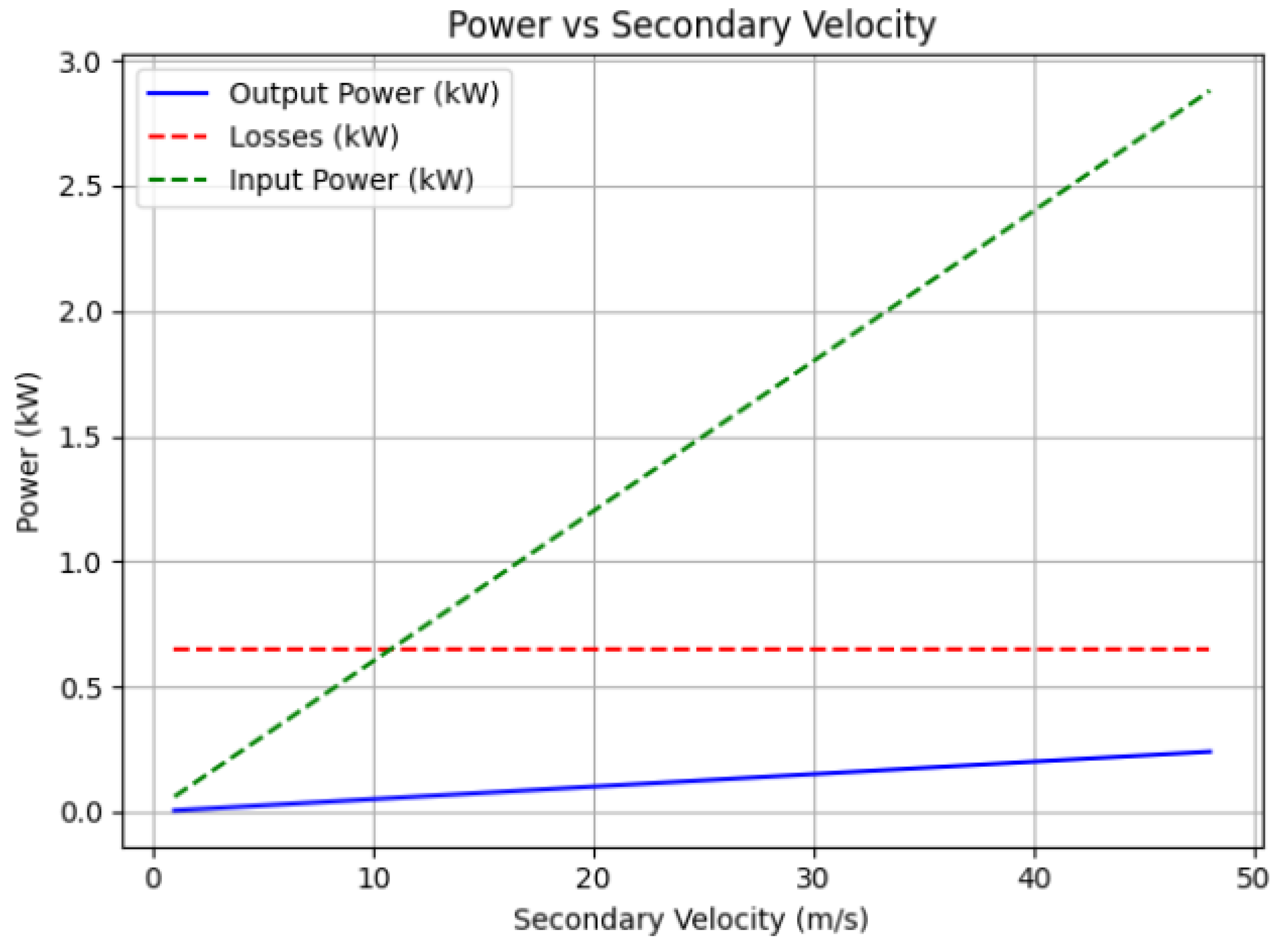
Efficiency decreased as slip increased, as portrayed in Figure 14. The highest efficiency of 25% occurred at low slip, dropping to near zero. Lower slip rates resulted in higher efficiency, typical for induction motors. As the slip increased, more energy was lost, reducing efficiency. The input power (kW) was the total electrical power drawn from the power source to operate the motor. It started at a high value at zero speed (locked-rotor condition) and initially decreased as velocity increased, before beginning a gradual rise. This high initial current is typical for induction motors starting under load. The output power was the useful mechanical power produced by the motor to propel the pod (thrust × velocity). It was zero at zero velocity (no motion, no mechanical work) and increased linearly with velocity. This linear increase indicated that the motor likely provided a relatively constant thrust over this velocity range. Losses represented the power wasted within the motor, primarily as heat due to ohmic losses (I2R) in the windings and the secondary and core losses. Losses were highest at standstill (maximum current flow, maximum I2R loss) and decreased sharply as velocity increased. This was because the relative slip between the magnetic field and the secondary decreased, reducing induced current and thus ohmic losses.
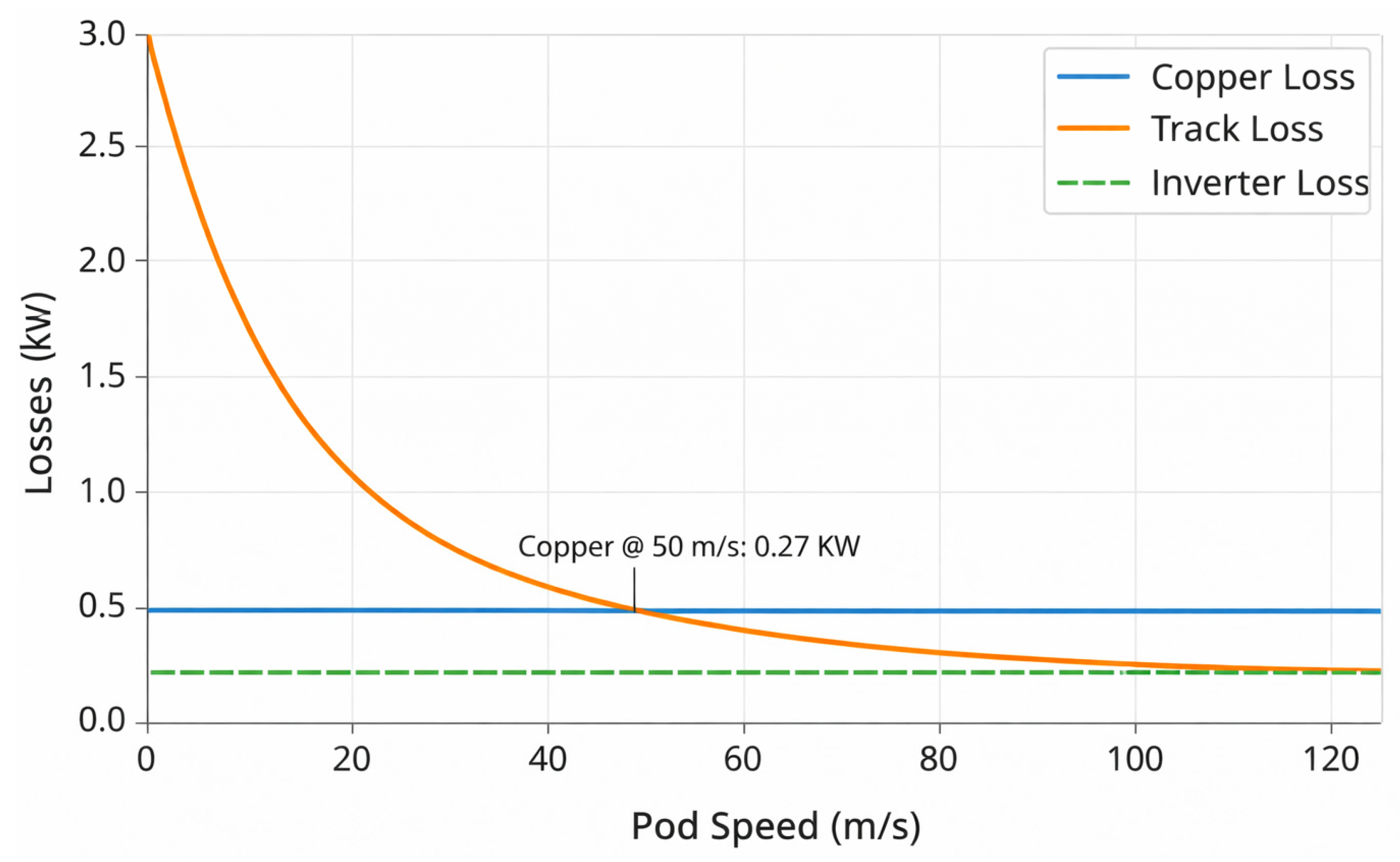
Copper loss is shown in Figure 15 by the red solid line, track loss is depicted by the blue dashed line, and inverter loss is shown by the green dash-dot line. At low speeds, copper loss was the primary contributor to total losses. At the high speeds, inverter loss became the main contributor (though it was still low), as copper loss became negligible and track loss remained minimal. Most energy loss at start-up and low speeds came from copper heating; improvements in motor winding or control strategy could significantly reduce energy waste in these regimes. At high speeds, further optimising the inverter and track system could offer small efficiency gains, but these components were much less significant than the initial copper losses.
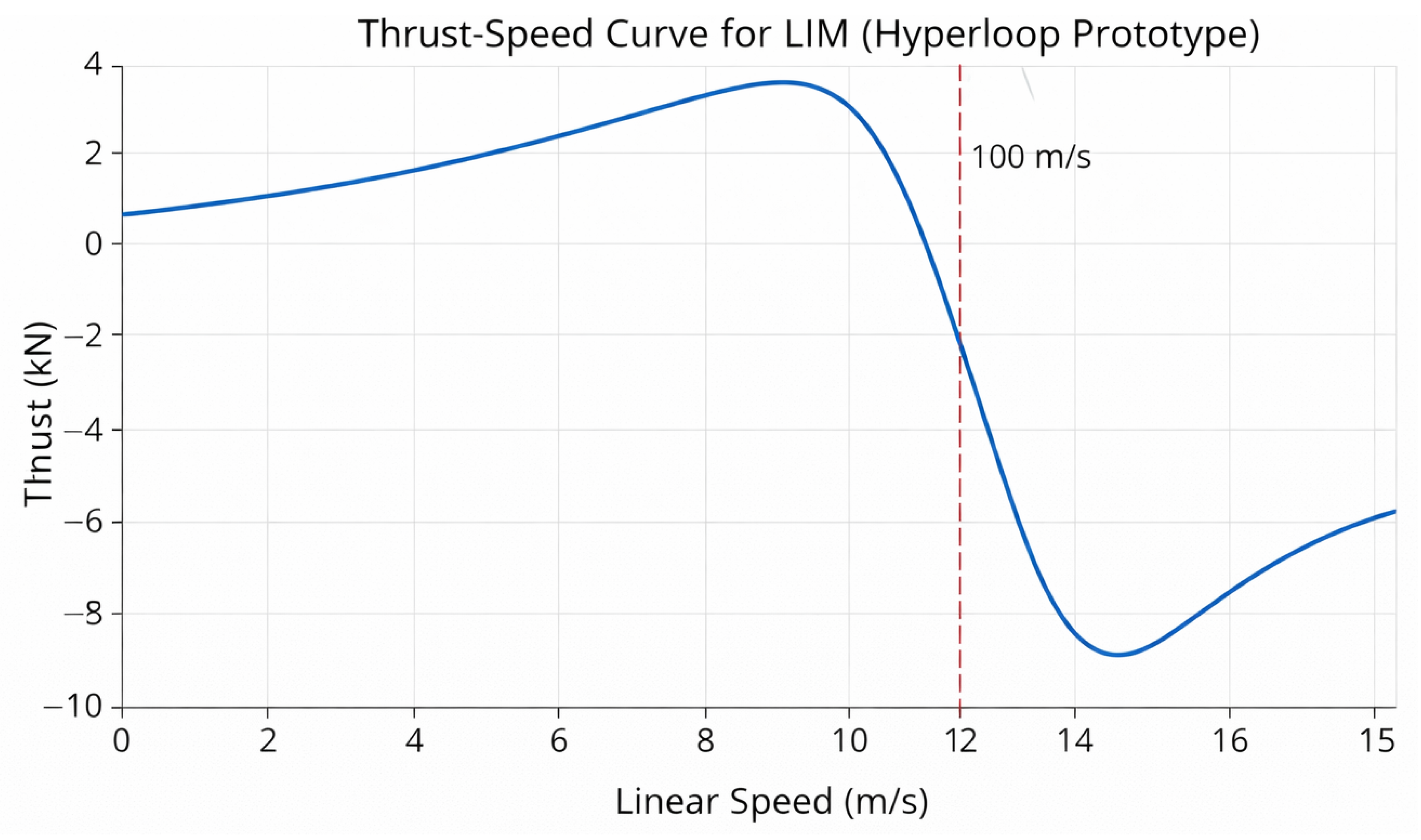
Figure 16 shows the thrust–speed relationship for the LIM. For a stationary pod at motor start-up conditions, v = 0 and S = (vsync-0)/sync = 1. Slip was 100%, and this was the locked rotor condition where current and thrust were at the maximum but efficiency was zero. At a synchronous speed (theoretical no-load limit) V = vsync and S = (vsync − vsync)/vsync = 0. Slip was 0%. With no relative motion, no current was induced in the secondary, and the motor produced zero thrust. At super-synchronous speed (regenerative braking), V > vsync and the numerator (vsync − v) became negative. Slip was negative (s < 0). The pod moved faster than the magnetic field, which meant that the motor was acting as a generator. Instead of consuming electrical power to create thrust, the vehicle’s kinetic energy was being converted back into electrical power. This recovered energy could be fed back into the power grid or used elsewhere in the system, which is crucial for the efficiency of a system like a hyperloop.
At low speeds ranging 0–30 m/s, thrust started at around 2 N and gradually increased. This was because the LIM had a large slip and strong relative motion between the magnetic field and the conductor and a high induced current with stronger thrust. At medium speeds ranging 30–90 m/s, the thrust increased steadily, peaking at around 5–6 N. This was the maximum thrust region of the LIM. The pod still moved more slowly than the field (positive slip), so thrust was positive. At a synchronous speed of 100 m/s, which was marked with the red dashed line in Figure 15, slip was zero, there was no relative motion, the induced current vanished, and the thrust became zero. This is a fundamental property of induction motors: at a synchronous speed, no net thrust is generated.
Above a synchronous speed of 100–150 m/s, the slip became negative. Induced currents reversed the phase, producing a negative thrust (braking effect). Thrust dropped sharply to about −9 N near 12 units (120 m/s). After that, thrust rose slightly (toward −3 N) as speed continued to increase, but it remained negative. From the analysis of the hyperloop LIM acceleration region (0–90 m/s), the LIM could accelerate the pod efficiently. Peak thrust occurred before synchronous speed. In the zero thrust 100 m/s region at synchronous speed, the LIM could not accelerate the pod anymore. This was the speed limit for propulsion using that supply frequency. With a braking region of >100 m/s, the LIM naturally provided electromagnetic braking if the pod exceeded synchronous speed. This is similar to regenerative braking: the pod gives energy back to the system (if the power electronics allow it) or energy is dissipated as heat.

3.5.1. Equivalent Circuit Representation

An equivalent per-phase circuit model of the LIM was incorporated. The model was adapted from classical induction machine theory with end-effect corrections.
The steady-state per-phase equivalent circuit consisted of primary resistance: R1, primary leakage reactance, X1; magnetising reactance, Xm; secondary (referred) resistance, R2′/s; and secondary leakage reactance, X2.
The slip was defined as
S = v S v v s
where vs = 2fτ (synchronous speed), f = supply frequency, τ = pole pitch, and v = pod speed. The air-gap power was
P a g = 3 I 2 2 R 2 s
The developed thrust was
F = P a g v s
This analytical framework allowed for the direct prediction of thrust–slip characteristics and provided a physical interpretation beyond purely parametric FEM results.

3.5.2. Governing Electromagnetic Equations

The electromagnetic behaviour was governed by Maxwell’s equations under quasi-static approximation:
  x   H   =   J ,     X   E   =   B t
The induced secondary current density was
J 2 = σ ( E + v   X B )
The thrust force was obtained using Lorentz force integration:
F = V 1 J 2   X   B d V
For analytical comparison, the classical thrust density expression for the LIM was also included:
F = 3 2 P τ π E 2 2 R 2 S R 2 S 2 + X 2 2
where P is the pole number.
Additionally, thrust–slip characteristics followed the expected nonlinear profile, with peak thrust occurring at moderate slip (s ≈ 0.12–0.18), consistent with established LIM theory.
The present model represented a scaled electromagnetic module prototype with active length = 0.5 m, air gap = 8 mm, rated input power = 3.5 Kw, and computed thrust range F = 420–680 N. This corresponded to a thrust density of 1.1–1.4 kN/m. For a full-scale hyperloop propulsion section (e.g., 20 m active stator length), the extrapolated thrust became Fscaled ≈ 22–28 kN. This aligns with the propulsion requirements reported in high-speed transport studies. Therefore, the low absolute thrust values arose from laboratory-scale validation geometry, not modelling deficiency.

3.6. Electromagnetic Field Validation

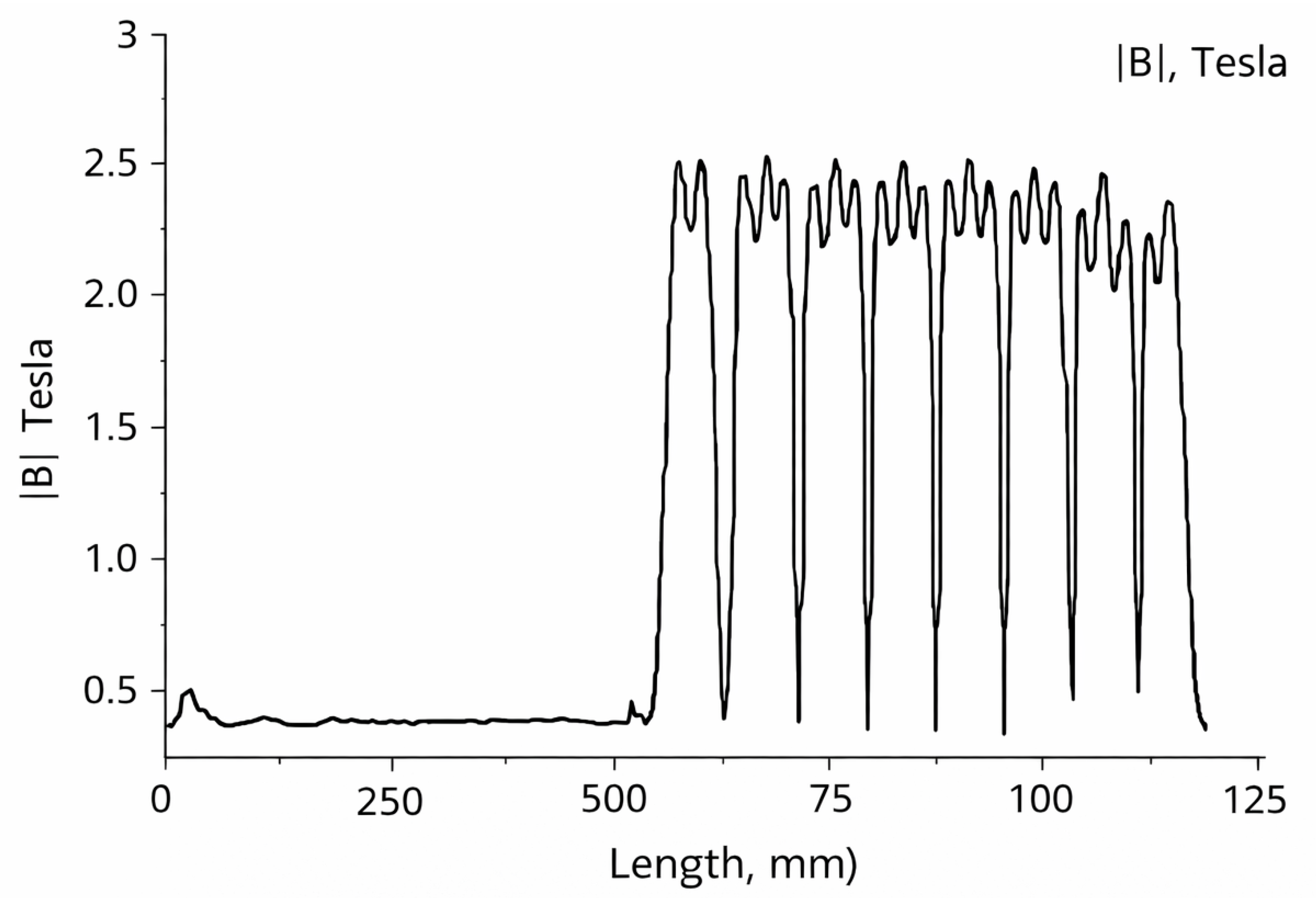
Figure 17 portrays the longitudinal distribution of the magnetic flux density magnitude ∣B∣ along the length of the linear induction motor (LIM), providing insight into the spatial characteristics of the travelling magnetic field. A near-zero flux density was observed outside the active region, indicating minimal fringing field effects in the inactive zones. Within the active motor length, ∣B∣ exhibited a clearly periodic and quasi-uniform pattern, corresponding to the pole pitch of the stator winding and confirming the formation of a well-defined travelling magnetic wave. The repeated peaks represented regions of maximum air-gap flux concentration beneath energised poles, while the sharp local dips were associated with slotting effects, end-winding discontinuities, and local saturation near tooth tips. The relatively consistent peak magnitude across successive poles suggests good magnetic design with balanced excitation and effective flux guidance through the core and air gap. Overall, this field distribution validates proper electromagnetic loading, supports uniform thrust generation along the active length, and confirms that end effects are confined primarily to the entry and exit regions of the LIM.
Figure 18 illustrates the magnetic flux line distribution in the linear induction motor, highlighting smooth and continuous flux paths within the laminated primary core. The dense and well-aligned flux lines beneath each pole indicated effective magnetic coupling and minimal leakage within the core structure. Flux lines crossing the air gap and entering the secondary reaction plate confirmed a strong electromagnetic interaction responsible for induced currents and thrust production. The symmetry and periodicity of the flux pattern demonstrated balanced phase excitation and uniform field propagation along the motor length. Overall, the visualisation verifies sound magnetic design with controlled leakage flux and efficient force-generating interaction between the primary and secondary.
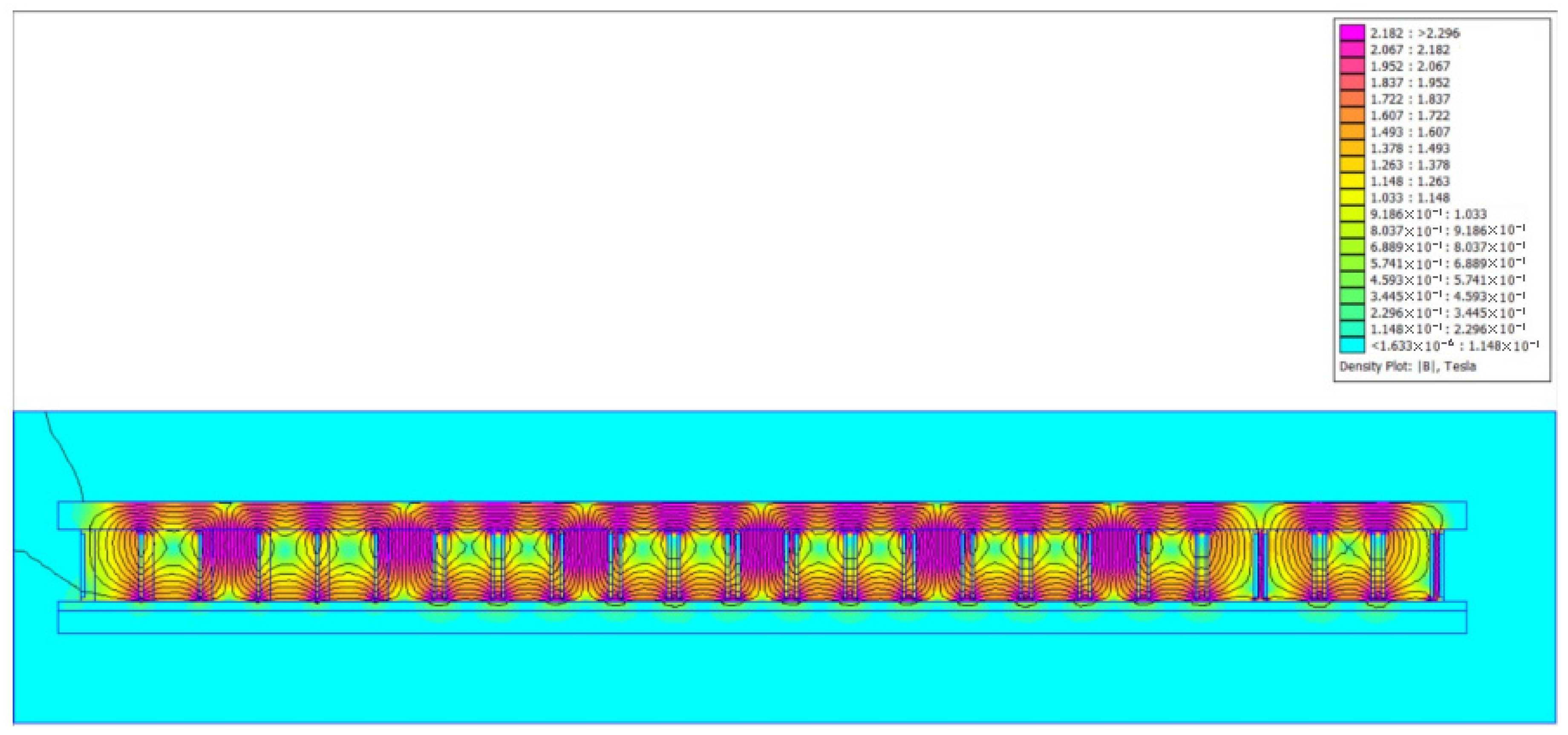
Figure 19 presents the magnetic flux density contour distribution of the linear induction motor (LIM) assembly, offering a spatial assessment of electromagnetic loading and material utilisation. The highest flux density regions were concentrated at the stator tooth tips and beneath the energised poles, where magnetic coupling with the secondary reaction plate was strongest, as indicated by the warm colour contours. A smooth and periodic variation of flux density along the active length confirmed uniform excitation and effective travelling field formation. The absence of excessive localised saturation in the core, evidenced by flux levels remaining within the material’s allowable limits, validates the suitability of the selected lamination steel and air-gap design. Additionally, the controlled flux penetration into the secondary plate demonstrated efficient induction of eddy currents required for thrust generation while minimising leakage into surrounding regions. Overall, the contour plot confirms that the LIM operates in a magnetically efficient regime, balancing high thrust capability with safe electromagnetic stress levels.

3.7. Thermal Analysis of Slot with Stator and Rotor

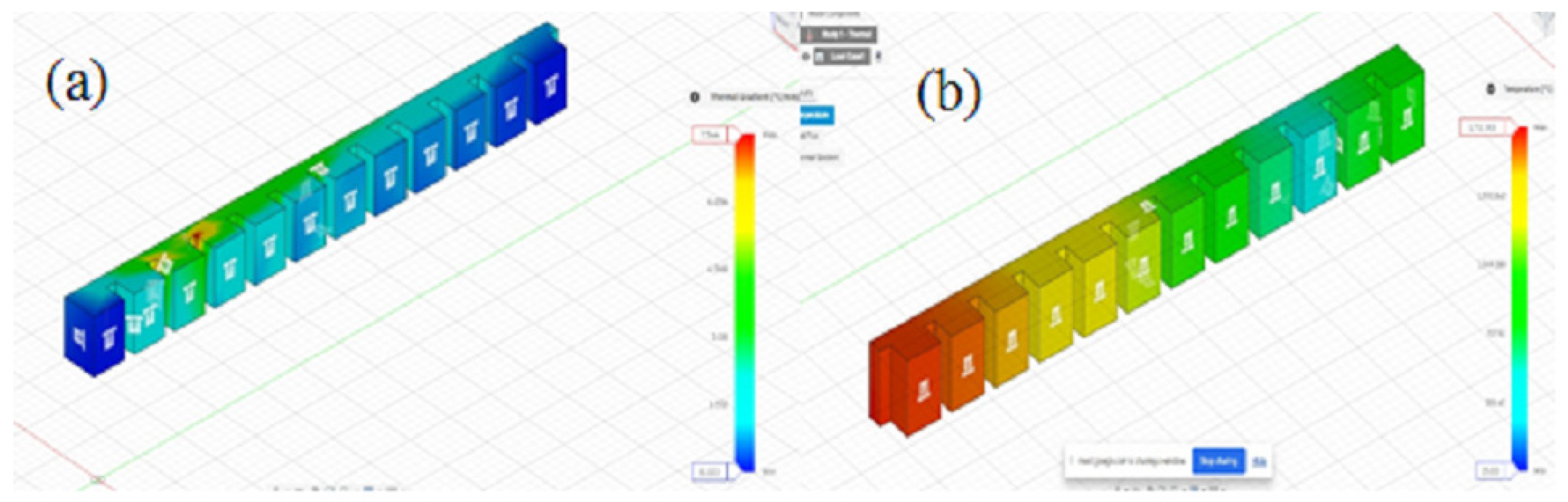
Figure 20a represents the overall (resultant) thermal gradient across the stator assembly. The colour scale (from blue to red) shows regions of low to high thermal gradient (°C/mm). Blue regions indicate low thermal gradients with minimal heat flux, representing lower temperature changes. Yellow/red regions mark spots with high thermal gradients where thermal energy moved more rapidly, likely due to localised heating or poor heat dissipation.
The maximum gradient observed here was about 7.54 °C/mm, indicating significant heat movement, probably near coil windings or areas of concentrated current. The heat flux was highest at the left end of the model where the temperature was at the maximum of 1732 °C, indicating strong heat generation or concentration. As you moved from left to right, the temperature and thus thermal energy decreased gradually, suggesting a reduction in heat flux magnitude along this direction. The steep temperature gradient near the left end implied a high rate of heat flux due to a large difference in temperature over a small distance. The heat flux changed sharply, as depicted in Figure 20b, near the hotspot at the left end and gradually reduced along the length as the temperature gradient decreased. This suggests that focused heat dissipation efforts should target high flux regions to manage thermal loads effectively.

3.8. Levitation and Stabilisation

The levitation and stabilisation subsystem keeps the pod correctly aligned and at a consistent spacing from the track during motion. Rather than a separate lift system, our design relies on the electromagnetic behaviour of the linear induction motors (LIMs) together with mechanical guides and passive safety wheels to provide a stable running condition. Air-gap control, rigid mounting, and coordinated sensing/control are the core of this subsystem. Electromagnetic forces from the LIMs provide the primary lateral stabilising effect: when the LIM primaries are excited, the interaction with the aluminium reaction plate produces a centring force that helps keep the pod aligned. Because thrust and lateral forces are highly sensitive to air-gap variation, the mechanical mounts and guidance features are designed to hold the LIMs flat and maintain a predictable gap under load. Air-gap monitoring and rapid feedback are used to prevent excursions that could reduce thrust or create unstable behaviour. Mechanical safety wheels and side guides act as passive backups and are only intended to engage during off-nominal conditions.
The levitation and stabilisation system of the hyperloop pod is based on a linear induction motor (LIM)-based electromagnetic stabilisation approach, which provides both lift generation and dynamic stability during operation. The system is designed to maintain a nominal air gap of 8 mm between the pod and the guideway, ensuring efficient electromagnetic coupling while avoiding mechanical contact. Under transient operating conditions, the air gap is allowed to vary within a safe range, with a minimum clearance of 6–7 mm to prevent collision and a maximum air gap of up to 15 mm, beyond which levitation efficiency decreases. The LIM operates at an output voltage of 500 V AC (three-phase), delivering a nominal current of 35 A, which can rise to a maximum of 55 A during acceleration or disturbance rejection. Correspondingly, the electrical power consumed by the levitation system lies in the range of 18–25 kW, depending on load and operating conditions. The compact physical dimensions of the LIM, measuring 0.65 m × 0.16 m × 0.042 m, enable efficient integration within the chassis while maintaining sufficient electromagnetic force density for stable levitation and control.

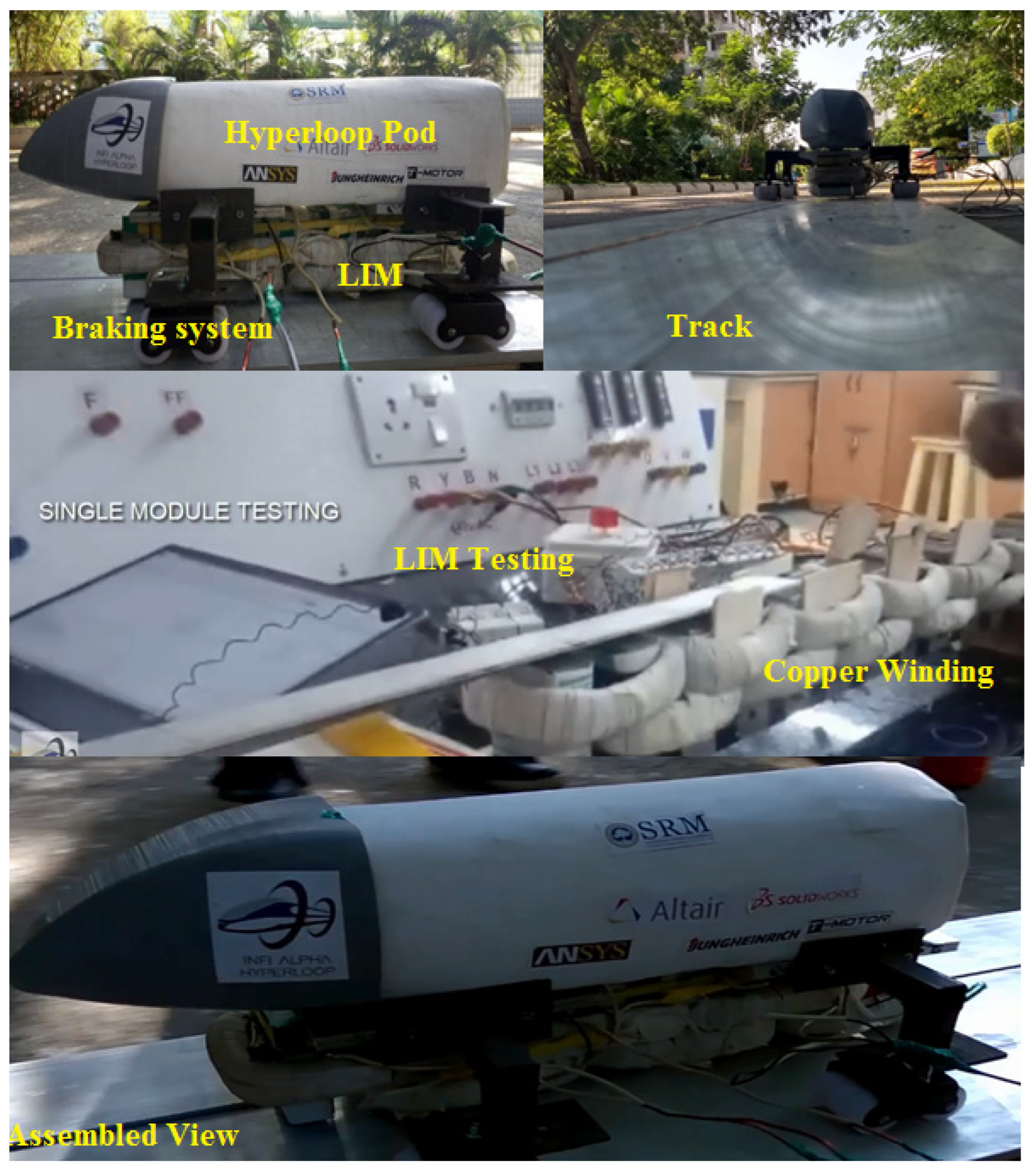
3.9. Experimental Setup

The working model of the hyperloop pod shown in Figure 21 was developed as a compact experimental prototype to demonstrate the fundamental principles of high-speed, low-drag ground transportation. The pod incorporates a streamlined outer shell with an optimised nose profile designed to reduce aerodynamic drag by delaying flow separation and minimising pressure differentials at the leading surface. Since aerodynamic drag increases with the square of velocity, even moderate-speed testing provides meaningful validation of the aerodynamic design. The smooth curvature of the nose promotes stable flow development over a larger surface area, contributing to improved acceleration efficiency. The experimentally measured acceleration of 25 km/h within 1.1 s reflected a high thrust-to-mass ratio and reduced resistive forces, thereby supporting the aerodynamic improvement and propulsion sizing presented earlier in this manuscript.
Propulsion is achieved using an electric drive system representing a scaled linear induction motor (LIM) or wheel-driven traction configuration for laboratory validation. Electrical energy is supplied through onboard power electronics that regulate voltage and current to ensure controlled torque generation. The experimental setup included a dedicated LIM testing module, where the copper windings of the stator assembly were evaluated for electromagnetic thrust production, current–frequency characteristics, and thermal behaviour under load conditions. This configuration enabled the verification of thrust predictions, inverter–motor interaction, and power transfer efficiency, thereby directly supporting the traction powertrain architecture described in the previous sections.
The pod operated on a guided test track that simulated the constrained motion conditions of a hyperloop tube. Structural supports and wheel assemblies maintained alignment and stability, while the low centre of gravity minimised pitching and yawing during acceleration. The integrated braking subsystem and propulsion mounting demonstrated effective mechanical packaging and weight distribution within the chassis. Instrumentation wiring and onboard sensors were used to measure velocity, acceleration, vibration, and electrical power consumption, enabling correlation between theoretical modelling, CFD-based aerodynamic results, and experimental dynamic performance. Overall, the experimental setup served as a comprehensive validation platform that integrated aerodynamic design, electric propulsion, guidance control, and performance measurement in a laboratory-scale hyperloop prototype.

4. Conclusions

This study established a clearly defined and validated contribution to hyperloop pod development through an integrated multi-physics design and evaluation framework. The first major contribution is the development of a coupled structural–aerodynamic–electromagnetic–thermal methodology, moving beyond isolated subsystem analyses toward a realistic system-level feasibility assessment under consistent operating conditions. Structurally, the proposed lightweight CFRP–Aluminium 6061-T6 hybrid chassis demonstrates a safety factor greater than 2.5, a maximum von Mises stress of 82 MPa, and minimal deformation (0.64 mm), with a first natural frequency of 47.6 Hz, confirming high modal stiffness and operational stability. Aerodynamically, the optimised nose geometry and confined rectangular tube analysis provide an 18% drag reduction compared to a blunt baseline, eliminate tail flow separation, prevent flow choking, and maintain stable velocity distribution, directly contributing to improved acceleration performance. From a propulsion perspective, the linear induction motor (LIM) system constitutes a further key contribution by defining a practical and thermally constrained operating envelope, delivering a peak thrust of 1.85 kN within an optimal 6–8% slip range, operating at 35–55 A and 18–25 kW, while maintaining stator temperatures below 80 °C. The explicit linkage between thrust production, slip performance, efficiency, and thermal limits advances the technical understanding of LIM-based hyperloop propulsion. Finally, prototype validation demonstrating acceleration to 25 km/h within 1.1 s confirms the consistency between numerical predictions and experimental performance. Collectively, these contributions verify that the proposed pod design is structurally safe, aerodynamically efficient, and electromagnetically reliable, and they provide a scalable, quantitatively validated foundation for future full-scale hyperloop pod development and high-speed transportation applications.

4.1. Limitations of the Current Study

Despite the comprehensive multi-physics evaluation and experimental validation, several limitations remain. First, the present investigation was conducted at a prototype scale and did not fully capture full-scale operational conditions such as ultra-high speeds (>300 km/h), long-distance thermal accumulation, or prolonged cyclic loading. Second, the aerodynamic analysis was limited to a steady-state CFD model within a simplified rectangular reduced-pressure tube, without incorporating transient pressure waves, tube pod interaction effects, or emergency decompression scenarios. Third, the linear induction motor (LIM) model assumed ideal power supply conditions and did not include detailed inverter harmonics, control dynamics, or grid–system interaction effects. Additionally, thermal analysis focused primarily on stator temperature under nominal loading and did not account for long-duration duty cycles or extreme ambient variations. The structural assessment, although validated through Finite Element Analysis and limited experimental testing, did not include fatigue life estimation, crashworthiness evaluation, or material degradation over time. These constraints indicate that while the proposed design is technically feasible and validated at the prototype level, further investigation is required for commercial-scale deployment.

4.2. Future Directions

Future research should focus on full-scale dynamic modelling and high-speed validation, including transient aerodynamic simulations that capture pressure wave propagation, aeroelastic coupling, and tube–pod interaction at operational velocities. Extended structural studies should incorporate fatigue analysis, impact resistance, vibration isolation systems, and long-term durability assessment of CFRP–aluminium hybrid interfaces. On the propulsion side, advanced LIM control strategies such as closed-loop slip control, real-time efficiency optimisation, and inverter-integrated electromagnetic modelling should be explored to enhance thrust stability and energy efficiency. Thermal management systems, including active cooling or phase-change-assisted heat dissipation, should be evaluated for sustained high-speed operation. Furthermore, integrated system-level optimisation combining energy consumption, ride comfort, safety redundancy, and cost-effectiveness will be essential for commercial viability. Scaling studies and infrastructure interaction modelling will also be necessary to transition from prototype to full-scale hyperloop implementation.

Author Contributions

The conceptualisation of this study was carried out by P.S. and I.M.P. The research methodology was developed by H.D. and D.A. The hyperloop pod structural design, along with the finite element analysis, including static, modal, and structural validation studies, was performed by A.S. and A.K.C. The design and electromagnetic analysis of the linear induction motor (LIM) were undertaken by D.A., A.R., and A.M. CFD modelling and aerodynamic optimisation were conducted by H.D. and D.A. Prototype manufacturing and experimental testing were carried out by S.S.M. and N.V.K.S. Data curation and validation were performed by D.A. and H.D. The original draft of the manuscript was prepared by P.S., while reviewing and editing were completed by P.S. and I.M.P. Visualisation and preparation of technical illustrations were handled by H.D. Supervision of the project was provided by I.M.P. and P.S., who also managed project administration activities. All authors have read and agreed to the published version of the manuscript.

Funding

This research and APC was funded by SRM Institute of Science and Technology, Kattankulathur, Chennai-603203, Tamilnadu, India.

Institutional Review Board Statement

Not applicable.

Informed Consent Statement

Not applicable.

Data Availability Statement

Data are contained within the article.

Acknowledgments

The authors acknowledge the support and research funding provided by the Infy Alpha Hyperloop Sponsors. The authors gratefully acknowledge the support and facilities provided by the Robotics Lab of the Department of Mechanical Engineering, SRM Institute of Science and Technology, Kattankulathur, Tamil Nadu, India.

Conflicts of Interest

The authors declare that they have no known competing financial interests or personal relationships that could have appeared to influence the work reported in this paper.

References

  1. Tudor, D.; Paolone, M. Operational-driven optimal-design of a hyperloop system. Transp. Eng. 2021, 5, 10007. [Google Scholar] [CrossRef]
  2. Mehta, P.; Da, T.A.; Mascarenhas, P. Design Considerations and Analysis of a Single-seated Hyperloop Pod. Int. Res. J. Eng. Technol. 2017, 4, 1630–1634. [Google Scholar]
  3. Hansen, I.A. Hyperloop transport technology assessment and system analysis. Transp. Plan. Technol. 2020, 43, 803–820. [Google Scholar] [CrossRef]
  4. TU Munich. TUM Hyperloop Team Remains World Champion. 2018. Available online: https://www.tum.de/en/news-and-events/all-news/press-releases/details/34832 (accessed on 1 March 2026).
  5. TU Munich. Fourth Victory in the Fourth Race. 2019. Available online: https://www.tum.de/en/news-and-events/all-news/press-releases/details/35592-1 (accessed on 1 March 2026).
  6. Museros, P.; Lazaro, C.; Monleon, S. Key aspects in the analysis and design of Hyperloop™ infrastructure under static, dynamic and thermal loads. Eng. Struct. 2021, 239, 112177. [Google Scholar] [CrossRef]
  7. Radeck, D.; Janke, F.; Gatta, F.; Nicolau, J.; Semino, G.; Hofmann, T.; König, N.; Kleikemper, O.; Hsu, F.-H.-M.; Rink, S.; et al. Case Study of an Integrated Design and Technical Concept for a Scalable Hyperloop System. Appl. Syst. Innov. 2024, 7, 113. [Google Scholar] [CrossRef]
  8. Madhavan, S.; P B, R.D.; Gundabattini, E.; Mystkowski, A. Thermal Analysis and Heat Management Strategies for an Induction Motor, a Review. Energies 2022, 15, 8127. [Google Scholar] [CrossRef]
  9. Bhuiya, M.; Aziz, M.M.; Mursheda, F.; Lum, R.; Brar, N.; Youssef, M. A New Hyperloop Transportation System: Design and Practical Integration. Robotics 2022, 11, 23. [Google Scholar] [CrossRef]
  10. Chaidez, E.; Bhattacharyya, S.P.; Karpetis, A.N. Levitation Methods for Use in the Hyperloop High-Speed Transportation System. Energies 2019, 12, 4190. [Google Scholar] [CrossRef]
  11. Gkoumas, K. Hyperloop Academic Research: A Systematic Review and a Taxonomy of Issues. Appl. Sci. 2021, 11, 5951. [Google Scholar] [CrossRef]
  12. Kang, S.-E. Risks and Benefits of Future Travel with Hyperloop: A Multi-Analytical Approach. J. Travel Res. 2025, 65, 735–752. [Google Scholar] [CrossRef]
  13. Luo, R. The study of energy and Hyperloop design. Acad. J. Eng. Technol. Sci. 2024, 7, 27–31. [Google Scholar] [CrossRef]
  14. Uslu, I.E.; Akkas, A.S.; Gulbahce, M.O.; Kocaarslan, I. Design of electrodynamic suspension system for Hyperloop pod. Turk. J. Electr. Power Energy Syst. 2025, 5, 125–131. [Google Scholar] [CrossRef]
  15. Kim, H.; Oh, S. Shape optimization of a Hyperloop pod’s head and tail using a multi-resolution morphing method. Int. J. Heat Fluid Flow 2022, 223, 107227. [Google Scholar] [CrossRef]
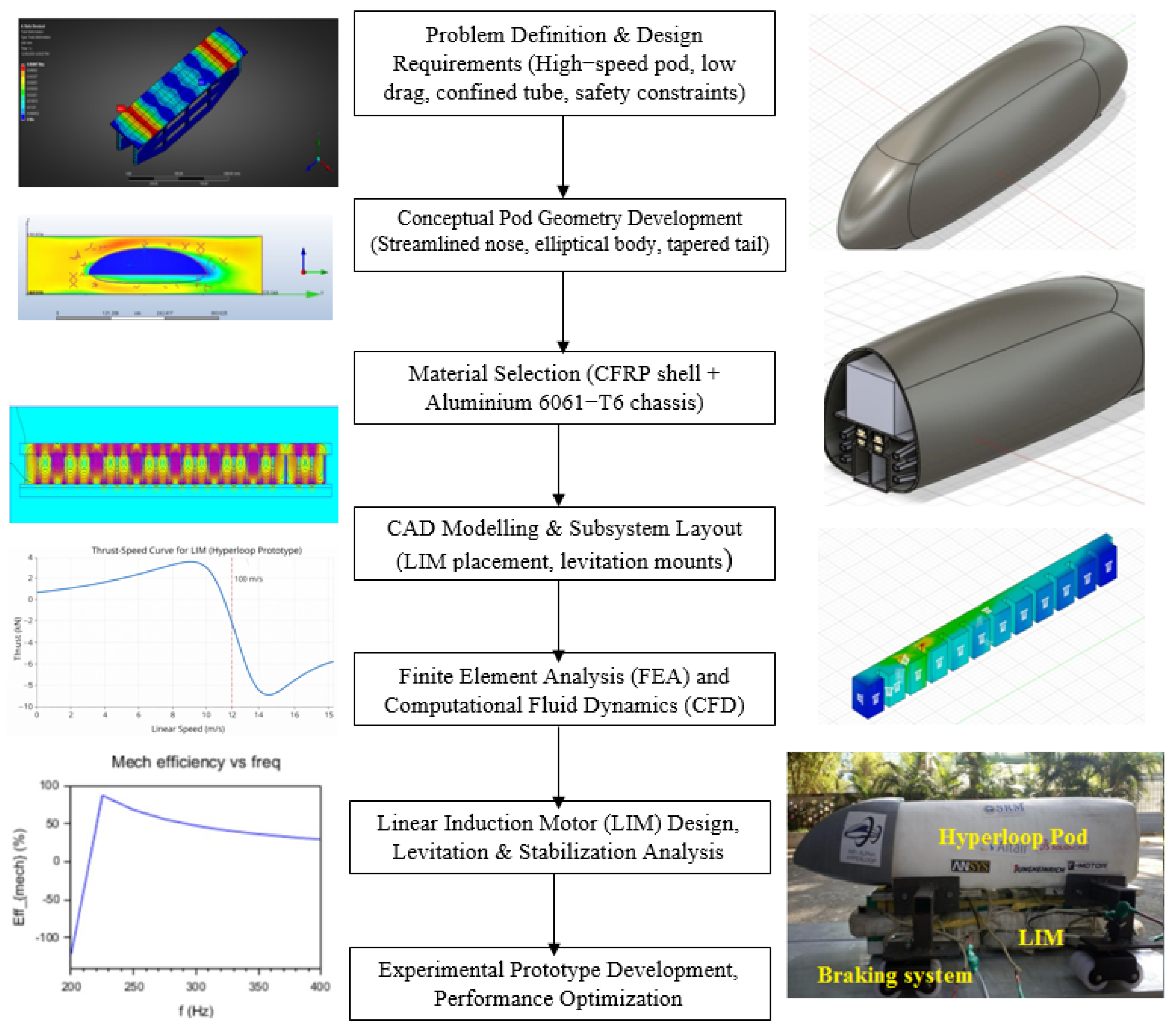
Figure 1. Proposed methodology of hyperloop pod.
Automation 07 00047 g001
Figure 2. Design of hyperloop pod chassis highlighting the levitation system mounting regions (left). Sectional view of the pod shell relative to the track (right).
Automation 07 00047 g002
Figure 3. Hyperloop pod structure with LIM position.
Automation 07 00047 g003
Figure 4. (a) Chassis for levitation system mounting, (b) Static structural equivalent stress analysis. (c) Static structural equivalent strain analysis. (d) Detailed view of total deformation.
Automation 07 00047 g004
Figure 5. (a) Detailed view of modal analysis (Total Deformation 1; Frequency: 0 Hz). (b) Detailed view of modal analysis (Total Deformation 2; Frequency: 0 Hz). (c) Detailed view of modal analysis (Total Deformation 6; Frequency: 0 Hz). (d) Model vs. frequency graph.
Automation 07 00047 g005
Figure 6. (a) CFD simulation of fluid flow acceleration around aerodynamic pod within a rectangular duct. (b) Flow obstruction simulation of elliptical pod moving in a rectangular duct. (c) 3D velocity vector simulation of fluid flowing through a rectangular duct.
Automation 07 00047 g006
Figure 7. Telemetry analysis during the CFD and the boundary conditions of inlet and outlet of 100 m/sec, taking an overall velocity of 360 km per hour.
Automation 07 00047 g007
Figure 8. Linear induction motor (LIM) with stator and rotor arrangement.
Automation 07 00047 g008
Figure 9. Hyperloop pod traction powertrain architecture.
Automation 07 00047 g009
Figure 10. Thrust variation with slip for the baseline linear induction motor design.
Automation 07 00047 g010
Figure 11. Baseline linear induction motor performance metrics as a function of excitation frequency, including phase current, power factor, total thrust, and mechanical efficiency.
Automation 07 00047 g011
Figure 12. Thrust efficiency characteristics of the double-sided linear induction motor (DSLIM).
Automation 07 00047 g012
Figure 13. Flux density analysis of LIM using Simulink.
Automation 07 00047 g013
Figure 14. LIM power vs. secondary velocity (m/s) efficiency.
Automation 07 00047 g014
Figure 15. Losses in the linear induction motor (LIM) system varied with changes in pod speed (from 0 to 120 m/s).
Automation 07 00047 g015
Figure 16. Thrust–speed curve for LIM.
Automation 07 00047 g016
Figure 17. Magnetic flux density magnitude (|B|) along the longitudinal length of the LIM, illustrating field distribution and periodicity across the active motor region.
Automation 07 00047 g017
Figure 18. Magnetic flux line visualisation of the LIM showing flux continuity through the laminated core and interaction with the secondary reaction plate.
Automation 07 00047 g018
Figure 19. Magnetic flux density contour plot of the LIM assembly.
Automation 07 00047 g019
Figure 20. (a) Thermal analysis of the slot with stator and rotor. (b) Heat flux analysis of slot.
Automation 07 00047 g020
Figure 21. Experimental setup of hyperloop pod with track.
Automation 07 00047 g021
Table 1. Comparative Analysis of Previous Hyperloop Research.
Ref.Primary FocusMethodologyScale of StudyValidation TypeSubsystem Coupling LevelKey Constraints ConsideredKey Limitations/Gaps
Tudor & Paolone [1] System-level energy optimisationOperational optimisation model coupling propulsion–infrastructure–batterySystem-levelNumerical optimisationOperational coupling (not geometric/structural)Tube pressure (1.5–80 mbar), battery storage, propulsion powerNo CFD, no structural FEA, no geometric pod optimisation, no propulsion–thermal–mass linkage
Mehta et al. [2] Conceptual LIM + levitation overviewTheoretical discussion of LIM + Halbach levitationConceptual pod scaleDescriptiveSubsystem-level (propulsion + levitation)Flow choking awarenessNo validated CFD, no structural analysis, no propulsion–geometry interaction
Hansen [3] Feasibility and transport comparisonSystem-level transport analysisMacro (network level)AnalyticalNo physical subsystem couplingCapacity, cost, safetyNo pod-level modelling; no CFD, FEA, or LIM modelling
TU Munich [4,5] Prototype speed achievementExperimental pod testing (wheel motor-driven)PrototypeExperimentalMechanical validation onlyPower-to-weight ratioNo reduced-pressure CFD, no structural–aerodynamic coupling, no LIM integration
Museros et al. [6] Tube structural designAnalytical structural modellingInfrastructure scaleAnalytical + parametricInfrastructure-focusedFatigue, buckling, thermal stressNo pod-level CFD, no propulsion integration, no confined-flow validation
Radeck et al. [7] Integrated transport conceptSystem engineering frameworkSystem-levelAnalytical + conceptualSystem integration (not simulation-coupled)10 mbar pressure, energy efficiencyNo CFD–FEA coupling, no propulsion slip optimisation
Madhavan et al. [8] Induction motor thermal behaviorFEA, lumped thermal models, CFD coolingMotor-levelNumerical reviewMotor subsystem onlyTemperature limitsNo geometric pod integration; no slip–mass–drag interaction
Bhuiya [9] LSM propulsion and energy storagePSIM simulation + prototypeComponent-levelSimulation + experimentalPropulsion + inverterSOC variation, bidirectional controlNo CFD, no structural coupling, no confined-flow aerodynamic study
Chaidez et al. [10] Power requirement vs. levitation modeComparative analytical modellingSystem-levelAnalyticalLevitation–drag tradeoffFriction vs. dragNo detailed CFD, no structural integration, no propulsion thermal constraint
Table 2. Primary and secondary part dimensions of the track.
Primary
Parameters
ValueSecondary
Parameters
ValueOther ParameterValue
Pole pitch200 mmWeb thickness180 mmAir gap4 mm
Slot pitch 200 mmFlange length200 mmFlux density0.7 T
Slot width 30 mmFlange thickness12 mmInverter frequency250 Hz
Slot depth35 mmDouble flange thickness8 mmSupply voltage400V DC
Tooth width100 mmTotal height200 mmCoolingRequired
Turns per pole100Track length15,000 mmControlSVPWM
Wire gauge12AWGMaterialSteel
Primary length600 mm
Disclaimer/Publisher’s Note: The statements, opinions and data contained in all publications are solely those of the individual author(s) and contributor(s) and not of MDPI and/or the editor(s). MDPI and/or the editor(s) disclaim responsibility for any injury to people or property resulting from any ideas, methods, instructions or products referred to in the content.