Article

Helical Molecular Cages with sp-Conjugated Linkages

Institute of Advanced Energy, Kyoto University, Gokasyo, Uji 611-0011, Kyoto, Japan
*
Author to whom correspondence should be addressed.
Organics 2026, 7(1), 2; https://doi.org/10.3390/org7010002
Submission received: 17 November 2025 / Revised: 17 December 2025 / Accepted: 24 December 2025 / Published: 25 December 2025

Abstract

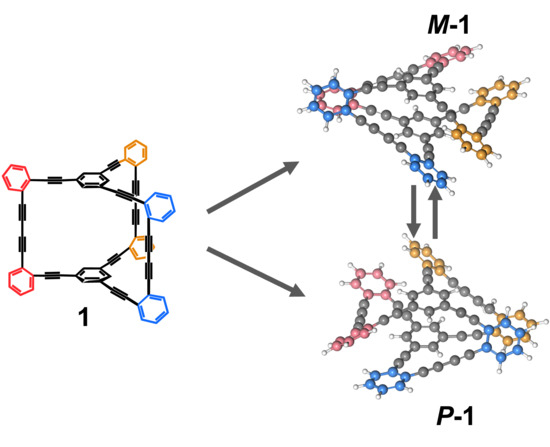
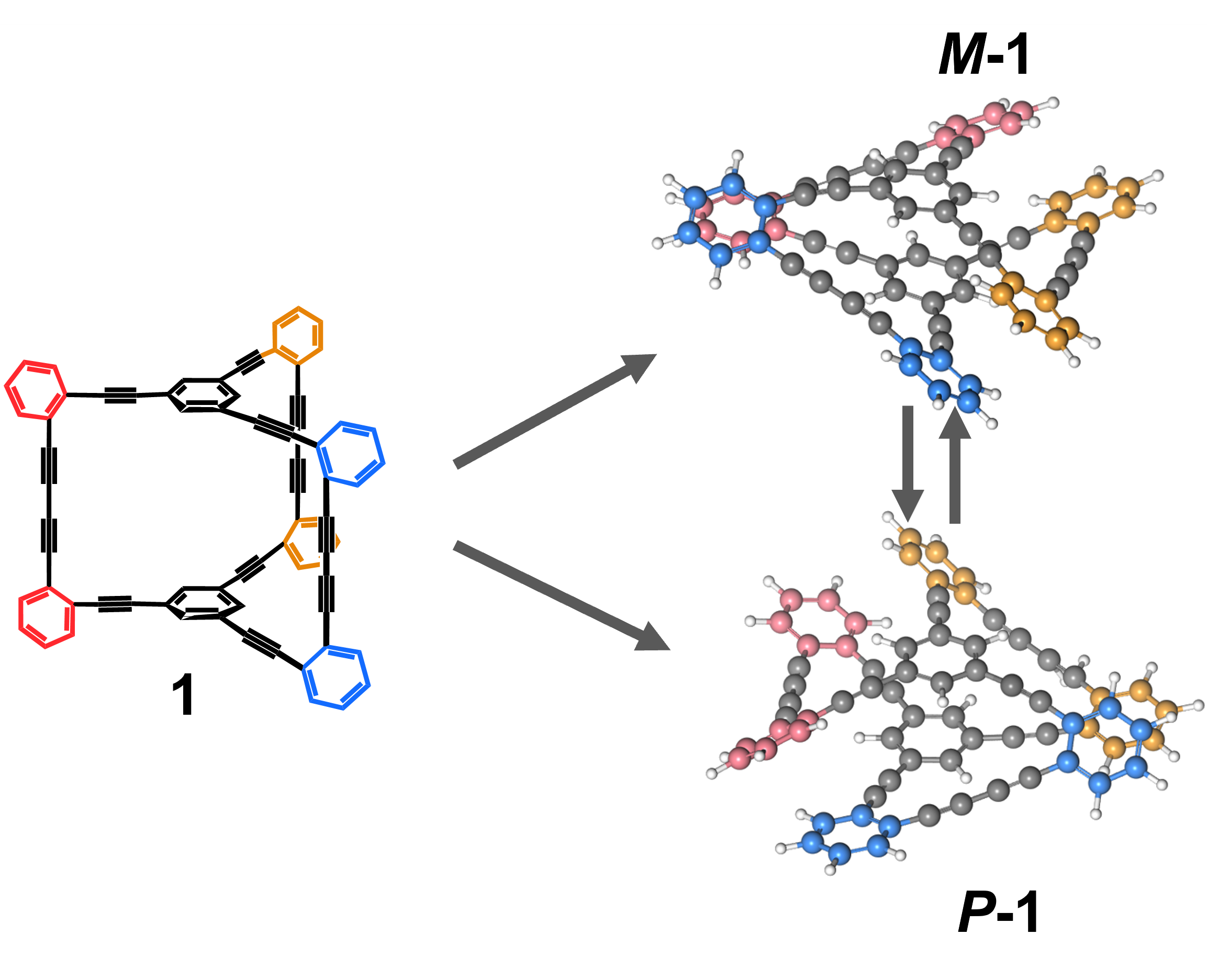
A conjugated helical cage, comprising two 1,3,5-tris(phenylethynyl)benzene units connected by diyne linkers, was successfully synthesized. X-ray crystallography revealed helical molecular structures with large twisted angles and a 1:1 mixture of P- and M-enantiomers. Variable-temperature-NMR measurement indicated the racemization process between the enantiomers occurs rapidly on the NMR timescale. The rapid interconversion is attributed to the flexible diyne linkages, even though they were believed to be rigid.

Graphical Abstract

1. Introduction

Organic cages, which consist of two core rings connected by three linkers, have garnered significant interest due to their unique conformations and dynamic behaviors [1,2,3,4,5]. Some organic cages consisting of flexible substituents such as alkyl or nitrogen-containing linkers can exhibit both right- and left-handed chirality depending on their conformation [6,7,8,9]. In particular, helical organic cages have the potential to exhibit conformational chiral structures. Helical organic cages have recently emerged as templates for the introduction of metal ions, which can be subsequently reduced to their metallic forms, resulting in chiral species. Owing to the versatility, high surface area, large porosity, and excellent solubility of the cages in common solvents, these metal-filled helical cages offer significant potential for applications in enantioselective catalysis, recognition, and separation [10,11,12,13]. Rigid linkers are known to promote helicity by imposing overall geometric constraints along molecular backbones, where strain is relieved through cooperative torsional distortion, as demonstrated in ethynylene-bonded and halogen-bonded helices [14,15]. Inspired by this mechanism, we designed a conjugated cage 5 that potentially features a large helical structure, which consists of two 1,3,5-tris(phenylethynyl)benzene units and diyne (sp) linkers.
The traditional synthetic methods of cages previously reported include the Williamson reaction in crown ether syntheses and the SN2 reaction in both pyridinium-containing cages and other nitrogen-containing cages [16,17,18,19]. These reactions mainly rely on the formation of irreversible bonds. During the ring closure steps of these reactions, the formation of macrocyclic products often leads to a diverse range of oligomeric and polymeric byproducts. Conversely, Li and colleagues presented an innovative dynamic method employing the Friedel-Crafts reaction with reversible bonds, such as coordinative and dynamic covalent bonds, to overcome this issue [20]. The reversible nature of these bonds enables dynamic error correction, allowing the system to equilibrate toward the thermodynamically most stable cage structure and thereby often affording higher yields [21]. However, the reversible nature of dynamic bonds poses a significant risk to the stability of products, as they may be susceptible to degradation through bond cleavage. In this respect, we envisioned that the method reported by Li and colleagues [20] could extend a strategy based on the high reactivity of the Glaser coupling reaction [22] for synthesizing complex topologies, such as three-dimensional cages. We successfully synthesized cage-shaped molecules using an efficient method of irreversible C-C bond formation.
Regarding the conformational mobility of alkynes, Toyota and et al. reported that a diyne unit can be significantly deformed from a linear shape, demonstrating greater flexibility than one might expect in extremely crowded transition states during conformational isomerization, even if this unit possesses considerable steric hindrance [23]. However, based on the calculated geometries of the optimized structures, it seems that the racemization process through ring inversion is quite difficult. In this context, it is intriguing to observe the flexibility in the conformational interconversion of enantiomers. In this work, the conformational properties of cages were thoroughly investigated using computational methods, X-ray crystallographic analysis, and variable-temperature NMR (VT-NMR) spectroscopy.

2. Materials and Methods

2.1. General

1H NMR and 13C NMR spectra were measured on JEOL JNM-ECS400 (400 MHz for 1H, 100 MHz for 13C) instruments (JEOL, Tokyo, Japan) at room temperature. The chemical shifts were referenced to the residual solvent protons at 7.26 ppm for 1H NMR and to solvent carbons at 77.0 ppm for 13C NMR. 2D NMR (COSY, HSQC, ROESY) spectra were recorded on Bruker Avance III HD (800 MHz) instruments (Bruker, Billerica, MA, USA) at room temperature. Art. 5554 (Merck KGaA, Merck, Darmstadt, Germany) and silica gel 60N (Kanto Chemical Co., Tokyo, Japan) were used for Thin-layer chromatography (TLC) and column chromatography, respectively. Gel permeation chromatography (GPC) was performed using a LC-9201 system (Japan Analytical Industry, Tokyo, Japan) with JAIGEL 1H and 2H polystyrene columns (eluent: CHCl3, flow: 10 mL/min). Melting point was measured by Micro Melting Point Apparatus MP-500V (Yanako Technical Science Co., Ltd., Tokyo, Japan).
All commercial reagents and solvents were purchased and used without further purification. Tetrahydrofuran (THF) and CH2Cl2 were dried with a GlassContour solvent purification system. 2-Ethynyl-1-[(trimethysilyl)ethynyl]benzene (2) was prepared according to the previous report [24].

2.2. Multistep Synthesis of Cage 5

2.2.1. Synthesis of Precursor 3

1,3,5-tris({2-[(trimethylsilyl)ethynyl]phenyl}ethynyl)benzene (3). Pd(PPh3)4 (185 mg, 0.160 mmol) and CuI (61.3 mg, 0.322 mmol) were added to a solution of 1,3,5-tribromobenzene 1 1.00 g, 3.18 mmol) and 2 (2.52 g, 12.7 mmol) in THF (10 mL) and Et3N (5 mL). After stirring at 80 °C for 13 h under a nitrogen atmosphere, the reaction mixture was diluted with DI water and further extracted with CH2Cl2. The organic phase was washed with brine and dried over anhydrous Na2SO4. Following solvent removal, the residue was purified by column chromatography using silica gel and a hexanes/CH2Cl2 (4:1) eluent to yield 3 (1.03 g, 1.54 mmol, 49%) as a pale yellow solid. 3: 1H NMR (400 MHz, CDCl3, 30 °C) δ 7.72 (s, 3H), 7.54–7.49 (m, 6H), 7.32–7.27 (m, 6H), 0.30 (s, 27H); 13C NMR (100 MHz, CDCl3, 30 °C) δ 134.2, 132.3, 131.5, 128.2, 126.0, 125.5, 124.1, 103.3, 98.9, 91.6, 89.5, 0.06.

2.2.2. Synthesis of Cage 5

A solution of 3 66.7 mg, 0.100 mmol) in THF (20 mL) was added to a suspension of K2CO3 (166 mg, 1.20 mmol) in MeOH (20 mL). The reaction mixture should be stirred at room temperature for 1 h, followed by dilution with water and extraction with CH2Cl2. After removal of the solvent, the residue was dissolved in THF (30 mL). The THF solution was added dropwise to a solution of Cu(OAc)2∙H2O (200 mg, 1.00 mmol) in pyridine (200 mL) over a period of 5 h. After stirring at room temperature overnight, the reaction mixture was diluted with water and extracted with CH2Cl2. The extract was washed with brine and dried over anhydrous Na2SO4. Following solvent removal, the residue was purified by column chromatography (silica gel, hexanes/CH2Cl2 = 5/1) followed by GPC (CHCl3) to afford 5 (20.1 mg, 0.0225 mmol, 45%) as a pale yellow solid. 1: Melting point: 261–263 °C. 1H NMR (400 MHz, CDCl3, 30 °C) δ 7.59 (s, 3H), 7.54 (d, J = 8.0 Hz, 3H), 7.23 (ddd, J = 7.6, 7.6, 1.2 Hz, 3H), 6.97 (ddd, J = 7.6, 7.6, 1.2 Hz, 3H), 6.84 (d, J = 7.6 Hz, 3H); 13C NMR (100 MHz, CDCl3, 30 °C) δ 134.8, 131.5, 131.0, 128.7, 127.8, 127.6, 124.9, 123.6, 93.5, 89.1, 81.6, 78.2.

2.3. Characterization Methods

2.3.1. X-Ray Crystallographic Measurement

The single-crystal X-ray analysis was measured with a Rigaku XtaLAB P200D (Rigaku, Tokyo, Japan). The X-ray diffraction data were collected using an imaging plate diffractometer with graphite monochromated CuKα radiation. The positional and thermal parameters of non-hydrogen atoms were refined anisotropically on F2 by the full-matrix least-squares method using SHELXL-2013 [25]. Hydrogen atoms were placed at calculated positions and refined “riding” on their corresponding carbon atoms. In the subsequent refinement, the function Σw(|Fo| − |Fc|)2 was minimized, where |Fo| and |Fc| are the observed and calculated structure factor amplitudes, respectively. The agreement indices are defined as R1 = Σ (||Fo| − |Fc||)/Σ|Fo| and wR2 = [Σw (|Fo| − |Fc|)2/Σ(wFo2)2]1/2.
Crystal data for 1: Formula C72H30, Mr = 894.96, 0.10 × 0.05 × 0.20 mm3, T = 113(2) K, triclinic, space group P-1, a = 13.4929(16) Å, b = 18.760(2) Å, c = 21.068(2) Å, α = 110.350(3)°, β = 92.218(2)°, γ = 106.023(2)°, V = 4751.7(10) Å3, Z = 4, ρcalcd = 1.251 gcm−3, μ = 0.071 mm−1, F(000) = 1848, 2θmax = 55.0°, R1 (I > 2θ(I)) = 0.0570, wR2 (all data) = 0.162 and GOF = 0.984 for 21,744 reflections and 1297 parameters. Single-crystal X-ray diffraction analysis indicates that no solvent molecules are present in the crystal structure. The crystallographic data for the reported structure have been uploaded at the Cambridge Crystallographic Data Centre (CCDC-2416749).

2.3.2. Variable-Temperature-NMR (VT-NMR) Measurement

VT-NMR spectra were measured with JEOL JNM-ECS400 (400 MHz for 1H) instruments at −50, −30, −10, 10, 30 and 50 °C. The residual solvent protons in the 1H NMR spectrum at 7.26 ppm chemical shifts were used as the reference.

2.3.3. Optical Absorption Measurement

The Ultraviolet–visible (UV-Vis) absorption spectrum was measured with the range of 250–500 nm using a spectrometer (LVmicro/SUV-100s, Lambda Vision, Yokohama, Kanagawa, Japan). 5 mL of CH2Cl2 or MeOH was used to dissolve the sample (0.75 mg) to prepare a solution concentration of 0.15 mg/mL. The resulting solution was then carefully transferred to a quartz cuvette for measurement. UV-Vis absorption spectra were recorded using a quartz cuvette with an optical path length of 1.0 cm.

2.3.4. Photoluminescence (PL) Measurement

PL spectra were acquired using a fluorescence spectrometer (F-7000, Hitachi, Tokyo, Japan). The sample solution (0.15 mg/mL in CH2Cl2 and MeOH) was prepared in a quartz cuvette. Excitation was carried out at 300 nm, and emission spectra were collected from 300 to 650 nm.

2.3.5. Mass Spectrum Analysis

Matrix-assisted laser desorption ionization-Fourier transform ion cyclotron resonance (MALDI-FT-ICR, Bluker Daltonics, Billerica, MA, USA) mass spectrometry was performed. The sample was analyzed using high-resolution mass spectrometry (HRMS) in positive ion mode. Trans-2-[3-(4-tert-Butylphenyl)-2-methyl-2-propenylidene] malononitrile (DCTB) was used as a matrix.

2.4. Theoretical Calculations

The Gaussian 16 program was used for the DFT calculations [26]. All geometry optimizations were conducted at the (R)B3LYP or M06-2X levels of density functional theory with the 6-31G(d) basis set. The nature of the stationary points was examined using vibrational frequency analysis.

3. Results and Discussion

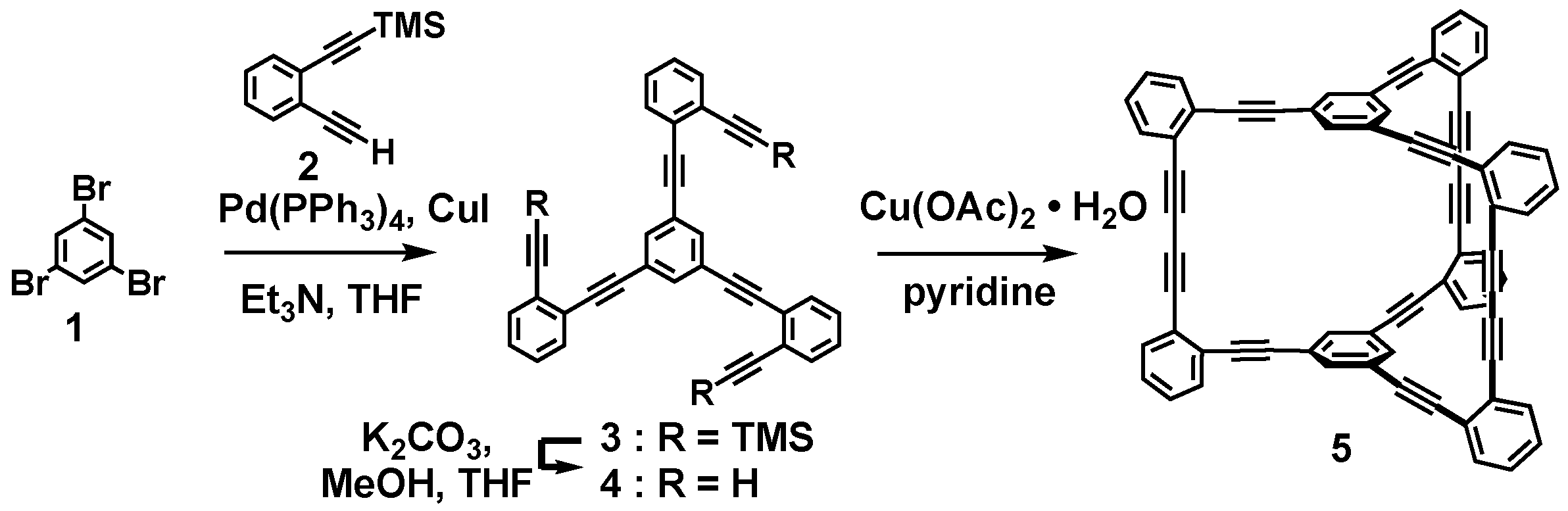
Compound 5 was synthesized through the intramolecular oxidative coupling of compound 4, which was obtained by attaching three diethynylarene units to a central benzene ring (Scheme 1). The synthesis commenced with the direct substitution of tribromobenzene (1) with TMS-protected o-diethynylbenzene (2) [27,28], yielding a tri-substituted product (3) with a yield of 49%. After this step, the TMS protecting group was removed to afford compound (4). This intermediate (4) was then subjected to oxidative coupling without purification, utilizing Cu(OAc)2·H2O as a catalyst in pyridine at room temperature. After purification by column chromatography, cage 5 was obtained as a pale-yellow solid in an overall yield of 45%.
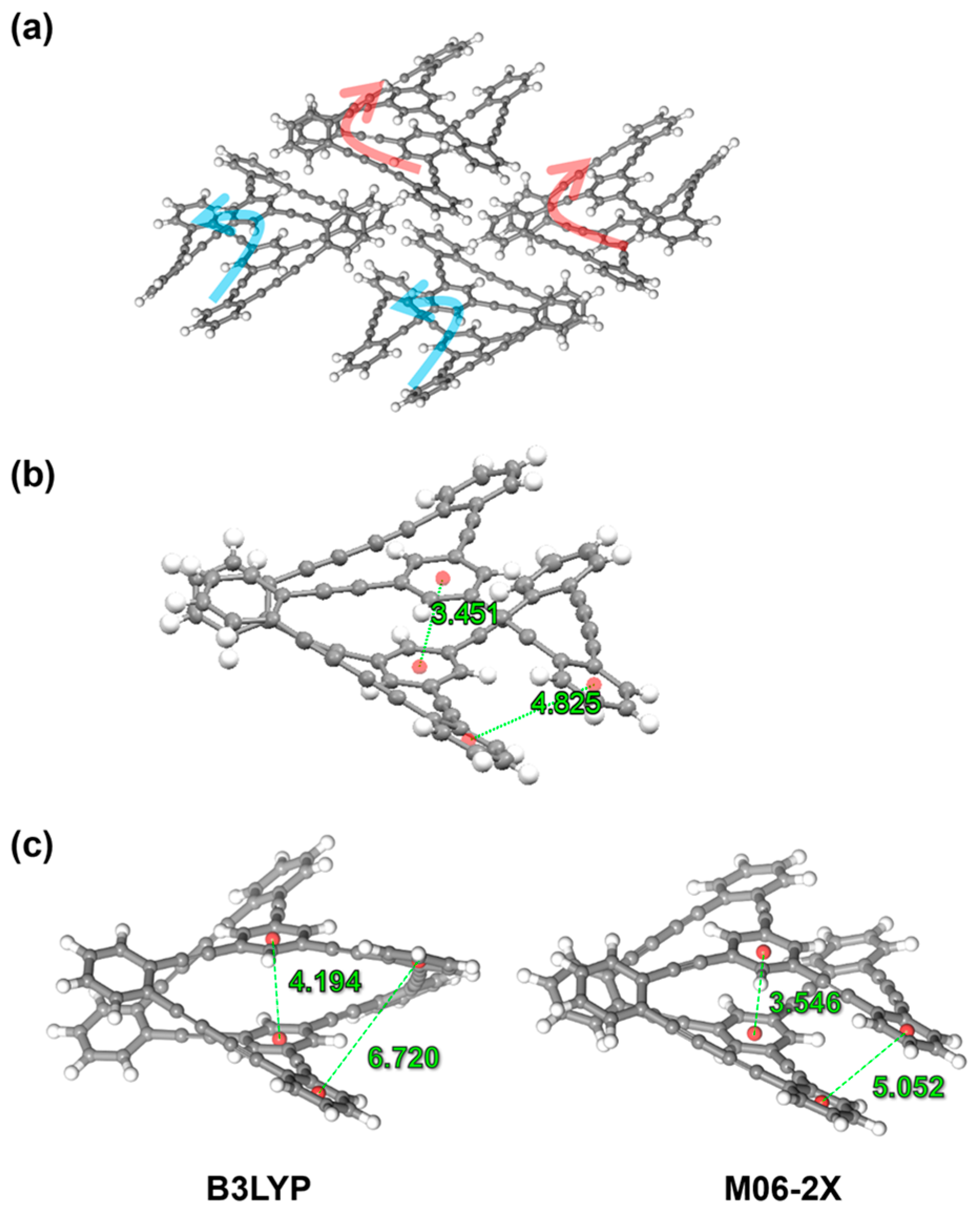
The structure of the synthesized product was successfully determined using X-ray crystallographic analysis, as illustrated in Figure 1. A suitable crystal for analysis was prepared using vapor diffusion of acetonitrile into an o-dichlorobenzene solution. The X-ray crystallographic analysis showed that cage 5 adopted two 1,3,5-tris(phenylethynyl)benzene units connected by twisted diethynyl linkers, resulting in a helical cage structure. Notably, as shown in Figure 1a, the crystal structure exhibits a racemic mixture of P- and M-1 in a 1:1 ratio. Additionally, the matrix-assisted laser desorption ionization-Fourier transform ion cyclotron resonance (MALDI-FT-ICR) mass spectrometry was performed on the synthesized product. The molecular ion peak at 894.23 m/z was detected (Figure S7). We assigned the peak as cage 5.
Regarding the conformation of 1, we performed computational calculations to investigate the presence of intra-molecular interactions. DFT calculations were conducted at the B3LYP/6-31G(d) and M06-2X/6-31G(d) levels of theory for comparison. The calculations with the M06 series of functionals are believed to effectively predict noncovalent interactions, such as π-π interactions [29,30].
The experimental and calculated conformations of 5 are shown in Figure 1b,c. The experimental results show that the centroid-to-centroid distance between the center phenyl ring of the top 1,3,5-tris(phenylethynyl)benzene unit in 5 and that of the bottom unit measures 3.45 Å, while the centroid-to-centroid separation between the most adjacent peripheral phenyl groups of the top and bottom 1,3,5-tris(phenylethynyl)benzene units is 4.82 Å (Figure 1b). The computational simulations demonstrated that the model at the B3LYP functional revealed a notably larger centroid-to-centroid separation, with the central phenyl groups being spaced at 4.19 Å and the peripheral phenyl groups at 6.72 Å (Figure 1c, left). On the other hand, the model calculated at M06-2X indicates that the centroid-to-centroid distance between the central phenyl groups is 3.55 Å, while the peripheral phenyl groups are positioned 5.05 Å apart in this model (Figure 1c, right). The root mean square deviation (RMSD) of atomic positions for the experimental and calculated structures was evaluated. The M06-2X functional revealed an RMSD value of 0.422 Å, which is lower than the 1.297 Å obtained with the B3LYP functional. Notably, the computational model at M06-2X aligns more consistent with the distances observed in X-ray crystallographic analyses, further supporting the relevance of π-π interactions in stabilizing the structural arrangement.
In Figure 1b, the central phenyl groups in the upper and lower planes are almost parallel, exhibiting a dihedral angle of 3.89° between their respective planes. The twist dihedral angles of the peripheral benzene rings linked by diacetylene units are 60.3°, 69.3°, and 75.3°, respectively. The diacetylene units exhibit deviations from linearity, with C≡C–C bond angles ranging from 173.0° to 175.3°. These twist angles are larger than those observed in other similarly structured cages [22,31,32]. For example, Chen and Zhang reported a triptycene-based cage through the Eglington-Glaser coupling reaction. In their study, the twist angles were 24.5°, 35.2°, and 24.5°, which are smaller than those observed in our work [22]. The difference in aromatic ring twisting between Cage 5 and Chen’s work arises from their distinct topological layouts. In Cage 5, the alkynyl substituents are ortho-connected to the peripheral phenyl rings, which introduces significant steric hindrance between neighboring phenyl rings, leading to large twist angles to alleviate the spatial strain. In contrast, Chen’s work incorporates meta-connections between the alkynyl substituents and peripheral phenyl rings, which reduces steric hindrance. This allows the aromatic units to remain nearly planar and to exhibit smaller twist angles.
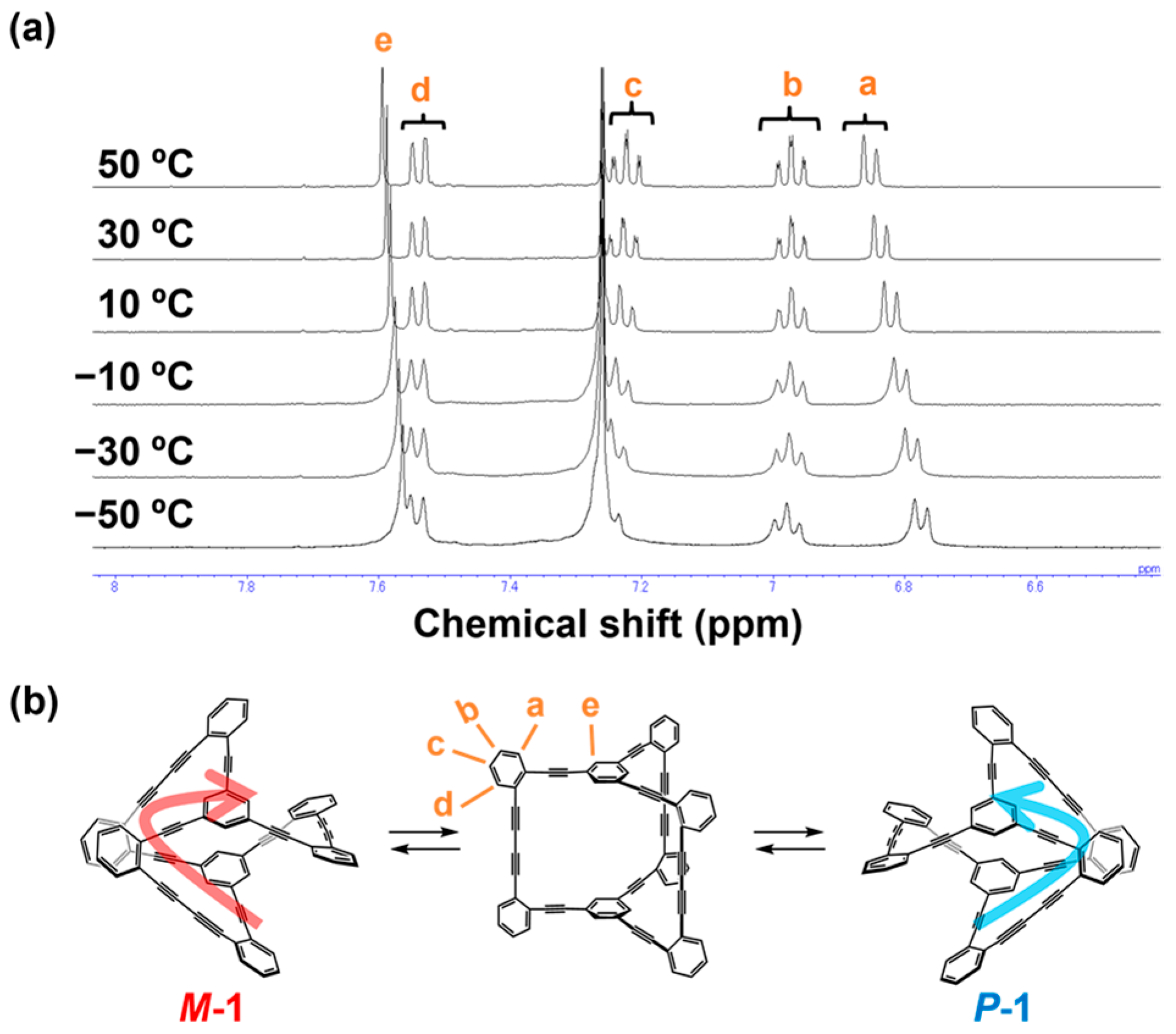
The 1H NMR spectrum of cage 5 at 30 °C (Figure 2a) displayed four distinct signals corresponding to the aromatic protons. The assignment of these peaks was assisted by two-dimensional NMR techniques, including 1H–1H COSY, 1H–13C HSQC, and 1H–1H ROESY (Figures S4–S6), which support our structural interpretation. Similarly, the 13C NMR spectrum taken at the same temperature (Figure S3) showed twelve signals for the aromatic carbon atoms. The presence of highly symmetric signals in both the 1H and 13C NMR suggest that racemization occurs rapidly on the NMR timescale, resulting in time-averaged signals from both P- and M-enantiomers. If the racemization process of the P-enantiomer through the M-enantiomer is relatively slow, it should be possible to separate them using chiral chromatography [33,34]. To investigate this, we attempted optical resolution by different chiral columns (see Supplementary Materials for more details). However, despite extensive efforts, the separation of the enantiomers of cage 5 was not observed, which supports the hypothesis of rapid racemization.
To further investigate the racemization process, we conducted a series of VT-NMR experiments. If the racemization rate were sufficiently slow on the NMR timescale, we would expect to see either broadening of the resonant peaks or the emergence of additional peaks that correspond to distinct conformational states of the molecule. However, even at temperatures lower than −50 °C, the 1H NMR spectrum of cage 5 did not show any significant changes in signal resolution (Figure 2a). Additionally, raising the temperature further did not result in any noticeable changes in the 1H NMR spectrum of cage 5, indicating that the racemization process occurs too quickly to be effectively captured within the NMR timescale. These results indicate that the interconversion between P- and M-enantiomers of cage 5 took place with a low activation energy for the plausible transition state (Figure 2b). This implies greater flexibility and weaker interactions between the phenyl rings, which is unexpected. However, introducing metal ions into the cage framework may stabilize the helical structure through interactions between the phenyl rings and the metal ions.
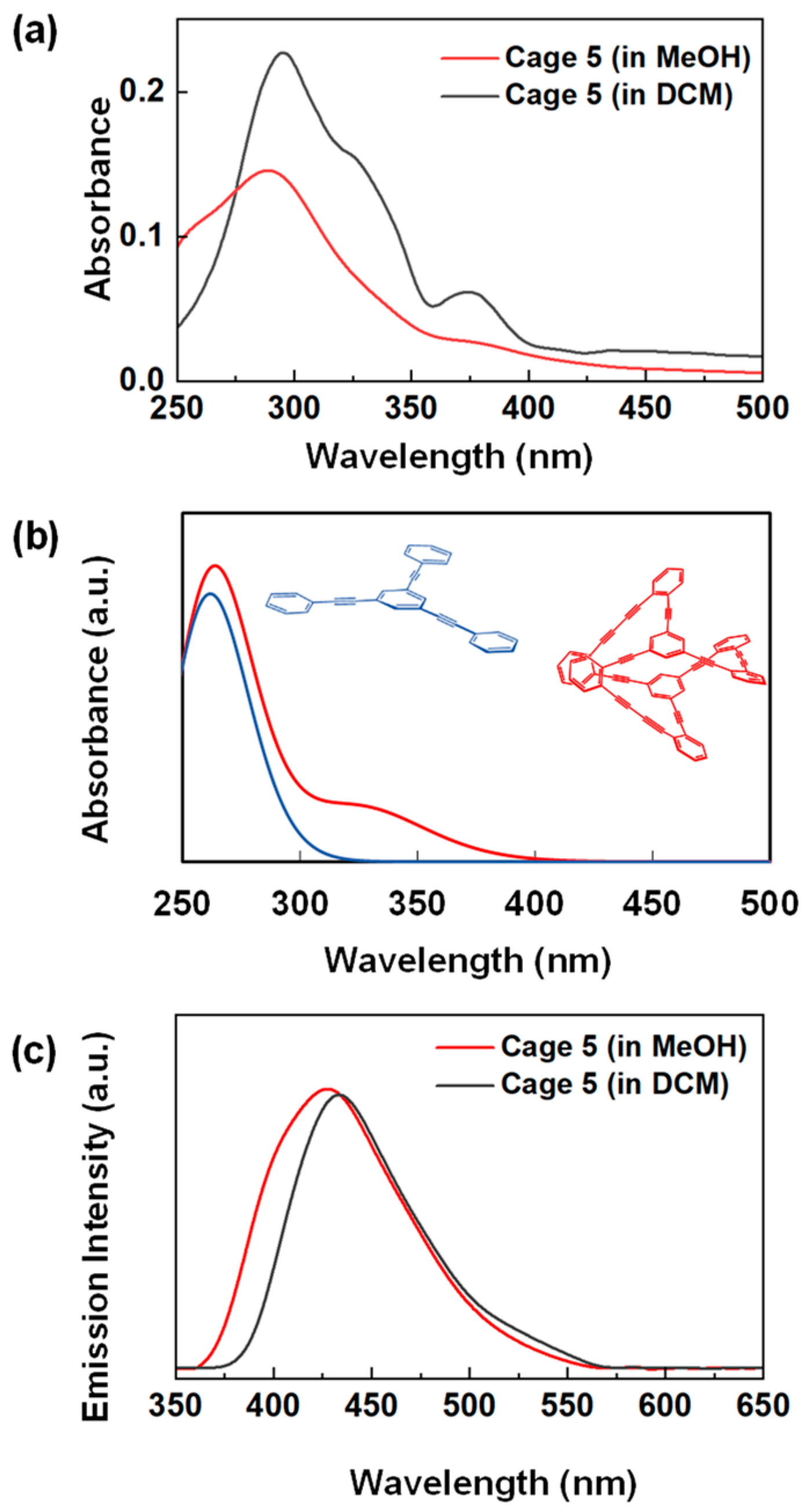
The UV-Vis absorption spectra of cage 5 was measured in CH2Cl2 and MeOH (Figure 3a). An absorption maximum is observed at 295 nm in CH2Cl2, whereas the corresponding peak appears at 288 nm in MeOH. To have a better understanding of the electronic properties of the cage, time-dependent density functional theory (TD-DFT) calculations were performed using the B3LYP/6-31G* method. The UV-Vis absorption experimental result agrees with the simulation (Figure 3b). The simulated absorption spectrum reveals a prominent absorption band in the longer-wavelength region, extending to approximately 400 nm. This band is distinctly different from the absorption peaks observed for the 1,3,5-tris(phenylethynyl)benzene, which appear at shorter wavelengths. Further analysis reveals that the dominant allowed optical transitions arise from frontier molecular orbital excitations localized on the organic ligands, primarily on the 1,3,5-tris(phenylethynyl)benzene units in Cage 5, indicating an intraligand π–π* transition character.
The experimental and simulated absorption of the cage at longer wavelengths are due to the extension of conjugation in the cage configuration, resulting in a more delocalized electronic structure, which reduces the energy needed for electronic transitions. This increased conjugation narrows the energy gap between the ground and excited states, resulting in transitions that occur at lower energies. Consequently, this phenomenon is reflected in the observed absorption at longer wavelengths in the UV-Vis spectrum. Regarding the photoluminescence of cage 5, excitation at 300 nm results in an emission spectrum with a peak at 434 nm in CH2Cl2, while the corresponding emission is observed at 427 nm in MeOH (Figure 3c). Accordingly, the absorption and emission spectra showed only slight changes with different solvent polarities (Figure 3a,c), suggesting weak solvatochromic effects.

4. Conclusions

The three-dimensional cage was successfully synthesized with a quantitative yield using an intramolecular Glaser coupling strategy. Structural characterization revealed that this molecule has a cage-like architecture consisting of two 1,3,5-tris(phenylethynyl)benzene units and diyne (sp) linkers. X-ray crystallographic analysis revealed that the compound exists as a racemic mixture of P- and M-enantiomers. Computational simulations suggest that π-π stacking interactions have a significant role in enhancing the stability of the structure. Additionally, a large twist angle was observed in the compound. NMR spectroscopy indicates a rapid racemization process between the enantiomers. Furthermore, UV-Vis spectroscopy demonstrates that the cage structure enhances conjugation within the molecule, resulting in an absorption peak at longer wavelengths. The findings from this research provide new insights into the development of cage-like molecular structures and establish a theoretical foundation for future research in molecular design and performance optimization.

Supplementary Materials

The following supporting information can be downloaded at: https://www.mdpi.com/article/10.3390/org7010002/s1, Crystal data for 1 (CIF), NMR spectra are available in Supplementary Materials. Figure S1: 1H and 13C NMR spectra of 3. Figure S2: 1H NMR spectra of 5. Figure S3: 13C NMR spectra of 5. Figure S4: 1H-1H COSY NMR spectrum of 5 (CDCl3, 303 K). Figure S5: 1H-13C HSQC NMR spectrum of 5 (CDCl3, 303 K). Figure S6: 1H-1H ROESY NMR spectrum of 5 (CDCl3, 303 K). Figure S7: MALDI-FT-ICR mass spectra of analysis for the cage 5. DCTB was used as a matrix. Figure S8: The geometry optimized model of cage 5 (M06-2X levels of theory. Total Energy = −2760.909 Hartree). Table S1: The Cartesian coordinates of cage 5.

Author Contributions

Conceptualization, T.K. and H.S.; methodology, W.W.; Software, H.S.; formal analysis, W.W.; investigation, T.K.; resources, H.S.; data curation, T.K.; writing—original draft preparation, W.W.; writing—review and editing, W.W. and T.K.; visualization, T.K.; supervision, H.S.; project administration, H.S. All authors have read and agreed to the published version of the manuscript.

Funding

This research was funded by KAKENHI Program, grant number 22H01891 (H.S.), 22K18944 (H.S.), 23K04521 (T.K.); Japan Society for the Promotion of Science, Japan; JST SPRING Program, grant number JPMJSP2110 (W.W.).

Data Availability Statement

CIF data generated in this work have been uploaded in the Cambridge Crystallographic Data Centre under accession code CCDC 2416749.

Acknowledgments

We thank Dehao Jiang for assistance during the experiments, as well as Shunpei Nobusue, Yudai Yamaoki, and Masato Katahira for their help with the characterization measurements. Computational resources were supplied by the supercomputer system at the Institute for Chemical Research, Kyoto University.

Conflicts of Interest

The authors declare no conflicts of interest.

Abbreviations

The following abbreviations are used in this manuscript:
VT-NMRVariable-temperature NMR
MALDI-FT-ICRMatrix-assisted laser desorption ionization-Fourier transform-Ion cyclotron resonance
TD-DFTTime-dependent density functional theory
CIFCrystallographic information file

References

  1. Charbonnière, L.J.; Williams, A.F.; Frey, U.; Merbach, A.E.; Kamalaprija, P.; Schaad, O. A Comparison of the Lability of Mononu-clear Octahedral and Dinuclear Triple-Helical Complexes of Cobalt (II). J. Am. Chem. Soc. 1997, 119, 2488–2496. [Google Scholar] [CrossRef]
  2. Míguez-Lago, S.; Gliemann, B.D.; Kivala, M.; Cid, M.M. A Chiral Molecular Cage Comprising Diethynylallenes and N-Heterotriangulenes for Enantioselective Recognition. Chem. Eur. J. 2021, 27, 13352–13357. [Google Scholar] [CrossRef] [PubMed]
  3. Beaudoin, D.; Rominger, F.; Mastalerz, M. Chiral Self-Sorting of [2 + 3] Salicylimine Cage Compounds. Angew. Chem. Int. Ed. 2017, 56, 1244–1248. [Google Scholar] [CrossRef]
  4. Qiu, F.; Chen, X.; Wang, W.; Su, K.; Yuan, D. Highly stable sp2 carbon-conjugated porous organic cages. CCS Chem. 2024, 6, 149–156. [Google Scholar] [CrossRef]
  5. Li, J.; Hii, S.S.; Zhu, X.; Yang, Y.; Wang, Y. sp2 carbon conjugated covalent organic cage with efficient photocatalysis. Chin. Chem. Lett. 2025, 37, 111151. [Google Scholar] [CrossRef]
  6. Chen, Y.; Wu, G.; Chen, B.; Qu, H.; Jiao, T.; Li, Y.; Ge, C.; Zhang, C.; Liang, L.; Zeng, X.; et al. Self-Assembly of a Purely Covalent Cage with Homochirality by Imine Formation in Water. Angew. Chem. Int. Ed. 2021, 60, 18815–18820. [Google Scholar] [CrossRef]
  7. Ren, F.; Day, K.J.; Hartley, C.S. Two-and Three-Tiered Stacked Architectures by Covalent Assembly. Angew. Chem. Int. Ed. 2016, 55, 8620–8623. [Google Scholar] [CrossRef]
  8. Li, G.; Mao, L.L.; Gao, J.N.; Shi, X.; Huo, Z.Y.; Yang, J.; Zhou, W.; Li, H.; Yang, H.B.; Tung, C.H.; et al. A Helical Tubular Dyad of [9]Cycloparaphenylene: Synthesis, Chiroptical Properties and Post-Functionalization. Angew. Chem. Int. Ed. 2025, 137, e202419435. [Google Scholar] [CrossRef]
  9. Guo, S.D.; Jiao, T.; Guo, D.S.; Cai, K. Chiral covalent organic cages: Construction and chiral functions. Smart Mol. 2025, 3, e20240038. [Google Scholar] [CrossRef] [PubMed]
  10. Mondal, B.; Acharyya, K.; Howlader, P.; Mukherjee, P.S. Molecular cage impregnated palladium nanoparticles: Efficient, additive-free heterogeneous catalysts for cyanation of aryl halides. J. Am. Chem. Soc. 2016, 138, 1709–1716. [Google Scholar] [CrossRef]
  11. Xue, W.; Benchimol, E.; Walther, A.; Ouyang, N.; Holstein, J.J.; Ronson, T.K.; Openy, J.; Zhou, Y.; Wu, K.; Chowdhury, R.; et al. Interplay of Stereochemistry and Charge Governs Guest Binding in Flexible ZnII4L4 Cages. J. Am. Chem. Soc. 2024, 146, 32730–32737. [Google Scholar] [CrossRef] [PubMed]
  12. Pan, M.; Wu, K.; Zhang, J.-H.; Su, C.-Y. Chiral metal–organic cages/containers (MOCs): From structural and stereochemical design to applications. Coord. Chem. Rev. 2019, 378, 333–349. [Google Scholar] [CrossRef]
  13. Wang, Y.; Zhang, Y.; Wang, Y.-Y.; Yan, Q. Highly Conductive Chiral Organic Cages and Their Helical Assemblies Enable Efficient Spin Filtering. J. Am. Chem. Soc. 2025, 147, 8751–8759. [Google Scholar] [CrossRef]
  14. Vanderkooy, A.; Gupta, A.K.; Földes, T.; Lindblad, S.; Orthaber, A.; Pápai, I.; Erdélyi, M. Halogen bonding helicates encompassing iodonium cations. Angew. Chem. Int. Ed. 2019, 131, 9110–9114. [Google Scholar] [CrossRef]
  15. Blatchly, R.A.; Tew, G.N. Theoretical Study of Helix Formation in Substituted Phenylene Ethynylene Oligomers. J. Org. Chem. 2003, 68, 8780–8785. [Google Scholar] [CrossRef]
  16. Hafezi, N.; Holcroft, J.M.; Hartlieb, K.J.; Dale, E.J.; Vermeulen, N.A.; Stern, C.L.; Sarjeant, A.A.; Stoddart, J.F. Modulating the Binding of Polycyclic Aromatic Hydrocarbons Insidea Hexacationic Cage by Anion-π Interactions. Angew. Chem. Int. Ed. 2015, 54, 456–461. [Google Scholar] [CrossRef]
  17. Dale, E.J.; Vermeulen, N.A.; Thomas, A.A.; Barnes, J.C.; Juríček, M.; Blackburn, A.K.; Strutt, N.L.; Sarjeant, A.A.; Stern, C.L.; Denmark, S.E.; et al. Excage. J. Am. Chem. Soc. 2014, 136, 10669–10682. [Google Scholar] [CrossRef]
  18. Wu, H.; Wang, Y.; Song, B.; Wang, H.-J.; Zhou, J.; Sun, Y.; Jones, L.O.; Liu, W.; Zhang, L.; Zhang, X.; et al. A contorted nanographene shelter. Nat. Commun. 2021, 12, 5191. [Google Scholar] [CrossRef]
  19. Tuo, D.; Ao, Y.; Wang, Q.; Wang, D. Naphthalene-pillaredbenzene triimide cage: An efficient receptor for polyhedral anions anda general tool for probing theoretically-existing anion-π bindingmotifs. CCS Chem. 2022, 4, 2806–2815. [Google Scholar] [CrossRef]
  20. Zhu, D.; Sun, B.; Tong, L.; Wu, Y.; Cetin, M.M.; Li, H. A π-Electron Rich Cage via the Friedel-Crafts Reaction. Org. Lett. 2022, 24, 8980–8985. [Google Scholar] [CrossRef] [PubMed]
  21. Montà-González, G.; Sancenón, F.; Martínez-Máñez, R.; Martí-Centelles, V. Purely covalent molecular cages and containers for guest encapsulation. Chem. Rev. 2022, 122, 13636–13708. [Google Scholar] [CrossRef]
  22. Zhang, C.; Chen, C.-F. Synthesis and Structure of a Triptycene-Based Nanosized Molecular Cage. J. Org. Chem. 2007, 72, 9339–9341. [Google Scholar] [CrossRef] [PubMed]
  23. Toyota, S.; Yamamori, T.; Makino, T. Effects of aryl and arylethynyl substituents at the 1-position on rotational barrier around C(sp)−C (sp3) bonds and bending deformation of acetylenic carbons in bis(9-triptycyl)ethynes. Tetrahedron 2001, 57, 3521–3528. [Google Scholar] [CrossRef]
  24. Nobusue, S.; Mukai, Y.; Fukumoto, Y.; Umeda, R.; Tahara, K.; Sonoda, M.; Tobe, Y. Molecular propellers that consist of dehydrobenzo[14]annulene blades. Chem. Eur. J. 2012, 18, 12814–12824. [Google Scholar] [CrossRef]
  25. Sheldrick, G.M. A short history of SHELX. Acta Crystallogr. A 2008, 64, 112–122. [Google Scholar] [CrossRef]
  26. Nobusue, S.; Xie, C.; Patel, K.; Kojima, T.; Sakaguchi, H. Aryl Shift Rearrangement in Scholl-Type Reaction Toward Nanographene. Chem. Eur. J. 2025, 31, e202501221. [Google Scholar] [CrossRef]
  27. Huynh, C.; Linstrumelle, G. A Short Route to Dehydro [12] Annulenes. Tetrahedron 1988, 44, 6337–6344. [Google Scholar] [CrossRef]
  28. John, J.A.; Tour, J.M. Synthesis of Polyphenylenes and Polynaphthalenes by Thermolysis of Enediynes and Dialkynylbenzenes. J. Am. Chem. Soc. 1994, 116, 5011–5012. [Google Scholar] [CrossRef]
  29. Jacquemin, D.; Perpète, E.A.; Ciofini, I.; Adamo, C.; Valero, R.; Zhao, Y.; Truhlar, D.G. On the Performances of the M06 Family of Density Functionals for Electronic Excitation Energies. J. Chem. Theory Comput. 2010, 6, 2071–2085. [Google Scholar] [CrossRef]
  30. Walker, M.; Harvey, A.J.A.; Dessent, C.E.H. Performance of M06, M06-2X, and M06-HF Density Functionals for conformationally Flexible Anionic Clusters: M06 Functionals Perform Better than B3LYP for a Model System with Dispersion and Ionic Hydrogen-Bonding Interactions. J. Phys. Chem. A 2013, 117, 12590–12600. [Google Scholar] [CrossRef]
  31. Wang, Z.; Zhang, Q.-P.; Guo, F.; Ma, H.; Liang, Z.-H.; Yi, C.-H.; Zhang, C.; Chen, C.-F. Self-Similar Chiral Organic Molecular Cages. Nat. Commun. 2024, 15, 670. [Google Scholar] [CrossRef] [PubMed]
  32. Míguez-Lago, S.; Llamas-Saiz, A.L.; Magdalena Cid, M.; Alonso-Gómez, J.L. A Covalent Organic Helical Cage with Remarkable Chiroptical Amplification. Chem. Eur. J. 2015, 21, 18085–18088. [Google Scholar] [CrossRef] [PubMed]
  33. Okamoto, Y.; Ikai, T. Chiral HPLC for efficient resolution of enantiomers. Chem. Soc. Rev. 2008, 37, 2593–2608. [Google Scholar] [CrossRef]
  34. Ikai, T.; Okamoto, Y. Structure Control of Polysaccharide Derivatives for Efficient Separation of Enantiomers by Chromatography. Chem. Rev. 2009, 109, 6077–6101. [Google Scholar] [CrossRef] [PubMed]
Scheme 1. Synthesis of cage 5.
Organics 07 00002 sch001
Figure 1. (a) X-ray crystallographic analysis of 5. (b) Experimental molecular structure of M-5. (c) Calculated molecular structures of M-5 at B3LYP (left) and M06-2X (right) levels of theory.
Organics 07 00002 g001
Figure 2. (a) VT-NMR spectra of 5. (The labels a-e correspond to the distinct proton resonances as shown.) (b) Racemization between P- and M-enantiomers of 5.
Organics 07 00002 g002
Figure 3. (a) Absorption spectrum of cage 5 in CH2Cl2 and in MeOH. (b) Calculated absorption spectra of cage 5 (red) and 1,3,5-tris(phenylethynyl)benzene (dark blue). (c) Emission spectrum of cage 5 in CH2Cl2 and in MeOH.
Organics 07 00002 g003
Disclaimer/Publisher’s Note: The statements, opinions and data contained in all publications are solely those of the individual author(s) and contributor(s) and not of MDPI and/or the editor(s). MDPI and/or the editor(s) disclaim responsibility for any injury to people or property resulting from any ideas, methods, instructions or products referred to in the content.