Article

Joint Computing Offloading, Resource Allocation and Service Pricing in RIS-Assisted Mobile Edge Computing

1
School of Artificial Intelligence, Guangxi Minzu University, Nanning 530006, China
2
School of Information Engineering, Jiangxi Technical College of Manufacturing, Nanchang 330095, China
3
School Computer and Communication Engineering, University of Science and Technology Beijing, Beijing 100083, China
*
Author to whom correspondence should be addressed.
Telecom 2026, 7(3), 71; https://doi.org/10.3390/telecom7030071
Submission received: 8 May 2026 / Revised: 29 May 2026 / Accepted: 2 June 2026 / Published: 4 June 2026

Abstract

This paper investigates an RIS-assisted mobile edge computing (MEC) system without reliable direct links between users and base stations (BSs). Users offload tasks to BSs through reconfigurable intelligent surface (RIS)-reflected links, where offloading decisions, service prices, and RIS-assisted transmission quality are tightly coupled. We formulate a joint design problem that considers task latency, transmission energy consumption, service pricing, BS computing constraints, and RIS phase-shift constraints. The RIS phase shifts are first optimized to improve the effective cascaded channel gain. Then, a distributed price-negotiation-based offloading mechanism is developed to coordinate user association and service pricing under channel-dependent utilities. Analysis and simulations show that the proposed algorithm converges within a finite number of iterations and achieves a balanced tradeoff between user utility and BS revenue.

1. Introduction

With the continuous growth in the number of Internet of Things (IoT) devices, the volume of data generated in the network has been increasing explosively. Meanwhile, emerging applications such as industrial monitoring, disaster warning, and healthcare have imposed more stringent requirements on computing capability, latency performance, and service reliability. Under such circumstances, the conventional paradigm relying solely on local processing at terminals or centralized cloud computing can no longer meet the development demands of the future IoT era [1]. Mobile edge computing (MEC) provides an effective solution to alleviate the computational burden in IoT scenarios by pushing computing resources from the core network to the network edge [2]. Under this architecture, IoT devices can offload computation-intensive tasks to edge servers deployed in proximity to access points, thereby significantly reducing task processing latency, alleviating device energy consumption, and improving the overall service capability of the system.
Although MEC can effectively relieve the computational pressure in IoT scenarios, the performance of task offloading still largely depends on the quality of wireless access links. In complex propagation environments with severe blockage or insufficient coverage, the communication performance between terminals and access nodes can be significantly degraded, thereby affecting the latency, energy consumption, and reliability of task offloading. To further enhance wireless transmission capability, reconfigurable intelligent surfaces (RISs), as a key enabling technology for future wireless communication systems, can effectively improve both energy efficiency and spectrum efficiency by adaptively reconfiguring the wireless propagation environment [3]. In general, an RIS consists of a large number of low-cost and nearly passive reflecting elements, each of which can independently adjust the amplitude and phase of the incident electromagnetic signal, thereby flexibly controlling the propagation direction and characteristics of the reflected signal [4]. Compared with conventional multiple-input multiple-output relay communication technologies, RIS can achieve higher beamforming gains with much lower power consumption, without requiring complicated radio-frequency chains or excessive signal processing overhead. In addition, RIS also enjoys several appealing advantages, such as ease of deployment, low cost, environmental friendliness, and high compatibility with existing wireless systems. Therefore, it has become an important technological means for enhancing communication performance in complex wireless environments.
In recent years, RIS-assisted MEC has gradually emerged as a research hotspot at the intersection of wireless communications and edge intelligence. Existing studies have mainly focused on task offloading optimization, reflection coefficient design, and the joint allocation of communication and computing resources. In ref. [5], the authors investigated the task offloading and reflection optimization problem in a RIS-assisted multi-user MEC system, and further proposed a low-complexity learning approach based on location information. In ref. [6], the authors studied the worst-case delay minimization problem in RIS-assisted edge computing for latency-sensitive scenarios. Huang et al. further extended RIS-assisted MEC to heterogeneous learning task scenarios, with particular emphasis on the coordinated optimization of communication, computation, and learning performance [7]. In ref. [8], the authors also examined the application of RIS in MEC networks from the perspective of green and secure offloading. Merluzzi et al. studied power-minimizing MEC offloading under RIS-empowered communications with QoS guarantees and frequency-selective RIS channel modeling [9]. Liu et al. further investigated STAR-RIS-aided MEC systems and proposed a joint optimization framework for STAR-RIS beamforming, transmission coefficients, and computation rate maximization [10]. These studies further demonstrated the effectiveness of RIS technologies in improving wireless offloading reliability and computation performance. However, most existing RIS-MEC works mainly focus on communication-computation coupling optimization, while relatively limited attention has been paid to distributed computation resource trading and continuous pricing negotiation under RIS-assisted communication environments. Meanwhile, market-oriented resource management mechanisms, such as pricing, auction theory, and contract theory, have also attracted increasing attention in MEC systems. Habiba et al. proposed a repeated auction model for load-aware dynamic resource allocation in MEC systems and analyzed the corresponding Nash equilibrium and individual rationality properties [11]. Liu et al. further investigated truthful reverse auction mechanisms for federated learning resource allocation in cloud-edge collaborative MEC systems [12]. Matching theory and contract theory have emerged as promising tools for distributed resource trading and user association in wireless edge networks. In particular, Su et al. proposed a matching-with-contracts-based resource trading and price negotiation framework for MEC systems [13], which demonstrated the effectiveness of distributed bilateral matching under continuous pricing variables. In ref. [14], the authors adopted a three-sided matching game approach to address the multidimensional resource allocation problem in satellite networks under incomplete information. In ref. [15], the authors established a one-sided cooperative many-to-one matching game to determine the communication mode and channel selection. Overall, existing works have demonstrated the significant potential of RIS in improving offloading link quality, reducing system latency and energy consumption, and enhancing system performance. However, most existing studies mainly focus on communication-computation optimization and RIS phase-shift design, while relatively limited attention has been paid to distributed resource trading, continuous price negotiation, stable matching relationships, and competitive equilibrium under RIS-assisted MEC systems. This paper investigates an RIS-assisted MEC system without reliable direct user–base station (BS) links and develops a matching-with-contracts-based task offloading and pricing framework with RIS phase-shift optimization.
In this paper, we investigate an RIS-assisted MEC system, in which no reliable direct link is available between users and BSs. Specifically, in a network consisting of multiple users and multiple BSs, users act as computation resource requesters, while BSs serve as computation resource providers. User tasks are offloaded to the corresponding BSs via the RIS for computation execution. Different from existing studies on MEC networks, the considered problem involves not only computation resource price negotiation, but also the joint design of RIS phase shifts. The main contributions of this paper are summarized as follows.
  • We establish an RIS-assisted MEC model without direct user–BS links and formulate a joint optimization problem involving task delay, energy consumption, resource pricing, computing capacity, and RIS phase-shift constraints.
  • We derive a closed-form solution for the optimal RIS phase shifts by analyzing the phase-shift design subproblem and exploiting the phase-alignment property of the cascaded channel.
  • We propose a price-negotiation-based task offloading algorithm under a matching-with-contracts framework, and prove that it converges to a stable outcome and achieves competitive equilibrium.
The rest of this paper is organized as follows. Section 2 introduces the system model and formulates the objective function. Section 3 presents the proposed algorithm, including RIS phase optimization and the price-negotiation-based task offloading mechanism. Section 4 provides simulation results and insightful discussions. Finally, Section 5 concludes the paper and highlights future research directions.

2. System Model and Problem Formulation

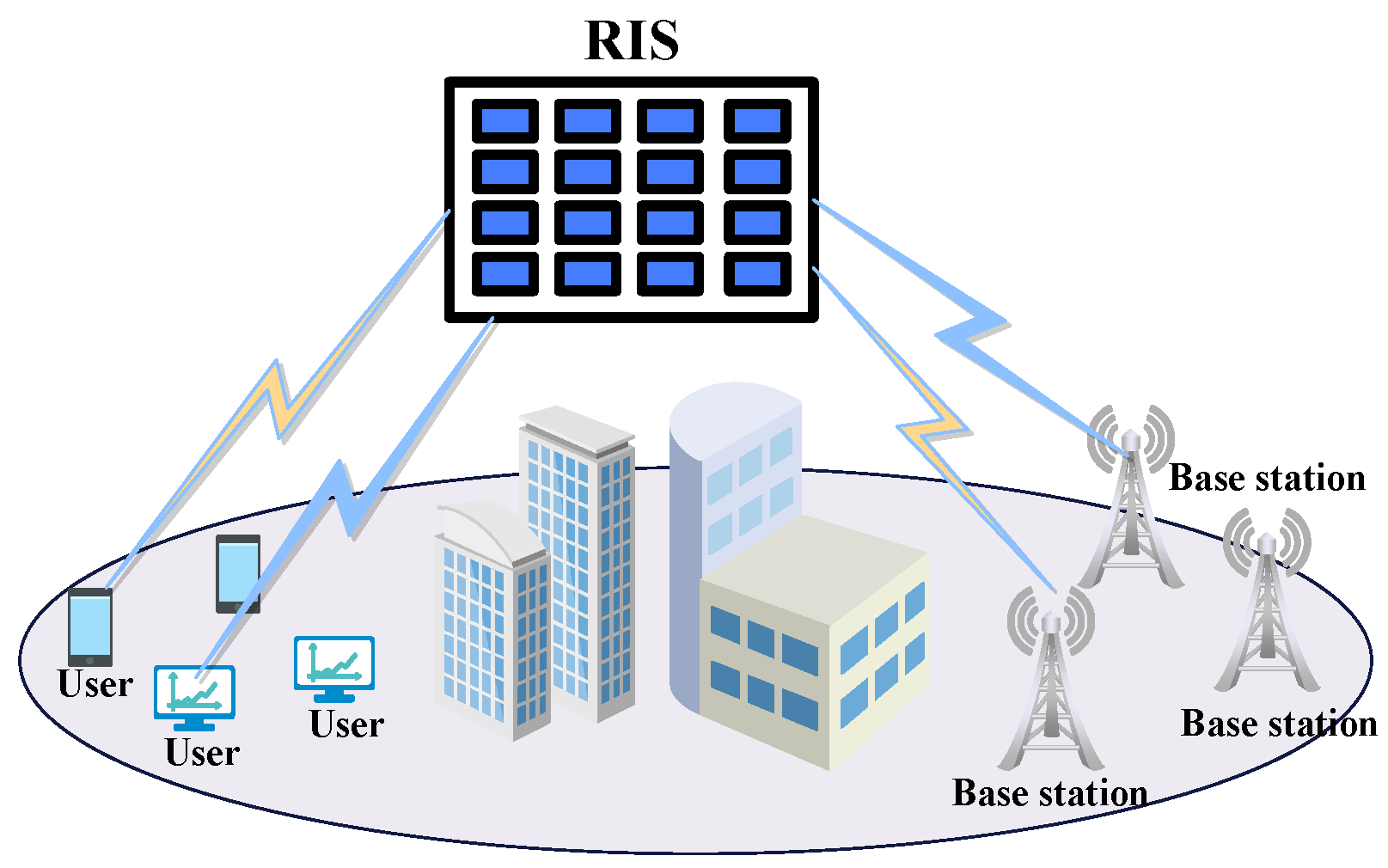
As shown in Figure 1, we consider an RIS-assisted mobile edge computing (MEC) system, which consists of a user set N = { 1 , 2 , , N } , a base-station set M = { 1 , 2 , , M } , and one RIS. Owing to blockage effects, complicated propagation environments, and limited coverage, no reliable direct communication link is available between the users and the BSs. To address this issue, an RIS is deployed to assist computation offloading from user devices to the BSs through passive beamforming coordinated by the RIS controller. Specifically, the RIS is equipped with L = M x × M y reflecting elements, where M x and M y denote the numbers of horizontally and vertically arranged elements, respectively. The reflection coefficient matrix of the RIS for user–BS pair ( n , m ) is defined as Θ n m = diag β n m , 1 e j α n m , 1 , , β n m , e j α n m , , , β n m , L e j α n m , L , where α n m , [ 0 , 2 π ] , L denotes the phase shift of the -th reflecting element for pair ( n , m ) , and  β n m , [ 0 , 1 ] represents the corresponding reflection amplitude coefficient. In practice, each RIS element is generally configured to maximize the reflected signal power and steer the reflected beam toward the serving BS. In this paper, we set β n m , = 1 , which is a common assumption and can be adopted without loss of generality. Moreover, let h n , r C L × 1 denote the channel vector from user n to the RIS, and let h r , m C L × 1 denote the channel vector from the RIS to BS m. It is worth noting that the RIS controller is responsible for coordinating the switching between two operating modes, namely, the receiving mode for channel estimation and the reflecting mode for data transmission, while providing real-time channel state information feedback. On this basis, to account for the imperfect cascaded channel, a robust beamforming approach is adopted to evaluate the system performance. The main symbols and their corresponding definitions are summarized in Table 1.
In the considered system, RIS phase shifts are configured on a per-time-slot basis according to the currently scheduled user–BS pair. Since the system adopts a time-division-based offloading mechanism, only one active user transmission is considered within each transmission interval. Therefore, the RIS controller dynamically adjusts the reflection coefficients before each offloading slot based on the estimated cascaded channel state information. Moreover, similar to most existing RIS-assisted MEC studies, the RIS reconfiguration delay and signaling overhead are assumed to be much smaller than the task transmission duration and are therefore neglected for analytical tractability.
In the system considered in this paper, computation offloading is achieved through a resource trading mechanism, where users act as resource requesters and BSs serve as resource providers. To characterize more clearly the one-to-one service relationship between users and BSs, both users and BSs are modeled as independent participating entities. During the computation offloading process, each user rents computing resources from a BS, while the BS charges the user a corresponding resource usage fee. From the perspective of the BS, its computing resources are limited, and thus the number of users that can be simultaneously served is constrained. Let G m denote the maximum number of users that can be served by BS m. We consider indivisible computation tasks, i.e., each computation task cannot be partitioned into multiple subtasks. To characterize this property, a binary decision variable ρ n m { 0 , 1 } is introduced for all n N and m M , where ρ n m = 1 indicates that user n offloads its task to BS m, and  ρ n m = 0 otherwise. The computation task of user n N is denoted by J n = ( D n , C n ) , where D n represents the input data size of the task, and  C n denotes the number of CPU cycles required to complete the task. Let f n l o c denote the local computing capability of user n. When the user chooses the local computing mode, the computation delay can be expressed as t n l o c = C n f n l o c , and the corresponding computation energy consumption is given by E n l o c = κ n f n l o c 2 C n , where κ n denotes the effective switched capacitance coefficient of the processor chip of user n, whose value is mainly determined by the chip architecture.
Similar to [16], in order to avoid inter-device interference, the system operates in a time-division multiplexing manner, where each device is allocated a dedicated transmission time interval. Under the RIS-assisted computation offloading framework, the equivalent channel from user n to BS m, including the cascaded link, can be expressed as h n m eff = h n , r Θ n m h r , m . Let the transmit power of user n be denoted by p n , and let the allocated bandwidth be B. Then, the uplink transmission rate of user n when offloading its task to BS m via the RIS can be expressed as r n m = B log 2 1 + p n h n m eff 2 σ 2 , where σ 2 denotes the Gaussian noise power. It is worth noting that large-scale fading is assumed to remain unchanged during the entire task transmission period. Therefore, the transmission delay of user n can be written as t n m c o m m = D n r n m , and the corresponding transmission energy consumption is given by E n m = p n t n m c o m m . We consider that each BS adopts an equal resource allocation strategy, where the total computation capability of BS m is denoted by F m , and identical computation resources are allocated to all associated users, i.e.,  f n m = F m G m . Therefore, the computation execution delay of the task at BS m can be expressed as T n m c o m p = D n C n f n m .
The utility achieved by a user for completing a task should comprehensively capture both the reward of task completion and the associated cost, including delay cost, transmission energy consumption, and payment price. Accordingly, the offloading utility of user n when selecting BS m is defined as U n m = V n δ n T n m ϵ n E n m π n m , where V n denotes the benefit obtained by user n after successfully completing the task, T n m = T n m c o m m + T n m c o m p denotes the task completion delay, δ n represents the delay cost coefficient, ϵ n denotes the energy consumption penalty coefficient, and  π n m is the price paid to the resource provider. For each BS, the utility of providing computing service to user n consists of the service revenue minus the costs incurred by computing resource provisioning and communication service support. Thus, the utility of BS m for serving user n is defined as O m n = π n m μ m C n ν m D n , where μ m denotes the unit computing cost coefficient and ν m denotes the unit communication service cost coefficient. In the considered model, our objective is to maximize the utilities of both users (buyers) and BSs (service providers). Therefore, the users (buyers)-oriented optimization problem can be formulated as
P 1 : max s n m , ρ n m , Θ n m m M ρ n m O m n & max s n m , ρ n m , Θ n m n N ρ n m U n m s . t . C 1 : V n δ n T n m ϵ n E n m π n m 0 , n N , m M , C 2 : π n m μ m C n ν m D n 0 , n N , m M , C 3 : m M ρ n m 1 , n N , C 4 : n N ρ n m G m , m M , C 5 : ρ n m { 0 , 1 } , C 6 : Θ n m = diag β n m , 1 e j α n m , 1 , , β n m , e j α n m , , , β n m , L e j α n m , L , exp j α n m , = 1 , α n m , [ 0 , 2 π ] , L , n N , m M ,
where constraints C1 and C2 denote that both the users and the BSs comply with the principle of individual rationality. Constraint C3 ensures that each user can select at most one BS. Constraint C4 denotes the computing service capacity constraint at the BSs. Constraint C5 denotes the task offloading strategy constraint. Constraint C6 denotes the phase-shift constraint of the RIS.
It is worth noting that Problem P1 is formulated as a one-to-many market equilibrium problem under a matching-with-contracts framework, rather than a conventional multi-objective optimization problem, social welfare maximization problem, or Nash social welfare maximization problem. In the considered system, users and BSs are self-interested entities associated with different utility functions. Therefore, the goal of this paper is not to centrally maximize two parallel objective functions. Instead, the user-side utility and BS-side utility are used to construct the preference relations of users and BSs, respectively. The final criterion is to find a stable set of offloading contracts, including user–BS association, service price, and RIS configuration, such that all accepted contracts satisfy individual rationality and BS capacity constraints, and no blocking contract exists.

3. Algorithm Design

In this subsection, we first optimize the reflection pattern of the RIS and then develop a computation offloading algorithm based on price negotiation.

3.1. RIS Phase Optimization

To facilitate the analysis, we transform problem P1 into a subproblem with respect to the phase-shift optimization of the RIS. Next, we present the following lemma, which is used to optimally design the phase shifts of the RIS over the offloading time slots of different users. For each offloading time slot, the RIS phase-shift matrix is optimized according to the currently associated user–BS pair to maximize the effective cascaded channel gain during task transmission.
Lemma 1. 
The following problem can be solved independently to obtain the optimal phase-shift matrix Θ n m for user n offloading to BS m:
max Θ n m h n , r Θ n m h r , m 2 s . t . exp ( j α n m , ) = 1 , Θ n m = diag β n m , 1 e j α n m , 1 , , β n m , e j α n m , , , β n m , L e j α n m , L , α n m , [ 0 , 2 π ] , L , n N , m M .
Proof. 
The delay-cost term in the user utility is determined by the transmission rate, which monotonically increases with the cascaded channel gain. Therefore, for a given user–BS pair ( n , m ) , the phase-shift design can be transformed into channel-gain maximization with respect to Θ n m . Each diagonal element of Θ n m satisfies the unit-modulus constraint exp ( j α n m , ) = 1 . Since the phase-shift design for each scheduled pair depends only on its own cascaded channel, the RIS optimization can be solved independently for each pair. □
The cascaded channel can be expressed as h n , r Θ n m h r , m = = 1 L h n , r , β n m , e j α n m , h r , m , . By representing the channel coefficients in polar form as h n , r , = | h n , r , | e j ϕ n , r , and h r , m , = | h r , m , | e j ϕ r , m , , the above expression can be rewritten as
h n , r Θ n m h r , m = = 1 L β n m , | h n , r , | | h r , m , | e j ( ϕ n , r , + ϕ r , m , + α n m , ) .
According to the triangle inequality, the magnitude of the above summation is maximized when all reflected components are coherently aligned in phase. Therefore, the optimal phase shifts should satisfy ϕ n , r , + ϕ r , m , + α n m , = 0 , which yields α n m , = ϕ n , r , ϕ r , m , = arg ( h n , r , ) arg ( h r , m , ) , where arg ( · ) denotes the phase operator. Accordingly, the optimal phase-shift vector for pair ( n , m ) is denoted by α n m . Based on α n m , the corresponding optimal phase-shift matrix Θ n m can be readily constructed.

3.2. Price-Negotiation-Based Task Offloading

It can be observed that the conventional matching model cannot be directly applied to solve the optimization problem P 1 considered in this paper. The main reason is that the rental price in the problem is a continuous variable, which cannot be effectively handled by the deferred acceptance algorithm [17]. Therefore, a matching-with-contracts framework is introduced to solve the problem [18]. For ease of subsequent analysis, the following definition is first provided.
Definition 1. 
The contract between user n and BS m is defined as x n m = ( n , m , π , f m , G m , H ) , where π denotes the payment made by the user and H denotes the channel gain of the cascaded link from user n to BS m via the RIS.
For BS m, the preference relation over the contract set X is defined as x m x O > O , where O and O denote the corresponding utility values of contracts x and x , respectively.
Similarly, for user n, the preference relation over X is defined as x n x U > U , where U and U denote the utilities of contracts x and x , respectively.
Given any subset X X of the contract set X, the choice behavior of user n can be characterized by its choice function Ψ n ( X ) . Specifically, user j selects its most preferred contract from all candidate contracts associated with itself according to its preference relation. If no contract is preferred to the outside option, then the choice result is the empty set. Similarly, the choice behavior of BS m can be represented by the choice set Ψ m ( X ) , which filters from all candidate contracts associated with itself an acceptable subset of contracts that maximizes its own utility.
Furthermore, the aggregate choice outcomes of all mobile nodes and resource providers over the contract set X can be expressed as the unions of their individual choice sets, denoted by Ψ n ( X ) and Ψ m ( X ) , respectively. Correspondingly, the contracts rejected by the two sides form the rejection sets, denoted by R n ( X ) = X \ Ψ n ( X ) and R m ( X ) = X \ Ψ m ( X ) . Based on the choice sets and rejection sets, the acceptance and elimination behaviors of all participating entities in the matching-with-contracts process can be explicitly characterized. Next, we introduce the definition of a stable contract.
Definition 2. 
For any subset X X of the contract set X, X is called a stable contract set if the following two conditions are satisfied:
( i ) Ψ m ( X ) = Ψ n ( X ) = X ,
( ii ) i , X Ψ m ( X ) s u c h t h a t X = Ψ m ( X X ) Ψ n ( X X ) .
Here, condition (i) reflects the individual rationality of both the resource providers and the resource requesters, namely, all contracts in the set X can be mutually accepted by the corresponding resource providers and mobile nodes. Condition (ii) indicates that there exists no blocking contract set in the system, i.e., there does not exist a resource provider m and a contract set X such that, once X is introduced, resource provider m would revise its original choice, while the contracts in X can also be accepted by the corresponding users.
For the competitive equilibrium in matching with contracts, its essence lies in influencing the decisions of resource providers through a pricing mechanism, thereby determining a set of equilibrium prices for all potential resource transactions and achieving a balance between resource supply and demand under user-preference-driven market interactions.
During the contract negotiation process, we define the opportunity sets of the BSs and the users at the tth iteration as X m ( t ) and X n ( t ) , respectively. The opportunity sets of the BSs and users can be iteratively updated according to their respective rejection sets, which can be expressed as
X m ( t ) = X \ R n X n ( t ) ,
and
X n ( t ) = X \ R m X m ( t 1 ) .
The above iterative relations indicate that the opportunity set of the BSs is determined by the set of contracts that have not been rejected by the users, whereas the opportunity set of the users is determined by the set of contracts that have not been rejected by the BSs in the previous iteration. In other words, the contract set is progressively reduced through the alternating selection and rejection process between the BSs and the users, and gradually converges to a matching outcome acceptable to both parties. Eventually, when the iterative process terminates, the retained contracts are exactly those desired, which can be represented as X m ( t ) X n ( t ) .
Enumerating all possible contracts in X is impractical in the considered scenario and would significantly increase the computational complexity of the algorithm. Therefore, we design a distributed price negotiation algorithm to realize task computation offloading, as shown in Algorithm 1. It is worth noting that only local information exchange is required during the solution process. In the price negotiation procedure, users propose contracts with gradually increasing resource requests and rental prices, where the increment step is denoted by Δ S . Here, Δ S represents the minimum price increment between two consecutive contracts. Subsequently, both sides perform contract matching iteratively until a stable matching result is achieved.
Before presenting Algorithm 1, the contract initialization and update rules are specified as follows. For each user–BS pair ((n,m)), the admissible service price is selected from a finite price set ( π n m min , π n m max ). Initially, each user proposes a contract to its most preferred BS with the minimum admissible service price ( π n m min ). During the negotiation process, the offered service price is updated with a fixed increment ( Δ S ) until the maximum admissible price ( π n m max ) is reached. In addition, local computing is regarded as the outside option of each user. If the utility achieved by all feasible offloading contracts is lower than that obtained through local execution, the user chooses local computing and withdraws from the matching process. When a contract is rejected by a BS, the corresponding user increases the offered price and resubmits a revised version of the same contract in the next iteration rather than generating a new contract. Furthermore, if multiple contracts provide identical utility values to a BS, priority is given to the contract with lower computation resource consumption. If a tie still exists, the contract associated with the smaller user index is selected. These rules ensure the uniqueness and reproducibility of the matching outcome.
Definition 3. 
For any two contract sets satisfying X X , if the rejection set of resource provider m over the smaller contract set X satisfies R m ( X ) R m ( X ) then the preference relation of resource provider i is said to satisfy substitutability.
Definition 4. 
For any two contract sets satisfying X X , if the rejection set of user node n over the smaller contract set X satisfies R n ( X ) R n ( X ) then the preference relation of user node n is said to satisfy substitutability.
Algorithm 1: Price-Negotiation-Based Task Offloading Algorithm
Input:   User set N , BS set M , utilities U n m and O m n , price increment Δ S , and maximum price π n m max .
Output:  Stable matching result μ and equilibrium prices π n m .
1:  Initialize π n m for all ( n , m ) and construct X ( 0 ) = { x n m = ( n , m , π n m ) } .
2:  Set t = 0 .
3:  Repeat the following steps until no contract is rejected:
     3.1:  Each user selects its most preferred acceptable contract from X ( t ) and submits it to the corresponding BS.
     3.2:  Each BS tentatively accepts the most preferred feasible contracts under capacity constraint G m and rejects the remaining contracts.
     3.3:  For each rejected contract x n m , update it as follows:
          3.3.1:  If π n m + Δ S π n m max , set π n m π n m + Δ S .
          3.3.2:  Otherwise, remove x n m from the available contract set.
     3.4:  Update X ( t + 1 ) and set t t + 1 .
4:  Return the retained contracts as μ and the corresponding prices π n m .
Based on the above definitions, if a participant does not reconsider and accept any previously rejected contract after additional contracts are introduced, then the participant’s preference relation is said to satisfy the substitutability condition. Before presenting the convergence analysis, we define the admissible service price set for each user–BS pair as π n m = { π n m m i n , π n m m i n + Δ S , . . . , π n m m a x } . Hence, the service price is updated over a finite discrete price grid during the negotiation process.
Theorem 1. 
After a finite number of iterations, Algorithm 1 converges to a stable and feasible offloading-pricing outcome.
Proof. 
We first prove the finite convergence of Algorithm 1. For each potential contract between user n and BS m, the service price is selected from a finite price grid. During the iterative negotiation process, once a contract is rejected by a BS, the corresponding user can only increase its proposed price by Δ S or remove the contract if the maximum admissible price π n m m a x is reached. Therefore, the price of each contract is monotonically nondecreasing and can be updated only a finite number of times. Since the number of users, BSs, and feasible price levels is finite, the total number of possible contracts is finite. Hence, Algorithm 1 must terminate after a finite number of iterations.
Next, we prove the feasibility and individual rationality of the obtained outcome. In each iteration, users only submit contracts that can provide non-negative user utility, while BSs only retain contracts that yield non-negative BS utility and satisfy their service capacity constraints. Therefore, all retained contracts satisfy the individual rationality constraints of both sides. Moreover, since each user can be associated with at most one BS and each BS only accepts contracts within its computation service capacity, the final matching outcome is feasible.
We then show that the preference relations satisfy the substitutability condition. For each user–BS contract, the utility of the user and that of the BS are determined by the corresponding user–BS pair, the negotiated price, the task parameters, and the RIS-assisted channel gain. The acceptance or rejection of one contract does not make a previously rejected contract more preferable when additional contracts are introduced. For users, each user selects its most preferred acceptable contract among the available candidates. For BSs, contracts are ranked according to the BS-side utility, and only the most preferred feasible contracts are retained under the capacity constraint. Therefore, once a contract is rejected from a larger feasible contract set, it will not become acceptable merely because the available contract set is further enlarged. Hence, the substitutability condition holds for both users and BSs.
Finally, we prove the stability of the final matching outcome. Suppose, by contradiction, that there exists a blocking contract outside the final matching result. This means that a user and a BS can form another contract that makes both sides strictly better off than under the obtained outcome. However, during Algorithm 1, every feasible contract is either accepted, rejected and updated with a higher price, or removed after reaching the maximum admissible price. At convergence, no rejected contract can further improve the utilities of both sides within the finite admissible price set. Therefore, no user–BS pair has an incentive to deviate from the final contract set, and no blocking contract exists. Thus, the obtained contract set is stable.
Furthermore, the final prices are obtained through bilateral price negotiation between resource requesters and resource providers. At convergence, users cannot improve their utilities by submitting another admissible price, and BSs cannot improve their utilities by replacing the retained contracts with other feasible contracts. Therefore, the resulting prices support a competitive equilibrium in the considered computation resource trading market. □
Let L = π max π min Δ S denote the maximum number of price updates. During each iteration, each BS evaluates at most (N) candidate contracts and performs preference ranking. Therefore, the computational complexity of Algorithm 1 is L M N log N .

4. Simulation Results

In this section, we evaluate the performance of the proposed algorithm through numerical simulations. Specifically, a network scenario is considered where users and BSs are randomly distributed on the two sides of the RIS. The user-to-RIS distance and the BS-to-RIS distance are both uniformly generated within [ 20 , 50 ] m. The number of base stations is set to 4. The transmit power of each user is set to 0.1 W, and the channel model follows [19]. The local computing capability of each user is set to 0.1 GHz. The computing capability of each BS is uniformly distributed over [ 5 , 10 ] GHz, and the maximum number of users that each BS can serve is randomly selected from [ 5 , 8 ] . In addition, the task size of each user is uniformly distributed within [ 400 , 600 ] KB, and the computation density is set to 1000 cycles/bit. The remaining system parameters are given as follows: B = 2 MHz, δ = 0.5 , ϵ = 0.5 , μ = 0.2 , ν = 0.2 , Δ S = 0.02 . To ensure the reliability and statistical stability of the results, all simulation results presented in this paper are averaged over 20 independent experiments. The main simulation parameters are summarized in Table 2.
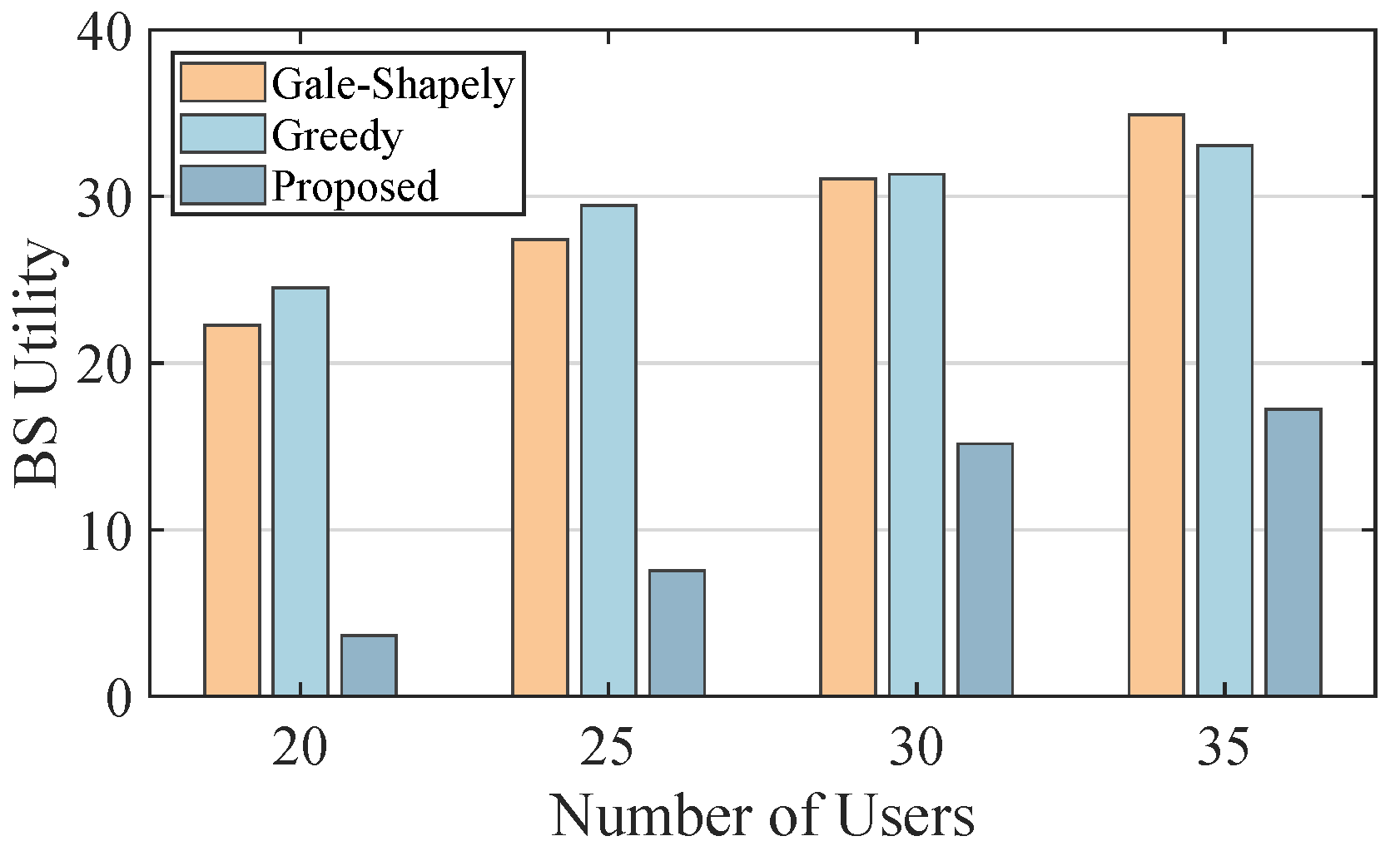
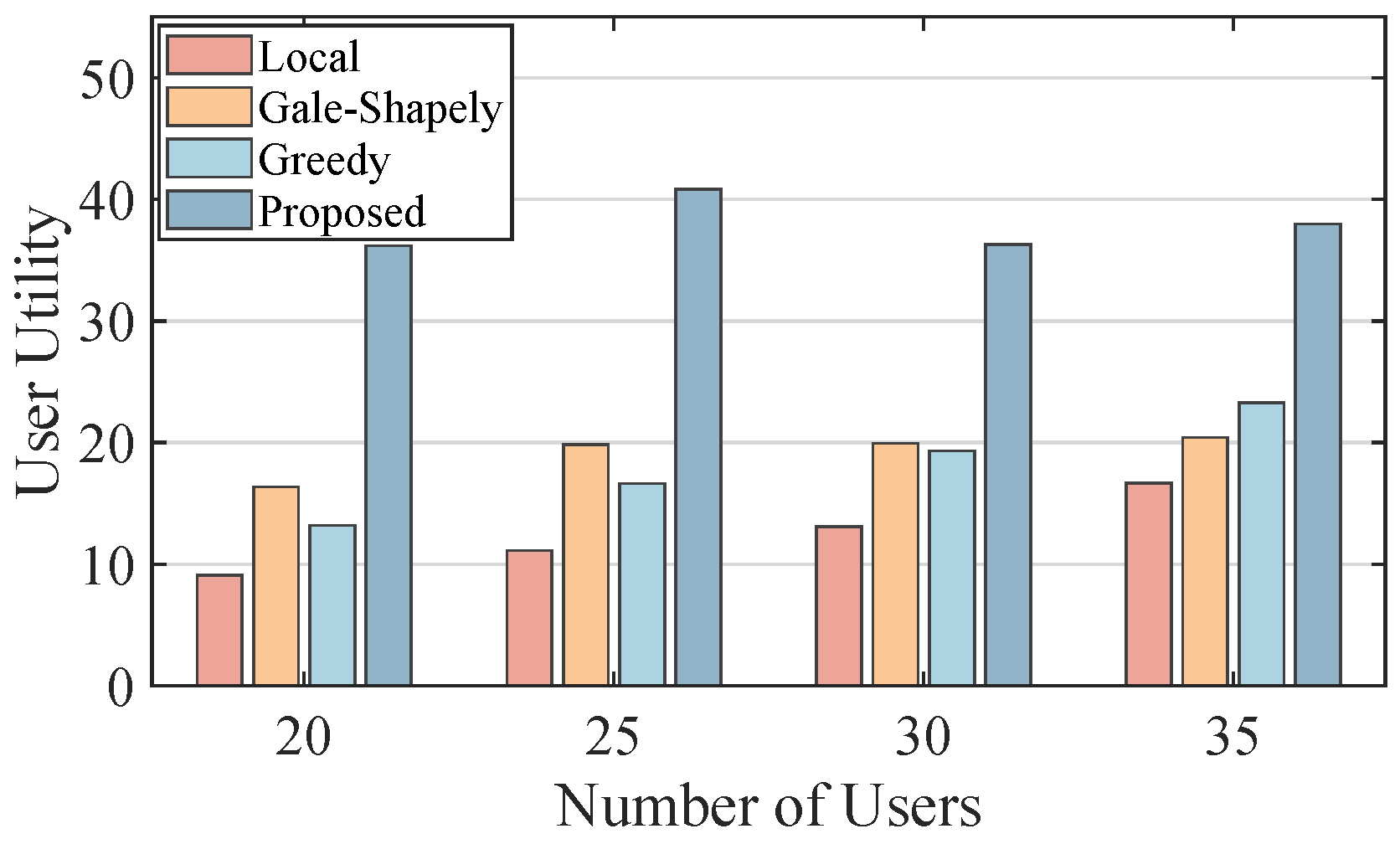
To evaluate the performance of the proposed algorithm, three benchmark schemes, namely local computing, Gale–Shapley matching [20], and a greedy strategy, are adopted for comparison. For fair comparison, the GS and Greedy baselines adopt the same initial price setting as the proposed scheme. Specifically, all users initially submit the same service price to BSs, while the association decisions are determined according to the corresponding GS matching mechanism and greedy channel-quality-based selection strategy, respectively. Unlike the proposed method, these benchmark schemes do not perform iterative bilateral price negotiation. Figure 2 and Figure 3 present the aggregated utilities of users and BSs under different numbers of users for various algorithms. As observed from Figure 2, the proposed algorithm consistently achieves the highest aggregated user utility across all user scales, significantly outperforming the other benchmark methods. This indicates that the proposed method, by jointly leveraging RIS reflection gain optimization and contract-based price negotiation, can more effectively reduce the user-side delay cost, transmission energy consumption, and resource rental cost, thereby improving the overall benefit of task offloading. As shown in Figure 3, the Gale–Shapley and Greedy methods generally achieve higher aggregated BS utility than the proposed algorithm, whereas the BS-side utility of the proposed method is relatively lower. This is because Algorithm 1 adopts a progressive price negotiation mechanism, under which users increase their bids only after their contracts are rejected, rather than engaging in aggressive price competition at the initial stage. As a result, in the final stable matching outcome, some accepted contracts are concluded at relatively low prices, which limits the rental revenue that can be obtained by the BSs. Overall, the proposed algorithm does not simply pursue the maximization of the supply-side utility, but instead achieves a more balanced bilateral tradeoff between user utility improvement and BS revenue acquisition, thereby exhibiting better comprehensive performance and adaptability in multi-user scenarios.
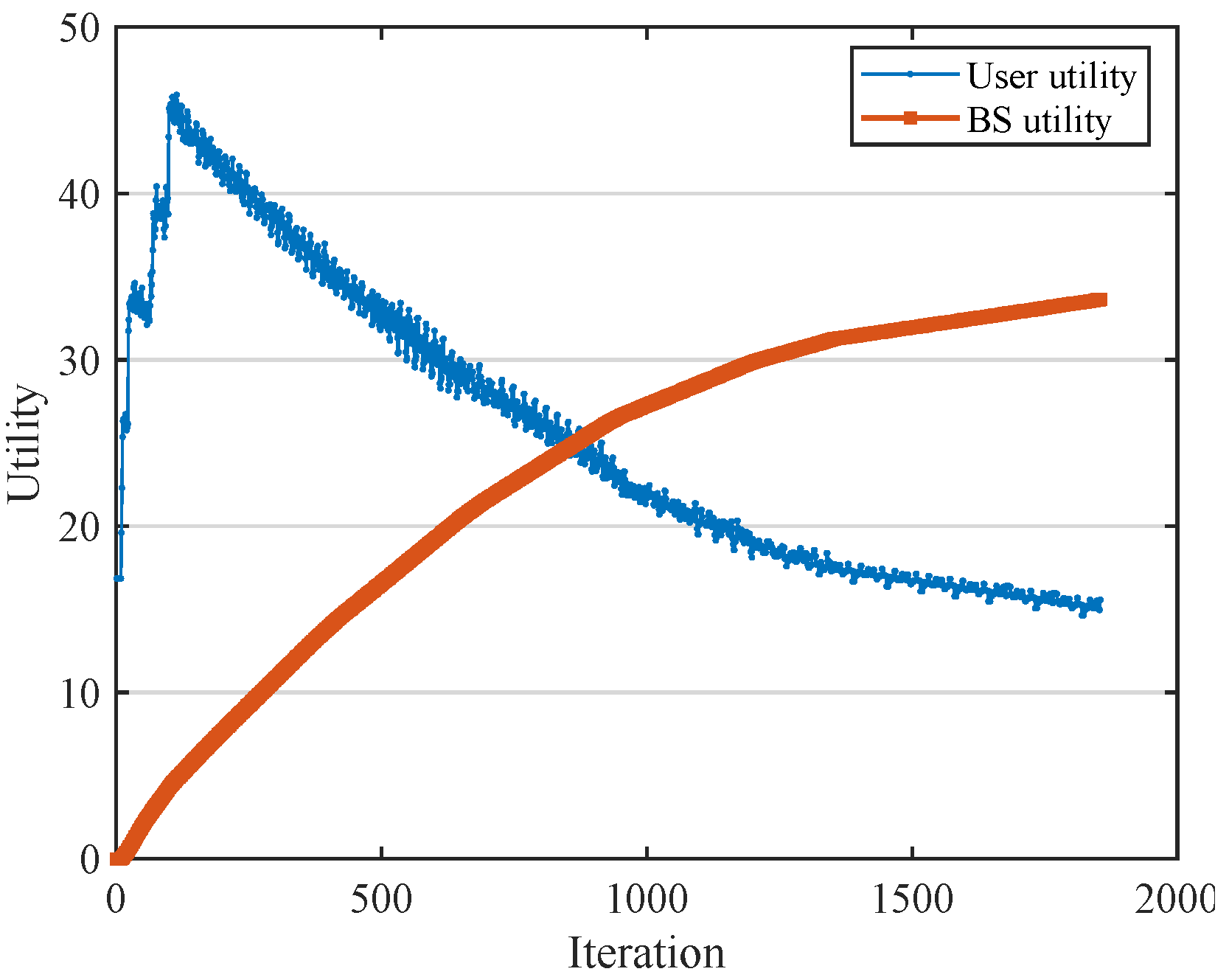
As shown in Figure 4, the utilities exhibit significant variations during the initial iterations, indicating that the price negotiation process rapidly adjusts the matching relationships between users and BSs. As the iterations proceed, both the user utility and BS utility gradually converge to stable values, while the total utility curve enters a plateau region, suggesting that the matching outcome and contract prices have reached a stable state. Moreover, the BS utility remains higher than the user utility throughout the negotiation process. This phenomenon can be attributed to the iterative price-adjustment mechanism, where rejected users continuously increase their offered prices, thereby improving the revenue of BSs. In contrast, the utility improvement of users is constrained by the increasing service payments, resulting in a relatively limited growth rate. Overall, Figure 4 demonstrates the convergence property of the proposed algorithm. The utility curves eventually stabilize without noticeable fluctuations, indicating that the system reaches a stable matching outcome after a finite number of price negotiation rounds while achieving a tradeoff between user utility and BS utility.
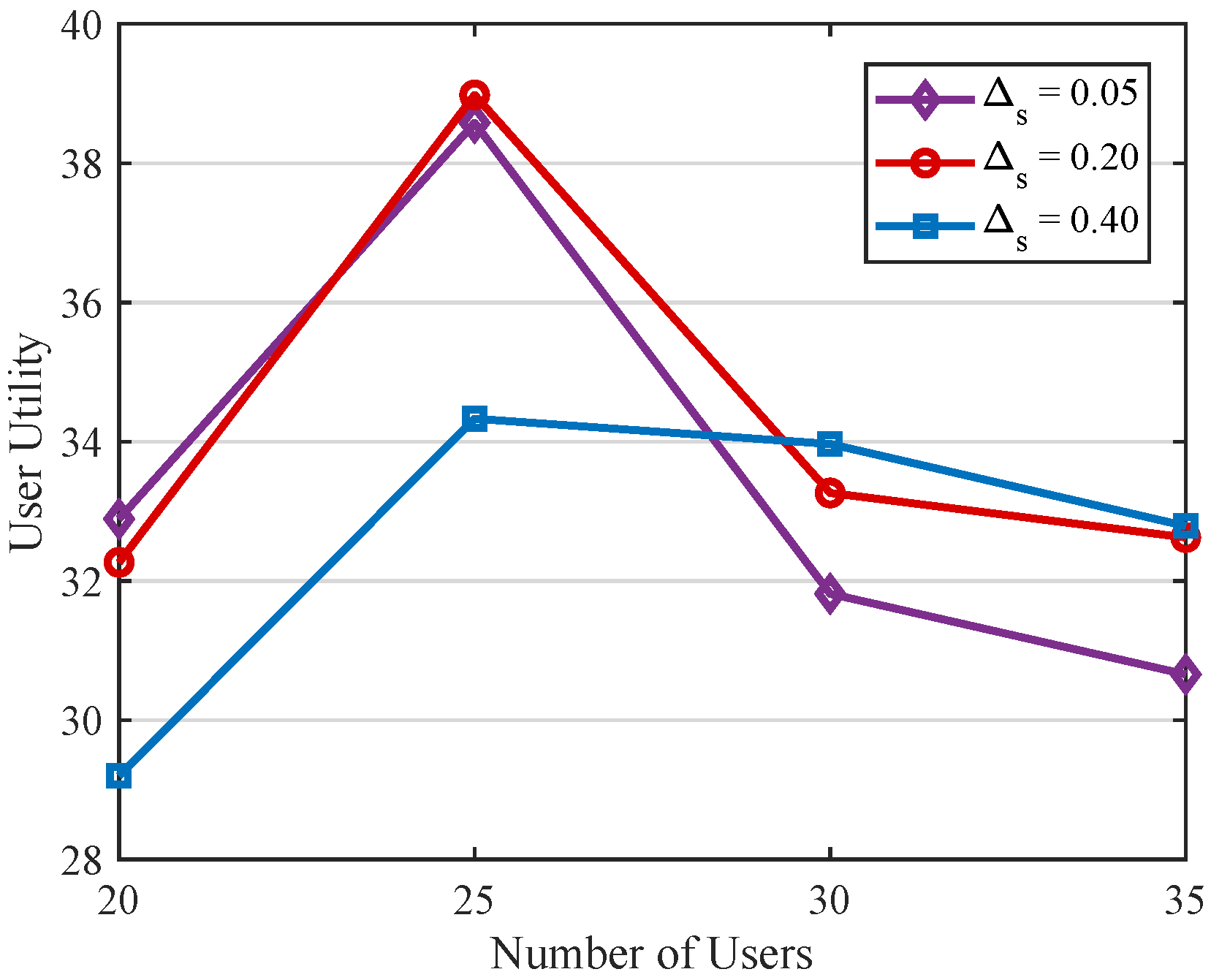
Figure 5 illustrates the impact of the price increment parameter δ s on the aggregated user utility under different numbers of users. It can be observed that different values of δ s lead to noticeable variations in the user-side performance, indicating that the price increment plays an important role in determining the benefits obtained by users. When δ s = 0.20 , the aggregated user utility remains relatively high in most cases, which suggests that a moderate price adjustment step can achieve a favorable balance between the payment cost of users and the probability of successful contract acceptance. In contrast, when δ s = 0.40 , the user utility is relatively low with a small number of users, but becomes more stable as the number of users increases. This is because a larger price increment may increase the payment burden of users, while it can also improve the likelihood that contracts are accepted by BSs, thereby mitigating the utility degradation caused by intensified resource competition.
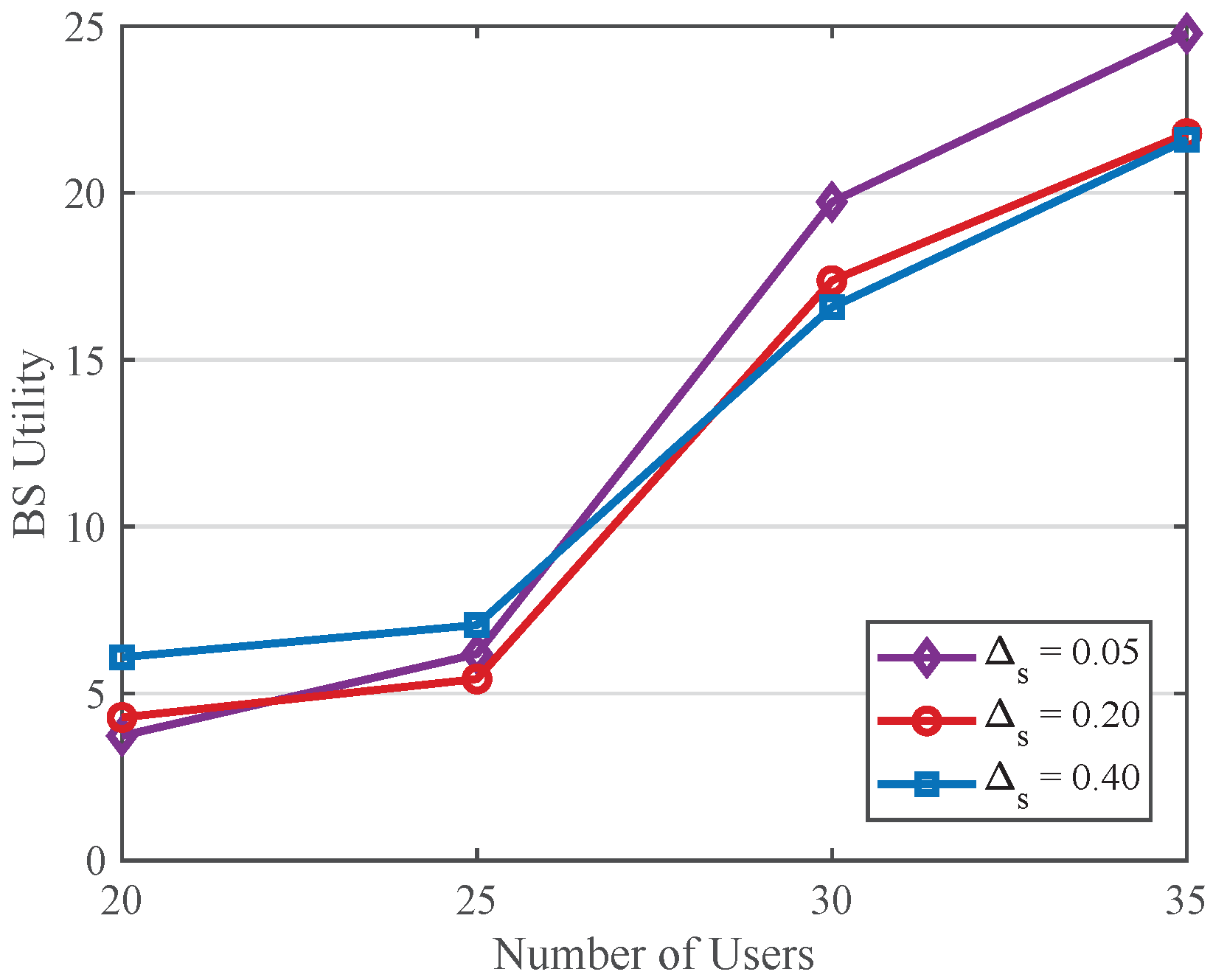
Figure 6 shows the variation in the aggregated BS utility with respect to the number of users under different values of δ s . The aggregated BS utility generally increases as the number of users grows. This is because more users participating in task offloading generate more potential service requests and resource rental revenues, thereby improving the benefits of the BSs. From the perspective of different price increments, the smaller step size δ s = 0.05 achieves the highest BS utility when the number of users is large. This is mainly because a smaller price adjustment step enables a more refined price negotiation process, and the resulting matching outcome is more likely to balance user acceptance and BS revenue. By contrast, the BS utilities achieved under δ s = 0.20 and δ s = 0.40 are slightly lower in large-scale user scenarios, implying that an excessively large price increment may reduce user utility or contract acceptability, thus limiting further improvement in BS-side revenue.
Overall, Figure 5 and Figure 6 demonstrate that the price increment δ s has different effects on the utilities of users and BSs. A larger price increment can help improve the probability of contract acceptance and maintain stable user utility under highly competitive conditions, whereas a smaller price increment is more beneficial for BSs to obtain higher revenue when the user scale is large. Therefore, the selection of δ s should carefully balance user utility and BS revenue. These simulation results further verify that the proposed price negotiation mechanism can adapt the matching outcome according to the user scale and the degree of resource competition, thereby achieving a flexible bilateral utility tradeoff under different system load conditions.

5. Conclusions

This paper investigates the computation offloading problem in an RIS-assisted mobile edge computing system without direct user-BS links. By jointly considering RIS-assisted transmission quality, task latency, energy consumption, service pricing, and base-station service capacity, a joint design framework is developed for RIS configuration, task offloading, and resource allocation. Based on the phase-alignment property of the cascaded channel, a closed-form solution for RIS phase optimization is derived, and a distributed price-negotiation-based offloading algorithm is proposed to coordinate user association and service pricing. Theoretical and simulation results show that the proposed algorithm converges to a stable and feasible outcome within a finite number of iterations while achieving a bilateral utility tradeoff between user utility improvement and BS revenue acquisition. Future work will extend the proposed framework to more practical RIS-assisted MEC scenarios by considering imperfect CSI, multi-RIS deployments, partial task offloading, dynamic task arrivals, and user mobility. In addition, more advanced market-oriented mechanisms, such as auction-based pricing, contract-theoretic incentive design, and learning-assisted price negotiation, will be investigated to further enhance resource allocation efficiency and market fairness.

Author Contributions

Conceptualization and methodology, C.X.; software and implementation, C.X.; formal analysis, S.W.; supervision, T.L.; writing—original draft preparation, C.X. and S.W.; writing—review and editing, T.L. and D.Q.; funding—D.Q. All authors have read and agreed to the published version of the manuscript.

Funding

This work was supported in part by the Guangxi Zhuang Autonomous Region Central Government Guides Local Science and Technology Development Fund Project under Grant Guike ZY24212045, and in part by the Guangxi Key Research and Development Program under Grant Guike AB25069456.

Institutional Review Board Statement

Not applicable.

Informed Consent Statement

Not applicable.

Data Availability Statement

The original contributions presented in the study are included in the article. Further inquiries can be directed to the corresponding author.

Conflicts of Interest

The authors declare no conflicts of interest.

References

  1. Wu, Q.; Xu, J.; Zhang, R. Capacity Characterization of UAV-Enabled Two-User Broadcast Channel. IEEE J. Sel. Areas Commun. 2018, 36, 1955–1971. [Google Scholar] [CrossRef]
  2. Mach, P.; Becvar, Z. Mobile Edge Computing: A Survey on Architecture and Computation Offloading. IEEE Commun. Surv. Tutor. 2017, 19, 1628–1656. [Google Scholar] [CrossRef]
  3. Zhang, L.; Niu, J.; Wang, Y.; Chen, G.; Gu, T.; Li, Y. Energy-Efficient Task Offloading in RIS-Aided HetNets with Wireless Backhaul. IEEE Commun. Lett. 2023, 27, 2531–2535. [Google Scholar] [CrossRef]
  4. Wu, Q.; Zhang, S.; Zheng, B.; You, C.; Zhang, R. Intelligent Reflecting Surface-Aided Wireless Communications: A Tutorial. IEEE Trans. Commun. 2021, 69, 3313–3351. [Google Scholar] [CrossRef]
  5. Hu, X.; Masouros, C.; Wong, K.-K. Reconfigurable Intelligent Surface Aided Mobile Edge Computing: From Optimization-Based to Location-Only Learning-Based Solutions. IEEE Trans. Commun. 2021, 69, 3709–3725. [Google Scholar] [CrossRef]
  6. Mukherjee, M.; Kumar, V.; Kumar, S.; Lloret, J.; Zhang, Q.; Guo, M. Reconfigurable Intelligent Surface-Assisted Edge Computing to Minimize Delay in Task Offloading. In Proceedings of the 2021 IEEE Global Communications Conference (GLOBECOM), Madrid, Spain, 7–11 December 2021. [Google Scholar]
  7. Huang, S.; Wang, S.; Wang, R.; Wen, M.; Huang, K. Reconfigurable Intelligent Surface Assisted Mobile Edge Computing with Heterogeneous Learning Tasks. IEEE Trans. Cogn. Commun. Netw. 2021, 7, 369–382. [Google Scholar] [CrossRef]
  8. Zheng, T.X.; Wang, X.; Chen, X.; Mao, D.; Shi, J.; Pan, C.; Huang, C.; Ding, H.; Li, Z. Reconfigurable-Intelligent-Surface-Enabled Green and Secure Offloading for Mobile Edge Computing Networks. IEEE Internet Things J. 2025, 12, 40822–40836. [Google Scholar] [CrossRef]
  9. Merluzzi, M.; Costanzo, F.; Katsanos, K.D.; Alexandropoulos, G.C.; Di Lorenzo, P. Power Minimizing MEC Offloading with QoS Constraints over RIS-Empowered Communications. IEEE Open J. Commun. Soc. 2024, 5, 1847–1863. [Google Scholar]
  10. Liu, Z.; Li, Z.; Wen, M.; Gong, Y.; Wu, Y.-C. STAR-RIS-Aided Mobile Edge Computing: Computation Rate Maximization with Binary Amplitude Coefficients. IEEE Wirel. Commun. Lett. 2024, 13, 210–214. [Google Scholar] [CrossRef]
  11. Habiba, U.; Maghsudi, S.; Hossain, E. A Repeated Auction Model for Load-Aware Dynamic Resource Allocation in Multi-Access Edge Computing. IEEE Trans. Mob. Comput. 2024, early access. [Google Scholar] [CrossRef]
  12. Liu, L.; Wang, Y.; Zhang, X.; Han, Z. A Truthful Reverse Auction Mechanism for Federated Learning Resource Allocation in Cloud-Edge Collaborative Systems. Mathematics 2023, 11, 4968. [Google Scholar] [CrossRef]
  13. Su, C.; Ye, F.; Tian, Y.; Zhang, H.; Peng, M. Matching with Contracts-Based Resource Trading and Price Negotiation in Multi-Access Edge Computing. IEEE Wirel. Commun. Lett. 2021, 10, 1487–1491. [Google Scholar] [CrossRef]
  14. Mi, X.; Song, Y.; Yang, C.; Han, Z.; Yuen, C. MAGIC: Matching Game-Based Resource Allocation with Incomplete Information in Space Communication Network. IEEE Trans. Commun. 2024, 72, 3481–3494. [Google Scholar] [CrossRef]
  15. Li, P.; Wang, Y.; Liu, M.; Liu, H. Matching Game Based Resource Allocation Scheme for Adaptive Semantic and Bit Communication Networks. In 2024 IEEE 99th Vehicular Technology Conference (VTC2024-Spring), Singapore; IEEE: Piscataway, NJ, USA, 2024; pp. 1–7. [Google Scholar]
  16. Yang, Y.; Gong, Y.; Wu, Y.-C. Intelligent-Reflecting-Surface-Aided Mobile Edge Computing with Binary Offloading: Energy Minimization for IoT Devices. IEEE Internet Things J. 2022, 9, 12973–12983. [Google Scholar] [CrossRef]
  17. Bayat, S.; Li, Y.; Song, L.; Han, Z. Matching Theory: Applications in Wireless Communications. IEEE Signal Process. Mag. 2016, 33, 103–122. [Google Scholar] [CrossRef]
  18. Hatfield, J.W.; Milgrom, P.R. Matching with Contracts. Am. Econ. Rev. 2005, 95, 913–935. [Google Scholar] [CrossRef]
  19. Chu, Z.; Xiao, P.; Shojafar, M.; Mi, D.; Mao, J.; Hao, W. Intelligent Reflecting Surface Assisted Mobile Edge Computing for Internet of Things. IEEE Wirel. Commun. Lett. 2021, 10, 619–623. [Google Scholar] [CrossRef]
  20. Mirza, J.; Ali, B.; Javed, M.A. Stable Matching for Selection of Intelligent Reflecting Surfaces in Multiuser MISO Systems. IEEE Commun. Lett. 2021, 25, 2748–2752. [Google Scholar] [CrossRef]
Figure 1. System model.
Telecom 07 00071 g001
Figure 2. Aggregated user utility.
Telecom 07 00071 g002
Figure 3. Aggregated BS utility.
Telecom 07 00071 g003
Figure 4. Convergence behavior of the proposed algorithm.
Telecom 07 00071 g004
Figure 5. Aggregated user utility under different values of Δ s .
Telecom 07 00071 g005
Figure 6. Aggregated BS utility under different values of Δ s .
Telecom 07 00071 g006
Table 1. Main Notations.
SymbolDescription
NSet of users
MSet of BSs
ρ n m User association variable
π n m Service price
F m Computing capability of BS m
Θ n m RIS phase-shift matrix for user–BS pair ( n , m )
U n User utility
O m BS utility
G m Maximum service capacity
Table 2. Simulation Parameters.
ParameterValue
Number of BSs M4
Number of RIS elements L100
User transmit power p n 0.2 W
BS computing capability F m Uniform[5, 10] GHz
Maximum served users G m Uniform[3, 5]
Task size D n Uniform[200, 500] KB
Computation density C n 1000 cycles/bit
Path-loss exponent η 2.2
Noise PSD N 0 174 dBm/Hz
Bandwidth B2 MHz
Price increment Δ S 0.02
Number of RIS elements100
Disclaimer/Publisher’s Note: The statements, opinions and data contained in all publications are solely those of the individual author(s) and contributor(s) and not of MDPI and/or the editor(s). MDPI and/or the editor(s) disclaim responsibility for any injury to people or property resulting from any ideas, methods, instructions or products referred to in the content.