
Spectral Efficiency Enhancement in V2X Communications via Joint Subcarrier Assignment and Power Allocation: A Multi-DQN Agent Approach


 ,
,  ,
, 
Abstract
1. Introduction
1.1. NOMA-V2X Literature Review
1.2. Using ML and DRL with V2X Literature Review
1.3. Contribution and Organization
- Problem formulation and benchmarking: We formulate the joint subcarrier (SC) assignment and power allocation problem specifically for NOMA downlink V2X communication systems. The paper introduces an enhanced conventional algorithm that utilizes an exhaustive search approach. Unlike concurrent work that utilizes local optimization techniques, the proposed enhanced conventional algorithm conducts an exhaustive search over the subcarrier assignment space together with iterative power optimization. Therefore, the algorithm can find a near-optimal solution with respect to the considered search space and system assumptions, at the cost of considerably increased computational complexity. The enhanced conventional methodology is initially applied to solve this problem, serving as a baseline for performance comparison.
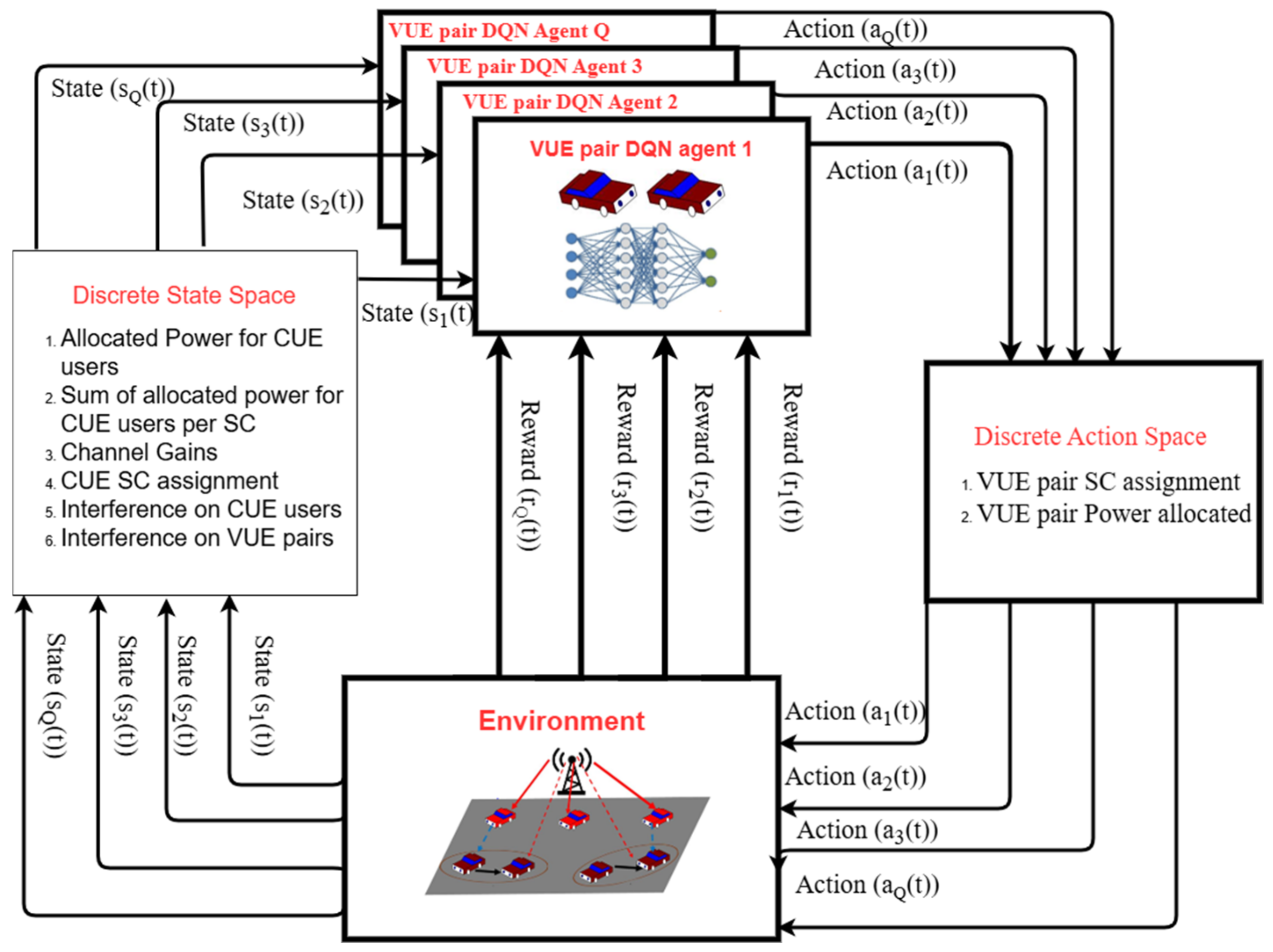
- Proposal of Multi-DQN framework: This paper introduces a novel Multi-Agent Deep Q-Network (Multi-DQN) framework designed to optimize subcarrier (SC) assignment and power allocation in V2X environments. Unlike the conventional models presented in [10], our approach utilizes a decentralized architecture where each VUE pair operates as an autonomous DQN agent. By shifting the decision-making process to the edge, the model significantly reduces the cross-correlation between VUE and CUE operations, thereby simultaneously enhancing the performance and reliability of both user groups.
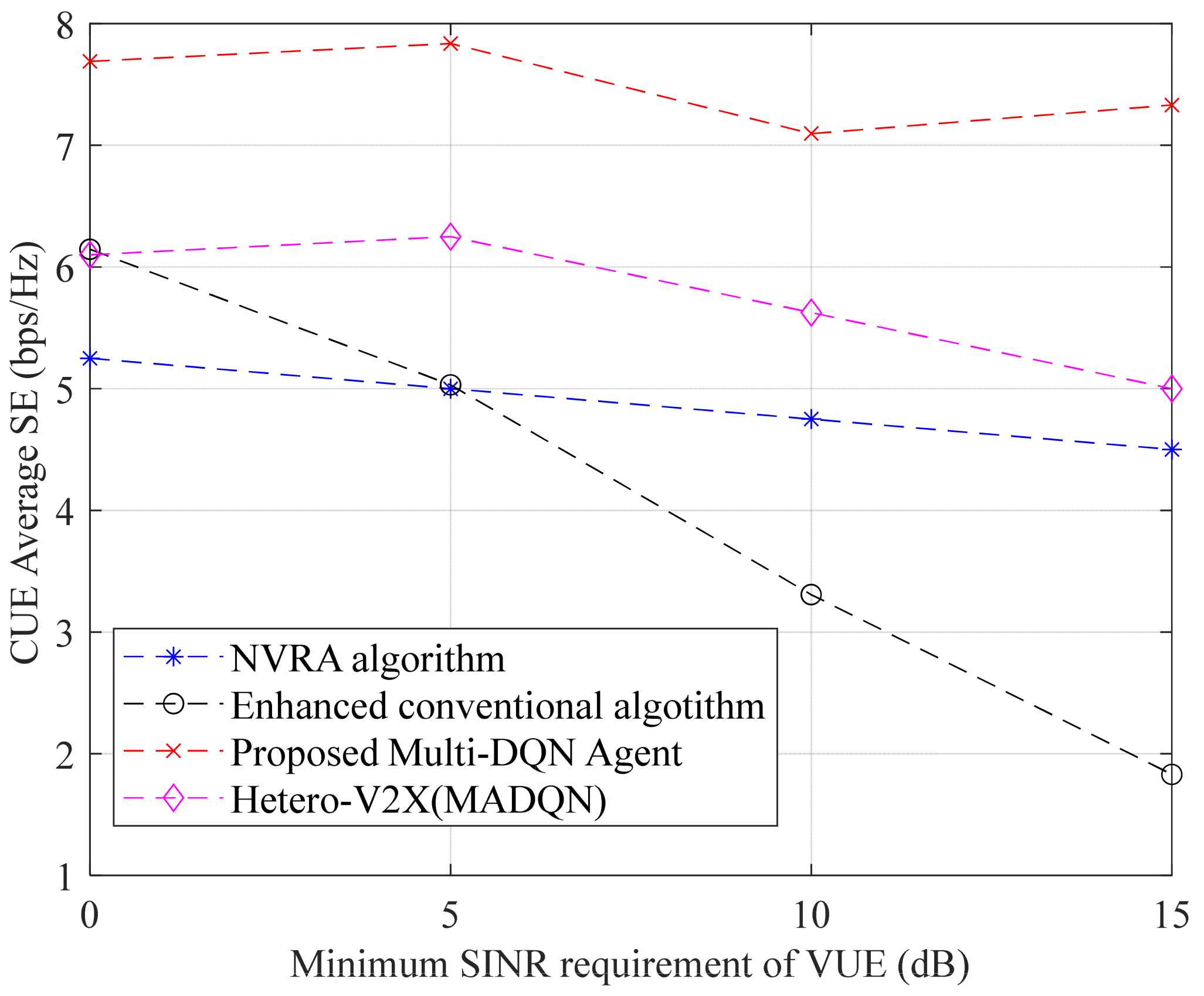
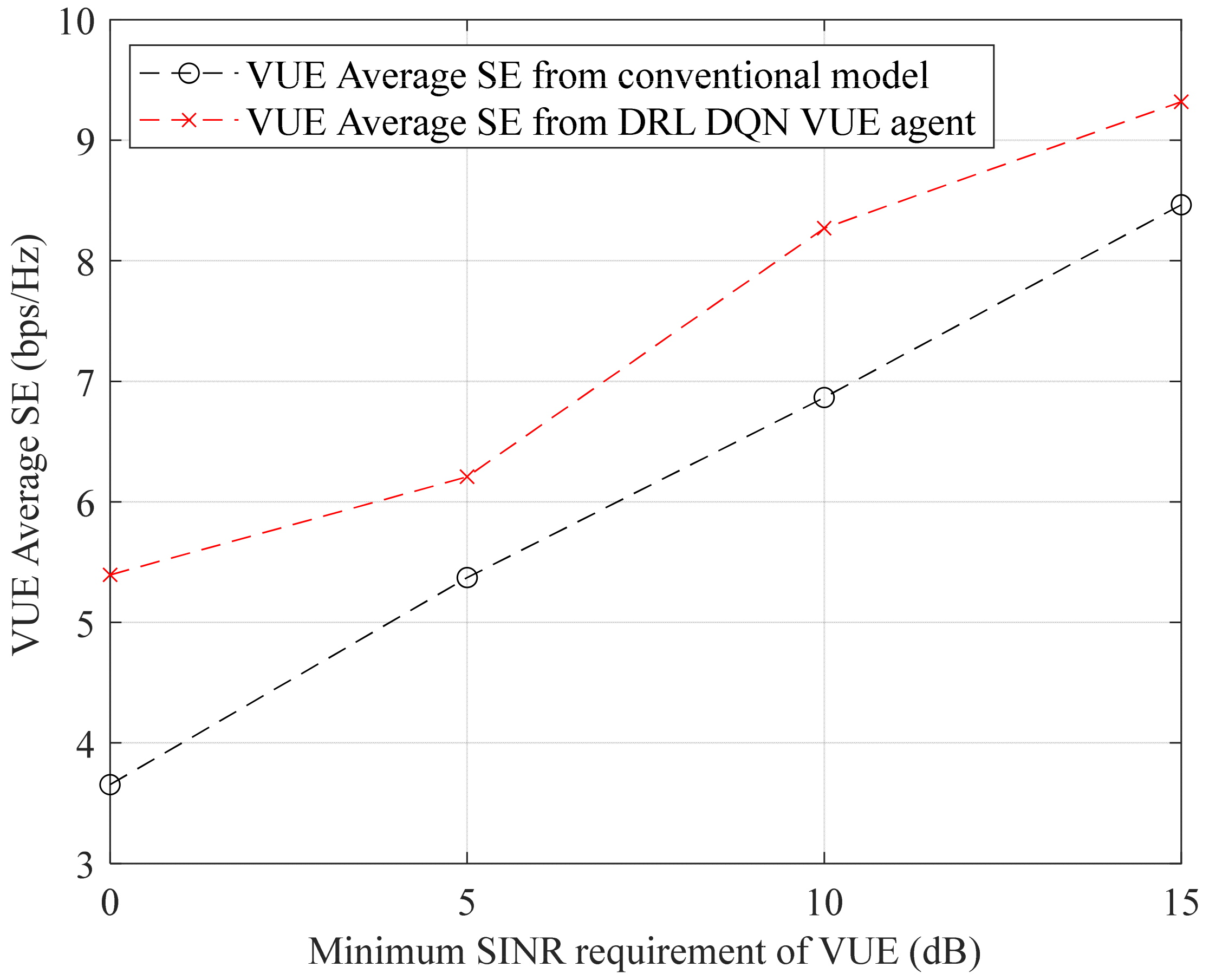
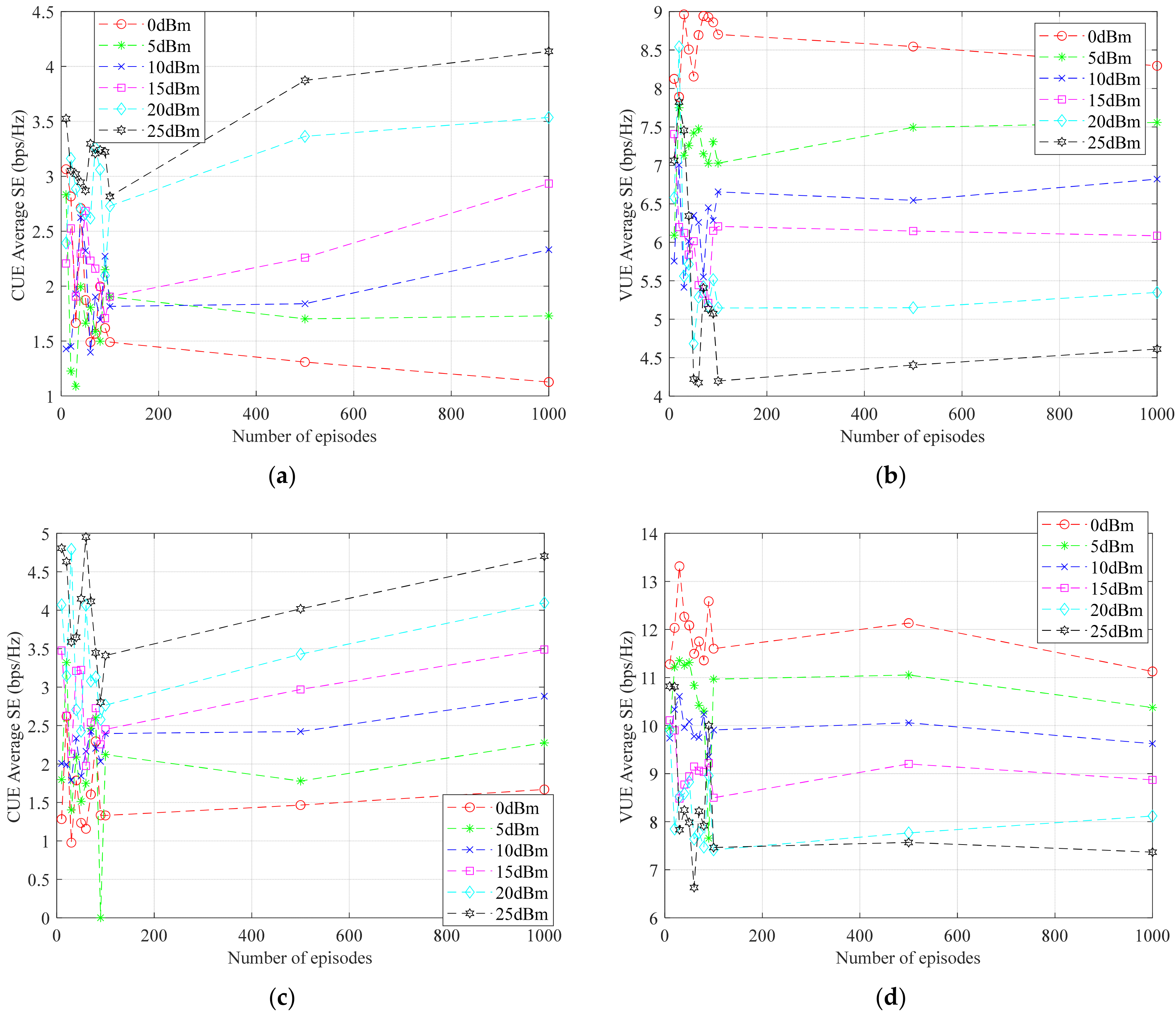
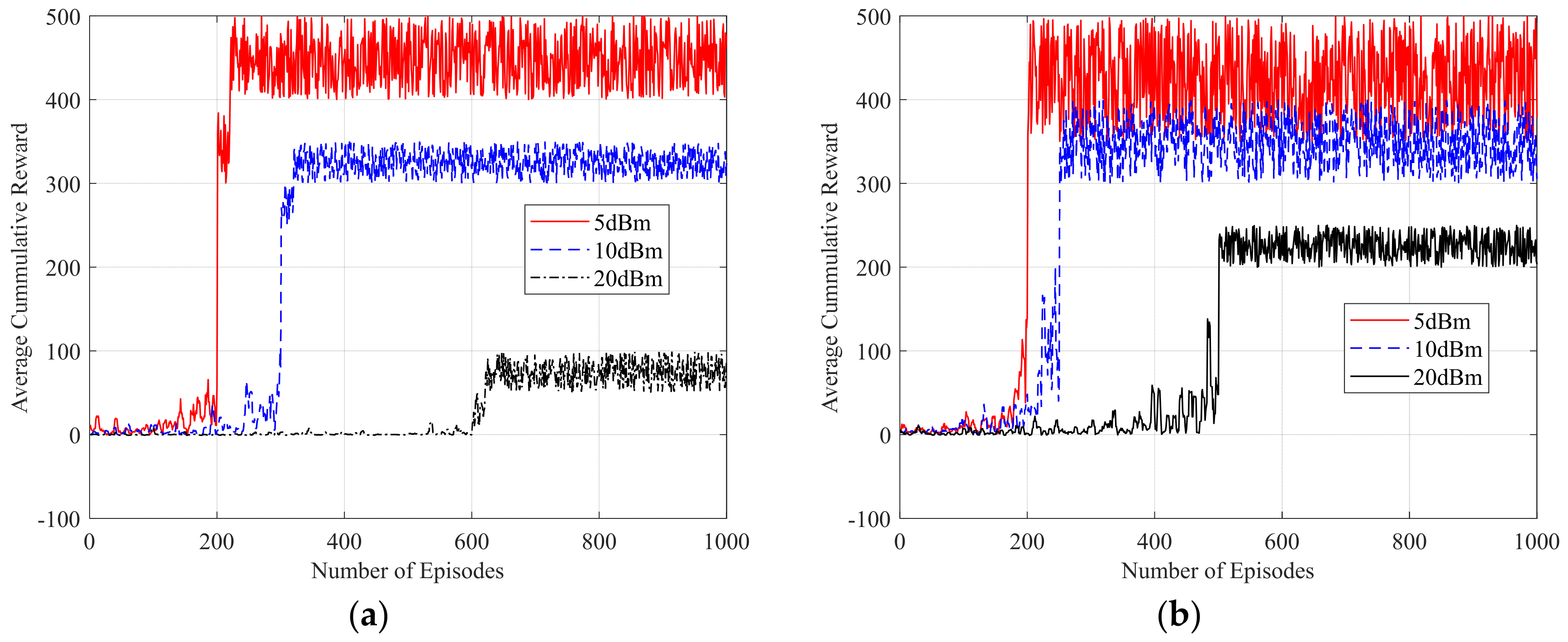
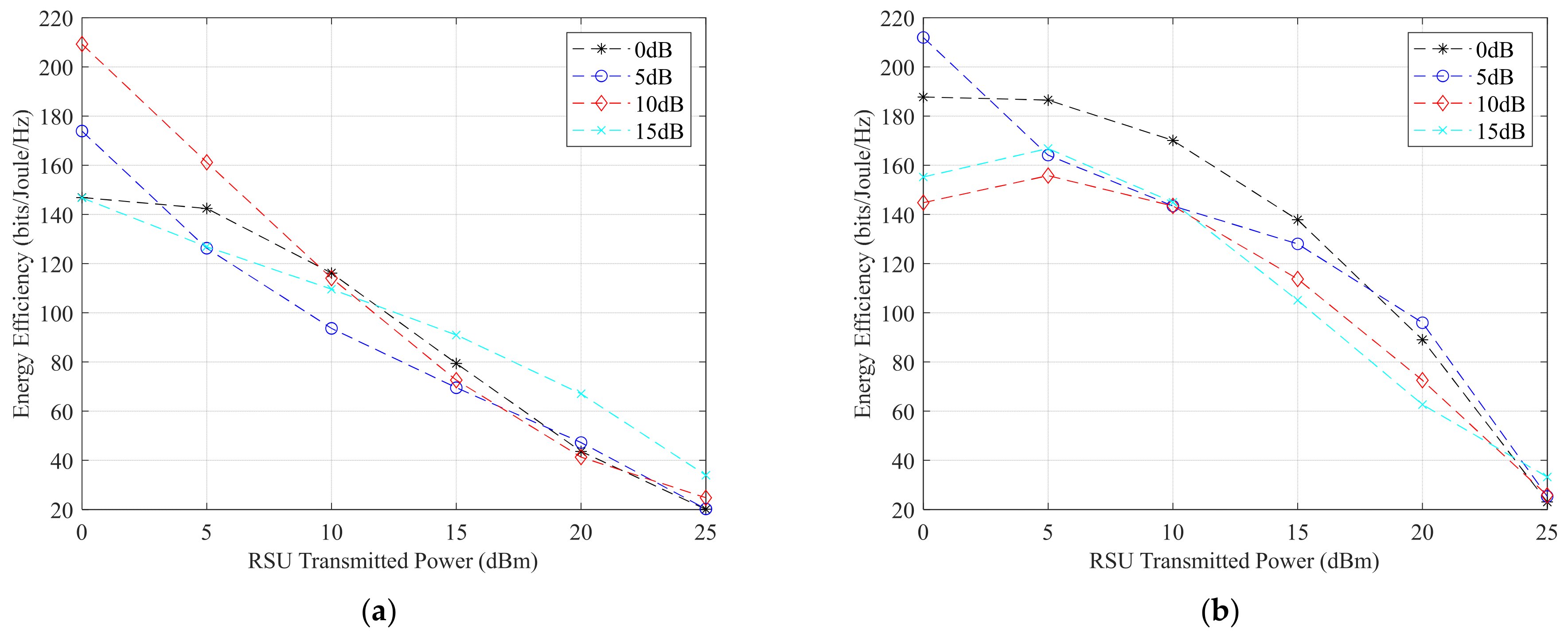
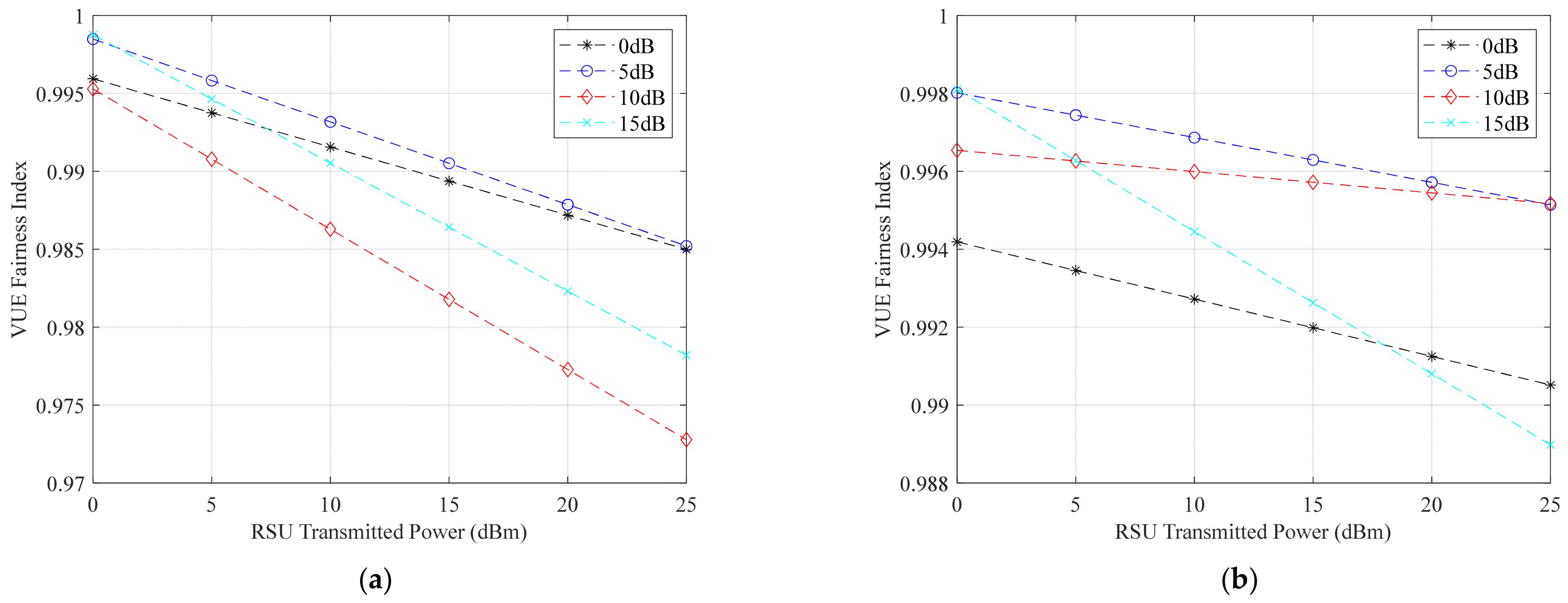
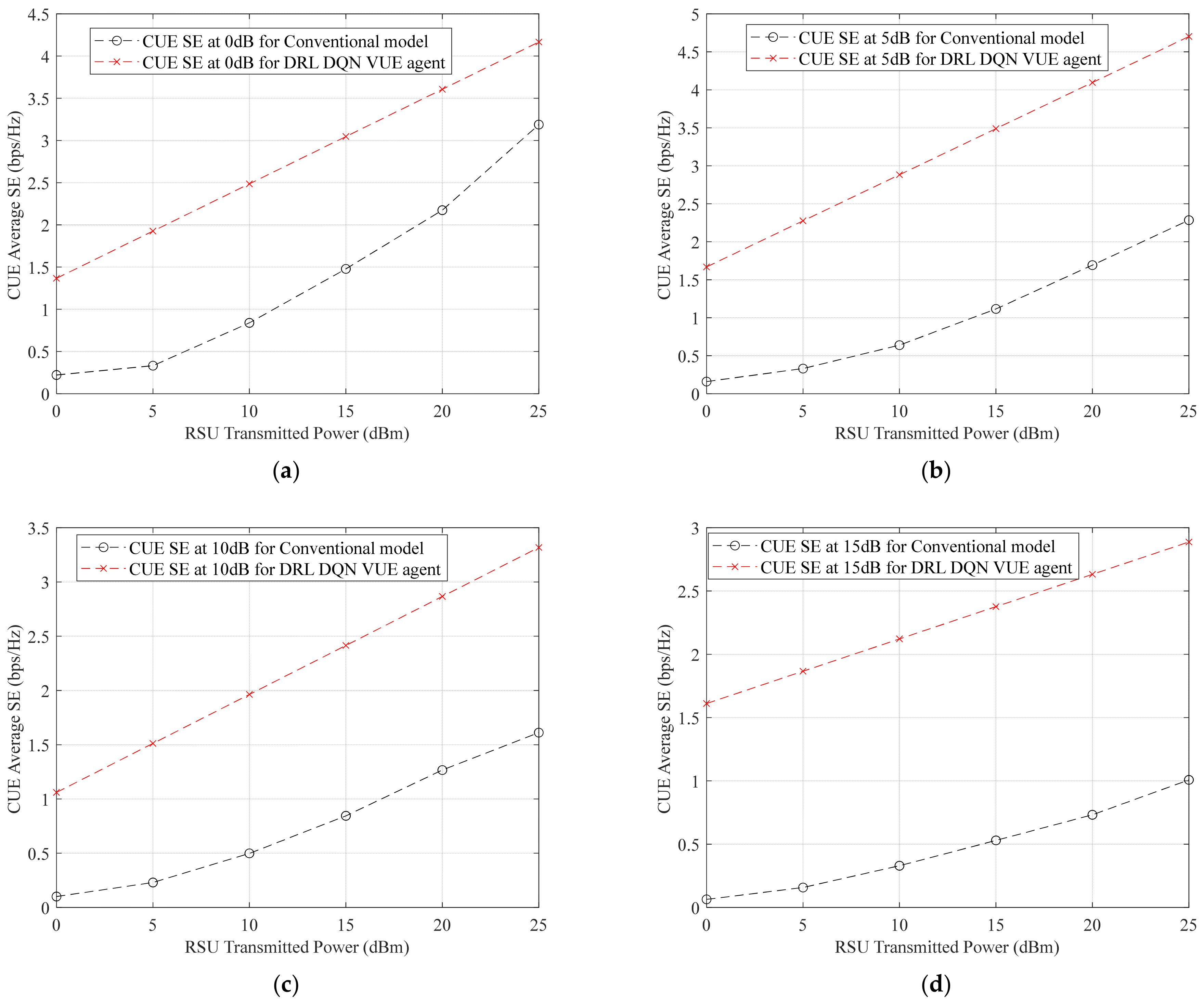
- Performance evaluation: We benchmark the proposed Multi-DQN agent against established conventional models. Our simulation results reveal a dual advantage: the Multi-DQN approach not only achieves superior spectral efficiency (SE) but also minimizes the computational complexity, proving that it is both more effective and more scalable than current benchmarks. Moreover, a comprehensive performance evaluation including EE, fairness, and convergence behavior is provided. Furthermore, we investigate the system performance in different environments under both line-of-sight (LOS) and non-line-of-sight (NLOS) scenarios, addressing a gap in prior research.
2. System Model
3. Enhanced Conventional Optimization Algorithm
| Algorithm 1: Enhanced conventional algorithm |
| Inputs: |
| 1: Step 1: Swapping Step |
| 2: for each swap do |
| 3: Step 1a: Apply Algorithm 2 4: Step 1b: Apply Algorithm 3 |
| 5: end for |
| 6: Step 2: Find . |
| 7: Step 3: Find |
| 8: Step 4: Find |
| 9: Step 5: Find and Outputs: , , , |
| Algorithm 2: Power allocation for CUE users |
| Inputs: , , |
| 1: While do |
| 2: |
| 3: Find the spectral radius of using Equation (13) 4: if do |
| 5: |
| 6: else |
| 7: |
| 8: end if |
| 9: end while |
| 10: |
| Output: optimum power allocated vector as shown in Equation (14) |
| Algorithm 3: Power allocation algorithm for VUE pairs and SC assignment for VUE pairs |
| Inputs: Power allocation and SC assignment for CUE users |
| 1: for n = 1:N (each SC) do |
| 2: for j = 1:Q (each VUE pair) do |
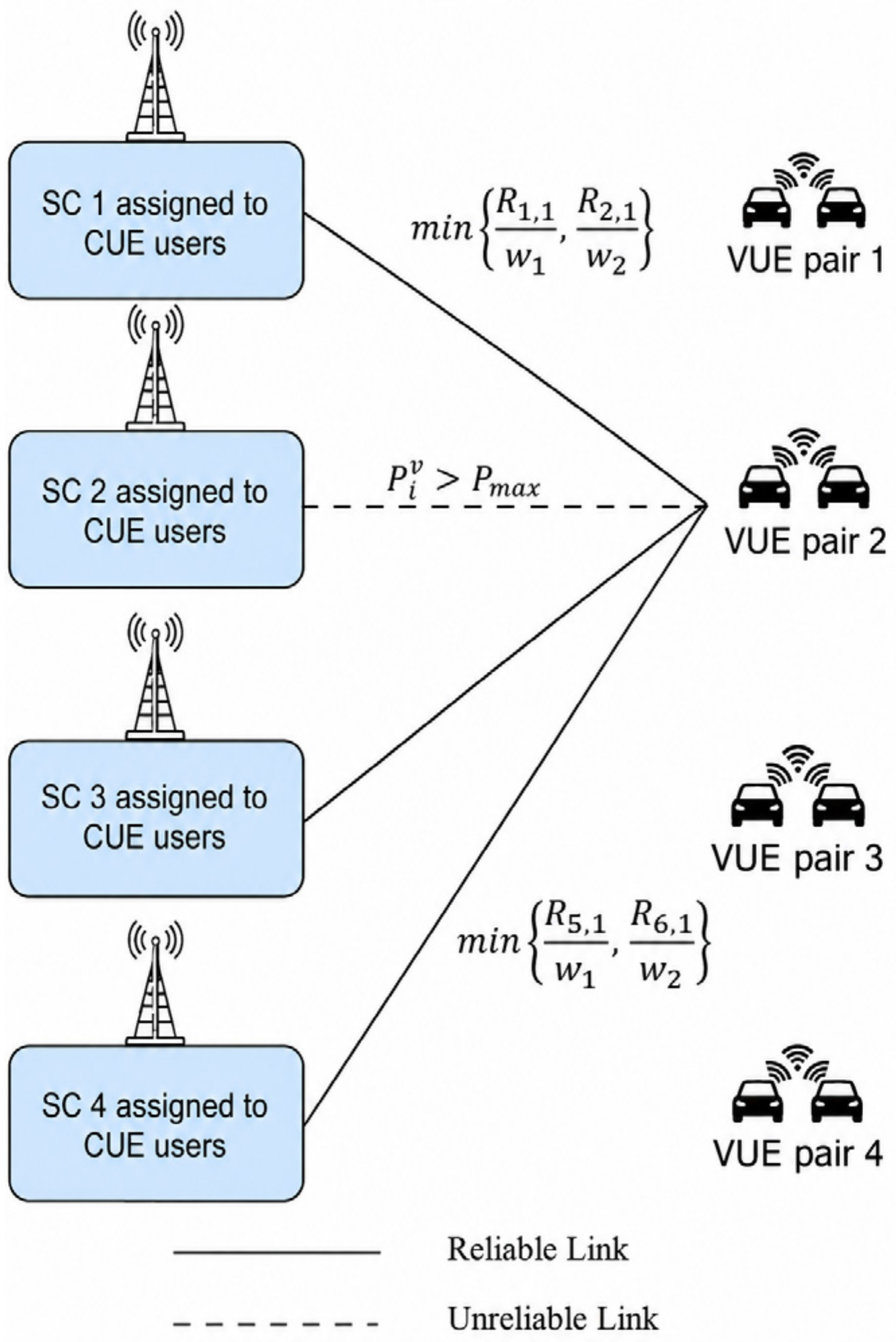
| 3: Find the reliability of each link between and VUE pair by calculating |
| 4: using Equation (15) |
| 5: if , do |
| 6: calculate |
| 7: end if |
| 8: end for |
| 9: end for |
| 10: Apply Kuhn–Munkres Algorithm to find and |
| Output: Find and |
4. DRL Approach for VUE Pair Resource Allocation
4.1. DRL Definitions and Preliminaries
4.2. Multi-DQN Agent Decentralized DRL Algorithm
- State Space
- Action StateEach VUE pair agent will independently determine its SC assignment selection and the power allocated for the VUE pair based on the observed state from the environment. Therefore, we define the action space for each VUE pair agent as , and , which represents the VUE pair agent SC allocation and the power level of the VUE pair agent, respectively. The transmit power of VUE has power levels. Consequently, the size of the action space is .Although transmit power allocation is naturally a continuous variable, the suggested framework divides the VUE transmit power into a limited set of predetermined power levels to be compatible with the DQN architecture. The DQN architecture works on discrete action spaces. This discretization greatly decreases the action space dimensionality and enhances the training stability and convergence behavior.
- RewardOne of the main advantages of DRL is its ability to address decision-making problems and to build a flexible reward structure to deal with complex, multi-constraint objectives and constrained problems [25]. The environment will provide an immediate reward after the agent executes an action in accordance with the policy and observed state. The reward indicates the success of the decision taken by the proposed policy. Therefore, the reward function is expressed as follows:
| Algorithm 4: Multi-DQN agent decentralized DRL algorithm |
| Inputs: Discount factor , learning rate , replay memory size, target update frequency, epsilon-greedy, mini-batch size, number of episodes |
| Initialize: Initialize the DNN for each agent with random weights the same as the action value function . Initialize the discrete state space and the discrete action space. Then, the VUE pairs randomly select actions until sorting number of transitions in the replay memory. |
| 1: for each episode do |
| 2: Observe the state |
| 3: for each step in each episode do |
| 4: Each DQN agent (VUE pair) selects an action |
| 5: Obtain the current reward and next state , then store the transition tuples in the replay memory |
| 6: end for |
| 7: end for |
4.3. Computational Complexity
5. Simulation Results
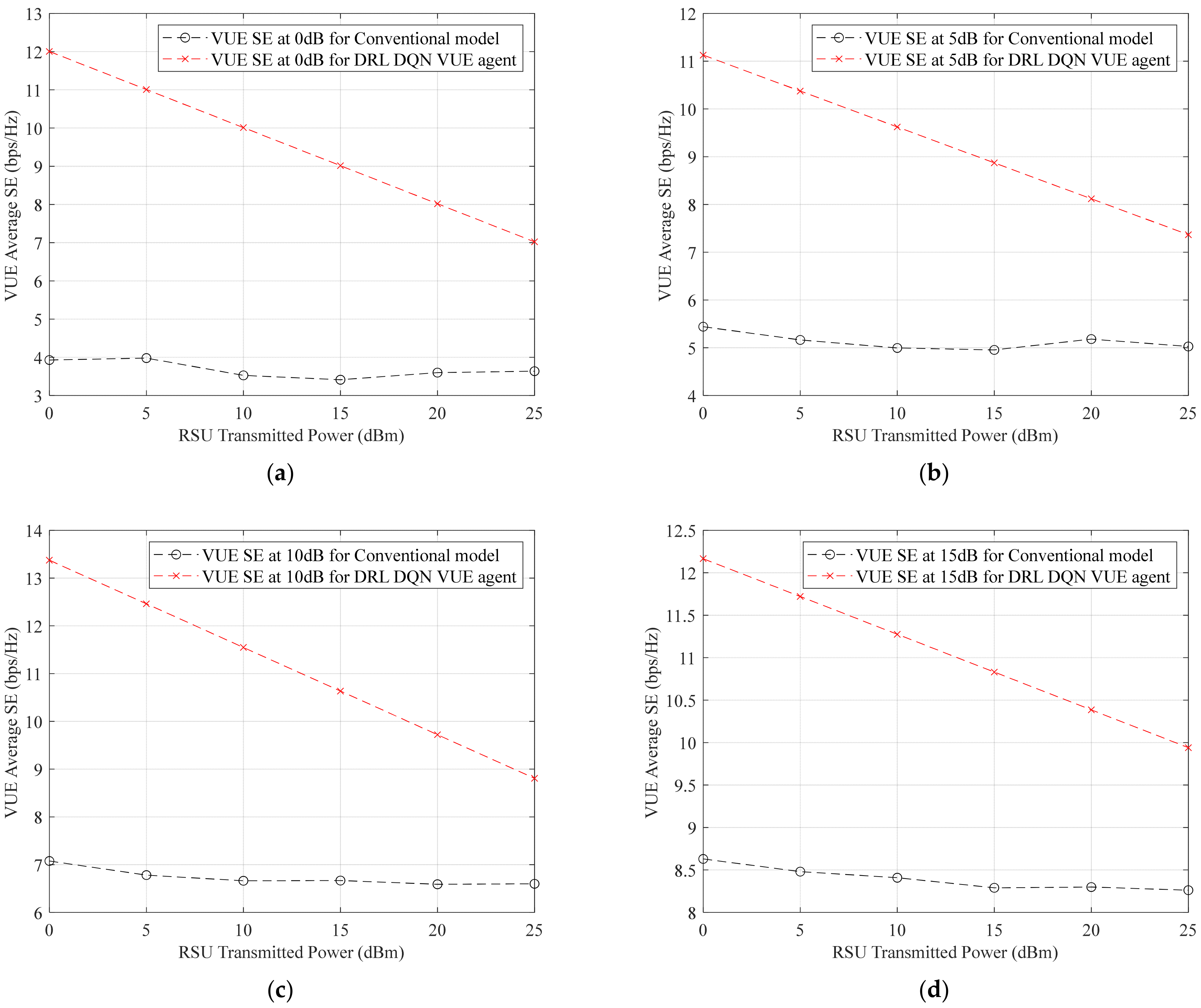
5.1. DRL Framework and Enhanced Conventional Model Benchmarking
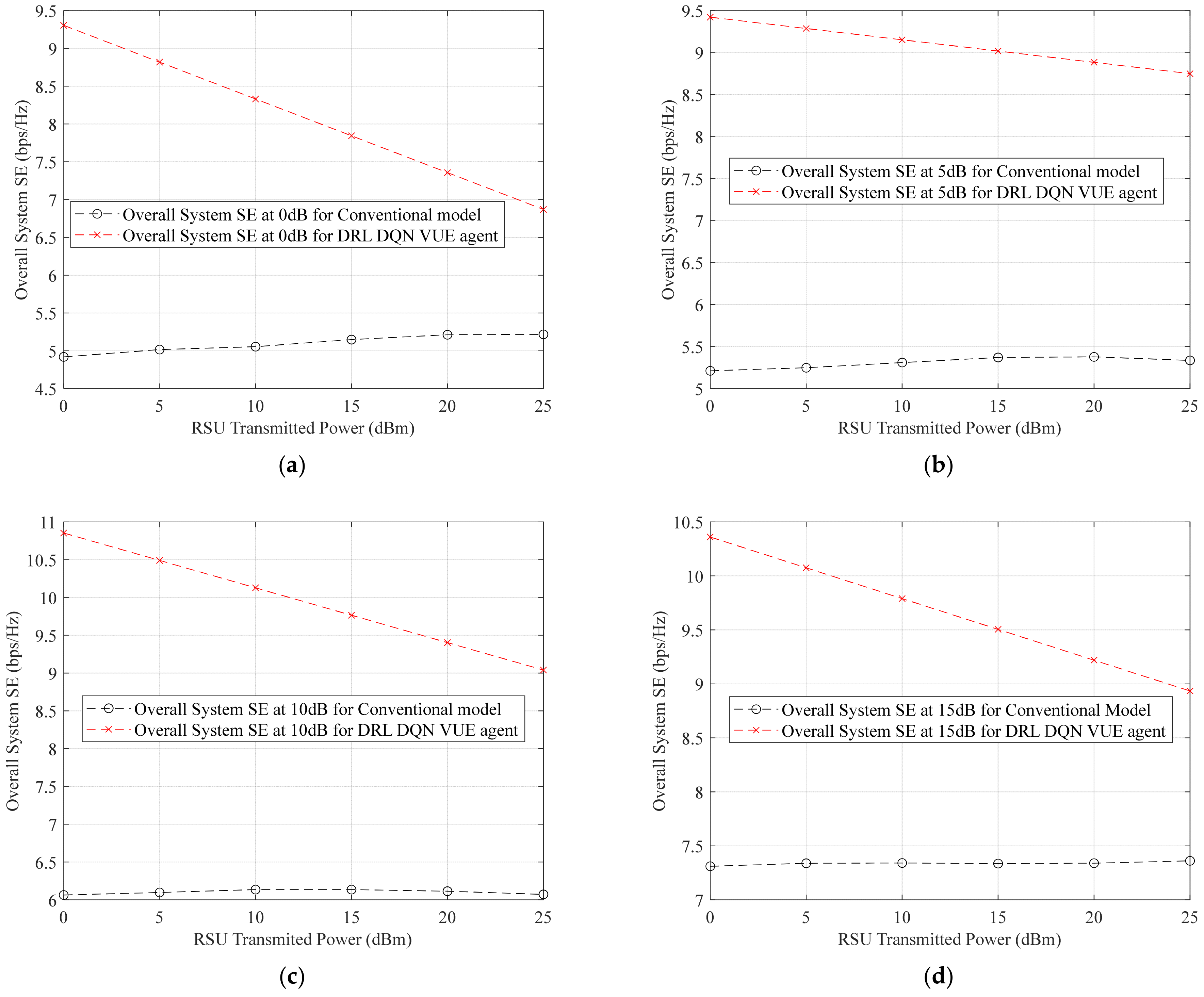
5.2. DRL Framework and Enhanced Conventional Model for LOS Scenario
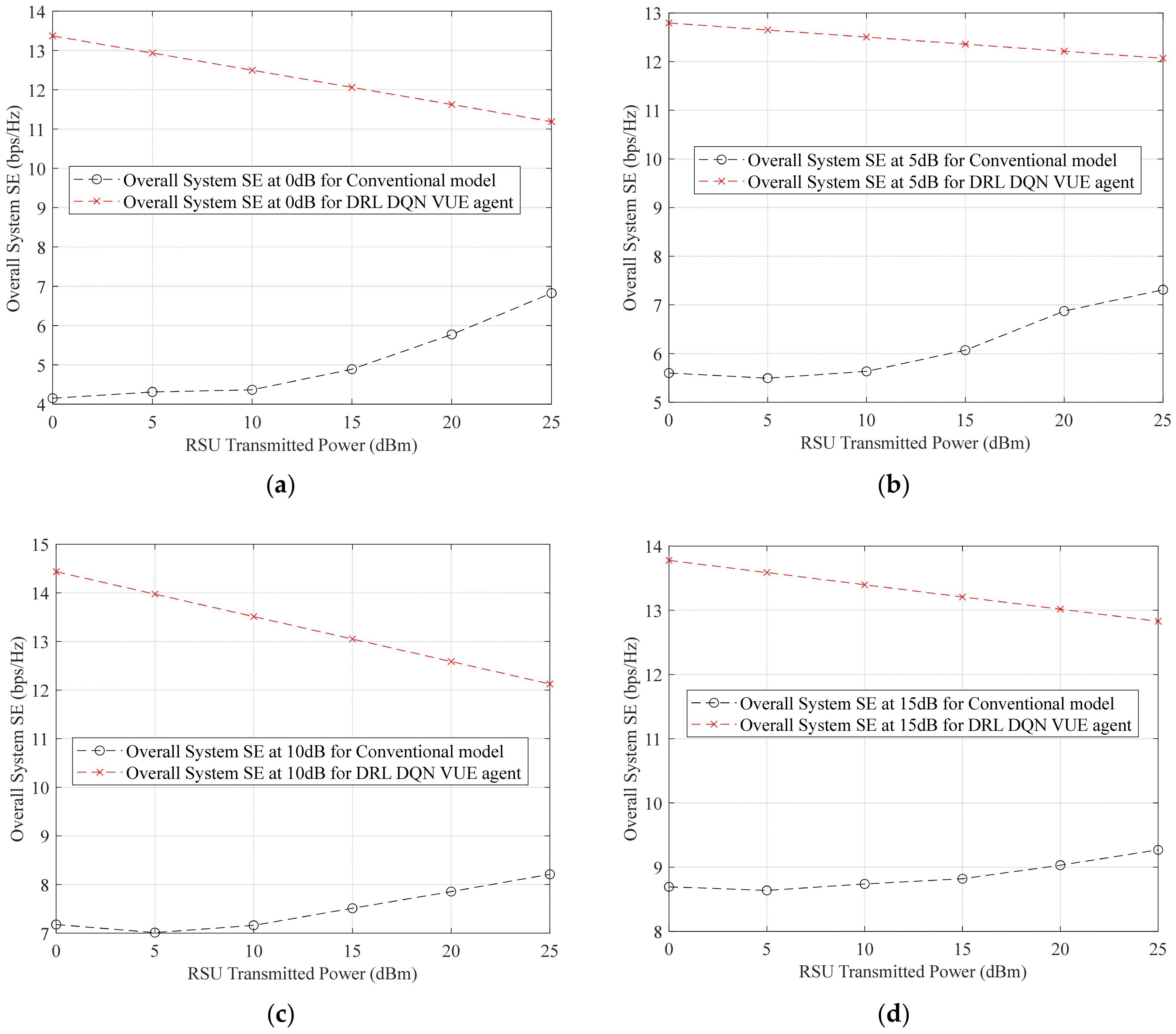
5.3. DRL Framework and Enhanced Conventional Model for NLOS Scenario
5.4. Overall System Performance
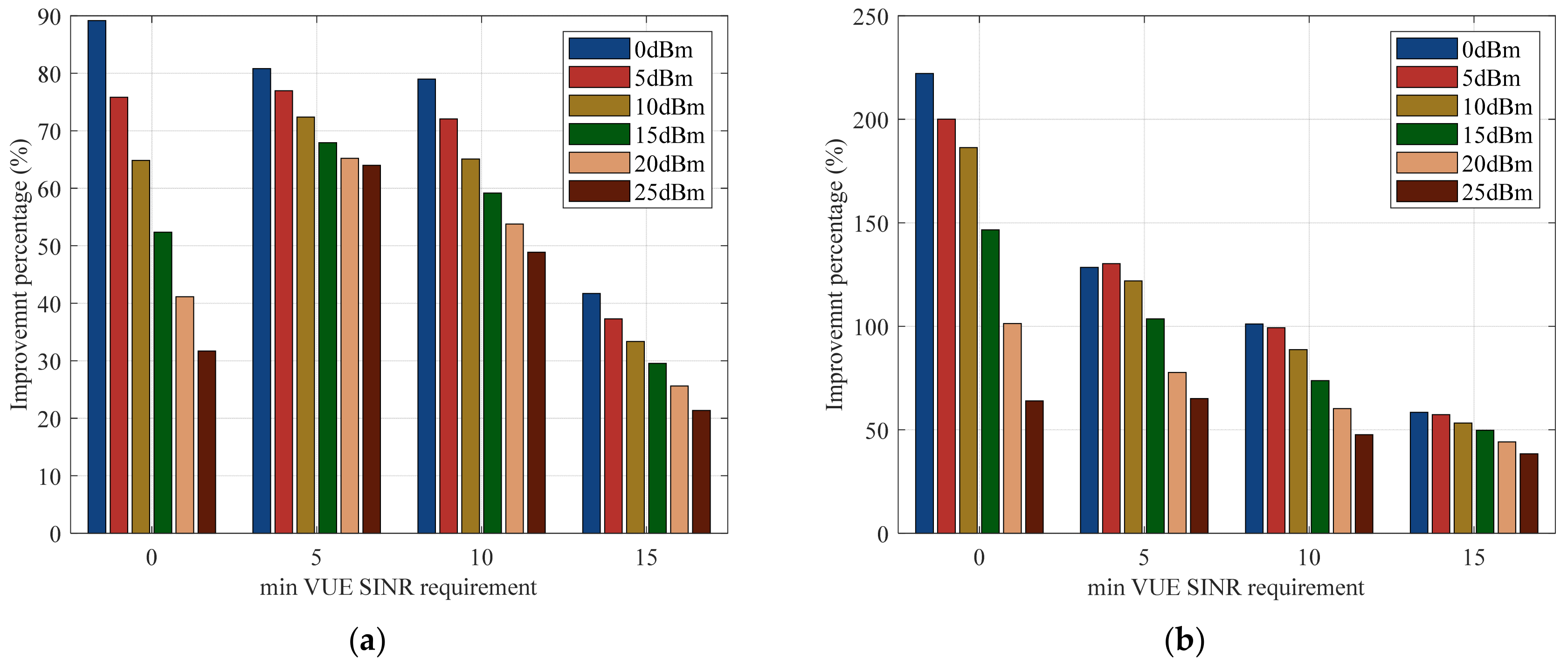
5.5. Additional Performance Metric Evaluation
6. Conclusions
Author Contributions
Funding
Institutional Review Board Statement
Informed Consent Statement
Data Availability Statement
Conflicts of Interest
References
- Garcia, M.H.C.; Molina-Galan, A.; Boban, M.; Gozalvez, J.; Coll-Perales, B.; Sahin, T.; Kousaridas, A. A Tutorial on 5G NR V2X Communications. IEEE Commun. Surv. Tutor. 2021, 23, 1972–2026. [Google Scholar] [CrossRef]
- 3GPP (3rd Generation Partnership Project). Technical Specification Group Radio Access Network; Study on LTE-Based V2X Services; TR 36.885 V14.0.0; 3GPP: Nice, France, 2016. [Google Scholar]
- Chen, S.; Hu, J.; Shi, Y.; Peng, Y.; Fang, J.; Zhao, R.; Zhao, L. Vehicle-to-Everything (V2x) Services Supported by LTE-Based Systems and 5G. IEEE Commun. Stand. Mag. 2017, 1, 70–76. [Google Scholar] [CrossRef]
- 3GPP. Study on Evaluation Methodology of New V2X Use Cases; 3GPP: Nice, France, 2017. [Google Scholar]
- 3GPP (3rd Generation Partnership Project). Technical Specification Group Services and System Aspects; Release 16 Description; Summary of Rel-16 Work Items; 3GPP: Nice, France, 2022. [Google Scholar]
- Liu, Z.; Lee, H.; Khyam, M.O.; He, J.; Pesch, D.; Moessner, K.; Saad, W.; Poor, H.V. 6G for Vehicle-to-Everything (V2X) Communications: Enabling Technologies, Challenges, and Opportunities. Proc. IEEE 2022, 110, 712–734. [Google Scholar] [CrossRef]
- Giordani, M.; Polese, M. Towards 6G Networks: Use Cases and Technologies. IEEE Commun. Mag. 2020, 58, 55–61. [Google Scholar] [CrossRef]
- Ji, M.; Wu, Q.; Fan, P.; Cheng, N.; Chen, W.; Wang, J.; Letaief, K.B. Graph Neural Networks and Deep Reinforcement Learning-Based Resource Allocation for V2X Communications. IEEE Internet Things J. 2025, 12, 3613–3628. [Google Scholar] [CrossRef]
- Sun, M.; Xu, J.; Wang, J. State-Aware Resource Allocation for V2X Communications. Sensors 2026, 26, 344. [Google Scholar] [CrossRef]
- Wang, D.; Qiu, A.; Zhou, Q.; Schotten, H.D. A Survey on the Role of Artificial Intelligence and Machine Learning in 6G-V2X Applications. In 2025 IEEE 11th World Forum on Internet of Things (WF-IoT); IEEE: New York, NY, USA, 2025. [Google Scholar]
- Zhang, Z.; Wu, Q.; Fan, P.; Cheng, N.; Chen, W.; Letaief, K.B. DRL-Based Optimization for AoI and Energy Consumption in C-V2X Enabled IoV. IEEE Trans. Green Commun. Netw. 2025, 9, 2144–2159. [Google Scholar] [CrossRef]
- Gyawali, S.; Xu, S.; Qian, Y.; Hu, R.Q. Challenges and Solutions for Cellular Based V2X. IEEE Commun. Surv. Tutor. 2020, 23, 222–255. [Google Scholar] [CrossRef]
- Zhang, F.; Wang, M.M.; Bao, X.; Liu, W. Centralized Resource Allocation and Distributed Power Control for NOMA-Integrated NR V2X. IEEE Internet Things J. 2021, 8, 16522–16534. [Google Scholar] [CrossRef]
- Rehman, A.; Valentini, R.; Cinque, E.; Di Marco, P.; Santucci, F. On the Impact of Multiple Access Interference in LTE-V2X and NR-V2X Sidelink Communications. Sensors 2023, 23, 4901. [Google Scholar] [CrossRef]
- ETSI. Multiple Access Techniques (MAT); Classification of Candidate Multiple Access Techniques for 6G and Their Comparison with Specified 3GPP Features; ETSI: Antipolis, France, 2026; Volume 1. [Google Scholar]
- Zheng, H.; Li, H.; Hou, S.; Song, Z. Joint Resource Allocation With Weighted Max-Min Fairness for NOMA-Enabled V2X Communications. IEEE Access 2018, 6, 65449–65462. [Google Scholar] [CrossRef]
- Di, B.; Song, L.; Li, Y.; Li, G.Y. Non-Orthogonal Multiple Access for High-Reliable and Low-Latency V2X Communications in 5G Systems. IEEE J. Sel. Areas Commun. 2017, 35, 2383–2397. [Google Scholar] [CrossRef]
- Hussein, H.H.; Radwan, M.H.; Elsayed, H.A.; Abd El-Kader, S.M. Multi V2X Channels Resource Allocation Algorithms for D2D 5G Network Performance Enhancement. Veh. Commun. 2021, 31, 100371. [Google Scholar] [CrossRef]
- Shan, L.; Gao, S.; Chen, S.; Xu, M.; Zhang, F.; Bao, X.; Chen, M. Energy-Efficient Resource Allocation in NOMA-Integrated V2X Networks. Comput. Commun. 2023, 197, 23–33. [Google Scholar] [CrossRef]
- Phillips, A. Quadratic Fractional Programming: Dinkelbach Method. In Encyclopedia of Optimization; Springer: Boston, MA, USA, 2008; pp. 3149–3153. [Google Scholar]
- Li, J.; Leng, Q.; Cheng, M. Resource Allocation in NOMA-V2X Networks with Multi-Agent Parameterized Action Space Reinforcement Learning. IEEE Trans. Veh. Technol. 2026, 1–16. [Google Scholar] [CrossRef]
- Gao, A.; Zhu, Z.; Zhang, J.; Liang, W.; Hu, Y. Matching Combined Heterogeneous Multi-Agent Reinforcement Learning for Resource Allocation in NOMA-V2X Networks. IEEE Trans. Veh. Technol. 2024, 73, 15109–15124. [Google Scholar] [CrossRef]
- Song, S.; Zhang, Z.; Wu, Q.; Fan, P.; Fan, Q. Joint Optimization of Age of Information and Energy Consumption in NR-V2X System Based on Deep. Sensors 2024, 24, 4338. [Google Scholar] [CrossRef]
- Zhao, J.; Hu, F.; Li, J.; Nie, Y. Multi-Agent Deep Reinforcement Learning Based Resource Management in Heterogeneous V2X Networks. Digit. Commun. Netw. 2025, 11, 182–190. [Google Scholar] [CrossRef]
- Yuan, Y.; Zheng, G.; Wong, K.; Letaief, K.B. Meta-Reinforcement Learning Based Resource Allocation for Dynamic V2X Communications. IEEE Trans. Veh. Technol. 2021, 70, 8964–8977. [Google Scholar] [CrossRef]
- Lee, I.; Kim, D.K. Decentralized Multi-Agent DQN-Based Resource Allocation for Heterogeneous Traffic in V2X Communications. IEEE Access 2023, 12, 3070–9084. [Google Scholar] [CrossRef]
- Ding, Y.; Huang, Y.; Tang, L.; Qin, X.; Jia, Z. Resource Allocation in V2X Communications Based on Multi-Agent Reinforcement Learning with Attention Mechanism. Mathematics 2022, 10, 3415. [Google Scholar] [CrossRef]
- Zhang, X.; Peng, M.; Yan, S.; Sun, Y. Deep-Reinforcement-Learning-Based Mode Selection and Resource Allocation for Cellular V2X Communications. IEEE Internet Things J. 2020, 7, 6380–6391. [Google Scholar] [CrossRef]
- Ye, H.; Li, G.Y.; Juang, B.F. Deep Reinforcement Learning Based Resource Allocation for V2V Communications. IEEE Trans. Veh. Technol. 2019, 68, 3163–3173. [Google Scholar] [CrossRef]
- Zhao, J.; Liu, Y.; Chai, K.K.; Elkashlan, M.; Chen, Y. Matching with Peer Effects for Context-Aware Resource Allocation in D2D Communications. IEEE Commun. Lett. 2017, 21, 837–840. [Google Scholar] [CrossRef]
- Zhao, J.; Liu, Y.; Chai, K.K.; Chen, Y.; Elkashlan, M. Many-To-Many Matching with Externalities for Device-To-Device Communications. IEEE Wirel. Commun. Lett. 2017, 6, 138–141. [Google Scholar] [CrossRef]
- Bazaraa, M.; Sherali, H.; Shetty, C.M. Nonlinear Programming Theory and Algorithms; John Wiley & Sons: Hoboken, NJ, USA, 2006; Volume 2. [Google Scholar]
- Boyd, S.; Vandenberghe, L. Convex Optimization; Cambridge University: Cambridge, UK, 2004. [Google Scholar]
- Yaw, B.; Kuhn, H.W. The Hungarian Method For the Assignment Problem. Nav. Res. Logist. Q. 1955, 2, 83–97. [Google Scholar] [CrossRef]
- Sutton, R.S.; Barto, A.G. Reinforcement Learning: An Introduction; MIT Press: Cambridge, UK, 2015. [Google Scholar]
- Plaat, A. Deep Reinforcement Learning; Springer: Singapore, 2023. [Google Scholar]
- Mnih, V.; Kavukcuoglu, K.; Silver, D.; Rusu, A.A.; Veness, J.; Bellemare, M.G.; Graves, A.; Riedmiller, M.; Fidjeland, A.K.; Ostrovski, G.; et al. Human-Level Control through Deep Reinforcement Learning. Nature 2015, 518, 529–533. [Google Scholar] [CrossRef] [PubMed]
- Kumar, A.; Singh, D. Adaptive Epsilon Greedy Reinforcement Learning Method in Securing IoT Devices in Edge Computing. Discov. Internet Things 2024, 4, 27. [Google Scholar] [CrossRef]
- Arulkumaran, K.; Deisenroth, M.P.; Brundage, M.; Bharath, A.A. Deep Reinforcement Learning: A Brief Survey. IEEE Signal Process. Mag. 2017, 34, 26–38. [Google Scholar] [CrossRef]
- Luong, N.C.; Hoang, D.T.; Gong, S.; Niyato, D.; Wang, P.; Liang, Y.C.; Kim, D.I. Applications of Deep Reinforcement Learning in Communications and Networking: A Survey. IEEE Commun. Surv. Tutor. 2019, 21, 3133–3174. [Google Scholar] [CrossRef]
- Lu, S.; Liu, S.; Zhu, Y.; Liang, W.; Li, K.; Lu, Y. A DRL-Based Decentralized Computation Offloading Method: An Example of an Intelligent Manufacturing Scenario. IEEE Trans. Ind. Inform. 2023, 19, 9631–9641. [Google Scholar] [CrossRef]
- Liu, Q.; Tan, F.; Lv, T.; Gao, H. Energy Efficiency and Spectral-Efficiency Tradeoff in Downlink NOMA Systems. In 2017 IEEE International Conference on Communications Workshops (ICC Workshops); IEEE: New York, NY, USA, 2017. [Google Scholar]
- Jain, R.; Chiu, D.M.; Hawe, W. A Quantitative Measure of Fairness and Discrimination for Resource Allocation in Shared Computer Systems. arXiv 1984. [Google Scholar] [CrossRef]





| Ref. | Approach | Methodology | Results | Challenges |
|---|---|---|---|---|
| [13] | Two-stage centralized/decentralized resource allocation for NOMA-NR-V2X | Graph matching theory for resource allocation and game theory for power control | Increases capacity by 5% and reduces power consumption by 36% | High vehicle mobility, extensive negotiation |
| [16] | Joint resource allocation mechanism based on max-weight fairness | Problem divided into 3 subproblems and solved via matching theories and iterative algorithms | Outperforms OMA and equal power distribution methods in terms of fairness and throughput | High computational complexity and convergence issues in dense environments |
| [17] | NOMA-MCD for V2X broadcasting | Centralized SPS at BS for resource allocation and distributed iterative power control among vehicles | Better packet reception and lower delay than OMA | Computational complexity from power control |
| [18] | Multi-channel resource allocation in 5G D2D-based V2X | Power optimization utilizing three different allocation schemes | Enhanced V2I capacity and bandwidth utilization | Trade-off exists among fairness, processing time, and the loss of V2V links during significant movement |
| [19] | EE optimization in NOMA-V2X system | Two-layer BCD that integrates Dinkelbach’s method | Superior EE performance over other benchmarks | System complexity, interference management, imperfect CSI |
| Ref. | Approach | Methodology | Results | Challenges |
|---|---|---|---|---|
| [21] | Multi-agent DRL with parameterized action space (res-MAPDDPG) | Decomposes the problem into V2I and V2V problems. Convex optimization NOMA grouping is applied for V2I links, while a res-MAPDDPG framework is utilized for V2V links. | Improves spectral efficiency and system capacity and reduces outage probability compared to OMA/NOMA baselines. | High training and computational complexity due to hybrid action spaces |
| [22] | Matching-combined heterogeneous MADDPG for NOMA-V2X resource allocation | Uses one-to-many matching for channel allocation and heterogeneous MADDPG for distributed power control of V2I and V2V links. | Improves convergence speed, spectral efficiency, and outage probability. | Scalability limitations under dense V2V deployment |
| [23] | DRL-based joint optimization of AoI and energy consumption in NOMA-enabled NR-V2X using MPDQN | Formulates AoI and energy consumption as an optimization problem in NR-V2X Mode 2. | Reduces AoI and energy consumption, demonstrating better performance than LTE-V2X under dense vehicular conditions. | High complexity fairness issues in NOMA resource allocation |
| [24] | Multi-agent DRL for heterogeneous V2X resource management | Cooperative learning for spectrum allocation and power control in dynamic V2X networks. | Improves resource allocation efficiency, spectrum utilization, and interference mitigation. | High complexity and convergence challenges |
| [25] | Hybrid DRL for sub-band and power control | DQN for sub-band allocation, DDPG for power control, and meta-RL for fast adaptation. | Increased throughput and flexibility over quantized power systems. | High computational demands due to many DRL models |
| [26] | Decentralized Multi-DQN agents with RSU clustering | RSUs are modeled as agents with limited actions and weighted global reward. | Near-optimal PRR performance, outperforming light and heavy traffic. | High complexity |
| [27] | AMARL system for joint spectrum and power allocation | Each V2V is a DQN agent enhanced by an attention mechanism. | Higher V2I sum rates and lower V2V latency. | Needs careful design for computational efficiency and practical application |
| [28] | DRL-based mode selection and resource allocation | Each V2V pair is a DQN agent that takes actions in terms of mode selection, spectrum, and power allocation. | Increase in total capacity and reduced latency. Outperforms heuristic algorithms. | High complexity, scalability problems under heavy traffic |
| [29] | Decentralized DRL for unicast and broadcast scenarios | Each V2V link is considered as a DQN agent that selects sub-band and power via local environment | Higher V2I capacity, lower V2V latency over conventional models. | Higher computational complexity |
| Parameter | Definition | Unit |
|---|---|---|
| Number of subcarriers | - | |
| Cellular user equipment (CUE) | - | |
| Vehicle user equipment (VUE) | - | |
| Received signal | Volt (V) | |
| CUE allocated power | Watt (W) | |
| CUE signal | Volt (V) | |
| Transmit power for VUE pair | Watt (W) | |
| VUE pair j signal | Volt (V) | |
| Additive white Gaussian noise with variance | ||
| Channel gain between CUE and BS using | - | |
| Channel gain between CUE and VUE pair transmitter using | - | |
| Channel gain between VUE pair using | - | |
| Channel gain between BS and the receiver of VUE pair j using | - | |
| Small-scale fast fading (Rayleigh coefficient) component | - | |
| Log-normal shadowing with standard deviation | - | |
| Path loss model | - | |
| Path loss exponent | - | |
| Binary indicator element for CUE SC assignment | - | |
| Binary matrix for CUE SC assignment | - | |
| Binary indicator element for VUE pair SC assignment | - | |
| Binary matrix for VUE pair SC assignment | - | |
| SINR of CUE on | - | |
| Bandwidth | Hertz (Hz) | |
| Achievable data rate of CUE on | Bit per second (bps) | |
| SINR of VUE pair on | - | |
| Minimum SINR VUE pair requirement | dB | |
| Minimum achievable data rate of VUE pair | Bit per second (bps) | |
| Achievable data rate of VUE pair on | Bit per second (bps) | |
| RSU total transmitted power | dBm | |
| Maximum VUE transmit power | dBm | |
| Power allocation matrix for CUE users | Watt (W) | |
| Power allocation matrix for VUE pairs | Watt (W) | |
| CUE subcarrier assignment | - | |
| VUE pair subcarrier assignment | - | |
| Control rate | Bit per second (bps) | |
| Optimum control rate | Bit per second (bps) | |
| Identity matrix | - | |
| All possible swaps between CUE and SC | - |
| Model | Computational Complexity |
|---|---|
| Enhanced Conventional Algorithm | |
| Multi-DQN Agent Framework |
| Parameter | Value | |
|---|---|---|
| Street width | 50 m | |
| Street length | 600 m | |
| RSU maximum transmit power | 25 dBm | |
| VUE maximum transmit power | 15 dBm | |
| Minimum SINR requirement for VUE pairs | 0, 5, 10, 15 dB | |
| LOS path loss (R18) | CUE | |
| VUE | ||
| NLOS path loss (R18) | CUE | |
| VUE | ||
| Standard deviation of shadow fading (CUE) | 8 dB | |
| Standard deviation of shadow fading (VUE) | 3 dB | |
| Noise power | −174 dBm/Hz | |
| Number of SCs | 4 | |
| Number of CUE | 12 (3 per SC) | |
| Number of VUE pairs | 4 (one for each SC) | |
| Maximum number of users per SC | 4 (3 CUE and 1 VUE pair) | |
| Parameter | Value |
|---|---|
| Discount factor | 0.99 |
| Learning rate | 0.01 |
| Total number of episodes | 1000 |
| Maximum step size of each episode | 500 |
| Replay memory size | |
| Target update frequency | 4 |
| Mini-batch size | 64 |
Disclaimer/Publisher’s Note: The statements, opinions and data contained in all publications are solely those of the individual author(s) and contributor(s) and not of MDPI and/or the editor(s). MDPI and/or the editor(s) disclaim responsibility for any injury to people or property resulting from any ideas, methods, instructions or products referred to in the content. |
© 2026 by the authors. Licensee MDPI, Basel, Switzerland. This article is an open access article distributed under the terms and conditions of the Creative Commons Attribution (CC BY) license.
Share and Cite
Al-Masry, A.A.; Ibrahim, M.; Elbadawy, H.; El-Hennawy, H.; Ahmed, M. Spectral Efficiency Enhancement in V2X Communications via Joint Subcarrier Assignment and Power Allocation: A Multi-DQN Agent Approach. Telecom 2026, 7, 66. https://doi.org/10.3390/telecom7030066
Al-Masry AA, Ibrahim M, Elbadawy H, El-Hennawy H, Ahmed M. Spectral Efficiency Enhancement in V2X Communications via Joint Subcarrier Assignment and Power Allocation: A Multi-DQN Agent Approach. Telecom. 2026; 7(3):66. https://doi.org/10.3390/telecom7030066
Chicago/Turabian StyleAl-Masry, Ahmed Ali, Michael Ibrahim, Hesham Elbadawy, Hadia El-Hennawy, and Mehaseb Ahmed. 2026. "Spectral Efficiency Enhancement in V2X Communications via Joint Subcarrier Assignment and Power Allocation: A Multi-DQN Agent Approach" Telecom 7, no. 3: 66. https://doi.org/10.3390/telecom7030066
APA StyleAl-Masry, A. A., Ibrahim, M., Elbadawy, H., El-Hennawy, H., & Ahmed, M. (2026). Spectral Efficiency Enhancement in V2X Communications via Joint Subcarrier Assignment and Power Allocation: A Multi-DQN Agent Approach. Telecom, 7(3), 66. https://doi.org/10.3390/telecom7030066