

Leveraging 5G RedCap and Spiking Neural Networks for Energy Efficiency in Edge Devices

 , , , , , , and
Abstract
1. Introduction
2. Related Work
2.1. 5G Reduced Capability Technology for IoT and Edge Devices
2.2. Spiking Neural Networks for Energy-Efficient Edge Computing
2.3. Neuromorphic Hardware Platforms
2.4. Learning Algorithms and Training Methods
2.5. Edge Computing Applications
2.6. Energy Efficiency Optimization in Edge Devices
2.7. Hardware Accelerators for Edge AI
2.8. Integration of Wireless Communications with Neural Networks
2.9. Edge AI over 5G Networks
2.10. Research Gaps in RedCap-AI Integration
3. Experimental Evaluation of 5G RedCap and SNNs for Edge Deployments and Energy Efficiency Measurement
3.1. 5G RedCap Configuration Analysis
3.2. SNN Implementation Analysis
3.3. Experimental Evaluation Results
- (i)
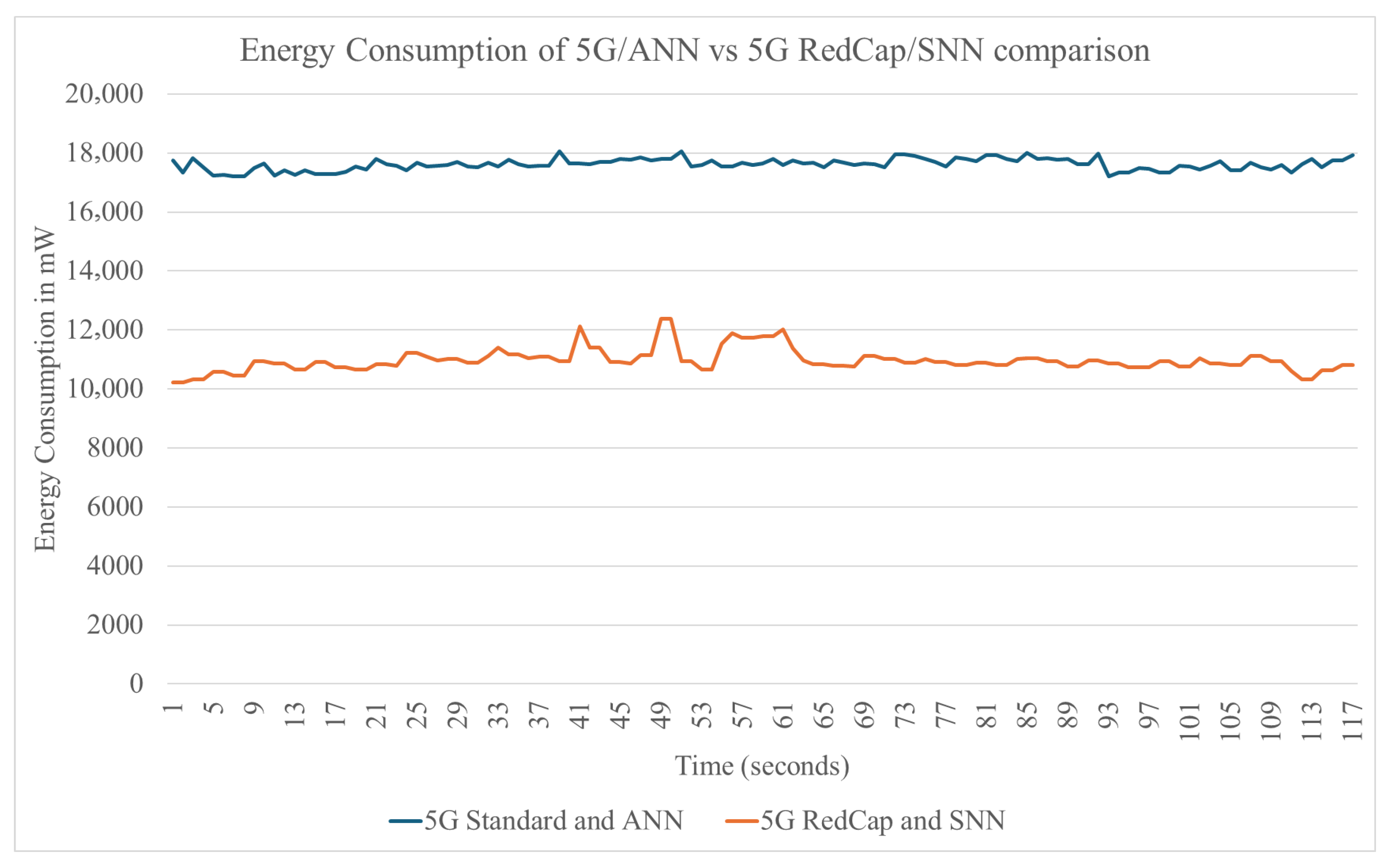
- Device-level power measurements of the connectivity and edge-compute subsystem on the ground;
- (ii)
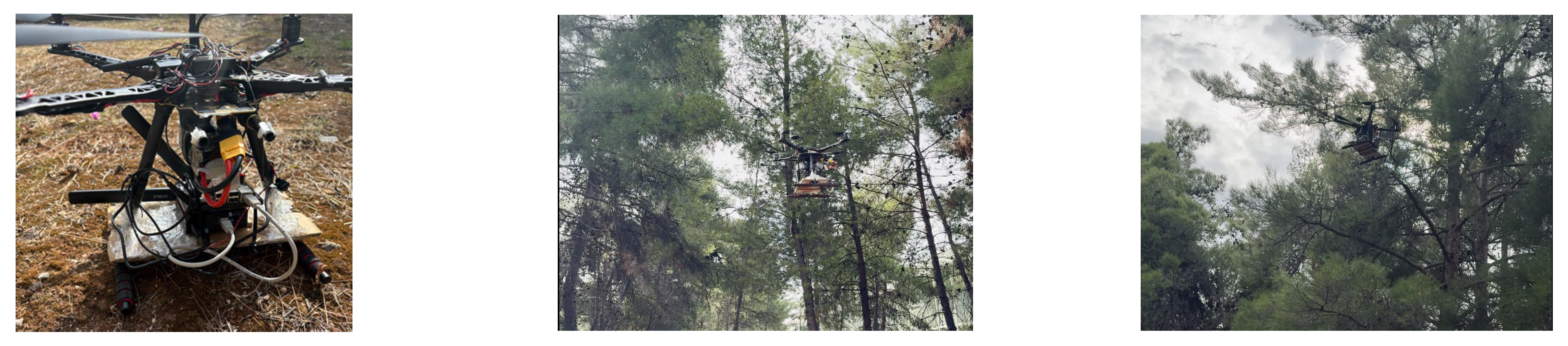
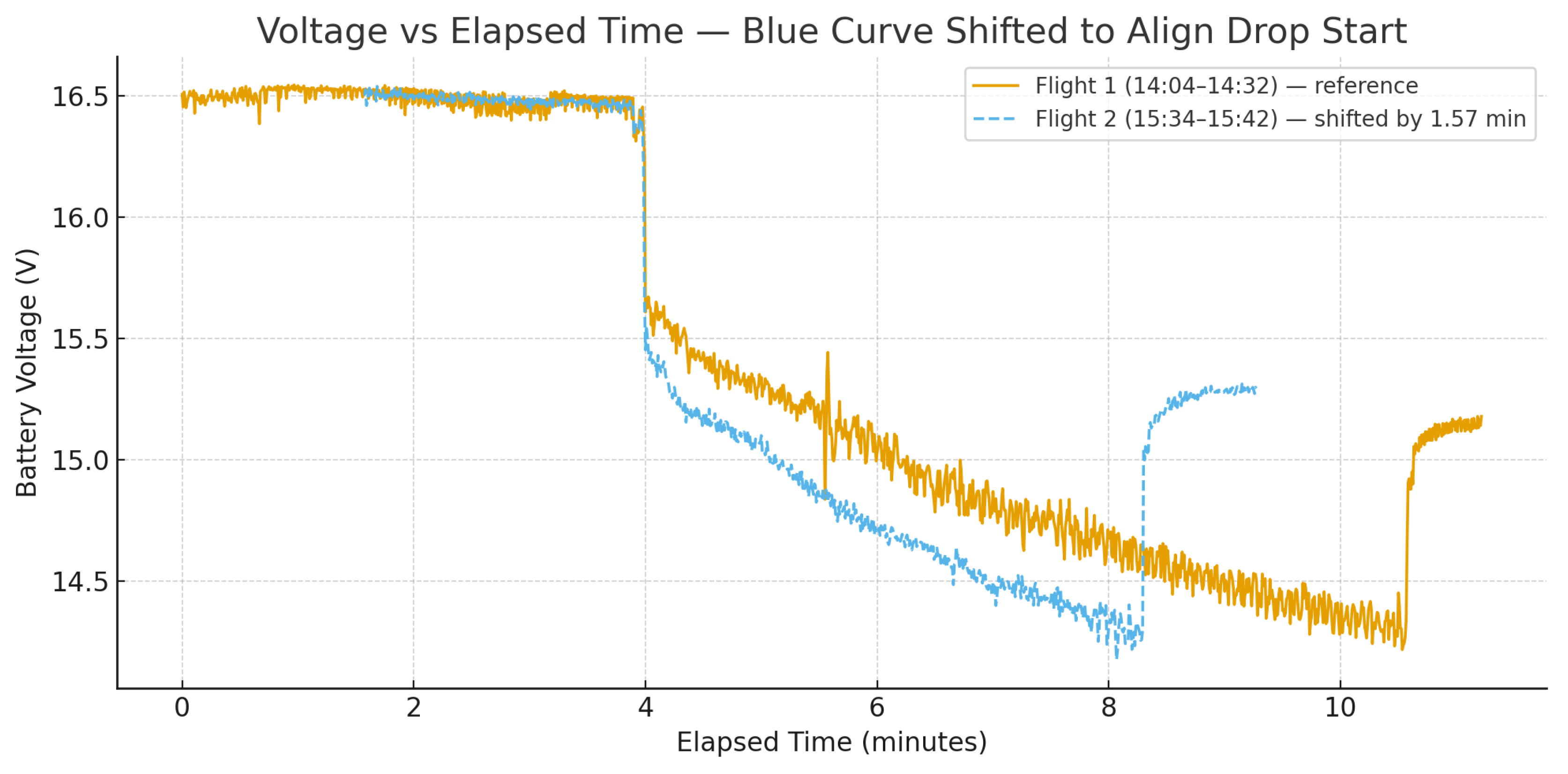
- System-level flight-time measurements on the UAV.
4. Conclusions
Author Contributions
Funding
Data Availability Statement
Conflicts of Interest
Abbreviations
| 3GPP | 3rd-Generation Partnership Project |
| 5G NR | 5th-Generation New Radio |
| 6G | Sixth-Generation (future mobile networks) |
| AI | Artificial Intelligence |
| ANN | Artificial Neural Network |
| ARFCN | Absolute Radio-Frequency Channel Number |
| ASIC | Application-Specific Integrated Circuit |
| BWP | Bandwidth Part |
| CNN | Convolutional Neural Network |
| CPU | Central Processing Unit |
| DNN | Deep Neural Network |
| DVFS | Dynamic Voltage and Frequency Scaling |
| eDRX | Extended Discontinuous Reception |
| eMBB | Enhanced Mobile Broadband |
| FDD | Frequency-Division Duplex |
| FR1 | Frequency Range 1 (sub-6 GHz) |
| FR2 | Frequency Range 2 (mmWave) |
| gNB | Next-generation NodeB (5G base station) |
| GOPS | Giga Operations Per Second |
| GPU | Graphics Processing Unit |
| HD-FDD | Half-Duplex FDD |
| mAP | mean Average Precision |
| MIMO | Multiple-Input Multiple-Output |
| mW | milliwatt |
| NPU | Neural Processing Unit |
| NR | New Radio (5G air interface) |
| OASEES | Open Autonomous Programmable Cloud Apps and Smart Sensors (Project) |
| OFDM | Orthogonal Frequency-Division Multiplexing |
| PRACH | Physical Random Access Channel |
| PRB | Physical Resource Block |
| PDSCH | Physical Downlink Shared Channel |
| PUCCH | Physical Uplink Control Channel |
| PUSCH | Physical Uplink Shared Channel |
| QoS | Quality of Service |
| QUBO | Quadratic Unconstrained Binary Optimization |
| RAN | Radio Access Network |
| RCM | RedCap-only (context: restricted operation on specific BWPs) |
| RedCap | Reduced Capability (5G NR device/profile) |
| RF | Radio Frequency |
| RNN | Recurrent Neural Network |
| RRC | Radio Resource Control |
| RRM | Radio Resource Management |
| SIB1 | System Information Block Type 1 |
| SISO | Single-Input Single-Output |
| SLTT | Spatial Learning Through Time |
| SNN | Spiking Neural Network |
| SSB | Synchronization Signal Block |
| STDP | Spike-Timing-Dependent Plasticity |
| TDD | Time-Division Duplex |
| TOPS | Tera Operations Per Second |
| TPU | Tensor Processing Unit |
| UCI | Uplink Control Information |
| UE | User Equipment |
| UAV | Unmanned Aerial Vehicle |
References
- Abrar, M.; Ajmal, U.; Almohaimeed, Z.M.; Gui, X.; Akram, R.; Masroor, R. Energy Efficient UAV-Enabled Mobile Edge Computing for IoT Devices: A Review. IEEE Access 2021, 9, 127779–127798. [Google Scholar] [CrossRef]
- Asheralieva, A.; Niyato, D. Effective UAV-Aided Asynchronous Decentralized Federated Learning with Distributed, Adaptive and Energy-Aware Gradient Sparsification. IEEE Internet Things J. 2025, 12, 27461–27480. [Google Scholar] [CrossRef]
- 3GPP. A Glimpse into RedCap NR Devices. 3rd Generation Partnership Project. 2022. Available online: https://www.3gpp.org/technologies/nr-redcap-glimpse (accessed on 1 November 2025).
- Ericsson. What Is Reduced Capability (RedCap) NR? Ericsson Technology Blog. 2021. Available online: https://www.ericsson.com/en/blog/2021/2/reduced-cap-nr (accessed on 1 November 2025).
- Ericsson. RedCap: Expanding the 5G Device Ecosystem for Consumers and Industries. White Paper. 2023. Available online: https://www.ericsson.com/493d70/assets/local/reports-papers/white-papers/redcap-5g-iot-for-wearables-and-industries.pdf (accessed on 2 November 2025).
- Kufel, J.; Bargieł-Łączek, K.; Kocot, S.; Koźlik, M.; Bartnikowska, W.; Janik, M.; Czogalik, Ł.; Dudek, P.; Magiera, M.; Lis, A.; et al. What Is Machine Learning, Artificial Neural Networks and Deep Learning?—Examples of Practical Applications in Medicine. Diagnostics 2023, 13, 2582. [Google Scholar] [CrossRef] [PubMed]
- Deng, S.; Yu, D.; Lv, C.; Du, X.; Jiang, L.; Zhao, X.; Tong, W.; Zheng, X.; Fang, W.; Zhao, P.; et al. Edge Intelligence with Spiking Neural Networks. arXiv 2025, arXiv:2507.14069. [Google Scholar] [CrossRef]
- Baller, S.P.; Jindal, A.; Chadha, M.; Gerndt, M. DeepEdgeBench: Benchmarking Deep Neural Networks on Edge Devices. In Proceedings of the 2021 IEEE International Conference on Cloud Engineering (IC2E), San Francisco, CA, USA, 4–8 October 2021; pp. 20–30. [Google Scholar] [CrossRef]
- u-blox. 5G RedCap, Completing the 3GPP Puzzle and Beyond. u-blox IoT Insights. 2023. Available online: https://www.u-blox.com/en/blogs/insights/5g-redcap (accessed on 1 November 2025).
- Richardson RFPD. 5G RedCap: An Essential Technology for IoT. Technical Article. 2024. Available online: https://shop.richardsonrfpd.com/docs/rfpd/RRFPD-5G-RedCap-An-Essential-Technology-for-IoT-2024-08.pdf (accessed on 2 November 2025).
- Telenor IoT. 5G RedCap for IoT: The Perfect Balance of 5G Capabilities. Telenor IoT. 2024. Available online: https://iot.telenor.com/technologies/connectivity/5g-redcap (accessed on 3 November 2025).
- Ericsson. RedCap/eRedCap—Standardizing Simplified 5G IoT Devices. Ericsson Blog. 2024. Available online: https://www.ericsson.com/en/blog/2024/12/redcap-eredcap (accessed on 2 November 2025).
- ABI Research. 5G RedCap: Simplifying Cellular Connectivity for IoT Devices. ABI Research Blog. 2024. Available online: https://www.abiresearch.com/blog/5g-redcap (accessed on 2 November 2025).
- Yan, Z.; Bai, Z.; Wong, W.-F. Reconsidering the Energy Efficiency of Spiking Neural Networks. arXiv 2024, arXiv:2409.08290. [Google Scholar]
- Yik, J.; Van den Berghe, K.; den Blanken, D.; Bouhadjar, Y.; Fabre, M.; Hueber, P.; Ke, W.; Khoei, M.A.; Kleyko, D.; Pacik-Nelson, N.; et al. The NeuroBench Framework for Benchmarking Neuromorphic Computing Algorithms and Systems. Nat. Commun. 2025, 16, 1545. [Google Scholar] [CrossRef] [PubMed]
- Intel. Neuromorphic Computing and Engineering with AI. Intel Research. 2024. Available online: https://www.intel.com/content/www/us/en/research/neuromorphic-computing.html (accessed on 3 November 2025).
- Davies, M.; Srinivasa, N.; Lin, T.-H.; Chinya, G.; Cao, Y.; Choday, S.H.; Dimou, G.; Joshi, P.; Imam, N.; Jain, S.; et al. Loihi: A Neuromorphic Manycore Processor with On-Chip Learning. IEEE Micro 2018, 38, 82–99. [Google Scholar] [CrossRef]
- Open Neuromorphic. A Look at Loihi—Intel Neuromorphic Chip. Open Neuromorphic. 2023. Available online: https://open-neuromorphic.org/neuromorphic-computing/hardware/loihi-intel (accessed on 2 November 2025).
- Open Neuromorphic. A Look at Loihi 2—Intel Neuromorphic Chip. Open Neuromorphic. 2024. Available online: https://open-neuromorphic.org/neuromorphic-computing/hardware/loihi-2-intel (accessed on 1 November 2025).
- Intel Corporation. Intel Builds World’s Largest Neuromorphic System to Enable More Sustainable AI. Intel Newsroom, 17 April 2024. Available online: https://newsroom.intel.com/artificial-intelligence/intel-builds-worlds-largest-neuromorphic-system-to-enable-more-sustainable-ai (accessed on 1 November 2025).
- Neftci, E.O.; Mostafa, H.; Zenke, F. Surrogate gradient learning in spiking neural networks. IEEE Signal Process. Mag. 2019, 36, 51–63. [Google Scholar] [CrossRef]
- Cramer, B.; Stradmann, Y.; Schemmel, J.; Zenke, F. A surrogate gradient spiking baseline for speech command recognition. Front. Neurosci. 2022, 16, 865897. [Google Scholar] [CrossRef] [PubMed]
- Nhan, L.T.; Duong, L.T.; Nam, P.N.; Thang, T.C. Accuracy–Robustness Trade Off via Spiking Neural Network Gradient Sparsity Trail. arXiv 2025, arXiv:2509.23762. Available online: https://arxiv.org/html/2509.23762 (accessed on 2 November 2025).
- Cheng, Y.-C.; Hu, W.-X.; He, Y.-L.; Huang, J.Z. A Comprehensive Multimodal Benchmark of Neuromorphic Training Frameworks for Spiking Neural Networks. Eng. Appl. Artif. Intell. 2025, 159, 111543. Available online: https://www.sciencedirect.com/science/article/abs/pii/S0952197625015453 (accessed on 3 November 2025).
- Rajendran, B.; Sebastian, A.; Schmuker, M.; Srinivasa, N.; Eleftheriou, E. Low-Power Neuromorphic Hardware for Signal Processing Applications. arXiv 2019, arXiv:1901.03690. Available online: https://arxiv.org/pdf/1901.03690 (accessed on 3 November 2025).
- Yu, D.; Du, X.; Jiang, L.; Tong, W.; Deng, S. EC-SNN: Splitting Deep Spiking Neural Networks for Edge Devices. In Proceedings of the 33rd International Joint Conference on Artificial Intelligence (IJCAI 2024), Jeju, Republic of Korea, 3–9 August 2024; Available online: https://www.ijcai.org/proceedings/2024/596 (accessed on 1 November 2025).
- Liu, Y.; Qin, Z.; Li, G.Y. Energy-Efficient Distributed Spiking Neural Network for Wireless Edge Intelligence. IEEE Trans. Wirel. Commun. 2024, 23, 10683–10697. [Google Scholar] [CrossRef]
- Gamage, T.; Perera, I. Optimizing Energy Efficient Cloud Architectures for Edge Computing: A Comprehensive Review. Int. J. Adv. Comput. Sci. Appl. 2024, 15, 637. [Google Scholar] [CrossRef]
- Liu, Y.; Qu, H.; Chen, S.; Feng, X. Energy efficient task scheduling for heterogeneous multicore processors in edge computing. Sci. Rep. 2025, 15, 11819. [Google Scholar] [CrossRef] [PubMed]
- Li, X.; Zhou, T.; Wang, H.; Lin, M. Energy-Efficient Computation with DVFS Using Deep Reinforcement Learning for Multi-Task Systems in Edge Computing. arXiv 2024, arXiv:2409.19434. Available online: https://arxiv.org/html/2409.19434v3 (accessed on 2 November 2025).
- Viso.ai. AI Hardware: Edge Machine Learning Inference Accelerators Overview. Viso Blog. 2024. Available online: https://viso.ai/edge-ai/ai-hardware-accelerators-overview (accessed on 1 November 2025).
- Jaycon Systems. Top 10 Edge AI Hardware for 2025. Jaycon Blog. 2025. Available online: https://www.jaycon.com/top-10-edge-ai-hardware-for-2025 (accessed on 2 November 2025).
- Renesas. Enable High Performance, Low Power Inference in Your Edge AI Applications. Renesas Blog. 2024. Available online: https://www.renesas.com/en/blogs/enable-high-performance-low-power-inference-your-edge-ai-applications (accessed on 2 November 2025).
- Musa, A.; Kakudi, H.A.; Hassan, M.; Hamada, M.; Umar, U.; Salisu, M.L. Lightweight Deep Learning Models for Edge Devices—A Review. Int. J. Comput. Inf. Syst. Ind. Manag. Appl. 2024, 17, 189–206. Available online: https://cspub-ijcisim.org/index.php/ijcisim/article/download/1025/635/1787 (accessed on 3 November 2025).
- Liu, Y.; Qin, Z.; Zhu, Y.; Li, G.Y. SpikACom: A Neuromorphic Computing Framework for Green Communications. arXiv 2025, arXiv:2502.17168. Available online: https://arxiv.org/abs/2502.17168 (accessed on 2 December 2025).
- Yang, H.; Lam, K.-Y.; Xiao, L.; Xiong, Z.; Hu, H.; Niyato, D.; Poor, H.V. Lead federated neuromorphic learning for wireless edge artificial intelligence. Nat. Commun. 2022, 13, 4269. [Google Scholar] [CrossRef] [PubMed]
- Li, E.; Zeng, L.; Zhou, Z.; Chen, X. Edge AI: On-Demand Accelerating Deep Neural Network Inference via Edge Computing. IEEE Trans. Wirel. Commun. 2019, 19, 447–457. [Google Scholar] [CrossRef]
- Tassi, A.; Kolawole, O.Y.; Roig, J.P.; Warren, D. Optimized Split Computing Framework for Edge and Core Devices. arXiv 2025, arXiv:2509.06049. Available online: https://arxiv.org/html/2509.06049 (accessed on 2 November 2025).
- Analog Devices. Driving 5G Energy Efficiency with Edge AI and Digital Predistortion. Analog Devices Signals+ Articles. 2024. Available online: https://www.analog.com/en/signals/articles/5g-energy-efficiency-with-edge-ai.html (accessed on 3 November 2025).
- Gotthans, T.; Baudoin, G.; Mbaye, A. Digital predistortion with advance/delay neural network and comparison with Volterra derived models. In Proceedings of the 2014 IEEE 25th Annual International Symposium on Personal, Indoor, and Mobile Radio Communication (PIMRC), Washington, DC, USA, 2–5 September 2014; pp. 811–815. [Google Scholar] [CrossRef]
- AT&T. AT&T Hits Another U.S. Industry-First: 5G RedCap Data Connection. AT&T Newsroom. 2023. Available online: https://about.att.com/blogs/2023/5g-redcap.html (accessed on 3 November 2025).
- Li, W.; Zhao, J.; Su, L.; Jiang, N.; Hu, Q. Spiking Neural Networks for Object Detection Based on Integrating Neuronal Variants and Self-Attention Mechanisms. Appl. Sci. 2024, 14, 9607. [Google Scholar] [CrossRef]
- López-Asunción, S.; Ituero, P. Enabling Efficient On-Edge Spiking Neural Network Acceleration with Highly Flexible FPGA Architectures. Electronics 2024, 13, 1074. [Google Scholar] [CrossRef]
- Xue, J.; Xie, L.; Chen, F.; Wu, L.; Tian, Q.; Zhou, Y.; Ying, R.; Liu, P. EdgeMap: An Optimized Mapping Toolchain for Spiking Neural Network in Edge Computing. Sensors 2023, 23, 6548. [Google Scholar] [CrossRef] [PubMed]



| Parameter | Standard 5G NR (Amarisoft Sample) | RedCap 5G (Amarisoft Sample) | How RedCap Differentiates |
|---|---|---|---|
| Duplex mode and pattern | NR_TDD = 1 (TDD); FR1 example uses pattern 2 via NR_TDD_CONFIG = 2. | NR_TDD = 0 (FDD) in RedCap config samples. | RedCap devices may operate HD-FDD to cut RF complexity; Amarisoft tutorial notes gNB can assume half-duplex until UE capabilities arrive. |
| Channel (cell) bandwidth | NR_BANDWIDTH = 40 MHz in FR1 default sample (100 MHz in FR2 path). | Often NR_BANDWIDTH = 20 MHz in RedCap examples. | RedCap UE max BW is 20 MHz (FR1)/100 MHz (FR2); if the cell is wider, configure RedCap-only BWPs. |
| Antennas/MIMO | N_ANTENNA_DL = 1, N_ANTENNA_UL = 1 (SISO) by default. | Example shows N_ANTENNA_DL = 2, N_ANTENNA_UL = 1. | RedCap reduces UE complexity: fewer Rx branches/DL layers vs. baseline NR. |
| MCS tables (mod/coding) | PDSCH and PUSCH mcs_table = “qam256”. | Global tables may stay 256-QAM, but on RedCap UL BWP mcs_table = “qam64”. | UL modulation intentionally capped on the RedCap BWP to match typical UE limits. |
| PRACH (initial access) | TDD FR1 example: prach_config_index = 160; FDD example: 16. | RedCap UE performs PRACH on a RedCap-only BWP; RRC Setup Request uses MAC LCID 35 (RedCap). | Enables early RedCap identification and attach on the narrow BWP. |
| Bandwidth Parts (BWP) | Single initial BWP spanning the cell in basic SA sample. | Adds dl_bwp_access: “redcap_only”/ul_bwp_access: “redcap_only” for narrow RedCap operation (esp. when cell BW > 20 MHz). | Constrains RedCap traffic to a 10–20 MHz slice while eMBB can use the wide carrier. |
| SSB/discovery | Cell-defining SSB only. | Supports NCD-SSB on a RedCap BWP via ssb_nr_arfcn (configured into nonCellDefiningSSB-r17). | Improves discovery when RedCap BWPs are narrower than the overall cell BW. |
| PUCCH (uplink control) | NR_LONG_PUCCH_FORMAT = 0 (auto). | Example uses long PUCCH format 2 with tuned resources. | Tightens UCI overhead for constrained RedCap UEs/BWPs. |
| SIB1 content | Standard SIB1 (no RedCap IEs). | SIB1 includes redCap-ConfigCommon (e.g., halfDuplexCapAllowed, cellBarredRedCap). | Broadcasts RedCap rules so UEs camp/attach on the proper BWP. |
| Scheduler duplex behavior | N/A (no special assumption). | gNB may assume half-duplex before UE capability signaling, then switch if UE isn’t HD-FDD. | Aligns with RedCap’s optional HD-FDD profile to reduce device cost. |
| Resource allocation on RedCap BWP | Default contiguous allocation. | Tutorial recommends ra_type = type0 for non-contiguous PRB allocation around PUCCH on RedCap BWP (when running wide cell + narrow BWP). | Eases scheduling within a narrow BWP that reserves PRBs for control. |
| UE multi-carrier features | Baseline NR UEs may support CA/DC. | CA/DC not supported for RedCap UEs. | Single-carrier operation further reduces RF/baseband complexity. |
| Work | Scenario/Application | Platform/Deployment | Main SNN Role and Model | Key Reported Metrics | Position vs. Our Work |
|---|---|---|---|---|---|
| Distributed SNN for Wire-less Edge Intelligence [27] | Collaborative wireless edge intelligence; multiple edge nodes over bandwidth-limited links | Distributed wireless edge devices (no UAVs, no 5G RedCap) | Distributed SNN (temporal tasks) designed to replace RNNs under wireless constraints | Matches RNN-level accuracy while reducing edge power and improving bandwidth efficiency for spike-based communication (qualitative in excerpt) | Shows that SNNs can replace RNNs under wireless constraints but does not couple SNNs with specific 5G profiles or measure system-level metrics like flight time. Our work instead co-designs radio (RedCap) + SNN on a UAV and reports concrete device-power and flight-time gains. |
| LeNet-5 SNN on FPGA [44] | Generic vision classification (MNIST-like) | FPGA SNN accelerator | LeNet-style SNN classifier mapped to FPGA for resource-efficient vision | 33% less area and 4× lower power per neuron (348 mW total) vs. prior digital SNN accelerators | Demonstrates that compact SNNs are excellent building blocks for ultra-low-power edge hardware, but does not consider wireless links, 5G, or UAVs. Our work uses a similarly small SNN (784–1000–10) but places it inside a full 5G-connected UAV stack and quantifies end-to-end energy/airtime impact. |
| EdgeMap–SNN mapping toolchain for edge devices [43] | Mapping SNN workloads efficiently to neuromorphic edge hardware | Neuromorphic edge platforms (no UAV/5G) | General SNN workloads; toolchain optimizes placement and communication | Up to 57% energy reduction, 19.8% latency reduction, 58% comms cost reduction, and 4.02× throughput increase vs. other mappings | Focuses on software/toolchain optimization for SNNs on neuromorphic hardware. Our work instead focuses on system integration (5G RedCap config + SNN gate) on commodity edge hardware (Jetson Orin + 5G router) and measures real UAV flight-time improvement. |
| AMS_YOLO & AMSpiking_VGG (SNN for object detection) [42] | Object detection on COCO2017 and GEN1 (dynamic vision) | SNN-based detection models (no UAV/5G system) | Full SNN object detectors with attention and neuron-model variants | Detection accuracy improved by +6.7 pp on COCO2017 and +11.4 pp on GEN1 vs. earlier SNN baselines | Shows that SNNs can carry out full object detection with good accuracy, but without radio/energy system measurements. Our work intentionally uses a simpler patch-level SNN gate (784–1000–10) prioritizing energy and flight time; we explicitly state that Li-style detection heads and surrogate-gradient training are future work to raise accuracy. |
| Proposed work | Rust/corrosion inspection from UAV; real-world 5G deployment | 5G-equipped UAV (Teltonika 5G router + NVIDIA Jetson Orin) with standard 5G vs. 5G RedCap | Small patch-level SNN (784–1000–10, CHL-trained) used as energy-efficient gate in a sliding-window pipeline (rust/no-rust); ANN baseline for comparison | ≈60–65% device-level power reduction (~7 W) at router + Jetson level and ≈35% flight-time increase (≈4 min → ≈6.5 min) for RedCap/SNN vs. 5G/ANN; peak bandwidth reduced (~100 Mbps → ~40 Mbps). SNN rust accuracy ≈26% vs. ANN ≈60% (explicitly acknowledged as limitation). | First to jointly integrate and experimentally evaluate 5G RedCap connectivity and SNN inference on a real UAV, with simultaneous connectivity and compute measurements. Unlike prior SNN work, it (i) considers the 5G profile (RedCap), (ii) quantifies both device-level power and system-level flight time, and (iii) exposes the trade-off between throughput, accuracy, and endurance in a concrete 5G-UAV setting. |
Disclaimer/Publisher’s Note: The statements, opinions and data contained in all publications are solely those of the individual author(s) and contributor(s) and not of MDPI and/or the editor(s). MDPI and/or the editor(s) disclaim responsibility for any injury to people or property resulting from any ideas, methods, instructions or products referred to in the content. |
© 2026 by the authors. Licensee MDPI, Basel, Switzerland. This article is an open access article distributed under the terms and conditions of the Creative Commons Attribution (CC BY) license.
Share and Cite
Kourtis, M.A.; Oikonomakis, A.; Economopoulos, A.; Batistatos, M.C.; Kalemai, G.; Vasalos, A.; Xilouris, G.; Trakadas, P. Leveraging 5G RedCap and Spiking Neural Networks for Energy Efficiency in Edge Devices. Telecom 2026, 7, 4. https://doi.org/10.3390/telecom7010004
Kourtis MA, Oikonomakis A, Economopoulos A, Batistatos MC, Kalemai G, Vasalos A, Xilouris G, Trakadas P. Leveraging 5G RedCap and Spiking Neural Networks for Energy Efficiency in Edge Devices. Telecom. 2026; 7(1):4. https://doi.org/10.3390/telecom7010004
Chicago/Turabian StyleKourtis, Michail Alexandros, Andreas Oikonomakis, Achileas Economopoulos, Michael C. Batistatos, Gion Kalemai, Averkios Vasalos, George Xilouris, and Panagiotis Trakadas. 2026. "Leveraging 5G RedCap and Spiking Neural Networks for Energy Efficiency in Edge Devices" Telecom 7, no. 1: 4. https://doi.org/10.3390/telecom7010004
APA StyleKourtis, M. A., Oikonomakis, A., Economopoulos, A., Batistatos, M. C., Kalemai, G., Vasalos, A., Xilouris, G., & Trakadas, P. (2026). Leveraging 5G RedCap and Spiking Neural Networks for Energy Efficiency in Edge Devices. Telecom, 7(1), 4. https://doi.org/10.3390/telecom7010004