Article

Characterization, Kinetic Studies, and Thermodynamic Analysis of Pili (Canarium ovatum Engl.) Nutshell for Assessing Its Biofuel Potential and Bioenergy Applications


1
Department of Agricultural and Biosystems Engineering, Central Luzon State University, Science City of Muñoz 3120, Nueva Ecija, Philippines
2
Department of Chemistry, College of Science, Central Luzon State University, Science City of Muñoz 3120, Nueva Ecija, Philippines
3
Department of Agricultural and Biosystems Engineering, College of Engineering and Computer Studies, Pampanga State Agricultural University, Pampanga 2011, Magalang, Philippines
*
Author to whom correspondence should be addressed.
Submission received: 31 October 2025 / Revised: 7 December 2025 / Accepted: 17 December 2025 / Published: 23 December 2025
(This article belongs to the Special Issue Biofuels and Bioenergy: New Advances and Challenges)

Abstract

Pili nutshell (PS), an abundant agro-industrial byproduct in the Bicol Region, Philippines, demonstrates substantial potential as a solid biofuel and bioenergy feedstock. Proximate and ultimate analyses revealed high volatile matter (72.00 ± 0.20 wt%), low ash content (4.33 ± 0.76 wt%), and a higher heating value of 20.60 MJ/kg, indicating strong suitability as a solid fuel for thermochemical conversion and biofuel production. Thermogravimetric analysis (TGA) was conducted from 30 °C to 900 °C at heating rates of 10, 15, and 20 °C/min under nitrogen to examine its thermal decomposition behavior. The process followed three stages: initial moisture loss, active devolatilization, and lignin-rich char formation. The resulting kinetic and thermodynamic parameters are directly relevant for designing fast pyrolysis processes aimed at liquid biofuel production and optimizing downstream fuel utilization of the derived bio-oil and char. Kinetic analysis using the Coats–Redfern method identified third-order reaction (CR03) and diffusion-controlled (DM6) models as best-fitting, with activation energies ranging from 64.03–96.21 kJ/mol (CR03) and 66.98–104.72 kJ/mol (DM6). Corresponding thermodynamic parameters—ΔH (58.67–90.95 kJ/mol), ΔG (201.51–231.46 kJ/mol), and ΔS (−174.57 to −255.08 kJ/mol·K)—indicated an endothermic, non-spontaneous, entropy-reducing reaction pathway. Model-free methods confirmed a highly reactive zone at α = 0.3–0.6, with consistent Ea values (~130–190 kJ/mol). These findings affirm the viability of PS for fast pyrolysis, offering data-driven insights for optimizing advanced fuel and bioenergy systems in line with circular economy objectives.

1. Introduction

The urgent global transition toward low-carbon energy systems is accelerating the development of renewable and sustainable energy sources. Among these, solid biomass has garnered growing attention due to its carbon neutrality, broad availability, and capacity to support decentralized fuel and energy production. In 2023, biomass contributed approximately 5% to total U.S. primary energy supply, predominantly through wood, solid fuels, waste-derived fuels, and bioenergy for power and heating applications [1]. At the global level, renewable energy reached a record exceeded 30% of global electricity in 2023; continuing to rise with biomass continuing to support base-load and rural energy systems in both developed and developing regions [2].
In Southeast Asia, and particularly in the Philippines, biomass represents a vital component of the renewable energy mix. With over 759 MW of installed capacity, biomass fuels provide an estimated 13% of the country’s total energy consumption, drawing from abundant agricultural residues, forestry waste, and livestock byproducts [3]. The Department of Energy (DOE) aims to expand the renewable share of electricity generation to 35% by 2030 and up to 50% by 2040, with biomass positioned as a critical contributor to these targets [4]. Despite this potential, many locally available feedstocks remain undercharacterized, limiting their integration into high-efficiency, low-emission thermal conversion systems.
The pili (Canarium ovatum Engl.) nutshell (PS) is an abundant agricultural byproduct in the Bicol region of the Philippines, primarily generated from the local pili nut industry. For many years, Pili shells have been used as a household fuel or converted to charcoal in rural areas. However, beyond these traditional uses, Pili shells have demonstrated potential for more advanced bioenergy and material applications. For instance, previous work successfully converted Pili shells into activated carbon, achieving high fixed-carbon content (≈86.8%) and large surface area (SBET ≈ 817 m2/g), suggesting their suitability as adsorbents or carbon precursors [5]. Pili residues have also yielded bio-crude oil, biochar, and other by-products under thermochemical conversion of sawdust, indicating feasibility for pyrolysis-based bioenergy production [6]. Additionally, direct combustion studies have shown that Pili shells can serve effectively as a solid fuel in biomass roasting furnaces, performing favorably compared to conventional heating [7].
Despite its availability, this lignocellulosic residue remains unexplored in terms of its thermal behavior, decomposition pathways, and energetic potential. Unlike other well-documented biomass materials—such as peanut shells, rice husks, and coconut shells—which have been extensively studied for pyrolysis and combustion applications [8,9,10], the thermochemical, kinetic, and thermodynamic characteristics of PS have not yet been systematically investigated. This knowledge gap limits its scientific valorization and excludes it from integration into predictive models for reactor design, process simulation, and energy conversion optimization. A thorough understanding of its pyrolytic behavior is therefore essential to unlock its potential as a renewable biofuel and bioenergy feedstock.
Pyrolysis, a thermochemical process that decomposes organic material in the absence of oxygen, is widely used for converting biomass into high-value fuels such as liquid bio-oil, combustible syngas, and solid char fuels [11]. The efficiency and selectivity of pyrolysis are strongly influenced by the thermal decomposition behavior of the feedstock, which varies with its chemical composition and heating conditions. Thermogravimetric analysis (TGA) is a widely accepted method for investigating these thermal behaviors, allowing the quantification of weight loss as a function of temperature and enabling the determination of kinetic and thermodynamic parameters through controlled, non-isothermal testing [12].
To account for the complex and multi-step decomposition mechanisms typically observed in lignocellulosic biomass—where hemicellulose, cellulose, and lignin degrade sequentially or in overlapping phases—kinetic analyses are employed using two main approaches: model-fitting method (non iso-conversional) and model-free (iso-conversional) methods. Model-fitting techniques, such as the Coats–Redfern (CR) method, estimate activation energy (Ea), pre-exponential factor (A), and reaction mechanism (g(a)) by assuming a functional form for the conversion model. Although widely used, their accuracy depends heavily on model selection and may not capture the kinetic complexity of biomass systems [13,14,15].
Conversely, model-free methods such as Flynn–Wall–Ozawa (FWO), Kissinger–Akahira–Sunose (KAS), Starink (STR), and Friedman (FD) enable the calculation of conversion-dependent activation energies without assuming a predefined reaction mechanism. These methods, endorsed by the International Confederation for Thermal Analysis and Calorimetry (ICTAC), are particularly suitable for complex solid-state reactions such as biomass pyrolysis and allow insights into changes in reaction mechanisms across the α = 0.1–0.9 range [15,16,17,18,19]. Nevertheless, when Ea varies significantly with conversion, it may signal multiple dominant pathways—necessitating model-fitting validation to determine plausible mechanistic behavior.
Alongside kinetic modeling, thermodynamic analysis provides a complementary dimension to characterize the energetic and entropic nature of biomass decomposition. Parameters such as enthalpy change (ΔH), Gibbs free energy change (ΔG), and entropy change (ΔS) offer insight into reaction spontaneity, feasibility, and the degree of molecular disorder during decomposition. These parameters are critical for process design, energy integration, and environmental assessments [20,21].
Accordingly, this study aims to comprehensively investigate the thermochemical conversion behavior of PS under nitrogen atmosphere. The experimental approach includes a detailed characterization of the biomass feedstock through proximate, ultimate, and compositional analyses to determine its physicochemical properties and assess its suitability for pyrolytic applications. Subsequently, thermogravimetric analysis (TGA) was conducted at three constant heating rates (10, 15, and 20 °C/min) to evaluate the material’s thermal decomposition profile. To extract kinetic parameters, four model-free (iso-conversional) methods, namely Flynn–Wall–Ozawa (FWO), Kissinger–Akahira–Sunose (KAS), Starink (STR), and Friedman (FD), were applied to determine the variation of activation energy (Ea) with respect to conversion (α). In parallel, the Coats–Redfern model-fitting method was used to identify the best-fitting reaction mechanism and derive the complete kinetic triplet (Ea, A, and g(α)). Thermodynamic parameters, including enthalpy change (ΔH), Gibbs free energy change (ΔG), and entropy change (ΔS), were then calculated to evaluate the feasibility and spontaneity of the pyrolytic reactions. The findings aim to address the current research gap by providing the first detailed kinetic and thermodynamic profiling of PS and supporting its valorization as a solid biofuel feedstock for sustainable fuel and energy development in the Philippines and other tropical regions.

2. Materials and Methods

2.1. Sample Collection and Preparation

PS samples were provided by the Pili Processing Center in Albay Provincial Agricultural Office (APAO), Camalig, Albay, Philippines. The collected samples were washed thoroughly with distilled water to eliminate surface impurities such as soil and dust then dried in a laboratory dryer (Universal Oven UN55, Memmert + Co. KG, Schwabach, Germany) at 105 °C for 24 h. The dried PS were then milled using a hammer grinder and sieved to a particle size ≤2 mm to ensure uniform thermal transfer. All analyses were performed in triplicate, and results are reported as mean ± standard deviation.

2.2. Characterization of the Biomass

2.2.1. Proximate Analysis

The moisture content (MC) of the sample was determined in accordance with ASTM D4442 using the oven-dry method [22]. Approximately 5 g of the sample was placed in a pre-weighed crucible and dried in a laboratory drying oven (Universal Oven UN55, Memmert + Co. KG, Schwabach, Germany) maintained at 105 °C for 24 h. The dried sample was then cooled and weighed to determine the mass loss, which was expressed as a percentage of the original weight. An analytical balance was used for all mass measurements. Volatile matter content (VMC) was determined following ASTM D1762. About 2 g of oven-dried sample was placed in a lidded crucible and heated at 900 °C for 7 min in a muffle furnace (JISICO Electric Muffle Furnace, JISICO, Seoul, Republic of Korea). After cooling in a desiccator, the sample was weighed, and the weight loss, excluding moisture, was recorded as volatile matter. Ash content (AC) was also determined per ASTM D1762 using the same furnace at 650 °C for 4 h [23]. A 2-g dried sample in a pre-weighed crucible was incinerated until a constant white or gray ash was obtained. The residue was cooled in a desiccator and weighed to compute ash content as a percentage of the initial dry weight. Subsequently, the fixed carbon (FC) is calculated using Equation (1) proposed by Speight (2015) [24].
FC = 100% − VM − AC
where FC is the fixed carbon content on a dry basis (%), VM is the volatile matter content on a dry basis (%), and AC is the ash content on a dry basis (%).
The higher heating value (HHV) was measured using a bomb calorimeter (IKA® Werke GmbH, C200, Staufen, Germany) based on ASTM D3286 [25]. The lower heating value (LHV) was estimated by applying a standard correction to the HHV, accounting for the latent heat of vaporization of the water produced during combustion (Özyuğuran et al., 2018) [26]. The formula used was shown in Equation (2):
LHV = HHV 2.442 × 9 × MC 100
where LHV is the lower heating value (J/g), HHV is the higher heating value (J/g), and MC is the moisture content (%).
These calorific values represent key fuel properties that determine the combustion performance and energy yield of biomass-derived biofuels.

2.2.2. Ultimate Analysis

The elemental analysis of the used waste biomass was carried out in the organic elemental analyzer (PerkinElmer, 2400 CHNS/O Series II, Waltham, MA, USA). To calculate the H/C ratio from the Carbon and Hydrogen content, Equation (3) was used.
H / C   Ratio = Hydrogen content 1   g / mol Carbon content 12   g / mol
where the Hydrogen content is the %H from ultimate analysis over 100, Carbon content is the %C from the ultimate analysis over 100, 1 g/mol is the molar mass of Hydrogen, and 12 g/mol is the molar mass of Carbon.

2.2.3. Compositional Analysis

The compositional analysis of PS included the determination of cellulose, hemicellulose, lignin, and extractive contents. Cellulose and hemicellulose contents were determined following TAPPI 45. Extractive-free biomass was first subjected to acidified sodium chlorite treatment to isolate holocellulose. Alpha cellulose was then extracted from the holocellulose using 17.5% sodium hydroxide, and hemicellulose was calculated by difference [27,28]. Extractive content was determined through Soxhlet extraction using n-hexane for 8 h, based on NREL/TP-510-42619 [29]. Lignin was quantified by summing acid-insoluble and acid-soluble lignin fractions following NREL/TP-510-42618 and NREL/TP-510-42617, respectively. The acid-insoluble lignin was determined gravimetrically after sulfuric acid hydrolysis, while the acid-soluble fraction was measured spectrophotometrically at 205 nm [30,31].

2.3. Thermogravimetric Analysis (TGA)

Thermal decomposition experiments were conducted using a TGA/DSC 3+ instrument (Mettler Toledo, Greifensee, Switzerland) under nitrogen atmosphere with a flow rate of 50 mL/min. For each run, approximately 5 mg of powdered PS was placed in an Al2O3 crucible (Alumina 70 μL, Mettler Toledo). The samples were subjected to heating from 30 °C to 900 °C at three different constant heating rates: 10, 15, and 20 °C/min. Data acquisition and processing were carried out using MATLAB R2024a and Microsoft Excel. The resulting TGA curves provided insight into the decomposition profile and were used for kinetic modeling. To ensure robust derivation of kinetic parameters, raw TGA curves were subjected to smoothing and numerical filtering using Savitzky-Golay [32]. This step minimizes instrumental noise and improves the accuracy of derivative thermogravimetric (DTG) data, which is critical for methods relying on dα/dt.

2.4. Kinetic Study

To analyze non-isothermal solid-state kinetic data, various methods have been developed to determine the kinetic triplet: activation energy (Ea), pre-exponential factor (A), and reaction mechanism (g(a)). These methods are generally categorized into two types—model-fitting and model-free approaches [15]. Model-fitting methods rely on assuming a specific reaction model and evaluate how well it statistically fits the experimental data to derive kinetic parameters. In contrast, model-free methods do not require prior assumption of the reaction mechanism. Instead, utilize multiple kinetic curves obtained at different heating rates to calculate the activation energy as a function of the conversion degree (α). This approach enables the determination of Ea without bias from model assumptions, provided that kinetic data at identical conversion levels across different heating rates are available [16,19].

2.4.1. Model Fitting Method Using Coats Redfern

To determine the kinetic parameters of the devolatilization stage, the Coats–Redfern integral method was applied. The isothermal devolatilization of biomass may be represented schematically as:
A(solid)B(solid) + C(volatile)
and described by the general rate expression
d α dt = k ( T ) f ( α )
where α is the conversion fraction, k(T) is the temperature-dependent rate constant, and f(α) specifies the reaction model [14,15]. The conversion is calculated from mass loss as:
α = m 0 m t m m
where m 0 is the initial mass, m t is the mass at time t, and m is the final residual mass. For an nth-order model:
d α dt = k ( T ) ( 1 a ) n
The rate constant follows the Arrhenius law:
k ( T ) = A exp E a RT
where A is the pre-exponential factor, Ea the activation energy, R the gas constant, and T the absolute temperature (K). Combining Equations (5) and (6) gives:
d α dt = A exp E a RT f ( α )
Under isothermal conditions, integration yields:
g ( α ) = A exp E a RT t
where g(α) = ∫dα/f(α) is the integral form of the reaction model. For non-isothermal experiments conducted at a constant heating rate β = dT/dt, Equation (7) is rewritten as:
d α dT = A β exp E a RT f ( α )
Separation and integration give:
g ( α ) = A β exp E a RT dT
Equation (11) can be evaluated using two common approaches: (i) the Coats–Redfern model-fitting method, which assumes a single constant Ea over the conversion range, and (ii) isoconversional (model-free) methods, which allow Ea to vary with α. Applying the Coats–Redfern approximation to Equation (11) leads to
ln g α T 2 = ln AR β E a E a RT
where β is the heating rate and g(α) is the integral form of the selected reaction model [13,15].
Reaction Mechanism Models Used
Twenty-one reaction mechanism models—covering chemical reaction order (CRO), diffusion-controlled (DM), geometric contraction (GM), and nucleation-growth (NM) mechanisms—were evaluated using the Coats–Redfern method. Each model is defined by a specific integral function g( α ), which characterizes the relationship between the extent of conversion and temperature. These functions are summarized in Table 1 [20,21].
Each model was fitted to the TGA-derived conversion data at three different heating rates. The model that resulted in the most linear Coats–Redfern plot with the highest coefficient of determination (R2) was identified as the most representative of the devolatilization mechanism in PS pyrolysis.

2.4.2. Model Free Method

Biomass degradation by pyrolysis involves a number of reactions that are difficult to describe using a single Coats-Redfern kinetic model. In particular, model-free techniques including Friedman differential isoconversional model (FD), Flynn-Wall-Ozawa (FWO), Kissinger-Akahira-Sunose (KAS), and Starink are relied on to predict the pyrolysis kinetics of biomass based on the change in activation energy (Eα) and conversion (α) throughout the pyrolysis process [15,16,17,18,19].
The FWO Method
The Flynn–Wall–Ozawa (FWO) method is an iso-conversional integral approach commonly employed to estimate the activation energy (Ea) of a thermally-induced reaction at different heating rates without assuming a specific reaction model. This method utilizes Doyle’s approximation for the temperature integral and is expressed as:
ln β = ln A E a g ( a ) R 5.331 1.052 E a RT
where β is the linear heating rate, A is the pre-exponential factor, R is the universal gas constant, T is the absolute temperature in Kelvin, and g(α) is the integral form of the conversion function at a fixed degree of conversion α. The method involves plotting ln (β) against 1/T for several heating rates at a constant conversion level. The resulting linear regression yields a slope of −1.052 Ea/R, from which the activation energy can be determined [19].
The KAS Method
The Kissinger–Akahira–Sunose (KAS) method is a model-free, iso-conversional technique widely applied for the determination of activation energy (Ea) in solid-state thermal processes. It is derived from an oversimplified temperature integral approximation and is mathematically expressed as:
ln β T 2 = ln A E a g ( a ) R E a RT
where β is the linear heating rate, T is the absolute temperature (K), A is the pre-exponential factor, R is the universal gas constant, and g(α) is the integral form of the reaction model at a constant conversion degree α. In this approach, a linear plot of ln β T 2 versus 1/T at a specific conversion yields a straight line whose slope corresponds to E a R T , enabling direct estimation of the activation energy without prior knowledge of the reaction mechanism [15].
The Starink Method
The Starink method is an integral iso-conversional model-free approach that refines the estimation of activation energy (Ea) by improving the temperature integral approximation used in other methods such as Flynn–Wall–Ozawa (FWO) and Kissinger–Akahira–Sunose (KAS). This technique provides a higher degree of accuracy by replacing the approximate temperature integral exponent with 1.92, leading to the following expression:
ln β T 1.92 = ln AR E a g ( a ) 1.0008 E a RT
where β is the linear heating rate, T is the absolute temperature (K), R is the universal gas constant, and Cs is a constant at a fixed degree of conversion α. By plotting ln β T 1.92 against 1 T , a straight line is obtained whose slope corresponds to 1.0008 E a R T , allowing direct determination of the activation energy for each conversion level [16].
The Friedman Method
The Friedman method is a differential iso-conversional technique that estimates the activation energy (Ea) without assuming a reaction model. Unlike integral methods such as FWO, KAS, or Starink, the Friedman approach directly utilizes the derivative form of the conversion rate. The kinetic expression is derived by taking the natural logarithm of the differential form of the general kinetic equation, resulting in the linear form:
ln β da dT = ln Af a E a RT
Here, β is the linear heating rate, α is the conversion fraction, f(α) is the differential conversion function, R is the gas constant, and T is the absolute temperature. For a given conversion level α, plotting ln β d a d T against 1 T across multiple heating rates yields a straight line. The slope of this line is equal to E a R , from which the activation energy can be determined. Since this method directly analyzes the rate of conversion at each α, it is particularly sensitive to experimental noise but offers high-resolution insight into kinetic behavior at discrete conversion levels [15,18].

2.5. Thermodynamic Parameter Calculations

Following the determination of the kinetic parameters—Ea, A, and R2—thermodynamic parameters such as the change in enthalpy (ΔH, kJ/mol), Gibbs free energy (ΔG, kJ/mol), and entropy (ΔS, kJ/(mol·K)) provide crucial insights into the energetic feasibility, spontaneity, and molecular rearrangements occurring during the thermal decomposition of biomass. These parameters are particularly useful for assessing the mechanism and energy flow of pyrolysis reactions under non-isothermal conditions [21].
The enthalpy change (ΔH) represents the energy absorbed by the system, excluding the thermal energy from the surrounding environment. It was calculated using the Arrhenius–Eyring relationship:
H = E a RT
where E a is the Arrhenius activation energy, R = 8.314 J/mol is the universal gas constant and T is the absolute temperature (K) at the maximum rate of mass loss.
The Gibbs free energy change (ΔG) quantifies the spontaneity of the reaction. A positive ΔG indicates a non-spontaneous process under the given conditions, while a negative value suggests spontaneous behavior. It is given by:
G = E a + R T m ln ( k B T m hA )
where h = 6.626 × 10⁻³⁴ Js is Planck’s constant, k B = 1.381 × 10⁻²³ J/K is Boltzmann’s constant, A is the pre-exponential factor (min−1), and T is the peak decomposition temperature in Kelvin.
The entropy change (ΔS) reflects the degree of randomness or disorder introduced into the system as chemical bonds are broken and volatiles are released. It was computed using the following expression derived from transition state theory:
S = H G T m
where ΔS is the entropy change and T m is again the absolute temperature (K).
The enthalpy change (ΔH) reflects the net energy required to overcome the bond dissociation barrier, excluding the thermal motion contribution of the system. Entropy change (ΔS) characterizes the degree of disorder introduced during the transition from the initial biomass structure to an activated complex.
These parameters were computed for each degree of conversion (α) across all heating rates using kinetic triplets derived from both model-free methods (FWO, KAS, Starink, Friedman) and corresponding Tm values interpolated from DTG curves [15]. The computed thermodynamic descriptors offer a mechanistic understanding of the devolatilization process and validate the thermal feasibility of bio-oil production from PS under non-isothermal pyrolysis conditions.

3. Results and Discussion

3.1. Thermochemical Properties

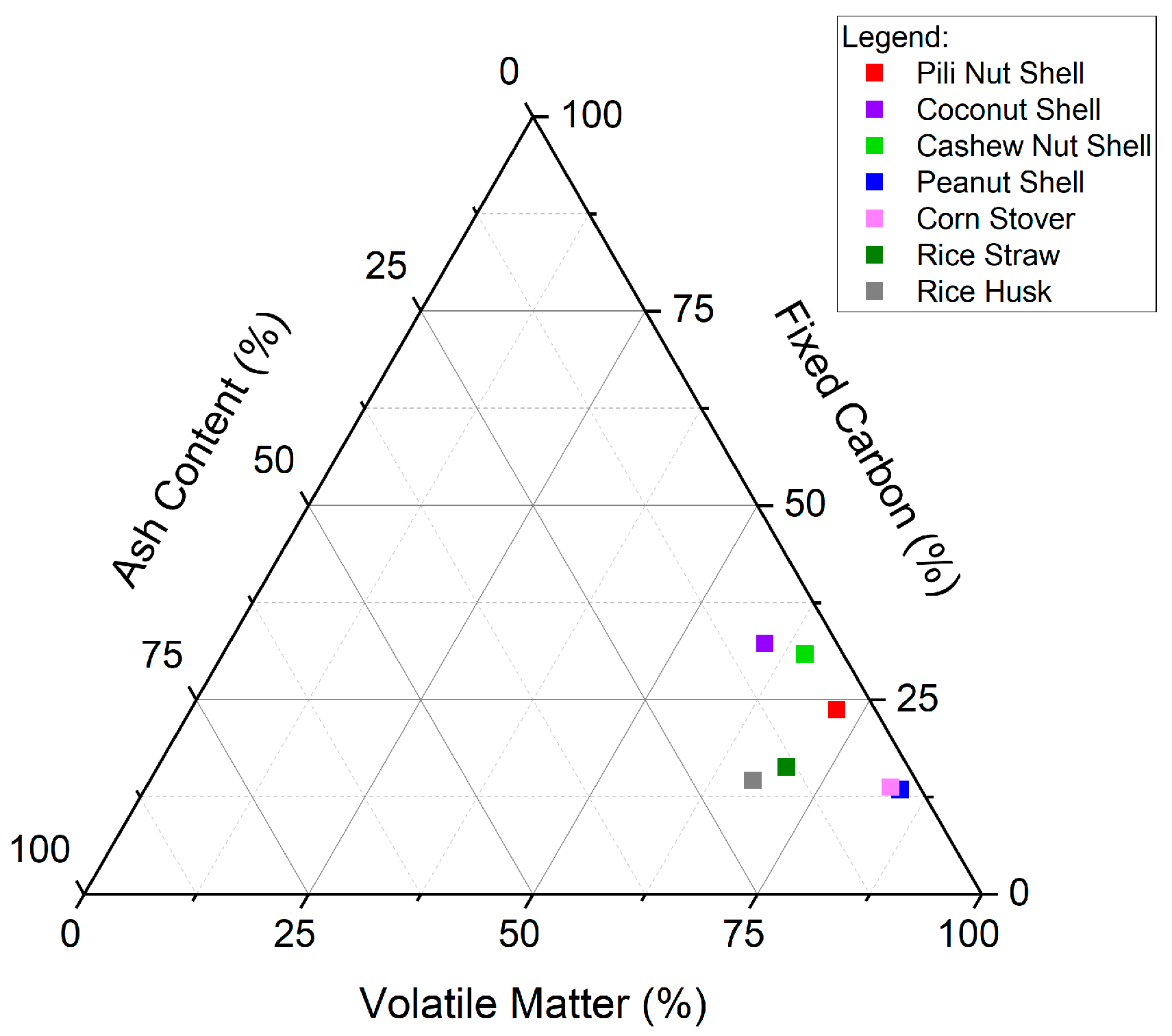
The viability of biomass feedstocks for thermochemical conversion is strongly influenced by proximate and ultimate compositions, which affect thermal degradation behavior, energy density, and the quality of resulting biofuels [11]. Table 2 summarizes the thermochemical characteristics of PS alongside common biomass types, while Figure 1 visualizes the distribution of VMC, FC, and AC for assessing pyrolytic suitability.
The proximate analysis shows that PS contains a high VMC (72.00 ± 0.20 wt%), comparable to other high-performing nutshell biomasses such as peanut shell (78.84 ± 0.40 wt%) [8] and cashew nutshell (76.81 wt%) [33], both known for supporting high liquid yields during fast pyrolysis. The measured MC (8.32 ± 0.73 wt%) falls within the recommended <10% range for efficient pyrolysis with minimal pre-drying [12]. The FC content (23.67 ± 2.75 wt%) indicates a reasonable char fraction, suitable for biochar production [34], while the low ash content (4.33 ± 0.76 wt%) is favorable compared with high-ash residues such as rice straw (12.8 wt%) [35] and rice husk (17.44 wt%) [9].
The energy density of PS (HHV = 20.60 MJ/kg) exceeds that of typical agricultural residues such as corn stover (17.34 MJ/kg) [36], rice straw (12.1 MJ/kg) [35], and rice husk (15.97 MJ/kg) [9]. More importantly, its HHV is within the same range as other nutshell-based biofuels, including coconut shell (17.40–20.16 MJ/kg) [21,33] and peanut shell (19.69 MJ/kg) [8], indicating competitive performance relative to established solid biofuels. Its HHV also approaches that of low-rank coals (15–25 MJ/kg) [37], but with substantially lower nitrogen and sulfur contents—offering cleaner combustion and fewer regulated emissions.
Ultimate analysis further supports the energetic and environmental favorability of PS as a feedstock. It contains 50.65 ± 0.60 wt% carbon, 6.46 ± 0.04 wt% hydrogen, and 39.52 ± 0.47 wt% oxygen, resulting in a high H/C molar ratio and relatively low O/C ratio. These attributes are beneficial for generating stable, energy-rich bio-oil with reduced water content and enhanced storage stability [21,38,39]. The oxygen content, at 39.52 ± 0.47 wt%, is moderately high and may contribute to the production of oxygenated compounds in the pyrolysis vapors, necessitating catalytic upgrading or stabilization [40]. The nitrogen and sulfur contents are relatively low, at 0.44 ± 0.08 wt% and 1.16 ± 0.18 wt%, respectively, indicating minimal potential for NOₓ and SOₓ emissions, and thereby supporting cleaner combustion or downstream utilization of the pyrolysis products [36,41].
Table 2. Thermochemical characteristics of PS and common biomass.
ParameterPS
(This study)
CNS
[21]
CS
[33]
PNS
[8]
CRS
[36]
RS
[35]
RH
[9]
Proximate Analysis
* MC, %8.32 ± 0.736.9 ± 0.076.936.32 ± 0.013.12 ± 0.065.74.15
** VMC, %72.00 ± 0.2049.9 ± 0.4876.8178.84 ± 0.4080.44 ± 0.4766.164.43
** AC, %4.33 ± 0.766.7 ± 0.055.022.20 ± 0.403.17 ± 0.0712.817.44
** FC, %23.67 ± 2.7536.5 ± 0.3518.1712.57 ± 0.3313.28 ± 0.6115.413.98
HHV, MJ/kg20.60 ± 0.0417.4020.1619.69 ± 0.0617.34 ± 0.0412.115.97
Ultimate Analysis
Carbon, %50.65 ± 0.6041.8 ± 0.6545.749 ± 1045.69 ± 0.0737.140.12
Hydrogen, %6.46 ± 0.044.1 ± 0.083.77.9 ± 1.65.31 ± 05.25.11
Oxygen, %39.52 ± 0.4751.5 ± 0.5144.639.6 ± 7.947.96 ± 0.144.354.14
Nitrogen, %0.44 ± 0.082.1 ± 0.010.21.2 ± 0.20.49 ± 00.50.53
Sulfur, %1.16 ± 0.180.5 ± 0.010.083 ± 0.0170.55 ± 0.030.10.1
* as received basis, ** dry basis. PS—pili nutshell, CNS—coconut shell, CS—Cashew nutshell, PNS—peanut shell, CRS-corn stover, RS—rice straw, RH—rice husk, MC—moisture content, VMC—volatile matter content, FC—fixed carbon content, AC—ash content, HHV—high heating value.
Figure 1 reinforces these observations. The ternary diagram shows the relative proportions of volatile matter, fixed carbon, and ash across all biomass types. PS (red square) clusters in the region characterized by high volatile matter, moderate fixed carbon, and low ash—similar to other nutshell biomasses such as cashew (light green) and peanut shells (blue)—which are known to favor high bio-oil yields under fast pyrolysis [42]. In contrast, rice husk (gray square) and rice straw (green square) occupy high-ash regions associated with reduced vapor-phase product formation and less favorable pyrolysis behavior.
Together, these results highlight the thermochemical advantages of PS over other lignocellulosic residues, making it a strong candidate for biofuel and bioenergy valorization via pyrolysis, particularly in tropical regions such as the Philippines, where it is abundantly available.

3.2. Chemical Compositional Properties

The chemical composition of PS reveals a structural lignocellulosic profile, consisting of 33.84 ± 0.53% cellulose, 25.95 ± 0.53% hemicellulose, 36.44 ± 2.21% lignin, and 3.77 ± 0.08% extractives (Table 3). The holocellulose content (59.8%) composed of hemicellulose (25.95%) and cellulose (33.84%) supports efficient volatile release, favoring bio-oil production during fast pyrolysis [43]. Cellulose decomposes at approximately 300–370 °C, yielding levoglucosan, furans, and other anhydrosugars, while hemicellulose decomposes earlier (200–300 °C), producing light oxygenated compounds such as acetic acid and furfural, which enhance reactivity and contribute to vapor-phase product formation [21,44].
The high lignin content sets PS apart from many agricultural residues. Lignin, which decomposes over a broad temperature range (200–500 °C), forms a complex mixture of phenolic compounds and contributes significantly to biochar formation [45]. Prior studies have reported that lignin-rich biomass or isolated lignin, under optimized pyrolysis or catalytic pyrolysis conditions, can yield bio-oil with phenolic contents in the range of ~60–70% of the organic fraction [46]. However, lignin-derived oils typically contain high oxygen levels and are chemically unstable, necessitating catalytic upgrading to enhance their quality and stability [47]. Meanwhile, the low extractives content (3.77 ± 0.08%) indicates minimal interference from non-structural volatiles, reducing the likelihood of premature vapor release and promoting cleaner thermal decomposition. Biomass with lower extractives generally produces cleaner vapors and more stable condensates, simplifying downstream condensation and refining.
Overall, PS’s lignocellulosic composition confirms its strong potential for dual-output thermochemical conversion. The synergy of high lignin and holocellulose contents supports the production of phenolic-rich bio-oil and carbon-dense biochar—both of which are valuable for renewable fuels for energy systems and functional material applications [46,48].

3.3. TGA/DTG Analysis and Thermal Decomposition Parameters

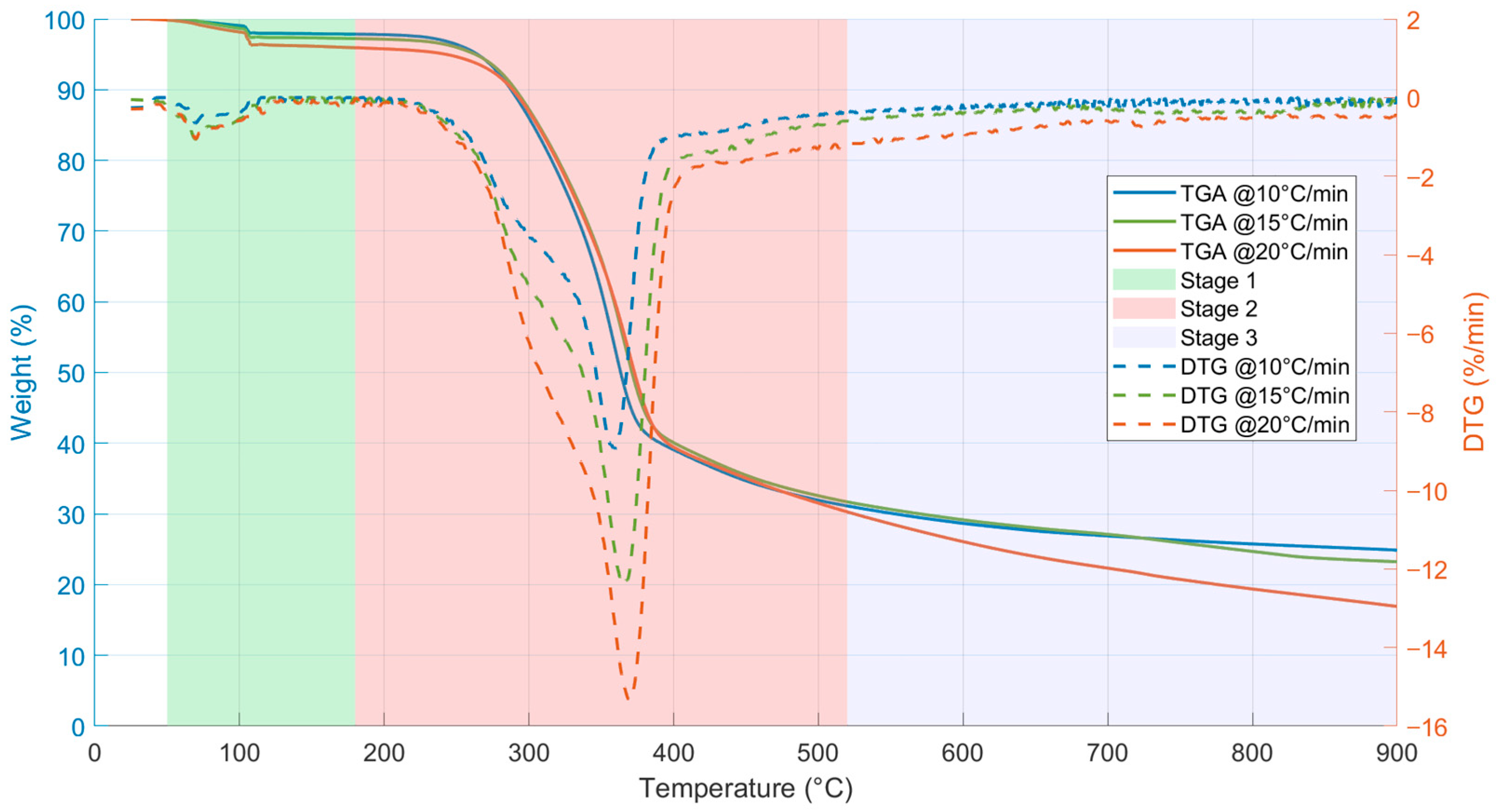
The thermogravimetric decomposition of PS under inert conditions exhibited the typical three-stage pattern reported for lignocellulosic biomass [11,45]. Stage I (≈50–180 °C) involved dehydration and the release of physically bound moisture and light volatiles, reflected by the low mass loss observed in this region. Stage II (≈180–520 °C) represented the dominant devolatilization window where hemicellulose and cellulose underwent rapid thermal degradation, producing the steep DTG peaks centered around Tp ≈ 360–370 °C (Figure 2). Stage III (>520 °C) progressed more gradually and corresponded to lignin depolymerization, char condensation, and the formation of thermally stable residual solids, consistent with the behavior of lignin-rich feedstocks documented in literature [11,49].
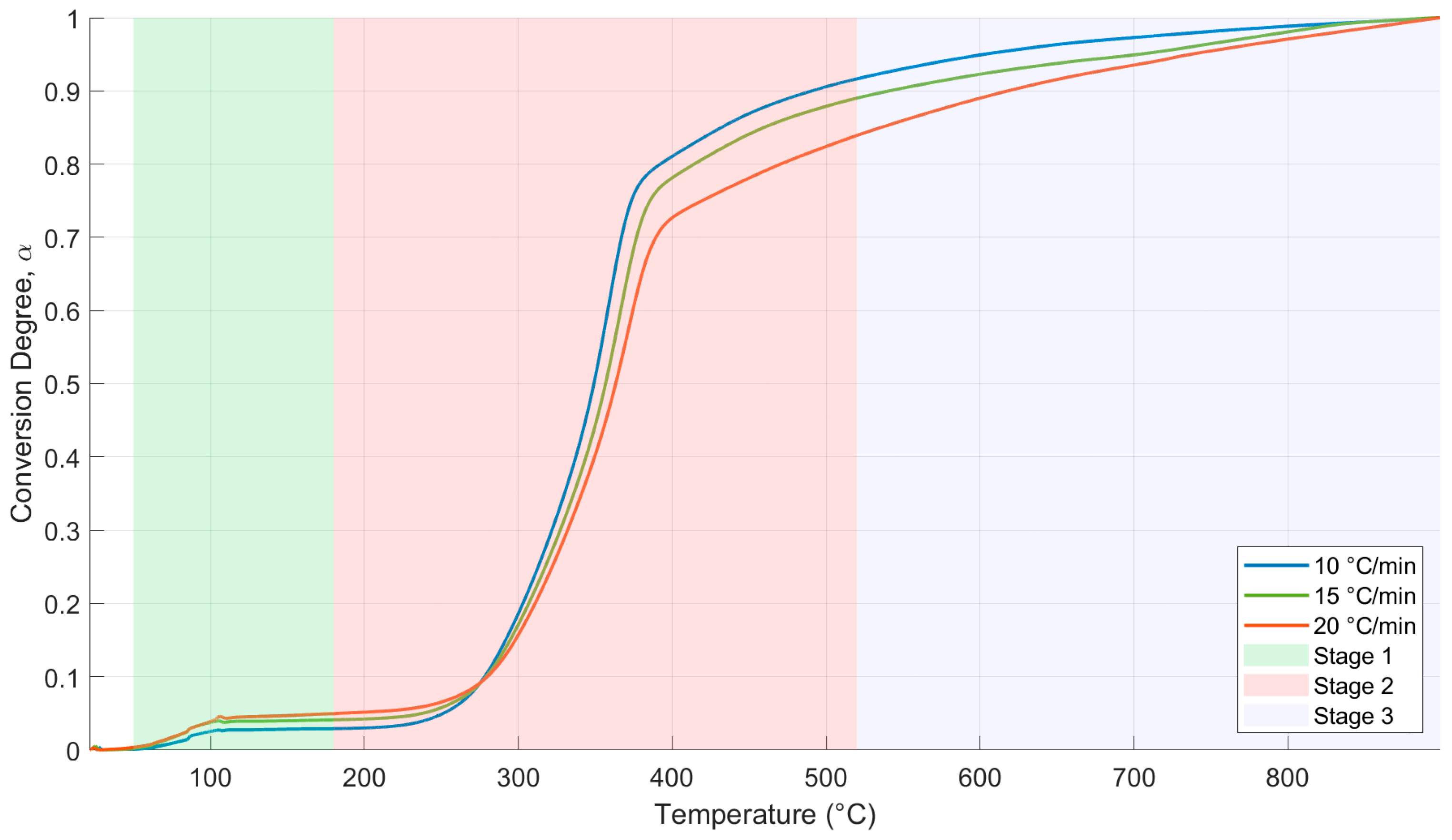
The effect of heating rate was evident across all thermal indicators. Increasing β from 10 to 20 °C/min generated a rightward shift in Ti, Tp, and Tf and produced steeper DTG peaks and wider decomposition spans (ΔT1/2), attributable to thermal lag and the reduced time for heat equilibration within the particles—well-established phenomena in biomass pyrolysis [22,50]. The α–T conversion curves (Figure 3) similarly demonstrated delayed yet accelerated decomposition as β increased, in agreement with previously reported behavior for lignocellulosic residues [23,44,51].
The TGA/DTG results have direct implications for the practical thermochemical conversion of PS. The primary devolatilization window (≈180–520 °C) and peak reactivity near 360–370 °C suggest that pyrolysis reactors may operate most efficiently within the 450–500 °C range, where volatilization is largely complete without excessive heat input into slow char conversion [8]. The defined low-temperature drying zone (<180 °C) also supports the incorporation of pre-heating or dedicated drying stages prior to reactor entry to reduce moisture-related energy penalties and improve reaction consistency. In addition, the observed volatile release of approximately 70 wt% during Stage II provides an initial basis for sizing condensation, vapor recovery, gas management, and char-handling systems, with the residual mass fraction (≈17–25 wt%) representing a practical upper bound for char yield in continuous pyrolysis [43].
The devolatilization index D, which characterizes the overall sharpness and reactivity of the thermal decomposition process, was evaluated using the relation:
D = R p R v ( 1 M r 100 ) T v T p T 1 / 2
As shown in Table 4, D increased with heating rate, indicating a more intense and concentrated devolatilization process at higher β. The index provides a useful measure of pyrolysis performance, capturing both the intensity and effective residence time of the decomposition reaction, as well as the degree to which the biomass remains passive or resistant under thermal conditions. The systematic rise in D confirms that PS becomes more reactive and volatile-rich under fast-heating conditions, supporting its suitability for high-throughput fast-pyrolysis applications aimed at maximizing bio-oil production [52].
While the heating rates applied herein represent non-isothermal laboratory conditions rather than true fast-pyrolysis (>100 °C/s), the increasing D-index, high volatile fraction, and sharp DTG peak collectively indicate favorable responsiveness under accelerated heating and suggest potential compatibility with short-residence-time reactor configurations, including fluidized-bed and ablative systems [38,47,50,51]. Moreover, the quantified thermal parameters (Ti, Tp, Tf, ΔT1/2, Rp, Rv, and D) serve as valuable inputs for reactor modeling and control, enabling preliminary estimation of heat demand, vapor generation kinetics, and char evolution during scale-up and design optimization [50,51,53].

3.4. Kinetic Parameters and Reaction Mechanism

3.4.1. Coats-Redfern Method

The data in Table 5 presents a comprehensive kinetic evaluation of PS decomposition using the Coats–Redfern method, encompassing a wide range of reaction mechanisms—reaction order, diffusion-controlled, geometrical contraction, power law, and nucleation-growth models (Avrami–Erofeev type)—across three heating rates (10, 15, 20 °C/min) [13]. The aim is to identify the most plausible reaction mechanism based on kinetic triplet parameters: activation energy (Ea), pre-exponential factor (A), and reaction mechanism (g(α)).
The Coats–Redfern kinetic analysis revealed that higher-order reaction models, particularly CRO1.5 to CRO3, provided the best agreement with experimental data for PS pyrolysis, with R2 values consistently exceeding 0.90 across all heating rates. Among these, CRO3 emerged as the most robust, with the highest correlation (R2 = 0.94–0.95), activation energies ranging from 96.21 to 64.03 kJ/mol, and physically valid pre-exponential factors. CRO1.5 also showed strong performance (R2 = 0.91–0.94) with plausible activation energies decreasing from ~80 to ~52 kJ/mol as the heating rate increased. These trends suggest that the thermal decomposition process follows complex, high-order kinetics, likely associated with overlapping reactions during cellulose and lignin degradation [54,55].
Diffusion-controlled models DM6 and DM7 also demonstrated good agreement, particularly DM6, which yielded activation energies up to 110 kJ/mol and high R2 values (0.83–0.89). DM7 followed with slightly lower but still acceptable correlation (0.73–0.82) and credible kinetic parameters. These results point to a secondary influence of internal mass transport limitations, especially during the later stages of pyrolysis when volatile release becomes diffusion-restricted [56]. The performance of other diffusion models was considerably weaker, with low R2 values and non-physical outputs, indicating limited applicability.
Geometrical contraction models produced only moderate fits and failed to represent the irregular morphology and decomposition pathway of the biomass. Power law models were the least reliable, generating negative or near-zero activation energies and invalid pre-exponential factors, and were therefore excluded from further consideration. Nucleation-growth models exhibited limited applicability, with NM6 performing moderately well only at lower heating rates but losing predictive power at higher temperatures [57].
Overall, the kinetic behavior of PS appears to be governed by a dual mechanism involving both high-order reaction kinetics and internal diffusion control. Based on fit quality and parameter validity, the most suitable models are summarized as follows: GM1–GM2 offer only moderate contraction-type fits, while NM (Avrami–Erofeev) and power-law forms show limited or non-physical behavior and are not recommended. Meanwhile, CRO3 (highest R2 and valid A), CRO1.5 (plausible Ea), DM6 (strong correlation, high Ea), and DM7 (good fit, consistent A). These models form a reliable basis for describing the thermal decomposition behavior of PS and support its continued investigation as a bioenergy feedstock.

3.4.2. Iso-Conversional Method Using FWO, KAS, Starink, and Friedman

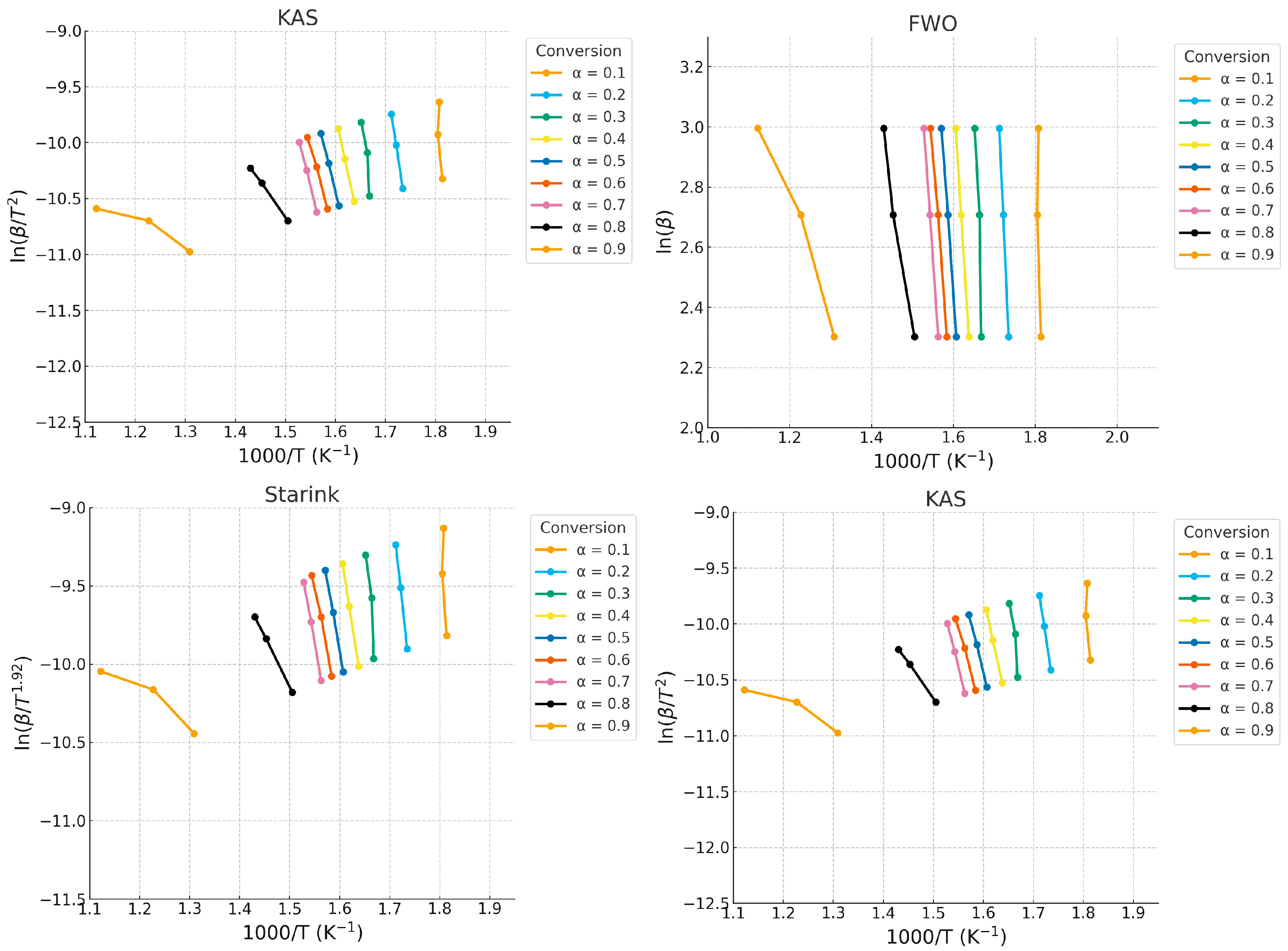
To understand the decomposition behavior of PS, Ea and A were determined using four model-free methods: Flynn–Wall–Ozawa (FWO), Kissinger–Akahira–Sunose (KAS), Starink, and Friedman. These iso-conversional techniques enabled analysis at nine conversion levels (α = 0.1 to 0.9) using three linear heating rates (10, 15, and 20 °C min−1), with the programmed range 25–900 °C (Table 6, Figure 4) [19,58].
A consistent trend was observed across all models: activation energy (Ea) decreased with increasing α. In the early stages (α = 0.1–0.2), all methods showed abnormally high Ea (≈450–466 kJ mol−1), plausibly reflecting moisture removal, surface desorption, and low-temperature volatilization where gas–solid mass transfer can dominate over intrinsic kinetics. At these stages, regression fits were poor (e.g., R2 < 0.55 for KAS, Starink, and FWO; <0.77 for Friedman), indicating limited reliability of kinetic estimation in this region [16]. In the active devolatilization zone (α ≈ 0.3–0.6), the four methods converged to physically reasonable and statistically robust Ea values (method-dependent but typically ~134–194 kJ mol−1), consistent with hemicellulose/cellulose breakdown reported for lignocellulosics [19,58]. Methodwise, Starink typically yielded slightly lower Ea than FWO/KAS due to its refined temperature-integral approximation [17], while Friedman provided higher resolution but greater sensitivity to noise in dα/dT (hence more scatter outside the active zone) [18]. A noticeable kinetic compensation effect (linear lnA-Ea correlation across α) was observed, a well-known feature of solid-state pyrolysis that reflects multi-step/overlapping reactions rather than a single mechanism [17,58].
Between α = 0.3 and 0.6 (active zone), activation energies stabilized across models, ranging from ~134 to ~194 kJ/mol. These values are consistent with primary devolatilization of lignocellulosic biomass compo nents such as hemicellulose and cellulose. Regression coefficients were remarkably high in this region (R2 ≈ 0.998–0.999 for KAS, Starink, FWO, and >0.99 for Friedman), indicating excellent linearity and model agreement. Corresponding temperatures during this active pyrolysis window ranged from ~595 K to ~648 K, representing the main energy-demanding reactions [59,60].
As conversion reached α ≥ 0.7, activation energy dropped sharply across all models (Ea ≈ 17–32 kJ/mol), and pre-exponential factors also declined by several orders of magnitude. These lower values are associated with char formation and residual slow devolatilization of lignin, aromatization, and solid-phase diffusion-limited processes. While still producing moderately acceptable R2 (0.90–0.97), this zone should be treated with caution in kinetic modeling due to the diminishing reactivity and possible heat/mass transport limitations.
The pre-exponential factor (A) followed a similar trend. At α = 0.3–0.6, A ranged from 106 to 1014 min−1, aligning with complex reaction mechanisms and active volatilization. Outside this region, A values became unreasonably high (e.g., >1039 min−1 at α = 0.1 for KAS and Starink) or non-physically low (e.g., <100 min−1 at α = 0.8–0.9), reinforcing the conclusion that the mid-α region is the most kinetically significant. For comparison, the Friedman method exhibited more erratic Ea values, especially at α > 0.6, including a negative Ea at α = 0.7, indicating model instability and strong sensitivity to noise in differential data. Nonetheless, Friedman remained consistent with integral methods in the α = 0.3–0.6 range, with Ea = 90–169 kJ/mol.
In summary, the optimal zone for kinetic parameter estimation is clearly between α = 0.3 and 0.6. In this range, all models converge to physically realistic and statistically strong kinetic parameters. These results highlight the consistency of integral methods and suggest that PS exhibits typical thermal degradation behavior of lignocellulosic biomass. The observed Ea values are comparable to those reported for other shells and woody biomass (e.g., 140–190 kJ/mol), as documented in kinetic studies for coconut and hazelnut shells [8], rice husk [9], and poplar wood and other lignocellulosics [50,60]. This validates the applicability of PS in thermochemical conversion technologies such as fast pyrolysis and bio-oil production, provided that reaction conditions target the active pyrolysis range for maximum conversion efficiency [39,59].

3.5. Thermodynamic Properties

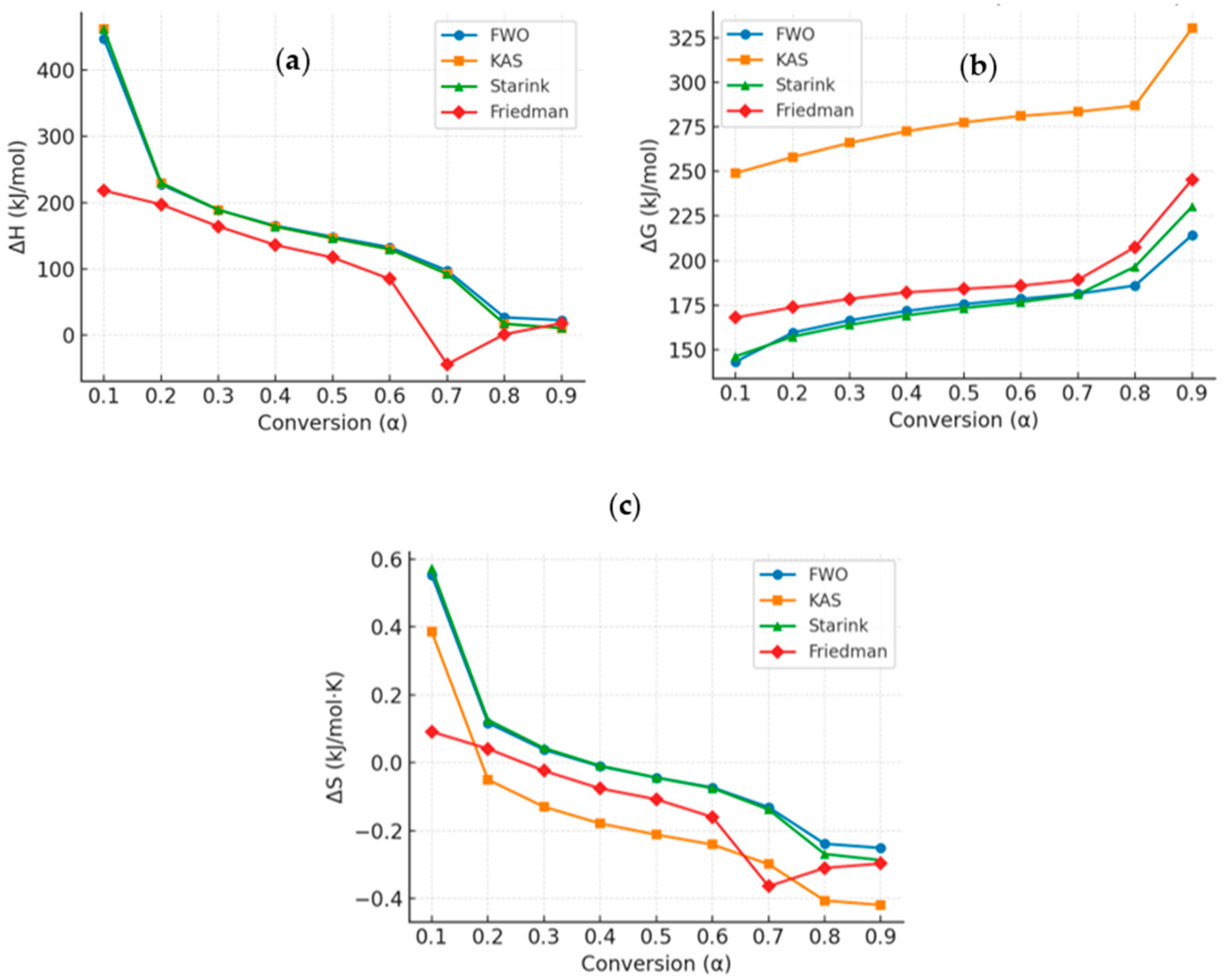
Thermodynamic analysis further strengthened the kinetic interpretation of PS pyrolysis and clarified its practical behavior during thermal conversion. Across CR, FWO, KAS, Starink, and Friedman (Table 7 and Table 8), the consistently positive ΔH values (Figure 5a) confirmed the endothermic nature of devolatilization, reflecting the heat required to cleave glycosidic and aromatic bonds in lignocellulosic biomass [61]. Within the kinetically active interval (α = 0.3–0.6), ΔH values from the iso-conversional methods ranged from 132 to 194 kJ/mol, closely matching reported thresholds for hemicellulose–cellulose degradation in rice husk [9], coconut shell [8,21], and palm kernel shell [8,51]. This agreement indicates that PS requires no additional thermal load beyond what is typically supplied in fast-pyrolysis reactors operating at 450–550 °C, suggesting feasible integration into existing reactor designs. The sharp decrease in ΔH at α ≥ 0.7 reflects the transition to lignin-rich char formation, where heating continues to consume energy but produces minimal additional volatiles—an important consideration for avoiding inefficient residence times in fixed- or fluidized-bed systems [38].
Gibbs free energy (ΔG) trend (Figure 5b) increased progressively with conversion, indicating decreasing thermodynamic favorability as PS transitions from holocellulosic to more aromatic structures. At low α (0.1–0.3), ΔG remained moderate (≈143–166 kJ/mol for FWO), suggesting that volatile release proceeds efficiently under typical external heat fluxes used in lab-scale and industrial pyrolyzers. Similar ΔG behavior reported for agricultural residues by Bongomin et al. (2024)—where early-stage ΔG remains moderate before rising sharply during char formation—supports that PS behaves as a conventional lignocellulosic feedstock during early devolatilization [51]. At α ≥ 0.7, ΔG exceeded 230–330 kJ/mol in the integral methods and rose even higher in Friedman, indicating that substantial energy input would be needed to continue decomposition of the increasingly crosslinked char matrix. From a practical standpoint, this suggests that extending residence time beyond the active window offers diminishing returns in liquid yield while significantly increasing thermal energy consumption.
The ΔS behavior (Figure 5c)of PS closely parallels that of other biomass residues [62]. During early devolatilization, PS exhibits slightly positive ΔS at α = 0.1–0.2, indicating greater molecular disorder during initial depolymerization. At higher conversion, PS transitions to strongly negative ΔS values, similar to the pronounced entropy decreases observed in macadamia nutshell (≈ −0.2356 kJ/mol·K) and rice husk (≈ −0.2534 kJ/mol·K) [51], reflecting the formation of increasingly ordered aromatic char structures. These trends mirror those reported for agricultural residues and are relevant for reactor operation, as highly negative ΔS corresponds to slower structural rearrangement and reduced reactivity, signaling that additional heating in this region yields limited volatile products.
Among the iso-conversional methods, KAS and Starink produced almost identical thermodynamic profiles, reinforcing their suitability for process modeling and scale-up [62]. Friedman, while useful for identifying localized changes, showed larger fluctuations at high α due to the sensitivity of differential methods to experimental noise [63]. Coats–Redfern results were consistent with these observations, with reaction-order models (CR01.5, CR03) and diffusion-controlled mechanisms (DM6) producing coherent ΔH–ΔG–ΔS sets, in contrast to nucleation and geometric contraction models that yielded implausible values due to poor kinetic fits [57].
Overall, the thermodynamic parameters converge with the kinetic findings to identify α = 0.3–0.6 as the optimal pyrolysis window for PS. Within this region, ΔH remains moderate, ΔG is comparatively low, and ΔS approaches zero, indicating efficient energy utilization and favorable activated-complex formation. Beyond this zone, rising ΔG and strongly negative ΔS reflect increasing structural resistance and reduced volatile yield, consistent with lignocellulosic pyrolysis behavior reported in the literature [45,64]. These insights have direct implications for reactor design and operation: maximizing residence time and heat input within the α = 0.3–0.6 window will enhance bio-oil yield and energy efficiency, while avoiding excessive heating at high conversions where product formation stagnates.

4. Conclusions

This study shows that pili nutshell (PS) presents thermochemical characteristics suitable for thermochemical conversion. Its high volatile content, low ash fraction, and favorable elemental profile are comparable to other commonly reported nutshell biomasses [8,21,33], supporting its potential use as a renewable feedstock for bio-oil production.
The TGA/DTG analysis revealed a well-defined devolatilization zone between ~180–520 °C, identifying the temperature window most suitable for industrial fast-pyrolysis systems. Within this interval, PS exhibited strong reactivity and low residual mass, confirming that reactor operation centered in this temperature range would maximize vapor production while minimizing char formation [45,49]. The enhancement of devolatilization and reduction of char at higher heating rates further highlight the importance of high-β conditions for boosting bio-oil yields, consistent with fast-pyrolysis requirements [52].
Kinetic modeling across both model-free and model-fitting approaches pinpointed the α = 0.3–0.6 region as the most stable and energetically favorable for PS decomposition, aligning with activation energy behavior reported for other nutshell-based feedstocks [19,58]. These convergent results provide a reliable foundation for defining residence times and heat-flux strategies in reactor design. Thermodynamic parameters supported these trends by confirming endothermic behavior with manageable energy barriers in the optimal conversion range, and reduced reaction favorability at higher α, where industrial reactors should avoid prolonged operation.
Overall, the combined thermochemical, kinetic, and thermodynamic evidence establishes PS as a competitive and underutilized biomass for pyrolysis-based biorefineries. The identified optimal temperature window, favorable response to high heating rates, and performance comparable to other high-value shells offer actionable guidance for scaling PS in industrial pyrolysis units and maximizing its contribution to sustainable biofuel production.

Author Contributions

Conceptualization, K.P., J.L., M.D. and D.P.; data curation, K.P.; formal analysis, K.P.; funding acquisition, K.P.; investigation, K.P., J.L., M.R.T. and A.M.; methodology, K.P., J.L., M.D. and D.P.; project administration, K.P., J.L., M.D. and D.P.; resources, K.P., J.L., M.D. and A.M.; software, K.P.; supervision, J.L., M.D. and D.P.; validation, K.P., J.L., M.D. and D.P.; visualization, K.P.; writing—original draft preparation, K.P.; writing—review and editing, K.P., J.L., M.D., D.P. and M.R.T. All authors have read and agreed to the published version of the manuscript.

Funding

This research was funded by the Department of Science and Technology–Engineering Research and Development for Technology (DOST-ERDT).

Data Availability Statement

Data are available upon request.

Acknowledgments

The authors would like to extend their sincerest gratitude to the Department of Science and Technology–Engineering Research and Development for Technology (DOST–ERDT) for financial support; Central Luzon State University (CLSU) for the opportunity for professional advancement; the APAO Pili Processing Center, Albay Provincial Agricultural Office (Camalig, Albay), for providing the pili nutshell samples; the Bioenergy Laboratory of Pampanga State Agricultural University (PSAU) and the Laboratory Services Division (LSD) of the Philippine Center for Postharvest Development and Mechanization (PhilMech), which served as the laboratories utilized in this study. The authors also acknowledge the administrative and technical assistance provided by the supporting staff involved in biomass preparation and characterization. During the preparation of this manuscript, the authors used OpenAI’s ChatGPT-4 to assist in refining technical phrasing, editing MATLAB and OriginPro code snippets for data analysis and figure preparation, and formatting. All outputs were reviewed, edited, and validated by the author, who assumes full responsibility for the final content of this publication.

Conflicts of Interest

The authors declare no conflicts of interest.

References

  1. U.S. Energy Information Administration (EIA). Biomass Explained: Use of Biomass for Energy. 2024. Available online: https://www.eia.gov/energyexplained/biomass (accessed on 27 July 2025).
  2. Ember Climate. Global Electricity Review 2024. Available online: https://ember-climate.org/insights/research/global-electricity-review-2024 (accessed on 27 July 2025).
  3. Koons, E. Biomass Energy in the Philippines: From Waste to Power. Energy Tracker Asia. 24 October 2024. Available online: https://energytracker.asia/biomass-energy-in-the-philippines (accessed on 27 July 2025).
  4. Department of Energy (DOE), Philippines. Philippine Energy Plan 2023–2040. Available online: https://legacy.doe.gov.ph/pep/philippine-energy-plan-2020-2040-1 (accessed on 27 July 2025).
  5. Yao, M.G. Pili (Canarium ovatum Engl.) Nut Shell Activated Carbon: Surface Modification, Characterization and Application for Carbon Dioxide Capture. 2012. Available online: https://animorepository.dlsu.edu.ph/etd_masteral/4112/ (accessed on 4 December 2025).
  6. Prado, J.; Mendez, J.C.; Brillante, F.; Ocampo, D. Utilization of Pili (Canarium ovatum) sawdust in bio-crude oil production and identification of potential by-products through thermochemical conversion. Acta Chim. Asiana 2024, 7, 464–470. [Google Scholar] [CrossRef]
  7. Cacho, J.L.; Reyes, S.R.; Santos, M.R.; Jocson, J.C.; Bernardo, E.L. Testing and evaluation of biomass roasting furnace using Pili Shell. Divers. J. 2023, 8, 3194–3202. [Google Scholar] [CrossRef]
  8. Noszczyk, T.; Dyjakon, A.; Koziel, J.A. Kinetic Parameters of Nut Shells Pyrolysis. Energies 2021, 14, 682. [Google Scholar] [CrossRef]
  9. Jagnade, P.; Panwar, N.L. Kinetic and Thermogravimetric Analysis of Rice Husk and Its Derived Biochar. Lett. Appl. NanoBioSci. 2024, 13, 86. [Google Scholar] [CrossRef]
  10. Awogbemi, O.; Kallon, D.V.V. Valorization of agricultural wastes for biofuel applications. Heliyon 2022, 8, e11117. [Google Scholar] [CrossRef]
  11. Sharma, R.K.; Wooten, J.B.; Baliga, V.L.; Lin, X.; Chan, W.G.; Hajaligol, M.R. Characterization of chars from pyrolysis of lignin. Fuel 2004, 83, 1469–1482. [Google Scholar] [CrossRef]
  12. Wang, L.; Lei, H.; Liu, J.; Bu, Q.; Ren, S.; Zhang, Q.; Tang, J.; Ruan, R. Thermal decomposition behavior and kinetics for pyrolysis and catalytic pyrolysis of Douglas fir. RSC Adv. 2018, 8, 33364–33374. [Google Scholar] [CrossRef] [PubMed]
  13. Coats, A.W.; Redfern, J.P. Kinetic parameters from thermogravimetric data. Nature 1964, 201, 68–69. [Google Scholar] [CrossRef]
  14. Burnham, A.K.; Braun, R.L. Global kinetic analysis of complex materials. Energy Fuels 1999, 13, 1–22. [Google Scholar] [CrossRef]
  15. Bach, Q.-V.; Chen, W.-H. Pyrolysis characteristics and kinetics of microalgae via thermogravimetric analysis (TGA): A state-of-the-art review. Bioresour. Technol. 2017, 246, 88–100. [Google Scholar] [CrossRef]
  16. Starink, M.J. A new method for the derivation of activation energies from experiments performed at constant heating rate. Thermochim. Acta 1996, 288, 97–104. [Google Scholar] [CrossRef]
  17. Kissinger, H.E. Reaction kinetics in differential thermal analysis. Anal. Chem. 1957, 29, 1702–1706. [Google Scholar] [CrossRef]
  18. Friedman, H.L. Kinetics of thermal degradation of char-forming plastics from thermogravimetry: Application to a phenolic plastic. J. Polym. Sci. Part C Polym. Symp. 1964, 6, 183–195. [Google Scholar] [CrossRef]
  19. Vyazovkin, S.; Burnham, A.K.; Criado, J.M.; Pérez-Maqueda, L.A.; Popescu, C.; Sbirrazzuoli, N. ICTAC Kinetics Committee recommendations for performing kinetic computations on thermal analysis data. Thermochim. Acta 2011, 520, 1–19. [Google Scholar] [CrossRef]
  20. Flynn, J.H.; Wall, L.A. A quick, direct method for the determination of activation energy from thermogravimetric data. J. Polym. Sci. Part B 1966, 4, 323–328. [Google Scholar] [CrossRef]
  21. Monir, M.U.; Shovon, S.M.; Akash, F.A.; Habib, A.; Techato, K.; Aziz, A.A.; Chowdhury, S.; Prasetya, T.A.E. Comprehensive Characterization and Kinetic Analysis of Coconut Shell Thermal Degradation: Energy Potential Evaluated via the Coats–Redfern Method. Case Stud. Therm. Eng. 2024, 55, 104186. [Google Scholar] [CrossRef]
  22. ASTM D4442-20; Standard Test Methods for Direct Moisture Content Measurement of Wood and Wood-Based Materials. ASTM International: West Conshohocken, PA, USA, 2020.
  23. ASTM D1762-84; Standard Test Method for Chemical Analysis of Wood Charcoal. ASTM International: West Conshohocken, PA, USA, 1984.
  24. Speight, J.G. Handbook of Coal Analysis, 2nd ed.; Wiley-Interscience: Hoboken, NJ, USA, 2015; pp. 144–169. [Google Scholar]
  25. ASTM D3286-91(2015); Standard Test Method for Gross Calorific Value of Solid Fuel by the Isothermal Jacket Bomb Calorimeter. ASTM International: West Conshohocken, PA, USA, 2015.
  26. Özyuğuran, Ö. Prediction of Calorific Value of Biomass Based on Elemental Analysis. Int. Adv. Res. Eng. J. 2018, 2, 254–260. [Google Scholar]
  27. TAPPI. TAPPI T203 cm-99: Alpha-, Beta- and Gamma-Cellulose in Pulp; TAPPI Press: Atlanta, GA, USA, 1999. [Google Scholar]
  28. Teramoto, Y.; Lee, S.H.; Endo, T. Cost reduction and feedstock diversity for sulfuric acid-free ethanol cooking of lignocellulosic biomass as a pretreatment to enzymatic saccharification. Bioresour. Technol. 2009, 100, 4783–4789. [Google Scholar] [CrossRef]
  29. Sluiter, A.; Ruiz, R.; Scarlata, C.; Sluiter, J.; Templeton, D. Determination of Extractives in Biomass; NREL/TP-510-42619; National Renewable Energy Laboratory: Golden, CO, USA, 2008. [Google Scholar]
  30. Sluiter, A.; Hames, B.; Ruiz, R.; Scarlata, C.; Sluiter, J.; Templeton, D.; Crocker, D. Determination of Structural Carbohydrates and Lignin in Biomass: Laboratory Analytical Procedure (LAP); NREL/TP-510-42618; National Renewable Energy Laboratory: Golden, CO, USA, 2012. [Google Scholar]
  31. Templeton, D.W.; Sluiter, A.D. Determination of Acid-Soluble Lignin in Biomass; NREL/TP-510-42617; National Renewable Energy Laboratory: Golden, CO, USA, 2005. [Google Scholar]
  32. Savitzky, A.; Golay, M.J.E. Smoothing and Differentiation of Data by Simplified Least Squares Procedures. Anal. Chem. 1964, 36, 1627–1639. [Google Scholar] [CrossRef]
  33. Nam, N.H.; Anh, K.D.; Gia, L.; Ha, T.A.; Thu, T. Pyrolysis of cashew nut shell: A parametric study. Vietnam J. Chem. 2020, 58, 506–511. [Google Scholar] [CrossRef]
  34. Li, Y.; Gupta, R.; Zhang, Q.; You, S. Review of biochar production via crop residue pyrolysis: Development and perspectives. Bioresour. Technol. 2022, 369, 128423. [Google Scholar] [CrossRef]
  35. Yerrayya, A.; Shree Vishnu, A.K.; Shreyas, S.; Chakravarthy, S.R.; Vinu, R. Hydrothermal Liquefaction of Rice Straw Using Methanol as Co-Solvent. Energies 2020, 13, 2618. [Google Scholar] [CrossRef]
  36. Liu, Q.; Xu, R.; Yan, C.; Han, L.; Lei, H.; Ruan, R.; Zhang, X. Fast hydrothermal co-liquefaction of corn stover and cow manure for biocrude and hydrochar production. Bioresour. Technol. 2021, 340, 125630. [Google Scholar] [CrossRef]
  37. Luo, Z.; Tao, W. CFBC and BFBC of low-rank coals. In Low-Rank Coals for Power Generation, Fuel and Chemical Production; Woodhead Publishing: Cambridge, UK, 2017; pp. 159–178. [Google Scholar] [CrossRef]
  38. Zhang, L.; Xu, C.; Champagne, P. Overview of recent advances in thermochemical conversion of biomass. Energy Convers. Manag. 2010, 51, 969–982. [Google Scholar] [CrossRef]
  39. Zhang, H.; Xiao, R.; Wang, D.; He, G.; Shao, S.; Zhang, J.; Zhong, Z.; Chen, R. Biomass fast pyrolysis in a fluidized bed reactor under N2, CO2, CO, CH4 and H2 atmospheres. Bioresour. Technol. 2011, 102, 4258–4264. [Google Scholar] [CrossRef] [PubMed]
  40. Imran, A.; Bramer, E.A.; Seshan, K.; Brem, G. An Overview of Catalysts in Biomass Pyrolysis for Production of Biofuels. Biofuel Res. J. 2018, 5, 872–885. [Google Scholar] [CrossRef]
  41. de Oliveira Paiva, I.; de Morais, E.G.; Jindo, K.; Silva, C.A. Biochar N content, pools and aromaticity as affected by feedstock and pyrolysis temperature. Waste Biomass Valorization 2024, 15, 3599–3619. [Google Scholar] [CrossRef]
  42. Ronsse, F.; van Hecke, S.; Dickinson, D.; Prins, W. Production and characterization of slow pyrolysis biochar: Influence of feedstock type and pyrolysis conditions. GCB Bioenergy 2013, 5, 104–115. [Google Scholar] [CrossRef]
  43. Yogalakshmi, K.N.; Natarajan, E.; Dutta, A. Lignocellulosic Biomass-Based Pyrolysis: A Comprehensive Review. Chemosphere 2022, 286, 131824. [Google Scholar] [CrossRef] [PubMed]
  44. Shen, D.; Xiao, R.; Gu, S.; Luo, K. The Pyrolytic Behavior of Cellulose in Lignocellulosic Biomass: A Review. RSC Adv. 2011, 1, 1641–1650. [Google Scholar] [CrossRef]
  45. Yang, H.; Yan, R.; Chen, H.; Lee, D.H.; Zheng, C. Characteristics of Hemicellulose, Cellulose and Lignin Pyrolysis. Fuel 2007, 86, 1781–1788. [Google Scholar] [CrossRef]
  46. Zhang, Z.-B.; Lu, Q.; Ye, X.-N.; Xiao, L.-P.; Dong, C.-Q.; Liu, Y.-Q. Selective Production of Phenolic-Rich Bio-Oil from Catalytic Fast Pyrolysis of Biomass: Comparison of K3PO4, K2HPO4, and KH2PO4. 2014. Available online: https://bioresources.cnr.ncsu.edu/resources/selective-production-of-phenolic-rich-bio-oil-from-catalytic-fast-pyrolysis-of-biomass-comparison-of-k3po4-k2hpo4-and-kh2po4/ (accessed on 27 July 2025).
  47. Lu, Q.; Li, W.Z.; Zhu, X.F. Overview of Fuel Properties of Biomass Fast Pyrolysis Oils. Energy Convers. Manag. 2009, 50, 1376–1383. [Google Scholar] [CrossRef]
  48. Sampaio, T.Q.; Lima, S.B.; Pires, C.A. Influence of Extractives on the Composition of Bio-Oil from Biomass Pyrolysis—A Review. J. Anal. Appl. Pyrolysis 2024, 186, 106919. [Google Scholar] [CrossRef]
  49. Saddawi, A.; Jones, J.M.; Williams, A. Influence of Alkali Metals on the Kinetics of the Thermal Decomposition of Biomass. Fuel Process. Technol. 2012, 104, 189–197. [Google Scholar] [CrossRef]
  50. Slopiecka, K.; Bartocci, P.; Fantozzi, F. Thermogravimetric analysis and kinetic study of poplar wood pyrolysis. Appl. Energy 2012, 97, 491–497. [Google Scholar] [CrossRef]
  51. Bongomin, O.; Nzila, C.; Igadwa Mwasiagi, J.; Maube, O. Comprehensive thermal properties, kinetic, and thermodynamic analyses of biomass wastes pyrolysis via TGA and Coats–Redfern methodologies. Energy Convers. Manag. X 2024, 24, 100723. [Google Scholar] [CrossRef]
  52. Paredes, R.; Castells, B.; Tascón, A. Thermogravimetric assessment of biomass: Unravelling kinetic, chemical composition and combustion profiles. Fire 2024, 7, 396. [Google Scholar] [CrossRef]
  53. Fraga, L.G.; Silva, J.; Teixeira, S.; Soares, D.; Ferreira, M.; Teixeira, J. Influence of operating conditions on the thermal behavior and kinetics of pine wood particles using thermogravimetric analysis. Energies 2020, 13, 2756. [Google Scholar] [CrossRef]
  54. Huang, X.-J.; Mo, W.-L.; Ma, Y.-Y.; He, X.-Q.; Syls, Y.; Wei, X.-Y.; Fan, X.; Yang, X.-Q.; Zhang, S.-P. Pyrolysis kinetic analysis of sequential extract residues from Hefeng subbituminous coal based on the Coats–Redfern method. ACS Omega 2022, 7, 21397–21406. [Google Scholar] [CrossRef]
  55. Mian, I.; Li, X.; Jian, Y.; Dacres, O.D.; Zhong, M.; Liu, J.; Ma, F.; Rahman, N. Kinetic study of biomass pellet pyrolysis by using distributed activation energy model and Coats–Redfern methods and their comparison. Bioresour. Technol. 2019, 294, 122099. [Google Scholar] [CrossRef]
  56. Raza, M.; Abu-Jdayil, B.; Inayat, A. Pyrolytic kinetics and thermodynamic analyses of date seeds at different heating rates using the Coats–Redfern method. Fuel 2023, 342, 127799. [Google Scholar] [CrossRef]
  57. Emiola-Sadiq, T.; Zhang, L.; Dalai, A.K. Thermal and kinetic studies on biomass degradation via thermogravimetric analysis: A combination of model-fitting and model-free approach. ACS Omega 2021, 6, 22233–22247. [Google Scholar] [CrossRef] [PubMed]
  58. Alvarado Flores, J.J.; Alcaraz Vera, J.V.; Ávalos Rodríguez, M.L.; López Sosa, L.B.; Rutiaga Quiñones, J.G.; Pintor Ibarra, L.F.; Márquez Montesino, F.; Aguado Zarraga, R. Analysis of pyrolysis kinetic parameters based on various mathematical models for more than twenty different biomasses: A review. Energies 2022, 15, 6524. [Google Scholar] [CrossRef]
  59. Lei, J.; Ye, X.; Wang, H.; Zhao, D. Insights into pyrolysis kinetics, thermodynamics, and the reaction mechanism of wheat straw for its resource utilization. Sustainability 2023, 15, 12536. [Google Scholar] [CrossRef]
  60. Arenas, C.N.; Navarro, M.V.; Martínez, J.D. Pyrolysis kinetics of biomass wastes using isoconversional methods and the distributed activation energy model. Bioresour. Technol. 2019, 288, 121485. [Google Scholar] [CrossRef]
  61. Jerzak, W.; Reinmöller, M.; Magdziarz, A. Estimation of the heat required for intermediate pyrolysis of biomass. Clean Technol. Environ. Policy 2022, 24, 3061–3075. [Google Scholar] [CrossRef]
  62. Zhai, M.; Pan, X.; Zhu, X. Kinetic Parameters of Biomass Pyrolysis by TGA. 2016. Available online: https://bioresources.cnr.ncsu.edu/resources/kinetic-parameters-of-biomass-pyrolysis-by-tga/ (accessed on 27 July 2025).
  63. Patil, Y.; Ku, X.; Vasudev, V. Pyrolysis characteristics and determination of kinetic and thermodynamic parameters of raw and torrefied Chinese fir. ACS Omega 2023, 8, 34938–34947. [Google Scholar] [CrossRef]
  64. Kumar, P.; Mohanty, K. Insight into the pyrolysis of Melocanna baccifera biomass: Pyrolysis behavior, kinetics, and thermodynamic parameters analysis based on iso-conversional methods. ACS Omega 2025, 10, 8420–8432. [Google Scholar] [CrossRef]
Figure 1. Ternary plot of proximate analysis for PS and other biomass types.
Fuels 07 00002 g001
Figure 2. TG/DTG curves of PS at 10, 15, and 20 °C/min.
Fuels 07 00002 g002
Figure 3. Conversion (α) vs. temperature at different heating rates.
Fuels 07 00002 g003
Figure 4. KAS, FWO, Starink, and Friedman Linear Plot.
Fuels 07 00002 g004
Figure 5. Thermodynamic parameter trends for PS pyrolysis using FWO, KAS, Starink, and Friedman methods: (a) ΔH vs. conversion, (b) ΔG vs. conversion, and (c) ΔS vs. conversion.
Fuels 07 00002 g005
Table 1. Integral functions g( α ) representing reaction mechanism models used in the Coats–Redfern analysis.
Model NameSymbol g ( α )
Reaction Order Models (CRO)
0th OrderCRO0 α
1st OrderCRO1 ln ( 1 α )
1.5th OrderCRO1.5 2 1 α 1.5 1
2nd OrderCRO2 1 1 α 1
3rd OrderCRO3 0.5 1 α 2 1
Diffusion-Controlled Models (DM)
1-way TransportDM1 α 2
2-way TransportDM2 ( 1 α ) l n ( 1 α ) + α
3-way TransportDM3 l n ( 1 α ) 1 3 2
Valensi EquationDM4 α + ( 1 α ) ln ( 1 α )
Ginstling-Brounstein EquationDM5 1 2 α 3 ( 1 α ) 2 3
Zhuravlev EquationDM6 ( 1 α ) 1 3 1 2
Jander EquationDM7 1 ( 1 α ) 1 3 2
Ginstling EquationDM8 1 ( 0.67 α ) ( 1 α ) 0.67
Geometrical Contraction Models (GM)
Cylindrical ShapeGM1 1 ( 1 α ) 1 2
Sphere ShapeGM2 1 ( 1 α ) 1 3
Power Law Models
1/2 Power LawNM1 α 1 / 2
α 1 2
1/3 Power LawNM2 α 1 / 3
α 1 3
1/4 Power LawNM3 α 1 / 4
α 1 4
Nucleation Models (Avrami–Erofeev Type) (NM)
1/2 Avrami-Erofeev EquationNM4 l n 1 α 1 2
1/3 Avrami-Erofeev EquationNM5 l n 1 α 1 3
2/3 Avrami-Erofeev EquationNM6 l n 1 α 2 3
Table 3. Chemical Composition of PS.
CompositionValue (wt%)
Hemicellulose25.95 ± 0.53
Cellulose33.84 ± 0.53
Lignin36.44 ± 2.21
Extractives3.77 ± 0.08
Table 4. Thermal decomposition parameters of PS under varying heating rates.
Β (°C/min)TiTpΔT1/2Tf−Rp −Rv tf WLMrTG TotalD (%2 °C−3min−2)
(°C)(%/min)(min)(wt%)
10107.50358.33219.83544.679.001.2757.9067.7024.8775.133.45 × 10−7
15107.75365.75269.88644.7512.471.5349.8769.2023.2476.764.28 × 10−7
20108.67369.333289.50684.0015.371.9343.0073.4816.9283.084.47 × 10−7
Ti (°C)—Initial decomposition temperature, defined where DTG first exceeds 0.2%/min. Tf (°C)—Final decomposition temperature before DTG approaches zero. Tp (°C)—Temperature at maximum decomposition rate (DTG minimum). Rp (%/min)—Maximum rate of mass loss during active pyrolysis. Rv (%/min)—Mean weight loss rate between Ti–Tf °C. ΔT1/2 (°C)—Temperature span at half-peak DTG height; indicates decomposition sharpness. Mr (wt%)—Final residual mass fraction at Tf. D (%2 °C−3 min−2)—Devolatilization index: (Rp × Rv × (1 − Mr))/(Tp2 × T1/2). WL (wt%)—Weight lost during primary decomposition. tf (min)—Total reaction time, equivalent to final time at Tf. TG Total (wt%)—Total mass loss: Wi − (Mr × 100).
Table 5. Kinetic parameters of PS decomposition using Coats-Redfern methods.
Kinetics10 °C/min15 °C/min20 °C/min
Ea (kJ/mol)A (min−1)R2Ea (kJ/mol)A (min−1)R2Ea (kJ/mol)A (min−1)R2
Reaction Order Models
CR0026.155.16 × 10−20.6520.207.57 × 10−30.5513.539.68 × 10−40.42
CR0142.512.91 × 1000.8234.402.84 × 10−10.7625.252.34 × 10−20.69
CR01.580.645.59 × 1040.9467.852.03 × 1030.9252.785.20 × 1010.91
CR0266.307.28 × 1020.9255.273.85 × 1010.8942.411.54 × 1000.86
CR0396.216.02 × 1050.9581.501.45 × 1040.9464.032.28 × 1020.94
Diffusion-Controlled Models
DM163.046.35 × 1010.7451.513.02 × 1000.6738.651.21 × 10−10.61
DM29.453.18 × 10−30.766.397.47 × 10−40.622.761.14 × 10−40.31
DM324.766.50 × 10−20.7719.301.05 × 10−20.6812.971.45 × 10−30.56
DM471.762.45 × 1020.7859.089.15 × 1000.7244.872.79 × 10−10.66
DM575.521.29 × 1020.7962.354.36 × 1000.7447.561.18 × 10−10.69
DM6109.993.12 × 1050.8992.464.17 × 1030.8672.343.82 × 1010.83
DM783.227.52 × 1020.8269.072.06 × 1010.7753.094.39 × 10−10.73
DM875.481.27 × 1020.7962.324.30 × 1000.7447.531.17 × 10−10.69
Geometrical Contraction Models
GM133.431.61 × 10−10.7426.521.98 × 10−20.6618.732.11 × 10−30.56
GM236.242.14 × 10−10.7728.982.45 × 10−20.7020.752.42 × 10−30.61
Power Law Models
NM17.716.73 × 10−40.384.541.36 × 10−40.190.981.06 × 10−50.01
NM21.564.81 × 10−50.05−0.68−8.75 × 10−60.01−3.21−1.85 × 10−50.23
NM3−1.52−2.79 × 10−50.08−3.29−2.79 × 10−50.29−5.30−2.24 × 10−50.57
Nucleation Models (Avrami–Erofeev Type)
NM415.888.17 × 10−30.7111.671.64 × 10−30.586.832.66 × 10−40.37
NM57.017.06 × 10−40.54.071.47 × 10−40.260.699.42 × 10−60.01
NM624.766.50 × 10−20.7719.261.05 × 10−20.6812.971.45 × 10−30.56
Table 6. Kinetic Parameters at Various Conversion Levels.
ModelT (K)αEa (kJ/mol)A (min−1)R2
FWO552.910.1451.854.44× 10430.54480
580.410.2231.919.69 × 10200.99997
600.450.3 *193.75 *6.92 × 10160.99996
616.980.4 *170.08 *2.06 × 10140.99998
629.620.5 *153.52 *4.06 × 10120.99913
639.570.6 *137.82 *1.25 × 10110.99611
650.980.7102.891.17 × 1080.97704
699.120.832.452.75 × 1020.90708
823.430.928.957.45 × 1010.97212
Average * 163.29 *
KAS552.910.1466.159.23 × 10340.53509
580.410.2234.331.87 × 10120.99997
600.450.3 *193.85 *1.26 × 1080.99996
616.980.4 *168.67 *3.57 × 1050.99997
629.620.5 *151.04 *6.82 × 1030.99899
639.570.6 *134.36 *2.06 × 1020.99544
650.980.797.401.91 × 10−10.97163
699.120.822.425.23 × 10−70.80368
823.430.916.731.23 × 10−70.90388
Average * 163.74 *
Starink552.910.1466.155.21 × 10440.53548
580.410.2234.522.68 × 10210.99997
600.450.3 *194.10 *1.24 × 10170.99996
616.980.4 *168.95 *2.67 × 10140.99997
629.620.5 *151.34 *4.09 × 10120.99899
639.570.6 *134.68 *9.79 × 10100.99547
650.980.797.764.78 × 1070.97188
699.120.822.877.10 × 1000.81030
823.430.917.269.56 × 10−10.90970
Average * 163.90 *
Friedman552.910.1222.733.91 × 10190.76351
580.410.2201.969.66 × 10160.99981
600.450.3 *168.98 *4.01 × 10130.99756
616.980.4 *141.05 *8.55 × 10100.99984
629.620.5 *122.28 *1.86 × 1090.99134
639.570.6 *90.05 *3.42 × 1060.95767
650.980.738.507.80 × 10−50.34351
699.120.87.015.59 × 10−20.25998
823.430.924.582.77 × 10−10.88973
Average * 132.03 *
Note: * Indicates optimal α values. Average * is computed only from these.
Table 7. Thermodynamic Properties (ΔH, ΔG, ΔS) of PS using Coats-Redfern.
Kinetics10 °C/min15 °C/min20 °C/min
ΔHΔGΔSΔHΔGΔSΔHΔGΔS
Reaction Order Models
CR0020.89217.13−309.8614.88223.38−325.908.17229.39−343.07
CR0137.25212.25−276.3429.08218.30−295.7719.89224.04−316.59
CR01.575.38198.45−194.3362.53204.54−221.9847.42210.25−252.52
CR0261.04206.97−230.4249.95213.05−254.9537.05218.75−281.78
CR0390.95201.51−174.5776.18207.74−205.6458.67213.58−240.23
Diffusion-Controlled Models
DM157.78216.55−250.7046.19222.83−276.1133.29228.63−302.93
DM24.18215.10−333.031.07221.89−345.16−2.60230.09−360.85
DM319.50214.52−307.9413.98220.74−323.187.61226.67−339.71
DM466.50218.16−239.4853.76224.51−266.9039.51230.37−295.98
DM570.26225.30−244.8157.03231.72−273.0642.20237.67−303.13
DM6104.72218.75−180.0487.14225.33−216.0066.98231.46−255.08
DM777.96223.72−230.1663.75230.18−260.1547.73236.16−292.21
DM870.22225.34−244.9457.00231.76−273.1742.17237.69−303.20
Geometrical Contraction Models
GM128.17218.41−300.4021.20224.58−317.9113.37230.42−336.59
GM230.98219.73−298.0323.66225.91−316.1415.39231.70−335.45
Power Law Models
NM12.44221.54−345.94−0.78229.10−359.32−4.38241.05−380.60
NM2−3.71229.28−367.88−6.00−8.57
NM3−6.79−8.61−10.66
Nucleation Models (Avrami–Erofeev Type)
NM410.62216.56−325.186.35222.98−338.621.47229.62−353.81
NM51.74220.58−345.54−1.25228.21−358.67−4.67241.39−381.58
NM619.50214.52−307.9413.94220.70−323.187.61226.67−339.71
Thermodynamic parameters were not calculated for models with non-physical activation energies (e.g., negative Ea), hence marked as ‘–’.
Table 8. Thermodynamic Properties (ΔH, ΔG, ΔS) of PS using the Iso-conversional method.
Kinetics10 °C/min15 °C/min20 °C/min
ΔHΔGΔSΔHΔGΔSΔHΔGΔS
FWO
0.1447.262143.1580.552447.240141.6760.551447.247142.1470.551
0.2227.121159.5150.117227.082158.9690.117227.055158.5830.117
0.3188.807166.3840.038188.757166.1600.038188.722166.0020.038
0.4165.005171.664−0.011164.946171.741−0.011164.903171.799−0.011
0.5148.345175.543−0.044148.280175.886−0.044148.228176.163−0.044
0.6132.574178.491−0.073132.503179.112−0.073132.439179.677−0.073
0.797.564181.330−0.13197.481182.633−0.13197.377184.264−0.131
0.826.921185.933−0.23926.733191.356−0.23926.271204.643−0.240
0.922.598214.296−0.25122.172227.146−0.25121.539246.330−0.252
Average161.800175.146−0.005161.688177.187−0.005161.531181.068−0.005
KAS
0.1461.568249.1140.385461.546248.0790.385461.553248.4080.385
0.2229.535258.066−0.050229.497258.297−0.050229.469258.460−0.050
0.3188.905266.051−0.130188.856266.825−0.130188.821267.371−0.130
0.4163.598272.646−0.179163.539273.907−0.179163.496274.835−0.179
0.5145.866277.592−0.212145.801279.252−0.212145.749280.591−0.212
0.6129.111281.188−0.241129.040283.245−0.241128.976285.112−0.241
0.792.081283.550−0.29991.999286.528−0.29991.895290.252−0.299
0.816.884287.000−0.40616.696296.209−0.40616.235318.757−0.407
0.910.375330.489−0.4199.950351.938−0.4209.317383.927−0.420
Average159.769278.411−0.172159.658282.698−0.172159.501289.746−0.172
Starink
0.1461.563146.1720.572461.540149.2420.564461.547149.7230.564
0.2229.733157.2630.126229.695161.5070.117229.667161.1210.117
0.3189.149163.8500.043189.100168.5940.034189.065168.4500.034
0.4163.873169.211−0.009163.814174.408−0.017163.771174.497−0.017
0.5146.164173.317−0.044146.099178.899−0.052146.046179.228−0.052
0.6129.428176.639−0.075129.357182.597−0.083129.293183.242−0.083
0.792.436180.969−0.13892.354187.752−0.14792.250189.579−0.147
0.817.335196.575−0.26917.146208.409−0.27816.685223.844−0.279
0.910.911230.276−0.28710.485251.755−0.2969.852274.331−0.297
Average160.066177.141−0.009159.954184.796−0.018159.797189.335−0.018
Friedman
0.1218.146167.9700.091218.124172.3320.083218.131172.4030.083
0.2197.169173.7030.041197.130178.3430.032197.103178.2360.032
0.3164.031178.481−0.024163.981183.623−0.033163.946183.761−0.033
0.4135.974182.154−0.076135.915187.823−0.084135.872188.260−0.084
0.5117.108184.073−0.108117.043190.156−0.116116.991190.890−0.116
0.684.802185.883−0.16084.731192.571−0.16984.667193.876−0.169
0.7−43.826189.172−0.364−43.909198.201−0.372−44.013202.836−0.373
0.81.475207.518−0.3101.286220.265−0.3180.825237.934−0.319
0.918.232245.466−0.29717.807267.473−0.30617.173290.834−0.307
Average99.234190.491−0.13499.123198.976−0.14398.966204.337−0.143
Disclaimer/Publisher’s Note: The statements, opinions and data contained in all publications are solely those of the individual author(s) and contributor(s) and not of MDPI and/or the editor(s). MDPI and/or the editor(s) disclaim responsibility for any injury to people or property resulting from any ideas, methods, instructions or products referred to in the content.