
Evidence Synthesis via Indirect Treatment Comparisons in the European Framework of Joint Clinical Assessment

 , , and
Abstract
1. Introduction
2. Methods
3. Synthesis of Scientific Evidence
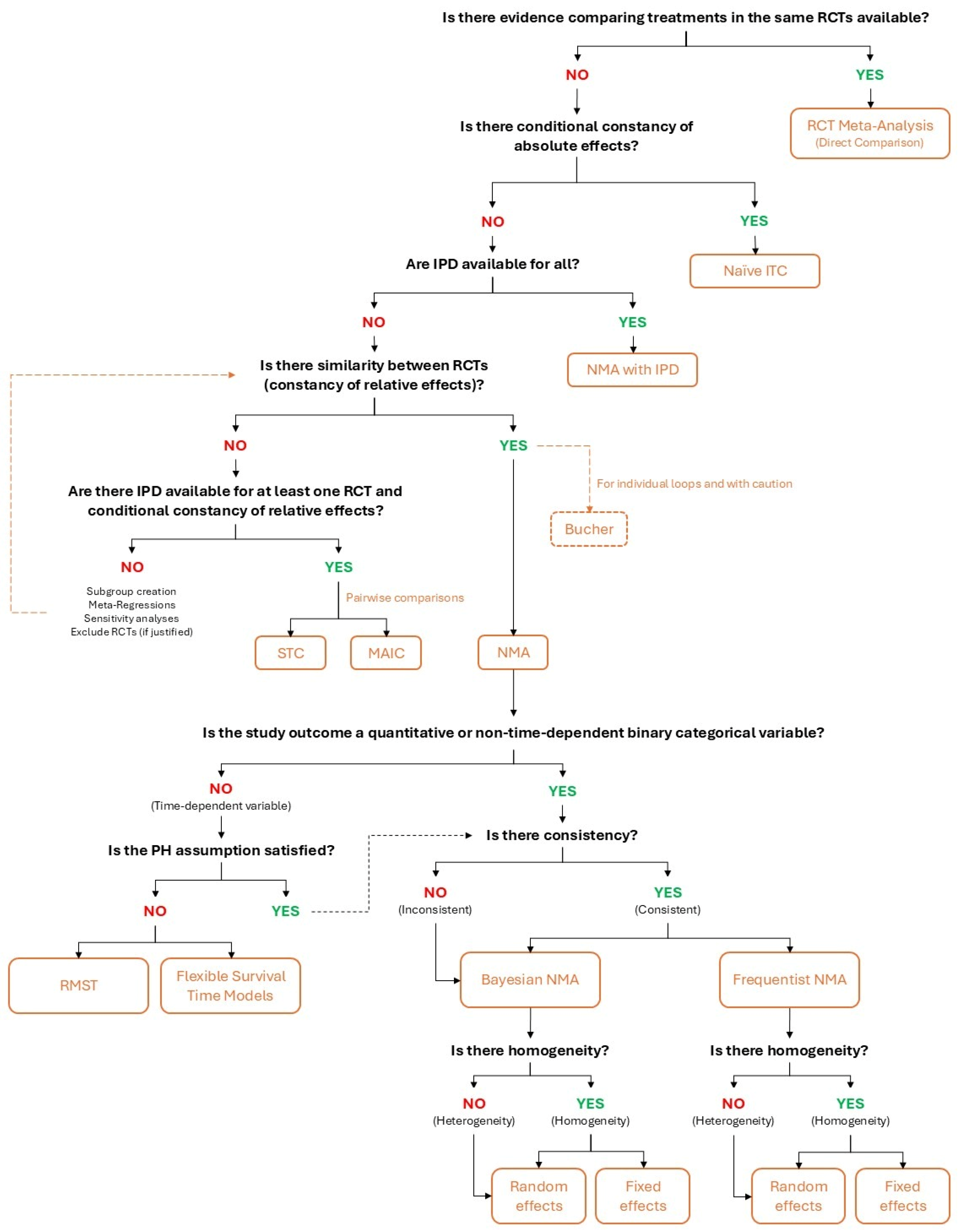
4. Selection of the Method for Indirect Treatment Comparison
5. Description of Methods for Indirect Treatment Comparison
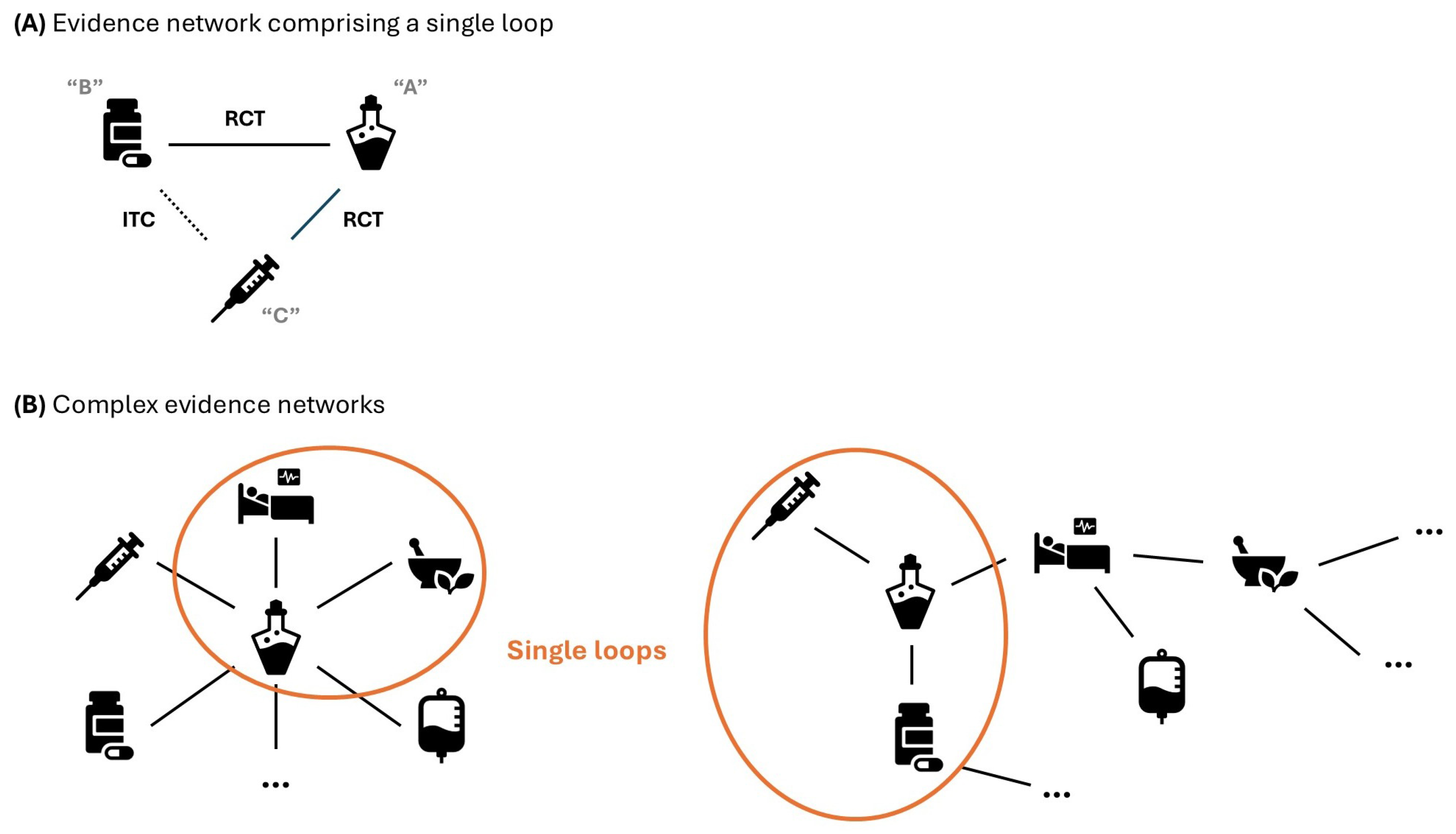
5.1. Bucher Method
- Differences in weights provided to each study in those direct vs. indirect comparisons can “artificially duplicate” the sample size in some RCTs.
- Differences in the design of the studies compared might yield different treatment effects.
- Differences in the method for measuring the result could produce differences in the observed treatment effect.
- Differences in the distribution of effect modifiers could impact the outcomes (e.g., overrepresentation of certain subgroups in one study compared to another), which could limit the consistency of the relative effects assumption.
5.2. Network Meta-Analysis (NMA)
5.2.1. Frequentist Network Meta-Analysis (NMA)
5.2.2. Bayesian Network Meta-Analysis (NMA)
5.2.3. Network Meta-Analysis (NMA) of Time-to-Event Variables
5.2.4. Network Meta-Analysis (NMA) with Individual Participant Data
- Two-step method: The IPDs for each RCT are analyzed, and the NMA is performed using the estimated pooled data.
- One-step method: IPDs are modeled considering the RCT to which they belong as an additional variable in the model.
5.3. Population-Adjusted Indirect Comparisons
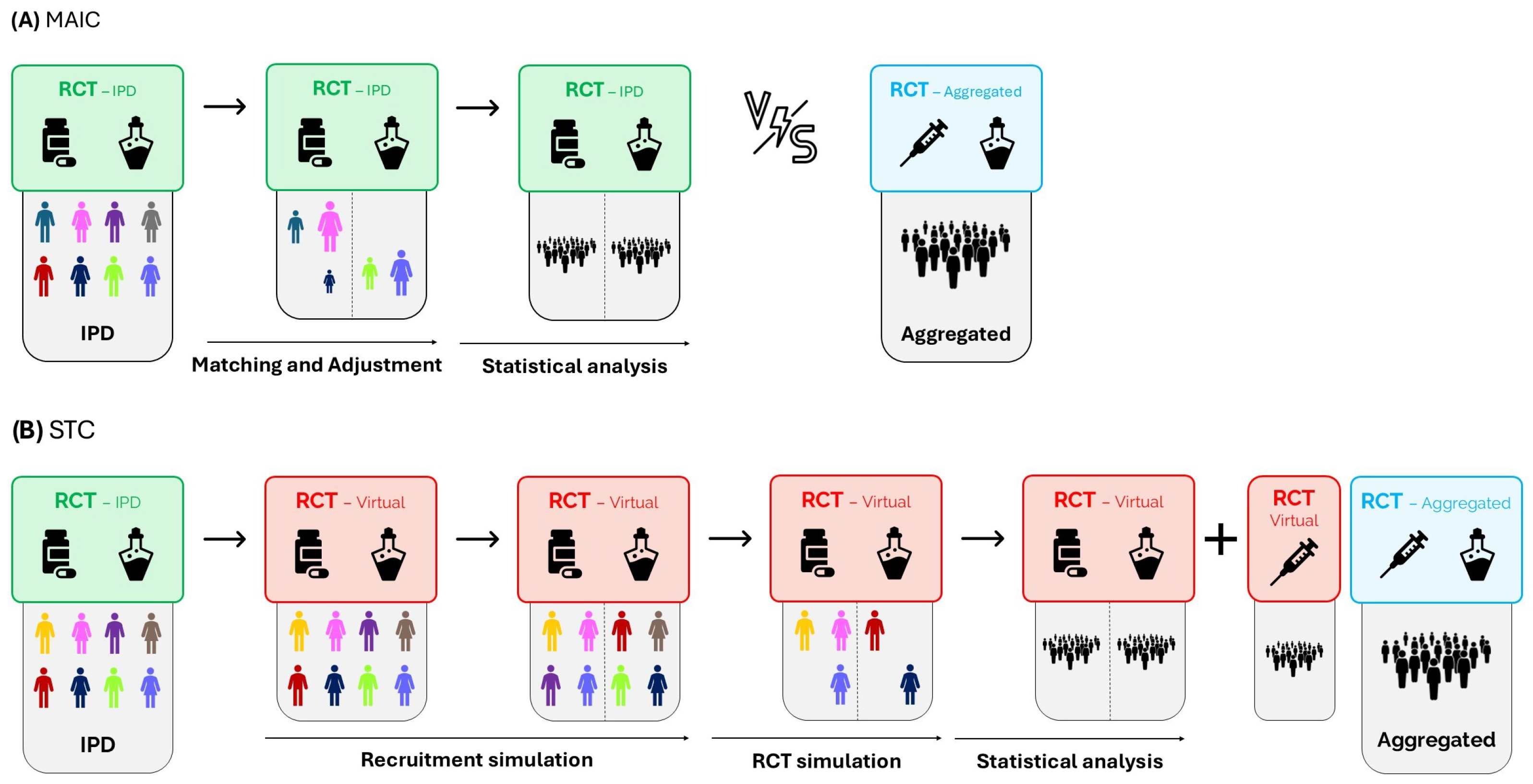
5.3.1. Matching-Adjusted Indirect Comparison (MAIC)
5.3.2. Simulated Treatment Comparison (STC)
6. Critical Assessment of Indirect Treatment Comparisons
7. Conclusions
Author Contributions
Funding
Institutional Review Board Statement
Informed Consent Statement
Data Availability Statement
Conflicts of Interest
Abbreviations
| AIC | Akaike information criterion |
| AUC | Area under the curve |
| BIC | Bayesian information criterion |
| CI | Confidence interval |
| CrI | Credibility interval |
| DIC | Deviation information criterion |
| DSL | DerSimonian–Laird |
| HR | Hazard ratio |
| HTA | Health technology assessment |
| HTACG | Health technology assessment coordination group |
| HTAR | Health technology assessment regulation |
| HTD | Health technology developer |
| IPD | Individual participant data |
| ITC | Indirect treatment comparison |
| JCA | Joint clinical assessment |
| KH | Knapp–Hartung |
| MAIC | Matching–adjusted indirect comparison |
| NMA | Network meta-analysis |
| OR | Odds ratio |
| PH | Proportional hazards |
| PICO | Population–Intervention–Comparator–Outcome |
| PWE | Piecewise exponential |
| RCT | Randomized controlled trial |
| RMST | Restricted mean survival time |
| STC | Simulated treatment comparison |
| SUCRA | Surface under the cumulative ranking curve |
References
- European Parliament; Council of the European Union. Regulation (EU) 2021/2282 of the European Parliament and of the Council of 15 December 2021 on Health Technology Assessment and Amending Directive 2011/24/EU. 2021. Available online: https://eur-lex.europa.eu/legal-content/EN/TXT/HTML/?uri=CELEX:32021R2282 (accessed on 15 April 2026).
- European Commission. Commission Implementing Regulatio (EU) 2024/1381 of 23 May 2024 Laying Down, Pursuant to Regulation (EU) 2021/2282 on Health Technology Assessment, Procedural Rules for the Interaction During, Exchange of Information on, and Participation in, the Preparation and Update of Joint Clinical Assessments of Medicinal Products for Human Use at Union Level, as Well as Templates for Those Joint Clinical Assessments. 2024. Available online: https://eur-lex.europa.eu/legal-content/EN/TXT/HTML/?uri=OJ:L_202401381 (accessed on 15 April 2026).
- Member State Coordination Group on Health Technology Assessment. Methodological Guideline for Quantitative Evidence Synthesis: Direct and Indirect Comparisons. 2024. Available online: https://health.ec.europa.eu/document/download/4ec8288e-6d15-49c5-a490-d8ad7748578f_en?filename=hta_methodological-guideline_direct-indirect-comparisons_en.pdf&prefLang=el (accessed on 15 April 2026).
- Member State Coordination Group on Health Technology Assessment. Practical Guideline for Quantitative Evidence Synthesis: Direct and Indirect Comparisons. 2024. Available online: https://health.ec.europa.eu/document/download/1f6b8a70-5ce0-404e-9066-120dc9a8df75_en?filename=hta_practical-guideline_direct-and-indirect-comparisons_en.pdf (accessed on 15 April 2026).
- Riley, R.D.; Lambert, P.C.; Abo-Zaid, G. Meta-analysis of individual participant data: Rationale, conduct, and reporting. BMJ 2010, 340, c221. [Google Scholar] [CrossRef] [PubMed]
- Bucher, H.C.; Guyatt, G.H.; Griffith, L.E.; Walter, S.D. The results of direct and indirect treatment comparisons in meta-analysis of randomized controlled trials. J. Clin. Epidemiol. 1997, 50, 683–691. [Google Scholar] [CrossRef]
- Hoaglin, D.C.; Hawkins, N.; Jansen, J.P.; Scott, D.A.; Itzler, R.; Cappelleri, J.C.; Boersma, C.; Thompson, D.; Larholt, K.M.; Diaz, M.; et al. Conducting indirect-treatment-comparison and network-meta-analysis studies: Report of the ISPOR Task Force on Indirect Treatment Comparisons Good Research Practices: Part 2. Value Health 2011, 14, 429–437. [Google Scholar] [CrossRef] [PubMed]
- Signorovitch, J.E.; Wu, E.Q.; Yu, A.P.; Gerrits, C.M.; Kantor, E.; Bao, Y.; Gupta, S.R.; Mulani, P.M. Comparative Effectiveness Without Head-to-Head Trials: A Method for Matching-Adjusted Indirect Comparisons Applied to Psoriasis Treatment with Adalimumab or Etanercept. PharmacoEconomics 2010, 28, 935–945. [Google Scholar] [CrossRef]
- Signorovitch, J.E.; Sikirica, V.; Erder, M.H.; Xie, J.; Lu, M.; Hodgkins, P.S.; Betts, K.A.; Wu, E.Q. Matching-Adjusted Indirect Comparisons: A New Tool for Timely Comparative Effectiveness Research. Value Health 2012, 15, 940–947. [Google Scholar] [CrossRef]
- Caro, J.J.; Ishak, K.J. No Head-to-Head Trial? Simulate the Missing Arms. PharmacoEconomics 2010, 28, 957–967. [Google Scholar] [CrossRef]
- Sadeghirad, B.; Foroutan, F.; Zoratti, M.J.; Busse, J.B.; Brignardello-Petersen, R.; Guyatt, G.; Thabane, L. Theory and practice of Bayesian and frequentist frameworks for network meta-analysis. BMJ Evid. Based Med. 2023, 28, 204–209. [Google Scholar] [CrossRef]
- Hespanhol, L.; Vallio, C.S.; Costa, L.M.; Menezes Costa, L.; Saragiotto, B.T. Understanding and interpreting confidence and credible intervals around effect estimates. Braz. J. Phys. Ther. 2019, 23, 290–301. [Google Scholar] [CrossRef] [PubMed]
- Jansen, J.P.; Crawford, B.; Bergman, G.; Stam, W. Bayesian meta-analysis of multiple treatment comparisons: An introduction to mixed treatment comparisons. Value Health 2008, 11, 956–964. [Google Scholar] [CrossRef]
- Borenstein, M.; Hedges, L.V.; Higgins, J.P.T.; Rothstein, H. Introduction to Meta-Analysis, 1st ed.; John Wiley & Sons, Ltd.: Chichester, UK, 2009; pp. 1–421. [Google Scholar]
- Lu, G.; Ades, A.E. Combination of direct and indirect evidence in mixed treatment comparisons. Stat. Med. 2004, 23, 3105–3124. [Google Scholar] [CrossRef]
- Jansen, J.P.; Fleurence, R.; Devine, B.; Itzler, R.; Barrett, A.; Hawkins, N.; Lee, K.; Boersma, C.; Annemans, L.; Cappelleri, J.C. Interpreting indirect treatment comparisons and network meta-analysis for health-care decision making: Report of the ISPOR Task Force on Indirect Treatment Comparisons Good Research Practices: Part 1. Value Health 2011, 14, 417–428. [Google Scholar] [CrossRef]
- Cipriani, A.; Higgins, J.P.; Geddes, J.R.; Salanti, G. Conceptual and technical challenges in network meta-analysis. Ann. Intern. Med. 2013, 159, 130–137. [Google Scholar] [CrossRef]
- Brockhaus, A.C.; Grouven, U.; Bender, R. Performance of the Peto odds ratio compared to the usual odds ratio estimator in the case of rare events. Biom. J. 2016, 58, 1428–1444. [Google Scholar] [CrossRef] [PubMed]
- DerSimonian, R.; Laird, N. Meta-analysis in clinical trials. Control Clin. Trials 1986, 7, 177–188. [Google Scholar] [CrossRef]
- Wiksten, A.; Rücker, G.; Schwarzer, G. Hartung-Knapp method is not always conservative compared with fixed-effect meta-analysis. Stat. Med. 2016, 35, 2503–2515. [Google Scholar] [CrossRef]
- Sutton, A.J.; Abrams, K.R. Bayesian methods in meta-analysis and evidence synthesis. Stat. Methods Med. Res. 2001, 10, 277–303. [Google Scholar] [CrossRef] [PubMed]
- Gelman, A. Prior distributions for variance parameters in hierarchical models (Comment on Article by Browne and Draper). Bayesian Anal. 2006, 1, 515–534. [Google Scholar] [CrossRef]
- Röver, C.; Bender, R.; Dias, S.; Schmid, C.H.; Schmidli, H.; Sturtz, S.; Weber, S.; Friede, T. On weakly informative prior distributions for the heterogeneity parameter in Bayesian random-effects meta-analysis. Res. Synth. Methods 2021, 12, 448–474. [Google Scholar] [CrossRef]
- Kleinbaum, D.; Klein, M. Survival Analysis: A Self-Learning Text, 1st ed.; Springer: New York, NY, USA, 1996; pp. 1–324. [Google Scholar]
- Guyot, P.; Ades, A.E.; Ouwens, M.J.; Welton, N.J. Enhanced secondary analysis of survival data: Reconstructing the data from published Kaplan-Meier survival curves. BMC Med. Res. Methodol. 2012, 12, 9. [Google Scholar] [CrossRef]
- Royston, P.; Parmar, M.K. Restricted mean survival time: An alternative to the hazard ratio for the design and analysis of randomized trials with a time-to-event outcome. BMC Med. Res. Methodol. 2013, 13, 152. [Google Scholar] [CrossRef]
- Freeman, S.C.; Carpenter, J.R. Bayesian one-step IPD network meta-analysis of time-to-event data using Royston-Parmar models. Res. Synth. Methods 2017, 8, 451–464. [Google Scholar] [CrossRef]
- Freeman, S.C.; Cooper, N.J.; Sutton, A.J.; Crowther, M.J.; Carpenter, J.R.; Hawkins, N. Challenges of modelling approaches for network meta-analysis of time-to-event outcomes in the presence of non-proportional hazards to aid decision making: Application to a melanoma network. Stat. Methods Med. Res. 2022, 31, 839–861. [Google Scholar] [CrossRef] [PubMed]
- Ouwens, M.J.; Philips, Z.; Jansen, J.P. Network meta-analysis of parametric survival curves. Res. Synth. Methods 2010, 1, 258–271. [Google Scholar] [CrossRef]
- Jansen, J.P. Network meta-analysis of survival data with fractional polynomials. BMC Med. Res. Methodol. 2011, 11, 61. [Google Scholar] [CrossRef] [PubMed]
- Lin, R.S.; Lin, J.; Roychoudhury, S.; Anderson, K.M.; Hu, T.; Huang, B.; Leon, L.F.; Liao, J.J.Z.; Liu, R.; Luo, X.; et al. Alternative Analysis Methods for Time to Event Endpoints Under Nonproportional Hazards: A Comparative Analysis. Stat. Biopharm. Res. 2020, 12, 187–198. [Google Scholar] [CrossRef]
- Heinecke, A.; Tallarita, M.; De Iorio, M. Bayesian splines versus fractional polynomials in network meta-analysis. BMC Med. Res. Methodol. 2020, 20, 261. [Google Scholar] [CrossRef] [PubMed]
- Wiksten, A.; Hawkins, N.; Piepho, H.P.; Gsteiger, S. Nonproportional hazards in network meta-analysis: Efficient strategies for model building and analysis. Value Health 2020, 23, 918–927. [Google Scholar] [CrossRef]
- Phillippo, D.M.; Ades, A.E.; Dias, S.; Palmer, S.; Abrahms, K.R.; Welton, N.J. Methods for Population-Adjusted Indirect Comparisons in Health Technology Appraisal. Med. Decis. Mak. 2018, 38, 200–211. [Google Scholar] [CrossRef]
- Phillippo, D.M.; Dias, S.; Ades, A.E.; Belger, M.; Brnabic, A.; Schacht, A.; Saure, D.; Kadziola, Z.; Welton, N.J. Multilevel network meta-regression for population-adjusted treatment comparisons. J. R. Stat. Soc. Ser. A Stat. Soc. 2020, 183, 1189–1210. [Google Scholar] [CrossRef]
- Thompson, J.C.; Manalastas, E.; Scott, D.A. MSR125 How Prognostic Factors Are Identified for Population Matching Analysis. Value Health 2023, 26, S417. [Google Scholar] [CrossRef]
- Freitag, A.; Gurskyte, L.; Sarri, G. Increasing transparency in indirect treatment comparisons: Is selecting effect modifiers the missing part of the puzzle? A review of methodological approaches and critical considerations. J. Comp. Eff. Res. 2023, 12, e230046. [Google Scholar] [CrossRef]
- Halabi, S.; Owzar, K. The importance of identifying and validating prognostic factors in oncology. Semin. Oncol. 2010, 37, e9–e18. [Google Scholar] [CrossRef]
- Igbelina, C.D.; Campden, R.; Grieve, S.; Thakur, D. CO14 Identification & Use of Prognostic Variables (PVs)/Treatment Effect Modifiers (TEMs) in Indirect Treatment Comparisons (ITCs) By Systematic Literature Review (SLR): Case Study of Chimeric Antigen Receptor (CAR) T-Cell Therapies. Value Health 2023, 26, S16. [Google Scholar]
- Guo, J.D.; Gehchan, A.; Hartzema, A. Selection of indirect treatment comparisons for health technology assessments: A practical guide for health economics and outcomes research scientists and clinicians. BMJ Open 2025, 15, e091961. [Google Scholar] [CrossRef]



| Method | Requirements | Effect Variable | Strengths | Limitations |
|---|---|---|---|---|
| Bucher method [6] | Rigorous assessment of similarity between RCTs (consistency of relative effects) An evidence network that comprises a single loop | Categorical (binary: OR, ratio, risk difference, standardized differences) Time-dependent events (HR) | Relatively “simple” and interpretable method Robust results when confounding factors are controlled due to randomization (adjusted ITC) | Exclusive method for evidence networks consisting of individual loops High sensitivity to methodological differences in design, description of the outcome, or subgroup variations between RCTs |
| Frequentist NMA [7] | Similarity between RCTs (consistency of relative effects) Consistent evidence network | Quantitative (discrete and continuous) Categorical (binary) Time-dependent events (HR) A | Relatively “simple” method (fixed effects models are easier to understand compared to random effects models) There are libraries for statistical software that facilitate the design of these frequentist NMA models (e.g., the “netmeta” library in R) They provide a deterministic result and its CI, which is generally easier to interpret | Requirement of individual loops, star networks, or the application of indirect ladder comparisons They do not reflect the uncertainty associated with heterogeneity The requirement of the consistency assumption must be satisfied |
| Bayesian NMA [7] | Similarity between RCTs (consistency of relative effects) | Quantitative (discrete and continuous) Categorical (binary) Time-dependent events (HR) A | They reflect the uncertainty inherent in heterogeneity among RCTs It is considered that they provide more robust results compared with frequentist NMAs They have more relaxed application requirements (they do not need to verify consistency to be used) They provide additional methods for studying consistency (e.g., node-splitting) They enable the creation of rankings of the interventions considered | They require advanced knowledge of statistics and programming for their development Its interpretation is less intuitive than in the case of frequentist NMAs The results are accompanied by CrI, a measure with which evaluators are less familiar |
| RMST [3,4] | NMA requirements and time-dependent outcome | Time-dependent events (when the PH assumption is not satisfied) | Offers the possibility of performing NMA with time-dependent data when the PH assumption is not satisfied | There is considerable uncertainty regarding the selected t*, which may depend on the data available in the RCTs; the t* should always be prespecified in the study protocol and should always be accompanied by sensitivity analyses varying the t* They require advanced knowledge of statistics and programming for their development Its interpretation is not very intuitive, as the time horizon is divided into “sections” |
| Flexible survival time models [3,4] | NMA requirements and time-dependent outcome | Time-dependent events (when the PH assumption is not satisfied) | Offers the possibility of performing NMA with time-dependent data when the PH assumption is not satisfied | To calculate this, it is necessary to access the IPDs (or reconstruct them from the published Kaplan–Meier curves) B They require advanced knowledge of statistics and programming for their development Their interpretation is not very intuitive Polynomial models use results predicted by models adjusted using the results of RCTs, rather than the results of RCTs directly PWE models provide fragmented data, and their subsequent aggregation across the entire time horizon is conceptually complex In polynomial models, choosing the right model is critical In PWE models, the number of fragments into which the time horizon is divided can be controversial |
| NMA with IPD [5] | Access to IPD from all RCTs | Quantitative (discrete and continuous) Categorical (binary) Time-dependent events (HR) A | The definition of consistent inclusion and exclusion criteria between RCTs is facilitated Missing data might be considered in the analysis The results of the individual RCTs can be verified during the analysis Updated follow-up information (in some cases beyond published data) might be included Duplicated participants between the data from each RCT can be identified Statistical analyses can be standardized between RCTs Checking assumptions can be conducted in an easier manner Baseline characteristics can be homogenized (including effect-modifier factors) Results can be estimated for subgroups of interest | Laborious method that requires significant resources (time, personnel, costs, etc.) It may be difficult to contact all authors of published and unpublished RCTs (and obtain access to IPDs) They require advanced knowledge of statistics They pose an ethical component to consider, since IPD is used instead of aggregated data (this type of NMA must be authorized by an Ethics Committee) The results are subject to bias if relevant RCTs are removed due to a lack of access to IPDs The quality of IPDs is not always adequate |
| MAIC [8,9] | Absence of similarity between RCTs but conditional constancy of relative/absolute effects Availability of IPD from at least one RCT Verification of the assumption of consistency of relative effects Presence of overlap between populations to be compared (populations that are as similar as possible) It is advisable for RCTs with IPD to have a large sample size. | Quantitative (discrete and continuous) Categorical (binary) Time-dependent events (HR) | More robust results are provided by this method when substantial differences in the characteristics of the RCT populations are observed This method is accepted in the scientific community, specifically in HTA, because it has been widely used | High overlap is required because it reduces the sample size and thus the statistical power The inclusion and exclusion criteria for the RCT-IPD should be less restrictive than the criteria for the RCT-aggregate The correct identification of the effect-modifier factors for which the populations will be adjusted is required (it is advisable to seek the collaboration of expert clinicians) The adjusted population may not be representative of the population on which the HTA decision is made |
| STC [10] | Absence of similarity between RCTs but conditional constancy of relative/absolute effects Availability of IPD from at least one RCT Verification of the assumption of consistency of relative effects Preferably in cases where the RCT with IPD has a small sample size | Quantitative (discrete and continuous) Categorical (binary) Time-dependent events (HR) | More robust results are provided by this method when substantial differences in the characteristics of the RCT populations are observed Aspects related to the design and implementation of RCTs can be simulated and adjusted (e.g., recruitment process) The sample size of the RCT-IPD is maintained after the population adjustment, being the preferred method when there are few patients in the RCT | The method validity depends on the correct specification of the outcome in the regression model The identification and inclusion of all effect-modifier factors are required to be included in regression models The adjusted population may not be representative of the population on which the HTA decision is made |
| Practical Considerations | Critical Assessment | ||
|---|---|---|---|
| 1 | General considerations and rationale for the need for an ITC |
| |
| 2 | Assumptions | Similarity |
|
| Homogeneity |
| ||
| Consistency |
| ||
| 3 | Missing data |
| |
| 4 | Direct comparison |
| |
| 5 | ITC | General aspects |
|
| NMA |
| ||
| MAIC |
| ||
| STC |
| ||
Disclaimer/Publisher’s Note: The statements, opinions and data contained in all publications are solely those of the individual author(s) and contributor(s) and not of MDPI and/or the editor(s). MDPI and/or the editor(s) disclaim responsibility for any injury to people or property resulting from any ideas, methods, instructions or products referred to in the content. |
© 2026 by the authors. Licensee MDPI, Basel, Switzerland. This article is an open access article distributed under the terms and conditions of the Creative Commons Attribution (CC BY) license.
Share and Cite
Cuadra-Grande, A.d.l.; Arruñada, M.; García-Solís, A.; Rossignoli-Montero, A.; Casado, M.Á. Evidence Synthesis via Indirect Treatment Comparisons in the European Framework of Joint Clinical Assessment. Epidemiologia 2026, 7, 64. https://doi.org/10.3390/epidemiologia7030064
Cuadra-Grande Adl, Arruñada M, García-Solís A, Rossignoli-Montero A, Casado MÁ. Evidence Synthesis via Indirect Treatment Comparisons in the European Framework of Joint Clinical Assessment. Epidemiologia. 2026; 7(3):64. https://doi.org/10.3390/epidemiologia7030064
Chicago/Turabian StyleCuadra-Grande, Alberto de la, María Arruñada, Alejandro García-Solís, Ana Rossignoli-Montero, and Miguel Ángel Casado. 2026. "Evidence Synthesis via Indirect Treatment Comparisons in the European Framework of Joint Clinical Assessment" Epidemiologia 7, no. 3: 64. https://doi.org/10.3390/epidemiologia7030064
APA StyleCuadra-Grande, A. d. l., Arruñada, M., García-Solís, A., Rossignoli-Montero, A., & Casado, M. Á. (2026). Evidence Synthesis via Indirect Treatment Comparisons in the European Framework of Joint Clinical Assessment. Epidemiologia, 7(3), 64. https://doi.org/10.3390/epidemiologia7030064