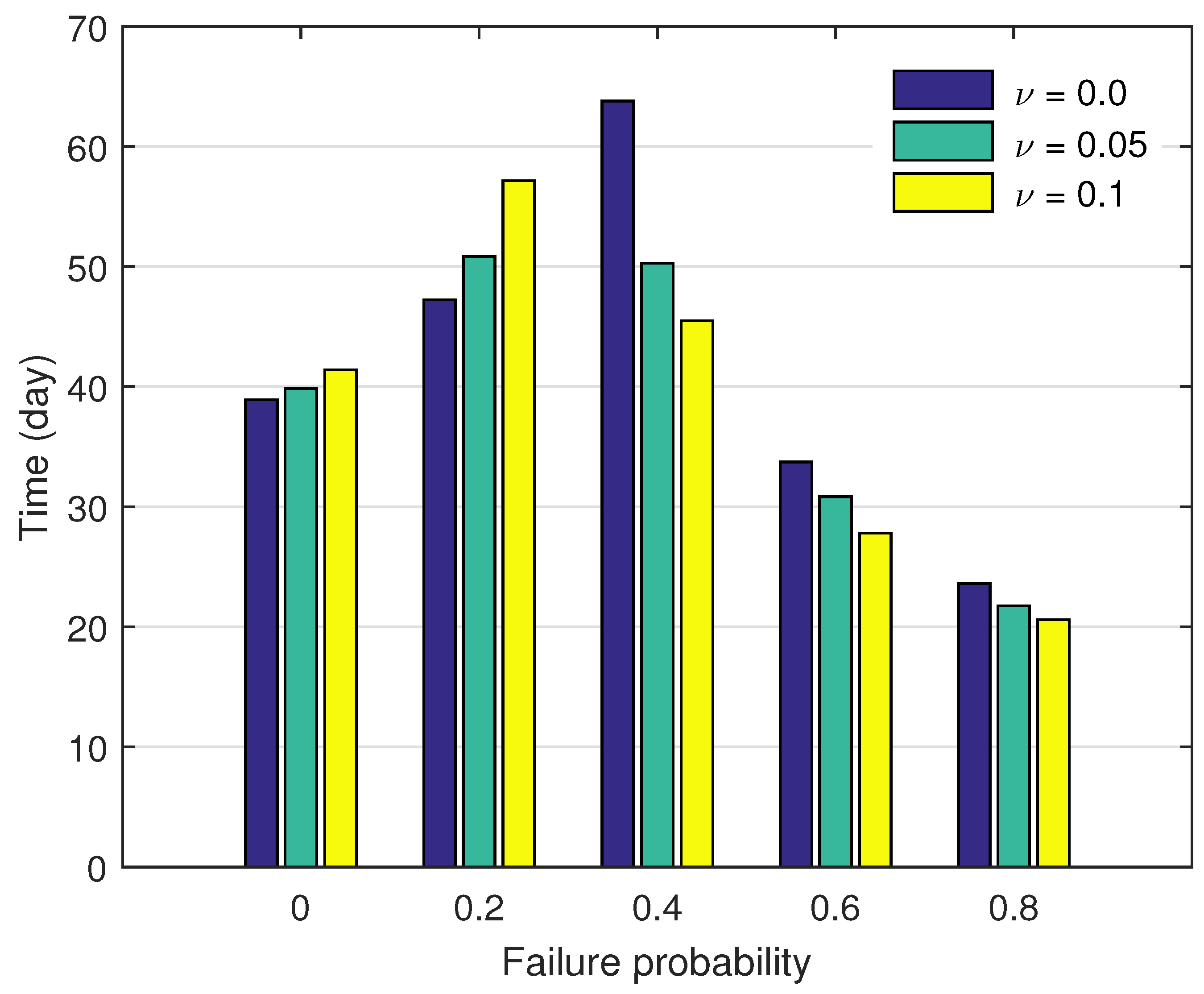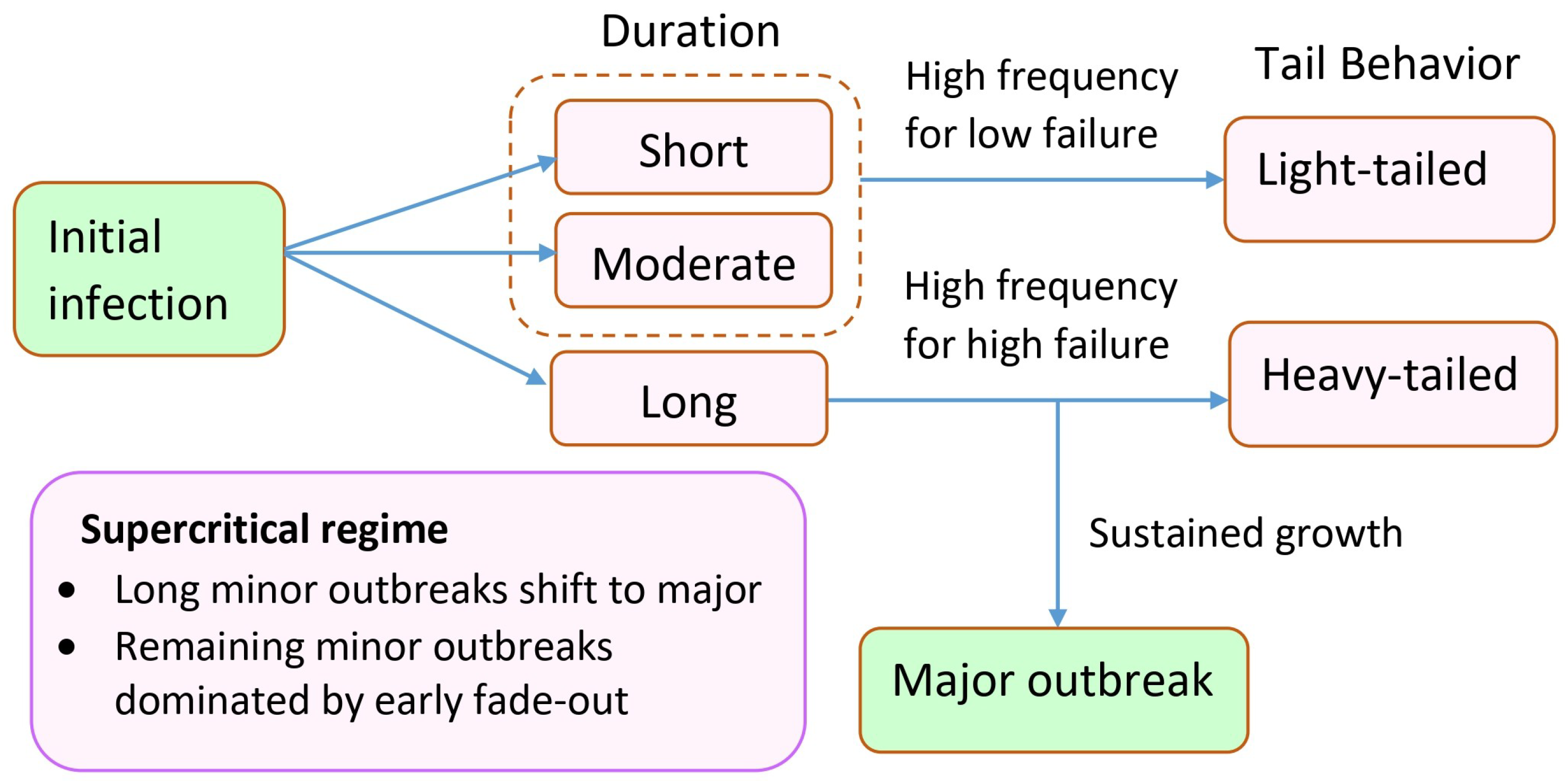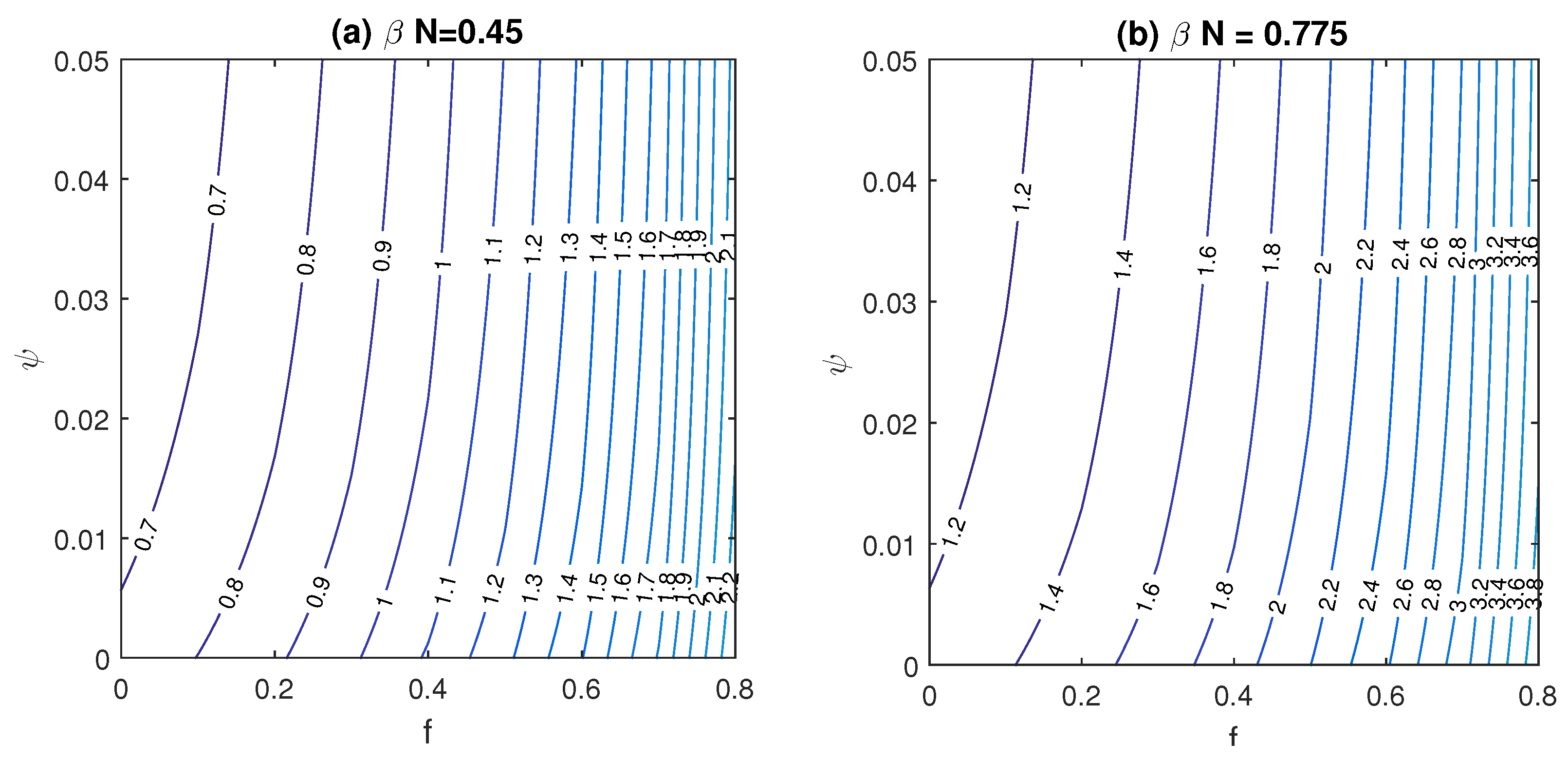


Modelling the Effects of Treatment Failure on the Minor Outbreak Duration for Carrier-Related Infectious Disease


Abstract
1. Introduction
2. Materials and Methods
2.1. Model Description
2.2. Extinction Threshold
2.3. Deterministic Approach
2.4. Probability Density Function of Minor Outbreak Duration
2.5. Case Study and Scenarios

| Symbol | Description | Value | Reference |
|---|---|---|---|
| Transmission rate | 0.45, 0.775 | Assumed | |
| Probability of symptomatic infection | 0.85 | [14,18] | |
| Untreated recovery rate of symptomatic individuals | 0.07 | [51,52] | |
| Scaling factor of carrier recovery rate | 0.189 | [49] | |
| Rate at which carriers undergo treatment | 0.012 | [34] | |
| Rate at which symptomatic individuals undergo treatment | 0.75 | [34] | |
| Scaling factor of carrier transmission rate | 0.1 | [34] | |
| Recovery rate under perfect treatment | 0.5 | [53] | |
| Rate at which carriers develop symptoms | 0.01 | Assumed | |
| Fraction of treated patients who fail and become carriers | 0.15 | [50,54] |
- (i)
- a parametric threshold exists and
- (ii)
- for all values of f.
- The values are selected to satisfy the existence condition for the parametric threshold. Although, the critical value can be computed from equation , the parametric threshold may not always exist [34].
- The values are selected to satisfy the possible range of estimated basic reproduction number. Since the estimation of basic reproduction number for S. pyogenes in literature is rare, we use data of scarlet fever and investigated spatiotemporal spreading patterns of the disease with certain time lags in Hong Kong, Macau, and Guangdong in 2011. The estimated is between and [59].
- The values are selected to satisfy the possible range of failure rate. Since the range is wide, the criterion to select parameter values is that the critical treatment failure probability should be intermediate so that we can investigate both the subcritical and supercritical regimes in the first scenario.
3. Results
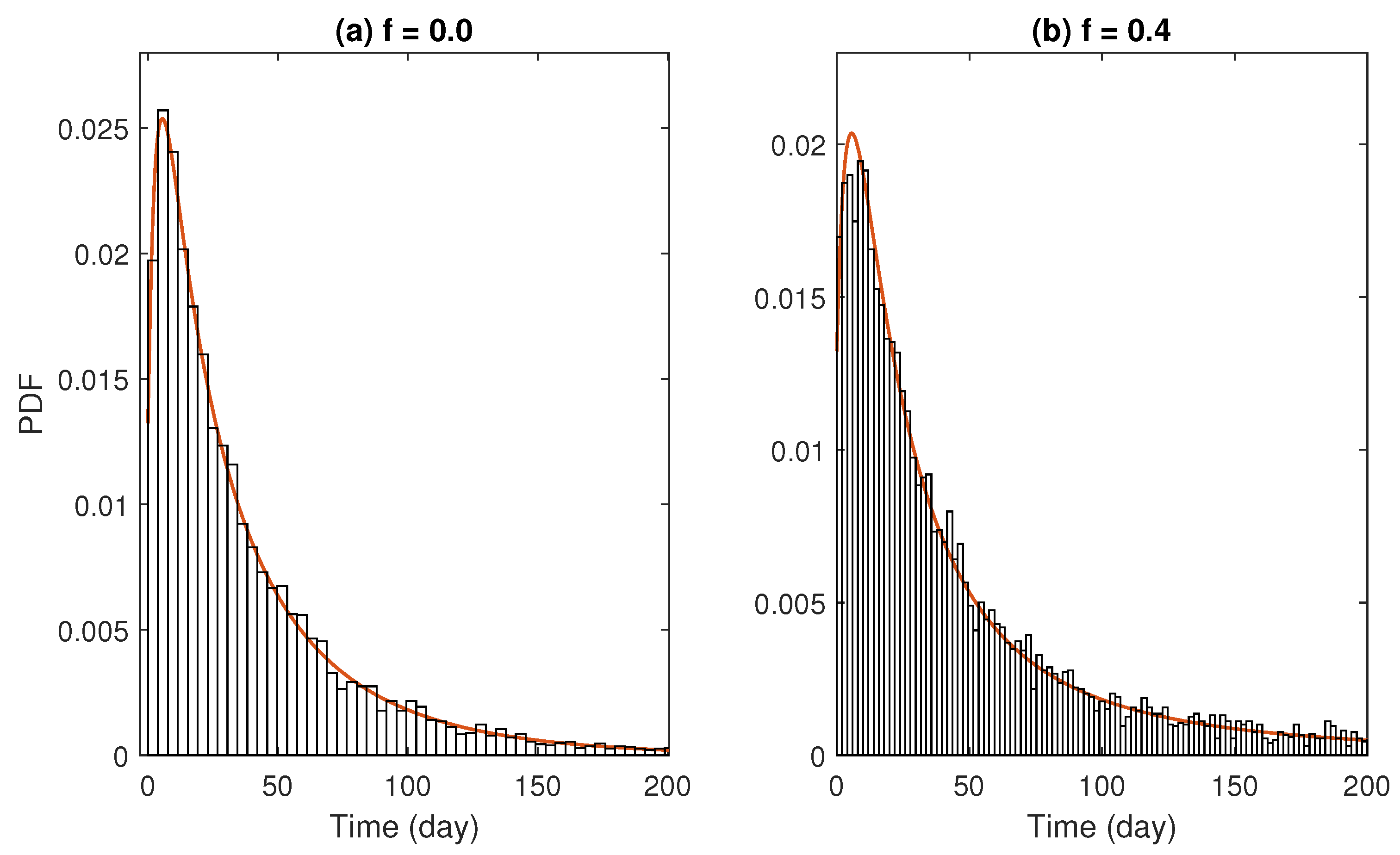
3.1. Influence of Treatment Failure Probability on PDF Patterns
3.2. Probability of Prolonged Persistence and Tail Risk
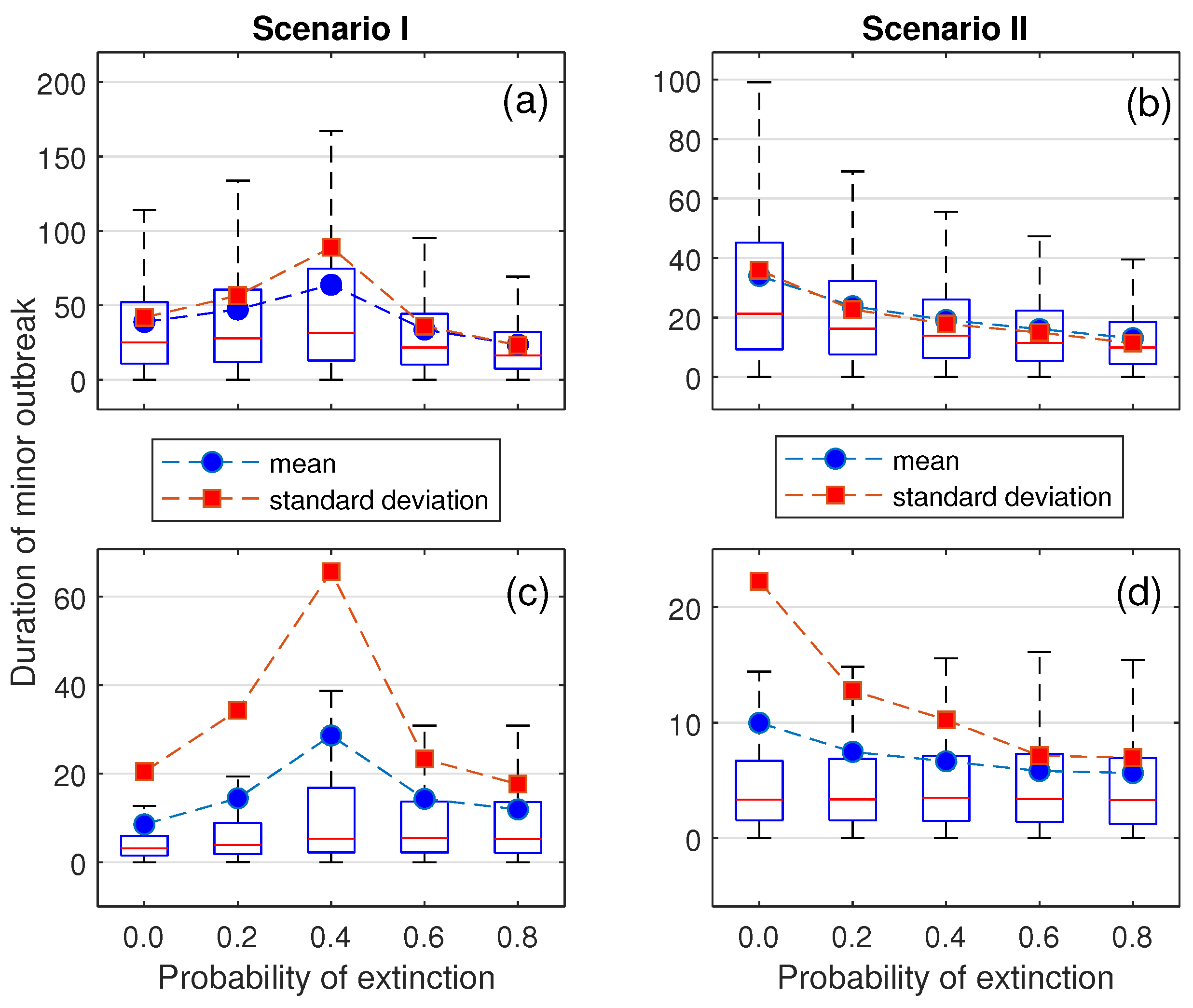
3.3. Statistics of Simulated Data
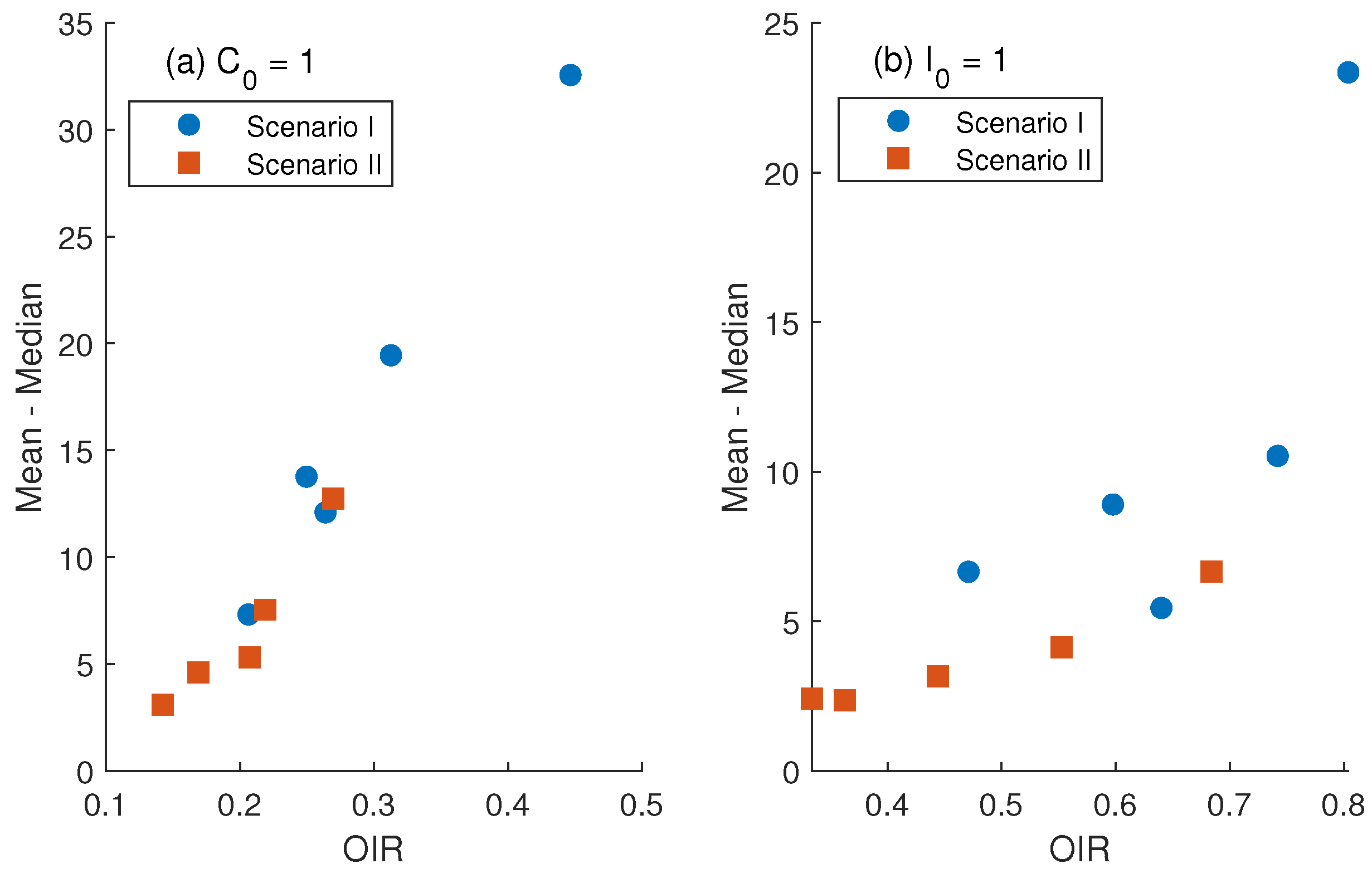
3.4. Effects of Initial Conditions
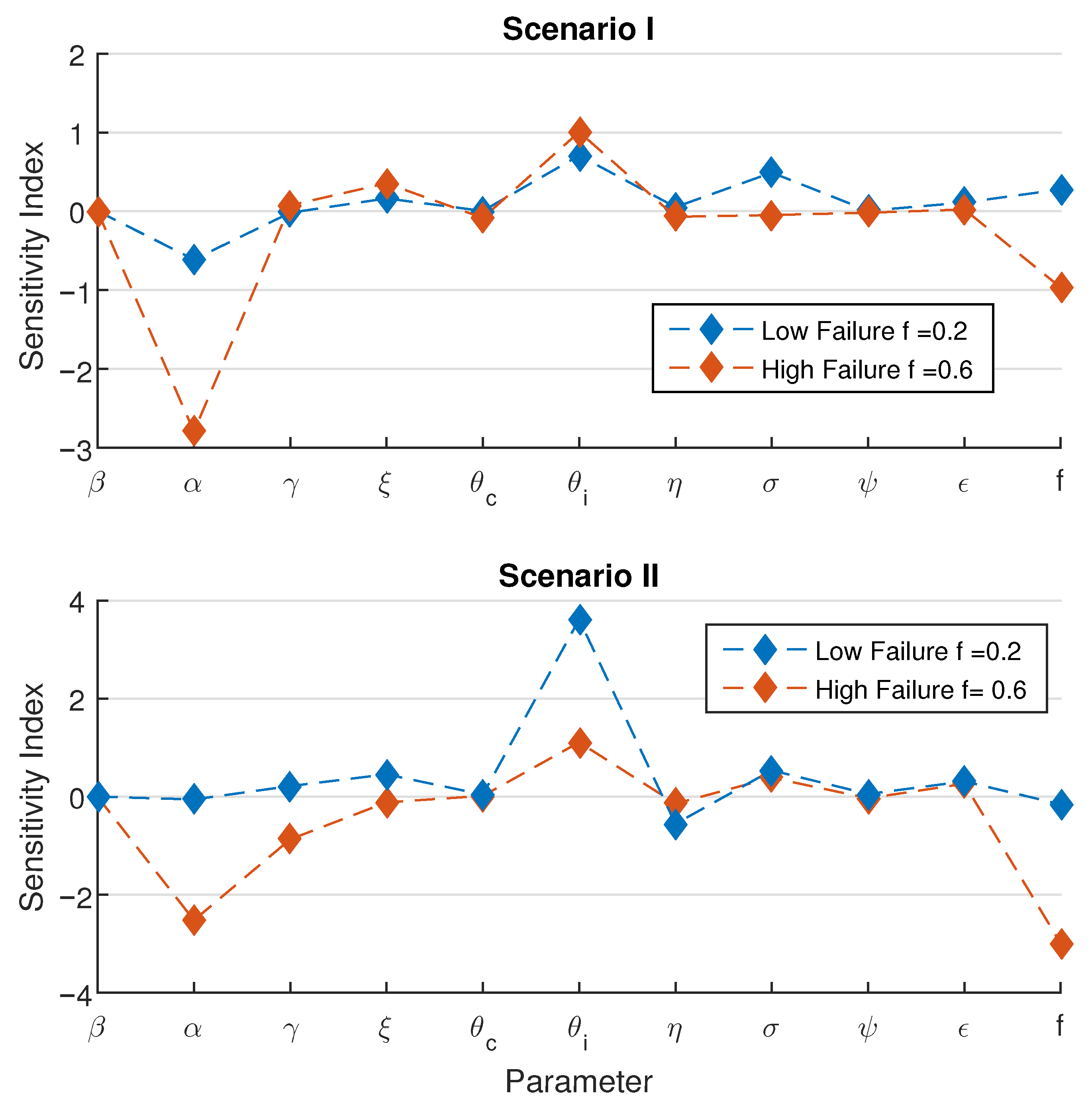
3.5. Sensitivity Analysis
3.6. Marginal Effect of Transmission During Treatment
4. Discussion
5. Conclusions
Author Contributions
Funding
Institutional Review Board Statement
Informed Consent Statement
Data Availability Statement
Conflicts of Interest
Abbreviations
| AMR | Antimicrobial resistance |
| CTMC | Continuous-Time Markov Chain |
| SCIT | Susceptible-Carriers-Infectious-Treatment |
| Probability density function | |
| PGF | Probability generating function |
| IQR | Interquartile range |
| OIR | Outlier Influence Ratio |
| PC | Percentage change |
Appendix A. Computational Procedure and Parameter Values Selection
Appendix A.1. Path Simulation
Appendix A.2. Numerical Implementation
Appendix A.3. Estimation of Extinction Probability
Appendix A.4. Parameter Values Selection

Appendix B. Supplementary Data
| Scenario I | ||||||
|---|---|---|---|---|---|---|
| Initial Condition | Error () | IQR | OIR | |||
| 0.0 | 0.68 | 1.00 | 0.00 | 41.28 | 0.25 | |
| 0.2 | 0.82 | 1.00 | 0.00 | 48.88 | 0.31 | |
| 0.4 | 1.04 | 0.94 | 1.21 | 60.23 | 0.45 | |
| 0.6 | 1.42 | 0.64 | 2.16 | 34.10 | 0.26 | |
| 0.8 | 2.23 | 0.41 | 1.66 | 24.80 | 0.21 | |
| 0.0 | 0.68 | 1.00 | 0.00 | 4.48 | 0.64 | |
| 0.2 | 0.82 | 1.00 | 0.00 | 7.05 | 0.74 | |
| 0.4 | 1.04 | 0.97 | 3.40 | 14.64 | 0.80 | |
| 0.6 | 1.42 | 0.73 | 0.78 | 11.48 | 0.60 | |
| 0.8 | 2.23 | 0.46 | 3.73 | 11.52 | 0.47 | |
| Scenario II | ||||||
| Initial Condition | Error () | IQR | OIR | |||
| 0.0 | 1.17 | 0.75 | 3.18 | 35.92 | 0.27 | |
| 0.2 | 1.42 | 0.57 | 3.76 | 24.66 | 0.22 | |
| 0.4 | 1.80 | 0.43 | 3.78 | 19.68 | 0.21 | |
| 0.6 | 2.45 | 0.32 | 0.09 | 16.82 | 0.17 | |
| 0.8 | 3.84 | 0.23 | 5.79 | 14.10 | 0.14 | |
| 0.0 | 1.17 | 0.89 | 1.38 | 5.15 | 0.68 | |
| 0.2 | 1.42 | 0.76 | 1.06 | 5.32 | 0.55 | |
| 0.4 | 1.80 | 0.61 | 2.54 | 5.63 | 0.44 | |
| 0.6 | 2.45 | 0.44 | 1.32 | 5.90 | 0.33 | |
| 0.8 | 3.84 | 0.27 | 3.82 | 5.70 | 0.36 | |
References
- Lambert, M.J. What Have We Learned About Treatment Failure in Empirically Supported Treatments? Some Suggestions for Practice. Cogn. Behav. Pract. 2011, 18, 413–420. [Google Scholar] [CrossRef]
- Endale, H.; Mathewos, M.; Abdeta, D. Potential Causes of Spread of Antimicrobial Resistance and Preventive Measures in One Health Perspective-A Review. Infect. Drug Resist. 2023, 16, 7515–7545. [Google Scholar] [CrossRef] [PubMed]
- Li, W.C. Antiviral Drug Resistance: Mechanisms and Solutions. Microbiol. Curr. Res. 2024, 8, 229. Available online: https://www.alliedacademies.org/articles/antiviral-drug-resistance-mechanisms-and-solutions-31077.html (accessed on 30 May 2025).
- Foka, F.E.T.; Mufhandu, H.T. Current ARTs, Virologic Failure, and Implications for AIDS Management: A Systematic Review. Viruses 2023, 15, 1732. [Google Scholar] [CrossRef]
- Meyer, A.N.; Giardina, T.D.; Khawaja, L.; Singh, H. Patient and clinician experiences of uncertainty in the diagnostic process: Current understanding and future directions. Patient Educ. Couns. 2021, 104, 2606–2615. [Google Scholar] [CrossRef]
- Sabharwal, K.A.; Simon, M.W. Are clinicians overdiagnosing strep throat and overprescribing antibiotics? Front Pediatr. 2023, 11, 1248903. [Google Scholar] [CrossRef]
- Evans, S.; Naylor, N.R.; Fowler, T.; Hopkins, S.; Robotham, J. The effectiveness and efficiency of asymptomatic SARS-CoV-2 testing strategies for patient and healthcare workers within acute NHS hospitals during an omicron-like period. BMC Infect. Dis. 2024, 24, 64. [Google Scholar] [CrossRef]
- Sivamalar, S.; Gomathi, S.; Boobalan, J.; Balakrishnan, P.; Pradeep, A.; Devaraj, C.A.; Solomonl, S.S.; Nallusamy, D.; Nalini, D.; Sureka, V.; et al. Delayed identification of treatment failure causes high levels of acquired drug resistance and less future drug options among HIV-1-infected South Indians. Indian J. Med. Microbiol. 2024, 47, 100520. [Google Scholar] [CrossRef]
- García, M.S. Early antibiotic treatment failure. Int. J. Antimicrob. Agents 2009, 34, S14–S19. [Google Scholar] [CrossRef]
- Shaikh, N.; Swali, P.; Houben, R.M.G.J. Asymptomatic but infectious – The silent driver of pathogen transmission. A pragmatic review. Epidemics 2023, 44, 100704. [Google Scholar] [CrossRef]
- Gao, W.; Lv, J.; Pang, Y.; Li, L.M. Role of asymptomatic and pre-symptomatic infections in covid-19 pandemic. BMJ 2021, 375, n2342. [Google Scholar] [CrossRef]
- Kuddus, M.A.; Tithi, S.K.; Theparod, T. Implications of Asymptomatic Carriers for Tuberculosis Transmission and Control in Thailand: A Modelling Approach. Symmetry 2024, 16, 1538. [Google Scholar] [CrossRef]
- Montgomery, M.P.; Morris, S.E.; Rolfes, M.A.; Kittikraisak, W.; Samuels, A.M.; Biggerstaff, M.; Davis, W.W.; Reed, C.; Olsen, S.J. The role of asymptomatic infections in influenza transmission: What do we really know. Lancet Infect. Dis. 2024, 24, e394–e404. [Google Scholar] [CrossRef] [PubMed]
- Yokchoo, N.; Patanarapeelert, N.; Patanarapeelert, K. The effect of group A streptococcal carrier on the epidemic model of acute rheumatic fever. Theor. Biol. Med. Model. 2019, 16, 14. [Google Scholar] [CrossRef] [PubMed]
- Chisholm, R.H.; Campbell, P.T.; Wu, Y.; Tong, S.Y.C.; McVernon, J.; Geard, N. Implications of asymptomatic carriers for infectious disease transmission and control. R. Soc. Open Sci. 2018, 5, 172341. [Google Scholar] [CrossRef]
- Zaaraoui, H.; Schumer, C.; Duval, X.; Hoen, B.; Opatowski, L.; Guedj, J. Modelling the effectiveness of antiviral treatment strategies to prevent household transmission of acute respiratory viruses. PLoS Comput. Biol. 2024, 20, e1012573. [Google Scholar] [CrossRef]
- Gerber, M.A. Treatment failures and carriers: Perception or problems? Pediatr. Infect. Dis. 1994, 13, 576–579. [Google Scholar] [CrossRef]
- DeMuri, G.P.; Wald, E.R. The Group A Streptococcal Carrier State Reviewed: Still an Enigma. J. Pediatr. Infect. Dis. Soc. 2014, 3, 336–342. [Google Scholar] [CrossRef]
- Kuhn, S.M.; Preiksaitis, J.; Tyrrel, G.J.; Jadavji, T.; Church, D.; Davies, H.D. Evaluation of potential factors contributing to microbiological treatment failure in Streptococcus pyogenes pharyngitis. Can. J. Infect. Dis. Med. Microbiol. 2001, 12, 297304. [Google Scholar] [CrossRef]
- Feng, Z.; Towers, S.; Yang, Y. Modeling the Effects of Vaccination and Treatment on Pandemic Influenza. AAPS J. 2011, 13, 427–437. [Google Scholar] [CrossRef]
- Wang, Y.; Cao, J.; Xue, C.; Li, L. Mathematical Analysis of Epidemic Models with Treatment in Heterogeneous Networks. Bull. Math. Biol. 2023, 85, 11. [Google Scholar] [CrossRef]
- Zobayer, A.; Ullah, M.S.; Ariful Kabir, K.M. A cyclic behavioral modeling aspect to understand the effects of vaccination and treatment on epidemic transmission dynamics. Sci. Rep. 2023, 13, 8356. [Google Scholar] [CrossRef] [PubMed]
- Diagne, M.L.; Agusto, F.B.; Rwezaura, H.; Tchuenche, J.M.; Lenhart, S. Optimal control of an epidemic model with treatment in the presence of media coverage. Sci. Afr. 2024, 24, e02138. [Google Scholar] [CrossRef]
- Lazebnik, T.; Itai, U. Bounding pandemic spread by heat spread. J. Eng. Math. 2023, 138, 6. [Google Scholar] [CrossRef] [PubMed]
- Lazebnik, T.; Alexi, A. High Resolution Spatio-Temporal Model for Room-Level Airborne Pandemic Spread. Mathematics 2023, 11, 426. [Google Scholar] [CrossRef]
- Mustapha, U.T.; Muhammad, A.I.; Yusuf, A.; Althobaiti, N.; Aliyu, A.I.; Andrawus, J. Mathematical Dynamics of Meningococcal Meningitis: Examining Carrier Diagnosis and Prophylaxis Treatment. Int. J. Appl. Comput. Math. 2025, 11, 77. [Google Scholar] [CrossRef]
- Campillo-Funollet, E.; Van Yperen, J.; Allman, P.; Bell, M.; Beresford, W.; Clay, J.; Dorey, M.; Evans, G.; Gilchrist, K.; Memon, A.; et al. Predicting and forecasting the impact of local outbreaks of COVID-19: Use of SEIR-D quantitative epidemiological modelling for healthcare demand and capacity. Int. J. Epidemiol. 2021, 50, 1103–1113. [Google Scholar] [CrossRef]
- Kretzschmar, M.E.; Ashby, B.; Fearon, E.; Overton, C.E.; Panovska-Griffiths, J.; Pellis, L.; Quaife, M.; Rozhnova, G.; Scarabel, F.; Stage, H.B.; et al. Challenges for modelling interventions for future pandemics. Epidemics 2022, 38, 100546. [Google Scholar] [CrossRef]
- Kucharski, A.J. Controlling minor outbreaks is necessary to prepare for major pandemics. PLoS Biol. 2024, 22, e3002945. [Google Scholar] [CrossRef]
- Ball, F.; Lashari, A.A.; Sirl, D.; Trapman, P. Modelling the spread of two successive SIR epidemics on a configuration model network. J. Math. Biol. 2025, 90, 51. [Google Scholar] [CrossRef]
- Hartfield, M.; Alizon, S. Introducing the Outbreak Threshold in Epidemiology. PLoS Pathog. 2013, 9, e1003277. [Google Scholar] [CrossRef] [PubMed]
- Thompson, R.N.; Gilligan, C.A.; Cunniffe, N.J. Will an outbreak exceed available resources for control? Estimating the risk from invading pathogens using practical definitions of a severe epidemic. J. R. Soc. Interface 2020, 17, 20200690. [Google Scholar] [CrossRef] [PubMed]
- Tritch, W.; Allen, L.J. Duration of a minor epidemic. Infect. Dis. Model. 2018, 3, 60–73. [Google Scholar] [CrossRef] [PubMed]
- Voottipruex, P.; Patanarapeelert, N.; Patanarapeelert, K. Treatment failure and the threshold of disease extinction. Infect. Dis. Model. 2025, 10, 453–465. [Google Scholar] [CrossRef]
- Nasell, I. On the Time to Extinction in Recurrent Epidemics. J. R. Stat. Soc. Ser. B Stat. Methodol. 1999, 61, 309–330. [Google Scholar] [CrossRef]
- Artalejo, J. On the time to extinction from quasi-stationarity: A unified approach. Phys. A Stat. Mech. Its Appl. 2012, 391, 4483–4486. [Google Scholar] [CrossRef]
- Hernández-Suárez, C.M.; Castillo-Chavez, C.; López, O.M.; Hernández-Cuevas, K. An application of queuing theory to SIS and SEIS epidemic models. Math. Biosci. Eng. 2010, 7, 809–823. [Google Scholar] [CrossRef]
- Schreiber, S.J.; Huang, S.; Jiang, J.; Wang, H. Extinction and Quasi-Stationarity for Discrete-Time, Endemic SIS and SIR Models. SIAM J. Appl. Math. 2021, 81, 2195–2217. [Google Scholar] [CrossRef]
- Yang, H.; Jin, Z. The critical community size on network. Nonlinear Dyn. 2024, 112, 16601–16612. [Google Scholar] [CrossRef]
- Clancy, D.; Tjia, E. Approximating Time to Extinction for Endemic Infection Models. Methodol. Comput. Appl. Probab. 2018, 20, 1043–1067. [Google Scholar] [CrossRef]
- Al-Darabsah, I.; Yuan, Y. A periodic disease transmission model with asymptomatic carriage and latency periods. J. Math. Biol. 2018, 77, 343–376. [Google Scholar] [CrossRef]
- Bi, X.; Beck, C.L. On the Role of Asymptomatic Carriers in Epidemic Spread Processes. In Proceedings of the 2021 American Control Conference (ACC); IEEE: New York, NY, USA, 2021; pp. 3164–3169. [Google Scholar] [CrossRef]
- Yaga, S.J.; Saporu, F.W. A study of a stochastic model and extinction phenomenon of meningitis epidemic. Epidemiol. Methods 2025, 14, 20240015. [Google Scholar] [CrossRef]
- Kimmel, M.; Axelrod, D.E. Branching Processes in Biology; Interdisciplinary Applied Mathematics; Springer: New York, NY, USA, 2002; Volume 19. [Google Scholar] [CrossRef]
- Allen, L.J.S. A primer on stochastic epidemic models: Formulation, numerical simulation, and analysis. Infect. Dis. Model. 2017, 2, 128–142. [Google Scholar] [CrossRef] [PubMed]
- Allen, L.J.S. Stochastic Population and Epidemic Models: Persistence and Extinction; Mathematical Biosciences Institute Lecture Series; Springer: Berlin/Heidelberg, Germany, 2015. [Google Scholar] [CrossRef]
- Allen, L.J.S.; Lahodny, G.E. Extinction thresholds in deterministic and stochastic epidemic models. J. Biol. Dyn. 2012, 6, 590–611. [Google Scholar] [CrossRef] [PubMed]
- Allen, L.J.S.; van den Driessche, P. Relations between deterministic and stochastic thresholds for disease extinction in continuous- and discrete-time infectious disease models. Math. Biosci. 2013, 243, 99–108. [Google Scholar] [CrossRef]
- Martin, J.M.; Green, M.; Barbadora, K.A.; Wald, E.R. Group A Streptococci Among School-Aged Children: Clinical Characteristics and the Carrier State. Pediatrics 2004, 114, 1212–1219. [Google Scholar] [CrossRef]
- Neeman, R.; Keller, N.; Barzilai, A.; Korenman, Z.; Sela, S. Prevalence of internalisation-associated gene, prtF1, among persisting group-A streptococcus strains isolated from asymptomatic carriers. Lancet 1998, 352, 1974–1977. [Google Scholar] [CrossRef]
- Bessen, D.E.; Smeesters, P.R.; Beall, B.W. Molecular Epidemiology, Ecology, and Evolution of Group A Streptococci. Microbiol. Spectr. 2018, 6, 10-1128. [Google Scholar] [CrossRef]
- Ottawa Public Health. Invasive Group A Streptococcal Disease (iGAS). 2024. Available online: https://www.ottawapublichealth.ca/en/public-health-topics/invasive-group-a-streptococcal-disease.aspx (accessed on 30 May 2025).
- Hayama, B.; Harada, S.; Suzuki, M.; Doi, Y.; Nomura, Y.; Aoki, K.; Takehana, K.; Akatsuchi, T.; Enokida, T.; Takeda, K.; et al. Outbreak of Streptococcus pyogenes emm89 ST646 in a head and neck surgical oncology ward. Microbiol. Spectr. 2024, 12, e04260-23. [Google Scholar] [CrossRef]
- Rick, A.M.; Zaheer, H.A.; Martin, J.M. Clinical Features of Group A Streptococcus in Children With Pharyngitis: Carriers versus Acute Infection. Pediatr. Infect. Dis. J. 2020, 39, 483–488. [Google Scholar] [CrossRef]
- Passàli, D.; Lauriello, M.; Passàli, G.C.; Passàli, F.M.; Bellussi, L. Group A streptococcus and its antibiotic resistance. Acta Otorhinolaryngol. Ital. 2007, 27, 27–32. [Google Scholar] [PubMed]
- Musser, J.M.; Beres, S.B.; Zhu, L.; Olsen, R.J.; Vuopio, J.; Hyyryläinen, H.L.; Gröndahl-Yli-Hannuksela, K.; Kristinsson, K.G.; Darenberg, J.; Henriques-Normark, B.; et al. Reduced In Vitro Susceptibility of Streptococcus pyogenes to β-Lactam Antibiotics Associated with Mutations in the pbp2x Gene Is Geographically Widespread. J. Clin. Microbiol. 2020, 58, 10-1128. [Google Scholar] [CrossRef] [PubMed]
- Martin, J. The Streptococcus pyogenes Carrier State. In Streptococcus pyogenes: Basic Biology to Clinical Manifestations; Ferretti, J.J., Stevens, D.L., Fischetti, V.A., Eds.; University of Oklahoma Health Sciences Center: Oklahoma City, OK, USA, 2022; pp. 451–462. [Google Scholar]
- Brook, I. Treatment Challenges of Group A Beta-hemolytic Streptococcal Pharyngo-Tonsillitis. Int. Arch. Otorhinolaryngol. 2017, 21, 286–296. [Google Scholar] [CrossRef] [PubMed]
- Lau, E.H.Y.; Nishiura, H.; Cowling, B.J.; Ip, D.K.M.; Wu, J.T. Scarlet fever outbreak, Hong Kong, 2011. Emerg. Infect. Dis. 2012, 18, 1700–1702. [Google Scholar] [CrossRef]
- Harkness, G.A.; Bentley, D.W.; Mottley, M.; Lee, J. Streptococcus pyogenes outbreak in a long-term care facility. Am. J. Infect. Control 1992, 20, 142–148. [Google Scholar] [CrossRef]
- Ruben, F.L.; Norden, C.W.; Heisler, B.; Korica, Y. An outbreak of Streptococcus pyogenes infections in a nursing home. Ann. Intern. Med. 1984, 101, 494–496. [Google Scholar] [CrossRef]
- Martin, J. The Carrier State of Streptococcus pyogenes. In Streptococcus pyogenes: Basic Biology to Clinical Manifestations, 2nd ed.; Ferretti, J.J., Stevens, D.L., Fischetti, V.A., Eds.; University of Oklahoma Health Sciences Center: Oklahoma City, OK, USA, 2022; Chapter 18. [Google Scholar]
- Zhang, T.; Wu, M.; Gao, C.; Wang, Y.; Wang, L. Probability of disease extinction and outbreak in a stochastic tuberculosis model with fast-slow progression and relapse. Electron. Res. Arch. 2023, 31, 7104–7124. [Google Scholar] [CrossRef]
- Ward, C.; Brown, G.D.; Oleson, J.J. Incorporating infectious duration-dependent transmission into Bayesian epidemic models. Biom. J. 2023, 65, 2100401. [Google Scholar] [CrossRef]
- Baazeem, A.S.; Nawaz, Y.; Arif, M.S.; Abodayeh, K.; AlHamrani, M.A. Modelling Infectious Disease Dynamics: A Robust Computational Approach for Stochastic SIRS with Partial Immunity and an Incidence Rate. Mathematics 2023, 11, 4794. [Google Scholar] [CrossRef]
- Di Domenico, L.; Valdano, E.; Colizza, V. Limited data on infectious disease distribution exposes ambiguity in epidemic modeling choices. Phys. Rev. Res. 2024, 6, 023265. [Google Scholar] [CrossRef]
- Oliver, J.; Malliya Wadu, E.; Pierse, N.; Moreland, N.J.; Williamson, D.A.; Baker, M.G. Group A Streptococcus pharyngitis and pharyngeal carriage: A meta-analysis. PLoS Neglected Trop. Dis. 2018, 12, e0006335. [Google Scholar] [CrossRef]
- Norton, L.; Myers, A. The treatment of streptococcal tonsillitis/pharyngitis in young children. World J. Otorhinolaryngol. Head Neck Surg. 2021, 7, 161–165. [Google Scholar] [CrossRef]


| Event | Transition Probability | |
|---|---|---|
| Infection to C | ||
| Infection to I | ||
| Flow from C to T | ||
| Flow from C to I | ||
| Flow from I to T | ||
| Recover from T to S | ||
| Flow from T to C | ||
| Flow from T to I | ||
| Recover from I to S | ||
| Recover from C to S |
| Scenario I | ||||||
|---|---|---|---|---|---|---|
| Initial Condition | Error () | Median (PC) | Mean (PC) | OIR (PC) | ||
| 0.0 | 1.00 | 0.00 | 139.80% | 88.22% | −50.92% | |
| 0.2 | 1.00 | 0.00 | 156.77% | 95.24% | −48.85% | |
| 0.4 | 0.83 | 7.65 | 173.90% | 100.51% | −51.83% | |
| 0.0 | 1.00 | 0.00 | 121.55% | 124.44% | 4.81% | |
| 0.2 | 1.00 | 0.00 | 185.65% | 153.16% | −34.33% | |
| 0.4 | 0.90 | 0.69 | 371.37% | 140.19% | −41.62% | |
Disclaimer/Publisher’s Note: The statements, opinions and data contained in all publications are solely those of the individual author(s) and contributor(s) and not of MDPI and/or the editor(s). MDPI and/or the editor(s) disclaim responsibility for any injury to people or property resulting from any ideas, methods, instructions or products referred to in the content. |
© 2026 by the authors. Licensee MDPI, Basel, Switzerland. This article is an open access article distributed under the terms and conditions of the Creative Commons Attribution (CC BY) license.
Share and Cite
Voottipruex, P.; Patanarapeelert, N.; Patanarapeelert, K. Modelling the Effects of Treatment Failure on the Minor Outbreak Duration for Carrier-Related Infectious Disease. Epidemiologia 2026, 7, 58. https://doi.org/10.3390/epidemiologia7030058
Voottipruex P, Patanarapeelert N, Patanarapeelert K. Modelling the Effects of Treatment Failure on the Minor Outbreak Duration for Carrier-Related Infectious Disease. Epidemiologia. 2026; 7(3):58. https://doi.org/10.3390/epidemiologia7030058
Chicago/Turabian StyleVoottipruex, Pichaya, Nichaphat Patanarapeelert, and Klot Patanarapeelert. 2026. "Modelling the Effects of Treatment Failure on the Minor Outbreak Duration for Carrier-Related Infectious Disease" Epidemiologia 7, no. 3: 58. https://doi.org/10.3390/epidemiologia7030058
APA StyleVoottipruex, P., Patanarapeelert, N., & Patanarapeelert, K. (2026). Modelling the Effects of Treatment Failure on the Minor Outbreak Duration for Carrier-Related Infectious Disease. Epidemiologia, 7(3), 58. https://doi.org/10.3390/epidemiologia7030058