
Knowledge, Attitudes, and Practices of the Mexican Population Regarding the Disposal of Medications: A Cross-Sectional Study

 ,
,  , and
, and
Abstract
1. Introduction
2. Materials and Methods
2.1. Study Area and Design
2.2. Data Analysis
3. Results
3.1. Sociodemographic Characteristics
3.2. Knowledge on EUM Disposal
3.3. Attitudes Towards EUM Disposal
3.4. Practices Related to EUM Disposal
3.5. Prediction of Sociodemographic Variables on the Disposal of Medicines
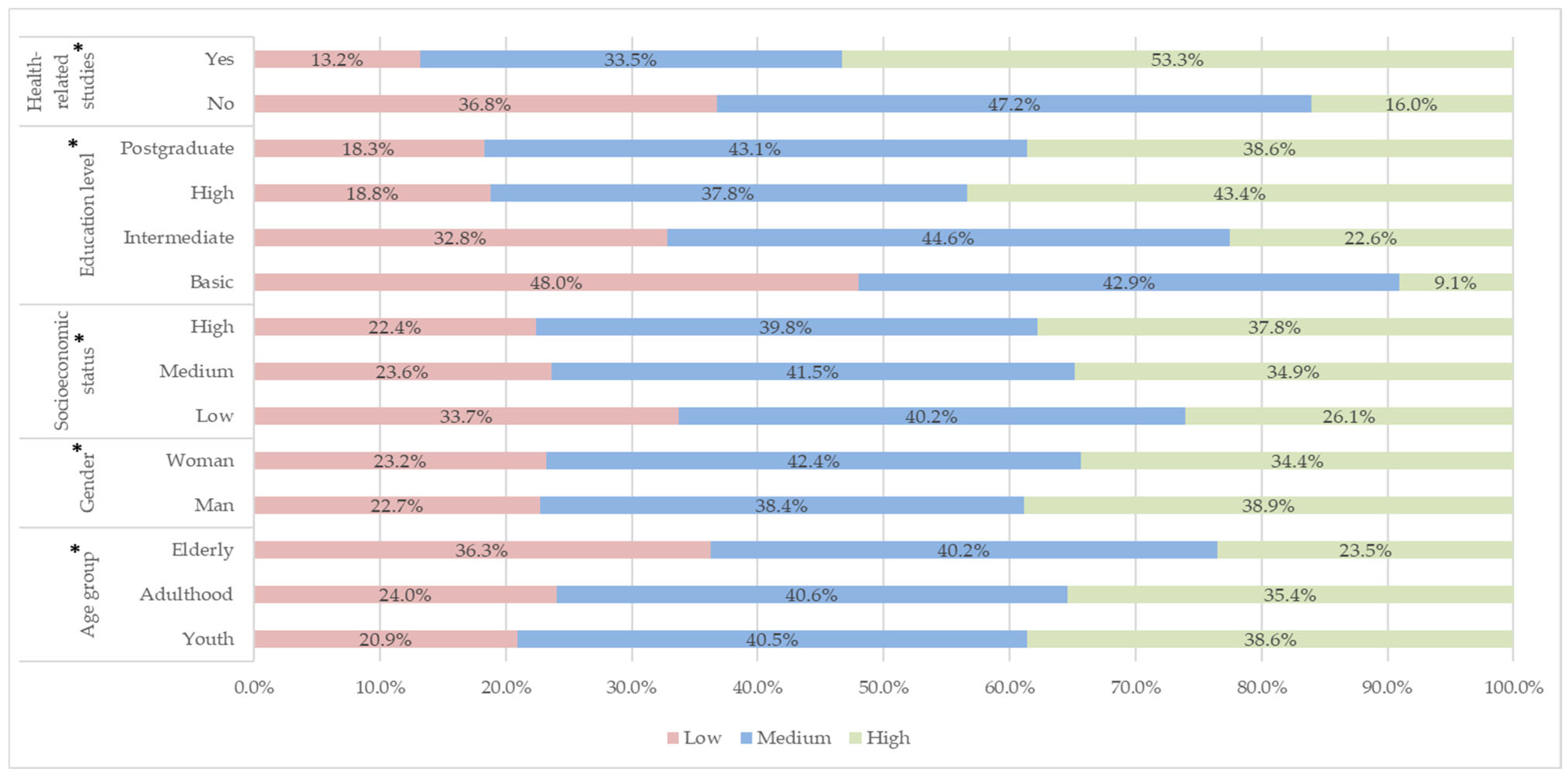
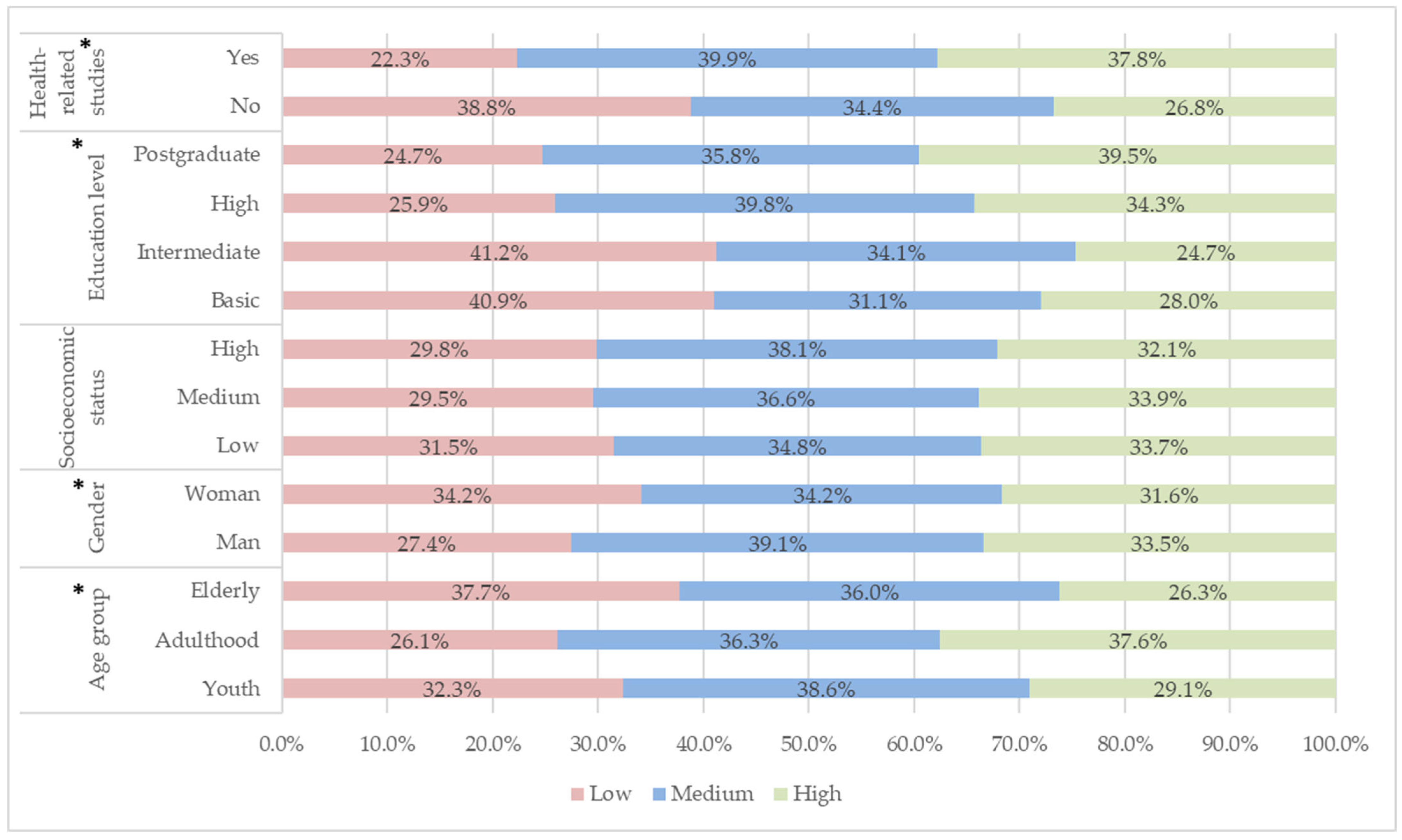
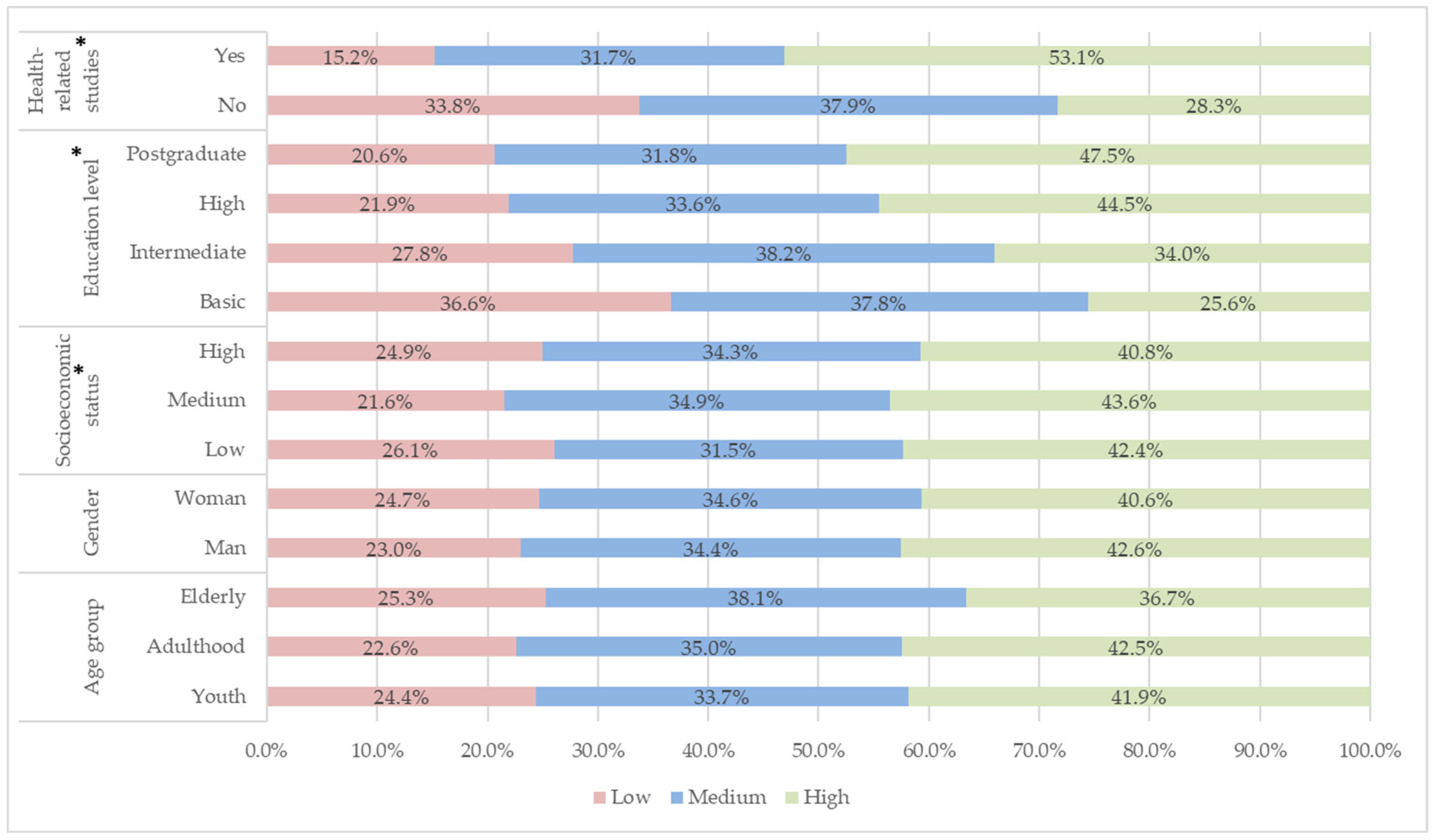
3.6. Associations Between Sociodemographic Variables and KAP
4. Discussion
- Infrastructure Optimization: The SINGREM system should expand its reach by increasing the density of collection points in high-traffic hubs (e.g., supermarkets and public transport) and launching a real-time digital map to reduce geographical barriers.
- Technological Integration: Transitioning from passive labeling to interactive QR codes on primary packaging. These should link directly to geo-located disposal sites and brief educational media, addressing the lack of awareness found in our study.
- Regulation: Adopting mandatory ‘take-back’ programs for pharmacies or the implementation of secure 24 h disposal kiosks in pharmacies and medical services buildings, similar to the U.S. model. For rural settings, public health services should offer information and disposal containers. Additionally, explicit regulation on medicines donations should be developed.
- Source Reduction: Promoting a shift toward unit-dose dispensing—a strategy proven effective in Spain—to prevent the initial accumulation of surplus medication in households. In the Mexican context, effectively mitigating the environmental and clinical risks associated with leftover medication requires prioritizing the professionalization of community pharmacies. Currently, most community pharmacies are operated by non-professionalized personnel rather than licensed pharmacists. Substantive improvement must be preceded by regulatory reforms that mandate the presence of qualified professionals capable of overseeing the integrity of the dispensing process.
5. Conclusions
Author Contributions
Funding
Institutional Review Board Statement
Informed Consent Statement
Data Availability Statement
Conflicts of Interest
Abbreviations
| EUM | Expired and Unused Medications |
| KAP | Knowledge, Attitudes and Practices |
| SINGREM | Sistema Nacional de Gestión de Residuos de Envases y Medicamentos |
| WHO | World Health Organization |
References
- Barnett-Itzhaki, Z.; Berman, T.; Grotto, I.; Schwartzberg, E. Household medical waste disposal policy in Israel. Isr. J. Health Policy Res. 2016, 5, 48. [Google Scholar] [CrossRef]
- Wilkinson, J.L.; Boxall, A.B.A.; Kolpin, D.W.; Leung, K.M.Y.; Lai, R.W.S.; Galbán-Malagón, C.; Teta, C. Pharmaceutical pollution of the world’s rivers. Proc. Natl. Acad. Sci. USA 2022, 119, e2113947119. [Google Scholar] [CrossRef] [PubMed]
- La Via, L.; Sangiorgio, G.; Stefani, S.; Marino, A.; Nunnari, G.; Cocuzza, S.; La Mantia, I.; Cacopardo, B.; Stracquadanio, S.; Spampinato, S.; et al. The Global Burden of Sepsis and Septic Shock. Epidemiologia 2024, 5, 456–478. [Google Scholar] [CrossRef] [PubMed]
- Organización Panamericana de la Salud. Directrices de Seguridad Para el Desecho de Productos Farmacéuticos. Available online: https://www.paho.org/es/emergencias-salud/directrices-seguridad-para-desecho-productos-farmaceuticos (accessed on 9 June 2025).
- Diario Oficial de la Federación. Ley General Para la Prevención y Gestión Integral de los Residuos. México: Procuraduría Federal de Protección al Ambiente. 2023. Available online: https://www.gob.mx/profepa/documentos/ley-general-para-la-prevencion-y-gestion-integral-de-los-residuos-62914 (accessed on 10 June 2025).
- Comisión Permanente de la Farmacopea de los Estados Unidos Mexicanos. Suplemento Para Establecimientos Dedicados a la Venta y Suministro de Medicamentos, Dispositivos Médicos y Demás Insumos Para la Salud 7.0; Secretaria de Salud: Ciudad de México, México, 2025. [Google Scholar]
- Sistema Nacional de Gestión de Residuos de Envases y Medicamentos (SINGREM). Busca tu Contenedor Seguro. Available online: https://www.singrem.org.mx/ (accessed on 9 June 2025).
- Felipe Fernandes, J.A.; Álvarez, P.; Carvajal, D.; Mera, A.C.; Garcia, G.M.; Aguiar Silva, L.N. Challenges of household medical waste collection systems: An analysis of regulatory instruments and stakeholders in three Latin American countries. J. Environ. Plan. Manag. 2024, 67, 3669–3693. [Google Scholar] [CrossRef]
- Saturno-Hernández, P.J.; Quiroz-Razo, R. Management and final disposal of expired medicines: An economic and public health problem. Salud Publica Mex. 2025, 67, 56–64. [Google Scholar] [CrossRef]
- Lam, J.; El Nsouli, D.; Lee, E.L.; Alqeisi, T.; Kane, R.; McGonagle, I.; Armani, K. Assessing the knowledge, attitudes and practices of healthcare staff and students regarding disposal of unwanted medications: A systematic review. BMJ Open 2024, 14, e093636. [Google Scholar] [CrossRef]
- Hiew, S.Y.; Low, B.Y. The knowledge, attitude, and practice of the public regarding household pharmaceutical waste disposal: A systematic review (2013–2023). Int. J. Pharm. Pract. 2024, 32, 120–132. [Google Scholar] [CrossRef]
- Cardwell, F. Knowledge, Attitudes and Practices of Global Environmental Change and Health: Toward Sustainable Behaviour Change? Master’s Thesis, McMaster University, Hamilton, ON, Canada, 2011. [Google Scholar]
- Thomas, D.; Zachariah, S. Chapter 11―Knowledge, Attitude, and Practice of Pharmacovigilance in Developing Countries. In Social and Administrative Aspects of Pharmacy in Low- and Middle-Income Countries; Ibrahim, M.I.M., Wertheimer, A.I., Babar, Z.U.D., Eds.; Academic Press: London, UK, 2018; pp. 177–193. [Google Scholar]
- Ayele, Y.; Mamu, M. Assessment of knowledge, attitude and practice towards disposal of unused and expired pharmaceuticals among community in Harar city, Eastern Ethiopia. J. Pharm. Policy Pract. 2018, 11, 27. [Google Scholar] [CrossRef]
- Instituto Nacional de Estadística y Geografía (INEGI). Encuesta Nacional de la Dinámica Demográfica (ENADID). 2023. Available online: https://www.inegi.org.mx/contenidos/saladeprensa/boletines/2024/ENADID/ENADID2023.pdf (accessed on 5 March 2025).
- Akande-Sholabi, W.; Adebisi, Y.A.; Abdul-Azeez, I.A. Disposal practices for unused and expired medications among outpatients in three healthcare facilities in Ibadan, Nigeria: A cross-sectional analysis. BMC Public Health 2025, 25, 4002. [Google Scholar] [CrossRef]
- Hajj, A.; Domiati, S.; Haddad, C.; Sacre, H.; Akl, M.; Akel, M.; Salameh, P. Assessment of knowledge, attitude, and practice regarding the disposal of expired and unused medications among the Lebanese population. J. Pharm. Policy Pract. 2022, 15, 107. [Google Scholar] [CrossRef]
- Khan, N.A.; Easwaran, V.; Orayj, K.; Venkatesan, K.; Shaik Alavudeen, S.; Alhadeer, S.A.; Vijayaraghavalu, S. A cross-sectional study on perceptions towards safe disposal of unused/expired medicines and its associated factors among the public in Saudi Arabia—A threat to the environment and health. PeerJ 2025, 13, e19258. [Google Scholar] [CrossRef]
- Espinal, J.A.V.; Rangel, A.V.M.; Flores, P.R.; Osorio, C.M.E.; Alcantara, G.C.; Chimal, G.A. Contaminación ambiental y riesgos de salud asociados con el desecho inadecuado de medicamentos en México 2024. LATAM Rev. Latinoam. Cienc. Soc. Humanidades 2024, 5, 579–599. [Google Scholar] [CrossRef]
- Bekele, D.W.; Dadebo, E.; Tilahun, G.; Gebremariam, Z. Awareness and Disposal Practices of Medicines among the Community in Hawassa City, Ethiopia. J. Toxicol. 2023, 2023, 4603993. [Google Scholar] [CrossRef] [PubMed]
- Esseku, Y.Y.; Mante, P.K.; Dodoo, A.N.O.; Woode, E. Drug Disposal and Ecopharmacovigilance Practices in the Krowor Municipality, Ghana. J. Toxicol. 2022, 2022, 7674701. [Google Scholar] [CrossRef] [PubMed]
- Sanabria Pérez, F.J.; Alanís Méndez, J.L.; Pech-Canché, J.M.; Solis Maldonado, C. Principales residuos de medicamentos generados en los hogares y su potencial ecotóxico en Tuxpan, Veracruz. Acta Univ. 2019, 29, e2108. [Google Scholar] [CrossRef]
- Quijano-Prieto, D.M.; Orozco-Díaz, J.G.; Holguín-Hernández, E. Conocimientos y prácticas de pacientes sobre disposición de medicamentos no consumidos. Aproximación a la ecofarmacovigilancia. Rev. Salud Publica 2016, 18, 61–71. [Google Scholar] [CrossRef][Green Version]
- Rojas-Cortés, R. Substandard, falsified and unregistered medicines in Latin America, 2017–2018. Rev. Panam. Salud Publica 2020, 44, e125. [Google Scholar] [CrossRef]
- Schulz-Bañares, B.; Sandoval-Cifuentes, C.; Sandoval-Quijada, T.; Müller-Ramírez, C. Residuos farmacéuticos domiciliarios en el medio ambiente: De la preocupación a la acción. Rev. Panam. Salud Publica 2021, 45, e155. [Google Scholar] [CrossRef]
- World Health Organization. One Health. Available online: https://www.who.int/news-room/fact-sheets/detail/one-health (accessed on 28 August 2025).
- Cámara Nacional de la Industria Farmacéutica (CANIFARMA). Presentación Anual de Estadísticas SINGREM; CANIFARMA: Mexico City, Mexico, 2024. [Google Scholar]
- Saturno-Hernández, P.J.; Poblano-Verástegui, O.; Acosta-Ruiz, O.; Bautista-Morales, A.C.; Gómez-Cortez, P.M.; Alcántara-Zamora, J.L.; Gutiérrez-Robledo, L.M. Potentially inappropriate prescribing in older adults in Mexico. Rev. Saude Publica 2021, 55, 80. [Google Scholar] [CrossRef]
- Ong, S.C.; Ooi, G.S.; Shafie, A.A.; Hassali, M.A. Knowledge, attitude and disposing practice of unused and expired medicines among the general public in Malaysia. J. Pharm. Health Serv. Res. 2020, 11, 141–148. [Google Scholar] [CrossRef]
- Alnahas, F.; Yeboah, P.; Fliedel, L.; Abdin, A.Y.; Alhareth, K. Expired Medication: Societal, Regulatory and Ethical Aspects of a Wasted Opportunity. Int. J. Environ. Res. Public Health 2020, 17, 787. [Google Scholar] [CrossRef]
- Instituto Nacional de Estadística y Geografía (INEGI). Encuesta Nacional sobre Disponibilidad y Uso de la Información en los Hogares (ENDUTIH). 2025. Available online: https://www.inegi.org.mx/contenidos/saladeprensa/boletines/2025/endutih/ENDUTIH_24_RR.pdf (accessed on 27 February 2026).



| Variables | Frequency (%) |
|---|---|
| Gender | |
| Female | 4001 (65.8) |
| Male | 2079 (34.2) |
| Age (years) | |
| 18–29 | 3017 (49.6) |
| 30–59 | 2782 (45.8) |
| ≥60 | 281 (4.6) |
| Marital status | |
| Single | 3729 (61.3) |
| Married | 1936 (31.9) |
| Divorced | 337 (5.6) |
| Widowed | 78 (1.3) |
| Educational level | |
| No formal education and basic level (0–8) | 254 (4.2) |
| Middle (9–12) | 1361 (22.4) |
| High | 3375 (55.5) |
| Postgraduate | 1090 (17.9) |
| Health-related studies | |
| Yes | 3332 (54.8) |
| No | 2748 (45.2) |
| Questions | Answers | Frequency (%) |
|---|---|---|
| From what day is a medication with an expiration date of March 2022 considered expired? | * 1 April 2022 | 1856 (30.5) |
| 1 March 2022 | 2471 (40.6) | |
| 31 March 2022 | 1753 (28.9) | |
| Do you understand the proper handling and disposal process for medicines and their packaging waste? | No | 2833 (46.6) |
| * Yes | 3247 (53.4) | |
| What is the most appropriate way for the final disposal of expired or unused medicines by the user? | * Placing them in special containers | 4790 (78.8) |
| Destroying them before throwing them in the household trash | 492 (8.1) | |
| Burning them | 69 (1.1) | |
| Throwing them in their original package into the household trash | 492 (8.1) | |
| Pouring them down the sink, toilet, or drain | 237 (3.9) | |
| What are the possible effects of improper disposal of expired or unused drugs? ** | * Environmental pollution | 5042 (82.9) |
| * Drug counterfeiting | 3668 (60.3) | |
| * Drug toxicity | 2779 (45.7) | |
| * Loss of drug efficacy | 1462 (24.0) | |
| * Bacterial resistance | 1795 (29.5) | |
| No effects | 191 (3.1) | |
| How can the risks associated with expired or unused medicines be reduced or controlled? ** | * Providing consumers with proper guidance on their medications | 1812 (29.8) |
| * Placing expired medications in special containers | 4589 (75.5) | |
| * Checking the expiration date of medications before using them | 1654 (27.2) | |
| * Including information about final disposal on the label or box of the medication | 3068 (50.5) | |
| * Prescribing doses, intervals, and durations that support therapeutic adherence | 2464 (40.5) | |
| Increasing the amount of medications prescribed by the doctor | 277 (4.6) | |
| Donating or sharing unused medications with others before they expire | 2740 (45.1) | |
| Do you know the “Sistema Nacional de Gestión de Residuos de Envases y Medicamentos” (SINGREM)? | No | 3412 (56.1) |
| Yes, but I do not know the location of the special containers | 1725 (28.4) | |
| * Yes, and I also know the location of the special containers | 943 (15.5) |
| Questions | Strongly Disagree n(%) | Disagree n(%) | Neutral n(%) | Agree n(%) | Strongly Agree n(%) |
| 1. Expired or unused medications can pose potential hazards in the home. | 287 (4.7) | 161 (2.6) | 681 (11.2) | 2064 (33.9) | 2887 (47.5) |
| 2. The media lacks adequate information on the proper disposal of medicines present in the home. | 261 (4.3) | 159 (2.6) | 592 (9.7) | 2228 (36.6) | 2840 (46.7) |
| 3. Health professionals should provide the general population with information on the proper disposal of medicines present in the home. | 257 (4.2) | 72 (1.2) | 338 (5.6) | 2075 (34.1) | 3338 (54.9) |
| 4. Collection programs for expired or unused medicines should be mandatory for all pharmacies in Mexico. | 231 (3.8) | 78 (1.3) | 356 (5.9) | 1769 (29.1) | 3646 (60.0) |
| 5. The general population should be actively involved in the proper disposal of medicines. | 215 (3.5) | 51 (0.8) | 295 (4.9) | 2134 (35.1) | 3385 (55.7) |
| 6. People who deposit expired or unused medicines in the special containers for this purpose deserve some kind of incentive, either financial or in kind. | 659 (10.8) | 1180 (19.4) | 2358 (38.8) | 1141 (18.8) | 742 (12.2) |
| Questions | Answers | Frequency (%) |
|---|---|---|
| Do you check the expiration date of medicines before use? | No | 159 (2.6) |
| *** Yes | 5168 (85.0) | |
| At times | 753 (12.4) | |
| Do you currently have expired medications in your home? | *** No | 1864 (30.6) |
| Yes | 2802 (46.1) | |
| I do not know | 1414 (23.3) | |
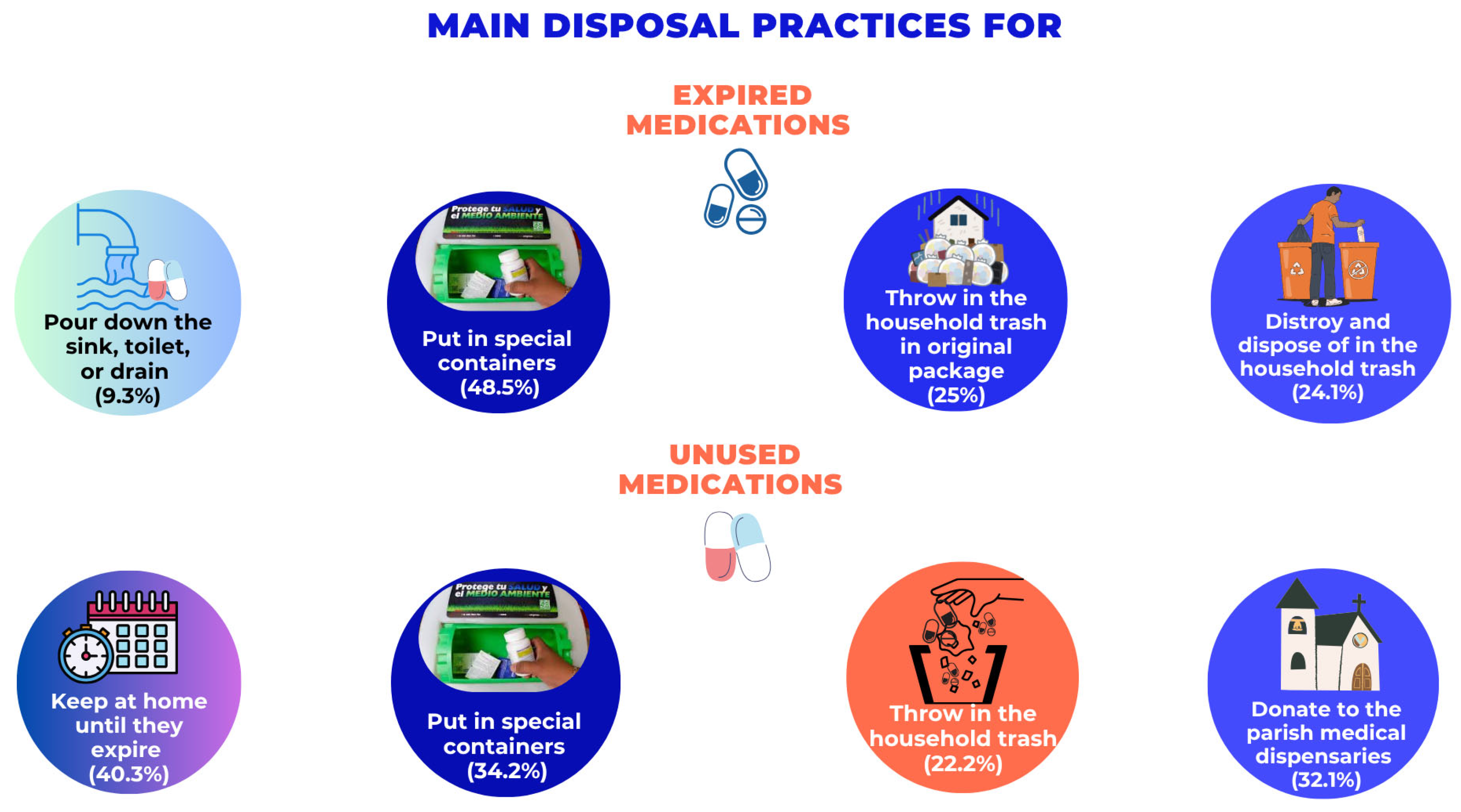
| How do you dispose of expired medicines? ** | *** I place them in special containers | 2949 (48.5) |
| I destroy them before throwing them in the household trash | 1466 (24.1) | |
| I burn them | 130 (2.1) | |
| I do not dispose of them, because I do not know how to do it. | 192 (3.2) | |
| I throw them in their original package into the household trash | 1522 (25.0) | |
| I pour them down the sink, toilet, or drain | 568 (9.3) | |
| What do you do with the medications you no longer use? ** | *** I place them in special containers | 2077 (34.2) |
| I donate them to the parish medical dispensaries | 1953 (32.1) | |
| I keep them at home until they expire | 2451 (40.3) | |
| I throw them in the household trash | 1352 (22.2) | |
| I sell them | 62 (1.0) | |
| I pour them down the sink, toilet or drain | 231 (3.8) | |
| What are the main reasons for the accumulation of unused medications in your home? ** | I consider it a shame to waste medication | 1246 (20.5) |
| I don’t know where the special containers are located | 2107 (34.7) | |
| *** The doctor told me to change my treatment | 1858 (30.6) | |
| They dispense too much medication to me | 1993 (32.8) | |
| *** I had an adverse reaction to the medication and stopped the treatment | 1002 (16.5) | |
| In case I need the same medication in the future | 2977 (49.0) | |
| I felt better and stopped taking the medication | 2131 (35.0) | |
| Where do you obtain information on the proper disposal of medicines? ** | *** At the doctor’s office | 1408 (23.2) |
| *** In pharmacies | 1452 (23.9) | |
| On the Internet (websites, social networks, mobile applications) | 3134 (51.5) | |
| In the media (radio, television, written press) | 519 (8.5) | |
| I do not have access to such information | 1458 (24.0) | |
| By family and friends | 1010 (16.6) |
| Predictor | Category | β | OR | 95% CI | p-Value |
|---|---|---|---|---|---|
| Age | Youth vs. elderly | 0.270 | 1.309 | 1.025–1.673 | 0.031 |
| Adulthood vs. elderly | 0.497 | 1.644 | 1.296–2.086 | <0.001 | |
| Sex | Male vs. female | −0.0083 | 0.920 | 0.831–1.019 | 0.112 |
| Socioeconomic status | Low vs. high | 0.009 | 1.009 | 0.677–1.504 | 0.965 |
| Medium vs. high | 0.140 | 1.15 | 1.042–1.270 | 0.005 | |
| Educational level | Basic vs. postgraduate | −0.549 | 0.577 | 0.436–0.764 | <0.001 |
| Intermediate vs. postgraduate | −0.398 | 0.672 | 0.564–0.799 | <0.001 | |
| High vs. postgraduate | 0.139 | 1.149 | 0.994–1.327 | 0.058 | |
| Health-realated studies | No vs. yes | −1.395 | 0.248 | 0.223–0.276 | <0.001 |
Disclaimer/Publisher’s Note: The statements, opinions and data contained in all publications are solely those of the individual author(s) and contributor(s) and not of MDPI and/or the editor(s). MDPI and/or the editor(s) disclaim responsibility for any injury to people or property resulting from any ideas, methods, instructions or products referred to in the content. |
© 2026 by the authors. Licensee MDPI, Basel, Switzerland. This article is an open access article distributed under the terms and conditions of the Creative Commons Attribution (CC BY) license.
Share and Cite
Escutia-Gutiérrez, R.; Ramos-Herrera, I.M.; Dreser-Mansilla, A.; de Almeida-Cunha, N.B. Knowledge, Attitudes, and Practices of the Mexican Population Regarding the Disposal of Medications: A Cross-Sectional Study. Epidemiologia 2026, 7, 44. https://doi.org/10.3390/epidemiologia7020044
Escutia-Gutiérrez R, Ramos-Herrera IM, Dreser-Mansilla A, de Almeida-Cunha NB. Knowledge, Attitudes, and Practices of the Mexican Population Regarding the Disposal of Medications: A Cross-Sectional Study. Epidemiologia. 2026; 7(2):44. https://doi.org/10.3390/epidemiologia7020044
Chicago/Turabian StyleEscutia-Gutiérrez, Raymundo, Igor Martin Ramos-Herrera, Anahí Dreser-Mansilla, and Nelson Bruno de Almeida-Cunha. 2026. "Knowledge, Attitudes, and Practices of the Mexican Population Regarding the Disposal of Medications: A Cross-Sectional Study" Epidemiologia 7, no. 2: 44. https://doi.org/10.3390/epidemiologia7020044
APA StyleEscutia-Gutiérrez, R., Ramos-Herrera, I. M., Dreser-Mansilla, A., & de Almeida-Cunha, N. B. (2026). Knowledge, Attitudes, and Practices of the Mexican Population Regarding the Disposal of Medications: A Cross-Sectional Study. Epidemiologia, 7(2), 44. https://doi.org/10.3390/epidemiologia7020044